• About
  • The Photo that Started it All

Uncovering Jewish Heritage

Uncovering Jewish Heritage

Author Archives: Marysia Galbraith

Cousins in the Warsaw Ghetto

22 Sunday Nov 2015

Posted by Marysia Galbraith in Bereda, Cemeteries, Jewish Culture, Jewish Ghetto, Kolski, Warsaw, World War II

≈ 2 Comments

Tags

Mirka Kolski, Okopowa Cemetery, Pinchas Kolski, Rachel Piwko Kolski, Warsaw Ghetto

My cousin Pini (Pinchas) Doron, reminded me that his grandfather and namesake died in the Warsaw Ghetto. This is the story he sent me this morning:

“The Okopowe Cemetery is the old big cemetery in Warsaw that we visited with the whole family in 1995, including Pnina’s (his wife) parents.

“Her mother used to run from the Ghetto through the cemetery to the fields to bring potatoes to her family when she was 13 years old.

“Amazing stories.

“I have seen in your post the stone sign for the people who died in the Ghetto. As I told you, my grandfather Pinchas Kolski died in the Warsaw Ghetto in 1940 and was buried in a temporary cemetery inside the ghetto. As we know, in 1940 they no longer allowed anyone to bury the dead  in the Okopowa Cemetery outside the Ghetto.

1941RachelMirkaKolskiAtPinchasGraveInGhetto

Mirka and Rachel Kolski at Pinchas Kolski’s grave in the Warsaw Ghetto. He died in 1940.

“We have this picture of Grandmother Rachel Kolski and her daughter Mirka (see the white sleeve with the [Star of David]-I think this was before they introduced the yellow star)?

“Mirka told me that after this visit to the grave, they managed to escape the Ghetto and to meet your step grandfather (that would have been Zygmunt Bereda) who hid them.”

Okopowa: Warsaw’s Jewish Cemetery, All Souls Day 2014

21 Saturday Nov 2015

Posted by Marysia Galbraith in Catholicism, Cemeteries, Family, Jewish Culture, Memory, Warsaw

≈ 5 Comments

Tags

All Saints Day, Mourning, Okopowa Cemetery, Powązki Cemetery

November is the month when I think about death the most. It starts with the Catholic holidays All Saints Day (November 1) and All Souls Day (November 2). It’s the month when the leaves fall from the trees and the long nights settle in. But it’s also the anniversary of my more personal encounters with death. My brother Ron’s accident was a few days before Thanksgiving in 1990. Nine years later, on the Friday after Thanksgiving, my dad had his accident while visiting me in my new home in Alabama. Both were injured in a fall. Both were in the hospital for two to three weeks before dying.

I think we all learned how to deal with this kind of loss from the first experience. The first time, no matter how dire the news was from New York, I held on to the certainty that Ron would pull through. I let my mother persuade me that it made no sense to come home right away, when he was still in such bad shape. I should finish the semester in graduate school in San Diego and come home as scheduled on December 11 when Ron would be well enough to appreciate my presence. I think she was trying to protect me from the shock of his injuries. And I believed her because she was my mom, and because it was easier, and because the prospect of him dying was inconceivable. But he didn’t last that long and I never got to see him alive again.

The second time, we knew not to assume anything. We held on to hope until the last moment, but we were more prepared for Dad’s passing. My brother Chris was already there, but my other brother Wiley flew in from California. We all sat vigil, visiting Dad every chance we could get and supporting each other in our grief.

So while I love Thanksgiving, this is also the time of year I think about my brother and my father. And I grieve for them all over again.

Especially after Ron died, I struggled with grief. There didn’t seem to be any way to talk about it or express it publicly. I think this is particularly difficult in California, a place that celebrates life and youth. The cemeteries are hidden from view or turned into parks. That’s why it resonated with me to spend All Saints Day in Poland. During this holiday, families visit their relatives in the cemetery (those who are living and those who are dead). They clean the graves and decorate them with chrysanthemums and candle lanterns. At night, the whole cemetery glows with candlelight, and throngs fill the cemetery pathways. Death isn’t hidden away, and the people you love remain a part of your life even after they die.

Whenever I’m in Warsaw, I make a point of visiting my step-grandfather’s grave in Warsaw’s Powązki Cemetery. I clean the stone, place flowers, and light candles. This is the closest thing to a relative I have in Poland, and one of the only remaining traces of my family’s lives there. Last year was the first time I was able to make it there on All Saints Day. I went with my son, who by now is familiar with the custom of visiting, cleaning, and decorating graves. He likes to watch the candles burn.

DSC01729

Ian watching the candles at his great grandfather’s grave, Powązki Cemetery in Warsaw, November 1, 2014

The first time I went to Powązki was in 1986, during my first visit to Poland. I spent a couple of days with Marta, a professor of American literature who had worked as my grandmother’s companion back in New York. She took me to my grandfather’s grave. She knew where it was because my grandmother had told her where to find it. She made a point of visiting every time she visited her own relatives in the cemetery, and she kept the grave tidy for Babcia.

I vaguely remember we stopped in at the Jewish cemetery also. But it’s also possible I’m confusing my memories of the large Jewish cemetery in Krakow, or the one in Prague, which was in a more confined space. It’s possible I visited Okopowa, the Jewish cemetery in Warsaw, on a later trip to Poland.

Last August, when I was at Powązki with my brothers, I noticed what looked like a synagogue on the other side of the wall, right there near my grandfather’s grave. Looking at a map, I realized that the Okopowa Jewish Cemetery abuts Powązki (a Catholic cemetery), as does the Evangelical Cemetery. Either I had forgotten this, or simply never knew how close they all were to each other.

On November 2, All Souls Day, I visited Okopowa with my friend Beata. She has lived in Warsaw for close to 20 years, but had never been there before. Beata said she had been wanting to visit the Jewish Cemetery for a long time. We parked in front of her friends’ glass high-rise apartment building right across the street from the entrance.

The regular admission fee was waived for the holiday. A good number of people strolled the alleys. A man in a yarmulke led a tour. Beata, Ian, and I made our way past a reconstruction of the original cemetery gate and a low wall made of the fragments of tombstones. The wall also includes commemorative plaques for Holocaust survivors who emigrated and were buried elsewhere.

The reconstructed gate and wall constructed of fragments of tombstones
"Father, You wanted to, so you symbolically returned to your country." Alia Skowronek died in the USA
“Father, You wanted to, so you symbolically returned to your country.” Alia Skowronek died in the USA

Okopowa remains an active burial ground, and people have continued to be buried there after World War II through to the present. The cemetery shows signs of ongoing attention and care, though broken and overgrown stones fill the vast expanses beyond the main walkways. There are many large tombstones and some family plots, suggesting affluent families. Even older tombstones include Polish as well as Hebrew inscriptions, and some have writing in Polish only. This signals to me a higher degree of assimilation in Warsaw relative to the smaller towns I have visited in central and eastern Poland (Lesko, Żychlin, Lutowiska, Skierniewice, to name a few) where most if not all inscriptions are in Hebrew. It’s different in western Poland, where tombstones were commonly in both Hebrew and German.

Off to one side, I found an area partially filled with older tombstones that have clearly been reset because they are all upright and evenly spaced in rows. These have the larger lettering characteristic of tombstones dating from an earlier period. They fill about 1/3 of the space; the remaining 2/3 are covered in weeds. Along the opposite wall more tombstones are stacked as if they are waiting to be set out in rows. I wonder what is being done here. Might these stones have been recovered from other locations?

Tombstones waiting to be set in rows? Where did they come from?
Older looking graves reset in rows

The cemetery also contains an area filled with symbolic graves for the victims of the Holocaust, and another large round depression marked by a ring of rough stones painted white with a thin black stripe through the middle. This is where victims of the Warsaw Ghetto are buried. Numerous candles were lit on and below the plaque explaining this, as well as on some sand fill that seems to have been recently placed in part of the depression. Some of the candles are in cans with Hebrew writing on the outside. I’m told these are from Israel.

Symbolic graves of Holocaust victims
Candles left on the site where victims of the Warsaw Ghetto are buried
"Here rest the victims of the Warsaw Ghetto 1941-1943" The plaque looks like a tombstone. The top is covered with stones and lighted candles cluster around its base
“Here rest the victims of the Warsaw Ghetto 1941-1943” The plaque looks like a tombstone. The top is covered with stones and lighted candles cluster around its base

Several headstones are adorned with white and red ribbons and Polish flags with “PW,” the symbol of the Polish Underground Army. These are soldiers who died during their service in the war, clearly both Jews and Polish patriots. Some resisted the pressures to identify as just one or the other. They were both, despite the antisemitism, despite Hitler.

Blima Mikanowska, AK soldier
Tombstone of Józef Walfisz. A distant ancestor?

I passed the grave of Józef Walfisz, who died 15 Aug 1874 at the age of 13. Walfisz was my great grandmother’s maiden name. Could this be a relative?

We had to leave because a man told us the cemetery closes at 4 PM. I understand why. Dusk was falling and the cemetery has no electric lights. A few candles glowed, but not enough to light the way as in the Catholic cemeteries on All Saint’s Day.

The Okopowa Cemetery evokes the rich life of Jews in Warsaw—it’s a physical reminder of their numbers and their affluence (and their level of assimilation). It also embodies how Jewish life in Poland was cut off, brutally and decidedly. But I also see here evidence of continued care and use, something that is not present in places where no Jews are left to visit their relatives and eventually be buried themselves.
My cousin’s quest

20 Friday Nov 2015

Posted by Marysia Galbraith in Family

≈ 1 Comment

Tags

Krysia Bereday Burnham

My cousin Krysia has been with me every step of the way as I’ve embarked on this journey to uncover Jewish heritage. We’ve been in dialog with each other the whole time, literally talking for hours, but also thinking and writing on parallel wavelengths. For her what started out as a story about her father (my mother’s brother) turned into a search for our Jewish roots, and then took another turn to her reflections about bearing witness to aging, love, spirituality, and loss in her blog The Quest (follow the link to check it out). And now, I can’t seem to stop writing about my own experiences of mourning. I’m sure it’s partly a response to her reflections.

I’m working right now on a post that was supposed to be about the Okopowa Jewish Cemetery in Warsaw. I get to that eventually, but first I had to write about why I think about death in November.

DSC00306

Krysia and me in Skierniewice, the birthplace of our great grandfather. April 2013

DSC03131

Krysia and me in Skierniewice, the birthplace of our great grandfather. April 2013

New York City Marathon

10 Tuesday Nov 2015

Posted by Marysia Galbraith in Family

≈ Leave a comment

Tags

New York City Marathon, Ron Galbraith

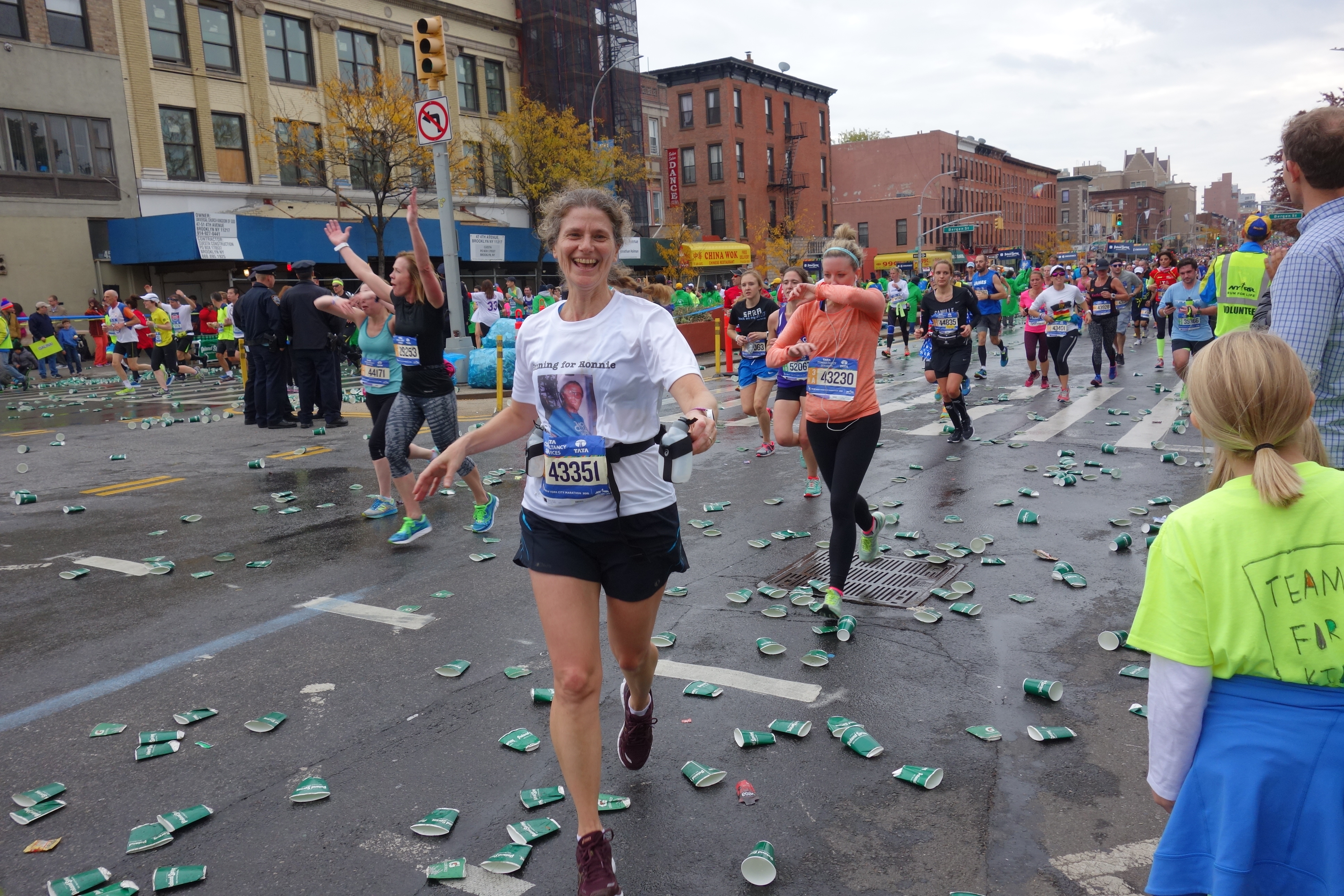
Well, I can’t say Ron was with me as I’d hoped. During some of the more challenging moments, I was able to conjure him up lumbering steadily beside me. But mostly, I felt his absence. Still, I’m grateful that yet again he inspired me to challenge myself. Just like when we were kids. He studied Spanish, so I did too. He wrote a novel, and so did I. I’m glad to remember the things we did together, even though it hurts to know he’s not with me anymore.

Mile Eight in Brooklyn, where Chris, Bessie, and Krystyna cheered me on.

Mile Eight in Brooklyn, where Chris, Bessie, and Krystyna cheered me on.

My remote cheering squad:

More of my cheering squad. Jeremy in Alabama

Jeremy in Alabama

And Mama on Long Island

And Mama on Long Island

Running for Ronnie

31 Saturday Oct 2015

Posted by Marysia Galbraith in Family, Memory

≈ 5 Comments

Tags

All Saints Day, New York City Marathon, Ron Galbraith

Ron was my big brother, my role model, and my friend. He was five years older than me—old enough to be the teacher in our imaginary school and the inventor of the neighborhood paper, but close enough in age to get down on the floor and play with me.

Ron during the summer of 1991, the last time I saw him.

Ron during the summer of 1991, the last time I saw him.

We sometimes called him a gentle giant. It wasn’t because of his weight—even though at one point he was well over 250 pounds—but because he was 6’ 4” with broad shoulders like a linebacker. And yet, he was the gentlest soul. After an explosive childhood, he stopped getting angry sometime around age twelve. He had an encyclopedic knowledge of history, music, and movies. He loved watching football on TV but never played any sports himself.

He started jogging before he left home. I can’t remember if he was in high school or already in college. I think he was in college. It was part of his plan for losing weight. At first, he was too shy to run outside so instead, he would jog in place inside the house. Eventually, he became an outdoor runner, and after moving to New York City, he started running in races. He decided that before his 30th birthday, he would run in the New York City Marathon. He didn’t quite make that deadline, but he did run it in 1989 when he was 31. He got in again the next year, but couldn’t participate because of a running injury. A month later, he died in a stupid, freak accident.

Ron's medal for completing the 1989 New York City Marathon.

Ron’s medal for completing the 1989 New York City Marathon.

1989RonMarathonMedal1

Losing Ronnie was and continues to be the most painful experience of my life. It’s when I confronted mortality personally, viscerally, emotionally for the first time. I lost a part of myself. I don’t think you ever get over that kind of grief. You just get used to it. You get used to the fact that the unimaginable has occurred and it can’t be undone.

Ron has remained an important person to me even after his death, and nowhere more so than when I run. I’ve often felt that he’s running there alongside me, a gentle supportive companion. I started doing races myself sometime in my 30s, but had no interest in ever doing a marathon. Until one day about five years ago I had a vision of running with Ron through the streets of New York City. And suddenly it made sense to try and sign up for my first marathon. But getting into the NYC Marathon isn’t easy. Either you have to be faster than I’ll ever be, or raise thousands of dollars for charity, or win an entry in the lottery. After four years of trying through the lottery, I got in in 2014 but had to postpone because of my trip to Poland. So here I am, finally about to run in the New York City Marathon.

I didn’t expect them, but walking from Penn Station to the Javitz Center to pick up my bib number today, there they were. Those raw emotions—love and grief intertwined with the excitement of the upcoming race. And there I was, bawling on 34th Street.

It’s fitting that the marathon is on November 1st this year, All Saints Day. It’s one of my favorite holidays in Poland, the day to remember the spirits of those who have left us. The day to visit the cemetery, clean the graves and decorate them with flowers and candle lanterns. I’m sure the cemeteries are already glowing with candlelight at night. I won’t clean graves or light candles this year. But I will run with my big brother as my companion, together with 50,000 other people, through the streets of New York City.

Two Letters

29 Thursday Oct 2015

Posted by Marysia Galbraith in Bereda, Family

≈ Leave a comment

Tags

Halina Bereday, Letters, Maria Bereda(y) Galbraith, mother-daughter relationships

I recently came across two letters Babcia wrote to Mama, one on August 31, 1945 and the other on February 4, 1958. The letters have some surprising parallels—Babcia’s instructions about proper modes of behavior and attire, and her lack of enthusiasm about my mother’s marriage plans. I’ve been trying to sort out what two letters indicate about the relationship between my mother and grandmother.

When the first letter was written, they were still living in Poland and Papa (Babcia’s second husband) was still alive. The letters are in Polish. Babcia expresses a great deal of affection for Mama; she addresses her “Ukochana Marychno”—Dearest Marysia (she uses a diminutive of Marysia, which is already a diminutive of Maria). She also calls her “coruś,” a diminutive form of “daughter,” and “słotkie dziecko”—“sweet child.”

I’m leaving out the details from the first part of the letter in which Babcia describes returning to Papa (probably after running away, as she was wont to do), Papa’s misbehavior and contrition, and Babcia’s joy at getting news from her sons who are living safely abroad. The second page is most relevant to this post. Babcia writes:

“Papa says that if you decided to marry, which wouldn’t necessarily thrill us, not because of Bimbus (a nickname I don’t recognize, but it probably refers to Mama’s first love Władek) who is a very decent fellow, and that means a lot, but because of your present state of health, so definitely let us know your plans and don’t worry that it will cost us. We want to pay for it. Besides, we never expected you to inform us, so we don’t want to be silly, but we think, without imposing on your views, that you are making too much trouble for each other, marrying, and that’s only worth doing when people love each other horribly. /you know, even then it’s often not worth it.

“I must be some kind of degenerate, because instead of encouraging my daughter to marry, I discourage her. Don’t be mad at me, my dear. I think that more than anything I’m your best friend.”

I can only wonder at the remarkable, long sentences. Though she says she doesn’t want to impose on Mama’s views, clearly she expresses her disapproval of Mama’s desire to marry. But why? Was it really concern for Mama’s health? Earlier in the letter, she refers to Mama’s operation. But even the issue of “health” is ambiguous—could it refer to a physical health issue or a mental health issue? Surgery to repair her war injuries or something else? Or might it rather be a reflection of Babcia’s own ambivalence about marriage generally, shaped by her own trials with Papa and perhaps also Mama’s choice of a partner?

I’m not sure how to read the tone of the letter, either. Is Babcia angry? I think maybe. She seems to be cloaking her efforts to exert an influence on Mama in expressions of affection.

In the letter, Babcia also instructs Mama about what kind of coat she should get. It should be straight and roomy in front and back. She even adds a lengthy handwritten note with further details about its style and price.

The second letter was written over twelve years later, when they lived in New York and Babcia was staying at The Breakers in Palm Beach, Forida. No doubt in response to the news that Mama eloped with my father, Babcia writes, “You leave me speechless, and you know well how agitated I am about your situation […] Please write me about your plans and where you intend to live. Will you live with Wiley or separately?”

Although Babcia addresses Mama as “ukochana Marychno” in this letter, as she did in the previous one, the tone seems harsher and more distant. And she definitely sounds angry. She insists Mama tell her immediately what she wants for a wedding present, and instructs Mama to send out wedding announcements right away (she provides a numbered list of people to contact). “Write to me right away what you plan to do next. Don’t you understand how much I want to be a part of this, at least post factum?” She asks if my Dad has forbidden Mama to communicate with her. “In that case I won’t be mad at you. God be with you.”

So much is left unsaid in this letter. It provides me with more context for understanding my grandmother and father’s dislike of each other, though it doesn’t clarify the root cause. Why does Babcia end the letter abruptly, “I have to run. Warm kisses?” Is this another expression of anger, or perhaps symptomatic of a distance that has grown between my mother and grandmother over a long period of time?

The letters also reflect Babcia’s concern with etiquette–the wedding announcements, the proper cut of a coat. She appreciates a bargain, but also values giving and receiving generous gifts. Paying for things for someone seems like a way of expressing affection.

These are more clues to my mother’s and grandmother’s lives. But they remain fragmentary. Only speculation holds them together.

Mothers and Daughters

24 Saturday Oct 2015

Posted by Marysia Galbraith in Family

≈ 4 Comments

Tags

Family photographs, Halina Piwko Bereda, Hinda Walfisz Piwko, mother-daughter relationships, women

My friend Justyna, a regular reader of the blog, remarked recently, “I don’t hear/see that much about men in your mom’s family.” And she’s right. Most of the relatives I knew growing up were female—Mama, Babcia, Auntie Nunia, Aunt Teresa. Most of the family stories featured them and a few other female relatives—Auntie Lusia, Mama’s cousins big Pauline and little Pauline. A simple explanation might be longevity; the men died young and the women lived much longer. Babcia lived to 99, Auntie Nunia to 97. But there’s more to it than that. I come from a long line of strong women. Each one made an impression on those around her, though each did so in her own way.

I get the sense that another thing that was passed down was close, but contentious relationships between mothers and daughters. Perhaps it’s inevitable when strong personalities collide.

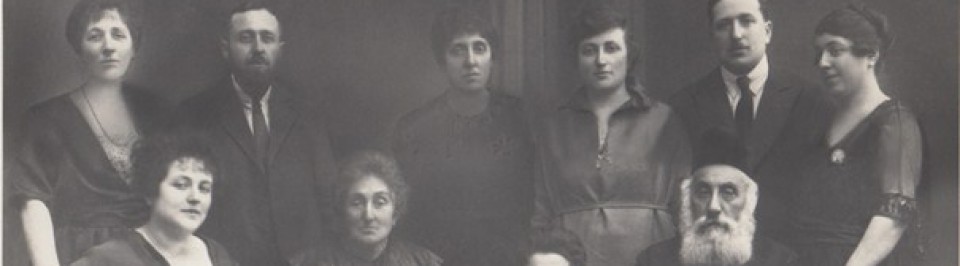
I don’t know a lot about my grandmother’s relationship with her mother. All my mom has told me about her grandmother is that she was physically small but she took charge in her large family. She had a dozen children over 24 years, starting with a daughter when she was just 19 and ending with twins at age 43. After the twins (one of whom died as an infant, the other as a teenager), my grandmother was the youngest. Looking at them together in the photo that launched my search for my Jewish heritage, I imagine they probably loved each other but drove each other crazy. More likely than not, my great grandmother was a very religious Jew. My grandmother was fun loving and bold, and eventually rejected her religion and her family for a life in Warsaw society.

My grandmother and great grandmother around 1919

My grandmother and great grandmother around 1919

I dissect the specific features captured in the photo, scouring them for hints about the people photographed. Babcia’s dress is silken, with what looks like a fabric train in back, a light colored inset at the bodice, and a rose-like adornment at her waistline. Even more striking is the dress’s length, reaching only to mid-calf and revealing a stockinged leg and high heels. Her mother, by contrast, wears a long dark dress made of matte fabric except for a silky dark addition at the wrists and shoulders. My grandmother looks coquettishly into the camera; though she does not smile, you can almost see her dimples. Her mother’s expression is serous. The thing that hints most directly at their relationship is the way my grandmother grips her mother’s hand. But what does this gesture say? Is it a sign of affection? Might it be an indication of special intimacy? Or perhaps is my grandmother expressing her possessiveness? Or her power over her mother? My great grandmother rests her hands on her knees straight in front her. My grandmother’s knees are turned toward her mother, her body at an angle to the camera.

I talked about this photo at a conference recently, and remarked how my grandmother is more brightly lit than anyone else in the photo. She’s positioned in the foreground as if she is preparing to leap out of the frame. When I described the way my grandmother clasps her mother’s wrist, and asked what it might communicate about their relationship, someone suggested it might not be a gesture of affection or power so much as reassurance. As if my grandmother knew she would leave her mother soon, and wanted to reassure her everything would be alright.

My Mama and Babcia were in many ways opposites, also. Mama was shy to the point of fearful of social situations; Babcia thrived as the center of attention. And yet, both could command any room they entered. Partly, this is a product of upbringing. They knew how to dress elegantly and carried themselves with an air of refinement that stood out in casual American settings. While Babcia entertained and commanded, Mama was more likely to draw people out and empathize with them.

Their relationship was complicated. On one hand, they depended on each other throughout their lives. Babcia helped Mama when she was injured and had to find a way out of Poland. Mama helped Babcia when she grew older, managing her finances and taking the train into the city from Long Island to visit every week. On the other hand, I get the impression Mama resented being “abandoned” by her mother at two critical junctures in her life. The first time was when she was left with an aunt as a very young child when Babcia ran away from her first husband and remarried. The second time was when Mama became a mother (eventually of four children) but Babcia decided to move to Puerto Rico. Further, Mama was deeply hurt and resentful when toward the end of her life, Babcia treated her poorly and failed to appreciate everything Mama did for her. Intellectually, she knew Babcia’s ill temper was a product of age and illness, but that didn’t ease the sting of feeling her efforts unrecognized. I think my mother was inordinately sensitive to her mother’s criticism, and perhaps annoyed with herself that it mattered so much. But maybe (probably) I’m projecting because that’s how I feel about my relationship with my mother.

The Galbraiths with Babcia outside Babcia's apartment on Riverside Drive sometime in the early 1980s, Mama in her beret.

The Galbraiths with Babcia outside Babcia’s apartment on Riverside Drive sometime in the early 1980s.

There are very few pictures of my mother together with my grandmother. Mama was reluctant to have her photo taken any time with anyone. This one, taken outside of Babcia’s apartment sometime around the early 1980s, is interesting for two reasons. First, it shows the distinctive style of both women. Second, there’s a hand on Babcia’s shoulder, probably my brother Chris’s [oops. Krysia’s right. It’s Wiley’s hand 10-29-15]. This gesture appears in many family photographs.

It’s hard for me to say if I am very similar to my mother or very different. It’s probably both, though neither made it easy for us to get along. I have no doubt that I became a professor, in part, to realize her dream for me—a dream she gave up for herself in order to have a “normal life” as a wife and mother. Perhaps it’s typical of my generation that I was raised believing I can have it all (and I more or less do, but there’s a price to pay for that, too). It’s hard to find the words to describe our relationship. What comes out is either a string of platitudes or far too much detail. Suffice it to say we were very close. So close, I was angry with her most of the time between the ages of 13 and 33, probably as a way of separating and asserting my autonomy. Mama was simultaneously weak and strong, shy and bold, afraid of meeting people and quick to establish intimacy with them. It drove me crazy that all my friends loved her and confided in her when I felt like I couldn’t talk to her myself. I’m just grateful that I finally stopped being mad. And now that I can’t talk with her anymore, I miss her. She was the person I was most likely to turn to in a crisis, like the time I was in labor, Ian was breech, and I and couldn’t think clearly enough to decide whether to continue with a natural childbirth or have a Cesarean section. She knew what to say to reassure me, to help me make the right decision.

Mama's 90th birthday, celebrated in white.

Mama’s 90th birthday, celebrated in white.

This photo is from Mama’s 90th birthday party in June 2012. Mama had often talked about wanting to have a white party in her garden. So my brothers and I made it happen. Dozens of relatives, friends, and even former neighbors came to celebrate, and everyone really did dress in white. In this photo, I notice again our hands. My brothers and I form a protective ring around Mama, our hands on her arm or shoulder, and Chris with his other hand on Wiley’s shoulder. We do so casually, an unorchestrated mark of intimacy and affection. And an appropriate complement to the photo of my grandmother with her hand placed upon her mother’s wrist.

Hints and Memories

13 Tuesday Oct 2015

Posted by Marysia Galbraith in Family, Memory

≈ Leave a comment

Tags

Maria Bereda(y) Galbraith

Going through boxes of hastily collected papers from Mom’s house I find so many unwritten cards. Sympathy cards: “Thinking of You. I know you’ll make it through this.” A Thomas the Tank Engine birthday card: “Peep-peep grandson!” I like to think that one was meant for Ian… There are also postcards: Salvadore Dali’s “Portrait of Gala;” two views of the Biltmore House; a café scene in New Orleans; the Isabella Stewart Gardner Museum in Boston. I find random addresses of people I don’t know, torn off envelopes, Three envelopes with “Maria” written on them in my dad’s hand—but they’re empty; his cards are missing. How do I dispose of this stuff? But why would I keep it?

I hold on to the memories they evoke. The bits of my mom’s story they signal. Mama liked to send cards. She always took the trouble to include a personal note.

I seem to recall she and my dad went to the Biltmore Estate on their way to Texas once. This might have been in December 1991 since I also found an unfinished Christmas card to my friends Kara and Bob and their daughters Paula and Maria (yes, she was named after my mother) with the heading “Austin, Texas December 16, 1991.” Mom wrote:

We arrived by car yesterday at 5 PM. It was an exhausting trip but we are happy to visit with our son Chris. We stopped in Virginia and drove through the Skyline Drive with the Blue Ridge Mountains all around us. A heavy rain stopped and there was no one on the road.

It stops there. Why didn’t she finish the letter? Why didn’t she send it? Maybe she lost track of it? Or couldn’t find the address?

“Return to sender, Addressee deceased” is stamped on the envelope of a letter to Dr. Gustave Aufricht, M.D.,. This was probably Mama’s plastic surgeon. Inside is a Christmas card “May the spirit of Christmas abide with you throughout the new year” and in her hand the note “Sincerest wishes from your devoted patient.” On the website of the American Society of Plastic Surgeons, Dr. Aufricht is described as a founder of the society:

Two Founding Fathers

Like most great American institutions, the American Society of Plastic Surgeons (ASPS) — known until 1999 as the American Society of Plastic and Reconstructive Surgeons (ASPRS) — developed mainly through the sweat and toil of immigrants. In this case, it was two surgeons from Europe who came to the United States after World War I, Jacques Maliniac and Gustave Aufricht.

The two doctors were as unalike as any two men could be, except for their dedication to their craft. Despite his French-sounding name, Dr. Maliniac was born in 1889 in Warsaw, Poland. After studying with the leading plastic surgeons on the continent before the war, he was called into the Russian Army at the outbreak of hostilities. A small, intense man, Dr. Maliniac, who was Jewish, came to the United States in 1923 and decided to stay as anti-Semitism was on the rise in Europe in the 1920s. Settling in New York City in 1925, he opened a thriving private practice, and convinced the administrators of the City Hospital system to establish the first division of plastic surgery at a public hospital.

Dr. Aufricht, born in 1894, was a native of Budapest, Hungary. Like Dr. Maliniac, he treated wounded soldiers during the war, studied with the leading practitioners in Europe and arrived in New York in 1923. And like Dr. Maliniac, he was Jewish and decided to stay here when things became inhospitable in the Old World. However, the similarities ended there.

Where Dr. Maliniac was considered bombastic and dictatorial with his students and residents, Dr. Aufricht, who went by the nickname “Gusti,” was genial and outgoing, but no less a commanding figure, loved and revered by his charges.

Interesting that Mama sent her Jewish doctor a Christmas card. Did she know his religion? The card was postmarked December 1981. If she was his patient around 1950, she probably sent cards to him for 30 years.

Another card was written by my friend Kimmy, thanking Mama after a visit in 1981. Kim also asks for my address at school so it must have been sent in the fall, soon after I started college. Jumping forward again, I find a postcard from me, written from Poland. This one was also written around Christmastime so it must have been 1991:

A postcard I found in Poland and sent home, probably in 1991.

A postcard I sent from Poland, probably in 1991.

Dear Chris, Mom, & Pop, The Happiest of holidays to you all. I hope you find some snow somewhere. Sorry I can’t be with you but know I’m thinking about you. Can you believe I found this card in Poland? Love, Marysia

In the living room on Long Island, probably Christmastime 1991

In the living room on Long Island, probably Christmastime 1991

And then this photo of Mama and Babcia on the couch in the living room at home. The tree and ornament in the left foreground signal it was around Christmas, also. Mama is in silhouette, eyes downcast. She appears to be spooning something out of a mug to give to Babcia, who is leaning toward her with closed eyes. Or maybe the camera just caught her blinking? She is bundled up in a down jacket and a blanket, like a child. When was this? Near the very end of Babcia’s life. Could it also be 1991? Maybe Mom and Dad returned from Texas before the holiday? It’s so rare that I have seen photos of my Mama and Babcia together. There seems to be so much tenderness in my mother’s attention, as if in this moment of caring all the tension between them dissolved.

My Post on Hair Struck a Nerve

12 Monday Oct 2015

Posted by Marysia Galbraith in Identity

≈ 4 Comments

A number of readers commented on last month’s post about hair. It’s interesting to me that most reached out to me in private. Here are some of the comments I received:

So I just read your blog post quickly. I know you don’t like stereotypes (who does?), but I can’t resist telling you that I thought you were Jewish the first time I met you. And it did have something to do with your hair, but also with your way of being. I love Jewish-looking hair myself and wish I had it! Sorry if I’m being lazy in this short cut.
Loved the post!

My response: Thanks. I wonder, too if there can be some sort of recognition of ethnicity/culture–a reading of multiple clues such as hair, gestures, etc. Whatever it is, I don’t believe it can be a simple reading of physiology. Regardless, I wear my hair proudly!

Another reader: I had to respond to what you said. Growing up Jewish, I knew/was told that Jewish hair was different. I could never (nor could any of my family or friends) wear the straight bob. I always wanted Veronica Lake’s hair. Straight, just hung there, no body. (You may not know who Veronica Lake was, but if you go on the internet you would probably get a picture of her.) I had thick hair – not curly. It is only recently with all the straighten products that one can have that straight look. I, and all my friends, had our hair thinned. We certainly wanted to look like the movie stars. Straight hair, small noses. I never thought it was a way to stereotype someone. It just was the way it was. Didn’t all young girls want to look like the movie stars? I was grateful when Barbra Streisand became famous. Although she never had the “Hollywood” image she was glamorous, which kind of made the big nose, thick hair seem more acceptable.

The question I occasionally ask myself – Why growing up didn’t we question any of this and just accepted it?

Interesting that we both used Veronica Lake as our archetype for hair. She was thinking of this:

VLake1

When I referred to Veronica Lake, I was thinking of soft, luxurious curls like this:

VLake2

More than likely, any wave in Veronica Lake’s hair was added with curlers.

And an exchange with a third reader who is not Jewish, but has full, curly hair: A wonderful essay that resonates with many things I’ve heard about my hair my whole life. You know, in Poland I had always been told I had beautiful hair. Then I came to the US at 18 and was surprised to hear that my hair was “frizzy” and apparently in need of stuff(s) that would get rid of that undesirable quality. I was thinking to myself then: “What? My hair is unusual [in Poland] and great, it’s crazy to say that anything about it should be “fixed.” But in the US, it sounded like in that particular situation (I’m talking about one person) my hair was seen as almost African-American or something. Then I realized “frizzy” was a concept here; it had never been in Poland, at least not in the Poland of my youth and childhood (where there were almost no “products” whatsoever to begin with).

My response: That’s really interesting. I think you know I’ve always loved your untamed hair. You are from the generation that was tired of the relative homogeneity of Polish culture, and would find your amazing ringlets exotic and beautiful. And it’s really interesting to learn that “frizzy” is an American concept. It’s definitely something I grew up trying to control.

Her response: I mean we have had ways to talk about thick wavy hair that’s out of control, and these days there are definitely “products” for “frizzy” hair sold in Poland (I wondered last summer at a Rossmann how many people actually buy them in Poland…). But in Polish I think these expressions are somehow more colorful/funny and they seem to refer to the state of unruly curly hair–at a particular moment–, not as a permanent feature that always should be controlled (not that I want to overanalyze it). So in my high school times you used to say “szopa” (“a barn”: meaning your hair looks like a bunch of straw stored together in a barn) or “jakby piorun strzelil w rabarbar” which translates into “as if a thunderbolt went through a piece of rhubarb”). But these expressions were somehow less definitive and diagnostic than “frizzy.”

Another reader recommended the book Coiffure to me, which is about the social significance of women’s hair in 19th century France. The review notes: “Hair, it turns out, is quite a bit more complex than it would seem, linked as it was to concepts such as ideal beauty, respectability, fashion, sexuality and even nostalgia.”

So yes. Hair seems to be wrapped up in our sense of identity, of being “like” some people and not like others. But these things aren’t fixed, either. Sometimes we feel compelled to do things with it so that we better fit Hollywood images, or what others tell us we should be like, or how we imagine ourselves (ideally) to be. And sometimes it’s good to just appreciate what we have.

Hair

13 Sunday Sep 2015

Posted by Marysia Galbraith in Family, Identity

≈ Leave a comment

Tags

categories, Halina Piwko Bereda, Maria Bereda(y) Galbraith, stereotypes

1st generation I have photos of: my great-granmother Hinda (Walfisz) Piwko with an impressive mass of hair.

1st generation I have photos of: my great-granmother Hinda (Walfisz) Piwko with an impressive mass of hair.

The women in my family have thick, wavy hair. My great-grandmother Hinda and her daughters all had it (see the photo at the head of this blog). In fact, in Aunt Pat’s notes (probably dictated from a conversation with Auntie Nunia), Sarah was identified by her “beautiful hair,” and Rachel by her “thick, thick hair.” When I was a child, Babcia and Auntie Nunia wore their long silver locks in buns piled high on their heads; I now know from photos that their sisters Liba, Sarah, and Rachel did the same.

I remember watching as Babcia let down her hair at night, and brushed it until it formed an undulating frame around her that extended past her waist. Then she plaited it into two braids. During the day, she wound the braids around her head and held them in place with pins and a hair net.

2nd generation: Babcia wound two braids high on her head and held them in place with pins and a hair net.

2nd generation: Babcia wound two braids high on her head and held them in place with pins and a hair net.

I can’t remember exactly when this was. Could it have been in Puerto Rico when I was five? That seems too early, but I think I was still a child. She kept her hair long until it got too difficult for her to lift her arms and pin it back. Cut short, her hair made a curly silver halo around her face.

My mama inherited this wavy hair, only she wore it differently. She favored a blunt cut to the shoulders, with long straight bangs across her forehead. The bangs were styled to cover the the uneven discolored surface that grew back after the skin of her forehead was removed to use in the reconstruction of her nose. While she couldn’t hide the imperfect nose left by numerous failed surgeries, she could use her hair to hide the scars on her forehead. But it was a struggle. Left to itself, her hair curled in different directions. What she longed for was an even, thick curtain that would lie flat across the terrain she sought to conceal.

3rd generation: Mama with her unruly bangs around 1965 feeding my brother Chris

3rd generation: Mama with her unruly bangs around 1965 feeding my brother Chris

Over the years, she developed a technique where she would tie a scarf around her wet head so the bangs would dry in place. She joked it made her look like an Indian. The struggle didn’t end there. To protect against the wind exposing her scars, she held her bangs in place with hats—when I was younger she favored berets, an exotic but elegant choice that stood out in suburban Long Island.

Even as she battled her wayward locks, I admired Mama’s soft waves. I liked to stroke her head, and wished my light stringy hair were more like hers. Luckily, when I grew older, my hair became darker, and along with it, thicker and more curly. On a good day, I might have waves like Veronica Lake, or even sometimes ringlets.

4th generation: my curls

4th generation: my curls

I’ve almost always worn my own hair long. Only once, right after my brother Ron died, I cut it short. So short I looked like a boy. Perhaps it was an act of mourning. Definitely, I was motivated by the desire for a radical change. I was just a few months away from beginning my dissertation fieldwork in Poland. Short hair was liberating. It dried almost instantly, and didn’t even need combing. When it grew just a bit longer, it curled around my face much as my grandmother’s had. But still, I didn’t like it and have never cut it short again.

When I first started looking into my Jewish heritage, I told a good friend about what I was learning. Before then, he hadn’t known; it wasn’t something I had talked about with anyone, really. At some point in the conversation, he remarked that I have Jewish hair. Surprised, I asked what he means. He described my hair as wavy (though he might even have said frizzy) and coarse. This unsettled me. I have often returned to this moment, and tried to understand why. Perhaps it’s as simple as hearing something I love about myself described negatively (who wants to have coarse hair?) But it’s more than that. I like my freckles, too, and when people have encouraged me to try to hide them I’ve only been amused. So maybe my uneasiness has something to do with being stereotyped, or maybe even with stereotypes in general.

Nevertheless, this idea of Jewish hair has continued to bother me. I spent a lot of time on the trams in Poland inspecting everyone’s hair. Sure enough, it seems that most Poles have straight, thin hair. So could there be something to this idea that my curls mark me as Jewish? I hate this kind of categorical thinking, though. This is probably the key thing; it may well be that most Poles have straight hair, but many have curly hair, too. Furthermore, maybe my waves come from my Dad’s side of the family. Scots can have wavy hair, as well. In fact, lots of people from many different backgrounds have hair like mine. Genetic inheritance is not as simple as “Jewish hair” suggests.

I hesitate to even write about this because it has the potential to just perpetuate the kind of categorical thinking I want to argue against. I mentioned my hair in a talk I gave at a conference in Poland, and I feel it backfired. Afterwards a couple of people talked to me about “Jewish hair,” trying it out as a new physical trait to assign to a category of people. It left me feeling uneasy.

I’m still trying to sort this all out. I love my hair, and I love that I share it with a long line of women, from my mother to her mother to her mother. I feel richer knowing that I have Jewish roots. But I have a problem with stereotypes, and the lazy way designations like “Jewish hair” can be used to make traits that may well be common in a population into essentialized markers.

So standing in solidarity with all the straight-haired Jews, curly-haired Poles, and everyone else who does and doesn’t fit ethnic stereotypes, I wish you a Happy New Year. May the coming year bring health, happiness, and better understanding regardless of our similarities and differences.

← Older posts
Newer posts →

Categories

  • Anthropology (38)
    • Archives (14)
    • Fieldwork (7)
    • Ground Penetrating Radar (GPR (5)
    • Research Methodology (8)
  • antisemitism (14)
  • Association of Descendants of Jewish Central Poland (34)
  • Catholicism (8)
  • Conference (1)
  • Discrimination (2)
  • Family (70)
    • Bereda (18)
    • Kolski (13)
    • Piwko (22)
    • Rotblit (3)
    • Walfisz (4)
    • Winawer (7)
  • Genealogy (11)
  • Heritage work (68)
    • Commemoration (23)
  • Identity (18)
  • Israel (6)
  • Jewish Culture (91)
    • Cemeteries (53)
    • Museum (8)
    • Synagogues (34)
    • Torah (1)
  • Jewish immigrants (8)
  • Jewish Religion (1)
  • Memory (73)
  • Names (14)
  • Photographs (6)
  • Pifko-Winawer Circle (5)
  • Poland (128)
    • Baligród (1)
    • Bolimów (1)
    • Brześć Kujawski (5)
    • Buk (1)
    • Chodecz (1)
    • Dukla (2)
    • Dąbrowice (1)
    • Gdynia (1)
    • Gostynin (2)
    • Gąbin (1)
    • Izbica Kujawska (1)
    • Kazimierz (4)
    • Kowal (1)
    • Koło (1)
    • Krakow (7)
    • Krośniewice (1)
    • Kutno (7)
    • Kłodawa (1)
    • Lesko (8)
    • Leszno (1)
    • Lubień Kujawski (1)
    • Lubraniec (1)
    • Lutowiska (3)
    • Piła (3)
    • Podgórze (2)
    • Poznan (11)
    • Przemyśl (2)
    • Pzedecz (1)
    • Radom (1)
    • Radymno (1)
    • Sanok (1)
    • Skierniewice (5)
    • Sobota (2)
    • Tarnów (2)
    • Warsaw (23)
    • Wielkopolska (1)
    • Wronki (7)
    • Włocławek (20)
    • Zasław (2)
    • Łódź (1)
    • Żychlin (32)
  • Polish Culture (10)
  • Polish-Jewish Heritage (60)
  • Polish-Jewish relations (61)
  • Post-World War II (24)
  • Pre-World War II (22)
  • Reclaimed Property (1)
  • stereotypes (3)
  • Survival (9)
  • Trauma (3)
  • Uncategorized (5)
  • Victims and perpetrators (4)
  • World War II (46)
    • Jewish Ghetto (12)
    • Nazi Camps (5)
    • Polish Underground Army (3)
  • Yiddish (5)

Enter your email address to follow this blog and receive notifications of new posts by email. Your email address will not be shared.

Archives

  • June 2026 (2)
  • May 2026 (1)
  • October 2025 (1)
  • July 2025 (8)
  • June 2025 (1)
  • April 2025 (1)
  • August 2024 (3)
  • July 2024 (3)
  • May 2024 (2)
  • April 2024 (1)
  • May 2023 (2)
  • January 2023 (2)
  • December 2022 (7)
  • November 2022 (2)
  • October 2022 (5)
  • September 2022 (1)
  • January 2022 (1)
  • August 2021 (1)
  • December 2020 (2)
  • July 2020 (1)
  • May 2020 (3)
  • April 2020 (1)
  • March 2020 (1)
  • January 2020 (2)
  • May 2019 (1)
  • February 2019 (1)
  • November 2018 (1)
  • September 2018 (1)
  • August 2018 (3)
  • July 2018 (1)
  • June 2018 (1)
  • May 2018 (1)
  • April 2018 (2)
  • March 2018 (2)
  • February 2018 (2)
  • January 2018 (2)
  • December 2017 (2)
  • November 2017 (2)
  • October 2017 (1)
  • September 2017 (3)
  • August 2017 (3)
  • June 2017 (2)
  • May 2017 (3)
  • April 2017 (1)
  • March 2017 (2)
  • February 2017 (1)
  • January 2017 (2)
  • December 2016 (2)
  • November 2016 (4)
  • October 2016 (1)
  • September 2016 (6)
  • August 2016 (2)
  • July 2016 (1)
  • May 2016 (4)
  • April 2016 (2)
  • March 2016 (3)
  • February 2016 (4)
  • January 2016 (3)
  • December 2015 (3)
  • November 2015 (5)
  • October 2015 (5)
  • September 2015 (3)
  • August 2015 (4)
  • July 2015 (3)
  • June 2015 (3)
  • May 2015 (4)
  • April 2015 (9)
  • March 2015 (3)
  • February 2015 (2)
  • January 2015 (5)
  • December 2014 (4)
  • November 2014 (9)
  • October 2014 (2)
  • September 2014 (1)

Copyright Notice

All original text and images are copyright © Marysia Galbraith. Please contact the author before quoting.

Blog at WordPress.com.

  • Subscribe Subscribed
    • Uncovering Jewish Heritage
    • Join 147 other subscribers
    • Already have a WordPress.com account? Log in now.
    • Uncovering Jewish Heritage
    • Subscribe Subscribed
    • Sign up
    • Log in
    • Report this content
    • View site in Reader
    • Manage subscriptions
    • Collapse this bar

Loading Comments...