• About
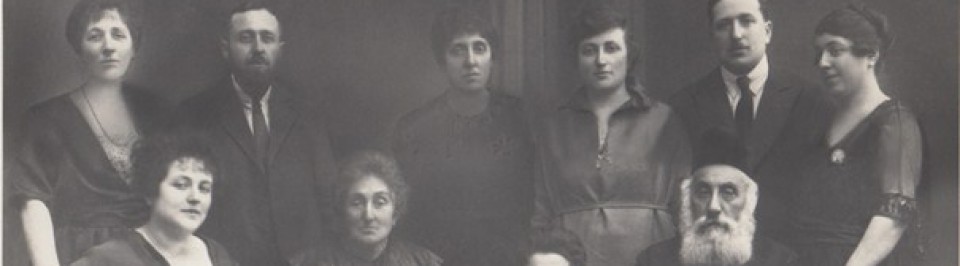
  • The Photo that Started it All

Uncovering Jewish Heritage

Uncovering Jewish Heritage

Author Archives: Marysia Galbraith

The Phantom Limb

24 Wednesday Feb 2016

Posted by Marysia Galbraith in antisemitism, Catholicism, Cemeteries, Jewish Culture, Lesko, Memory, Poland, Polish Culture, Polish-Jewish Heritage, Polish-Jewish relations, stereotypes

≈ 2 Comments

Tags

Fieldwork 1991-3

It was a beautiful sunny day in Alabama. As I walked across the quad enjoying the promise of spring, I bumped into a colleague, Joanna Biermann, who is going to Warsaw next month to participate in a conference associated with the annual Beethoven Festival. She has been an invited guest several times already, and has made some good friends in Warsaw as a result. We took a half hour to catch up, sipping tea on a bench under the large oaks behind the library. In response to my current research, she quoted a friend of hers who describes Polish Jews as the nation’s phantom limb; the pain remains even after the Jews are gone.

The beauty of ethnographic fieldwork is you record everything, even what seems at the times peripheral to your area of focus. That means I have over twenty years of fieldnotes I continue to mine for information about other aspects of Polish culture. Recently, I returned to the notes from my earliest fieldwork in 1991-1993 looking for references to Jews and Jewish culture. I coded them using ethnographic software, and now I’m trying to pull out patterns in the way Poles talked about and acted toward Jewish subjects. The first thing that strikes me is how often Jews were mentioned in interviews and informal conversations, despite the fact that most of the people I spoke with had limited or no contact with actual Jews. Most of the participants in my study were still in high school in the early 1990s. That means that by the time they were born in the 1970s, most of the Polish Jews who had survived the Holocaust had left, pushed out by organized political campaigns and by everyday prejudice.

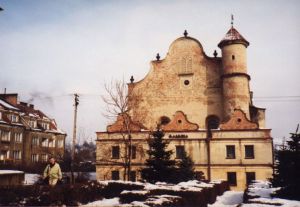
LeskoSynagog

Lesko Synagogue in 1992

The comments I recorded are mostly superficial, and usually fall back on stock phrases, sentiments, and stereotypes. Since I mostly did group interviews in the early 1990s, I was able to witness young peoples’ debates about the role of Jews in Polish life. Their views were so varied that no unified perspective emerged. One person would claim that Jews are still prevalent in government, or in journalism, and others would disagree. One criticized Poles for intolerance, while others interjected that tolerance was a fundamental value that has made Poland a hospitable environment for minorities (including Jews) for most of the nation’s history. Some addressed a lingering distaste, or even hatred of Jews; others countered that these are dying artifacts of an older generation that young people do not share.

Most commonly, Jews were linked to property and wealth. I was told that Jews used to say, “You own the streets but we own the buildings.” Even today, this phrase is repeated. Usually, it’s a way of highlighting the discrepancy between the political domination of Poles and the economic power of Jews. Some imply that because Jews expressed disdain for the impoverished Poles, it justifies Poles’ resentment and dislike of Jews. But also, because I’ve heard this phrase so many times in so many ways, I know it’s often repeated without much thought at all, as one of the few things anyone ever told them about Jews.

Some participants in my study expressed continued concern about Jews reclaiming property or Jewish capital flooding into Poland and buying up the country, yet again leaving Poles with nothing. Others defended everyone’s right to invest in Poland, emphasizing the importance of being open to other groups, or countered that Poles are envious of anyone who gets ahead. One person suggested that Jews should be admired for their ability to create and organize; Poles should learn from them, not assume that they are schemers.

On the ten-day walking pilgrimage to Częstochowa (I really did this—all 300 km—to the monastery housing Poland’s most important icon, the Black Madonna), a priest entertained the pilgrims on the journey with stories that used humor as a vehicle for discussing the differences between Catholics and Jews. Although he tried to show that the two faiths have shared origins and fundamental similarities, he sometimes crossed the line toward mockery. For instance, when explaining why Catholics don’t abide by Sabbath restrictions, he told a story about an Orthodox Jew who hadn’t locked his business before sunset on the Sabbath, so he used his cat to turn the key.

On another occasion, I spoke with a priest who felt the Polish people and the Catholic Church are under attack by accusations of intolerance and antisemitism. He talked about slander in the press, and referred to an article that linked antisemitism in Germany to the irrational antisemitism that persists in Poland despite the virtual absence of Jews. He complained that this view is biased and has no place in an article about Germany. He further complained that when Poles tell the truth, for instance that most communists in Poland during and after WWII were Jews, Jews accuse them of antisemitism. These are the same Jews, he went on, who told Poles, “You own the streets but we own the buildings.” The priest also argued that press reports are overwhelmingly negative and misrepresent the Church, giving it a bad name. But then he went on to label as Jews two prominent journalists—Adam Michnik, the editor of the newspaper Gazeta Wyborcza and Jerzy Urban, editor of the satirical news weekly Nie. On another occasion, he got into a heated defense of Poles, saying he doesn’t understand why they have a reputation in the West for antisemitism.

Both of the priests reinforced the distance between Poles and Jews, though in different ways and with different degrees of vitriol. They offered little possibility for Jews to be regarded as Poles.

The person who expressed the most nuanced view of Poles’ relations with other ethnic and religious groups was the director of one of the high schools in Lesko, a small town in the southeastern mountain region of Bieszczady. Even before I started the taped interview with him, he told me that the biggest ethnic problem in Poland was going to be with Lithuanians and Jews who want their former properties back. For example, the dormitory of the high school is claimed by prewar owners who were Jews. At the time, it wasn’t yet clear if the building would be returned, and if the money spent on its renovation would be reimbursed. During the interview, he had this to say:

“There are minorities [in Poland], everyone knows that. It’s an interesting situation. The typical American may not understand because in the US there are many nationalities that cultivate their own traditions, but nevertheless remain primarily American. But because of the unjust politics toward minorities during the Interwar period, hatred was awakened between Poles and Jews and Poles and Ukrainians. This was easy to do because Poles were in their own country but poor, while Jews owned the buildings and businesses. Jews are condemned for being rich, while Ukrainians are pushing for higher positions. But there are no attacks. Everyone lived together, went to school together, met and got to know each other’s culture. They were all free to study their religion. Also, in Lesko, there was a Greek Catholic church, a Catholic church, and a Jewish place of worship, and nothing happened. Everyone could believe what they wanted, and no one was persecuted for what they think. Jews were destroyed by Germans[…] After the war, state politics was also in error. It acted as if minorities didn’t exist at all.”

Although he reiterated stereotypes, he also sought to balance positive and negative views of Jews and their history in Poland.

Others hinted at an ethos of tolerance. They talked about historically mixed communities that functioned peacefully, and about the need for acceptance of all people. One student in Krakow said, “If we are really are democratic now, there has to be a place for Jews [in Poland]. We can’t say ‘Polska dla Polakow’ [‘Poland for Poles’].” Others, like the student who showed me the Jewish cemetery in Lesko shortly after I moved there in 1992, expressed sadness that Jews are no longer present. He said it’s too bad the cemetery is neglected, but Poles have no money and there are no more Jews to insure its upkeep. He said he likes to come to the cemetery; it’s a peaceful place.

Much of the talk I recorded in the early 1990s seems predicated on the assumption that there were more Jews present than actually were at the time, and they were hiding in plain sight. Some felt threatened by the potential wealth and power of these covert Jews. But others asserted that there are no more Jews in Poland. If any remained, they assimilated— it was Jews who felt threatened by Poles after the war and during communism, so they stopped admitting their ethnicity, changed their last names, and forgot their culture and traditions. These are two sides of the same coin because in fact, public Jewish life and religion disappeared from nearly every Polish village, town, and city. But the past 25 years have shown that a notable proportion of contemporary Poles have some Jewish heritage and an increasing number of them (though still a tiny fraction of the contemporary Polish population, and a tiny fraction of the prewar Polish-Jewish population) is becoming more curious about their origins. Already in 1992-3, the sense was growing among the teenagers I spoke with that it isn’t necessary to hide one’s ethnic/religious roots anymore. After the fall of communism in 1989, something significant had shifted and institutional barriers against ethnic and religious minorities had weakened.

Still, so much about Jewish lives and deaths were left out of the comments I collected, as if the pain of their amputation from Polish communities was too much to bear.

Where’s Ralph?

13 Saturday Feb 2016

Posted by Marysia Galbraith in Jewish Culture, Kazimierz, Krakow, Memory, Polish-Jewish Heritage, World War II

≈ Leave a comment

Tags

Amon Goeth, Ralph Fiennes, Schindler's List

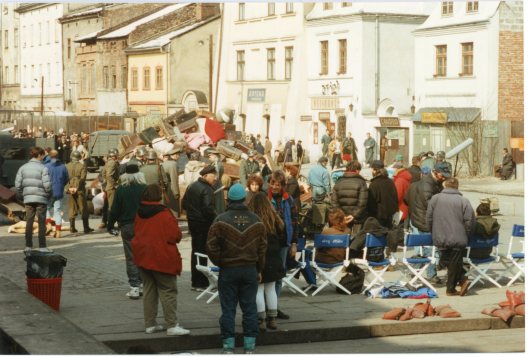
I should have remarked yesterday how strange it was to see Nazi uniforms and people wearing yellow stars in the middle of Kazimierz. Even though the atmosphere was relaxed–people were play acting, or really just standing around and waiting. Those piles of suitcases stood out as a stark reminder of the destruction the scene was designed to recall. Also, the energy shifted when Ralph Fiennes/Amon Goeth strode purposefully to the top of the pile. He exuded an authority that even at a distance was unsettling. And in case you’ve been wondering where Ralph Fiennes is in this photo:

1993SchindlersList3

Filming Schindler’s List, 1993. Ralph Fiennes is in the background, playing Amon Goeth

Here he is:

RFiennes

Ralph Fiennes preparing to climb to the top of the pile of suitcases while playing Amon Goeth

Kazimierz

13 Saturday Feb 2016

Posted by Marysia Galbraith in Cemeteries, Identity, Jewish Culture, Kazimierz, Krakow, Memory, Polish-Jewish Heritage, Polish-Jewish relations, Synagogues

≈ Leave a comment

Tags

Schindler's List

Raised on stories about Mama’s magical homeland of Poland, I visited for the first time in 1986. This was before the fall of communism, when the country was still in the grips of a state socialist government. But although I went in search of my roots, I didn’t think about my heritage as being Jewish. I knew nothing about Polish Jews, and I didn’t identify as Jewish. Nor did I mention it to anyone; there would not have been much to tell since I didn’t know anything about this aspect of my family history. Moreover, and perhaps primarily, I had somehow internalized the unspoken understanding that Poles are Catholic, and Jewish heritage wasn’t supposed to be talked about.

I review the memories in my mind, searching for clues about how I thought about Polish Jews. Again, I am reminded that I didn’t think about my own Jewish heritage during my first visits to Poland, except perhaps to repress it. I preferred the family narrative about our Polish Catholic background to the reality of our more complex past. From time to time, I saw anti-Semitic graffiti, or heard prejudicial remarks about Jews. But mostly, neither I nor the Poles I met paid much attention to the past lives of Polish Jews.

But not entirely. For instance, during the summer school I attended in Krakow, a fieldtrip was organized to Kazimierz, the former Jewish quarter of the city. Jews settled there near the end of the 15th century when faced with restrictions against living in the city center. By the 1930s the population of Kazimierz reached about 60,000 Jews. Most died in the Holocaust, leaving the district abandoned. After the war, it was not a popular place to live and those who moved in did little to maintain or update the historic buildings. By the 1980s, most of Kazimierz was in disrepair. Some buildings had fallen down completely while others had cracked, grey, and dirty walls. In fact, much of the Old City of Krakow looked run down. But Kazimierz was worse, even on Szeroka Street, the historic center of the Jewish district.

Trace of a mezuzah in a doorway, Kazimierz 1986
Kazimierz 1986
Kazimierz 1986
Old Synagogue in Kazimierz, 1986

It’s hard for me to distinguish memories from my first visit to Poland and subsequent ones in the early 1990s, but I think I went to the Remuh Synagogue already in 1986. That’s where a small group of older Jews continued to congregate. I also visited the walled cemetery next to the synagogue, where at least some of the gravestones and arched grave coverings were maintained and, judging by the small stones left on them, visited regularly. I think it was in the 1990s I was told that many of these older Jews were not in fact Polish, but rather came from the former Soviet Union. Such talk left me with the impression they weren’t real Polish Jews, but rather opportunists exploiting the growing interest in Jewish heritage tourism.

Some of the historic buildings started to be renovated already in the early 1990s. The first Jewish-themed business I remember was Ariel, a restaurant and café on Szeroka Street. It featured Jewish food and displayed Jewish memorabilia and artwork. I took some of my friends from Bieszczady, my rural fieldsite in the southeast of the country, to Ariel. I wanted to impress them with the cultural diversity of Krakow. Looking back at my fieldnotes from that time, I was surprised to see I noted that my friends were fascinated by this former Jewish district. They asked me if the café was in a Jewish style, and if the people around us were Jewish. So perhaps even then, Poles were more interested in Jewish culture than I realized.

1993Ariel

Ariel Cafe in Kazimierz 1993

Over the years, Kazimierz has become more and more popular. The first to come were artists and students seeking an edgier, cheaper part of the city to live in, as well as tourists seeking traces of Poland’s Jewish past. I have read that a turning point came after Steven Spielberg filmed Schindler’s List in the district. This was in early 1993, while I was still living in Krakow. A fake wall was built to enclose Szeroka Street near Starowiślna Street, and movie-set facades resembling World War II era businesses were painted on abandoned buildings. In effect, Spielberg turned the area into the Jewish ghetto, even though the actual ghetto was a few miles away in the district of Płaszów. I watched filming one day. An actor dressed as a Nazi officer (I now realize it was Ralph Fiennes playing Amon Goeth) strode to the top of a pile of suitcases over and over again. Mostly, everyone was just standing around. I was able to pick Spielberg himself out; he was wearing one of his signature ball caps. Some of his kids were there, and I think I saw his wife as well.

Filming Schindler's List, 1993. Ralph Fiennes is in the background, playing Amon Goeth
Filming Schindler’s List, 1993. Ralph Fiennes is in the background, playing Amon Goeth
Filming Schindler's List, Kazimierz 1993. Note Ariel Cafe in the background and the fake facades on the surrounding buildings.
Filming Schindler’s List, Kazimierz 1993. Note Ariel Cafe in the background and the fake facades on the surrounding buildings.

After witnessing the filming of Schindler’s List, I couldn’t suspend my disbelief and become absorbed into the story when I watched the movie in the theatre. It didn’t help that one of my friends, a swarthy Brazilian whose father’s family was Polish, appeared larger than life in the first “Jewish” crowd scene.

Today, so many parts of Kazimierz have been reconstructed or renovated that it can be easy to forget how derelict it used to be. In addition to the many cafes and restaurants, the synagogues, prayer houses, and other Jewish institutions have been restored. Even more significantly, eclectic forms of Jewish life have returned to the district, most visibly at the Jewish Community Center, which holds Shabbat dinners and Jewish cultural events, and functions as both a gathering point and an information center for Jewish residents of Krakow and visitors from around the world.

Inside the Tempel Synagogue, Kazimierz
Inside the Tempel Synagogue, Miodowa Street, Kazimierz 2015
Izaak Synagogue, Kazimierz
I gave a talk at the Jewish Community Center in Kazimierz, June 2015

David Bowie’s brief encounters with Warsaw

12 Tuesday Jan 2016

Posted by Marysia Galbraith in Poland

≈ Leave a comment

Tags

David Bowie

Another article explaining how Bowie’s “Warszawa” came to be from culture.pl.


Warszawa

11 Monday Jan 2016

Posted by Marysia Galbraith in Poland, Post-World War II

≈ Leave a comment

Tags

David Bowie

Interesting commentary on David Bowie’s “Warszawa,” which he did with Brian Eno in the 1970s. I remember listening to this song, but don’t think I ever connected it to Warsaw or communism or Poland. RIP David Bowie. “Pushing Ahead of the Dame” is a blog about David Bowie’s music written by Chris O’Leary.

Super Kosher Cookies and Sliced Ham

07 Thursday Jan 2016

Posted by Marysia Galbraith in Bereda, Family, Jewish Culture, Jewish immigrants, Kolski, Names, Piwko, Winawer

≈ 6 Comments

Tags

Efraim/Philip Piwko, Halina Piwko Bereda, Hiel Majer Piwko, Hinda Walfisz Piwko, Jankel Wolf Piwko and Tema Walfisz, Kosher, Maria Bereda(y) Galbraith

My brother Chris and I hosted a cousin reunion on Long Island in mid-December. I extended invitations to my old family—those I grew up with—and my new family—the cousins I have only recently found out about. My (new) cousin Eldad made sure to encourage the cousins on his mother’s side to attend. He also said he would bring “super kosher cookies” for the guests who are very religious and who might not eat otherwise.

I wanted to provide kosher food also, so Chris suggested we get everything at the Bagel Boss, a nearby kosher deli. But still, I don’t know how to serve a kosher meal in a non-kosher kitchen. So I did what most people do when they want to learn something. I got on the Internet and did a search for “how to feed kosher guests.” Several sites confirmed some things we had already thought about, like using paper plates and plastic ware. But I also learned some new things. There are many different degrees of kosher, but it’s best to keep the kosher food separate from the non-kosher food, and in its original packaging so guests can read the labels and know what kind of kosher everything is.

Trying to make my guests comfortable was important to me. Religious differences were at the heart of what divided our family, and the whole point of the reunion was to forge new links where old ones were severed.

Chris and I had fun selecting the bagels, cream cheese, fish, and salads at the deli. We talked with the owners, who assured us everything they have is kosher. They didn’t have a brochure we could take, so we photographed their kosher certification just in case. Even though we weren’t raised Jewish, we grew up on this kind of food. When I was eight years old, a bagel bakery moved in next to the local King Kullen supermarket. Mom loved bagels—we all did—and would pick some up every time she went grocery shopping. They’re one of the main things I look forward to when I visit Long Island—there are no good bagels in Tuscaloosa.

In addition to lox we got sable, which needs to be hand sliced to order. This takes special skill and only one particular clerk knows how to do it. I think we made his day. He rhapsodized about how supple and symmetrical the sable was, and held it up for us to admire. He gave us a slice to sample.

At the party store, we found a plastic knife sturdy enough to slice bagels, plastic serving spoons for the salads, and matching blue plates, cups, napkins, and tablecloth. Chris decided a large plastic bowl molded to look like cabbage leaves would be perfect for holding the bagels, and the ideal kitschy accessory to add to his serving ware. We set everything up on the side counter, separate from the non-kosher food in ceramic bowls on the kitchen table.

And then the pace of everything accelerated. We got a call from Aunt Pat that her son Marc was sick and they wouldn’t be able to come after all. The baby was fussy. Chris and others drove off on last minute errands. My first cousin Krysia and my husband Jeremy helped with final preparations. Before I knew it, guests were arriving. I never even had a chance to change into my party dress.

Arline, Joan (descendant of Liba Piwko and Jacob Winawer), Krysia (descendant of Halina Piwko Bereday), and Jodi (Joan's daughter)
Arline, Joan (descendant of Liba Piwko and Jacob Winawer), Krysia (descendant of Halina Piwko Bereday), and Jodi (Joan’s daughter)
Anna, Miriam, and Susi (descendants of Abram, son of Jankel and Tema).
Sal (descendant of Abram Piwko) and wife Mira, Daniella, (Eldad's daughter and descendant of Pouli Piwko and Abrash Kolski)
Sal (descendant of Abram Piwko) and wife Mira, Daniella, (Eldad’s daughter and descendant of Pouli Piwko and Abrash Kolski)
Jeremy and Bob (descendant of Abraham/John Piwko and Bertha/Blima Kolska)
Steve (Krysia's husband) and Eldad (descendant of Pouli Piwko and Abrash Kolski)
Steve (Krysia’s husband) and Eldad (descendant of Pouli Piwko and Abrash Kolski)
Elizabeth, who I grew up calling aunt, and Marsha (Eldad's wife)
Elizabeth, who I grew up calling aunt, and Marsha (Eldad’s wife)

I have only two regrets. First, that Aunt Pat couldn’t be there. She is the one who set me on the path that led to my first connections with lost relatives. Pat is a professional genealogist who collected information about the family in the 1970s. At the time she knew or contacted many cousins. Her charts, records, and memories have been tremendous resources. My second regret is that I didn’t have the opportunity to talk as much as I wanted with everyone who did come.

The first to arrive were the Bellaks. Even though we are not related by blood, these are the people I grew up with. Elizabeth and Mama knew each other in Poland and found each other by chance years later while registering for classes at Teacher’s College in Manhattan. Elizabeth and George, with their children Andrew and Alexandra would visit more often than our biological kin. Elizabeth loves good food, and always comes with a bag full of goodies. This time, she whispered something to me about a ham. I didn’t think anything of it.

Krysia, who has been with me on this journey from the beginning, guided most of the guests downstairs to see the family tree I had printed and posted to the wall. We’re related (by descent or marriage) to two brothers—Jechiel/Hiel (1854-1929) and Jankel (d. 1887) Piwko—who married two sisters—Hinda (1854-1933) and Tema (1858-1925) Walfisz.

The Piwkos lived in Skierniewice. According to Aunt Pat’s notes, Jozef Piwko (1824-1912) was a successful businessman who ran a tannery that had been in the family for generations. And he had four wives. I’ve only been able to find vital records for two of them. Cywia Rajch (1828-1862) was the mother of Jechiel, Jankel, and Dawid (1862-1865). She died within months of giving birth to Dawid. Jozef then married Sura Burgerman (b. 1842) and they had a son Nusen Dawid in 1866 and a daughter Chawa in 1871. Sura was already deceased when Chawa married in 1891.

Nusen Walfisz (b. 1817), originally from Wyszogród, lived in Żychlin with his wife Pesa Losman (b. 1831) and daughters Hinda, Tema, and Łaya (b. 1864). Nusen was a belfer, a religious education teacher.

Żychlin book of residents, Walfisz family first half. Hinda, third from the top, was crossed out when she married and moved to Skierniewice.
Żychlin Book of Residents, Walfisz family second half.

Most of the cousins who came to the reunion descend from Jankel and Tema through their son Abram who moved to Zurich before World War II. Eldad (who came with his wife and daughter) is related to them through his mother Pouli. He’s also related to Jechiel and Hinda, my great grandparents, through his father, another Abram (though he’s often called Abrash). In other words, Eldad’s parents were second cousins.

Avraham Piwko & Family in Switzerland

Abram Piwko and family in Switzerland 1947

There is a lot of intertwining like this in the family tree—among the Piwkos, Winawers, and Kolskis especially. Two of my grandmother’s sisters married Winawers (Jacob and Liba’s granddaughter Joan came to the reunion with her daughter Jodi); another sister, Sarah married Sol (their granddaughters were supposed to come but had to cancel at the last minute), and her brother Abraham Jan/John married a Kolska (their great grandson Bob came to the reunion). Two other sisters married the Pinkus/Pinchas Kolski (after Regina died in childbirth, Rachel married him and had four more children). I’m still trying to trace how all the various Piwkos, Kolskis, and Winawers are related.

Morris Winawer and Hannah Gelman's wedding 1935 in New York. Also pictured: brothers Sol and Max and mother Liba Winawer, nee Piwko.
Morris Winawer and Hannah Gelman’s wedding 1935 in New York. Also pictured: brothers Sol and Max and mother Liba Winawer, nee Piwko.
Rachel (nee Piwko) and Pinkus Kolski in Poland with their children

Some of the guests at the reunion are very religious. Susie (a great granddaughter of Jankel and Tema) called the day before to ask if there is an orthodox synagogue nearby. I didn’t understand at first, but she explained she needed to go before sunset. I gave her the phone number of a Chabad house that referred her to a synagogue just two miles away. She stayed in regular contact with them throughout the afternoon, and recruited several men from the party to make sure there would be a minyan for sunset prayers. It turned out there were already 10 men there when they arrived. Standing in the living room, another cousin remarked this is the closest she’s ever been to a Christmas tree.

Several cousins are artists—Miriam (Susie’s sister) used to do ceramics but now she prefers enamels, her husband Shiah does woodwork and fused glass. Arline is a painter. We’re also a well-educated bunch. Daniella is a historian and professor; Bob is a musicologist, curator, and librarian; my brother Chris has a PhD in economics; Sal’s wife Mira is a professor of political theory.

Arline is a straight talking 91 year old. She remains spry—going up and down stairs without assistance—and mentally acute. We tried but failed to work out how we are related. She believes that her husband (Harry Jacoby) was related to Tema Walfisz, while she descends from another Walfisz sister (maybe Łaya?). I looked on Ancestry and found a reference to Leah Walfisz. Could that be the link? Arline’s grandfather came to the US but her grandmother refused because she didn’t think it would be kosher enough.

Arline remembers my mother’s brother Philip, who ran the bakery that most relatives worked in when they first came over from Europe. She met Mama and Babcia at Philip’s when they first arrived in the US. Mama was withdrawn, maybe even anti-Semitic. Arline remembers Mama comparing blacks in the US to Jews in Poland. Babcia babysat for Arline’s children, and also sold handkerchiefs to all the relatives. That’s how she earned money when she first got to the US.

DSC07428

Arline talks with Mama

I went with Arline when she visited Mama who was in bed in her room. At first Mama did not remember her, which is not surprising considering seventy years have passed, and Mama sometimes doesn’t recognize me anymore. Only later, after Arline talked for a while, Mama recognized Arline’s voice. Arline was explaining that her parents (or was it her husband’s parents?) were with Philip when he died. They had attended a wedding in Massachusetts together, and were on their way home when the car ran off the road.

I had hoped that this reunion would be an opportunity for my old family (the one I grew up knowing) to meet my new family (the relatives I have only recently learned about). The super kosher cookies and the sliced ham represent some of the challenges of making that a reality.

I never got around to eating so I didn’t see the ham on the table until after everyone had left. At first I was upset. I had worked so hard to make our kosher guests comfortable and I didn’t want to offend anyone. It struck me as so stereotypical and even mean spirited to serve the food that symbolizes the opposite of kosher. But it turns out no one deliberately meant the ham to represent anything. Elizabeth handed it to my husband, who found a plate and set it on the table without a thought about what it might mean to anybody. And in retrospect, it was probably just as well. Intent aside, maybe some of my old family felt more comfortable because the ham was there. Just as some needed the kosher cookies, maybe eating the ham was for others a normal part of not being Jewish, or of no longer being Jewish, or of not keeping kosher. I don’t know for sure, because I didn’t ask anyone, nor did I pay much attention to what people ate. And, as a friend remarked later, with ham on the table no one had to wonder what food wasn’t kosher.

Bridging the divides forged by my grandmother’s conversion will not always be easy. It’s complicated. But we’re family so we’ll figure it out.
Memory in Fragments: the talk at UA

31 Thursday Dec 2015

Posted by Marysia Galbraith in Brześć Kujawski, Buk, Cemeteries, Family, Heritage work, Israel, Jewish Culture, Lutowiska, Memory, Poland, Polish Culture, Polish-Jewish Heritage, Polish-Jewish relations, Post-World War II, Poznan, Pre-World War II, Research Methodology, Skierniewice, Synagogues, World War II, Wronki, Włocławek

≈ 2 Comments

Tags

Fulbright Program, Postmemory, University of Alabama

The lecture I gave at UA September 3, 2015 about my research during my Fulbright Fellowship is now available on vimeo. I’ve never seen myself lecture before. It’s a little unsettling. Still, here it is, flaws and all (for instance I know that Poland entered the European Union in 2004, even though I misspoke here).

I talk a little about the Fulbright Program–the kinds of grants available and some tips for applying.

It’s also a good introduction to my ideas about reassembling Jewish life: the strands that I’m following, what has been lost, what can be recovered, and how memory projects at sites throughout Poland intertwine with my own search for my family history. I hear echoes of some of the scholars I’ve read–Iwona Irwin Zarecka and Marianne Hirsch, as well as my sometime collaborator Malgosia Wosińska. There is no way to bring back what has been lost, but fragments of the past can be reassembled to form a new kind of life that allows for connection with what used to be and what yet might be.

Guide to the United States for the Jewish Immigrant

19 Saturday Dec 2015

Posted by Marysia Galbraith in Archives, Jewish immigrants, Pre-World War II

≈ 2 Comments

Here’s something a friend uncovered: Guide to the United States for the Jewish Immigrant, published in 1916.

Besides providing helpful information about transportation options in the US, the benefits of farming as a profession, and how to become a citizen, it includes legal advice; bigamy, spitting in public, and beating or shaking a rug are illegal. The second of these, spitting, is also disgusting.

It advises, “The Jew, like any other foreigner, is appreciated when he lives the American social life. Until then he counts for nothing.” Though it also urges, “Be proud of your race, your birth and your family, a Jew is all the better an American for being a good Jew.”

Guide

Title page of Guide to the United States for the Jewish Immigrant (1916)

Available at archive.org.

Tracking Down Jewish Radymno

13 Sunday Dec 2015

Posted by Marysia Galbraith in Cemeteries, Jewish Culture, Memory, Polish-Jewish Heritage, Polish-Jewish relations, Post-World War II, Pre-World War II, Radymno, Synagogues, World War II

≈ 3 Comments

Although I knew the former synagogue still stands in Radymno, had to look several times before I actually found it. I’ve visited for years, and yet my friends never even told me the town had a prewar Jewish population. But until June, I never thought to ask them about it, either.

When I finally did ask, my friend couldn’t tell me much. She repeated a common refrain, especially in southeastern Poland: Jews used to say “nasze kamienicy, wasze ulicy” [“our buildings, your streets”]. It’s not clear that any Jews ever actually said this, but nevertheless, this is often what is remembered about them—Poles may have been the majority but Jews were richer. It’s a telling way of marking the distinction between Poles and Jews. Rather than all residents being regarded as Poles of various religions, Jews remained separate. Moreover Jews are remembered as being complicit in asserting their difference, and indeed their superiority. My friend didn’t mean it this way, but I’ve commonly heard this expression deployed as a justification for why Poles didn’t like Jews. Not only were Jews the property owners, they rubbed it in.

Jewish property ownership poses different challenges today. Some current residents fear prewar owners will return to claim what was theirs. My friend told me about two men who came to Radymno a few years ago and looked at some buildings that had once belonged to Jews. She also described a building in the center of town that is falling apart, but nothing can be done about it. It can’t be torn down because it is a historic structure, but no one will invest in its renovation for fear they will lose possession of it if the owner comes back. She also mentioned another property, a plot of land surrounded by fields whose last owners were Jews. The town hasn’t pursued a clarification of ownership because it isn’t worth enough to hire a lawyer and try and collect the few zloties of tax owed on it each year. So it just stands fallow. I suggested the owner is probably dead. She said of course, it’s been so many years. I clarified there probably aren’t even any descendants, and she responded “of course, because of what happened to Jews.” She didn’t elaborate, nor did she use the words Holocaust, murder, or genocide.

My friend’s mother-in-law had heard her mother’s stories about Jews. She grew up right next door to where they live now. Still, when we asked her about it, she responded she doesn’t know much. She was too young, and her mother didn’t tell her much. She remembers her mother complaining about the sound of the calves at the slaughterhouse across the fields. Kosher law demanded that they be killed with a single knife stroke, and with an empty stomach. Her mother could hear the calves crying in hunger as they awaited slaughter. There still is a slaughterhouse in the same spot, but it has been rebuilt and expanded. At first, my friend’s mother said it used to be owned by Jews, but then she said she wasn’t sure. Jews definitely used it, even if they weren’t the owners.

Her father opened a grocery store in Jarosław, a nearby town. All his neighbors were Jewish shopkeepers. He had to give up the business after a year and a half because they lowered their prices to the point that he could not compete.

Her mother also told her how all the Jews were collected by the Germans and taken to the cemetery where they were shot. She mourned the loss of two young pretty Jewesses, whom she knew because they did seamstress work together.

My friend’s mother-in-law said some Jews and Poles się przyjaźnili [were friendly with each other]. They lived side by side.

She also recalled where the Jewish cemetery was, not far from the water treatment plant.

My friend drove me down a dirt road past the plant, but there was no cemetery. When the road narrowed to two wheel tracks in tall grass, we turned around. My friend pointed to a stand of trees in the distance, saying she thought the cemetery was there. She tried to find someone at the water treatment plant but no one responded. From there, she stopped at a store, but chanced on a man who lives in a nearby city.  The young men working at the car wash knew nothing about the cemetery, either. She finally found an older woman who pointed to a different, less traveled dirt road. We drove up it, but it didn’t get us to that stand of trees. My friend kept looking for a road leading in that direction. I can’t help wondering if maybe at some point in the past she hd been told the cemetery was there.

We drove past the slaughterhouse her mother-in-law had mentioned. It’s a big operation, rebuilt and expanded since the war. The building closer to the road, essentially a box shape, is probably the oldest.

From there, we took a back road up the hill into town and I finally got to see the former synagogue. It is now a beverage wholesaler. My friend’s uncle lives next door. I took some photos while she went to ask him if he knew where the cemetery might be.

DSC06762

The Radymno synagogue now houses a beverage wholesaler.

The front of the synagogue is an imposing two-story square façade that has been renovated, leaving no clear elements of synagogue architecture. From the back, though, the bricked-in semicircular tops of the former synagogue windows are visible. Through windows, you can also see staircases on either side that used to go to the “babiniec,” the upstairs balcony for women. My friend’s uncle used this term when he described it to us, so clearly he knows a bit about the building’s former life as a synagogue. He said nothing has been added to the building. It still has the same footprint, and it stands at its original height. I asked him how he knows, and he simply responded, “after all, I live next door.”

The synagogue from the back
Brick arches used to be the tops of the synagogue windows.

My friend’s uncle also knew how to get to the cemetery. He said he last went there over 30 years ago. As a high school student and a young man, he and his friends used to go there sometimes to have fun (in other words to drink). He remembers some tombstones were still standing, though many others had been brought to the river where people would wash their clothes on them. The writing was still visible on them, but later, the stones fell apart. Today there is nothing left.

Looking back toward Radymno from the cornfield beside the Jewish cemetery
The overgrown site of the Radymno Jewish cemetery.

He took us past the slaughterhouse and up a different dirt road. It petered out in a cornfield, right beside the stand of overgrowth and trees that Jasia had kept pointing toward. Still, we still couldn’t reach it because of a deep gully that separated it from the cornfield. Besides, the overgrowth would not have been penetrable without proper footwear, pants, and probably a machete. I suggested returning in the winter might be best.

At least I know the site to return to.

Jewish Youth and Identity in Postwar France

30 Monday Nov 2015

Posted by Marysia Galbraith in Family, Identity, Post-World War II

≈ Leave a comment

Tags

Daniella Doron, France, Jewish Youth and Identity

My cousin’s book was just published by Indiana University Press: Jewish Youth and Identity in Postwar France: Rebuilding Family and Nation.

The book description:

“At the end of World War II, French Jews faced a devastating demographic reality: thousands of orphaned children, large numbers of single-parent households, and families in emotional and financial distress. Daniella Doron suggests that after years of occupation and collaboration, French Jews and non-Jews held contrary opinions about the future of the nation and the institution of the family. At the center of the disagreement was what was to become of the children. Doron traces emerging notions about the postwar family and its role in strengthening Jewish ethnicity and French republicanism in the shadow of Vichy and the Holocaust.”

9780253017413_med

Cover of Daniella Doron’s new book Jewish Youth and Identity in Postwar France

The author Daniella Doron and I share great-grandparents; her father’s mother was the sister of my mother’s mother. We started corresponding after I discovered her parents live twenty miles from where I grew up. It’s interesting how our scholarly interests have converged even though our family connection was broken until just a couple of years ago.

← Older posts
Newer posts →

Categories

  • Anthropology (38)
    • Archives (14)
    • Fieldwork (7)
    • Ground Penetrating Radar (GPR (5)
    • Research Methodology (8)
  • antisemitism (14)
  • Association of Descendants of Jewish Central Poland (34)
  • Catholicism (8)
  • Conference (1)
  • Discrimination (2)
  • Family (70)
    • Bereda (18)
    • Kolski (13)
    • Piwko (22)
    • Rotblit (3)
    • Walfisz (4)
    • Winawer (7)
  • Genealogy (11)
  • Heritage work (68)
    • Commemoration (23)
  • Identity (18)
  • Israel (6)
  • Jewish Culture (91)
    • Cemeteries (53)
    • Museum (8)
    • Synagogues (34)
    • Torah (1)
  • Jewish immigrants (8)
  • Jewish Religion (1)
  • Memory (73)
  • Names (14)
  • Photographs (6)
  • Pifko-Winawer Circle (5)
  • Poland (128)
    • Baligród (1)
    • Bolimów (1)
    • Brześć Kujawski (5)
    • Buk (1)
    • Chodecz (1)
    • Dukla (2)
    • Dąbrowice (1)
    • Gdynia (1)
    • Gostynin (2)
    • Gąbin (1)
    • Izbica Kujawska (1)
    • Kazimierz (4)
    • Kowal (1)
    • Koło (1)
    • Krakow (7)
    • Krośniewice (1)
    • Kutno (7)
    • Kłodawa (1)
    • Lesko (8)
    • Leszno (1)
    • Lubień Kujawski (1)
    • Lubraniec (1)
    • Lutowiska (3)
    • Piła (3)
    • Podgórze (2)
    • Poznan (11)
    • Przemyśl (2)
    • Pzedecz (1)
    • Radom (1)
    • Radymno (1)
    • Sanok (1)
    • Skierniewice (5)
    • Sobota (2)
    • Tarnów (2)
    • Warsaw (23)
    • Wielkopolska (1)
    • Wronki (7)
    • Włocławek (20)
    • Zasław (2)
    • Łódź (1)
    • Żychlin (32)
  • Polish Culture (10)
  • Polish-Jewish Heritage (60)
  • Polish-Jewish relations (61)
  • Post-World War II (24)
  • Pre-World War II (22)
  • Reclaimed Property (1)
  • stereotypes (3)
  • Survival (9)
  • Trauma (3)
  • Uncategorized (5)
  • Victims and perpetrators (4)
  • World War II (46)
    • Jewish Ghetto (12)
    • Nazi Camps (5)
    • Polish Underground Army (3)
  • Yiddish (5)

Enter your email address to follow this blog and receive notifications of new posts by email. Your email address will not be shared.

Archives

  • June 2026 (2)
  • May 2026 (1)
  • October 2025 (1)
  • July 2025 (8)
  • June 2025 (1)
  • April 2025 (1)
  • August 2024 (3)
  • July 2024 (3)
  • May 2024 (2)
  • April 2024 (1)
  • May 2023 (2)
  • January 2023 (2)
  • December 2022 (7)
  • November 2022 (2)
  • October 2022 (5)
  • September 2022 (1)
  • January 2022 (1)
  • August 2021 (1)
  • December 2020 (2)
  • July 2020 (1)
  • May 2020 (3)
  • April 2020 (1)
  • March 2020 (1)
  • January 2020 (2)
  • May 2019 (1)
  • February 2019 (1)
  • November 2018 (1)
  • September 2018 (1)
  • August 2018 (3)
  • July 2018 (1)
  • June 2018 (1)
  • May 2018 (1)
  • April 2018 (2)
  • March 2018 (2)
  • February 2018 (2)
  • January 2018 (2)
  • December 2017 (2)
  • November 2017 (2)
  • October 2017 (1)
  • September 2017 (3)
  • August 2017 (3)
  • June 2017 (2)
  • May 2017 (3)
  • April 2017 (1)
  • March 2017 (2)
  • February 2017 (1)
  • January 2017 (2)
  • December 2016 (2)
  • November 2016 (4)
  • October 2016 (1)
  • September 2016 (6)
  • August 2016 (2)
  • July 2016 (1)
  • May 2016 (4)
  • April 2016 (2)
  • March 2016 (3)
  • February 2016 (4)
  • January 2016 (3)
  • December 2015 (3)
  • November 2015 (5)
  • October 2015 (5)
  • September 2015 (3)
  • August 2015 (4)
  • July 2015 (3)
  • June 2015 (3)
  • May 2015 (4)
  • April 2015 (9)
  • March 2015 (3)
  • February 2015 (2)
  • January 2015 (5)
  • December 2014 (4)
  • November 2014 (9)
  • October 2014 (2)
  • September 2014 (1)

Copyright Notice

All original text and images are copyright © Marysia Galbraith. Please contact the author before quoting.

Blog at WordPress.com.

  • Subscribe Subscribed
    • Uncovering Jewish Heritage
    • Join 147 other subscribers
    • Already have a WordPress.com account? Log in now.
    • Uncovering Jewish Heritage
    • Subscribe Subscribed
    • Sign up
    • Log in
    • Report this content
    • View site in Reader
    • Manage subscriptions
    • Collapse this bar

Loading Comments...