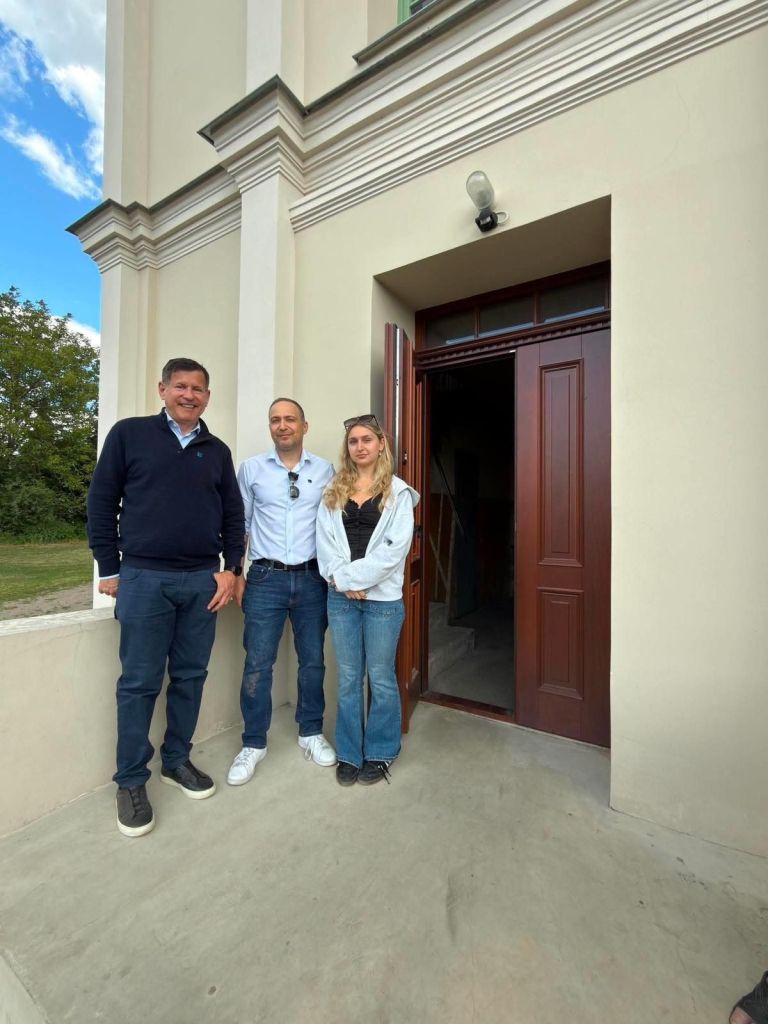
Krzysztof Sąsiadek and I at Wawel Castle in Kraków, renewing our mother’s friendship from 80 years ago.
Sąsiadek is an unusual last name. Between April 1945 and July 1950, Mama received 34 letters from a friend named Halina. During the time they corresponded, Halina married and took her husband’s last name Sąsiadek. That’s how I was able to track down her son Krzysztof, an architect who moved to the US from Poland in 1979.
Clearly, our mothers were good friends. Perhaps they met during the war or perhaps they met while studying medicine at the university. They kept up their correspondence as they moved between Warsaw, Poznań, and Krakow, through my mother’s operations in London and move to the US, and Halina’s move to Wrocław where she met the man who became her husband and they had a child (Krzysztof). The main topic in many of the letters was Halina’s attempts to obtain documents for my mother to verify her education. Mama wanted to continue as a doctor in the US, but had trouble proving she had attended the underground university during the war and completed her coursework before leaving Poland. Halina kept facing bureaucratic hurdles. Multiple times, Halina refered to Maria as “dziecinka” in her letters, a term of endearment indicating the warm connection between them.
Why did their correspondence stop after five years? Perhaps because life got hard in communist Poland and Halina was busy with work and family, including a second child born in 1950. Perhaps Mama withdrew after struggling with more surgeries, tuberculosis, and the break up of her wartime romance.
I found a phone number for Krzysztof online, and took a chance calling him, not sure if the number still worked or if it was in fact his mother who knew mine. After we talked and I had shared his mother’s letters with him, he wrote me, “My mother mentioned your mother many times and that’s why, the first time you called I knew immediately who you were referring to. My mother also expressed the desire to find your mother, but neither she nor I knew how to do so.”
Krzysztof and I have since met twice in Poland–two years ago in Warsaw and this week in Krakow.
I wonder what our mothers would have said if they saw us together like this? I wonder if they would have rekindled their friendship if they had reconnected before they died?
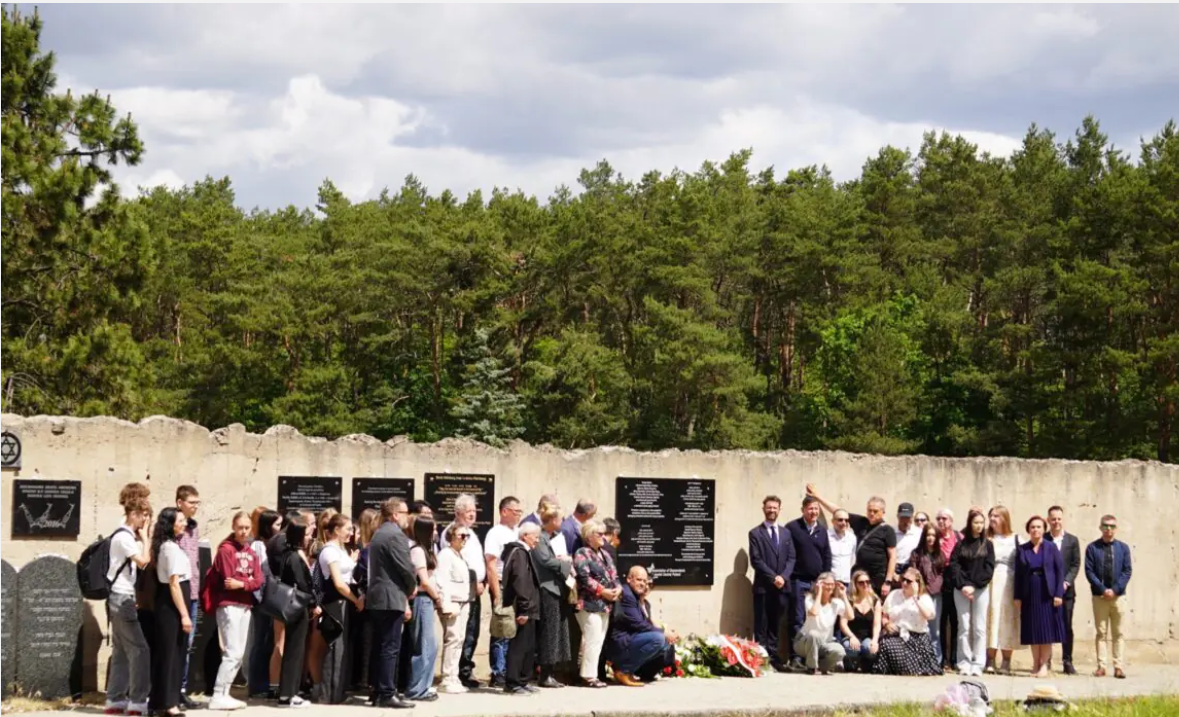
We packed a lot into our trip from May 25-29. Fourteen international volunteers joined numerous local volunteers at the Żychlin cemetery, where we finished clearing and surveying the depression where we suspect victims of the March 1942 liquidation of the Jewish ghetto were buried. In addition, on May 25, there was the ceremonial transfer of a Torah fragment recovered in Żychlin to the Saski Palace Museum in Kutno. On May 26, two Żychlin descendants and two participating University of Alabama students visited the Żychlin school to talk about Żychlin’s Jewish history and our project. On May 27, most of the 8th grade students joined our clean-up activities in the Jewish cemetery. On May 28, we traveled to the Former German Death Camp Kulmhoff for the unveiling of a memorial marker on the Wall of Memory for the victims from ADJCP towns.
News coverage of the Żychlin Cemetery Project, 2026
Please keep an eye out for more posts about the Żychlin Cemetery Project and other ADJCP activities.
Ceremonial unveiling of the memorial plaque at the Wall of Memory in the Rzuchowski Forest. Source: Museum of the Former German Death Camp Kulmhoff website.
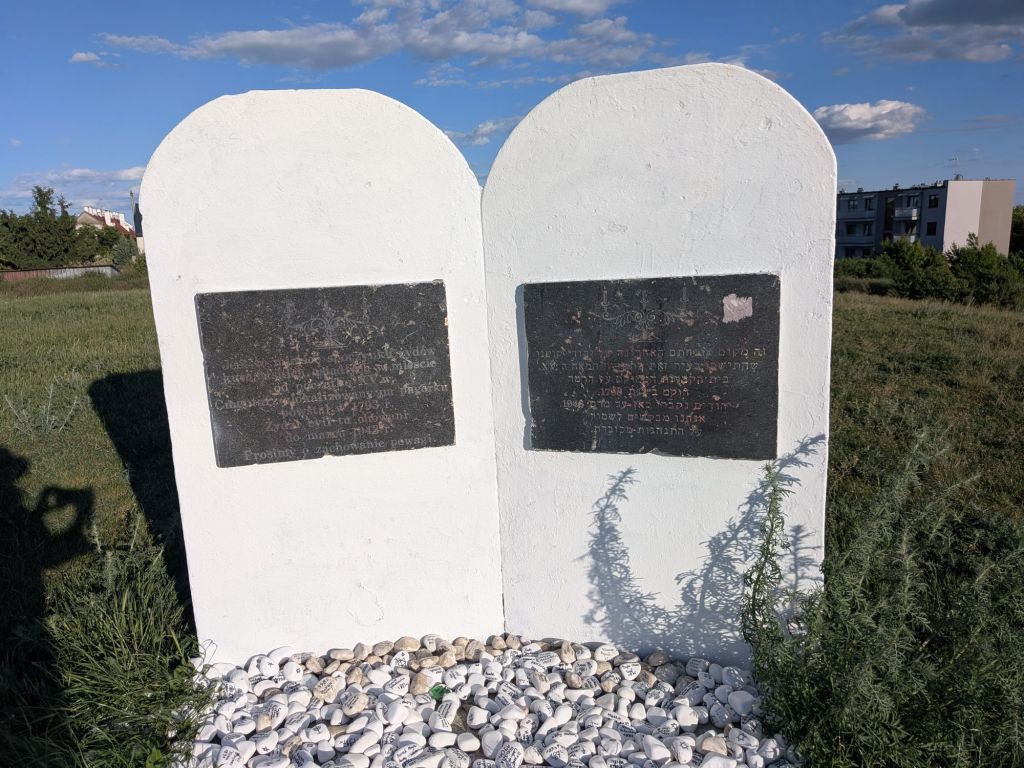
While we were staying in Kutno, both Tanja Cummings and I decided to visit the Kutno Jewish Cemetery, located on a large grassy hill surrounded by suburban streets, bloc apartments, and a school. Some remnants of the historic wall separate the space from the private yards of its neighbors.
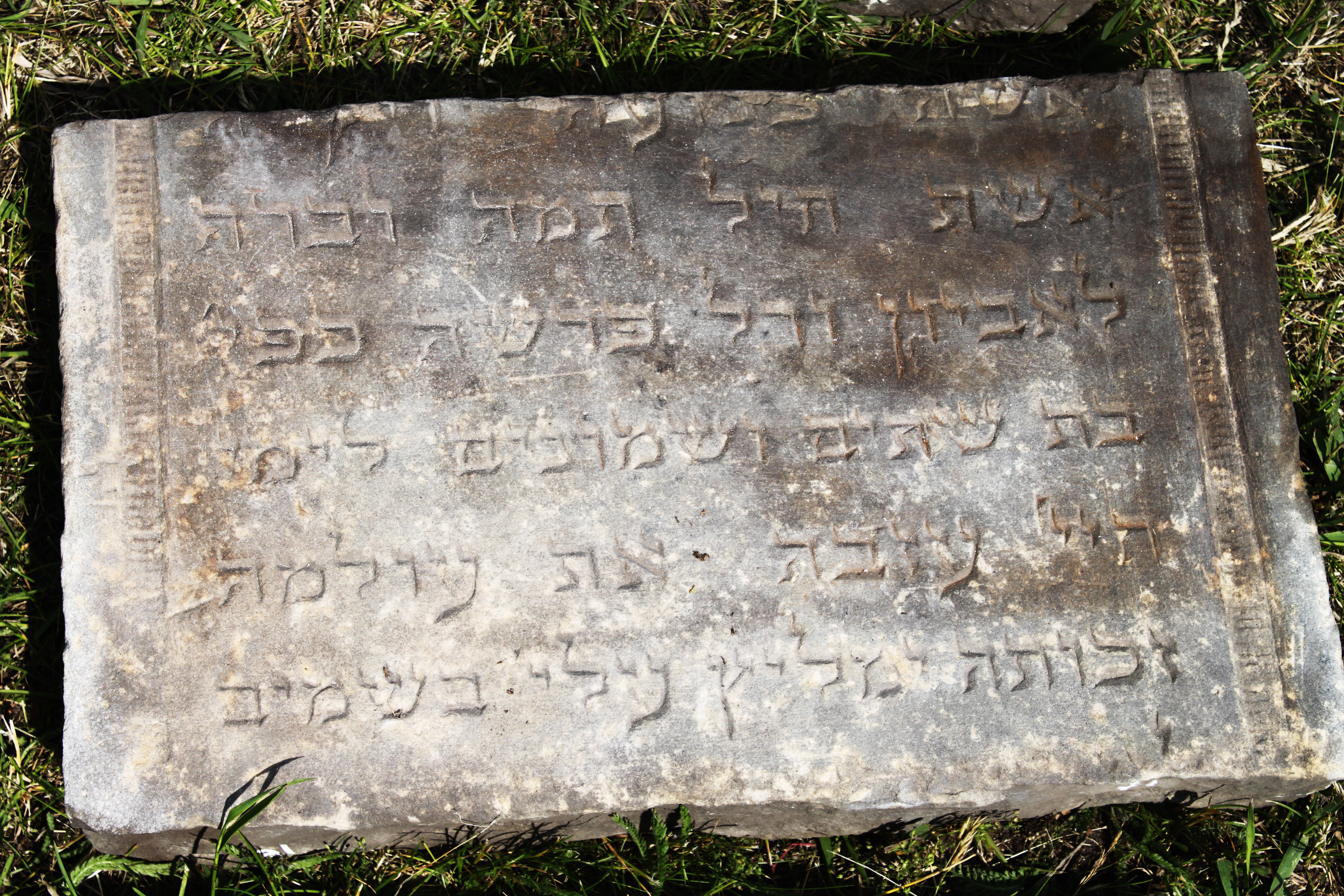
For years, descendant Yosef Kutner (see his website Jewish Kutno) has been working to rebuild a sturdy wall around the cemetery to make it safe for the return of hundreds of recovered tombstone fragments.
I also took a few photographs on a sunny afternoon a few days later.
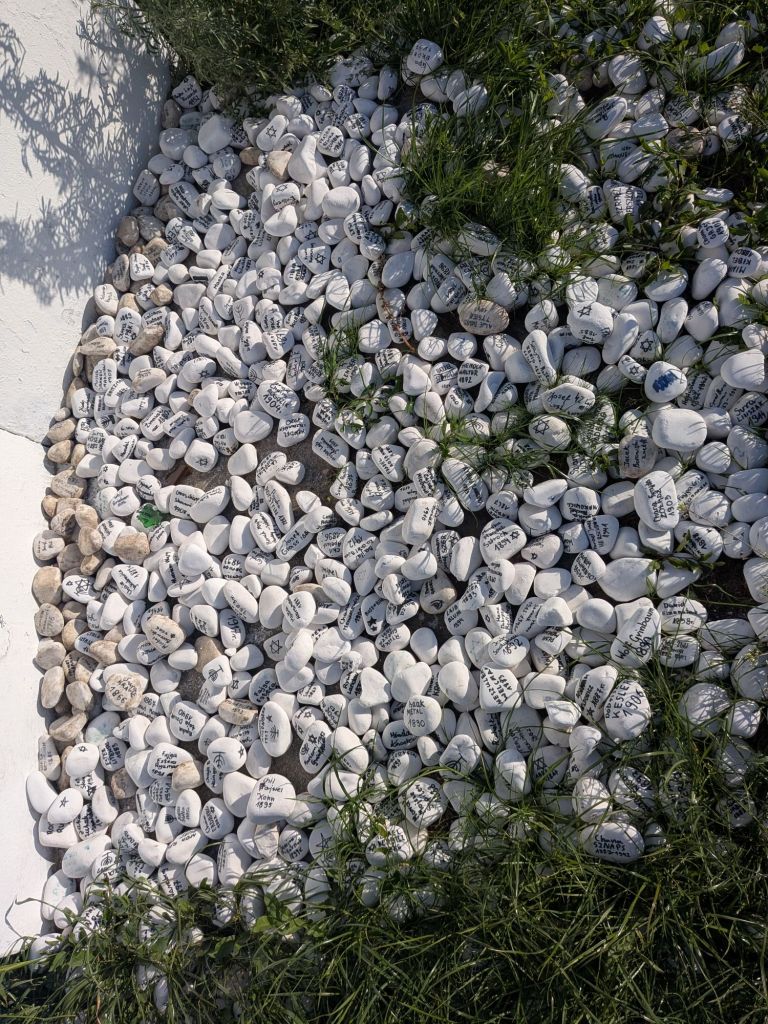
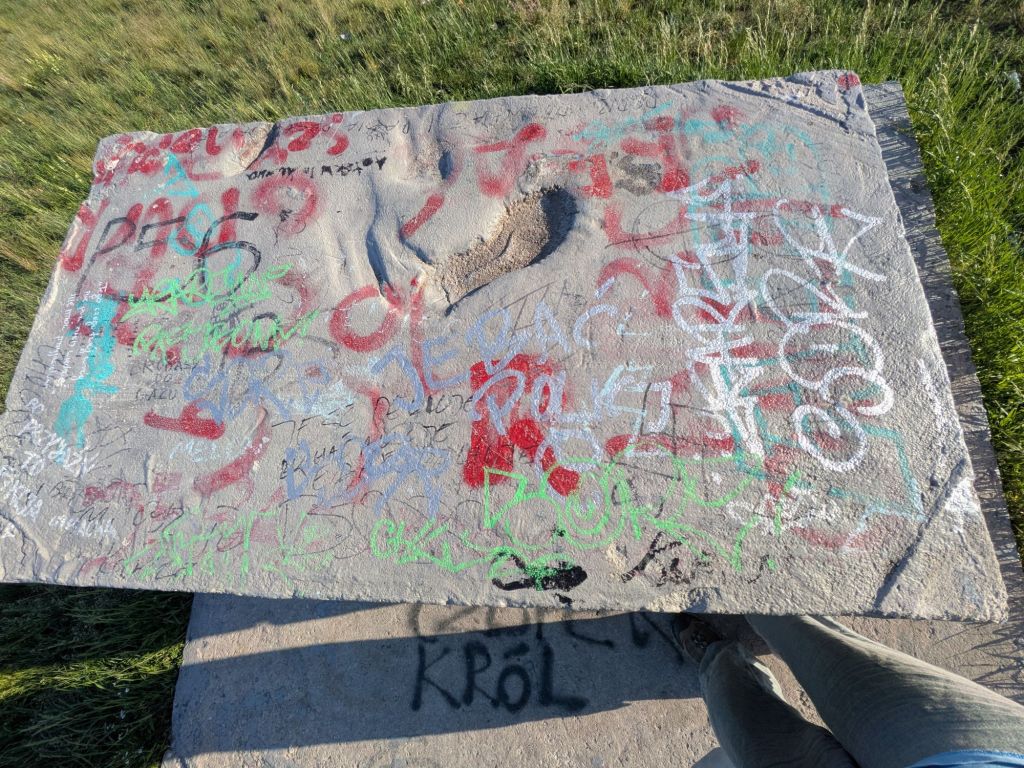
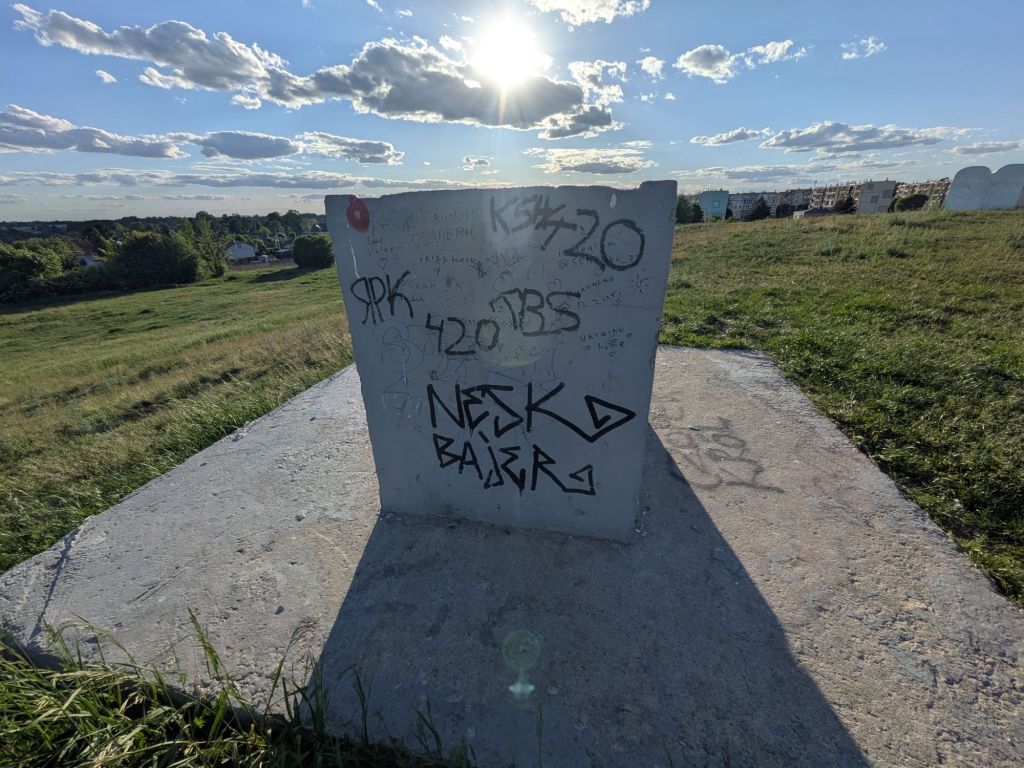
Memorial monument at the top of the hillStones left by school groups who visited the cemetery Graffiti taints a symbolic grave
Sun setting on the Hassidic monument
View of the Kutno Jewish Cemetery from the memorial at the top of the hill
I witnessed a dog walker, several groups of high school aged boys, and some solo young men drinking beer. Other signs of disturbance included trash, graffiti, and dug holes.
The condition of the cemetery raises the question about appropriate use of the space, given its historic and sacred value and the lack of a living Jewish community to watch over it. Should it be secured behind a locked wall? That might prevent both intentional and unintentional desecration, but there could be unintended consequences. It would cut the space off from the day to day lives of current residents, marking it as “other” and beyond their responsibility.
Might it be left available for respectful use by the people living in Kutno today? After all, they are the ones in a position to keep an eye on the place. What constitutes respectful? Would walking count? What about walking dogs? How about picnicking, playing ball, sunbathing? How do you stop people from leaving behind trash, dog droppings, and graffiti? Signs that identify the space as a Jewish cemetery and outline its history have not worked.
Although most of my recent news has been from Żychlin, much is happening in other towns in central Europe. In Gostynin, about 170 matzevah fragments have been recovered. Our hope is to construct a lapidarium wall at the Jewish cemetery that incorporates them.
“Żychlin’s Jewish past is not a footnote. It is a central chapter in the town’s history, and every step we take here helps restore dignity to those who lived, prayed, and were murdered here,” writes Michael Mooney. He joined the Żychlin Cemetery Project last year through our partner the Matzevah Foundation, and this year he returned with his daughter Ariel, a college student. Michael and Ariel brought energy and curiosity to our activities, as well as a willingness to do the hard physical labor of clearing our target site of the stubborn shrub blackthorn.
Michael wrote this Facebook post about our activities:
Ariel and I arrived yesterday afternoon in Kutno, Poland, where we are staying for the duration of our volunteer work in Żychlin. We immediately met the international volunteers who have gathered here this year — people joining us from across Poland, the United States, and several countries in Europe. It’s a remarkable group: committed, thoughtful, and united by a shared purpose.
This morning we took part in a moving ceremony in Kutno, where a fragment of a pre‑war Torah scroll from Żychlin was formally entrusted to the Museum Pałac Saski. The event brought together representatives of the Jewish community and the Catholic Church — including Chief Rabbi of Poland Michael Schudrich and Bishop Wojciech Osial — in a shared act of remembrance and responsibility for Jewish heritage in central Poland.
After the ceremony, our group continued our work at the Jewish cemetery in Żychlin, a place that holds both the memory of centuries of Jewish life and the trauma of its destruction.
Work at the Cemetery Today
• Clearing vegetation along the perimeter of a suspected mass‑grave area, where Jews from Żychlin were likely executed during the liquidation of the ghetto. This continues the work we began last year, slowly reclaiming the land from decades of overgrowth.
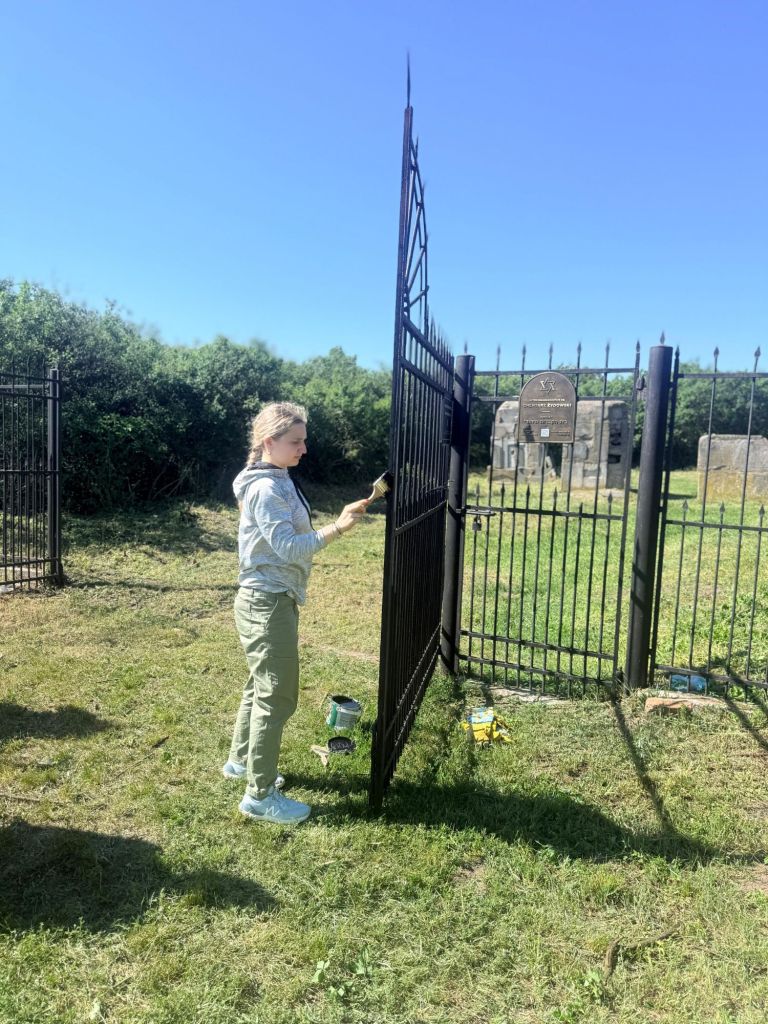
• Beginning the repainting of the cemetery gates, restoring dignity to the entrance of a sacred site that has been neglected for more than 80 years.
Every brushstroke and every branch removed is an act of remembrance — a way of returning visibility and respect to a place that was meant to be forgotten.
A Stop at the Żychlin Synagogue
Before heading to the cemetery, we stopped at the former synagogue of Żychlin — today only a shell of what it once was. The building is completely inaccessible: every doorway bricked shut, the interior long collapsed, the structure left to decay in silence.
One of our volunteers, Lawrence, whose father was a survivor from Żychlin, stood with us as we placed a memorial candle outside the sealed entrance. The candle remained unlit — a symbol of a light that once burned here but cannot yet return inside.
As we stood there, neighbors stepped out of the surrounding houses to watch. No one spoke.
The building was silent.
The street was silent.
Only the memory remained.
The Jewish Community of Żychlin
For more than 400 years, Żychlin was home to a vibrant and deeply rooted Jewish community. On the eve of World War II, Jews made up over half the town’s population, roughly 3,000–4,000 people. They built synagogues, schools, businesses, and a rich communal life that shaped the town’s identity.
All of it was destroyed between 1939 and 1942.
The Murder of Żychlin’s Jews
In 1942, the Jews of Żychlin were rounded up and deported to the Chelmno extermination camp, where they were murdered.
Local testimony and post‑war accounts also indicate that executions took place on the grounds of the Jewish cemetery itself. Two areas within the cemetery are believed to contain mass graves, where groups of Żychlin’s Jews were shot and buried during the liquidation of the ghetto. These sites were never formally marked or commemorated, and for decades nature concealed them.
Our work today — clearing brush, restoring the gates, and tending to the land — is part of the long process of bringing these places back into historical visibility and honoring those buried there.
Why This Matters
The Torah fragment entrusted to the museum this morning, the silent synagogue we visited, and the work at the cemetery this afternoon are all part of the same story:
A story of a community erased —
and of descendants, volunteers, and allies working to ensure it is never forgotten.
Żychlin’s Jewish past is not a footnote. It is a central chapter in the town’s history, and every step we take here helps restore dignity to those who lived, prayed, and were murdered here.
Thank you Marysia Galbraith and Bożena Gajewska
Michael (center) with his daughter Ariel and Żychlin descendant Lawrence Zlatkin
Only 1/3 of this area was cleared before we started on Monday.
It’s remarkable how much can be accomplished with many helpers. The Żychlin Cemetery Project exceeded its goals thanks to 14 volunteers through the Association of Descendants of Jewish Central Poland working together with local residents, including the tireless Bogdan whose boss at Active Energy also donated the necessary equipment, residents of the Correctional Facility in Garbalin, students from Adam Mickiewicz school in Żychlin, Tomasz from the city of Żychlin, den mother Bożena Gajewska, and others.
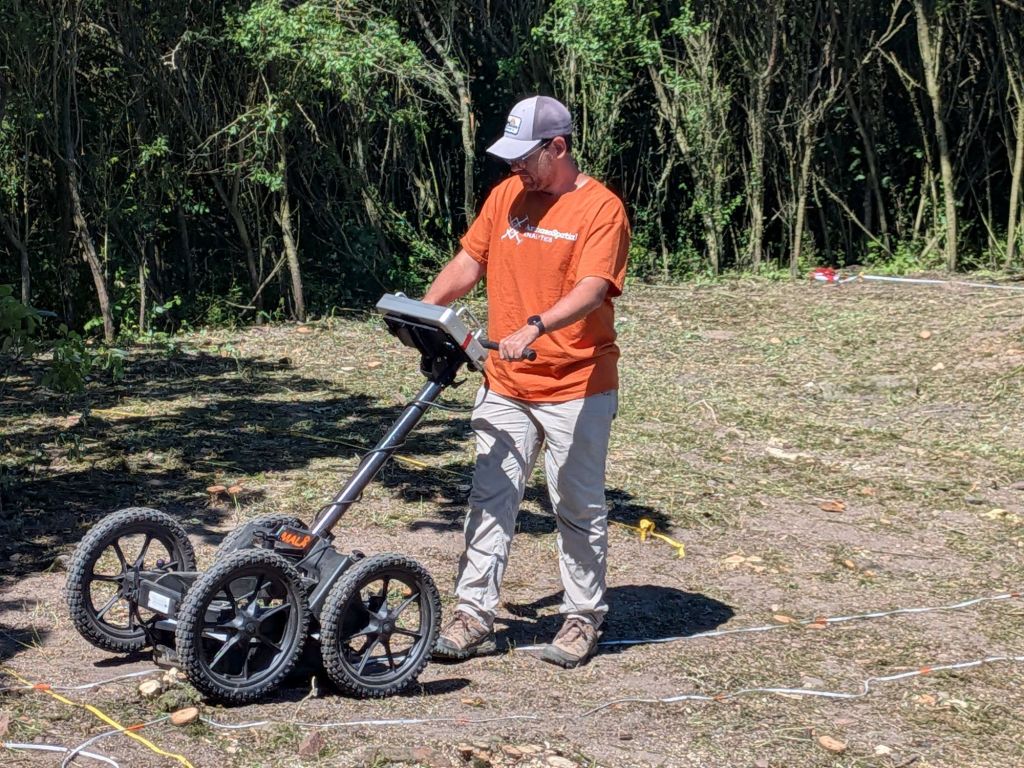
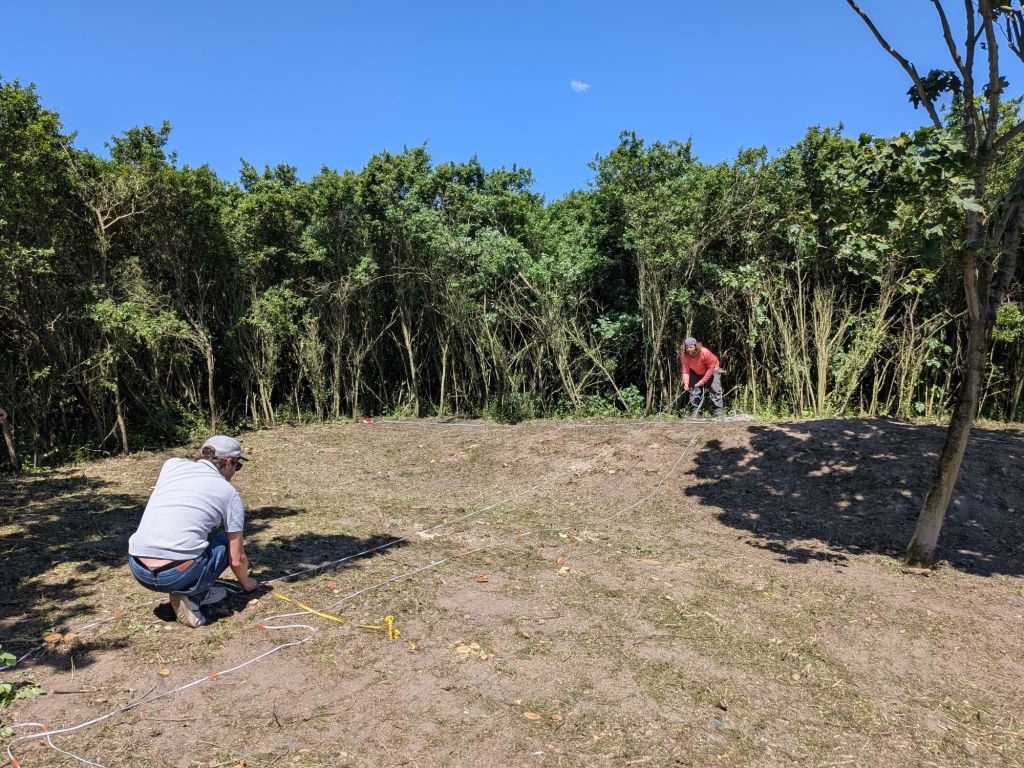
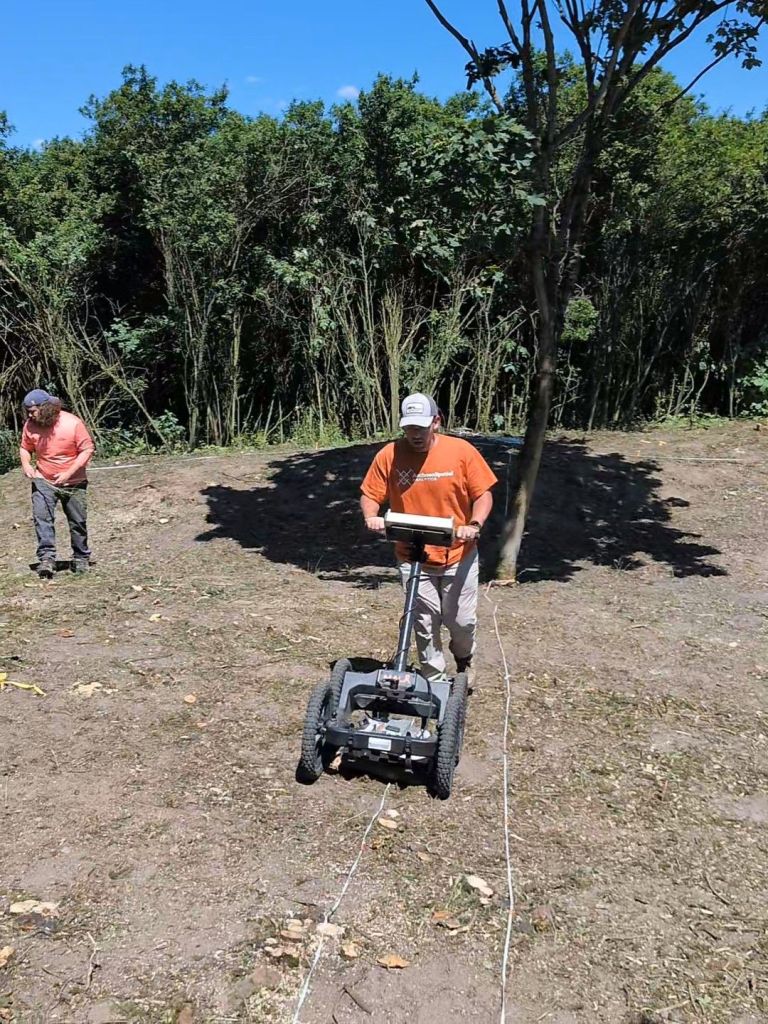
The gentlemen fired up their mechanical saws and trimmers, and within two days had cleared the remaining 2/3 of our target site. Those of us who started out with loppers quickly realized that we were more needed hauling cut branches and trunks to the entrance of the cemetery where they were piled up for the city of Żychlin to pick up. On day three, students from the local school arrived at the perfect time to help remove rocks and smaller twigs that would interrupt the course of the ground-penetrating radar (GPR) equipment. Thursday and Friday were dedicated to laying the grid and running the GPR across the site at 25 meter increments.
This results in a mass of data that our GPR expert Claiborne Sea will analyze. Already last year, the results indicated a mass burial, unlike traditional grave burials in a number of key ways. With the data collected this year, we will be able to map the extent of the burial area. We will submit our report to the Polish authorities so that the site can be marked, memorialized, and maintained.
May these victims of some of the worst horrors perpetrated against another group of human beings be remembered; May their final resting place be shown the respect they deserve.
Claiborne operating the GPRCaleb sets the grid
Luke picks up a few remaining sticks while Claiborne follows the grid lines with the GPR
My first morning in Warsaw, I woke up to the news that a friend and colleague passed away suddenly. He was only 40, recently tenured and promoted, and a highly regarded scholar. But I knew him as a warm and friendly person. When he joined us for our Thanksgiving potluck, he brought sałata, the iconic Polish salad made of fine cubes of egg, potato, carrot, and peas in a mayonnaise sauce. The taste of Poland for me. Last December, we were both in Kraków and we met for lunch at Chimera, a restaurant I first frequented when it was an upstart business in the early 1990s.
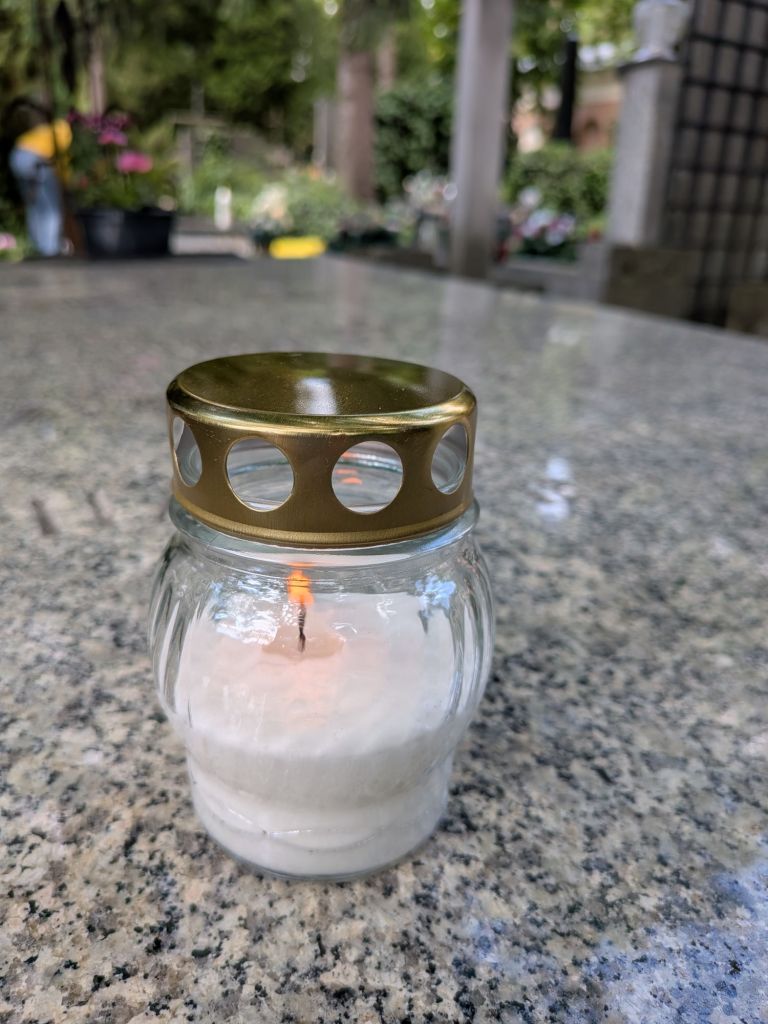
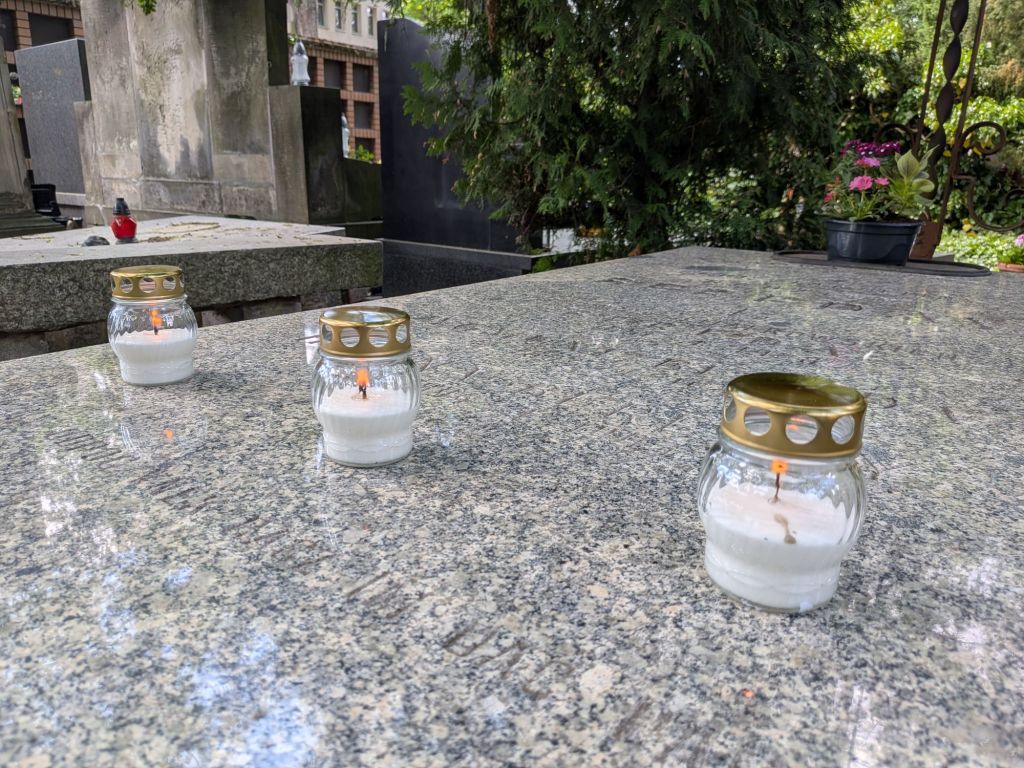
Since I was planning to visit my grandmother’s grave at Powązki Cemetery, I also lit a candle lantern for Łukasz.
A candle for a friend
Cleaning my ancestor’s grave is an act of care and remembrance. I feel like I’m with them for a short time. As I wiped the grime off the granite marker, I was reminded of the Christian practice of washing other people’s feet. I’m not enough of a Christian myself to know the full meaning of the practice, but it feels like a kind of humbling of oneself and honoring another. I find comfort in maintaining my connection with the people who are no longer here, but with whom my relationship lives on through simple acts of remembrance and care.
Sparkling granite, flowers, and candles are all signs of care and remembrance
My cousin Annice captured the spirit of the memorial monuments in the Żychlin Jewish cemetery during our summer clean-up and research.
Depicted in watercolor and ink are two of the monuments constructed out of concrete and matzevah fragments, designed and engineered by descendant Moshe Zyslander shortly after Poland regained her autonomy from communism and Soviet influence. Annice captures the poignant contrast between the stark grey monuments and the wild green weeds surrounding them.
Her text reads, “Honoring and never forget the Jews of Zychlin the day before the liquidation of the ghetto March 2, 1942 at the cemetery buried in a mass grave at the Jewish cemetery Desecrated headstones returned and assembled by generation holding their memory Nature returing life L’chaim July 2025 For Marysia her […dom] and vision Annice Jacoby descendant”
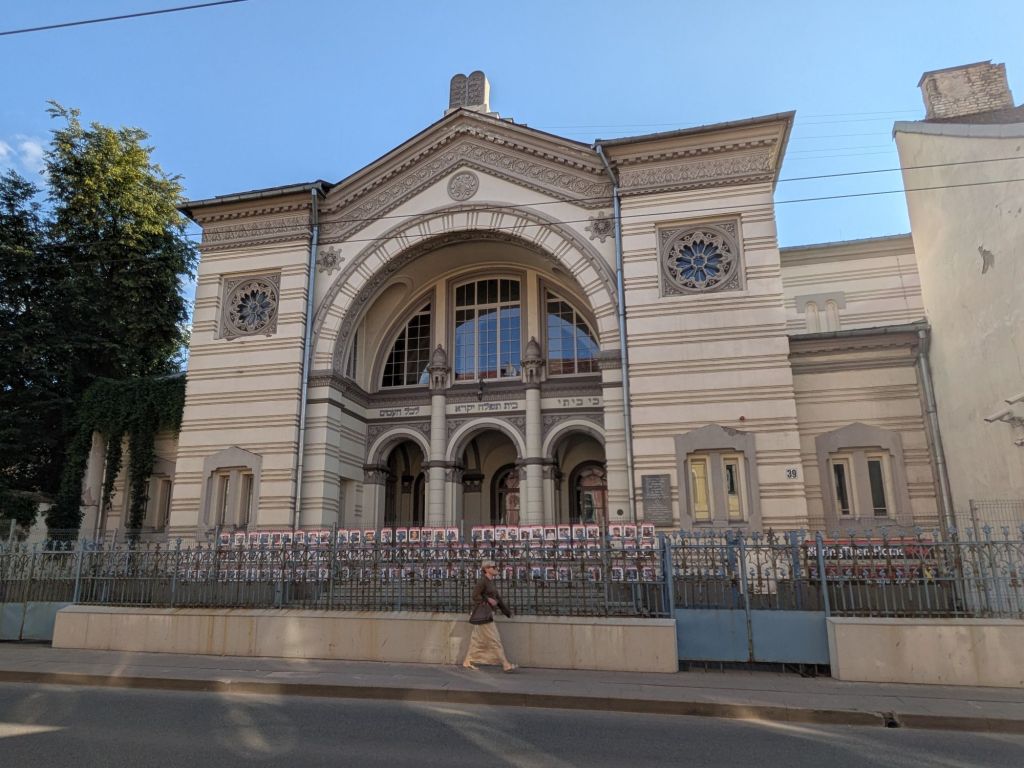
I wasn’t looking for Jewish history in Vilnius but it found me. The synagogue, still functioning as a house of prayer for the few thousand remaining Lithuanian Jews, is a half block from my hotel.
The Choral Synagogue in Vilnius. “Bring Them Home” along with photos of the hostages sits right behind the metal fence
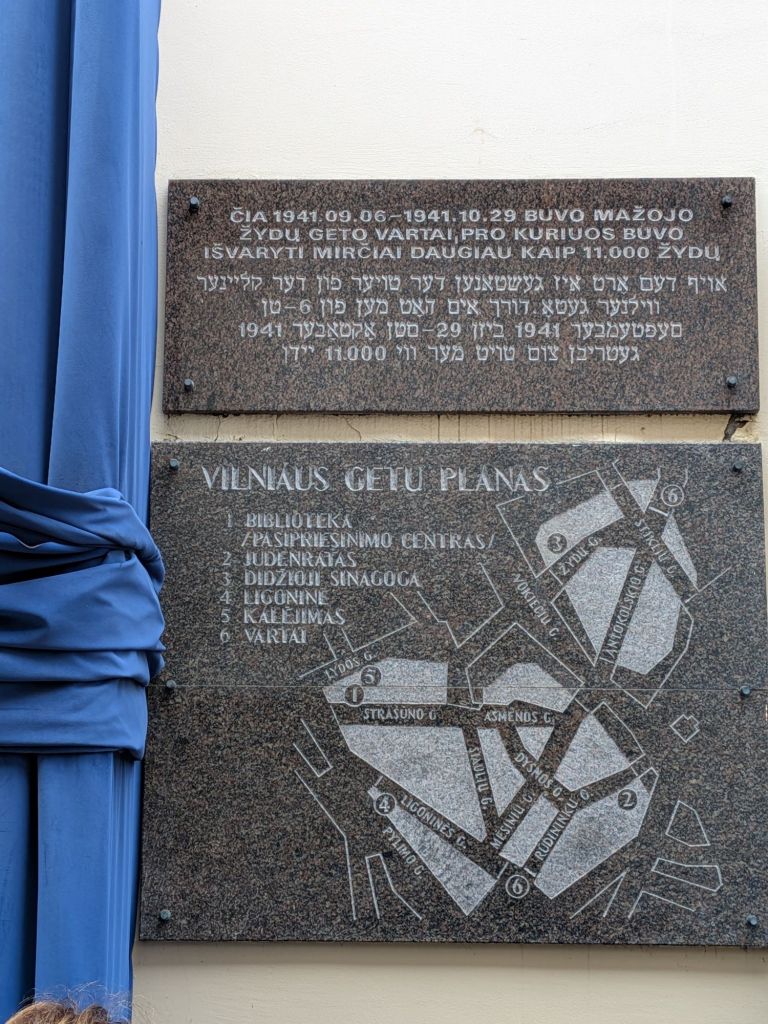
I signed up for a Vilnius with Locals walking tour of Jewish Vilnius, the so-called Jerusalem of Lithuania. We spent 3 hours exploring the Jewish quarter. In some sections, Soviet-era concrete buildings took the place of the prewar structures blown to rubble when the WW II ghetto was dismantled.
It’s hard to picture the prewar buildings that once filled this area
Other areas escaped destruction and retain their prewar appearance. As we meandered through narrow cobblestone lanes, Kristina our tour guide explained how much of the city’s Jewish story was silenced during the Soviet occupation, the period from 1940 to 1990 when the country was a republic within the Soviet Union. During that time, nobody talked about the Jews who had made up 45% of the city’s inhabitants before the war.
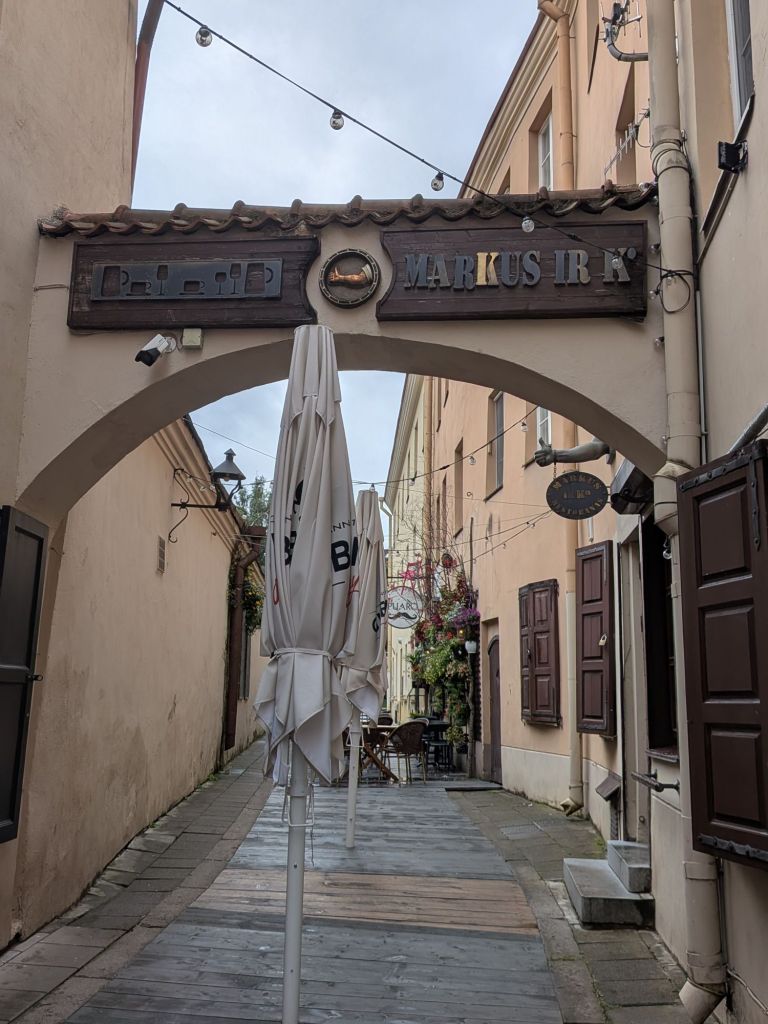
An iconic street in the Jewish district Map of the WW II ghettoJewish library scheduled for renovation
Kristina explained that this lost history only began to be rediscovered after Lithuania regained independence in 1990. Since then, scholars have been translating and writing about thousands of pages of documents that survived in hiding for 50 years. Many were collected by a group of people called the Paper Brigade who made it their mission to preserve all the documents in the YIVO Archive, a massive repository of Yiddish resources. Much of the archive found safety in New York. Today, the archive is split between Vilnius and New York.
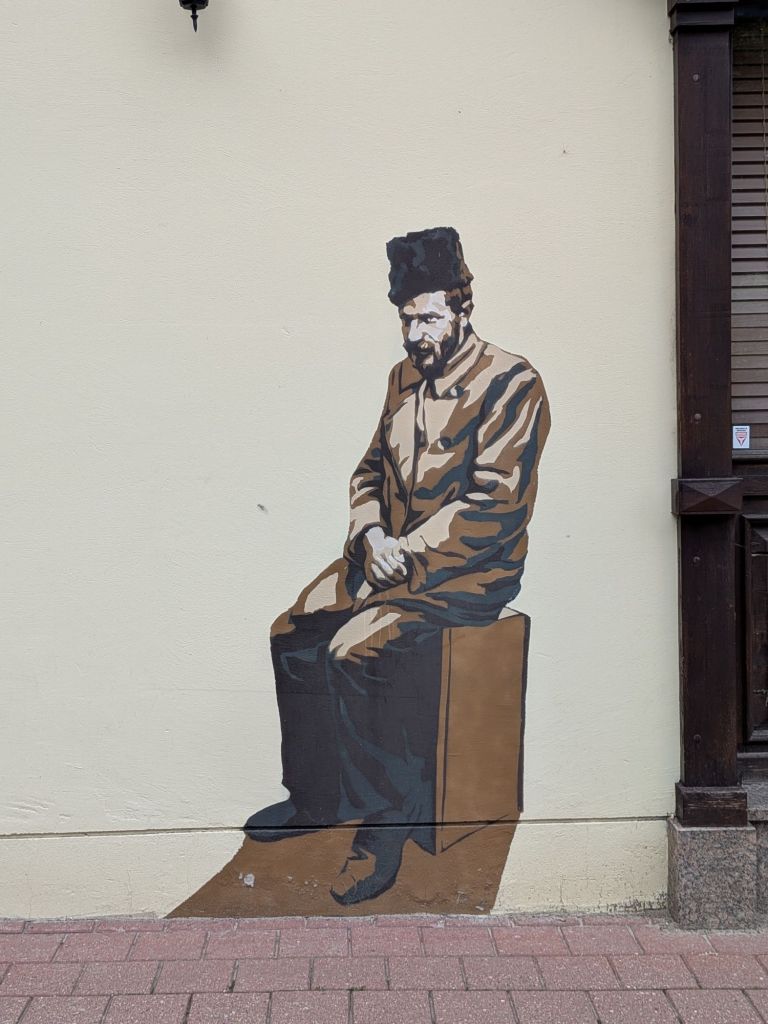
As more has been learned about The Jews of Vilnius, artwork, memorials, and institutions have made the story public. The Walls That Remember project stencils images from archival photos onto the walls of the former Jewish Quarter.
Kristina tells us about The Walls that Remember
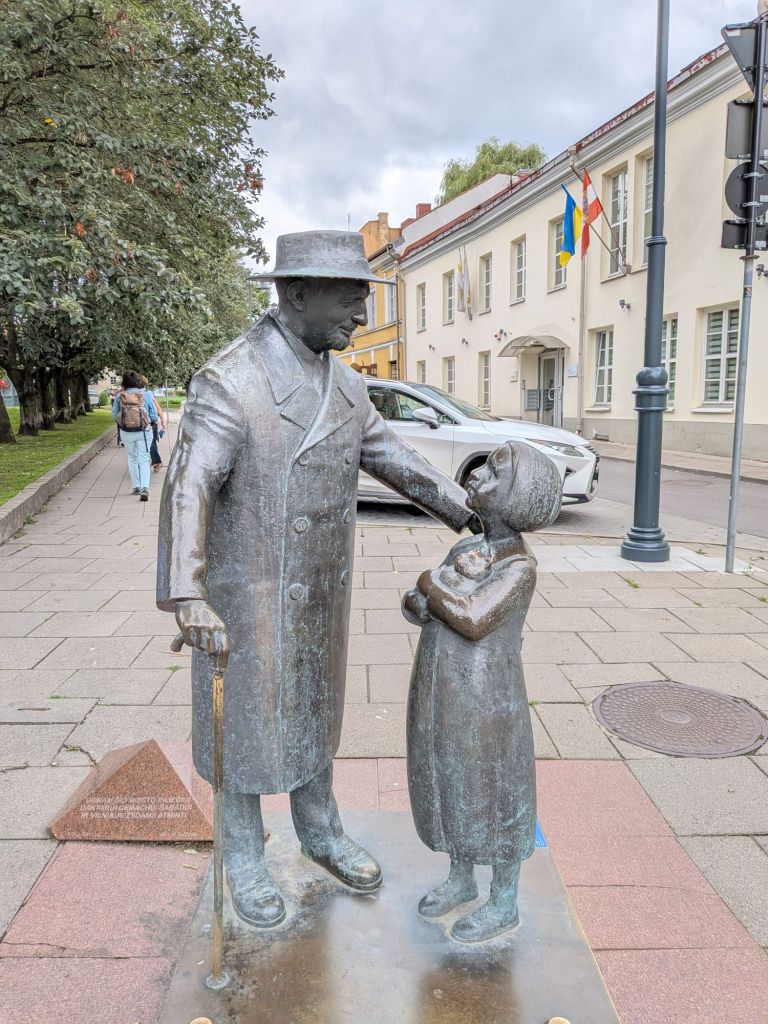
Remembered with a statue are: Zemach Shabad, a doctor known for his kindness who cared for the poor; Rabbi Elijah Ben Solomon (1720 – 1797), also called the Gaon of Vilnius; and singer Leonard Cohen, who had roots in Lithuania.
Zemach ShabadThe GaonLeonard Cohen
Jews first came to Vilnius as merchants before the 14th century. They were granted privileges by the Lithuanian rulers by the late 14th century. In Vilnius, they settled in the Jewish Quarter; other ethnic groups like Germans each settled in their own quarter of the city. By the time Lithuania was absorbed into the Russian Empire at the end of the 18th century, these ethnic enclaves were less rigid, and Jews could be found throughout the city along with other ethnic and religious inhabitants.
Vilnius was an important center for the growth of Yiddish language and culture, which explains why it was one of the places the Yiddish Scientific Institute (YIVO) was founded in 1925.
After a brief period of national autonomy from 1922 to 1940, Lithuania, like the other Baltic States, became a battleground between Stalinist USSR and Nazi Germany. When Hitler’s forces invaded in 1941, as many as 95% of the Jewish inhabitants were murdered.
Under Communism, the Choral Synagogue continued to operate, though it functioned more as a cultural organization than a religious one (at least officially). Since 1990, the Jewish community remains active at the synagogue. The interior can be viewed for just 2€. Whereas before the war, this was more of a reform synagogue, the current congregation is conservative. Women attend services on the upstairs balcony or behind a curtain on the ground floor.
Choral Synagogue
While on the tour, another participant and I struck up a conversation. Suzanne just completed a two-week tour of Jewish Poland with others of Jewish descent seeking to reconnect with the homeland of their ancestors. It was more than a historical trip, fusing spirituality and rituals within their encounters with Jewish spaces. For instance, at the grave of one participant’s ancestor, they did their own version of feldmestn, a ritual practiced by women; they measured the grave with wax, from which they made a candle.
I bonded with Suzanne over the importance of reconnecting with your Jewish origins, and also because of our shared appreciation for the individuals working in Poland to preserve Jewish memory. She called them memory keepers, a name that perfectly captures the role they play. I will use the term in my future writing about these memory keepers.
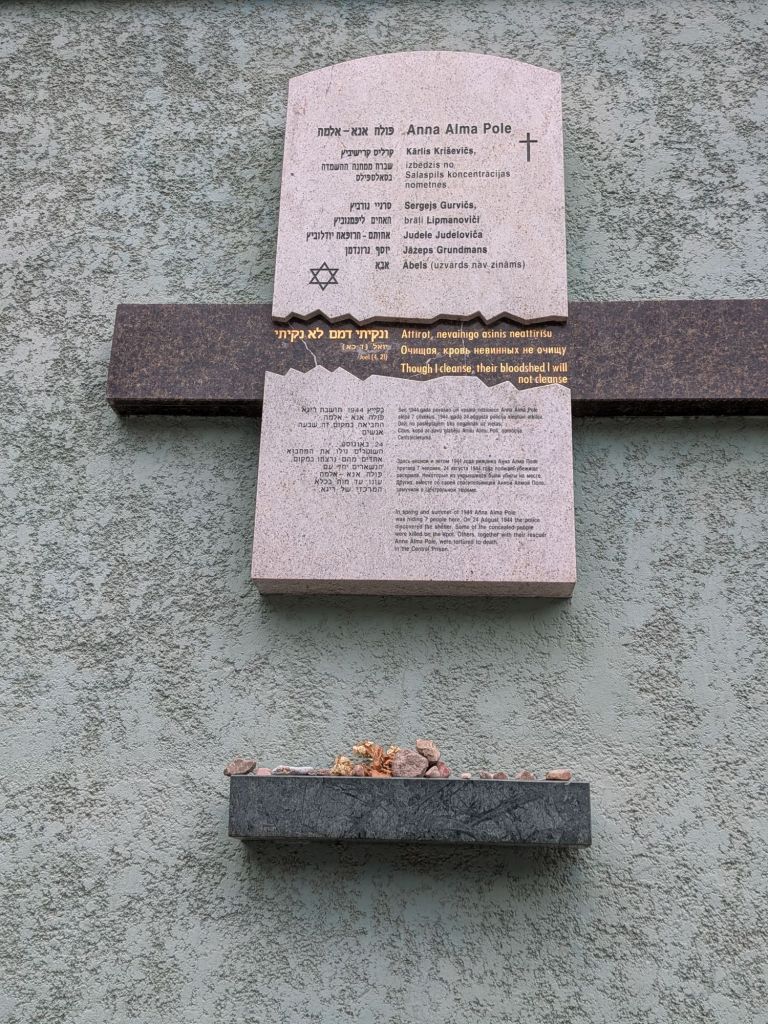
In Riga, the capitol of neighboring Latvia, Jewish markers continued to find me. On the building next to my hotel is a memorial marker for someone who saved Jews during the German occupation, and around the corner stands the synagogue. Also, during a walking tour of the city, I met Dimitri and his son Shiloh, reconnecting with their Jewish Latvian roots.
Today, we left central Poland and travelled down to Kraków for a final weekend of sight seeing and learning about the history of Poland. Tomorrow, we go to Wawel Castle, the seat of Polish kings. Sunday we have a guided tour of the Jewish district. Tonight, we had a feast at Hamsa, an Israeli restaurant.