• About
  • The Photo that Started it All

Uncovering Jewish Heritage

Uncovering Jewish Heritage

Category Archives: Cemeteries

Kazimierz

13 Saturday Feb 2016

Posted by Marysia Galbraith in Cemeteries, Identity, Jewish Culture, Kazimierz, Krakow, Memory, Polish-Jewish Heritage, Polish-Jewish relations, Synagogues

≈ Leave a comment

Tags

Schindler's List

Raised on stories about Mama’s magical homeland of Poland, I visited for the first time in 1986. This was before the fall of communism, when the country was still in the grips of a state socialist government. But although I went in search of my roots, I didn’t think about my heritage as being Jewish. I knew nothing about Polish Jews, and I didn’t identify as Jewish. Nor did I mention it to anyone; there would not have been much to tell since I didn’t know anything about this aspect of my family history. Moreover, and perhaps primarily, I had somehow internalized the unspoken understanding that Poles are Catholic, and Jewish heritage wasn’t supposed to be talked about.

I review the memories in my mind, searching for clues about how I thought about Polish Jews. Again, I am reminded that I didn’t think about my own Jewish heritage during my first visits to Poland, except perhaps to repress it. I preferred the family narrative about our Polish Catholic background to the reality of our more complex past. From time to time, I saw anti-Semitic graffiti, or heard prejudicial remarks about Jews. But mostly, neither I nor the Poles I met paid much attention to the past lives of Polish Jews.

But not entirely. For instance, during the summer school I attended in Krakow, a fieldtrip was organized to Kazimierz, the former Jewish quarter of the city. Jews settled there near the end of the 15th century when faced with restrictions against living in the city center. By the 1930s the population of Kazimierz reached about 60,000 Jews. Most died in the Holocaust, leaving the district abandoned. After the war, it was not a popular place to live and those who moved in did little to maintain or update the historic buildings. By the 1980s, most of Kazimierz was in disrepair. Some buildings had fallen down completely while others had cracked, grey, and dirty walls. In fact, much of the Old City of Krakow looked run down. But Kazimierz was worse, even on Szeroka Street, the historic center of the Jewish district.

Trace of a mezuzah in a doorway, Kazimierz 1986
Kazimierz 1986
Kazimierz 1986
Old Synagogue in Kazimierz, 1986

It’s hard for me to distinguish memories from my first visit to Poland and subsequent ones in the early 1990s, but I think I went to the Remuh Synagogue already in 1986. That’s where a small group of older Jews continued to congregate. I also visited the walled cemetery next to the synagogue, where at least some of the gravestones and arched grave coverings were maintained and, judging by the small stones left on them, visited regularly. I think it was in the 1990s I was told that many of these older Jews were not in fact Polish, but rather came from the former Soviet Union. Such talk left me with the impression they weren’t real Polish Jews, but rather opportunists exploiting the growing interest in Jewish heritage tourism.

Some of the historic buildings started to be renovated already in the early 1990s. The first Jewish-themed business I remember was Ariel, a restaurant and café on Szeroka Street. It featured Jewish food and displayed Jewish memorabilia and artwork. I took some of my friends from Bieszczady, my rural fieldsite in the southeast of the country, to Ariel. I wanted to impress them with the cultural diversity of Krakow. Looking back at my fieldnotes from that time, I was surprised to see I noted that my friends were fascinated by this former Jewish district. They asked me if the café was in a Jewish style, and if the people around us were Jewish. So perhaps even then, Poles were more interested in Jewish culture than I realized.
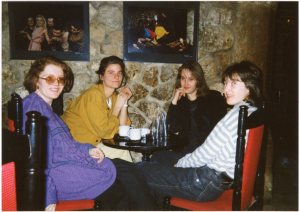
1993Ariel

Ariel Cafe in Kazimierz 1993

Over the years, Kazimierz has become more and more popular. The first to come were artists and students seeking an edgier, cheaper part of the city to live in, as well as tourists seeking traces of Poland’s Jewish past. I have read that a turning point came after Steven Spielberg filmed Schindler’s List in the district. This was in early 1993, while I was still living in Krakow. A fake wall was built to enclose Szeroka Street near Starowiślna Street, and movie-set facades resembling World War II era businesses were painted on abandoned buildings. In effect, Spielberg turned the area into the Jewish ghetto, even though the actual ghetto was a few miles away in the district of Płaszów. I watched filming one day. An actor dressed as a Nazi officer (I now realize it was Ralph Fiennes playing Amon Goeth) strode to the top of a pile of suitcases over and over again. Mostly, everyone was just standing around. I was able to pick Spielberg himself out; he was wearing one of his signature ball caps. Some of his kids were there, and I think I saw his wife as well.

Filming Schindler's List, 1993. Ralph Fiennes is in the background, playing Amon Goeth
Filming Schindler’s List, 1993. Ralph Fiennes is in the background, playing Amon Goeth
Filming Schindler's List, Kazimierz 1993. Note Ariel Cafe in the background and the fake facades on the surrounding buildings.
Filming Schindler’s List, Kazimierz 1993. Note Ariel Cafe in the background and the fake facades on the surrounding buildings.

After witnessing the filming of Schindler’s List, I couldn’t suspend my disbelief and become absorbed into the story when I watched the movie in the theatre. It didn’t help that one of my friends, a swarthy Brazilian whose father’s family was Polish, appeared larger than life in the first “Jewish” crowd scene.

Today, so many parts of Kazimierz have been reconstructed or renovated that it can be easy to forget how derelict it used to be. In addition to the many cafes and restaurants, the synagogues, prayer houses, and other Jewish institutions have been restored. Even more significantly, eclectic forms of Jewish life have returned to the district, most visibly at the Jewish Community Center, which holds Shabbat dinners and Jewish cultural events, and functions as both a gathering point and an information center for Jewish residents of Krakow and visitors from around the world.

Inside the Tempel Synagogue, Kazimierz
Inside the Tempel Synagogue, Miodowa Street, Kazimierz 2015
Izaak Synagogue, Kazimierz
I gave a talk at the Jewish Community Center in Kazimierz, June 2015

Memory in Fragments: the talk at UA

31 Thursday Dec 2015

Posted by Marysia Galbraith in Brześć Kujawski, Buk, Cemeteries, Family, Heritage work, Israel, Jewish Culture, Lutowiska, Memory, Poland, Polish Culture, Polish-Jewish Heritage, Polish-Jewish relations, Post-World War II, Poznan, Pre-World War II, Research Methodology, Skierniewice, Synagogues, World War II, Wronki, Włocławek

≈ 2 Comments

Tags

Fulbright Program, Postmemory, University of Alabama

The lecture I gave at UA September 3, 2015 about my research during my Fulbright Fellowship is now available on vimeo. I’ve never seen myself lecture before. It’s a little unsettling. Still, here it is, flaws and all (for instance I know that Poland entered the European Union in 2004, even though I misspoke here).

I talk a little about the Fulbright Program–the kinds of grants available and some tips for applying.

It’s also a good introduction to my ideas about reassembling Jewish life: the strands that I’m following, what has been lost, what can be recovered, and how memory projects at sites throughout Poland intertwine with my own search for my family history. I hear echoes of some of the scholars I’ve read–Iwona Irwin Zarecka and Marianne Hirsch, as well as my sometime collaborator Malgosia Wosińska. There is no way to bring back what has been lost, but fragments of the past can be reassembled to form a new kind of life that allows for connection with what used to be and what yet might be.

Tracking Down Jewish Radymno

13 Sunday Dec 2015

Posted by Marysia Galbraith in Cemeteries, Jewish Culture, Memory, Polish-Jewish Heritage, Polish-Jewish relations, Post-World War II, Pre-World War II, Radymno, Synagogues, World War II

≈ 3 Comments

Although I knew the former synagogue still stands in Radymno, I had to look several times before I actually found it. I’ve visited for years, and yet my friends never even told me the town had a prewar Jewish population. But until June, I never thought to ask them about it, either.

When I finally did ask, my friend couldn’t tell me much. She repeated a common refrain, especially in southeastern Poland: Jews used to say “nasze kamienicy, wasze ulicy” [“our buildings, your streets”]. It’s not clear that any Jews ever actually said this, but nevertheless, this is often what is remembered about them—Poles may have been the majority but Jews were richer. It’s a telling way of marking the distinction between Poles and Jews. Rather than all residents being regarded as Poles of various religions, Jews remained separate. Moreover Jews are remembered as being complicit in asserting their difference, and indeed their superiority. My friend didn’t mean it this way, but I’ve commonly heard this expression deployed as a justification for why Poles didn’t like Jews. Not only were Jews the property owners, they rubbed it in.

Jewish property ownership poses different challenges today. Some current residents fear prewar owners will return to claim what was theirs. My friend told me about two men who came to Radymno a few years ago and looked at some buildings that had once belonged to Jews. She also described a building in the center of town that is falling apart, but nothing can be done about it. It can’t be torn down because it is a historic structure, but no one will invest in its renovation for fear they will lose possession of it if the owner comes back. She also mentioned another property, a plot of land surrounded by fields whose last owners were Jews. The town hasn’t pursued a clarification of ownership because it isn’t worth enough to hire a lawyer and try and collect the few zloties of tax owed on it each year. So it just stands fallow. I suggested the owner is probably dead. She said of course, it’s been so many years. I clarified there probably aren’t even any descendants, and she responded “of course, because of what happened to Jews.” She didn’t elaborate, nor did she use the words Holocaust, murder, or genocide.

My friend’s mother-in-law had heard her mother’s stories about Jews. She grew up right next door to where they live now. Still, when we asked her about it, she responded she doesn’t know much. She was too young, and her mother didn’t tell her much. She remembers her mother complaining about the sound of the calves at the slaughterhouse across the fields. Kosher law demanded that they be killed with a single knife stroke, and with an empty stomach. Her mother could hear the calves crying in hunger as they awaited slaughter. There still is a slaughterhouse in the same spot, but it has been rebuilt and expanded. At first, my friend’s mother said it used to be owned by Jews, but then she said she wasn’t sure. Jews definitely used it, even if they weren’t the owners.

Her father opened a grocery store in Jarosław, a nearby town. All his neighbors were Jewish shopkeepers. He had to give up the business after a year and a half because they lowered their prices to the point that he could not compete.

Her mother also told her how all the Jews were collected by the Germans and taken to the cemetery where they were shot. She mourned the loss of two young pretty Jewesses, whom she knew because they did seamstress work together.

My friend’s mother-in-law said some Jews and Poles się przyjaźnili [were friendly with each other]. They lived side by side.

She also recalled where the Jewish cemetery was, not far from the water treatment plant.

My friend drove me down a dirt road past the plant, but there was no cemetery. When the road narrowed to two wheel tracks in tall grass, we turned around. My friend pointed to a stand of trees in the distance, saying she thought the cemetery was there. She tried to find someone at the water treatment plant but no one responded. From there, she stopped at a store, but chanced on a man who lives in a nearby city.  The young men working at the car wash knew nothing about the cemetery, either. She finally found an older woman who pointed to a different, less traveled dirt road. We drove up it, but it didn’t get us to that stand of trees. My friend kept looking for a road leading in that direction. I can’t help wondering if maybe at some point in the past she had been told the cemetery was there.

We drove past the slaughterhouse her mother-in-law had mentioned. It’s a big operation, rebuilt and expanded since the war. The building closer to the road, essentially a box shape, is probably the oldest.

From there, we took a back road up the hill into town and I finally got to see the former synagogue. It is now a beverage wholesaler. My friend’s uncle lives next door. I took some photos while she went to ask him if he knew where the cemetery might be.

DSC06762

The Radymno synagogue now houses a beverage wholesaler.

The front of the synagogue is an imposing two-story square façade that has been renovated, leaving no clear elements of synagogue architecture. From the back, though, the bricked-in semicircular tops of the former synagogue windows are visible. Through windows, you can also see staircases on either side that used to go to the “babiniec,” the upstairs balcony for women. My friend’s uncle used this term when he described it to us, so clearly he knows a bit about the building’s former life as a synagogue. He said nothing has been added to the building. It still has the same footprint, and it stands at its original height. I asked him how he knows, and he simply responded, “after all, I live next door.”

The synagogue from the back
Brick arches used to be the tops of the synagogue windows.

My friend’s uncle also knew how to get to the cemetery. He said he last went there over 30 years ago. As a high school student and a young man, he and his friends used to go there sometimes to have fun (in other words to drink). He remembers some tombstones were still standing, though many others had been brought to the river where people would wash their clothes on them. The writing was still visible on them, but later, the stones fell apart. Today there is nothing left.

Looking back toward Radymno from the cornfield beside the Jewish cemetery
The overgrown site of the Radymno Jewish cemetery.

He took us past the slaughterhouse and up a different dirt road. It petered out in a cornfield, right beside the stand of overgrowth and trees that my friend had kept pointing toward. Still, we couldn’t reach it because of a deep gully that separated it from the cornfield. Besides, the overgrowth would not have been penetrable without proper footwear, pants, and probably a machete. I suggested returning in the winter might be best.

At least I know the site to return to.

Cousins in the Warsaw Ghetto

22 Sunday Nov 2015

Posted by Marysia Galbraith in Bereda, Cemeteries, Jewish Culture, Jewish Ghetto, Kolski, Warsaw, World War II

≈ 2 Comments

Tags

Mirka Kolski, Okopowa Cemetery, Pinchas Kolski, Rachel Piwko Kolski, Warsaw Ghetto

My cousin Pini (Pinchas) Doron, reminded me that his grandfather and namesake died in the Warsaw Ghetto. This is the story he sent me this morning:

“The Okopowe Cemetery is the old big cemetery in Warsaw that we visited with the whole family in 1995, including Pnina’s (his wife) parents.

“Her mother used to run from the Ghetto through the cemetery to the fields to bring potatoes to her family when she was 13 years old.

“Amazing stories.

“I have seen in your post the stone sign for the people who died in the Ghetto. As I told you, my grandfather Pinchas Kolski died in the Warsaw Ghetto in 1940 and was buried in a temporary cemetery inside the ghetto. As we know, in 1940 they no longer allowed anyone to bury the dead  in the Okopowa Cemetery outside the Ghetto.

1941RachelMirkaKolskiAtPinchasGraveInGhetto

Mirka and Rachel Kolski at Pinchas Kolski’s grave in the Warsaw Ghetto. He died in 1940.

“We have this picture of Grandmother Rachel Kolski and her daughter Mirka (see the white sleeve with the [Star of David]-I think this was before they introduced the yellow star)?

“Mirka told me that after this visit to the grave, they managed to escape the Ghetto and to meet your step grandfather (that would have been Zygmunt Bereda) who hid them.”

Okopowa: Warsaw’s Jewish Cemetery, All Souls Day 2014

21 Saturday Nov 2015

Posted by Marysia Galbraith in Catholicism, Cemeteries, Family, Jewish Culture, Memory, Warsaw

≈ 5 Comments

Tags

All Saints Day, Mourning, Okopowa Cemetery, Powązki Cemetery

November is the month when I think about death the most. It starts with the Catholic holidays All Saints Day (November 1) and All Souls Day (November 2). It’s the month when the leaves fall from the trees and the long nights settle in. But it’s also the anniversary of my more personal encounters with death. My brother Ron’s accident was a few days before Thanksgiving in 1990. Nine years later, on the Friday after Thanksgiving, my dad had his accident while visiting me in my new home in Alabama. Both were injured in a fall. Both were in the hospital for two to three weeks before dying.

I think we all learned how to deal with this kind of loss from the first experience. The first time, no matter how dire the news was from New York, I held on to the certainty that Ron would pull through. I let my mother persuade me that it made no sense to come home right away, when he was still in such bad shape. I should finish the semester in graduate school in San Diego and come home as scheduled on December 11 when Ron would be well enough to appreciate my presence. I think she was trying to protect me from the shock of his injuries. And I believed her because she was my mom, and because it was easier, and because the prospect of him dying was inconceivable. But he didn’t last that long and I never got to see him alive again.

The second time, we knew not to assume anything. We held on to hope until the last moment, but we were more prepared for Dad’s passing. My brother Chris was already there, but my other brother Wiley flew in from California. We all sat vigil, visiting Dad every chance we could get and supporting each other in our grief.

So while I love Thanksgiving, this is also the time of year I think about my brother and my father. And I grieve for them all over again.

Especially after Ron died, I struggled with grief. There didn’t seem to be any way to talk about it or express it publicly. I think this is particularly difficult in California, a place that celebrates life and youth. The cemeteries are hidden from view or turned into parks. That’s why it resonated with me to spend All Saints Day in Poland. During this holiday, families visit their relatives in the cemetery (those who are living and those who are dead). They clean the graves and decorate them with chrysanthemums and candle lanterns. At night, the whole cemetery glows with candlelight, and throngs fill the cemetery pathways. Death isn’t hidden away, and the people you love remain a part of your life even after they die.

Whenever I’m in Warsaw, I make a point of visiting my step-grandfather’s grave in Warsaw’s Powązki Cemetery. I clean the stone, place flowers, and light candles. This is the closest thing to a relative I have in Poland, and one of the only remaining traces of my family’s lives there. Last year was the first time I was able to make it there on All Saints Day. I went with my son, who by now is familiar with the custom of visiting, cleaning, and decorating graves. He likes to watch the candles burn.

DSC01729

Ian watching the candles at his great grandfather’s grave, Powązki Cemetery in Warsaw, November 1, 2014

The first time I went to Powązki was in 1986, during my first visit to Poland. I spent a couple of days with Marta, a professor of American literature who had worked as my grandmother’s companion back in New York. She took me to my grandfather’s grave. She knew where it was because my grandmother had told her where to find it. She made a point of visiting every time she visited her own relatives in the cemetery, and she kept the grave tidy for Babcia.

I vaguely remember we stopped in at the Jewish cemetery also. But it’s also possible I’m confusing my memories of the large Jewish cemetery in Krakow, or the one in Prague, which was in a more confined space. It’s possible I visited Okopowa, the Jewish cemetery in Warsaw, on a later trip to Poland.

Last August, when I was at Powązki with my brothers, I noticed what looked like a synagogue on the other side of the wall, right there near my grandfather’s grave. Looking at a map, I realized that the Okopowa Jewish Cemetery abuts Powązki (a Catholic cemetery), as does the Evangelical Cemetery. Either I had forgotten this, or simply never knew how close they all were to each other.

On November 2, All Souls Day, I visited Okopowa with my friend Beata. She has lived in Warsaw for close to 20 years, but had never been there before. Beata said she had been wanting to visit the Jewish Cemetery for a long time. We parked in front of her friends’ glass high-rise apartment building right across the street from the entrance.

The regular admission fee was waived for the holiday. A good number of people strolled the alleys. A man in a yarmulke led a tour. Beata, Ian, and I made our way past a reconstruction of the original cemetery gate and a low wall made of the fragments of tombstones. The wall also includes commemorative plaques for Holocaust survivors who emigrated and were buried elsewhere.

The reconstructed gate and wall constructed of fragments of tombstones
"Father, You wanted to, so you symbolically returned to your country." Alia Skowronek died in the USA
“Father, You wanted to, so you symbolically returned to your country.” Alia Skowronek died in the USA

Okopowa remains an active burial ground, and people have continued to be buried there after World War II through to the present. The cemetery shows signs of ongoing attention and care, though broken and overgrown stones fill the vast expanses beyond the main walkways. There are many large tombstones and some family plots, suggesting affluent families. Even older tombstones include Polish as well as Hebrew inscriptions, and some have writing in Polish only. This signals to me a higher degree of assimilation in Warsaw relative to the smaller towns I have visited in central and eastern Poland (Lesko, Żychlin, Lutowiska, Skierniewice, to name a few) where most if not all inscriptions are in Hebrew. It’s different in western Poland, where tombstones were commonly in both Hebrew and German.

Off to one side, I found an area partially filled with older tombstones that have clearly been reset because they are all upright and evenly spaced in rows. These have the larger lettering characteristic of tombstones dating from an earlier period. They fill about 1/3 of the space; the remaining 2/3 are covered in weeds. Along the opposite wall more tombstones are stacked as if they are waiting to be set out in rows. I wonder what is being done here. Might these stones have been recovered from other locations?

Tombstones waiting to be set in rows? Where did they come from?
Older looking graves reset in rows

The cemetery also contains an area filled with symbolic graves for the victims of the Holocaust, and another large round depression marked by a ring of rough stones painted white with a thin black stripe through the middle. This is where victims of the Warsaw Ghetto are buried. Numerous candles were lit on and below the plaque explaining this, as well as on some sand fill that seems to have been recently placed in part of the depression. Some of the candles are in cans with Hebrew writing on the outside. I’m told these are from Israel.

Symbolic graves of Holocaust victims
Candles left on the site where victims of the Warsaw Ghetto are buried
"Here rest the victims of the Warsaw Ghetto 1941-1943" The plaque looks like a tombstone. The top is covered with stones and lighted candles cluster around its base
“Here rest the victims of the Warsaw Ghetto 1941-1943” The plaque looks like a tombstone. The top is covered with stones and lighted candles cluster around its base

Several headstones are adorned with white and red ribbons and Polish flags with “PW,” the symbol of the Polish Underground Army. These are soldiers who died during their service in the war, clearly both Jews and Polish patriots. Some resisted the pressures to identify as just one or the other. They were both, despite the antisemitism, despite Hitler.

Blima Mikanowska, AK soldier
Tombstone of Józef Walfisz. A distant ancestor?

I passed the grave of Józef Walfisz, who died 15 Aug 1874 at the age of 13. Walfisz was my great grandmother’s maiden name. Could this be a relative?

We had to leave because a man told us the cemetery closes at 4 PM. I understand why. Dusk was falling and the cemetery has no electric lights. A few candles glowed, but not enough to light the way as in the Catholic cemeteries on All Saint’s Day.

The Okopowa Cemetery evokes the rich life of Jews in Warsaw—it’s a physical reminder of their numbers and their affluence (and their level of assimilation). It also embodies how Jewish life in Poland was cut off, brutally and decidedly. But I also see here evidence of continued care and use, something that is not present in places where no Jews are left to visit their relatives and eventually be buried themselves.

Island of remembrance: the Jewish cemetery in Piła

21 Tuesday Jul 2015

Posted by Marysia Galbraith in Cemeteries, Heritage work, Memory, Piła

≈ Leave a comment

A fragment of the lecture I gave at the unveiling of the monument at the 17th century Jewish cemetery in Piła on June 2, 2015, translated into English:

Monument commemorating the Jewish cemetery in Piła

Monument commemorating the Jewish cemetery in Piła

What can be communicated through objects, and often just fragments of objects? What value do the broken mementos of the past have? Material remains of history can seem more and more distant from us. Preoccupied with our daily concerns, we rarely think them. The fragment of the Jewish cemetery in Piła, destroyed during the war, reminds us of earlier times of prosperity and peaceful coexistence among the city’s residents; it simultaneously reminds us of events that even today inspire anguish and opposition. It is understandable why people might try to forget painful memories. It might seem easier to look toward the future instead of back at the past. But reality is not so simple. Something connects us to the past, especially to tragic memories. They function below the level of consciousness and influence us in spite of our desire to forget.

A monument like this one on the remaining fragment of the Jewish cemetery in Piła is an expression not only of respect for the people buried in this place, but also a tool for focusing attention on what used to be. That life will never return, but recognizing its passage can serve as a reminder and a warning. A monument can help us establish a connection with the past and also with the future. It is impossible to think of the future without also thinking about the past. A monument invites us to learn about the history of this city and its residents. It encourages us to reflect on what remains—a fragment of the cemetery wall and several preserved tombstones. We can also have a dialog with nature as we stand under the oldest trees that were witnesses of the history of this place. This island of remembrance helps us connect with our humanity; it makes Piła a more beautiful city and its contemporary citizens better people. Standing in the preserved fragment of the cemetery, we remember all of the former residents of Piła who, like us, had their worries and dreams. From these memories, hope for a better future can emerge.

DSC06457

It is worth getting to know and understand what came before us so that we can understand ourselves better. The way we treat the tangible and intangible fragments of the city’s past communicates to those we associate with everyday, and to those who watch us from afar, including those who seek their own identity and roots.

When we listen to what fragments of the past have to tell us, the past comes alive. Fragments speak to us regardless of whether we try to remember or forget them. Although memories can cause us pain, the absence of memory can also wound us. This can happen when we close ourselves from the past and we don’t want to understand it. That is why it is better to remember and to try to understand the past as well as its influence on us. That is the only way we can heal the trauma of the horrors that transformed this place and so many other places like it.

Marked by a monument, this space functions differently than it did without the monument. The monument fills, however incompletely, the void left behind by loss. Left empty, the void could be interpreted as indifference, disrespect, and even a sign of hatred. A monument inspires memory work and contemplation. The cemetery has been returned to the map of the city and to the consciousness of its residents. It is once again a place for focusing on the experience of loss, and simultaneously on respect for the phenomenon of life. We are not alone. We share common feelings. Memory brings us closer to each other, making us a community despite our differences.

This translation is a little different from the Polish text. Even translating my own writing, some things are easier to express in one language than the other.

Americans in Lesko: Project Preservation

04 Saturday Jul 2015

Posted by Marysia Galbraith in Cemeteries, Heritage work, Lesko

≈ 2 Comments

Tags

Dartmouth College, Project Preservation, Rabbi Edward Boraz

Sometimes things just fall into place better than could been planned. I got in touch with Arkadiusz Komski to discuss Jewish heritage work in Sanok. We met at the Słotki Domek Café in Lesko. In addition to being a wealth of knowledge about the history of Jews in the Sanok region, Arek told me that Rabbi Edward Boraz was scheduled to come with a group of Dartmouth students to clean up and inventory the Jewish cemetery in Lesko. I knew I needed to stay an extra day to meet them, and I’m glad I did.

Boraz has been at Dartmouth since 1998. As town rabbi, head of the campus Hillel, and professor in the medical school, he wears many hats. Also, for the past fifteen years, he has led a summer trip to a different town in Eastern Europe to clean up a Jewish cemetery (called Project Preservation). Students receive no academic credit for participating. Before the trip, they attend ten weekly seminars, and read and discuss a range of relevant literature. This year, they focused on the intellectual foundations for the Holocaust, and how science and medicine were used as tools to develop the techniques for mass murder.

The group spent about a week in Poland. They flew into Krakow, visited Auschwitz, the synagogue in Łańcut, and the death camp at Bełżec (where many Jews from the Lesko region were taken). Then they came to Lesko. They were scheduled to work about four days at the cemetery, with a day off for Shabbat. They also held a short Shabbat ceremony in the Lesko synagogue building.

When I met Boraz the night he arrived, I spoke more than I should have. He asks good questions, and is a good listener. He explained that he likes to hear peoples’ stories. Still, as an ethnographer, usually I’m the one who asks the questions and listens to peoples’ stories.

Ewa Bryła speaks with Marek Duszyński of MojeLesko.pl

Ewa Bryła, of the Carpathian Minority Heritage Association, speaks with Marek Duszyński of MojeLesko.pl

Rabbi Boraz says thanks to the help of Arek Komski, Ewa Bryła, and her brother Piotr, this is the fifth time he has returned to southeast Poland. They help coordinate all the logistics, bring equipment and people to help cut the grass, act as translators, and provide information about the region.

Meeting with Rabbi Boraz and his students seems like a fitting bookend to my year in Poland. When I arrived in Poland last August, I just missed them. In Lutowiska, I walked up the new steps they had built and through the gate they had mounted at the cemetery entrance. I followed in their footsteps along the paths through the cemetery and looked at the tombstones they had cleaned.

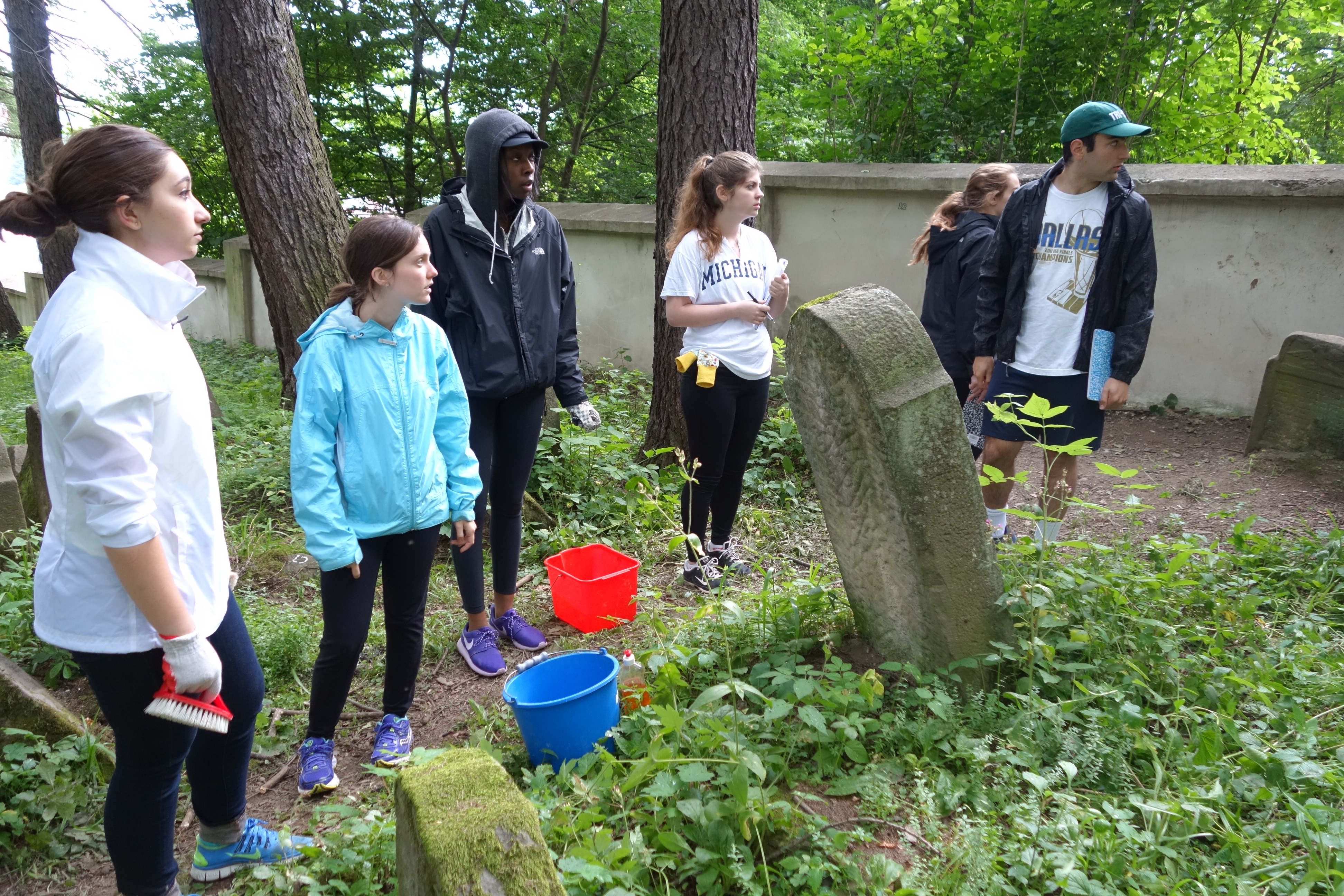
This year in Lesko, I chatted with the students before they began work and asked them what motivated them to sign up for the trip. About half were raised in Jewish households, some more reformed and some more conservative, while the rest were from a variety of backgrounds. Some grew up in neighborhoods with a lot of Jews, others with almost none. They had various levels of familiarity with the history of European Jews and the Holocaust. Some were interested in the project because they knew Holocaust survivors or because their own distant ancestors came from this part of the world. Others focused on the service component of the trip; they wanted to contribute to the preservation of Jewish culture. Still others expressed an interest in history.
The students were impressed by the age and charm of Krakow, although they weren’t so sure about some Polish food practices. It struck some as odd that normal life goes on in the Polish city of Oświęcim right next to the death camp of Auschwitz. They found the tour of the death camp was unsettling, though one student said reading about Holocaust history had a greater personal impact.

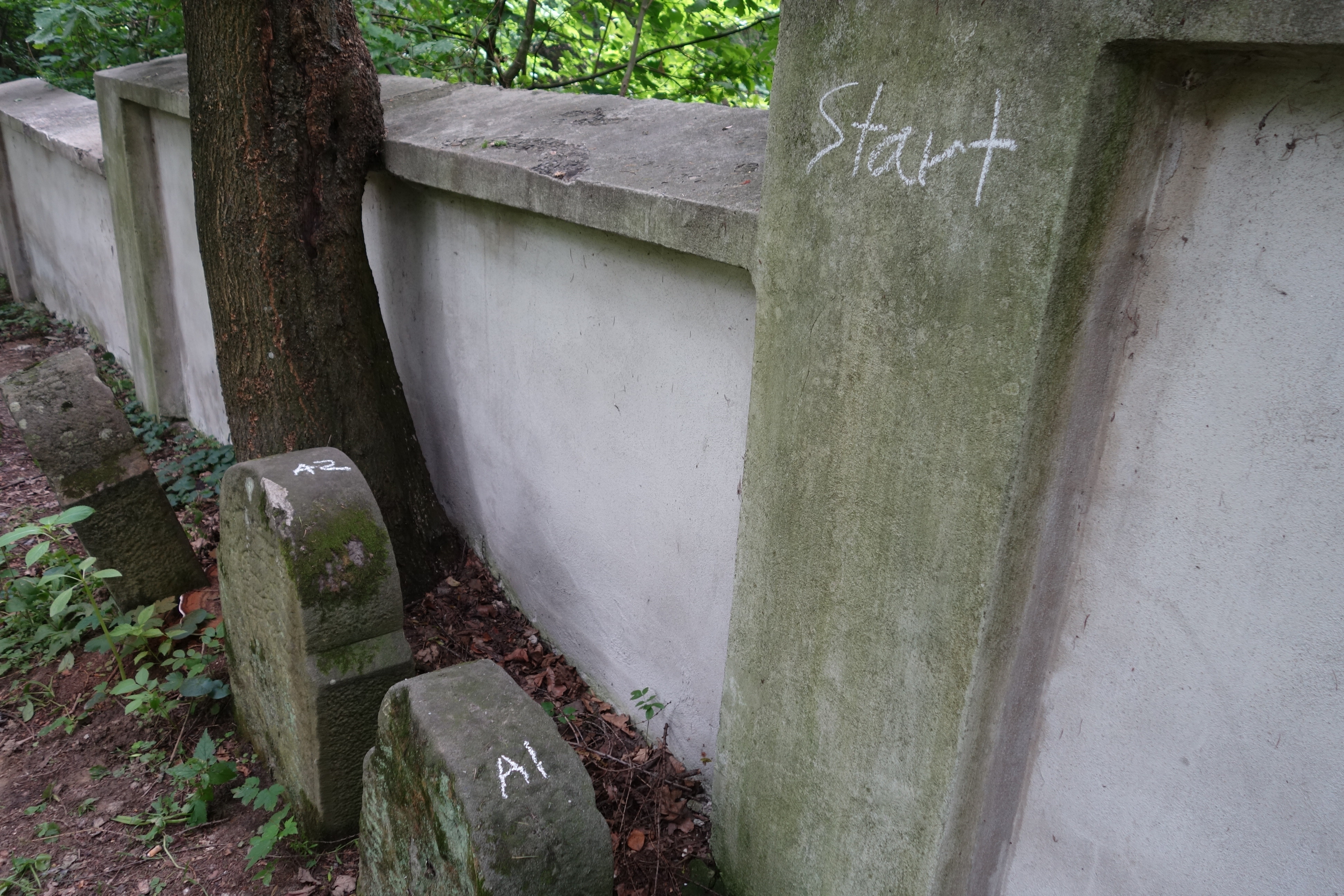
Start

Start

The students got started in the area of the cemetery with the densest concentration of tombstones. One began numbering the stones with chalk, DSC06897

Deciphering inscriptions

Deciphering inscriptions

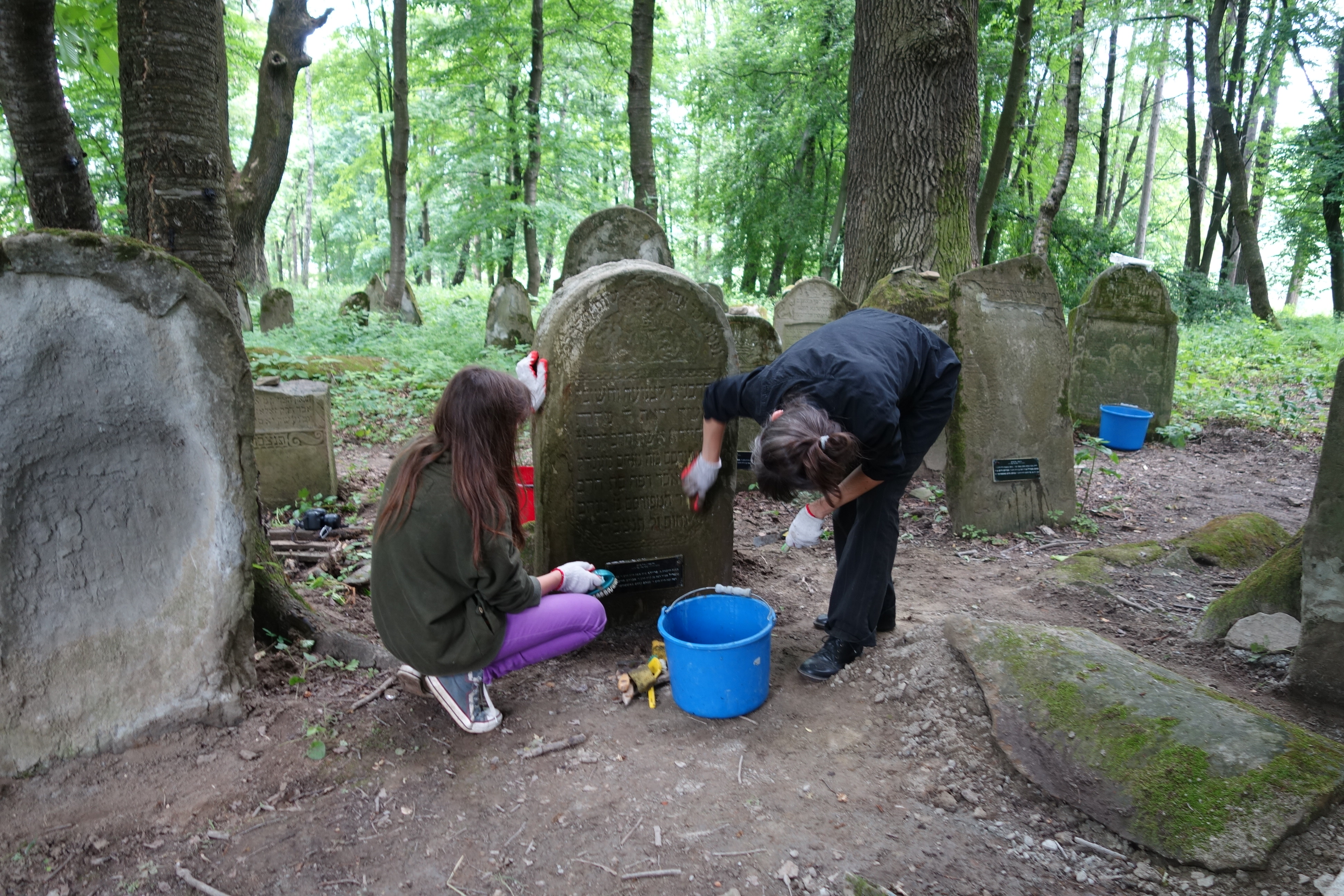
some set about photographing, transcribing, and translating inscriptions, others used soft brushes and water to gently clean the stones’ surfaces. DSC06895They had to be especially careful because most are of a soft sandstone which is prone to fracturing and wearing away. Many are covered with moss that provides a degree of protection but can also obscure the inscriptions. An additional complication is that some varieties of moss are endangered and protected, and thus not to be disturbed.

The Americans were joined by Poles—a woman who moved to the area from Warsaw with her two teenage daughters and another teenage girl. Some more local residents joined the group in the Lesko synagogue for the Shabbat service Friday afternoon (see mojelesko).
Local residents help clean the tombstones in Lesko

Local residents help clean the tombstones in Lesko

The Jewish cemetery in Lesko is the oldest and largest in the region. The earliest tombstone dates from 1548, and over 2000 stones remain on the site. It was one of the first places I was taken by a couple of local teens who showed me around town when I moved there in 1992. Nevertheless, the cemetery was talked about as a place to hang out with friends away from the scrutiny of adults. Little was known about the former Jewish population, and even less was discussed in public. I hope this is changing, even though (or perhaps because?) few witnesses remain of the prewar community and the removal and murder of Jews.

Grassroots heritage work in Bieszczady

21 Sunday Jun 2015

Posted by Marysia Galbraith in Cemeteries, Dukla, Heritage work, Lesko, Nazi Camps, Polish-Jewish relations, Pre-World War II, Sanok, Synagogues, World War II, Zasław

≈ 6 Comments

Tags

Bieszczady, Jewish culture and history

There is a pattern in the frequency (or rareness) of my posts. When I’m focused on other writing projects, I also write more for the blog. When I’m traveling, interviewing, and attending events, I write less. This month I’ve been traveling.

It seemed important to bring my new research focus to my old fieldsite, and see what is happening in relation to Jewish culture and history in the Bieszczady Mountain region.

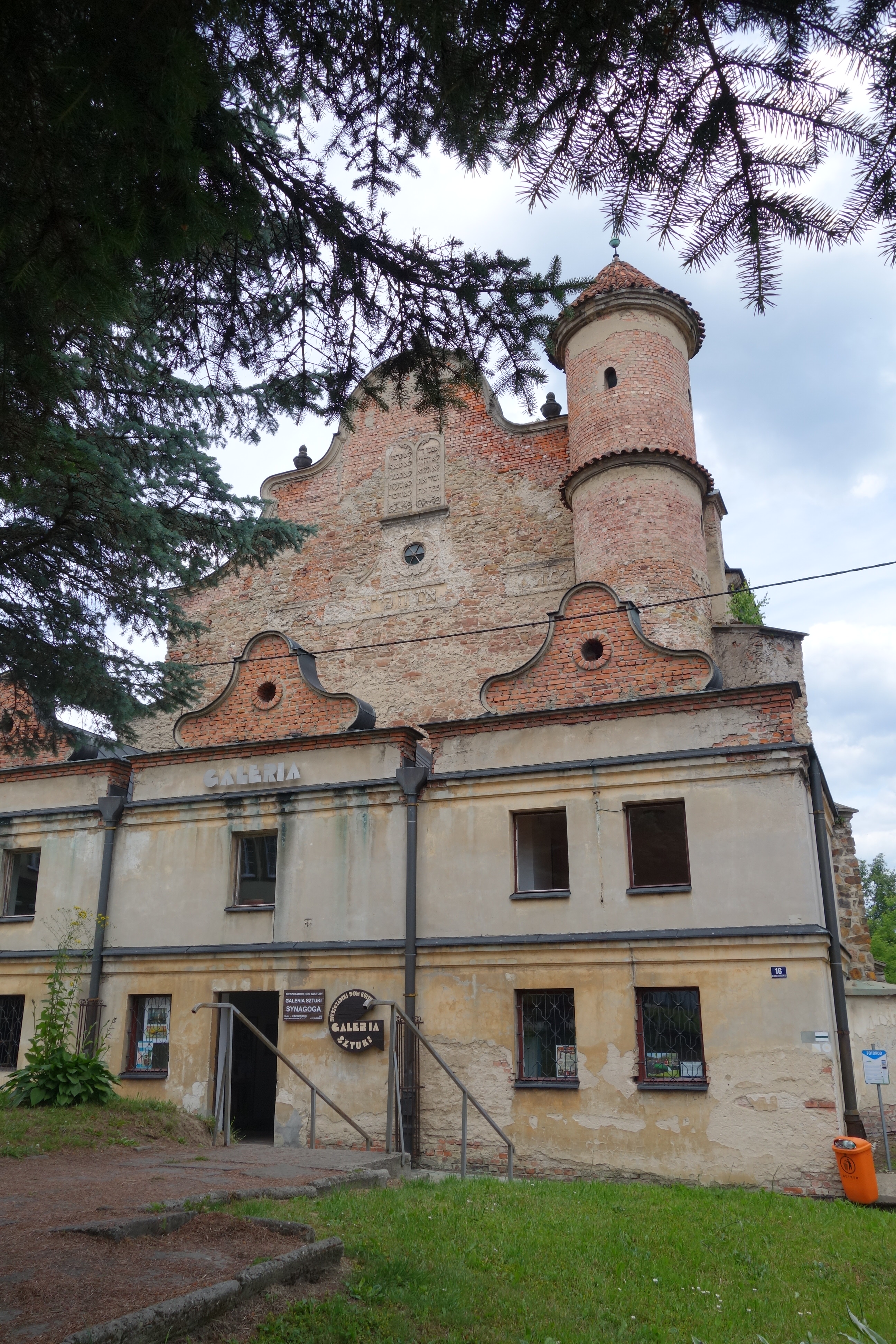
The Lesko synagogue. Destroyed in World War II, it was rebuilt in the 1960s.

The Lesko synagogue. Destroyed in World War II, it was rebuilt in the 1960s.

I’ve written elsewhere about how striking it is that, despite the fact that before World War II more Jews lived in Lesko than Poles, only very rarely have contemporary residents volunteered any information about the former Jewish residents. Even though I walked by the former synagogue (bigger than the Catholic Church) and the massive Jewish cemetery countless times, it really only sunk in to me last November that Lesko was a sztetl. One of my friends in Lesko described it really clearly. She said that somehow she always knew that the Jewish history of the town was something that you don’t talk about. It was a taboo topic. This has only recently started to change. Only in the past few years has she noticed that people talk about Jewish culture and history openly. She thinks this is a good thing. Realizing how little she knows about the subject, she has started to educate herself about prewar Jewish life and the Holocaust in Bieszczady.

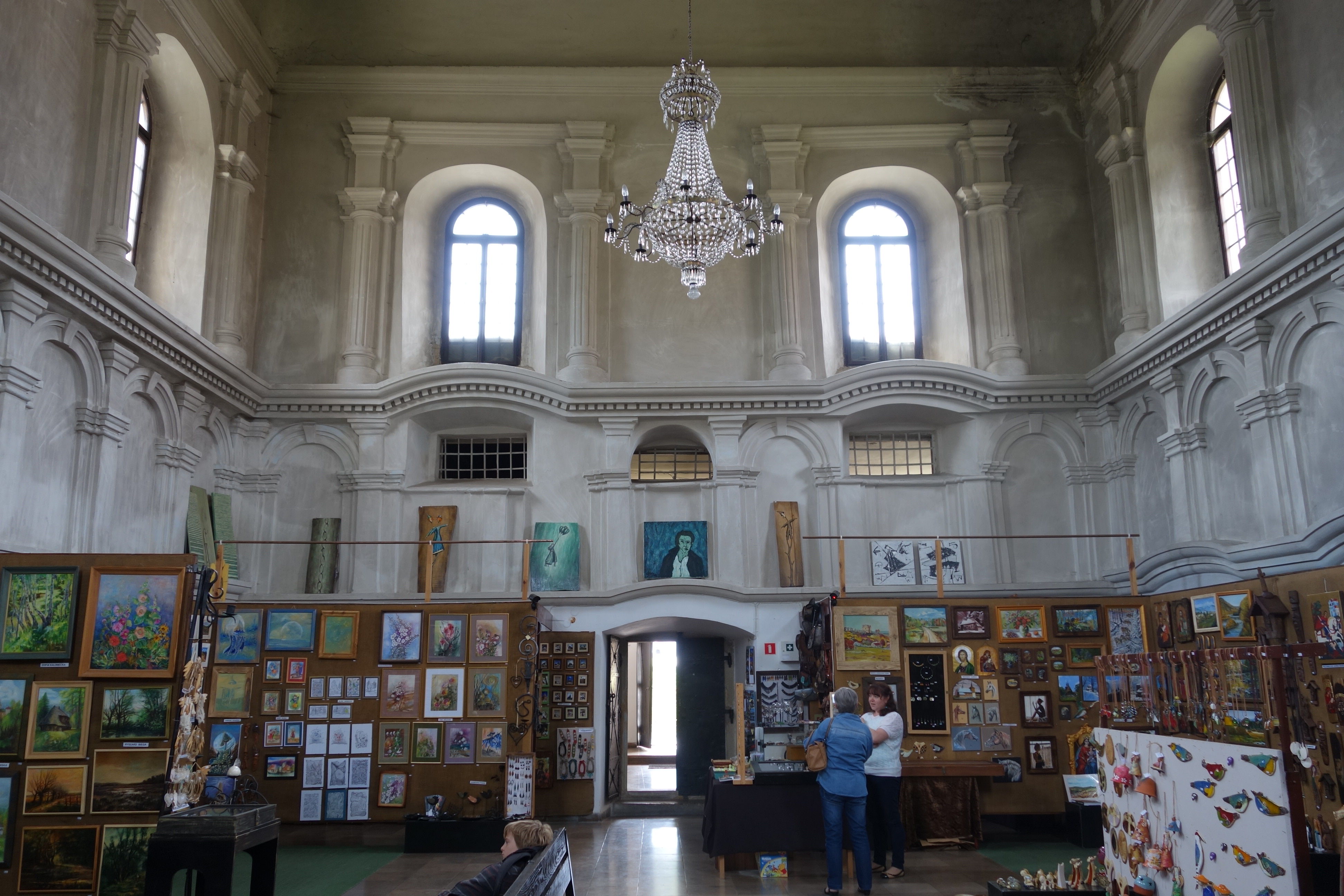
Interior of the Lesko Synagogue. Now owned by the town, it functions as a gallery of regional art.

Interior of the Lesko Synagogue. Now owned by the town, it functions as a gallery of regional art.

Generally, I have found that when I ask, most people have a story or two to tell about Jews in Bieszczady, either something they have read or a some fragmentary memory their grandmother told them. Though also when I told one friend about my interest in Jewish culture and history, she responded, “There were Jews in Bieszczady?” Even though she went to high school in Lesko, she only vaguely remembered the Jewish cemetery and had no recollection of the synagogue. Whether she really didn’t know or just continues to think this is a topic that polite people don’t talk about, I’m not sure.

Nevertheless, some important grass roots work is being done: by Arkadiusz (Arek) Komski in Sanok, Ewa Bryła and her brother Piotr in Zagórz, and Jacek Koszczan in Dukla. Arek is working on a dissertation about the Jews of Sanok. We met at the Słotki Domek Cafe in Lesko after he finished work, and then the next day he showed me the places associated with Jewish life in Sanok.

One of the former synagogues in Sanok

One of the former synagogues in Sanok

Commemorative marker, Sanok

Commemorative marker, Sanok

His interest in the topic originated with a curiosity about history, and particularly the history of his hometown. He has published articles about the Nazi work camp in neighboring Zasław and about the locks that were found at the Jewish cemetery. Last year, he realized a project to place a commemorative marker across the street from the former site of the great synagogue.

Arek also let me know that he was awaiting the arrival of a group of students from Dartmouth College, led by Rabbi Edward Boraz, who were going to clean up and inventory the tombstones in the Jewish cemetery in Lesko (see Project Preservation). He has helped them already, first when they came to the cemetery in Sanok, then to Ustrzyki Dolne, Korczyna, and last year to Lutowiska.

Through Arek, I met Ewa, who helped found the Stowarzyszenie Dziedzictwo Mniejszości Karpackich (Association for the Heritage of Carpathian Minorities). Arek joked that for Ewa, working on heritage preservation is a full time hobby. Her interest emerged out of her own Bojko/Ukrainian roots; her parents and grandparents spoke Ukrainian among themselves, though they only spoke Polish with her and her brother. To date, the association has helped clean up as many as thirty Uniate (Ukrainian) and Jewish cemeteries in the region.

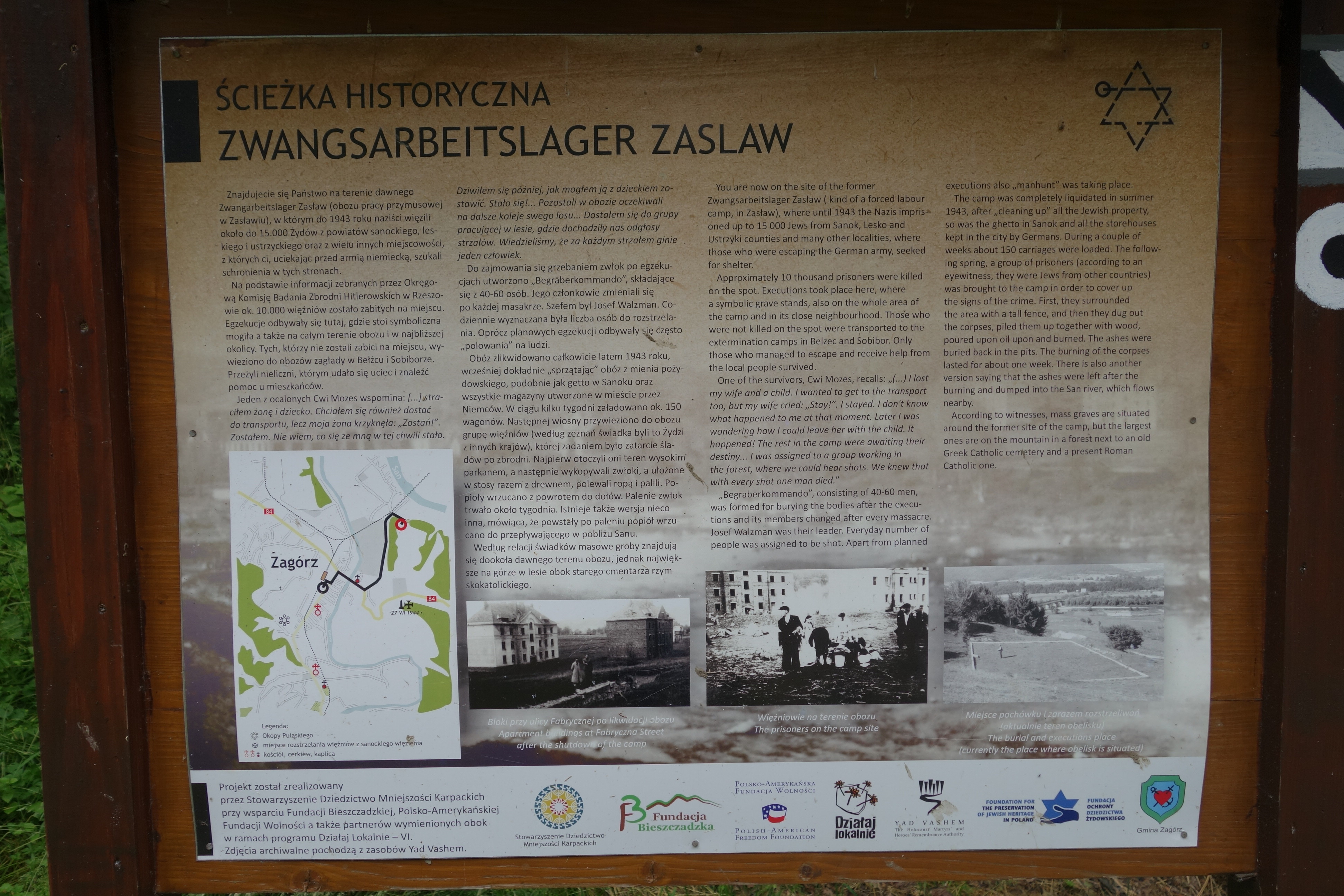
Information about the prison camp and murder of Bieszczady Jews in Zasław, near Zagórz

Information about the prison camp and murder of Bieszczady Jews in Zasław, near Zagórz

Another of the association’s projects is a heritage trail and information sign at the site of the Nazi work camp in Zasław. This is where most Jews from Lesko and neighboring communities were taken and forced to work at a neighboring factory. Approximately 10,000 prisoners were shot on the site, while perhaps 5,000 were sent to extermination camps at Belżec and Sobibor.

Monument at the site of mass murders in Zasław, near Zagórz

Monument at the site of mass murders in Zasław, near Zagórz

I stopped by Dukla on my way back to Krakow, and despite the rain Jacek and Ania, who works at the local tourist office, showed me around. Jacek had already started collecting Judaica around the time of his retirement from the border patrol. An infectiously upbeat and energetic man, he needed something to occupy himself and so decided to get to work protecting and publicizing the sites associated with Dukla’s prewar Jewish population. He told me that the town was as much as 80% Jewish. We walked by the former Jewish school, where boys learned various trades. It is across the street from the old government building; Jacek says that the associate mayor used to be selected from among the Jewish population. Similarly, most of the stone buildings around the market square (rynek) were owned by Jews. Jacek told me the fate of the last rabbi who hid under his rynek home, but then was caught and killed by the Nazis when he tried to escape to Krosno.

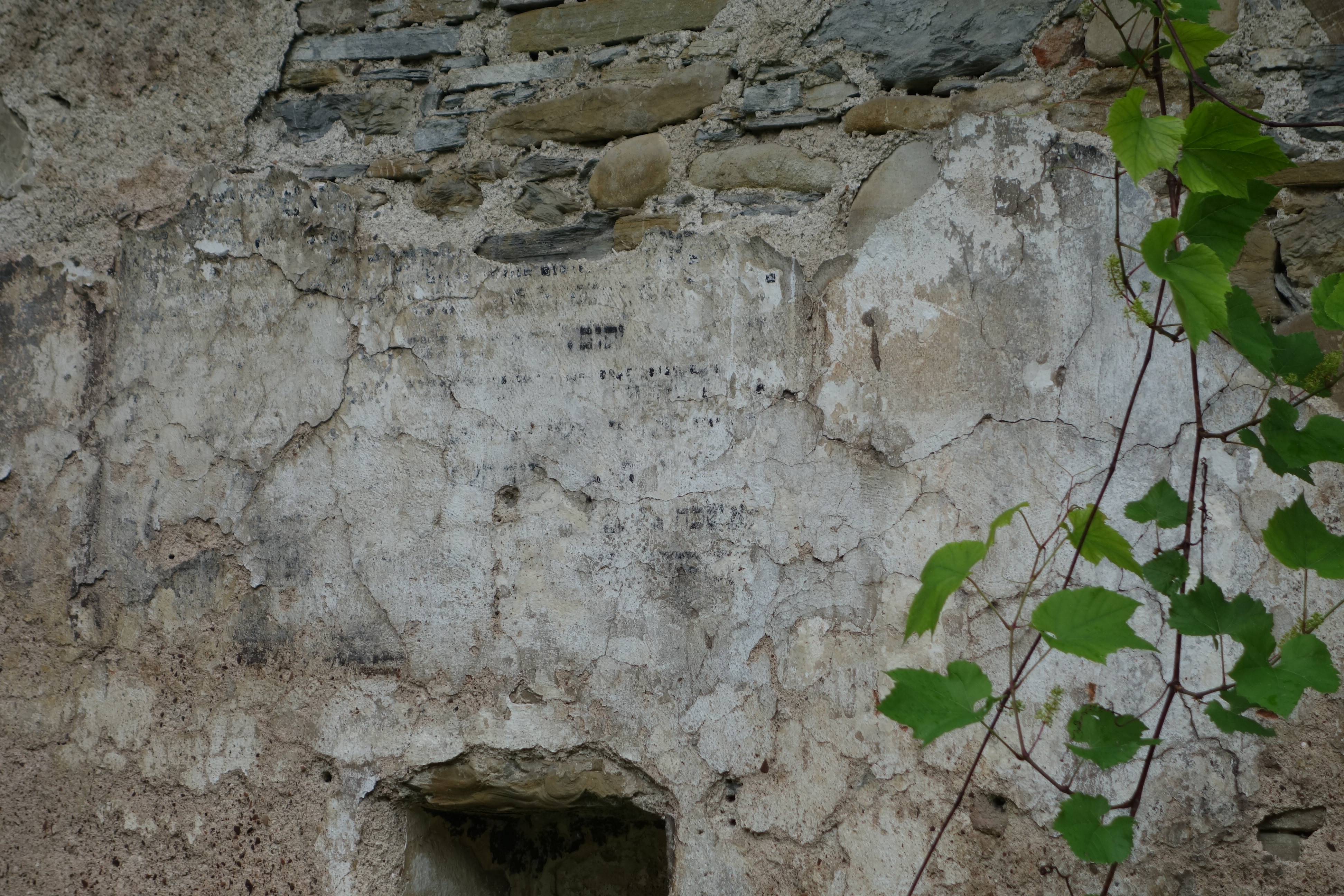
Writing still visible on the wall of the ruined synagogue in Dukla

Writing still visible on the wall of the ruined synagogue in Dukla

Ruin of the 18th century synagogue in Dukla

Ruin of the 18th century synagogue in Dukla


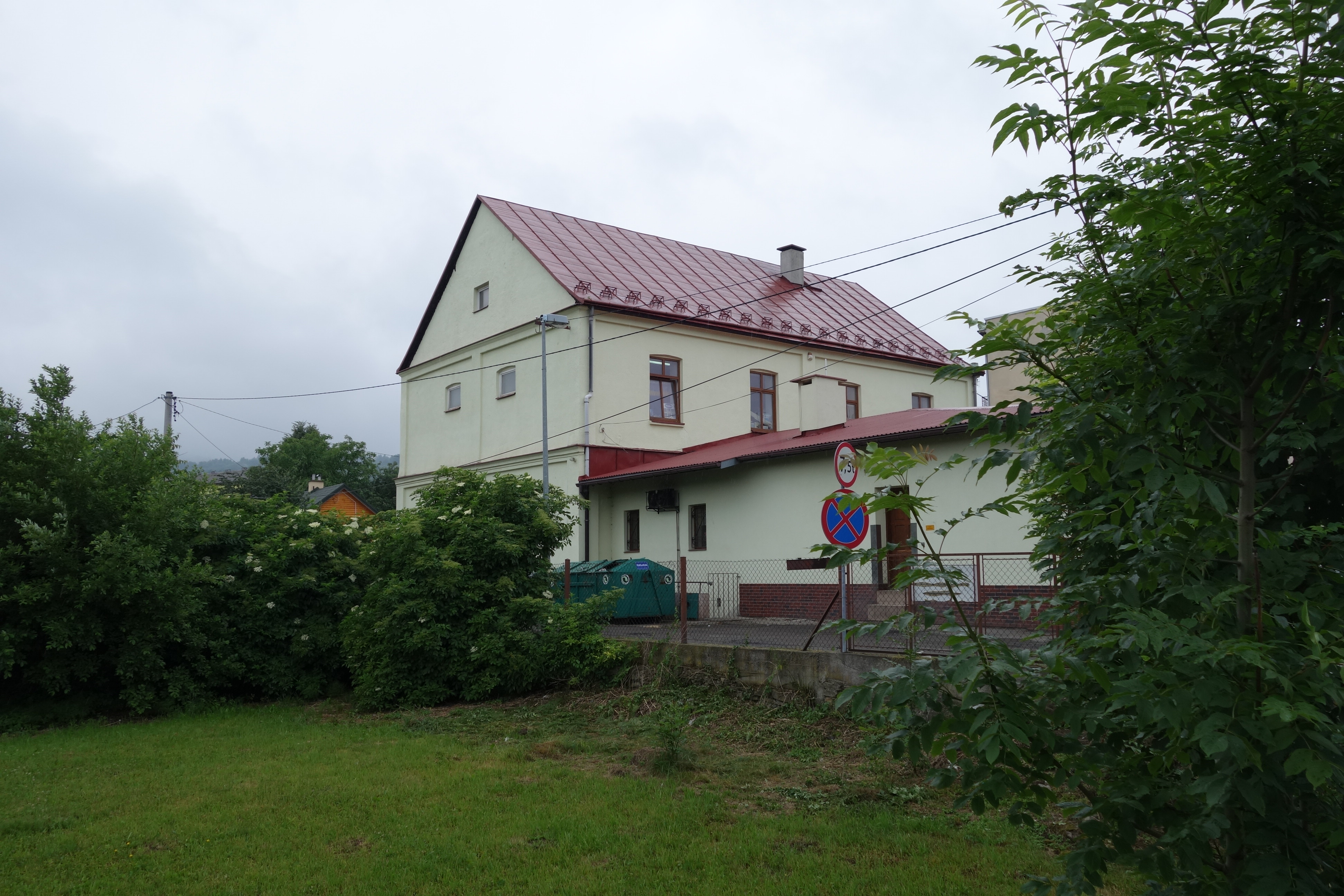
Former synagogue, now a grocery store in Dukla

Former synagogue, now a grocery store in Dukla

Two synagogues stood side by side. The one dating from the 18th century was burned by the Nazis with Jewish residents inside. The neighboring mykwa was also destroyed. Jacek would like to see the remains of this synagogue conserved. All it would take is reinforcing the window arches and putting in a platform on the inside for viewers to walk on; right now a chain link fence surrounds the site. The other synagogue, dating from the late 19th century, is now a grocery store. Dukla also has two Jewish cemeteries, the older one with burials up to World War I, and the newer one beside it used during the interwar period. Jacek mows them himself.

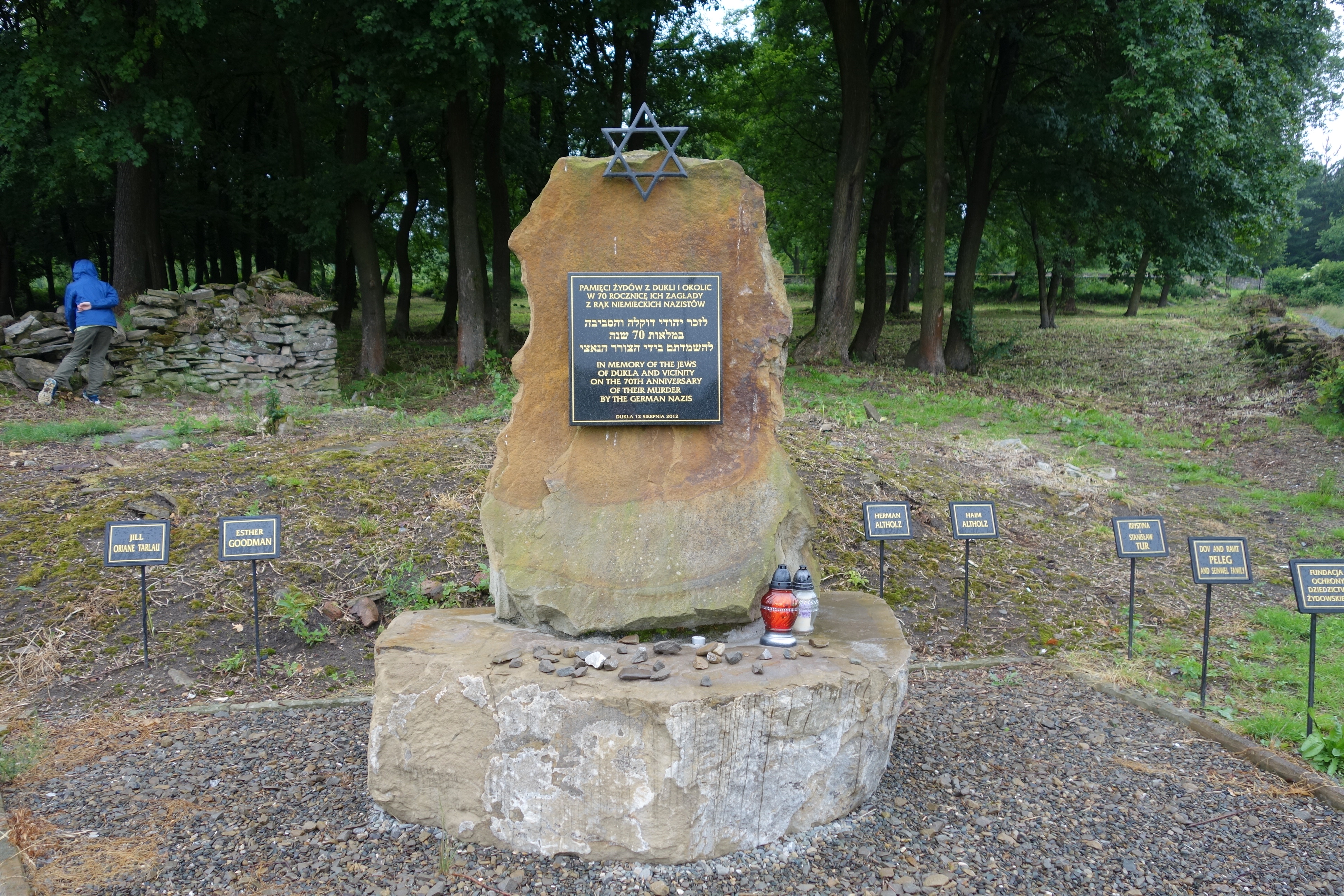
Jacek also coordinated the construction of a monument near the entrance of the old cemetery recognizing the 70th anniversary of the murder of Dukla’s Jewish population. Funders include the Foundation for the Preservation of Jewish Heritage (FODŻ) and descendants of former Jewish residents. While there have been many contributors to these various projects, Jacek is clearly the energy behind them, insuring that they are realized, and doing much of the physical labor himself.

Jacek reading a tombstone in the new Jewish cemetery, Dukla

Jacek reading a tombstone in the new Jewish cemetery, Dukla

Remembering the murder of Dukla's Jews

Remembering the murder of Dukla’s Jews

In each of these cases, someone (or several people) from the local community has taken the initiative to insure that Jewish culture and history is brought back into the public landscape. They are not Jewish themselves, but something compels them to remember, and to teach others about the former residents of their towns.

Commemorative monument in Piła

01 Monday Jun 2015

Posted by Marysia Galbraith in Cemeteries, Heritage work, Piła

≈ 2 Comments

The unveiling of the monument at the 17th century Jewish cemetery in Piła will be tomorrow (June 2) at 10 AM. The monument is on the grounds of the Police Academy, who funded the project together with the Piła City Council.

Cemetery monument in Piła, designed by Janusz Marciniak

Cemetery monument in Piła, designed by Janusz Marciniak

Poznan artist Janusz Marciniak designed the monument. He explains (and this comes from Samuel Gruber’s blog which includes a good description of the project):

“I tried to make the monument simple and minimalist in form, and at the same time full of content. The granite’s color is reminiscent of human ashes. The disc was mounted on a steel frame to create the impression that the star floats above the ground. The monument is an open book, which invites you to read. The top of the star was slightly raised  – according to tradition – facing east (towards Jerusalem). On its smooth surface, like a mirror, is reflected the sky and trees. Under the star is a concrete replica of its shadow. This is the basis of the monument and at the same time symbolic seal the memory of the people buried in this place and to emphasize the permanence of this memory.” 

The inscription reads in Polish, Hebrew, and English:

You are standing in a 17th century Jewish cemetery destroyed by the German Nazis during World War II

The dust returns to the earth from which it came and the spirit returns to God who gave it, Eccl. 12:7

As we remember, thus we shall be remembered

The monument was funded by the Piła commune and the Police School in Piła.

More in Polish about the monument is posted on the Police Academy website.

Wyspa pamięci

28 Thursday May 2015

Posted by Marysia Galbraith in Cemeteries, Heritage work, Memory, Piła

≈ 1 Comment

Here is an essay I prepared for the unveiling of a monument commemorating the 17th century jewish cemetery in Piła. It is part of a lecture I will give at the ceremony. Special thanks to Janusz Marciniak for his expert editing.

Monument to Piła Jews who died in World War I. Archival photo. http://www.kirkuty.xip.pl/pila.htm

Monument to Piła Jews who died in World War I. Archival photo. http://www.kirkuty.xip.pl/pila.htm

Co mówią przedmioty, a częściej już tylko fragmenty przedmiotów – okaleczone pamiątki z przeszłości? Jaką wartość mają resztki dawnego świata, materialne okruchy historii, która wydaje się nam coraz bardziej odległa i o której nie myślimy zbyt często z powodu naszych współczesnych trosk? Fragment zniszczonego w czasie wojny cmentarza żydowskiego przypomina nam o czasach pomyślności i harmonijnej koegzystencji mieszkańców Piły i jednocześnie o wydarzeniach, które jeszcze dziś budzą w nas trwogę i sprzeciw. Niepamięć można zrozumieć, bo pamięć bywa bolesna. Łatwiej patrzeć w przyszłość niż w przeszłość. Jednak rzeczywistość nie jest taka prosta. Coś nas łączy z przeszłością, szczególnie z tą tragiczną. Pamięć o niej działa w naszej podświadomości i ma na nas wpływ niezależnie od naszej woli.

One of the few traces remaining today--a fragment of the wall surrounding the Jewish Cemetery wall, Piła

One of the few traces remaining today–a fragment of the wall surrounding the Jewish Cemetery wall, Piła

Pomnik, taki jak ten na ocalonym fragmencie cmentarza żydowskiego w Pile, jest nie tylko wyrazem szacunku dla ludzi pochowanych w tym miejscu, lecz także narzędziem skupiania uwagi na tym, co było kiedyś i co już nie wróci, ale co teraz może służyć jako memento, ostrzeżenie, upomnienie i przestroga. Pomnik może nam pomagać w zachowaniu więzi z przeszłością i także z przyszłością. Nie można myśleć o przyszłości bez myślenia o przeszłości. Pomnik zachęca do poznania historii miasta i jego mieszkańców. Skłania do reflekcji nad fragmentem cmentarnego muru i kilkoma ocalonymi macewami. Prowadzi dialog z tym wszystkim, co pozostało z cmentarza. Także dialog z naturą, a zwłaszcza z najstarszymi drzewami, które są świadkami historii tego miejsca. Pomnik łączy ocalone fragmenty w większą całość i tworzy z nimi wyspę pamięci w centrum miasta. Ta wyspa pamięci uzmysławia nam stan naszej ludzkiej wrażliwości i czyni Piłę piękniejszym miastem, a jej dzisiejszych mieszkańców lepszymi ludźmi. Stojąc na zachowanym fragmencie cmentarza, wspominamy wszystkich mieszkańców dawnej Piły, którzy – tak jak my – mieli swoje troski i marzenia. Pamięć o nich może być źródłem dobra i nadziei.

Foundation of the monument, December 2014

Foundation of the monument, December 2014

Warto poznać i zrozumieć to, co było przed nami, żeby lepiej zrozumieć siebie. Sposób traktowania materialnych i niematerialnych fragmentów przeszłości miasta ma znaczenie dla tych, którzy obcują z nimi na co dzień, i dla tych, którzy patrzą na nie z daleka. Ważną grupą zainteresowanych przeszłością są ci, którzy szukają swojej tożsamości i korzeni.

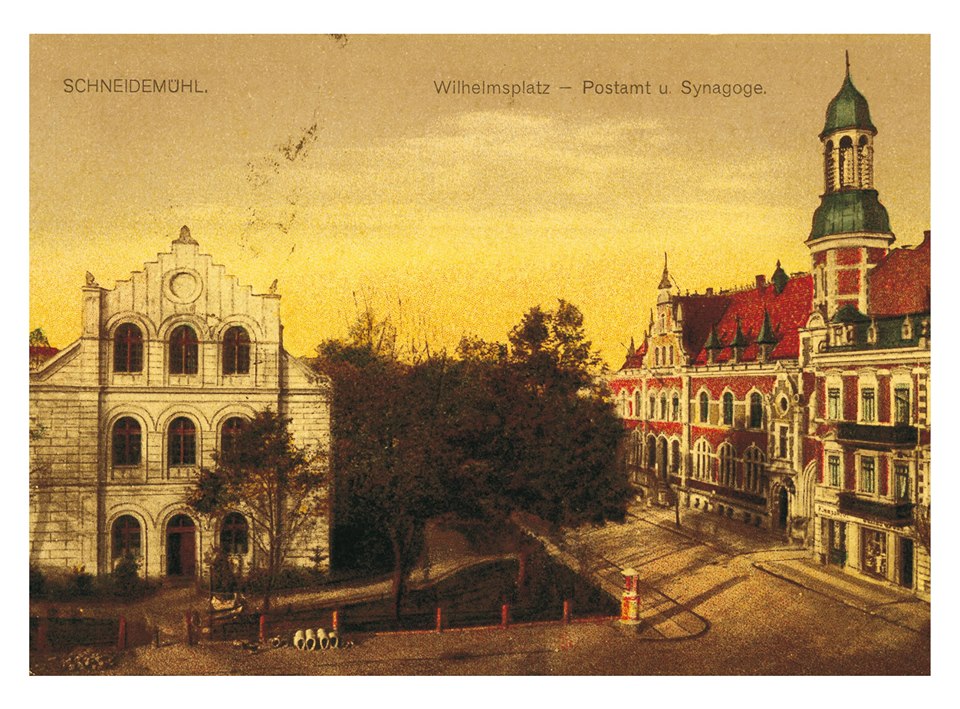
Postcard with the synagogue on the left. Piła was in the Prussian partition of Poland, and was also known as Schneidemühl.

Postcard with the synagogue on the left. Piła was in the Prussian partition of Poland, and was also known as Schneidemühl.

Book with photo of the synagogue on the cover held to show the approximate location of the  synagogue until it was destroyed in the Kristallnacht in 1938.

Book (History of the Jewish Community of Schneidemuhl– 1641 to the Holocaust by Peter Simonstein Cullman) with photo of the synagogue on the cover held to show the approximate location of the synagogue until it was destroyed in the Kristallnacht in 1938.

Kiedy słuchamy tego, co mówią do nas fragmenty przeszłości, to przeszłość ożywa. Fragmenty mówią do nas niezależnie od tego czy staramy się zapomnieć, czy pamiętać o niej. Czasami cudza niepamięć nas rani i zdarza się, że własna pamięć sprawia nam ból. Jest tak, kiedy zamykamy się przed przeszłością i nie chcemy jej zrozumieć. Dlatego lepiej pamiętać i starać się zrozumieć przeszłość oraz jej wpływ na nas. Tylko tak można leczyć traumę.

Inaczej wygląda i działa miejsce z pomnikiem niż bez pomnika. Pomnik wypełnia pustkę po stracie. Pustka może być interpretowana jako obojętność, brak szacunku, a nawet znak nienawiści. Pomnik zaś inspiruje do pracy pamięci i kontemplacji. Cmentarz wrócił na mapę miasta i do świadomości jego mieszkańców. Jest znowu miejscem skupienia i przeżywania straty, a równocześnie szacunku dla fenomenu życia. Nie jesteśmy sami. Odczuwamy znaczenie pamięci podobnie. Pamięć nas zbliża. Dzięki niej stanowimy wspólnotę, chociaż jesteśmy różni. Pamięć sprawia, że różnice nas nie dzielą, lecz łączą. Pamięć staje się podstawą nowych więzi społecznych.

I will post a photo of the completed monument after the unveiling on Tuesday, June 2.

← Older posts
Newer posts →

Categories

  • Anthropology (38)
    • Archives (14)
    • Fieldwork (7)
    • Ground Penetrating Radar (GPR (5)
    • Research Methodology (8)
  • antisemitism (14)
  • Association of Descendants of Jewish Central Poland (36)
  • Catholicism (8)
  • Conference (1)
  • Discrimination (2)
  • Family (71)
    • Bereda (19)
    • Kolski (13)
    • Piwko (22)
    • Rotblit (3)
    • Walfisz (4)
    • Winawer (7)
  • Genealogy (11)
  • Heritage work (70)
    • Commemoration (24)
  • Identity (18)
  • Israel (6)
  • Jewish Culture (93)
    • Cemeteries (55)
    • Museum (8)
    • Synagogues (34)
    • Torah (1)
  • Jewish immigrants (8)
  • Jewish Religion (1)
  • Memory (73)
  • Names (14)
  • Photographs (6)
  • Pifko-Winawer Circle (5)
  • Poland (131)
    • Baligród (1)
    • Bolimów (1)
    • Brześć Kujawski (5)
    • Buk (1)
    • Chodecz (1)
    • Dukla (2)
    • Dąbrowice (1)
    • Gdynia (1)
    • Gostynin (3)
    • Gąbin (1)
    • Izbica Kujawska (1)
    • Kazimierz (4)
    • Kowal (1)
    • Koło (1)
    • Krakow (7)
    • Krośniewice (1)
    • Kutno (9)
    • Kłodawa (1)
    • Lesko (8)
    • Leszno (1)
    • Lubień Kujawski (1)
    • Lubraniec (1)
    • Lutowiska (3)
    • Piła (3)
    • Podgórze (2)
    • Poznan (11)
    • Przemyśl (2)
    • Pzedecz (1)
    • Radom (1)
    • Radymno (1)
    • Sanok (1)
    • Skierniewice (5)
    • Sobota (2)
    • Tarnów (2)
    • Warsaw (23)
    • Wielkopolska (1)
    • Wronki (7)
    • Włocławek (20)
    • Zasław (2)
    • Łódź (1)
    • Żychlin (33)
  • Polish Culture (10)
  • Polish-Jewish Heritage (60)
  • Polish-Jewish relations (61)
  • Post-World War II (25)
  • Pre-World War II (22)
  • Reclaimed Property (1)
  • stereotypes (3)
  • Survival (9)
  • Trauma (3)
  • Uncategorized (5)
  • Victims and perpetrators (4)
  • World War II (47)
    • Jewish Ghetto (12)
    • Nazi Camps (6)
    • Polish Underground Army (3)
  • Yiddish (5)

Enter your email address to follow this blog and receive notifications of new posts by email. Your email address will not be shared.

Archives

  • July 2026 (1)
  • June 2026 (5)
  • May 2026 (1)
  • October 2025 (1)
  • July 2025 (8)
  • June 2025 (1)
  • April 2025 (1)
  • August 2024 (3)
  • July 2024 (3)
  • May 2024 (2)
  • April 2024 (1)
  • May 2023 (2)
  • January 2023 (2)
  • December 2022 (7)
  • November 2022 (2)
  • October 2022 (5)
  • September 2022 (1)
  • January 2022 (1)
  • August 2021 (1)
  • December 2020 (2)
  • July 2020 (1)
  • May 2020 (3)
  • April 2020 (1)
  • March 2020 (1)
  • January 2020 (2)
  • May 2019 (1)
  • February 2019 (1)
  • November 2018 (1)
  • September 2018 (1)
  • August 2018 (3)
  • July 2018 (1)
  • June 2018 (1)
  • May 2018 (1)
  • April 2018 (2)
  • March 2018 (2)
  • February 2018 (2)
  • January 2018 (2)
  • December 2017 (2)
  • November 2017 (2)
  • October 2017 (1)
  • September 2017 (3)
  • August 2017 (3)
  • June 2017 (2)
  • May 2017 (3)
  • April 2017 (1)
  • March 2017 (2)
  • February 2017 (1)
  • January 2017 (2)
  • December 2016 (2)
  • November 2016 (4)
  • October 2016 (1)
  • September 2016 (6)
  • August 2016 (2)
  • July 2016 (1)
  • May 2016 (4)
  • April 2016 (2)
  • March 2016 (3)
  • February 2016 (4)
  • January 2016 (3)
  • December 2015 (3)
  • November 2015 (5)
  • October 2015 (5)
  • September 2015 (3)
  • August 2015 (4)
  • July 2015 (3)
  • June 2015 (3)
  • May 2015 (4)
  • April 2015 (9)
  • March 2015 (3)
  • February 2015 (2)
  • January 2015 (5)
  • December 2014 (4)
  • November 2014 (9)
  • October 2014 (2)
  • September 2014 (1)

Copyright Notice

All original text and images are copyright © Marysia Galbraith. Please contact the author before quoting.

Blog at WordPress.com.

  • Subscribe Subscribed
    Uncovering Jewish Heritage
    Join 151 other subscribers

    Have a WordPress.com account? Log in now.

  • Uncovering Jewish Heritage
    View site in Reader
    Manage subscriptionsSign upLog in
    Report this content
    Collapse this bar
Loading Comments...