• About
  • The Photo that Started it All

Uncovering Jewish Heritage

Uncovering Jewish Heritage

Category Archives: Heritage work

Pavement of Memory

17 Tuesday Apr 2018

Posted by Marysia Galbraith in Cemeteries, Commemoration, Heritage work, Memory, Polish-Jewish Heritage, Poznan

≈ 1 Comment

Tags

Janusz Marciniak

“We recover history…we record history.”

That is what the Jewish Community of Poznan wrote when they announced a new memorial, “Pavement of Memory,” built with fragments of Jewish tombstones that were recovered during roadwork in Poznan.

1_Jewish Cemetery in Poznan

“Pavement of Memory” composed with fragments of matzevot (Jewish Tombstones), Poznan                            Source: Janusz Marciniak

When the road crew dug up the old pavement, they noticed some stones with strange writing on them. Realizing the letters were in Hebrew, they contacted the Jewish Community. The fragments are too small to make out names or details about whose tombstones they were, but at least they have returned to the cemetery where they belong. All over Poland, fragments like this are being found, out of place, reinforcing road beds, bridge foundations, and lake beds. They were harvested during the terror of the Nazi occupation, and sometimes afterwards under state socialism. With only ghosts to look over them, Jewish cemeteries became a source for scarce building materials.

The extraordinary thing is that when public spaces are designated as repositories of Jewish memory and culture, objects return to them. As cemeteries are cleaned up, fenced, and marked, tombstones come back. In some cases, it’s as if people have known for a long time about these objects. They felt they were out of place and it has sat uneasily on their minds. They are relieved to finally know where these objects should go. In others, as with this road project, people are surprised to find these fragments, but they feel a sense of obligation to honor the memory of the past. To put things back into place.

3_Jewish Cemetery in Poznan.JPG

“Pavement of Memory” at the memorial site in a corner of Poznan’s Jewish cemetery.

These fragments are back home on a wall in the corner of the Poznan Jewish Cemetery.

“Pavement of Memory” was designed by Janusz Marciniak, who also designed the memorial at the Jewish cemetery in Piła and did a series of installations in the Poznan synagogue when it still housed a swimming pool. Janusz’s design is simple and powerful, honoring the integrity of each fragment by hanging them in three rows of ten. And yet together, like a mosaic, they make a unified statement.

4_Jewish Cemetery in Poznan.JPG

Detail of macevot fragments in Pavement of Memory

The words on the memorial plaque, in Polish, Hebrew and English, read:

Był czas, kiedy z macew robiono bruk. Czas, w którym najdosłowniej rozbijano, deptano i kaleczono pamięć o ludziach pochowanych pod macewami. Niektóre z kamiennych okruchów tej pamięci przetrwały i dziś ta pamięć łączy się z wdzięcznością dla wszystkich, którzy przyczynili się do jej ocalenia. „Z owocu swoich ust nasycony będzie człowiek dobrem, a odpłacone mu będzie według tego, co zrobity jego rece” (Prz 12, 14).

הייתה עת שבה עשו ממצבות אבני מדרכת, עת שבה היו באופן ממשי מנתצים, רומסים ופוצעים את זכרם של האנשים הטמונים מתחת למצבות. אחדים מהשברים של אבני הזיכרון

אותן הזיכרון מתאחד שרדו, וכיום עם הכרת טובה לכל אלה שתרמו להצלתו. “מפְרִי פי־אישׁ יִשְׂבַּע־טוֹב וּגְמוּל יְדֵי־אָדָם יָשִׁיב לוֹ” (משלי י”נ יד).

There was a time when matzevot [Jewish tombstones] were used for pavement; a time when the memory of the people buried under the matzevot was most literally broken, trampled, and maimed. Some remnants have survived and today this memory is connected with the gratitude to those who contributed to its rescue. “A man shall be satisfied with good by the fruit of his mouth, and the doings of a man’s hands shall be rendered unto him” (Prov. 12:14).

6_Jewish Cemetery in Poznan.JPG

Bird on an old boulder tombstone in the corner of the Poznan Jewish Cemetery that has been designated as a memorial site.

Holocaust Remembrance Day in Włocławek

29 Monday Jan 2018

Posted by Marysia Galbraith in Cemeteries, Commemoration, Jewish Ghetto, Memory, Polish-Jewish relations, Włocławek

≈ 2 Comments

Tags

International Holocaust Remembrance Day, January 27

Thanks to Mirosława Stojak for all the work she does to preserve the memory of Jewish history and culture in Włocławek.

Here is a video from Holocaust Remembrance Day (January 27) when she and students and teachers from the Automotive High School visited the memorial at the site of the World War II Jewish ghetto, also the prewar Jewish cemetery.

Flim credit: Q4.pl, http://q4.pl/?id=17&news=170583

The interviews are in Polish, but even if you can’t understand the words, you can see that these people remember the Jewish history of their city. And they are passing on those memories to the next generation.  They lit candle lanterns in front of the commemorative monument, and the students placed pebbles upon which they had written words like “traditions,” “love,” and “memories.”

There’s more about Włocławek’s Jews on Ms. Stojak’s website Zydzi.Wloclawek.pl. The tagline of her site: “Ku pamięci, z nadzieją, na pojednanie,” “In memory, with hope, for reconciliation.”

Crossing Boarders

07 Thursday Sep 2017

Posted by Marysia Galbraith in Commemoration, Polish-Jewish Heritage, Polish-Jewish relations, Radom

≈ 1 Comment

Here’s a post from a heritage seeker on a similar quest to my own. She attended the commemoration of the 75th anniversary of the liquidation of the Radom ghetto, which took place in Radom last month.

radommusings1945's avatarRadom Musings

After a few weeks of decompression, I am finally able to sort through some of my feelings about last month’s commemoration ceremony in Radom.  At times solemn, while at other times celebratory, the event was a reflection of how present day Catholic Poles choose to confront Poland’s complicated relationship between Christians and Jews.

Poland’s internal and external struggles to reconcile its past were highlighted by the incongruity of a klezmer band playing music at the entrance of the Jewish cemetery, and by the reverence demonstrated when a Holocaust Survivor spoke about his fond pre-War memories, followed by a concert of a well-known Polish performer.  While one can say that this combination of somber commemoration and entertaining celebration reflects the merger of past and present, not all of us are ready for the journey.  Poland’s past has a long way to travel before it catches up to present day Jewry.  At…

View original post 287 more words

More Jewish Heritage Work in Kutno

26 Wednesday Apr 2017

Posted by Marysia Galbraith in Cemeteries, Heritage work, Jewish Culture, Jewish Ghetto, Kutno, Memory, Names, Polish-Jewish Heritage, Polish-Jewish relations, Synagogues, World War II

≈ 2 Comments

Tags

Friends of Kutno, Polin Museum, Reclaiming "Jew", Towarzystwo Przyjaciół Ziemi Kutnowski

This is part II about heritage work in Kutno. The first is Jewish History of Kutno.

While in Kutno, I visited the Society of Friends of Kutno (Towarzystwo Przyjaciół Ziemi Kutnowski). The organization has been active since the early 1970s, and has put out an annual periodical about local history and customs for about 20 years. Most issues of the publication contain an article about Jews. In 2016, these articles were compiled in a book along with other historical materials about Kutno’s Jews, including Holocaust witness reports and photographs, and a list of people who lived in the Kutno ghetto.

okladka zarys historii

Outline of the History of Kutno Area Jews, published by the Friends of Kutno

The chairwoman of the Friends of Kutno Bożena Gajewska is an energetic and upbeat woman. She accepted the position because of her interest in local history and her desire to promote that history among local residents. She isn’t paid for this; she volunteers for the organization after getting off work. The Friends of Kutno have their office in a historic wooden villa that was recently renovated by the city. Most of their funding comes from grants. Over the years, they have placed historical markers where the synagogue, Jewish cemetery, and ghetto used to be. Other recent projects related to Jewish culture include field trips for local residents to the Polin Museum in Warsaw, to a production of a Sholem Asch play at the Yiddish Theatre in Warsaw, and to the Chełmno Extermination Camp, where Kutno Jews were transported when the ghetto was liquidated. Kutno was selected as a site where the Museum on Wheels (a traveling branch of the Polin Museum of the History of Polish Jews) would visit; this happened in August 2016.

DSC08529

Marker reads, “In this place the 18th century synagogue stood. It was destroyed by the Nazis during World War II, evidence of the hatred of one human to another, and to his works.”

Pani Bożena says she’s noticed that orientations toward Jews have improved since the Polin Museum has opened. Thanks to the Museum, you can talk about Jews, whereas before, the word “Jew” had negative connotations, and was even used as an insult. This made people unsure what to call practitioners of the Jewish faith. Polin has helped to rehabilitate the term. While this may seem like a manifestation of the particularly fraught relationship between Poles and Jews, Mark Oppenheimer just published an opinion piece in the New York Times (Sunday, April 23, 2017, “Reclaiming ‘Jew’”) in which he notes that it’s the same in the US. “Jew” is almost never used as a noun; rather, the adjective “Jewish” is used, as in “Jewish people” or “I’m Jewish” (never “I’m a Jew”). Oppenheimer quotes the comedian Louis C. K. who called “Jew” a funny word “because ‘Jew’ is the only word that is the polite thing to call a group of people and a slur for the same group.”

The Polin Museum has also contributed to a surge of activity related to Jewish history and culture throughout Poland. This has led some townspeople to complain to the Friends of Kutno, “Why is everything always about Jews?” Bożena says she reminds these people that the Friends are interested in all aspects of regional history, and Jews were a part of that history. They address plenty of other topics, as well. For example, they recently published the biography of a native son who was an ultra nationalist during the period when the majority of Kutno residents were Jews (I can’t remember his name but maybe someone reading this can remind me).

Pani Bożena drove me to see some historical sites around town. The Jewish cemetery is on a hill overlooking a neighborhood of concrete apartment buildings. The hillside is covered with tall grass and wildflowers, and crisscrossed by dirt tracks where people walk their dogs, kids play, and people hang out. Many leave their trash behind. The Friends of Kutno recently put up signs around the cemetery that say “Here is the resting place of Kutno Jews, who settled in the city from the beginning of the 16th century. The cemetery located on this hill may have been established as early as the 16th century, also. Jews were buried here until March 1943. Please maintain its solemnity.” Below this historical information is the reminder, “Keep in mind as you go into this vast expanse that this is a cemetery; people are buried here, you walk on their graves, even though there are no longer tombstones…” Further, the sign states the cemetery is a registered monument and thus legally protected, and any vandalism is subject to a sentence of imprisonment. Nevertheless, within just a few months, four out of six such signs were vandalized. The metal poles were snapped at ground level. Bożena condemned the destruction, but also minimized it as the work of thoughtless hooligans (as opposed to a deliberately antisemitic act). In September, the poles were replaced and the signs stand once again.

Bożena showing me the new sign at the Jewish cemetery in Kutno
An older monument at the top of the cemetery hill

We passed people with dogs as we walked to the top of the hill to an older monument. It contains the same historical information as the new metal signs in Polish and Hebrew (but not the reminders about proper behavior and legal issues), and is shaped like two adjoining tombstones. Heading back down the hill, past some children playing, we saw the bases of some grave markers peaking out of the grass. Many tombstones were recovered and are stored at the Kutno Museum.

Bożena dreams of building a fence around the cemetery so there will be a more substantial barrier against further vandalism. They have received all the necessary approvals, but are in need of funding.

From the cemetery, we went on to the site of the ghetto, which is outside the center of town on the grounds of a former sugar factory. The factory was used by various industries after the war, but now is closed. The buildings, some dating from the late 19th century, stand behind a high fence and a guard patrols the site. Historic markers tell the story of the ghetto. A granite plaque reads:

Here on the terrain of the former Konstancja Sugar Factory

Germans established a ghetto for the Jewish population of Kutno and the surrounding area.

After its liquidation in 1942, the surviving Jews perished in the camp at Chelmno.

Honoring their memory, the People of Kutno.

Kutno, April 1993

A more recent sign contains a bit more historical information in both Polish and English (if you want to read it, click on the photo below to enlarge it).

Former site of the Kutno ghetto.
Wall plaque at the site of the Kutno ghetto
Historical marker in front of the main gate of the factory where the Kutno ghetto used to be.

Bożena told me that over 8000 people lived in the ghetto from 1940-1942. Those who got there first occupied all the most obvious places, so later arrivals had to build shacks from scrap wood, or find ways of populating balconies and any other inhabitable space throughout the large factory hall. In 1942, they were all transported to the camp at Chełmno by train (the tracks are right across the street from the factory) and by truck.

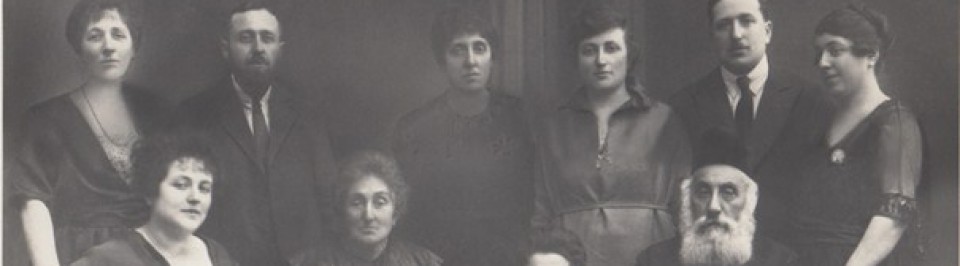
Thinking about the people I met in Kutno (and elsewhere), one thing I am trying to sort out is why Christian Poles get involved in Jewish heritage projects. Not surprisingly, the reasons are varied. One is interested in historical artifacts; he has no political agenda. Another of my companions tried to place this history into a more pro-Polish framework. He explained that the Nazis forced Christian townspeople to do horrible things as part of a strategy to damage relations between Poles and Jews. “All people really want is to live in peace (Chcą w spokoju żyć)”, he continued, “Poland is in the heart of Europe, a pretty terrain that has historically been attacked from all sides.” Others feel personally drawn to Jewish culture. One of my acquaintances in Kutno believes she has Jewish heritage. She seems to understand my quest for my own family history. “It’s important to know where you’re from,” she told me. She hasn’t found anything as concrete as my family photograph (the one I use at the top of the blog) to confirm her feeling that she has Jewish roots. All she can point to are allusions in family stories she remembers from childhood, and sometimes people have told her she looks Jewish. But anyone she could have asked has passed away.

But what’s clear from my visits to Kutno is that fragments of Jewish history remain, and some have been marked as such thanks to the efforts of a small group of residents who think it is important to include the stories of Kutno’s Jews in the history of their town.

Healing Collective Trauma: Jewish Heritage Work in Poland

18 Saturday Mar 2017

Posted by Marysia Galbraith in Cemeteries, Commemoration, Fieldwork, Heritage work, Memory, Polish-Jewish Heritage, Trauma, Wronki

≈ Leave a comment

Tags

affect, Aleida Assmann, collective memory, lapidarium in Wronki, Piotr Pojasek, Shadows of Trauma, Society for Psychological Anthropology Meeting

Healing Collective Trauma: Jewish Heritage Work in Poland is the title of the paper I presented at the Society for Psychological Anthropology Meeting in New Orleans on March 12. Here is the abstract I submitted:

The legacy of the Holocaust weighs heavily on Polish communities that were witness to unspeakable events. The paper examines how collective and personal trauma and recovery are intertwined, particularly in relation to Jewish heritage work in Poland. It emphasizes the affective engagement of heritage workers, most of whom are Catholic Poles, working on local projects intended to bring the history and culture of the community’s absent Jews back into the public sphere. Person-centered ethnography helps to reveal how participants talk about the work they do in relation to notions of self and society, and associated personal and social meanings. It further reveals their particular narratives about past and present relationships between Catholics and Jews in Poland, which they often pose as a challenge to the silences of the socialist era and the present-day reemergence of xenophobic nationalism. As members of the post-memory generation—they grew up with stories about former Jewish residents and the destruction of their communities, but they did not actually experience these events themselves—heritage workers are able to work towards reconciliation in ways that older generations could not. They have coming-of-age stories associated with the moment historical events became real to them, and their emotional distress about the past became the force that compelled them to do something about it in the present. Their personal narratives suggest motivation stems from the convergence of attachment to their native place, a sense of responsibility to those who are no longer present, and a desire to realize a more inclusive community that accepts past and present diversity within the Polish polity.

In memory of the Jewish community that inhabited Wronki from 1507-1939. Lapidarium of tombstones from the destroyed Jewish cemeteries of Wronki
Lapidarium of Jewish Tombstones, Wronki
Piotr Pojasek pointing to one of Wronki's Jewish cemeteries. Some pedestals of tombstones remain buried, as well as a large spruce tree that was planted when the cemetery was still functioning.
Piotr Pojasek pointing to one of Wronki’s Jewish cemeteries. Some pedestals of tombstones remain buried, as well as a large spruce tree that was planted when the cemetery was still functioning.

The paper starts with the story of Piotr Pojasek, who grew up in an old farmhouse near Wronki. From childhood, he knew that the curb on his street had been made out of Jewish tombstones during the Nazi occupation, but it was only as an adult that he really realized how wrong that was. And once he became engaged emotionally and morally, he knew he had to do something about it. It took many years, but in 2014, the lapidarium of the tombstones was completed. Applying the categories of memory as defined by Aleida Assmann, I use this case to explore how individual memories can shape social memory, and in turn national and cultural (collective) memory. The point is that individual connections to the past, as Piotr had through the uneasy presence of the tombstones outside his front door and the stories his father told him, are what compelled action. By collecting and sharing historical evidence and the stories of witnesses, social memory about the impact of the Holocaust grew, and developed a resonance for others. Eventually, a large coalition of local, national, and even international sponsors succeeded in building a public monument that revives and perpetuates collective memory of the Jews who lived there, of the inhuman circumstances of their death, and of the Polish citizens who recognize this as an important part of the history of their community.

Commonly, scholarship on collective memory focuses on public symbols and commemorative spaces, and has little to say about the transmission of meaning on the individual level. In my work, I am trying to show the relevance of individual memory workers and their personal engagement with the past as well as their local community. They are the ones who can bring things together, forging personal, affective links that make others care about far distant people and events.

Jewish history of Kutno

18 Saturday Feb 2017

Posted by Marysia Galbraith in Archives, Fieldwork, Heritage work, Jewish Culture, Kutno

≈ 10 Comments

Tags

Kutno Museum, Kutno Public Library

When I first visited Kutno in 2013, I only stopped for a few minutes on the way from Poznan to Warsaw. I had found a record of my great grandmother on JewishGen, and the original document from the 1860s was in the Kutno archive. I got there too late to see the record (the archive was about to close), but I spoke briefly with one of the archivists, and asked her if any traces of Kutno’s Jewish culture can be found today. She said she didn’t know of anything, except perhaps some fragments of tombstones in the municipal museum.

I returned to that museum in early 2015, and the director showed me their small display of Jewish artifacts.

Jewish candleholders in the Kutno Museum
Torah in the Kutno Museum
Fragment of a tombstone in Kutno Museum

Finally last summer, I met some people who have spent years documenting the history of Kutno’s Jews. It turns out a lot is going on. There is a biannual festival in honor of Sholem Asch, a highly regarded Yiddish writer who was from Kutno. There are also commemorative markers at a number of sites around town. And a book was just published—a collection of articles about the Jews of Kutno (Karol Koszada, Elżbieta Świątkowska, Bożena Gajewska, Zaryz Historii Żydów Ziemi Kutnowski, 2016, Kutno: Towarzystwo Przyjaciół Ziemi Kutnowskiej).

I’ve been to the archive a few times now, often enough to break through the reserve of the archivists a couple of times. One told me that school groups sometimes come to visit. “This is a good thing,” she told me “because youths need to know that heritage is not always as straightforward as some people make it out to be. Things change.” She also said that youth don’t necessarily value the past, but seeing the records in the archive helps them to connect with history.

At the Kutno public library, I met Andrzej Olewnik, a librarian with a deep interest in town history. He seemed delighted to meet someone who shared his interest; his whole face smiled as we talked. Pan Andrzej is also a collector, and finds documents associated with Kutno in auctions. He showed me old postcards and photos, including a photo taken in the Kutno ghetto during the Nazi occupation. He also showed me one of Sholem Asch’s business cards, given to him by Asch’s great grandson. He keeps these treasures in protective plastic covers, but slid them out so I could examine them more closely.

Sketch of Kutno synagogue, in Kutno Museum. My shadow reflection is on the far left.
Postcard of the Sugar Factory in Kutno
Passport application of Icek and Ruchla Holeman, 1865. In the collection of the Kutno Museum

The library has a collection of books about Kutno history. One features historic passport photos from the Kutno museum collection, many of which belonged to Jewish residents of the region. It turns out that the museum has other items related to Jewish culture they keep in storage. Some tombstones were found in a sidewalk and brought to the museum. The museum has them in storage, but took photographs of the inscriptions, which are in Yiddish and Hebrew. They are looking for someone to transcribe and translate them.

Another book Andrzej showed me was the Kutno Yizkor book. Yizkor books were compiled after World War II; in them, Jews who survived the Holocaust collected all the information they could about the Jewish population of their hometowns, including historic documents, demographic data, and personal accounts. This one was written in Hebrew—only some Yizkor books have been translated into English. Other books are by or about Sholem Asch, including precious Polish language translations of some of Asch’s plays.

Andrzej showed me digital photos of the prewar synagogue. It was right in the center of the street. Traffic would go around it on both sides. It had columns on one side, and the main entrance on the other. A map from the 1820s shows there was a long narrow green area in front of the building. Across the street from the synagogue there used to be the Jewish school, and behind that the ritual bathes. Andrzej had photos that were taken from the air showing synagogue’s destruction. First the roof was removed in 1940. Later, explosives were embedded in the pillars and the building was blown up.

Grażyna Baranowska, another librarian, organizes the Sholem Asch Festival which takes place every other year. It started as a literature contest, in which contestants competed for prizes for their original writing or their reading of literary texts. Then, it expanded into a culture festival. Next, an academic conference on the life and work of Sholem Asch was added. For the past two festivals, the great-grandson of Asch, David Mazower, has come from England. The next conference is in September 2017 and the festival is in October or November 2017. I’m trying to work out a way to attend this year.

Podgórze: Below the hill and through the ghetto

16 Monday Jan 2017

Posted by Marysia Galbraith in antisemitism, Commemoration, Jewish Ghetto, Krakow, Memory, Podgórze, Polish-Jewish relations, Post-World War II, Reclaimed Property, World War II

≈ 2 Comments

Tags

Ghetto Heroes Square, Plac Bohaterów Getta, Places of Holocaust Memory

When Krysia and I visited Poland a few years ago, we walked to her friend Wanda’s apartment in Podgórze, a district across the Vistula River from Krakow’s Old City. Historically, Podgórze was an industrial part of town, and also the site of the Jewish Ghetto during World War II. Until recently, this was not a particularly desirable place to live. I went there for the first time in 1986 when my Polish teacher invited me for dinner. She lived with her doctor husband and baby daughter on Limanowski Street in a ground floor apartment that was a converted storefront. The building was grey and crumbling, and the tram rumbled by loudly and frequently. They couldn’t wait to move somewhere better. In 1992, I met a high school student whose classmates joked he was “from the country” because he lived in Podgórze. Even though you could see Wawel Castle on the opposite shore of the river, Podgórze was considered a remote corner of the city.

I really discovered Podgórze in 2005 when I was back in Kraków for 5 months during my first sabbatical leave. I made a point of exploring all the city’s parks and playgrounds as a way of entertaining my two-year-old son; long afternoon walks were often the only way I could get him to nap. Podgórze charmed me. The buildings along the tramline on Limanowski Street were still grey and crumbling, but there was also a lovely triangular plaza and a beautiful church with a hillside rising up behind it. Maybe that’s the source of the name—Podgórze means “below the hill.” Climbing up the curving street from the plaza, large houses with fenced gardens replaced the apartment buildings, and then a massive park appeared on the right. And yet, despite these explorations, I still didn’t know that I had been moving in and out of the borders of the former ghetto, where the Nazis had forced Jews to live (and die).

Plaza and church in Podgórze
Heading up the hill
Heading up the hill
One of the large houses on the way to the park

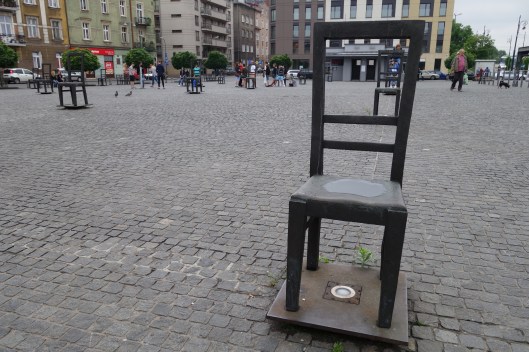
Wanda, a long-time resident of Podgórze, pointed out traces of that difficult era as we walked to her apartment. It was the first time I actually connected the contemporary streets of Podgórze with the places associated with the Holocaust. Just over the bridge, we entered Ghetto Heroes Square (Plac Bohaterów Getta), the site where Jews were assembled before being transported to work, the ghetto, or the camps. It wasn’t until December 2005 that a monument commemorating these historical events was installed. The monument is comprised of 33 large chairs arranged in rows throughout the plaza and 37 smaller chairs scattered around the edges of the square and at the nearby tram stop. These serve as a symbol of the people whose material possessions were taken from them as they were selected for the ghetto and elsewhere. The idea was “to tell the story of the place through the configuration of the urban space itself, so that the memory of the absent ones would be manifested through the presence of everyday objects which compose the urban furniture” (Bordas 2006). The chairs make an impression, especially the big ones. They look like they should be functional but they’re not–another way they symbolize the way ordinary life became abnormal.

Chair monument in Ghetto Heroes Square

Ghetto Heroes Square

Wanda led us to a nearby street where a fragment of the ghetto wall still stands. Its characteristic scalloped top makes it resemble side-by-side tombstones. Flowers rested at the foot of a historical marker, an offering made during a commemorative event in March. Wanda also pointed out where a gate of the ghetto used to cross the street near her apartment. For 23 years, Wanda lived on that street. But then the prewar owners—Jews—regained ownership of the property and doubled the rent. Faced with the option of paying 2000 zloties per month or move, Wanda decided it would be better to invest that kind of money in a place she could own herself. That way, she doesn’t have to worry about being displaced again.

Like many Poles, Wanda feels personally affronted by former owners reasserting their claim over property. These feelings are complicated.

It seems only right that descendants of victims of the Holocaust be compensated. Regaining ownership of a building can only to the slightest degree address what those families lost.

And yet, losing their home to the prewar owner seems particularly unfair to the generation that endured years of communism, and never was able to accumulate much wealth in their own lives. Since the end of communism, prices have risen, unemployment has become common, and wages remain modest. Often it’s the poorest residents who live in former homes of Jews because the government took over their management and made them into low-cost housing for those in greatest need. This affordable housing was a small oasis of security in unsettled times. Many such residents today are elderly; others are unemployed; some have problems with their health or with substance abuse. They don’t have many options.

Wanda was one of the lucky ones with the wherewithal and the financial means to buy her own place. But still she carries the resentment with her that she sometimes translates into resentment of Jews more generally. Who was looking out for her rights when the apartment was returned to the prewar owners? What did some rich foreigner need with her building? Why should they get even wealthier at her expense?

In fact, prewar owners are reclaiming properties all over Poland, and even though they are not all Jewish, the greatest resentment is directed toward those who are.

Ghetto Memory Trail marker
Star of David crossed out--on a storefront in Podgórze
Star of David crossed out–on a storefront in Podgórze

In Podgórze, you can see both the effort to acknowledge sites of Jewish heritage, and also signs of continued antisemitism.

Wanda loves her neighborhood and doesn’t want to live anywhere else (even though she has to spend part of each year in the US to earn enough money to pay her mortgage). The apartment she lives in now is new construction on top of a historic townhouse; an additional floor was added to an existing building. As we climbed the three flights of stairs, she explained that when she bought the place, all that was there were the bare walls. This is standard practice in Poland. The buyer has to select, purchase, and install all the flooring, fixtures, wall coverings cabinets, and appliances. The apartment is long and narrow, with a wall of windows and a sleeping loft. Wanda said she bought it at the peak of the market; today she could find something for half that price. But that would mean moving again.

As we ate a generous spread of Polish dishes, including stuffed cabbage (gołąbki) and two kinds of pickles, Wanda said that Podgórze has become one of the most popular neighborhoods in Krakow. The new heritage sites and museums—including the Ghetto Heroes Square, the Schindler Factory Museum, and the Museum of Modern Art—have brought with them tourists and the amenities that tourists expect. People are moving out of the center of the city because it has become too crowded, cars are restricted on most streets, there are few stores with everyday necessities, and the prices are too high. Podgórze is desirable because it has good public transportation, is within walking distance of the city center, and because of the park, the trees, and the hill that I find so appealing.

OLYMPUS DIGITAL CAMERA

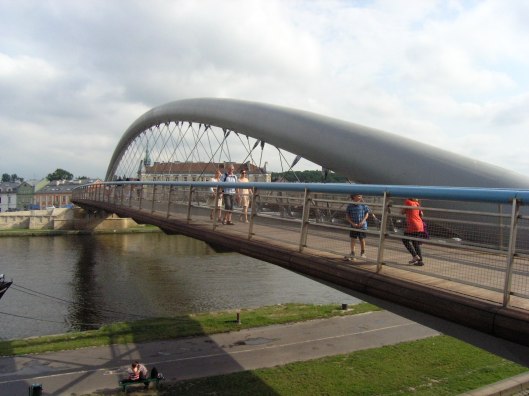
The new pedestrian bridge across the Vistula River to Podgórze.

Poles Remember

01 Tuesday Nov 2016

Posted by Marysia Galbraith in Catholicism, Cemeteries, Commemoration, Dukla, Memory, Polish Culture, Polish-Jewish Heritage, Polish-Jewish relations

≈ Leave a comment

Tags

All Saints Day

Today is the Catholic holiday, All Saints Day, the time to honor the dead. Customarily, Poles visit cemeteries to clean and decorate the graves of their family members. During the day, chrysanthemums in all shades adorn tombstones. At night, candle lanterns on graves make the cemeteries glow. Twinkling hillsides can be seen from far away.

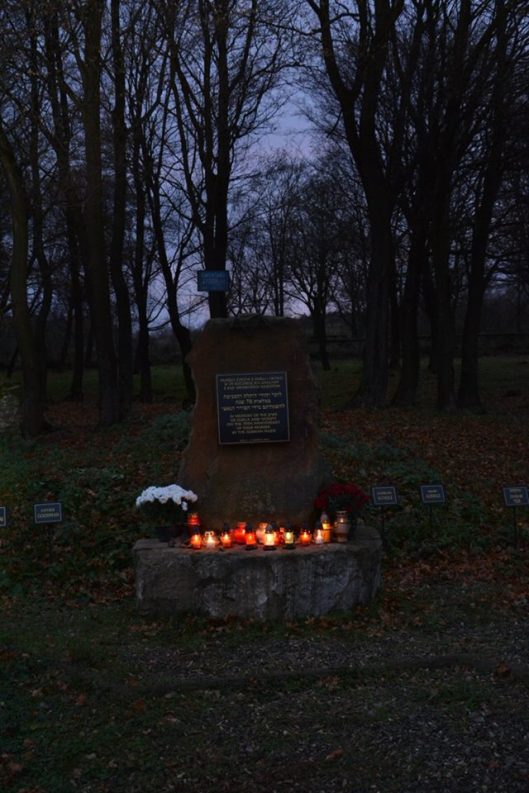
I’m pleased to see that some Poles also remember Poland’s now-absent Jewish population on November 1. I’ve seen this in Warsaw and in Lutowiska. And here is a photo Jacek Koszczan posted on Facebook today showing the candle lanterns on the commemorative monument at the town of Dukla’s Jewish cemetery.

Candle lanterns on the monument commemorating Dukla's Jewish population, November 1, 2016, All Saint's Day.

Candle lanterns on the monument commemorating Dukla’s Jewish population, November 1, 2016, All Saint’s Day.

He and other citizens of Dukla made the trip out to the cemetery to light a candle for the dead. In this, I see an expression of honor that transcends religious difference.

Jacek has done a great deal to reassemble the memory of Jewish life in Dukla. In fact, he was honored last month by the Polin Museum for his work. The Polin website explains, “Jacek Koszczan is the founder and director of the Organization for the Preservation of Jewish Heritage in the Dukla Region–Dukla Shtetl. His work involves both obtaining and archiving knowledge about the Jews of Dukla and its surroundings, as well as educational activities. Jacek Koszczan is the initiator and builder of a monument commemorating the 70th anniversary of the murder of Dukla’s Jews, the volunteer caretaker of the Jewish cemeteries, mass grave, as well as the ruins of the Dukla synagogue. Thanks to his efforts and knowledge, he succeeded in facilitating the honoring of two Dukla-region families with the medal for the Righteous among Nations.”

Jacek Koszczan receiving his award from the Polin Museum for his work on Jewish heritage in Dukla, October 21, 2016. Photo by Janusz Czamarski

Jacek Koszczan receiving his award from the Polin Museum for his work on Jewish heritage in Dukla, October 21, 2016. Photo by Janusz Czamarski

All in all, Jacek has been instrumental in the return of the memory of Jews to his community. I have been impressed by his energy, enthusiasm, and generosity. For him, this is a labor of love–for his community, for the memory of those who suffered, and for humanity in the face of evil.

Two Bottles of Vodka

19 Monday Sep 2016

Posted by Marysia Galbraith in Heritage work, Jewish Culture, Memory, Polish-Jewish relations, Post-World War II, Survival, Włocławek, Żychlin

≈ Leave a comment

Two times over the course of my visit to Żychlin, my host Henryk told me a story about a young Jewish boy who survived the war and returned to the town to collect his family’s jewels. A bad Pole threatened the boy’s life unless he showed him where the valuables were hidden. The frightened boy showed him. They sat down at a table and for each one item the bad Pole gave the boy, he took several for himself. The boy took out a roll of money and offered to buy the jewelry. Then, the brother of the bad Pole came in and saw what was going on. He told his brother, “Here, I have two bottles of vodka. We’ll drink together.” Then he gave the boy all his money and jewels back.

The story made an impression on Henryk. He said a woman from Włocławek had told it to him. Because they were talking on the phone, he didn’t want her to tell him the real names of the men. He wants to save it for when they meet in person. That kind of information is better shared face-to-face. The second time he told me this story, it occurred to me I might know the woman he had spoken with. Indeed, it turned out that it was Mirosława Stojak, who has made it her personal quest to learn all she can about Włocławek Jews. Henryk promptly called Mira so we could talk. I met Mira during my first visit to Włocławek in 2014, and then again when I was there in June.

Mira uses her talents as a poet, writer, and actress to share the stories of Włocławek Jews. In her book Utkane Sercem Włocławskim Żydom, she includes the story that so captivated Henryk, called “Two Bottles of Vodka.” Here is the translation of the story:

Two Bottles of Vodka

Utkane Sercem Włocławskim Żydom by Mirosława StojakWinter 1946 was cold. All around, snow covered homes, roads, and trees. Long icicles hung from the roofs. On a January afternoon, Ariel came on the snowy road to the home of his relatives. Before the war, together with his sisters, he was there a few times. During his last visit in 1939 Ariel’s father, a merchant from Żychlin, knew that soon Germans would attack Poland militarily. Sixteen-year-old Ariel, a short boy, emaciated after the experience of the camp, walked pensively listening to the scrape of his creaking shoes. In his ears rang what his father once told him:
“You have to save yourself, and whoever survives should return here…”

He knew perfectly well that his visit would not be viewed happily by the new owners of the house. He was even afraid that he would be treated poorly. He wasn’t sure, either, if the home still stood, or if it was bombed during the war. He hoped not. He walked slowly, every once in a while touching an icy rock. He passed ruins of houses and ashes, people shoveled snow. He heard dogs barking. Before the war he loved dogs, and they even had two beautiful German shepherds at home. Now, they reminded him of scenes from the camp and he was horribly afraid of them. In Auschwitz they were trained to murder. Ariel picked up his pace. Soon the sun would set and it would be dark. After a while, he saw the home of his uncles and aunts, who didn’t much care for visitors during the war. Fearfully, he knocked on the door. A young man stood before him, tall and well built. He had an unfriendly expression on his face, as if he had been expecting him. With his strong hand, he pulled Ariel inside, shutting the door, and yelled,

“Where is it?”

The frightened Jew led him down the stairs to the basement, and then the “brute” pushed him against a wall and demanded he say where the treasure is. A few strikes of a hammer against a wall and in the hands of his “captor” appeared a casket. Now, the boy was led upstairs and into the kitchen. The man grabbed his shirt and sat him on a chair at the table, then sat down across from him and opened the box. Inside was the ancestral jewelry of Ariel’s family. There were brilliantly shiny rings, broaches, and necklaces. Taking the valuables out of the casket, the man put them on the table, between himself and Ariel, loudly counting:

“Mine, mine, yours, mine, mine, mine, yours, mine, mine…”

When he finished, there were just three family heirlooms in front of Ariel. Tears appeared in his eyes. They reminded him of his mother, who always wore a string of white pearls around her neck when she went to synagogue. Now they lay in front of him on the table awaiting their verdict. The boy slowly reached into his pocket and pulled out a role of banknotes, explaining that for him the jewelry has sentimental value for his family and he would gladly buy them back. The “brute,” without thinking, took all the valuables lying on the table for himself, and in a deep resonant voice called out,

“Józek!”

In the kitchen doorway appeared a “man like an oak,” big and broad-shouldered, who asked contemptuously,

“What?” and looked at the table.

The brute moved aside, his eyes not leaving the valuables. Józek who was much older was supposed to settle the matter. Ariel began quickly explaining, persuading him to agree to his proposition to buy the jewelry. He asked Józek to take the money and give back the valuables and then everyone would be satisfied. Józek thought; he silently looked at the young Jew and the table with an appraising eye. Frightened, Ariel imagined them closing him in the basement and starving him, or God forbid, murdering him. Wouldn’t it be ironic to die here and now, after he had the good fortune to miss death at the hands of the Nazis? After a while, Józek broke the silence, yelling:

“Karol!”

A boy who was perhaps eight years old came into the kitchen. Freckled, with wavy hair and an intelligent look. From the pile of money lying on the table, Józek took one bill, gave it to the boy and told him:

“Go and buy two bottles of vodka.”

The boy, like a shot, ran from the cottage. Józek pushed the jewelry and money in the direction of Arial and said:

“Take it and go!”

Ariel ran as fast as his legs would take him. It was a marathon. He didn’t even touch the rock; he didn’t hear the barking dogs. He sped ahead with all the strength in his legs, not looking back. When he got to the station, the train stood ready for departure.

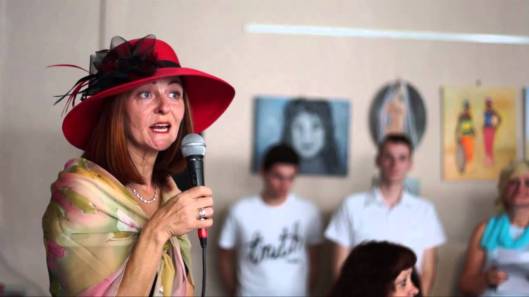
Mirosława Stojak recounting stories about Włocławek Jews, October 1, 2015

Mirosława Stojak recounting stories about Włocławek Jews, October 1, 2015

Mirka told me she met the boy from the story when he visited Włocławek (now of course, he’s an elderly man). His wife wore some beautiful jewelry; she doesn’t know if these were pieces he recovered, but it is nice to think that they were. At his request, she changed all the names when she wrote down the story. Nor did she write about the further misfortunes the boy experienced before he found his way to safety in Israel. I won’t either—the most important thing is that he survived.

Włocławek’s Forgotten Street: The Street of Death (Ulica Śmierci)

04 Thursday Aug 2016

Posted by Marysia Galbraith in Heritage work, Memory, Polish-Jewish Heritage, Synagogues, World War II, Wronki, Włocławek

≈ 4 Comments

Tags

Facebook Fan Page, Memory for the Future, Miejsce Pamięci Zagłady Blisko Nas, Pamięć dla Przyszłości, Places of Holocaust Memory Near Us, Włocławek’s Forgotten Street, Włocławska Zapomniana Ulica

“Here and then” (“Tu i wtedy”)…that was the recurring line in Deputy Mayor Robert Dorna’s speech at the unveiling of the lapidarium in the Jewish cemetery in Wronki in December 2014. He linked the place we were standing (tu—here) to various moments in history (wtedy—then).

This could be an apt description of many of the heritage projects I have observed. They are efforts to gather together the fragments that can be recovered, and to reassemble them so they bring back to everyday landscapes the memories of multiple historical events in the lives of former Jewish residents. Seeing the past in the present has also been the touchstone of my recent trip to Poland. Everywhere, it seemed I was walking through streets as they look today, and at the same time carrying envisioning the way they looked back then (wtedy). Linking a particular place concretely to its past was also the goal of the contest that led the students and teachers at the Automotive High School in Włocławek (Zespół Szkół Samochodowych im. Tadeusza Kościuszki) to develop their Facebook “fan page” Włocławek’s Forgotten Street (Włocławska Zapomniana Ulica). They decided to focus on Piwna Street, which despite its small size (just two blocks long) became a focal point for viewing Jewish life and death in this city.

Screen Shot 2016-08-04 at 12.05.30 PM

Włocławska Zapomniana Ulica–the Facebook fanpage documenting the history of Włocławek’s Jews, on Piwna Street and beyond.

For thirteen years, the program “Memory for the Future” (“Pamięć dla Przyszłości”) has held annual contests for middle and high school students, challenging them to explore some aspect of Holocaust history. Initiated by the Association of Children of the Holocaust in Poland, and joined in recent years by the Polin Museum, Jewish Historical Institute, and Center for Educational Development, students have produced a variety of projects—essays, posters, and drawings. This year, the sponsors decided to try something new, more in keeping with the way young people communicate today. That’s why this year’s challenge “Places of Holocaust Memory Near Us” (“Miejsce Pamięci Zagłady Blisko Nas”) involved the production of a Facebook page.

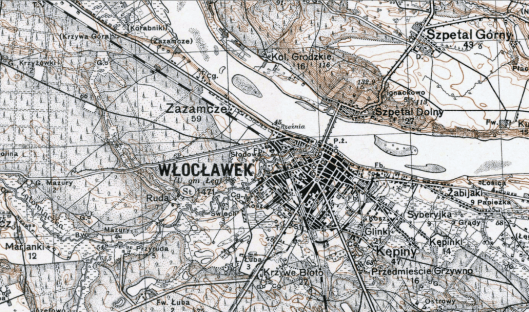
Włocławek is a city of about 114,000 residents; the population has been declining since the fall of state socialism as local industries have closed and residents have sought better opportunities in more prosperous places within and outside of Poland. A century earlier, the city experienced rapid growth; during the four decades before World War II, it became a regional industrial center and the population tripled, reaching 68,000 by 1939. Jews were important contributors to the city’s development, and comprised nearly 20% of residents. My family was among the migrants to the city during this time. By the end of the war, most of Włocławek’s Jews had been murdered, the synagogues burned, and the cemetery desecrated.

Screen Shot 2016-08-03 at 4.33.01 PM

Map of Włocławek in 1930. Piwna Street is to the left of the bridge, just past an estuary opening out to the river. Map by Wojskowy Instytut Geograficzny.

Piwna Street is located off of Wyszyński Street (one of the main routes through town). About one third of the way along its short length it makes a 90 degree turn and runs for another block parallel to the Vistula River. On the river side is a massive two story building and dock that includes the Rejs na Przystani Café. Across the street, colorful depictions of fruits and the products made with them decorate the wall around the Delecta factory (see the cover photo of the Facebook page above). Until the Forgotten Street project, nothing indicated that Piwna was called the “Street of Death” after the Nazi occupation.

In September of 1939, the city’s synagogues were burned to the ground and the Jewish population was terrorized (read more about this here); some were arrested while others were killed. The retreating Polish forces had blown up the bridge across the Vistula, so the Nazis decided to replace it with a pontoon bridge at Piwna Street. But first the riverbank had to be reinforced. Captive Jews were forced to do this backbreaking work, using the stone and concrete remnants of the synagogue as building materials. Many died in the process, hence the name “Street of Death.”

What’s extraordinary about the high schoolers’ project is how effectively it brings into the present an awareness of the past. It does so with a wide variety of archival information, photographs, and first-person recollections. The public nature of the fan page also meant that other people learned about this history and could even contribute to it. For instance, one viewer posted this gouache painting of Piwna Street from the mid-19th century.

WloclawekUlPiwna1853

The view across Zgłowiączki Estuary and Piwna Street. Gouache by Alfons Matuszkiewicz, c. 1853. Posted on Włocławkska Zapomniana Ulica

To date the fan page has 1773 “likes.” Another component of the project was the posting of a QR code that when scanned with a smartphone connects to a brief explanation of the history of Piwna Street in four languages. QR codes were also posted at several other sites around town that are associated with Jewish culture (listen here).

DSC08097

QR code linking to a brief history of Piwna Street.

For now, these notices are just on laminated paper, but the hope is that something more permanent will be installed so visitors will continue to connect here and then—this particular location with the events that occurred in the past. When I visited in June, the city’s president expressed his support for the project. The question remains where the money will come from to pay for a more lasting marker. Still, with people of good will and extraordinary energy like the teachers and students at the Automotive High School, I’m hopeful something will be done in the not too distant future.

DSC08098

The teachers who worked on the project Włocławska Zapomniana Ulica: from the left, Anita Kaniewska-Kwiatkowska, Monika Lamka-Czerwińska, and Robert Feter.

← Older posts
Newer posts →

Categories

  • Anthropology (38)
    • Archives (14)
    • Fieldwork (7)
    • Ground Penetrating Radar (GPR (5)
    • Research Methodology (8)
  • antisemitism (14)
  • Association of Descendants of Jewish Central Poland (36)
  • Catholicism (8)
  • Conference (1)
  • Discrimination (2)
  • Family (71)
    • Bereda (19)
    • Kolski (13)
    • Piwko (22)
    • Rotblit (3)
    • Walfisz (4)
    • Winawer (7)
  • Genealogy (11)
  • Heritage work (70)
    • Commemoration (24)
  • Identity (18)
  • Israel (6)
  • Jewish Culture (93)
    • Cemeteries (55)
    • Museum (8)
    • Synagogues (34)
    • Torah (1)
  • Jewish immigrants (8)
  • Jewish Religion (1)
  • Memory (73)
  • Names (14)
  • Photographs (6)
  • Pifko-Winawer Circle (5)
  • Poland (131)
    • Baligród (1)
    • Bolimów (1)
    • Brześć Kujawski (5)
    • Buk (1)
    • Chodecz (1)
    • Dukla (2)
    • Dąbrowice (1)
    • Gdynia (1)
    • Gostynin (3)
    • Gąbin (1)
    • Izbica Kujawska (1)
    • Kazimierz (4)
    • Kowal (1)
    • Koło (1)
    • Krakow (7)
    • Krośniewice (1)
    • Kutno (9)
    • Kłodawa (1)
    • Lesko (8)
    • Leszno (1)
    • Lubień Kujawski (1)
    • Lubraniec (1)
    • Lutowiska (3)
    • Piła (3)
    • Podgórze (2)
    • Poznan (11)
    • Przemyśl (2)
    • Pzedecz (1)
    • Radom (1)
    • Radymno (1)
    • Sanok (1)
    • Skierniewice (5)
    • Sobota (2)
    • Tarnów (2)
    • Warsaw (23)
    • Wielkopolska (1)
    • Wronki (7)
    • Włocławek (20)
    • Zasław (2)
    • Łódź (1)
    • Żychlin (33)
  • Polish Culture (10)
  • Polish-Jewish Heritage (60)
  • Polish-Jewish relations (61)
  • Post-World War II (25)
  • Pre-World War II (22)
  • Reclaimed Property (1)
  • stereotypes (3)
  • Survival (9)
  • Trauma (3)
  • Uncategorized (5)
  • Victims and perpetrators (4)
  • World War II (47)
    • Jewish Ghetto (12)
    • Nazi Camps (6)
    • Polish Underground Army (3)
  • Yiddish (5)

Enter your email address to follow this blog and receive notifications of new posts by email. Your email address will not be shared.

Archives

  • July 2026 (1)
  • June 2026 (5)
  • May 2026 (1)
  • October 2025 (1)
  • July 2025 (8)
  • June 2025 (1)
  • April 2025 (1)
  • August 2024 (3)
  • July 2024 (3)
  • May 2024 (2)
  • April 2024 (1)
  • May 2023 (2)
  • January 2023 (2)
  • December 2022 (7)
  • November 2022 (2)
  • October 2022 (5)
  • September 2022 (1)
  • January 2022 (1)
  • August 2021 (1)
  • December 2020 (2)
  • July 2020 (1)
  • May 2020 (3)
  • April 2020 (1)
  • March 2020 (1)
  • January 2020 (2)
  • May 2019 (1)
  • February 2019 (1)
  • November 2018 (1)
  • September 2018 (1)
  • August 2018 (3)
  • July 2018 (1)
  • June 2018 (1)
  • May 2018 (1)
  • April 2018 (2)
  • March 2018 (2)
  • February 2018 (2)
  • January 2018 (2)
  • December 2017 (2)
  • November 2017 (2)
  • October 2017 (1)
  • September 2017 (3)
  • August 2017 (3)
  • June 2017 (2)
  • May 2017 (3)
  • April 2017 (1)
  • March 2017 (2)
  • February 2017 (1)
  • January 2017 (2)
  • December 2016 (2)
  • November 2016 (4)
  • October 2016 (1)
  • September 2016 (6)
  • August 2016 (2)
  • July 2016 (1)
  • May 2016 (4)
  • April 2016 (2)
  • March 2016 (3)
  • February 2016 (4)
  • January 2016 (3)
  • December 2015 (3)
  • November 2015 (5)
  • October 2015 (5)
  • September 2015 (3)
  • August 2015 (4)
  • July 2015 (3)
  • June 2015 (3)
  • May 2015 (4)
  • April 2015 (9)
  • March 2015 (3)
  • February 2015 (2)
  • January 2015 (5)
  • December 2014 (4)
  • November 2014 (9)
  • October 2014 (2)
  • September 2014 (1)

Copyright Notice

All original text and images are copyright © Marysia Galbraith. Please contact the author before quoting.

Blog at WordPress.com.

  • Subscribe Subscribed
    Uncovering Jewish Heritage
    Join 151 other subscribers

    Have a WordPress.com account? Log in now.

  • Uncovering Jewish Heritage
    View site in Reader
    Manage subscriptionsSign upLog in
    Report this content
    Collapse this bar
Loading Comments...