• About
  • The Photo that Started it All

Uncovering Jewish Heritage

Uncovering Jewish Heritage

Category Archives: Poland

Learning about Jewish Religion and Culture in Leszno

07 Thursday Jun 2018

Posted by Marysia Galbraith in Catholicism, Fieldwork, Heritage work, Jewish Culture, Jewish Religion, Leszno, Museum, Polish-Jewish Heritage, Polish-Jewish relations, Synagogues

≈ Leave a comment

Tags

Leszno Regional Museum, Muzeum Okręgowe w Lesznie, Religious Instruction in Schools

“Why should we learn about Judaism?” Mirosława Maćkowiak asked, gazing kindly at my son’s 5th grade class. The twenty-five ten-year-olds sat in chairs in the Jewish Gallery of the Leszno Regional Museum, which is housed in the former synagogue. I hurried to translate Maćkowiak’s question; the language of instruction at the International School of Poznan is English, and only some of the students speak Polish. Maćkowiak, the curator of the Museum’s Jewish collection, answered her own question: We should learn about Judaism because Jesus was a Jew. He celebrated all the Jewish holidays, followed all the Jewish laws, and dressed like a Jew. It’s important to know about the older religion from which Christians came. Judaism is that older religion.
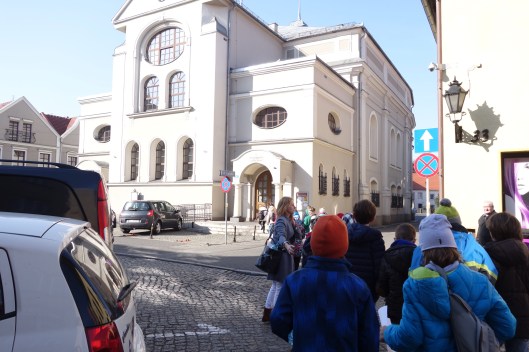
DSC03937

ISOP students heading to the museum in Leszno, 2015.

Ian’s teacher, Ms. Ania grew up in Leszno, which is about 50 miles south of Poznan. Blond, with the perky beauty of a cheerleader, she is perhaps the only Pole I have ever met who openly declares herself an atheist. She developed a special interest in Judaism after getting to know some Jewish people in London. She lived on a kibbutz in Israel, where she absolutely loved the country and the people. When she returned to Poland, she made a point of learning more about its Jewish history. She brings her students to Leszno every year so they can see artifacts that once were part of the Jewish life that filled the city. She said there isn’t really an equivalent space in Poznan, where the historic synagogue housed a public swimming pool for years, and closed to the public in 2012.

Ania and Mirosława have known each other for years, but each has a very different perspective on religion. Both are positively oriented toward Judaism, and celebrate the historic cultural and religious diversity of Poland, but Mirosława also makes the assumption that the Polish nation is Catholic, and so legitimizes Judaism for her young Polish audience by linking it to the origins of Christianity. Segments of the Catholic Church promote the perspective that Jews are “older brothers in faith, as I witnessed during Judaism Day, which has been a holiday of the Polish Catholic Church since 1997.

During our visit, Ania kept reminding Mirosława that her students were not there to study Judaism from a Catholic theological perspective. “Not all of my students are Catholic,” she insisted. When Ania took a turn translating, she distanced herself from statements framed in a Christian perspective by prefacing them “According to Ms. Mirosława.”

Jewish memory work in Leszno shows us a few things about what can be done with Jewish heritage in Poland. In Leszno, important tangible heritage survived the war, providing a foundation for building public awareness about the history of Leszno’s Jewish population. Additionally, a local institution, the Leszno Regional Museum (Muzeum Okręgowe w Lesznie), became active in historical preservation right after the fall of communism, making Leszno one of the first communities in Poland to renovate Jewish structures, mount Jewish-themed exhibitions, and organize related public events. A central cornerstone of museum activity includes programs for school children, such as the one attended by my son’s class.

Leszno is a regional center with a population of about 64,000. More than a century of Prussian rule contributed to German cultural influences, and in the mid-19th century, the Jewish population began to emigrate to other German cities. By 1923 the last Leszno rabbi departed and was not replaced; only 160 Jews remained in Leszno. When Leszno was absorbed into Hitler’s Third Reich, the few remaining Jews were forced to move to places further east and then became victims of the Holocaust.

Besides the synagogue, several other buildings remain of the city’s Jewish past: a mortuary building where bodies were prepared for burial, now the public library; a mikvah; and multiple houses within the narrow, winding streets of the Jewish district. Little remains of the cemetery, on which socialist-era concrete apartments were built in the 1970s. Some tombstones have returned, however, rediscovered in farmyards and under roads, and now wait in a pile outside the mortuary building until someone gathers the funds and the initiative to create a lapidarium.

Former synagogue, Leszno
Childhood home of Leo Baeck (1987-1958), rabbi and theologian of Liberal Judaism. Leszno.
Mortuary building, Leszno. Apartments behind it were built on the Jewish cemetery
Grave stones outside the former mortuary house, Leszno
Mikvah, Leszno
Mikvah, Leszno
Jewish quarter, Leszno
Old House of Prayer, dating from the first half of the 18th century, Leszno Jewish quarter

The Leszno Regional Museum’s impressive collection of Jewish sacred and everyday objects are mostly on loan from other regional museums. They are arranged in wood-framed glass display cases, each containing objects associated with a religious holiday. A laminated sheet on top of each case describes the historical and religious significance of the holiday, typical activities and meals, as well as characteristic objects associated with the holiday. For instance, one case contains artifacts relevant to Hanukah, mostly nine-candle menorahs called hanukiahs. The written description explains Hanukah, the Holiday of Lights, is “the eight-day holiday commemorating the triumph of Judah Maccabee against the Syrian army in 165 BC….” and explains, “Each day a successive candle is lit.” Words like “hanukiah,” “gelt,” and “dreidel” are written in bold, followed by their definition and their significance for the holiday.

Students meet Mirosława Maćkowiak, Director of the Jewish Division of the Leszno Museum, in the former sanctuary of the synagogue
Maćkowiak, Director of the Jewish Division of the Leszno Museum, discusses Jewish religion and culture. On the wall hangs an ornately embroidered parochet, a curtain that would go in front of the wooden cabinet containing the Torah scrolls.
Shabbat artifacts, including cups, tray, spice tower, and challah draped by a white cloth, Leszno Museum.
Torah, crown and cover, Leszno Museum.
Barrel and dippers for ablution, Leszno Museum.
Maćkowiak explains to the the children how to use a yad, a Torah pointer, Leszno Museum.

Another case labeled “Shabbat table” contains silver cups, goblets, spice towers, candlesticks, a tray, and a knife, all arranged atop a white linen cloth. Two loaves of challah covered with a white cloth complete the display. The information sheet says, “Shabbat (rest) is the most important weekly Jewish holiday, in which there is an obligatory restriction on doing any kind of work. It begins on Friday at sunset and ends on Saturday at dusk. It is a joyful holiday.” It goes on to describe how candles are lit by a woman, while the father of the family says a prayer called kaddish (written in bold). Further, it explains that herbs are placed in the spice tower (bessamin, the Hebrew word is written in bold) and lit on fire. It describes typical Shabbat food, including challah, chicken soup, and the single-dish meal for Saturday dinner called cholent (again, this term is in bold).

The texts signal continuity over change. Jewish culture is portrayed as something that does not modernize. But this emphasis on normative customs also relegates Jewish culture to the past. The objects on display are old, most dating back to the 19th and early 20th centuries. While many of the objects, such as hanukiahs and Shabbat goblets, have contemporary equivalents that remain part of standard Jewish cultural and religious practice, other objects on display are artifacts of a former era. For instance, one of particular interest to the ten-year-olds on my son’s fieldtrip was a massive copper barrel set on the floor in a corner. Mirosława Maćkowiak explained that it would have been placed at the entrance of a mortuary building or some other place where it was customary for Jews to wash their hands. She pointed to two two-handled containers tacked to the wall above the barrel, and said they would have been used to scoop out and pour the water. She related this practice to the importance of cleanliness in the Jewish tradition.

Maćkowiak made similar generalizations about the value Jews placed on education, their kosher dietary practices, as well as the kinds of activities restricted on the Sabbath, such as cooking or turning lights on or off. She made no mention of the fact that many contemporary Jews dispense with these practices, nor did she discuss historical variation among Jewish populations. Even though Mirosława Maćkowiak talked about Judaism as a living religion, still practiced by millions of people worldwide, the static portrayal within the museum exhibition reflects the absence of Jews within contemporary Polish society.

My son’s class, when given the opportunity, gazed at the articles in the display cases with curiosity. Of far greater interest to them, however, was the hands-on demonstration by Maćkowiak in front of a two-meter tall display case intended as the focal point of the room. She explained that this was meant to evoke the most sacred part of a synagogue—the Aron haKodesh, where the Torah scrolls are stored. She pointed out the parochet hanging on the wall to the right of the case, explaining elaborately embroidered curtains such as this would cover the front of the wooden Torah cabinet. She pointed out the items in the case, including a silver crown set atop a fabric Torah cover, as well as some Torah scrolls wound around wooden dowels. Then she put on white archivist gloves, and took out a silver yad with a pointing end shaped like a tiny hand with its index finger extended, and demonstrated how such pointers were used to read the Torah from right to left without touching the parchment.

My son’s class was not the traditional school group. Their teacher brought them as part of a unit on world religions, where the emphasis was on cultural and religious diversity. By contrast, most school trips are initiated by religion teachers.

In most cases, religion is taught by Catholic clergy during the regular school day. This is an artifact of a law passed in 1991 in reaction to the Communist rejection of religion. As a reassertion of the centrality of religion for the Polish nation, religious education in schools became standard. Over the years, many have complained to me about it, but very few go to the trouble of filing the necessary paperwork to have their children attend “ethics” classes instead. After all, 90% of Poles identify as Catholic, and children risk ostracization if they are singled out like that.

Notably, this law passed at the same time that Jewish heritage work came out of the shadows and spurred public projects like the one that established the Jewish exhibition in Leszno. Poland is a complicated place, and relations between Jewish and non-Jewish Polish culture and history are a fundamental knot at the center of that complexity.
Jewish Genealogists in Warsaw

24 Thursday May 2018

Posted by Marysia Galbraith in Conference, Genealogy, Heritage work, Poland, Polish-Jewish Heritage, Research Methodology, Warsaw

≈ Leave a comment

Tags

IAJGS, International Association of Jewish Genealogical Socieities

For the first time, the International Association of Jewish Genealogical Societies (IAJGS) will hold their annual conference in Poland. From my perspective the timing couldn’t be better. It’s a chance for Jewish genealogists to visit the land where so many Jewish ancestors lived, and to highlight the incredible work that has been done in Poland to reassemble Jewish history and culture in towns and cities all over the country. None of this erases the horror of the Holocaust, but the conference promises to be a space for Poles and Jews to meet in a spirit of dialog and reconciliation. The Polish co-hosts, the Jewish Historical Institute and the POLIN Museum of the History of Polish Jews, have been at the forefront of such efforts. They deserve international recognition and support for all they have done, and all there remains to do.

The conference will be in Warsaw from August 5-10. The first hotel filled up so quickly, they added a second, and now a third to the list. In fact, I read somewhere that already more people have registered this year than ever before.

I will have two presentations at the conference. I  tried to think of topics related to my areas of expertise that would also be of relevance to genealogists. This is what I came up with:

The Past in the Present: How the Polish Partitions Shape Jewish Heritage Work Today (a 1 hour presentation)

Returning to the towns and cities of our Jewish ancestors in Poland, we are likely to feel haunted by the absence of Jewish life. And yet, if we know where to look, residents of communities throughout Poland have worked tirelessly to bring Jewish history, heritage, and memory back into the public sphere, in the form of monuments, memorials, and culture festivals. This work is influenced by the legacy of the ruling empires—Russian, Prussian, and Austrian—that partitioned Poland from the end of the 18th century until World War I. Within each partition, the particular character of leadership shaped Jewish communities, which in turn contributed to the different ways in which the Holocaust was carried out. The legacy of the partitions continues to influence Jewish heritage work today—as well as the kinds of records and local allies available to genealogists. The presentation offers insights into finding local resources relevant to genealogical work.

–and–

Pulling Stories Out of Silence: Uncovering my Hidden Jewish-Polish Heritage ( a 25 minute presentation)

I had been visiting Poland for 20 years before I realized that if I really want to know about my family’s Polish heritage, I needed to delve into the big secret in the family: that my grandmother was born Jewish. Since 2011, I have tracked down family photographs, collected memories from relatives, searched archives for family records, and traveled to the towns and cities of my ancestors. Not only have I traced my ancestors back to the 18th century, I have also, more importantly, found my living relatives—in the US, Israel, Switzerland, and Canada. Through my personal story, I explore the complex relationship between Jews and Catholics in Poland before and during World War II, and how it carried over into my family’s life in the US. I also offer clues about the resources available online and in Poland for anyone who wants to trace their Polish-Jewish ancestry.

PolishPartitionRegionsMapJewishGen

Source: : https://www.jewishgen.org/databases/Poland/GeoRegions.htm. Map shows the administrative subdivisions (gubernia) of Congress Poland from 1867-1918.

The first presentation dovetails with the ethnography I’m writing about Jewish heritage work in towns and small cities, provisionally titled Memory in Fragments: Reassembling Jewish Life in Poland. The project asks what can be done with the fragments of Jewish heritage that remain, sometimes hidden and sometimes in plain sight? And what value does such memory work have? I have learned that the legacy of the Polish partitions continues to  shape the various regions of Poland in ways that also influence what is left of Jewish culture, and how local communities mobilize to commemorate and preserve Jewish memory. Genealogists will find it useful to know the history of the Polish partitions because it influences the language in which records were kept, the migration patterns of Jewish populations into and out of various regions, the impact of the Holocaust, and the memories and silences that contributed to the preservation or destruction of Jewish heritage after the war.

The second presentation recounts my more personal journey of discovery about my Polish Jewish family, which I am documenting in what I call a family memoir provisionally titled, Do Not Open: A Family Memoir of Hidden Jewish Ancestry.

The conference website includes a statement, Why Our Jewish Genealogy Conference is Coming to Warsaw. In it, conference co-chair Robinn Magid writes, “We believe in continuing dialogue between people of different perspectives and in supporting the Jewish Community of Poland today.” Especially now, as nativism, tribalism, and nationalism have been overtaking public discourse, such dialog and support are crucial for advancing an alternate narrative of mutual respect and hopefully, reconciliation.

Pavement of Memory

17 Tuesday Apr 2018

Posted by Marysia Galbraith in Cemeteries, Commemoration, Heritage work, Memory, Polish-Jewish Heritage, Poznan

≈ 1 Comment

Tags

Janusz Marciniak

“We recover history…we record history.”

That is what the Jewish Community of Poznan wrote when they announced a new memorial, “Pavement of Memory,” built with fragments of Jewish tombstones that were recovered during roadwork in Poznan.

1_Jewish Cemetery in Poznan

“Pavement of Memory” composed with fragments of matzevot (Jewish Tombstones), Poznan                            Source: Janusz Marciniak

When the road crew dug up the old pavement, they noticed some stones with strange writing on them. Realizing the letters were in Hebrew, they contacted the Jewish Community. The fragments are too small to make out names or details about whose tombstones they were, but at least they have returned to the cemetery where they belong. All over Poland, fragments like this are being found, out of place, reinforcing road beds, bridge foundations, and lake beds. They were harvested during the terror of the Nazi occupation, and sometimes afterwards under state socialism. With only ghosts to look over them, Jewish cemeteries became a source for scarce building materials.

The extraordinary thing is that when public spaces are designated as repositories of Jewish memory and culture, objects return to them. As cemeteries are cleaned up, fenced, and marked, tombstones come back. In some cases, it’s as if people have known for a long time about these objects. They felt they were out of place and it has sat uneasily on their minds. They are relieved to finally know where these objects should go. In others, as with this road project, people are surprised to find these fragments, but they feel a sense of obligation to honor the memory of the past. To put things back into place.

3_Jewish Cemetery in Poznan.JPG

“Pavement of Memory” at the memorial site in a corner of Poznan’s Jewish cemetery.

These fragments are back home on a wall in the corner of the Poznan Jewish Cemetery.

“Pavement of Memory” was designed by Janusz Marciniak, who also designed the memorial at the Jewish cemetery in Piła and did a series of installations in the Poznan synagogue when it still housed a swimming pool. Janusz’s design is simple and powerful, honoring the integrity of each fragment by hanging them in three rows of ten. And yet together, like a mosaic, they make a unified statement.

4_Jewish Cemetery in Poznan.JPG

Detail of macevot fragments in Pavement of Memory

The words on the memorial plaque, in Polish, Hebrew and English, read:

Był czas, kiedy z macew robiono bruk. Czas, w którym najdosłowniej rozbijano, deptano i kaleczono pamięć o ludziach pochowanych pod macewami. Niektóre z kamiennych okruchów tej pamięci przetrwały i dziś ta pamięć łączy się z wdzięcznością dla wszystkich, którzy przyczynili się do jej ocalenia. „Z owocu swoich ust nasycony będzie człowiek dobrem, a odpłacone mu będzie według tego, co zrobity jego rece” (Prz 12, 14).

הייתה עת שבה עשו ממצבות אבני מדרכת, עת שבה היו באופן ממשי מנתצים, רומסים ופוצעים את זכרם של האנשים הטמונים מתחת למצבות. אחדים מהשברים של אבני הזיכרון

אותן הזיכרון מתאחד שרדו, וכיום עם הכרת טובה לכל אלה שתרמו להצלתו. “מפְרִי פי־אישׁ יִשְׂבַּע־טוֹב וּגְמוּל יְדֵי־אָדָם יָשִׁיב לוֹ” (משלי י”נ יד).

There was a time when matzevot [Jewish tombstones] were used for pavement; a time when the memory of the people buried under the matzevot was most literally broken, trampled, and maimed. Some remnants have survived and today this memory is connected with the gratitude to those who contributed to its rescue. “A man shall be satisfied with good by the fruit of his mouth, and the doings of a man’s hands shall be rendered unto him” (Prov. 12:14).

6_Jewish Cemetery in Poznan.JPG

Bird on an old boulder tombstone in the corner of the Poznan Jewish Cemetery that has been designated as a memorial site.

Inclusion and Exclusion in the Polish Nation

20 Tuesday Mar 2018

Posted by Marysia Galbraith in antisemitism, Catholicism, Family, Genealogy, Identity, Jewish immigrants, Poland, Polish-Jewish Heritage, Polish-Jewish relations, Pre-World War II, Włocławek

≈ 1 Comment

Tags

Honorary Citizen of the Russian Empire, Mizrahi Party

Were Jews included as part of the Polish nation or were they excluded from it? This was one of my driving questions when I started to uncover the Jewish roots of my (Polish) mother’s family. I wondered if I might find my ancestors in some kind of hybrid Polish-Jewish space in which they identified as both Polish and Jewish. Or perhaps they lived in a world that ran parallel to that of their non-Jewish neighbors, with limited points of interaction. What I have found so far is neither straightforward nor consistent. It doesn’t fit entirely nor unambiguously into a narrative of hostile separation nor of peaceful coexistence. I’ll be focusing here on my ancestors’ lives before World War II. The Holocaust was such a devastating event that it needs to considered in its own terms, something I’ll try to do in another post.

The Polish lands were hospitable to my Jewish ancestors, allowing them to prosper for generations. My grandfather Jacob Rotblit owned a Ford dealership in the 1930s, and before then he was a manager of an international trading firm. Or maybe he sold jewelry. It’s hard to find absolute proof, but either way, he maintained important business interests.

Poland PartitionMap

Poland was under Russian, Prussian, and Austrian rule from the end of the 18th century until World War I. The region around Warsaw, where my family lived, was under Russian rule, though it had some degree of autonomy for some of this time. Map source and more information about the partitions of Poland: http://www.britannica.com/EBchecked/topic/466910/Partitions-of-Poland

My grandmother’s father Hil Majer Piwko was in the lumber trade. Documents from the National Archive in Włocławek show he owned a building supply store in the 1920s, and according to Aunt Pat, he owned a sawmill before then. Pat also writes that he was recognized as an “honorary citizen of the Russian Empire” for his service during a cholera epidemic. This was sometime before 1918, when the region near Warsaw was part of the Russian Empire. Apparently, the title “honorary citizen” came with some of the rights that were normally reserved for the nobility.

So there was separation but also opportunity. It was not very easy for Jews to become gentry, unless perhaps through marriage, but there were other means by which they were granted special honors and rights. By comparison, different social classes faced road blocks against entering the gentry, regardless of ethnicity or religion. For instance, most peasants lacked the financial means and cultural capital to gain such social standing. At least in some times and places, wealthy, educated Jews would have had more avenues to social advancement.

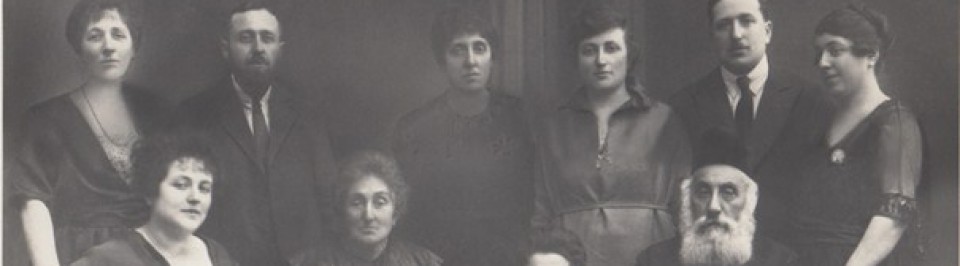
More about my family’s prosperity can be read from the family portrait that was taken around 1916. Hil Majer and his wife Hinda had many children. They were wealthy enough to dress in fine fabrics. Hil Majer’s traditional clothing suggests that he had the freedom to practice his faith and customs, while his children were free to assimilate, as indicated by their modern clothing. Separation wasn’t just enforced by the majority, but also sometimes chosen to preserve cultural and religious distinctiveness.

JechielHindaAndChildren

The Piwkos c. 1916. For more about this photo see: The Photo That Started it All, Some Reassembled Stories, and What Year Was It?


Why did the family move from Hil Majer’s native Skierniewice to the village of Sobota, before settling down in Brześć Kujawski and then Włocławek? It seems likely they were following economic opportunities, but also possibly they were seeking a place more hospitable to Jews. This fits a common narrative about the Jews as wanderers. They arrived in Eastern Europe as tradespeople, financial advisers, and estate managers, and eventually established settled communities. But I’ve also been told that by the 19th century, most Jewish families stayed put. That’s why knowing the place of origin of one relative usually leads to many more relations.

Włocławek hadn’t always welcomed Jews. Until the end of the 18th century, it was a Church town, home to a bishop’s cathedral, with restrictions against Jewish residents. But then the city secularized, and as it industrialized and became an engine of commerce, the Jewish population also grew. Located as it was between Warsaw and the Baltic Coast on the Vistula River, Włocławek became an important port, and home to paper, ceramic, metal, chemical, and food processing factories.

Włocławek-Wyszyński_street_on_photograph_by_Sztejner

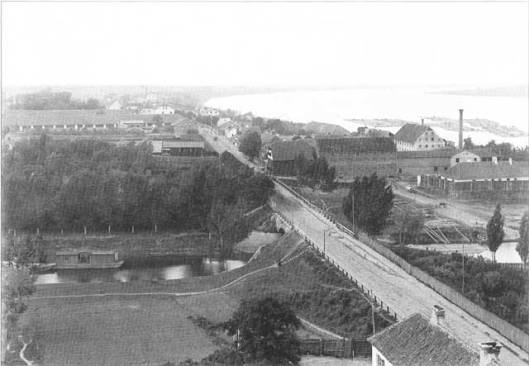
Włocławek before 1898. Note the factories near the river. By Bolesław Julian Sztejner (1861-1921) (http://www.wuja.republika.pl/widoki_ogolne_wl.html) [Public domain], via Wikimedia Commons

In addition to economics and religion, political factors shaped the degree of inclusion available to Jews within the broader society. Antisemitism grew in the 1880s throughout the Polish lands, as Polish nationalists became more active in their pursuit of national sovereignty. Once Poland gained its autonomy in 1918, tensions deepened. Some political forces, led by Józef Piłsudski, argued for a broad definition of citizenship within the new Polish state, insuring equal rights for the 1/3 of the population that was Ukrainian, German, Jewish, and other minorities. Another political faction, led by Roman Dmowski, advocated for a narrower definition of Polishness, based on an idea of “pure blood,” by which he meant shared descent that also tied the nation to Catholicism. At the same time, Jewish nationalism grew, and took on a number of forms, leading some to embrace  Yiddish culture, and others to espouse Zionism. Some Jewish nationalists dreamed of a safe place within the countries in which they lived, while others turned their eyes toward Palestine.

Włocławek became a crossroad for different varieties of Judaism, including Zionism, Hasidism, and Reform. Around the time that my great grandfather moved there, a new rabbi, Jehuda Lejb Kowalski, also arrived. He was very popular, and succeeded in reconciling the factions within the Jewish community. In 1902, Kowalski helped found the Mizrahi Party, and was a key leader in this Orthodox Zionist organization. Perhaps Kowalski is what drew the family to Włocławek? I’m not sure of Hil Majer’s affiliation, but his son-in-law, Rachel’s husband Pinkas, was a member of the Mizrahi Party in Włocławek, and a representative of the governing board of the city’s Jewish Community in 1931. Hil Majer’s oldest son Jacob represented the Zionist Party on the governing board from 1917 until 1922, and he was on the City Council from 1917-19. In other words, Jacob wasn’t only involved in Jewish political life; he also held a position in city government.

So there were opportunities to integrate into the broader society, to pursue economic and political goals, and to flourish as a distinct religious and cultural group.

But clearly there were problems that caused my relatives to leave for other countries, long before the German occupation and Nazi assaults against Jews. One of Hil Majer’s brothers went to Canada in the 1880s; the son of another went to Switzerland. In 1906-7, two of Hil Majer’s sons went to New York. Over the years, Philip sponsored many of the next generation who started out in the US at his bakery. Four more sisters, including my grandmother, also came to the US. Jacob’s children, as well as Rachel and her children, went to Palestine starting in the 1930s. Still, choosing, or even being forced, to leave didn’t necessarily signal a lack of attachment to Poland. For over a century, there have been mass migrations from the Polish lands by Catholics, Protestants, and Jews who, regardless of their national or ethnic affiliation, chased after their dreams in distant lands.

Are Members of the Jewish Community Still Welcome in Poland?

26 Monday Feb 2018

Posted by Marysia Galbraith in antisemitism, Identity, Jewish Culture, Krakow, Poland, Polish-Jewish Heritage, Polish-Jewish relations, Post-World War II

≈ Leave a comment

Tags

JCC Krakow, Jonathan Ornstein, Should you visit Poland?

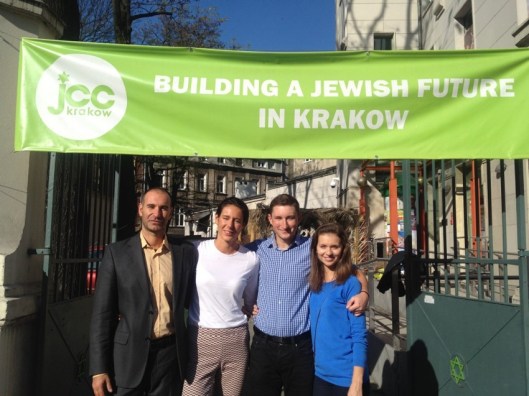
A reader just asked me whether members of the Jewish community are still welcome in Poland. Fortunately, Jonathan Ornstein, the director of the Jewish Community Center in Krakow, answered this very question in his New York Times op-ed, In Poland, a Grass-Roots Jewish Revival Endures.

JCCJewishFutureDezco_Co_Uk

Building a Jewish Future in Krakow: Jonathan Ornstein at the entrance to the JCC Krakow. Source: http://dezco.co.uk/life/jewish-life-in-krakow-poland/

It’s worth reading the whole article, but here is an excerpt:

“The concern is genuine, warranted and appreciated. We, the Polish Jewish community, are weathering challenging times. The country we call home can feel a little less welcoming these days. On one hand, young people who only recently discovered their Jewish roots have eagerly joined newly opened Hillel student organizations in Warsaw and Krakow. But they hold in the back of their minds a question of what the future may bring.

“Polish Jewish leaders, too, are grappling with an uncertain future as we continue to build Jewish life in an environment that has taken a turn away from democracy toward populism. That shift is never a good sign for Jews — or anyone in a free and open society. And now the Holocaust bill, which criminalizes statements that the Polish nation had any responsibility in the Holocaust, may complicate our good relationship with our non-Jewish neighbors.

“What we have managed to rebuild over the last 30 years with the help of those neighbors is real. It is strong and it has emerged not only from government policy, but also from grass-roots efforts. We’ve built Jewish schools, synagogues, community centers and museums by working hand in hand with non-Jewish high school students, senior citizens and many others. Not only have they allowed these institutions to be born and flourish, but many have stood up and taken an active part in Jewish rebirth.

…

“So the answer is: Yes, come visit Poland. Walk down the historic streets that I walk without fear as a proud Jew. See beyond the camps. Go beyond the history, both the beautiful and the tragic. Stand with a community that has been through so much suffering, yet has emerged optimistic and eager to rejoin the Jewish world.”

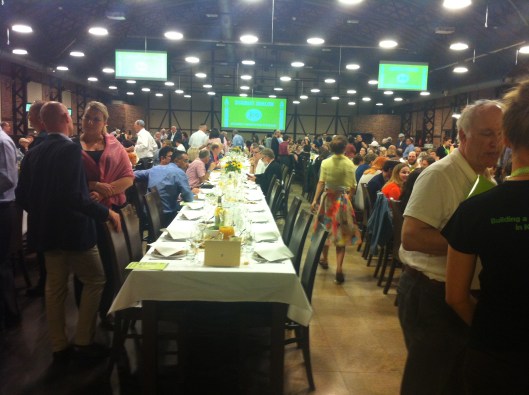
Jonathan can be trusted on this. He has been at the forefront of the revival of Jewish life in Krakow since the JCC opened there ten years ago. It’s an extraordinary organization, and I was lucky enough to help out as a Shabbos Goy during the Jewish Culture Festival in 2016, when hundreds of people attended the largest shabbat dinner in Poland since World War II.

IMG_0951

JCC Shabbat Dinner, July 1, 2016

The JCC welcomes Holocaust survivors, Jewish visitors from around the world, and Poles rediscovering their Jewish heritage or who just feel an affinity to Jewish culture and history. It was a space where I felt right at home, as an American raised in a secular Christian household with a Polish-Catholic mother who descended from Polish Jews. It’s a space where I can be Jewish or Christian, Polish or American, but regardless I’m welcomed simply because I’m there and I want to learn more about what it means to be Jewish in Poland.

“The Polish Anne Frank” in The Forward

12 Monday Feb 2018

Posted by Marysia Galbraith in Family, Memory, Przemyśl, World War II

≈ Leave a comment

Tags

Ariana Spiegel, Elizabeth Bellak, Renia Spiegel

Today in The Forward is an article Why Renia Spiegel is Called ‘The Polish Anne Frank‘.

During the Nazi occupation of Przesmyśl, Poland, she filled notebooks with her poetry and diary. Renia was only 18 when she was shot on the street, after someone reported her hiding place to the Nazis. Ariana, her younger sister, survived because she had been brought to Warsaw just a few days before that. Ariana became Elizabeth, whom I grew up calling Aunt Elizabeth. She was my mother’s friend for nearly 80 years.

Holocaust Remembrance Day in Włocławek

29 Monday Jan 2018

Posted by Marysia Galbraith in Cemeteries, Commemoration, Jewish Ghetto, Memory, Polish-Jewish relations, Włocławek

≈ 2 Comments

Tags

International Holocaust Remembrance Day, January 27

Thanks to Mirosława Stojak for all the work she does to preserve the memory of Jewish history and culture in Włocławek.

Here is a video from Holocaust Remembrance Day (January 27) when she and students and teachers from the Automotive High School visited the memorial at the site of the World War II Jewish ghetto, also the prewar Jewish cemetery.

Flim credit: Q4.pl, http://q4.pl/?id=17&news=170583

The interviews are in Polish, but even if you can’t understand the words, you can see that these people remember the Jewish history of their city. And they are passing on those memories to the next generation.  They lit candle lanterns in front of the commemorative monument, and the students placed pebbles upon which they had written words like “traditions,” “love,” and “memories.”

There’s more about Włocławek’s Jews on Ms. Stojak’s website Zydzi.Wloclawek.pl. The tagline of her site: “Ku pamięci, z nadzieją, na pojednanie,” “In memory, with hope, for reconciliation.”

The Photo that Started it All: What Year Was It?

22 Friday Dec 2017

Posted by Marysia Galbraith in Family, Genealogy, Jewish immigrants, Kolski, Memory, Photographs, Piwko, Włocławek

≈ 9 Comments

Tags

1910s fashion, Efraim/Philip Piwko

This blog started with a photograph. A family portrait of adult siblings with their parents. The photo also instigated my search for my hidden Jewish ancestors.

JechielHindaAndChildren

The Photo that started it all

Here, in my great grandfather’s long beard, head covering, and black robe, I saw for the first time visible proof that I descend from Jews. It took a long time, but I managed to identify everyone in the photo, including my grandmother (Babcia) who appears in the bottom left, her hand resting proprietarily on her mother’s wrist.

Based on their clothing and ages, I have guessed this photo was taken sometime around World War I. But I just came across some new information about my grand uncle Philip, the man standing to the right, that throws this date into question. Let me walk through what I have figured out.

Two Pifko brothers came to America, Abraham in 1906 and Philip in 1907. Here they are with Abraham’s wife and children and some other relatives:

BerthaPiwkoNathanPaulineEwa c1908

The Pifko brothers around 1908, New York. Front from left: Philip, Abraham, Paulina, Ewa, Bertha, Nathan. Back from left: Raphael Kolski, Sam and Max Alexander

This photo is easy to date; everything fits together. It must have been taken after Bertha and the children arrived in New York in May 1907, and Philip arrived in December 1907, but before Abraham and Bertha had their fourth child in October 1909. The style of Bertha’s dress is also consistent with this time period. Census records add another piece of supporting evidence; in 1910, all the people in the photo lived in the same household in Manhattan. So the photo was taken sometime between 1908 and the middle of 1909.

2Brothers

Philip and Abraham Pifko in the US.

In another photo of Philip and Abraham (on the right), they look a bit older, and Philip has grown a mustache. In my last post, I said that Philip is on the left, but my cousin Joan, who knew Philip when he was older, says she’s pretty sure he is on the right, driving the car. She also has no idea why his complexion was labeled “light brown” on an official document I found. His skin was not dark.

The photo that started this blog, and my search for ancestors, would seem to have been taken next, sometime around 1914-1918. Except it seems strange that Philip visited Poland during World War I.

Then, while looking through Philip’s documents on Ancestry.com, I clicked on a passport application from 1920. It was for both him and his wife Goldie, to go to England and France. According to what is written, Philip became a US citizen in January 1916, and resided in the US uninterruptedly since arriving in 1907. In response to a question about where he has lived outside of the US since his naturalization, the space is stamped, “I have never resided outside of the U.S.” Below, in response to a question about previous passports, it’s stamped “I have never had a passport.”

So this got me wondering. If Philip didn’t leave the country between 1907 and 1920, could the photo have been made later than I thought, in 1920? Could it have been when he traveled on this passport?

1920PPifkoPassportAppln

Goldie and Philip Pifko 1920, passport application photo

I found this passport application a while ago, but it didn’t occur to me until now that it might have a back. Sure enough, when I clicked to the next page in the database, there it was. The back of the form includes a place where a lawyer verified the truth of everything on it. There is also a handwritten note, “Applicant says he will not go to Russia or Poland. Instruct Amer consul [American Consulate] at France and England.” And even more convincingly, Philip and Goldie’s photo is attached at the bottom.

At age 37, Philip clearly seems older than in any of the other photos. His hair is receding (and, by the way, his skin does not look particularly dark).

It seems unlikely, after all, that the photo was taken in 1920. Could it have been taken before Philip’s departure in 1907? I went back to the photo itself, to reconsider all the details. First, I checked everyone’s ages. In 1907, my grandmother would have only been 13, but clearly she is older in the photo. The boy in front, sitting between his grandparents is Nathan Kolski, whose mother Regina died when he was born; several of my cousins have confirmed his identity. But Nathan was born in 1905, and he is definitely not a toddler in the photo. He almost certainly isn’t 15 either, making it unlikely the photo was taken in 1920. Also, the oldest sister Liba was 20 years older than Babcia. It’s really hard to tell for sure, but I would say that none of the women who are standing in the photo look as old as 48. Perhaps a couple are around 40. So again, considering everyone’s ages, it seems most likely the photo was taken around 1915, when Babcia was 21, Nathan was 10, Liba was 42, and Philip was 32.

It is also worth noting that the youngest child in the family, Malka, is missing, making me think the photo was taken after she died in 1913. Otherwise she would have been in it.

Next, I looked at the way everyone is dressed. Clearly, there is a great deal of variation between my great grandmother’s conservative dress and my grandmother’s short hemline and high heels. The dresses of the younger women flow; they are not fitted and buttoned up like Bertha’s in the photo from 1908. Fashion catalogs from the period show that during World War I, fashions changed markedly. Hemlines went up, waistlines became higher, and clothes used less fabric to conserve resources for the war. Other characteristics from the period include the “V” neckline with a lace inset, as well as attractive high heeled shoes, like Babcia and her sisters wear. The clothes date this photo back at my original estimate, 1914-1918.

I even considered whether I could be mistaken about the identity of the man standing to the right. Could it be the spouse of one of the sisters beside him? But several relatives have identified him as Philip, and he looks like Philip based on the other photos. Rachel’s husband Pinkus Kolski looked completely different. I don’t have a photo of Nunia’s husband, so I can’t compare.

But if the photo was taken around 1914-1918, how can Philip have been there? Occam’s razor says when there are multiple explanations, the simplest is probably the best one. The simplest explanation in this case is that Philip was indeed in Poland at some point during World War I. Maybe the photo was taken in celebration of his visit. Maybe a space was left between Jacob and Nunia to symbolically mark where Abraham, the brother who stayed in the US, would have stood. Maybe it was taken for Abraham, so he would have a memento of his kin back in Poland. That would explain why the photo was passed down in Abraham’s family. Many years later, his grandson made copies for my grandmother and other branches of the family.

Does that mean Philip lied on his passport application? Maybe not. If he traveled to Poland before he became a US citizen in 1916, maybe he didn’t need to report it on the form. And if that’s what happened, maybe I can pinpoint the photo more specifically to 1914-1916, before his hair had receded quite so much, and before the US entered the war. That seems like the simplest solution, even though it still doesn’t explain why Philip went back to Europe in the middle of a war.

Polish Independence Day is International News

16 Thursday Nov 2017

Posted by Marysia Galbraith in antisemitism, Identity, Poland, Warsaw

≈ 1 Comment

Tags

American Anthropological Association Meeting 2017, International press, Marsz Niepodległości, Nationalism, patriotism, Polish Independence Day, xenophobia

The Marsz Niepodlegołości, March of Freedom, has gotten a lot of attention from the international press, no doubt because of parallels with rising nationalism in other parts of the world. The march, organized by radical nationalist parties, was on November 11, Polish Independence Day. Started in 2010, it has attracted more attendees than the official Independence Day celebrations almost since it began.

2017NYTPolishIndependenceMarch

2017 March of Freedom under the shadow of the Palace of Culture. Photo credit: Radek Pietruszka/European Pressphoto Agency

Here are links to a few articles. Unfortunately, some of them are behind pay walls.

From The Wall Street Journal, “Polish Nationalist Youth March Draws Thousands in Capital”

The next day, “Polish Leaders Condemn Nationalist March” was published.

From BuzzFeed: “March Led By White Nationalist Group In Poland Draws Tens Of Thousands From Across Europe“

From Politico, “White nationalists call for ethnic purity at Polish demonstration“

From The New York Times: “Nationalist March Dominates Poland’s Independence Day”

And a couple days later: “Polish President Sharply Condemns Weekend Nationalist March”

From The Guardian: “‘White Europe’: 60,000 nationalists march on Poland’s independence day”

And a couple days later: “Polish president condemns far-right scenes at Independence Day march”

And in Haaretz: “Tens of Thousands Join Far-right Nationalist March for Polish Independence”

My post about the march: Independence Day: The Emotional Tenor of Populism in Poland

I’ll give a paper about it at the American Anthropological Association Meeting on November 30.


Finding Family at the Jewish Historical Institute

24 Sunday Sep 2017

Posted by Marysia Galbraith in Archives, Family, Genealogy, Piwko, Research Methodology, Rotblit, Warsaw

≈ 2 Comments

Tags

Jewish Historical Institute, JewishGen, Żydowski Instytut Historyczny

When my cousin Krysia and I first started searching for our Jewish roots, we barely knew where to start. Our Aunt Pat, a genealogist, had shared an impressive record of names, places, and even stories. Obsessive Internet searches yielded limited results–things like a notice in the Canadian Jewish Review from October 1963 that listed my grandmother’s sister Maria Weglinska among the out-of-town guests at Rochelle Pifko’s bat mitzvah in Toronto. Pifko/Piwko was my grandmother and her sister’s maiden name. But how were they related to these Canadian Pifkos?

1963CanadianJewishReviewBatMizvah

Notice in the Canadian Jewish Review on October 18, 1963 about Rochelle Pifko’s bat mitzvah.

How could we push beyond these tidbits? What more could we learn about our family?

Thanks to the Jewish Historical Institute (JHI, Żydowski Instytut Historyczny) in Warsaw we made some breakthroughs that have helped us piece together our family tree. Krysia’s husband Steve stopped in during a business trip to Warsaw and met Anna Przybyszewska-Drozd at the genealogical division of the JHI. She did a preliminary search on JewishGen, and found references to vital records of some of our ancestors. A few months later, Krysia and I went on our first roots trip to Poland. We still had no idea what we were doing so we stopped in at the JHI, meeting with Anna’s associate Aleksandra (Ola) Dybkowska-Grefkowicz who stayed after hours to help us with our search. She prefaced everything with her usual caution, “Don’t be disappointed if you don’t find anything” because so many records were destroyed and most Holocaust deaths were not recorded. Then, she showed us how to make use of the records in JewishGen and the databases of  the Polish National Archives, and suggested other places we could search for records.

I learned enough at that meeting to make some breakthroughs. I discovered my Zurich cousins through the Family Finder database on JewishGen, and shortly after my Israeli cousins through myHeritage.

On successive trips to Warsaw, Anna and Ola helped me learn more about my grandfather Jakob Rotblit. I was speaking with Ola about his automobile dealership in Gdansk when Anna walked in. A look of recognition flashed across her face; she pulled a book off the shelf about Jewish business owners in Gdansk between the World Wars. Sure enough, Jakob Rotblit was listed with information about his Ford dealership and with details about his wife and his parents. Another time, I mentioned that my mother and grandmother are on the list of Jewish survivors who registered after World War II ended. With a satisfied smile, Ola told me that the original registration cards are in the JHI archive. I walked upstairs to the archive and was able to hold those cards in my hand. The archivist showed me how the earliest records, from 1945, were handwritten on the backs of cut up prewar accounting records. Paper was scarce, so they used what they could find. By 1946, information was filled in on larger, pre-printed cards made especially for this purpose.

Once again, just a few months ago, the genealogical division helped me with my search. Anna e-mailed me that a woman, Ellen, had contacted her to find out about her Piwko ancestors. Anna thought we were related and asked if she could share my contact information with her. Of course I agreed, and since then Ellen and I have been in ongoing communication. She is an avid genealogist who turns out to be my 3rd cousin. Her great grandfather was my great grandfather Hiel Majer Piwko’s younger brother Urish. I knew nothing about him, maybe in part because he moved to Canada in the 1880s.

DSC00199

3rd Cousins in Krakow, Poland in June 2017

Ellen and I had the extraordinary good fortune to be in Poland at the same time this June. She was on a once in a lifetime Jewish history tour of Eastern Europe with Professor Stephen Berk. Although I didn’t know anything about her or her great grandfather, I had an inkling about her branch of the family from that notice I found years ago about my Auntie Nunia’s (Maria Weglinska) visit to Toronto in 1963. Rochelle Pifko, the girl whose bat mitzvah she attended, was Ellen’s cousin and another descendent of Urish. So another mystery is solved. Some contact was maintained between my great aunt and her uncle who migrated to Canada shortly after she was born. And when Nunia/Maria came to the US in the 1950s, she renewed that connection and even visited. Ellen remembers when Nunia came to Canada some years later for another family event.

← Older posts
Newer posts →

Categories

  • Anthropology (38)
    • Archives (14)
    • Fieldwork (7)
    • Ground Penetrating Radar (GPR (5)
    • Research Methodology (8)
  • antisemitism (14)
  • Association of Descendants of Jewish Central Poland (34)
  • Catholicism (8)
  • Conference (1)
  • Discrimination (2)
  • Family (70)
    • Bereda (18)
    • Kolski (13)
    • Piwko (22)
    • Rotblit (3)
    • Walfisz (4)
    • Winawer (7)
  • Genealogy (11)
  • Heritage work (68)
    • Commemoration (23)
  • Identity (18)
  • Israel (6)
  • Jewish Culture (91)
    • Cemeteries (53)
    • Museum (8)
    • Synagogues (34)
    • Torah (1)
  • Jewish immigrants (8)
  • Jewish Religion (1)
  • Memory (73)
  • Names (14)
  • Photographs (6)
  • Pifko-Winawer Circle (5)
  • Poland (128)
    • Baligród (1)
    • Bolimów (1)
    • Brześć Kujawski (5)
    • Buk (1)
    • Chodecz (1)
    • Dukla (2)
    • Dąbrowice (1)
    • Gdynia (1)
    • Gostynin (2)
    • Gąbin (1)
    • Izbica Kujawska (1)
    • Kazimierz (4)
    • Kowal (1)
    • Koło (1)
    • Krakow (7)
    • Krośniewice (1)
    • Kutno (7)
    • Kłodawa (1)
    • Lesko (8)
    • Leszno (1)
    • Lubień Kujawski (1)
    • Lubraniec (1)
    • Lutowiska (3)
    • Piła (3)
    • Podgórze (2)
    • Poznan (11)
    • Przemyśl (2)
    • Pzedecz (1)
    • Radom (1)
    • Radymno (1)
    • Sanok (1)
    • Skierniewice (5)
    • Sobota (2)
    • Tarnów (2)
    • Warsaw (23)
    • Wielkopolska (1)
    • Wronki (7)
    • Włocławek (20)
    • Zasław (2)
    • Łódź (1)
    • Żychlin (32)
  • Polish Culture (10)
  • Polish-Jewish Heritage (60)
  • Polish-Jewish relations (61)
  • Post-World War II (24)
  • Pre-World War II (22)
  • Reclaimed Property (1)
  • stereotypes (3)
  • Survival (9)
  • Trauma (3)
  • Uncategorized (5)
  • Victims and perpetrators (4)
  • World War II (46)
    • Jewish Ghetto (12)
    • Nazi Camps (5)
    • Polish Underground Army (3)
  • Yiddish (5)

Enter your email address to follow this blog and receive notifications of new posts by email. Your email address will not be shared.

Archives

  • June 2026 (2)
  • May 2026 (1)
  • October 2025 (1)
  • July 2025 (8)
  • June 2025 (1)
  • April 2025 (1)
  • August 2024 (3)
  • July 2024 (3)
  • May 2024 (2)
  • April 2024 (1)
  • May 2023 (2)
  • January 2023 (2)
  • December 2022 (7)
  • November 2022 (2)
  • October 2022 (5)
  • September 2022 (1)
  • January 2022 (1)
  • August 2021 (1)
  • December 2020 (2)
  • July 2020 (1)
  • May 2020 (3)
  • April 2020 (1)
  • March 2020 (1)
  • January 2020 (2)
  • May 2019 (1)
  • February 2019 (1)
  • November 2018 (1)
  • September 2018 (1)
  • August 2018 (3)
  • July 2018 (1)
  • June 2018 (1)
  • May 2018 (1)
  • April 2018 (2)
  • March 2018 (2)
  • February 2018 (2)
  • January 2018 (2)
  • December 2017 (2)
  • November 2017 (2)
  • October 2017 (1)
  • September 2017 (3)
  • August 2017 (3)
  • June 2017 (2)
  • May 2017 (3)
  • April 2017 (1)
  • March 2017 (2)
  • February 2017 (1)
  • January 2017 (2)
  • December 2016 (2)
  • November 2016 (4)
  • October 2016 (1)
  • September 2016 (6)
  • August 2016 (2)
  • July 2016 (1)
  • May 2016 (4)
  • April 2016 (2)
  • March 2016 (3)
  • February 2016 (4)
  • January 2016 (3)
  • December 2015 (3)
  • November 2015 (5)
  • October 2015 (5)
  • September 2015 (3)
  • August 2015 (4)
  • July 2015 (3)
  • June 2015 (3)
  • May 2015 (4)
  • April 2015 (9)
  • March 2015 (3)
  • February 2015 (2)
  • January 2015 (5)
  • December 2014 (4)
  • November 2014 (9)
  • October 2014 (2)
  • September 2014 (1)

Copyright Notice

All original text and images are copyright © Marysia Galbraith. Please contact the author before quoting.

Blog at WordPress.com.

  • Subscribe Subscribed
    • Uncovering Jewish Heritage
    • Join 147 other subscribers
    • Already have a WordPress.com account? Log in now.
    • Uncovering Jewish Heritage
    • Subscribe Subscribed
    • Sign up
    • Log in
    • Report this content
    • View site in Reader
    • Manage subscriptions
    • Collapse this bar

Loading Comments...