Report #5 about Roberta Books and Marysia Galbraith’s trip to meet Polish partners in preparation for the ADJCP‘s memorial visit to central Poland. Reports include contributions by Roberta.
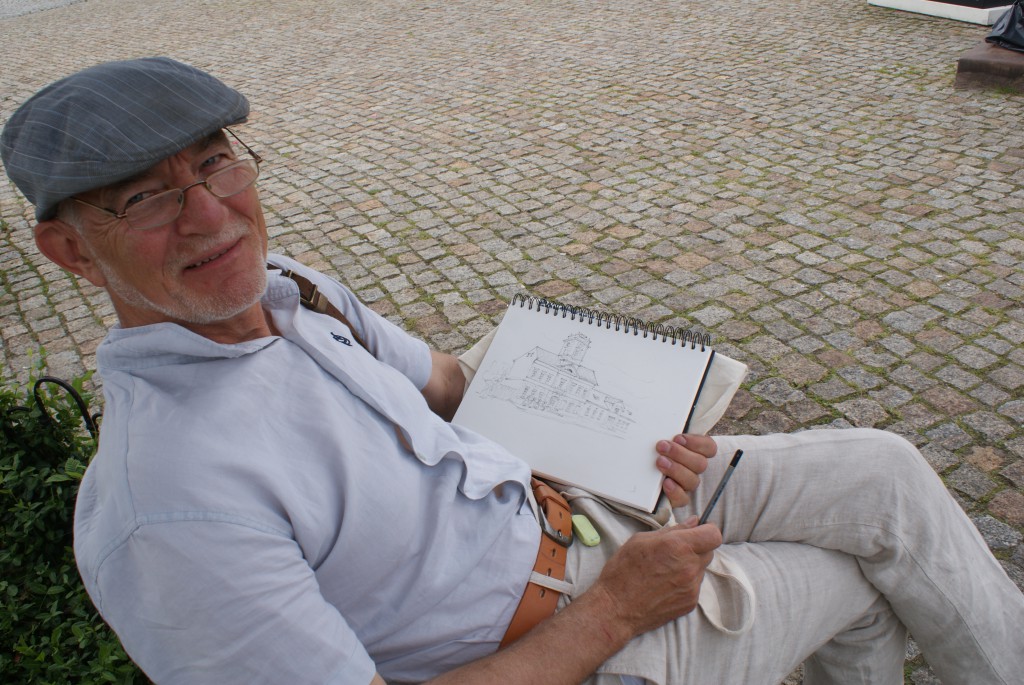
We met Grzegorz Stęplewski on September 9 at the Kutno Community Center so we could talk about what remains from the Jewish community of Dąbrowice. Grzegorz lives in Kutno and is a member of TPŻK (Friends of the Kutno Region), but he grew up in Dąbrowice, a village of about 1,300 residents nearby. Grzegorz likes to paint and sketch; he imagines scenes as they would have looked based on historical records and the current configuration of streets, for example reinserting the synagogue next to his childhood home.
The next day, Grzegorz met us at the Krośniewice cemetery and we followed him to nearby Dąbrowice, just 9 km away. We parked outside his family home, a one-story house with a small covered wooden porch in front, which he continues to own. The house is on a small plaza called the “Nowy Rynek” that functions as green space with grass, pollarded trees and a green-painted kiosk. This rainy Saturday afternoon, the kiosk was closed and no one was on the streets.

We climbed the rough wood steps and sat out of the rain on a single bench perpendicular to the front door. Grzegorz showed us hand-drawn street plans dated 1959 with his family property facing the plaza and the synagogue plot next to it on Sienkiewicza Street.

The synagogue was destroyed during the war. Some years later, Grzegorz’s father added the synagogue plot to the back garden of his house. He has what is called a dzierzawa wieczysta, a perpetual lease; in effect, he doesn’t own the land but can use it indefinitely. It currently sits behind a stone wall, though we could see into the yard from the neighbor’s driveway gate. Based on the size of the lot and the space Grzegorz paced out for us, the synagogue was not large.


We continued on a roundabout route to the site of the cemetery. Gzegorz pointed out where the center of town was visible across agricultural fields, and explained the old, unpaved road takes a more direct route but it’s only suitable for farm vehicles. The cemetery plot stands forlorn, an overgrown thicket surrounded by plowed fields. Getting to it would require walking across those fields. It’s unlikely that any grave markers remain under the shrubs and small trees. Grzegorz said that at minimum, there should be a sign at the side of the road indicating the location of the Jewish cemetery.

That was the extent of what remains of the Jewish community of Dąbrowice.


Finding such engaged keepers of memory is very special. Hearing their stories and sharing their knowledge allows for the creation of a narrative of Jewish life in these towns.
LikeLike
Exactly Jill! I’ve learned so much and I want to share it
LikeLike
Hello,
My name is Oz Harpaz, and I’m conducting genealogical research about my family, the Złotogórski family, originally from Dąbrowice, Kutno County. I will be visiting Kutno on June 9, 2025, as part of my roots journey.
I found your fascinating website “Uncovering Jewish Heritage,” and your extensive research about the Jewish heritage in Dąbrowice and Kutno greatly interests me.
Would it be possible to meet briefly during our visit to Kutno, or perhaps you could suggest contacts or locations of particular interest in Dąbrowice?
Thank you very much in advance for your assistance. I look forward to your reply.
Best regards,
Oz Harpaz
LikeLike
I don’t live in Poland but I will share your information with Bożena Gajewska who lives in Kutno. She leads all kinds of Jewish memorial activities in the Kutno area. Perhaps she can help you or she can put you in touch with someone with knowledge about Dąbrowice. I hope you find out more about your family!
LikeLike