• About
  • The Photo that Started it All

Uncovering Jewish Heritage

Uncovering Jewish Heritage

Category Archives: Warsaw

Finding Family at the Jewish Historical Institute

24 Sunday Sep 2017

Posted by Marysia Galbraith in Archives, Family, Genealogy, Piwko, Research Methodology, Rotblit, Warsaw

≈ 2 Comments

Tags

Jewish Historical Institute, JewishGen, Żydowski Instytut Historyczny

When my cousin Krysia and I first started searching for our Jewish roots, we barely knew where to start. Our Aunt Pat, a genealogist, had shared an impressive record of names, places, and even stories. Obsessive Internet searches yielded limited results–things like a notice in the Canadian Jewish Review from October 1963 that listed my grandmother’s sister Maria Weglinska among the out-of-town guests at Rochelle Pifko’s bat mitzvah in Toronto. Pifko/Piwko was my grandmother and her sister’s maiden name. But how were they related to these Canadian Pifkos?

1963CanadianJewishReviewBatMizvah

Notice in the Canadian Jewish Review on October 18, 1963 about Rochelle Pifko’s bat mitzvah.

How could we push beyond these tidbits? What more could we learn about our family?

Thanks to the Jewish Historical Institute (JHI, Żydowski Instytut Historyczny) in Warsaw we made some breakthroughs that have helped us piece together our family tree. Krysia’s husband Steve stopped in during a business trip to Warsaw and met Anna Przybyszewska-Drozd at the genealogical division of the JHI. She did a preliminary search on JewishGen, and found references to vital records of some of our ancestors. A few months later, Krysia and I went on our first roots trip to Poland. We still had no idea what we were doing so we stopped in at the JHI, meeting with Anna’s associate Aleksandra (Ola) Dybkowska-Grefkowicz who stayed after hours to help us with our search. She prefaced everything with her usual caution, “Don’t be disappointed if you don’t find anything” because so many records were destroyed and most Holocaust deaths were not recorded. Then, she showed us how to make use of the records in JewishGen and the databases of  the Polish National Archives, and suggested other places we could search for records.

I learned enough at that meeting to make some breakthroughs. I discovered my Zurich cousins through the Family Finder database on JewishGen, and shortly after my Israeli cousins through myHeritage.

On successive trips to Warsaw, Anna and Ola helped me learn more about my grandfather Jakob Rotblit. I was speaking with Ola about his automobile dealership in Gdansk when Anna walked in. A look of recognition flashed across her face; she pulled a book off the shelf about Jewish business owners in Gdansk between the World Wars. Sure enough, Jakob Rotblit was listed with information about his Ford dealership and with details about his wife and his parents. Another time, I mentioned that my mother and grandmother are on the list of Jewish survivors who registered after World War II ended. With a satisfied smile, Ola told me that the original registration cards are in the JHI archive. I walked upstairs to the archive and was able to hold those cards in my hand. The archivist showed me how the earliest records, from 1945, were handwritten on the backs of cut up prewar accounting records. Paper was scarce, so they used what they could find. By 1946, information was filled in on larger, pre-printed cards made especially for this purpose.

Once again, just a few months ago, the genealogical division helped me with my search. Anna e-mailed me that a woman, Ellen, had contacted her to find out about her Piwko ancestors. Anna thought we were related and asked if she could share my contact information with her. Of course I agreed, and since then Ellen and I have been in ongoing communication. She is an avid genealogist who turns out to be my 3rd cousin. Her great grandfather was my great grandfather Hiel Majer Piwko’s younger brother Urish. I knew nothing about him, maybe in part because he moved to Canada in the 1880s.
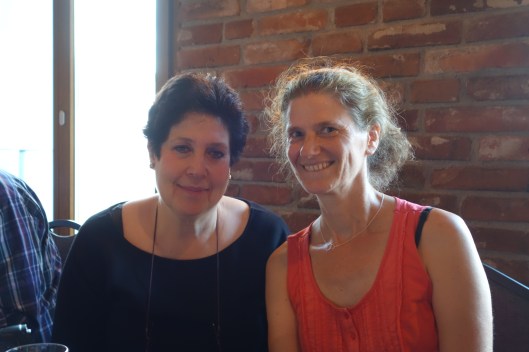
DSC00199

3rd Cousins in Krakow, Poland in June 2017

Ellen and I had the extraordinary good fortune to be in Poland at the same time this June. She was on a once in a lifetime Jewish history tour of Eastern Europe with Professor Stephen Berk. Although I didn’t know anything about her or her great grandfather, I had an inkling about her branch of the family from that notice I found years ago about my Auntie Nunia’s (Maria Weglinska) visit to Toronto in 1963. Rochelle Pifko, the girl whose bat mitzvah she attended, was Ellen’s cousin and another descendent of Urish. So another mystery is solved. Some contact was maintained between my great aunt and her uncle who migrated to Canada shortly after she was born. And when Nunia/Maria came to the US in the 1950s, she renewed that connection and even visited. Ellen remembers when Nunia came to Canada some years later for another family event.

AK Verification, Part III

02 Saturday Sep 2017

Posted by Marysia Galbraith in Archives, Bereda, Family, Memory, Polish Culture, Polish Underground Army, Warsaw, World War II

≈ Leave a comment

Tags

AK, Armia Krajowa, Maria Bereda(y) Galbraith, patriotism

NOTE: This overview of my recent discoveries at the Polish Underground Movement Study Trust, Studium Polskiej Podziemniej (SPP) got so long I am publishing it in three separate posts. Here is part III. During the German occupation of Poland during World War II, the Polish Underground Army worked in secret to resist, sabotage, and fight against the Nazis. Another name for the Polish forces is “AK,” short for “Armia Krajowa,” or “Home Army.” I talk about the soldiers as “the partisans;” in Polish sources they are also called “konspiracja,” “the conspiracy.”

Sorry it’s taken a while for me to get to part III. The semester has begun which means I’ve been very busy.

DSC00534

Pencil sketch of Maria Bereday from the 1950s, signed Ditri. Friends tell me she looks like a spy.

All of the questions the archivist Krystyna asked me about the names Mama went by paid off because she found another file; the envelope was mislabeled “Maria Fijułkowska.” Inside was a six-page report, relacja, Mama had written titled, “Outline of Courier Work.”

Initially, neither Krystyna nor I found this file because not only was “Bereda” missing, but Fijałkowska was also misspelled. Krystyna wrote “Fijałkowska” on a new envelope; I don’t know why she didn’t also add the Bereda, even after I pointed out that Mama’s full name was hand-written in large letters along the left margin of the document’s first page. Around World War II, the family usually used the name Bereda-Fijałkowska. Mama told me they added the Fijałkowski/a, which was grandpa Bereda’s mother’s maiden name and a name associated with the Polish gentry, because of Babcia’s social aspirations.

DSC00333

Mama’s name (Bereda-Fijałkowska) and pseudonym “Renata” in the margins of her typewritten report.

Mama’s report matches up with some of the stories she told me, and confirms some of what she did during the occupation. It also gives more details about the way her courier unit “Zadra,” was organized, and how couriers carried out their duties. The report is dry and factual. It contains no specifics about her emotional engagement or personal thoughts. A historian might find it interesting for what it reveals about the operations of the Underground conspiracy. I keep trying to look beyond the words to find the person behind them.

She writes, that “Zadra” started out very small, and because the work wasn’t systematized, the couriers were on call at all times. “By the end of 1942,” she writes, “the number of couriers stabilized at 15, and that group became close and experienced, and worked together for a long time without changing members.” This all changed in the fall of 1943 when the occupier, okupant, limited train travel to Germans only. Overnight, the courier corps dropped from 60 to just six who spoke German well and had German papers. “The work for these couriers during this time was nonstop,” she continues, “The number of trips for each courier came to 10-12 per month, depending on the route.” My mother doesn’t state it in the report, but she must have been one of the couriers who carried out missions during this time. Some of her most vivid stories were about traveling in the train cars with an assumed identity as a “volksdeutch,” a half-German whose father was fighting for the Reich on the Eastern front.

After about two months, the courier corps were reorganized and expanded, with more reserve couriers brought into regular service. In the half year before the Warsaw Uprising, the number of couriers in her unit approached 40, and overall reached 100.

The duties of the couriers included delivering coded and uncoded orders hidden in ordinary objects such as candles or paint, special messages that had to be handed to specific commanders, and large sums of money (1/4-12 million zloties in 500 zloty bills). Some missions involved carrying the messages brought by paratroopers they called “ptaszki,” “little birds.” This is the code name for the cichociemni, the officers who parachuted in from the West carrying money and messages from the Polish Government in Exile.

The report includes an example of a special mission Mama undertook at the end of 1943. Instead of being briefed by her usual commander “Wanda”, “Beata,” the head of communication with the west, did it. “Wanda” gave her a special coded message she had to hand directly to the chief of staff or the commander of the Radom District. This was to occur in private with no witnesses. Mama also had to memorize and deliver the oral message, “The commanders of the divisions and subdivisions of “Burza” require complete secrecy in the event of the invasion of the Russians.” Burza, Tempest, was the code name for the Warsaw Uprising.

Because the chief of staff wasn’t available on the day Mama arrived, she had to spend the night at a safe house. The next day, she delivered the messages to Chief of Staff “Rawicz” [his real name was Jan Stencel or Stenzel], but had to spend another two days before “Rawicz” returned from the forest, where the partisans were hiding out, with the required response for the Central Command in Warsaw.

Reading this sparked another memory for me. I think it was a big deal for Mama to stay away from home for so long, especially because her father didn’t know she was in the Underground. Her mother did know, though, and they hatched an alibi about a visit to Mama’s fiance’s family. Or maybe this is the story she told the authorities on the train to explain why she was returning several days late. Hopefully, my brothers remember this story, too, and can confirm one of these versions.

The documents from the Studium Polski Podziemnej in London have been a lynch pin that holds together information from a variety of sources. While I was there, I also found a citation for Communication, Sabotage, and Diversion: Women in the Home Army, Łączność, Sabotaż, Dywersja: Kobiety w Armii Krajowej, published in 1985. The book was written in Polish but published in London. I found a copy of it at an online used bookstore whose brick and mortar shop is in Warsaw. I called, and sure enough they had it in the shop, so I picked it up while I was in Warsaw. It contains the recollections of the head of the Women’s division of Central Command (VK) Janina Karasiówna, the oficer who confirmed Mama’s verification file. Another chapter contains the report of Natalia Żukowska who was the assistant commander of Mama’s courier unit; Mama identifies her by her pseudonym “Klara.” From Żukowska’s report, I learned that “Zadra” was the name used by the couriers who had been working with the unit for the longest, but in 1943 the name was changed to “Dworzec Zachodni.” Reviewing Mama’s documents, I see now that she identified her unit as Zadra-Dworzec Zachodni in one place. She underlined it, too. Until I read this book, I had thought Dworzec Zachodni, which means Western Station, referred to Zadra’s location, not an alternative cryptonym. And then there’s this: the names of the 15 couriers, including “Renata.” That’s Mama’s pseudonym; her last name is misidentified as “Brodzka” instead of “Bereda,” but Natalia writes, “Unfortunately, it wasn’t possible to decrypt all of the last names” (p. 118).

Mama was proud of her service for her country, but she was also painfully aware of the cost of war. She called herself a pacifist and the war solidified her abhorrence of armed conflict. I remember her asking, “Are there times when fighting is necessary?” I could tell from her voice that she wanted to believe all conflicts can be resolved peaceably. But her experience had taught her otherwise.

AK Verification: Part II

13 Sunday Aug 2017

Posted by Marysia Galbraith in Archives, Bereda, Family, Poland, Polish Culture, Polish Underground Army, Warsaw, World War II

≈ Leave a comment

Tags

"Zadra", AK, Armia Krajowa, Courier, General Bór Komorowski, Grupa "Koło", Major Janina Karaś, Maria Bereda(y) Galbraith, Polish Home Army, Polish Underground Study Trust, Studium Polski Podziemnej, Warsaw Uprising

NOTE: This overview of my recent discoveries at the Polish Underground Movement Study Trust, Studium Polskiej Podziemniej (SPP) got so long I am publishing it in three separate posts. Here is part II. During the German occupation of Poland during World War II, the Polish Underground Army worked in secret to resist, sabotage, and fight against the Nazis. Another name for the Polish forces is “AK,” short for “Armia Krajowa,” or “Home Army.” I talk about the soldiers as “the partisans;” in Polish sources they are also called “konspiracja,” “the conspiracy.”


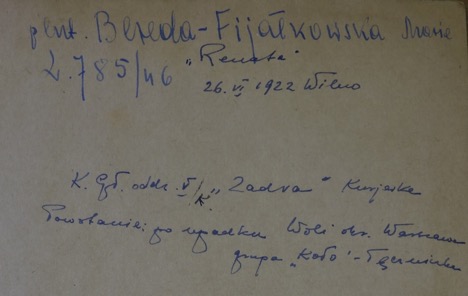
The file at the archive of the Polish Underground Movement Study Trust, Studium Polski Podziemnej (SPP), contained the same verification questionnaire I had from my mother’s papers and so much more. On the envelope itself is the following identifying information:

VerificationEnvelope

Information on the envelope containing Mama’s papers at the SPP

I ‘ve learned how to decipher all of this. Here’s what it means:

Cadet Bereda-Fijałkowska Maria

2.785/46 [record #]     “Renata” [her pseudonym]

   26. VI 1922 Wilno [birth date and place of birth]


            Central Command division V/Women “Zadra” courier

Uprising: after the fall of the Wola district of Warsaw

                                    “Koło” Group-liaison officer [the names of her units]

The documents inside the envelope confirm Mama’s service and rank in the AK [Home Army], as well as her receipt of the Cross of Bravery. She submitted her questionnaire on March 9, 1946, her commanding officer confirmed her claims on April 15th of the same year, and the official report was completed the next day on April 16. The final report says the head of the Polish Army himself, General Bór-Komorowski, confirmed her receipt of the Cross of Bravery. Here is what looks like his signature on the document:

BórSignature

General Bór Komorowski’s signature verifying Mama’s service in the Polish Home Army. It looks like he wrote “Stwierdzam (I confirm)  16/IV 46” above his signature. Note the “gn” for “generał.”

Mama started military training in middle school, gimnasium, at the Klementyna Hoffman School in the mid-1930s. She continued training in high school, liceum, and entered the Underground in June 1941, right after finishing high school. She took courses on how to be a courier, the organization of the Underground and of the German military, as well as marksmanship, topography, and first aid. She was in “Zadra” Group, part of the women’s courier corps in the 5th Division of the Central Command. She delivered encoded communications, money, and oral messages on the routes between Warsaw and Krakow, Radom and Skarżysko-Kamienna. In these latter two places, she acted as a go-between for the partisans in the surrounding forests and Central Command in Warsaw. From 1942-4, she also worked as an instructor training other women to serve in the Underground.

When the Warsaw Uprising began on August 1, 1944, she was with her unit “Zadra” in Wola, a district to the northwest of downtown. A handwritten note on her typed questionnaire says “wounded on route from Wola to the Old City.” The handwriting is different from Mama’s distinctive, almost calligraphic style, so somebody else must have added it after Mama submitted her answers.

The archivist Krystyna Zatylna said that the heaviest fighting in the first days of the Uprising was in Wola. Mama was lucky to have survived. By August 8, 40,000 civilians died in Wola.

The Home Army regrouped in the Old City. Mama got separated from her unit and joined “Koło” group. She is referred to here as a “liaison,” “lączniczka,” rather than “courier,” “kurierka.” Both terms refer to people entrusted with delivering critical information. Initially, however, she worked as a medic on Długa Street. When the Germans pushed the partisans out of the Old City, they escaped to the City Center, Śródmieście, via the sewers.

14SPPVerificationDossier

Document dated September 9, 1944 that allowed “Renata” to travel through the City Center during the Warsaw Uprising.

The file contains two papers dated from the Uprising. No doubt Mama brought them with her to London to help corroborate her report. These tattered notes—physical proof of her service—must have been very precious to her. The first, on a third of a piece of paper that has deep creases from having been folded many times, is dated September 9, 1944. It states:

I assert that cadet Renata is a liaison of “Koło” Group. The conditions of her service require movement within the region between Savior Square and Napoleon Square.

The note is signed by the Chief of Staff of “Koło” Group, Major Krynicki. The document contains a round stamp with a crowned eagle in the middle surrounded by the words “Motorized Transport Brigade, “Brygada Dyspozycyjna Zmotoryzowana.” Mama must have shown this note at barricades on the streets so the AK soldiers would let her pass. Savior Square and Napoleon Square are in the City Center, which means she retreated through the sewers before September 9. I can, however, imagine her dodging Nazi bullets as she ran across the barricaded Jerusalem Street carrying messages from Napoleon Square to Savior Square. These names would sound good in a poem. Too bad I’m not a poet.

The second paper dates from October 3, 1944, the last day of the Uprising. Signed by Colonel Bolesław Kołodziejski, the commander of “Koło” Group, it is titled, “Provisional certificate (to be exchanged after the war for official recognition).” The text reads:

I confirm that “Renata Lewandowska” was decorated for her activity during the Uprising from August 1 to October 3 1944 with the Cross of Bravery for the first time.

Based on: the personal confirmation of the head of the Warsaw Corps of the A.K. Brigadier General Montera and his assistant Colonel Wachowski, as told to the commander of “Koło” Group during the last days of the Uprising.

“Montera” was the code name for General Antoni Chruściel, who led the Home Army (AK) in Warsaw during the Uprising. Kołodziejski was also a code name. Elsewhere in the documents, Mama writes that his real name was Zygmunt Trzaska-Reliszko.

Mama writes that she was promoted twice; in September 1944 she became a cadet, plutonowy podchorązy and in October she was promoted again to ensign, podporucznik. It looks as though the Verification Commission could only confirm the first promotion. A handwritten note on Mama’s questionnaire says they weren’t able to contact her commanding officer from “Koło” Group to verify the second promotion.

Also in the file are two statements written by the commander of the women’s branch of the 5th division of Central Command (V.K. KG) Major Janina Karaś, dated April 15, 1946. In them Karaś, also known as Karasiówna, confirmed that Mama earned the rank of cadet in “Koło” Group, and was also granted the Cross of Bravery for her service. Clearly, the Verification Commission contacted Karaś to corroborate Mama’s claims on her questionnaire. One of Karaś’s statements reads:

As the chief of the V.K. [5th Women’s] Central Command I certify that in the course of her service as a courier, “Renata” Maria Bereda Fijałkowska distinguished herself on the route Warsaw-Krakow and Warsaw-Skarzysko-Radom with bravery and decision to take risks. Traveling with German false papers she carried money, mail, and oral orders /for example related to the order for [Operation] Tempest. She earned the Cross of Bravery for her service.

Operation Tempest, “Burza,” was the code name for the beginning of the Warsaw Uprising. In other words, some of the messages Mama carried between Central Command and the partisans in the forest involved critical details about the Polish Underground’s battle to free the capital city from German occupation. I’m reminded of something the archivist at the Warsaw Uprising Museum kept repeating when I showed him Mama’s verification questionnaire two years ago: “She must have been very high in the conspiracy.” He couldn’t find the exact connection, but I believe I have it right here.

Krystyna Zatylna helped me put the pieces together. The forests around Radom are where the so-called “cichociemni,” “the quiet unseen” soldiers parachuted in from the West, bringing messages and money from the Polish Government in Exile for the leaders of the Underground in Poland. I believe Mama was given these items from the cichociemni and carried them back to Central Command in Warsaw. It fits with stories she sometimes told, and it fits with the seven-page report she filed with her verification papers. And that will be the subject of the third part of this blog post.

Jewish Warsaw in the Shadow of Skyscrapers

30 Friday Jun 2017

Posted by Marysia Galbraith in Jewish Culture, Memory, Polish-Jewish Heritage, Polish-Jewish relations, Post-World War II, Synagogues, Warsaw

≈ Leave a comment

Tags

Plac Grzybowski

I discovered Jewish Warsaw tucked between streets I’ve walked dozens of times. My first surprise was that the apartment I rented in an ugly green socialist-era tower is literally around the corner from Plac Grzybowski (Grzybowski Square), where Jewish life survived into the communist era.

DSC00155

6th floor view of Plac Grzybowski. From the left, a socialist era apartment, All Saints’ Church, modern skyscraper, (at the center) green space, with the site of Jewish Theater behind it and the roof of the Gmina Żydowska behind that, (bottom right) back of building with Charlotte Menora Cafe.

I’ll say more about Plac Grzybowski in a minute, but I was even more surprised when, while mapping out a running route, I saw that I was also just a block away from Nożyk Synagogue, the only synagogue in Warsaw that survived the war. I’m embarrassed to admit that I had never been there before, nor is this the first time I’ve been so close and didn’t even realize it. When my best friend from childhood Kim visited with her father in November 2014, we stayed at a hotel on Grzybowska Street, and were it not for the newer building across the street, we could have seen the synagogue from the hotel entrance. Kim and her family introduced me to Passover Seders, and bagels with lox and cream cheese, and I’m sure they would have loved to see the synagogue. In my defense, the synagogue sits in the green space at the center of the block, with tall buildings all around it. It’s easy to miss. The street access to the synagogue looks like the entrance to a parking lot, and from Grzybowska Street, the only access is via pedestrian walkways.

DSC02259

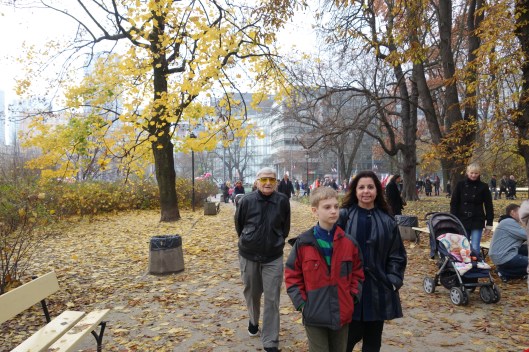
My friend Kim with her father Sandy and my son Ian in Saski Park, Grzybowska Street in the background, November 2014

This isn’t the first time I have seen a synagogue tucked within the central courtyard of a city block. I wonder what the historic reasons were for that. Regardless, I imagine that in the difficult years after the Holocaust, this location offered the synagogue some protection; only people looking for it would find it. This is also where the Gmina Żydowska—the Association of Jewish Communities—has its offices. I should have come here before.

Nożyk Synagogue, Warsaw
"About the Jewish Community"
“About the Jewish Community”

Built in 1902, the synagogue is a solid stone rectangle with arch-topped windows all around. Above the front door, two arch-topped tablets contain the Ten Commandments, and above them is a Star of David. The building survived World War II because the Nazis used it as a warehouse. Jews returned to worship there after the War, and at present, it remains the main synagogue of Warsaw, home to the Orthodox community. The offices of the Gmina Żydowska fill a modern addition across the back of the building.

Both times I walked by the synagogue, a few men were inside praying. More people walked by briskly, probably residents of surrounding buildings. Along the edge of the parking area, large information boards contain headlines like “We, the Jews of Warsaw,” “About the community,” and “Kosher…what does it mean?”

All the pieces fit together from my 6th floor balcony. I can see the metal roof of the synagogue’s modern addition. I also look down at the corner of Charlotte Menora in Plac Grzybowski; this is one of four Charlotte Cafes in Poland. They all specialize in French pastries, but this one also includes Jewish offerings such as bagels and rugelach. My friend Beata took me there last summer. She also pointed out the center of the square that has been converted into a shaggy grassland and wildflower garden. Pathways lined with benches lead down to a central fountain. This novel use of space started out as an art installation by Joanna Rajkowska called “Dotleniacz,” which in English means “Oxegenator;” The project was later reworked into its present, more permanent form.  Beata also showed me Próżna Street, the only street in the ghetto where the original buildings weren’t destroyed in the systematic bombing after the Ghetto Uprising in 1943. On one side of the street, the townhouses have been painstakingly restored. On the other, netting covers the buildings to prevent pedestrians from being harmed by falling elements of the crumbling façade. One of the renovated buildings is home to the Austrian Cultural Forum. Some of my Polish friends say they feel uncomfortable about this because of Austrian support for the Nazis.

Park in the middle of Plac Grzybowski
Próżna Street at night

Grzybowski Square is actually shaped more like a triangle. Charlotte Menora and the intersection with Próżna Street are on one long side. At the second long side, a pile of debris peaks above a barrier fence where the Jewish Theater was torn down last year. This theatre continued to operate all through the communist period, offering performances in Yiddish. Posters on the fence announce that the theater will be rebuilt, along with the TSKŻ, which stands for Towarzystwo Społeczno – Kulturalne Żydów, The Social and Cultural Association of Jews. Sophie, whom I met because she shares the last name of my great grandmother, lived in Warsaw until 1968. Her face lit up as she recalled going to youth activities at the TSKŻ. But she, like most of Poland’s remaining Jews, left in 1968 when the government waged a campaign against Jews. That’s also when many of the TSKŻ branches closed. In Warsaw, the organization hobbled along until after the end of communism, and has since been growing once again.

"Coming here, The new location of the TSKŻ. Jewish Theater and Office-Services Building"
“Coming here, The new location of the TSKŻ. Jewish Theater and Office-Services Building”
All Saints Church
All Saints Church
Pope John Paul II statue in front of All Saints' Church
Pope John Paul II statue in front of All Saints’ Church

At the third, shorter side of the triangle stands the All Saints Church, where Christian Poland asserts itself even in this Jewish part of town. I’ve read that the church was right along the border of the ghetto, and it was where converts to Catholicism living in the ghetto would come to pray. More recently, symbols of Polish nationalism have been placed across the front of the church. Numerous plaques commemorate Home Army soldiers who fought against the Nazi occupation and in the Warsaw Uprising of 1944. These soldiers belonged to companies with names like “Buttress,” and “Brave,” and had wartime pseudonyms such as “Goliath,” “Fisherman,” and “Rooster.” A sculpture of Pope John Paul II stands on the steps leading up to the church, and a monument honoring the Home Army soldiers who produced weapons for the partisans is in the park across the street.

Plac Grzybowski is virtually unrecognizable from the first time I saw it. Marta, a family friend from Warsaw, pointed out the Jewish theatre to me in what I remember as a wide, crowded, dirty intersection with no central green space. It might have been 1990 or 1991, or maybe even 1986. Marta also painted a picture for me of how the square looked still earlier in time, before the war, when the streets were filled with Jews, many of them orthodox men with long beards and black coats, and women wearing wigs or kerchiefs.

The view from my window encapsulates this city–a mishmash of old and new, Catholic and Jewish, nationalism and subversion. Add to this the layers of memory every place contains, along with the energy of a capital city, and you can feel the beating heart of Warsaw.

My elusive grandfather Jakob Rotblit

27 Tuesday Sep 2016

Posted by Marysia Galbraith in Family, Gdynia, Memory, Names, Poland, Pre-World War II, Rotblit, Warsaw

≈ 3 Comments

Tags

Jakub Rotblit

The danger of digging up family skeletons is that you never know what kind of bones you’ll find.

My mom rarely said anything about her biological father. In fact, it wasn’t until I was a teenager that she told me the man she called Papa, the husband of her mother, was not her birth father. As children, she and her older brother felt like orphans. They never saw their birth father, which I’m sure was related to the fact that talking about him would have revealed the family’s secret Jewish roots. Back then, in prewar Poland, Catholics did not divorce and remarry.

When she finally opened up to me about him, Mama said she barely knew her father. She almost never saw him. Then one summer, following a big fight between him and her mother, Babcia (my grandmother) got fed up and told him, “If you want your children you can have them.” She put George (who was 15 at the time) and my mother (who was 13) onto a train to Gdansk, where they joined their father with his second wife and their daughter.

The Baltic Coast was beautiful, but Mama was miserable. Her father didn’t know what to do with them, and his 2nd wife didn’t want them there; perhaps she felt threatened. After two months (that’s what I remember mom said, though some relatives have told me it’s inconceivable Babcia would have left her children for that long), my grandmother came to Gdansk and with effusive tears and passionate apologies, she brought them back with her to Warsaw. That’s the last time Mama saw her father. She told me she did not know what happened to him, but that probably he died during the war. She never told me his name.

Victorian high button shoes. Source: http://antique-gown.com/

Victorian high button shoes. Source: http://antique-gown.com/

One of the stories my mother would tell me from time to time was about the “high button shoes” her father insisted she wear when she was around 13 years old. The bitterness still lingered when she described to me how much she hated those boots; they were old fashioned and ugly, the kind that were commonly worn in the 19th century. Her father contended they were sturdy, and proper for a young girl. They were also expensive because he’d had them custom made for her. I always assumed this was a conflict Mama had with Papa, her stepfather. It’s only now, as I piece together the fragments, it occurs to me this argument might have been with her biological father. The timing fits. Also I imagine he was probably the more conservative of the two.

I only learned my biological grandfather’s name in 2011, when my Aunt Pat (the wife of my mother’s younger brother Sig) showed me a family tree she had made identifying my grandfather as Jacob Rotblit (in a previous post, I’ve written about how names can vary), son of Ignacy and Hanna, and brother of Maurice and Helena. Pat reiterated another fact my mother had mentioned: Jacob was from Warsaw but had moved to the Baltic Coast. Pat also had notes, presumably from conversations with my grandmother’s sister, that Rotblit had been a merchant who sold fine jewelry and luxury cars.

Jakub Rotblit b. 1891

Jakob Rotblit, b. 1891

Then my cousin Krysia remembered that before he died, her father (my mother’s brother George) gave her a photo of his father. Krysia wrote some notes on the back of the photo: “He was a respected Jew. Babcia fell in love with his friend Zygmunt and left him.” Then, with a rectangle around it was the name “Jakup Rotblit” and under that “my father’s father” and a roughly sketched family tree. So not only could I attach a name to my mysterious grandfather. I also had a photograph. And yes, his children resemble him. And so does one of my brothers and a cousin.

From here, the trail went cold. It took another two years before Krysia and I obtained a copy of a birth certificate of a Jacob Rotblit who was born in Warsaw in 1891. The name, city, and date were plausible, but we didn’t know if this was our grandfather, our Jacob Rotblit or some other one. Though not a common name, I have found prewar records of at least three.

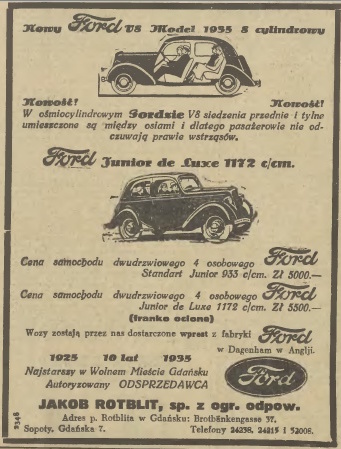
This was in 2013, a time when Krysia and I would stay up until early morning searching everything we could think of on Google, and sending tidbits back and forth to try and fill out the story of our grandfather . She contacted several Rotblits she found to inquire if we might be related. I dug up references to Jacob Rotblit’s Ford dealership. This business, car sales, corresponded with my aunt’s notes. Granted, neither now nor then were Fords “luxury cars,” but in the 1930s any car was a luxury.

Ad for Jakob Rotblit, Ford Dealer in Gdansk, Sopot, and Gdynia, Gazeta Gdanska 1935

Ad for Jakob Rotblit, Ford Dealer in Gdansk, Sopot, and Gdynia, Gazeta Gdanska 1935

In September 2013, when I was back in Warsaw at the Jewish Historical Institute, Anna Przybyszewska recalled seeing the name in a book, J. Drozd Społeczność Żydowska Gdyni w Okresie Miedzywojennym [Jewish Residents of Gdynia during the Interwar Period]. Indeed, on page 309 is the following (I’ve translated it):


On November 20, 1936, a company was registered in Gdynia named “Permanent Automobile Market (Stałe Targi Samochodowe).” It was the initiative of the married couple Jakub and Bronisława Rotblit. The object of the enterprise Stałe Targi Samochodowe was the management of the trade in domestic and international products, specifically mechanized vehicles (new and used) as well as their accessories. In addition, the company offered parts, service, and repairs of vehicles. Jakub Rotblit specialized in the sale of automobiles and accessories of the Ford firm, of which he was an authorized dealer. The specific headquarters of the Rotblit’s company were always located in places beneficial to the interests of the place—first in the BGK building (at #31 10 Lutego [Tenth of February] Street), and from July 1938 in the new office building of the firm “Bananas” (at #24 Kwiatkowskiego Street). The operation of the firm ended suddenly upon the death of Bronisława Rotblit, as a result of which her husband moved to Warsaw.

In the footnote: Jakub Rotblit (born June 25, 1891 in Warsaw), son of Arkadiusz Rotblit and Racheli Prowizor, married, merchant. Arrived in Gdynia from Warsaw June 25 1935. He lived at 25/7 10 Lutego Street and 6 Hetmańskiej Street.


It took another year before I got the birth certificate (which was in Russian) translated and could confirm the vital information was consistent with what was written in this book: The birthdate was the same; the parent’s names were similar enough to likely be Hebrew and Polish versions of the same names (Aron/Arkadiusz and Ruchla/Racheli Prowizor). In my Aunt Pat’s notes, Jacob’s second wife was “Blanka” and their daughter’s name “Rosa.” I still couldn’t be sure, but it was looking more likely I had uncovered more traces of my biological grandfather.

I have continued to collect fragments, fleeting references to Jacob Rotblit, never sure if they’re about my grandfather or not. Did his 2nd wife really commit suicide? Was he really arrested for business fraud? Was he shot outside of Warsaw in 1941 by a German officer? I have documents saying these things happened, but I have no way of checking these details and no way of linking them conclusively to my grandfather.

But I have recently learned something truly extraordinary. Last month I was contacted by someone through Ancestry’s DNA matches. Genetically, we appear to be second cousins. And yes. His mother was a Rotblit, daughter of Louis/Leib Rotblit who came from Russia/Poland. Louis arrived in England, married and had three children around the time of World War I. My cousin knows very little about his grandfather because he left his grandmother after several years. His mother never talked about him. But on his grandparent’s marriage certificate, Louis’ father was named Aaron and his brothers Moshe and Ya’akov (all written in Hebrew, so the English or Polish forms could easily be Arkadiusz, Maurice (?), and Jacob).

Enough of these details add up. And DNA is likely to be the most concrete evidence I’ll ever find. Another branch of my family tree is filling out. More relatives survived.

Threading the Needle

27 Wednesday Jul 2016

Posted by Marysia Galbraith in antisemitism, Baligród, Commemoration, Fieldwork, Heritage work, Jewish Culture, Kazimierz, Krakow, Lesko, Memory, Poland, Polish Culture, Polish-Jewish Heritage, Polish-Jewish relations, Tarnów, Warsaw, Wronki, Włocławek, Zasław, Żychlin

≈ Leave a comment

Tags

Erica Lehrer, Jacek Nowak, Jewish Poland Revisited, Katka Reszke, Return of the Jew

I am back from six weeks in Poland. I envisioned regular posts from the field in this blog. But instead, doing fieldwork left little time for writing and reflecting about it. Nevertheless, a structure for my next book project has been emerging. The challenge will be threading the needle between celebrating the renewal of interest in Jewish life in Poland, captured so well in Erica Lehrer’s Jewish Poland Revisited and Katka Reszke’s Return of the Jew, and addressing the ongoing silences, distaste, even hatred expressed toward Jews, as revealed in Jacek Nowak’s interviews with ordinary Poles. Because both are happening at the same time, often in the same places, and sometimes even within the same people.

And I’ve seen evidence of both in my own research. People all over Poland are doing incredible work to preserve cemeteries, renovate synagogues, document first-person accounts, and celebrate Jewish music and culture, often in the absence of any involvement from living Jews. They work with passion to fill what they feel to be a void in their local communities. And they do so despite the resistance they sometimes face from fellow residents and local government representatives. Every place tells a different story, even though many of the same elements can be found in each of them. Over the next several posts, I’ll highlight the places and projects I visited. Watch for the place names to become links to more details.

Włocławek

DSC08792

Students and teachers from the Automotive High School in Włocławek receive the first place award for their Facebook “fan page” “Włocławska zapomniania ulica” (“Wloclawek’s forgotten street”) at the Polin Museum in Warsaw, June 22, 2016. The contest was “Places of Holocaust Memory Near Us” and the challenge was to highlight a place in the local community. The team from Włocławek chose Piwna Street, called “the street of death” during World War II.

Żychlin

DSC08396

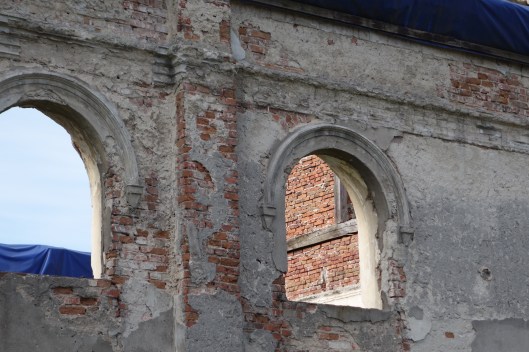
Detail of the synagogue in Żychlin, converted into a warehouse by the Nazis and used as such for many years after. The roof caved in several years ago. Traces of frescos are barely visible through the empty windows.

Kutno

KutnoCemetery

New signs at the Kutno Jewish cemetery provide historical information and urge residents to keep in mind this green hillside is a cemetery. Installed by Towarzystwo Przyjaciół Ziemi Kutnowski (Association of the Friends of the Kutno Region).

Wronki

An arial view of the Lapidarium in Wronki that shows the shape of the raised beds, meant to evoke an open book.

Warsaw

konferencja_zdk_polin-eng_1600_rgbIn Warsaw, the conference Jewish Cultural Heritage: Projects, Methods, Inspirations at the Polin Museum of the History of Polish Jews gave me a good idea of the scope of heritage work throughout Europe, as well as ongoing debates about Jewish heritage projects.

Krakow

IMG_0956

Glass House Orchestra performing at Shalom on Szeroka, the outdoor concert culminating the Krakow Jewish Culture Festival.

Tarnów

DSC09413

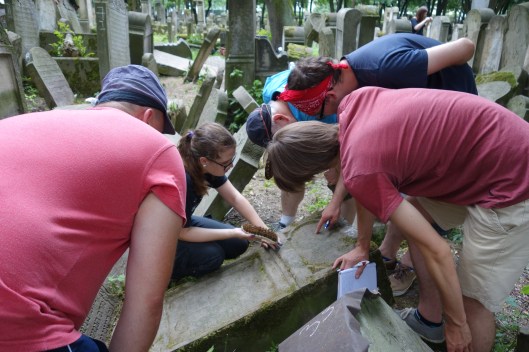
Professor Hońdo of the Jagiellonian University helps participants in the Tarnów Tombstone camp for volunteers (Tarnowskie macewy – obóz dla wolontariuszy) decipher the text on a tombstone.

Baligród

IMG_0998

The weeds grow tall in the Jewish cemetery in Baligród, despite indications of maintenance done not too long ago. It takes constant attention to keep these sites from slipping back into obscurity.

Zasław

ZaslawSignZagorz

Historical information about the Nazi Work Camp in Zasław marking the beginning of the trail from the Zagórz train station to the monument on the mass grave at Zasław. A project of the Stowarzyszenie Dziedzictwo Mniejszości Karpackich (Association of the Heritage of Minorities of the Carpathians).

Lesko

DSC09276

The synagogue in my beloved Lesko–much of the front facade was rebuilt and reinvented around 1960.


Cousins in the Warsaw Ghetto

22 Sunday Nov 2015

Posted by Marysia Galbraith in Bereda, Cemeteries, Jewish Culture, Jewish Ghetto, Kolski, Warsaw, World War II

≈ 2 Comments

Tags

Mirka Kolski, Okopowa Cemetery, Pinchas Kolski, Rachel Piwko Kolski, Warsaw Ghetto

My cousin Pini (Pinchas) Doron, reminded me that his grandfather and namesake died in the Warsaw Ghetto. This is the story he sent me this morning:

“The Okopowe Cemetery is the old big cemetery in Warsaw that we visited with the whole family in 1995, including Pnina’s (his wife) parents.

“Her mother used to run from the Ghetto through the cemetery to the fields to bring potatoes to her family when she was 13 years old.

“Amazing stories.

“I have seen in your post the stone sign for the people who died in the Ghetto. As I told you, my grandfather Pinchas Kolski died in the Warsaw Ghetto in 1940 and was buried in a temporary cemetery inside the ghetto. As we know, in 1940 they no longer allowed anyone to bury the dead  in the Okopowa Cemetery outside the Ghetto.

1941RachelMirkaKolskiAtPinchasGraveInGhetto

Mirka and Rachel Kolski at Pinchas Kolski’s grave in the Warsaw Ghetto. He died in 1940.

“We have this picture of Grandmother Rachel Kolski and her daughter Mirka (see the white sleeve with the [Star of David]-I think this was before they introduced the yellow star)?

“Mirka told me that after this visit to the grave, they managed to escape the Ghetto and to meet your step grandfather (that would have been Zygmunt Bereda) who hid them.”

Okopowa: Warsaw’s Jewish Cemetery, All Souls Day 2014

21 Saturday Nov 2015

Posted by Marysia Galbraith in Catholicism, Cemeteries, Family, Jewish Culture, Memory, Warsaw

≈ 5 Comments

Tags

All Saints Day, Mourning, Okopowa Cemetery, Powązki Cemetery

November is the month when I think about death the most. It starts with the Catholic holidays All Saints Day (November 1) and All Souls Day (November 2). It’s the month when the leaves fall from the trees and the long nights settle in. But it’s also the anniversary of my more personal encounters with death. My brother Ron’s accident was a few days before Thanksgiving in 1990. Nine years later, on the Friday after Thanksgiving, my dad had his accident while visiting me in my new home in Alabama. Both were injured in a fall. Both were in the hospital for two to three weeks before dying.

I think we all learned how to deal with this kind of loss from the first experience. The first time, no matter how dire the news was from New York, I held on to the certainty that Ron would pull through. I let my mother persuade me that it made no sense to come home right away, when he was still in such bad shape. I should finish the semester in graduate school in San Diego and come home as scheduled on December 11 when Ron would be well enough to appreciate my presence. I think she was trying to protect me from the shock of his injuries. And I believed her because she was my mom, and because it was easier, and because the prospect of him dying was inconceivable. But he didn’t last that long and I never got to see him alive again.

The second time, we knew not to assume anything. We held on to hope until the last moment, but we were more prepared for Dad’s passing. My brother Chris was already there, but my other brother Wiley flew in from California. We all sat vigil, visiting Dad every chance we could get and supporting each other in our grief.

So while I love Thanksgiving, this is also the time of year I think about my brother and my father. And I grieve for them all over again.

Especially after Ron died, I struggled with grief. There didn’t seem to be any way to talk about it or express it publicly. I think this is particularly difficult in California, a place that celebrates life and youth. The cemeteries are hidden from view or turned into parks. That’s why it resonated with me to spend All Saints Day in Poland. During this holiday, families visit their relatives in the cemetery (those who are living and those who are dead). They clean the graves and decorate them with chrysanthemums and candle lanterns. At night, the whole cemetery glows with candlelight, and throngs fill the cemetery pathways. Death isn’t hidden away, and the people you love remain a part of your life even after they die.

Whenever I’m in Warsaw, I make a point of visiting my step-grandfather’s grave in Warsaw’s Powązki Cemetery. I clean the stone, place flowers, and light candles. This is the closest thing to a relative I have in Poland, and one of the only remaining traces of my family’s lives there. Last year was the first time I was able to make it there on All Saints Day. I went with my son, who by now is familiar with the custom of visiting, cleaning, and decorating graves. He likes to watch the candles burn.

DSC01729

Ian watching the candles at his great grandfather’s grave, Powązki Cemetery in Warsaw, November 1, 2014

The first time I went to Powązki was in 1986, during my first visit to Poland. I spent a couple of days with Marta, a professor of American literature who had worked as my grandmother’s companion back in New York. She took me to my grandfather’s grave. She knew where it was because my grandmother had told her where to find it. She made a point of visiting every time she visited her own relatives in the cemetery, and she kept the grave tidy for Babcia.

I vaguely remember we stopped in at the Jewish cemetery also. But it’s also possible I’m confusing my memories of the large Jewish cemetery in Krakow, or the one in Prague, which was in a more confined space. It’s possible I visited Okopowa, the Jewish cemetery in Warsaw, on a later trip to Poland.

Last August, when I was at Powązki with my brothers, I noticed what looked like a synagogue on the other side of the wall, right there near my grandfather’s grave. Looking at a map, I realized that the Okopowa Jewish Cemetery abuts Powązki (a Catholic cemetery), as does the Evangelical Cemetery. Either I had forgotten this, or simply never knew how close they all were to each other.

On November 2, All Souls Day, I visited Okopowa with my friend Beata. She has lived in Warsaw for close to 20 years, but had never been there before. Beata said she had been wanting to visit the Jewish Cemetery for a long time. We parked in front of her friends’ glass high-rise apartment building right across the street from the entrance.

The regular admission fee was waived for the holiday. A good number of people strolled the alleys. A man in a yarmulke led a tour. Beata, Ian, and I made our way past a reconstruction of the original cemetery gate and a low wall made of the fragments of tombstones. The wall also includes commemorative plaques for Holocaust survivors who emigrated and were buried elsewhere.

The reconstructed gate and wall constructed of fragments of tombstones
"Father, You wanted to, so you symbolically returned to your country." Alia Skowronek died in the USA
“Father, You wanted to, so you symbolically returned to your country.” Alia Skowronek died in the USA

Okopowa remains an active burial ground, and people have continued to be buried there after World War II through to the present. The cemetery shows signs of ongoing attention and care, though broken and overgrown stones fill the vast expanses beyond the main walkways. There are many large tombstones and some family plots, suggesting affluent families. Even older tombstones include Polish as well as Hebrew inscriptions, and some have writing in Polish only. This signals to me a higher degree of assimilation in Warsaw relative to the smaller towns I have visited in central and eastern Poland (Lesko, Żychlin, Lutowiska, Skierniewice, to name a few) where most if not all inscriptions are in Hebrew. It’s different in western Poland, where tombstones were commonly in both Hebrew and German.

Off to one side, I found an area partially filled with older tombstones that have clearly been reset because they are all upright and evenly spaced in rows. These have the larger lettering characteristic of tombstones dating from an earlier period. They fill about 1/3 of the space; the remaining 2/3 are covered in weeds. Along the opposite wall more tombstones are stacked as if they are waiting to be set out in rows. I wonder what is being done here. Might these stones have been recovered from other locations?

Tombstones waiting to be set in rows? Where did they come from?
Older looking graves reset in rows

The cemetery also contains an area filled with symbolic graves for the victims of the Holocaust, and another large round depression marked by a ring of rough stones painted white with a thin black stripe through the middle. This is where victims of the Warsaw Ghetto are buried. Numerous candles were lit on and below the plaque explaining this, as well as on some sand fill that seems to have been recently placed in part of the depression. Some of the candles are in cans with Hebrew writing on the outside. I’m told these are from Israel.

Symbolic graves of Holocaust victims
Candles left on the site where victims of the Warsaw Ghetto are buried
"Here rest the victims of the Warsaw Ghetto 1941-1943" The plaque looks like a tombstone. The top is covered with stones and lighted candles cluster around its base
“Here rest the victims of the Warsaw Ghetto 1941-1943” The plaque looks like a tombstone. The top is covered with stones and lighted candles cluster around its base

Several headstones are adorned with white and red ribbons and Polish flags with “PW,” the symbol of the Polish Underground Army. These are soldiers who died during their service in the war, clearly both Jews and Polish patriots. Some resisted the pressures to identify as just one or the other. They were both, despite the antisemitism, despite Hitler.

Blima Mikanowska, AK soldier
Tombstone of Józef Walfisz. A distant ancestor?

I passed the grave of Józef Walfisz, who died 15 Aug 1874 at the age of 13. Walfisz was my great grandmother’s maiden name. Could this be a relative?

We had to leave because a man told us the cemetery closes at 4 PM. I understand why. Dusk was falling and the cemetery has no electric lights. A few candles glowed, but not enough to light the way as in the Catholic cemeteries on All Saint’s Day.

The Okopowa Cemetery evokes the rich life of Jews in Warsaw—it’s a physical reminder of their numbers and their affluence (and their level of assimilation). It also embodies how Jewish life in Poland was cut off, brutally and decidedly. But I also see here evidence of continued care and use, something that is not present in places where no Jews are left to visit their relatives and eventually be buried themselves.

Life and Death in Poland

03 Thursday Sep 2015

Posted by Marysia Galbraith in Identity, Israel, Jewish Culture, Memory, Warsaw

≈ Leave a comment

Tags

Embodiment, Israeli youth voyages to Poland, Jackie Feldman

One of the things I like about the blog format is that it is episodic. A flash of vision or memory appears from nowhere, and then stays around for a while. I can examine it for a while, tossing it around in my mind until its outlines grow more clear. Rarely does it unfold chronologically. So here it is September in Alabama, six months and half a world away from my trip to Israel, and yet Israel is what I have on my mind.FeldmanAbove

A big part of it is that I just finished Jackie Feldman’s book about Israeli youth voyages to Poland. Each year, thousands of Israeli youth participate in organized trips to Poland to visit the death camps and to connect more strongly with their Israeli national identity. Feldman shows how the voyages (because that’s what the trips are called) reinforce a particular narrative dividing Jewish history into three epochs: Antiquity, Exile, and Zionist settlement of the Land of Israel (p. 12). Antiquity refers to the period of sovereignty of the Isrealite kingdom. A narrative of the other two epochs plays out on the voyages—from suffering and persecution in Europe during the long period of Exile culminating in the Holocaust, to revival of Jewish national life in the contemporary state of Israel. As such, Poland represents oppression and death in Exile, while Israel represents freedom and life in the homeland.

Feldman argues that these trips, most of which are subsidized by the Israeli government, are akin to pilgrimages—a journey to a sacred place involving a break from everyday social lives and hierarchies into a liminal space filled with intense physical and emotional experiences as well as transmission of cultural, symbolic knowledge. Pilgrims return transformed, ready to reintegrate into society, but in a new social status (in this case, they transform from youths to adults and ambassadors of the lessons learned about their Jewish heritage and Israeli citizenship). I like Feldman’s book because he effectively shows how this transformation is fueled primarily by emotion and sensation—through the body—more than through cognition and learning. This is consistent with my own observations on a Polish pilgrimage to Częstochowa many years ago.

Muranów, Warsaw

Muranów, Warsaw

The book also brings home to me another thing I have observed: that the symbolic significance of Poland is quite different for me than it is for most Jews I have met. So are the emotional associations. Many Jews view Poland both symbolically and materially as a vast killing ground and graveyard. I have felt this myself, especially in places like Muranów in Warsaw, the prewar Jewish quarter that was at the heart of the Jewish ghetto during World War II. When the district was rebuilt in the postwar period, the rubble heaps (doubtless containing the bodies of victims) were left in place and new buildings were built right on top of them. This has created a district that is jarringly pleasant. The raised terraces break up the mostly flat city terrain creating intimate interior courtyards and slopes for lush gardens. But knowing the district’s history, it is hard to not feel uneasy about walking on the victims of the Holocaust.

Muranów, Warsaw

Muranów, Warsaw

Still, for me, Poland is the lost homeland of my mother—a place she mythologized and longed for. These associations were also tragic, because she knew return was not possible. But no doubt that also contributed to the magic. As an imagined place, Poland did not need to accommodate the harsh realities of postwar devastation or state socialism–or the Holocaust. And also, I’ve built my own memories of Poland over the past 25 years. I’ve witnessed the country’s “colorization” as it evolved from state socialist greyness into consumer-fueled color. My time there has always been marked as “special,” separate from the humdrum of everyday life. It’s become a second home to me. Marked as it is by my use of a second language, I also visit another version of myself in Poland, the Polish-speaking one, the foreigner, but also the native daughter returning to the homeland. In short, unlike the Israeli voyagers (for whom Poland represents death and Israel life), I return to life in Poland. Life in the face of displacement and death, perhaps even in defiance of that difficult history.

I thought I was going to write a description of my visit to Israel, but this has turned into a more reflective piece about place and identity. I’ll have to get to my memories of Israel next time.

Bogdan was Daniel

16 Sunday Aug 2015

Posted by Marysia Galbraith in Family, Israel, Kolski, Names, Warsaw

≈ 2 Comments

Tags

Danek Kolski

A photo from my grandmother's papers of Mirka (Rachel's daughter), Rachel (Babcia's sister), Czesław Mochorowski, and Nelly. The boy who is standing is Bogdan, Rachel's grandson, the son of Samek and Nelly. I don't know who the man on the right or the boy at the very bottom are.

A photo from my grandmother’s papers of Mirka (Rachel’s daughter), Rachel (Babcia’s sister), Czesław Mochorowski, and Nelly. The boy who is standing is Danek, Rachel’s grandson, the son of Samek and Nelly. I don’t know who the man on the right or the boy at the very bottom are.

Following up on yesterday’s post, cousin Nelly Kolski Kampf who is the granddaughter and namesake of Nelly Kolska Mochorowska and daughter of the standing boy in the photo, wrote:

The child in the picture named Bogdan is my father. He was born as Danek Kolski and during the war his name was changed to Bogdan to help him to hide and when he came to Israel he changed his name again to Daniel (Danek) Kolski.

He was with my grandfather Samek my grandmother Nelly, Babcha Rachel and Mirka together in the Ghetto.

The name Bereda was mentioned by my father (who was a child during the war) that help them to escape from the Ghetto.

So Bogdan was Daniel; he was also Danek. Some cousins call him Dani.

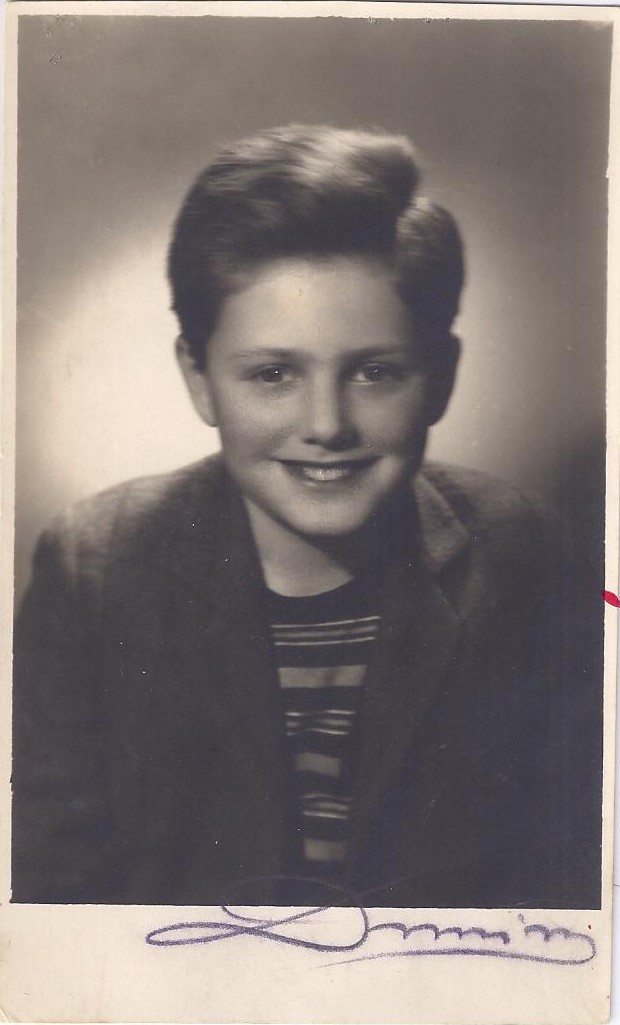
Daniel/Bogdan/Danek/Dani Kolski c. 1939

Daniel/Bogdan/Danek/Dani Kolski c. 1949

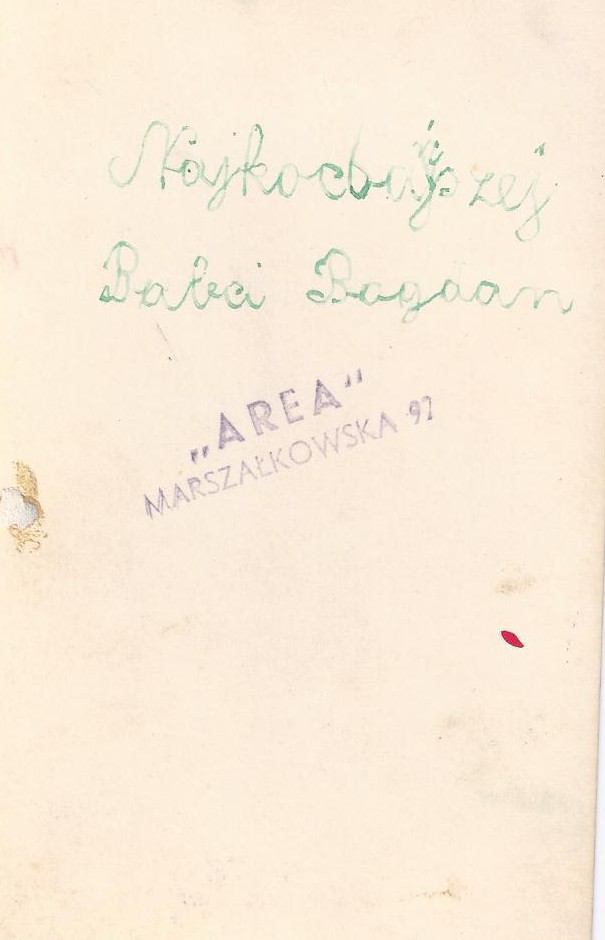
Back of Danek's photo. The first word was corrected, but probably meant to be something like

Back of Danek’s photo. The first word was corrected, but probably was intended to be “Najkochańszej” which means “most beloved.” The printer stamp shows the photo was from Poland.

This is a photo of young Danek. Written in Polish on the back in a child’s hand is: “To my most beloved grandmother, Bogdan.” I can’t make out the word on the front though it clearly begins with a “D” and is in an adult’s hand. He was born in 1937, so he would have been around 7 when the war ended. Danek looks here like he is about the age of my almost-twelve-year-old son, so this was after the war–around 1949?

I asked Nelly (Kampf) if they used the term “Babcia” at home. She said yes; her parents spoke Polish to each other, so Danek’s grandmother Rachel was called  “Babcia.”

Samek and Nelly (Służewska) Kolski's wedding photo.

Samek and Nelly (Służewska) Kolski’s wedding photo.

I met Nelly (the granddaughter of Samek and Nelly), her husband, and two younger children at Pini (another grandchild of Rachel’s) and Pnina’s house in Israel. I felt an immediate strong connection with her. She brought her father’s family album, as well as pages from a book about the Jewish history of Włocławek. I’ve been going through old photos and notes, but creating a narrative out of everything is taking too much time. Better to post this update now and get to the rest of the story in a later post.

Nelly and her husband Nir, February 2015

Nelly and her husband Nir, February 2015

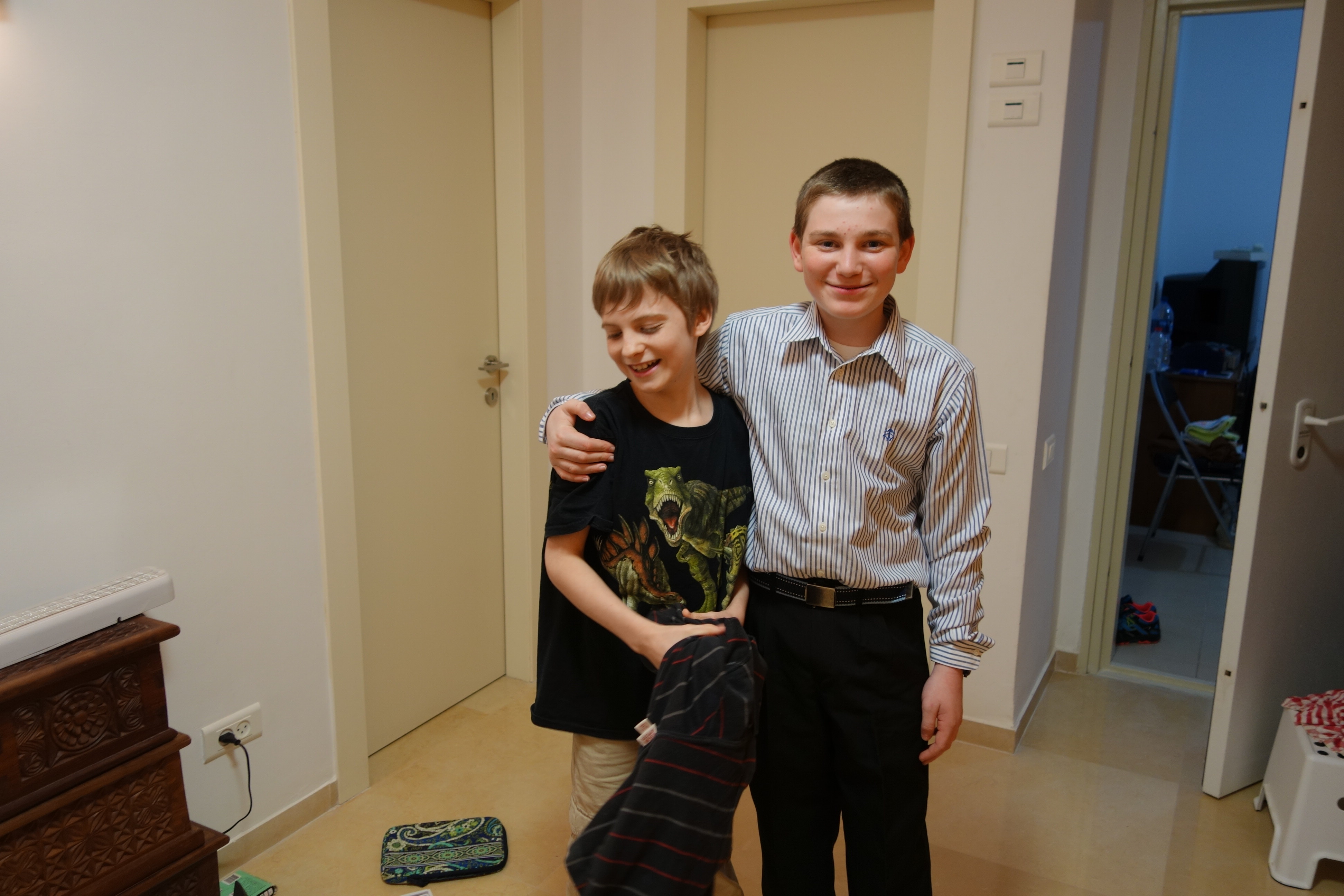
Cousins--my son Ian on the left and Nelly's son Asaf on the right. I see a resemblance between Asaf and his grandfather Danek.

Cousins–my son Ian on the left and Nelly’s son Asaf on the right. I see a resemblance between Asaf and his grandfather Danek.

← Older posts
Newer posts →

Categories

  • Anthropology (37)
    • Archives (14)
    • Fieldwork (7)
    • Ground Penetrating Radar (GPR (4)
    • Research Methodology (8)
  • antisemitism (14)
  • Association of Descendants of Jewish Central Poland (32)
  • Catholicism (8)
  • Conference (1)
  • Discrimination (2)
  • Family (69)
    • Bereda (17)
    • Kolski (13)
    • Piwko (22)
    • Rotblit (3)
    • Walfisz (4)
    • Winawer (7)
  • Genealogy (11)
  • Heritage work (66)
    • Commemoration (23)
  • Identity (18)
  • Israel (6)
  • Jewish Culture (89)
    • Cemeteries (51)
    • Museum (7)
    • Synagogues (33)
  • Jewish immigrants (8)
  • Jewish Religion (1)
  • Memory (70)
  • Names (14)
  • Photographs (6)
  • Pifko-Winawer Circle (5)
  • Poland (125)
    • Baligród (1)
    • Bolimów (1)
    • Brześć Kujawski (5)
    • Buk (1)
    • Chodecz (1)
    • Dukla (2)
    • Dąbrowice (1)
    • Gdynia (1)
    • Gostynin (2)
    • Gąbin (1)
    • Izbica Kujawska (1)
    • Kazimierz (4)
    • Kowal (1)
    • Koło (1)
    • Krakow (7)
    • Krośniewice (1)
    • Kutno (6)
    • Kłodawa (1)
    • Lesko (8)
    • Leszno (1)
    • Lubień Kujawski (1)
    • Lubraniec (1)
    • Lutowiska (3)
    • Piła (3)
    • Podgórze (2)
    • Poznan (11)
    • Przemyśl (2)
    • Pzedecz (1)
    • Radom (1)
    • Radymno (1)
    • Sanok (1)
    • Skierniewice (5)
    • Sobota (2)
    • Tarnów (2)
    • Warsaw (22)
    • Wielkopolska (1)
    • Wronki (7)
    • Włocławek (20)
    • Zasław (2)
    • Łódź (1)
    • Żychlin (30)
  • Polish Culture (10)
  • Polish-Jewish Heritage (60)
  • Polish-Jewish relations (60)
  • Post-World War II (24)
  • Pre-World War II (22)
  • Reclaimed Property (1)
  • stereotypes (3)
  • Survival (9)
  • Trauma (3)
  • Uncategorized (5)
  • Victims and perpetrators (4)
  • World War II (45)
    • Jewish Ghetto (12)
    • Nazi Camps (5)
    • Polish Underground Army (3)
  • Yiddish (5)

Enter your email address to follow this blog and receive notifications of new posts by email. Your email address will not be shared.

Archives

  • October 2025 (1)
  • July 2025 (8)
  • June 2025 (1)
  • April 2025 (1)
  • August 2024 (3)
  • July 2024 (3)
  • May 2024 (2)
  • April 2024 (1)
  • May 2023 (2)
  • January 2023 (2)
  • December 2022 (7)
  • November 2022 (2)
  • October 2022 (5)
  • September 2022 (1)
  • January 2022 (1)
  • August 2021 (1)
  • December 2020 (2)
  • July 2020 (1)
  • May 2020 (3)
  • April 2020 (1)
  • March 2020 (1)
  • January 2020 (2)
  • May 2019 (1)
  • February 2019 (1)
  • November 2018 (1)
  • September 2018 (1)
  • August 2018 (3)
  • July 2018 (1)
  • June 2018 (1)
  • May 2018 (1)
  • April 2018 (2)
  • March 2018 (2)
  • February 2018 (2)
  • January 2018 (2)
  • December 2017 (2)
  • November 2017 (2)
  • October 2017 (1)
  • September 2017 (3)
  • August 2017 (3)
  • June 2017 (2)
  • May 2017 (3)
  • April 2017 (1)
  • March 2017 (2)
  • February 2017 (1)
  • January 2017 (2)
  • December 2016 (2)
  • November 2016 (4)
  • October 2016 (1)
  • September 2016 (6)
  • August 2016 (2)
  • July 2016 (1)
  • May 2016 (4)
  • April 2016 (2)
  • March 2016 (3)
  • February 2016 (4)
  • January 2016 (3)
  • December 2015 (3)
  • November 2015 (5)
  • October 2015 (5)
  • September 2015 (3)
  • August 2015 (4)
  • July 2015 (3)
  • June 2015 (3)
  • May 2015 (4)
  • April 2015 (9)
  • March 2015 (3)
  • February 2015 (2)
  • January 2015 (5)
  • December 2014 (4)
  • November 2014 (9)
  • October 2014 (2)
  • September 2014 (1)

Copyright Notice

All original text and images are copyright © Marysia Galbraith. Please contact the author before quoting.

Blog at WordPress.com.

  • Subscribe Subscribed
    • Uncovering Jewish Heritage
    • Join 145 other subscribers
    • Already have a WordPress.com account? Log in now.
    • Uncovering Jewish Heritage
    • Subscribe Subscribed
    • Sign up
    • Log in
    • Report this content
    • View site in Reader
    • Manage subscriptions
    • Collapse this bar
 

Loading Comments...