• About
  • The Photo that Started it All

Uncovering Jewish Heritage

Uncovering Jewish Heritage

Category Archives: Poland

How do you remember Jewish lives when nothing remains?

27 Saturday Dec 2014

Posted by Marysia Galbraith in Cemeteries, Heritage work, Jewish Culture, Poznan

≈ 1 Comment

Tags

Akiva Eger

A defining question of my study is turning out to be: How do you remember Jewish lives in Poland when nothing remains? Or when there are only scattered traces?

I certainly started with next to nothing when I began the search for my own family story. Since then, I have found so much—most extraordinarily many living relatives. I’m gathering up the fragments of the past—a half remembered story, a photograph, a birth record. And pieced together, something fuller is emerging. It’s still impossibly far from the rich lives that have passed, but it nevertheless gives me a much better sense of where I come from.

All this resonates with an article I read in the Atlantic, which although it is about the tension between science and belief in God, makes the point that the more knowledge we gain the more we become aware of how much we still do not understand (“Why God Will Not Die” by Jack Miles, December 2014, pp. 96-107). Miles explains, “Scientific progress is like mountain climbing: the higher you climb, the more you know, but the wider the vistas of ignorance that extends on all sides” (p. 100). Maybe this is what my search is destined to be like. Every relative I find points to many more ancestors and descendants who remain to be discovered. Every historical artifact hints at another vast realm of Jewish culture that remains hidden.

So how do you remember Jewish lives when nothing remains? When I met pani Alicja Kobus, the head of the Gmina Żydowska (Jewish Community) in Poznań, she told me about numerous ways in which the Gmina has fought to commemorate Jewish heritage throughout the region. Pani Alicja calls herself a bulldozer; she keeps at it no matter what obstacles she faces. She doesn’t give up. She also attributes her success to cudy (miracles), and to the material and spiritual support provided by numerous allies. Among the projects she described to me, one stands out—the reclaiming of a section of the Jewish cemetery. The story is pretty extraordinary.

The Jewish cemetery on Głogowska Street was established in the early 1800s, in what at the time was the outskirts of the city. The Poznan city leaders liquidated a number of cemeteries in the city center, including the old Jewish cemetery near what is now Plac Wolności, so the city would have room to expand. A photo taken in 1927 (on the webpage of the Poznańska Filia Związku Gmin Wyznaniowych Żydowskich w RP/ Polish Branch of the Union of Jewish Communities in the Republic of Poland) shows the Trade Center in the foreground and the Głogowska Street cemetery in the background.The cemetery was devastated by the Nazis during World War II, and the tombstones were either destroyed or carted off for construction projects. During the communist period, the adjoining Targi Poznańskie (Poznan Trade Center) was expanded into the former cemetery site.

Pani Alicja says it took something like eight years to create a memorial at the cemetery site. She focused her energies on a strip of land between some apartment buildings and the Trade Center, where a row of mismatched, ramshackle garages stood. Reclaiming the space for a cemetery memorial required the support of city officials, local residents, and international interest groups, including the descendants of Rabbi Akiva Eger, a highly regarded Talmudic scholar who was buried in the cemetery in 1837.

As pani Alicja tells it, opponents to the project were slowly persuaded, or they met with misfortune. One elderly woman refused to sell her garage, saying “I don’t want Jews in my courtyard.” Alicja responded, “You already do have Jews in your courtyard” (pointing out that the whole space was within the cemetery grounds). Not long after, the elderly woman passed away. A member of the city government who opposed the project got caught up in a scandal and resigned. Other residents were swayed by the promise that the neglected space would be renovated, with new gates and building facades. Finally, in 2007, the commemorative site was completed.

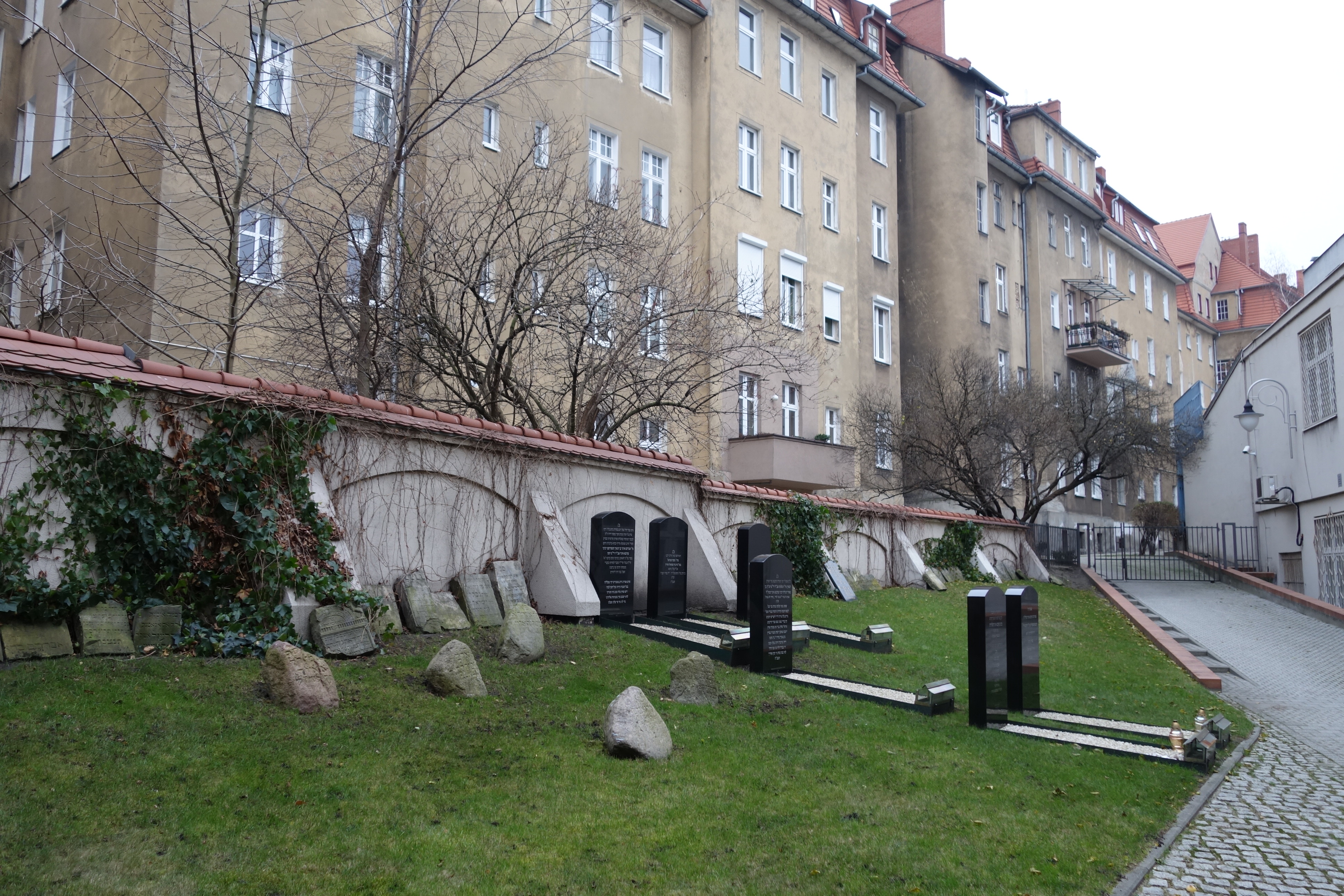
The memorial site is hard to spot from the street. The best clue is the Stars of David that ornament the new metal gates closing off the courtyard from the busy street. Inside the gate, granite plaques mounted on the archway wall outline the history of the cemetery, the rabbis who were buried there, and the international sponsors of the project (Committee for the Preservation of Jewish Cemeteries in Europe, and the British descendants of Rabbi Eger). The text is repeated in Polish, Hebrew, and English. In a narrow strip of grass sloping up to a plaster-covered brick wall (where the garages used to be) stand six tombstones commemorating Eger, his wife, and other descendants who were also rabbis. The black stones are inscribed with Hebrew writing. White gravel fills a rectangle in front of each stone, the foot marked by a metal roofed glass enclosure for candles. Old stone tombstones lean against the wall, while a few stones with large, rough writing are scattered on the grass. These grave markers were found around the city, many dug out of roadways and other wartime construction projects.

The site is closed to the public because it is in a private, locked courtyard. The first time I visited was when rabbis and others came from Zurich and England to say the kaddish on the anniversary of Eger’s death. They gathered around the grave and sang and prayed for about an hour, nodding as they read in unison. The visitors were all male; they wore black hats and long coats, their payot curled in front of their ears. Observers from the Poznan Jewish Community watched at a respectful distance, except for a few key members including Pani Alicja who stood with the visitors.

Kaddish for Rabbi Akiva Eger, October 6, 2014

Kaddish for Rabbi Akiva Eger, October 6, 2014

It struck me that throughout the kaddish, I didn’t see a single resident of the surrounding buildings. As it got dark, I could see the lights in many apartments. Didn’t they hear the singing? Weren’t they interested in what was happening right outside their windows?

Rosh Hashanah, Poznan, September 26, 2014

30 Sunday Nov 2014

Posted by Marysia Galbraith in Jewish Culture, Poznan, Synagogues

≈ 3 Comments

Tags

contemporary Jewish practice in Poland

It seems fitting that I would celebrate Rosh Hashanah for the first time in Poland, considering that generations of my family lived and worshiped here. It’s our removal that is bizarre, not our presence on Polish territory.

I have been told there are only about sixty Jews in Poznan today. Most Jews in this part of Poland left when the region was under Prussian rule in the 19th century. The story contained in a number of sources is that they left because larger German cities farther west offered them more economic opportunity. I can’t help wondering, though, if they were also seeking a place with greater freedom and less persecution (a subject for further research). Over 20% of the city’s population was Jewish in 1837, but by 1922 only 1.2% were, about 2000 residents (Rafał Witkowski, 2012, The Jews of Poznań, Poznań: Wydawnictwo Miejskie Posnania). By contrast, 30% of Warsaw’s citizens at the time were Jewish.

I met the head of the Poznan Jewish Community (Gmina Żydowska), Pani Alicja Kobus, shortly before Rosh Hashanah. She has the energy and charm I remember in my grandmother and her sister, my Auntie Nunia. Pani Alicja established the Jewish Community about 15 years ago. She said nothing was happening in Poznan related to Jewish culture and heritage so she had to start from scratch. All the momentum was in Krakow and Warsaw, and much of worth in and around Poznan was being forgotten. So she negotiated with the city, and got permission to begin operations in a space the city gave her in a rough part of town. Through persistence and a lot of work, she managed to reclaim the former Jewish Community Headquarters, the building that houses the Jewish Community offices today. She said that she has had to fight for everything. She is a bulldozer. She only goes forward; she doesn’t give up. She doesn’t let obstacles stand in her way, even when people refuse her or tell her what she is trying to do is impossible. She attributes her success to this level of effort, along with the unfailing encouragement of others, as well as divine intervention. She often refers to God and miracles.

I asked pani Alicja if I could attend the events she was planning for Rosh Hashanah. She said I could, adding, “We’re such a small community, we have to be open.

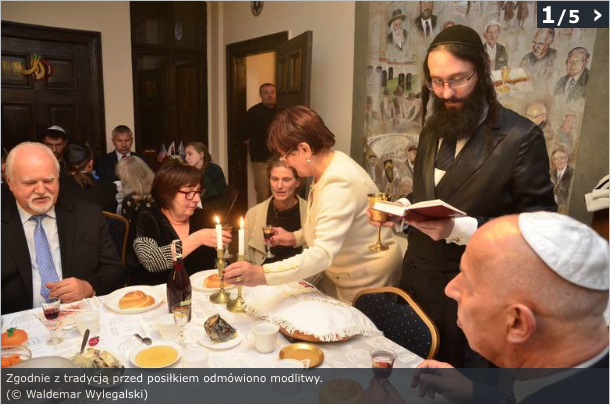
I really didn’t know what to expect when I arrived at the Jewish Community Headquarters the evening of Rosh Hashanah. The building is unmarked. Last time, I had to be buzzed in. This time a few people were standing outside. One greeted me as I arrived and told me the door was open. As I climbed the wide wooden staircase to the first floor, I heard the sound of many voices. The main room was packed with people standing and sitting around two long tables laid out with tablecloths, candles, and all kinds of dishes. Two large, round challah were placed at the head of one table, and each plate had a large challah roll on it.

Pani Alicja greeted me from across the room and invited me to sit near the head of a table already full of people. She introduced me to several of the people around her. The atmosphere was warm, and the conversations friendly.

Pani Alicja got the attention of the crowd. She expressed her joy at seeing so many people (I counted over fifty, but there were more; I never saw everyone at once). She called our presence there a miracle (cud). “Just look around you,” she said, noting there were guests from the US, Germany and Israel. She lit the candles at the head of the table. It was a moving moment for me.

The synagogue is one floor up, in a smaller room with high ceilings and windows. Pews fill the back, with room to seat about 30 people. The men sit behind a partition on the side by the windows and the women sit on the side by the door. A table with a lectern faces the pews. A cabinet in the corner behind the table holds the Torah and the crown, gifts from international donors. Along the wall by the door is an old synagogue pew with faded Hebrew lettering. Pani Alicja told me it dates back to the 1800s. Someone had it in his attic, and she convinced him to donate it to the synagogue.

Rabbi Jaakov has the long ringlets (peyot), black coat and hat characteristic of Hassidic Jews. He spoke to us in Polish, explaining a little about the ceremony, how it differs from a typical Shabbat, and how to read the prayer books, which contain a combination of Hebrew, transliterated and in Hebrew lettering, and I think Polish translations. He promised to guide us through the ceremony, telling us which page to turn to in the prayer books, and explaining the various prayers and songs. In other words, he took on a teaching role as well as leading the service. He read the prayers and songs in Hebrew, with his back to us, swaying forward and back.

Some men were given prayer shawls, and removed the Torah from the cabinet. They took turns carrying it around for everyone to touch. Many also kissed their hand. There was a call for a young male volunteer to blow a horn, the shofar. One said he has tried but couldn’t. Finally someone stepped up. He was supposed to make one long and then three short toots. His first attempts didn’t produce much sound. Eventually, some awkward sounds came out. Pani Alicja remarked it was important “tylko żeby było” (just to make it).

http://www.gloswielkopolski.pl/

Rosh Hashanah, Poznan Jewish Community, September 26, 2014. http://www.gloswielkopolski.pl/

After the service, everyone returned downstairs to the tables, which were covered with a variety of dishes. Besides challah, there was carp in vinegar, beet salad, tsimis (sweet carrot salad), pomegranates, and various meat dishes, which guests identified as kosher. Rabbi Yaakov blessed the bread, which was broken and passed around. There were plates of honey to dip the challah into. Pani Alicja made a toast, and the feast began.

The event was strange and familiar at the same time. My secular upbringing makes any religious service unfamiliar. Here, especially, everything was new to me—the language, the rabbi’s motions, the separation between women and men. But the feeling was not strange—that of solidarity, of connection to something bigger than we are. It felt, oddly like a kind of homecoming.

More about Lesko

22 Saturday Nov 2014

Posted by Marysia Galbraith in Heritage work, Lesko, Synagogues, World War II

≈ 8 Comments

While he was in Poland in August, my older brother Wiley had some valuable insights about Jewish heritage and about our family. This was his first time in Poland and his fresh perspective gave me a lot to think about.

This is what he posted on Facebook about Lesko:

“The largest structure in Lesko, Poland is a synagogue yet there are no Jews. Larger than the church. Not only are there no Jews there is no memory that there were any Jews. Let’s remember that 3,000 human beings, Jews, were murdered from this town, half the population, and there are those that care.”

The interior of the Lesko Synagogue. It is used as an art gallery. During my last trip to Lesko, I learned that the gallery is closed from fall to spring because the building has no heat.

The interior of the Lesko Synagogue.

201408LeskoSynagogueNames1

Inside the synagogue: List of 3000 residents of Lesko and surroundings murdered by Nazis during the years 1939-1944.

About this photo, my brother’s commented, “Someone took the time to list the names. Thank you.” About me he remarked, “Taking the time to read the names and remember.”

Today, the synagogue belongs to the county (gmina) and is used as an art gallery. Just this month, I learned that the gallery is closed from fall to spring because the building has no heat. The Dom Kultury (Community Center) which manages the building wants to apply for funds to renovate the synagogue. The most pressing problem is moisture issues. Water creeps through the old stone walls and plaster, weakening the structure and even damaging the art housed within it.

Only a few survived in Lesko

17 Monday Nov 2014

Posted by Marysia Galbraith in Lesko, Polish-Jewish relations, Survival, World War II

≈ 9 Comments

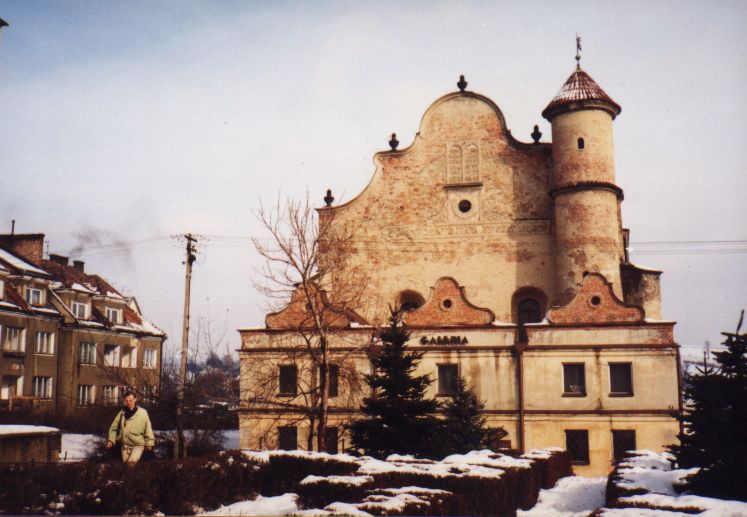
I have often remarked how the synagogue in Lesko is larger than the Catholic Church. It stands as a silent reminder of the prewar Jewish majority. Lesko is a small town of about 6000 residents on the edge of the Bieszczady Mountains in the southeast corner of Poland, and the site of my ethnographic fieldwork since 1992. The Bieszczady region was home to a multicultural population until the devastation of the mid-20th century turned it into Poland’s underpopulated, ethnically homogenous “wild east.” The Jews became victims of the Holocaust, while many Ukrainians and Poles escaped the German-Soviet front during the war. After the war most of the remaining Ukrainians were removed to the Soviet Union or the land acquired from Germany by the postwar Polish state, and Poles were resettled from across the Soviet border or emigrated voluntarily from overpopulated communities in western Poland.

Lesko Synagogue, 1992

Lesko Synagogue, 1992

While in Lesko last week, I asked some of my friends what they know about the town’s Jews—is there anyone who can tell me what happened before and during the war? Did any Jews survive? Are there any Jewish descendants left in the area? Ever since embarking on this investigation of Jews in Poland, I have wanted to find out why the topic of Jews has come up so rarely during my frequent visits to Lesko over the past twenty years. Sure, I was shown the synagogue and the Jewish Cemetery on my first tour of the town, and rarely, someone mentioned that certain buildings used to belong to Jews, but that’s where it ended. Unlike in Krakow, where having a Jewish ancestor became for some a badge of distinction, in Bieszczady no one ever mentioned their own or anyone else’s Jewish heritage. It simply was not talked about. Or maybe I never asked?

Based on my initial conversations last week, there is still a lot of reluctance to think about, let alone talk about Lesko’s Jews. But a few people gladly engaged with the topic.

First the reluctance. Often there is a pause, and then the response, “No, there is nobody left. Or at least they don’t admit it (nie przyznają się).” I got the same response in places like Lutowiska, which was over 60% Jewish before World War II. In Lutowiska, nearly all the contemporary residents have roots in other parts of Poland or in the former Soviet Union (borders were not fixed there until the 1950s), which might explain the general ignorance about the village’s history. Many of Lesko’s residents arrived after the war, but there is also a good number of autochthonous families who remain in the town.

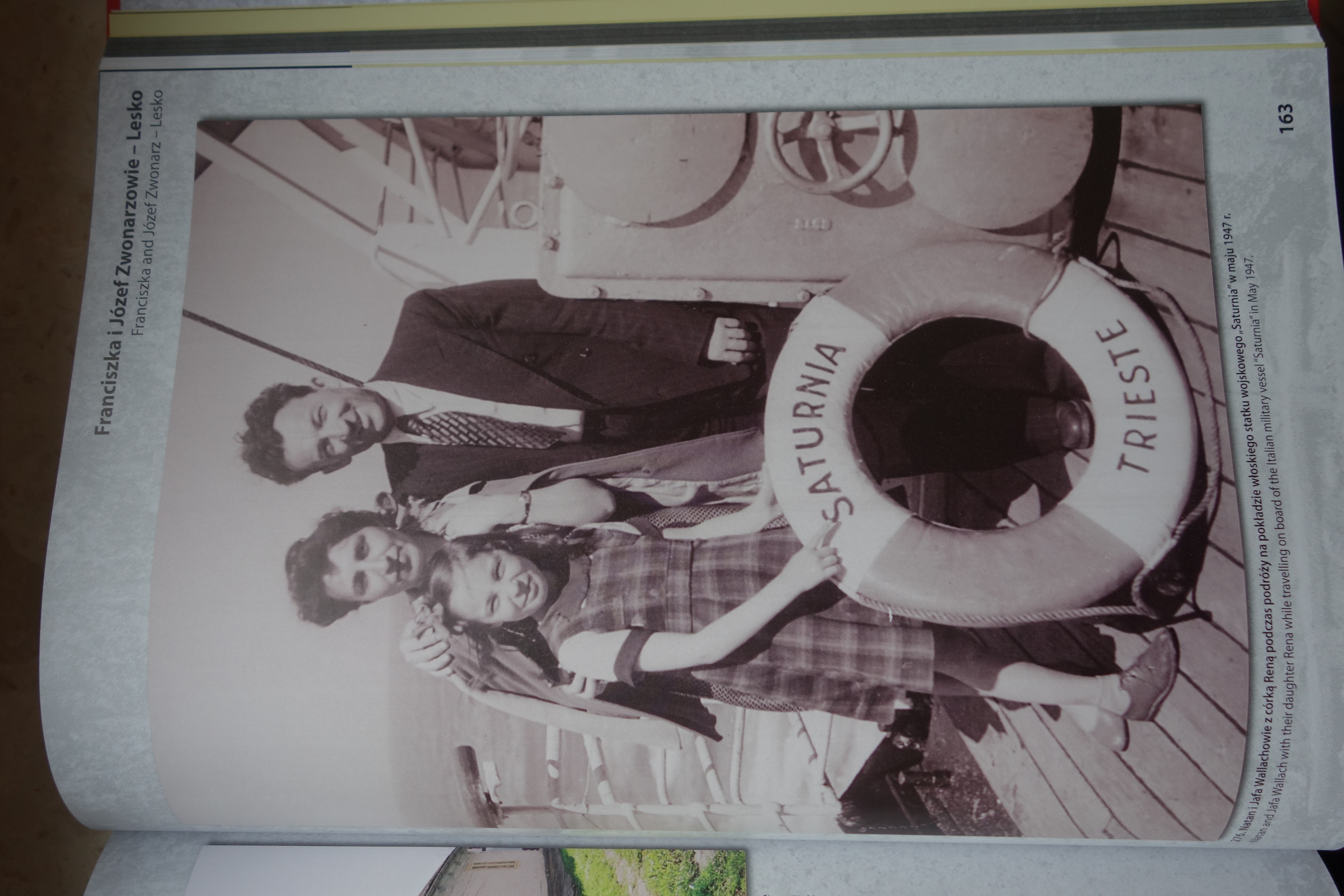
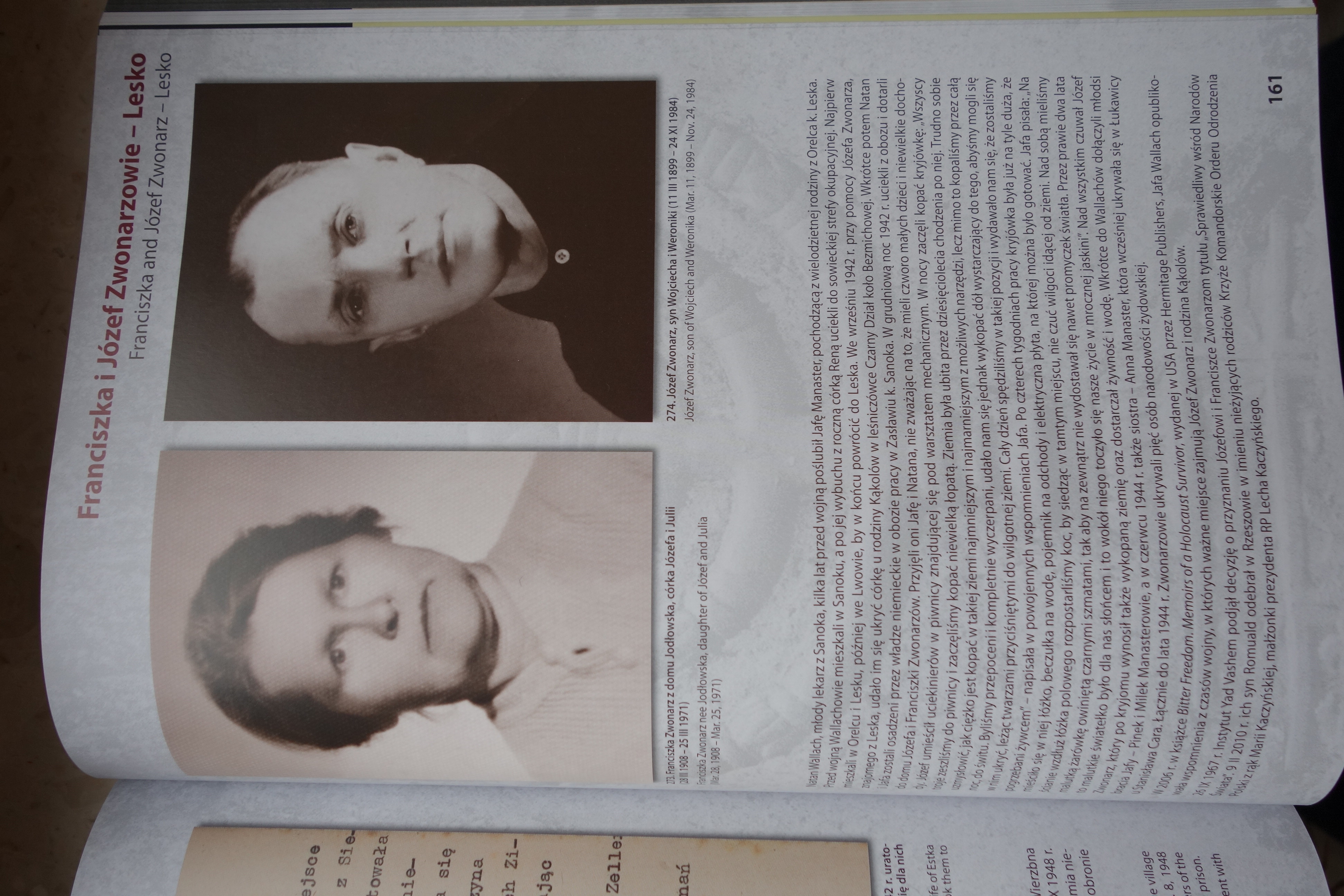
The one person several people suggested might be willing to talk to me was Romuald Zwonarz, whose father Józef saved the lives of several Jews by helping them hide from the Nazis for nearly two years. Fortunately, pan Romuald agreed to meet me. Over a long conversation, he told me his father’s story, mostly by sharing published accounts with me, annotated with marginal comments and sticky notes that correct errors and point out inconsistencies. He did not want to be recorded because he aspires toward a perfect historical record and is too painfully aware of the false starts and misremembered details that taint spoken language. Still, he is proud of what his father did.

DSC01915

Rena, Jafa, and Natan Wallach 1947

DSC01912

Józef Zwonarz and his wife Franciszka

The story is told in rich detail in Bitter Freedom, written by one of the survivors, Jafa Wallach shortly after she settled in the United States. Jafa wrote it to her daughter Rena to explain their wartime experiences and why they left Rena with strangers from the age of four to six. It’s an amazing account of an awful story. Basically, Jafa along with her husband Natan, who was a doctor, her two brothers, and toward the very end her sister, all hid under Józef’s mechanic workshop in a crawl space they dug themselves. It had earthen walls and was barely tall enough to kneel in with your head against the ceiling. Even more extraordinarily, the workshop was situated between Gestapo headquarters and the Ukrainian police offices in the center of town. Józef worked long hours repairing the occupiers’ vehicles, and then would sneak water and food to the hidden Jews at night. He also helped to find a safe place for Rena with a forest guard in a remote hut several kilometers from Lesko. Józef was recognized in 1967 as one of the Righteous among Nations, though he could not receive his medal until 1980.

From Romuald and his family’s story, I learned there was a work camp for Jews across the river from Zagórz. Lesko’s Jews were taken there before being killed on the spot or at the concentration camp at Belzec. Jafa only knew of a few who survived in hiding or with false (Aryan) papers. Romuald mentioned a few more he is aware of. Out of 30,000 Jews in the region before the war, only eighty survivors gathered in nearby Sanok after it ended. Those who came out of hiding were not made to feel welcome. As Jafa explains, some asked them “What are you doing among the living?” while others just looked with expressions of indifference.

I count on it that on future visits, I will learn of other people who remember Lesko’s Jews and are willing to talk about them.

Żychlin, part 3

10 Monday Nov 2014

Posted by Marysia Galbraith in Synagogues, Żychlin

≈ Leave a comment

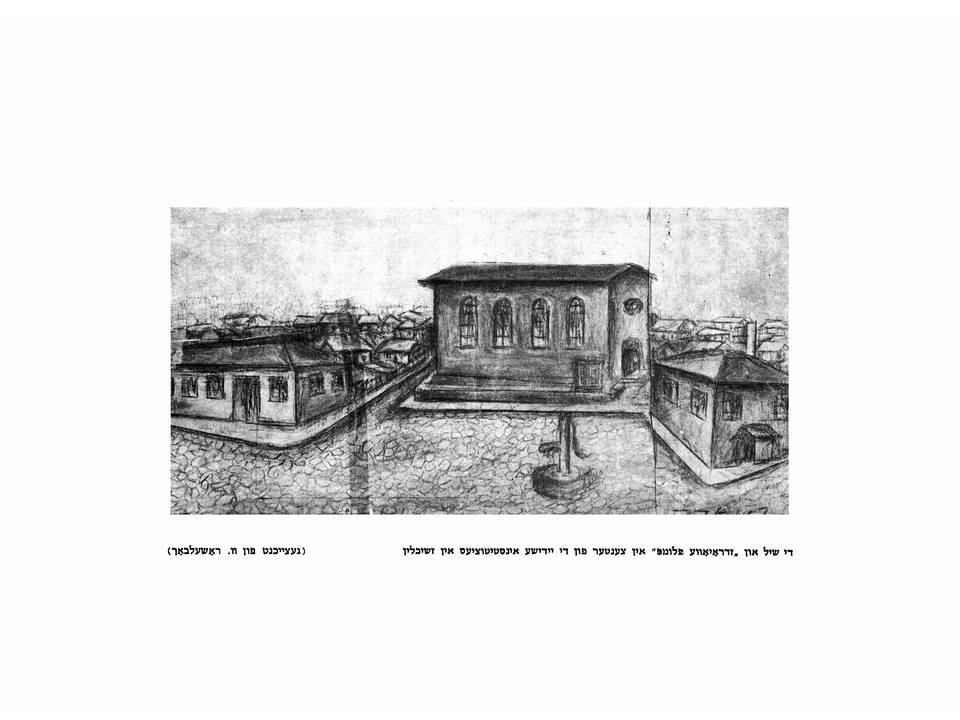
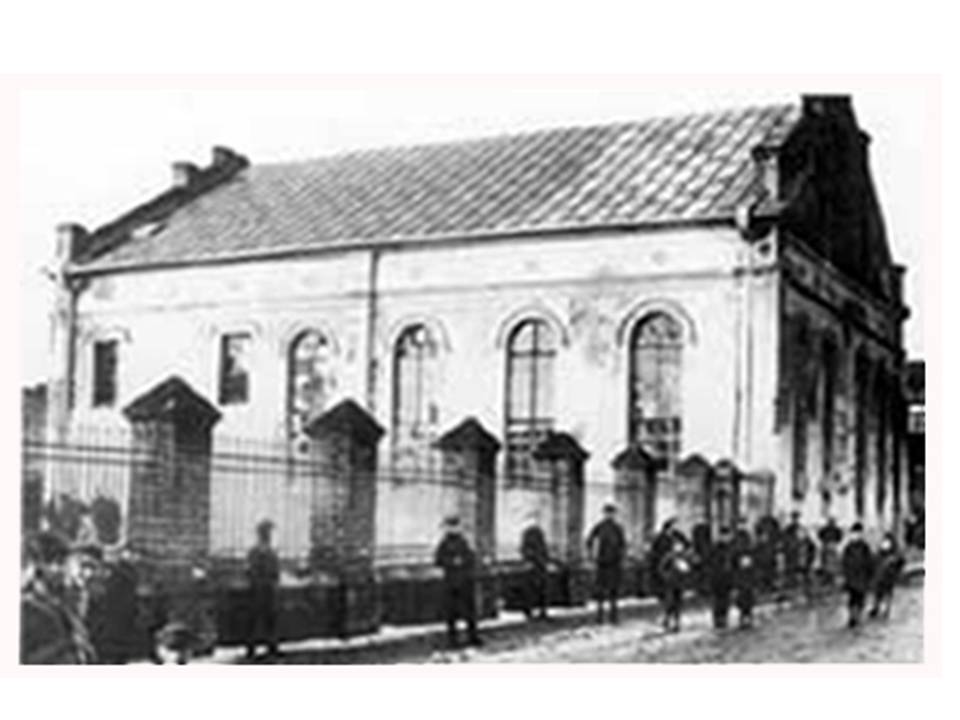
Promised photos of the Żychlin synagogue before the roof fell in:

Slajd17

Sketch of the Żychlin synagogue, with well in front and mikvah on right. From “Memorial Book of Zychlin” Ami Shamir . The Zychliner Organization of Israel and America”. Tel Aviv 1974. Posted on “Zychlin-Historia.com.pl

Slajd18

Żychlin synagogue during the Interwar Period. From Zychlin-Historia.com.pl

Slajd22

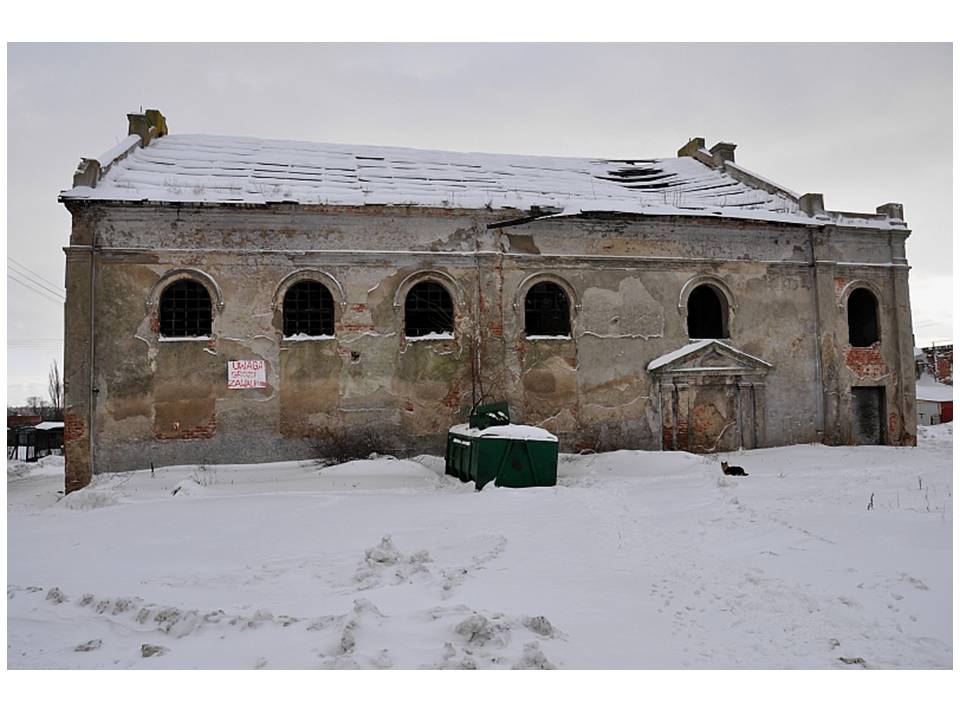
Around 2008, roof still intact. From H. Olszewski

Slajd23

Żychlin, part 2

02 Sunday Nov 2014

Posted by Marysia Galbraith in Jewish Culture, World War II, Żychlin

≈ Leave a comment

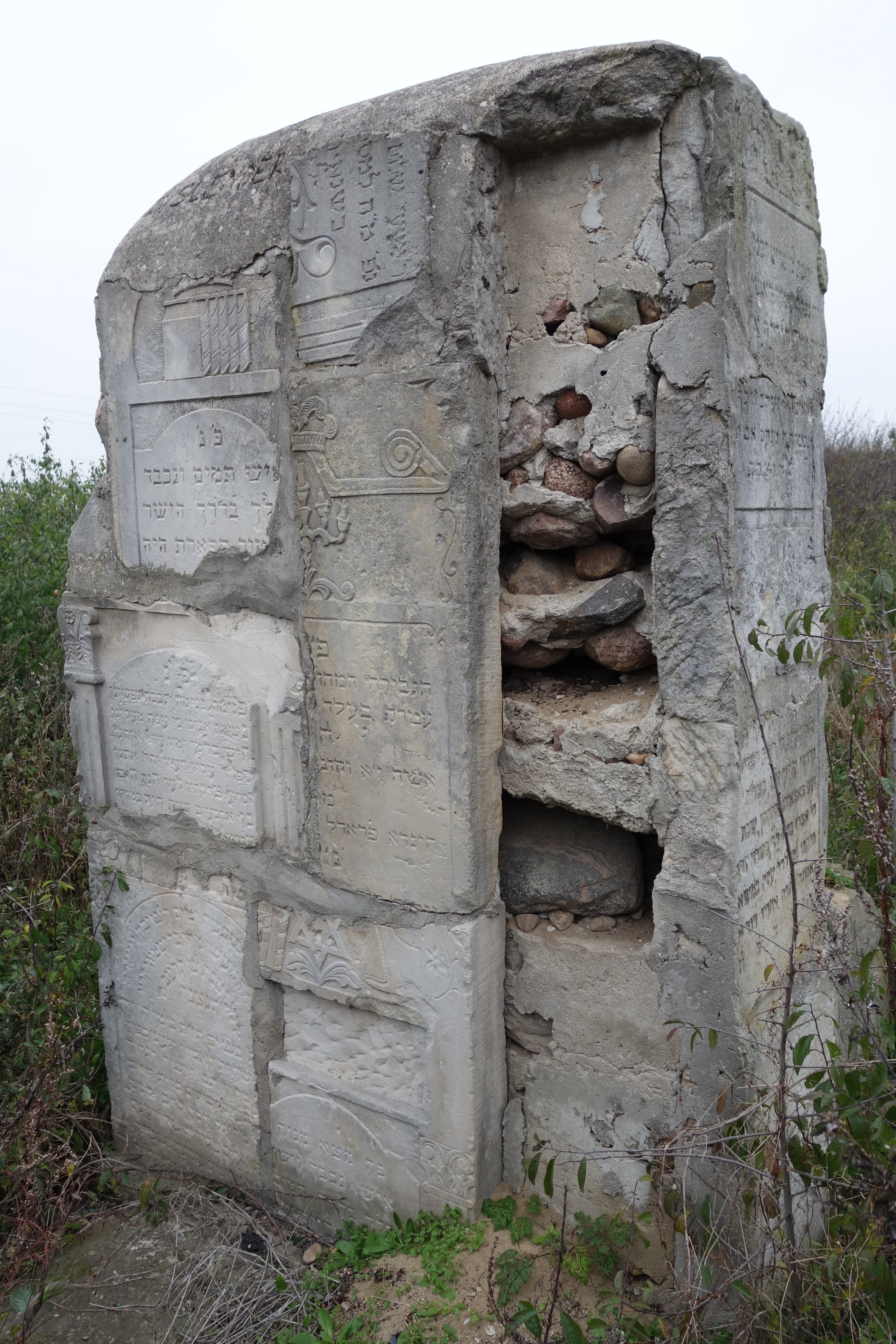
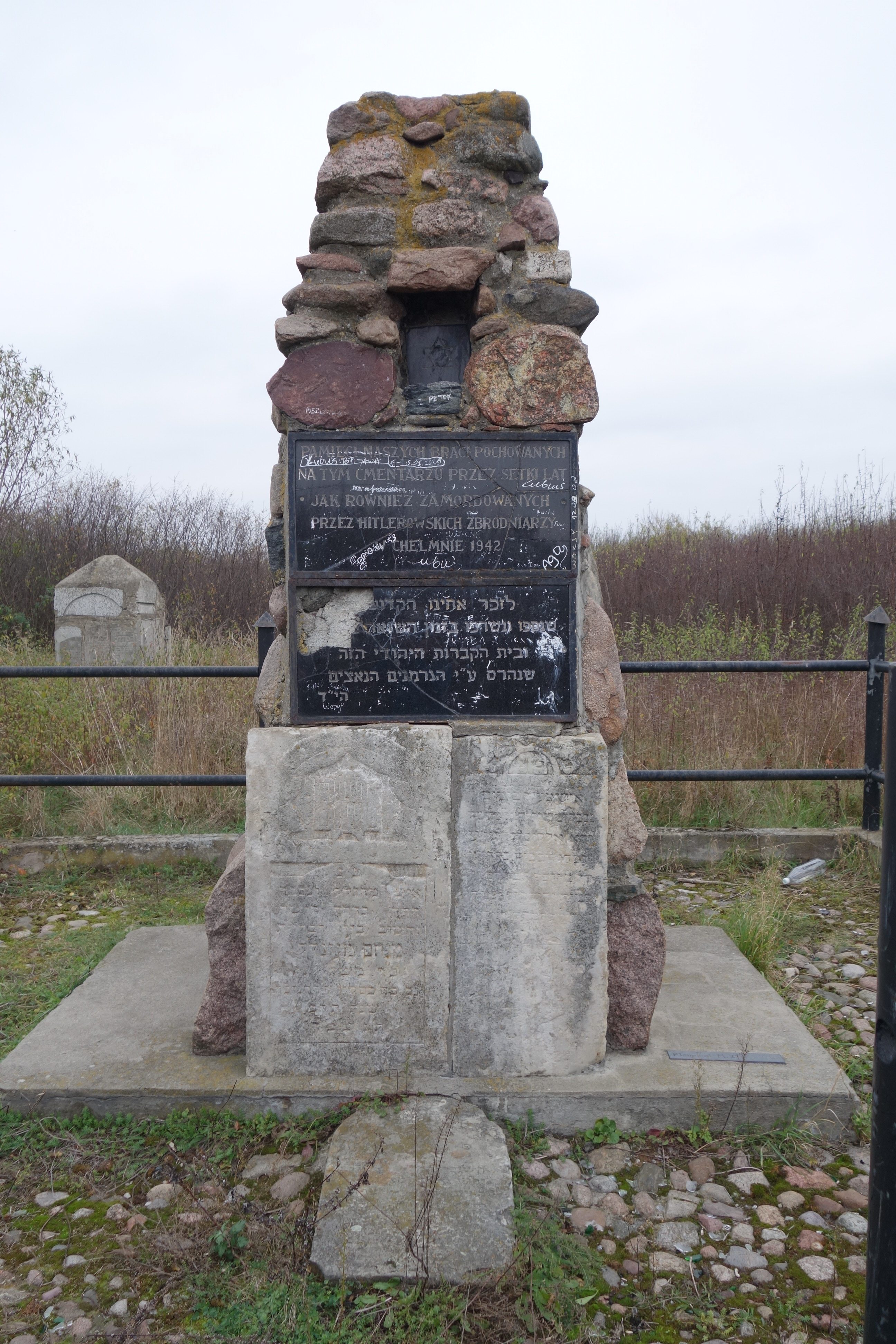
The Jewish cemetery is on a hillside on the outskirts of Żychlin, surrounded by a metal fence. The place is overgrown, though not too long ago someone cleared out some of the underbrush, leaving cut branches in piles. The tombstones were decimated during World War II. The remaining fragments were assembled into roughly formed monuments, which are disturbing for several reasons. For one, there are so few remnants relative to the size of the cemetery. Second, most are just pieces of the original stones. Third, the monuments have a haphazard quality. I wished for something better able to display the details of the remaining tombstones, and more visually compelling. Three such piles (I don’t really know what to call them) are near the entrance gate. A fourth is behind a monument with the inscription in Polish and Hebrew, “In memory of our brothers buried in this cemetery as well as for those murdered by Hitler’s criminals at Chełm [Concentration Camp] 1942.” The plaques are covered with graffiti—mostly peoples’ names, though “Wisła,” the name of a soccer team, is also inscribed. The only grave in what seems like its full form is that of a rabbi. The upright rectangular stone has a plaque inscribed in Hebrew, and domed stones cover the gravesite.

DSC01533

Monument made of fragments of tombstones

Commemorative monument

Commemorative monument

DSC01543

Grave of the tzadik Szmuel Abba, son of Zelig (sztetl.org.pl)

No one remembered for sure, but pani Agnieszka said she thinks a foundation paid for the renovation of the cemetery in the early 1990s. Later, pan Józef at the local government offices recalled the work was done during the first term of the postcommunist local government, which would put it about 22 years ago.

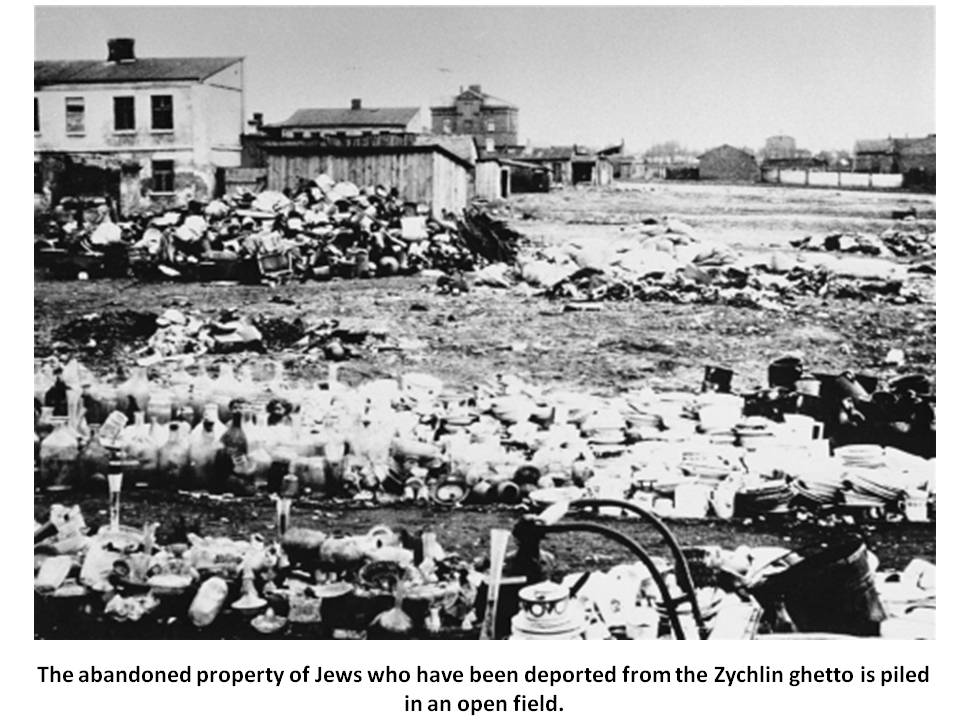
Other events directly associated with the destruction of Jewish life and lives occurred in Żychlin. Nazi occupiers marched 200 Jews to the cemetery and shot them. Pan Józef recalls his father and two other neighbors were awakened by the Nazis and told to dig graves for murdered Jews. There were also two Jewish ghettos in town. The smaller one was on the grounds of an old factory. A long, low workers’ residence (which remains occupied today) was also where Jews lived in the ghetto. The larger ghetto was nearer the center of town. One side of it ran along Budzyńska Street, which was the most common address for Jews in the early 20th century (see Tomasz Kawski, Gminy zydowskie pogranicza Wielkopolski Mazowsza i Pomorza w latach 1918-1942, 2007, pp. 270-77). Pan Henryk explained that the area used to contain smaller, older homes. All the Jews were moved to the area on one side of Budzińska Street, and all the Poles were moved to the area on the other side. Jews were only allowed to walk on the side of street that was in the ghetto. The Jews were removed in 1942 to death camps in other parts of Poland. All the buildings in the ghetto were burned. Pan Henryk gave me a photo of Jews’ possessions stacked in piles in a barren field that had been the ghetto, and a thriving neighborhood before that. In total about 4000 people lived in both ghettos. Most were from Żychlin, though some came from the surrounding area. No one returned after the war.

Slajd4

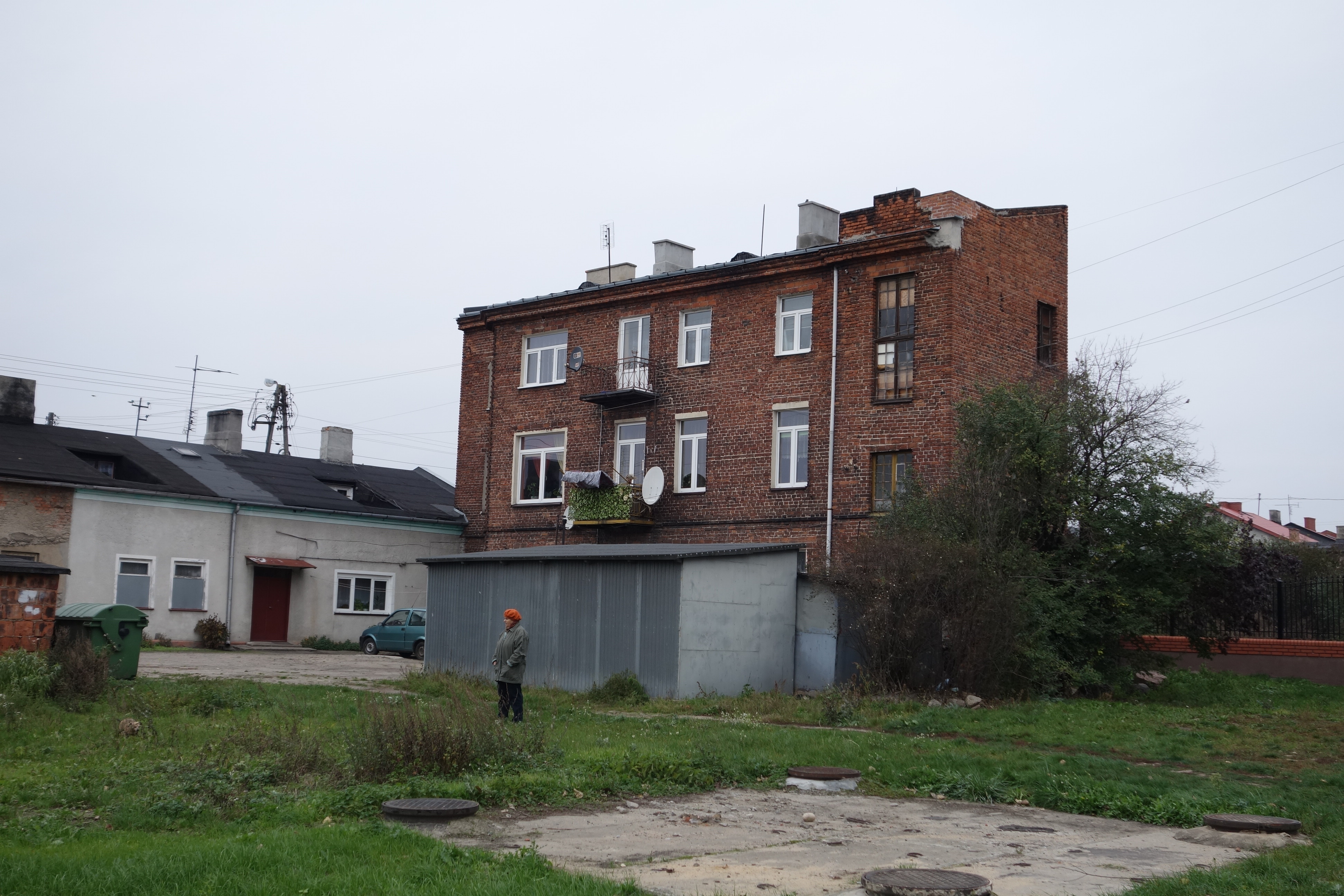
The former ghetto area is now filled with block apartments dating from the 1970s. Some older homes survived along Budzyńska Street. Pani Agnieszka pointed out typical characteristics of Jewish buildings. They tend to be shallow with windows on just the front and sides, and a flat windowless back as if the owners anticipated adding on another home that would share the back wall. She pointed out one house where after the war bedding and other valuables were found above a false ceiling in the attic. There was mention of other places where hidden treasures were found or where former residents returned to dig up the valuables they left behind, but the details were fuzzy. So maybe they really happened, though maybe they are stories built out of the stereotype of rich Jews.

A former Jewish home with characteristic flat back

A former Jewish home with characteristic flat back

Żychlin, part 1

01 Saturday Nov 2014

Posted by Marysia Galbraith in Synagogues, Żychlin

≈ 6 Comments

My great-grandmother Hinda Walfisz was born in 1854 in Żychlin, a town near Kutno and perhaps 100km from Warsaw. Before World War II, its Jewish residents (the first of whom settled in the 16th century) comprised as much as 60% of the population. None returned after the war. Many were shot by the Nazis; others were moved into ghettos and then to the death camps. Today, Żychlin has about 10,000 residents, including descendents of prewar Catholic families and others who migrated to the town after the war.

My guides where local historians Henryk and Agnieszka Olszewski. Pan Henryk emphasized to me that local history is his passion, but that he is an amateur (his word). I found him through his blog http://zychlin-historia.com.pl/ in which he documents his ongoing discovery of historical information about the town. Henryk’s wife Agnieszka said she couldn’t avoid becoming interested in history through her husband. She took the lead when describing the places we visited, while pan Henryk talked more about the supporting documents he has found through the people he has met, in Polish archives, and online.

DSC01541

Henryk and Agnieszka, Żychlin historians

From the very beginning, pan Henryk stressed to me that Jews and Christians lived well together. There were no pogroms in Żychlin. He drove us through former Jewish neighborhoods to the synagogue, Jewish cemetery, and World War II ghettos.

Former Jewish homes

Former Jewish homes

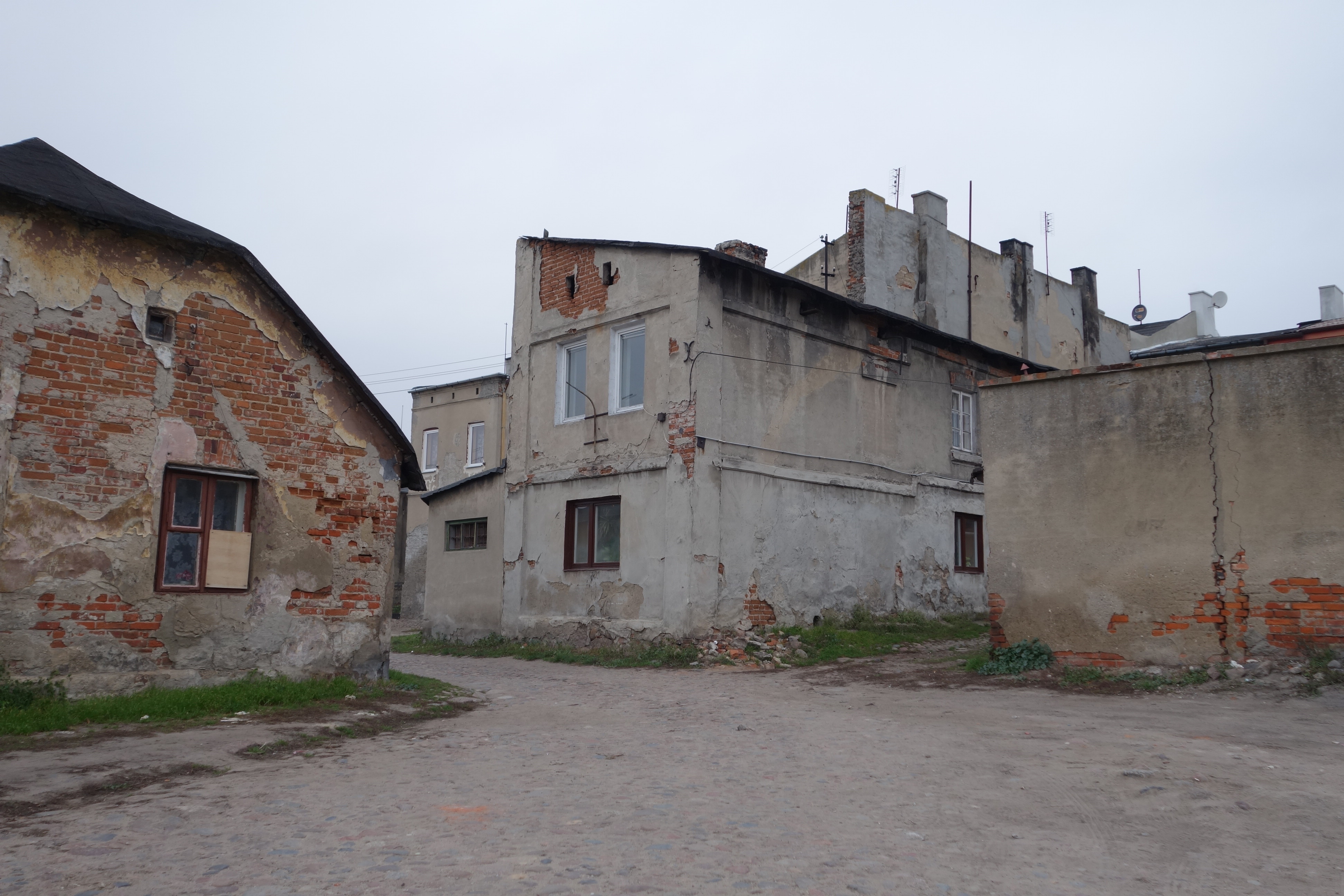
The synagogue is in a neglected part of town, surrounded on two sides by the backs of buildings. The roads here have not been resurfaced in a long time. They have ruts and holes, and one paved with rounded stones probably dates back a hundred years. Pani Agnieszka explained that all the buildings around there used to be owned and occupied by Jews. Now they belong to the town and are rented. It doesn’t look like anyone bothers to maintain them. For instance, the wall of one house has a wide crack, windows are old, and plaster is falling off walls. Residents looked out at us from behind curtains and doorways.

DSC01494

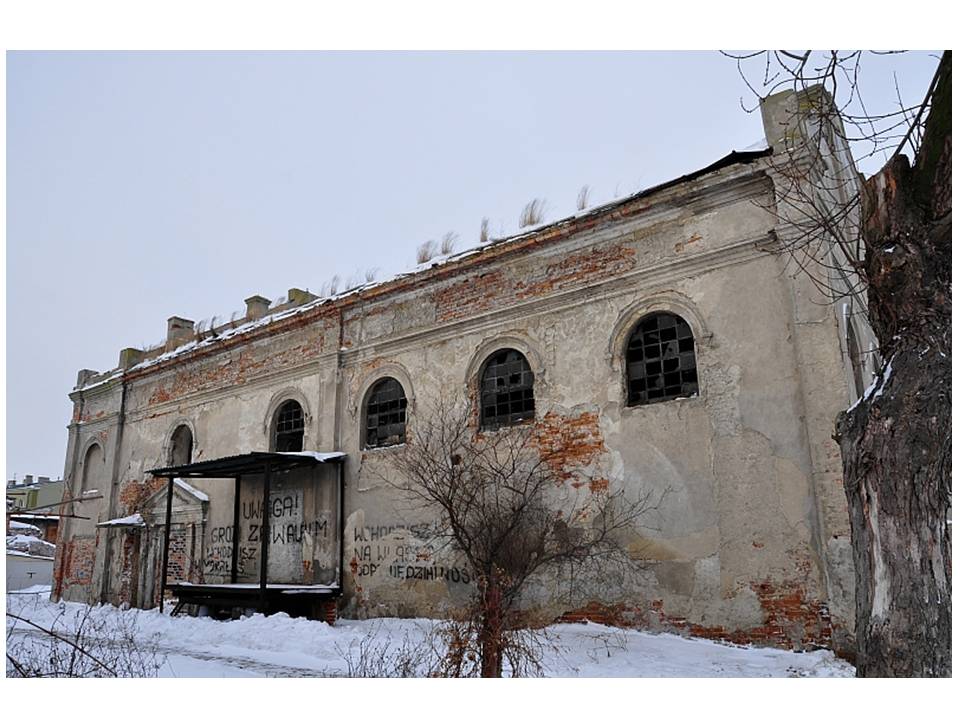
Żychlin synagogue

The synagogue was used by the Nazis as a warehouse. They bricked up all but the tops of the long arched windows. For many years after the war, a state cooperative continued to use the building as a warehouse, but now it stands abandoned. The roof fell in five or six years ago. Pan Henryk said one day there was a loud crash as it just collapsed. Until recently, the wooden babiniec (2nd floor where women sat) was still held up by metal beams, and the wall paintings were still intact in places. But only a few fragments of paint survive today, barely visible through the gaps where the windows used to be.

DSC01502

Little is left of the interior paintings

The salvageable metal and wood were carted away. “You know how it is,” pan Henryk explained. The fate of the remaining walls is uncertain. Pan Henryk says the Jewish Community gave it to the local government after the roof fell in, but they have no money to renovate it, nor can they tear it down because it’s protected as a historic site. For now, it seems fated to continue to deteriorate along with the homes and roads around it.

Conversion

21 Tuesday Oct 2014

Posted by Marysia Galbraith in Family, Jewish Culture, Poland

≈ Leave a comment

What was it like for a Jew to become a Christian in Poland in the early 1920s? For my grandmother, it meant a total break with her family, her past, and her heritage.

Her own father sat shiva, the seven-day mourning period following a death in the family. In other words, by converting she became dead to him. I can only approximate the date; My mom remembers being left with Auntie Nunia at a very young age. She says she was two (which would make it 1924 or 5) but I wonder if she could have been a bit older since it would be highly unusual to have vivid memories so young. Uncle Sig was born in 1927 so it probably happened before then.

BTMQ1OcQra4VP1wzh9ZjvgzgwLboLrS_jJ0lt4fN87g

Hiel Majer Piwko, c. 1908

There was another part of the story. I’ve known this for a while so it’s possible my mom told it to me at some point. When Babcia’s father became ill, she visited him on his deathbed, kissed his feet, and begged him to forgive her. He refused to acknowledge her despite her pleas. This would have been in 1929, so just a few years after her conversion. Babcia did, however, reconcile with her mother, who lived a few more years until 1933. Mostly, mom resisted talking about this history. Only once, she expressed bitterness to me that because of her mother’s actions, she never knew her grandparents. This suggests to me that contact between my branch and other branches of the family remained strained and infrequent, with the notable exception of Auntie Nunia.

Thinking more broadly, Aleksander Hertz (Żydzi w Kulturze Polskiej, 1961) sheds some light on the meaning and experience of conversion for Polish Jews. He describes pre-20th century Poland as a caste society, meaning there was a closed system of social groupings comprised principally of landed gentry, peasants, and Jews. Each caste had clearly defined boundaries reinforced by myriad external (dress, customs, economic roles, language) and internal (culture, religion, sensibilities, morality) factors. Further, caste is closed from both the inside and the outside (p. 125). The only way out of the Jewish caste was through christening and conversion.

During the Interwar Period in Poland, Jews faced blocks against full equality within Polish society. In many ways, regardless of how well they spoke Polish, how much wealth they accumulated, or how much education they had, they remained categorically different (and lower in the social hierarchy) than Catholic Poles. Those who assimilated were still viewed as members of their caste (92), and those who sought to integrate the most (via conversion) were often viewed with the greatest distrust (125).

About the psychological experience of conversion, Hertz writes “The change of religion in every specific case [excepting those for whom it was a purely pragmatic decision] marked a strong shock of massive proportions for a Jew” (130). There was a great deal of pride within the Jewish community; Jews felt they were the “chosen nation” and in many ways superior to the “goys” around them (132-3). Conversion meant a radical break with a whole system of life and the associated social environment (środowisko); “The neophyte was someone who didn’t only abandon their caste, but also denied its ideals, everything that was part of its soul and reason to exist. He was a defector and a traitor” (131). Within the Jewish community, converts were thus viewed harshly.

Conversion was never common, but it became more so in the 19th century. For wealthy Jews in particular, it became a means of shifting class and becoming part of gentry culture (178). They had little in common with orthodox Jews, and often identified more with the values and practices of the elite (Poles in central Poland, Germans in western Poland) (148-50, 155). Mixed marriages also became more common during this period. However, exit from caste actually became harder as anti-Semitism grew in response to the increasing similarity between Jews and non-Jews via mass education, adoption of Polish (or German) language, and modern styles of dress. While some assimilated without rejecting their Jewishness, breaking out of the boundaries of caste often also entailed changing names and erasing all traces of Jewish heritage (153, 167). Essentially, the culture that was adopted was not only Polish, but also noble culture (156). The reassertion of caste during the Interwar period was “particularly painfully and dramatically felt by assimilated Jews” (174). Some became overzealous in their perfection of the Polish language and customs, their commitment to the cult of Polish literature and art, and their fanatical nationalism. They became “more Polish than the Poles” (175). Nevertheless, the “shadow of caste” fell on them, and they were never sure if their performance of Polishness, no matter how perfect, would be recognized as good enough (176-7).

My family fits this pattern described by Hertz to such a degree it is painful to me. My mom used to mock my grandmother for being “More Catholic than the Pope,” but she herself adopted a fierce Polish patriotism and worked as hard as anyone in the family to deny their Jewish roots. They tried to integrate completely with gentry society, and in most ways they succeeded. For instance, even after forty-five years of communism, Poles treated my mom with deference; those from humble backgrounds in particular responded to her refined manner of speaking by enacting persistent class/caste relationships. But this life performance came at a cost, and probably contributed to my mom’s hyper self-consciousness and battle with insecurity.

Newer posts →

Categories

  • Anthropology (38)
    • Archives (14)
    • Fieldwork (7)
    • Ground Penetrating Radar (GPR (5)
    • Research Methodology (8)
  • antisemitism (14)
  • Association of Descendants of Jewish Central Poland (34)
  • Catholicism (8)
  • Conference (1)
  • Discrimination (2)
  • Family (70)
    • Bereda (18)
    • Kolski (13)
    • Piwko (22)
    • Rotblit (3)
    • Walfisz (4)
    • Winawer (7)
  • Genealogy (11)
  • Heritage work (68)
    • Commemoration (23)
  • Identity (18)
  • Israel (6)
  • Jewish Culture (91)
    • Cemeteries (53)
    • Museum (8)
    • Synagogues (34)
    • Torah (1)
  • Jewish immigrants (8)
  • Jewish Religion (1)
  • Memory (73)
  • Names (14)
  • Photographs (6)
  • Pifko-Winawer Circle (5)
  • Poland (128)
    • Baligród (1)
    • Bolimów (1)
    • Brześć Kujawski (5)
    • Buk (1)
    • Chodecz (1)
    • Dukla (2)
    • Dąbrowice (1)
    • Gdynia (1)
    • Gostynin (2)
    • Gąbin (1)
    • Izbica Kujawska (1)
    • Kazimierz (4)
    • Kowal (1)
    • Koło (1)
    • Krakow (7)
    • Krośniewice (1)
    • Kutno (7)
    • Kłodawa (1)
    • Lesko (8)
    • Leszno (1)
    • Lubień Kujawski (1)
    • Lubraniec (1)
    • Lutowiska (3)
    • Piła (3)
    • Podgórze (2)
    • Poznan (11)
    • Przemyśl (2)
    • Pzedecz (1)
    • Radom (1)
    • Radymno (1)
    • Sanok (1)
    • Skierniewice (5)
    • Sobota (2)
    • Tarnów (2)
    • Warsaw (23)
    • Wielkopolska (1)
    • Wronki (7)
    • Włocławek (20)
    • Zasław (2)
    • Łódź (1)
    • Żychlin (32)
  • Polish Culture (10)
  • Polish-Jewish Heritage (60)
  • Polish-Jewish relations (61)
  • Post-World War II (24)
  • Pre-World War II (22)
  • Reclaimed Property (1)
  • stereotypes (3)
  • Survival (9)
  • Trauma (3)
  • Uncategorized (5)
  • Victims and perpetrators (4)
  • World War II (46)
    • Jewish Ghetto (12)
    • Nazi Camps (5)
    • Polish Underground Army (3)
  • Yiddish (5)

Enter your email address to follow this blog and receive notifications of new posts by email. Your email address will not be shared.

Archives

  • June 2026 (2)
  • May 2026 (1)
  • October 2025 (1)
  • July 2025 (8)
  • June 2025 (1)
  • April 2025 (1)
  • August 2024 (3)
  • July 2024 (3)
  • May 2024 (2)
  • April 2024 (1)
  • May 2023 (2)
  • January 2023 (2)
  • December 2022 (7)
  • November 2022 (2)
  • October 2022 (5)
  • September 2022 (1)
  • January 2022 (1)
  • August 2021 (1)
  • December 2020 (2)
  • July 2020 (1)
  • May 2020 (3)
  • April 2020 (1)
  • March 2020 (1)
  • January 2020 (2)
  • May 2019 (1)
  • February 2019 (1)
  • November 2018 (1)
  • September 2018 (1)
  • August 2018 (3)
  • July 2018 (1)
  • June 2018 (1)
  • May 2018 (1)
  • April 2018 (2)
  • March 2018 (2)
  • February 2018 (2)
  • January 2018 (2)
  • December 2017 (2)
  • November 2017 (2)
  • October 2017 (1)
  • September 2017 (3)
  • August 2017 (3)
  • June 2017 (2)
  • May 2017 (3)
  • April 2017 (1)
  • March 2017 (2)
  • February 2017 (1)
  • January 2017 (2)
  • December 2016 (2)
  • November 2016 (4)
  • October 2016 (1)
  • September 2016 (6)
  • August 2016 (2)
  • July 2016 (1)
  • May 2016 (4)
  • April 2016 (2)
  • March 2016 (3)
  • February 2016 (4)
  • January 2016 (3)
  • December 2015 (3)
  • November 2015 (5)
  • October 2015 (5)
  • September 2015 (3)
  • August 2015 (4)
  • July 2015 (3)
  • June 2015 (3)
  • May 2015 (4)
  • April 2015 (9)
  • March 2015 (3)
  • February 2015 (2)
  • January 2015 (5)
  • December 2014 (4)
  • November 2014 (9)
  • October 2014 (2)
  • September 2014 (1)

Copyright Notice

All original text and images are copyright © Marysia Galbraith. Please contact the author before quoting.

Blog at WordPress.com.

  • Subscribe Subscribed
    • Uncovering Jewish Heritage
    • Join 147 other subscribers
    • Already have a WordPress.com account? Log in now.
    • Uncovering Jewish Heritage
    • Subscribe Subscribed
    • Sign up
    • Log in
    • Report this content
    • View site in Reader
    • Manage subscriptions
    • Collapse this bar

Loading Comments...