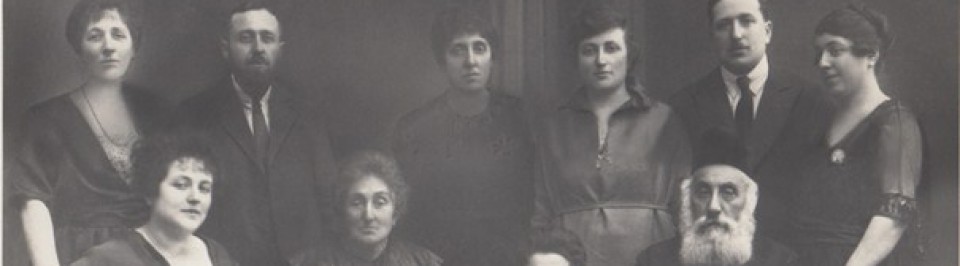
What was it like for a Jew to become a Christian in Poland in the early 1920s? For my grandmother, it meant a total break with her family, her past, and her heritage.
Her own father sat shiva, the seven-day mourning period following a death in the family. In other words, by converting she became dead to him. I can only approximate the date; My mom remembers being left with Auntie Nunia at a very young age. She says she was two (which would make it 1924 or 5) but I wonder if she could have been a bit older since it would be highly unusual to have vivid memories so young. Uncle Sig was born in 1927 so it probably happened before then.
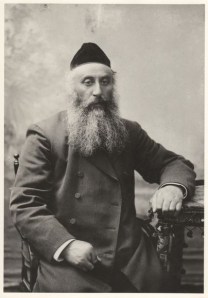
Hiel Majer Piwko, c. 1908
There was another part of the story. I’ve known this for a while so it’s possible my mom told it to me at some point. When Babcia’s father became ill, she visited him on his deathbed, kissed his feet, and begged him to forgive her. He refused to acknowledge her despite her pleas. This would have been in 1929, so just a few years after her conversion. Babcia did, however, reconcile with her mother, who lived a few more years until 1933. Mostly, mom resisted talking about this history. Only once, she expressed bitterness to me that because of her mother’s actions, she never knew her grandparents. This suggests to me that contact between my branch and other branches of the family remained strained and infrequent, with the notable exception of Auntie Nunia.
Thinking more broadly, Aleksander Hertz (Żydzi w Kulturze Polskiej, 1961) sheds some light on the meaning and experience of conversion for Polish Jews. He describes pre-20th century Poland as a caste society, meaning there was a closed system of social groupings comprised principally of landed gentry, peasants, and Jews. Each caste had clearly defined boundaries reinforced by myriad external (dress, customs, economic roles, language) and internal (culture, religion, sensibilities, morality) factors. Further, caste is closed from both the inside and the outside (p. 125). The only way out of the Jewish caste was through christening and conversion.
During the Interwar Period in Poland, Jews faced blocks against full equality within Polish society. In many ways, regardless of how well they spoke Polish, how much wealth they accumulated, or how much education they had, they remained categorically different (and lower in the social hierarchy) than Catholic Poles. Those who assimilated were still viewed as members of their caste (92), and those who sought to integrate the most (via conversion) were often viewed with the greatest distrust (125).
About the psychological experience of conversion, Hertz writes “The change of religion in every specific case [excepting those for whom it was a purely pragmatic decision] marked a strong shock of massive proportions for a Jew” (130). There was a great deal of pride within the Jewish community; Jews felt they were the “chosen nation” and in many ways superior to the “goys” around them (132-3). Conversion meant a radical break with a whole system of life and the associated social environment (środowisko); “The neophyte was someone who didn’t only abandon their caste, but also denied its ideals, everything that was part of its soul and reason to exist. He was a defector and a traitor” (131). Within the Jewish community, converts were thus viewed harshly.
Conversion was never common, but it became more so in the 19th century. For wealthy Jews in particular, it became a means of shifting class and becoming part of gentry culture (178). They had little in common with orthodox Jews, and often identified more with the values and practices of the elite (Poles in central Poland, Germans in western Poland) (148-50, 155). Mixed marriages also became more common during this period. However, exit from caste actually became harder as anti-Semitism grew in response to the increasing similarity between Jews and non-Jews via mass education, adoption of Polish (or German) language, and modern styles of dress. While some assimilated without rejecting their Jewishness, breaking out of the boundaries of caste often also entailed changing names and erasing all traces of Jewish heritage (153, 167). Essentially, the culture that was adopted was not only Polish, but also noble culture (156). The reassertion of caste during the Interwar period was “particularly painfully and dramatically felt by assimilated Jews” (174). Some became overzealous in their perfection of the Polish language and customs, their commitment to the cult of Polish literature and art, and their fanatical nationalism. They became “more Polish than the Poles” (175). Nevertheless, the “shadow of caste” fell on them, and they were never sure if their performance of Polishness, no matter how perfect, would be recognized as good enough (176-7).
My family fits this pattern described by Hertz to such a degree it is painful to me. My mom used to mock my grandmother for being “More Catholic than the Pope,” but she herself adopted a fierce Polish patriotism and worked as hard as anyone in the family to deny their Jewish roots. They tried to integrate completely with gentry society, and in most ways they succeeded. For instance, even after forty-five years of communism, Poles treated my mom with deference; those from humble backgrounds in particular responded to her refined manner of speaking by enacting persistent class/caste relationships. But this life performance came at a cost, and probably contributed to my mom’s hyper self-consciousness and battle with insecurity.

