Report #9 about Roberta Books and Marysia Galbraith’s trip to meet Polish partners in preparation for the ADJCP‘s memorial visit to central Poland.
Koło, September 11
Roberta, Yosef, and I met Koło museum employee Tomasz Nuszkiewicz at the Town Hall, and we walked across the street to the city’s museum of ceramics. Like Włocławek, Koło had factories specializing in faience, tin-glaze ware with painted designs, usually floral motifs. These factories were started by Jewish industrialists, who owned them until they were taken over by the German occupiers during World War II; after the war, they were nationalized by the Polish government.
We sat in an upstairs room at a table, where Tomasz had set out a copy of the Koło Yizkor Book for us, along with copies of a book of town postcards which he gave to each of us. The museum publishes a historical periodical that occasionally has articles about the town’s Jewish community. The room also has a Torah on display; it was found after the war and probably came from a neighboring town. Roberta suggested that based on its modest size, it might have belonged to someone wealthy enough to have a Torah at home.
Roberta, Tomasz, and Yosef at the Ceramics Museum in KołoThe Torah on exhibition in the Koło museum
We walked back past the Town Hall, which has a plaque mounted on its back wall inscribed in Hebrew, Polish, and Yiddish:
In the years 1939-1943 German occupiers murdered about 5000 Jews, citizens of the city of Koło. Honor their memory! The community and city council of Koło, September 1, 2009.
We continued another block to the former site of the synagogue, an overgrown lot with a pile of organic debris under some trees. The site is owned by the Jewish Community in Wrocław, but they don’t maintain it. Tomasz said maybe the city should clean it up, but they rarely do because it is not their property.
These issues of ownership are fundamental and challenging. How do you maintain property when the owners are absent? Who has the rights? Who has the responsibility? What is legally mandated and what is morally correct?
Location of the Koło synagogue, now an undeveloped, overgrown lot
A commemorative monument sits behind a fence in a square filled with trees, walkways, and grass across the street from the synagogue site. A plaque on a tall boulder reads (in Hebrew, Polish, and Yiddish):
Next to this place stood two synagogues built in 1860. The Nazis destroyed the larger synagogue and turned the smaller one into a resettlement point.
Inscribed in metal along the base, it reads:
In the years 1939-1943, Nazis resettled about 7500 Jews from Koło and the surrounding area to camps of torment and murder. Honor their eternal memory.
The buildings all around the square used to be owned and occupied by the Jewish population. Without clear ownership after the war, the city took over their management and rented them to people in need of social assistance. The same thing happened to Jewish property in Włocławek and other cities throughout Poland.
Monument recognizing the site of the former synagogue in Koło
We continued by car to the Jewish cemetery, which is on the other side of the river on a hilltop behind the community center. A fence surrounds the cemetery, which can be accessed through an unlocked gate. The front section is covered with with trees and grass, and the cemetery extends across a grassy field. The city maintains this site because they own it. They keep the grass cut. Under the trees, a brick wall adorned with a Star of David pattern serves as a monument, with a plaque saying “The cemetery was destroyed by Nazis 1940-1943 and the Koło municipality 1945-1968; Koło June 24, 1993.”
Three matzevot, the only ones that have been recovered, lie on the ground in front of the wall.
Monument in the Koło Jewish community. One of the remaining matzevot lies in the grass in front of it.
As we left, Yosef commented that of all the towns we have visited so far, Koło has probably done the most to protect their Jewish cemetery. It has a fence all around it, a commemorative memorial, and benefits from regular maintenance.
Report #6 about Roberta Books and Marysia Galbraith’s trip to meet Polish partners in preparation for the ADJCP‘s memorial visit to central Poland. Reports include contributions by Roberta.
Kłodawa, September 10
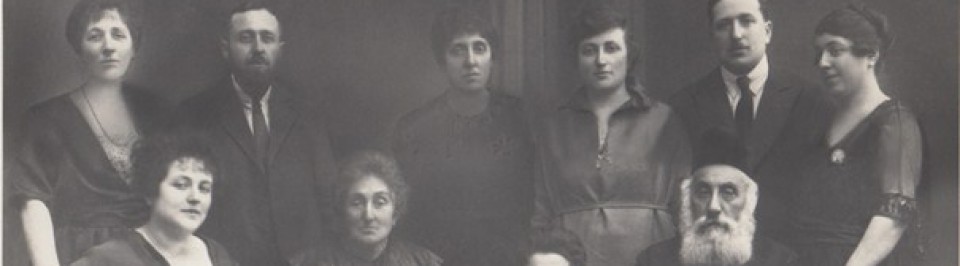
It’s thanks to Roberta’s cousin Judy Muratore and her website Klodawa Tribute that I found my cousin Bob at the very beginning of my search for my own cousins ten years ago. He had posted a photo of his ancestors on the site, a photo that I also had found among my grandmother’s papers. Bob’s great grandmother Bertha, seated on the right, was from Kłodawa. I visited Kłodawa a few years later, but without a guide, I didn’t find the town’s Jewish history.
The Pifko brothers around 1908, New York. Front from left: Philip, Abraham, Paulina, Ewa, Bertha, Nathan. Back from left: Raphael Kolski, Sam and Max Alexander
After visiting Dąbrowice, Roberta, Yosef, and I continued 14 km to Kłodawa. All the towns in the scope of ADJCP’s “central Poland” are very close to each other, connected by narrow country roads.
We met Barbara Gańczyk, the founder and president of the Kłodawa Cultural Society (Kłodawskie Towarzystwo Kulturalne), who has been researching Kłodawa’s Jewish community for decades. A small woman with short-cropped white hair and dressed casually in jeans, she gave the impression of someone who is no-nonsense, authoritative, and eager to share her knowledge of Kłodawa’s Jews. Although she has a PhD, she doesn’t expect to be addressed by any title, preferring to be called by her nickname Bachna.
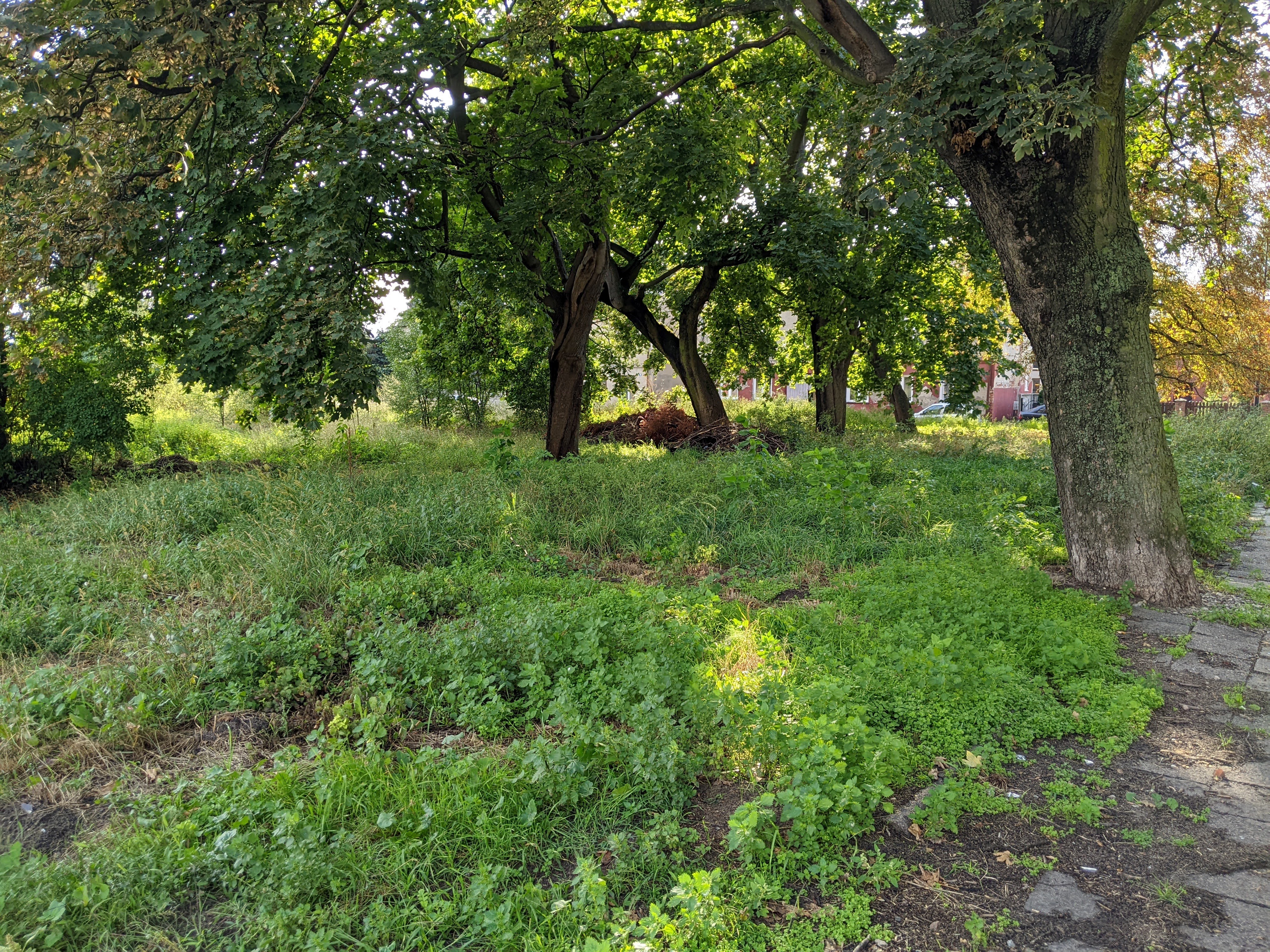
Bachna wanted to start our tour at the Orlen Gas Station outside of town because, she said, “This is where the Jewish history of Kłodawa began.” The first Jews came to the town in the middle-ages, during what she calls the first phase of residence, when the center of the town was closer to this spot. In addition, the Jewish cemetery is a short distance away.
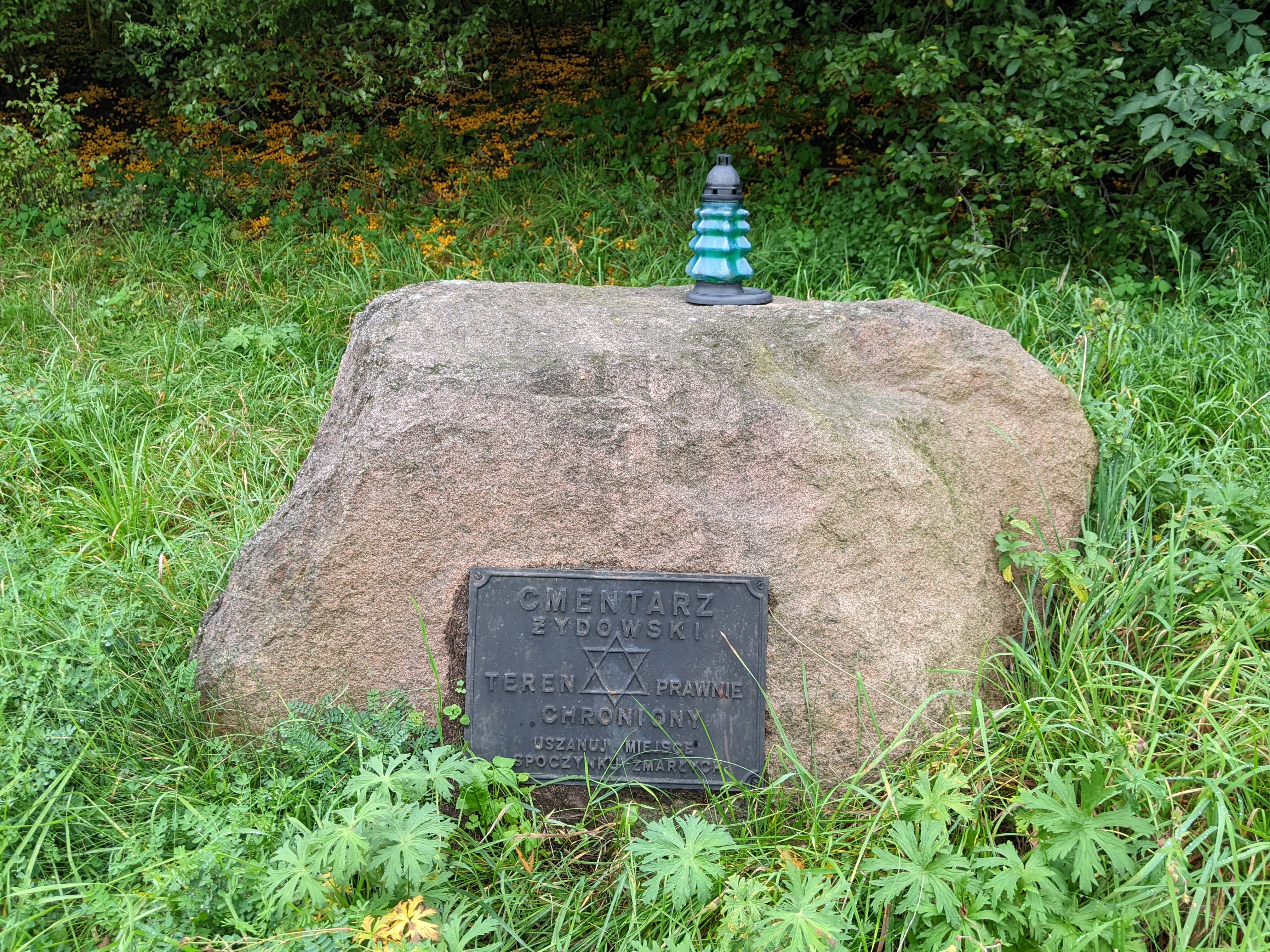
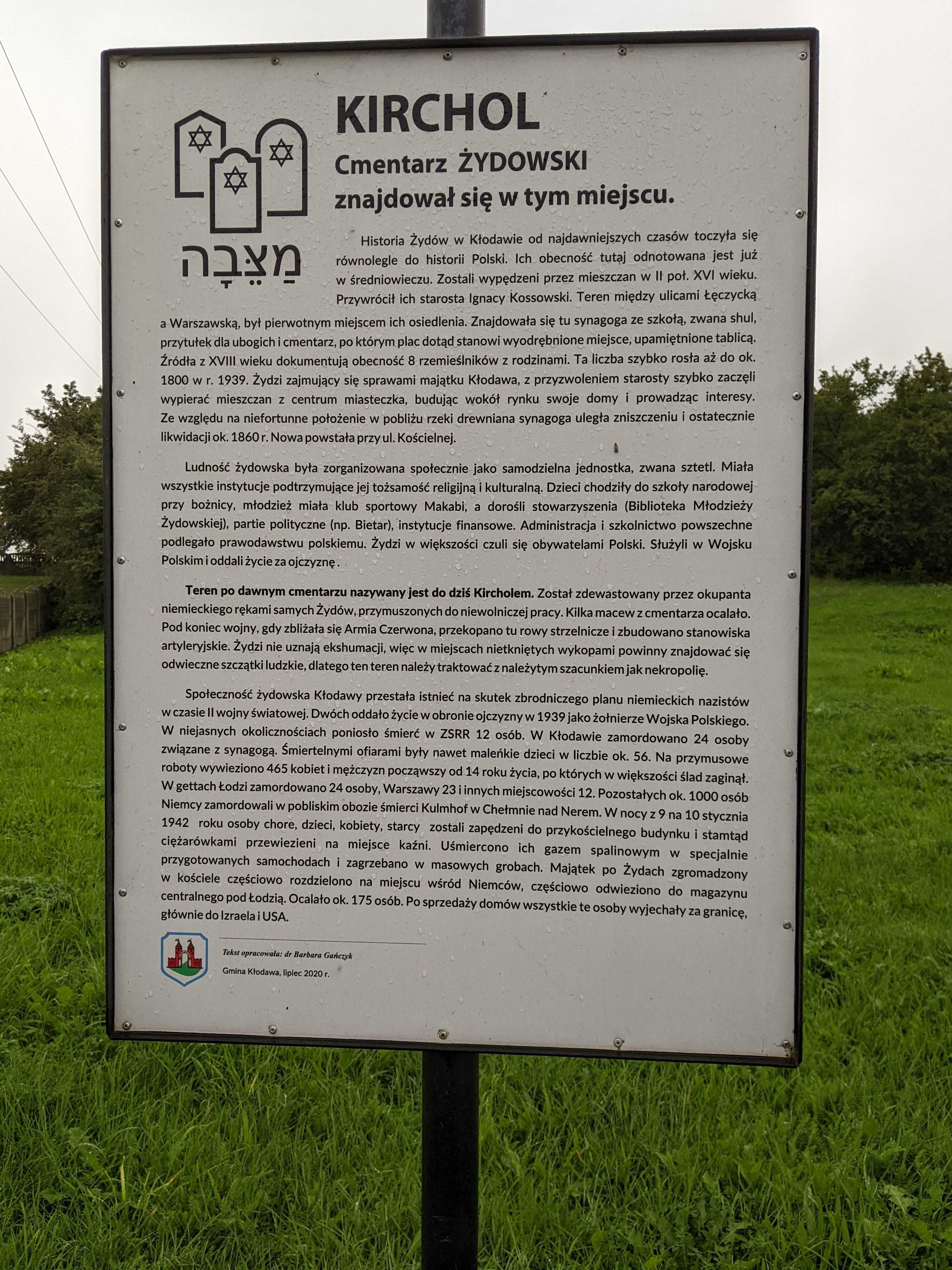
The cemetery is mostly covered by calf-high grass and wildflowers, with small trees toward the back of the plot. Bachna pointed to a building on the other side of the concrete fence along the left-hand border of the cemetery, which she believes was the mortuary house where bodies were prepared for burial. A sign at the edge of the road labels the site “kirchol,” a regional term for a Jewish cemetery, and outlines the history of the town’s Jewish population. Further back, around the place where the land slopes upward, stands a boulder with a plaque saying (in Polish):
Jewish Cemetery
Site is legally protected
Respect this place of rest for the dead
Bachna believes Germans moved the earth from the front part of the cemetery and created the hill at the back as part of their munitions activities.
Plaque identifies this as a Jewish cemeteryHistory of the cemeteryPossible mortuary house on neighboring propertyThe cemetery slopes upwardKłodawa Jewish Cemetery
City landowners forced Jewish residents to leave Kłodawa in the second half of the 16th century, but they were invited back in the 18th century and remained until the Shoah. At that point, they built their synagogue, school, and other institutions closer to the contemporary center of town.
In the center of town, we visited the church where Jews were imprisoned on the night of January 9-10, 1942 a nd then transported to the death camp at Chełmno. An informational sign outlining “the last moments of the the Jewish community in Kłodawa” was mounted here in 2021.
The church where Jews were imprisoned before being sent to the Chełmno death camp in January 1942History of the last days of Kłodawa’s Jews, located near the church
We walked by the site of the synagogue, where the Community Center now stands. Bachna said that curve-topped archways across the front façade were designed to evoke the former synagogue. In front of the building, another informational sign dating from 2020 outlines the history of the synagogue.
Roberta, Bachna, and Yosef in front of the Community Center designed to evoke the former synagogueHistory of the synagogue
Bachna will be a strong ally for ADJCP members with ancestors from Kłodawa. She has studied and written about the town’s Jewish history for decades and has amassed a great deal of knowledge. She is eager to collaborate with Jewish descendants and with our group.
Report #5 about Roberta Books and Marysia Galbraith’s trip to meet Polish partners in preparation for the ADJCP‘s memorial visit to central Poland. Reports include contributions by Roberta.
We met Grzegorz Stęplewski on September 9 at the Kutno Community Center so we could talk about what remains from the Jewish community of Dąbrowice. Grzegorz lives in Kutno and is a member of TPŻK (Friends of the Kutno Region), but he grew up in Dąbrowice, a village of about 1,300 residents nearby. Grzegorz likes to paint and sketch; he imagines scenes as they would have looked based on historical records and the current configuration of streets, for example reinserting the synagogue next to his childhood home.
The next day, Grzegorz met us at the Krośniewice cemetery and we followed him to nearby Dąbrowice, just 9 km away. We parked outside his family home, a one-story house with a small covered wooden porch in front, which he continues to own. The house is on a small plaza called the “Nowy Rynek” that functions as green space with grass, pollarded trees and a green-painted kiosk. This rainy Saturday afternoon, the kiosk was closed and no one was on the streets.
Dąbrowice Rynek viewed from Grzegorz’s house
We climbed the rough wood steps and sat out of the rain on a single bench perpendicular to the front door. Grzegorz showed us hand-drawn street plans dated 1959 with his family property facing the plaza and the synagogue plot next to it on Sienkiewicza Street.
1959 map shows lot #4, the former site of the synagogue (labelled gmina żydowska, Jewish community)
The synagogue was destroyed during the war. Some years later, Grzegorz’s father added the synagogue plot to the back garden of his house. He has what is called a dzierzawa wieczysta, a perpetual lease; in effect, he doesn’t own the land but can use it indefinitely. It currently sits behind a stone wall, though we could see into the yard from the neighbor’s driveway gate. Based on the size of the lot and the space Grzegorz paced out for us, the synagogue was not large.
Inside Grzegorz’s gardenGrzegorz shows the approximate length of the former synagogue
We continued on a roundabout route to the site of the cemetery. Gzegorz pointed out where the center of town was visible across agricultural fields, and explained the old, unpaved road takes a more direct route but it’s only suitable for farm vehicles. The cemetery plot stands forlorn, an overgrown thicket surrounded by plowed fields. Getting to it would require walking across those fields. It’s unlikely that any grave markers remain under the shrubs and small trees. Grzegorz said that at minimum, there should be a sign at the side of the road indicating the location of the Jewish cemetery.
Across an agricultural field, the Dąbrowice Jewish cemetery is an island of brush and trees
That was the extent of what remains of the Jewish community of Dąbrowice.
Report #4 about Roberta Books and Marysia Galbraith’s trip to meet Polish partners in preparation for the ADJCP‘s memorial visit to central Poland. Reports include contributions by Roberta.
Krośniewice Mayor Katarzyna Erdman, Sławomir Mikołajczyk, and his son Adam Mikołajczyk stood on the side of the main road from Kutno, sheltered from the rain under two umbrellas. Sławomir, a member of the Krośniewice branch of the Friends of Kutno (TPŻK), works at the city museum, while Adam a City Hall employee, shares his father’s passion for local history. They waited for Roberta, Yosef, and me in the rain so they could start our tour of Jewish sites at a memorial stone engraved with the statement:
People today should bring back the memory of those who are no more
At the 70th Anniversary of the liquidation of the ghetto III X 1942
The Krośniewice Community
2012 (my translation from Polish)
Monument commemorating the Krośniewice Jewish community. Behind the chain-link fence is the synagogue, transformed into a funeral home
They pointed out that the building next to us was the synagogue. For years it served as a movie theatre, but when it was sold in 2004, the new owner converted it into a funeral home. The walls of the synagogue are hidden behind the utilitarian exterior of the current plaster façade.
Adam Mikołajczyk and Mayor Katarzyna Erdman in the Dunin-Burkowski Museum, Krośniewice
During our meeting all participants affirmed their willingness to help organize a half-day event for descendants in May. Our hosts told us about Sol Rosenkranz, a Holocaust survivor who returned to his hometown and built a fence and monument at the Jewish cemetery. They told us that Sol’s son still returns regularly to maintain the cemetery. The mayor had the impression that the town does not have permission to cut the grass themselves. She also said they know about tombstones under roads, including 20 or more in a nearby town. The Jewish cemetery has a few tombstones incorporated into a makeshift monument, and she hopes more can be recovered.
Roberta asked Mayor Erdman what she considers Krośniewice’s biggest challenges. Erdman replied employment and investment. As with so many small towns in Poland (and throughout the world, really) young people are leaving in search of work and a better life. Her greatest task as mayor is finding investors who will build businesses and create jobs. Later, I asked Adam what motivated him to return to Krośniewice. He responded, “Someone needs to stay.” Also, he feels such a strong attachment to the place and its history he decided to try and make a life for himself there.
Sławomir and Adam told us about other Holocaust survivors. 92-year-old Róża Aleksander (now Krysia Nowak) still lives in town. As a young child, she and her mother Saba were hidden by Józefa Dziewierska, a righteous gentile acknowledged for her actions in 1997. Saba’s maiden name was Flaster; her husband’s name was Gabriel Alexander. Their daughter Róża was born in 1931 to Gabriel Aleksander and Saba Flaster Aleksander. During the war, mother and daughter adopted false identities Zofia and Krysia Marczak. Róża, now Krysia Nowak (her married name), used to meet with descendants but is no longer well enough to do so. Her testimony was recorded by the Shoah Foundation.
Another child survivor, (Hanna Kałużna?) lives in Wrocław. She and Krysia remain friends. Hanna used to visit Krysia in Krośniewice, but now that she is in her late 80s she hasn’t been able to.
We concluded our visit at the cemetery, which is 900 meters from the center of town. Cars whizzed by on the city bypass running up the slope from the cemetery. A paved drive leads to a metal gate, and a plaque on the right contains a brief history of the city’s Jews in Polish, English, and Hebrew. The Foundation for the Preservation of Jewish Heritage (FODŻ) installed it in 2014.
Jewish Cemetery, Bypass road on the horizonYosef reads the plaque on the cemetery gateMemorial plaquePaved path to the Krośniewice Jewish Cemetery
Only Adam and Yosef ventured through the long grass inside, to the pile of debris that someone topped with matzevah fragments and cynically labelled a monument.
In the 1980’s, an unscrupulous businessman decided the abandoned cemetery would be an ideal place to dump construction debris. His illegal use was reported to the authorities, and he was told to remove the debris. Instead, to avoid the expense of clean-up and a fine, he mounted tombstone fragments atop the rubble and claimed that since it is now a monument none of it can be disturbed.
Adam made photos with my phone, so I can share them here.
Tombstone fragments in the make-shift memorial, Krośniewice Jewish Cemetery
An important update to this report
ADJCP president Leon Zamosc shared what he knows about Sol Rosenkranz and Sol’s efforts to restore the cemetery.
“The initiative to restore the cemetery came from Sol Rosenkranz, a survivor from Krosniewice. He had been born in Grabow, but the family moved to Krosniewice when he was a child. “During the war, Sol Rosenkranz was in six labor camps until his liberation in Theresienstadt. He and one of his brothers were the only survivors of his family. He came to the US in 1946, lived in New York and Los Angeles (where he worked as a volunteer speaker in the Simon Wiesenthal Center), and spent his final years back in New York (where he was an active gallery educator at the Museum of Jewish Heritage in Battery Park). He passed away in 2019 at the age of 101. “After his liberation in 1945, Sol returned to Krosniewice and saw that the Germans had paved the town square with gravestones removed from the Jewish cemetery (all deliberately placed with the inscriptions up). That memory stayed with him for decades. In 2002, Sol visited Krosniewice and found that the communist administration had re-surfaced the town square in the early 1950s. The matzevot had been removed but there was no record of their whereabouts. “In 2013, Sol went to Krosniewice again. At the dilapidated cemetery site, there were only half a dozen fragments of matzevot that someone had cemented together. Sol was not a wealthy man, but during that visit he decided that he would fund the restoration of the cemetery (placement of a fence around the perimeter of the cemetery and installation of an iron-wrought gate with a memorial plaque). The works were carried out by FODZ (the Foundation for the Preservation of Jewish Heritage in Poland) and the dedication took place in 2014.”
Leon also reached out to Sol’s son Joel who tells a slightly different story about the ongoing maintenance of the cemetery.
“When we dedicated the cemetery in 2014 we were hopeful that city officials including the then mayor Juliana Herman, the clergy and teachers would advocate support and maintenance – however that did not materialize.”
Joel also reached out to me with more details:
At the Wiesenthal Center, Sol worked in the library translating Yiddish and Hebrew letters and other documents for families, asking only that they make a donation to the Center in return. He started talking about the Shoah after Joel’s mother Sally died in 1996. He returned to New York and began to volunteer for the Museum of Jewish Heritage even before it had a physical space. He “embraced his role as a witness, speaking to students at schools of all denominations. After the MJH was established, he was a member of the Speakers Bureau for more than 20 years and by their estimate had told his story to more than 10,000 people, one class or group at a time.”
He further explains “Regarding Krosniewice cemetery maintenance, because Nature remained unchecked in that spot for decades, trees and shrubs developed deep roots. According to Rabbinic law as Rabbi Schudrich stated, in clearing the cemetery grounds, it was not permitted to use any heavy equipment that would disturb bodies below the surface. As a result, the tools we used were chainsaws to cut trunks as close to the ground as possible, clippers and weed whackers. Within a year, certainly two, nature asserted herself again and so a program of perpetual care is what is required. Local authorities don’t have any ownership authority, but they could certainly play a helpful, respectful role in maintenance if they wanted.”
Sol Rosenkranz (right) with Rabbi Michael Schudrich at the rededication of the Krosniewice Jewish cemetery
This just goes to show how hard it can be to maintain cemeteries and other memorial sites. Even when all sides approach a project with good will, plenty of room remains for misunderstanding. It is also a real challenge for information to be passed down from one government administration to the next, and from one activist to another.
Report #2 about Roberta Books and Marysia Galbraith’s trip to meet Polish partners in preparation for the ADJCP‘s memorial visit to central Poland. Reports include contributions by Roberta.
September 8-12, ADJCP Members Roberta Books and Marysia Galbraith, Jewish Kutno Member Yosef Kutner
Panorama of the Kutno Jewish Cemetery from the top of the hill, Roberta stands beside the memorial monument on the left
The cemetery is the largest one in our area, covering 3 hectares. Yosef’s mission was to inspect the boundaries to see the condition of the fence. We found some fragments of the prewar brick fence. There are several access points to the cemetery, making it a place where Kutno residents cut through on their way to school or home, or where they walk their dogs or children play. Despite signs posted by the TPŻK explaining this is a cemetery and should be respected, piles of trash in remote corners of the cemetery suggest it is used as a place to drink and socialize. We located a sunken area where a tree grows, the likely sight of the Ohel of Rabbi Israel Joshua Trunk (1821-93), and larger sunken area hidden by overgrowth that might be the site of a wartime mass grave.
Sign reminding visitors to respect the Jewish Cemetery
Possible fragment of the original brick wall that surrounded the cemetery
Possible site of Rabbi Trunk’s Ohel
Sunken area that may be site of mass grave
Roberta next to the commemorative monument, Kutno cemetery
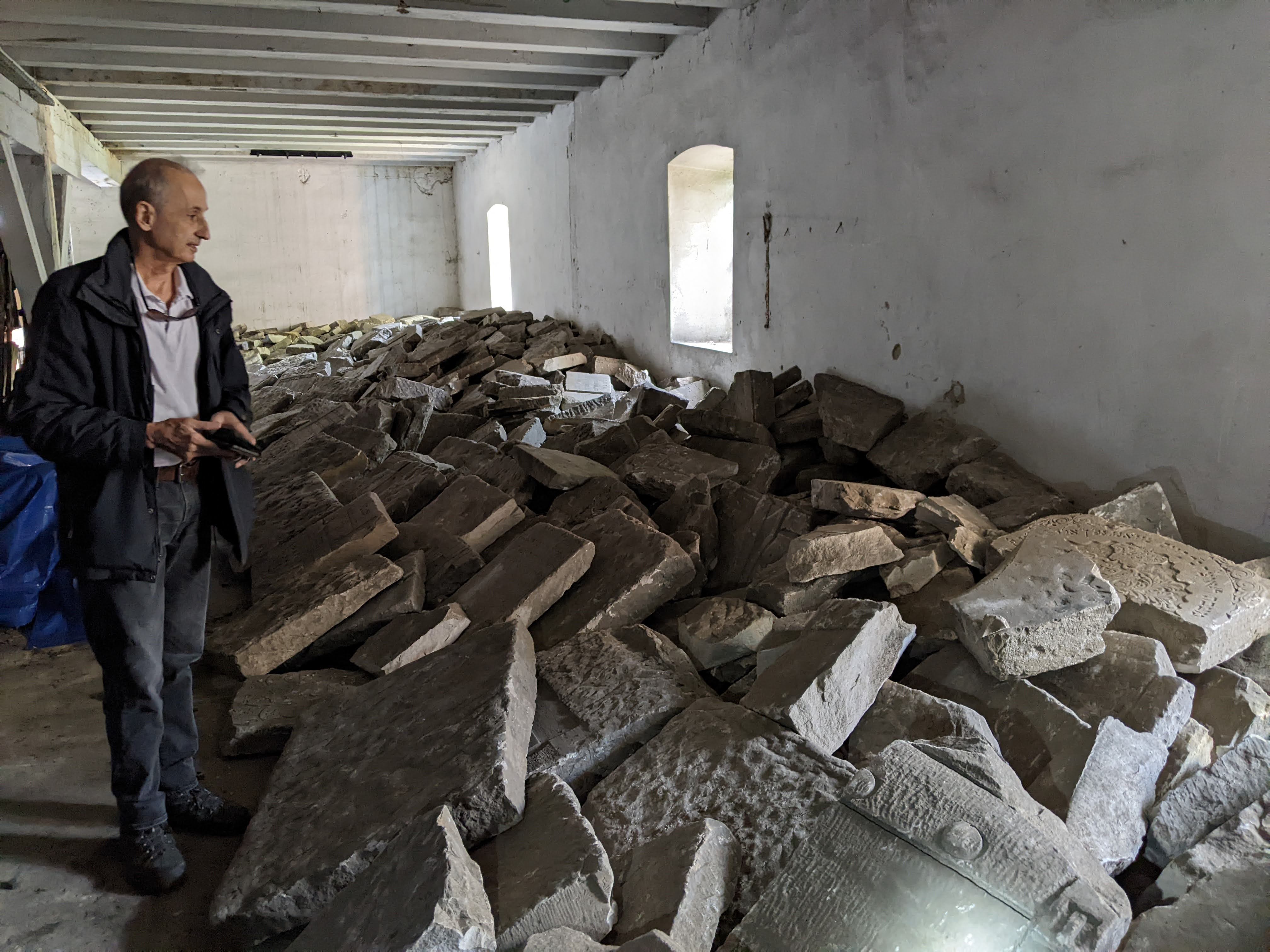
Next, we met the Kutno Regional Museum Director Grzegorz Skrzynecki and others at a defunct brewery warehouse where the museum stores hundreds of matzevot fragments recovered from the places they were used in road and construction projects (a common practice during and after the German occupation). The volume of stones is astounding, though still just a fraction of the matzevot plundered from the cemetery. You can see many of them with English translations of the decipherable texts in Yosef Kutner’s book Broken Memories: Remains from the Jewish Cemetery in Kutno. Yosef compiled the book from photographs, so this is the first time he saw the actual stones. Piled as they were, most of their identifying numbers are not visible. Nevertheless, there on the surface, Yosef found the top of his great grandfather’s tombstone. Mr. Skrzynecki explained that more fragments were found during a recent road project. They didn’t make it into the book, but I’m sure Yosef will find a way to share that information once he has it.
Yosef scans the recovered matzevot fragments, many of which he includes in his book Broken Memories
Meeting to discuss cemetery protection and maintenance
The meeting to discuss the future of the Kutno Jewish Cemetery followed. It was attended by key figures from the Jewish Community of Poland (Chief Rabbi Michael Schudrich), from the town of Kutno (Deputy Mayor Zbigniew Wdowiak, town attorney Agnieszka Wojkowska-Pawlak, museum director Grzegorz Skrzynecki, museum public relations and marketing Katarzyna Erwińska, library head Magdalena Konczarek, and Michael Adamski, head of the Department of Culture, Promotion, and Development), from the Association of Friends of the Kutno Region–TPŻK (Bożena Gajewska), and from international Jewish heritage groups (Yosef from Jewish Kutno and Roberta and me from ADJCP).
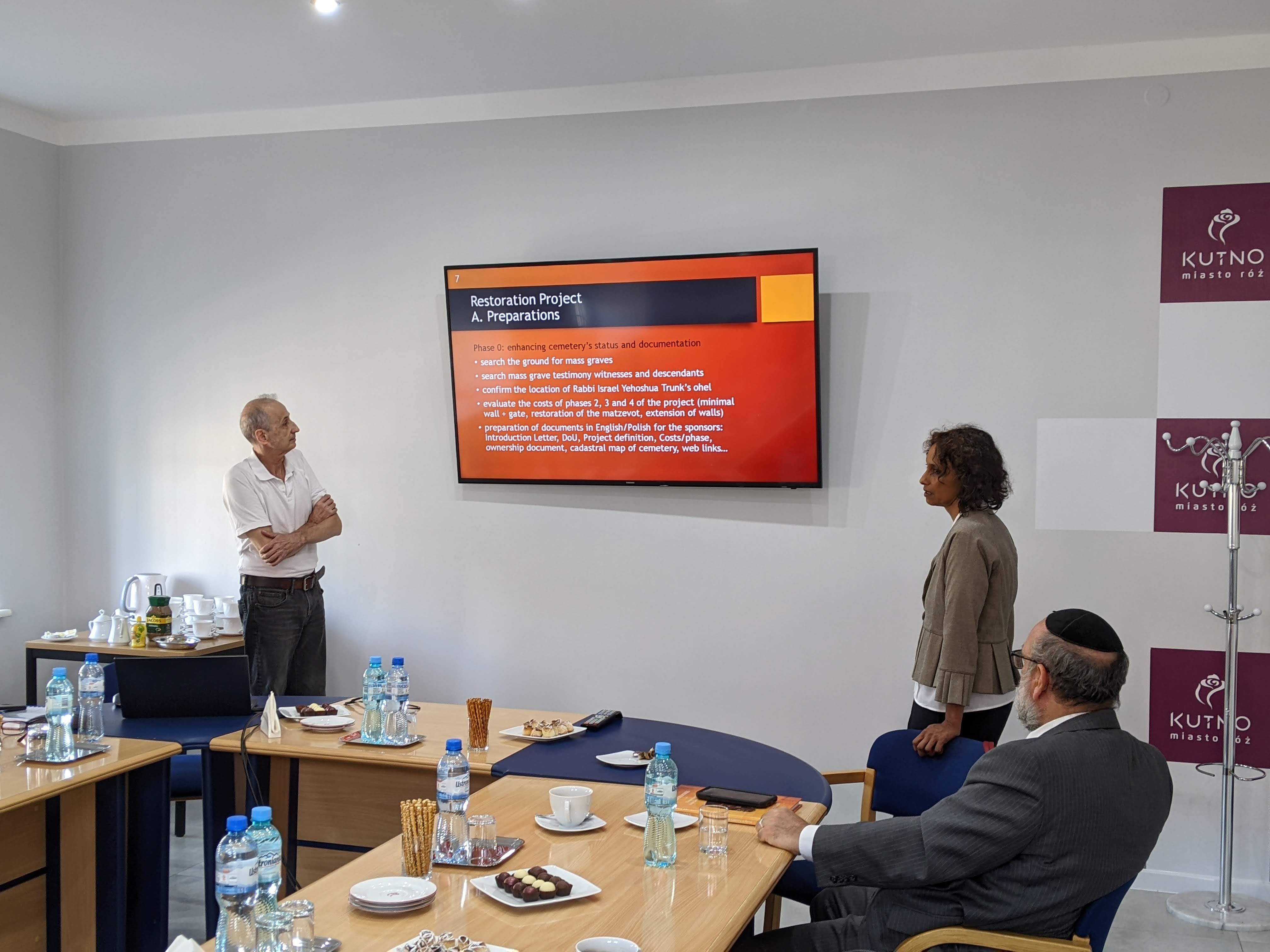
Yosef Kutner presenting his proposal for the Kutno Jewish Cemetery. Rabbi Schudrich seated on the right
This description is based on Roberta Books’ memo: The city deputy president opened the meeting with a presentation of the many actions the Town of Kutno has undertaken in support of remembrance of the Jewish history of Kutno, including the biennial Asch Festival.
Josef Kutner followed with a slide presentation about the Jewish cemetery of Kutno, and his proposal for protection of the property. His proposal includes fencing the entire property with a brick wall that resembles the wall around the Christian cemetery, confirming the location of two mass graves mentioned in the Yizkor book and commemorating the mass graves with an appropriate marker, and limiting access to the site in order to prevent partygoers and others from disrespecting the site. Kutner also advocated creating a memorial with the preserved matsevot and marking the site of Rabbi Trunk’s Ohel.
The town attorney then discussed the ownership of the site. Important records for verifying with legal clarity that the Jewish Community of Kutno owned the site, in particular the Land Registry Book, are missing and unlikely to be located. Despite 20 years of effort, the town has been caught between legal requirements and administrative rulings that have called into question their legal right to maintain the site. Although no interested party questions that the site belonged to the Jewish Community of Kutno, legally this remains a murky area.
Rabbi Schudrich responded that he has dealt with similar problems in Poland on a number of occasions and he is confident that he can sort this out satisfactorily. He told the parties that they should begin planning while the legal issues were being sorted.
Schudrich and the deputy president talked about the change in mentality that they expect will come about when the plans began to come to fruition. When Jewish cemeteries are protected, local residents begin to take pride in them and matsevot have a way of coming out of hiding and returning to the cemetery.
The deputy president voiced his full support for the cemetery renovation, including covering the costs of a new wall. He noted that he, too, had drawn up preliminary plans for fencing the cemetery. They differ from Kutner’s proposal in two key ways. His design would be constructed of metal with brick pillars, not brick like the historical wall or the wall surrounding the Christian cemetery. Also, it would have multiple access points rather than the single access point in the Kutner proposal. The deputy president wants current residents to remain able to walk across the site; he pointed out that its location in the middle of the city would complicate closing it off. He wants the site to be respected as an integral part of the town. He noted that Rabbi Schudrich was consulted throughout the development of the plan, and he supported this idea.
I want to emphasize the good will everyone projected toward each other as well as the resolve to push through the twenty-year roadblock that has stalled the project to secure the cemetery. Since the meeting, Yosef Kutner has continued to share materials about the likely location of the mass grave and to push for his vision for the cemetery restoration.
Additional meetings
After lunch, we visited the city library, where director Magdalena Konczarek showed us a short film they produced about Sholem Asch, his work, and the biennial Kutno Sholem Asch Festival. The library sponsors the festival, which has been held every other year since 1993. They also have an extensive collection of materials related to the Jewish history of Kutno and of Asch. They have published several academic volumes based on papers delivered at the conference that occurs in conjunction with the festival, as well as Polish translations of Asch’s work. For the memorial trip in May, Magdalena and library historian/regional specialist Andrzej Olewnik will mount an exhibition featuring their collection.
We continued to the offices of the TPŻK where we met Bożena Gajewska (until recently the organization president) and the vice-president Grażyna Baranowska (former librarian and organizer of the Sholem Asch Festival). Bożena reaffirmed her commitment to continue working on projects associated with Jewish Kutno, and Grażyna affirmed the continued support of the TPŻK.
The next day, we viewed an exhibition in the Kutno Community Center about the Eizyk brothers who bred and grew roses before and after the war. From this successful business, the city adopted the moniker “City of Roses.” The exhibition was part of the annual Rose Festival that attracts thousands of visitors to Kutno.
Students at the Jan Kasprowicz High School in Kutno, together with Roberta, Marysia, and principal Ciurlej
On September 12, we visited students at the Jan Kasprowicz High School (Liceum II). Roberta and I agree that such outreach to young people was one of the most important (if not the most important) part of our visit. We were welcomed by school director (principal) Artur Ciurlej, teacher Anna Ambrosiak, and a room full of students eager to hear from us. They showed us a short video about their recent activities related to Jewish memory (including dancing lessons!), and then Roberta and I each told our personal family story, explained our ancestors lived nearby, and talked briefly about our desire to restore Jewish memory. The meeting took place in English, but the students clearly understood us; they asked thoughtful questions and shared some of their own experiences with us. We spoke for more than a class period, even after the bells rang. Some students promised to meet us again in May, although they will have graduated by then.
Final note: Clearly, we have strong partners in the Kutno city government and with the TPŻK. They all expressed the desire to work with us and seem to have a sincere interest in preserving and promoting the Jewish heritage of the city. They are eager to participate in the memorial trip in May.
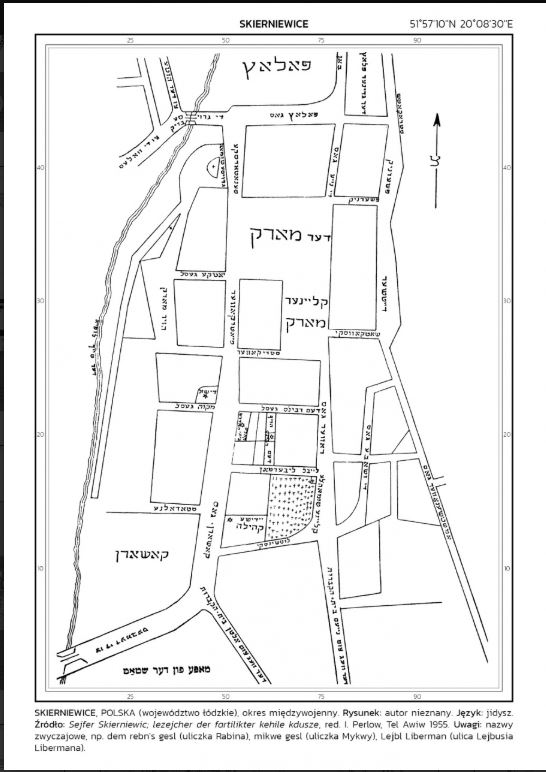
The Atlas of Memory Maps exhibit features maps drafted by non-experts in an effort to preserve the memory of their hometowns, which had been destroyed or radically transformed during and after World War II. Most were published in Yizkor books, memorial books compiled by Jewish survivors. The exhibition is mostly in Polish, but includes some English-language information. The maps contain notations in Yiddish or Hebrew. This virtual exhibition by Grodzka Gate-NN Theatre Center includes maps from Poland, Belarus, Ukraine, Lithuania, Moldavia and Slovakia.
I found a map of Skierniewice among over 150 included in the exhibition. My grandfather Hil Majer Piwko was born in there in 1854, as were his siblings Jankel Wolf (1857), Urysz (c. 1861), Dawid (1862, d. 1865), Nusen Dawid (1866), Chawa (c. 1871), and Fajga (c. 1878). It’s where Hil Majer brought his bride Hinda Walfisz in 1873, and where they started their own family. It’s also where his parents were buried (Cywia Rajch in 1862 and Chaim Josef in 1912), and probably his stepmothers, too.
Here is the map from the exhibition:
Map of prewar Skierniewice drawn from memory by an unknown author
Comparing it with a contemporary map, it’s hard to figure out exactly how they match up. Maybe someone who can read Yiddish can help me by translating the words on the map. Please leave me a comment if you do! I think the rivers on each map are the same, and the space marked with crosses in the bottom center of the prewar map may be the green space marked “Church of St. Stanislaus” in the bottom right of the contemporary map.
Map of contemporary Skierniewice. The site of the synagogue is marked with a black dot surrounded by a grey circle. Source: Google Maps
I’ve been to Skierniewice twice, with my cousin Krysia in 2013 and with my cousin Bob in 2018. Little remains of the town’s Jewish heritage.
Skierniewice Rynek in 2013
Krysia and me in Skierniewice, the birthplace of our great grandfather. April 2013
With cousin Bob, the former synagogue in the background–it’s now an electrical supply store
The synagogue, though the exterior is well maintained, now houses an electrical supply store. On the road running parallel to the river, a few tombstones have survived in the old Jewish cemetery, but they are in what is currently the backyard of a private residence. I wonder if this cemetery was included on the prewar map? The newer Jewish cemetery contains many more surviving tombstones as well as commemorative markers outlining the history of the town’s Jewish population. It is located beyond the bottom edges of these maps, off a dirt road a short ride south of town.
Located in Lublin, Grodzka Gate-NN Theatre is one of the oldest and most active Jewish heritage organizations in Poland. About its origins, Tomasz Pietrasiewicz writes:
The changes brought about by the fall of communism in Poland in 1989 initiated the process of regaining Memory by the Polish society, and Lublin was among many Polish cities which had to face their forgotten past.
When we began our activities at the Grodzka Gate [which historically separated the Jewish and Catholic districts of the city] in the early 1990s, we knew nothing about the history of Jews in Lublin. We were not aware that the enormous empty space on one side of the Gate conceals the Memory of the Jewish Quarter. We did not realize that the Gate leads to the non-existent town, the Jewish Atlantis.There is a huge parking area, lawns and new roads where there used to be houses, synagogues and streets. A large part of this area, including the foundations of the former Jewish houses, was buried under a concrete cover, and the memory of those who lived here was hidden as well. You cannot understand Lublin’s history without these empty spaces near the Gate. For the NN Theatre, they have become a natural setting for artistic actions, Mysteries of Memory, which uncover the memory of the past while mourning the victims of the Holocaust. (from “History of Grodzka Gate-NN Theatre“).
More information about the exhibition and Grodzka Gate-NN Theatre can be found at the following websites:
That is what the Jewish Community of Poznan wrote when they announced a new memorial, “Pavement of Memory,” built with fragments of Jewish tombstones that were recovered during roadwork in Poznan.
“Pavement of Memory” composed with fragments of matzevot (Jewish Tombstones), Poznan Source: Janusz Marciniak
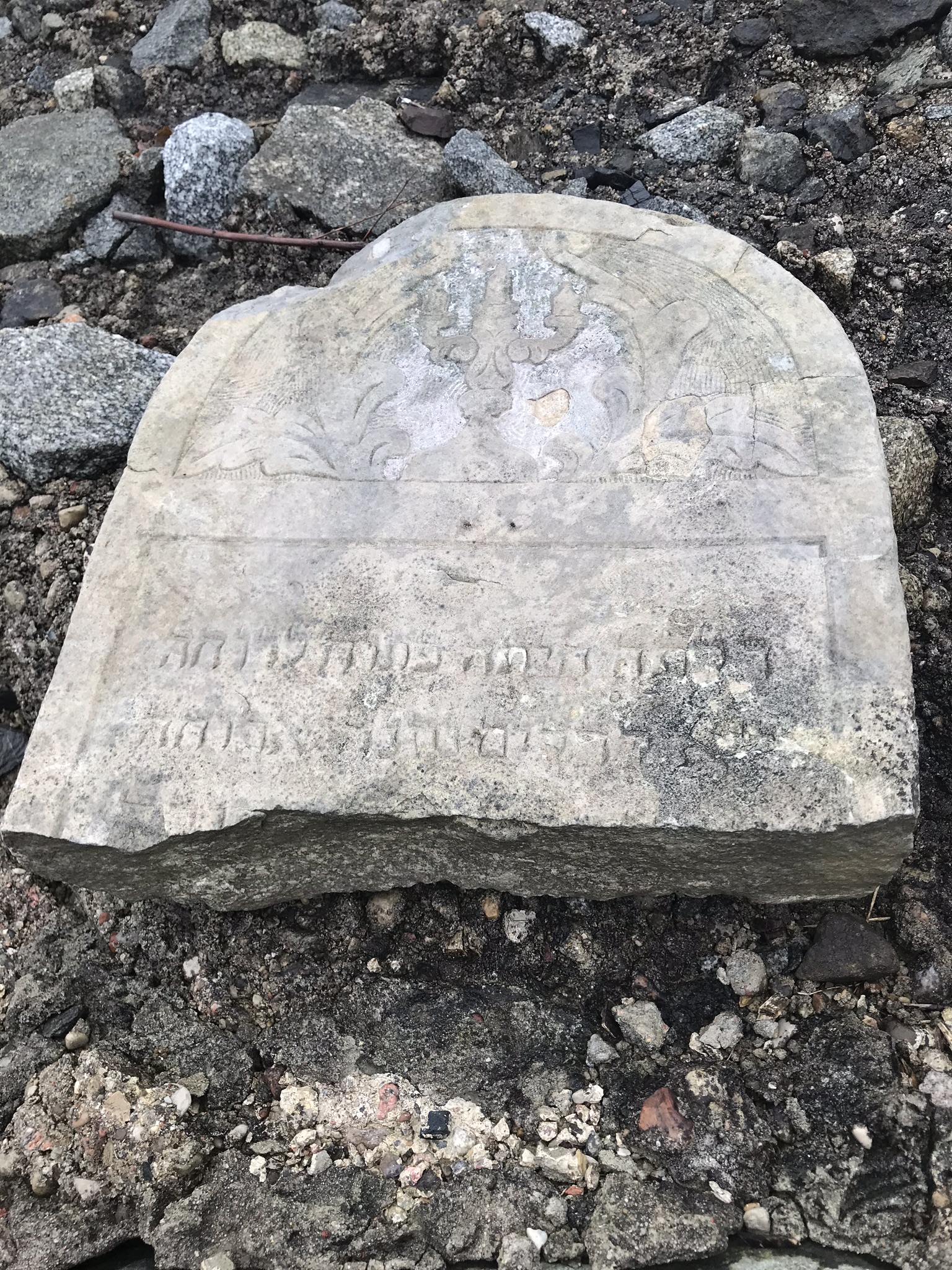
When the road crew dug up the old pavement, they noticed some stones with strange writing on them. Realizing the letters were in Hebrew, they contacted the Jewish Community. The fragments are too small to make out names or details about whose tombstones they were, but at least they have returned to the cemetery where they belong. All over Poland, fragments like this are being found, out of place, reinforcing road beds, bridge foundations, and lake beds. They were harvested during the terror of the Nazi occupation, and sometimes afterwards under state socialism. With only ghosts to look over them, Jewish cemeteries became a source for scarce building materials.
The extraordinary thing is that when public spaces are designated as repositories of Jewish memory and culture, objects return to them. As cemeteries are cleaned up, fenced, and marked, tombstones come back. In some cases, it’s as if people have known for a long time about these objects. They felt they were out of place and it has sat uneasily on their minds. They are relieved to finally know where these objects should go. In others, as with this road project, people are surprised to find these fragments, but they feel a sense of obligation to honor the memory of the past. To put things back into place.
“Pavement of Memory” at the memorial site in a corner of Poznan’s Jewish cemetery.
The words on the memorial plaque, in Polish, Hebrew and English, read:
Był czas, kiedy z macew robiono bruk. Czas, w którym najdosłowniej rozbijano, deptano i kaleczono pamięć o ludziach pochowanych pod macewami. Niektóre z kamiennych okruchów tej pamięci przetrwały i dziś ta pamięć łączy się z wdzięcznością dla wszystkich, którzy przyczynili się do jej ocalenia. „Z owocu swoich ust nasycony będzie człowiek dobrem, a odpłacone mu będzie według tego, co zrobity jego rece” (Prz 12, 14).
הייתה עת שבה עשו ממצבות אבני מדרכת, עת שבה היו באופן ממשי מנתצים, רומסים ופוצעים את זכרם של האנשים הטמונים מתחת למצבות. אחדים מהשברים של אבני הזיכרון
אותן הזיכרון מתאחד שרדו, וכיום עם הכרת טובה לכל אלה שתרמו להצלתו. “מפְרִי פי־אישׁ יִשְׂבַּע־טוֹב וּגְמוּל יְדֵי־אָדָם יָשִׁיב לוֹ” (משלי י”נ יד).
There was a time when matzevot [Jewish tombstones] were used for pavement; a time when the memory of the people buried under the matzevot was most literally broken, trampled, and maimed. Some remnants have survived and today this memory is connected with the gratitude to those who contributed to its rescue. “A man shall be satisfied with good by the fruit of his mouth, and the doings of a man’s hands shall be rendered unto him” (Prov. 12:14).
Bird on an old boulder tombstone in the corner of the Poznan Jewish Cemetery that has been designated as a memorial site.
Thanks to Mirosława Stojak for all the work she does to preserve the memory of Jewish history and culture in Włocławek.
Here is a video from Holocaust Remembrance Day (January 27) when she and students and teachers from the Automotive High School visited the memorial at the site of the World War II Jewish ghetto, also the prewar Jewish cemetery.
The interviews are in Polish, but even if you can’t understand the words, you can see that these people remember the Jewish history of their city. And they are passing on those memories to the next generation. They lit candle lanterns in front of the commemorative monument, and the students placed pebbles upon which they had written words like “traditions,” “love,” and “memories.”
There’s more about Włocławek’s Jews on Ms. Stojak’s website Zydzi.Wloclawek.pl. The tagline of her site: “Ku pamięci, z nadzieją, na pojednanie,” “In memory, with hope, for reconciliation.”
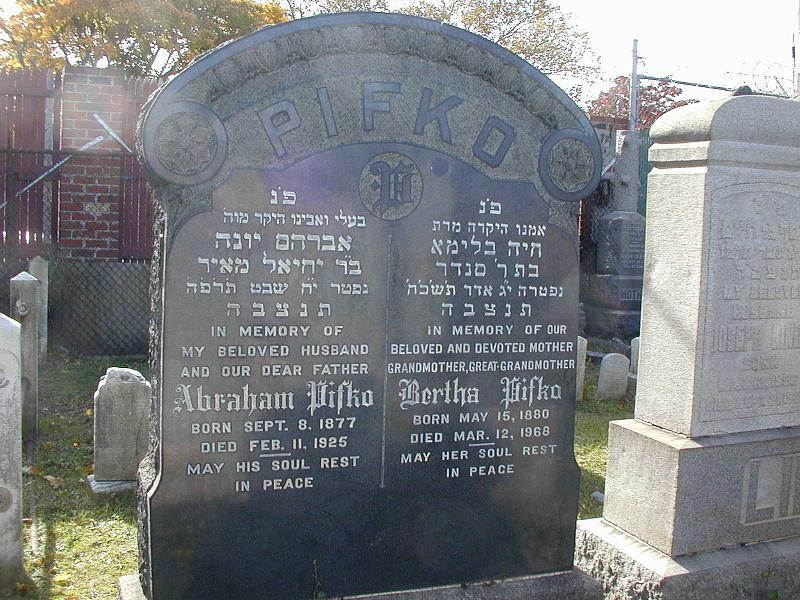
I was shocked to learn that the family burial plot is just 20 minutes from where I grew up. No one had ever told me about it.
Gravestone of Abraham and Bertha Pifko, Washington Cemetery. Photo credit: B Kosovsky
I met my 2nd cousin Bob right around the same time my 1st cousin Krysia found his photo of Abraham and Bertha Pifko’s gravestone. Abraham and Bertha were Bob’s great-grandparents, and Krysia’s and my great-uncle and aunt. Poking around some more on the Internet, I figured out that this photograph comes from Bob’s Flickr account, in a folder containing photos of all the tombstones in the Pifko-Winawer Circle in New Montefiore Jewish Cemetery.
Since I was on Long Island for a visit, I decided to see the Family Circle for myself. I went with my friend Krystyna, who is Polish, on our way to Copiague, a town on the south shore of Long Island with a large Polish community and several Polish delis. I’ve driven that route many times to get black current jam, kasha, makowiec, white cheese, and other foods I miss so much from Poland, as well as my son’s favorites: kielbasa and ptasie mleczko, rectangles of marshmallow covered in chocolate. I’ve tried buying kielbasa from the grocery store, but Ian won’t eat it; he insists only the real stuff from Poland is any good.
You can practically see the cemetery from the road, but I never knew it was there. Nor did I know that my relatives were buried there. This is what family silence does. Because we weren’t supposed to know about our Jewish heritage, I had never been there, not even to visit the graves of Stanley and Stella Winawer or Pauline Kanal, relatives whom I remember so fondly.
Pifko-Winawer Family Circle, New Montefiore Cemetery, Organized 1938
Philip and Goldie Pifko’s gravestones
Sarah Winawer’s gravestone
Memorial bench for Jacob and Libe Winawer
It’s a large cemetery. Krystyna and I had to figure out how the sectors, blocks, and rows are organized, but eventually we found the Pifko-Winawer Family Circle. The size of the plot is astonishing. It contains dozens of graves. A hexagonal pillar toward the front is labelled “Pifko Winawer Family Circle Organized 1938.” Other faces of the hexagon include the last names Pifko, Lewis, Davis, Kanal, Shapiro, Winawer, Jaret, Jacoby, Jacobs, and Portny. Written on the back face is “In Memorium; Abraham J. Pifko; Max Winawer Rosen.” I had only begun my genealogical research and only recognized a few of those last names. Even today, after six years of genealogical research, I’m still not sure how I’m related to the Davises, Jacobys, and Portnys.
We wandered through the rows of gravestones—raised blocks with blunted front corners, backed by low evergreen hedgerows. Among them, I found Babcia’s sister Sarah Winawer, “beloved mother, grandmother, great grandmother, March 16, 1880-Feb. 16, 1964.” This is the sister my immediate relatives called Lusia, the one who died a few months after I was born and who said before her death that she would look down on me from heaven. She rests beside her husband Saul, and near their children Nathan, Stanley, and Pauline. Another son, Milton, is not there; much later, I learned he chose a different cemetery because his wife Nettie, who was not Jewish, couldn’t be buried in New Montefiore. I recognized names of other relatives Aunt Pat has told me about—Abraham Pifko’s daughters: Eva Lewis and Sarah Lewis who share a last name because they married brothers; and Pauline who was there with her husband Fred Rosen.
I found Babcia’s brother Philip with his wife Goldie, whose graves are on the side of the family plot, facing perpendicular to the others. Their stones have Hebrew lettering on top and English on the side. The others either have both languages on top, or English on top and Hebrew on the sides. Could this signal something? Perhaps Goldie felt a closer affinity with the Hebrew/Yiddish language?
I did not find Abraham and Bertha’s grave. When I asked Bob about it, he explained that they are buried in Washington Cemetery in Brooklyn. Abraham died before the family circle was established, and even though his great-grandmother wanted to be buried with the rest of the family, her spot was waiting for her with her husband. Another sister, Liba’s grave is not there, either, though she and her husband are remembered on a memorial bench with the inscription, “In memory of Jacob and Libe Winawer.”
Walking among my extended family, I felt the joy of finding them, and simultaneously the sense of loss that I never got to know, or even know anything about, most of them.
Pifko-Winawer Family Circle, New Montefiore Cemtery
My brother Chris resting on a commemorative bench at the family burial plot.
Is it odd that I spoke in Polish the first time I visited family graves in a Jewish cemetery? I don’t think so because Babcia’s family prided themselves in their ability to speak the language well. In some ways my ancestors straddled the boundary between Polish and Jewish culture. But the gulf was wide, and when my grandmother converted, she closed the door on her Jewish heritage, just as her father expelled her from the Jewish world in which she had been raised.
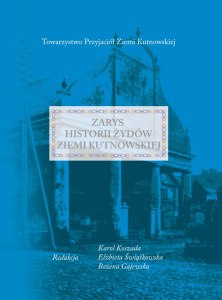
While in Kutno, I visited the Society of Friends of Kutno (Towarzystwo Przyjaciół Ziemi Kutnowski). The organization has been active since the early 1970s, and has put out an annual periodical about local history and customs for about 20 years. Most issues of the publication contain an article about Jews. In 2016, these articles were compiled in a book along with other historical materials about Kutno’s Jews, including Holocaust witness reports and photographs, and a list of people who lived in the Kutno ghetto.
Outline of the History of Kutno Area Jews, published by the Friends of Kutno
The chairwoman of the Friends of Kutno Bożena Gajewska is an energetic and upbeat woman. She accepted the position because of her interest in local history and her desire to promote that history among local residents. She isn’t paid for this; she volunteers for the organization after getting off work. The Friends of Kutno have their office in a historic wooden villa that was recently renovated by the city. Most of their funding comes from grants. Over the years, they have placed historical markers where the synagogue, Jewish cemetery, and ghetto used to be. Other recent projects related to Jewish culture include field trips for local residents to the Polin Museum in Warsaw, to a production of a Sholem Asch play at the Yiddish Theatre in Warsaw, and to the Chełmno Extermination Camp, where Kutno Jews were transported when the ghetto was liquidated. Kutno was selected as a site where the Museum on Wheels (a traveling branch of the Polin Museum of the History of Polish Jews) would visit; this happened in August 2016.
Marker reads, “In this place the 18th century synagogue stood. It was destroyed by the Nazis during World War II, evidence of the hatred of one human to another, and to his works.”
Pani Bożena says she’s noticed that orientations toward Jews have improved since the Polin Museum has opened. Thanks to the Museum, you can talk about Jews, whereas before, the word “Jew” had negative connotations, and was even used as an insult. This made people unsure what to call practitioners of the Jewish faith. Polin has helped to rehabilitate the term. While this may seem like a manifestation of the particularly fraught relationship between Poles and Jews, Mark Oppenheimer just published an opinion piece in the New York Times (Sunday, April 23, 2017, “Reclaiming ‘Jew’”) in which he notes that it’s the same in the US. “Jew” is almost never used as a noun; rather, the adjective “Jewish” is used, as in “Jewish people” or “I’m Jewish” (never “I’m a Jew”). Oppenheimer quotes the comedian Louis C. K. who called “Jew” a funny word “because ‘Jew’ is the only word that is the polite thing to call a group of people and a slur for the same group.”
The Polin Museum has also contributed to a surge of activity related to Jewish history and culture throughout Poland. This has led some townspeople to complain to the Friends of Kutno, “Why is everything always about Jews?” Bożena says she reminds these people that the Friends are interested in all aspects of regional history, and Jews were a part of that history. They address plenty of other topics, as well. For example, they recently published the biography of a native son who was an ultra nationalist during the period when the majority of Kutno residents were Jews (I can’t remember his name but maybe someone reading this can remind me).
Pani Bożena drove me to see some historical sites around town. The Jewish cemetery is on a hill overlooking a neighborhood of concrete apartment buildings. The hillside is covered with tall grass and wildflowers, and crisscrossed by dirt tracks where people walk their dogs, kids play, and people hang out. Many leave their trash behind. The Friends of Kutno recently put up signs around the cemetery that say “Here is the resting place of Kutno Jews, who settled in the city from the beginning of the 16th century. The cemetery located on this hill may have been established as early as the 16th century, also. Jews were buried here until March 1943. Please maintain its solemnity.” Below this historical information is the reminder, “Keep in mind as you go into this vast expanse that this is a cemetery; people are buried here, you walk on their graves, even though there are no longer tombstones…” Further, the sign states the cemetery is a registered monument and thus legally protected, and any vandalism is subject to a sentence of imprisonment. Nevertheless, within just a few months, four out of six such signs were vandalized. The metal poles were snapped at ground level. Bożena condemned the destruction, but also minimized it as the work of thoughtless hooligans (as opposed to a deliberately antisemitic act). In September, the poles were replaced and the signs stand once again.
Bożena showing me the new sign at the Jewish cemetery in Kutno
An older monument at the top of the cemetery hill
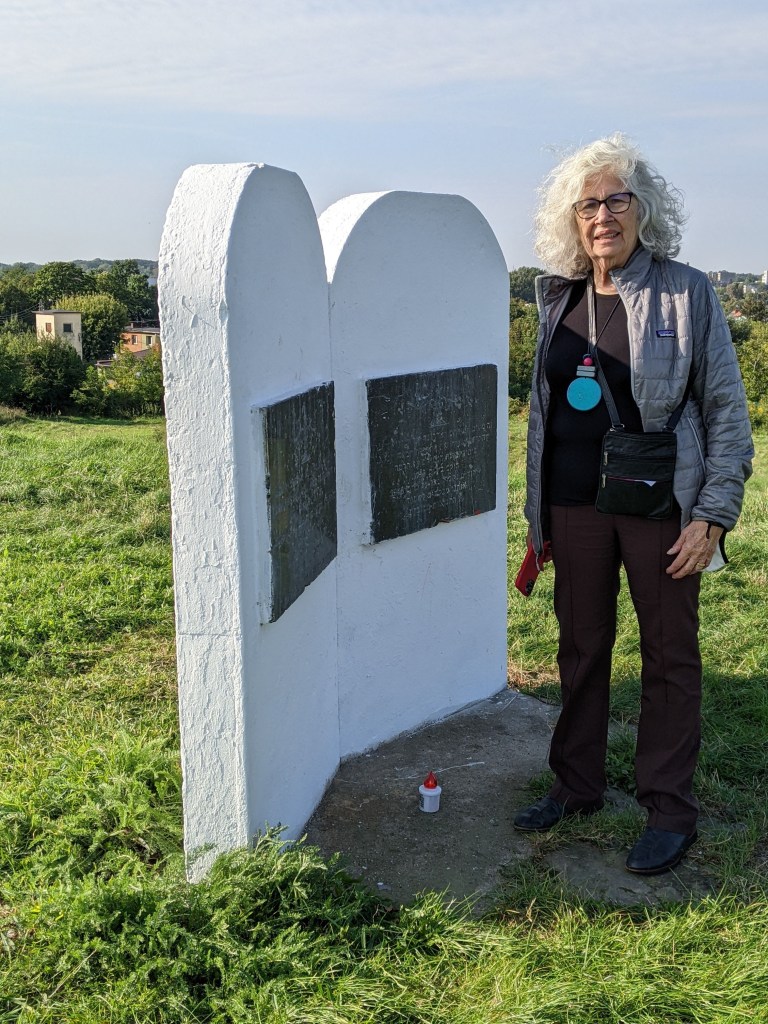
We passed people with dogs as we walked to the top of the hill to an older monument. It contains the same historical information as the new metal signs in Polish and Hebrew (but not the reminders about proper behavior and legal issues), and is shaped like two adjoining tombstones. Heading back down the hill, past some children playing, we saw the bases of some grave markers peaking out of the grass. Many tombstones were recovered and are stored at the Kutno Museum.
Bożena dreams of building a fence around the cemetery so there will be a more substantial barrier against further vandalism. They have received all the necessary approvals, but are in need of funding.
From the cemetery, we went on to the site of the ghetto, which is outside the center of town on the grounds of a former sugar factory. The factory was used by various industries after the war, but now is closed. The buildings, some dating from the late 19th century, stand behind a high fence and a guard patrols the site. Historic markers tell the story of the ghetto. A granite plaque reads:
Here on the terrain of the former Konstancja Sugar Factory
Germans established a ghetto for the Jewish population of Kutno and the surrounding area.
After its liquidation in 1942, the surviving Jews perished in the camp at Chelmno.
Honoring their memory, the People of Kutno.
Kutno, April 1993
A more recent sign contains a bit more historical information in both Polish and English (if you want to read it, click on the photo below to enlarge it).
Former site of the Kutno ghetto.
Wall plaque at the site of the Kutno ghetto
Historical marker in front of the main gate of the factory where the Kutno ghetto used to be.
Bożena told me that over 8000 people lived in the ghetto from 1940-1942. Those who got there first occupied all the most obvious places, so later arrivals had to build shacks from scrap wood, or find ways of populating balconies and any other inhabitable space throughout the large factory hall. In 1942, they were all transported to the camp at Chełmno by train (the tracks are right across the street from the factory) and by truck.
Thinking about the people I met in Kutno (and elsewhere), one thing I am trying to sort out is why Christian Poles get involved in Jewish heritage projects. Not surprisingly, the reasons are varied. One is interested in historical artifacts; he has no political agenda. Another of my companions tried to place this history into a more pro-Polish framework. He explained that the Nazis forced Christian townspeople to do horrible things as part of a strategy to damage relations between Poles and Jews. “All people really want is to live in peace (Chcą w spokoju żyć)”, he continued, “Poland is in the heart of Europe, a pretty terrain that has historically been attacked from all sides.” Others feel personally drawn to Jewish culture. One of my acquaintances in Kutno believes she has Jewish heritage. She seems to understand my quest for my own family history. “It’s important to know where you’re from,” she told me. She hasn’t found anything as concrete as my family photograph (the one I use at the top of the blog) to confirm her feeling that she has Jewish roots. All she can point to are allusions in family stories she remembers from childhood, and sometimes people have told her she looks Jewish. But anyone she could have asked has passed away.
But what’s clear from my visits to Kutno is that fragments of Jewish history remain, and some have been marked as such thanks to the efforts of a small group of residents who think it is important to include the stories of Kutno’s Jews in the history of their town.






















 Uncovering Jewish Heritage