• About
  • The Photo that Started it All

Uncovering Jewish Heritage

Uncovering Jewish Heritage

Category Archives: Family

Posts about my family.

Mapping Family Roots

23 Sunday Oct 2016

Posted by Marysia Galbraith in Archives, Family, Identity, Polish-Jewish Heritage, Pre-World War II, Walfisz, Żychlin

≈ 2 Comments

Tags

map

I made an extraordinary find in the Kutno archive—a map of Żychlin dating from 1869. I found reference to it in an article, but the archivists had a little difficulty locating it because it didn’t have an identification number (signatura). One archivist said something about it being so fragile they don’t show it. But another found it hanging on the wall and brought it out for me. The writing is in Russian. At that time, Żychlin was in the Russian partition of Poland. After the January Insurrection in 1863, the Russians mandated all public documents had to be in Russian, not Polish. That is why archival documents before the 1860s are in Polish while the later ones are mostly in Russian.

Russian writing on the 1869 map of Żychlin

I don’t know what is written here–maybe a reader could translate it for me?

dsc08463

Map of Żychlin dated 1869

Properties are numbered on the map, but not by street address. That means the numbers are scattered throughout the city making it difficult to find particular locations. According to the Żychlin Books of Residents (Akta Miasta Żychlina, also in the archive), my Walfisz ancestors lived at various times at numbers 28, 53, and 63. My great grandmother Hinda Walfisz married my great grandfather Hiel Majer Piwko. I wrote about them in previous posts: Piwko Saga, The Photo, and Super Kosher Cookies and Sliced Ham.

The map is hard to read, patched, and creased. The cross-shaped church stands out in the top half. Below it is the market square, and #53 is in the row of buildings along its lower edge. #63 is further to the left, and #28 is on the street running down from the market square.Not surprisingly, these properties are all near the synagogue, which as best as I can tell is #86 on the map (a bit below #63).

I had already seen one Book of Residents in 2013, but in 2016 I found my great grandmother’s family listed in three others, as well. Since the books have been indexed, the archivist was able to tell me what page to look on. And even though these records are only a few years older than the map, they are in Polish. There is only one Walfisz family in the books (my great grandmother with her sisters and parents), but other more distant family names also appear: many Losmans, a couple of Kolskis, and one Jakubowicz. Each household has its own page in the book, but there can be several households in the same building. Because religion is one of the things recorded in the Books, I could see that it wasn’t uncommon for addresses with multiple households to include families of multiple faiths: some Catholic, some Jewish, some Evangelical.

I know this is just an old map, but being able to pore over it, to touch it, helped to transport me back in time, and to once again (for the first time?) connect with the place where I’m from. It doesn’t matter that I never actually lived there (nor did my mother nor even my grandmother). Some of my people did. Right there in that place. With this newfound knowledge, I drove back through Żychlin one more time, this time gazing at the buildings that once housed my family. It didn’t really matter that the buildings had changed, nor that I was still unsure how exactly the old building numbers match the contemporary ones. Once this was their home.

My elusive grandfather Jakob Rotblit

27 Tuesday Sep 2016

Posted by Marysia Galbraith in Family, Gdynia, Memory, Names, Poland, Pre-World War II, Rotblit, Warsaw

≈ 3 Comments

Tags

Jakub Rotblit

The danger of digging up family skeletons is that you never know what kind of bones you’ll find.

My mom rarely said anything about her biological father. In fact, it wasn’t until I was a teenager that she told me the man she called Papa, the husband of her mother, was not her birth father. As children, she and her older brother felt like orphans. They never saw their birth father, which I’m sure was related to the fact that talking about him would have revealed the family’s secret Jewish roots. Back then, in prewar Poland, Catholics did not divorce and remarry.

When she finally opened up to me about him, Mama said she barely knew her father. She almost never saw him. Then one summer, following a big fight between him and her mother, Babcia (my grandmother) got fed up and told him, “If you want your children you can have them.” She put George (who was 15 at the time) and my mother (who was 13) onto a train to Gdansk, where they joined their father with his second wife and their daughter.

The Baltic Coast was beautiful, but Mama was miserable. Her father didn’t know what to do with them, and his 2nd wife didn’t want them there; perhaps she felt threatened. After two months (that’s what I remember mom said, though some relatives have told me it’s inconceivable Babcia would have left her children for that long), my grandmother came to Gdansk and with effusive tears and passionate apologies, she brought them back with her to Warsaw. That’s the last time Mama saw her father. She told me she did not know what happened to him, but that probably he died during the war. She never told me his name.

Victorian high button shoes. Source: http://antique-gown.com/

Victorian high button shoes. Source: http://antique-gown.com/

One of the stories my mother would tell me from time to time was about the “high button shoes” her father insisted she wear when she was around 13 years old. The bitterness still lingered when she described to me how much she hated those boots; they were old fashioned and ugly, the kind that were commonly worn in the 19th century. Her father contended they were sturdy, and proper for a young girl. They were also expensive because he’d had them custom made for her. I always assumed this was a conflict Mama had with Papa, her stepfather. It’s only now, as I piece together the fragments, it occurs to me this argument might have been with her biological father. The timing fits. Also I imagine he was probably the more conservative of the two.

I only learned my biological grandfather’s name in 2011, when my Aunt Pat (the wife of my mother’s younger brother Sig) showed me a family tree she had made identifying my grandfather as Jacob Rotblit (in a previous post, I’ve written about how names can vary), son of Ignacy and Hanna, and brother of Maurice and Helena. Pat reiterated another fact my mother had mentioned: Jacob was from Warsaw but had moved to the Baltic Coast. Pat also had notes, presumably from conversations with my grandmother’s sister, that Rotblit had been a merchant who sold fine jewelry and luxury cars.

Jakub Rotblit b. 1891

Jakob Rotblit, b. 1891

Then my cousin Krysia remembered that before he died, her father (my mother’s brother George) gave her a photo of his father. Krysia wrote some notes on the back of the photo: “He was a respected Jew. Babcia fell in love with his friend Zygmunt and left him.” Then, with a rectangle around it was the name “Jakup Rotblit” and under that “my father’s father” and a roughly sketched family tree. So not only could I attach a name to my mysterious grandfather. I also had a photograph. And yes, his children resemble him. And so does one of my brothers and a cousin.

From here, the trail went cold. It took another two years before Krysia and I obtained a copy of a birth certificate of a Jacob Rotblit who was born in Warsaw in 1891. The name, city, and date were plausible, but we didn’t know if this was our grandfather, our Jacob Rotblit or some other one. Though not a common name, I have found prewar records of at least three.

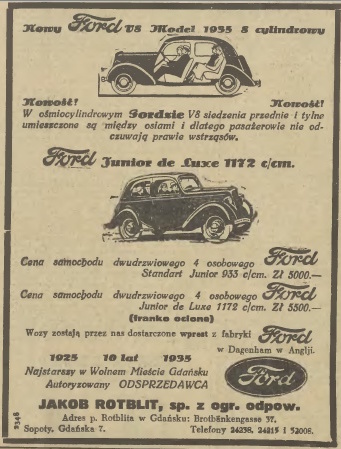
This was in 2013, a time when Krysia and I would stay up until early morning searching everything we could think of on Google, and sending tidbits back and forth to try and fill out the story of our grandfather . She contacted several Rotblits she found to inquire if we might be related. I dug up references to Jacob Rotblit’s Ford dealership. This business, car sales, corresponded with my aunt’s notes. Granted, neither now nor then were Fords “luxury cars,” but in the 1930s any car was a luxury.

Ad for Jakob Rotblit, Ford Dealer in Gdansk, Sopot, and Gdynia, Gazeta Gdanska 1935

Ad for Jakob Rotblit, Ford Dealer in Gdansk, Sopot, and Gdynia, Gazeta Gdanska 1935

In September 2013, when I was back in Warsaw at the Jewish Historical Institute, Anna Przybyszewska recalled seeing the name in a book, J. Drozd Społeczność Żydowska Gdyni w Okresie Miedzywojennym [Jewish Residents of Gdynia during the Interwar Period]. Indeed, on page 309 is the following (I’ve translated it):


On November 20, 1936, a company was registered in Gdynia named “Permanent Automobile Market (Stałe Targi Samochodowe).” It was the initiative of the married couple Jakub and Bronisława Rotblit. The object of the enterprise Stałe Targi Samochodowe was the management of the trade in domestic and international products, specifically mechanized vehicles (new and used) as well as their accessories. In addition, the company offered parts, service, and repairs of vehicles. Jakub Rotblit specialized in the sale of automobiles and accessories of the Ford firm, of which he was an authorized dealer. The specific headquarters of the Rotblit’s company were always located in places beneficial to the interests of the place—first in the BGK building (at #31 10 Lutego [Tenth of February] Street), and from July 1938 in the new office building of the firm “Bananas” (at #24 Kwiatkowskiego Street). The operation of the firm ended suddenly upon the death of Bronisława Rotblit, as a result of which her husband moved to Warsaw.

In the footnote: Jakub Rotblit (born June 25, 1891 in Warsaw), son of Arkadiusz Rotblit and Racheli Prowizor, married, merchant. Arrived in Gdynia from Warsaw June 25 1935. He lived at 25/7 10 Lutego Street and 6 Hetmańskiej Street.


It took another year before I got the birth certificate (which was in Russian) translated and could confirm the vital information was consistent with what was written in this book: The birthdate was the same; the parent’s names were similar enough to likely be Hebrew and Polish versions of the same names (Aron/Arkadiusz and Ruchla/Racheli Prowizor). In my Aunt Pat’s notes, Jacob’s second wife was “Blanka” and their daughter’s name “Rosa.” I still couldn’t be sure, but it was looking more likely I had uncovered more traces of my biological grandfather.

I have continued to collect fragments, fleeting references to Jacob Rotblit, never sure if they’re about my grandfather or not. Did his 2nd wife really commit suicide? Was he really arrested for business fraud? Was he shot outside of Warsaw in 1941 by a German officer? I have documents saying these things happened, but I have no way of checking these details and no way of linking them conclusively to my grandfather.

But I have recently learned something truly extraordinary. Last month I was contacted by someone through Ancestry’s DNA matches. Genetically, we appear to be second cousins. And yes. His mother was a Rotblit, daughter of Louis/Leib Rotblit who came from Russia/Poland. Louis arrived in England, married and had three children around the time of World War I. My cousin knows very little about his grandfather because he left his grandmother after several years. His mother never talked about him. But on his grandparent’s marriage certificate, Louis’ father was named Aaron and his brothers Moshe and Ya’akov (all written in Hebrew, so the English or Polish forms could easily be Arkadiusz, Maurice (?), and Jacob).

Enough of these details add up. And DNA is likely to be the most concrete evidence I’ll ever find. Another branch of my family tree is filling out. More relatives survived.

Traveling with Babcia

31 Tuesday May 2016

Posted by Marysia Galbraith in Bereda, Family, Memory

≈ 2 Comments

Tags

Halina Bereday

Babcia died over twenty years ago, shortly before I returned from my doctoral fieldwork in Poland. The last time I saw her was a few months before she passed, when she was already on her way. She did not recognize me, or my brother Chris, and didn’t even acknowledge our presence. Except, she grabbed my hand—at first, I thought it was because she knew who I was, but in fact she just used my finger to scratch her ear. It was an intimate and disturbing final contact between us.

The last time we spoke was a year and a half earlier, right before I left for Poland. Babcia was already 97, in assisted living, but still sharp. She became agitated about my trip, cajoling me, “Don’t fall in love with a Polish man.” She warned me against life in Poland, she said a Polish man would not treat me well; she was afraid I would not return. She insisted there was nothing for me there, that she and the rest of the family decided to leave Poland to seek a better life in the US.

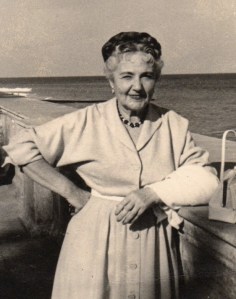
BabciaPuertoRico

Babcia in Florida, late 1950s.

Babcia was a mystic. She believed she could see the future, and even though I did not fall in love with a Polish man and I did come back, often it seemed like her premonitions were right. Mama also had an uncanny ability to sense things, but with her it was more psychological. Mama was deeply empathetic and could intuit the emotional states of others.

There was very little fanfare when Babcia died. I missed the funeral because I wasn’t told about it. Mama didn’t want me to cut my trip short to attend. Babcia was cremated, in accordance with her wishes. She also wanted to be buried in Poland with her husband Zygmunt who died nearly fifty years earlier in 1945, but no one seemed to have the will to make it happen. Instead, my cousin Alexandra brought the ashes home and placed them on an altar in her home, where they stayed for many years.

In 2015, when I returned from my year in Poland, we had a family reunion. I took it as an opportunity to offer to take Babcia back home to Poland. It’s something I have thought about doing for a long time, and I finally I got up the nerve to make it happen. I’m the one who can do it. I speak the language and know my way around.

At first, it seemed my cousin would be reluctant to give Babcia up. But when I visited her mother a short time after the family reunion, the ashes were there waiting for me in their metal box.

So I brought her to my home in Alabama, where she has rested in my pottery studio awaiting this trip to Poland.

I knew I would not be able to bring a metal box through airport security, but still was reluctant to remove Babcia from her resting place. I waited until the night before my departure. I apprehensively removed the screws from the lid, and found a metal tin like a paint can inside labeled with Babcia’s name and the date she died. I have been told that surprisingly little is left after cremation, but I still was taken aback that even the tin, quite a bit smaller and lighter than the box, was filled halfway with paper. A whole body reduced to little more than a quart of ashes. I transferred them to the plastic bag nestled in the bottom of the box (no doubt for this purpose), and put that into a zippered bag I got at the Black Sea in Israel. She will be buried in a ceramic urn I made.

I had read that it’s not a problem bringing cremated remains on airplanes, so I set them in the bottom of my carry-on luggage. It was detected in the x-ray screening at the Birmingham Airport. I apprehensively explained what it was as the bag was being searched. The screener was very kind. She did some sort of test for explosives but let me through without otherwise disturbing the ashes.

So Babcia is on her way back to Poland. We’ll see what happens at the cemetery. When I called several months ago to inquire about the procedure, the person I spoke with was initially very confused. However, once he understood that Babcia was cremated, she died over twenty years ago, and there is already a family plot, he told me to just call once I get to Poland and we’ll make arrangements then. I hope it’s really that easy.

Council for European Studies Conference

15 Friday Apr 2016

Posted by Marysia Galbraith in antisemitism, Brześć Kujawski, Commemoration, Family, Fieldwork, Heritage work, Jewish Culture, Kolski, Memory, Piwko, Poland, Polish Culture, Polish-Jewish Heritage, Polish-Jewish relations, Research Methodology, Włocławek

≈ 5 Comments

Tags

Absence of Memory, Council for European Studies Conference, Postmemory, Reassembling Jewish Life in Poland, Włocławska Zapomniana Ulica

Yesterday, I presented a paper titled, “Reassembling Jewish Life in Poland.” It starts like this:

It is easy to get the impression that we have entered an era of retrenchment of exclusionary national, ethnic, and religious categories, making minorities of any kind suspect. Specific objects of fear, such as terrorists, raise suspicions about broader categories, such as Muslims; the economic threat attributed to immigrants extends to all Mexicans, Syrians, North Africans, or Eastern Europeans. And Jews have once again become the object of attacks in Western Europe, leading Atlantic journalist Jeffrey Goldberg (2015) to title his recent cover article, “Is it Time for the Jews to Leave Europe?” In the current climate of exclusionary politics, the quiet emergence in Poland of efforts to embrace the long history of Jewish residence is all the more striking. Recent studies have “revisited” Jewish Poland (Lehrer 2013) and documented the “return of the Jew” (Reszke 2013), challenging the common assumption that antisemitism rests at the heart of what it means to be Polish. I have been studying contemporary memory projects, including commemorative sites, museums, and cultural festivals that endeavor to reassemble the remaining fragments that provide a window into what Jewish life (and its destruction) was like in Poland. These fragments can reveal something about the past, even if it is just in an incomplete and shattered form. Perhaps of greater significance, they can point toward the future—the possibilities for reengaging with ethnic and religious categories in ways that acknowledge difference without encouraging exclusion. 

Placing a lantern at the opening of the Lapidarium in Wronki
The Atlantic, April 2015

The figure of the Jew remains a multivalent symbol in Poland, even after the destruction of Jewish culture during the Holocaust and further erasure of its traces during state socialism. My research on Jewish heritage asks what can be done with the fragments of Jewish culture that remain, sometimes hidden and sometimes in plain sight. And what value does such memory work have? It might appear that too little is left, or that any attempt to piece together fragments will just expose more horror, trauma, and death. Nevertheless, the steady growth of interest in Jewish culture in Poland can be seen in major projects like Warsaw’s Polin Museum of the History of Polish Jews, and in much quieter ways in smaller communities throughout the country. Even President Duda, whose Law and Justice Party tends to support nationalism and exclusionary practices, recently spoke against antisemitism at the opening of the Ulma Family Museum of Poles Saving Jews. To set the stage for my reflections about reassembled fragments of Jewish culture, I first situate Jews within the disrupted history of Poland, and discuss the consequences of postwar trauma under state socialism. This is also a first attempt at integrating an ethnographic approach to the topic, through exploration of commemorative sites and practices, and a more personal one, in the form of interwoven stories about my own Jewish-Polish heritage. Building on concepts of postmemory (Hirsch) and absence of memory (Irwin-Zarecka), I consider what reassembly projects promise for the reconciliation of Polish-Jewish relations on both social and personal levels.

I focused on Włocławek for my case material: Places embodying the “absence of memory” such as the swimming pool in the Jewish cemetery in Brześć Kujawski, the crumbling buildings formerly owned by Jews in the center of Włocławek, and the monument to the Jewish ghetto in the schoolyard that used to be the Jewish cemetery. I discussed what such places communicate about the history of Jewish life (and death) in Poland, as well as the personal, emotional resonances of such places.

DSC03544

Pre-World War II facade on Tumska Street, Włocławek

Then, I contrasted the impression left by the the Facebook page, “Włocławska Zapomniana Ulica (Forgotten Street of Włocławek),” in which students and teachers at the Automotive High School in Włocławek document “Places of the Holocaust close to us.” The site features historic photographs, brief histories, and excerpts from interviews with local historians and residents who remember the Nazi occupation of the city. This is heavy stuff, and yet the project reflects a different orientation toward the past than do the crumbling buildings on abandoned streets and the swimming pool in a burial ground. It is a public display of intangible heritage, a space for documenting the murder and destruction that occurred during the Holocaust in very personal, localized terms. The Facebook page announces, “These events happened here, on our streets.” It is all the more notable because the primary organizers and audience in this project are young people, probably in most cases the post-postmemory generation that was supposed to be too distant from events to feel any personal connection to them.

And the story doesn’t stop here. I am looking forward to visiting the high school students and their teachers in June. And now my cousins are also interested in the project and maybe even getting involved with it somehow. The ethnographic and personal strands of my work continue to become more strongly intertwined.


Włocławek Youth Document Jewish History

10 Sunday Apr 2016

Posted by Marysia Galbraith in Heritage work, Jewish Culture, Kolski, Memory, Piwko, Polish-Jewish Heritage, Post-World War II, Synagogues, World War II, Włocławek

≈ 5 Comments

When I visited Włocławek last February, I was disheartened by the crumbling historic buildings that were formerly owned by pre-World War II Jewish residents. Still, I met a few people actively involved in documenting and preserving the memory of the city’s Jewish population. They include: Mirosława Stojak, who writes about Włocławek’s Jews and manages the website zydzi.wloclawek.pl, Tomasz Wąsik, the historian and director of the Museum of History in Włocławek, and Tomasz Kawski, a historian and professor at Kazimierz the Great University in Bydgoszcz, and author of several books on the history of Polish Jews.

And now high school students in Włocławek have been collecting photographs, writing historical accounts, and doing interviews with people who remember the events of World War II. Their work can be seen on their Facebook page. Here are just a few of the photos they have posted. The synagogue on Królowiecka Street:

Synagogue on ul. Królowiecka, Włocławek

Synagogue on ul. Królowiecka, Włocławek

The synagogue on Zabia Street:

Synagogue ul. Żabia, Włocławek


And here the synagogue in flames:

The synagogue in flames. Source: http://www.4ict.pl/szlaki_pamieci/
Jews in front of the burned Włocławek synagogue. Source: http://www.4ict.pl/szlaki_pamieci/

The students write on their Facebook page:

“On September 24, 1939, Germans ordered Jews they selected to bring a barrel full of tar to the synagogue on Żabia Street. Then they forced them to ignite the fire.

In this way, one of the prettiest synagogues in Poland ceased to exist. The synagogue on Królowiecka Street met the same fate.”

“24 września 1939 roku Niemcy nakazali wyznaczonym przez siebie Żydom wprowadzenie do Synagogi na ulicy Żabiej beczek wypełnionych smołą. Następnie zmusili ich do wzniecenia pożaru.
“Tym samym przestała istnieć jedna z najpiękniejszych Synagog w Polsce.
Podobny los spotkał Synagogę przy ulicy Królewieckiej.”

So while horrible truths are communicated, this project and the Facebook page that documents it stand out to me as a marker of hope. A new generation of Włocławek residents are learning about this difficult history, and returning the story of what happened to the city’s Jews to the center of the narrative about their hometown.


Super Kosher Cookies and Sliced Ham

07 Thursday Jan 2016

Posted by Marysia Galbraith in Bereda, Family, Jewish Culture, Jewish immigrants, Kolski, Names, Piwko, Winawer

≈ 6 Comments

Tags

Efraim/Philip Piwko, Halina Piwko Bereda, Hiel Majer Piwko, Hinda Walfisz Piwko, Jankel Wolf Piwko and Tema Walfisz, Kosher, Maria Bereda(y) Galbraith

My brother Chris and I hosted a cousin reunion on Long Island in mid-December. I extended invitations to my old family—those I grew up with—and my new family—the cousins I have only recently found out about. My (new) cousin Eldad made sure to encourage the cousins on his mother’s side to attend. He also said he would bring “super kosher cookies” for the guests who are very religious and who might not eat otherwise.

I wanted to provide kosher food also, so Chris suggested we get everything at the Bagel Boss, a nearby kosher deli. But still, I don’t know how to serve a kosher meal in a non-kosher kitchen. So I did what most people do when they want to learn something. I got on the Internet and did a search for “how to feed kosher guests.” Several sites confirmed some things we had already thought about, like using paper plates and plastic ware. But I also learned some new things. There are many different degrees of kosher, but it’s best to keep the kosher food separate from the non-kosher food, and in its original packaging so guests can read the labels and know what kind of kosher everything is.

Trying to make my guests comfortable was important to me. Religious differences were at the heart of what divided our family, and the whole point of the reunion was to forge new links where old ones were severed.

Chris and I had fun selecting the bagels, cream cheese, fish, and salads at the deli. We talked with the owners, who assured us everything they have is kosher. They didn’t have a brochure we could take, so we photographed their kosher certification just in case. Even though we weren’t raised Jewish, we grew up on this kind of food. When I was eight years old, a bagel bakery moved in next to the local King Kullen supermarket. Mom loved bagels—we all did—and would pick some up every time she went grocery shopping. They’re one of the main things I look forward to when I visit Long Island—there are no good bagels in Tuscaloosa.

In addition to lox we got sable, which needs to be hand sliced to order. This takes special skill and only one particular clerk knows how to do it. I think we made his day. He rhapsodized about how supple and symmetrical the sable was, and held it up for us to admire. He gave us a slice to sample.

At the party store, we found a plastic knife sturdy enough to slice bagels, plastic serving spoons for the salads, and matching blue plates, cups, napkins, and tablecloth. Chris decided a large plastic bowl molded to look like cabbage leaves would be perfect for holding the bagels, and the ideal kitschy accessory to add to his serving ware. We set everything up on the side counter, separate from the non-kosher food in ceramic bowls on the kitchen table.

And then the pace of everything accelerated. We got a call from Aunt Pat that her son Marc was sick and they wouldn’t be able to come after all. The baby was fussy. Chris and others drove off on last minute errands. My first cousin Krysia and my husband Jeremy helped with final preparations. Before I knew it, guests were arriving. I never even had a chance to change into my party dress.

Sal (descendant of Abram Piwko) and wife Mira, Daniella, (Eldad's daughter and descendant of Pouli Piwko and Abrash Kolski)
Sal (descendant of Abram Piwko) and wife Mira, Daniella, (Eldad’s daughter and descendant of Pouli Piwko and Abrash Kolski)
Anna, Miriam, and Susi (descendants of Abram, son of Jankel and Tema).
Steve (Krysia's husband) and Eldad (descendant of Pouli Piwko and Abrash Kolski)
Steve (Krysia’s husband) and Eldad (descendant of Pouli Piwko and Abrash Kolski)
Jeremy and Bob (descendant of Abraham/John Piwko and Bertha/Blima Kolska)
Arline, Joan (descendant of Liba Piwko and Jacob Winawer), Krysia (descendant of Halina Piwko Bereday), and Jodi (Joan's daughter)
Arline, Joan (descendant of Liba Piwko and Jacob Winawer), Krysia (descendant of Halina Piwko Bereday), and Jodi (Joan’s daughter)
Elizabeth, who I grew up calling aunt, and Marsha (Eldad's wife)
Elizabeth, who I grew up calling aunt, and Marsha (Eldad’s wife)

I have only two regrets. First, that Aunt Pat couldn’t be there. She is the one who set me on the path that led to my first connections with lost relatives. Pat is a professional genealogist who collected information about the family in the 1970s. At the time she knew or contacted many cousins. Her charts, records, and memories have been tremendous resources. My second regret is that I didn’t have the opportunity to talk as much as I wanted with everyone who did come.

The first to arrive were the Bellaks. Even though we are not related by blood, these are the people I grew up with. Elizabeth and Mama knew each other in Poland and found each other by chance years later while registering for classes at Teacher’s College in Manhattan. Elizabeth and George, with their children Andrew and Alexandra would visit more often than our biological kin. Elizabeth loves good food, and always comes with a bag full of goodies. This time, she whispered something to me about a ham. I didn’t think anything of it.

Krysia, who has been with me on this journey from the beginning, guided most of the guests downstairs to see the family tree I had printed and posted to the wall. We’re related (by descent or marriage) to two brothers—Jechiel/Hiel (1854-1929) and Jankel (d. 1887) Piwko—who married two sisters—Hinda (1854-1933) and Tema (1858-1925) Walfisz.

The Piwkos lived in Skierniewice. According to Aunt Pat’s notes, Jozef Piwko (1824-1912) was a successful businessman who ran a tannery that had been in the family for generations. And he had four wives. I’ve only been able to find vital records for two of them. Cywia Rajch (1828-1862) was the mother of Jechiel, Jankel, and Dawid (1862-1865). She died within months of giving birth to Dawid. Jozef then married Sura Burgerman (b. 1842) and they had a son Nusen Dawid in 1866 and a daughter Chawa in 1871. Sura was already deceased when Chawa married in 1891.

Nusen Walfisz (b. 1817), originally from Wyszogród, lived in Żychlin with his wife Pesa Losman (b. 1831) and daughters Hinda, Tema, and Łaya (b. 1864). Nusen was a belfer, a religious education teacher.

Żychlin book of residents, Walfisz family first half. Hinda, third from the top, was crossed out when she married and moved to Skierniewice.
Żychlin Book of Residents, Walfisz family second half.

Most of the cousins who came to the reunion descend from Jankel and Tema through their son Abram who moved to Zurich before World War II. Eldad (who came with his wife and daughter) is related to them through his mother Pouli. He’s also related to Jechiel and Hinda, my great grandparents, through his father, another Abram (though he’s often called Abrash). In other words, Eldad’s parents were second cousins.

Avraham Piwko & Family in Switzerland

Abram Piwko and family in Switzerland 1947

There is a lot of intertwining like this in the family tree—among the Piwkos, Winawers, and Kolskis especially. Two of my grandmother’s sisters married Winawers (Jacob and Liba’s granddaughter Joan came to the reunion with her daughter Jodi); another sister, Sarah married Sol (their granddaughters were supposed to come but had to cancel at the last minute), and her brother Abraham Jan/John married a Kolska (their great grandson Bob came to the reunion). Two other sisters married the Pinkus/Pinchas Kolski (after Regina died in childbirth, Rachel married him and had four more children). I’m still trying to trace how all the various Piwkos, Kolskis, and Winawers are related.

Morris Winawer and Hannah Gelman's wedding 1935 in New York. Also pictured: brothers Sol and Max and mother Liba Winawer, nee Piwko.
Morris Winawer and Hannah Gelman’s wedding 1935 in New York. Also pictured: brothers Sol and Max and mother Liba Winawer, nee Piwko.
Rachel (nee Piwko) and Pinkus Kolski in Poland with their children

Some of the guests at the reunion are very religious. Susie (a great granddaughter of Jankel and Tema) called the day before to ask if there is an orthodox synagogue nearby. I didn’t understand at first, but she explained she needed to go before sunset. I gave her the phone number of a Chabad house that referred her to a synagogue just two miles away. She stayed in regular contact with them throughout the afternoon, and recruited several men from the party to make sure there would be a minyan for sunset prayers. It turned out there were already 10 men there when they arrived. Standing in the living room, another cousin remarked this is the closest she’s ever been to a Christmas tree.

Several cousins are artists—Miriam (Susie’s sister) used to do ceramics but now she prefers enamels, her husband Shiah does woodwork and fused glass. Arline is a painter. We’re also a well-educated bunch. Daniella is a historian and professor; Bob is a musicologist, curator, and librarian; my brother Chris has a PhD in economics; Sal’s wife Mira is a professor of political theory.

Arline is a straight talking 91 year old. She remains spry—going up and down stairs without assistance—and mentally acute. We tried but failed to work out how we are related. She believes that her husband (Harry Jacoby) was related to Tema Walfisz, while she descends from another Walfisz sister (maybe Łaya?). I looked on Ancestry and found a reference to Leah Walfisz. Could that be the link? Arline’s grandfather came to the US but her grandmother refused because she didn’t think it would be kosher enough.

Arline remembers my mother’s brother Philip, who ran the bakery that most relatives worked in when they first came over from Europe. She met Mama and Babcia at Philip’s when they first arrived in the US. Mama was withdrawn, maybe even anti-Semitic. Arline remembers Mama comparing blacks in the US to Jews in Poland. Babcia babysat for Arline’s children, and also sold handkerchiefs to all the relatives. That’s how she earned money when she first got to the US.

DSC07428

Arline talks with Mama

I went with Arline when she visited Mama who was in bed in her room. At first Mama did not remember her, which is not surprising considering seventy years have passed, and Mama sometimes doesn’t recognize me anymore. Only later, after Arline talked for a while, Mama recognized Arline’s voice. Arline was explaining that her parents (or was it her husband’s parents?) were with Philip when he died. They had attended a wedding in Massachusetts together, and were on their way home when the car ran off the road.

I had hoped that this reunion would be an opportunity for my old family (the one I grew up knowing) to meet my new family (the relatives I have only recently learned about). The super kosher cookies and the sliced ham represent some of the challenges of making that a reality.

I never got around to eating so I didn’t see the ham on the table until after everyone had left. At first I was upset. I had worked so hard to make our kosher guests comfortable and I didn’t want to offend anyone. It struck me as so stereotypical and even mean spirited to serve the food that symbolizes the opposite of kosher. But it turns out no one deliberately meant the ham to represent anything. Elizabeth handed it to my husband, who found a plate and set it on the table without a thought about what it might mean to anybody. And in retrospect, it was probably just as well. Intent aside, maybe some of my old family felt more comfortable because the ham was there. Just as some needed the kosher cookies, maybe eating the ham was for others a normal part of not being Jewish, or of no longer being Jewish, or of not keeping kosher. I don’t know for sure, because I didn’t ask anyone, nor did I pay much attention to what people ate. And, as a friend remarked later, with ham on the table no one had to wonder what food wasn’t kosher.

Bridging the divides forged by my grandmother’s conversion will not always be easy. It’s complicated. But we’re family so we’ll figure it out.
Memory in Fragments: the talk at UA

31 Thursday Dec 2015

Posted by Marysia Galbraith in Brześć Kujawski, Buk, Cemeteries, Family, Heritage work, Israel, Jewish Culture, Lutowiska, Memory, Poland, Polish Culture, Polish-Jewish Heritage, Polish-Jewish relations, Post-World War II, Poznan, Pre-World War II, Research Methodology, Skierniewice, Synagogues, World War II, Wronki, Włocławek

≈ 2 Comments

Tags

Fulbright Program, Postmemory, University of Alabama

The lecture I gave at UA September 3, 2015 about my research during my Fulbright Fellowship is now available on vimeo. I’ve never seen myself lecture before. It’s a little unsettling. Still, here it is, flaws and all (for instance I know that Poland entered the European Union in 2004, even though I misspoke here).

I talk a little about the Fulbright Program–the kinds of grants available and some tips for applying.

It’s also a good introduction to my ideas about reassembling Jewish life: the strands that I’m following, what has been lost, what can be recovered, and how memory projects at sites throughout Poland intertwine with my own search for my family history. I hear echoes of some of the scholars I’ve read–Iwona Irwin Zarecka and Marianne Hirsch, as well as my sometime collaborator Malgosia Wosińska. There is no way to bring back what has been lost, but fragments of the past can be reassembled to form a new kind of life that allows for connection with what used to be and what yet might be.

Jewish Youth and Identity in Postwar France

30 Monday Nov 2015

Posted by Marysia Galbraith in Family, Identity, Post-World War II

≈ Leave a comment

Tags

Daniella Doron, France, Jewish Youth and Identity

My cousin’s book was just published by Indiana University Press: Jewish Youth and Identity in Postwar France: Rebuilding Family and Nation.

The book description:

“At the end of World War II, French Jews faced a devastating demographic reality: thousands of orphaned children, large numbers of single-parent households, and families in emotional and financial distress. Daniella Doron suggests that after years of occupation and collaboration, French Jews and non-Jews held contrary opinions about the future of the nation and the institution of the family. At the center of the disagreement was what was to become of the children. Doron traces emerging notions about the postwar family and its role in strengthening Jewish ethnicity and French republicanism in the shadow of Vichy and the Holocaust.”

9780253017413_med

Cover of Daniella Doron’s new book Jewish Youth and Identity in Postwar France

The author Daniella Doron and I share great-grandparents; her father’s mother was the sister of my mother’s mother. We started corresponding after I discovered her parents live twenty miles from where I grew up. It’s interesting how our scholarly interests have converged even though our family connection was broken until just a couple of years ago.

Cousins in the Warsaw Ghetto

22 Sunday Nov 2015

Posted by Marysia Galbraith in Bereda, Cemeteries, Jewish Culture, Jewish Ghetto, Kolski, Warsaw, World War II

≈ 2 Comments

Tags

Mirka Kolski, Okopowa Cemetery, Pinchas Kolski, Rachel Piwko Kolski, Warsaw Ghetto

My cousin Pini (Pinchas) Doron, reminded me that his grandfather and namesake died in the Warsaw Ghetto. This is the story he sent me this morning:

“The Okopowe Cemetery is the old big cemetery in Warsaw that we visited with the whole family in 1995, including Pnina’s (his wife) parents.

“Her mother used to run from the Ghetto through the cemetery to the fields to bring potatoes to her family when she was 13 years old.

“Amazing stories.

“I have seen in your post the stone sign for the people who died in the Ghetto. As I told you, my grandfather Pinchas Kolski died in the Warsaw Ghetto in 1940 and was buried in a temporary cemetery inside the ghetto. As we know, in 1940 they no longer allowed anyone to bury the dead  in the Okopowa Cemetery outside the Ghetto.

1941RachelMirkaKolskiAtPinchasGraveInGhetto

Mirka and Rachel Kolski at Pinchas Kolski’s grave in the Warsaw Ghetto. He died in 1940.

“We have this picture of Grandmother Rachel Kolski and her daughter Mirka (see the white sleeve with the [Star of David]-I think this was before they introduced the yellow star)?

“Mirka told me that after this visit to the grave, they managed to escape the Ghetto and to meet your step grandfather (that would have been Zygmunt Bereda) who hid them.”

Okopowa: Warsaw’s Jewish Cemetery, All Souls Day 2014

21 Saturday Nov 2015

Posted by Marysia Galbraith in Catholicism, Cemeteries, Family, Jewish Culture, Memory, Warsaw

≈ 5 Comments

Tags

All Saints Day, Mourning, Okopowa Cemetery, Powązki Cemetery

November is the month when I think about death the most. It starts with the Catholic holidays All Saints Day (November 1) and All Souls Day (November 2). It’s the month when the leaves fall from the trees and the long nights settle in. But it’s also the anniversary of my more personal encounters with death. My brother Ron’s accident was a few days before Thanksgiving in 1990. Nine years later, on the Friday after Thanksgiving, my dad had his accident while visiting me in my new home in Alabama. Both were injured in a fall. Both were in the hospital for two to three weeks before dying.

I think we all learned how to deal with this kind of loss from the first experience. The first time, no matter how dire the news was from New York, I held on to the certainty that Ron would pull through. I let my mother persuade me that it made no sense to come home right away, when he was still in such bad shape. I should finish the semester in graduate school in San Diego and come home as scheduled on December 11 when Ron would be well enough to appreciate my presence. I think she was trying to protect me from the shock of his injuries. And I believed her because she was my mom, and because it was easier, and because the prospect of him dying was inconceivable. But he didn’t last that long and I never got to see him alive again.

The second time, we knew not to assume anything. We held on to hope until the last moment, but we were more prepared for Dad’s passing. My brother Chris was already there, but my other brother Wiley flew in from California. We all sat vigil, visiting Dad every chance we could get and supporting each other in our grief.

So while I love Thanksgiving, this is also the time of year I think about my brother and my father. And I grieve for them all over again.

Especially after Ron died, I struggled with grief. There didn’t seem to be any way to talk about it or express it publicly. I think this is particularly difficult in California, a place that celebrates life and youth. The cemeteries are hidden from view or turned into parks. That’s why it resonated with me to spend All Saints Day in Poland. During this holiday, families visit their relatives in the cemetery (those who are living and those who are dead). They clean the graves and decorate them with chrysanthemums and candle lanterns. At night, the whole cemetery glows with candlelight, and throngs fill the cemetery pathways. Death isn’t hidden away, and the people you love remain a part of your life even after they die.

Whenever I’m in Warsaw, I make a point of visiting my step-grandfather’s grave in Warsaw’s Powązki Cemetery. I clean the stone, place flowers, and light candles. This is the closest thing to a relative I have in Poland, and one of the only remaining traces of my family’s lives there. Last year was the first time I was able to make it there on All Saints Day. I went with my son, who by now is familiar with the custom of visiting, cleaning, and decorating graves. He likes to watch the candles burn.

DSC01729

Ian watching the candles at his great grandfather’s grave, Powązki Cemetery in Warsaw, November 1, 2014

The first time I went to Powązki was in 1986, during my first visit to Poland. I spent a couple of days with Marta, a professor of American literature who had worked as my grandmother’s companion back in New York. She took me to my grandfather’s grave. She knew where it was because my grandmother had told her where to find it. She made a point of visiting every time she visited her own relatives in the cemetery, and she kept the grave tidy for Babcia.

I vaguely remember we stopped in at the Jewish cemetery also. But it’s also possible I’m confusing my memories of the large Jewish cemetery in Krakow, or the one in Prague, which was in a more confined space. It’s possible I visited Okopowa, the Jewish cemetery in Warsaw, on a later trip to Poland.

Last August, when I was at Powązki with my brothers, I noticed what looked like a synagogue on the other side of the wall, right there near my grandfather’s grave. Looking at a map, I realized that the Okopowa Jewish Cemetery abuts Powązki (a Catholic cemetery), as does the Evangelical Cemetery. Either I had forgotten this, or simply never knew how close they all were to each other.

On November 2, All Souls Day, I visited Okopowa with my friend Beata. She has lived in Warsaw for close to 20 years, but had never been there before. Beata said she had been wanting to visit the Jewish Cemetery for a long time. We parked in front of her friends’ glass high-rise apartment building right across the street from the entrance.

The regular admission fee was waived for the holiday. A good number of people strolled the alleys. A man in a yarmulke led a tour. Beata, Ian, and I made our way past a reconstruction of the original cemetery gate and a low wall made of the fragments of tombstones. The wall also includes commemorative plaques for Holocaust survivors who emigrated and were buried elsewhere.

The reconstructed gate and wall constructed of fragments of tombstones
"Father, You wanted to, so you symbolically returned to your country." Alia Skowronek died in the USA
“Father, You wanted to, so you symbolically returned to your country.” Alia Skowronek died in the USA

Okopowa remains an active burial ground, and people have continued to be buried there after World War II through to the present. The cemetery shows signs of ongoing attention and care, though broken and overgrown stones fill the vast expanses beyond the main walkways. There are many large tombstones and some family plots, suggesting affluent families. Even older tombstones include Polish as well as Hebrew inscriptions, and some have writing in Polish only. This signals to me a higher degree of assimilation in Warsaw relative to the smaller towns I have visited in central and eastern Poland (Lesko, Żychlin, Lutowiska, Skierniewice, to name a few) where most if not all inscriptions are in Hebrew. It’s different in western Poland, where tombstones were commonly in both Hebrew and German.

Off to one side, I found an area partially filled with older tombstones that have clearly been reset because they are all upright and evenly spaced in rows. These have the larger lettering characteristic of tombstones dating from an earlier period. They fill about 1/3 of the space; the remaining 2/3 are covered in weeds. Along the opposite wall more tombstones are stacked as if they are waiting to be set out in rows. I wonder what is being done here. Might these stones have been recovered from other locations?

Tombstones waiting to be set in rows? Where did they come from?
Older looking graves reset in rows

The cemetery also contains an area filled with symbolic graves for the victims of the Holocaust, and another large round depression marked by a ring of rough stones painted white with a thin black stripe through the middle. This is where victims of the Warsaw Ghetto are buried. Numerous candles were lit on and below the plaque explaining this, as well as on some sand fill that seems to have been recently placed in part of the depression. Some of the candles are in cans with Hebrew writing on the outside. I’m told these are from Israel.

Symbolic graves of Holocaust victims
Candles left on the site where victims of the Warsaw Ghetto are buried
"Here rest the victims of the Warsaw Ghetto 1941-1943" The plaque looks like a tombstone. The top is covered with stones and lighted candles cluster around its base
“Here rest the victims of the Warsaw Ghetto 1941-1943” The plaque looks like a tombstone. The top is covered with stones and lighted candles cluster around its base

Several headstones are adorned with white and red ribbons and Polish flags with “PW,” the symbol of the Polish Underground Army. These are soldiers who died during their service in the war, clearly both Jews and Polish patriots. Some resisted the pressures to identify as just one or the other. They were both, despite the antisemitism, despite Hitler.

Blima Mikanowska, AK soldier
Tombstone of Józef Walfisz. A distant ancestor?

I passed the grave of Józef Walfisz, who died 15 Aug 1874 at the age of 13. Walfisz was my great grandmother’s maiden name. Could this be a relative?

We had to leave because a man told us the cemetery closes at 4 PM. I understand why. Dusk was falling and the cemetery has no electric lights. A few candles glowed, but not enough to light the way as in the Catholic cemeteries on All Saint’s Day.

The Okopowa Cemetery evokes the rich life of Jews in Warsaw—it’s a physical reminder of their numbers and their affluence (and their level of assimilation). It also embodies how Jewish life in Poland was cut off, brutally and decidedly. But I also see here evidence of continued care and use, something that is not present in places where no Jews are left to visit their relatives and eventually be buried themselves.

← Older posts
Newer posts →

Categories

  • Anthropology (37)
    • Archives (14)
    • Fieldwork (7)
    • Ground Penetrating Radar (GPR (4)
    • Research Methodology (8)
  • antisemitism (14)
  • Association of Descendants of Jewish Central Poland (32)
  • Catholicism (8)
  • Conference (1)
  • Discrimination (2)
  • Family (69)
    • Bereda (17)
    • Kolski (13)
    • Piwko (22)
    • Rotblit (3)
    • Walfisz (4)
    • Winawer (7)
  • Genealogy (11)
  • Heritage work (66)
    • Commemoration (23)
  • Identity (18)
  • Israel (6)
  • Jewish Culture (89)
    • Cemeteries (51)
    • Museum (7)
    • Synagogues (33)
  • Jewish immigrants (8)
  • Jewish Religion (1)
  • Memory (70)
  • Names (14)
  • Photographs (6)
  • Pifko-Winawer Circle (5)
  • Poland (125)
    • Baligród (1)
    • Bolimów (1)
    • Brześć Kujawski (5)
    • Buk (1)
    • Chodecz (1)
    • Dukla (2)
    • Dąbrowice (1)
    • Gdynia (1)
    • Gostynin (2)
    • Gąbin (1)
    • Izbica Kujawska (1)
    • Kazimierz (4)
    • Kowal (1)
    • Koło (1)
    • Krakow (7)
    • Krośniewice (1)
    • Kutno (6)
    • Kłodawa (1)
    • Lesko (8)
    • Leszno (1)
    • Lubień Kujawski (1)
    • Lubraniec (1)
    • Lutowiska (3)
    • Piła (3)
    • Podgórze (2)
    • Poznan (11)
    • Przemyśl (2)
    • Pzedecz (1)
    • Radom (1)
    • Radymno (1)
    • Sanok (1)
    • Skierniewice (5)
    • Sobota (2)
    • Tarnów (2)
    • Warsaw (22)
    • Wielkopolska (1)
    • Wronki (7)
    • Włocławek (20)
    • Zasław (2)
    • Łódź (1)
    • Żychlin (30)
  • Polish Culture (10)
  • Polish-Jewish Heritage (60)
  • Polish-Jewish relations (60)
  • Post-World War II (24)
  • Pre-World War II (22)
  • Reclaimed Property (1)
  • stereotypes (3)
  • Survival (9)
  • Trauma (3)
  • Uncategorized (5)
  • Victims and perpetrators (4)
  • World War II (45)
    • Jewish Ghetto (12)
    • Nazi Camps (5)
    • Polish Underground Army (3)
  • Yiddish (5)

Enter your email address to follow this blog and receive notifications of new posts by email. Your email address will not be shared.

Archives

  • October 2025 (1)
  • July 2025 (8)
  • June 2025 (1)
  • April 2025 (1)
  • August 2024 (3)
  • July 2024 (3)
  • May 2024 (2)
  • April 2024 (1)
  • May 2023 (2)
  • January 2023 (2)
  • December 2022 (7)
  • November 2022 (2)
  • October 2022 (5)
  • September 2022 (1)
  • January 2022 (1)
  • August 2021 (1)
  • December 2020 (2)
  • July 2020 (1)
  • May 2020 (3)
  • April 2020 (1)
  • March 2020 (1)
  • January 2020 (2)
  • May 2019 (1)
  • February 2019 (1)
  • November 2018 (1)
  • September 2018 (1)
  • August 2018 (3)
  • July 2018 (1)
  • June 2018 (1)
  • May 2018 (1)
  • April 2018 (2)
  • March 2018 (2)
  • February 2018 (2)
  • January 2018 (2)
  • December 2017 (2)
  • November 2017 (2)
  • October 2017 (1)
  • September 2017 (3)
  • August 2017 (3)
  • June 2017 (2)
  • May 2017 (3)
  • April 2017 (1)
  • March 2017 (2)
  • February 2017 (1)
  • January 2017 (2)
  • December 2016 (2)
  • November 2016 (4)
  • October 2016 (1)
  • September 2016 (6)
  • August 2016 (2)
  • July 2016 (1)
  • May 2016 (4)
  • April 2016 (2)
  • March 2016 (3)
  • February 2016 (4)
  • January 2016 (3)
  • December 2015 (3)
  • November 2015 (5)
  • October 2015 (5)
  • September 2015 (3)
  • August 2015 (4)
  • July 2015 (3)
  • June 2015 (3)
  • May 2015 (4)
  • April 2015 (9)
  • March 2015 (3)
  • February 2015 (2)
  • January 2015 (5)
  • December 2014 (4)
  • November 2014 (9)
  • October 2014 (2)
  • September 2014 (1)

Copyright Notice

All original text and images are copyright © Marysia Galbraith. Please contact the author before quoting.

Blog at WordPress.com.

  • Subscribe Subscribed
    • Uncovering Jewish Heritage
    • Join 145 other subscribers
    • Already have a WordPress.com account? Log in now.
    • Uncovering Jewish Heritage
    • Subscribe Subscribed
    • Sign up
    • Log in
    • Report this content
    • View site in Reader
    • Manage subscriptions
    • Collapse this bar
 

Loading Comments...