• About
  • The Photo that Started it All

Uncovering Jewish Heritage

Uncovering Jewish Heritage

Author Archives: Marysia Galbraith

Podgórze: Below the hill and through the ghetto

16 Monday Jan 2017

Posted by Marysia Galbraith in antisemitism, Commemoration, Jewish Ghetto, Krakow, Memory, Podgórze, Polish-Jewish relations, Post-World War II, Reclaimed Property, World War II

≈ 2 Comments

Tags

Ghetto Heroes Square, Plac Bohaterów Getta, Places of Holocaust Memory

When Krysia and I visited Poland a few years ago, we walked to her friend Wanda’s apartment in Podgórze, a district across the Vistula River from Krakow’s Old City. Historically, Podgórze was an industrial part of town, and also the site of the Jewish Ghetto during World War II. Until recently, this was not a particularly desirable place to live. I went there for the first time in 1986 when my Polish teacher invited me for dinner. She lived with her doctor husband and baby daughter on Limanowski Street in a ground floor apartment that was a converted storefront. The building was grey and crumbling, and the tram rumbled by loudly and frequently. They couldn’t wait to move somewhere better. In 1992, I met a high school student whose classmates joked he was “from the country” because he lived in Podgórze. Even though you could see Wawel Castle on the opposite shore of the river, Podgórze was considered a remote corner of the city.

I really discovered Podgórze in 2005 when I was back in Kraków for 5 months during my first sabbatical leave. I made a point of exploring all the city’s parks and playgrounds as a way of entertaining my two-year-old son; long afternoon walks were often the only way I could get him to nap. Podgórze charmed me. The buildings along the tramline on Limanowski Street were still grey and crumbling, but there was also a lovely triangular plaza and a beautiful church with a hillside rising up behind it. Maybe that’s the source of the name—Podgórze means “below the hill.” Climbing up the curving street from the plaza, large houses with fenced gardens replaced the apartment buildings, and then a massive park appeared on the right. And yet, despite these explorations, I still didn’t know that I had been moving in and out of the borders of the former ghetto, where the Nazis had forced Jews to live (and die).

Plaza and church in Podgórze
Heading up the hill
Heading up the hill
One of the large houses on the way to the park

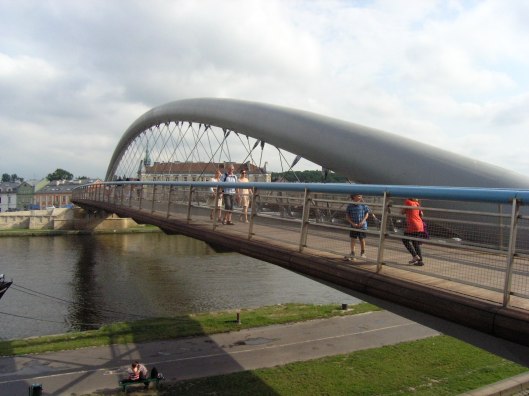
Wanda, a long-time resident of Podgórze, pointed out traces of that difficult era as we walked to her apartment. It was the first time I actually connected the contemporary streets of Podgórze with the places associated with the Holocaust. Just over the bridge, we entered Ghetto Heroes Square (Plac Bohaterów Getta), the site where Jews were assembled before being transported to work, the ghetto, or the camps. It wasn’t until December 2005 that a monument commemorating these historical events was installed. The monument is comprised of 33 large chairs arranged in rows throughout the plaza and 37 smaller chairs scattered around the edges of the square and at the nearby tram stop. These serve as a symbol of the people whose material possessions were taken from them as they were selected for the ghetto and elsewhere. The idea was “to tell the story of the place through the configuration of the urban space itself, so that the memory of the absent ones would be manifested through the presence of everyday objects which compose the urban furniture” (Bordas 2006). The chairs make an impression, especially the big ones. They look like they should be functional but they’re not–another way they symbolize the way ordinary life became abnormal.
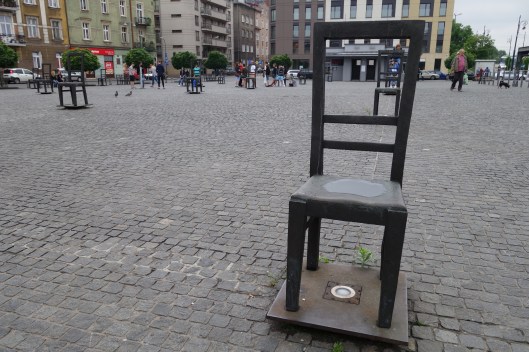
Chair monument in Ghetto Heroes Square

Ghetto Heroes Square

Wanda led us to a nearby street where a fragment of the ghetto wall still stands. Its characteristic scalloped top makes it resemble side-by-side tombstones. Flowers rested at the foot of a historical marker, an offering made during a commemorative event in March. Wanda also pointed out where a gate of the ghetto used to cross the street near her apartment. For 23 years, Wanda lived on that street. But then the prewar owners—Jews—regained ownership of the property and doubled the rent. Faced with the option of paying 2000 zloties per month or move, Wanda decided it would be better to invest that kind of money in a place she could own herself. That way, she doesn’t have to worry about being displaced again.

Like many Poles, Wanda feels personally affronted by former owners reasserting their claim over property. These feelings are complicated.

It seems only right that descendants of victims of the Holocaust be compensated. Regaining ownership of a building can only to the slightest degree address what those families lost.

And yet, losing their home to the prewar owner seems particularly unfair to the generation that endured years of communism, and never was able to accumulate much wealth in their own lives. Since the end of communism, prices have risen, unemployment has become common, and wages remain modest. Often it’s the poorest residents who live in former homes of Jews because the government took over their management and made them into low-cost housing for those in greatest need. This affordable housing was a small oasis of security in unsettled times. Many such residents today are elderly; others are unemployed; some have problems with their health or with substance abuse. They don’t have many options.

Wanda was one of the lucky ones with the wherewithal and the financial means to buy her own place. But still she carries the resentment with her that she sometimes translates into resentment of Jews more generally. Who was looking out for her rights when the apartment was returned to the prewar owners? What did some rich foreigner need with her building? Why should they get even wealthier at her expense?

In fact, prewar owners are reclaiming properties all over Poland, and even though they are not all Jewish, the greatest resentment is directed toward those who are.

Ghetto Memory Trail marker
Star of David crossed out--on a storefront in Podgórze
Star of David crossed out–on a storefront in Podgórze

In Podgórze, you can see both the effort to acknowledge sites of Jewish heritage, and also signs of continued antisemitism.

Wanda loves her neighborhood and doesn’t want to live anywhere else (even though she has to spend part of each year in the US to earn enough money to pay her mortgage). The apartment she lives in now is new construction on top of a historic townhouse; an additional floor was added to an existing building. As we climbed the three flights of stairs, she explained that when she bought the place, all that was there were the bare walls. This is standard practice in Poland. The buyer has to select, purchase, and install all the flooring, fixtures, wall coverings cabinets, and appliances. The apartment is long and narrow, with a wall of windows and a sleeping loft. Wanda said she bought it at the peak of the market; today she could find something for half that price. But that would mean moving again.

As we ate a generous spread of Polish dishes, including stuffed cabbage (gołąbki) and two kinds of pickles, Wanda said that Podgórze has become one of the most popular neighborhoods in Krakow. The new heritage sites and museums—including the Ghetto Heroes Square, the Schindler Factory Museum, and the Museum of Modern Art—have brought with them tourists and the amenities that tourists expect. People are moving out of the center of the city because it has become too crowded, cars are restricted on most streets, there are few stores with everyday necessities, and the prices are too high. Podgórze is desirable because it has good public transportation, is within walking distance of the city center, and because of the park, the trees, and the hill that I find so appealing.
OLYMPUS DIGITAL CAMERA

The new pedestrian bridge across the Vistula River to Podgórze.
Neo-Nazis in the Mainstream?

12 Monday Dec 2016

Posted by Marysia Galbraith in antisemitism, Identity

≈ 1 Comment

Tags

Alt-Right, European nationalism, Joshua Rothman, Nazi symbols, Noxious ideology as traditional values, Politics

As a follow-up to Josh Rothman’s article about the KKK in the 1920s, this came out in the New York Times yesterday:


Apparently, the neo-Nazi National Socialist Movement is seeking more mainstream appeal by dropping the swastika as its official symbol and replacing it with a more obscure pre-Roman symbol the Nazis also used. This sounds eerily like the broad appeal the KKK gained in the 1920s when it highlighted traditional (white-only) values through civic events like parades and picnics.

According to the Times article, what unites the disparate organizations now called the “Alt-right” is an assertion of European identity, and the fundamental divisions between races. Groups may be divided on “the vexing ‘J.Q.’ — the ‘Jewish Question,'” but Nazi salutes are nevertheless common at gatherings such as the one in Washington last month.

These movements have been on the fringe, but are now finding more pathways into the public sphere. So what comes next?


When Bigotry Paraded in the Streets

10 Saturday Dec 2016

Posted by Marysia Galbraith in antisemitism

≈ 1 Comment

Tags

1920s USA, Joshua Rothman, Ku Klux Klan, Middle Class, Noxious ideology as traditional values, The Atlantic

jrothmanbigotryatlantic

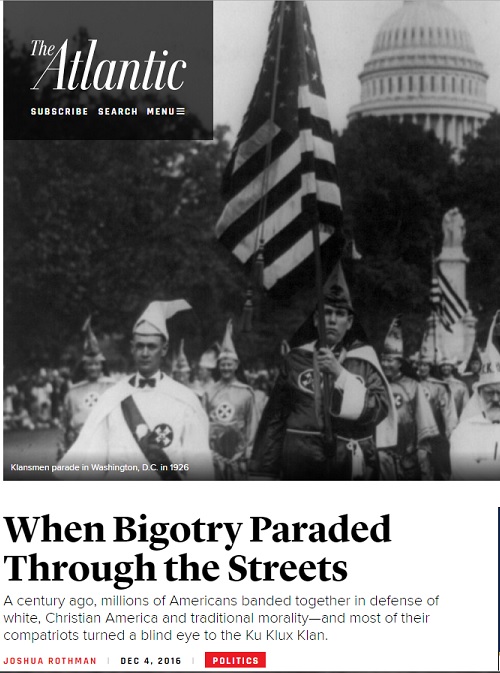
Screenshot of Josh Rothman’s article When Bigotry Paraded through the Streets, The Atlantic website

In “When Bigotry Paraded in the Streets,”Josh Rothman (a friend and colleague at University of Alabama) describes the surge of membership in the Ku Klux Klan during the 1920s.

Rothman writes:

“Most Americans today likely think of the Ku Klux Klan as an organization whose heyday came in the civil-rights era of the 1950s and 1960s, and of its members as lower-class white Southern men—ones who concealed their identities while waving the Confederate flag at pro-segregation rallies, burning crosses on the lawns of their enemies, or brutalizing their innocent victims. Others are perhaps familiar with the Klan of the 1860s and 1870s, which was a white and distinctively Southern terrorist organization composed of men who tortured and murdered people under cover of darkness in an effort to undermine the political and economic freedoms accorded to formerly enslaved people during Reconstruction.

“But the Klan was easily at its most popular in the United States during the 1920s, when its reach was nationwide, its members disproportionately middle class, and many of its very visible public activities geared toward festivities, pageants, and social gatherings. In some ways, it was this superficially innocuous Klan that was the most insidious of them all. Packaging its noxious ideology as traditional small-town values and wholesome fun, the Klan of the 1920s encouraged native-born white Americans to believe that bigotry, intimidation, harassment, and extralegal violence were all perfectly compatible with, if not central to, patriotic respectability.”

He’s a historian, so he doesn’t make direct parallels with contemporary politics. But it’s scary to think that these same processes are at work today. Maybe it isn’t the Klan itself that is becoming mainstream again, but middle class respectability and traditional values are being aligned with Klan-like sentiments–fear of immigrants, minorities, feminists, and Jews.

The article leaves me with a lot to think about and a feeling of dread.

The Curious Tale of the Fake Rabbi

29 Tuesday Nov 2016

Posted by Marysia Galbraith in Identity, Jewish Culture, Polish-Jewish relations, Poznan, stereotypes

≈ 3 Comments

Tags

Fake rabbi, Jacek Niszczota, Jacoob Ben Nistell, Ruth Ellen Gruber, Virtually Jewish

Purim 2015
Purim 2015
http://www.gloswielkopolski.pl/

Not long ago, a reporter revealed that that the man acting as Poznan’s rabbi was not in fact a rabbi. He called himself Jacoob Ben Nistell and claimed to be an Israeli from Haifa, but it turns out he is actually Jacek Niszczota, a Catholic Pole from Ciechanów, a town 60 miles north of Warsaw.

I’m not quite sure what to think of the story, but it resonates with Ruth Ellen Gruber’s characterization of much of Jewish activity in contemporary Europe as “virtual.” In her book Virtually Jewish: Reinventing Jewish Culture in Europe (2002), Gruber describes the myriad ways Jewish spaces, performances, and even people are in fact idealizations, representations, or stylizations of Jewishness. They are done up in “Jewish style” but often without actual Jews. This has occurred throughout Europe, where the interest in all things Jewish far exceeds the capacity of the tiny or absent populations of Jews to fulfill. Instead, non-Jews renovate synagogues, restore cemeteries, run Jewish restaurants, perform Klezmer music, and lead Jewish heritage tours.

Jacoob/Jacek’s self-presentation as Hasidic rabbi can be added to this long list of virtual Jewish performances, with the important qualification that his role was deceptive. He claimed to be a real Hasidic Jew, not someone just dressed up as one. He wore his hair long, with the distinctive side curls. He also dressed in a black brimmed hat and long black jacket. I don’t believe his intentions were malicious. Nor am I sure how much he deliberately deceived people, and how much people saw him as they wanted him to be. When I met him, he didn’t tell me “I’m a rabbi.” Rather, he said “They call me a rabbi,” his sweet smile and amused tone suggesting he was willing to go along with what others were saying about him. He did, however, claim to be from Israel. I didn’t quite believe him; more accurately, I questioned whether I heard him correctly because it didn’t fit my reading of him. He seemed Polish to me. Others tell me he put on an Israeli accent, but I can’t always recognize accents of Polish speakers. When I talked with him about a possible interview, he did not refuse, but he did not seem very eager either so I never pursued it. He seemed quirky and harmless, a bit of a happy jester.

Nevertheless, Jacoob/Jacek was deceptive and his actions are highly offensive. I saw him at a number of commemorative events: praying at the grave of Akiva Eger, a respected early 19th century Poznan rabbi; saying kaddish at the unveiling of the commemorative monument and lapidarium in Wronki; leading prayers at the Jewish Religious Community in Poznan. What got him caught was the media attention he received when he appeared at an ecumenical meeting with a Catholic priest and a Muslim imam. Someone from his hometown recognized him and alerted the media.

At that point, it became clear that there had been rumblings among Israelis and other Hebrew speakers that Jacoob/Jacek didn’t actually know Hebrew. Rather he read texts phonetically, putting emphasis and accents in the wrong places.

So that leaves me with the question why no one at the Jewish Religious Community (which is an official religious association for practicing Jews) challenged the veracity of his claims. Either they were genuinely deceived or they chose not to do anything about it. It’s problematic either way. If they didn’t know, it reveals how tenuous their knowledge of Jewish religious practice, culture, and language is. If they did know, it suggests they allowed the deception to go on. Even though Jacoob/Jacek was never declared a rabbi officially, I did hear him referred to affectionately as “our rabbi” (“nasz rabin”) and he was allowed to lead prayers in contexts that everyone expected would be done by a real rabbi. The Jewish Religious Community has a legal status. It is supposed to be the official institution for practicing Jews. What it turned out to be instead in this case is part of the virtual Jewish space. The idea, look, and performance of Jewishness was deemed sufficient.

I feel sympathy for Jacoob/Jacek, who has disappeared since his deception was revealed. I wonder what compelled him to pretend he was Jewish, and why he adopted the stereotypical form of a Hasidic Jew. It’s anachronistic in so many ways. Being any kind of Jew is a rarity in Poland, and the only Hasidic Jews in Poznan are occasional foreign visitors. Even historically, when Jews lived in Poznan in greater numbers, very few were Hasidic. This was even pointed out to me by a prominent member of the Jewish Religious Community. He gestured toward Jacoob/Jacek and assured me that even in the past, Poznan Jews tended to be more modernized.

“Who, 30 years ago in this country, would have pretended to be a rabbi, to say nothing of 70 years ago?”asked the Chief Rabbi of Poland Michael Schudrich in an article in the Times of Israel. He described Jacoob/Jacek as “very sweet and smiley,” much the same as I saw him.

Polish Anthropologists against Discrimination

15 Tuesday Nov 2016

Posted by Marysia Galbraith in Anthropology, Identity

≈ Leave a comment

Tags

Adam Mickiewicz University, globalization, immigrants, Institute of Ethnology and Cultural Anthropology, minorities, national mythology, patriotism, populism, presidential election, refugees, xenophobia

Poland is having its own troubles with a turn toward intolerance and the reassertion of a monoethnic Polish–and Catholic–norm. It parallels trends in numerous countries, including my own, against immigrants, Muslims, Syrian refugees, and minorities. I’m proud to say my friends and colleagues in the Institute of Ethnology and Cultural Anthropology at Adam Mickiewicz Univeristy in Poznan are organizing in support of multiculturalism and migration. An article in Gazeta Wyborcza, Anthropologists against Racism in Discussions about Refugees, begins:
“Different terms have become politicized. The word patriotism begins to be identified with aggressive nationalism, culture becomes an instrument of exclusion,” assert anthropologists. They are convening a special meeting in which they want to oppose racism and the appropriation of concepts by radicals and xenophobes.”

The original text in Polish reads- Różne terminy zostały upolitycznione. Słowo patriotyzm zaczyna być utożsamiane z agresywnym nacjonalizmem, kultura staje się narzędziem wykluczenia – twierdzą antropolodzy. Zwołują nadzwyczajny zjazd, na którym chcą się sprzeciwić rasizmowi i zawłaszczaniu pojęć przez radykałów i ksenofobów.

In Poland’s election in 2014, the Law and Justice Party, riding a wave of populist frustration with the status quo, won in a surprise victory over then-President Komorowski. They have since won a plurality in the parliament and are more powerful than ever. Joanna Kakissis examined this in her report Populist Party Campaigns on Making Poland Great Again on All Things Considered today.

I’m fearful about what will happen next in Poland, and in the US. Already last summer, some heritage workers in Poland said they are confronting more road blocks against raising money for projects. Some people in government are also trying to limit free speech by making it a crime to speak out against the Polish nation. Scholars and journalists who investigate historic events and uncover evidence of crimes Poles committed against Jews feel threatened they might be accused of treason; it doesn’t seem to matter whether they are reporting the truth or not. What matters to some is that they may besmirch Poland’s good name; Nothing should challenge the national mythology that Poles were heroes who were themselves victims of Nazi oppression. There is no room for ambiguity, for dealing with cases where victims were also perpetrators. After our own election, I worry that the need for a simple collective narrative about American exceptionalism will now challenge free speech in the US. I already see hints of it in the anger some have expressed toward the people who are protesting the election results.

Something is definitely shifting all over the world. I believe it is a reaction to globalization and the failed promises of neoliberalism. I fear, though, it is easier to look for a scapegoat than it is to fix these fundamental institutional problems.


Revisioning Jewish Poland through Art

11 Friday Nov 2016

Posted by Marysia Galbraith in Anthropology, Memory, Poland, Polish-Jewish Heritage, Post-World War II

≈ Leave a comment

Tags

American Anthropological Association Meeting 2016, Andrzej Niziołek, art, Janusz Marciniak, moral self, political action, Wojtek Wilczyk

The abstract for the paper I will be giving at the American Anthropological Association Meeting next week:

Artistic expression can be a powerful means to challenge the hegemonic power structure and to imagine an alternative social and moral order. In this paper, I highlight the work of three Polish artists who experienced a moral awakening during the Solidarity Movement in the early 1980s which made them sensitive to the repression of memories of Poland’s multi-ethnic, multi-religious past. In the ensuing years, they have engaged politically through their art to expose what remains of Jewish material culture (such as synagogues, cemeteries, and photographs), and to bring back into the public sphere a recognition of the space Jews once filled in everyday life in Poland. This artwork is both documentary and affective; it is intended to simultaneously inform viewers and to generate in them deep emotional responses that encourage ethical reflection.  Through various media, the artists seek to communicate that Jews were an essential part of Polish culture until the Holocaust, and also to give form to a collective sense of loss experienced after their violent removal. The cases examined are Wojtek Wilczyk’s photographs of former synagogues, called “There is no Innocent Eye,” Janusz Marciniak’s installations in the former synagogue in Poznan, and Andrzej Niziołek’s book Fira which traces the everyday life of a Jewish woman as revealed in her photo album of snapshots taken between the World Wars. These artists engage their moral selves to challenge political exclusion, public indifference, and antisemitism that until recently has kept Jewish spaces outside of everyday public and personal memories.

Synagogue by Wojtek Wilczyk
Atlantis, 2004, by Janusz Marciniak. Star of David floating on water and lit by hundreds of blue candle lanterns, while the Academic Choir sang "Meditation on Peace."
Atlantis, 2004, by Janusz Marciniak. Star of David floating on water and lit by hundreds of blue candle lanterns, while the Academic Choir sang “Meditation on Peace.”
Fira by Andrzej Niziołek

It’s part of a panel organized by Natasa Garic-Humphrey at UCSD:

The Politics of Indignation, Resistance, and Reconstitution of the Moral Self

This panel explores the intersections of governmentality, citizenship, political subjectivity, activism, ethics, and morality, and critically examines the importance of inserting “the moral self” within political theory to better understand how citizens come to confront political organizations and policies. Recent years have provided unprecedented examples of large-scale resistance, uprising, protest, and violent confrontation to authoritarian regimes, invidious state policies, and localized manifestations of neoliberal political-economics. To explain current confrontations to prevailing forms of state power, scholars have successfully highlighted the gaps between policy making from above and people’s on-the-ground experiences, resulting in citizens’ alienation from governmental ideologies, programs, and practices, while another line of research explored the various ways in which experiences of subjectivity and suffering are shaped within particular contexts of political economy.

This panel however, takes a closer look at the ways people manage to change their moral orientations within the context of hegemonic power and (re)make their moral selves to engage in and confront larger political and socioeconomic processes. How do specific situations, events, and visceral experiences in people’s lives evoke moments of self-reflection, engender reorientations towards the self, and inspire courses of action that cultivate a new sense of moral personhood? How does this experience of generating a new moral self shape one’s perceptions of government ineptitude and prepare them to engage in citizen-based action to confront political injustices and socio-political reforms? What motivates people to resist, initiate change, and form new senses of themselves as moral actors in the midst of stifling crises brought by socioeconomic and political transformations, war, genocide, fear, and other examples of structural violence?

Poles Remember

01 Tuesday Nov 2016

Posted by Marysia Galbraith in Catholicism, Cemeteries, Commemoration, Dukla, Memory, Polish Culture, Polish-Jewish Heritage, Polish-Jewish relations

≈ Leave a comment

Tags

All Saints Day

Today is the Catholic holiday, All Saints Day, the time to honor the dead. Customarily, Poles visit cemeteries to clean and decorate the graves of their family members. During the day, chrysanthemums in all shades adorn tombstones. At night, candle lanterns on graves make the cemeteries glow. Twinkling hillsides can be seen from far away.

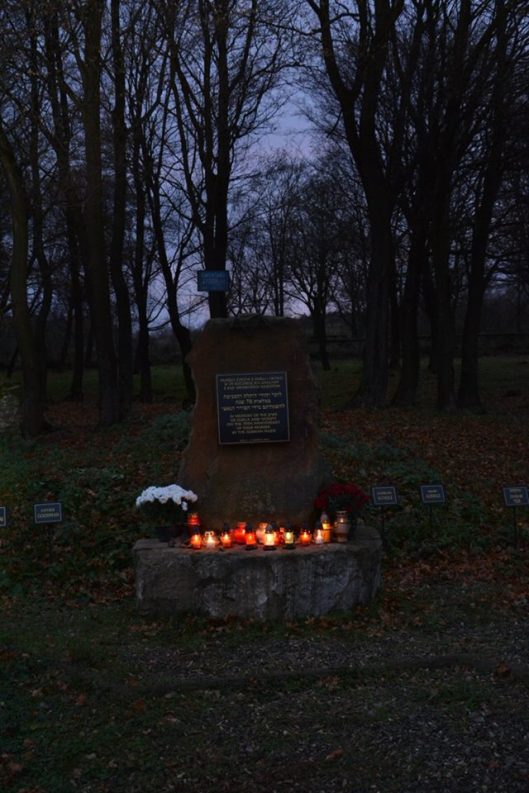
I’m pleased to see that some Poles also remember Poland’s now-absent Jewish population on November 1. I’ve seen this in Warsaw and in Lutowiska. And here is a photo Jacek Koszczan posted on Facebook today showing the candle lanterns on the commemorative monument at the town of Dukla’s Jewish cemetery.

Candle lanterns on the monument commemorating Dukla's Jewish population, November 1, 2016, All Saint's Day.

Candle lanterns on the monument commemorating Dukla’s Jewish population, November 1, 2016, All Saint’s Day.

He and other citizens of Dukla made the trip out to the cemetery to light a candle for the dead. In this, I see an expression of honor that transcends religious difference.

Jacek has done a great deal to reassemble the memory of Jewish life in Dukla. In fact, he was honored last month by the Polin Museum for his work. The Polin website explains, “Jacek Koszczan is the founder and director of the Organization for the Preservation of Jewish Heritage in the Dukla Region–Dukla Shtetl. His work involves both obtaining and archiving knowledge about the Jews of Dukla and its surroundings, as well as educational activities. Jacek Koszczan is the initiator and builder of a monument commemorating the 70th anniversary of the murder of Dukla’s Jews, the volunteer caretaker of the Jewish cemeteries, mass grave, as well as the ruins of the Dukla synagogue. Thanks to his efforts and knowledge, he succeeded in facilitating the honoring of two Dukla-region families with the medal for the Righteous among Nations.”

Jacek Koszczan receiving his award from the Polin Museum for his work on Jewish heritage in Dukla, October 21, 2016. Photo by Janusz Czamarski

Jacek Koszczan receiving his award from the Polin Museum for his work on Jewish heritage in Dukla, October 21, 2016. Photo by Janusz Czamarski

All in all, Jacek has been instrumental in the return of the memory of Jews to his community. I have been impressed by his energy, enthusiasm, and generosity. For him, this is a labor of love–for his community, for the memory of those who suffered, and for humanity in the face of evil.

Mapping Family Roots

23 Sunday Oct 2016

Posted by Marysia Galbraith in Archives, Family, Identity, Polish-Jewish Heritage, Pre-World War II, Walfisz, Żychlin

≈ 2 Comments

Tags

map

I made an extraordinary find in the Kutno archive—a map of Żychlin dating from 1869. I found reference to it in an article, but the archivists had a little difficulty locating it because it didn’t have an identification number (signatura). One archivist said something about it being so fragile they don’t show it. But another found it hanging on the wall and brought it out for me. The writing is in Russian. At that time, Żychlin was in the Russian partition of Poland. After the January Insurrection in 1863, the Russians mandated all public documents had to be in Russian, not Polish. That is why archival documents before the 1860s are in Polish while the later ones are mostly in Russian.

Russian writing on the 1869 map of Żychlin

I don’t know what is written here–maybe a reader could translate it for me?

dsc08463

Map of Żychlin dated 1869

Properties are numbered on the map, but not by street address. That means the numbers are scattered throughout the city making it difficult to find particular locations. According to the Żychlin Books of Residents (Akta Miasta Żychlina, also in the archive), my Walfisz ancestors lived at various times at numbers 28, 53, and 63. My great grandmother Hinda Walfisz married my great grandfather Hiel Majer Piwko. I wrote about them in previous posts: Piwko Saga, The Photo, and Super Kosher Cookies and Sliced Ham.

The map is hard to read, patched, and creased. The cross-shaped church stands out in the top half. Below it is the market square, and #53 is in the row of buildings along its lower edge. #63 is further to the left, and #28 is on the street running down from the market square.Not surprisingly, these properties are all near the synagogue, which as best as I can tell is #86 on the map (a bit below #63).

I had already seen one Book of Residents in 2013, but in 2016 I found my great grandmother’s family listed in three others, as well. Since the books have been indexed, the archivist was able to tell me what page to look on. And even though these records are only a few years older than the map, they are in Polish. There is only one Walfisz family in the books (my great grandmother with her sisters and parents), but other more distant family names also appear: many Losmans, a couple of Kolskis, and one Jakubowicz. Each household has its own page in the book, but there can be several households in the same building. Because religion is one of the things recorded in the Books, I could see that it wasn’t uncommon for addresses with multiple households to include families of multiple faiths: some Catholic, some Jewish, some Evangelical.

I know this is just an old map, but being able to pore over it, to touch it, helped to transport me back in time, and to once again (for the first time?) connect with the place where I’m from. It doesn’t matter that I never actually lived there (nor did my mother nor even my grandmother). Some of my people did. Right there in that place. With this newfound knowledge, I drove back through Żychlin one more time, this time gazing at the buildings that once housed my family. It didn’t really matter that the buildings had changed, nor that I was still unsure how exactly the old building numbers match the contemporary ones. Once this was their home.

My elusive grandfather Jakob Rotblit

27 Tuesday Sep 2016

Posted by Marysia Galbraith in Family, Gdynia, Memory, Names, Poland, Pre-World War II, Rotblit, Warsaw

≈ 3 Comments

Tags

Jakub Rotblit

The danger of digging up family skeletons is that you never know what kind of bones you’ll find.

My mom rarely said anything about her biological father. In fact, it wasn’t until I was a teenager that she told me the man she called Papa, the husband of her mother, was not her birth father. As children, she and her older brother felt like orphans. They never saw their birth father, which I’m sure was related to the fact that talking about him would have revealed the family’s secret Jewish roots. Back then, in prewar Poland, Catholics did not divorce and remarry.

When she finally opened up to me about him, Mama said she barely knew her father. She almost never saw him. Then one summer, following a big fight between him and her mother, Babcia (my grandmother) got fed up and told him, “If you want your children you can have them.” She put George (who was 15 at the time) and my mother (who was 13) onto a train to Gdansk, where they joined their father with his second wife and their daughter.

The Baltic Coast was beautiful, but Mama was miserable. Her father didn’t know what to do with them, and his 2nd wife didn’t want them there; perhaps she felt threatened. After two months (that’s what I remember mom said, though some relatives have told me it’s inconceivable Babcia would have left her children for that long), my grandmother came to Gdansk and with effusive tears and passionate apologies, she brought them back with her to Warsaw. That’s the last time Mama saw her father. She told me she did not know what happened to him, but that probably he died during the war. She never told me his name.

Victorian high button shoes. Source: http://antique-gown.com/

Victorian high button shoes. Source: http://antique-gown.com/

One of the stories my mother would tell me from time to time was about the “high button shoes” her father insisted she wear when she was around 13 years old. The bitterness still lingered when she described to me how much she hated those boots; they were old fashioned and ugly, the kind that were commonly worn in the 19th century. Her father contended they were sturdy, and proper for a young girl. They were also expensive because he’d had them custom made for her. I always assumed this was a conflict Mama had with Papa, her stepfather. It’s only now, as I piece together the fragments, it occurs to me this argument might have been with her biological father. The timing fits. Also I imagine he was probably the more conservative of the two.

I only learned my biological grandfather’s name in 2011, when my Aunt Pat (the wife of my mother’s younger brother Sig) showed me a family tree she had made identifying my grandfather as Jacob Rotblit (in a previous post, I’ve written about how names can vary), son of Ignacy and Hanna, and brother of Maurice and Helena. Pat reiterated another fact my mother had mentioned: Jacob was from Warsaw but had moved to the Baltic Coast. Pat also had notes, presumably from conversations with my grandmother’s sister, that Rotblit had been a merchant who sold fine jewelry and luxury cars.

Jakub Rotblit b. 1891

Jakob Rotblit, b. 1891

Then my cousin Krysia remembered that before he died, her father (my mother’s brother George) gave her a photo of his father. Krysia wrote some notes on the back of the photo: “He was a respected Jew. Babcia fell in love with his friend Zygmunt and left him.” Then, with a rectangle around it was the name “Jakup Rotblit” and under that “my father’s father” and a roughly sketched family tree. So not only could I attach a name to my mysterious grandfather. I also had a photograph. And yes, his children resemble him. And so does one of my brothers and a cousin.

From here, the trail went cold. It took another two years before Krysia and I obtained a copy of a birth certificate of a Jacob Rotblit who was born in Warsaw in 1891. The name, city, and date were plausible, but we didn’t know if this was our grandfather, our Jacob Rotblit or some other one. Though not a common name, I have found prewar records of at least three.

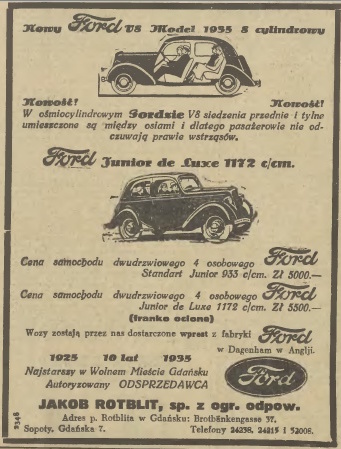
This was in 2013, a time when Krysia and I would stay up until early morning searching everything we could think of on Google, and sending tidbits back and forth to try and fill out the story of our grandfather . She contacted several Rotblits she found to inquire if we might be related. I dug up references to Jacob Rotblit’s Ford dealership. This business, car sales, corresponded with my aunt’s notes. Granted, neither now nor then were Fords “luxury cars,” but in the 1930s any car was a luxury.

Ad for Jakob Rotblit, Ford Dealer in Gdansk, Sopot, and Gdynia, Gazeta Gdanska 1935

Ad for Jakob Rotblit, Ford Dealer in Gdansk, Sopot, and Gdynia, Gazeta Gdanska 1935

In September 2013, when I was back in Warsaw at the Jewish Historical Institute, Anna Przybyszewska recalled seeing the name in a book, J. Drozd Społeczność Żydowska Gdyni w Okresie Miedzywojennym [Jewish Residents of Gdynia during the Interwar Period]. Indeed, on page 309 is the following (I’ve translated it):


On November 20, 1936, a company was registered in Gdynia named “Permanent Automobile Market (Stałe Targi Samochodowe).” It was the initiative of the married couple Jakub and Bronisława Rotblit. The object of the enterprise Stałe Targi Samochodowe was the management of the trade in domestic and international products, specifically mechanized vehicles (new and used) as well as their accessories. In addition, the company offered parts, service, and repairs of vehicles. Jakub Rotblit specialized in the sale of automobiles and accessories of the Ford firm, of which he was an authorized dealer. The specific headquarters of the Rotblit’s company were always located in places beneficial to the interests of the place—first in the BGK building (at #31 10 Lutego [Tenth of February] Street), and from July 1938 in the new office building of the firm “Bananas” (at #24 Kwiatkowskiego Street). The operation of the firm ended suddenly upon the death of Bronisława Rotblit, as a result of which her husband moved to Warsaw.

In the footnote: Jakub Rotblit (born June 25, 1891 in Warsaw), son of Arkadiusz Rotblit and Racheli Prowizor, married, merchant. Arrived in Gdynia from Warsaw June 25 1935. He lived at 25/7 10 Lutego Street and 6 Hetmańskiej Street.


It took another year before I got the birth certificate (which was in Russian) translated and could confirm the vital information was consistent with what was written in this book: The birthdate was the same; the parent’s names were similar enough to likely be Hebrew and Polish versions of the same names (Aron/Arkadiusz and Ruchla/Racheli Prowizor). In my Aunt Pat’s notes, Jacob’s second wife was “Blanka” and their daughter’s name “Rosa.” I still couldn’t be sure, but it was looking more likely I had uncovered more traces of my biological grandfather.

I have continued to collect fragments, fleeting references to Jacob Rotblit, never sure if they’re about my grandfather or not. Did his 2nd wife really commit suicide? Was he really arrested for business fraud? Was he shot outside of Warsaw in 1941 by a German officer? I have documents saying these things happened, but I have no way of checking these details and no way of linking them conclusively to my grandfather.

But I have recently learned something truly extraordinary. Last month I was contacted by someone through Ancestry’s DNA matches. Genetically, we appear to be second cousins. And yes. His mother was a Rotblit, daughter of Louis/Leib Rotblit who came from Russia/Poland. Louis arrived in England, married and had three children around the time of World War I. My cousin knows very little about his grandfather because he left his grandmother after several years. His mother never talked about him. But on his grandparent’s marriage certificate, Louis’ father was named Aaron and his brothers Moshe and Ya’akov (all written in Hebrew, so the English or Polish forms could easily be Arkadiusz, Maurice (?), and Jacob).

Enough of these details add up. And DNA is likely to be the most concrete evidence I’ll ever find. Another branch of my family tree is filling out. More relatives survived.

Dwie Butelki Wódki

21 Wednesday Sep 2016

Posted by Marysia Galbraith in Memory, Polish-Jewish relations, Post-World War II, Żychlin

≈ Leave a comment

Historia “Dwie Butelki Wódki,” napisana przez Mirosława Stojak, prezentacja opracowana przez Henryk Olszewski:

dwie-butelki

← Older posts
Newer posts →

Categories

  • Anthropology (37)
    • Archives (14)
    • Fieldwork (7)
    • Ground Penetrating Radar (GPR (4)
    • Research Methodology (8)
  • antisemitism (14)
  • Association of Descendants of Jewish Central Poland (32)
  • Catholicism (8)
  • Conference (1)
  • Discrimination (2)
  • Family (69)
    • Bereda (17)
    • Kolski (13)
    • Piwko (22)
    • Rotblit (3)
    • Walfisz (4)
    • Winawer (7)
  • Genealogy (11)
  • Heritage work (66)
    • Commemoration (23)
  • Identity (18)
  • Israel (6)
  • Jewish Culture (89)
    • Cemeteries (51)
    • Museum (7)
    • Synagogues (33)
  • Jewish immigrants (8)
  • Jewish Religion (1)
  • Memory (70)
  • Names (14)
  • Photographs (6)
  • Pifko-Winawer Circle (5)
  • Poland (125)
    • Baligród (1)
    • Bolimów (1)
    • Brześć Kujawski (5)
    • Buk (1)
    • Chodecz (1)
    • Dukla (2)
    • Dąbrowice (1)
    • Gdynia (1)
    • Gostynin (2)
    • Gąbin (1)
    • Izbica Kujawska (1)
    • Kazimierz (4)
    • Kowal (1)
    • Koło (1)
    • Krakow (7)
    • Krośniewice (1)
    • Kutno (6)
    • Kłodawa (1)
    • Lesko (8)
    • Leszno (1)
    • Lubień Kujawski (1)
    • Lubraniec (1)
    • Lutowiska (3)
    • Piła (3)
    • Podgórze (2)
    • Poznan (11)
    • Przemyśl (2)
    • Pzedecz (1)
    • Radom (1)
    • Radymno (1)
    • Sanok (1)
    • Skierniewice (5)
    • Sobota (2)
    • Tarnów (2)
    • Warsaw (22)
    • Wielkopolska (1)
    • Wronki (7)
    • Włocławek (20)
    • Zasław (2)
    • Łódź (1)
    • Żychlin (30)
  • Polish Culture (10)
  • Polish-Jewish Heritage (60)
  • Polish-Jewish relations (60)
  • Post-World War II (24)
  • Pre-World War II (22)
  • Reclaimed Property (1)
  • stereotypes (3)
  • Survival (9)
  • Trauma (3)
  • Uncategorized (5)
  • Victims and perpetrators (4)
  • World War II (45)
    • Jewish Ghetto (12)
    • Nazi Camps (5)
    • Polish Underground Army (3)
  • Yiddish (5)

Enter your email address to follow this blog and receive notifications of new posts by email. Your email address will not be shared.

Archives

  • October 2025 (1)
  • July 2025 (8)
  • June 2025 (1)
  • April 2025 (1)
  • August 2024 (3)
  • July 2024 (3)
  • May 2024 (2)
  • April 2024 (1)
  • May 2023 (2)
  • January 2023 (2)
  • December 2022 (7)
  • November 2022 (2)
  • October 2022 (5)
  • September 2022 (1)
  • January 2022 (1)
  • August 2021 (1)
  • December 2020 (2)
  • July 2020 (1)
  • May 2020 (3)
  • April 2020 (1)
  • March 2020 (1)
  • January 2020 (2)
  • May 2019 (1)
  • February 2019 (1)
  • November 2018 (1)
  • September 2018 (1)
  • August 2018 (3)
  • July 2018 (1)
  • June 2018 (1)
  • May 2018 (1)
  • April 2018 (2)
  • March 2018 (2)
  • February 2018 (2)
  • January 2018 (2)
  • December 2017 (2)
  • November 2017 (2)
  • October 2017 (1)
  • September 2017 (3)
  • August 2017 (3)
  • June 2017 (2)
  • May 2017 (3)
  • April 2017 (1)
  • March 2017 (2)
  • February 2017 (1)
  • January 2017 (2)
  • December 2016 (2)
  • November 2016 (4)
  • October 2016 (1)
  • September 2016 (6)
  • August 2016 (2)
  • July 2016 (1)
  • May 2016 (4)
  • April 2016 (2)
  • March 2016 (3)
  • February 2016 (4)
  • January 2016 (3)
  • December 2015 (3)
  • November 2015 (5)
  • October 2015 (5)
  • September 2015 (3)
  • August 2015 (4)
  • July 2015 (3)
  • June 2015 (3)
  • May 2015 (4)
  • April 2015 (9)
  • March 2015 (3)
  • February 2015 (2)
  • January 2015 (5)
  • December 2014 (4)
  • November 2014 (9)
  • October 2014 (2)
  • September 2014 (1)

Copyright Notice

All original text and images are copyright © Marysia Galbraith. Please contact the author before quoting.

Blog at WordPress.com.

  • Subscribe Subscribed
    • Uncovering Jewish Heritage
    • Join 147 other subscribers
    • Already have a WordPress.com account? Log in now.
    • Uncovering Jewish Heritage
    • Subscribe Subscribed
    • Sign up
    • Log in
    • Report this content
    • View site in Reader
    • Manage subscriptions
    • Collapse this bar
 

Loading Comments...