• About
  • The Photo that Started it All

Uncovering Jewish Heritage

Uncovering Jewish Heritage

Category Archives: Pre-World War II

Mapping Family Roots

23 Sunday Oct 2016

Posted by Marysia Galbraith in Archives, Family, Identity, Polish-Jewish Heritage, Pre-World War II, Walfisz, Żychlin

≈ 2 Comments

Tags

map

I made an extraordinary find in the Kutno archive—a map of Żychlin dating from 1869. I found reference to it in an article, but the archivists had a little difficulty locating it because it didn’t have an identification number (signatura). One archivist said something about it being so fragile they don’t show it. But another found it hanging on the wall and brought it out for me. The writing is in Russian. At that time, Żychlin was in the Russian partition of Poland. After the January Insurrection in 1863, the Russians mandated all public documents had to be in Russian, not Polish. That is why archival documents before the 1860s are in Polish while the later ones are mostly in Russian.

Russian writing on the 1869 map of Żychlin

I don’t know what is written here–maybe a reader could translate it for me?

dsc08463

Map of Żychlin dated 1869

Properties are numbered on the map, but not by street address. That means the numbers are scattered throughout the city making it difficult to find particular locations. According to the Żychlin Books of Residents (Akta Miasta Żychlina, also in the archive), my Walfisz ancestors lived at various times at numbers 28, 53, and 63. My great grandmother Hinda Walfisz married my great grandfather Hiel Majer Piwko. I wrote about them in previous posts: Piwko Saga, The Photo, and Super Kosher Cookies and Sliced Ham.

The map is hard to read, patched, and creased. The cross-shaped church stands out in the top half. Below it is the market square, and #53 is in the row of buildings along its lower edge. #63 is further to the left, and #28 is on the street running down from the market square.Not surprisingly, these properties are all near the synagogue, which as best as I can tell is #86 on the map (a bit below #63).

I had already seen one Book of Residents in 2013, but in 2016 I found my great grandmother’s family listed in three others, as well. Since the books have been indexed, the archivist was able to tell me what page to look on. And even though these records are only a few years older than the map, they are in Polish. There is only one Walfisz family in the books (my great grandmother with her sisters and parents), but other more distant family names also appear: many Losmans, a couple of Kolskis, and one Jakubowicz. Each household has its own page in the book, but there can be several households in the same building. Because religion is one of the things recorded in the Books, I could see that it wasn’t uncommon for addresses with multiple households to include families of multiple faiths: some Catholic, some Jewish, some Evangelical.

I know this is just an old map, but being able to pore over it, to touch it, helped to transport me back in time, and to once again (for the first time?) connect with the place where I’m from. It doesn’t matter that I never actually lived there (nor did my mother nor even my grandmother). Some of my people did. Right there in that place. With this newfound knowledge, I drove back through Żychlin one more time, this time gazing at the buildings that once housed my family. It didn’t really matter that the buildings had changed, nor that I was still unsure how exactly the old building numbers match the contemporary ones. Once this was their home.

My elusive grandfather Jakob Rotblit

27 Tuesday Sep 2016

Posted by Marysia Galbraith in Family, Gdynia, Memory, Names, Poland, Pre-World War II, Rotblit, Warsaw

≈ 3 Comments

Tags

Jakub Rotblit

The danger of digging up family skeletons is that you never know what kind of bones you’ll find.

My mom rarely said anything about her biological father. In fact, it wasn’t until I was a teenager that she told me the man she called Papa, the husband of her mother, was not her birth father. As children, she and her older brother felt like orphans. They never saw their birth father, which I’m sure was related to the fact that talking about him would have revealed the family’s secret Jewish roots. Back then, in prewar Poland, Catholics did not divorce and remarry.

When she finally opened up to me about him, Mama said she barely knew her father. She almost never saw him. Then one summer, following a big fight between him and her mother, Babcia (my grandmother) got fed up and told him, “If you want your children you can have them.” She put George (who was 15 at the time) and my mother (who was 13) onto a train to Gdansk, where they joined their father with his second wife and their daughter.

The Baltic Coast was beautiful, but Mama was miserable. Her father didn’t know what to do with them, and his 2nd wife didn’t want them there; perhaps she felt threatened. After two months (that’s what I remember mom said, though some relatives have told me it’s inconceivable Babcia would have left her children for that long), my grandmother came to Gdansk and with effusive tears and passionate apologies, she brought them back with her to Warsaw. That’s the last time Mama saw her father. She told me she did not know what happened to him, but that probably he died during the war. She never told me his name.

Victorian high button shoes. Source: http://antique-gown.com/

Victorian high button shoes. Source: http://antique-gown.com/

One of the stories my mother would tell me from time to time was about the “high button shoes” her father insisted she wear when she was around 13 years old. The bitterness still lingered when she described to me how much she hated those boots; they were old fashioned and ugly, the kind that were commonly worn in the 19th century. Her father contended they were sturdy, and proper for a young girl. They were also expensive because he’d had them custom made for her. I always assumed this was a conflict Mama had with Papa, her stepfather. It’s only now, as I piece together the fragments, it occurs to me this argument might have been with her biological father. The timing fits. Also I imagine he was probably the more conservative of the two.

I only learned my biological grandfather’s name in 2011, when my Aunt Pat (the wife of my mother’s younger brother Sig) showed me a family tree she had made identifying my grandfather as Jacob Rotblit (in a previous post, I’ve written about how names can vary), son of Ignacy and Hanna, and brother of Maurice and Helena. Pat reiterated another fact my mother had mentioned: Jacob was from Warsaw but had moved to the Baltic Coast. Pat also had notes, presumably from conversations with my grandmother’s sister, that Rotblit had been a merchant who sold fine jewelry and luxury cars.

Jakub Rotblit b. 1891

Jakob Rotblit, b. 1891

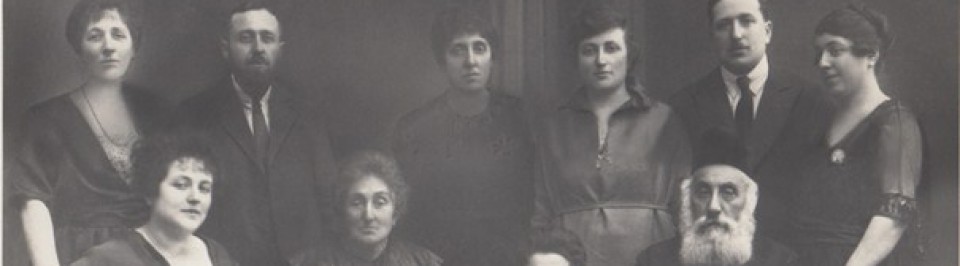
Then my cousin Krysia remembered that before he died, her father (my mother’s brother George) gave her a photo of his father. Krysia wrote some notes on the back of the photo: “He was a respected Jew. Babcia fell in love with his friend Zygmunt and left him.” Then, with a rectangle around it was the name “Jakup Rotblit” and under that “my father’s father” and a roughly sketched family tree. So not only could I attach a name to my mysterious grandfather. I also had a photograph. And yes, his children resemble him. And so does one of my brothers and a cousin.

From here, the trail went cold. It took another two years before Krysia and I obtained a copy of a birth certificate of a Jacob Rotblit who was born in Warsaw in 1891. The name, city, and date were plausible, but we didn’t know if this was our grandfather, our Jacob Rotblit or some other one. Though not a common name, I have found prewar records of at least three.

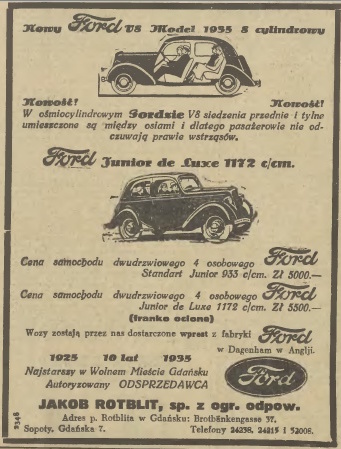
This was in 2013, a time when Krysia and I would stay up until early morning searching everything we could think of on Google, and sending tidbits back and forth to try and fill out the story of our grandfather . She contacted several Rotblits she found to inquire if we might be related. I dug up references to Jacob Rotblit’s Ford dealership. This business, car sales, corresponded with my aunt’s notes. Granted, neither now nor then were Fords “luxury cars,” but in the 1930s any car was a luxury.

Ad for Jakob Rotblit, Ford Dealer in Gdansk, Sopot, and Gdynia, Gazeta Gdanska 1935

Ad for Jakob Rotblit, Ford Dealer in Gdansk, Sopot, and Gdynia, Gazeta Gdanska 1935

In September 2013, when I was back in Warsaw at the Jewish Historical Institute, Anna Przybyszewska recalled seeing the name in a book, J. Drozd Społeczność Żydowska Gdyni w Okresie Miedzywojennym [Jewish Residents of Gdynia during the Interwar Period]. Indeed, on page 309 is the following (I’ve translated it):


On November 20, 1936, a company was registered in Gdynia named “Permanent Automobile Market (Stałe Targi Samochodowe).” It was the initiative of the married couple Jakub and Bronisława Rotblit. The object of the enterprise Stałe Targi Samochodowe was the management of the trade in domestic and international products, specifically mechanized vehicles (new and used) as well as their accessories. In addition, the company offered parts, service, and repairs of vehicles. Jakub Rotblit specialized in the sale of automobiles and accessories of the Ford firm, of which he was an authorized dealer. The specific headquarters of the Rotblit’s company were always located in places beneficial to the interests of the place—first in the BGK building (at #31 10 Lutego [Tenth of February] Street), and from July 1938 in the new office building of the firm “Bananas” (at #24 Kwiatkowskiego Street). The operation of the firm ended suddenly upon the death of Bronisława Rotblit, as a result of which her husband moved to Warsaw.

In the footnote: Jakub Rotblit (born June 25, 1891 in Warsaw), son of Arkadiusz Rotblit and Racheli Prowizor, married, merchant. Arrived in Gdynia from Warsaw June 25 1935. He lived at 25/7 10 Lutego Street and 6 Hetmańskiej Street.


It took another year before I got the birth certificate (which was in Russian) translated and could confirm the vital information was consistent with what was written in this book: The birthdate was the same; the parent’s names were similar enough to likely be Hebrew and Polish versions of the same names (Aron/Arkadiusz and Ruchla/Racheli Prowizor). In my Aunt Pat’s notes, Jacob’s second wife was “Blanka” and their daughter’s name “Rosa.” I still couldn’t be sure, but it was looking more likely I had uncovered more traces of my biological grandfather.

I have continued to collect fragments, fleeting references to Jacob Rotblit, never sure if they’re about my grandfather or not. Did his 2nd wife really commit suicide? Was he really arrested for business fraud? Was he shot outside of Warsaw in 1941 by a German officer? I have documents saying these things happened, but I have no way of checking these details and no way of linking them conclusively to my grandfather.

But I have recently learned something truly extraordinary. Last month I was contacted by someone through Ancestry’s DNA matches. Genetically, we appear to be second cousins. And yes. His mother was a Rotblit, daughter of Louis/Leib Rotblit who came from Russia/Poland. Louis arrived in England, married and had three children around the time of World War I. My cousin knows very little about his grandfather because he left his grandmother after several years. His mother never talked about him. But on his grandparent’s marriage certificate, Louis’ father was named Aaron and his brothers Moshe and Ya’akov (all written in Hebrew, so the English or Polish forms could easily be Arkadiusz, Maurice (?), and Jacob).

Enough of these details add up. And DNA is likely to be the most concrete evidence I’ll ever find. Another branch of my family tree is filling out. More relatives survived.

How Żychlin Remembers, part 2

01 Thursday Sep 2016

Posted by Marysia Galbraith in antisemitism, Jewish Ghetto, Memory, Polish-Jewish Heritage, Polish-Jewish relations, Post-World War II, Pre-World War II, stereotypes, Synagogues, World War II, Żychlin

≈ Leave a comment

The next morning I met Tadeusz Kafarski for a tour of the city. He was with Józef Staszewski, the director of the Żychlin branch of the Association of Children of War. Because Józef was born in 1929, he remembers wartime better than Tadeusz, who was only a year old when the Nazis invaded. The two sometimes disagreed about details, but together they reconstructed for me Jewish life in Żychlin. As they pointed to the buildings that stand here and now, their descriptions transported me back and forth through time, to prewar life, wartime murder, and communist era absence. I had the odd sensation as I did so many times on this trip of being both here (in the present) and then (in the past), my mind trying to reconcile what stood before my eyes with what used to be. My guides led me back in time with varied fragments of information:

On Łukasieńskiego Street, we passed concrete apartment buildings built in the 1970s on the site of the second, larger Jewish ghetto.

Mr. Helmer, the richest Jew in town, lived across from the market square, to the left of Narutowicza Street, in what is now a well maintained two story building.

One block south, near the synagogue (the blue Star of David on the map below) on Kilińskiego Street, we passed the former home of a Jewish doctor, a building that used to be a dairy collection point, and another that was the preschool Tadeusz attended. A man named Merc lived nearer the synagogue. Behind some houses was the Jewish slaughterhouse, but Christian Poles also bought meat from there.

Jews and Poles lived side by side, even though this part of town was predominantly Jewish. Today, this section of town is run down though these particular buildings seem in good shape.
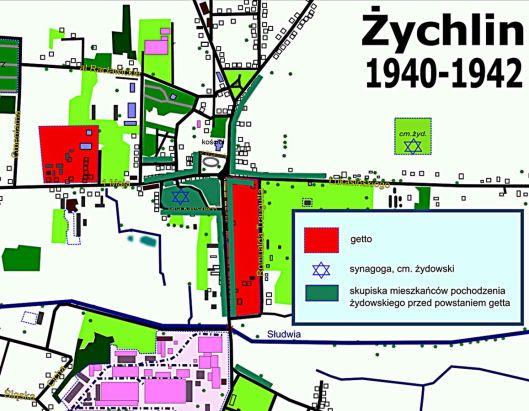
Map of Żychlin 1940-42 showing the ghettos in red, the first one is on the left and the second is on the right. The dark green shows the main areas where Jews lived--note that most were not in what became the ghetto. That meant gentiles had to move out of those areas when the Jews were forced to move in.

Map of Żychlin 1940-42 showing the ghettos in red, the first one is on the left and the second is on the right. The dark green shows the main areas where Jews lived–note that most were not in what became the ghetto. That meant gentiles had to move out of the ghetto areas when the Jews were forced to move into them.

As we wound through the dusty streets, the contemporary residents stared at us suspiciously, though some who know my guides greeted them, “Dzień dobry (Good day).”

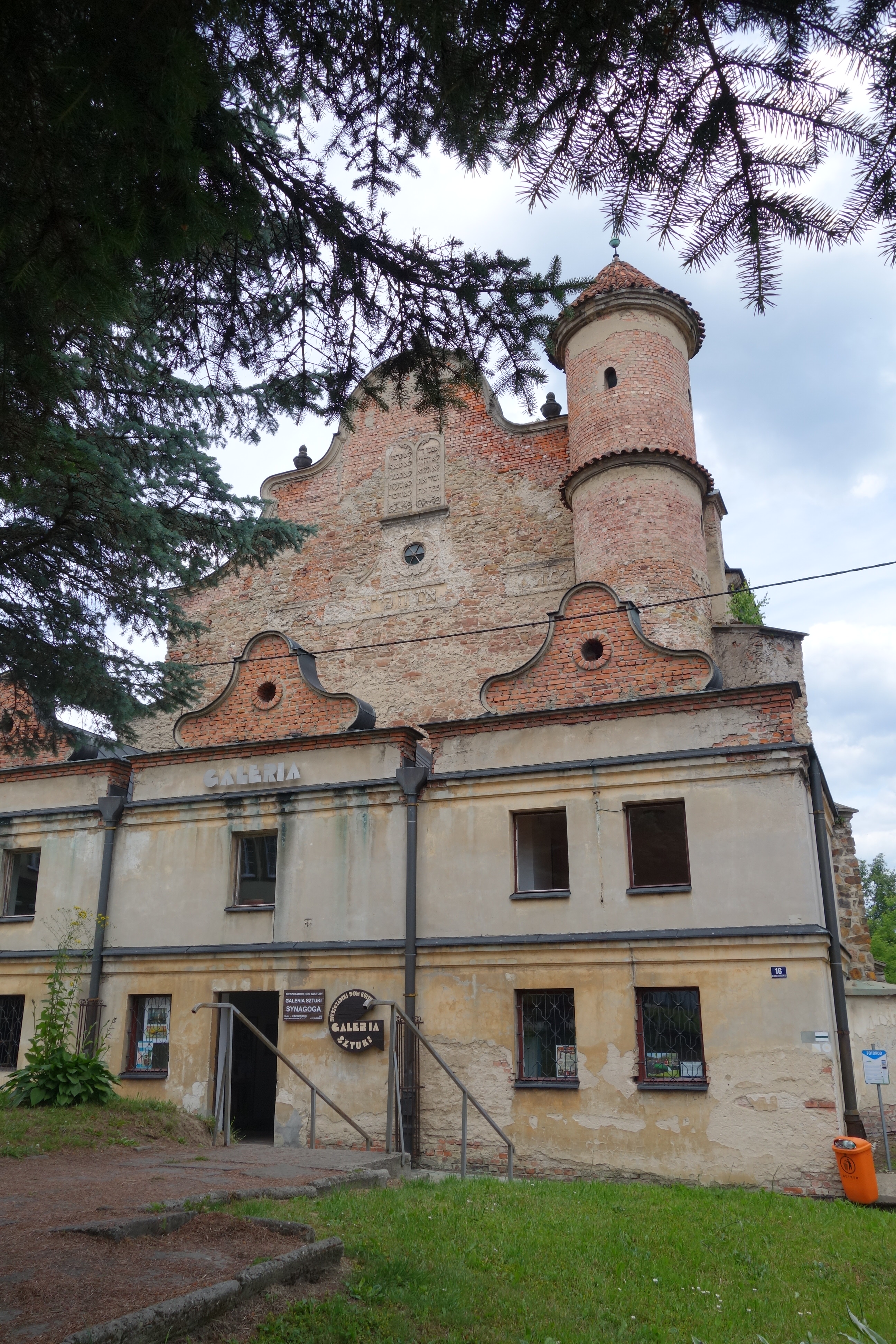
The patch of tall weeds in front of the synagogue (on Jana Kulińskiego Street) used to be a fenced garden. The garden continued to be maintained after the war, even though the Polish residents used the synagogue as a warehouse, as did the Nazis. The lower sections of the windows were bricked in and new doorways were installed in the sides of the building to facilitate loading and unloading.

What's left of the Żychlin synagogue. Note the windows used to extend much father down, and the more recent doorway (now blocked) added when the building was used as a warehouse. The weedy area in the foreground used to be a fenced garden.
What’s left of the Żychlin synagogue. Note the windows used to extend much father down, and the more recent doorway (now blocked) added when the building was used as a warehouse. The weedy area in the foreground used to be a fenced garden.
Pan Józef beside the site of the well and mikvah
Worn stones--something I learned to value as a student archeologist. These were used in place of asphalt before World War II
Worn stones–something I learned to value as a student archeologist. These were used in place of asphalt before World War II

As a child, Józef went inside several times with his parents, though he could only describe the general layout of the interior. The candlelit altar was on the east wall, the main entrance on the west. Above the entrance was a balcony that would have been for the choir in a church but in the synagogue was for women to pray in. In a neighboring building, the rabbi would change. On the other side of the synagogue were a well (with the best water in town) and mikvah. After the war, everyone used that bathhouse.

Józef said, “There is just one faith; Jews believe in God just like we do.” He declared children played together regardless of religion. He described distinctive aspects of the Jewish population. Men wore head covers and beards. They would take their shoes off in the synagogue, but had to keep their head covered. The Jewish “priest” was the only one with side curls. He wore a black hat, black clothes, and a white shirt. Jews stayed home Friday and Saturday; they didn’t work. They held their hands at their waist and rocked as they prayed. They read scrolls. Jews used to bury their dead in a sitting position with money on their eyes. Men carried the unclothed, shrouded body to the cemetery. They returned to God as they began. When they left the cemetery after the burial, mourners dispersed in different directions . He asked why and was told it was so the spirit doesn’t return home with them.

Are these personal memories or stereotypes picked up from other sources?

My guides told me about a man named Rozenberg. They pointed to the yard of his bakery, and then we walked around to what used to be its storefront on Narutowicza Street. Rozenberg lived in a multi-story home on the other side of the street. He married a Christian named Czajka. Jozek said the Rozenbergs’ children Krysia and Rudek were Jewish. He played with the boy. After her husband died, Czajka married her brother-in-law, a judge. They had two more children. After the war, the family was harassed by the police so they sold all their buildings and went to Israel. One child moved to Norway.

The Germans occupied the town on September 15. At first, they didn’t treat anyone harshly, but they did take their property—first the stores and richer buildings owned by Jews, and then jewelry and everything anyone had that was valuable.

The main entrance to the ghetto used to be across from Rozenberg’s bakery. This was the second ghetto, established later for the poorer Jews. The first ghetto, where the richer Jews were sent, was on the grounds of an old factory outside the center of town. As Jews were forced into the ghetto, Poles whose homes were within the ghetto territory had to move to homes on the other side of the street—homes that had been emptied of their Jewish residents.

In July 1942, the second ghetto was liquidated. It took five hours because thousands of people were loaded onto wagons, and then everything was removed from their homes and segregated into piles. Some Poles helped, forced to work under threat of death. My guides disputed claims that Poles plundered Jewish possessions. They insisted the Germans took everything valuable, then piled up all the remaining dirty and broken things and burned them.

We crossed the street to the main square. Right there in front of the church there used to be a row of market stalls run by Jews. The church owned the land, but didn’t have any problem with Jewish venders. We continued behind the church and across another market square to the town library. This solid stone structure was originally built for Hempel, the Nazi mayor of the town remembered for his cruelty.

My guides Tadeusz Kafarski and Józef Staszewski in the town square
The Żychlin town square
Director of the Żychlin Library, Ewa Andrzejewska
Nazi Mayor Hempel's villa is now the Żychlin Public Library
Nazi Mayor Hempel’s villa is now the Żychlin Public Library

Tadeusz told me the wartime mayor’s villa was built with tombstones from the Jewish cemetery. Jews were pressed into service carrying the heavy stones. It was backbreaking labor made more difficult by the extreme heat. When one of the workers asked for a drink of water, the Nazi officer shot and killed him. Then, he held up a stick threateningly and asked who else wants a drink. No one dared ask for water after that. Józef told the story a little differently. He said the man who asked for water was dragged to the nearby lake and drowned.

Pani Ewa Andrzejewska, the director of the library, said her aunt who took care of Hempel’s children described him as ruthless, “A typical German.” He furnished his house with things he took from the richer people in the city. He rode a white horse. She also suggested my guides were a little too invested in showing Poles in a positive light to me—emphasizing heroism and victimization and minimizing complicity. She said that on one hand, Jews and Poles lived peacefully together. She was raised to not feel any prejudice. But on the other, many have negative sentiments toward Jews. She even went further to say Poles are genetically indisposed toward Jews. I challenged her on this saying that since sentiments toward Jews have changed over time, it’s a matter of history, not biology. She still didn’t agree, and repeated that Poles have a problem with this.

A dream of mine would be to help preserve and maybe even rebuild the town synagogue. My hosts said the TMHŻ has looked into turning it into their meeting space. Ewa said the ownership of the building is in dispute. So for now it just sits there, slowly crumbling away.

Leaving town the next day, I was once again stopped at the railway crossing as a train sped by. I didn’t mind having one last moment in this town where my great grandmother lived. I felt saddened and rooted by what I had learned, and grateful for the acquaintances who showed me Żychlin as it is now and as it was then.
How Żychlin Remembers, part 1

01 Thursday Sep 2016

Posted by Marysia Galbraith in Bolimów, Jewish Ghetto, Memory, Polish-Jewish Heritage, Polish-Jewish relations, Post-World War II, Pre-World War II, Sobota, Synagogues, World War II, Żychlin

≈ 1 Comment

My visit to Żychlin began and ended at the railway crossing. I had meandered up from the highway, passing through the small communities of Bolimów and Sobota where my ancestors lived over a century ago, and had to stop as a train sped by. I called pan Henryk to make sure I was on the right road. He assured me I was, and met me a few minutes later. Henryk, whom I met in 2014 through his website Historia Żychlina, had arranged meetings, tours, and interviews for me with resident fans of local history.

Bolimów synagogue, now the police station at 6 Farna Street
Central Square, Sobota

Tadeusz Kafarski, Vice President of the Association of Enthusiasts of Żychlin History (TMHŻ) joined us for a look around the train station. He and Henryk pointed across the tracks where during World War II transports took 2500 Jews from the Żychlin ghetto to Kulmhof (Chełmno) Camp near Poznań. They debated exactly where the trains had stood, but later, Henryk and his wife took me to a platform across from the main train station, saying that is where it happened.

Pan Tadeusz describing the transports that took away the Jewish residents of Żychlin in 1942.
Żychlin Train station, boarded up and unused
Looking across the express train tracks to the platform where Jews were loaded onto transports
A closer look at the same platform

The station building signals the effects of communism and its demise on this community. My guides told me the prewar station was imposing and beautiful. The postwar building that stands today—boarded up in places, broken windows and graffiti in others—is more functional than attractive. Its size shows that this used to be a major stop on the route from Moscow to Berlin. But since the express tracks were laid following the fall of communism, only a few trains stop here each day. Instead, every few minutes, one zips by at breakneck speed. The place was deserted, except for a group of teenagers who were hanging out.

Tadeusz told me he remembers the transports as they left the station with their human cargo in 1942, even though he was only four years old. During the war, when his family was forced to move from their home, as were many residents, they were resettled in a former Jewish residence. From the street it looked like a normal cottage with a living room on one side and a kitchen on the other. A distinctive feature of this house, though, was the stairs from the kitchen to the basement and the door from the basement to the courtyard behind the house. This private entrance was used sometimes by the men of the family who didn’t want to be seen returning in their dirty clothes.

Others whom I met during my visit shared similar memories of childhood. Janusz Tomczak, who was a teenager during the war, remembers seeing the land covered with wagons. Only later, he understood that these belonged to the Jews who were being taken to the camps. Józef Staszewski was with some older boys when the ghetto was being liquidated. It was a few days before Easter. He was a scout at the time and he made a vow to God he that he would choose death before he betrayed his friends. A couple of blocks from where they stood, Nazis loaded people into wagons and took them away. Now he knows that the captives were segregated by age and ability, and the children and elderly were led to special vehicles and then gassed inside them.

To be continued….


The Polish Shirley Temple and her sister the poet

25 Wednesday May 2016

Posted by Marysia Galbraith in Memory, Names, Poland, Polish-Jewish Heritage, Pre-World War II, World War II

≈ 3 Comments

Tags

Ariana Spiegel, Elizabeth Bellak, Polish Consulate, Renia Spiegel

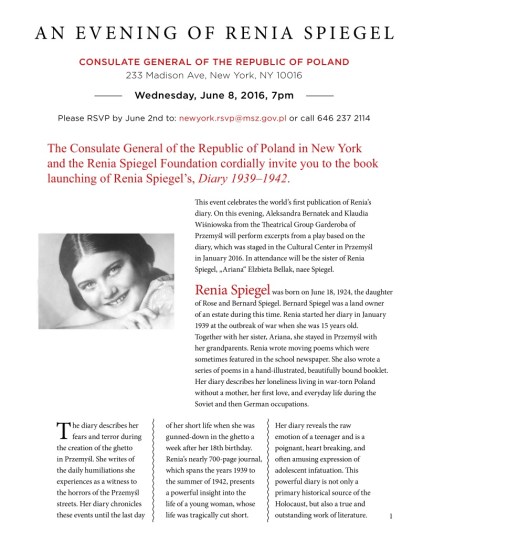
ReniaEvent1


Elizabeth Bellak and my mother met in Poland, when Elizabeth was just a child and mama a teenager. Years later, they reconnected in New York and have been best friends and confidants ever since. Elizabeth, her husband George, and their children Andrew and Alexandra visited us on Long Island more often than our biological relatives did. In fact, I’ve grown up calling her my aunt.

Elizabeth is as outgoing as my mother is shy. She loves to socialize, to tell stories, even to sing and dance. She dresses elegantly in heels and designer clothes, her hair and make up always perfect. I don’t think I’ve ever seen her in pants.

But she and my mother share a deep fondness for each other. They also share a hidden Jewish heritage that they kept silent about until recently. Elizabeth was actually Ariana Spiegel, born in eastern Poland in what is now Ukraine. Her talent was recognized at a young age, when she appeared in films like Gehenna, and was called “the Polish Shirley Temple.”

Ariana as the Gypsy girl in Gehenna, 1938.
Review of Ariana Spigiel's performance in Gehenna. She is called the "Polish Shirley Temple." In Kurier Filmowy 1938, vol. 12, nr.27.
Review of Ariana Spigiel’s performance in Gehenna. She is called the “Polish Shirley Temple.” In Kurier Filmowy 1938, vol. 12, nr.27.
Ariana Spigiel
Ariana Spigiel

Her older sister Renia was equally talented, though as a writer and poet. Renia kept a diary for the last few years of her short life which has just been published along with her poetry (in Polish, though there are plans for it to be published in English as well).

I can’t wait to read it.


ReniaEvent2


Swimming in the Synagogue?

20 Sunday Mar 2016

Posted by Marysia Galbraith in Commemoration, Jewish Culture, Polish-Jewish Heritage, Post-World War II, Poznan, Pre-World War II, Synagogues, World War II

≈ 5 Comments

Tags

Janusz Marciniak, swimming pool in a synagogue

How, realistically, can Jewish heritage be preserved in Poland? Some projects are easy to get behind, like the lapidarium in Wronki. Others fall into more problematic ethical territory. The fact remains that there are many more sites in need of preservation than there are funds for such projects. And yet, I would argue that because of the magnitude of the destruction of Jewish life in Poland, every fragment has enhanced value.

The survival of a building as grand as the New Synagogue in Poznań is thus of particular worth. As with most remaining synagogues in Poland, the New Synagogue was not destroyed because it was repurposed. The Nazis converted the building into a swimming pool; after World War II, it remained a municipal pool until 2011. Although there has been ongoing public debate about more appropriate uses of the space, which at some point was passed back into the hands of the Jewish Community, the main reason the pool was finally closed was because of its deteriorating condition.

The New Synagogue was built in 1907 on Stawna Street between Wroniecka and Żydowska (Jewish) Street, just a few blocks from the central market square of the old city. Intended for Poznań’s wealthier Jewish citizens, the imposing structure had a seating capacity of 1200 and a large copper-covered cupola. Its size and grandeur is all the more striking, considering the Jewish population of the city was under 6000 when the synagogue was built, and further dwindled to perhaps 3000 right before World War II (statistics from Virtual Sztetl).

synagogue_1907-2011A

Poznań’s New Synagogue in 1907 when it was first opened and in 2011, around the time the swimming pool closed (photos from: http://www.januszmarciniak.pl/synagogue)

As these photos show, the German occupiers also removed the cupola and other ornate features, leaving a far less elaborate structure. For several years, starting in 2004, artists like Janusz Marciniak were involved in installations and commemorative events that used the pool as a focal point. Some of these include Marciniak’s  Atlantis (2004),  Alphabet (2005), and 9/09/1939 (2006).

4_ATLANTIS

Poznań’s New Synagogue in 1907 when it was first opened and in 2011, around the time the swimming pool closed (photos from: http://www.januszmarciniak.pl/synagogue)

The Jewish Community, together with others interested in preserving the New Synagogue, proposed restoring the building to its prewar shape and condition, and housing a Center for Dialog and Tolerance. Unfortunately, the plan failed to gain the institutional support and financial backing necessary for it to be realized.

But now there is a new plan in the works, to turn the synagogue into a hotel. In and of itself, that is not the worst outcome; investors will preserve and upgrade the structure, which will include a mini-museum with information about the building’s origins and the history of Poznań’s Jews. So while a museum, or memorial, or center for dialog and tolerance would be preferable, at least the synagogue won’t be torn down, as some city leaders suggested as recently as 2006.

Artist's rendering of the proposed hotel project. The prewar copper-clad dome is reimagined in glass. Photo from article in Gazeta Wyborcza
Artist’s rendering of the proposed hotel project. The prewar copper-clad dome is reimagined in glass. Photo from article in Gazeta Wyborcza
Elements of the pool being disassembled. Photo by Łukasz Cynalewski

But putting another pool in the synagogue is, as my husband put it, kind of tone deaf. It’s insensitive to the cruel history of the place.

A recent article in Gazeta Wyborcza about the planned hotel begins with the following fable:

(my translation) “Summer 2020. Early morning at the hotel on Wroniecki Street at the corner of Stawna Street. In a luxury room in the former Jewish synagogue Alessandro Gianini, a tourist from Rome, wakes up. He flew into Poznan the night before and stayed in the modern hotel with intriguing architecture. In the guidebook, he read that the glass copula of the building recreates the old outline of an imposing synagogue. Now he wants to look around the city.

“But before Alessandro sets out for the Old Market Square, he goes down to the second floor for a swim in the hotel pool. The swim helps to relax and awaken him. He changes, and full of life goes down to the ground floor to the restaurant. After a light breakfast and a cappuccino, he heads to the exit. In the hall, however, he sees an open door to a small space. A sign in English hangs on it: “Museum of the Jews of Wielkopolski.”

“Intrigued, Gianini looks inside. He sees large boards–reproductions of sepia-colored photographs. On the first of these–a long swimming pool under a high vaulted ceiling. On the wall of the pool–a fascist eagle.

“Surprised, the Italian looks at the caption below the photo: “In 1940 Nazi occupiers profaned the synagogue, removing the Star of David from it and building a pool inside of it.

“Alessandro suddenly feels ashamed. Because of his morning swim in the place where 80 years earlier Nazis showed complete contempt for the feelings and religion of Jews, and then sentenced them to a horrible death. He is ashamed and embarrassed. And more than anything surprised that history could be repeated in this cruelly perverse way…”

(the original Polish is in the article)

I don’t know anything more about these plans, except for rumors I heard while I was in Poznań last year, and the contents of this article. Perhaps if they do include a pool, it will be located in some new addition to the structure, in a less offensive place than the main sanctuary. I certainly hope so.

Memory in Fragments: the talk at UA

31 Thursday Dec 2015

Posted by Marysia Galbraith in Brześć Kujawski, Buk, Cemeteries, Family, Heritage work, Israel, Jewish Culture, Lutowiska, Memory, Poland, Polish Culture, Polish-Jewish Heritage, Polish-Jewish relations, Post-World War II, Poznan, Pre-World War II, Research Methodology, Skierniewice, Synagogues, World War II, Wronki, Włocławek

≈ 2 Comments

Tags

Fulbright Program, Postmemory, University of Alabama

The lecture I gave at UA September 3, 2015 about my research during my Fulbright Fellowship is now available on vimeo. I’ve never seen myself lecture before. It’s a little unsettling. Still, here it is, flaws and all (for instance I know that Poland entered the European Union in 2004, even though I misspoke here).

I talk a little about the Fulbright Program–the kinds of grants available and some tips for applying.

It’s also a good introduction to my ideas about reassembling Jewish life: the strands that I’m following, what has been lost, what can be recovered, and how memory projects at sites throughout Poland intertwine with my own search for my family history. I hear echoes of some of the scholars I’ve read–Iwona Irwin Zarecka and Marianne Hirsch, as well as my sometime collaborator Malgosia Wosińska. There is no way to bring back what has been lost, but fragments of the past can be reassembled to form a new kind of life that allows for connection with what used to be and what yet might be.

Guide to the United States for the Jewish Immigrant

19 Saturday Dec 2015

Posted by Marysia Galbraith in Archives, Jewish immigrants, Pre-World War II

≈ 2 Comments

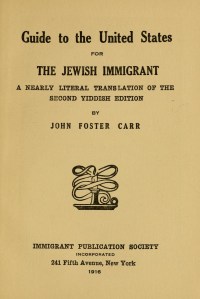
Here’s something a friend uncovered: Guide to the United States for the Jewish Immigrant, published in 1916.

Besides providing helpful information about transportation options in the US, the benefits of farming as a profession, and how to become a citizen, it includes legal advice; bigamy, spitting in public, and beating or shaking a rug are illegal. The second of these, spitting, is also disgusting.

It advises, “The Jew, like any other foreigner, is appreciated when he lives the American social life. Until then he counts for nothing.” Though it also urges, “Be proud of your race, your birth and your family, a Jew is all the better an American for being a good Jew.”

Guide

Title page of Guide to the United States for the Jewish Immigrant (1916)

Available at archive.org.

Tracking Down Jewish Radymno

13 Sunday Dec 2015

Posted by Marysia Galbraith in Cemeteries, Jewish Culture, Memory, Polish-Jewish Heritage, Polish-Jewish relations, Post-World War II, Pre-World War II, Radymno, Synagogues, World War II

≈ 3 Comments

Although I knew the former synagogue still stands in Radymno, had to look several times before I actually found it. I’ve visited for years, and yet my friends never even told me the town had a prewar Jewish population. But until June, I never thought to ask them about it, either.

When I finally did ask, my friend couldn’t tell me much. She repeated a common refrain, especially in southeastern Poland: Jews used to say “nasze kamienicy, wasze ulicy” [“our buildings, your streets”]. It’s not clear that any Jews ever actually said this, but nevertheless, this is often what is remembered about them—Poles may have been the majority but Jews were richer. It’s a telling way of marking the distinction between Poles and Jews. Rather than all residents being regarded as Poles of various religions, Jews remained separate. Moreover Jews are remembered as being complicit in asserting their difference, and indeed their superiority. My friend didn’t mean it this way, but I’ve commonly heard this expression deployed as a justification for why Poles didn’t like Jews. Not only were Jews the property owners, they rubbed it in.

Jewish property ownership poses different challenges today. Some current residents fear prewar owners will return to claim what was theirs. My friend told me about two men who came to Radymno a few years ago and looked at some buildings that had once belonged to Jews. She also described a building in the center of town that is falling apart, but nothing can be done about it. It can’t be torn down because it is a historic structure, but no one will invest in its renovation for fear they will lose possession of it if the owner comes back. She also mentioned another property, a plot of land surrounded by fields whose last owners were Jews. The town hasn’t pursued a clarification of ownership because it isn’t worth enough to hire a lawyer and try and collect the few zloties of tax owed on it each year. So it just stands fallow. I suggested the owner is probably dead. She said of course, it’s been so many years. I clarified there probably aren’t even any descendants, and she responded “of course, because of what happened to Jews.” She didn’t elaborate, nor did she use the words Holocaust, murder, or genocide.

My friend’s mother-in-law had heard her mother’s stories about Jews. She grew up right next door to where they live now. Still, when we asked her about it, she responded she doesn’t know much. She was too young, and her mother didn’t tell her much. She remembers her mother complaining about the sound of the calves at the slaughterhouse across the fields. Kosher law demanded that they be killed with a single knife stroke, and with an empty stomach. Her mother could hear the calves crying in hunger as they awaited slaughter. There still is a slaughterhouse in the same spot, but it has been rebuilt and expanded. At first, my friend’s mother said it used to be owned by Jews, but then she said she wasn’t sure. Jews definitely used it, even if they weren’t the owners.

Her father opened a grocery store in Jarosław, a nearby town. All his neighbors were Jewish shopkeepers. He had to give up the business after a year and a half because they lowered their prices to the point that he could not compete.

Her mother also told her how all the Jews were collected by the Germans and taken to the cemetery where they were shot. She mourned the loss of two young pretty Jewesses, whom she knew because they did seamstress work together.

My friend’s mother-in-law said some Jews and Poles się przyjaźnili [were friendly with each other]. They lived side by side.

She also recalled where the Jewish cemetery was, not far from the water treatment plant.

My friend drove me down a dirt road past the plant, but there was no cemetery. When the road narrowed to two wheel tracks in tall grass, we turned around. My friend pointed to a stand of trees in the distance, saying she thought the cemetery was there. She tried to find someone at the water treatment plant but no one responded. From there, she stopped at a store, but chanced on a man who lives in a nearby city.  The young men working at the car wash knew nothing about the cemetery, either. She finally found an older woman who pointed to a different, less traveled dirt road. We drove up it, but it didn’t get us to that stand of trees. My friend kept looking for a road leading in that direction. I can’t help wondering if maybe at some point in the past she hd been told the cemetery was there.

We drove past the slaughterhouse her mother-in-law had mentioned. It’s a big operation, rebuilt and expanded since the war. The building closer to the road, essentially a box shape, is probably the oldest.

From there, we took a back road up the hill into town and I finally got to see the former synagogue. It is now a beverage wholesaler. My friend’s uncle lives next door. I took some photos while she went to ask him if he knew where the cemetery might be.

DSC06762

The Radymno synagogue now houses a beverage wholesaler.

The front of the synagogue is an imposing two-story square façade that has been renovated, leaving no clear elements of synagogue architecture. From the back, though, the bricked-in semicircular tops of the former synagogue windows are visible. Through windows, you can also see staircases on either side that used to go to the “babiniec,” the upstairs balcony for women. My friend’s uncle used this term when he described it to us, so clearly he knows a bit about the building’s former life as a synagogue. He said nothing has been added to the building. It still has the same footprint, and it stands at its original height. I asked him how he knows, and he simply responded, “after all, I live next door.”
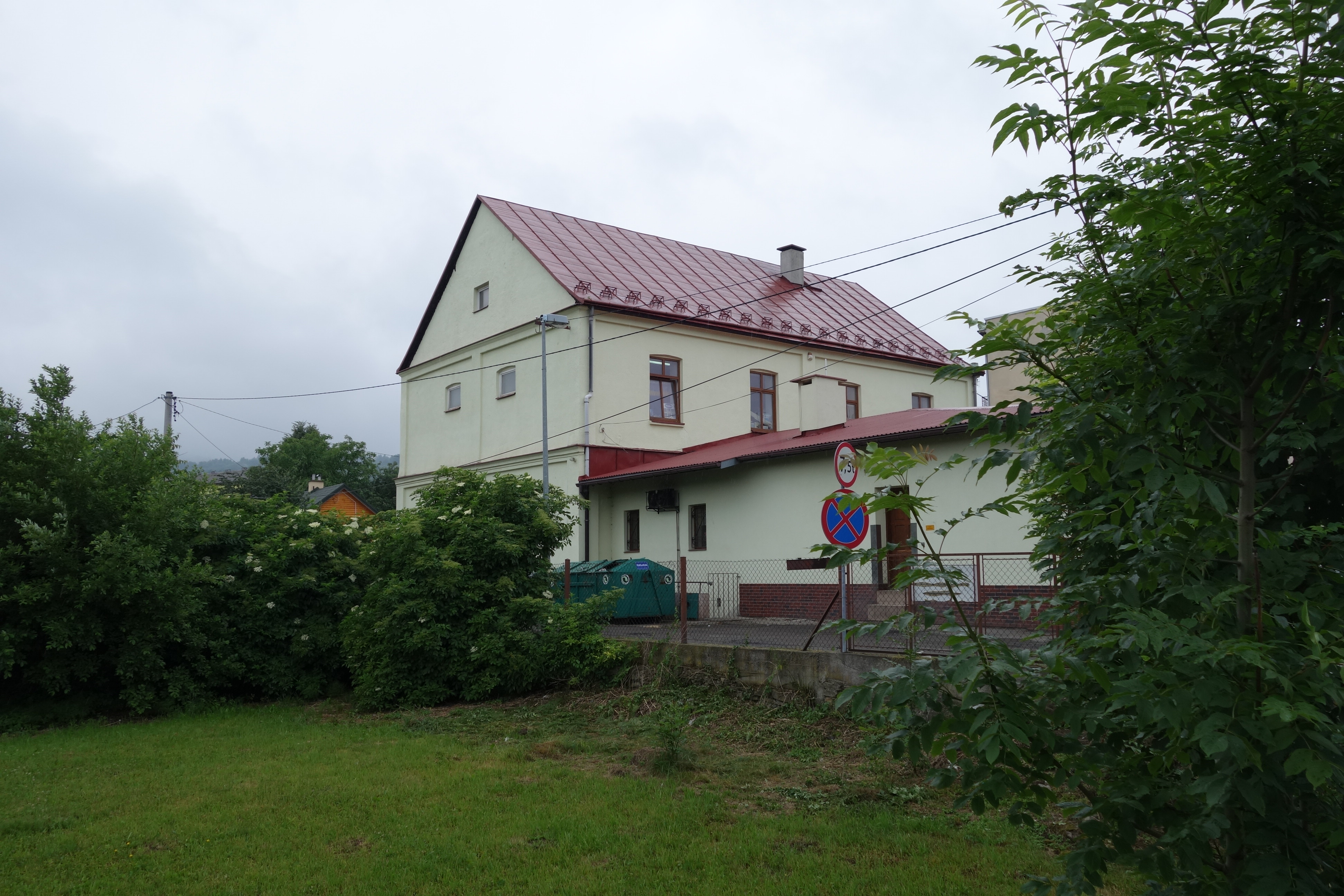
The synagogue from the back
Brick arches used to be the tops of the synagogue windows.

My friend’s uncle also knew how to get to the cemetery. He said he last went there over 30 years ago. As a high school student and a young man, he and his friends used to go there sometimes to have fun (in other words to drink). He remembers some tombstones were still standing, though many others had been brought to the river where people would wash their clothes on them. The writing was still visible on them, but later, the stones fell apart. Today there is nothing left.

Looking back toward Radymno from the cornfield beside the Jewish cemetery
The overgrown site of the Radymno Jewish cemetery.

He took us past the slaughterhouse and up a different dirt road. It petered out in a cornfield, right beside the stand of overgrowth and trees that Jasia had kept pointing toward. Still, we still couldn’t reach it because of a deep gully that separated it from the cornfield. Besides, the overgrowth would not have been penetrable without proper footwear, pants, and probably a machete. I suggested returning in the winter might be best.

At least I know the site to return to.

Grassroots heritage work in Bieszczady

21 Sunday Jun 2015

Posted by Marysia Galbraith in Cemeteries, Dukla, Heritage work, Lesko, Nazi Camps, Polish-Jewish relations, Pre-World War II, Sanok, Synagogues, World War II, Zasław

≈ 6 Comments

Tags

Bieszczady, Jewish culture and history

There is a pattern in the frequency (or rareness) of my posts. When I’m focused on other writing projects, I also write more for the blog. When I’m traveling, interviewing, and attending events, I write less. This month I’ve been traveling.

It seemed important to bring my new research focus to my old fieldsite, and see what is happening in relation to Jewish culture and history in the Bieszczady Mountain region.

The Lesko synagogue. Destroyed in World War II, it was rebuilt in the 1960s.
The Lesko synagogue. Destroyed in World War II, it was rebuilt in the 1960s.

I’ve written elsewhere about how striking it is that, despite the fact that before World War II more Jews lived in Lesko than Poles, only very rarely have contemporary residents volunteered any information about the former Jewish residents. Even though I walked by the former synagogue (bigger than the Catholic Church) and the massive Jewish cemetery countless times, it really only sunk in to me last November that Lesko was a sztetl. One of my friends in Lesko described it really clearly. She said that somehow she always knew that the Jewish history of the town was something that you don’t talk about. It was a taboo topic. This has only recently started to change. Only in the past few years has she noticed that people talk about Jewish culture and history openly. She thinks this is a good thing. Realizing how little she knows about the subject, she has started to educate herself about prewar Jewish life and the Holocaust in Bieszczady.

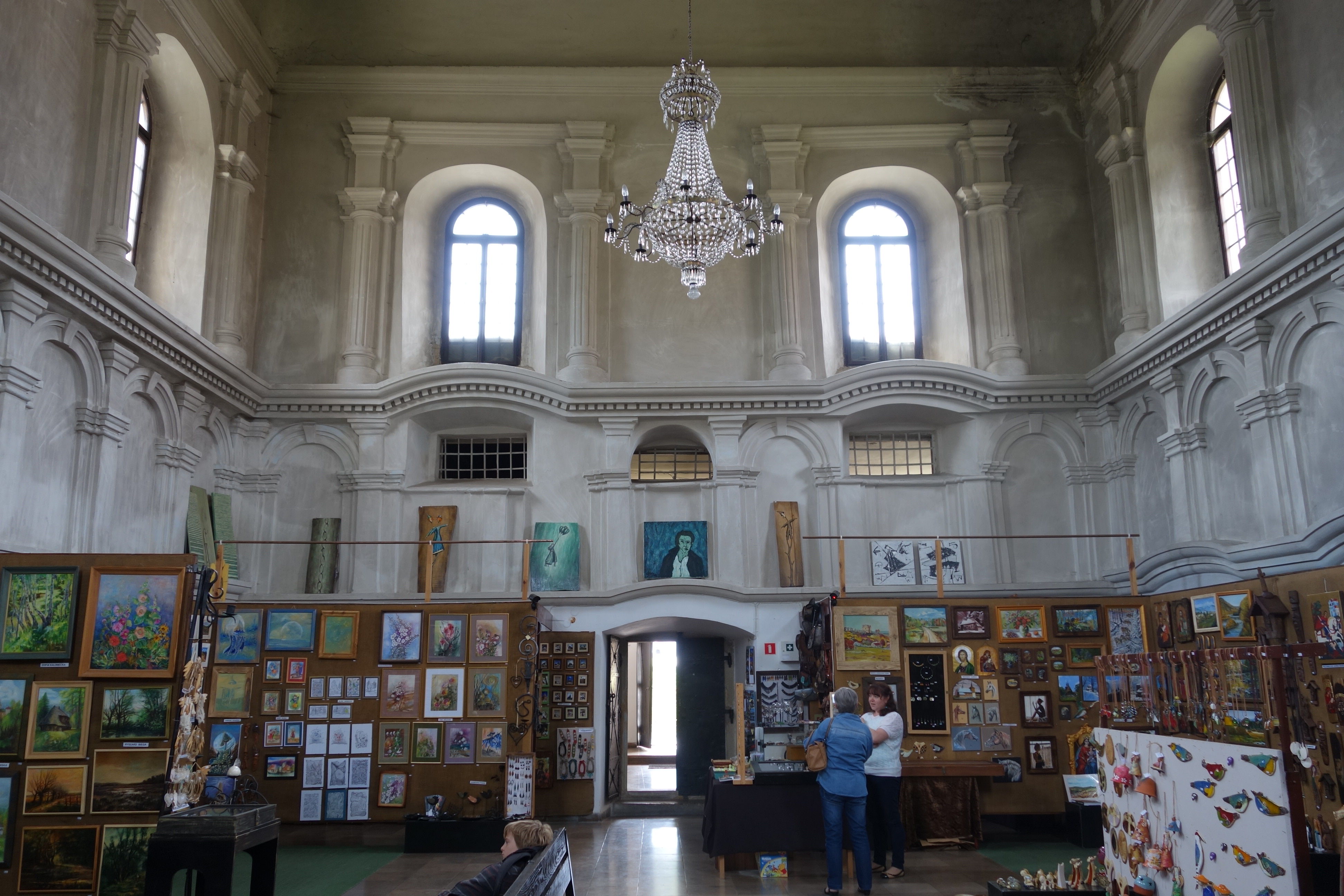
Interior of the Lesko Synagogue. Now owned by the town, it functions as a gallery of regional art.

Interior of the Lesko Synagogue. Now owned by the town, it functions as a gallery of regional art.

Generally, I have found that when I ask, most people have a story or two to tell about Jews in Bieszczady, either something they have read or a some fragmentary memory their grandmother told them. Though also when I told one friend about my interest in Jewish culture and history, she responded, “There were Jews in Bieszczady?” Even though she went to high school in Lesko, she only vaguely remembered the Jewish cemetery and had no recollection of the synagogue. Whether she really didn’t know or just continues to think this is a topic that polite people don’t talk about, I’m not sure.

Nevertheless, some important grass roots work is being done: by Arkadiusz (Arek) Komski in Sanok, Ewa Bryła and her brother Piotr in Zagórz, and Jacek Koszczan in Dukla. Arek is working on a dissertation about the Jews of Sanok. We met at the Słotki Domek Cafe in Lesko after he finished work, and then the next day he showed me the places associated with Jewish life in Sanok.

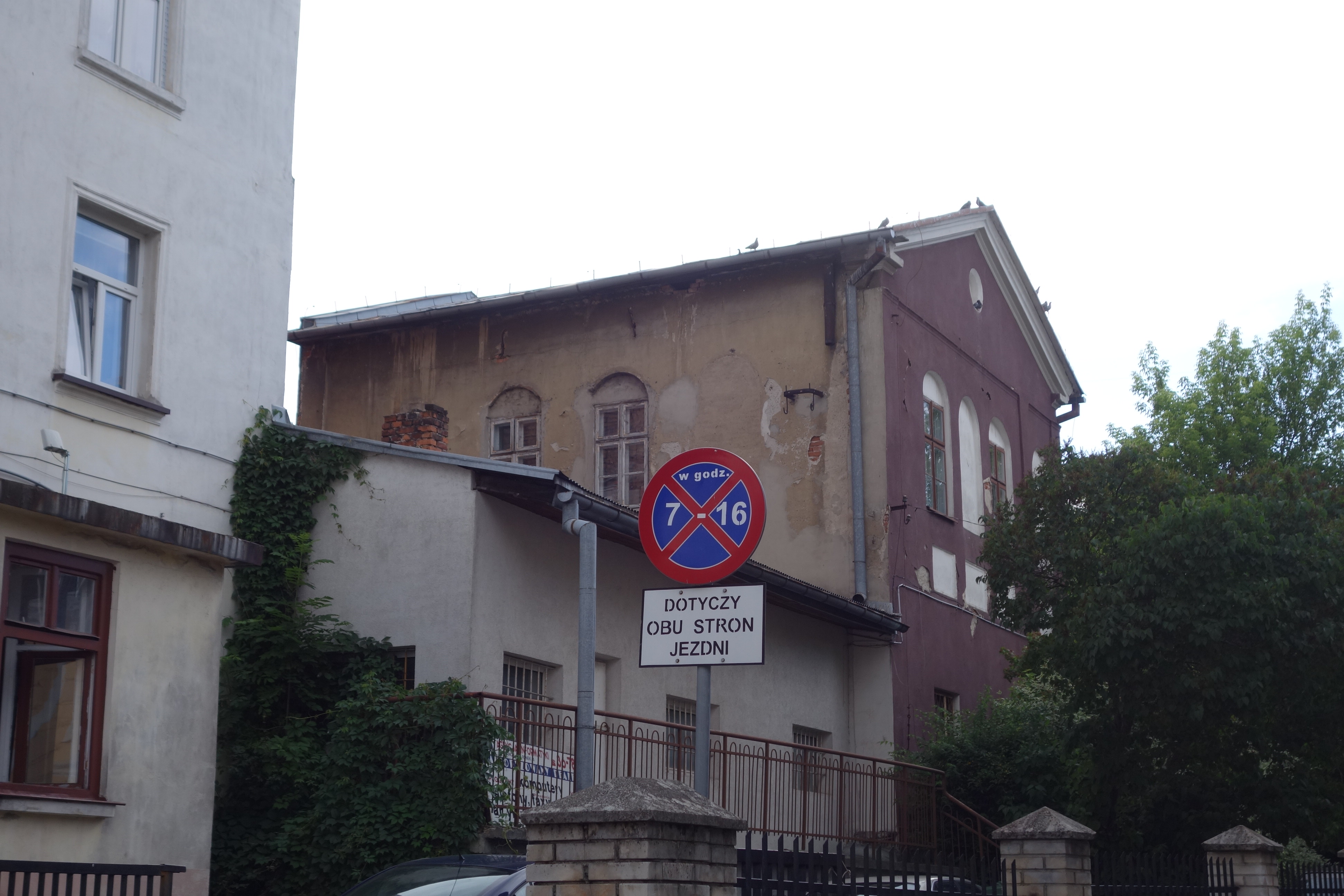
One of the former synagogues in Sanok

One of the former synagogues in Sanok

Commemorative marker, Sanok

Commemorative marker, Sanok

His interest in the topic originated with a curiosity about history, and particularly the history of his hometown. He has published articles about the Nazi work camp in neighboring Zasław and about the locks that were found at the Jewish cemetery. Last year, he realized a project to place a commemorative marker across the street from the former site of the great synagogue.

Arek also let me know that he was awaiting the arrival of a group of students from Dartmouth College, led by Rabbi Edward Boraz, who were going to clean up and inventory the tombstones in the Jewish cemetery in Lesko (see Project Preservation). He has helped them already, first when they came to the cemetery in Sanok, then to Ustrzyki Dolne, Korczyna, and last year to Lutowiska.

Through Arek, I met Ewa, who helped found the Stowarzyszenie Dziedzictwo Mniejszości Karpackich (Association for the Heritage of Carpathian Minorities). Arek joked that for Ewa, working on heritage preservation is a full time hobby. Her interest emerged out of her own Bojko/Ukrainian roots; her parents and grandparents spoke Ukrainian among themselves, though they only spoke Polish with her and her brother. To date, the association has helped clean up as many as thirty Uniate (Ukrainian) and Jewish cemeteries in the region.

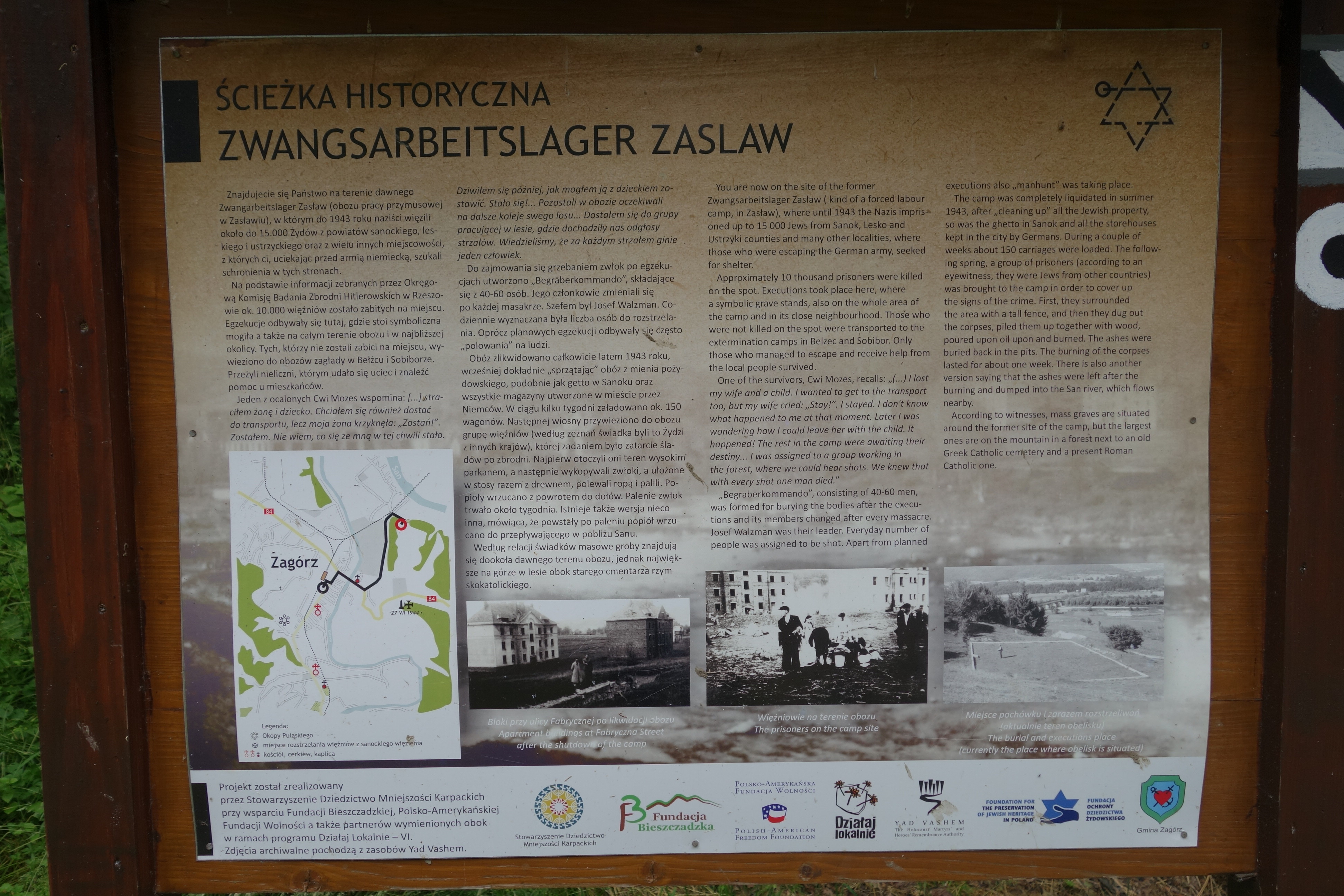
Information about the prison camp and murder of Bieszczady Jews in Zasław, near Zagórz

Information about the prison camp and murder of Bieszczady Jews in Zasław, near Zagórz

Another of the association’s projects is a heritage trail and information sign at the site of the Nazi work camp in Zasław. This is where most Jews from Lesko and neighboring communities were taken and forced to work at a neighboring factory. Approximately 10,000 prisoners were shot on the site, while perhaps 5,000 were sent to extermination camps at Belżec and Sobibor.

Monument at the site of mass murders in Zasław, near Zagórz

Monument at the site of mass murders in Zasław, near Zagórz

I stopped by Dukla on my way back to Krakow, and despite the rain Jacek and Ania, who works at the local tourist office, showed me around. Jacek had already started collecting Judaica around the time of his retirement from the border patrol. An infectiously upbeat and energetic man, he needed something to occupy himself and so decided to get to work protecting and publicizing the sites associated with Dukla’s prewar Jewish population. He told me that the town was as much as 80% Jewish. We walked by the former Jewish school, where boys learned various trades. It is across the street from the old government building; Jacek says that the associate mayor used to be selected from among the Jewish population. Similarly, most of the stone buildings around the market square (rynek) were owned by Jews. Jacek told me the fate of the last rabbi who hid under his rynek home, but then was caught and killed by the Nazis when he tried to escape to Krosno.

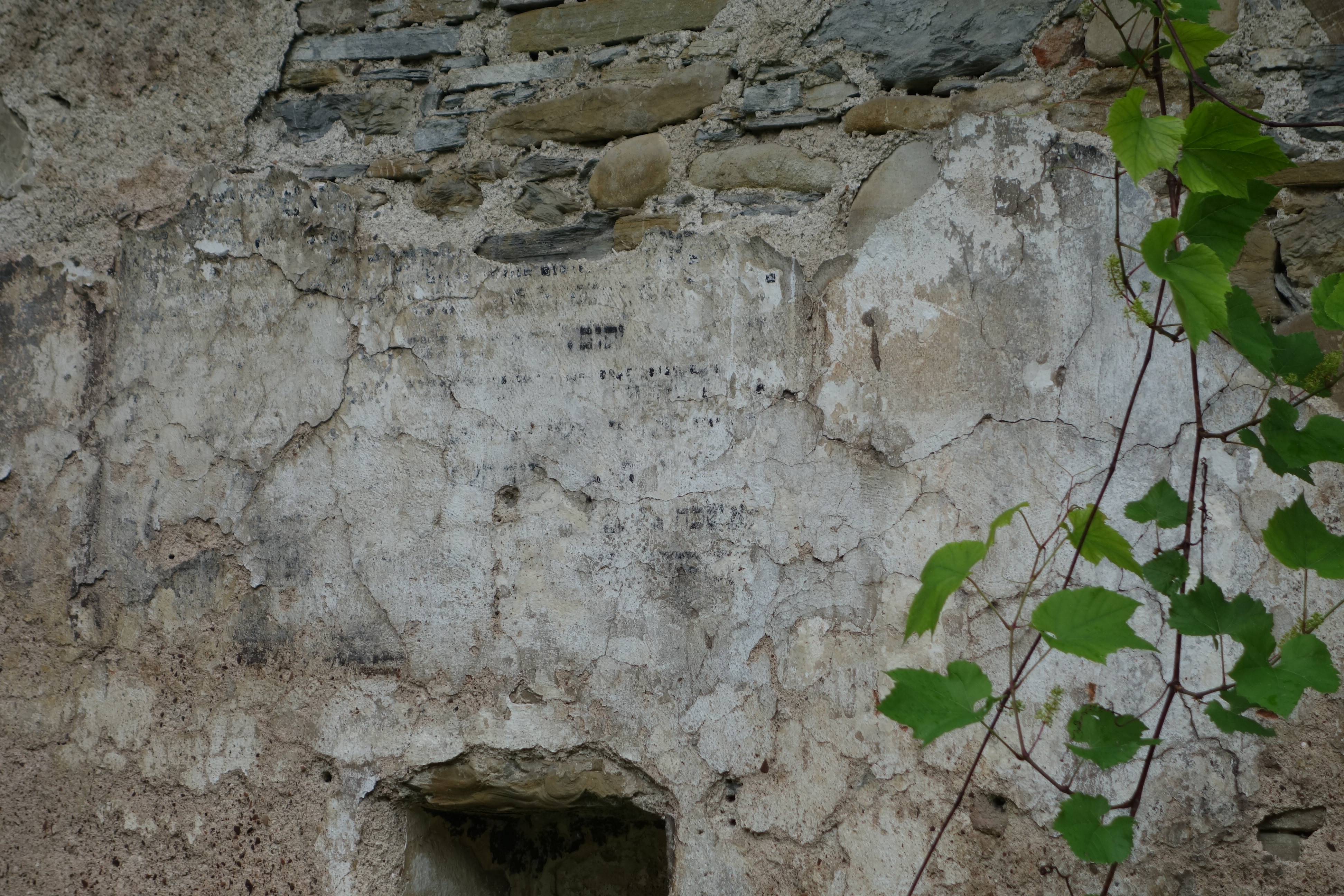
Writing still visible on the wall of the ruined synagogue in Dukla

Writing still visible on the wall of the ruined synagogue in Dukla

Ruin of the 18th century synagogue in Dukla

Ruin of the 18th century synagogue in Dukla


Former synagogue, now a grocery store in Dukla

Former synagogue, now a grocery store in Dukla

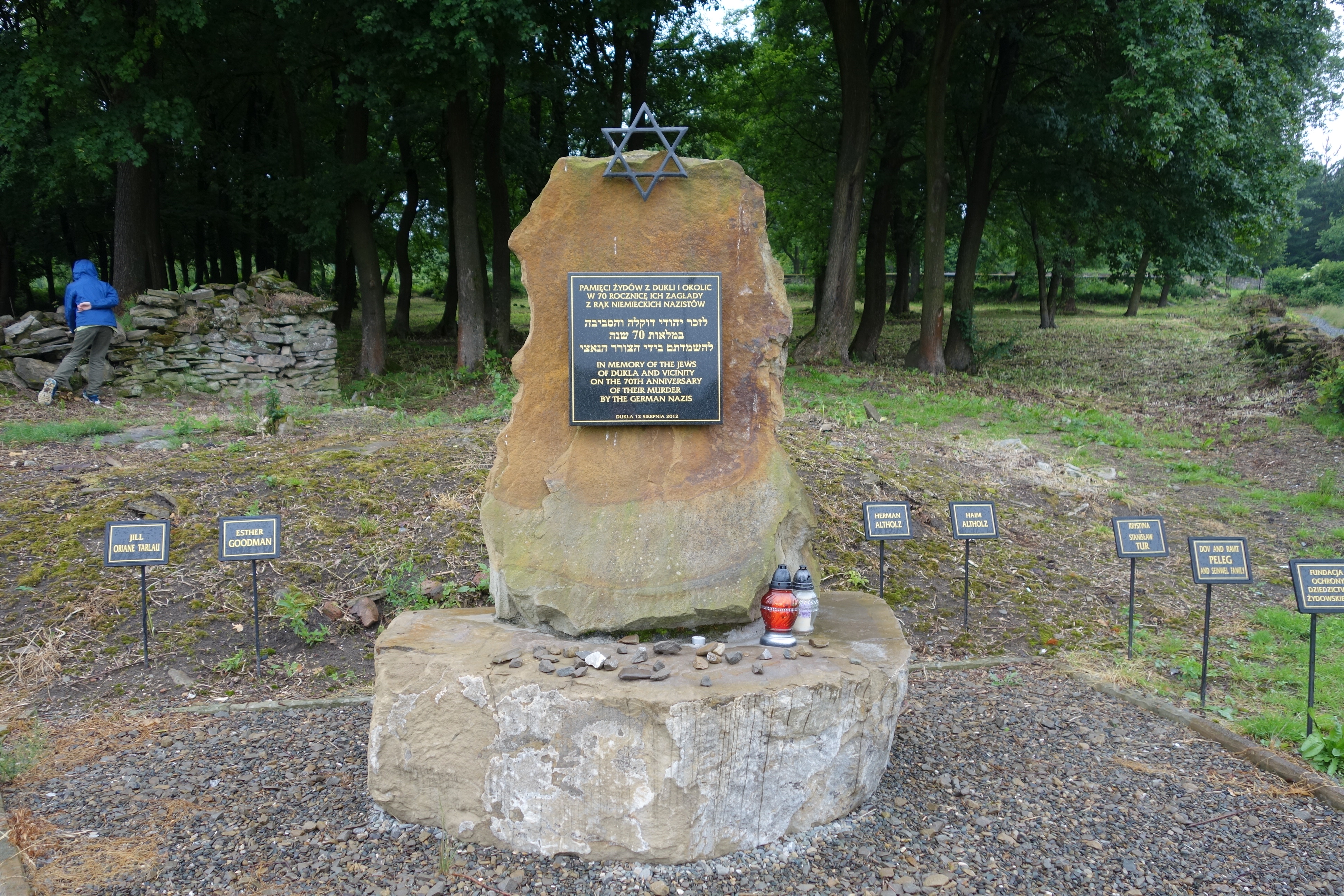
Two synagogues stood side by side. The one dating from the 18th century was burned by the Nazis with Jewish residents inside. The neighboring mykwa was also destroyed. Jacek would like to see the remains of this synagogue conserved. All it would take is reinforcing the window arches and putting in a platform on the inside for viewers to walk on; right now a chain link fence surrounds the site. The other synagogue, dating from the late 19th century, is now a grocery store. Dukla also has two Jewish cemeteries, the older one with burials up to World War I, and the newer one beside it used during the interwar period. Jacek mows them himself.

Jacek also coordinated the construction of a monument near the entrance of the old cemetery recognizing the 70th anniversary of the murder of Dukla’s Jewish population. Funders include the Foundation for the Preservation of Jewish Heritage (FODŻ) and descendants of former Jewish residents. While there have been many contributors to these various projects, Jacek is clearly the energy behind them, insuring that they are realized, and doing much of the physical labor himself.

Jacek reading a tombstone in the new Jewish cemetery, Dukla

Jacek reading a tombstone in the new Jewish cemetery, Dukla

Remembering the murder of Dukla's Jews

Remembering the murder of Dukla’s Jews

In each of these cases, someone (or several people) from the local community has taken the initiative to insure that Jewish culture and history is brought back into the public landscape. They are not Jewish themselves, but something compels them to remember, and to teach others about the former residents of their towns.

← Older posts
Newer posts →

Categories

  • Anthropology (37)
    • Archives (14)
    • Fieldwork (7)
    • Ground Penetrating Radar (GPR (4)
    • Research Methodology (8)
  • antisemitism (14)
  • Association of Descendants of Jewish Central Poland (32)
  • Catholicism (8)
  • Conference (1)
  • Discrimination (2)
  • Family (69)
    • Bereda (17)
    • Kolski (13)
    • Piwko (22)
    • Rotblit (3)
    • Walfisz (4)
    • Winawer (7)
  • Genealogy (11)
  • Heritage work (66)
    • Commemoration (23)
  • Identity (18)
  • Israel (6)
  • Jewish Culture (89)
    • Cemeteries (51)
    • Museum (7)
    • Synagogues (33)
  • Jewish immigrants (8)
  • Jewish Religion (1)
  • Memory (70)
  • Names (14)
  • Photographs (6)
  • Pifko-Winawer Circle (5)
  • Poland (125)
    • Baligród (1)
    • Bolimów (1)
    • Brześć Kujawski (5)
    • Buk (1)
    • Chodecz (1)
    • Dukla (2)
    • Dąbrowice (1)
    • Gdynia (1)
    • Gostynin (2)
    • Gąbin (1)
    • Izbica Kujawska (1)
    • Kazimierz (4)
    • Kowal (1)
    • Koło (1)
    • Krakow (7)
    • Krośniewice (1)
    • Kutno (6)
    • Kłodawa (1)
    • Lesko (8)
    • Leszno (1)
    • Lubień Kujawski (1)
    • Lubraniec (1)
    • Lutowiska (3)
    • Piła (3)
    • Podgórze (2)
    • Poznan (11)
    • Przemyśl (2)
    • Pzedecz (1)
    • Radom (1)
    • Radymno (1)
    • Sanok (1)
    • Skierniewice (5)
    • Sobota (2)
    • Tarnów (2)
    • Warsaw (22)
    • Wielkopolska (1)
    • Wronki (7)
    • Włocławek (20)
    • Zasław (2)
    • Łódź (1)
    • Żychlin (30)
  • Polish Culture (10)
  • Polish-Jewish Heritage (60)
  • Polish-Jewish relations (60)
  • Post-World War II (24)
  • Pre-World War II (22)
  • Reclaimed Property (1)
  • stereotypes (3)
  • Survival (9)
  • Trauma (3)
  • Uncategorized (5)
  • Victims and perpetrators (4)
  • World War II (45)
    • Jewish Ghetto (12)
    • Nazi Camps (5)
    • Polish Underground Army (3)
  • Yiddish (5)

Enter your email address to follow this blog and receive notifications of new posts by email. Your email address will not be shared.

Archives

  • October 2025 (1)
  • July 2025 (8)
  • June 2025 (1)
  • April 2025 (1)
  • August 2024 (3)
  • July 2024 (3)
  • May 2024 (2)
  • April 2024 (1)
  • May 2023 (2)
  • January 2023 (2)
  • December 2022 (7)
  • November 2022 (2)
  • October 2022 (5)
  • September 2022 (1)
  • January 2022 (1)
  • August 2021 (1)
  • December 2020 (2)
  • July 2020 (1)
  • May 2020 (3)
  • April 2020 (1)
  • March 2020 (1)
  • January 2020 (2)
  • May 2019 (1)
  • February 2019 (1)
  • November 2018 (1)
  • September 2018 (1)
  • August 2018 (3)
  • July 2018 (1)
  • June 2018 (1)
  • May 2018 (1)
  • April 2018 (2)
  • March 2018 (2)
  • February 2018 (2)
  • January 2018 (2)
  • December 2017 (2)
  • November 2017 (2)
  • October 2017 (1)
  • September 2017 (3)
  • August 2017 (3)
  • June 2017 (2)
  • May 2017 (3)
  • April 2017 (1)
  • March 2017 (2)
  • February 2017 (1)
  • January 2017 (2)
  • December 2016 (2)
  • November 2016 (4)
  • October 2016 (1)
  • September 2016 (6)
  • August 2016 (2)
  • July 2016 (1)
  • May 2016 (4)
  • April 2016 (2)
  • March 2016 (3)
  • February 2016 (4)
  • January 2016 (3)
  • December 2015 (3)
  • November 2015 (5)
  • October 2015 (5)
  • September 2015 (3)
  • August 2015 (4)
  • July 2015 (3)
  • June 2015 (3)
  • May 2015 (4)
  • April 2015 (9)
  • March 2015 (3)
  • February 2015 (2)
  • January 2015 (5)
  • December 2014 (4)
  • November 2014 (9)
  • October 2014 (2)
  • September 2014 (1)

Copyright Notice

All original text and images are copyright © Marysia Galbraith. Please contact the author before quoting.

Blog at WordPress.com.

  • Subscribe Subscribed
    • Uncovering Jewish Heritage
    • Join 145 other subscribers
    • Already have a WordPress.com account? Log in now.
    • Uncovering Jewish Heritage
    • Subscribe Subscribed
    • Sign up
    • Log in
    • Report this content
    • View site in Reader
    • Manage subscriptions
    • Collapse this bar
 

Loading Comments...