• About
  • The Photo that Started it All

Uncovering Jewish Heritage

Uncovering Jewish Heritage

Category Archives: Polish-Jewish Heritage

Memory in Fragments: the talk at UA

31 Thursday Dec 2015

Posted by Marysia Galbraith in Brześć Kujawski, Buk, Cemeteries, Family, Heritage work, Israel, Jewish Culture, Lutowiska, Memory, Poland, Polish Culture, Polish-Jewish Heritage, Polish-Jewish relations, Post-World War II, Poznan, Pre-World War II, Research Methodology, Skierniewice, Synagogues, World War II, Wronki, Włocławek

≈ 2 Comments

Tags

Fulbright Program, Postmemory, University of Alabama

The lecture I gave at UA September 3, 2015 about my research during my Fulbright Fellowship is now available on vimeo. I’ve never seen myself lecture before. It’s a little unsettling. Still, here it is, flaws and all (for instance I know that Poland entered the European Union in 2004, even though I misspoke here).

I talk a little about the Fulbright Program–the kinds of grants available and some tips for applying.

It’s also a good introduction to my ideas about reassembling Jewish life: the strands that I’m following, what has been lost, what can be recovered, and how memory projects at sites throughout Poland intertwine with my own search for my family history. I hear echoes of some of the scholars I’ve read–Iwona Irwin Zarecka and Marianne Hirsch, as well as my sometime collaborator Malgosia Wosińska. There is no way to bring back what has been lost, but fragments of the past can be reassembled to form a new kind of life that allows for connection with what used to be and what yet might be.

Tracking Down Jewish Radymno

13 Sunday Dec 2015

Posted by Marysia Galbraith in Cemeteries, Jewish Culture, Memory, Polish-Jewish Heritage, Polish-Jewish relations, Post-World War II, Pre-World War II, Radymno, Synagogues, World War II

≈ 3 Comments

Although I knew the former synagogue still stands in Radymno, had to look several times before I actually found it. I’ve visited for years, and yet my friends never even told me the town had a prewar Jewish population. But until June, I never thought to ask them about it, either.

When I finally did ask, my friend couldn’t tell me much. She repeated a common refrain, especially in southeastern Poland: Jews used to say “nasze kamienicy, wasze ulicy” [“our buildings, your streets”]. It’s not clear that any Jews ever actually said this, but nevertheless, this is often what is remembered about them—Poles may have been the majority but Jews were richer. It’s a telling way of marking the distinction between Poles and Jews. Rather than all residents being regarded as Poles of various religions, Jews remained separate. Moreover Jews are remembered as being complicit in asserting their difference, and indeed their superiority. My friend didn’t mean it this way, but I’ve commonly heard this expression deployed as a justification for why Poles didn’t like Jews. Not only were Jews the property owners, they rubbed it in.

Jewish property ownership poses different challenges today. Some current residents fear prewar owners will return to claim what was theirs. My friend told me about two men who came to Radymno a few years ago and looked at some buildings that had once belonged to Jews. She also described a building in the center of town that is falling apart, but nothing can be done about it. It can’t be torn down because it is a historic structure, but no one will invest in its renovation for fear they will lose possession of it if the owner comes back. She also mentioned another property, a plot of land surrounded by fields whose last owners were Jews. The town hasn’t pursued a clarification of ownership because it isn’t worth enough to hire a lawyer and try and collect the few zloties of tax owed on it each year. So it just stands fallow. I suggested the owner is probably dead. She said of course, it’s been so many years. I clarified there probably aren’t even any descendants, and she responded “of course, because of what happened to Jews.” She didn’t elaborate, nor did she use the words Holocaust, murder, or genocide.

My friend’s mother-in-law had heard her mother’s stories about Jews. She grew up right next door to where they live now. Still, when we asked her about it, she responded she doesn’t know much. She was too young, and her mother didn’t tell her much. She remembers her mother complaining about the sound of the calves at the slaughterhouse across the fields. Kosher law demanded that they be killed with a single knife stroke, and with an empty stomach. Her mother could hear the calves crying in hunger as they awaited slaughter. There still is a slaughterhouse in the same spot, but it has been rebuilt and expanded. At first, my friend’s mother said it used to be owned by Jews, but then she said she wasn’t sure. Jews definitely used it, even if they weren’t the owners.

Her father opened a grocery store in Jarosław, a nearby town. All his neighbors were Jewish shopkeepers. He had to give up the business after a year and a half because they lowered their prices to the point that he could not compete.

Her mother also told her how all the Jews were collected by the Germans and taken to the cemetery where they were shot. She mourned the loss of two young pretty Jewesses, whom she knew because they did seamstress work together.

My friend’s mother-in-law said some Jews and Poles się przyjaźnili [were friendly with each other]. They lived side by side.

She also recalled where the Jewish cemetery was, not far from the water treatment plant.

My friend drove me down a dirt road past the plant, but there was no cemetery. When the road narrowed to two wheel tracks in tall grass, we turned around. My friend pointed to a stand of trees in the distance, saying she thought the cemetery was there. She tried to find someone at the water treatment plant but no one responded. From there, she stopped at a store, but chanced on a man who lives in a nearby city.  The young men working at the car wash knew nothing about the cemetery, either. She finally found an older woman who pointed to a different, less traveled dirt road. We drove up it, but it didn’t get us to that stand of trees. My friend kept looking for a road leading in that direction. I can’t help wondering if maybe at some point in the past she hd been told the cemetery was there.

We drove past the slaughterhouse her mother-in-law had mentioned. It’s a big operation, rebuilt and expanded since the war. The building closer to the road, essentially a box shape, is probably the oldest.

From there, we took a back road up the hill into town and I finally got to see the former synagogue. It is now a beverage wholesaler. My friend’s uncle lives next door. I took some photos while she went to ask him if he knew where the cemetery might be.

DSC06762

The Radymno synagogue now houses a beverage wholesaler.

The front of the synagogue is an imposing two-story square façade that has been renovated, leaving no clear elements of synagogue architecture. From the back, though, the bricked-in semicircular tops of the former synagogue windows are visible. Through windows, you can also see staircases on either side that used to go to the “babiniec,” the upstairs balcony for women. My friend’s uncle used this term when he described it to us, so clearly he knows a bit about the building’s former life as a synagogue. He said nothing has been added to the building. It still has the same footprint, and it stands at its original height. I asked him how he knows, and he simply responded, “after all, I live next door.”

The synagogue from the back
Brick arches used to be the tops of the synagogue windows.

My friend’s uncle also knew how to get to the cemetery. He said he last went there over 30 years ago. As a high school student and a young man, he and his friends used to go there sometimes to have fun (in other words to drink). He remembers some tombstones were still standing, though many others had been brought to the river where people would wash their clothes on them. The writing was still visible on them, but later, the stones fell apart. Today there is nothing left.

Looking back toward Radymno from the cornfield beside the Jewish cemetery
The overgrown site of the Radymno Jewish cemetery.

He took us past the slaughterhouse and up a different dirt road. It petered out in a cornfield, right beside the stand of overgrowth and trees that Jasia had kept pointing toward. Still, we still couldn’t reach it because of a deep gully that separated it from the cornfield. Besides, the overgrowth would not have been penetrable without proper footwear, pants, and probably a machete. I suggested returning in the winter might be best.

At least I know the site to return to.

Memory in Fragments: Reassembling Jewish Life in Poland

03 Thursday Sep 2015

Posted by Marysia Galbraith in Anthropology, Heritage work, Jewish Culture, Memory, Poland, Polish-Jewish Heritage, Polish-Jewish relations

≈ Leave a comment

A summary of Dr. Marysia Galbraith’s year as a Fulbright Scholar in Poznan, Poland

September 3, 2015

Lloyd Hall 319

6:00 p.m.

Dr. Galbraith will also answer questions about the Fulbright Program and fellowship opportunities.

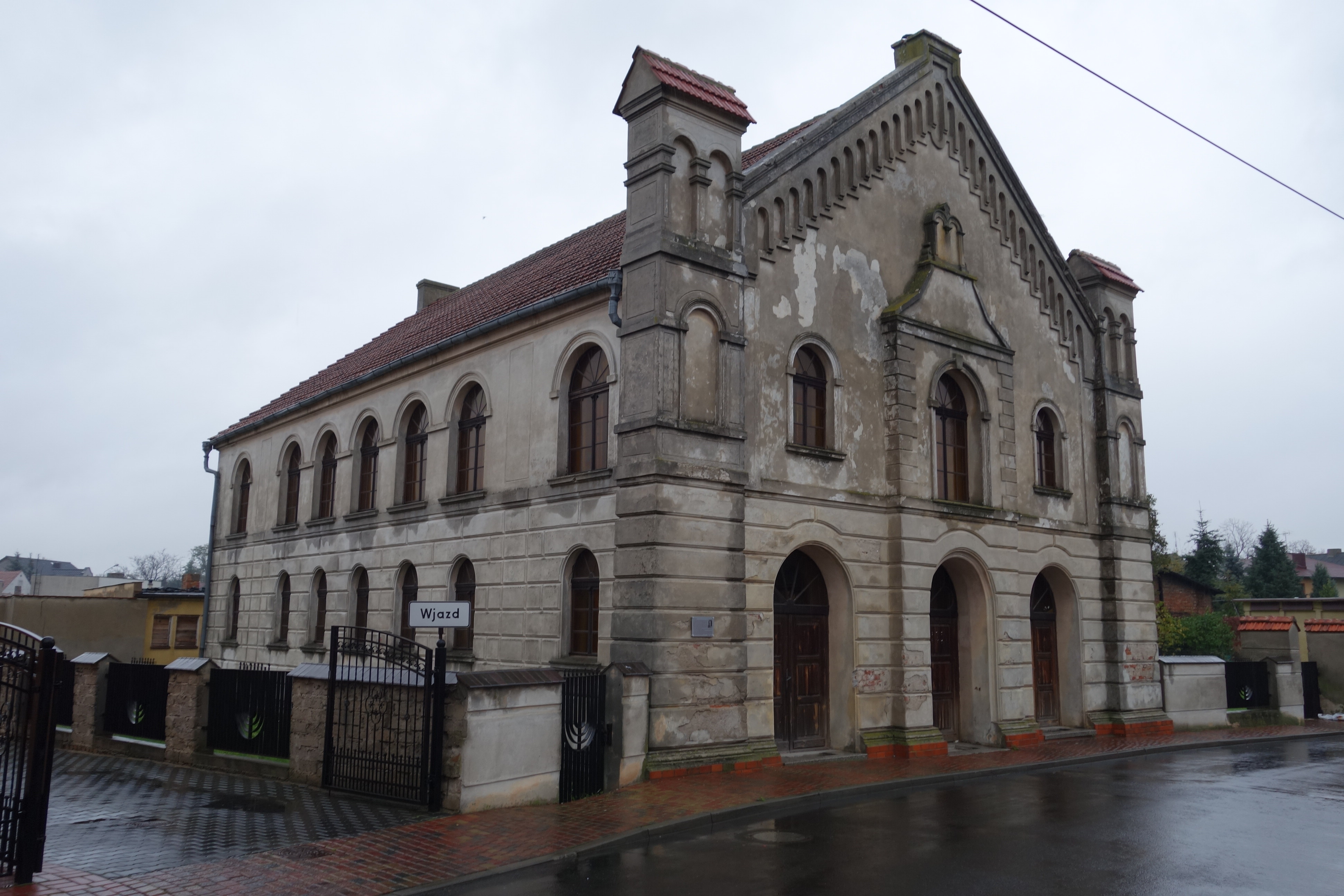
Former synagogue in Buk, Poland

Former synagogue in Buk, Poland

My research on Jewish heritage asks what can be done with the fragments of Jewish culture that remain in Poland, sometimes hidden and sometimes in plain sight? And what value does such memory work have? I explore these questions on two levels: the social level where I focus on what is actually being done with physical traces of Jewish culture in the absence of living Jewish communities, and on the personal level via the archeology of my own hidden Jewish ancestry. These fragments can reveal something about the past, even if it is just in an incomplete and shattered form. And they can point toward the future—the possibilities that might emerge out of traces of memory.

The photo: some reassembled stories

10 Friday Jul 2015

Posted by Marysia Galbraith in Family, Names, Piwko, Polish-Jewish Heritage, Włocławek

≈ 4 Comments

Tags

Abram Janas Piwko, Efraim/Philip Piwko, Halina Bereda/Haja Piwko, Hanna Cytryn, Hil Majer Piwko, Hinda Walfisz Piwko, Jakub Piwko, Liba Piwko Winawer, Natan Kolski, Rachel Piwko Kolski, Sarah Piwko Winawer

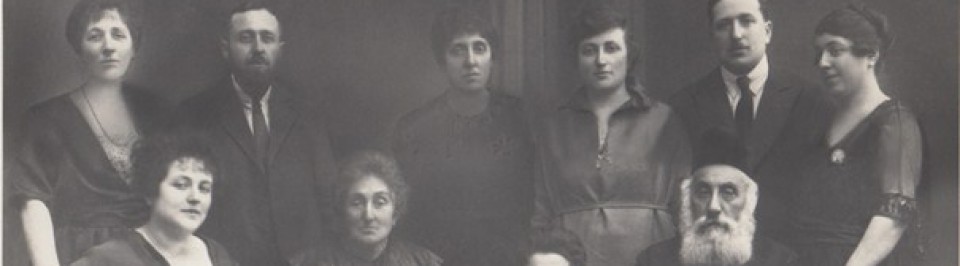
When I first saw this photo in the summer of 2011, I knew almost nothing— I didn’t know who was in it, nor even my grandmother’s maiden name. I figured the older couple was my grandmother’s parents. Were the others their children? Could one of them be my grandmother? And who was the boy in the front row?

JechielHindaAndChildren

My brother Chris and cousin Krysia almost immediately recognized the woman on the bottom left, as our grandmother. With her coquettishly tilted head, her stylish clothes, and her hand resting on her mother’s wrist, it seemed likely to me, too. But I wanted to be sure.

This photo has proven to be an essential clue in my search for family history. Many of the cousins I have met are familiar with the photo and helped me identify everyone in it. In fact, it has helped me establish connections with cousins, and served as proof that we are actually related. When I contacted Pini in Israel, he was skeptical at first that we were cousins. But when I sent him this photo, he responded, “Welcome back to the family.” And he meant it. I feel embraced by the large clan of descendants of my great grandparents, the elderly couple in the photo whom I now know are Hinda (nee Walfisz) and Hil Majer Piwko.

Hil Majer Piwko

Hil Majer Piwko

Hinda Piwko

Hinda Piwko

And it is indeed my grandmother Halina in the bottom left corner.
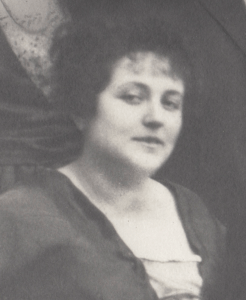
Halka Piwko

Halka Piwko, my grandmother

This photo has led me to living relatives, and back to the time depicted in the image. It helps me see and feel what family life was like back then, and adds depth to my understanding of the dry genealogical facts I have gathered.

Even my uncle Stanley Winawar has spoken to me from the grave in the form of a letter he wrote to Pini in 2002 (just two years before his death) in which he identifies everyone in this photo, and lists many of their descendants as well. One of my regrets is not having started this search sooner so I could have talked with Stanley and others before they died. At least through the letters, I’ve had a taste of the conversations we might have had.

So let me introduce my family:
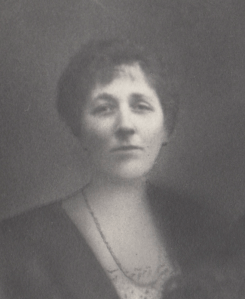
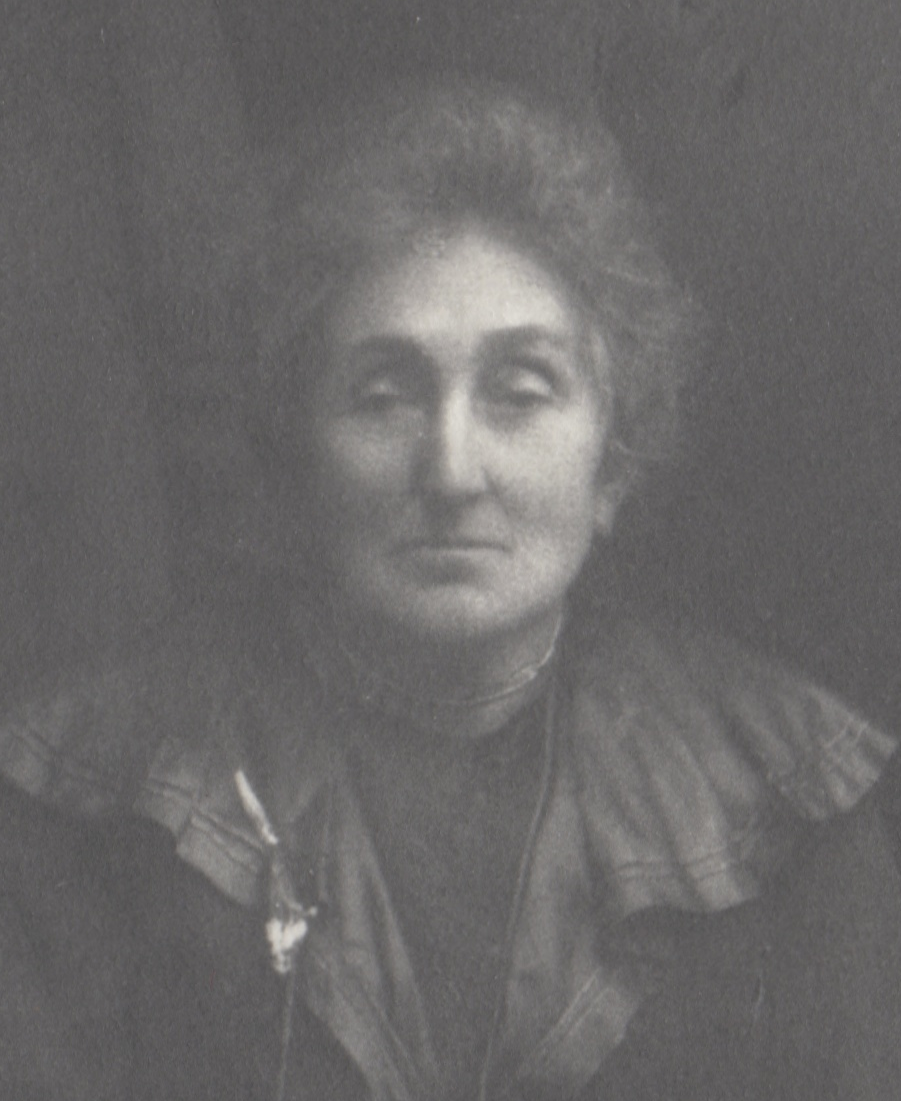
Sarah Winawer

Sarah Winawer

Starting at the top left, most people identify the elegantly dressed woman as Sara (Piwko) Winawer, Uncle Stanley’s mother. Born in 1880, she was the second daughter of my great grandparents. On a list compiled by my Aunt Pat (probably based on a conversation with my grandmother’s sister Hanna/Nunia), she is described as having “beautiful hair.” She married Saul Winawer in 1899, and they had four children (Nathan, Milton, Stanley, and Paulina). My mom stayed in touch with her aunt Sara in the United States, though she was known in my family as Lusia (apparently no one besides our branch of the family called her that). She died in 1964 when I was 6 months old. She was too sick to visit me, but told my Mom on the phone that she would watch over me from heaven. I only heard this story once or twice when I was a child, but it left an impression on me. I liked the idea of having a guardian angel of sorts. Who knows? Maybe it foreshadowed this search for deeper connections with my mother’s extended family.

Jakub Piwko

Jakub Piwko

Next in the top row is Jakub, the oldest son born around 1874. Aunt Pat says he had four wives, including Helen Esther Kirsten, Genia Ellinberg, and Rozalia Kirsten. She (Nunia?) describes him as blond, delicate, of medium height, resembling his maternal grandfather Natan Walfisz. He was a Zionist and member of the governing board of the Jewish Community of Włocławek from December 1917 until resigning on March 3, 1922. He was also a representative on the City Council from 1917-19 (see virtual sztetl). Jakub died in 1942; by one cousin’s account he owned a small hotel in Otwock and was shot by Nazis for being out on the street after curfew. He had a son Natan who emigrated to Israel and a daughter, Pola.

In a letter to Pini, Stanley (Sara’s son) wrote, “The space missing between Jacob and Liba was obviously reserved for Yona…” Abraham/Abram, the second-born son, was called by his middle name John/Yona/Janas. Born around 1876, Pat (Nunia?) describes him “devil eyes, tall, brunette, liked girls and girls liked him, 6’ 2”-6’ 4”.” He was the first in the family to come to the United States, arriving in New York in January 1906. His wife Bertha/Blima (they married in 1901) followed in May 1907 with their children Nathan, Paula/Pauline, and Ewa. A fourth child, Sarah, was born in New York. Abraham owned a bakery in Brooklyn until his death in 1925.
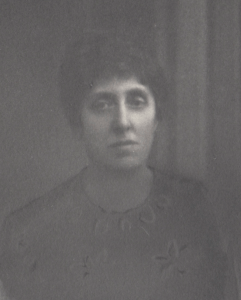
Liba Winawer

Liba Winawer

In the middle of the top row is the oldest child Liba, born around 1872. Aunt Pat’s list (Nunia’s description?) says she was tall, blond, and beautiful. At the age of 17 or 18 she married Jakob/Jankiel Winawer. I don’t know how he was related to Saul Winawer (Sarah’s husband), but some say they were cousins. Liba and Jakob had four sons—Nusen, Sol/Saloman, Max, and Morris. In 1928, Liba and Jakob came to the US, where their three younger sons were living. Jakob died there in 1932, but I haven’t found a record of Liba’s death. Did she die in the US? If so, why isn’t it documented? Could she have returned to Poland, where her oldest son still lived? Could she have died in the death camp at Treblinka in 1942, as some say Natan did?

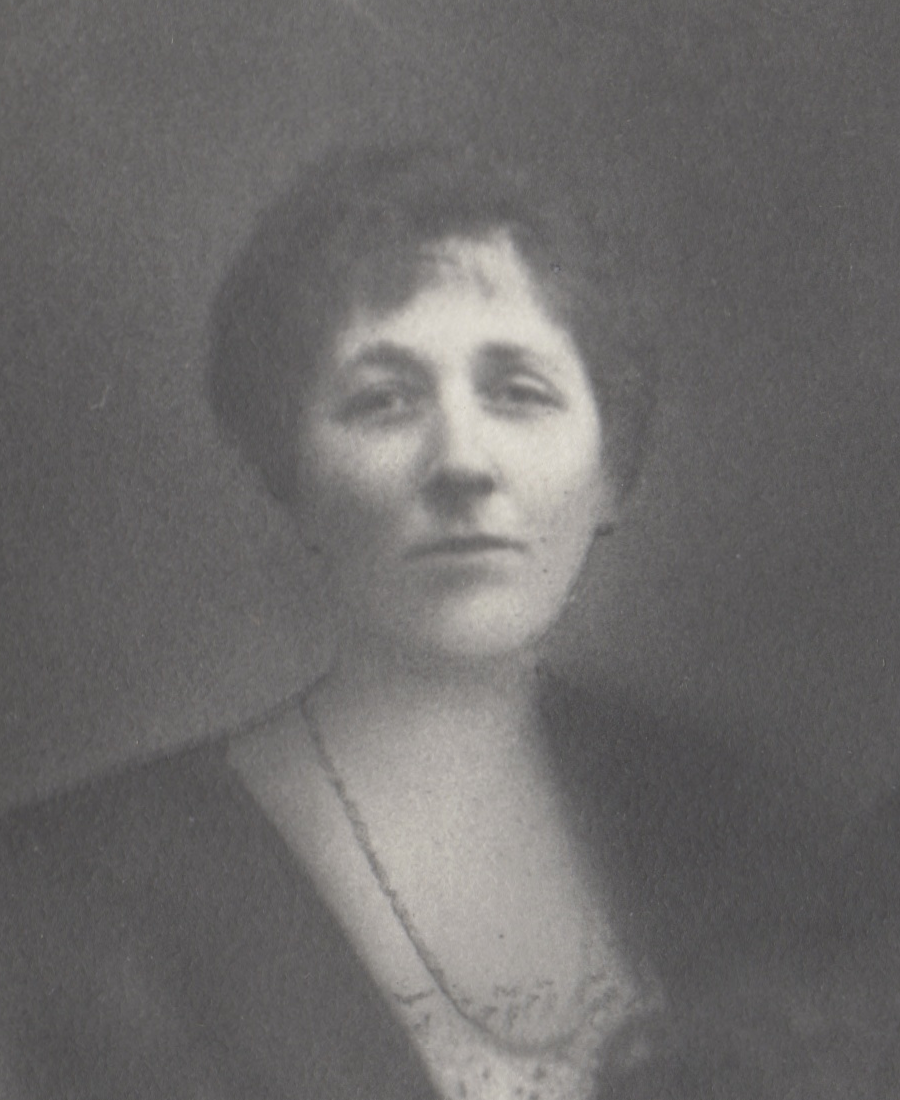
Hanna Cytryn

Hanna Cytryn

Next to Liba is Hanna (born around 1886), though everyone in the family called her Nunia. I’ve already written about her, but briefly, she married Stanisław/Samson Cytryn and had one daughter, Teresa. She and Samson lived in Warsaw where they ran a shop that has variously been described as a pharmacy or a supplier of lotions and toiletries. Maybe she was an herbalist and so offered products that crossed the boundary between health and beauty? She took over the shop after her husband’s death in 1927. Nunia spent World War II in Warsaw under the false identity of Maria Weglinska (the name she kept until her death in 1984) After the war, she lived in Paris, and then in 1951 she moved to the US.

Philip Piwko

Philip Piwko

Next is Philip/Efraim, described by Pat (Nunia?) as “six foot, blond, pock marked, shy, sweet.” Born around 1882, he came to the US a couple of years after his brother, at the end of 1907. He, too, owned a bakery though I don’t know if it was the same one as his brother or a different one. Philip married Goldie. They never had any children of their own, but they took care of siblings, nieces, and nephews as they immigrated to the US. Many of the cousins remember him as the glue that held the family together in the US. Philip died tragically in an auto accident in 1947 on his way home from Boston.

Rachel Kolska

Rachel Kolska

At the far right of the top row is Rachel, who was born around 1890 between Hanna and Halina (my grandmother). Pat (Nunia?) describes her as shorter than her sisters, with thick thick hair. She married Pinkus/Pinchas Kolski, the widow of her older sister Regina who died giving birth to a son, Natan. Rachel raised Natan, and had four more children with Pinkus—Samek, Abram, Naftali/Maniek, and Mirka. They settled in Włocławek, where they had a store right in the center of town. After the war broke out, Rachel, Pinkus, and Mirka (who was just a teenager—she was ten years younger than her youngest brother) were moved to the ghetto in Warsaw. Pinkus, who was in ill health, died there in 1940, and Rachel and Mirka escaped and lived on the Aryan side under false papers. After the war ended, they joined Natan, Abram, and Maniek who were living in Israel. Rachel died in 1969.

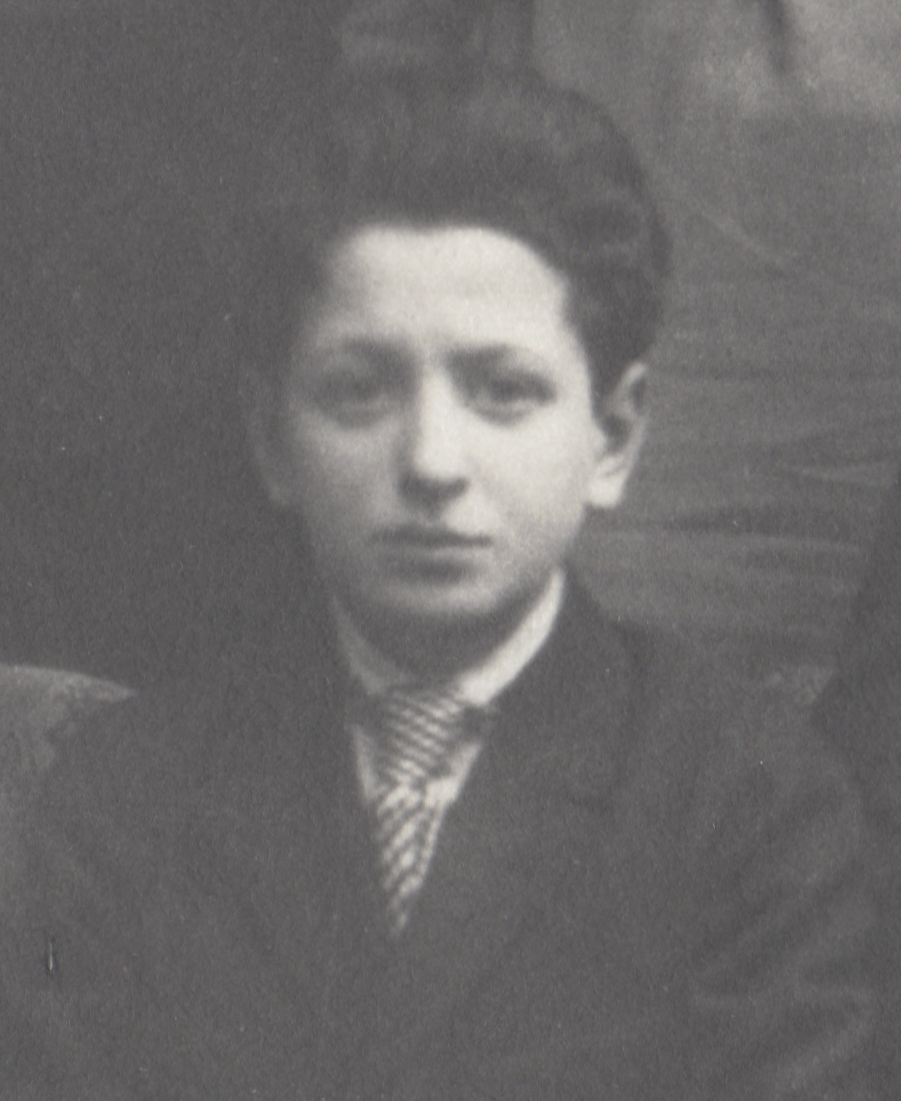
Natan Kolski

Natan Kolski

On the bottom left, as I have already said, is my grandmother Haja/Halina, born in 1894. Seated beside her is her mother, Hinda (Walfisz) Piwko, while her father Hil Majer Piwko is on the far right. The young boy is Natan, the son of Regina and Pinkus Kolski. Perhaps he was there in his mother’s place, just like a gap was left for Abraham/John? Natan is said to have spent a lot of time with his grandparents. His position between them suggests they were very fond of each other. And I almost forgot one more member of the family—the dog under the couch behind Natan’s feet. Could this have been Natan’s dog? Another sign of the favor of his grandparents? I don’t know but I like to think of it that way.

So that’s my grandmother’s family, excluding only Małka who died as a teenager and two other siblings who died as infants.

Considering Natan was born in October 1905, I would guess this photo was taken near the end of the 1910s, maybe in 1919. Natan looks like he’s about 12, like my son is now, or maybe a little older. It seems unlikely the photo would have been taken during World War I, especially because of Philip’s presence. Philip was living in the US already (he is listed in both the 1910 and 1920 US census) and I don’t think he would have made the journey during the war. I don’t know enough about the history of fashion to be sure, but Halina’s dress seems scandalously short for the period, and even Rachel’s hemline is a few inches above her ankles. Still, I read that hemlines started to rise in Europe in 1915. I wonder, as well, whether Hanna’s comparatively simple dress was because she was less well off than her sisters, or perhaps was rather due to a more practical nature (which fits with how I remember her).

The photo is a window into the past. In it, I see a large, affluent, close family, but one in which social and cultural divisions were growing through the generations. While father Hil’s thick beard, black cap and long coat were characteristic of a conservative, religious Jew, his older son (the Zionist) had a shorter, more trimmed beard, and his younger son, by now an American citizen, sported only a moustache. The twenty-two-year gap between Liba, the oldest sibling, and Halina, the youngest, also seems apparent in the way they carried themselves and dressed.

I’ve learned a lot since I pulled this photo out of the envelope my grandmother had marked “Do Not Open.” And yet it all remains fragmentary. Most of the richer details are tentative, based on stories I try to piece together into something more substantial. But the fragments stand stubbornly apart from each other, and sometimes even in opposition to each other. Did Rachel accept her sister’s son Natan as one of her own, or did he spend much of his time with his grandparents? Perhaps it was both, since Hinda and Hil also lived in Włocławek later in life. Why does Liba seem to be retreating into the background? Is it just an accident of the lighting or a reflection of her character? Why was my grandmother holding her mother’s hand like that? Was it a sign of affection or perhaps an assertion of autonomy? The more I sit with this photo, the stronger I feel a connection with these people. And still, how distant they remain from me.
A crowded field

22 Friday May 2015

Posted by Marysia Galbraith in Anthropology, Polish-Jewish Heritage

≈ 1 Comment

I find myself working here in a very crowded field. At all the commemorative events, concerts, and exhibitions, I’m one of many taking photos, writing notes, and doing interviews. The press is there, along with filmmakers, and even other ethnographers. And more often than not, the organizers of events are doing their own documentation for their websites or promotional materials. All of this is a testament of the widespread interest in Jewish heritage in Poland. It’s also, I think, reflective of our mediated lives. Everything is posted on Facebook or a blog such as this one.

It was very different when I began fieldwork 25 years ago. In the Bieszczady Mountains in particular, local residents sometimes wondered if I was a spy. Why else would I spend so much time in such a remote place asking all kinds of questions? I was the only foreigner and the only anthropologist in the small town of Lesko, where I lived for a year.

I’ve had two interesting experiences in the last week alone. First, I interviewed an Israeli woman who lives in Poland. She works as a Hebrew teacher and she is doing a documentary film about what it means to be a Jew (Żyd) in Poland. Over the course of our conversation, I shared some of my own quest for information about my family. Now she wants to interview me for her film. And then today, while attending an educational event sponsored by the Polin Museum of the History of Polish Jews and coordinated by a local museum curator and schoolteacher, I met another ethnographer who is traveling with the exhibition and interviewing people involved with Jewish heritage work in each of the places that are part of the tour.

And next week, I will be the guest speaker at the unveiling of a commemorative monument at the site of the Jewish cemetery in Piła.

This all brings home the impossibility of being an invisible, objective observer in the research I am doing. The participant side of participant-observation is far more robust. I am a collaborator, a lecturer, and myself a subject of other peoples’ projects. All I can do is keep writing notes about how intertwined I become in the various projects I witness. In Jewish Poland Revisted, Erica Lehrer made a similar observation about her “postmodern field site” in Kazimierz, Krakow’s former Jewish quarter which she describes as “transnational, increasingly cyber-mediated, tangled up with flows of tourism” and a site for “the confrontation, dialogue, or at times blurring among ethnography and other practices of cultural representation, translation and brokering” (2014:7; she also describes it as a crowded field of endeavor). I can only wonder at how invisible this all was to me until I started asking the right questions and finding people who are seeking their own answers to them.

What happened to Tumska Street?

18 Saturday Apr 2015

Posted by Marysia Galbraith in Polish-Jewish Heritage, Post-World War II, Włocławek

≈ 1 Comment

My great grandparents lived the last years of their lives in Włocławek, a city on the Vistula downriver from Warsaw. I don’t know exactly when or why they moved there, but it was a city that experienced rapid industrialization and growth in the early 20th century. During this time the Jewish population grew to about 20% of the city’s residents. Tomasz Kawski, a professor in the nearby city of Bydgoszcz, has posted an extensive history of Włocławek’s Jews on virtual sztetl. He also showed me around the city in February.

Historically, Jews concentrated around ten streets in the center of town, including Tumska Street which runs from the Old Rynek to the cathedral.[1] This is where Pinkus Kolski and his wife Rachel (my grandfather’s sister) lived and had their store. It was one of the central shopping streets in the city.

When I visited Pini in Israel (he, too is Pinchas like his grandfather, though he has changed his last name to Doron) he and his wife Pnina told me about visiting Włocławek in the 1990s. Here is a photo of Pnina, her mother, and daughter in front of 15 Tumska Street where Pini’s grandparents lived.

My cousins in front of Pinkus and Rachel Kolski's house on Tumska Street, Włocławek

My cousins in front of Pinkus and Rachel Kolski’s house on Tumska Street, Włocławek

And this is what Tumska Street looked like the week after I returned from Israel.DSC03544

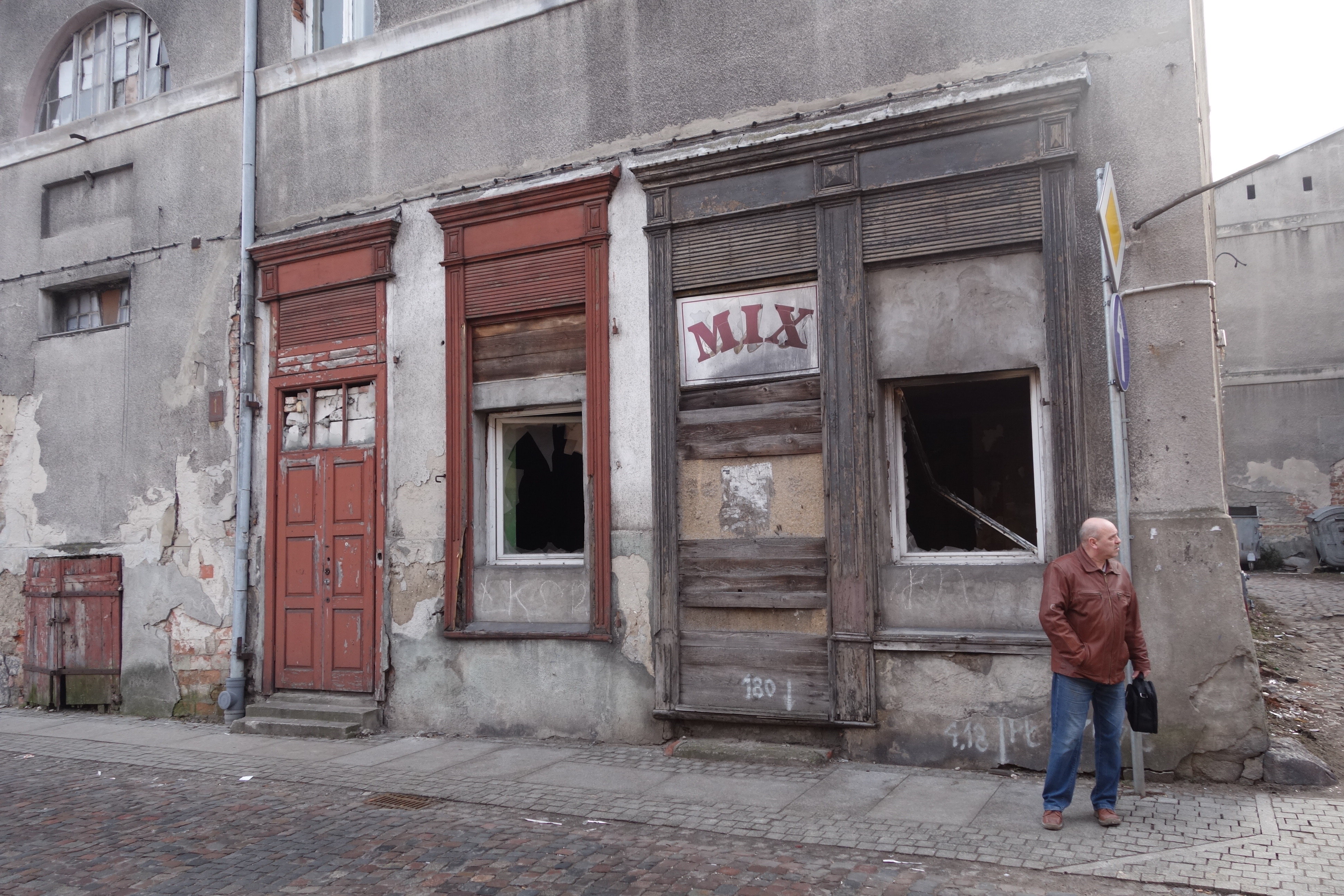
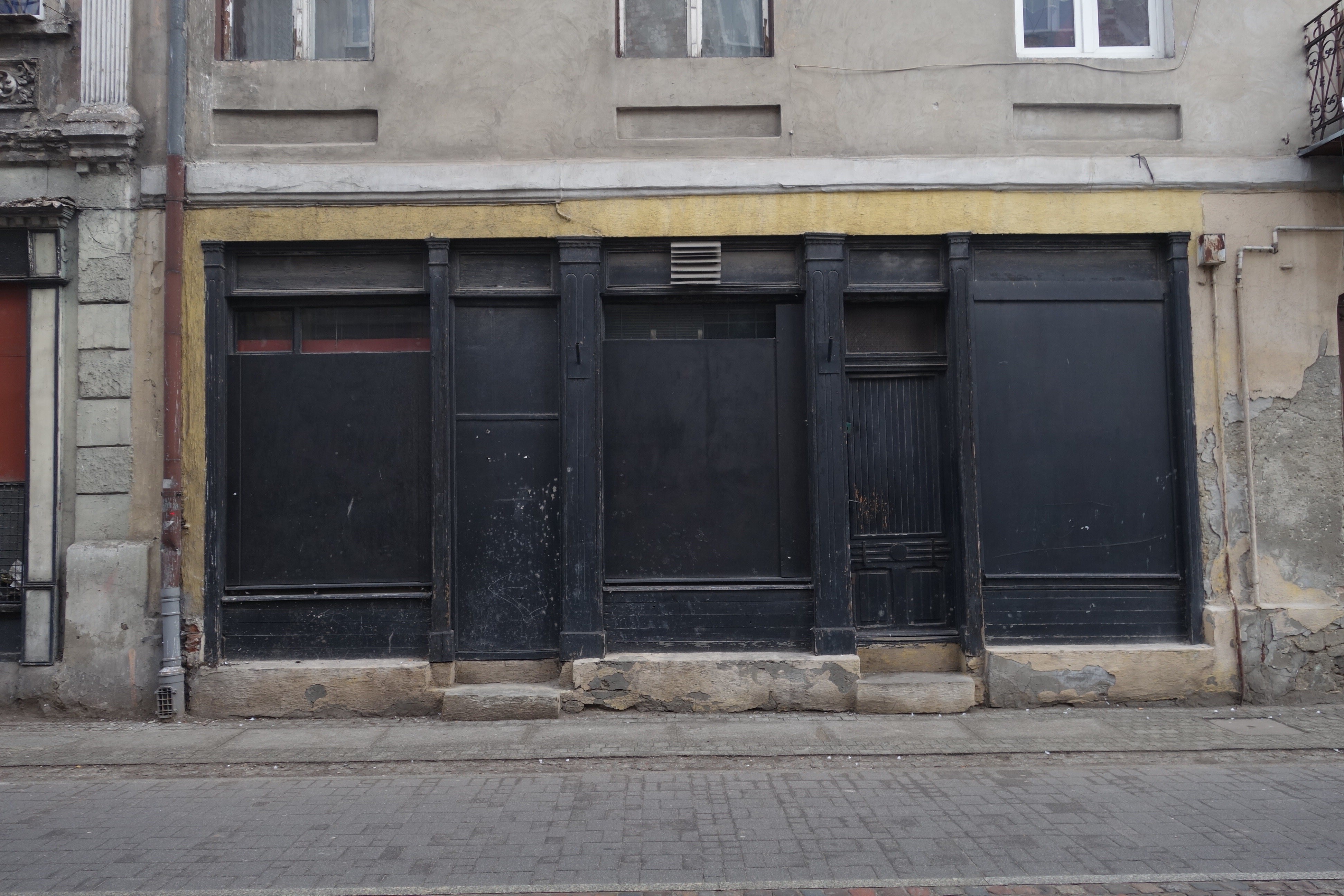
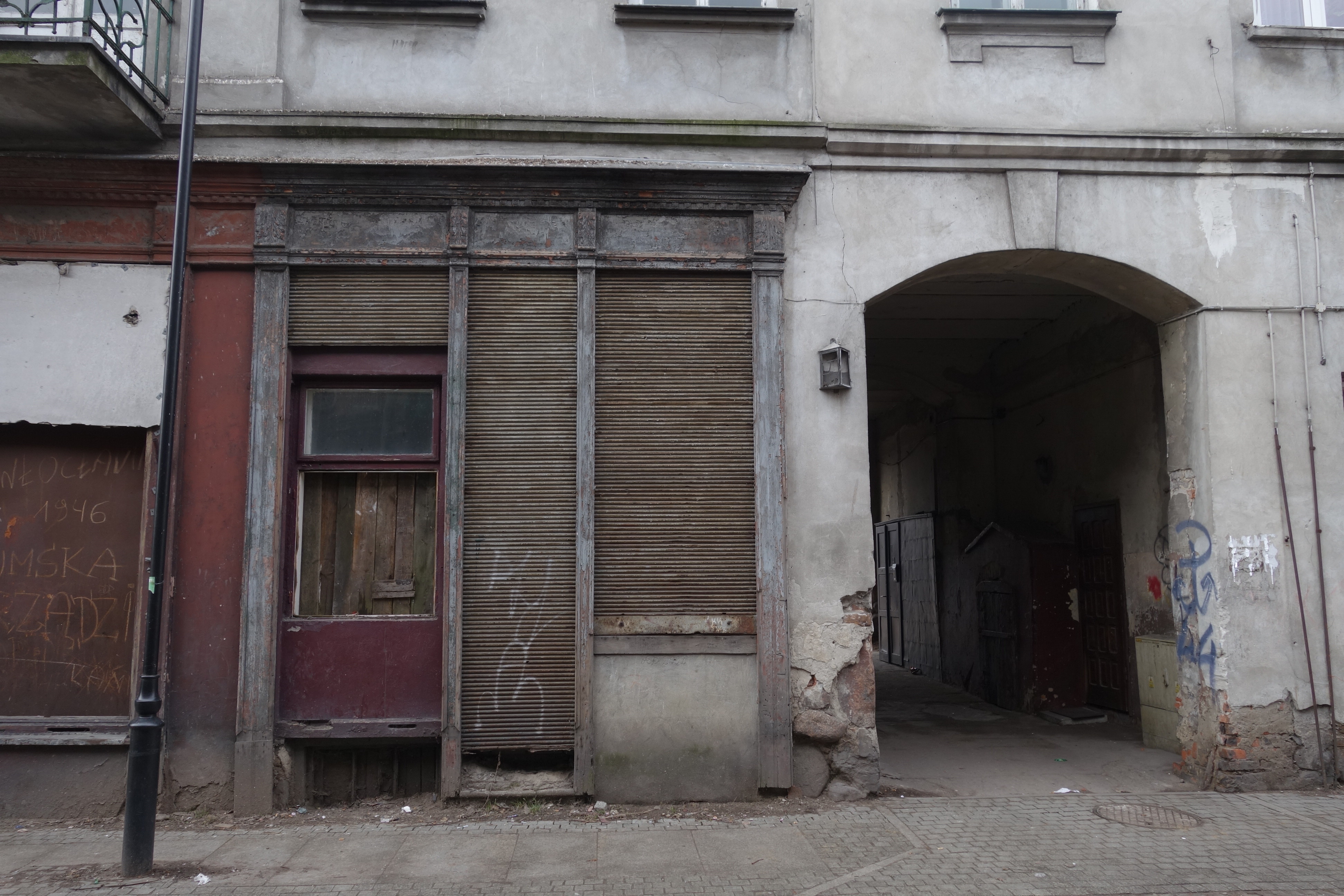
DSC03628Tumska Street is in total decay. Some of the abandoned storefronts have prewar wood paneling that hints at the street’s former glory.

DSC03617

DSC03614Other houses have collapsed into a pile of rubble. Number 15 is gone completely.

A wall stands where 15 Tumska Street used to be. The cathedral is in the background.

A wall stands where 15 Tumska Street used to be. The cathedral is in the background.

I asked a few people why this neighborhood is in such disrepair. I was told the whole city is struggling economically due to the closing of many industries since the fall of communism. About 20% of residents are unemployed. Even before then, residents were moving out of the center and into newer homes and apartments in the outskirts of the city. Also, most of the former Jewish properties were nationalized under communism. In recent years, laws have changed to allow former owners to reclaim their properties, so buildings whose ownership is uncertain or under dispute have been left alone. No one wants to invest in them and risk that someone with a valid claim over them might appear and take possession of them. In fact, communal, city-owned properties nearby are better cared for than those on Tumska Street.

[1] On Virtual Sztetl, Kawski writes, “Ten streets were inhabited by over 88% of the Włocławek Jews (Żabia Street – 6.5%, Kaliska St. – 7.5%, Piekarska St. – 10.1%, Tumska St. – 5.3%, Kościuszki St. – 4.3%, Plac Dąbrowskiego – 6.1%, 3 Maja St. –  26.3%, Łęgska St. –  6.4%, Cygancka St. – 8.4%, Królewiecka St. – 7.5%).”

Jewish heritage in Poland: Remembered pasts and imagined futures

17 Friday Apr 2015

Posted by Marysia Galbraith in Anthropology, Heritage work, Memory, Polish-Jewish Heritage, Research Methodology

≈ 3 Comments

Here is a brief summary of my research project in Poland:

My research on Jewish heritage asks what can be done with the fragments of Jewish culture that remain in Poland, sometimes hidden and sometimes in plain sight? And what value does such memory work have? It might appear that too little is left, or that any attempt to piece together fragments will just expose more horror, trauma, and death. After all, Poland’s numerous and diverse Jewish communities were destroyed in the Holocaust. The few survivors who returned after World War II were made to feel unwelcome by inhospitable neighbors and a political regime that demonized them. By 1968, nearly no Jews were left in Poland. A collective amnesia erased most remaining traces of Poland’s Jews. Physical reminders were torn down or repurposed, and even memories were pushed out of consciousness or silenced. Can anything be gained by revisiting all that has been lost?

I explore these questions on two levels. First, on the social level, I focus on what is actually being done with physical traces of Jewish culture. I have visited Jewish cemeteries and synagogues, including the places where no marker is left of their location. I have also gone to places where active memory work is being done, including commemorative monuments and websites. I have viewed museums and archives where some materials and records are collected. I have talked with curators, artists, historians, and others who engage with the objects of Jewish memory in various ways. From these explorations, it is clear that the silence surrounding Jewish culture in Poland has been challenged at least since the Solidarity period at the beginning of the 1980s, when rediscovering Poland’s historical ethnic and religious diversity was a way of protesting state socialist nationalism which limited all kinds of expressions of difference and freedom. The steady growth of interest in Jewish culture in Poland has been manifested most recently in major projects like Warsaw’s new Polin Museum of the History of Polish Jews, but also in much quieter ways in smaller communities all over Poland. I use ethnographic methods to examine the ways contemporary memory projects piece together the fragments of Jewish memory. If you know where to look, fragments of Jewish lives (and deaths) can be found even where whole Jewish communities and their most visible elements like synagogues and cemeteries have been destroyed. These fragments can reveal something about the past, even if it is just in an incomplete and shattered form. And they can point toward the future—the possibilities that might emerge out of traces of memory.

Second, I explore the fragments of Jewish culture on the personal level. Central to this is the archeology of my own hidden Jewish ancestry. I have dug up secret family photographs, pieced together the memories of living relatives, sifted through numerous archives and online records, and finally I discovered extended family I never knew I had—in Israel, the United States, and Europe. But not in Poland, where only scattered hints of my ancestors’ lives remain. In addition to tracing my own family history, I have been gathering the flashes of memory held by witnesses (and others who like me are witnesses of witnesses), as well as the efforts of contemporary Jews to revive the practice of Jewish culture and religion in Poland.

Lapidarium in Wronki

14 Tuesday Apr 2015

Posted by Marysia Galbraith in Cemeteries, Heritage work, Polish-Jewish Heritage, Wronki

≈ 2 Comments

Tags

Lapidarium

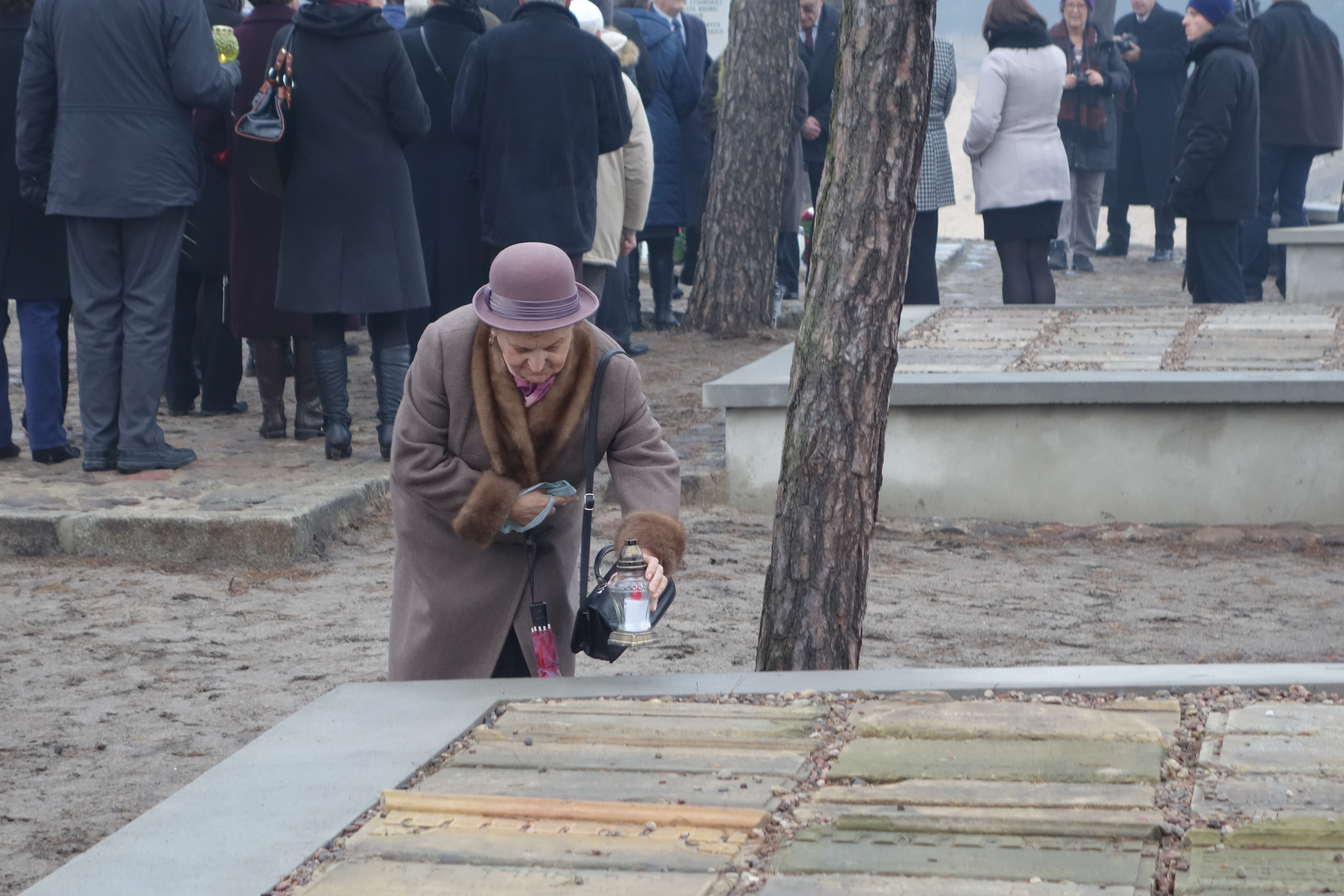
I didn’t know what a lapidarium is until I went to the opening ceremony for one in Wronki, a town about an hour north of Poznan. The opening was on December 14, 2014. Here are some photos:

Lapidarium in Wronki

Lapidarium in Wronki

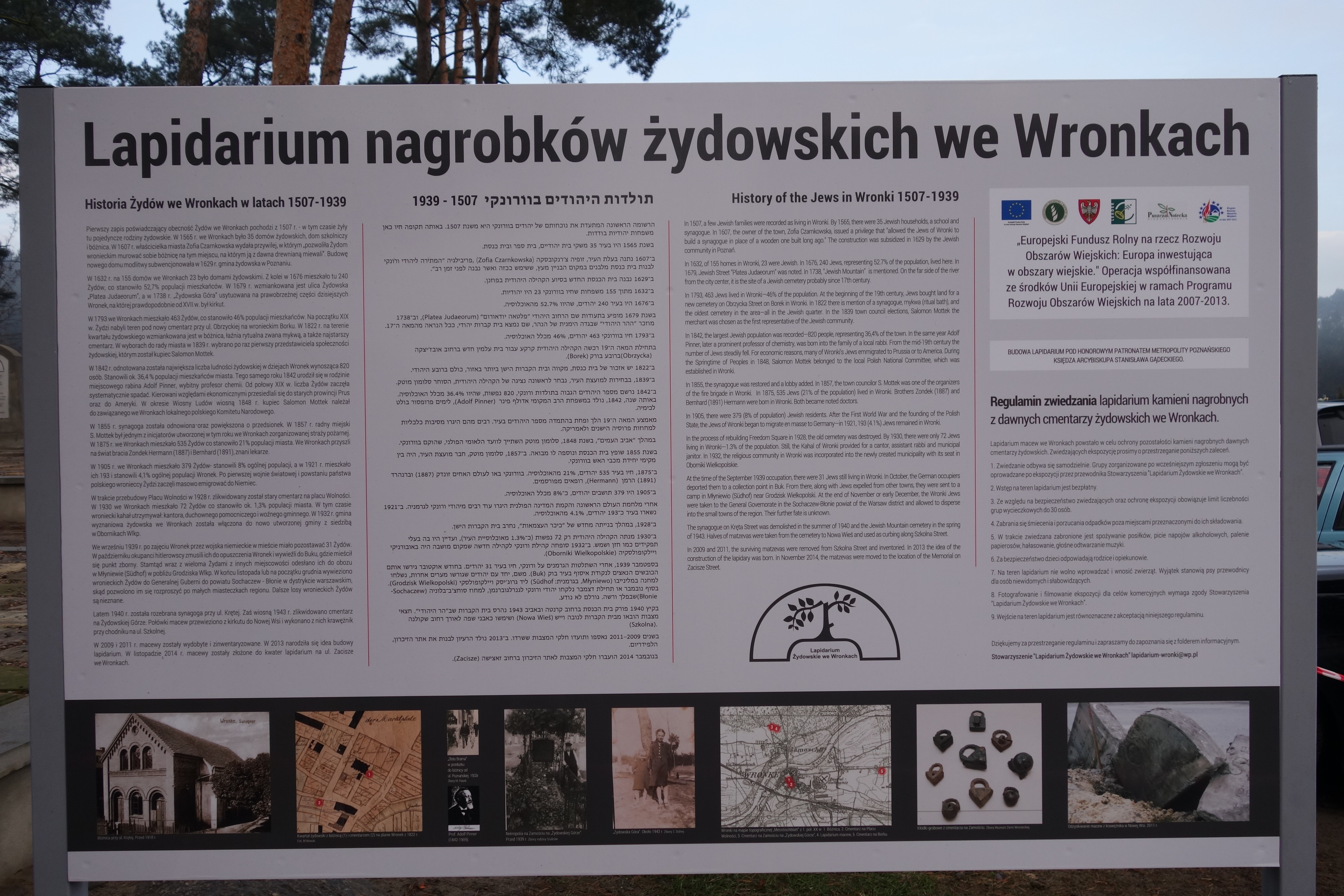
Sign outlining the history of Jews in Wronki

Sign outlining the history of Jews in Wronki

Piotr Pojasek speaking at the opening of the Lapidarium in Wronki

Piotr Pojasek speaking at the opening of the Lapidarium in Wronki

Placing a lantern at the opening of the Lapidarium in Wronki

Placing a lantern at the opening of the Lapidarium in Wronki

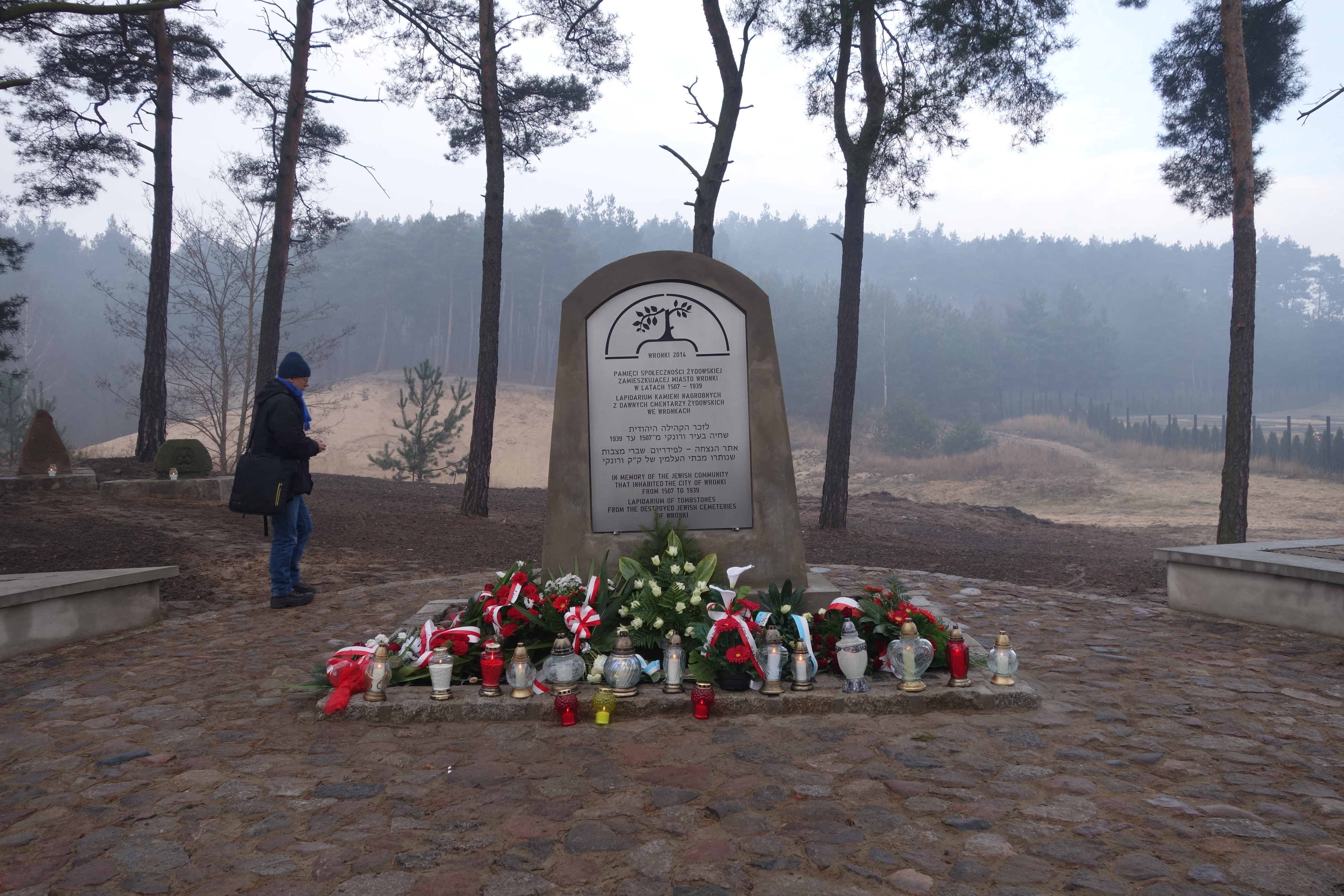
Flowers and candle lanterns placed at the monument at the heart of the Lapidarium in Wronki

Flowers and candle lanterns placed at the monument at the heart of the Lapidarium in Wronki

A stone with a tree with a broken branch, which became the logo for the lapidarium in Wronki

A stone with a tree with a broken branch, which became the logo for the lapidarium in Wronki

A lapidarium is essentially a place where stones are displayed. In this case, the fragments of the tombstones from the Jewish cemetery were recovered and placed in raised beds. The space around them is filled with small stones about the size of those that customarily would be placed on Jewish graves. Written in Polish, Hebrew, and English on a monument in the shape of a large tombstone are the words:

In memory of the Jewish community that inhabited Wronki from 1507-1939. Lapidarium of tombstones from the destroyed Jewish cemeteries of Wronki

This project represents for me the best of what can be done with the fragments of Jewish culture in Poland. It required the engagement of many different organizations and individuals, most of whom are not Jewish but who felt a moral obligation to recover these stones which were removed from the cemetery during World War II and later used to make a curb on a street in a neighboring village. For some, the lapidarium was a project of reclaiming the town’s heritage. For others it was much more bound up with faith and spirituality.

I’ve been back to Wronki a few times and talked with a number of people involved in the project. I’ll fill out this story in future posts.

Jews in Wielkopolska

14 Saturday Mar 2015

Posted by Marysia Galbraith in Heritage work, Polish-Jewish Heritage, Polish-Jewish relations, Poznan, Wielkopolska, Wronki

≈ 4 Comments

Tags

Partitions of Poland

Regions in Poland still reflect the different administrative regimes within the Russian, Prussian, and Austrian Empires that controlled Polish territory from the late 18th century until World War I. The experience of Jews in Poland varied across these boundaries, as well. It’s a bit like the continued influence of North-South differences in the US, particularly with regard to African Americans’ experiences. History can dig channels that influence the flow of events far into the future.

Map source and more information about the partitions of Poland: http://www.britannica.com/EBchecked/topic/466910/Partitions-of-Poland

Map source and more information about the partitions of Poland: http://www.britannica.com/EBchecked/topic/466910/Partitions-of-Poland

Wielkopolska Province, where I’m living, was under German/Prussian control during the period of partitions. Older residents in particular tell me this German influence has contributed to the region’s sense of order and relative economic success. Historically, regional residents were more interested in taking pragmatic steps to improve daily life (what has been called “organic work”) than in romantic battles for independence that were destined to be defeated. Some refer to this region as “Polska A” in contrast to the more backward and poor “Polska B” in eastern Poland. Some also complain that in recent years state and EU funding have tended to go to other regions of Poland, and that this is a residue of outdated perceptions that Wielkopolska is the least in need of development aid as well as distaste for the German influence that makes some consider the region “less Polish.” Channels can be redirected.

The highest percentage of Jews in Wielkopolska dates back to the first half of the 19th century. Jewish outmigration after then has been attributed to a number of factors. The first is economic; Jews saw more opportunities for themselves in larger German cities. They had often been educated in German schools, spoke German, and could move west without crossing political borders. Second, the German state offered rights of citizenship for ethnic and religious minorities. Many saw more opportunities to study at universities and build careers or businesses in what they perceived as the more developed west. Third, especially from the late 19th century and continuing when Poland regained independence after World War I, Jews were escaping growing Polish anti-Semitism. The National Democrats, with their platform defending the purity of the Polish state against ethnic and religious minorities, were particularly strong in Western Poland. Many Jews continued from Germany to the United States, chasing the promise of greater social equality as well as economic opportunities. In the interwar period, Palestine became the preferred destination.[1]

By the time World War II started, Jews constituted a tiny proportion of the population of cities like Poznan and towns like Wronki. In Poznan, there were maybe 2000 Jews, while in Wronki there were perhaps 30. This early emigration and the small numbers affect the kind of memory work that can be done in Wielkopolska. Many Jewish institutions (hospitals, schools, and even synagogues) had already closed their doors well before the war; Jews were less visible for the Poles who remember prewar life. There is another issue that has tended to limit Polish scholarship about the Jews of Wielkopolska. They often identified more closely with German culture than with Polish. This is visible even in the material fragments that have been recovered. I am thinking for instance of tombstones commonly inscribed in Hebrew on one side and in German on the other.

So overall, the fragments of Jewish life in Wielkopolska are older, the memories are more distant, and fewer residents have had direct experiences with Jews and Jewish culture. These factors pose a challenge to heritage work—it can be harder to find artifacts worthy of preservation, and more difficult to convince local residents and funding sources that these stories need to be told.

[1] I’ve read and talked to a lot of people about this, but thanks especially to Tomasz Kawski for explaining it so clearly.

Survival through luck and pluck

12 Thursday Feb 2015

Posted by Marysia Galbraith in Polish-Jewish Heritage, Survival, World War II

≈ 2 Comments

Tags

Embodiment, Eugene Bergman, False Papers, Memoir, Robert Melson, Survival Artist

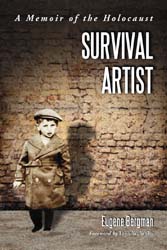
Survivial Artist by Eugene Bergman

Survivial Artist by Eugene Bergman

Today, I played mental hooky and finished Survival Artist: A Memoir of the Holocaust, written by Eugene Bergman (2009, McFarland). A Jew born in Poznan, he was nine years old when the war started in 1939. About surviving three ghettos—Łódź, Warsaw, and Częstochowa—and two years on the “Aryan side” he says, “I am not such a hotshot survival artist. If I have survived those sinister wartime years it was owing more to luck than to pluck” (p. 183). Still, to have survived at all, even after a German officer beat him with the butt of his rifle causing him to go deaf, required pluck as well as luck.

Every memoir helps reveal more facets of Jewish life (and death) in Poland. What stands out to me about this one is the way it shows the diversity of prewar Jewish culture, and the continued effects of those differences during the war. Poznan Jews generally had resources that helped them survive, particularly the fact that they were more integrated into Polish society; they were more secular, wore contemporary clothes and hairstyles, and spoke good Polish (or German). Bergman emphasizes his father’s business acumen, as well—a prewar fabric store owner, he supported the family by buying and selling whatever he could throughout the war. Further, he describes the family’s ability to “pass” through less tangible attitudes and behaviors. Instead of displaying fear in front of Germans (or Poles) they were bold, looking them in the eyes or ignoring them as the situation demanded.

This is interesting to me as a cultural anthropologist because they were able to embody the unmarked characteristics that tended to set non-Jews apart from Jews, and to shed the characteristics that made Jews targets. In many cases, these subtle cues were the only things that distinguished Jews and Catholic Poles. Bergman’s ability to embody that other identity is where I see his pluck. It reminds me of another fascinating memoir, Robert Melson’s False Papers: Deception and Survival in the Holocaust (2005, University of Illinois Press), also written by a child survivor on the Aryan side. Melson’s parents demonstrated “chutzpah and bravado” not only by taking on Catholic Polish identities, but also by claiming to belong to the noble Zamoyski family.

I was fortunate enough to meet Bob Melson when I was first embarking on this journey to uncover my own Jewish heritage. As a person, he stuck me as instantly familiar, as if he could have been my uncle. I think I was reading in him some of those same embodied ways of being I associate with my mom’s family–intellectual, refined, and Polish. But a particular kind of Polish. My family masked their Jewishness in a way that Melson hasn’t since the war ended, but I think what I recognized was a shared heritage, a particular version comprising both Jewish and Polish accents.

Newer posts →

Categories

  • Anthropology (37)
    • Archives (14)
    • Fieldwork (7)
    • Ground Penetrating Radar (GPR (4)
    • Research Methodology (8)
  • antisemitism (14)
  • Association of Descendants of Jewish Central Poland (32)
  • Catholicism (8)
  • Conference (1)
  • Discrimination (2)
  • Family (69)
    • Bereda (17)
    • Kolski (13)
    • Piwko (22)
    • Rotblit (3)
    • Walfisz (4)
    • Winawer (7)
  • Genealogy (11)
  • Heritage work (66)
    • Commemoration (23)
  • Identity (18)
  • Israel (6)
  • Jewish Culture (89)
    • Cemeteries (51)
    • Museum (7)
    • Synagogues (33)
  • Jewish immigrants (8)
  • Jewish Religion (1)
  • Memory (70)
  • Names (14)
  • Photographs (6)
  • Pifko-Winawer Circle (5)
  • Poland (125)
    • Baligród (1)
    • Bolimów (1)
    • Brześć Kujawski (5)
    • Buk (1)
    • Chodecz (1)
    • Dukla (2)
    • Dąbrowice (1)
    • Gdynia (1)
    • Gostynin (2)
    • Gąbin (1)
    • Izbica Kujawska (1)
    • Kazimierz (4)
    • Kowal (1)
    • Koło (1)
    • Krakow (7)
    • Krośniewice (1)
    • Kutno (6)
    • Kłodawa (1)
    • Lesko (8)
    • Leszno (1)
    • Lubień Kujawski (1)
    • Lubraniec (1)
    • Lutowiska (3)
    • Piła (3)
    • Podgórze (2)
    • Poznan (11)
    • Przemyśl (2)
    • Pzedecz (1)
    • Radom (1)
    • Radymno (1)
    • Sanok (1)
    • Skierniewice (5)
    • Sobota (2)
    • Tarnów (2)
    • Warsaw (22)
    • Wielkopolska (1)
    • Wronki (7)
    • Włocławek (20)
    • Zasław (2)
    • Łódź (1)
    • Żychlin (30)
  • Polish Culture (10)
  • Polish-Jewish Heritage (60)
  • Polish-Jewish relations (60)
  • Post-World War II (24)
  • Pre-World War II (22)
  • Reclaimed Property (1)
  • stereotypes (3)
  • Survival (9)
  • Trauma (3)
  • Uncategorized (5)
  • Victims and perpetrators (4)
  • World War II (45)
    • Jewish Ghetto (12)
    • Nazi Camps (5)
    • Polish Underground Army (3)
  • Yiddish (5)

Enter your email address to follow this blog and receive notifications of new posts by email. Your email address will not be shared.

Archives

  • October 2025 (1)
  • July 2025 (8)
  • June 2025 (1)
  • April 2025 (1)
  • August 2024 (3)
  • July 2024 (3)
  • May 2024 (2)
  • April 2024 (1)
  • May 2023 (2)
  • January 2023 (2)
  • December 2022 (7)
  • November 2022 (2)
  • October 2022 (5)
  • September 2022 (1)
  • January 2022 (1)
  • August 2021 (1)
  • December 2020 (2)
  • July 2020 (1)
  • May 2020 (3)
  • April 2020 (1)
  • March 2020 (1)
  • January 2020 (2)
  • May 2019 (1)
  • February 2019 (1)
  • November 2018 (1)
  • September 2018 (1)
  • August 2018 (3)
  • July 2018 (1)
  • June 2018 (1)
  • May 2018 (1)
  • April 2018 (2)
  • March 2018 (2)
  • February 2018 (2)
  • January 2018 (2)
  • December 2017 (2)
  • November 2017 (2)
  • October 2017 (1)
  • September 2017 (3)
  • August 2017 (3)
  • June 2017 (2)
  • May 2017 (3)
  • April 2017 (1)
  • March 2017 (2)
  • February 2017 (1)
  • January 2017 (2)
  • December 2016 (2)
  • November 2016 (4)
  • October 2016 (1)
  • September 2016 (6)
  • August 2016 (2)
  • July 2016 (1)
  • May 2016 (4)
  • April 2016 (2)
  • March 2016 (3)
  • February 2016 (4)
  • January 2016 (3)
  • December 2015 (3)
  • November 2015 (5)
  • October 2015 (5)
  • September 2015 (3)
  • August 2015 (4)
  • July 2015 (3)
  • June 2015 (3)
  • May 2015 (4)
  • April 2015 (9)
  • March 2015 (3)
  • February 2015 (2)
  • January 2015 (5)
  • December 2014 (4)
  • November 2014 (9)
  • October 2014 (2)
  • September 2014 (1)

Copyright Notice

All original text and images are copyright © Marysia Galbraith. Please contact the author before quoting.

Blog at WordPress.com.

  • Subscribe Subscribed
    • Uncovering Jewish Heritage
    • Join 147 other subscribers
    • Already have a WordPress.com account? Log in now.
    • Uncovering Jewish Heritage
    • Subscribe Subscribed
    • Sign up
    • Log in
    • Report this content
    • View site in Reader
    • Manage subscriptions
    • Collapse this bar
 

Loading Comments...