• About
  • The Photo that Started it All

Uncovering Jewish Heritage

Uncovering Jewish Heritage

Category Archives: Polish-Jewish Heritage

Kutno: Partnerships for Preservation

08 Saturday Oct 2022

Posted by Marysia Galbraith in Association of Descendants of Jewish Central Poland, Cemeteries, Commemoration, Heritage work, Kutno, Polish-Jewish Heritage, Polish-Jewish relations

≈ 6 Comments

Report #2 about Roberta Books and Marysia Galbraith’s trip to meet Polish partners in preparation for the ADJCP‘s memorial visit to central Poland. Reports include contributions by Roberta.

September 8-12, ADJCP Members Roberta Books and Marysia Galbraith, Jewish Kutno Member Yosef Kutner

Our visit to Kutno was organized by our tireless partner Bożena Gajewska, until recently the director of the Friends of Kutno (Towarzystwo Przyjaciół Żiemi Kutnowski, TPŻK) and the coordinator of multiple projects related to Jewish memory.

We started the day in the Kutno Jewish Cemetery.

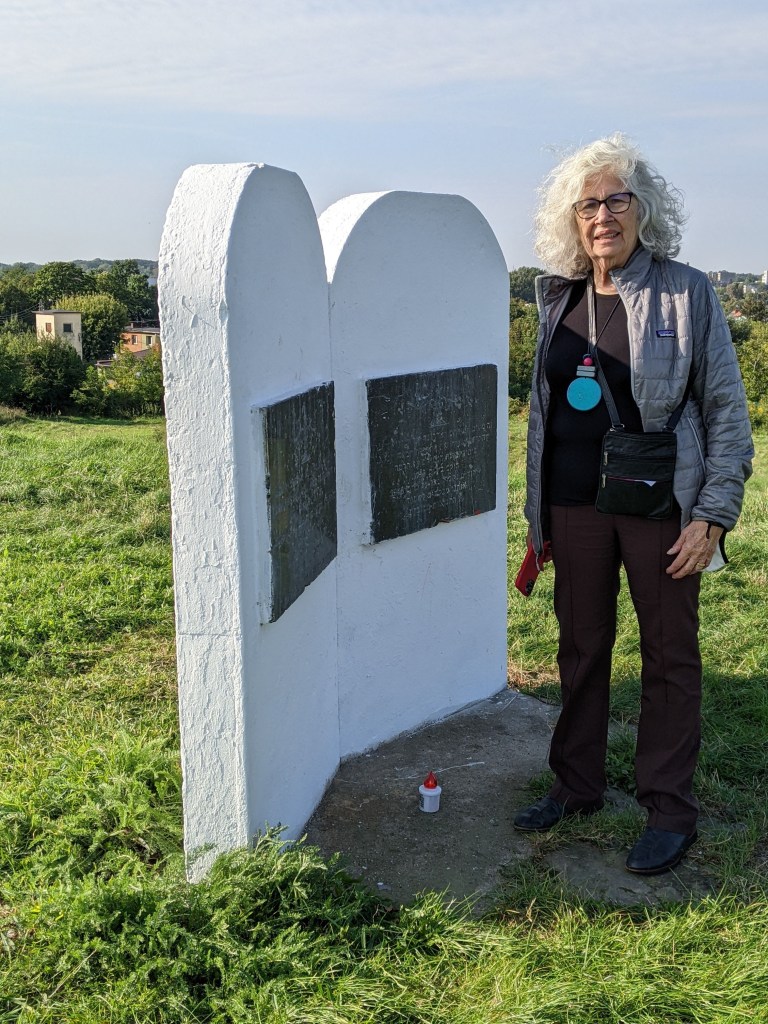
Panorama of the Kutno Jewish Cemetery from the top of the hill, Roberta stands beside the memorial monument on the left

The cemetery is the largest one in our area, covering 3 hectares. Yosef’s mission was to inspect the boundaries to see the condition of the fence. We found some fragments of the prewar brick fence. There are several access points to the cemetery, making it a place where Kutno residents cut through on their way to school or home, or where they walk their dogs or children play. Despite signs posted by the TPŻK explaining this is a cemetery and should be respected, piles of trash in remote corners of the cemetery suggest it is used as a place to drink and socialize. We located a sunken area where a tree grows, the likely sight of the Ohel of Rabbi Israel Joshua Trunk (1821-93), and larger sunken area hidden by overgrowth that might be the site of a wartime mass grave.

  • Sign reminding visitors to respect the Jewish Cemetery
  • Possible fragment of the original brick wall that surrounded the cemetery
  • Possible site of Rabbi Trunk’s Ohel
  • Sunken area that may be site of mass grave
  • Roberta next to the commemorative monument, Kutno cemetery

Next, we met the Kutno Regional Museum Director Grzegorz Skrzynecki and others at a defunct brewery warehouse where the museum stores hundreds of matzevot fragments recovered from the places they were used in road and construction projects (a common practice during and after the German occupation). The volume of stones is astounding, though still just a fraction of the matzevot plundered from the cemetery. You can see many of them with English translations of the decipherable texts in Yosef Kutner’s book Broken Memories: Remains from the Jewish Cemetery in Kutno. Yosef compiled the book from photographs, so this is the first time he saw the actual stones. Piled as they were, most of their identifying numbers are not visible. Nevertheless, there on the surface, Yosef found the top of his great grandfather’s tombstone. Mr. Skrzynecki explained that more fragments were found during a recent road project. They didn’t make it into the book, but I’m sure Yosef will find a way to share that information once he has it.
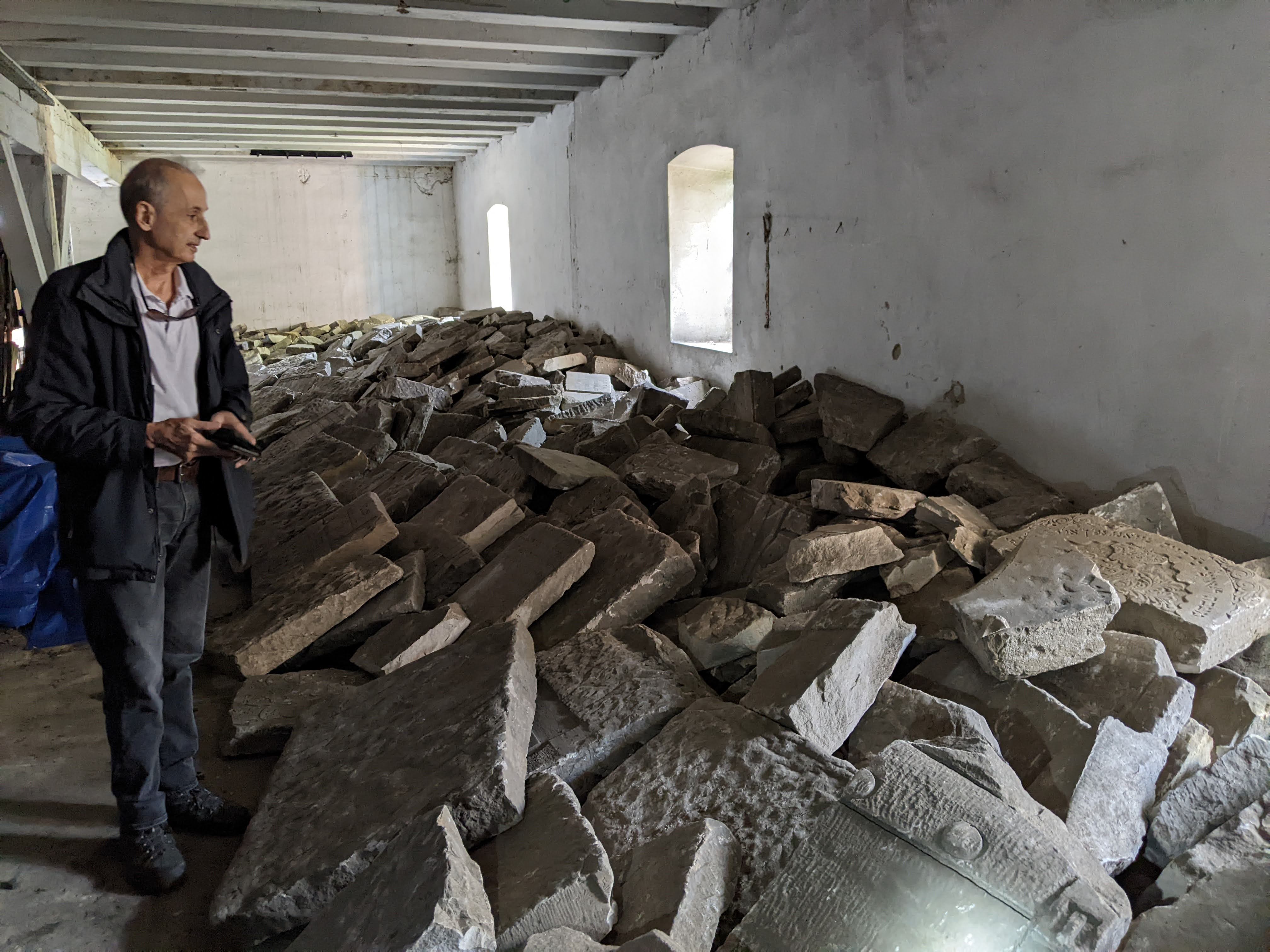
Yosef scans the recovered matzevot fragments, many of which he includes in his book Broken Memories

Meeting to discuss cemetery protection and maintenance

The meeting to discuss the future of the Kutno Jewish Cemetery followed. It was attended by key figures from the Jewish Community of Poland (Chief Rabbi Michael Schudrich), from the town of Kutno (Deputy Mayor Zbigniew Wdowiak, town attorney Agnieszka Wojkowska-Pawlak, museum director Grzegorz Skrzynecki, museum public relations and marketing Katarzyna Erwińska, library head Magdalena Konczarek, and Michael Adamski, head of the Department of Culture, Promotion, and Development), from the Association of Friends of the Kutno Region–TPŻK (Bożena Gajewska), and from international Jewish heritage groups (Yosef from Jewish Kutno and Roberta and me from ADJCP).
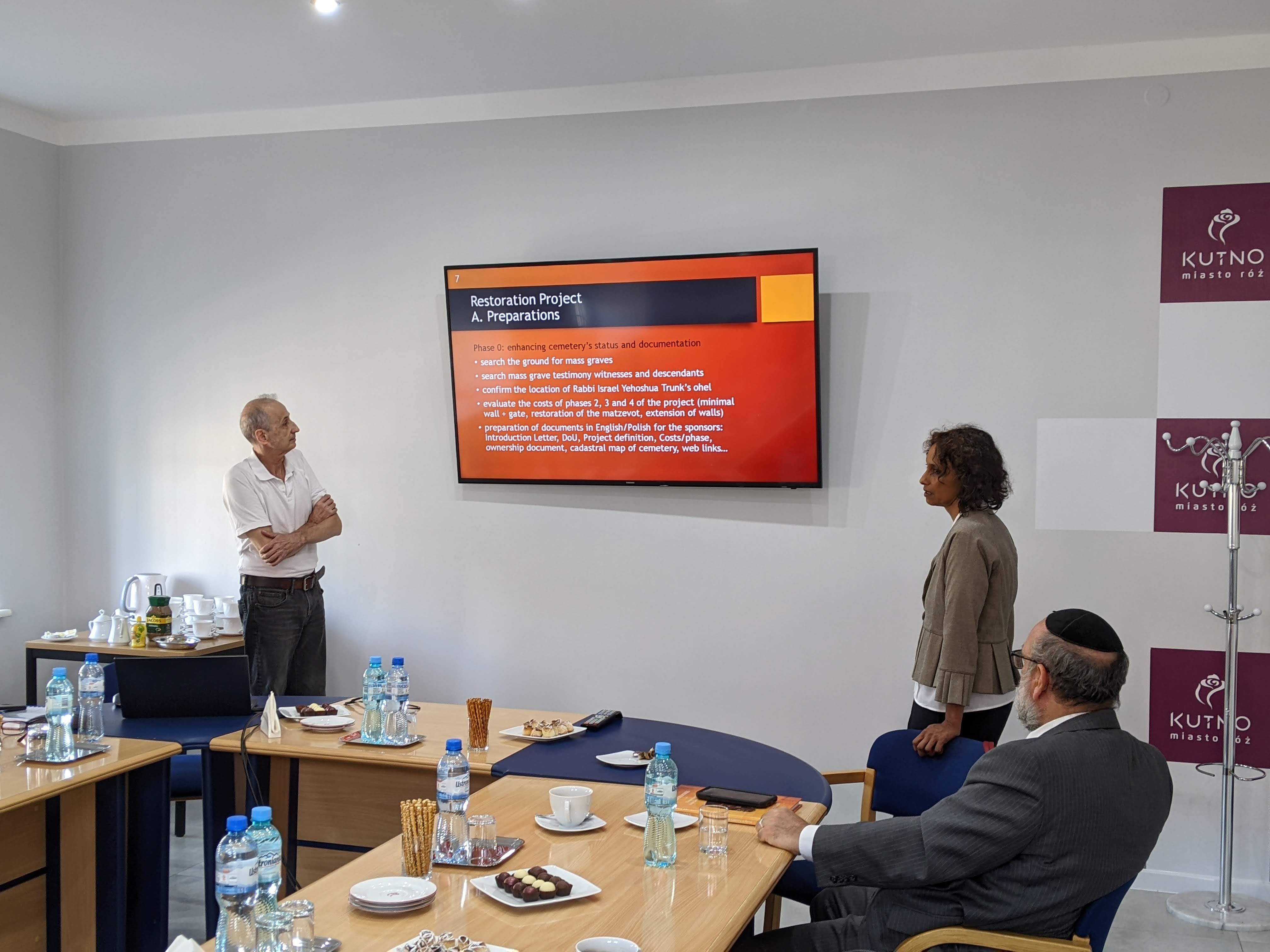
Yosef Kutner presenting his proposal for the Kutno Jewish Cemetery. Rabbi Schudrich seated on the right

This description is based on Roberta Books’ memo: The city deputy president opened the meeting with a presentation of the many actions the Town of Kutno has undertaken in support of remembrance of the Jewish history of Kutno, including the biennial Asch Festival.  

Josef Kutner followed with a slide presentation about the Jewish cemetery of Kutno, and his proposal for protection of the property. His proposal includes fencing the entire property with a brick wall that resembles the wall around the Christian cemetery, confirming the location of two mass graves mentioned in the Yizkor book and commemorating the mass graves with an appropriate marker, and limiting access to the site in order to prevent partygoers and others from disrespecting the site. Kutner also advocated creating a memorial with the preserved matsevot and marking the site of Rabbi Trunk’s Ohel.  

The town attorney then discussed the ownership of the site. Important records for verifying with legal clarity that the Jewish Community of Kutno owned the site, in particular the Land Registry Book, are missing and unlikely to be located. Despite 20 years of effort, the town has been caught between legal requirements and administrative rulings that have called into question their legal right to maintain the site. Although no interested party questions that the site belonged to the Jewish Community of Kutno, legally this remains a murky area.  

Rabbi Schudrich responded that he has dealt with similar problems in Poland on a number of occasions and he is confident that he can sort this out satisfactorily. He told the parties that they should begin planning while the legal issues were being sorted.  

Schudrich and the deputy president talked about the change in mentality that they expect will come about when the plans began to come to fruition. When Jewish cemeteries are protected, local residents begin to take pride in them and matsevot have a way of coming out of hiding and returning to the cemetery.  

The deputy president voiced his full support for the cemetery renovation, including covering the costs of a new wall. He noted that he, too, had drawn up preliminary plans for fencing the cemetery. They differ from Kutner’s proposal in two key ways. His design would be constructed of metal with brick pillars, not brick like the historical wall or the wall surrounding the Christian cemetery. Also, it would have multiple access points rather than the single access point in the Kutner proposal. The deputy president wants current residents to remain able to walk across the site; he pointed out that its location in the middle of the city would complicate closing it off. He wants the site to be respected as an integral part of the town. He noted that Rabbi Schudrich was consulted throughout the development of the plan, and he supported this idea. 

I want to emphasize the good will everyone projected toward each other as well as the resolve to push through the twenty-year roadblock that has stalled the project to secure the cemetery. Since the meeting, Yosef Kutner has continued to share materials about the likely location of the mass grave and to push for his vision for the cemetery restoration.

Additional meetings

After lunch, we visited the city library, where director Magdalena Konczarek showed us a short film they produced about Sholem Asch, his work, and the biennial Kutno Sholem Asch Festival. The library sponsors the festival, which has been held every other year since 1993. They also have an extensive collection of materials related to the Jewish history of Kutno and of Asch. They have published several academic volumes based on papers delivered at the conference that occurs in conjunction with the festival, as well as Polish translations of Asch’s work. For the memorial trip in May, Magdalena and library historian/regional specialist Andrzej Olewnik will mount an exhibition featuring their collection.

We continued to the offices of the TPŻK where we met Bożena Gajewska (until recently the organization president) and the vice-president Grażyna Baranowska (former librarian and organizer of the Sholem Asch Festival). Bożena reaffirmed her commitment to continue working on projects associated with Jewish Kutno, and Grażyna affirmed the continued support of the TPŻK.

The next day, we viewed an exhibition in the Kutno Community Center about the Eizyk brothers who bred and grew roses before and after the war. From this successful business, the city adopted the moniker “City of Roses.” The exhibition was part of the annual Rose Festival that attracts thousands of visitors to Kutno.

Students at the Jan Kasprowicz High School in Kutno, together with Roberta, Marysia, and principal Ciurlej

On September 12, we visited students at the Jan Kasprowicz High School (Liceum II). Roberta and I agree that such outreach to young people was one of the most important (if not the most important) part of our visit. We were welcomed by school director (principal) Artur Ciurlej, teacher Anna Ambrosiak, and a room full of students eager to hear from us. They showed us a short video about their recent activities related to Jewish memory (including dancing lessons!), and then Roberta and I each told our personal family story, explained our ancestors lived nearby, and talked briefly about our desire to restore Jewish memory. The meeting took place in English, but the students clearly understood us; they asked thoughtful questions and shared some of their own experiences with us. We spoke for more than a class period, even after the bells rang. Some students promised to meet us again in May, although they will have graduated by then.

Final note: Clearly, we have strong partners in the Kutno city government and with the TPŻK. They all expressed the desire to work with us and seem to have a sincere interest in preserving and promoting the Jewish heritage of the city. They are eager to participate in the memorial trip in May.

They Want to Know Our Stories:

21 Wednesday Sep 2022

Posted by Marysia Galbraith in Association of Descendants of Jewish Central Poland, Heritage work, Poland, Polish-Jewish Heritage, Polish-Jewish relations

≈ 4 Comments

Tags

ADJCP Memorial Trip in May 2023, Central Poland September 2022

Report #1 about Roberta Books and Marysia Galbraith’s trip to meet Polish partners in preparation for the ADJCP’s memorial visit to central Poland. Reports include contributions by Roberta.

What stories were passed down in your families? Do you have any photos from Poland?

Roberta Books and I took a whirlwind trip through central Poland to meet with local government officials, as well as representatives of nonprofit organizations, local history organizations, and schools. Our primary goals were to introduce the the Association of Descendants of Jewish Central Poland (ADJCP), discuss ways we can collaborate on projects that commemorate and preserve Jewish history in the region, and develop partnerships with people who will help coordinate activities for the May 2023 memorial trip. I will post photos and brief outlines of our visits to 15 of the towns in our region, but first let me share some overall impressions.

First and foremost, everywhere we went, we met people interested in the Jewish history of their communities and most of them have already worked on projects preserving and publicizing that history. We are confident they will prepare an interesting program for our memorial trip.

Roberta and I made a great team. I initiated and translated most of the conversations, while Roberta kept notes on who we met and what we discussed. She also asked a lot of great questions that helped clarify what our Polish partners have done and the source of their interest in Jewish heritage.

The working itinerary for our heritage trip is as follows:

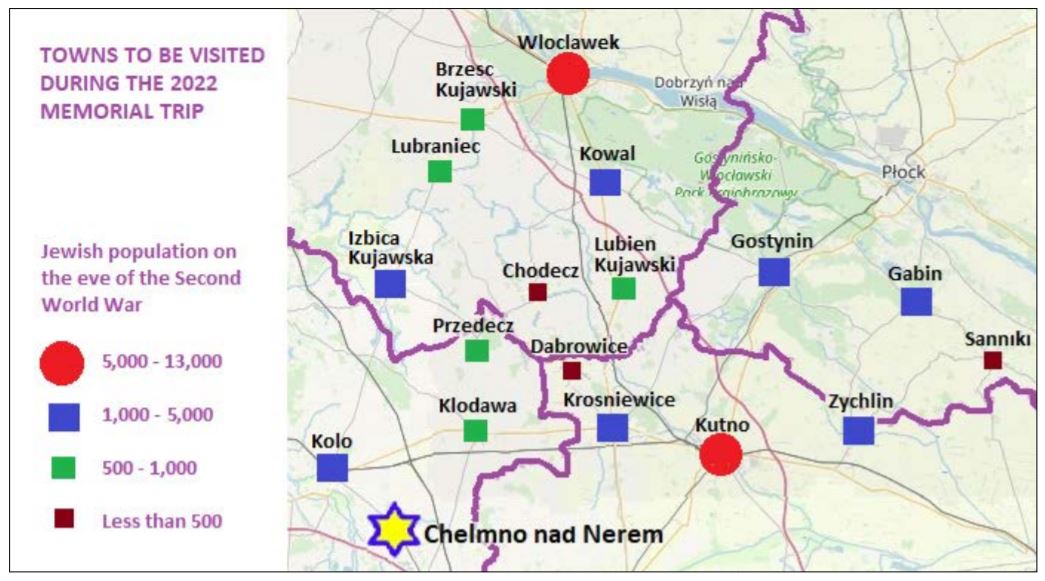
Proposed schedule for memorial trip for members of the Association of Descendants of Jewish Central Poland (ADJCP). Map shows the towns that will be included on the trip.

We asked our Polish partners to help plan half-day or full-day activities, depending on the size of the town. Specifically, we asked for a tour of Jewish sites, a visit to the Jewish cemetery, and one other organized activity such as a visit to a local school or a museum exhibition about Jewish residents of the town. Partners in Wloclawek and Kutno were asked to organize additional activities since we will be in these places for a full day. They will help us find translators wherever our partners don’t speak English.

We emphasized that our hope is to establish lasting connections. We asked our partners what they would like to see done in their community and how we might help. Pretty much everyone expressed the desire for personal accounts of the experiences of Jewish residents (even those told to our members by older relatives) as well as photographs. Our partners would use these materials in educational programs, exhibitions, and publications.

Do you have any stories or photographs to share? Please let us know and we will make sure they are delivered to our partners in the places where our ancestors lived.

Trip to Jewish Central Poland in 2022

06 Wednesday May 2020

Posted by Marysia Galbraith in Brześć Kujawski, Heritage work, Kutno, Nazi Camps, Polish-Jewish Heritage, World War II, Włocławek, Żychlin

≈ 7 Comments

Tags

ADJCP, Association of Descendants of Jewish Central Poland, Memorial Trip 2022

It turns out I’m not the only one who dreams of doing Jewish heritage work in the land of my ancestors. The Association of Descendants of Jewish Central Poland has just gained nonprofit status and welcomes members.

It started at the initiative of Leon Zamosc, who reached out to others on JewishGen seeking information about ancestors from the region around Kutno and Włocławek. As the message from the founders explains:

The concept of a regional organization of descendants developed out of an initiative to visit the districts of Wloclawek, Gostynin, and Kutno in order to commemorate the 80th anniversary of the destruction of the region’s Jewish communities during the Shoah. About 60 JewishGen researchers responded to the initial invitation, including 16 who volunteered as consultants for the planning of the Spring 2022 trip. In those early exchanges, some participants proposed the creation of a more permanent organization that would allow us to develop other activities related to the cultural heritage of the region’s shtetls. After studying the options, a subcommittee of 9 participants suggested ideas for possible activities and recommended the establishment of the ADJCP – Association of Descendants of Jewish Central Poland.

On the 2022 trip, we’ll participate in memorial activities at the Chełmno Death Camp. We will also learn about the history and culture of Jewish residents of the region, spending time in the larger cities of Włocławek, Kutno, and Gostynin. In additon, participants will have the opportunity to participate in small group excursions to the smaller cities and towns where their ancestors lived. We hope to contribute to a heritage project while we are there.

2022MemorialTripMap

Learning about Jewish Religion and Culture in Leszno

07 Thursday Jun 2018

Posted by Marysia Galbraith in Catholicism, Fieldwork, Heritage work, Jewish Culture, Jewish Religion, Leszno, Museum, Polish-Jewish Heritage, Polish-Jewish relations, Synagogues

≈ Leave a comment

Tags

Leszno Regional Museum, Muzeum Okręgowe w Lesznie, Religious Instruction in Schools

“Why should we learn about Judaism?” Mirosława Maćkowiak asked, gazing kindly at my son’s 5th grade class. The twenty-five ten-year-olds sat in chairs in the Jewish Gallery of the Leszno Regional Museum, which is housed in the former synagogue. I hurried to translate Maćkowiak’s question; the language of instruction at the International School of Poznan is English, and only some of the students speak Polish. Maćkowiak, the curator of the Museum’s Jewish collection, answered her own question: We should learn about Judaism because Jesus was a Jew. He celebrated all the Jewish holidays, followed all the Jewish laws, and dressed like a Jew. It’s important to know about the older religion from which Christians came. Judaism is that older religion.

DSC03937

ISOP students heading to the museum in Leszno, 2015.

Ian’s teacher, Ms. Ania grew up in Leszno, which is about 50 miles south of Poznan. Blond, with the perky beauty of a cheerleader, she is perhaps the only Pole I have ever met who openly declares herself an atheist. She developed a special interest in Judaism after getting to know some Jewish people in London. She lived on a kibbutz in Israel, where she absolutely loved the country and the people. When she returned to Poland, she made a point of learning more about its Jewish history. She brings her students to Leszno every year so they can see artifacts that once were part of the Jewish life that filled the city. She said there isn’t really an equivalent space in Poznan, where the historic synagogue housed a public swimming pool for years, and closed to the public in 2012.

Ania and Mirosława have known each other for years, but each has a very different perspective on religion. Both are positively oriented toward Judaism, and celebrate the historic cultural and religious diversity of Poland, but Mirosława also makes the assumption that the Polish nation is Catholic, and so legitimizes Judaism for her young Polish audience by linking it to the origins of Christianity. Segments of the Catholic Church promote the perspective that Jews are “older brothers in faith, as I witnessed during Judaism Day, which has been a holiday of the Polish Catholic Church since 1997.

During our visit, Ania kept reminding Mirosława that her students were not there to study Judaism from a Catholic theological perspective. “Not all of my students are Catholic,” she insisted. When Ania took a turn translating, she distanced herself from statements framed in a Christian perspective by prefacing them “According to Ms. Mirosława.”

Jewish memory work in Leszno shows us a few things about what can be done with Jewish heritage in Poland. In Leszno, important tangible heritage survived the war, providing a foundation for building public awareness about the history of Leszno’s Jewish population. Additionally, a local institution, the Leszno Regional Museum (Muzeum Okręgowe w Lesznie), became active in historical preservation right after the fall of communism, making Leszno one of the first communities in Poland to renovate Jewish structures, mount Jewish-themed exhibitions, and organize related public events. A central cornerstone of museum activity includes programs for school children, such as the one attended by my son’s class.

Leszno is a regional center with a population of about 64,000. More than a century of Prussian rule contributed to German cultural influences, and in the mid-19th century, the Jewish population began to emigrate to other German cities. By 1923 the last Leszno rabbi departed and was not replaced; only 160 Jews remained in Leszno. When Leszno was absorbed into Hitler’s Third Reich, the few remaining Jews were forced to move to places further east and then became victims of the Holocaust.

Besides the synagogue, several other buildings remain of the city’s Jewish past: a mortuary building where bodies were prepared for burial, now the public library; a mikvah; and multiple houses within the narrow, winding streets of the Jewish district. Little remains of the cemetery, on which socialist-era concrete apartments were built in the 1970s. Some tombstones have returned, however, rediscovered in farmyards and under roads, and now wait in a pile outside the mortuary building until someone gathers the funds and the initiative to create a lapidarium.

Former synagogue, Leszno
Childhood home of Leo Baeck (1987-1958), rabbi and theologian of Liberal Judaism. Leszno.
Mortuary building, Leszno. Apartments behind it were built on the Jewish cemetery
Grave stones outside the former mortuary house, Leszno
Mikvah, Leszno
Mikvah, Leszno
Jewish quarter, Leszno
Old House of Prayer, dating from the first half of the 18th century, Leszno Jewish quarter

The Leszno Regional Museum’s impressive collection of Jewish sacred and everyday objects are mostly on loan from other regional museums. They are arranged in wood-framed glass display cases, each containing objects associated with a religious holiday. A laminated sheet on top of each case describes the historical and religious significance of the holiday, typical activities and meals, as well as characteristic objects associated with the holiday. For instance, one case contains artifacts relevant to Hanukah, mostly nine-candle menorahs called hanukiahs. The written description explains Hanukah, the Holiday of Lights, is “the eight-day holiday commemorating the triumph of Judah Maccabee against the Syrian army in 165 BC….” and explains, “Each day a successive candle is lit.” Words like “hanukiah,” “gelt,” and “dreidel” are written in bold, followed by their definition and their significance for the holiday.

Students meet Mirosława Maćkowiak, Director of the Jewish Division of the Leszno Museum, in the former sanctuary of the synagogue
Maćkowiak, Director of the Jewish Division of the Leszno Museum, discusses Jewish religion and culture. On the wall hangs an ornately embroidered parochet, a curtain that would go in front of the wooden cabinet containing the Torah scrolls.
Shabbat artifacts, including cups, tray, spice tower, and challah draped by a white cloth, Leszno Museum.
Torah, crown and cover, Leszno Museum.
Barrel and dippers for ablution, Leszno Museum.
Maćkowiak explains to the the children how to use a yad, a Torah pointer, Leszno Museum.

Another case labeled “Shabbat table” contains silver cups, goblets, spice towers, candlesticks, a tray, and a knife, all arranged atop a white linen cloth. Two loaves of challah covered with a white cloth complete the display. The information sheet says, “Shabbat (rest) is the most important weekly Jewish holiday, in which there is an obligatory restriction on doing any kind of work. It begins on Friday at sunset and ends on Saturday at dusk. It is a joyful holiday.” It goes on to describe how candles are lit by a woman, while the father of the family says a prayer called kaddish (written in bold). Further, it explains that herbs are placed in the spice tower (bessamin, the Hebrew word is written in bold) and lit on fire. It describes typical Shabbat food, including challah, chicken soup, and the single-dish meal for Saturday dinner called cholent (again, this term is in bold).

The texts signal continuity over change. Jewish culture is portrayed as something that does not modernize. But this emphasis on normative customs also relegates Jewish culture to the past. The objects on display are old, most dating back to the 19th and early 20th centuries. While many of the objects, such as hanukiahs and Shabbat goblets, have contemporary equivalents that remain part of standard Jewish cultural and religious practice, other objects on display are artifacts of a former era. For instance, one of particular interest to the ten-year-olds on my son’s fieldtrip was a massive copper barrel set on the floor in a corner. Mirosława Maćkowiak explained that it would have been placed at the entrance of a mortuary building or some other place where it was customary for Jews to wash their hands. She pointed to two two-handled containers tacked to the wall above the barrel, and said they would have been used to scoop out and pour the water. She related this practice to the importance of cleanliness in the Jewish tradition.

Maćkowiak made similar generalizations about the value Jews placed on education, their kosher dietary practices, as well as the kinds of activities restricted on the Sabbath, such as cooking or turning lights on or off. She made no mention of the fact that many contemporary Jews dispense with these practices, nor did she discuss historical variation among Jewish populations. Even though Mirosława Maćkowiak talked about Judaism as a living religion, still practiced by millions of people worldwide, the static portrayal within the museum exhibition reflects the absence of Jews within contemporary Polish society.

My son’s class, when given the opportunity, gazed at the articles in the display cases with curiosity. Of far greater interest to them, however, was the hands-on demonstration by Maćkowiak in front of a two-meter tall display case intended as the focal point of the room. She explained that this was meant to evoke the most sacred part of a synagogue—the Aron haKodesh, where the Torah scrolls are stored. She pointed out the parochet hanging on the wall to the right of the case, explaining elaborately embroidered curtains such as this would cover the front of the wooden Torah cabinet. She pointed out the items in the case, including a silver crown set atop a fabric Torah cover, as well as some Torah scrolls wound around wooden dowels. Then she put on white archivist gloves, and took out a silver yad with a pointing end shaped like a tiny hand with its index finger extended, and demonstrated how such pointers were used to read the Torah from right to left without touching the parchment.

My son’s class was not the traditional school group. Their teacher brought them as part of a unit on world religions, where the emphasis was on cultural and religious diversity. By contrast, most school trips are initiated by religion teachers.

In most cases, religion is taught by Catholic clergy during the regular school day. This is an artifact of a law passed in 1991 in reaction to the Communist rejection of religion. As a reassertion of the centrality of religion for the Polish nation, religious education in schools became standard. Over the years, many have complained to me about it, but very few go to the trouble of filing the necessary paperwork to have their children attend “ethics” classes instead. After all, 90% of Poles identify as Catholic, and children risk ostracization if they are singled out like that.

Notably, this law passed at the same time that Jewish heritage work came out of the shadows and spurred public projects like the one that established the Jewish exhibition in Leszno. Poland is a complicated place, and relations between Jewish and non-Jewish Polish culture and history are a fundamental knot at the center of that complexity.

Jewish Genealogists in Warsaw

24 Thursday May 2018

Posted by Marysia Galbraith in Conference, Genealogy, Heritage work, Poland, Polish-Jewish Heritage, Research Methodology, Warsaw

≈ Leave a comment

Tags

IAJGS, International Association of Jewish Genealogical Socieities

For the first time, the International Association of Jewish Genealogical Societies (IAJGS) will hold their annual conference in Poland. From my perspective the timing couldn’t be better. It’s a chance for Jewish genealogists to visit the land where so many Jewish ancestors lived, and to highlight the incredible work that has been done in Poland to reassemble Jewish history and culture in towns and cities all over the country. None of this erases the horror of the Holocaust, but the conference promises to be a space for Poles and Jews to meet in a spirit of dialog and reconciliation. The Polish co-hosts, the Jewish Historical Institute and the POLIN Museum of the History of Polish Jews, have been at the forefront of such efforts. They deserve international recognition and support for all they have done, and all there remains to do.

The conference will be in Warsaw from August 5-10. The first hotel filled up so quickly, they added a second, and now a third to the list. In fact, I read somewhere that already more people have registered this year than ever before.

I will have two presentations at the conference. I  tried to think of topics related to my areas of expertise that would also be of relevance to genealogists. This is what I came up with:

The Past in the Present: How the Polish Partitions Shape Jewish Heritage Work Today (a 1 hour presentation)

Returning to the towns and cities of our Jewish ancestors in Poland, we are likely to feel haunted by the absence of Jewish life. And yet, if we know where to look, residents of communities throughout Poland have worked tirelessly to bring Jewish history, heritage, and memory back into the public sphere, in the form of monuments, memorials, and culture festivals. This work is influenced by the legacy of the ruling empires—Russian, Prussian, and Austrian—that partitioned Poland from the end of the 18th century until World War I. Within each partition, the particular character of leadership shaped Jewish communities, which in turn contributed to the different ways in which the Holocaust was carried out. The legacy of the partitions continues to influence Jewish heritage work today—as well as the kinds of records and local allies available to genealogists. The presentation offers insights into finding local resources relevant to genealogical work.

–and–

Pulling Stories Out of Silence: Uncovering my Hidden Jewish-Polish Heritage ( a 25 minute presentation)

I had been visiting Poland for 20 years before I realized that if I really want to know about my family’s Polish heritage, I needed to delve into the big secret in the family: that my grandmother was born Jewish. Since 2011, I have tracked down family photographs, collected memories from relatives, searched archives for family records, and traveled to the towns and cities of my ancestors. Not only have I traced my ancestors back to the 18th century, I have also, more importantly, found my living relatives—in the US, Israel, Switzerland, and Canada. Through my personal story, I explore the complex relationship between Jews and Catholics in Poland before and during World War II, and how it carried over into my family’s life in the US. I also offer clues about the resources available online and in Poland for anyone who wants to trace their Polish-Jewish ancestry.

PolishPartitionRegionsMapJewishGen

Source: : https://www.jewishgen.org/databases/Poland/GeoRegions.htm. Map shows the administrative subdivisions (gubernia) of Congress Poland from 1867-1918.

The first presentation dovetails with the ethnography I’m writing about Jewish heritage work in towns and small cities, provisionally titled Memory in Fragments: Reassembling Jewish Life in Poland. The project asks what can be done with the fragments of Jewish heritage that remain, sometimes hidden and sometimes in plain sight? And what value does such memory work have? I have learned that the legacy of the Polish partitions continues to  shape the various regions of Poland in ways that also influence what is left of Jewish culture, and how local communities mobilize to commemorate and preserve Jewish memory. Genealogists will find it useful to know the history of the Polish partitions because it influences the language in which records were kept, the migration patterns of Jewish populations into and out of various regions, the impact of the Holocaust, and the memories and silences that contributed to the preservation or destruction of Jewish heritage after the war.

The second presentation recounts my more personal journey of discovery about my Polish Jewish family, which I am documenting in what I call a family memoir provisionally titled, Do Not Open: A Family Memoir of Hidden Jewish Ancestry.

The conference website includes a statement, Why Our Jewish Genealogy Conference is Coming to Warsaw. In it, conference co-chair Robinn Magid writes, “We believe in continuing dialogue between people of different perspectives and in supporting the Jewish Community of Poland today.” Especially now, as nativism, tribalism, and nationalism have been overtaking public discourse, such dialog and support are crucial for advancing an alternate narrative of mutual respect and hopefully, reconciliation.

Pavement of Memory

17 Tuesday Apr 2018

Posted by Marysia Galbraith in Cemeteries, Commemoration, Heritage work, Memory, Polish-Jewish Heritage, Poznan

≈ 1 Comment

Tags

Janusz Marciniak

“We recover history…we record history.”

That is what the Jewish Community of Poznan wrote when they announced a new memorial, “Pavement of Memory,” built with fragments of Jewish tombstones that were recovered during roadwork in Poznan.

1_Jewish Cemetery in Poznan

“Pavement of Memory” composed with fragments of matzevot (Jewish Tombstones), Poznan                            Source: Janusz Marciniak

When the road crew dug up the old pavement, they noticed some stones with strange writing on them. Realizing the letters were in Hebrew, they contacted the Jewish Community. The fragments are too small to make out names or details about whose tombstones they were, but at least they have returned to the cemetery where they belong. All over Poland, fragments like this are being found, out of place, reinforcing road beds, bridge foundations, and lake beds. They were harvested during the terror of the Nazi occupation, and sometimes afterwards under state socialism. With only ghosts to look over them, Jewish cemeteries became a source for scarce building materials.

The extraordinary thing is that when public spaces are designated as repositories of Jewish memory and culture, objects return to them. As cemeteries are cleaned up, fenced, and marked, tombstones come back. In some cases, it’s as if people have known for a long time about these objects. They felt they were out of place and it has sat uneasily on their minds. They are relieved to finally know where these objects should go. In others, as with this road project, people are surprised to find these fragments, but they feel a sense of obligation to honor the memory of the past. To put things back into place.

3_Jewish Cemetery in Poznan.JPG

“Pavement of Memory” at the memorial site in a corner of Poznan’s Jewish cemetery.

These fragments are back home on a wall in the corner of the Poznan Jewish Cemetery.

“Pavement of Memory” was designed by Janusz Marciniak, who also designed the memorial at the Jewish cemetery in Piła and did a series of installations in the Poznan synagogue when it still housed a swimming pool. Janusz’s design is simple and powerful, honoring the integrity of each fragment by hanging them in three rows of ten. And yet together, like a mosaic, they make a unified statement.

4_Jewish Cemetery in Poznan.JPG

Detail of macevot fragments in Pavement of Memory

The words on the memorial plaque, in Polish, Hebrew and English, read:

Był czas, kiedy z macew robiono bruk. Czas, w którym najdosłowniej rozbijano, deptano i kaleczono pamięć o ludziach pochowanych pod macewami. Niektóre z kamiennych okruchów tej pamięci przetrwały i dziś ta pamięć łączy się z wdzięcznością dla wszystkich, którzy przyczynili się do jej ocalenia. „Z owocu swoich ust nasycony będzie człowiek dobrem, a odpłacone mu będzie według tego, co zrobity jego rece” (Prz 12, 14).

הייתה עת שבה עשו ממצבות אבני מדרכת, עת שבה היו באופן ממשי מנתצים, רומסים ופוצעים את זכרם של האנשים הטמונים מתחת למצבות. אחדים מהשברים של אבני הזיכרון

אותן הזיכרון מתאחד שרדו, וכיום עם הכרת טובה לכל אלה שתרמו להצלתו. “מפְרִי פי־אישׁ יִשְׂבַּע־טוֹב וּגְמוּל יְדֵי־אָדָם יָשִׁיב לוֹ” (משלי י”נ יד).

There was a time when matzevot [Jewish tombstones] were used for pavement; a time when the memory of the people buried under the matzevot was most literally broken, trampled, and maimed. Some remnants have survived and today this memory is connected with the gratitude to those who contributed to its rescue. “A man shall be satisfied with good by the fruit of his mouth, and the doings of a man’s hands shall be rendered unto him” (Prov. 12:14).

6_Jewish Cemetery in Poznan.JPG

Bird on an old boulder tombstone in the corner of the Poznan Jewish Cemetery that has been designated as a memorial site.

Inclusion and Exclusion in the Polish Nation

20 Tuesday Mar 2018

Posted by Marysia Galbraith in antisemitism, Catholicism, Family, Genealogy, Identity, Jewish immigrants, Poland, Polish-Jewish Heritage, Polish-Jewish relations, Pre-World War II, Włocławek

≈ 1 Comment

Tags

Honorary Citizen of the Russian Empire, Mizrahi Party

Were Jews included as part of the Polish nation or were they excluded from it? This was one of my driving questions when I started to uncover the Jewish roots of my (Polish) mother’s family. I wondered if I might find my ancestors in some kind of hybrid Polish-Jewish space in which they identified as both Polish and Jewish. Or perhaps they lived in a world that ran parallel to that of their non-Jewish neighbors, with limited points of interaction. What I have found so far is neither straightforward nor consistent. It doesn’t fit entirely nor unambiguously into a narrative of hostile separation nor of peaceful coexistence. I’ll be focusing here on my ancestors’ lives before World War II. The Holocaust was such a devastating event that it needs to considered in its own terms, something I’ll try to do in another post.

The Polish lands were hospitable to my Jewish ancestors, allowing them to prosper for generations. My grandfather Jacob Rotblit owned a Ford dealership in the 1930s, and before then he was a manager of an international trading firm. Or maybe he sold jewelry. It’s hard to find absolute proof, but either way, he maintained important business interests.

Poland PartitionMap

Poland was under Russian, Prussian, and Austrian rule from the end of the 18th century until World War I. The region around Warsaw, where my family lived, was under Russian rule, though it had some degree of autonomy for some of this time. Map source and more information about the partitions of Poland: http://www.britannica.com/EBchecked/topic/466910/Partitions-of-Poland

My grandmother’s father Hil Majer Piwko was in the lumber trade. Documents from the National Archive in Włocławek show he owned a building supply store in the 1920s, and according to Aunt Pat, he owned a sawmill before then. Pat also writes that he was recognized as an “honorary citizen of the Russian Empire” for his service during a cholera epidemic. This was sometime before 1918, when the region near Warsaw was part of the Russian Empire. Apparently, the title “honorary citizen” came with some of the rights that were normally reserved for the nobility.

So there was separation but also opportunity. It was not very easy for Jews to become gentry, unless perhaps through marriage, but there were other means by which they were granted special honors and rights. By comparison, different social classes faced road blocks against entering the gentry, regardless of ethnicity or religion. For instance, most peasants lacked the financial means and cultural capital to gain such social standing. At least in some times and places, wealthy, educated Jews would have had more avenues to social advancement.

More about my family’s prosperity can be read from the family portrait that was taken around 1916. Hil Majer and his wife Hinda had many children. They were wealthy enough to dress in fine fabrics. Hil Majer’s traditional clothing suggests that he had the freedom to practice his faith and customs, while his children were free to assimilate, as indicated by their modern clothing. Separation wasn’t just enforced by the majority, but also sometimes chosen to preserve cultural and religious distinctiveness.

JechielHindaAndChildren

The Piwkos c. 1916. For more about this photo see: The Photo That Started it All, Some Reassembled Stories, and What Year Was It?


Why did the family move from Hil Majer’s native Skierniewice to the village of Sobota, before settling down in Brześć Kujawski and then Włocławek? It seems likely they were following economic opportunities, but also possibly they were seeking a place more hospitable to Jews. This fits a common narrative about the Jews as wanderers. They arrived in Eastern Europe as tradespeople, financial advisers, and estate managers, and eventually established settled communities. But I’ve also been told that by the 19th century, most Jewish families stayed put. That’s why knowing the place of origin of one relative usually leads to many more relations.

Włocławek hadn’t always welcomed Jews. Until the end of the 18th century, it was a Church town, home to a bishop’s cathedral, with restrictions against Jewish residents. But then the city secularized, and as it industrialized and became an engine of commerce, the Jewish population also grew. Located as it was between Warsaw and the Baltic Coast on the Vistula River, Włocławek became an important port, and home to paper, ceramic, metal, chemical, and food processing factories.

Włocławek-Wyszyński_street_on_photograph_by_Sztejner

Włocławek before 1898. Note the factories near the river. By Bolesław Julian Sztejner (1861-1921) (http://www.wuja.republika.pl/widoki_ogolne_wl.html) [Public domain], via Wikimedia Commons


In addition to economics and religion, political factors shaped the degree of inclusion available to Jews within the broader society. Antisemitism grew in the 1880s throughout the Polish lands, as Polish nationalists became more active in their pursuit of national sovereignty. Once Poland gained its autonomy in 1918, tensions deepened. Some political forces, led by Józef Piłsudski, argued for a broad definition of citizenship within the new Polish state, insuring equal rights for the 1/3 of the population that was Ukrainian, German, Jewish, and other minorities. Another political faction, led by Roman Dmowski, advocated for a narrower definition of Polishness, based on an idea of “pure blood,” by which he meant shared descent that also tied the nation to Catholicism. At the same time, Jewish nationalism grew, and took on a number of forms, leading some to embrace  Yiddish culture, and others to espouse Zionism. Some Jewish nationalists dreamed of a safe place within the countries in which they lived, while others turned their eyes toward Palestine.

Włocławek became a crossroad for different varieties of Judaism, including Zionism, Hasidism, and Reform. Around the time that my great grandfather moved there, a new rabbi, Jehuda Lejb Kowalski, also arrived. He was very popular, and succeeded in reconciling the factions within the Jewish community. In 1902, Kowalski helped found the Mizrahi Party, and was a key leader in this Orthodox Zionist organization. Perhaps Kowalski is what drew the family to Włocławek? I’m not sure of Hil Majer’s affiliation, but his son-in-law, Rachel’s husband Pinkas, was a member of the Mizrahi Party in Włocławek, and a representative of the governing board of the city’s Jewish Community in 1931. Hil Majer’s oldest son Jacob represented the Zionist Party on the governing board from 1917 until 1922, and he was on the City Council from 1917-19. In other words, Jacob wasn’t only involved in Jewish political life; he also held a position in city government.

So there were opportunities to integrate into the broader society, to pursue economic and political goals, and to flourish as a distinct religious and cultural group.

But clearly there were problems that caused my relatives to leave for other countries, long before the German occupation and Nazi assaults against Jews. One of Hil Majer’s brothers went to Canada in the 1880s; the son of another went to Switzerland. In 1906-7, two of Hil Majer’s sons went to New York. Over the years, Philip sponsored many of the next generation who started out in the US at his bakery. Four more sisters, including my grandmother, also came to the US. Jacob’s children, as well as Rachel and her children, went to Palestine starting in the 1930s. Still, choosing, or even being forced, to leave didn’t necessarily signal a lack of attachment to Poland. For over a century, there have been mass migrations from the Polish lands by Catholics, Protestants, and Jews who, regardless of their national or ethnic affiliation, chased after their dreams in distant lands.

Are Members of the Jewish Community Still Welcome in Poland?

26 Monday Feb 2018

Posted by Marysia Galbraith in antisemitism, Identity, Jewish Culture, Krakow, Poland, Polish-Jewish Heritage, Polish-Jewish relations, Post-World War II

≈ Leave a comment

Tags

JCC Krakow, Jonathan Ornstein, Should you visit Poland?

A reader just asked me whether members of the Jewish community are still welcome in Poland. Fortunately, Jonathan Ornstein, the director of the Jewish Community Center in Krakow, answered this very question in his New York Times op-ed, In Poland, a Grass-Roots Jewish Revival Endures.

JCCJewishFutureDezco_Co_Uk

Building a Jewish Future in Krakow: Jonathan Ornstein at the entrance to the JCC Krakow. Source: http://dezco.co.uk/life/jewish-life-in-krakow-poland/

It’s worth reading the whole article, but here is an excerpt:

“The concern is genuine, warranted and appreciated. We, the Polish Jewish community, are weathering challenging times. The country we call home can feel a little less welcoming these days. On one hand, young people who only recently discovered their Jewish roots have eagerly joined newly opened Hillel student organizations in Warsaw and Krakow. But they hold in the back of their minds a question of what the future may bring.

“Polish Jewish leaders, too, are grappling with an uncertain future as we continue to build Jewish life in an environment that has taken a turn away from democracy toward populism. That shift is never a good sign for Jews — or anyone in a free and open society. And now the Holocaust bill, which criminalizes statements that the Polish nation had any responsibility in the Holocaust, may complicate our good relationship with our non-Jewish neighbors.

“What we have managed to rebuild over the last 30 years with the help of those neighbors is real. It is strong and it has emerged not only from government policy, but also from grass-roots efforts. We’ve built Jewish schools, synagogues, community centers and museums by working hand in hand with non-Jewish high school students, senior citizens and many others. Not only have they allowed these institutions to be born and flourish, but many have stood up and taken an active part in Jewish rebirth.

…

“So the answer is: Yes, come visit Poland. Walk down the historic streets that I walk without fear as a proud Jew. See beyond the camps. Go beyond the history, both the beautiful and the tragic. Stand with a community that has been through so much suffering, yet has emerged optimistic and eager to rejoin the Jewish world.”

Jonathan can be trusted on this. He has been at the forefront of the revival of Jewish life in Krakow since the JCC opened there ten years ago. It’s an extraordinary organization, and I was lucky enough to help out as a Shabbos Goy during the Jewish Culture Festival in 2016, when hundreds of people attended the largest shabbat dinner in Poland since World War II.

IMG_0951

JCC Shabbat Dinner, July 1, 2016

The JCC welcomes Holocaust survivors, Jewish visitors from around the world, and Poles rediscovering their Jewish heritage or who just feel an affinity to Jewish culture and history. It was a space where I felt right at home, as an American raised in a secular Christian household with a Polish-Catholic mother who descended from Polish Jews. It’s a space where I can be Jewish or Christian, Polish or American, but regardless I’m welcomed simply because I’m there and I want to learn more about what it means to be Jewish in Poland.

Crossing Boarders

07 Thursday Sep 2017

Posted by Marysia Galbraith in Commemoration, Polish-Jewish Heritage, Polish-Jewish relations, Radom

≈ 1 Comment

Here’s a post from a heritage seeker on a similar quest to my own. She attended the commemoration of the 75th anniversary of the liquidation of the Radom ghetto, which took place in Radom last month.

radommusings1945's avatarRadom Musings

After a few weeks of decompression, I am finally able to sort through some of my feelings about last month’s commemoration ceremony in Radom.  At times solemn, while at other times celebratory, the event was a reflection of how present day Catholic Poles choose to confront Poland’s complicated relationship between Christians and Jews.

Poland’s internal and external struggles to reconcile its past were highlighted by the incongruity of a klezmer band playing music at the entrance of the Jewish cemetery, and by the reverence demonstrated when a Holocaust Survivor spoke about his fond pre-War memories, followed by a concert of a well-known Polish performer.  While one can say that this combination of somber commemoration and entertaining celebration reflects the merger of past and present, not all of us are ready for the journey.  Poland’s past has a long way to travel before it catches up to present day Jewry.  At…

View original post 287 more words

Jewish Warsaw in the Shadow of Skyscrapers

30 Friday Jun 2017

Posted by Marysia Galbraith in Jewish Culture, Memory, Polish-Jewish Heritage, Polish-Jewish relations, Post-World War II, Synagogues, Warsaw

≈ Leave a comment

Tags

Plac Grzybowski

I discovered Jewish Warsaw tucked between streets I’ve walked dozens of times. My first surprise was that the apartment I rented in an ugly green socialist-era tower is literally around the corner from Plac Grzybowski (Grzybowski Square), where Jewish life survived into the communist era.

DSC00155

6th floor view of Plac Grzybowski. From the left, a socialist era apartment, All Saints’ Church, modern skyscraper, (at the center) green space, with the site of Jewish Theater behind it and the roof of the Gmina Żydowska behind that, (bottom right) back of building with Charlotte Menora Cafe.

I’ll say more about Plac Grzybowski in a minute, but I was even more surprised when, while mapping out a running route, I saw that I was also just a block away from Nożyk Synagogue, the only synagogue in Warsaw that survived the war. I’m embarrassed to admit that I had never been there before, nor is this the first time I’ve been so close and didn’t even realize it. When my best friend from childhood Kim visited with her father in November 2014, we stayed at a hotel on Grzybowska Street, and were it not for the newer building across the street, we could have seen the synagogue from the hotel entrance. Kim and her family introduced me to Passover Seders, and bagels with lox and cream cheese, and I’m sure they would have loved to see the synagogue. In my defense, the synagogue sits in the green space at the center of the block, with tall buildings all around it. It’s easy to miss. The street access to the synagogue looks like the entrance to a parking lot, and from Grzybowska Street, the only access is via pedestrian walkways.

DSC02259

My friend Kim with her father Sandy and my son Ian in Saski Park, Grzybowska Street in the background, November 2014

This isn’t the first time I have seen a synagogue tucked within the central courtyard of a city block. I wonder what the historic reasons were for that. Regardless, I imagine that in the difficult years after the Holocaust, this location offered the synagogue some protection; only people looking for it would find it. This is also where the Gmina Żydowska—the Association of Jewish Communities—has its offices. I should have come here before.

Nożyk Synagogue, Warsaw
"About the Jewish Community"
“About the Jewish Community”

Built in 1902, the synagogue is a solid stone rectangle with arch-topped windows all around. Above the front door, two arch-topped tablets contain the Ten Commandments, and above them is a Star of David. The building survived World War II because the Nazis used it as a warehouse. Jews returned to worship there after the War, and at present, it remains the main synagogue of Warsaw, home to the Orthodox community. The offices of the Gmina Żydowska fill a modern addition across the back of the building.

Both times I walked by the synagogue, a few men were inside praying. More people walked by briskly, probably residents of surrounding buildings. Along the edge of the parking area, large information boards contain headlines like “We, the Jews of Warsaw,” “About the community,” and “Kosher…what does it mean?”

All the pieces fit together from my 6th floor balcony. I can see the metal roof of the synagogue’s modern addition. I also look down at the corner of Charlotte Menora in Plac Grzybowski; this is one of four Charlotte Cafes in Poland. They all specialize in French pastries, but this one also includes Jewish offerings such as bagels and rugelach. My friend Beata took me there last summer. She also pointed out the center of the square that has been converted into a shaggy grassland and wildflower garden. Pathways lined with benches lead down to a central fountain. This novel use of space started out as an art installation by Joanna Rajkowska called “Dotleniacz,” which in English means “Oxegenator;” The project was later reworked into its present, more permanent form.  Beata also showed me Próżna Street, the only street in the ghetto where the original buildings weren’t destroyed in the systematic bombing after the Ghetto Uprising in 1943. On one side of the street, the townhouses have been painstakingly restored. On the other, netting covers the buildings to prevent pedestrians from being harmed by falling elements of the crumbling façade. One of the renovated buildings is home to the Austrian Cultural Forum. Some of my Polish friends say they feel uncomfortable about this because of Austrian support for the Nazis.

Park in the middle of Plac Grzybowski
Próżna Street at night

Grzybowski Square is actually shaped more like a triangle. Charlotte Menora and the intersection with Próżna Street are on one long side. At the second long side, a pile of debris peaks above a barrier fence where the Jewish Theater was torn down last year. This theatre continued to operate all through the communist period, offering performances in Yiddish. Posters on the fence announce that the theater will be rebuilt, along with the TSKŻ, which stands for Towarzystwo Społeczno – Kulturalne Żydów, The Social and Cultural Association of Jews. Sophie, whom I met because she shares the last name of my great grandmother, lived in Warsaw until 1968. Her face lit up as she recalled going to youth activities at the TSKŻ. But she, like most of Poland’s remaining Jews, left in 1968 when the government waged a campaign against Jews. That’s also when many of the TSKŻ branches closed. In Warsaw, the organization hobbled along until after the end of communism, and has since been growing once again.

"Coming here, The new location of the TSKŻ. Jewish Theater and Office-Services Building"
“Coming here, The new location of the TSKŻ. Jewish Theater and Office-Services Building”
All Saints Church
All Saints Church
Pope John Paul II statue in front of All Saints' Church
Pope John Paul II statue in front of All Saints’ Church

At the third, shorter side of the triangle stands the All Saints Church, where Christian Poland asserts itself even in this Jewish part of town. I’ve read that the church was right along the border of the ghetto, and it was where converts to Catholicism living in the ghetto would come to pray. More recently, symbols of Polish nationalism have been placed across the front of the church. Numerous plaques commemorate Home Army soldiers who fought against the Nazi occupation and in the Warsaw Uprising of 1944. These soldiers belonged to companies with names like “Buttress,” and “Brave,” and had wartime pseudonyms such as “Goliath,” “Fisherman,” and “Rooster.” A sculpture of Pope John Paul II stands on the steps leading up to the church, and a monument honoring the Home Army soldiers who produced weapons for the partisans is in the park across the street.

Plac Grzybowski is virtually unrecognizable from the first time I saw it. Marta, a family friend from Warsaw, pointed out the Jewish theatre to me in what I remember as a wide, crowded, dirty intersection with no central green space. It might have been 1990 or 1991, or maybe even 1986. Marta also painted a picture for me of how the square looked still earlier in time, before the war, when the streets were filled with Jews, many of them orthodox men with long beards and black coats, and women wearing wigs or kerchiefs.

The view from my window encapsulates this city–a mishmash of old and new, Catholic and Jewish, nationalism and subversion. Add to this the layers of memory every place contains, along with the energy of a capital city, and you can feel the beating heart of Warsaw.

← Older posts
Newer posts →

Categories

  • Anthropology (37)
    • Archives (14)
    • Fieldwork (7)
    • Ground Penetrating Radar (GPR (4)
    • Research Methodology (8)
  • antisemitism (14)
  • Association of Descendants of Jewish Central Poland (32)
  • Catholicism (8)
  • Conference (1)
  • Discrimination (2)
  • Family (69)
    • Bereda (17)
    • Kolski (13)
    • Piwko (22)
    • Rotblit (3)
    • Walfisz (4)
    • Winawer (7)
  • Genealogy (11)
  • Heritage work (66)
    • Commemoration (23)
  • Identity (18)
  • Israel (6)
  • Jewish Culture (89)
    • Cemeteries (51)
    • Museum (7)
    • Synagogues (33)
  • Jewish immigrants (8)
  • Jewish Religion (1)
  • Memory (70)
  • Names (14)
  • Photographs (6)
  • Pifko-Winawer Circle (5)
  • Poland (125)
    • Baligród (1)
    • Bolimów (1)
    • Brześć Kujawski (5)
    • Buk (1)
    • Chodecz (1)
    • Dukla (2)
    • Dąbrowice (1)
    • Gdynia (1)
    • Gostynin (2)
    • Gąbin (1)
    • Izbica Kujawska (1)
    • Kazimierz (4)
    • Kowal (1)
    • Koło (1)
    • Krakow (7)
    • Krośniewice (1)
    • Kutno (6)
    • Kłodawa (1)
    • Lesko (8)
    • Leszno (1)
    • Lubień Kujawski (1)
    • Lubraniec (1)
    • Lutowiska (3)
    • Piła (3)
    • Podgórze (2)
    • Poznan (11)
    • Przemyśl (2)
    • Pzedecz (1)
    • Radom (1)
    • Radymno (1)
    • Sanok (1)
    • Skierniewice (5)
    • Sobota (2)
    • Tarnów (2)
    • Warsaw (22)
    • Wielkopolska (1)
    • Wronki (7)
    • Włocławek (20)
    • Zasław (2)
    • Łódź (1)
    • Żychlin (30)
  • Polish Culture (10)
  • Polish-Jewish Heritage (60)
  • Polish-Jewish relations (60)
  • Post-World War II (24)
  • Pre-World War II (22)
  • Reclaimed Property (1)
  • stereotypes (3)
  • Survival (9)
  • Trauma (3)
  • Uncategorized (5)
  • Victims and perpetrators (4)
  • World War II (45)
    • Jewish Ghetto (12)
    • Nazi Camps (5)
    • Polish Underground Army (3)
  • Yiddish (5)

Enter your email address to follow this blog and receive notifications of new posts by email. Your email address will not be shared.

Archives

  • October 2025 (1)
  • July 2025 (8)
  • June 2025 (1)
  • April 2025 (1)
  • August 2024 (3)
  • July 2024 (3)
  • May 2024 (2)
  • April 2024 (1)
  • May 2023 (2)
  • January 2023 (2)
  • December 2022 (7)
  • November 2022 (2)
  • October 2022 (5)
  • September 2022 (1)
  • January 2022 (1)
  • August 2021 (1)
  • December 2020 (2)
  • July 2020 (1)
  • May 2020 (3)
  • April 2020 (1)
  • March 2020 (1)
  • January 2020 (2)
  • May 2019 (1)
  • February 2019 (1)
  • November 2018 (1)
  • September 2018 (1)
  • August 2018 (3)
  • July 2018 (1)
  • June 2018 (1)
  • May 2018 (1)
  • April 2018 (2)
  • March 2018 (2)
  • February 2018 (2)
  • January 2018 (2)
  • December 2017 (2)
  • November 2017 (2)
  • October 2017 (1)
  • September 2017 (3)
  • August 2017 (3)
  • June 2017 (2)
  • May 2017 (3)
  • April 2017 (1)
  • March 2017 (2)
  • February 2017 (1)
  • January 2017 (2)
  • December 2016 (2)
  • November 2016 (4)
  • October 2016 (1)
  • September 2016 (6)
  • August 2016 (2)
  • July 2016 (1)
  • May 2016 (4)
  • April 2016 (2)
  • March 2016 (3)
  • February 2016 (4)
  • January 2016 (3)
  • December 2015 (3)
  • November 2015 (5)
  • October 2015 (5)
  • September 2015 (3)
  • August 2015 (4)
  • July 2015 (3)
  • June 2015 (3)
  • May 2015 (4)
  • April 2015 (9)
  • March 2015 (3)
  • February 2015 (2)
  • January 2015 (5)
  • December 2014 (4)
  • November 2014 (9)
  • October 2014 (2)
  • September 2014 (1)

Copyright Notice

All original text and images are copyright © Marysia Galbraith. Please contact the author before quoting.

Blog at WordPress.com.

  • Subscribe Subscribed
    • Uncovering Jewish Heritage
    • Join 145 other subscribers
    • Already have a WordPress.com account? Log in now.
    • Uncovering Jewish Heritage
    • Subscribe Subscribed
    • Sign up
    • Log in
    • Report this content
    • View site in Reader
    • Manage subscriptions
    • Collapse this bar
 

Loading Comments...