• About
  • The Photo that Started it All

Uncovering Jewish Heritage

Uncovering Jewish Heritage

Category Archives: Memory

Lutowiska’s Ecomuseum of Three Cultures

03 Friday Apr 2015

Posted by Marysia Galbraith in Cemeteries, Heritage work, Jewish Culture, Lutowiska, Memory, Polish-Jewish relations, Synagogues

≈ 4 Comments

Nestled at the Ukrainian border in the Bieszczady Mountains of southeast Poland, Lutowiska integrates the remnants of the village’s multiethnic past in a walking trail called the Ecomuseum of Three Cultures (here’s a brochure and map ekomuzeum_trzy_kultury-2).

When I moved to Bieszczady in 1992 to do my dissertation fieldwork, some residents of the region had only just started to exercise new postcommunist freedoms by talking openly about their Ukrainian heritage. For the first time, they felt free to speak Ukrainian in public. But neither then nor now, has anyone ever spoken to me in a similar way about their Jewish heritage. Either no one is left, or no one wants to admit it. In Bieszczady, silence persists with regard to the topic of Jews. This is all the more startling when you realize that the prewar towns—Lesko, Lutowiska, Ustrzyki Dolne, Baligród—were all sztetls. Jews outnumbered Christians. According to a guidebook from 1914 (M. Orłowicz Ilustrowany Przewodnik po Galicyi, republished in 1998), Lutowiska had 1700 Jews, 180 Poles, and 720 Rusyns (the name used for the Ukrainian speaking population).

A former Jewish home across the street from the school in Lutowiska

A former Jewish home across the street from the school in Lutowiska. Characteristic for the time, it was made of wood with a stone foundation.

Today, Lutowiska is a large village on the road that runs south from Ustrzyki Dolne into the high mountains of Bieszczady National Park. Immediately after World War II, it fell on the Soviet side of the border, but it was annexed to Poland in 1951 as part of a land swap. Residents were forced to move, as well; those from the chunk of Poland that was ceded to the Soviet Union were moved to the region between Ustrzyki Dolne and Lutowiska that had been depopulated during and after the war. I did my original fieldwork with some of the children of these resettled farmers who never got used to the rocky, hilly soil and colder weather of the higher elevations and longed for the rich, flat farmlands they were forced to leave behind.

So one possible explanation for the silence about the Jewish residents who were brutally murdered during the war is that very few prewar residents, those who would have had personal memories of Jews, remained in Bieszczady. Of course, this isn’t a sufficient explanation. It seems that many forces converged to produce this absence of memory. The state socialist government evoked Marxist internationalism to deemphasize ethnic differences while at the same time trying to solidify Poland’s claim over the land by Polonizing the resident population. Church rhetoric, too, frequently demonized Jews. Certain stereotypes persist in everyday discourse—Poland was weakened by Jewish domination of commerce, and Jews running the contemporary press constantly criticize the Church and the government. Some repeated a phrase they said Jews used to tell Poles, “the streets are yours but the buildings are ours.” But mostly in my experience, not even disparaging stereotypes broke the silence surrounding the topic of Jews; they simply were not talked about.

This backdrop of silence makes it all the more remarkable that, when a group of young Lutowiska residents got together in the early 2000s to explore ways of promoting their village, they decided to view the region’s multiethnic history as an asset rather than a liability. They were not specifically interested in Jewish heritage. Rather, they had a more pragmatic goal: to create attractions that would encourage tourists passing through on their way to the high mountains to stop for a while in Lutowiska. To achieve this, they developed a project called the Ecomuseum of Three Cultures, a 13 kilometer walking trail with information tablets at various sites associated with the village’s cultural and natural history. The three cultures were distinguished most clearly by faith—Roman Catholic (generally understood to be Polish), Uniate (generally understood to be Ukrainian), or Jewish. The trail includes views of the high peaks of the Bieszczady Mountains and the site where the classic Pan Wołodyjowski (1968) was filmed. It winds past the 19th century Catholic church, the former site of the Uniate church, and the ruins of the Jewish synagogue.

One of the main designers of the museum, Agnieszka Magda-Pyzocha, teaches at the local school. She explained to me that nearly everyone forgot that the synagogue ruins still stood right at the heart of the village. For years, the old walls were used by the Polish Army’s Border Patrol as a trash dump. Agnieszka explained:

I remember when I was a child I walked there and saw that some stones stood, trees growing out of them, and nearly nobody knew. By looking in various sources, talking with people, and looking at photographs, we discovered that this was the synagogue that used to be here. Several truckloads of trash were carted away, the whole place was cleaned, and in this way it became an attraction that most residents had known nothing about for all these years.

Synagogue ruins and information sign, Lutowiska

Synagogue ruins and information sign, Lutowiska

An information board next to the synagogue ruins outlines the history of Jews in Lutowiska. It points out that, contrary to popular belief, most Jews were poor. Most were petty traders and craftspeople, though a few were farmers. The wealthiest Jews in Lutowiska were the Rand family. Mendel Rand started out as a traveling trader of sewing supplies. He worked hard enough to buy a country inn (karczma), and eventually bought the home of the local nobleman. On June 22, 1942, Nazi soldiers instructed Ukrainian peasants to dig trenches near the Catholic Church. That evening Ukrainian police gathered 650 Jews remaining in Lutowiska and neighboring villages Two Nazi officers shot them all, and had them buried in the trenches. A teenage boy escaped and hid in the Jewish cemetery, but he was discovered and brought back. Only seventeen-year old Blima Meyer survived; she was pulled out of the mass grave still alive (A. Potocki, Żydzi na Podkarpaciu 2004).

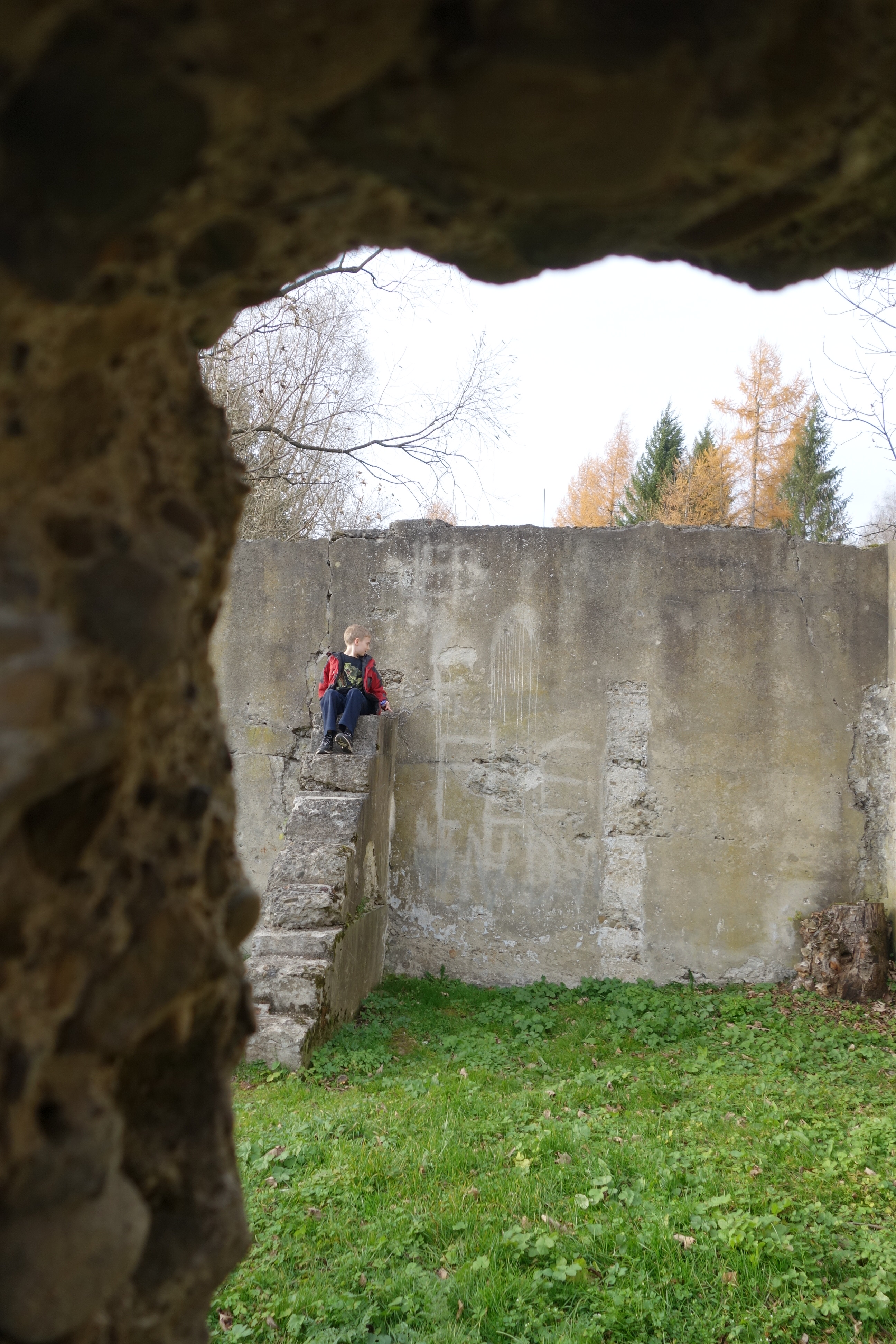
Lutowiska synagogue ruins

Lutowiska synagogue ruins

Information sign next to the synagogue, Lutowiska
Information sign next to the synagogue, Lutowiska

A boy connecting with his Jewish roots.

A boy connecting with his Jewish roots.

The Jewish cemetery is on a hill that is visible from the synagogue, but to reach it you have to go down to the school, back around the playing fields, and up a dirt road. It holds as many as 1000 headstones, some dating back to the 18th century. The cemetery was easier to get around in November than it was in August because the grass and weeds had died back. It is on a hill, with a steep slope to one side that is also covered with tombstones. Many stones are decorated with lions or deer (on males’ graves only), birds or candles (females only), crowns or torahs (for men with knowledge of the torah). In places, trees have grown into and around the grave markers. As Agnieszka noted, there is no graffiti or trash in the cemetery. She also told me a group of students from Dartmouth were there for about 3 days this summer. They built steps up to a gate they installed, cleaned some of the stones (they had an expert help them do this), and cut the grass. On the Internet, I saw Dartmouth Rabbi Edward Boraz organizes service trips to a different Jewish cemetery each summer. It’s called Project Preservation.

Tombstones in the Lutowiska Jewish Cemetery

Tombstones in the Lutowiska Jewish Cemetery

Agnieszka likes to visit the cemetery: “It’s peaceful there, and sometimes it’s so pretty when the sun is setting and the light is falling a certain way. I lie down in the grass between those tombstones, birds sing, I feel peaceful and some sort of connection.”

At first I couldn’t find the plaque marking the site where 650 Jews were murdered by Nazis. Between the Catholic church and cemetery, there was a monument to those killed at Katyn and another for victims of Ukrainian aggression. I asked someone walking by and she explained the place I was looking for was up the road on the other side of the church. Notably, she knew, and was very pleasant about sharing the information with me.

Monument at the mass grave, Lutowiska

Monument at the mass grave, Lutowiska

And there it was, a short way off the road down a shrub-lined pathway—a simple monument with two plaques. I almost cried when I saw it. The inscriptions read:

Mass grave for Jewish and Gypsy victims of terror murdered in 1943 [sic] by Nazis

In memory of 650 victims of fascism shot here by the Gestapo in 1943 [sic]—The people of Lutowiska 1969

It is disturbing to stand on a place where hundreds of people were brutally murdered.

DSC02016

I was deeply moved to see perhaps a dozen candle lanterns and a bouquet of red roses left at the site, probably earlier that week on the occasion of All Saint’s Day. Granted, it’s barely marked from the street. There is just a small sign on a tree saying “National Memorial, Places of Martyrdom.” But it is well maintained. It has not been forgotten as have so many other places I’ve visited associated with Jewish life.

Marker for "National Memorial, Places of Martyrdom"

Marker for “National Memorial, Places of Martyrdom”

Thanks to the Ecomuseum of Three Cultures, Lutowiska feels like a place that has embraced its history, even the tragic events. They have literally cleaned the trash out of the synagogue ruins and marked the site with a sign that hints at the life Jews had there, and how it ended.
Three Minutes in Poland

17 Saturday Jan 2015

Posted by Marysia Galbraith in Jewish Culture, Memory, Pre-World War II, Research Methodology

≈ 2 Comments

Tags

Glenn Kurtz, Three Minutes in Poland, working with fragments

Glenn Kurtz’s book Three Minutes in Poland: Discovering a Lost World in a 1938 Family Film (2014) recounts a project similar to my own, of piecing together fragments. Kurtz’s journey began with a film recorded during his grandparent’s visit to his grandfather’s native town in Poland. Seeing the places and faces on film inspired him to learn all he could about the town and its prewar inhabitants—what life was like in Nasielsk, how it was disrupted by World War II, the fate of those who perished, and what became of those who survived. It’s a fascinating story of discovery, tacking between information revealed in archival records and the stories recounted by survivors and their families. He makes use of the same archival resources I’ve been using—JewishGen, Ancestry.com, Yad Vashem, Warsaw Database, ship manifests of passengers, archival photographs. And extraordinarily, out of these fragments, he was able to find some of the people in the three-minute film, or find people who remembered them and could tell some of their story.

These stories bring the fragments, and the town, back alive. Still partial, still shadowy, but alive. I see this particularly in the words of Morry Chandler (Moszek Tuchendler), whom Kurtz found in Florida with his wife, children, and grandchildren. He appears momentarily in Kurtz’s grandfather’s film jumping out and smiling in front of the camera. For Morry, looking at himself and his town on film, and recalling the people he lived with in Nasielsk reminded him he ever had a childhood, and that he was happy:

It’s looking back and saying, Yes, there was a world. Other than what we have lived all these years, knowing what happened. It was a real world there. I mean people were going about their business. Kids were running, and doing all the things that kids do. And here I look at myself, and I see it was a happy face.

The book models two guidelines for my fieldwork: first, how to weave together fragments into a coherent story, integrating as well the gaps and inconsistencies that remain. Information is labeled along a scale of likelihood; the probable, the possible, and the still unknown outnumber what can be unambiguously confirmed. The book also provides a model for working with personal accounts. It corroborates Greenspan’s argument for ongoing contact with survivors, which provides the space for new stories to be recounted, for the revision or elaboration of past accounts, and for interviewers to ask questions that lead to new explanations and deeper insight into survivors’ experiences. (See Henry Greenspan’s “The Unsaid, the Incommunicable, the Unbearable, and the Irretrievable,” Oral History Review 2014, Vol 41, No. 2, pp. 229–243).

Kurtz writes, “Memories, like artifacts, are tightly wound bundles of information. Pull one thread, try to identify one figure, and the whole bundle unfurls.”

Memory and forgetting in Poznan, part 2

29 Monday Dec 2014

Posted by Marysia Galbraith in Heritage work, Jewish Culture, Memory, Polish-Jewish relations, Poznan, Synagogues

≈ Leave a comment

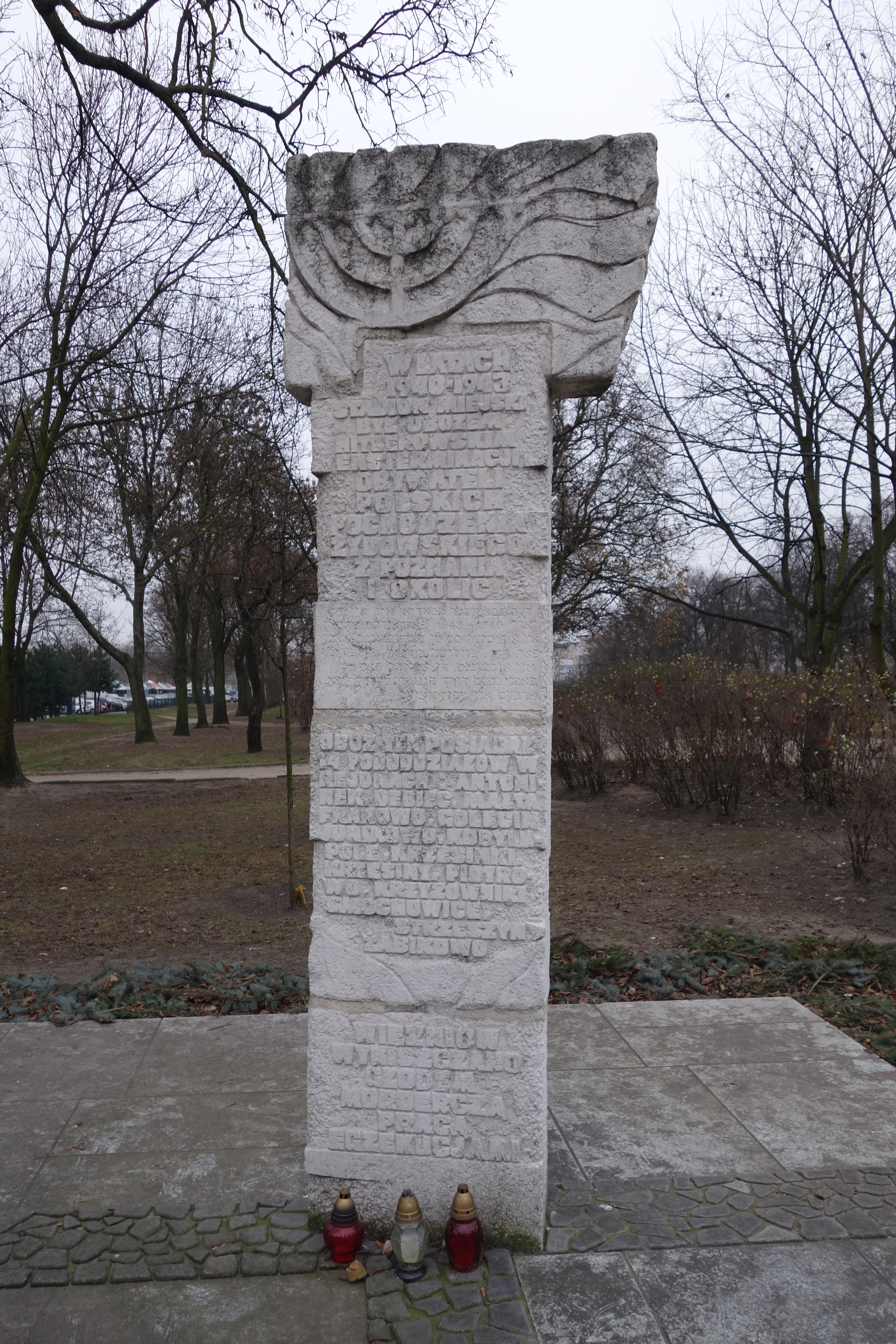
Monument to the victims of the Poznan labor camp

Monument to the victims of the Poznan labor camp

Despite the cold, Anka, Małgosia and I visited a few other sites associated with Jewish culture and history. The monument to the victims of the Poznan labor camp is on Królowa Jadwiga Street even though the actual detainment site was a block away in the old football stadium. The socialist-era monument is a tall concrete pillar with what looks like a menorah at the top. Anka pointed out the dedication on back of the monument stating it was erected on the 40th anniversary of the Warsaw Ghetto Uprising; even sites commemorating local events reproduce the idea that the Holocaust happened elsewhere—in cities such as Warsaw and Krakow.

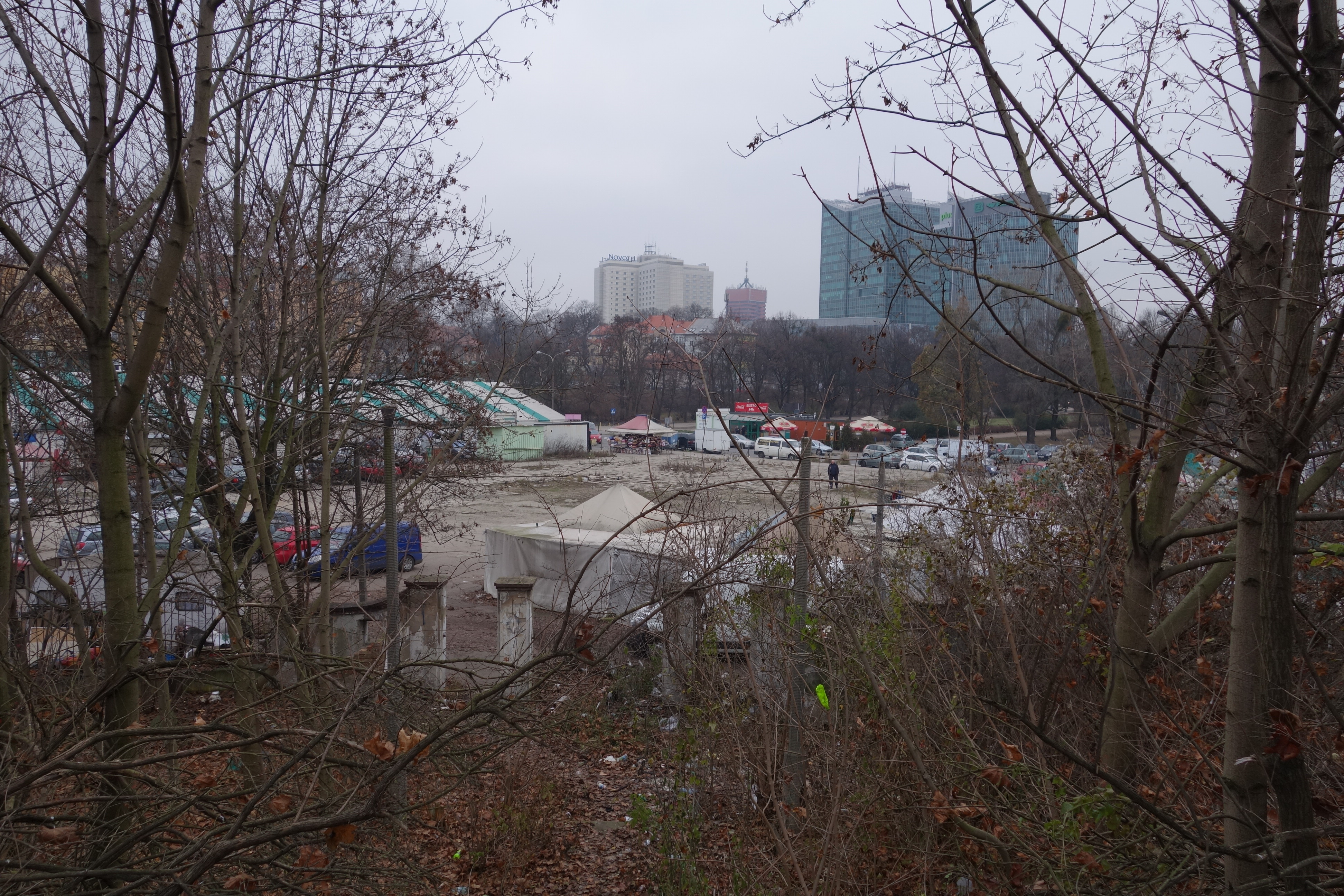
The actual stadium was abandoned in the 1990s when a new one was built for the Warta football team. Warta is Poznan’s smaller club, rival to Lech, who got a big new stadium for the European football championship Euro 2012. Małgosia conducted ethnographic research in which Warta fans turned out to be the only ones who know the function the stadium served during the war. Essentially, it was a work camp where Jews were briefly held before being shipped off to the death camps. Many detainees were shot right there on the spot. We walked through the broken down gateway, up a set of stairs to an earthen berm surrounding what used to be the playing field. Today, the site is covered with trash, and trees grow everywhere including where the bench seating used to be. Only the concrete supports of the benches are left. Goal posts stand on the field, left over from 2012 when local teams competed in a kind of lighthearted protest against the massive outlay of funds for Euro 2012.

DSC02577

Looking out from the old football stadium toward the outdoor market and new high-rises.

Looking out from the old football stadium toward the outdoor market and new high-rises.

For the most part, this is forgotten space, despite its proximity to the center of the city. It is separated from Królowa Jadwiga Street by a dilapidated outdoor market. On this frigid day, there were no customers, just very cold sellers who urged us to their buy their wares. I was told the outdoor market used to be bigger. When they were in high school, it was the place to get real Adidas and blue jeans. With all the competition from new shopping centers, the market has shrunk. There is an ongoing debate about what to do with the old stadium—what primary purpose should the space fill? Should it be a place for sports activities? A nature preserve? A place of commemoration for those who suffered and died there? Or should it become another housing development or mall?

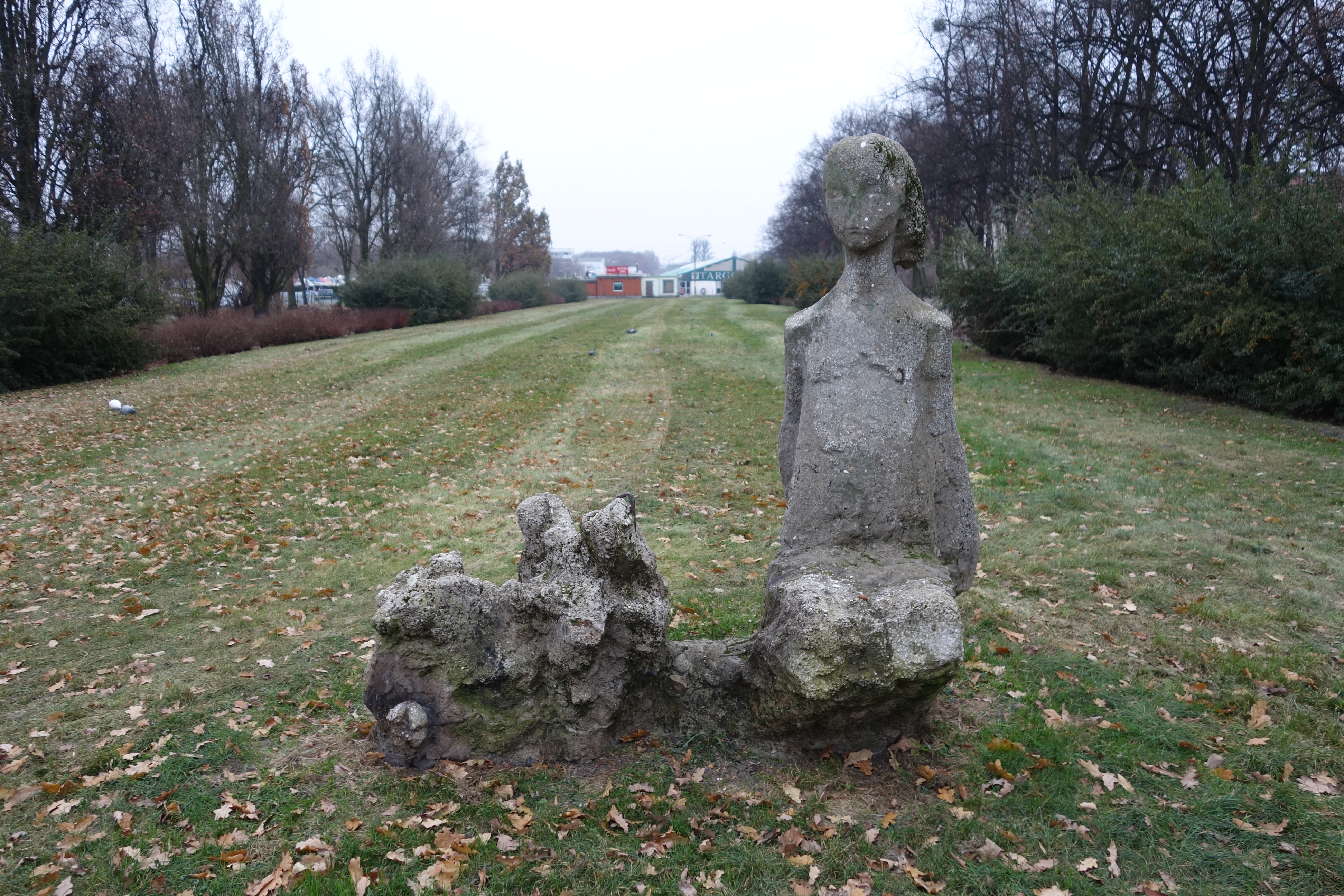
What is the origin and meaning of this sculpture? Why is it in the newly named Square of the Righteous among Nations of the World?

What is the origin and meaning of this sculpture? Why is it in the newly named Square of the Righteous among Nations of the World?

Heading back toward the center of the old city to thaw out at a café, we chanced upon an unmarked, decaying stone sculpture. I think it was Małgosia who said it suggests some sort of Holocaust memorial. Then we noticed the sign designating the area as “Square of the Righteous Among Nations of the World.” I’ve since learned that this is a new name, approved by the city just this year.

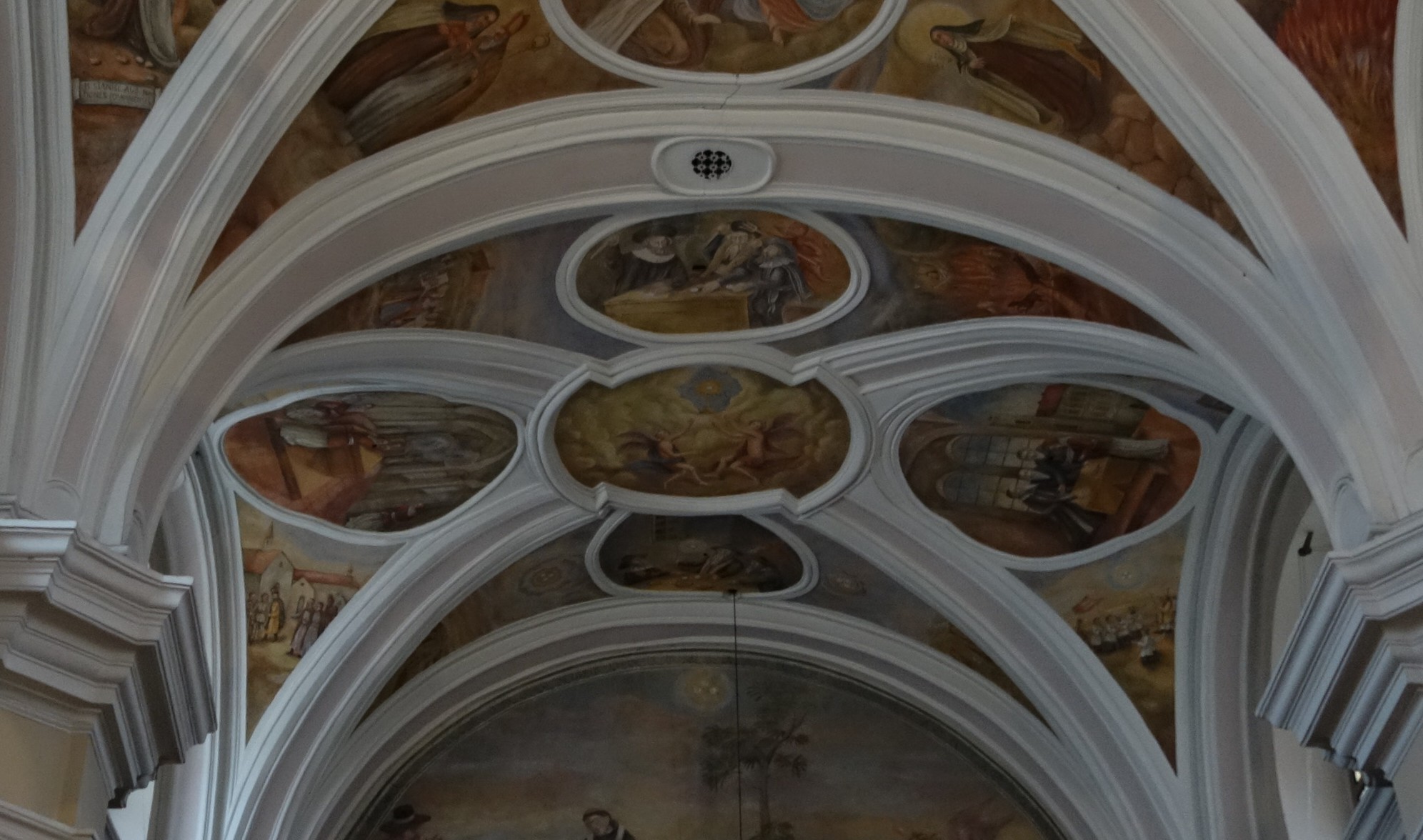
We made two more brief stops on our tour. We peaked into the Church of the Most Holy Blood of Christ (Najświętszej Krwi Pana Jezusa) on Żydowska (Jewish) Street, where I showed Anka and Małgosia the ceiling frescos depicting Jews profaning the host.

Frescos over the alter depicting the profaning of the host

Frescos over the alter depicting the profaning of the host

In Sinners on Trial, Magda Teter outlines the historical context in which this story was told:

On Fridays, as late as 1926, and perhaps even up to the eve of World War II, in a small Catholic church on what has been known as “the Jewish street,” a few meters off the main market square in the city of Poznań, the faithful did not sing the prayer Kyrie Eleison, “God Have Mercy, Christ Have Mercy.” Instead, the church followed a liturgy that diverged markedly from the approved official liturgy of the Catholic Mass. The song’s text that replaced the words of the Kyrie Eleison told of Jewish desecration of the host in Poznan:

O, Jesus, unsurpassed in your goodness,

Stabbed by Jews and soaked in blood again

Through your new wounds

And spilled springs of blood

            Have Mercy on Us, Have Mercy on Us, Have Mercy!

The hearts of stone from the Jewish street

In the house once known as the Świdwińskis’

Sank their knives in You

In the Three Hosts, the Eternal God

            Have Mercy on Us, Have Mercy on Us, Have Mercy!

The song recounted the story of three hosts stolen by a Christian woman from a Dominican church in Poznań in 1399. According to the story, she delivered the three hosts to Jews who desecrated them, “stabbing” them with knives. Unable to dispose of them, the Jews took them outside the city and buried them in swamps. The hosts miraculously emerged to reveal themselves to a shepherd boy. The Christian woman and the Jews were punished by the magistrate, and the Church of Corpus Christi was constructed on the site after the miracle (2011: 89-90).

Teter goes on to suggest that this story might have been used as a rationale for building a new church on Żydowska Street. Pani Alicja, the head of the Poznan Jewish Community, told me that she has been waging another battle to have an informational plaque installed in the entranceway of the church explaining that the story of the profaning of the host is a legend, not historical fact. To date, church representatives have only agreed to post an explanation in the basement where most people will never see it.

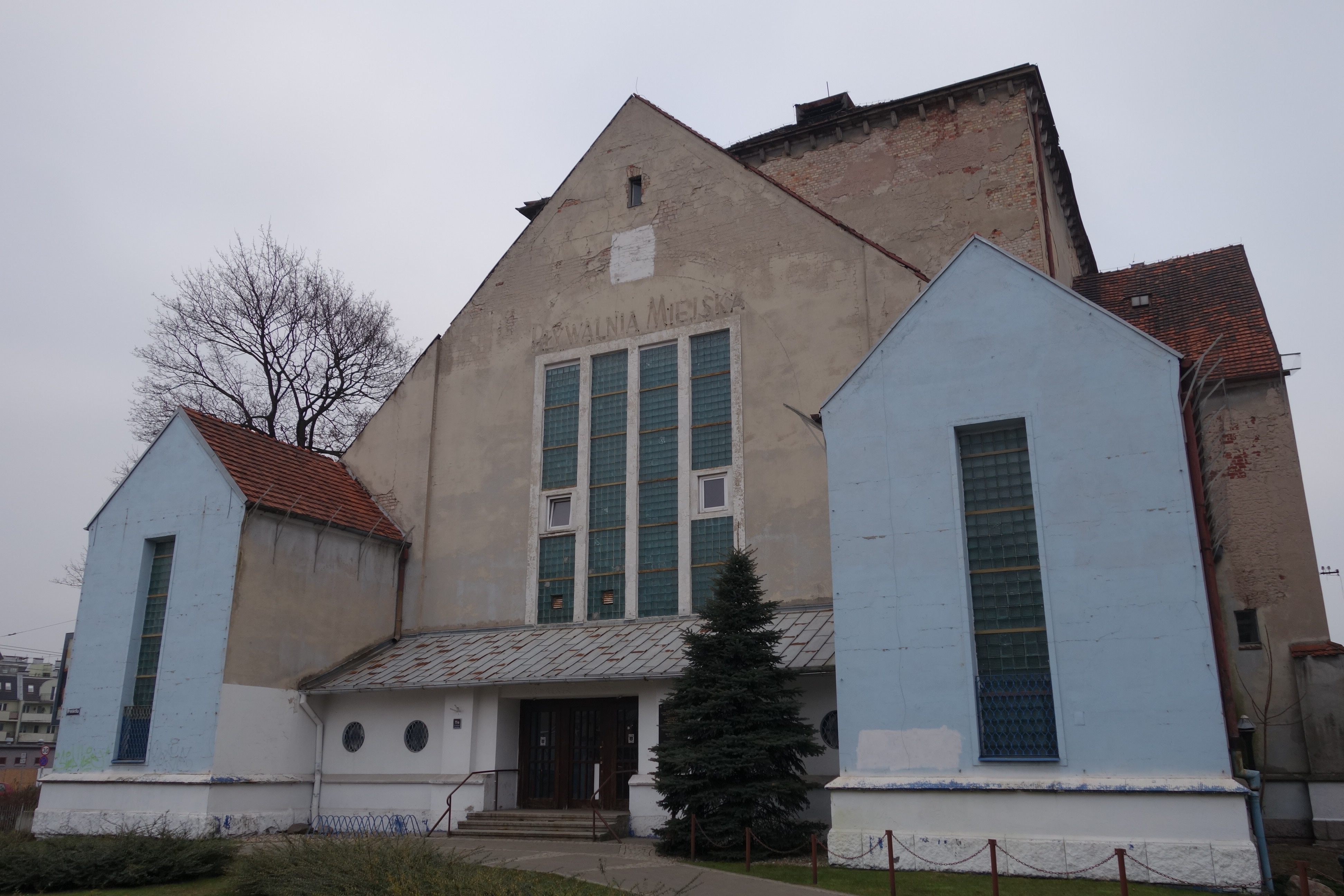
The exterior of the former "new" synagogue in Poznan. The words "Pływalnia Miejska" (City Pool) can be made out above the long windows. The pool was closed just three years ago in 2011.

The exterior of the former “new” synagogue in Poznan. The words “Pływalnia Miejska” (City Pool) can be made out above the long central windows. The pool was closed just three years ago in 2011.

Our final stop was the former synagogue near the end of Żydowska Street. When built in 1907, it was considered the “new” synagogue. It could hold 1200 worshipers, and was richly ornamented with a copper dome. During the war, the Nazis stripped off the dome and transformed the synagogue into a swimming pool. It continued to function as a pool even after the Jewish Community regained possession of the building in 2002. Małgosia has seen the interior. She described how the bottom of the sanctuary was tiled with the pool at the center, but the upper part remained just like a synagogue. She also said she has been in the attic above the wooden beams of the sanctuary which is still filled with old papers and books. The building is in bad shape and in need of major renovation. Efforts have so far failed to turn it into a Center for Dialog and Tolerance (see this essay by Janusz Marciniak, which includes photos of the exterior in 1907 and today. An essay by Teddy Weinberger describes his visit to the synagogue when it was still a pool; he includes photos of the interior as a place of worship and as a swimming pool).

Newer posts →

Categories

  • Anthropology (38)
    • Archives (14)
    • Fieldwork (7)
    • Ground Penetrating Radar (GPR (5)
    • Research Methodology (8)
  • antisemitism (14)
  • Association of Descendants of Jewish Central Poland (36)
  • Catholicism (8)
  • Conference (1)
  • Discrimination (2)
  • Family (70)
    • Bereda (18)
    • Kolski (13)
    • Piwko (22)
    • Rotblit (3)
    • Walfisz (4)
    • Winawer (7)
  • Genealogy (11)
  • Heritage work (70)
    • Commemoration (24)
  • Identity (18)
  • Israel (6)
  • Jewish Culture (93)
    • Cemeteries (55)
    • Museum (8)
    • Synagogues (34)
    • Torah (1)
  • Jewish immigrants (8)
  • Jewish Religion (1)
  • Memory (73)
  • Names (14)
  • Photographs (6)
  • Pifko-Winawer Circle (5)
  • Poland (131)
    • Baligród (1)
    • Bolimów (1)
    • Brześć Kujawski (5)
    • Buk (1)
    • Chodecz (1)
    • Dukla (2)
    • Dąbrowice (1)
    • Gdynia (1)
    • Gostynin (3)
    • Gąbin (1)
    • Izbica Kujawska (1)
    • Kazimierz (4)
    • Kowal (1)
    • Koło (1)
    • Krakow (7)
    • Krośniewice (1)
    • Kutno (9)
    • Kłodawa (1)
    • Lesko (8)
    • Leszno (1)
    • Lubień Kujawski (1)
    • Lubraniec (1)
    • Lutowiska (3)
    • Piła (3)
    • Podgórze (2)
    • Poznan (11)
    • Przemyśl (2)
    • Pzedecz (1)
    • Radom (1)
    • Radymno (1)
    • Sanok (1)
    • Skierniewice (5)
    • Sobota (2)
    • Tarnów (2)
    • Warsaw (23)
    • Wielkopolska (1)
    • Wronki (7)
    • Włocławek (20)
    • Zasław (2)
    • Łódź (1)
    • Żychlin (33)
  • Polish Culture (10)
  • Polish-Jewish Heritage (60)
  • Polish-Jewish relations (61)
  • Post-World War II (24)
  • Pre-World War II (22)
  • Reclaimed Property (1)
  • stereotypes (3)
  • Survival (9)
  • Trauma (3)
  • Uncategorized (5)
  • Victims and perpetrators (4)
  • World War II (47)
    • Jewish Ghetto (12)
    • Nazi Camps (6)
    • Polish Underground Army (3)
  • Yiddish (5)

Enter your email address to follow this blog and receive notifications of new posts by email. Your email address will not be shared.

Archives

  • June 2026 (5)
  • May 2026 (1)
  • October 2025 (1)
  • July 2025 (8)
  • June 2025 (1)
  • April 2025 (1)
  • August 2024 (3)
  • July 2024 (3)
  • May 2024 (2)
  • April 2024 (1)
  • May 2023 (2)
  • January 2023 (2)
  • December 2022 (7)
  • November 2022 (2)
  • October 2022 (5)
  • September 2022 (1)
  • January 2022 (1)
  • August 2021 (1)
  • December 2020 (2)
  • July 2020 (1)
  • May 2020 (3)
  • April 2020 (1)
  • March 2020 (1)
  • January 2020 (2)
  • May 2019 (1)
  • February 2019 (1)
  • November 2018 (1)
  • September 2018 (1)
  • August 2018 (3)
  • July 2018 (1)
  • June 2018 (1)
  • May 2018 (1)
  • April 2018 (2)
  • March 2018 (2)
  • February 2018 (2)
  • January 2018 (2)
  • December 2017 (2)
  • November 2017 (2)
  • October 2017 (1)
  • September 2017 (3)
  • August 2017 (3)
  • June 2017 (2)
  • May 2017 (3)
  • April 2017 (1)
  • March 2017 (2)
  • February 2017 (1)
  • January 2017 (2)
  • December 2016 (2)
  • November 2016 (4)
  • October 2016 (1)
  • September 2016 (6)
  • August 2016 (2)
  • July 2016 (1)
  • May 2016 (4)
  • April 2016 (2)
  • March 2016 (3)
  • February 2016 (4)
  • January 2016 (3)
  • December 2015 (3)
  • November 2015 (5)
  • October 2015 (5)
  • September 2015 (3)
  • August 2015 (4)
  • July 2015 (3)
  • June 2015 (3)
  • May 2015 (4)
  • April 2015 (9)
  • March 2015 (3)
  • February 2015 (2)
  • January 2015 (5)
  • December 2014 (4)
  • November 2014 (9)
  • October 2014 (2)
  • September 2014 (1)

Copyright Notice

All original text and images are copyright © Marysia Galbraith. Please contact the author before quoting.

Blog at WordPress.com.

  • Subscribe Subscribed
    • Uncovering Jewish Heritage
    • Join 149 other subscribers
    • Already have a WordPress.com account? Log in now.
    • Uncovering Jewish Heritage
    • Subscribe Subscribed
    • Sign up
    • Log in
    • Report this content
    • View site in Reader
    • Manage subscriptions
    • Collapse this bar

Loading Comments...