• About
  • The Photo that Started it All

Uncovering Jewish Heritage

Uncovering Jewish Heritage

Author Archives: Marysia Galbraith

Jewish Warsaw in the Shadow of Skyscrapers

30 Friday Jun 2017

Posted by Marysia Galbraith in Jewish Culture, Memory, Polish-Jewish Heritage, Polish-Jewish relations, Post-World War II, Synagogues, Warsaw

≈ Leave a comment

Tags

Plac Grzybowski

I discovered Jewish Warsaw tucked between streets I’ve walked dozens of times. My first surprise was that the apartment I rented in an ugly green socialist-era tower is literally around the corner from Plac Grzybowski (Grzybowski Square), where Jewish life survived into the communist era.

DSC00155

6th floor view of Plac Grzybowski. From the left, a socialist era apartment, All Saints’ Church, modern skyscraper, (at the center) green space, with the site of Jewish Theater behind it and the roof of the Gmina Żydowska behind that, (bottom right) back of building with Charlotte Menora Cafe.

I’ll say more about Plac Grzybowski in a minute, but I was even more surprised when, while mapping out a running route, I saw that I was also just a block away from Nożyk Synagogue, the only synagogue in Warsaw that survived the war. I’m embarrassed to admit that I had never been there before, nor is this the first time I’ve been so close and didn’t even realize it. When my best friend from childhood Kim visited with her father in November 2014, we stayed at a hotel on Grzybowska Street, and were it not for the newer building across the street, we could have seen the synagogue from the hotel entrance. Kim and her family introduced me to Passover Seders, and bagels with lox and cream cheese, and I’m sure they would have loved to see the synagogue. In my defense, the synagogue sits in the green space at the center of the block, with tall buildings all around it. It’s easy to miss. The street access to the synagogue looks like the entrance to a parking lot, and from Grzybowska Street, the only access is via pedestrian walkways.
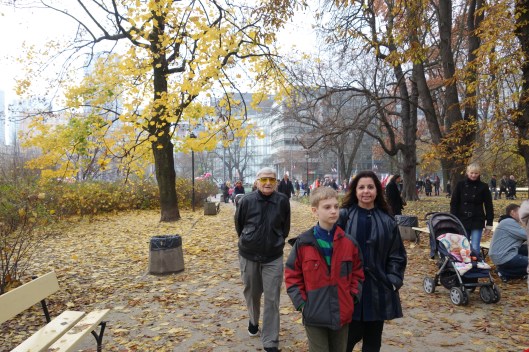
DSC02259

My friend Kim with her father Sandy and my son Ian in Saski Park, Grzybowska Street in the background, November 2014

This isn’t the first time I have seen a synagogue tucked within the central courtyard of a city block. I wonder what the historic reasons were for that. Regardless, I imagine that in the difficult years after the Holocaust, this location offered the synagogue some protection; only people looking for it would find it. This is also where the Gmina Żydowska—the Association of Jewish Communities—has its offices. I should have come here before.

Nożyk Synagogue, Warsaw
"About the Jewish Community"
“About the Jewish Community”

Built in 1902, the synagogue is a solid stone rectangle with arch-topped windows all around. Above the front door, two arch-topped tablets contain the Ten Commandments, and above them is a Star of David. The building survived World War II because the Nazis used it as a warehouse. Jews returned to worship there after the War, and at present, it remains the main synagogue of Warsaw, home to the Orthodox community. The offices of the Gmina Żydowska fill a modern addition across the back of the building.

Both times I walked by the synagogue, a few men were inside praying. More people walked by briskly, probably residents of surrounding buildings. Along the edge of the parking area, large information boards contain headlines like “We, the Jews of Warsaw,” “About the community,” and “Kosher…what does it mean?”

All the pieces fit together from my 6th floor balcony. I can see the metal roof of the synagogue’s modern addition. I also look down at the corner of Charlotte Menora in Plac Grzybowski; this is one of four Charlotte Cafes in Poland. They all specialize in French pastries, but this one also includes Jewish offerings such as bagels and rugelach. My friend Beata took me there last summer. She also pointed out the center of the square that has been converted into a shaggy grassland and wildflower garden. Pathways lined with benches lead down to a central fountain. This novel use of space started out as an art installation by Joanna Rajkowska called “Dotleniacz,” which in English means “Oxegenator;” The project was later reworked into its present, more permanent form.  Beata also showed me Próżna Street, the only street in the ghetto where the original buildings weren’t destroyed in the systematic bombing after the Ghetto Uprising in 1943. On one side of the street, the townhouses have been painstakingly restored. On the other, netting covers the buildings to prevent pedestrians from being harmed by falling elements of the crumbling façade. One of the renovated buildings is home to the Austrian Cultural Forum. Some of my Polish friends say they feel uncomfortable about this because of Austrian support for the Nazis.

Park in the middle of Plac Grzybowski
Próżna Street at night

Grzybowski Square is actually shaped more like a triangle. Charlotte Menora and the intersection with Próżna Street are on one long side. At the second long side, a pile of debris peaks above a barrier fence where the Jewish Theater was torn down last year. This theatre continued to operate all through the communist period, offering performances in Yiddish. Posters on the fence announce that the theater will be rebuilt, along with the TSKŻ, which stands for Towarzystwo Społeczno – Kulturalne Żydów, The Social and Cultural Association of Jews. Sophie, whom I met because she shares the last name of my great grandmother, lived in Warsaw until 1968. Her face lit up as she recalled going to youth activities at the TSKŻ. But she, like most of Poland’s remaining Jews, left in 1968 when the government waged a campaign against Jews. That’s also when many of the TSKŻ branches closed. In Warsaw, the organization hobbled along until after the end of communism, and has since been growing once again.

"Coming here, The new location of the TSKŻ. Jewish Theater and Office-Services Building"
“Coming here, The new location of the TSKŻ. Jewish Theater and Office-Services Building”
All Saints Church
All Saints Church
Pope John Paul II statue in front of All Saints' Church
Pope John Paul II statue in front of All Saints’ Church

At the third, shorter side of the triangle stands the All Saints Church, where Christian Poland asserts itself even in this Jewish part of town. I’ve read that the church was right along the border of the ghetto, and it was where converts to Catholicism living in the ghetto would come to pray. More recently, symbols of Polish nationalism have been placed across the front of the church. Numerous plaques commemorate Home Army soldiers who fought against the Nazi occupation and in the Warsaw Uprising of 1944. These soldiers belonged to companies with names like “Buttress,” and “Brave,” and had wartime pseudonyms such as “Goliath,” “Fisherman,” and “Rooster.” A sculpture of Pope John Paul II stands on the steps leading up to the church, and a monument honoring the Home Army soldiers who produced weapons for the partisans is in the park across the street.

Plac Grzybowski is virtually unrecognizable from the first time I saw it. Marta, a family friend from Warsaw, pointed out the Jewish theatre to me in what I remember as a wide, crowded, dirty intersection with no central green space. It might have been 1990 or 1991, or maybe even 1986. Marta also painted a picture for me of how the square looked still earlier in time, before the war, when the streets were filled with Jews, many of them orthodox men with long beards and black coats, and women wearing wigs or kerchiefs.

The view from my window encapsulates this city–a mishmash of old and new, Catholic and Jewish, nationalism and subversion. Add to this the layers of memory every place contains, along with the energy of a capital city, and you can feel the beating heart of Warsaw.
Remembering Maria R. B. Galbraith

04 Sunday Jun 2017

Posted by Marysia Galbraith in Family

≈ Leave a comment

Tags

Maria Bereda(y) Galbraith

Some people have asked me to post the remembrance I shared at the funeral. The service was held under a tent in the backyard, the place Mama sometimes called her church. Mama used to follow the shade, sitting in chairs strategically placed throughout the garden. Sometimes she would meditate to her mantra, the word “ocean.”

Krysia Bereday Burnham, the daughter of Mama’s brother George, officiated. It was perfect. Krysia wove together elements of the Christian rite with personal reflections, always sensitive to Mama’s unique form of faith. She wore her black robe and a green quilted stole she had been given when she was ordained last summer. “Green to match the garden,” she told me. You could feel the special bond she had with Mama. Krysia has told me that the same empathy that fueled Mama’s pursuit of psychology guided her own call to ministry.

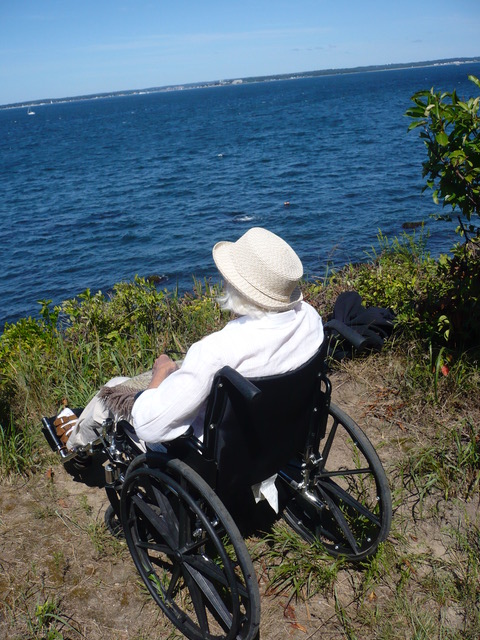
My Aunt Maria at Hawk's Nest Point

At Hawk’s Nest Point, Fishers Island, visiting Krysia. Photo by Krysia Burnham.

My remembrance from the service:

I suspect that many of you here experienced a moment in your life when you were struggling emotionally, and my mama’s laser-like focus fell on you, and she seemed to know exactly what you were thinking and feeling, even before you did yourself. Maria had the gift of empathy. She knew how to listen uncritically, and she helped and healed many of us.

Maria was born in Warsaw, Poland on June 26, 1922 during the exciting but unsettled period between the world wars. In many ways she lived a charmed life in villas and manor houses, with nursemaids and tutors, and her own pony named Dolly. But she also felt the strains of her mother’s religious conversion and divorce that distanced her from some family. Raised on the literature of Polish romantic poets and the history of Poles’ struggle for independence, she became an ardent Polish patriot.

At the age of sixteen, she spent a year at a convent school in Belgium, and she was preparing to continue high school in Paris when World War II broke out. While finishing high school in Warsaw, she also joined the Polish resistance against the Nazi occupation.

Although her teachers hoped she would study literature at University and develop her talents as a writer, Maria decided instead to pursue medicine. She wanted to become a psychiatrist so she could help people, particularly those experiencing psychological or emotional distress.

Maria was deeply involved in the resistance to free her country. As a courier, she delivered messages to the partisans hiding in the countryside. She took advantage of her appearance as an innocent, shy young woman with sad eyes, as well as her fluency in German, and traveled under the assumed name Elisabeth Hoffman. With papers claiming she had a German father, she could travel in the train cars reserved for German officers, listening to their conversations and even talking with them in an effort to learn more. When the Warsaw Uprising began on August 1, 1944, Maria employed her medical training and served as a medic for the wounded. When the Old City was overrun, she escaped with her unit through the sewers to the City Center, where she continued to treat the injured until the end of the Uprising. Maria received a Cross of Bravery for her service.

After the war, the family started to rebuild their life in the ruins of Warsaw, but it quickly became clear that Soviet powers were determined to maintain their hold on Poland, and there was no place for business owners and former resistance fighters in the new communist system. Taking advantage of a medical visa to treat her wartime injuries, Maria and her mother left Poland for good in December 1946.

In the US, Maria began what she called her second life. Initially, she continued her medical studies as a resident under the mentorship of Dr. Stanley Cobb at Massachusetts General Hospital, but then shifted her focus from psychiatry to psychology. While studying for her master’s degree in developmental psychology at Teacher’s College, Columbia University, she met her mother’s neighbor Wiley Galbraith. Intrigued that such an intelligent and good-looking man could be so shy, they started dating and eventually married. Together, they established a home on Long Island where they raised their four children.

Being a wife and mother satisfied Mama’s most essential life goals. She placed the needs of her family above her own, making sure we were safe, happy, and free to determine our own paths in life. But she was always drawn to the life of the mind and the work of helping others. When the four of us grew more independent, she returned to her studies at Teachers College, traveling by train weekly to take one course at a time. Her steady persistence paid off when in 1983 she completed her Ed.M. in Counseling Psychology, her third graduate degree.

Though she was uneasy around strangers, Mama was fiercely loyal to the people she knew and loved. She counseled many in their time of need, including many of my brothers’ and my friends when they were struggling with the inevitable challenges of growing up. Everybody touched by her uncritical empathy loved Maria back. Even after we left home, our friends continued to visit her.

Being Maria’s child, especially her daughter, wasn’t always easy. But no one had a stronger influence on shaping the person I am than she did. Mama had her way of urging me to pursue my education, to be a good person, and not to give up on myself. I remember calling her once at a particularly difficult moment in graduate school to tell her “I want to quit.” She didn’t try to persuade me otherwise. All she said was, “Oh…” But that was enough to make clear that she wanted me to persist, she believed I could do it, and she loved me no matter what.

With all of us kids finally out of the house, my parents renewed their common interests in classical music, gardening, and the arts. They enjoyed visiting us, and we had memorable, noisy, and sometimes contentious family reunions in LA, Austin, Alabama, and even Poland.

Mama spent her final years living quietly at home, under the loving care of Chris and Shih Han, and her inexhaustible companion Krystyna. As the grip of life’s traumas finally slipped away, she became quiet, radiating love toward her many visitors. Part of a bustling and growing household, she took special joy in the visits of her grandchildren. Her room was Bessie and Charlie’s favorite place to play, or to just sit a while. And she always lit up when she saw her other grandsons.

These are the traits that defined her: she was resilient yet fragile, forceful yet timid. She was generous and devoted to her friends and family. She was so emotionally attuned that there was no way of hiding anything from her, even when we tried.

Mama had just about convinced us all she was immortal when she slipped away quietly and peacefully, within sight of her beloved garden. She was deeply loved and will be missed by all of us who were touched by her goodness and comforted by her sensitive guidance.

Go in peace, Mamusiu. We’ll remember you every time we walk in this garden—your sanctuary, every time we’re transported by a work of art, and every time we look into your grandchildren’s eyes.

Maria R. B. Galbraith, 1922-2017

31 Wednesday May 2017

Posted by Marysia Galbraith in Family

≈ 1 Comment

Tags

Maria Bereda(y) Galbraith, Obituary

Niech odpoczywa w pokoju wiecznym.

Obituary
Obituary
Mama with her youngest son Chris, circa 1964
Mama with her youngest grandson Charlie, 2015

My cousin’s book: The Scribe of Siena

18 Thursday May 2017

Posted by Marysia Galbraith in Family, Winawer

≈ Leave a comment

Tags

Melodie Winawer, Scribe of Siena

I set out to learn about my family’s past, but I also found my living relatives. My cousins are an engaging and accomplished group of people. I would want to know them even if we weren’t related.

Scribe

The Scribe of Sienna by Melodie Winawer

My cousin Melodie Winawer is one of them. She lives in Brooklyn with her spouse and three kids. She is a both a medical doctor and professor, and she just published her first historical novel called The Scribe of Siena. Reviewers compare it  to Outlander, one of my guilty pleasures. A work of historical fiction, the novel involves time travel, and a romance between a strong 21st century woman and a 14th century Italian man. Melodie also uses her medical background to accurately depict illness and healing.

I just got my copy and can’t wait to read it!

Sholem Asch: A Yiddish Playwright Ahead of His Time

11 Thursday May 2017

Posted by Marysia Galbraith in Jewish Culture, Kutno, Pre-World War II, Yiddish

≈ 1 Comment

Tags

God of Vengence, Indecent: the play, Paula Vogel, Sholem Asch


Kutno’s native son Sholem Asch is in the news a hundred years after writing a play that deals with issues that remain controversial today. His work also shatters a lot of assumptions about Jewish life in Poland in the early 20th century–Written in Yiddish, it features a brothel, a Torah scroll, and love between two women. Asch’s play God of Vengeance was written in Yiddish in 1907 and first produced in Berlin in 1910. I found an electronic version of the 1918 English translation (you can follow the hotlink above). In the play, Yekel, who lives with his family above the brothel he owns, tries to improve his family’s status by commissioning a Torah scroll and marrying his daughter Rifkele to a Yeshiva student. Instead, the young daughter falls in love with one of the prostitutes and in a pivotal scene, they kiss. The play highlights the tension between piety, reflected in the Holy Scroll that is supposed to bring respectability to the family and the economic and sensual attraction of the brothel downstairs, as well as observations about women’s empowerment and oppression.

The play has been getting attention recently because of Paula Vogel’s Broadway play Indecent, a play about a Yiddish play that was ahead of its time (as the NPR report about Indecent is titled). Vogel’s play centers around the 1923 staging of God of Vengeance in New York’s Apollo Theater (also on Broadway), notable because the whole cast, the producer, and one of the theatre owners were arrested and eventually convicted of indecency. The play had been controversial where it had been staged throughout Europe, but it also received critical acclaim.

The popularity of Indecent has led to renewed interest in Asch and his play, which was recently produced at LaMaMa Experimental Theater in the East Village (In God of Vengeance, a Nice Jewish Family Lives Above a Brothel).

30godofvengeance-master768

From left, Eleanor Reissa, Shayna Schmidt and Shane Baker as Orthodox Jewish parents and their marriageable young daughter in Sholem Asch’s “God of Vengeance,” at La MaMa. Credit Richard Termine for The New York Times


More Jewish Heritage Work in Kutno

26 Wednesday Apr 2017

Posted by Marysia Galbraith in Cemeteries, Heritage work, Jewish Culture, Jewish Ghetto, Kutno, Memory, Names, Polish-Jewish Heritage, Polish-Jewish relations, Synagogues, World War II

≈ 2 Comments

Tags

Friends of Kutno, Polin Museum, Reclaiming "Jew", Towarzystwo Przyjaciół Ziemi Kutnowski

This is part II about heritage work in Kutno. The first is Jewish History of Kutno.

While in Kutno, I visited the Society of Friends of Kutno (Towarzystwo Przyjaciół Ziemi Kutnowski). The organization has been active since the early 1970s, and has put out an annual periodical about local history and customs for about 20 years. Most issues of the publication contain an article about Jews. In 2016, these articles were compiled in a book along with other historical materials about Kutno’s Jews, including Holocaust witness reports and photographs, and a list of people who lived in the Kutno ghetto.

okladka zarys historii

Outline of the History of Kutno Area Jews, published by the Friends of Kutno

The chairwoman of the Friends of Kutno Bożena Gajewska is an energetic and upbeat woman. She accepted the position because of her interest in local history and her desire to promote that history among local residents. She isn’t paid for this; she volunteers for the organization after getting off work. The Friends of Kutno have their office in a historic wooden villa that was recently renovated by the city. Most of their funding comes from grants. Over the years, they have placed historical markers where the synagogue, Jewish cemetery, and ghetto used to be. Other recent projects related to Jewish culture include field trips for local residents to the Polin Museum in Warsaw, to a production of a Sholem Asch play at the Yiddish Theatre in Warsaw, and to the Chełmno Extermination Camp, where Kutno Jews were transported when the ghetto was liquidated. Kutno was selected as a site where the Museum on Wheels (a traveling branch of the Polin Museum of the History of Polish Jews) would visit; this happened in August 2016.

DSC08529

Marker reads, “In this place the 18th century synagogue stood. It was destroyed by the Nazis during World War II, evidence of the hatred of one human to another, and to his works.”

Pani Bożena says she’s noticed that orientations toward Jews have improved since the Polin Museum has opened. Thanks to the Museum, you can talk about Jews, whereas before, the word “Jew” had negative connotations, and was even used as an insult. This made people unsure what to call practitioners of the Jewish faith. Polin has helped to rehabilitate the term. While this may seem like a manifestation of the particularly fraught relationship between Poles and Jews, Mark Oppenheimer just published an opinion piece in the New York Times (Sunday, April 23, 2017, “Reclaiming ‘Jew’”) in which he notes that it’s the same in the US. “Jew” is almost never used as a noun; rather, the adjective “Jewish” is used, as in “Jewish people” or “I’m Jewish” (never “I’m a Jew”). Oppenheimer quotes the comedian Louis C. K. who called “Jew” a funny word “because ‘Jew’ is the only word that is the polite thing to call a group of people and a slur for the same group.”

The Polin Museum has also contributed to a surge of activity related to Jewish history and culture throughout Poland. This has led some townspeople to complain to the Friends of Kutno, “Why is everything always about Jews?” Bożena says she reminds these people that the Friends are interested in all aspects of regional history, and Jews were a part of that history. They address plenty of other topics, as well. For example, they recently published the biography of a native son who was an ultra nationalist during the period when the majority of Kutno residents were Jews (I can’t remember his name but maybe someone reading this can remind me).

Pani Bożena drove me to see some historical sites around town. The Jewish cemetery is on a hill overlooking a neighborhood of concrete apartment buildings. The hillside is covered with tall grass and wildflowers, and crisscrossed by dirt tracks where people walk their dogs, kids play, and people hang out. Many leave their trash behind. The Friends of Kutno recently put up signs around the cemetery that say “Here is the resting place of Kutno Jews, who settled in the city from the beginning of the 16th century. The cemetery located on this hill was established in 1793. Jews were buried here until March 1943. Please maintain its solemnity.” Below this historical information is the reminder, “Keep in mind as you go into this vast expanse that this is a cemetery; people are buried here, you walk on their graves, even though there are no longer tombstones…” Further, the sign states the cemetery is a registered monument and thus legally protected, and any vandalism is subject to a sentence of imprisonment. Nevertheless, within just a few months, four out of six such signs were vandalized. The metal poles were snapped at ground level. Bożena condemned the destruction, but also minimized it as the work of thoughtless hooligans (as opposed to a deliberately antisemitic act). In September, the poles were replaced and the signs stand once again.

Bożena showing me the new sign at the Jewish cemetery in Kutno
An older monument at the top of the cemetery hill

We passed people with dogs as we walked to the top of the hill to an older monument. It contains the same historical information as the new metal signs in Polish and Hebrew (but not the reminders about proper behavior and legal issues), and is shaped like two adjoining tombstones. Heading back down the hill, past some children playing, we saw the bases of some grave markers peaking out of the grass. Many tombstones were recovered and are stored at the Kutno Museum.

Bożena dreams of building a fence around the cemetery so there will be a more substantial barrier against further vandalism. They have received all the necessary approvals, but are in need of funding.

From the cemetery, we went on to the site of the ghetto, which is outside the center of town on the grounds of a former sugar factory. The factory was used by various industries after the war, but now is closed. The buildings, some dating from the late 19th century, stand behind a high fence and a guard patrols the site. Historic markers tell the story of the ghetto. A granite plaque reads:

Here on the terrain of the former Konstancja Sugar Factory

Germans established a ghetto for the Jewish population of Kutno and the surrounding area.

After its liquidation in 1942, the surviving Jews perished in the camp at Chelmno.

Honoring their memory, the People of Kutno.

Kutno, April 1993

A more recent sign contains a bit more historical information in both Polish and English (if you want to read it, click on the photo below to enlarge it).

Former site of the Kutno ghetto.
Wall plaque at the site of the Kutno ghetto
Historical marker in front of the main gate of the factory where the Kutno ghetto used to be.

Bożena told me that over 8000 people lived in the ghetto from 1940-1942. Those who got there first occupied all the most obvious places, so later arrivals had to build shacks from scrap wood, or find ways of populating balconies and any other inhabitable space throughout the large factory hall. In 1942, they were all transported to the camp at Chełmno by train (the tracks are right across the street from the factory) and by truck.

Thinking about the people I met in Kutno (and elsewhere), one thing I am trying to sort out is why Christian Poles get involved in Jewish heritage projects. Not surprisingly, the reasons are varied. One is interested in historical artifacts; he has no political agenda. Another of my companions tried to place this history into a more pro-Polish framework. He explained that the Nazis forced Christian townspeople to do horrible things as part of a strategy to damage relations between Poles and Jews. “All people really want is to live in peace (Chcą w spokoju żyć)”, he continued, “Poland is in the heart of Europe, a pretty terrain that has historically been attacked from all sides.” Others feel personally drawn to Jewish culture. One of my acquaintances in Kutno believes she has Jewish heritage. She seems to understand my quest for my own family history. “It’s important to know where you’re from,” she told me. She hasn’t found anything as concrete as my family photograph (the one I use at the top of the blog) to confirm her feeling that she has Jewish roots. All she can point to are allusions in family stories she remembers from childhood, and sometimes people have told her she looks Jewish. But anyone she could have asked has passed away.

But what’s clear from my visits to Kutno is that fragments of Jewish history remain, and some have been marked as such thanks to the efforts of a small group of residents who think it is important to include the stories of Kutno’s Jews in the history of their town.

Healing Collective Trauma: Jewish Heritage Work in Poland

18 Saturday Mar 2017

Posted by Marysia Galbraith in Cemeteries, Commemoration, Fieldwork, Heritage work, Memory, Polish-Jewish Heritage, Trauma, Wronki

≈ Leave a comment

Tags

affect, Aleida Assmann, collective memory, lapidarium in Wronki, Piotr Pojasek, Shadows of Trauma, Society for Psychological Anthropology Meeting

Healing Collective Trauma: Jewish Heritage Work in Poland is the title of the paper I presented at the Society for Psychological Anthropology Meeting in New Orleans on March 12. Here is the abstract I submitted:

The legacy of the Holocaust weighs heavily on Polish communities that were witness to unspeakable events. The paper examines how collective and personal trauma and recovery are intertwined, particularly in relation to Jewish heritage work in Poland. It emphasizes the affective engagement of heritage workers, most of whom are Catholic Poles, working on local projects intended to bring the history and culture of the community’s absent Jews back into the public sphere. Person-centered ethnography helps to reveal how participants talk about the work they do in relation to notions of self and society, and associated personal and social meanings. It further reveals their particular narratives about past and present relationships between Catholics and Jews in Poland, which they often pose as a challenge to the silences of the socialist era and the present-day reemergence of xenophobic nationalism. As members of the post-memory generation—they grew up with stories about former Jewish residents and the destruction of their communities, but they did not actually experience these events themselves—heritage workers are able to work towards reconciliation in ways that older generations could not. They have coming-of-age stories associated with the moment historical events became real to them, and their emotional distress about the past became the force that compelled them to do something about it in the present. Their personal narratives suggest motivation stems from the convergence of attachment to their native place, a sense of responsibility to those who are no longer present, and a desire to realize a more inclusive community that accepts past and present diversity within the Polish polity.

In memory of the Jewish community that inhabited Wronki from 1507-1939. Lapidarium of tombstones from the destroyed Jewish cemeteries of Wronki
Lapidarium of Jewish Tombstones, Wronki
Piotr Pojasek pointing to one of Wronki's Jewish cemeteries. Some pedestals of tombstones remain buried, as well as a large spruce tree that was planted when the cemetery was still functioning.
Piotr Pojasek pointing to one of Wronki’s Jewish cemeteries. Some pedestals of tombstones remain buried, as well as a large spruce tree that was planted when the cemetery was still functioning.

The paper starts with the story of Piotr Pojasek, who grew up in an old farmhouse near Wronki. From childhood, he knew that the curb on his street had been made out of Jewish tombstones during the Nazi occupation, but it was only as an adult that he really realized how wrong that was. And once he became engaged emotionally and morally, he knew he had to do something about it. It took many years, but in 2014, the lapidarium of the tombstones was completed. Applying the categories of memory as defined by Aleida Assmann, I use this case to explore how individual memories can shape social memory, and in turn national and cultural (collective) memory. The point is that individual connections to the past, as Piotr had through the uneasy presence of the tombstones outside his front door and the stories his father told him, are what compelled action. By collecting and sharing historical evidence and the stories of witnesses, social memory about the impact of the Holocaust grew, and developed a resonance for others. Eventually, a large coalition of local, national, and even international sponsors succeeded in building a public monument that revives and perpetuates collective memory of the Jews who lived there, of the inhuman circumstances of their death, and of the Polish citizens who recognize this as an important part of the history of their community.

Commonly, scholarship on collective memory focuses on public symbols and commemorative spaces, and has little to say about the transmission of meaning on the individual level. In my work, I am trying to show the relevance of individual memory workers and their personal engagement with the past as well as their local community. They are the ones who can bring things together, forging personal, affective links that make others care about far distant people and events.

Erik Ross, a priest, blogs about Poznan’s Jewish history and heritage

15 Wednesday Mar 2017

Posted by Marysia Galbraith in antisemitism, Catholicism, Polish-Jewish Heritage, Poznan

≈ Leave a comment

Tags

Erik Ross

I came across some extraordinary posts about the fragments of Jewish life in Poznan, written by Erik Ross, a priest of the Dominican order, whose blog appears in the Times of Israel.

His posts are heart-wrenching and entertaining, full of photos, personal reflections, and difficult facts.

In Walk down Jew Street, he describes the frescoes in the Church of the Holy Blood of the Lord Jesus (Kościół Najświętszej Krwi Pana Jezusa). The church is on what is now called “Jewish Street” but inside, the recently renovated paintings depict the story of the desecration of the host by three Jews. Most striking to me, Ross points out the many places around town where this story is renewed–in the weekly opportunities to get miraculous water from the well below the church (where according to legend the Jews tried to wash off the blood that ran from the stolen hosts where they had stabbed them); in the fresh gold leaf on the Latin words recounting the story in the Corpus Christi Church, as well as three newly painted doll-sized figures of Jews around a well under a fragment of alter (marking the site where the stolen hosts were discarded in what was originally a swamp, reclaimed by a priest who brought them to another church, but then miraculously flew back to the swamp leading to the decision to build the church there).

But you should read his post, which goes into much more detail.

Frescos over the alter depicting the profaning of the host, Church of the Most Holy Blood of the Lord Jesus in Poznan
DSC03871
DSC03873

Ross has also written Fake Lake, about the beautiful Lake Rusałka that was built with Jewish slave labor and reinforced with Jewish tombstones, and Swim-a-gogue about the pool that until recently filled the main sanctuary of the synagogue (I’ve written about it too, in Swimming in the Synagogue).

IMG_0465

Lake Rusałka, where the CityTrail runs are held in Poznań. Built with the forced labor of Jews during World War II, many of whom died in the process.


Jewish history of Kutno

18 Saturday Feb 2017

Posted by Marysia Galbraith in Archives, Fieldwork, Heritage work, Jewish Culture, Kutno

≈ 10 Comments

Tags

Kutno Museum, Kutno Public Library

When I first visited Kutno in 2013, I only stopped for a few minutes on the way from Poznan to Warsaw. I had found a record of my great grandmother on JewishGen, and the original document from the 1860s was in the Kutno archive. I got there too late to see the record (the archive was about to close), but I spoke briefly with one of the archivists, and asked her if any traces of Kutno’s Jewish culture can be found today. She said she didn’t know of anything, except perhaps some fragments of tombstones in the municipal museum.

I returned to that museum in early 2015, and the director showed me their small display of Jewish artifacts.

Jewish candleholders in the Kutno Museum
Torah in the Kutno Museum
Fragment of a tombstone in Kutno Museum

Finally last summer, I met some people who have spent years documenting the history of Kutno’s Jews. It turns out a lot is going on. There is a biannual festival in honor of Sholem Asch, a highly regarded Yiddish writer who was from Kutno. There are also commemorative markers at a number of sites around town. And a book was just published—a collection of articles about the Jews of Kutno (Karol Koszada, Elżbieta Świątkowska, Bożena Gajewska, Zaryz Historii Żydów Ziemi Kutnowski, 2016, Kutno: Towarzystwo Przyjaciół Ziemi Kutnowskiej).

I’ve been to the archive a few times now, often enough to break through the reserve of the archivists a couple of times. One told me that school groups sometimes come to visit. “This is a good thing,” she told me “because youths need to know that heritage is not always as straightforward as some people make it out to be. Things change.” She also said that youth don’t necessarily value the past, but seeing the records in the archive helps them to connect with history.

At the Kutno public library, I met Andrzej Olewnik, a librarian with a deep interest in town history. He seemed delighted to meet someone who shared his interest; his whole face smiled as we talked. Pan Andrzej is also a collector, and finds documents associated with Kutno in auctions. He showed me old postcards and photos, including a photo taken in the Kutno ghetto during the Nazi occupation. He also showed me one of Sholem Asch’s business cards, given to him by Asch’s great grandson. He keeps these treasures in protective plastic covers, but slid them out so I could examine them more closely.

Sketch of Kutno synagogue, in Kutno Museum. My shadow reflection is on the far left.
Postcard of the Sugar Factory in Kutno
Passport application of Icek and Ruchla Holeman, 1865. In the collection of the Kutno Museum

The library has a collection of books about Kutno history. One features historic passport photos from the Kutno museum collection, many of which belonged to Jewish residents of the region. It turns out that the museum has other items related to Jewish culture they keep in storage. Some tombstones were found in a sidewalk and brought to the museum. The museum has them in storage, but took photographs of the inscriptions, which are in Yiddish and Hebrew. They are looking for someone to transcribe and translate them.

Another book Andrzej showed me was the Kutno Yizkor book. Yizkor books were compiled after World War II; in them, Jews who survived the Holocaust collected all the information they could about the Jewish population of their hometowns, including historic documents, demographic data, and personal accounts. This one was written in Hebrew—only some Yizkor books have been translated into English. Other books are by or about Sholem Asch, including precious Polish language translations of some of Asch’s plays.

Andrzej showed me digital photos of the prewar synagogue. It was right in the center of the street. Traffic would go around it on both sides. It had columns on one side, and the main entrance on the other. A map from the 1820s shows there was a long narrow green area in front of the building. Across the street from the synagogue there used to be the Jewish school, and behind that the ritual bathes. Andrzej had photos that were taken from the air showing synagogue’s destruction. First the roof was removed in 1940. Later, explosives were embedded in the pillars and the building was blown up.

Grażyna Baranowska, another librarian, organizes the Sholem Asch Festival which takes place every other year. It started as a literature contest, in which contestants competed for prizes for their original writing or their reading of literary texts. Then, it expanded into a culture festival. Next, an academic conference on the life and work of Sholem Asch was added. For the past two festivals, the great-grandson of Asch, David Mazower, has come from England. The next conference is in September 2017 and the festival is in October or November 2017. I’m trying to work out a way to attend this year.

Piwko-Winawer Reunion

22 Sunday Jan 2017

Posted by Marysia Galbraith in Family, Jewish immigrants, Memory, Names, Pifko-Winawer Circle, Piwko, Survival, Winawer

≈ 3 Comments

Tags

Family Reunion, Pifko-Winawer Circle

In the mid-20th century, my grandmother’s relatives in New York established the Pifko-Winawer family circle. At the time, family circles were common among Jewish immigrants from Eastern Europe. They met on a regular basis (usually monthly) and provided emotional and financial support to members.

My grandmother’s maiden name was Piwko. The US relatives spelled their last name with an “f” instead of a “w,” perhaps to retain the proper pronunciation (in Polish, the “w” was pronounced “f”). Some relatives who settled in Switzerland spell the name “Piwko” while others use “Pifko.” One in Israel spells it “Pivko.” The name Winawer came from the husbands of two Piwko sisters—Liba married Jacob Winawar and Sarah married Saul Winawer. Aunt Pat says Jacob and Saul were cousins. I’m still looking for historical records that show exactly how they were related.

At the heart of this family circle was Philip Pifko, the youngest of my grandmother’s brothers. He had a bakery in Brooklyn where all the relatives (that is, the male ones) worked when they first came over from Poland. Philip started the bakery with another brother, Abram whom everyone called Jan in Poland and John in the US. They both came over between 1905 and 1907, but they kept in touch with the family in the home country, and Philip returned periodically for a visit. This is what I’ve been told by family members. I have also found ship manifests showing he arrived to the US in 1907 and he was a passenger to Europe in 1931. Philip stands on the right in the photo on the banner of this blog. Almost certainly, the photo was taken shortly after World War I, and it was definitely taken in Poland–evidence of another trip to Poland.

pifkowinawerdinner

Pifko-Winawer Dinner-on left: Murray and Hannah Winawer, ? and Sadie Shapiro, ?, ? , Pauline and Fred Rosen. On right: Nathan and Sally Winawer, Sol and Numture Winawer, ? Jacobs, Philip and Goldie Pifko, ?, Max Winawer. Cousin Joan showed me this photo and identified everyone.

My cousin Joan (granddaughter of Liba and Saul) was a child at the time, but she recalls two topics of conversation at family circle gatherings: First, issues related to the family burial plot in New Montefiore Cemetery; and second, conversations about how to get the family out of Poland (this would have been in the 1940s). She also remembers my grandmother, uncle George, and mother when they first arrived in the US. They went to the family circle meetings for a while, but then they stopped.

Philip died tragically in a car accident in 1947. He was returning with his wife and some other relatives from a wedding in Massachusetts. The roads were icy and the car slid off the road, killing Philip. The other passengers survived. Without Philip to hold everyone together, the family circle weakened. Meetings became less frequent. Disputes arose over the division of Philip’s inheritance. He had done well during his lifetime but never had any children of his own.

dsc07216

Article about Philip Pifko’s death.

The split in the family was already clear here. Only Philip’s sister Sarah is mentioned in the obituary, not my grandmother Halina or the other living sisters Rachel (who lived in Israel) and Hanna (whom we called Nunia, and who went by the name Maria).

On Sunday, January 8, of this year the Pifko-Winawer circle reconvened at Melodie’s house in Brooklyn. Melodie is the great granddaughter of Liba and Jacob Winawer. Here we are, descendants of five of the Piwko siblings:

dsc09671

Pifko-Winawer Reunion 2017

Descendants of Liba: Melodie (daughter of Herbert and granddaughter of Max), her wife Susanna, and children Chiara and Leo

Descendants of Abram/John: Bob (son of Abby, grandson of Ewa)

Descendants of Sarah: Hinda (daughter of Nathan) and her son Erik

Descendants of Rachel: Eldad (son of Abrash), his wife Marsha, their children Daniella, Yoni, and Shelly, and Yoni’s wife Charity

Descendants of Halina: Krysia (daughter of George) and her husband Steve; Chris (son of Maria), his husband Shih Han and children Bessie and Charlie; and me (Marysia)

Also: Miriam and her husband Shiah. Miriam’s great grandparents were the brother and sister of my great grandparents.

Because I wasn’t host, I had more time to talk with my cousins than I did at the last reunion. But so many came, I still couldn’t talk with everyone.

Hinda is named after our great grandmother. She remembers my mother and grandmother. She called Babcia a beautiful woman, and described Mama as elegant. She also remembered Mama’s scars. Hinda visited Babcia on a trip to Puerto Rico in the late 1960s. Babcia was in the hospital with a broken hip. Hinda expected her to be feeble, but found her as vibrant as ever.

Bob gave me tablecloths and napkins hand embroidered by his great grandmother Bertha (Abram/John’s wife). She made them for all her female descendants in the early 1960s. Bob found them when he cleaned out his mother’s apartment and wanted them to stay in the family. So he gave them to me.

Eldad and Marsha just moved from a house on Long Island to an apartment in Brooklyn, and they love it. They have an incredible view from their 8th floor picture window, and they’re just a short walk from the Brooklyn Bridge and the Botanical Garden.

Daniella lives in Australia, but spends her summers (our winters) in New York. She and her husband are both professors. They have been living in a friend’s apartment in Manhattan. We barely got a chance to chat at the reunion, but fortunately Daniella and I had a great time together in San Diego last month. We were both there for the Jewish Studies Association Meeting.

Yoni told me about his education start-up that developed a computer program that helps to personalize instruction to students’ learning styles and challenges. The program has been introduced in a number of public school systems around the country. His wife Charity shared her incredible story. She is an opera singer, but pulmonary hypertension led to such a deterioration of her lungs she had to have replacement surgery—twice. She is doing well now, and even singing again. She has written about it in a memoir, The Encore, due to be published in October.

Melodie, who is a medical doctor and a professor, is also about to publish a book. Hers is a historical novel, The Scribe of Siena, due out in May.

Shiah and Miriam are artists. He used to do woodwork but now does fused glass. She has done pottery.

It’s reassuring to know that we are doing okay. Despite the trauma and disruption of the past that brought us from Poland to the US, we’ve found our way. We’re doctors and teachers, ministers and counselors, entrepreneurs and artists. Counting spouses, at least two of us are MDs and four of us have PhDs. At least four of us have written books. And this is just counting the relatives that were at the reunion.

← Older posts
Newer posts →

Categories

  • Anthropology (37)
    • Archives (14)
    • Fieldwork (7)
    • Ground Penetrating Radar (GPR (4)
    • Research Methodology (8)
  • antisemitism (14)
  • Association of Descendants of Jewish Central Poland (32)
  • Catholicism (8)
  • Conference (1)
  • Discrimination (2)
  • Family (69)
    • Bereda (17)
    • Kolski (13)
    • Piwko (22)
    • Rotblit (3)
    • Walfisz (4)
    • Winawer (7)
  • Genealogy (11)
  • Heritage work (66)
    • Commemoration (23)
  • Identity (18)
  • Israel (6)
  • Jewish Culture (89)
    • Cemeteries (51)
    • Museum (7)
    • Synagogues (33)
  • Jewish immigrants (8)
  • Jewish Religion (1)
  • Memory (70)
  • Names (14)
  • Photographs (6)
  • Pifko-Winawer Circle (5)
  • Poland (125)
    • Baligród (1)
    • Bolimów (1)
    • Brześć Kujawski (5)
    • Buk (1)
    • Chodecz (1)
    • Dukla (2)
    • Dąbrowice (1)
    • Gdynia (1)
    • Gostynin (2)
    • Gąbin (1)
    • Izbica Kujawska (1)
    • Kazimierz (4)
    • Kowal (1)
    • Koło (1)
    • Krakow (7)
    • Krośniewice (1)
    • Kutno (6)
    • Kłodawa (1)
    • Lesko (8)
    • Leszno (1)
    • Lubień Kujawski (1)
    • Lubraniec (1)
    • Lutowiska (3)
    • Piła (3)
    • Podgórze (2)
    • Poznan (11)
    • Przemyśl (2)
    • Pzedecz (1)
    • Radom (1)
    • Radymno (1)
    • Sanok (1)
    • Skierniewice (5)
    • Sobota (2)
    • Tarnów (2)
    • Warsaw (22)
    • Wielkopolska (1)
    • Wronki (7)
    • Włocławek (20)
    • Zasław (2)
    • Łódź (1)
    • Żychlin (30)
  • Polish Culture (10)
  • Polish-Jewish Heritage (60)
  • Polish-Jewish relations (60)
  • Post-World War II (24)
  • Pre-World War II (22)
  • Reclaimed Property (1)
  • stereotypes (3)
  • Survival (9)
  • Trauma (3)
  • Uncategorized (5)
  • Victims and perpetrators (4)
  • World War II (45)
    • Jewish Ghetto (12)
    • Nazi Camps (5)
    • Polish Underground Army (3)
  • Yiddish (5)

Enter your email address to follow this blog and receive notifications of new posts by email. Your email address will not be shared.

Archives

  • October 2025 (1)
  • July 2025 (8)
  • June 2025 (1)
  • April 2025 (1)
  • August 2024 (3)
  • July 2024 (3)
  • May 2024 (2)
  • April 2024 (1)
  • May 2023 (2)
  • January 2023 (2)
  • December 2022 (7)
  • November 2022 (2)
  • October 2022 (5)
  • September 2022 (1)
  • January 2022 (1)
  • August 2021 (1)
  • December 2020 (2)
  • July 2020 (1)
  • May 2020 (3)
  • April 2020 (1)
  • March 2020 (1)
  • January 2020 (2)
  • May 2019 (1)
  • February 2019 (1)
  • November 2018 (1)
  • September 2018 (1)
  • August 2018 (3)
  • July 2018 (1)
  • June 2018 (1)
  • May 2018 (1)
  • April 2018 (2)
  • March 2018 (2)
  • February 2018 (2)
  • January 2018 (2)
  • December 2017 (2)
  • November 2017 (2)
  • October 2017 (1)
  • September 2017 (3)
  • August 2017 (3)
  • June 2017 (2)
  • May 2017 (3)
  • April 2017 (1)
  • March 2017 (2)
  • February 2017 (1)
  • January 2017 (2)
  • December 2016 (2)
  • November 2016 (4)
  • October 2016 (1)
  • September 2016 (6)
  • August 2016 (2)
  • July 2016 (1)
  • May 2016 (4)
  • April 2016 (2)
  • March 2016 (3)
  • February 2016 (4)
  • January 2016 (3)
  • December 2015 (3)
  • November 2015 (5)
  • October 2015 (5)
  • September 2015 (3)
  • August 2015 (4)
  • July 2015 (3)
  • June 2015 (3)
  • May 2015 (4)
  • April 2015 (9)
  • March 2015 (3)
  • February 2015 (2)
  • January 2015 (5)
  • December 2014 (4)
  • November 2014 (9)
  • October 2014 (2)
  • September 2014 (1)

Copyright Notice

All original text and images are copyright © Marysia Galbraith. Please contact the author before quoting.

Blog at WordPress.com.

  • Subscribe Subscribed
    • Uncovering Jewish Heritage
    • Join 147 other subscribers
    • Already have a WordPress.com account? Log in now.
    • Uncovering Jewish Heritage
    • Subscribe Subscribed
    • Sign up
    • Log in
    • Report this content
    • View site in Reader
    • Manage subscriptions
    • Collapse this bar
 

Loading Comments...