• About
  • The Photo that Started it All

Uncovering Jewish Heritage

Uncovering Jewish Heritage

Category Archives: Polish-Jewish relations

Holocaust Remembrance Day in Włocławek

29 Monday Jan 2018

Posted by Marysia Galbraith in Cemeteries, Commemoration, Jewish Ghetto, Memory, Polish-Jewish relations, Włocławek

≈ 2 Comments

Tags

International Holocaust Remembrance Day, January 27

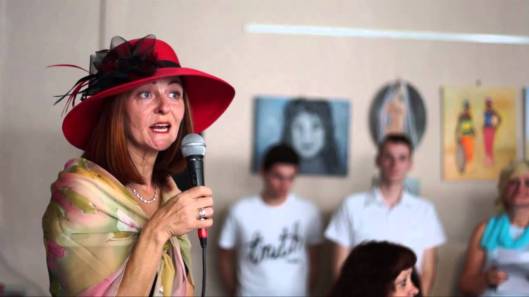
Thanks to Mirosława Stojak for all the work she does to preserve the memory of Jewish history and culture in Włocławek.

Here is a video from Holocaust Remembrance Day (January 27) when she and students and teachers from the Automotive High School visited the memorial at the site of the World War II Jewish ghetto, also the prewar Jewish cemetery.

Flim credit: Q4.pl, http://q4.pl/?id=17&news=170583

The interviews are in Polish, but even if you can’t understand the words, you can see that these people remember the Jewish history of their city. And they are passing on those memories to the next generation.  They lit candle lanterns in front of the commemorative monument, and the students placed pebbles upon which they had written words like “traditions,” “love,” and “memories.”

There’s more about Włocławek’s Jews on Ms. Stojak’s website Zydzi.Wloclawek.pl. The tagline of her site: “Ku pamięci, z nadzieją, na pojednanie,” “In memory, with hope, for reconciliation.”

Crossing Boarders

07 Thursday Sep 2017

Posted by Marysia Galbraith in Commemoration, Polish-Jewish Heritage, Polish-Jewish relations, Radom

≈ 1 Comment

Here’s a post from a heritage seeker on a similar quest to my own. She attended the commemoration of the 75th anniversary of the liquidation of the Radom ghetto, which took place in Radom last month.

radommusings1945's avatarRadom Musings

After a few weeks of decompression, I am finally able to sort through some of my feelings about last month’s commemoration ceremony in Radom.  At times solemn, while at other times celebratory, the event was a reflection of how present day Catholic Poles choose to confront Poland’s complicated relationship between Christians and Jews.

Poland’s internal and external struggles to reconcile its past were highlighted by the incongruity of a klezmer band playing music at the entrance of the Jewish cemetery, and by the reverence demonstrated when a Holocaust Survivor spoke about his fond pre-War memories, followed by a concert of a well-known Polish performer.  While one can say that this combination of somber commemoration and entertaining celebration reflects the merger of past and present, not all of us are ready for the journey.  Poland’s past has a long way to travel before it catches up to present day Jewry.  At…

View original post 287 more words

Jewish Warsaw in the Shadow of Skyscrapers

30 Friday Jun 2017

Posted by Marysia Galbraith in Jewish Culture, Memory, Polish-Jewish Heritage, Polish-Jewish relations, Post-World War II, Synagogues, Warsaw

≈ Leave a comment

Tags

Plac Grzybowski

I discovered Jewish Warsaw tucked between streets I’ve walked dozens of times. My first surprise was that the apartment I rented in an ugly green socialist-era tower is literally around the corner from Plac Grzybowski (Grzybowski Square), where Jewish life survived into the communist era.

DSC00155

6th floor view of Plac Grzybowski. From the left, a socialist era apartment, All Saints’ Church, modern skyscraper, (at the center) green space, with the site of Jewish Theater behind it and the roof of the Gmina Żydowska behind that, (bottom right) back of building with Charlotte Menora Cafe.

I’ll say more about Plac Grzybowski in a minute, but I was even more surprised when, while mapping out a running route, I saw that I was also just a block away from Nożyk Synagogue, the only synagogue in Warsaw that survived the war. I’m embarrassed to admit that I had never been there before, nor is this the first time I’ve been so close and didn’t even realize it. When my best friend from childhood Kim visited with her father in November 2014, we stayed at a hotel on Grzybowska Street, and were it not for the newer building across the street, we could have seen the synagogue from the hotel entrance. Kim and her family introduced me to Passover Seders, and bagels with lox and cream cheese, and I’m sure they would have loved to see the synagogue. In my defense, the synagogue sits in the green space at the center of the block, with tall buildings all around it. It’s easy to miss. The street access to the synagogue looks like the entrance to a parking lot, and from Grzybowska Street, the only access is via pedestrian walkways.

DSC02259

My friend Kim with her father Sandy and my son Ian in Saski Park, Grzybowska Street in the background, November 2014

This isn’t the first time I have seen a synagogue tucked within the central courtyard of a city block. I wonder what the historic reasons were for that. Regardless, I imagine that in the difficult years after the Holocaust, this location offered the synagogue some protection; only people looking for it would find it. This is also where the Gmina Żydowska—the Association of Jewish Communities—has its offices. I should have come here before.

Nożyk Synagogue, Warsaw
"About the Jewish Community"
“About the Jewish Community”

Built in 1902, the synagogue is a solid stone rectangle with arch-topped windows all around. Above the front door, two arch-topped tablets contain the Ten Commandments, and above them is a Star of David. The building survived World War II because the Nazis used it as a warehouse. Jews returned to worship there after the War, and at present, it remains the main synagogue of Warsaw, home to the Orthodox community. The offices of the Gmina Żydowska fill a modern addition across the back of the building.

Both times I walked by the synagogue, a few men were inside praying. More people walked by briskly, probably residents of surrounding buildings. Along the edge of the parking area, large information boards contain headlines like “We, the Jews of Warsaw,” “About the community,” and “Kosher…what does it mean?”

All the pieces fit together from my 6th floor balcony. I can see the metal roof of the synagogue’s modern addition. I also look down at the corner of Charlotte Menora in Plac Grzybowski; this is one of four Charlotte Cafes in Poland. They all specialize in French pastries, but this one also includes Jewish offerings such as bagels and rugelach. My friend Beata took me there last summer. She also pointed out the center of the square that has been converted into a shaggy grassland and wildflower garden. Pathways lined with benches lead down to a central fountain. This novel use of space started out as an art installation by Joanna Rajkowska called “Dotleniacz,” which in English means “Oxegenator;” The project was later reworked into its present, more permanent form.  Beata also showed me Próżna Street, the only street in the ghetto where the original buildings weren’t destroyed in the systematic bombing after the Ghetto Uprising in 1943. On one side of the street, the townhouses have been painstakingly restored. On the other, netting covers the buildings to prevent pedestrians from being harmed by falling elements of the crumbling façade. One of the renovated buildings is home to the Austrian Cultural Forum. Some of my Polish friends say they feel uncomfortable about this because of Austrian support for the Nazis.

Park in the middle of Plac Grzybowski
Próżna Street at night

Grzybowski Square is actually shaped more like a triangle. Charlotte Menora and the intersection with Próżna Street are on one long side. At the second long side, a pile of debris peaks above a barrier fence where the Jewish Theater was torn down last year. This theatre continued to operate all through the communist period, offering performances in Yiddish. Posters on the fence announce that the theater will be rebuilt, along with the TSKŻ, which stands for Towarzystwo Społeczno – Kulturalne Żydów, The Social and Cultural Association of Jews. Sophie, whom I met because she shares the last name of my great grandmother, lived in Warsaw until 1968. Her face lit up as she recalled going to youth activities at the TSKŻ. But she, like most of Poland’s remaining Jews, left in 1968 when the government waged a campaign against Jews. That’s also when many of the TSKŻ branches closed. In Warsaw, the organization hobbled along until after the end of communism, and has since been growing once again.

"Coming here, The new location of the TSKŻ. Jewish Theater and Office-Services Building"
“Coming here, The new location of the TSKŻ. Jewish Theater and Office-Services Building”
All Saints Church
All Saints Church
Pope John Paul II statue in front of All Saints' Church
Pope John Paul II statue in front of All Saints’ Church

At the third, shorter side of the triangle stands the All Saints Church, where Christian Poland asserts itself even in this Jewish part of town. I’ve read that the church was right along the border of the ghetto, and it was where converts to Catholicism living in the ghetto would come to pray. More recently, symbols of Polish nationalism have been placed across the front of the church. Numerous plaques commemorate Home Army soldiers who fought against the Nazi occupation and in the Warsaw Uprising of 1944. These soldiers belonged to companies with names like “Buttress,” and “Brave,” and had wartime pseudonyms such as “Goliath,” “Fisherman,” and “Rooster.” A sculpture of Pope John Paul II stands on the steps leading up to the church, and a monument honoring the Home Army soldiers who produced weapons for the partisans is in the park across the street.

Plac Grzybowski is virtually unrecognizable from the first time I saw it. Marta, a family friend from Warsaw, pointed out the Jewish theatre to me in what I remember as a wide, crowded, dirty intersection with no central green space. It might have been 1990 or 1991, or maybe even 1986. Marta also painted a picture for me of how the square looked still earlier in time, before the war, when the streets were filled with Jews, many of them orthodox men with long beards and black coats, and women wearing wigs or kerchiefs.

The view from my window encapsulates this city–a mishmash of old and new, Catholic and Jewish, nationalism and subversion. Add to this the layers of memory every place contains, along with the energy of a capital city, and you can feel the beating heart of Warsaw.

More Jewish Heritage Work in Kutno

26 Wednesday Apr 2017

Posted by Marysia Galbraith in Cemeteries, Heritage work, Jewish Culture, Jewish Ghetto, Kutno, Memory, Names, Polish-Jewish Heritage, Polish-Jewish relations, Synagogues, World War II

≈ 2 Comments

Tags

Friends of Kutno, Polin Museum, Reclaiming "Jew", Towarzystwo Przyjaciół Ziemi Kutnowski

This is part II about heritage work in Kutno. The first is Jewish History of Kutno.

While in Kutno, I visited the Society of Friends of Kutno (Towarzystwo Przyjaciół Ziemi Kutnowski). The organization has been active since the early 1970s, and has put out an annual periodical about local history and customs for about 20 years. Most issues of the publication contain an article about Jews. In 2016, these articles were compiled in a book along with other historical materials about Kutno’s Jews, including Holocaust witness reports and photographs, and a list of people who lived in the Kutno ghetto.

okladka zarys historii

Outline of the History of Kutno Area Jews, published by the Friends of Kutno

The chairwoman of the Friends of Kutno Bożena Gajewska is an energetic and upbeat woman. She accepted the position because of her interest in local history and her desire to promote that history among local residents. She isn’t paid for this; she volunteers for the organization after getting off work. The Friends of Kutno have their office in a historic wooden villa that was recently renovated by the city. Most of their funding comes from grants. Over the years, they have placed historical markers where the synagogue, Jewish cemetery, and ghetto used to be. Other recent projects related to Jewish culture include field trips for local residents to the Polin Museum in Warsaw, to a production of a Sholem Asch play at the Yiddish Theatre in Warsaw, and to the Chełmno Extermination Camp, where Kutno Jews were transported when the ghetto was liquidated. Kutno was selected as a site where the Museum on Wheels (a traveling branch of the Polin Museum of the History of Polish Jews) would visit; this happened in August 2016.

DSC08529

Marker reads, “In this place the 18th century synagogue stood. It was destroyed by the Nazis during World War II, evidence of the hatred of one human to another, and to his works.”

Pani Bożena says she’s noticed that orientations toward Jews have improved since the Polin Museum has opened. Thanks to the Museum, you can talk about Jews, whereas before, the word “Jew” had negative connotations, and was even used as an insult. This made people unsure what to call practitioners of the Jewish faith. Polin has helped to rehabilitate the term. While this may seem like a manifestation of the particularly fraught relationship between Poles and Jews, Mark Oppenheimer just published an opinion piece in the New York Times (Sunday, April 23, 2017, “Reclaiming ‘Jew’”) in which he notes that it’s the same in the US. “Jew” is almost never used as a noun; rather, the adjective “Jewish” is used, as in “Jewish people” or “I’m Jewish” (never “I’m a Jew”). Oppenheimer quotes the comedian Louis C. K. who called “Jew” a funny word “because ‘Jew’ is the only word that is the polite thing to call a group of people and a slur for the same group.”

The Polin Museum has also contributed to a surge of activity related to Jewish history and culture throughout Poland. This has led some townspeople to complain to the Friends of Kutno, “Why is everything always about Jews?” Bożena says she reminds these people that the Friends are interested in all aspects of regional history, and Jews were a part of that history. They address plenty of other topics, as well. For example, they recently published the biography of a native son who was an ultra nationalist during the period when the majority of Kutno residents were Jews (I can’t remember his name but maybe someone reading this can remind me).

Pani Bożena drove me to see some historical sites around town. The Jewish cemetery is on a hill overlooking a neighborhood of concrete apartment buildings. The hillside is covered with tall grass and wildflowers, and crisscrossed by dirt tracks where people walk their dogs, kids play, and people hang out. Many leave their trash behind. The Friends of Kutno recently put up signs around the cemetery that say “Here is the resting place of Kutno Jews, who settled in the city from the beginning of the 16th century. The cemetery located on this hill was established in 1793. Jews were buried here until March 1943. Please maintain its solemnity.” Below this historical information is the reminder, “Keep in mind as you go into this vast expanse that this is a cemetery; people are buried here, you walk on their graves, even though there are no longer tombstones…” Further, the sign states the cemetery is a registered monument and thus legally protected, and any vandalism is subject to a sentence of imprisonment. Nevertheless, within just a few months, four out of six such signs were vandalized. The metal poles were snapped at ground level. Bożena condemned the destruction, but also minimized it as the work of thoughtless hooligans (as opposed to a deliberately antisemitic act). In September, the poles were replaced and the signs stand once again.

Bożena showing me the new sign at the Jewish cemetery in Kutno
An older monument at the top of the cemetery hill

We passed people with dogs as we walked to the top of the hill to an older monument. It contains the same historical information as the new metal signs in Polish and Hebrew (but not the reminders about proper behavior and legal issues), and is shaped like two adjoining tombstones. Heading back down the hill, past some children playing, we saw the bases of some grave markers peaking out of the grass. Many tombstones were recovered and are stored at the Kutno Museum.

Bożena dreams of building a fence around the cemetery so there will be a more substantial barrier against further vandalism. They have received all the necessary approvals, but are in need of funding.

From the cemetery, we went on to the site of the ghetto, which is outside the center of town on the grounds of a former sugar factory. The factory was used by various industries after the war, but now is closed. The buildings, some dating from the late 19th century, stand behind a high fence and a guard patrols the site. Historic markers tell the story of the ghetto. A granite plaque reads:

Here on the terrain of the former Konstancja Sugar Factory

Germans established a ghetto for the Jewish population of Kutno and the surrounding area.

After its liquidation in 1942, the surviving Jews perished in the camp at Chelmno.

Honoring their memory, the People of Kutno.

Kutno, April 1993

A more recent sign contains a bit more historical information in both Polish and English (if you want to read it, click on the photo below to enlarge it).

Former site of the Kutno ghetto.
Wall plaque at the site of the Kutno ghetto
Historical marker in front of the main gate of the factory where the Kutno ghetto used to be.

Bożena told me that over 8000 people lived in the ghetto from 1940-1942. Those who got there first occupied all the most obvious places, so later arrivals had to build shacks from scrap wood, or find ways of populating balconies and any other inhabitable space throughout the large factory hall. In 1942, they were all transported to the camp at Chełmno by train (the tracks are right across the street from the factory) and by truck.

Thinking about the people I met in Kutno (and elsewhere), one thing I am trying to sort out is why Christian Poles get involved in Jewish heritage projects. Not surprisingly, the reasons are varied. One is interested in historical artifacts; he has no political agenda. Another of my companions tried to place this history into a more pro-Polish framework. He explained that the Nazis forced Christian townspeople to do horrible things as part of a strategy to damage relations between Poles and Jews. “All people really want is to live in peace (Chcą w spokoju żyć)”, he continued, “Poland is in the heart of Europe, a pretty terrain that has historically been attacked from all sides.” Others feel personally drawn to Jewish culture. One of my acquaintances in Kutno believes she has Jewish heritage. She seems to understand my quest for my own family history. “It’s important to know where you’re from,” she told me. She hasn’t found anything as concrete as my family photograph (the one I use at the top of the blog) to confirm her feeling that she has Jewish roots. All she can point to are allusions in family stories she remembers from childhood, and sometimes people have told her she looks Jewish. But anyone she could have asked has passed away.

But what’s clear from my visits to Kutno is that fragments of Jewish history remain, and some have been marked as such thanks to the efforts of a small group of residents who think it is important to include the stories of Kutno’s Jews in the history of their town.

Podgórze: Below the hill and through the ghetto

16 Monday Jan 2017

Posted by Marysia Galbraith in antisemitism, Commemoration, Jewish Ghetto, Krakow, Memory, Podgórze, Polish-Jewish relations, Post-World War II, Reclaimed Property, World War II

≈ 2 Comments

Tags

Ghetto Heroes Square, Plac Bohaterów Getta, Places of Holocaust Memory

When Krysia and I visited Poland a few years ago, we walked to her friend Wanda’s apartment in Podgórze, a district across the Vistula River from Krakow’s Old City. Historically, Podgórze was an industrial part of town, and also the site of the Jewish Ghetto during World War II. Until recently, this was not a particularly desirable place to live. I went there for the first time in 1986 when my Polish teacher invited me for dinner. She lived with her doctor husband and baby daughter on Limanowski Street in a ground floor apartment that was a converted storefront. The building was grey and crumbling, and the tram rumbled by loudly and frequently. They couldn’t wait to move somewhere better. In 1992, I met a high school student whose classmates joked he was “from the country” because he lived in Podgórze. Even though you could see Wawel Castle on the opposite shore of the river, Podgórze was considered a remote corner of the city.

I really discovered Podgórze in 2005 when I was back in Kraków for 5 months during my first sabbatical leave. I made a point of exploring all the city’s parks and playgrounds as a way of entertaining my two-year-old son; long afternoon walks were often the only way I could get him to nap. Podgórze charmed me. The buildings along the tramline on Limanowski Street were still grey and crumbling, but there was also a lovely triangular plaza and a beautiful church with a hillside rising up behind it. Maybe that’s the source of the name—Podgórze means “below the hill.” Climbing up the curving street from the plaza, large houses with fenced gardens replaced the apartment buildings, and then a massive park appeared on the right. And yet, despite these explorations, I still didn’t know that I had been moving in and out of the borders of the former ghetto, where the Nazis had forced Jews to live (and die).

Plaza and church in Podgórze
Heading up the hill
Heading up the hill
One of the large houses on the way to the park

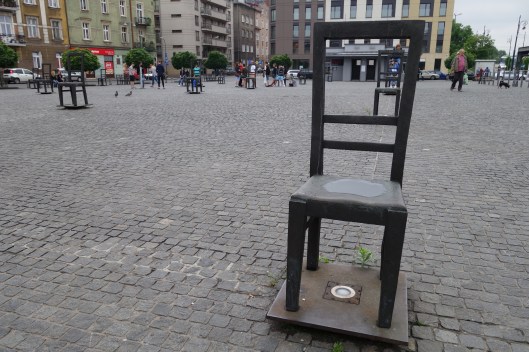
Wanda, a long-time resident of Podgórze, pointed out traces of that difficult era as we walked to her apartment. It was the first time I actually connected the contemporary streets of Podgórze with the places associated with the Holocaust. Just over the bridge, we entered Ghetto Heroes Square (Plac Bohaterów Getta), the site where Jews were assembled before being transported to work, the ghetto, or the camps. It wasn’t until December 2005 that a monument commemorating these historical events was installed. The monument is comprised of 33 large chairs arranged in rows throughout the plaza and 37 smaller chairs scattered around the edges of the square and at the nearby tram stop. These serve as a symbol of the people whose material possessions were taken from them as they were selected for the ghetto and elsewhere. The idea was “to tell the story of the place through the configuration of the urban space itself, so that the memory of the absent ones would be manifested through the presence of everyday objects which compose the urban furniture” (Bordas 2006). The chairs make an impression, especially the big ones. They look like they should be functional but they’re not–another way they symbolize the way ordinary life became abnormal.

Chair monument in Ghetto Heroes Square

Ghetto Heroes Square

Wanda led us to a nearby street where a fragment of the ghetto wall still stands. Its characteristic scalloped top makes it resemble side-by-side tombstones. Flowers rested at the foot of a historical marker, an offering made during a commemorative event in March. Wanda also pointed out where a gate of the ghetto used to cross the street near her apartment. For 23 years, Wanda lived on that street. But then the prewar owners—Jews—regained ownership of the property and doubled the rent. Faced with the option of paying 2000 zloties per month or move, Wanda decided it would be better to invest that kind of money in a place she could own herself. That way, she doesn’t have to worry about being displaced again.

Like many Poles, Wanda feels personally affronted by former owners reasserting their claim over property. These feelings are complicated.

It seems only right that descendants of victims of the Holocaust be compensated. Regaining ownership of a building can only to the slightest degree address what those families lost.

And yet, losing their home to the prewar owner seems particularly unfair to the generation that endured years of communism, and never was able to accumulate much wealth in their own lives. Since the end of communism, prices have risen, unemployment has become common, and wages remain modest. Often it’s the poorest residents who live in former homes of Jews because the government took over their management and made them into low-cost housing for those in greatest need. This affordable housing was a small oasis of security in unsettled times. Many such residents today are elderly; others are unemployed; some have problems with their health or with substance abuse. They don’t have many options.

Wanda was one of the lucky ones with the wherewithal and the financial means to buy her own place. But still she carries the resentment with her that she sometimes translates into resentment of Jews more generally. Who was looking out for her rights when the apartment was returned to the prewar owners? What did some rich foreigner need with her building? Why should they get even wealthier at her expense?

In fact, prewar owners are reclaiming properties all over Poland, and even though they are not all Jewish, the greatest resentment is directed toward those who are.

Ghetto Memory Trail marker
Star of David crossed out--on a storefront in Podgórze
Star of David crossed out–on a storefront in Podgórze

In Podgórze, you can see both the effort to acknowledge sites of Jewish heritage, and also signs of continued antisemitism.

Wanda loves her neighborhood and doesn’t want to live anywhere else (even though she has to spend part of each year in the US to earn enough money to pay her mortgage). The apartment she lives in now is new construction on top of a historic townhouse; an additional floor was added to an existing building. As we climbed the three flights of stairs, she explained that when she bought the place, all that was there were the bare walls. This is standard practice in Poland. The buyer has to select, purchase, and install all the flooring, fixtures, wall coverings cabinets, and appliances. The apartment is long and narrow, with a wall of windows and a sleeping loft. Wanda said she bought it at the peak of the market; today she could find something for half that price. But that would mean moving again.

As we ate a generous spread of Polish dishes, including stuffed cabbage (gołąbki) and two kinds of pickles, Wanda said that Podgórze has become one of the most popular neighborhoods in Krakow. The new heritage sites and museums—including the Ghetto Heroes Square, the Schindler Factory Museum, and the Museum of Modern Art—have brought with them tourists and the amenities that tourists expect. People are moving out of the center of the city because it has become too crowded, cars are restricted on most streets, there are few stores with everyday necessities, and the prices are too high. Podgórze is desirable because it has good public transportation, is within walking distance of the city center, and because of the park, the trees, and the hill that I find so appealing.

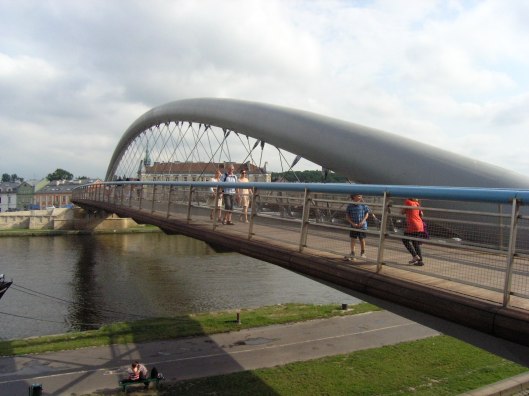
OLYMPUS DIGITAL CAMERA

The new pedestrian bridge across the Vistula River to Podgórze.

The Curious Tale of the Fake Rabbi

29 Tuesday Nov 2016

Posted by Marysia Galbraith in Identity, Jewish Culture, Polish-Jewish relations, Poznan, stereotypes

≈ 3 Comments

Tags

Fake rabbi, Jacek Niszczota, Jacoob Ben Nistell, Ruth Ellen Gruber, Virtually Jewish

Purim 2015
Purim 2015
http://www.gloswielkopolski.pl/

Not long ago, a reporter revealed that that the man acting as Poznan’s rabbi was not in fact a rabbi. He called himself Jacoob Ben Nistell and claimed to be an Israeli from Haifa, but it turns out he is actually Jacek Niszczota, a Catholic Pole from Ciechanów, a town 60 miles north of Warsaw.

I’m not quite sure what to think of the story, but it resonates with Ruth Ellen Gruber’s characterization of much of Jewish activity in contemporary Europe as “virtual.” In her book Virtually Jewish: Reinventing Jewish Culture in Europe (2002), Gruber describes the myriad ways Jewish spaces, performances, and even people are in fact idealizations, representations, or stylizations of Jewishness. They are done up in “Jewish style” but often without actual Jews. This has occurred throughout Europe, where the interest in all things Jewish far exceeds the capacity of the tiny or absent populations of Jews to fulfill. Instead, non-Jews renovate synagogues, restore cemeteries, run Jewish restaurants, perform Klezmer music, and lead Jewish heritage tours.

Jacoob/Jacek’s self-presentation as Hasidic rabbi can be added to this long list of virtual Jewish performances, with the important qualification that his role was deceptive. He claimed to be a real Hasidic Jew, not someone just dressed up as one. He wore his hair long, with the distinctive side curls. He also dressed in a black brimmed hat and long black jacket. I don’t believe his intentions were malicious. Nor am I sure how much he deliberately deceived people, and how much people saw him as they wanted him to be. When I met him, he didn’t tell me “I’m a rabbi.” Rather, he said “They call me a rabbi,” his sweet smile and amused tone suggesting he was willing to go along with what others were saying about him. He did, however, claim to be from Israel. I didn’t quite believe him; more accurately, I questioned whether I heard him correctly because it didn’t fit my reading of him. He seemed Polish to me. Others tell me he put on an Israeli accent, but I can’t always recognize accents of Polish speakers. When I talked with him about a possible interview, he did not refuse, but he did not seem very eager either so I never pursued it. He seemed quirky and harmless, a bit of a happy jester.

Nevertheless, Jacoob/Jacek was deceptive and his actions are highly offensive. I saw him at a number of commemorative events: praying at the grave of Akiva Eger, a respected early 19th century Poznan rabbi; saying kaddish at the unveiling of the commemorative monument and lapidarium in Wronki; leading prayers at the Jewish Religious Community in Poznan. What got him caught was the media attention he received when he appeared at an ecumenical meeting with a Catholic priest and a Muslim imam. Someone from his hometown recognized him and alerted the media.

At that point, it became clear that there had been rumblings among Israelis and other Hebrew speakers that Jacoob/Jacek didn’t actually know Hebrew. Rather he read texts phonetically, putting emphasis and accents in the wrong places.

So that leaves me with the question why no one at the Jewish Religious Community (which is an official religious association for practicing Jews) challenged the veracity of his claims. Either they were genuinely deceived or they chose not to do anything about it. It’s problematic either way. If they didn’t know, it reveals how tenuous their knowledge of Jewish religious practice, culture, and language is. If they did know, it suggests they allowed the deception to go on. Even though Jacoob/Jacek was never declared a rabbi officially, I did hear him referred to affectionately as “our rabbi” (“nasz rabin”) and he was allowed to lead prayers in contexts that everyone expected would be done by a real rabbi. The Jewish Religious Community has a legal status. It is supposed to be the official institution for practicing Jews. What it turned out to be instead in this case is part of the virtual Jewish space. The idea, look, and performance of Jewishness was deemed sufficient.

I feel sympathy for Jacoob/Jacek, who has disappeared since his deception was revealed. I wonder what compelled him to pretend he was Jewish, and why he adopted the stereotypical form of a Hasidic Jew. It’s anachronistic in so many ways. Being any kind of Jew is a rarity in Poland, and the only Hasidic Jews in Poznan are occasional foreign visitors. Even historically, when Jews lived in Poznan in greater numbers, very few were Hasidic. This was even pointed out to me by a prominent member of the Jewish Religious Community. He gestured toward Jacoob/Jacek and assured me that even in the past, Poznan Jews tended to be more modernized.

“Who, 30 years ago in this country, would have pretended to be a rabbi, to say nothing of 70 years ago?”asked the Chief Rabbi of Poland Michael Schudrich in an article in the Times of Israel. He described Jacoob/Jacek as “very sweet and smiley,” much the same as I saw him.

Poles Remember

01 Tuesday Nov 2016

Posted by Marysia Galbraith in Catholicism, Cemeteries, Commemoration, Dukla, Memory, Polish Culture, Polish-Jewish Heritage, Polish-Jewish relations

≈ Leave a comment

Tags

All Saints Day

Today is the Catholic holiday, All Saints Day, the time to honor the dead. Customarily, Poles visit cemeteries to clean and decorate the graves of their family members. During the day, chrysanthemums in all shades adorn tombstones. At night, candle lanterns on graves make the cemeteries glow. Twinkling hillsides can be seen from far away.

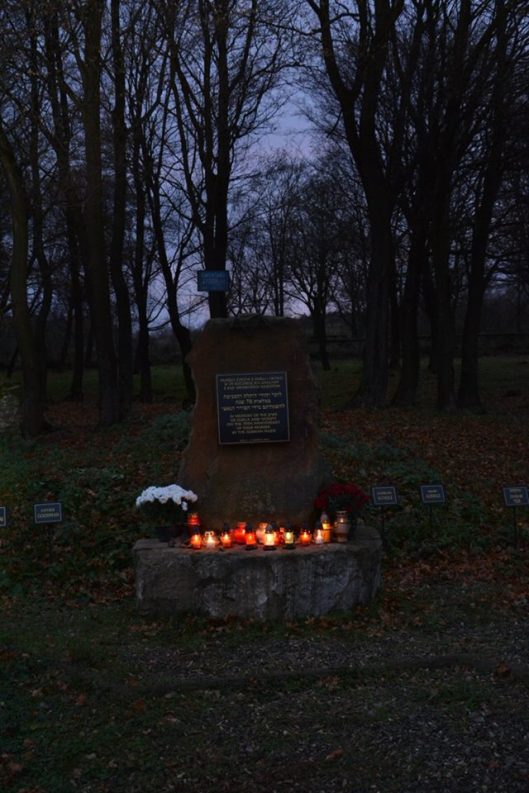
I’m pleased to see that some Poles also remember Poland’s now-absent Jewish population on November 1. I’ve seen this in Warsaw and in Lutowiska. And here is a photo Jacek Koszczan posted on Facebook today showing the candle lanterns on the commemorative monument at the town of Dukla’s Jewish cemetery.

Candle lanterns on the monument commemorating Dukla's Jewish population, November 1, 2016, All Saint's Day.

Candle lanterns on the monument commemorating Dukla’s Jewish population, November 1, 2016, All Saint’s Day.

He and other citizens of Dukla made the trip out to the cemetery to light a candle for the dead. In this, I see an expression of honor that transcends religious difference.

Jacek has done a great deal to reassemble the memory of Jewish life in Dukla. In fact, he was honored last month by the Polin Museum for his work. The Polin website explains, “Jacek Koszczan is the founder and director of the Organization for the Preservation of Jewish Heritage in the Dukla Region–Dukla Shtetl. His work involves both obtaining and archiving knowledge about the Jews of Dukla and its surroundings, as well as educational activities. Jacek Koszczan is the initiator and builder of a monument commemorating the 70th anniversary of the murder of Dukla’s Jews, the volunteer caretaker of the Jewish cemeteries, mass grave, as well as the ruins of the Dukla synagogue. Thanks to his efforts and knowledge, he succeeded in facilitating the honoring of two Dukla-region families with the medal for the Righteous among Nations.”

Jacek Koszczan receiving his award from the Polin Museum for his work on Jewish heritage in Dukla, October 21, 2016. Photo by Janusz Czamarski

Jacek Koszczan receiving his award from the Polin Museum for his work on Jewish heritage in Dukla, October 21, 2016. Photo by Janusz Czamarski

All in all, Jacek has been instrumental in the return of the memory of Jews to his community. I have been impressed by his energy, enthusiasm, and generosity. For him, this is a labor of love–for his community, for the memory of those who suffered, and for humanity in the face of evil.

Dwie Butelki Wódki

21 Wednesday Sep 2016

Posted by Marysia Galbraith in Memory, Polish-Jewish relations, Post-World War II, Żychlin

≈ Leave a comment

Historia “Dwie Butelki Wódki,” napisana przez Mirosława Stojak, prezentacja opracowana przez Henryk Olszewski:

dwie-butelki

Two Bottles of Vodka

19 Monday Sep 2016

Posted by Marysia Galbraith in Heritage work, Jewish Culture, Memory, Polish-Jewish relations, Post-World War II, Survival, Włocławek, Żychlin

≈ Leave a comment

Two times over the course of my visit to Żychlin, my host Henryk told me a story about a young Jewish boy who survived the war and returned to the town to collect his family’s jewels. A bad Pole threatened the boy’s life unless he showed him where the valuables were hidden. The frightened boy showed him. They sat down at a table and for each one item the bad Pole gave the boy, he took several for himself. The boy took out a roll of money and offered to buy the jewelry. Then, the brother of the bad Pole came in and saw what was going on. He told his brother, “Here, I have two bottles of vodka. We’ll drink together.” Then he gave the boy all his money and jewels back.

The story made an impression on Henryk. He said a woman from Włocławek had told it to him. Because they were talking on the phone, he didn’t want her to tell him the real names of the men. He wants to save it for when they meet in person. That kind of information is better shared face-to-face. The second time he told me this story, it occurred to me I might know the woman he had spoken with. Indeed, it turned out that it was Mirosława Stojak, who has made it her personal quest to learn all she can about Włocławek Jews. Henryk promptly called Mira so we could talk. I met Mira during my first visit to Włocławek in 2014, and then again when I was there in June.

Mira uses her talents as a poet, writer, and actress to share the stories of Włocławek Jews. In her book Utkane Sercem Włocławskim Żydom, she includes the story that so captivated Henryk, called “Two Bottles of Vodka.” Here is the translation of the story:

Two Bottles of Vodka

Utkane Sercem Włocławskim Żydom by Mirosława StojakWinter 1946 was cold. All around, snow covered homes, roads, and trees. Long icicles hung from the roofs. On a January afternoon, Ariel came on the snowy road to the home of his relatives. Before the war, together with his sisters, he was there a few times. During his last visit in 1939 Ariel’s father, a merchant from Żychlin, knew that soon Germans would attack Poland militarily. Sixteen-year-old Ariel, a short boy, emaciated after the experience of the camp, walked pensively listening to the scrape of his creaking shoes. In his ears rang what his father once told him:

“You have to save yourself, and whoever survives should return here…”

He knew perfectly well that his visit would not be viewed happily by the new owners of the house. He was even afraid that he would be treated poorly. He wasn’t sure, either, if the home still stood, or if it was bombed during the war. He hoped not. He walked slowly, every once in a while touching an icy rock. He passed ruins of houses and ashes, people shoveled snow. He heard dogs barking. Before the war he loved dogs, and they even had two beautiful German shepherds at home. Now, they reminded him of scenes from the camp and he was horribly afraid of them. In Auschwitz they were trained to murder. Ariel picked up his pace. Soon the sun would set and it would be dark. After a while, he saw the home of his uncles and aunts, who didn’t much care for visitors during the war. Fearfully, he knocked on the door. A young man stood before him, tall and well built. He had an unfriendly expression on his face, as if he had been expecting him. With his strong hand, he pulled Ariel inside, shutting the door, and yelled,

“Where is it?”

The frightened Jew led him down the stairs to the basement, and then the “brute” pushed him against a wall and demanded he say where the treasure is. A few strikes of a hammer against a wall and in the hands of his “captor” appeared a casket. Now, the boy was led upstairs and into the kitchen. The man grabbed his shirt and sat him on a chair at the table, then sat down across from him and opened the box. Inside was the ancestral jewelry of Ariel’s family. There were brilliantly shiny rings, broaches, and necklaces. Taking the valuables out of the casket, the man put them on the table, between himself and Ariel, loudly counting:

“Mine, mine, yours, mine, mine, mine, yours, mine, mine…”

When he finished, there were just three family heirlooms in front of Ariel. Tears appeared in his eyes. They reminded him of his mother, who always wore a string of white pearls around her neck when she went to synagogue. Now they lay in front of him on the table awaiting their verdict. The boy slowly reached into his pocket and pulled out a role of banknotes, explaining that for him the jewelry has sentimental value for his family and he would gladly buy them back. The “brute,” without thinking, took all the valuables lying on the table for himself, and in a deep resonant voice called out,

“Józek!”

In the kitchen doorway appeared a “man like an oak,” big and broad-shouldered, who asked contemptuously,

“What?” and looked at the table.

The brute moved aside, his eyes not leaving the valuables. Józek who was much older was supposed to settle the matter. Ariel began quickly explaining, persuading him to agree to his proposition to buy the jewelry. He asked Józek to take the money and give back the valuables and then everyone would be satisfied. Józek thought; he silently looked at the young Jew and the table with an appraising eye. Frightened, Ariel imagined them closing him in the basement and starving him, or God forbid, murdering him. Wouldn’t it be ironic to die here and now, after he had the good fortune to miss death at the hands of the Nazis? After a while, Józek broke the silence, yelling:

“Karol!”

A boy who was perhaps eight years old came into the kitchen. Freckled, with wavy hair and an intelligent look. From the pile of money lying on the table, Józek took one bill, gave it to the boy and told him:

“Go and buy two bottles of vodka.”

The boy, like a shot, ran from the cottage. Józek pushed the jewelry and money in the direction of Arial and said:

“Take it and go!”

Ariel ran as fast as his legs would take him. It was a marathon. He didn’t even touch the rock; he didn’t hear the barking dogs. He sped ahead with all the strength in his legs, not looking back. When he got to the station, the train stood ready for departure.

Mirosława Stojak recounting stories about Włocławek Jews, October 1, 2015

Mirosława Stojak recounting stories about Włocławek Jews, October 1, 2015

Mirka told me she met the boy from the story when he visited Włocławek (now of course, he’s an elderly man). His wife wore some beautiful jewelry; she doesn’t know if these were pieces he recovered, but it is nice to think that they were. At his request, she changed all the names when she wrote down the story. Nor did she write about the further misfortunes the boy experienced before he found his way to safety in Israel. I won’t either—the most important thing is that he survived.

How Żychlin Remembers, part 2

01 Thursday Sep 2016

Posted by Marysia Galbraith in antisemitism, Jewish Ghetto, Memory, Polish-Jewish Heritage, Polish-Jewish relations, Post-World War II, Pre-World War II, stereotypes, Synagogues, World War II, Żychlin

≈ Leave a comment

The next morning I met Tadeusz Kafarski for a tour of the city. He was with Józef Staszewski, the director of the Żychlin branch of the Association of Children of War. Because Józef was born in 1929, he remembers wartime better than Tadeusz, who was only a year old when the Nazis invaded. The two sometimes disagreed about details, but together they reconstructed for me Jewish life in Żychlin. As they pointed to the buildings that stand here and now, their descriptions transported me back and forth through time, to prewar life, wartime murder, and communist era absence. I had the odd sensation as I did so many times on this trip of being both here (in the present) and then (in the past), my mind trying to reconcile what stood before my eyes with what used to be. My guides led me back in time with varied fragments of information:

On Łukasieńskiego Street, we passed concrete apartment buildings built in the 1970s on the site of the second, larger Jewish ghetto.

Mr. Helmer, the richest Jew in town, lived across from the market square, to the left of Narutowicza Street, in what is now a well maintained two story building.

One block south, near the synagogue (the blue Star of David on the map below) on Kilińskiego Street, we passed the former home of a Jewish doctor, a building that used to be a dairy collection point, and another that was the preschool Tadeusz attended. A man named Merc lived nearer the synagogue. Behind some houses was the Jewish slaughterhouse, but Christian Poles also bought meat from there.

Jews and Poles lived side by side, even though this part of town was predominantly Jewish. Today, this section of town is run down though these particular buildings seem in good shape.
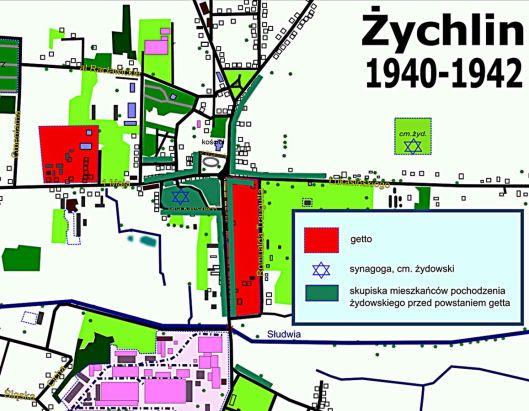
Map of Żychlin 1940-42 showing the ghettos in red, the first one is on the left and the second is on the right. The dark green shows the main areas where Jews lived--note that most were not in what became the ghetto. That meant gentiles had to move out of those areas when the Jews were forced to move in.

Map of Żychlin 1940-42 showing the ghettos in red, the first one is on the left and the second is on the right. The dark green shows the main areas where Jews lived–note that most were not in what became the ghetto. That meant gentiles had to move out of the ghetto areas when the Jews were forced to move into them.

As we wound through the dusty streets, the contemporary residents stared at us suspiciously, though some who know my guides greeted them, “Dzień dobry (Good day).”

The patch of tall weeds in front of the synagogue (on Jana Kulińskiego Street) used to be a fenced garden. The garden continued to be maintained after the war, even though the Polish residents used the synagogue as a warehouse, as did the Nazis. The lower sections of the windows were bricked in and new doorways were installed in the sides of the building to facilitate loading and unloading.

What's left of the Żychlin synagogue. Note the windows used to extend much father down, and the more recent doorway (now blocked) added when the building was used as a warehouse. The weedy area in the foreground used to be a fenced garden.
What’s left of the Żychlin synagogue. Note the windows used to extend much father down, and the more recent doorway (now blocked) added when the building was used as a warehouse. The weedy area in the foreground used to be a fenced garden.
Pan Józef beside the site of the well and mikvah
Worn stones--something I learned to value as a student archeologist. These were used in place of asphalt before World War II
Worn stones–something I learned to value as a student archeologist. These were used in place of asphalt before World War II

As a child, Józef went inside several times with his parents, though he could only describe the general layout of the interior. The candlelit altar was on the east wall, the main entrance on the west. Above the entrance was a balcony that would have been for the choir in a church but in the synagogue was for women to pray in. In a neighboring building, the rabbi would change. On the other side of the synagogue were a well (with the best water in town) and mikvah. After the war, everyone used that bathhouse.

Józef said, “There is just one faith; Jews believe in God just like we do.” He declared children played together regardless of religion. He described distinctive aspects of the Jewish population. Men wore head covers and beards. They would take their shoes off in the synagogue, but had to keep their head covered. The Jewish “priest” was the only one with side curls. He wore a black hat, black clothes, and a white shirt. Jews stayed home Friday and Saturday; they didn’t work. They held their hands at their waist and rocked as they prayed. They read scrolls. Jews used to bury their dead in a sitting position with money on their eyes. Men carried the unclothed, shrouded body to the cemetery. They returned to God as they began. When they left the cemetery after the burial, mourners dispersed in different directions . He asked why and was told it was so the spirit doesn’t return home with them.

Are these personal memories or stereotypes picked up from other sources?

My guides told me about a man named Rozenberg. They pointed to the yard of his bakery, and then we walked around to what used to be its storefront on Narutowicza Street. Rozenberg lived in a multi-story home on the other side of the street. He married a Christian named Czajka. Jozek said the Rozenbergs’ children Krysia and Rudek were Jewish. He played with the boy. After her husband died, Czajka married her brother-in-law, a judge. They had two more children. After the war, the family was harassed by the police so they sold all their buildings and went to Israel. One child moved to Norway.

The Germans occupied the town on September 15. At first, they didn’t treat anyone harshly, but they did take their property—first the stores and richer buildings owned by Jews, and then jewelry and everything anyone had that was valuable.

The main entrance to the ghetto used to be across from Rozenberg’s bakery. This was the second ghetto, established later for the poorer Jews. The first ghetto, where the richer Jews were sent, was on the grounds of an old factory outside the center of town. As Jews were forced into the ghetto, Poles whose homes were within the ghetto territory had to move to homes on the other side of the street—homes that had been emptied of their Jewish residents.

In July 1942, the second ghetto was liquidated. It took five hours because thousands of people were loaded onto wagons, and then everything was removed from their homes and segregated into piles. Some Poles helped, forced to work under threat of death. My guides disputed claims that Poles plundered Jewish possessions. They insisted the Germans took everything valuable, then piled up all the remaining dirty and broken things and burned them.

We crossed the street to the main square. Right there in front of the church there used to be a row of market stalls run by Jews. The church owned the land, but didn’t have any problem with Jewish venders. We continued behind the church and across another market square to the town library. This solid stone structure was originally built for Hempel, the Nazi mayor of the town remembered for his cruelty.

My guides Tadeusz Kafarski and Józef Staszewski in the town square
The Żychlin town square
Director of the Żychlin Library, Ewa Andrzejewska
Nazi Mayor Hempel's villa is now the Żychlin Public Library
Nazi Mayor Hempel’s villa is now the Żychlin Public Library

Tadeusz told me the wartime mayor’s villa was built with tombstones from the Jewish cemetery. Jews were pressed into service carrying the heavy stones. It was backbreaking labor made more difficult by the extreme heat. When one of the workers asked for a drink of water, the Nazi officer shot and killed him. Then, he held up a stick threateningly and asked who else wants a drink. No one dared ask for water after that. Józef told the story a little differently. He said the man who asked for water was dragged to the nearby lake and drowned.

Pani Ewa Andrzejewska, the director of the library, said her aunt who took care of Hempel’s children described him as ruthless, “A typical German.” He furnished his house with things he took from the richer people in the city. He rode a white horse. She also suggested my guides were a little too invested in showing Poles in a positive light to me—emphasizing heroism and victimization and minimizing complicity. She said that on one hand, Jews and Poles lived peacefully together. She was raised to not feel any prejudice. But on the other, many have negative sentiments toward Jews. She even went further to say Poles are genetically indisposed toward Jews. I challenged her on this saying that since sentiments toward Jews have changed over time, it’s a matter of history, not biology. She still didn’t agree, and repeated that Poles have a problem with this.

A dream of mine would be to help preserve and maybe even rebuild the town synagogue. My hosts said the TMHŻ has looked into turning it into their meeting space. Ewa said the ownership of the building is in dispute. So for now it just sits there, slowly crumbling away.

Leaving town the next day, I was once again stopped at the railway crossing as a train sped by. I didn’t mind having one last moment in this town where my great grandmother lived. I felt saddened and rooted by what I had learned, and grateful for the acquaintances who showed me Żychlin as it is now and as it was then.
← Older posts
Newer posts →

Categories

  • Anthropology (37)
    • Archives (14)
    • Fieldwork (7)
    • Ground Penetrating Radar (GPR (4)
    • Research Methodology (8)
  • antisemitism (14)
  • Association of Descendants of Jewish Central Poland (32)
  • Catholicism (8)
  • Conference (1)
  • Discrimination (2)
  • Family (69)
    • Bereda (17)
    • Kolski (13)
    • Piwko (22)
    • Rotblit (3)
    • Walfisz (4)
    • Winawer (7)
  • Genealogy (11)
  • Heritage work (66)
    • Commemoration (23)
  • Identity (18)
  • Israel (6)
  • Jewish Culture (89)
    • Cemeteries (51)
    • Museum (7)
    • Synagogues (33)
  • Jewish immigrants (8)
  • Jewish Religion (1)
  • Memory (70)
  • Names (14)
  • Photographs (6)
  • Pifko-Winawer Circle (5)
  • Poland (125)
    • Baligród (1)
    • Bolimów (1)
    • Brześć Kujawski (5)
    • Buk (1)
    • Chodecz (1)
    • Dukla (2)
    • Dąbrowice (1)
    • Gdynia (1)
    • Gostynin (2)
    • Gąbin (1)
    • Izbica Kujawska (1)
    • Kazimierz (4)
    • Kowal (1)
    • Koło (1)
    • Krakow (7)
    • Krośniewice (1)
    • Kutno (6)
    • Kłodawa (1)
    • Lesko (8)
    • Leszno (1)
    • Lubień Kujawski (1)
    • Lubraniec (1)
    • Lutowiska (3)
    • Piła (3)
    • Podgórze (2)
    • Poznan (11)
    • Przemyśl (2)
    • Pzedecz (1)
    • Radom (1)
    • Radymno (1)
    • Sanok (1)
    • Skierniewice (5)
    • Sobota (2)
    • Tarnów (2)
    • Warsaw (22)
    • Wielkopolska (1)
    • Wronki (7)
    • Włocławek (20)
    • Zasław (2)
    • Łódź (1)
    • Żychlin (30)
  • Polish Culture (10)
  • Polish-Jewish Heritage (60)
  • Polish-Jewish relations (60)
  • Post-World War II (24)
  • Pre-World War II (22)
  • Reclaimed Property (1)
  • stereotypes (3)
  • Survival (9)
  • Trauma (3)
  • Uncategorized (5)
  • Victims and perpetrators (4)
  • World War II (45)
    • Jewish Ghetto (12)
    • Nazi Camps (5)
    • Polish Underground Army (3)
  • Yiddish (5)

Enter your email address to follow this blog and receive notifications of new posts by email. Your email address will not be shared.

Archives

  • October 2025 (1)
  • July 2025 (8)
  • June 2025 (1)
  • April 2025 (1)
  • August 2024 (3)
  • July 2024 (3)
  • May 2024 (2)
  • April 2024 (1)
  • May 2023 (2)
  • January 2023 (2)
  • December 2022 (7)
  • November 2022 (2)
  • October 2022 (5)
  • September 2022 (1)
  • January 2022 (1)
  • August 2021 (1)
  • December 2020 (2)
  • July 2020 (1)
  • May 2020 (3)
  • April 2020 (1)
  • March 2020 (1)
  • January 2020 (2)
  • May 2019 (1)
  • February 2019 (1)
  • November 2018 (1)
  • September 2018 (1)
  • August 2018 (3)
  • July 2018 (1)
  • June 2018 (1)
  • May 2018 (1)
  • April 2018 (2)
  • March 2018 (2)
  • February 2018 (2)
  • January 2018 (2)
  • December 2017 (2)
  • November 2017 (2)
  • October 2017 (1)
  • September 2017 (3)
  • August 2017 (3)
  • June 2017 (2)
  • May 2017 (3)
  • April 2017 (1)
  • March 2017 (2)
  • February 2017 (1)
  • January 2017 (2)
  • December 2016 (2)
  • November 2016 (4)
  • October 2016 (1)
  • September 2016 (6)
  • August 2016 (2)
  • July 2016 (1)
  • May 2016 (4)
  • April 2016 (2)
  • March 2016 (3)
  • February 2016 (4)
  • January 2016 (3)
  • December 2015 (3)
  • November 2015 (5)
  • October 2015 (5)
  • September 2015 (3)
  • August 2015 (4)
  • July 2015 (3)
  • June 2015 (3)
  • May 2015 (4)
  • April 2015 (9)
  • March 2015 (3)
  • February 2015 (2)
  • January 2015 (5)
  • December 2014 (4)
  • November 2014 (9)
  • October 2014 (2)
  • September 2014 (1)

Copyright Notice

All original text and images are copyright © Marysia Galbraith. Please contact the author before quoting.

Blog at WordPress.com.

  • Subscribe Subscribed
    • Uncovering Jewish Heritage
    • Join 145 other subscribers
    • Already have a WordPress.com account? Log in now.
    • Uncovering Jewish Heritage
    • Subscribe Subscribed
    • Sign up
    • Log in
    • Report this content
    • View site in Reader
    • Manage subscriptions
    • Collapse this bar
 

Loading Comments...