• About
  • The Photo that Started it All

Uncovering Jewish Heritage

Uncovering Jewish Heritage

Category Archives: Poland

Inclusion and Exclusion in the Polish Nation

20 Tuesday Mar 2018

Posted by Marysia Galbraith in antisemitism, Catholicism, Family, Genealogy, Identity, Jewish immigrants, Poland, Polish-Jewish Heritage, Polish-Jewish relations, Pre-World War II, Włocławek

≈ 1 Comment

Tags

Honorary Citizen of the Russian Empire, Mizrahi Party

Were Jews included as part of the Polish nation or were they excluded from it? This was one of my driving questions when I started to uncover the Jewish roots of my (Polish) mother’s family. I wondered if I might find my ancestors in some kind of hybrid Polish-Jewish space in which they identified as both Polish and Jewish. Or perhaps they lived in a world that ran parallel to that of their non-Jewish neighbors, with limited points of interaction. What I have found so far is neither straightforward nor consistent. It doesn’t fit entirely nor unambiguously into a narrative of hostile separation nor of peaceful coexistence. I’ll be focusing here on my ancestors’ lives before World War II. The Holocaust was such a devastating event that it needs to considered in its own terms, something I’ll try to do in another post.

The Polish lands were hospitable to my Jewish ancestors, allowing them to prosper for generations. My grandfather Jacob Rotblit owned a Ford dealership in the 1930s, and before then he was a manager of an international trading firm. Or maybe he sold jewelry. It’s hard to find absolute proof, but either way, he maintained important business interests.

Poland PartitionMap

Poland was under Russian, Prussian, and Austrian rule from the end of the 18th century until World War I. The region around Warsaw, where my family lived, was under Russian rule, though it had some degree of autonomy for some of this time. Map source and more information about the partitions of Poland: http://www.britannica.com/EBchecked/topic/466910/Partitions-of-Poland

My grandmother’s father Hil Majer Piwko was in the lumber trade. Documents from the National Archive in Włocławek show he owned a building supply store in the 1920s, and according to Aunt Pat, he owned a sawmill before then. Pat also writes that he was recognized as an “honorary citizen of the Russian Empire” for his service during a cholera epidemic. This was sometime before 1918, when the region near Warsaw was part of the Russian Empire. Apparently, the title “honorary citizen” came with some of the rights that were normally reserved for the nobility.

So there was separation but also opportunity. It was not very easy for Jews to become gentry, unless perhaps through marriage, but there were other means by which they were granted special honors and rights. By comparison, different social classes faced road blocks against entering the gentry, regardless of ethnicity or religion. For instance, most peasants lacked the financial means and cultural capital to gain such social standing. At least in some times and places, wealthy, educated Jews would have had more avenues to social advancement.

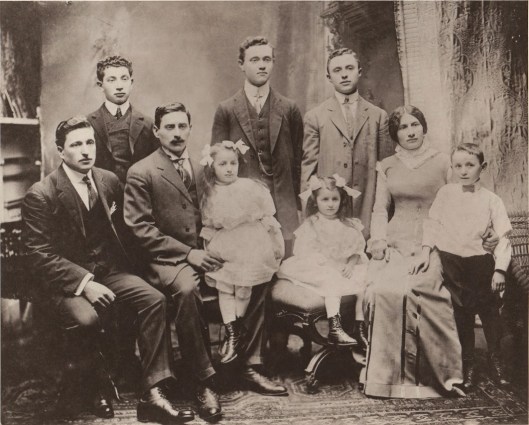
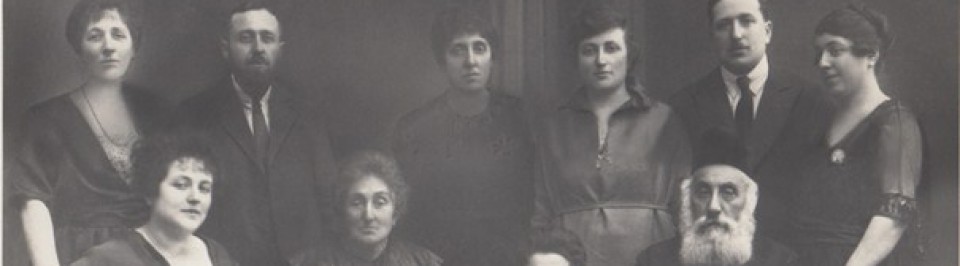
More about my family’s prosperity can be read from the family portrait that was taken around 1916. Hil Majer and his wife Hinda had many children. They were wealthy enough to dress in fine fabrics. Hil Majer’s traditional clothing suggests that he had the freedom to practice his faith and customs, while his children were free to assimilate, as indicated by their modern clothing. Separation wasn’t just enforced by the majority, but also sometimes chosen to preserve cultural and religious distinctiveness.

JechielHindaAndChildren

The Piwkos c. 1916. For more about this photo see: The Photo That Started it All, Some Reassembled Stories, and What Year Was It?


Why did the family move from Hil Majer’s native Skierniewice to the village of Sobota, before settling down in Brześć Kujawski and then Włocławek? It seems likely they were following economic opportunities, but also possibly they were seeking a place more hospitable to Jews. This fits a common narrative about the Jews as wanderers. They arrived in Eastern Europe as tradespeople, financial advisers, and estate managers, and eventually established settled communities. But I’ve also been told that by the 19th century, most Jewish families stayed put. That’s why knowing the place of origin of one relative usually leads to many more relations.

Włocławek hadn’t always welcomed Jews. Until the end of the 18th century, it was a Church town, home to a bishop’s cathedral, with restrictions against Jewish residents. But then the city secularized, and as it industrialized and became an engine of commerce, the Jewish population also grew. Located as it was between Warsaw and the Baltic Coast on the Vistula River, Włocławek became an important port, and home to paper, ceramic, metal, chemical, and food processing factories.
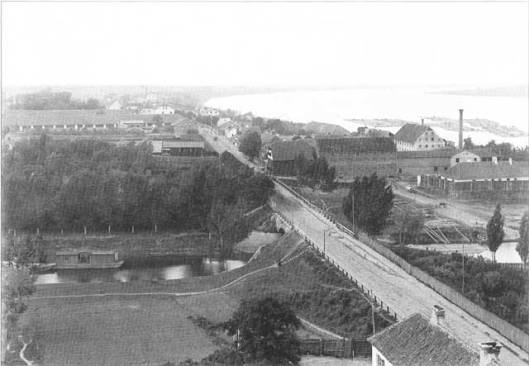
Włocławek-Wyszyński_street_on_photograph_by_Sztejner

Włocławek before 1898. Note the factories near the river. By Bolesław Julian Sztejner (1861-1921) (http://www.wuja.republika.pl/widoki_ogolne_wl.html) [Public domain], via Wikimedia Commons

In addition to economics and religion, political factors shaped the degree of inclusion available to Jews within the broader society. Antisemitism grew in the 1880s throughout the Polish lands, as Polish nationalists became more active in their pursuit of national sovereignty. Once Poland gained its autonomy in 1918, tensions deepened. Some political forces, led by Józef Piłsudski, argued for a broad definition of citizenship within the new Polish state, insuring equal rights for the 1/3 of the population that was Ukrainian, German, Jewish, and other minorities. Another political faction, led by Roman Dmowski, advocated for a narrower definition of Polishness, based on an idea of “pure blood,” by which he meant shared descent that also tied the nation to Catholicism. At the same time, Jewish nationalism grew, and took on a number of forms, leading some to embrace  Yiddish culture, and others to espouse Zionism. Some Jewish nationalists dreamed of a safe place within the countries in which they lived, while others turned their eyes toward Palestine.

Włocławek became a crossroad for different varieties of Judaism, including Zionism, Hasidism, and Reform. Around the time that my great grandfather moved there, a new rabbi, Jehuda Lejb Kowalski, also arrived. He was very popular, and succeeded in reconciling the factions within the Jewish community. In 1902, Kowalski helped found the Mizrahi Party, and was a key leader in this Orthodox Zionist organization. Perhaps Kowalski is what drew the family to Włocławek? I’m not sure of Hil Majer’s affiliation, but his son-in-law, Rachel’s husband Pinkas, was a member of the Mizrahi Party in Włocławek, and a representative of the governing board of the city’s Jewish Community in 1931. Hil Majer’s oldest son Jacob represented the Zionist Party on the governing board from 1917 until 1922, and he was on the City Council from 1917-19. In other words, Jacob wasn’t only involved in Jewish political life; he also held a position in city government.

So there were opportunities to integrate into the broader society, to pursue economic and political goals, and to flourish as a distinct religious and cultural group.

But clearly there were problems that caused my relatives to leave for other countries, long before the German occupation and Nazi assaults against Jews. One of Hil Majer’s brothers went to Canada in the 1880s; the son of another went to Switzerland. In 1906-7, two of Hil Majer’s sons went to New York. Over the years, Philip sponsored many of the next generation who started out in the US at his bakery. Four more sisters, including my grandmother, also came to the US. Jacob’s children, as well as Rachel and her children, went to Palestine starting in the 1930s. Still, choosing, or even being forced, to leave didn’t necessarily signal a lack of attachment to Poland. For over a century, there have been mass migrations from the Polish lands by Catholics, Protestants, and Jews who, regardless of their national or ethnic affiliation, chased after their dreams in distant lands.
Are Members of the Jewish Community Still Welcome in Poland?

26 Monday Feb 2018

Posted by Marysia Galbraith in antisemitism, Identity, Jewish Culture, Krakow, Poland, Polish-Jewish Heritage, Polish-Jewish relations, Post-World War II

≈ Leave a comment

Tags

JCC Krakow, Jonathan Ornstein, Should you visit Poland?

A reader just asked me whether members of the Jewish community are still welcome in Poland. Fortunately, Jonathan Ornstein, the director of the Jewish Community Center in Krakow, answered this very question in his New York Times op-ed, In Poland, a Grass-Roots Jewish Revival Endures.

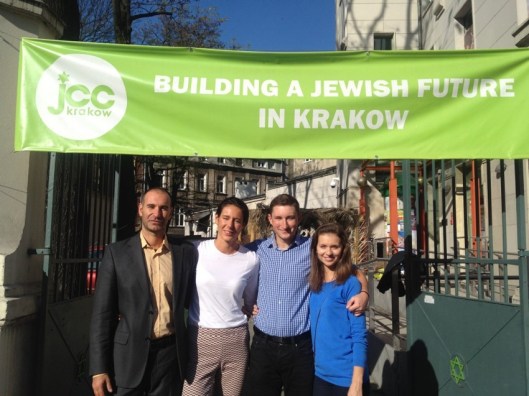
JCCJewishFutureDezco_Co_Uk

Building a Jewish Future in Krakow: Jonathan Ornstein at the entrance to the JCC Krakow. Source: http://dezco.co.uk/life/jewish-life-in-krakow-poland/

It’s worth reading the whole article, but here is an excerpt:

“The concern is genuine, warranted and appreciated. We, the Polish Jewish community, are weathering challenging times. The country we call home can feel a little less welcoming these days. On one hand, young people who only recently discovered their Jewish roots have eagerly joined newly opened Hillel student organizations in Warsaw and Krakow. But they hold in the back of their minds a question of what the future may bring.

“Polish Jewish leaders, too, are grappling with an uncertain future as we continue to build Jewish life in an environment that has taken a turn away from democracy toward populism. That shift is never a good sign for Jews — or anyone in a free and open society. And now the Holocaust bill, which criminalizes statements that the Polish nation had any responsibility in the Holocaust, may complicate our good relationship with our non-Jewish neighbors.

“What we have managed to rebuild over the last 30 years with the help of those neighbors is real. It is strong and it has emerged not only from government policy, but also from grass-roots efforts. We’ve built Jewish schools, synagogues, community centers and museums by working hand in hand with non-Jewish high school students, senior citizens and many others. Not only have they allowed these institutions to be born and flourish, but many have stood up and taken an active part in Jewish rebirth.

…

“So the answer is: Yes, come visit Poland. Walk down the historic streets that I walk without fear as a proud Jew. See beyond the camps. Go beyond the history, both the beautiful and the tragic. Stand with a community that has been through so much suffering, yet has emerged optimistic and eager to rejoin the Jewish world.”

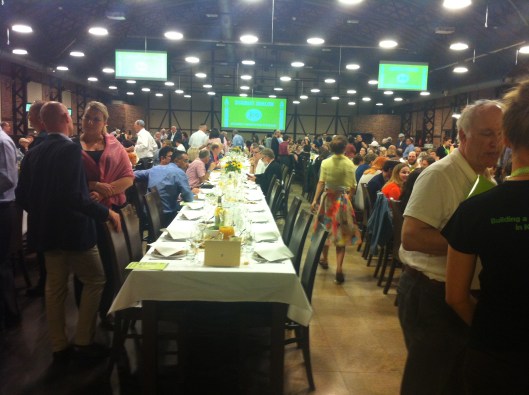
Jonathan can be trusted on this. He has been at the forefront of the revival of Jewish life in Krakow since the JCC opened there ten years ago. It’s an extraordinary organization, and I was lucky enough to help out as a Shabbos Goy during the Jewish Culture Festival in 2016, when hundreds of people attended the largest shabbat dinner in Poland since World War II.

IMG_0951

JCC Shabbat Dinner, July 1, 2016

The JCC welcomes Holocaust survivors, Jewish visitors from around the world, and Poles rediscovering their Jewish heritage or who just feel an affinity to Jewish culture and history. It was a space where I felt right at home, as an American raised in a secular Christian household with a Polish-Catholic mother who descended from Polish Jews. It’s a space where I can be Jewish or Christian, Polish or American, but regardless I’m welcomed simply because I’m there and I want to learn more about what it means to be Jewish in Poland.

“The Polish Anne Frank” in The Forward

12 Monday Feb 2018

Posted by Marysia Galbraith in Family, Memory, Przemyśl, World War II

≈ Leave a comment

Tags

Ariana Spiegel, Elizabeth Bellak, Renia Spiegel

Today in The Forward is an article Why Renia Spiegel is Called ‘The Polish Anne Frank‘.

During the Nazi occupation of Przesmyśl, Poland, she filled notebooks with her poetry and diary. Renia was only 18 when she was shot on the street, after someone reported her hiding place to the Nazis. Ariana, her younger sister, survived because she had been brought to Warsaw just a few days before that. Ariana became Elizabeth, whom I grew up calling Aunt Elizabeth. She was my mother’s friend for nearly 80 years.

Holocaust Remembrance Day in Włocławek

29 Monday Jan 2018

Posted by Marysia Galbraith in Cemeteries, Commemoration, Jewish Ghetto, Memory, Polish-Jewish relations, Włocławek

≈ 2 Comments

Tags

International Holocaust Remembrance Day, January 27

Thanks to Mirosława Stojak for all the work she does to preserve the memory of Jewish history and culture in Włocławek.

Here is a video from Holocaust Remembrance Day (January 27) when she and students and teachers from the Automotive High School visited the memorial at the site of the World War II Jewish ghetto, also the prewar Jewish cemetery.

Flim credit: Q4.pl, http://q4.pl/?id=17&news=170583

The interviews are in Polish, but even if you can’t understand the words, you can see that these people remember the Jewish history of their city. And they are passing on those memories to the next generation.  They lit candle lanterns in front of the commemorative monument, and the students placed pebbles upon which they had written words like “traditions,” “love,” and “memories.”

There’s more about Włocławek’s Jews on Ms. Stojak’s website Zydzi.Wloclawek.pl. The tagline of her site: “Ku pamięci, z nadzieją, na pojednanie,” “In memory, with hope, for reconciliation.”

The Photo that Started it All: What Year Was It?

22 Friday Dec 2017

Posted by Marysia Galbraith in Family, Genealogy, Jewish immigrants, Kolski, Memory, Photographs, Piwko, Włocławek

≈ 9 Comments

Tags

1910s fashion, Efraim/Philip Piwko

This blog started with a photograph. A family portrait of adult siblings with their parents. The photo also instigated my search for my hidden Jewish ancestors.

JechielHindaAndChildren

The Photo that started it all

Here, in my great grandfather’s long beard, head covering, and black robe, I saw for the first time visible proof that I descend from Jews. It took a long time, but I managed to identify everyone in the photo, including my grandmother (Babcia) who appears in the bottom left, her hand resting proprietarily on her mother’s wrist.

Based on their clothing and ages, I have guessed this photo was taken sometime around World War I. But I just came across some new information about my grand uncle Philip, the man standing to the right, that throws this date into question. Let me walk through what I have figured out.

Two Pifko brothers came to America, Abraham in 1906 and Philip in 1907. Here they are with Abraham’s wife and children and some other relatives:

BerthaPiwkoNathanPaulineEwa c1908

The Pifko brothers around 1908, New York. Front from left: Philip, Abraham, Paulina, Ewa, Bertha, Nathan. Back from left: Raphael Kolski, Sam and Max Alexander

This photo is easy to date; everything fits together. It must have been taken after Bertha and the children arrived in New York in May 1907, and Philip arrived in December 1907, but before Abraham and Bertha had their fourth child in October 1909. The style of Bertha’s dress is also consistent with this time period. Census records add another piece of supporting evidence; in 1910, all the people in the photo lived in the same household in Manhattan. So the photo was taken sometime between 1908 and the middle of 1909.

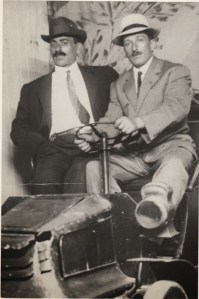
2Brothers

Philip and Abraham Pifko in the US.

In another photo of Philip and Abraham (on the right), they look a bit older, and Philip has grown a mustache. In my last post, I said that Philip is on the left, but my cousin Joan, who knew Philip when he was older, says she’s pretty sure he is on the right, driving the car. She also has no idea why his complexion was labeled “light brown” on an official document I found. His skin was not dark.

The photo that started this blog, and my search for ancestors, would seem to have been taken next, sometime around 1914-1918. Except it seems strange that Philip visited Poland during World War I.

Then, while looking through Philip’s documents on Ancestry.com, I clicked on a passport application from 1920. It was for both him and his wife Goldie, to go to England and France. According to what is written, Philip became a US citizen in January 1916, and resided in the US uninterruptedly since arriving in 1907. In response to a question about where he has lived outside of the US since his naturalization, the space is stamped, “I have never resided outside of the U.S.” Below, in response to a question about previous passports, it’s stamped “I have never had a passport.”

So this got me wondering. If Philip didn’t leave the country between 1907 and 1920, could the photo have been made later than I thought, in 1920? Could it have been when he traveled on this passport?

1920PPifkoPassportAppln

Goldie and Philip Pifko 1920, passport application photo

I found this passport application a while ago, but it didn’t occur to me until now that it might have a back. Sure enough, when I clicked to the next page in the database, there it was. The back of the form includes a place where a lawyer verified the truth of everything on it. There is also a handwritten note, “Applicant says he will not go to Russia or Poland. Instruct Amer consul [American Consulate] at France and England.” And even more convincingly, Philip and Goldie’s photo is attached at the bottom.

At age 37, Philip clearly seems older than in any of the other photos. His hair is receding (and, by the way, his skin does not look particularly dark).

It seems unlikely, after all, that the photo was taken in 1920. Could it have been taken before Philip’s departure in 1907? I went back to the photo itself, to reconsider all the details. First, I checked everyone’s ages. In 1907, my grandmother would have only been 13, but clearly she is older in the photo. The boy in front, sitting between his grandparents is Nathan Kolski, whose mother Regina died when he was born; several of my cousins have confirmed his identity. But Nathan was born in 1905, and he is definitely not a toddler in the photo. He almost certainly isn’t 15 either, making it unlikely the photo was taken in 1920. Also, the oldest sister Liba was 20 years older than Babcia. It’s really hard to tell for sure, but I would say that none of the women who are standing in the photo look as old as 48. Perhaps a couple are around 40. So again, considering everyone’s ages, it seems most likely the photo was taken around 1915, when Babcia was 21, Nathan was 10, Liba was 42, and Philip was 32.

It is also worth noting that the youngest child in the family, Malka, is missing, making me think the photo was taken after she died in 1913. Otherwise she would have been in it.

Next, I looked at the way everyone is dressed. Clearly, there is a great deal of variation between my great grandmother’s conservative dress and my grandmother’s short hemline and high heels. The dresses of the younger women flow; they are not fitted and buttoned up like Bertha’s in the photo from 1908. Fashion catalogs from the period show that during World War I, fashions changed markedly. Hemlines went up, waistlines became higher, and clothes used less fabric to conserve resources for the war. Other characteristics from the period include the “V” neckline with a lace inset, as well as attractive high heeled shoes, like Babcia and her sisters wear. The clothes date this photo back at my original estimate, 1914-1918.

I even considered whether I could be mistaken about the identity of the man standing to the right. Could it be the spouse of one of the sisters beside him? But several relatives have identified him as Philip, and he looks like Philip based on the other photos. Rachel’s husband Pinkus Kolski looked completely different. I don’t have a photo of Nunia’s husband, so I can’t compare.

But if the photo was taken around 1914-1918, how can Philip have been there? Occam’s razor says when there are multiple explanations, the simplest is probably the best one. The simplest explanation in this case is that Philip was indeed in Poland at some point during World War I. Maybe the photo was taken in celebration of his visit. Maybe a space was left between Jacob and Nunia to symbolically mark where Abraham, the brother who stayed in the US, would have stood. Maybe it was taken for Abraham, so he would have a memento of his kin back in Poland. That would explain why the photo was passed down in Abraham’s family. Many years later, his grandson made copies for my grandmother and other branches of the family.

Does that mean Philip lied on his passport application? Maybe not. If he traveled to Poland before he became a US citizen in 1916, maybe he didn’t need to report it on the form. And if that’s what happened, maybe I can pinpoint the photo more specifically to 1914-1916, before his hair had receded quite so much, and before the US entered the war. That seems like the simplest solution, even though it still doesn’t explain why Philip went back to Europe in the middle of a war.

Polish Independence Day is International News

16 Thursday Nov 2017

Posted by Marysia Galbraith in antisemitism, Identity, Poland, Warsaw

≈ 1 Comment

Tags

American Anthropological Association Meeting 2017, International press, Marsz Niepodległości, Nationalism, patriotism, Polish Independence Day, xenophobia

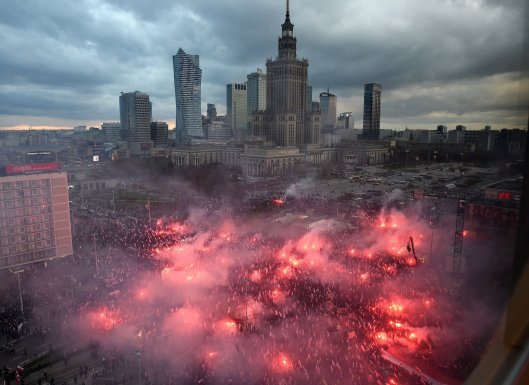
The Marsz Niepodlegołości, March of Freedom, has gotten a lot of attention from the international press, no doubt because of parallels with rising nationalism in other parts of the world. The march, organized by radical nationalist parties, was on November 11, Polish Independence Day. Started in 2010, it has attracted more attendees than the official Independence Day celebrations almost since it began.

2017NYTPolishIndependenceMarch

2017 March of Freedom under the shadow of the Palace of Culture. Photo credit: Radek Pietruszka/European Pressphoto Agency

Here are links to a few articles. Unfortunately, some of them are behind pay walls.

From The Wall Street Journal, “Polish Nationalist Youth March Draws Thousands in Capital”

The next day, “Polish Leaders Condemn Nationalist March” was published.

From BuzzFeed: “March Led By White Nationalist Group In Poland Draws Tens Of Thousands From Across Europe“

From Politico, “White nationalists call for ethnic purity at Polish demonstration“

From The New York Times: “Nationalist March Dominates Poland’s Independence Day”

And a couple days later: “Polish President Sharply Condemns Weekend Nationalist March”

From The Guardian: “‘White Europe’: 60,000 nationalists march on Poland’s independence day”

And a couple days later: “Polish president condemns far-right scenes at Independence Day march”

And in Haaretz: “Tens of Thousands Join Far-right Nationalist March for Polish Independence”

My post about the march: Independence Day: The Emotional Tenor of Populism in Poland

I’ll give a paper about it at the American Anthropological Association Meeting on November 30.


Finding Family at the Jewish Historical Institute

24 Sunday Sep 2017

Posted by Marysia Galbraith in Archives, Family, Genealogy, Piwko, Research Methodology, Rotblit, Warsaw

≈ 2 Comments

Tags

Jewish Historical Institute, JewishGen, Żydowski Instytut Historyczny

When my cousin Krysia and I first started searching for our Jewish roots, we barely knew where to start. Our Aunt Pat, a genealogist, had shared an impressive record of names, places, and even stories. Obsessive Internet searches yielded limited results–things like a notice in the Canadian Jewish Review from October 1963 that listed my grandmother’s sister Maria Weglinska among the out-of-town guests at Rochelle Pifko’s bat mitzvah in Toronto. Pifko/Piwko was my grandmother and her sister’s maiden name. But how were they related to these Canadian Pifkos?

1963CanadianJewishReviewBatMizvah

Notice in the Canadian Jewish Review on October 18, 1963 about Rochelle Pifko’s bat mitzvah.

How could we push beyond these tidbits? What more could we learn about our family?

Thanks to the Jewish Historical Institute (JHI, Żydowski Instytut Historyczny) in Warsaw we made some breakthroughs that have helped us piece together our family tree. Krysia’s husband Steve stopped in during a business trip to Warsaw and met Anna Przybyszewska-Drozd at the genealogical division of the JHI. She did a preliminary search on JewishGen, and found references to vital records of some of our ancestors. A few months later, Krysia and I went on our first roots trip to Poland. We still had no idea what we were doing so we stopped in at the JHI, meeting with Anna’s associate Aleksandra (Ola) Dybkowska-Grefkowicz who stayed after hours to help us with our search. She prefaced everything with her usual caution, “Don’t be disappointed if you don’t find anything” because so many records were destroyed and most Holocaust deaths were not recorded. Then, she showed us how to make use of the records in JewishGen and the databases of  the Polish National Archives, and suggested other places we could search for records.

I learned enough at that meeting to make some breakthroughs. I discovered my Zurich cousins through the Family Finder database on JewishGen, and shortly after my Israeli cousins through myHeritage.

On successive trips to Warsaw, Anna and Ola helped me learn more about my grandfather Jakob Rotblit. I was speaking with Ola about his automobile dealership in Gdansk when Anna walked in. A look of recognition flashed across her face; she pulled a book off the shelf about Jewish business owners in Gdansk between the World Wars. Sure enough, Jakob Rotblit was listed with information about his Ford dealership and with details about his wife and his parents. Another time, I mentioned that my mother and grandmother are on the list of Jewish survivors who registered after World War II ended. With a satisfied smile, Ola told me that the original registration cards are in the JHI archive. I walked upstairs to the archive and was able to hold those cards in my hand. The archivist showed me how the earliest records, from 1945, were handwritten on the backs of cut up prewar accounting records. Paper was scarce, so they used what they could find. By 1946, information was filled in on larger, pre-printed cards made especially for this purpose.

Once again, just a few months ago, the genealogical division helped me with my search. Anna e-mailed me that a woman, Ellen, had contacted her to find out about her Piwko ancestors. Anna thought we were related and asked if she could share my contact information with her. Of course I agreed, and since then Ellen and I have been in ongoing communication. She is an avid genealogist who turns out to be my 3rd cousin. Her great grandfather was my great grandfather Hiel Majer Piwko’s younger brother Urish. I knew nothing about him, maybe in part because he moved to Canada in the 1880s.

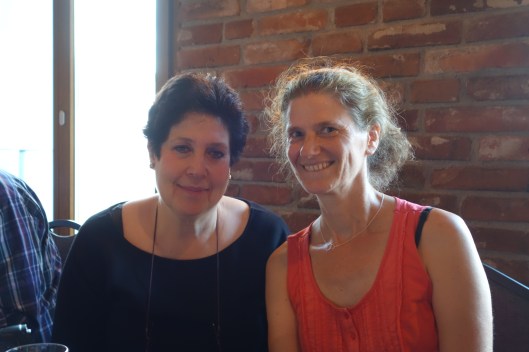
DSC00199

3rd Cousins in Krakow, Poland in June 2017

Ellen and I had the extraordinary good fortune to be in Poland at the same time this June. She was on a once in a lifetime Jewish history tour of Eastern Europe with Professor Stephen Berk. Although I didn’t know anything about her or her great grandfather, I had an inkling about her branch of the family from that notice I found years ago about my Auntie Nunia’s (Maria Weglinska) visit to Toronto in 1963. Rochelle Pifko, the girl whose bat mitzvah she attended, was Ellen’s cousin and another descendent of Urish. So another mystery is solved. Some contact was maintained between my great aunt and her uncle who migrated to Canada shortly after she was born. And when Nunia/Maria came to the US in the 1950s, she renewed that connection and even visited. Ellen remembers when Nunia came to Canada some years later for another family event.

Crossing Boarders

07 Thursday Sep 2017

Posted by Marysia Galbraith in Commemoration, Polish-Jewish Heritage, Polish-Jewish relations, Radom

≈ 1 Comment

Here’s a post from a heritage seeker on a similar quest to my own. She attended the commemoration of the 75th anniversary of the liquidation of the Radom ghetto, which took place in Radom last month.

radommusings1945's avatarRadom Musings

After a few weeks of decompression, I am finally able to sort through some of my feelings about last month’s commemoration ceremony in Radom.  At times solemn, while at other times celebratory, the event was a reflection of how present day Catholic Poles choose to confront Poland’s complicated relationship between Christians and Jews.

Poland’s internal and external struggles to reconcile its past were highlighted by the incongruity of a klezmer band playing music at the entrance of the Jewish cemetery, and by the reverence demonstrated when a Holocaust Survivor spoke about his fond pre-War memories, followed by a concert of a well-known Polish performer.  While one can say that this combination of somber commemoration and entertaining celebration reflects the merger of past and present, not all of us are ready for the journey.  Poland’s past has a long way to travel before it catches up to present day Jewry.  At…

View original post 287 more words

AK Verification, Part III

02 Saturday Sep 2017

Posted by Marysia Galbraith in Archives, Bereda, Family, Memory, Polish Culture, Polish Underground Army, Warsaw, World War II

≈ Leave a comment

Tags

AK, Armia Krajowa, Maria Bereda(y) Galbraith, patriotism

NOTE: This overview of my recent discoveries at the Polish Underground Movement Study Trust, Studium Polskiej Podziemniej (SPP) got so long I am publishing it in three separate posts. Here is part III. During the German occupation of Poland during World War II, the Polish Underground Army worked in secret to resist, sabotage, and fight against the Nazis. Another name for the Polish forces is “AK,” short for “Armia Krajowa,” or “Home Army.” I talk about the soldiers as “the partisans;” in Polish sources they are also called “konspiracja,” “the conspiracy.”

Sorry it’s taken a while for me to get to part III. The semester has begun which means I’ve been very busy.

DSC00534

Pencil sketch of Maria Bereday from the 1950s, signed Ditri. Friends tell me she looks like a spy.

All of the questions the archivist Krystyna asked me about the names Mama went by paid off because she found another file; the envelope was mislabeled “Maria Fijułkowska.” Inside was a six-page report, relacja, Mama had written titled, “Outline of Courier Work.”

Initially, neither Krystyna nor I found this file because not only was “Bereda” missing, but Fijałkowska was also misspelled. Krystyna wrote “Fijałkowska” on a new envelope; I don’t know why she didn’t also add the Bereda, even after I pointed out that Mama’s full name was hand-written in large letters along the left margin of the document’s first page. Around World War II, the family usually used the name Bereda-Fijałkowska. Mama told me they added the Fijałkowski/a, which was grandpa Bereda’s mother’s maiden name and a name associated with the Polish gentry, because of Babcia’s social aspirations.

DSC00333

Mama’s name (Bereda-Fijałkowska) and pseudonym “Renata” in the margins of her typewritten report.

Mama’s report matches up with some of the stories she told me, and confirms some of what she did during the occupation. It also gives more details about the way her courier unit “Zadra,” was organized, and how couriers carried out their duties. The report is dry and factual. It contains no specifics about her emotional engagement or personal thoughts. A historian might find it interesting for what it reveals about the operations of the Underground conspiracy. I keep trying to look beyond the words to find the person behind them.

She writes, that “Zadra” started out very small, and because the work wasn’t systematized, the couriers were on call at all times. “By the end of 1942,” she writes, “the number of couriers stabilized at 15, and that group became close and experienced, and worked together for a long time without changing members.” This all changed in the fall of 1943 when the occupier, okupant, limited train travel to Germans only. Overnight, the courier corps dropped from 60 to just six who spoke German well and had German papers. “The work for these couriers during this time was nonstop,” she continues, “The number of trips for each courier came to 10-12 per month, depending on the route.” My mother doesn’t state it in the report, but she must have been one of the couriers who carried out missions during this time. Some of her most vivid stories were about traveling in the train cars with an assumed identity as a “volksdeutch,” a half-German whose father was fighting for the Reich on the Eastern front.

After about two months, the courier corps were reorganized and expanded, with more reserve couriers brought into regular service. In the half year before the Warsaw Uprising, the number of couriers in her unit approached 40, and overall reached 100.

The duties of the couriers included delivering coded and uncoded orders hidden in ordinary objects such as candles or paint, special messages that had to be handed to specific commanders, and large sums of money (1/4-12 million zloties in 500 zloty bills). Some missions involved carrying the messages brought by paratroopers they called “ptaszki,” “little birds.” This is the code name for the cichociemni, the officers who parachuted in from the West carrying money and messages from the Polish Government in Exile.

The report includes an example of a special mission Mama undertook at the end of 1943. Instead of being briefed by her usual commander “Wanda”, “Beata,” the head of communication with the west, did it. “Wanda” gave her a special coded message she had to hand directly to the chief of staff or the commander of the Radom District. This was to occur in private with no witnesses. Mama also had to memorize and deliver the oral message, “The commanders of the divisions and subdivisions of “Burza” require complete secrecy in the event of the invasion of the Russians.” Burza, Tempest, was the code name for the Warsaw Uprising.

Because the chief of staff wasn’t available on the day Mama arrived, she had to spend the night at a safe house. The next day, she delivered the messages to Chief of Staff “Rawicz” [his real name was Jan Stencel or Stenzel], but had to spend another two days before “Rawicz” returned from the forest, where the partisans were hiding out, with the required response for the Central Command in Warsaw.

Reading this sparked another memory for me. I think it was a big deal for Mama to stay away from home for so long, especially because her father didn’t know she was in the Underground. Her mother did know, though, and they hatched an alibi about a visit to Mama’s fiance’s family. Or maybe this is the story she told the authorities on the train to explain why she was returning several days late. Hopefully, my brothers remember this story, too, and can confirm one of these versions.

The documents from the Studium Polski Podziemnej in London have been a lynch pin that holds together information from a variety of sources. While I was there, I also found a citation for Communication, Sabotage, and Diversion: Women in the Home Army, Łączność, Sabotaż, Dywersja: Kobiety w Armii Krajowej, published in 1985. The book was written in Polish but published in London. I found a copy of it at an online used bookstore whose brick and mortar shop is in Warsaw. I called, and sure enough they had it in the shop, so I picked it up while I was in Warsaw. It contains the recollections of the head of the Women’s division of Central Command (VK) Janina Karasiówna, the oficer who confirmed Mama’s verification file. Another chapter contains the report of Natalia Żukowska who was the assistant commander of Mama’s courier unit; Mama identifies her by her pseudonym “Klara.” From Żukowska’s report, I learned that “Zadra” was the name used by the couriers who had been working with the unit for the longest, but in 1943 the name was changed to “Dworzec Zachodni.” Reviewing Mama’s documents, I see now that she identified her unit as Zadra-Dworzec Zachodni in one place. She underlined it, too. Until I read this book, I had thought Dworzec Zachodni, which means Western Station, referred to Zadra’s location, not an alternative cryptonym. And then there’s this: the names of the 15 couriers, including “Renata.” That’s Mama’s pseudonym; her last name is misidentified as “Brodzka” instead of “Bereda,” but Natalia writes, “Unfortunately, it wasn’t possible to decrypt all of the last names” (p. 118).

Mama was proud of her service for her country, but she was also painfully aware of the cost of war. She called herself a pacifist and the war solidified her abhorrence of armed conflict. I remember her asking, “Are there times when fighting is necessary?” I could tell from her voice that she wanted to believe all conflicts can be resolved peaceably. But her experience had taught her otherwise.

AK Verification: Part II

13 Sunday Aug 2017

Posted by Marysia Galbraith in Archives, Bereda, Family, Poland, Polish Culture, Polish Underground Army, Warsaw, World War II

≈ Leave a comment

Tags

"Zadra", AK, Armia Krajowa, Courier, General Bór Komorowski, Grupa "Koło", Major Janina Karaś, Maria Bereda(y) Galbraith, Polish Home Army, Polish Underground Study Trust, Studium Polski Podziemnej, Warsaw Uprising

NOTE: This overview of my recent discoveries at the Polish Underground Movement Study Trust, Studium Polskiej Podziemniej (SPP) got so long I am publishing it in three separate posts. Here is part II. During the German occupation of Poland during World War II, the Polish Underground Army worked in secret to resist, sabotage, and fight against the Nazis. Another name for the Polish forces is “AK,” short for “Armia Krajowa,” or “Home Army.” I talk about the soldiers as “the partisans;” in Polish sources they are also called “konspiracja,” “the conspiracy.”


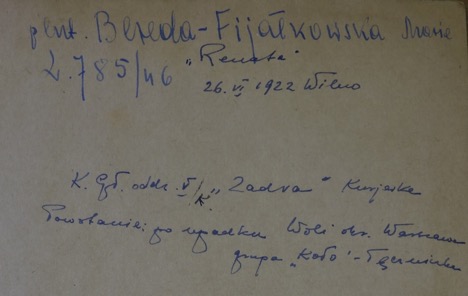
The file at the archive of the Polish Underground Movement Study Trust, Studium Polski Podziemnej (SPP), contained the same verification questionnaire I had from my mother’s papers and so much more. On the envelope itself is the following identifying information:

VerificationEnvelope

Information on the envelope containing Mama’s papers at the SPP

I ‘ve learned how to decipher all of this. Here’s what it means:

Cadet Bereda-Fijałkowska Maria

2.785/46 [record #]     “Renata” [her pseudonym]

   26. VI 1922 Wilno [birth date and place of birth]


            Central Command division V/Women “Zadra” courier

Uprising: after the fall of the Wola district of Warsaw

                                    “Koło” Group-liaison officer [the names of her units]

The documents inside the envelope confirm Mama’s service and rank in the AK [Home Army], as well as her receipt of the Cross of Bravery. She submitted her questionnaire on March 9, 1946, her commanding officer confirmed her claims on April 15th of the same year, and the official report was completed the next day on April 16. The final report says the head of the Polish Army himself, General Bór-Komorowski, confirmed her receipt of the Cross of Bravery. Here is what looks like his signature on the document:

BórSignature

General Bór Komorowski’s signature verifying Mama’s service in the Polish Home Army. It looks like he wrote “Stwierdzam (I confirm)  16/IV 46” above his signature. Note the “gn” for “generał.”

Mama started military training in middle school, gimnasium, at the Klementyna Hoffman School in the mid-1930s. She continued training in high school, liceum, and entered the Underground in June 1941, right after finishing high school. She took courses on how to be a courier, the organization of the Underground and of the German military, as well as marksmanship, topography, and first aid. She was in “Zadra” Group, part of the women’s courier corps in the 5th Division of the Central Command. She delivered encoded communications, money, and oral messages on the routes between Warsaw and Krakow, Radom and Skarżysko-Kamienna. In these latter two places, she acted as a go-between for the partisans in the surrounding forests and Central Command in Warsaw. From 1942-4, she also worked as an instructor training other women to serve in the Underground.

When the Warsaw Uprising began on August 1, 1944, she was with her unit “Zadra” in Wola, a district to the northwest of downtown. A handwritten note on her typed questionnaire says “wounded on route from Wola to the Old City.” The handwriting is different from Mama’s distinctive, almost calligraphic style, so somebody else must have added it after Mama submitted her answers.

The archivist Krystyna Zatylna said that the heaviest fighting in the first days of the Uprising was in Wola. Mama was lucky to have survived. By August 8, 40,000 civilians died in Wola.

The Home Army regrouped in the Old City. Mama got separated from her unit and joined “Koło” group. She is referred to here as a “liaison,” “lączniczka,” rather than “courier,” “kurierka.” Both terms refer to people entrusted with delivering critical information. Initially, however, she worked as a medic on Długa Street. When the Germans pushed the partisans out of the Old City, they escaped to the City Center, Śródmieście, via the sewers.

14SPPVerificationDossier

Document dated September 9, 1944 that allowed “Renata” to travel through the City Center during the Warsaw Uprising.

The file contains two papers dated from the Uprising. No doubt Mama brought them with her to London to help corroborate her report. These tattered notes—physical proof of her service—must have been very precious to her. The first, on a third of a piece of paper that has deep creases from having been folded many times, is dated September 9, 1944. It states:

I assert that cadet Renata is a liaison of “Koło” Group. The conditions of her service require movement within the region between Savior Square and Napoleon Square.

The note is signed by the Chief of Staff of “Koło” Group, Major Krynicki. The document contains a round stamp with a crowned eagle in the middle surrounded by the words “Motorized Transport Brigade, “Brygada Dyspozycyjna Zmotoryzowana.” Mama must have shown this note at barricades on the streets so the AK soldiers would let her pass. Savior Square and Napoleon Square are in the City Center, which means she retreated through the sewers before September 9. I can, however, imagine her dodging Nazi bullets as she ran across the barricaded Jerusalem Street carrying messages from Napoleon Square to Savior Square. These names would sound good in a poem. Too bad I’m not a poet.

The second paper dates from October 3, 1944, the last day of the Uprising. Signed by Colonel Bolesław Kołodziejski, the commander of “Koło” Group, it is titled, “Provisional certificate (to be exchanged after the war for official recognition).” The text reads:

I confirm that “Renata Lewandowska” was decorated for her activity during the Uprising from August 1 to October 3 1944 with the Cross of Bravery for the first time.

Based on: the personal confirmation of the head of the Warsaw Corps of the A.K. Brigadier General Montera and his assistant Colonel Wachowski, as told to the commander of “Koło” Group during the last days of the Uprising.

“Montera” was the code name for General Antoni Chruściel, who led the Home Army (AK) in Warsaw during the Uprising. Kołodziejski was also a code name. Elsewhere in the documents, Mama writes that his real name was Zygmunt Trzaska-Reliszko.

Mama writes that she was promoted twice; in September 1944 she became a cadet, plutonowy podchorązy and in October she was promoted again to ensign, podporucznik. It looks as though the Verification Commission could only confirm the first promotion. A handwritten note on Mama’s questionnaire says they weren’t able to contact her commanding officer from “Koło” Group to verify the second promotion.

Also in the file are two statements written by the commander of the women’s branch of the 5th division of Central Command (V.K. KG) Major Janina Karaś, dated April 15, 1946. In them Karaś, also known as Karasiówna, confirmed that Mama earned the rank of cadet in “Koło” Group, and was also granted the Cross of Bravery for her service. Clearly, the Verification Commission contacted Karaś to corroborate Mama’s claims on her questionnaire. One of Karaś’s statements reads:

As the chief of the V.K. [5th Women’s] Central Command I certify that in the course of her service as a courier, “Renata” Maria Bereda Fijałkowska distinguished herself on the route Warsaw-Krakow and Warsaw-Skarzysko-Radom with bravery and decision to take risks. Traveling with German false papers she carried money, mail, and oral orders /for example related to the order for [Operation] Tempest. She earned the Cross of Bravery for her service.

Operation Tempest, “Burza,” was the code name for the beginning of the Warsaw Uprising. In other words, some of the messages Mama carried between Central Command and the partisans in the forest involved critical details about the Polish Underground’s battle to free the capital city from German occupation. I’m reminded of something the archivist at the Warsaw Uprising Museum kept repeating when I showed him Mama’s verification questionnaire two years ago: “She must have been very high in the conspiracy.” He couldn’t find the exact connection, but I believe I have it right here.

Krystyna Zatylna helped me put the pieces together. The forests around Radom are where the so-called “cichociemni,” “the quiet unseen” soldiers parachuted in from the West, bringing messages and money from the Polish Government in Exile for the leaders of the Underground in Poland. I believe Mama was given these items from the cichociemni and carried them back to Central Command in Warsaw. It fits with stories she sometimes told, and it fits with the seven-page report she filed with her verification papers. And that will be the subject of the third part of this blog post.

← Older posts
Newer posts →

Categories

  • Anthropology (37)
    • Archives (14)
    • Fieldwork (7)
    • Ground Penetrating Radar (GPR (4)
    • Research Methodology (8)
  • antisemitism (14)
  • Association of Descendants of Jewish Central Poland (32)
  • Catholicism (8)
  • Conference (1)
  • Discrimination (2)
  • Family (69)
    • Bereda (17)
    • Kolski (13)
    • Piwko (22)
    • Rotblit (3)
    • Walfisz (4)
    • Winawer (7)
  • Genealogy (11)
  • Heritage work (66)
    • Commemoration (23)
  • Identity (18)
  • Israel (6)
  • Jewish Culture (89)
    • Cemeteries (51)
    • Museum (7)
    • Synagogues (33)
  • Jewish immigrants (8)
  • Jewish Religion (1)
  • Memory (70)
  • Names (14)
  • Photographs (6)
  • Pifko-Winawer Circle (5)
  • Poland (125)
    • Baligród (1)
    • Bolimów (1)
    • Brześć Kujawski (5)
    • Buk (1)
    • Chodecz (1)
    • Dukla (2)
    • Dąbrowice (1)
    • Gdynia (1)
    • Gostynin (2)
    • Gąbin (1)
    • Izbica Kujawska (1)
    • Kazimierz (4)
    • Kowal (1)
    • Koło (1)
    • Krakow (7)
    • Krośniewice (1)
    • Kutno (6)
    • Kłodawa (1)
    • Lesko (8)
    • Leszno (1)
    • Lubień Kujawski (1)
    • Lubraniec (1)
    • Lutowiska (3)
    • Piła (3)
    • Podgórze (2)
    • Poznan (11)
    • Przemyśl (2)
    • Pzedecz (1)
    • Radom (1)
    • Radymno (1)
    • Sanok (1)
    • Skierniewice (5)
    • Sobota (2)
    • Tarnów (2)
    • Warsaw (22)
    • Wielkopolska (1)
    • Wronki (7)
    • Włocławek (20)
    • Zasław (2)
    • Łódź (1)
    • Żychlin (30)
  • Polish Culture (10)
  • Polish-Jewish Heritage (60)
  • Polish-Jewish relations (60)
  • Post-World War II (24)
  • Pre-World War II (22)
  • Reclaimed Property (1)
  • stereotypes (3)
  • Survival (9)
  • Trauma (3)
  • Uncategorized (5)
  • Victims and perpetrators (4)
  • World War II (45)
    • Jewish Ghetto (12)
    • Nazi Camps (5)
    • Polish Underground Army (3)
  • Yiddish (5)

Enter your email address to follow this blog and receive notifications of new posts by email. Your email address will not be shared.

Archives

  • October 2025 (1)
  • July 2025 (8)
  • June 2025 (1)
  • April 2025 (1)
  • August 2024 (3)
  • July 2024 (3)
  • May 2024 (2)
  • April 2024 (1)
  • May 2023 (2)
  • January 2023 (2)
  • December 2022 (7)
  • November 2022 (2)
  • October 2022 (5)
  • September 2022 (1)
  • January 2022 (1)
  • August 2021 (1)
  • December 2020 (2)
  • July 2020 (1)
  • May 2020 (3)
  • April 2020 (1)
  • March 2020 (1)
  • January 2020 (2)
  • May 2019 (1)
  • February 2019 (1)
  • November 2018 (1)
  • September 2018 (1)
  • August 2018 (3)
  • July 2018 (1)
  • June 2018 (1)
  • May 2018 (1)
  • April 2018 (2)
  • March 2018 (2)
  • February 2018 (2)
  • January 2018 (2)
  • December 2017 (2)
  • November 2017 (2)
  • October 2017 (1)
  • September 2017 (3)
  • August 2017 (3)
  • June 2017 (2)
  • May 2017 (3)
  • April 2017 (1)
  • March 2017 (2)
  • February 2017 (1)
  • January 2017 (2)
  • December 2016 (2)
  • November 2016 (4)
  • October 2016 (1)
  • September 2016 (6)
  • August 2016 (2)
  • July 2016 (1)
  • May 2016 (4)
  • April 2016 (2)
  • March 2016 (3)
  • February 2016 (4)
  • January 2016 (3)
  • December 2015 (3)
  • November 2015 (5)
  • October 2015 (5)
  • September 2015 (3)
  • August 2015 (4)
  • July 2015 (3)
  • June 2015 (3)
  • May 2015 (4)
  • April 2015 (9)
  • March 2015 (3)
  • February 2015 (2)
  • January 2015 (5)
  • December 2014 (4)
  • November 2014 (9)
  • October 2014 (2)
  • September 2014 (1)

Copyright Notice

All original text and images are copyright © Marysia Galbraith. Please contact the author before quoting.

Blog at WordPress.com.

  • Subscribe Subscribed
    • Uncovering Jewish Heritage
    • Join 145 other subscribers
    • Already have a WordPress.com account? Log in now.
    • Uncovering Jewish Heritage
    • Subscribe Subscribed
    • Sign up
    • Log in
    • Report this content
    • View site in Reader
    • Manage subscriptions
    • Collapse this bar
 

Loading Comments...