Work at the Żychlin Cemetery Begins!
01 Monday Jul 2024
01 Monday Jul 2024
30 Thursday May 2024
The Association of Descendants of Jewish Central Poland (ADJCP) will undertake the restoration of the Zychlin Jewish cemetery starting this summer. Like many Jewish cemeteries in Poland, dense vegetation covers most of the space, monuments and fencing are in disrepair, and signage is needed. Please consider joining us from July 1-5.
ADJCP has teamed up with the Matzevah Foundation, a non-profit organization with a wealth of experience restoring Jewish cemeteries. Our local partners Mayor Grzegorz Ambroziak, Bożena Gajewska, and Anna Wrzesińska will coordinate local volunteers and provide other assistance.
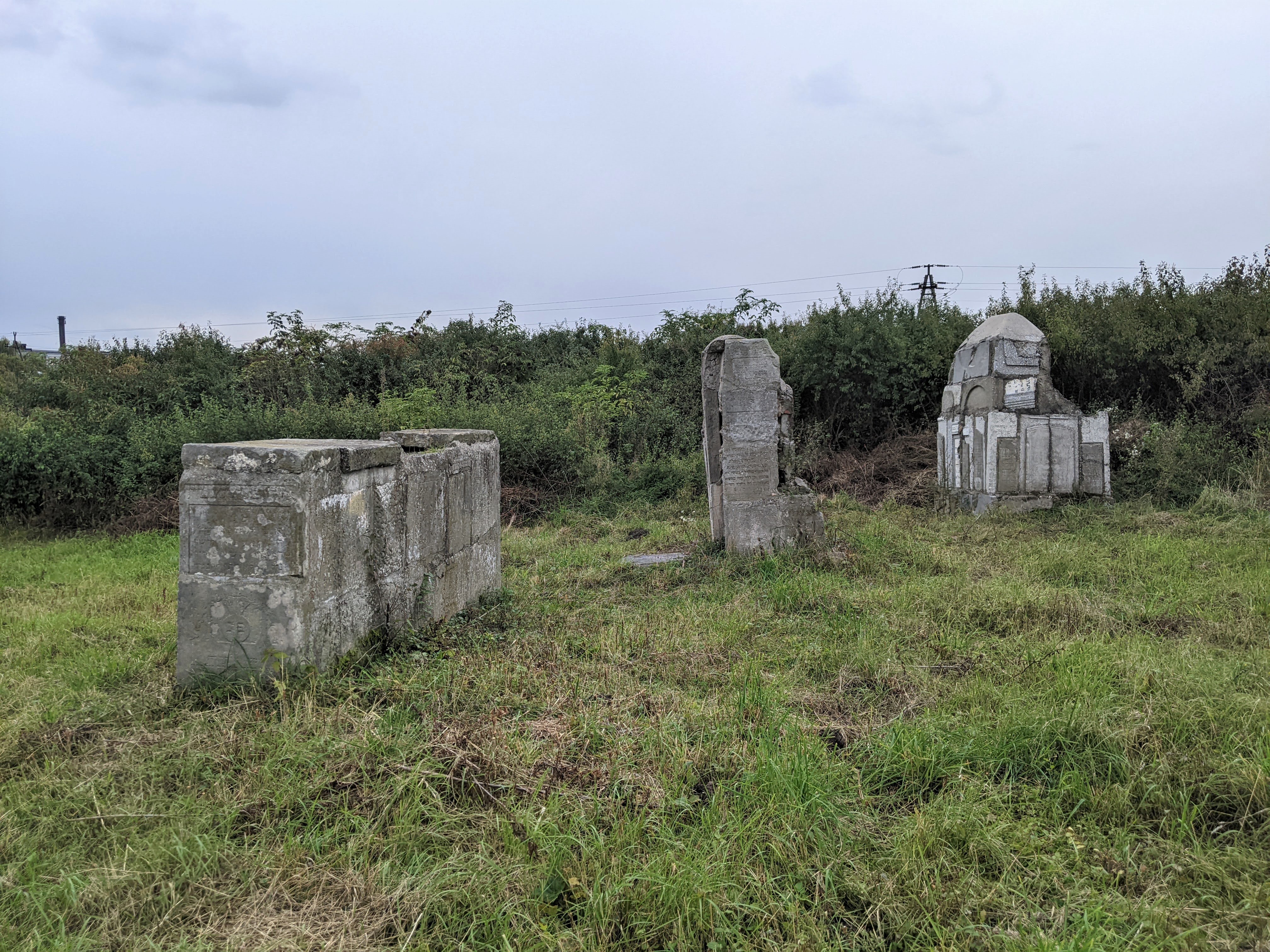
Photo: Monument incorporating matzevot fragments in the Żychlin Jewish Cemetery

How can you help?
Żychlin is located about 75 miles west of Warsaw and about 45 miles south of Włocławek. The town’s Jewish Community was established in the second half of the 18th century, and until World War II, more than half of the inhabitants were Jewish.
Questions? Contact Marysia Galbraith at: info@adjcp.org

08 Wednesday May 2024
Posted in antisemitism, Family, Identity, Polish-Jewish relations, Pre-World War II, Warsaw, World War II
I have been calling my project a family memoir since the beginning, well before I read In the Garden of Memory (the English translation was published by Weidenfield and Nicolson in 2004). My family’s story overlaps with author Joanna Olczak-Ronikier’s in other ways, too. The social world of Warsaw was intimate enough that it seems likely our families knew about each other even if they weren’t directly acquainted. Joanna’s relatives, the Horwitzs and the Mortkowiczes, were central figures in the social circles my Babcia also frequented, those occupied by writers, artists, publishers, and professionals. Both families have Jewish origins, and each assimilated, though to varying degrees.

Joanna, her mother Hanna Olczak, and her grandmother Janina Mortkowicz didn’t deny their Jewish origins in the way my mother and grandmother did. Still, they frequented many of the same places around Warsaw. When Janina, then Horwitz, was a child, her “consolation prize” for check-ups at the dentist were a visit to Lourse Café on Krakowskie Przedmieście for chocolate (15). This was in the 1880s, so decades before my grandfather Zygmunt Bereda gained an interest in the business. During the 1930s, Joanna’s cousins attended the same high schools as my mother and uncle. Girls attended the Klementyna Hoffmanowa High School, while boys went to the Stefan Batory High School.
The book also gives me some insight into marriage customs during my Babcia’s generation. “According to Jewish tradition, finding suitable husbands for one’s daughters was a basic parental duty,” Olczak-Ronikier writes. “Marriage was too serious a matter to be contracted for love. After all, it concerned two people’s future, and that of their offspring. The older generation took charge of bringing the couples together, involving family, friends and a professional matchmaker” (32). Things were changing rapidly in the late 19th century, though, and just like I have observed among Babcia’s siblings, older children were more bound by tradition while younger children were more inclined to choose their own pathway. In Olczak-Ronikier’s family, the younger children were drawn to socialism and communism.
By the next generation, Joanna’s mother Hanna was the first and only family member to marry a non-Jeweven and to change her religion. Olczak-Ronikier says, it “did not provoke any particular reaction among her relatives” (184). She was not excluded from the family because of it, unlike my grandmother Halina, whose father sat shiva and treated her as dead after her marriage to a Catholic. Olczak-Ronikier’s family was far more secular than Babcia’s, though. Perhaps in part this is because the Piwkos lived in provincial cities where the pull of religious tradition was stronger. My grandmother was drawn to Warsaw for the opportunities it offered for her to remake her life.
Another parallel I see between our family stories is in the internalized antisemitism Joanna experienced. As a child in the 1930s, she didn’t want to be Jewish, especially when she became the object of the anti-Jewish taunts of other children. She explains, “Among Jews who had decided to assimilate, a huge role was played by ambitions relating to the level of Polonization they had achieved. When the parents, through their looks, language and religious customs, were a reminder of the environment that the children had made such an effort to get out of, family love and loyalty were severely put to the test. Nowadays it is hard to imagine how painful this process of tearing oneself away from one’s roots must have been” (71).
Maks Horwitz, her great uncle, put it this way: “They were ashamed of their origin. Understandably, they never denied it among those who knew about it. But even here, in deed, word and gesture they tried to prove and convince others that they felt themselves to be completely and utterly Polish and that they were entirely rid of their Jewishness” (111).
Members of both families survived the war by adopting Aryan identities. Babcia was able to live more in the open than Olczak-Ronikier’s family because she had been distanced from her Jewish origins since the 1920s, and also because her Catholic husband was well enough positioned to bribe the Nazi authorities to look the other way. As in my family, the women of Joanna’s family took a few years off their age on their false documents (92). During the Warsaw Uprising, when the area they lived in was overrun by the Germans, Olczak-Ronikier’s family escaped via the underground sewers, as did my mother. With the destruction of the capital, both families took the same path out of the city, traveling with a crowd of refugees south to Krakow, where they remained until the end of the German occupation. (268)
Joanna’s cousin Ryś Bychowski was born the same year as my mother. He attended Stefan Batory High School, just like my Uncle George who was just a couple of years older. It seems likely they knew each other, and its possible they could have been friends. Their lives might have overlapped during the war, as well. Ryś escaped to safety in the US with his parents in 1941, only to volunteer for the Polish Airforce, which operated out of Britain. My uncle was a paratrooper, while Ryś became a navigator. Ryś joined as a Polish patriot, unwilling to remain in safety when his people were subject to Nazi oppression. For him, the fact that he was Jewish only added to his resolve. He wanted to liberate Poland and the Jewish people. While in Britain, he confronted the horror of the mass annihilation of the Jews, made even more unbearable when his friends and comrades exhibited indifference, or in some instances satisfaction, that the Jews were killed. Olczak-Ronikier explains, “His Polish-Jewish identity had always seemed something quite natural to him, yet in view of this and similar episodes he came to the conclusion that he had to make a choice” (295). He decided he could never live in Poland again, even though he remained committed to the fight against Nazism.

The evolution of Ryszard’s view of Poles helps me understand the deep anger and resentment so many Jews feel toward Poland. It’s something I have recognized before, and wondered why they direct their fury more strongly toward Poles than to Germans. In a letter to his father in 1943, Ryś Bychowski explained in clear and emotionally resonant terms; “I do not want to be a second-class citizen ever again […] Above all I’m afraid of knowing the whole truth about the reaction of Polish society to the extermination of the Jews. I cannot live with or talk to, I am not able to work with people who found it possible to ignore their destruction, occupy their homes and denounce or blackmail the survivors” (296). This was an intimate betrayal, not by a sworn enemy but by comrades and neighbors. It was exclusion from the group he felt himself to be a part of. No wonder it cut so deeply.
11 Thursday Apr 2024

Żychlin mayor Grzegorz Ambroziak sent me photos of daffodils blooming around the memorial to the city’s Jewish community. These flowers, planted by local school children, are a symbol of remembrance. Daffodils are also associated with the upcoming anniversary of the Warsaw Ghetto Uprising, which started on April 19, 1943.
These small markers of remembrance matter. They offer a time and place to contemplate what used to be, what was lost.
22 Monday May 2023
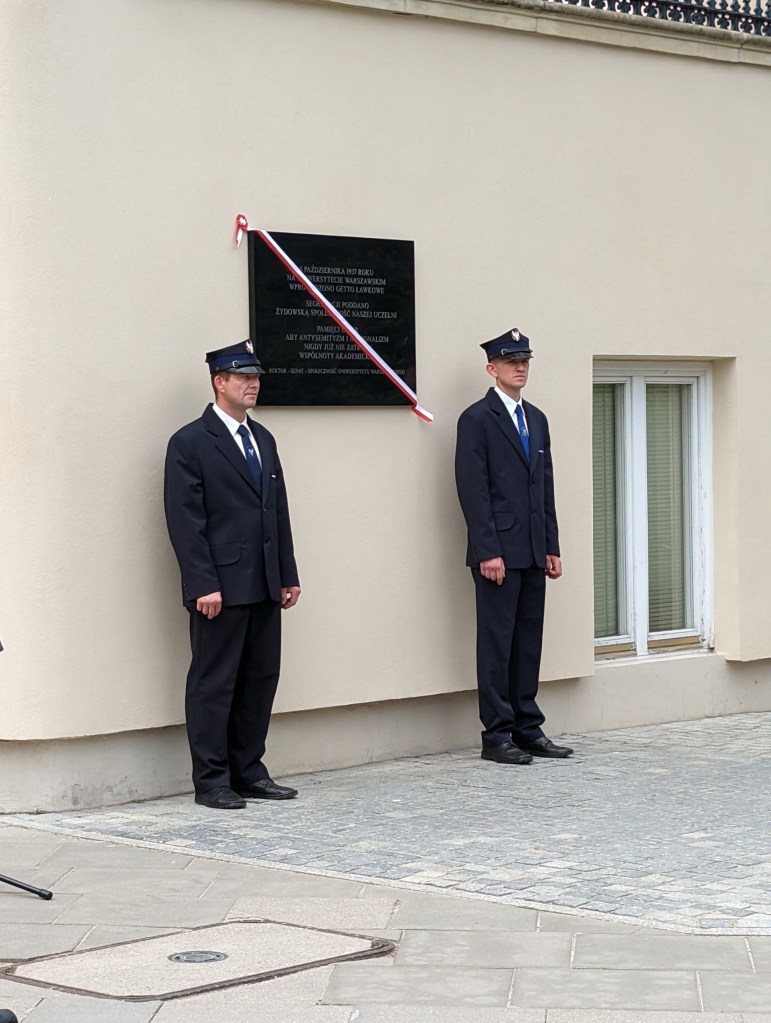
A dark stain in the history of Warsaw University was the decision to follow a nationalist trend in the 1930s and mandate segregated seating for the university’s Jewish students. Over 80 years later, a student-initiated campaign resulted in a permanent, public acknowledgement of this institutionalized discrimination. On May 22, University Rector Alojzy Nowak and Israeli Ambassador Yacov Livne dedicated a commemorative plaque before a crowd of about 200. Dignitaries, scholars of Jewish history and culture, and prominent members of Warsaw’s Jewish community gathered behind a red retractable belt barrier under the watchful eye of an Israeli guard, while a younger crowd of students and onlookers looked on from the other side.


I learned about the event serendipitously, when fellow ADJCP board member Ken Drabinsky invited me to accompany him to the Warsaw University Department of History to donate a copy of the self-published autobiography of Henry Balaban, nephew of renowned historian Meir Bałaban. I accompanied Ken as he presented the book to Łukasz Niesiołowski and Marzena Zawanowska at the Department of History.

The commemorative ceremony began with songs in Yiddish performed by students from the Multicultural High School of Humanities named after Solidarity hero Jacek Kuroń, followed by predictable remarks by the rector and the Israeli ambassador about the need for unity across cultural and religious differences and the importance of remembering the dark as well as light moments in history. Both celebrated the university students who initiated the project.
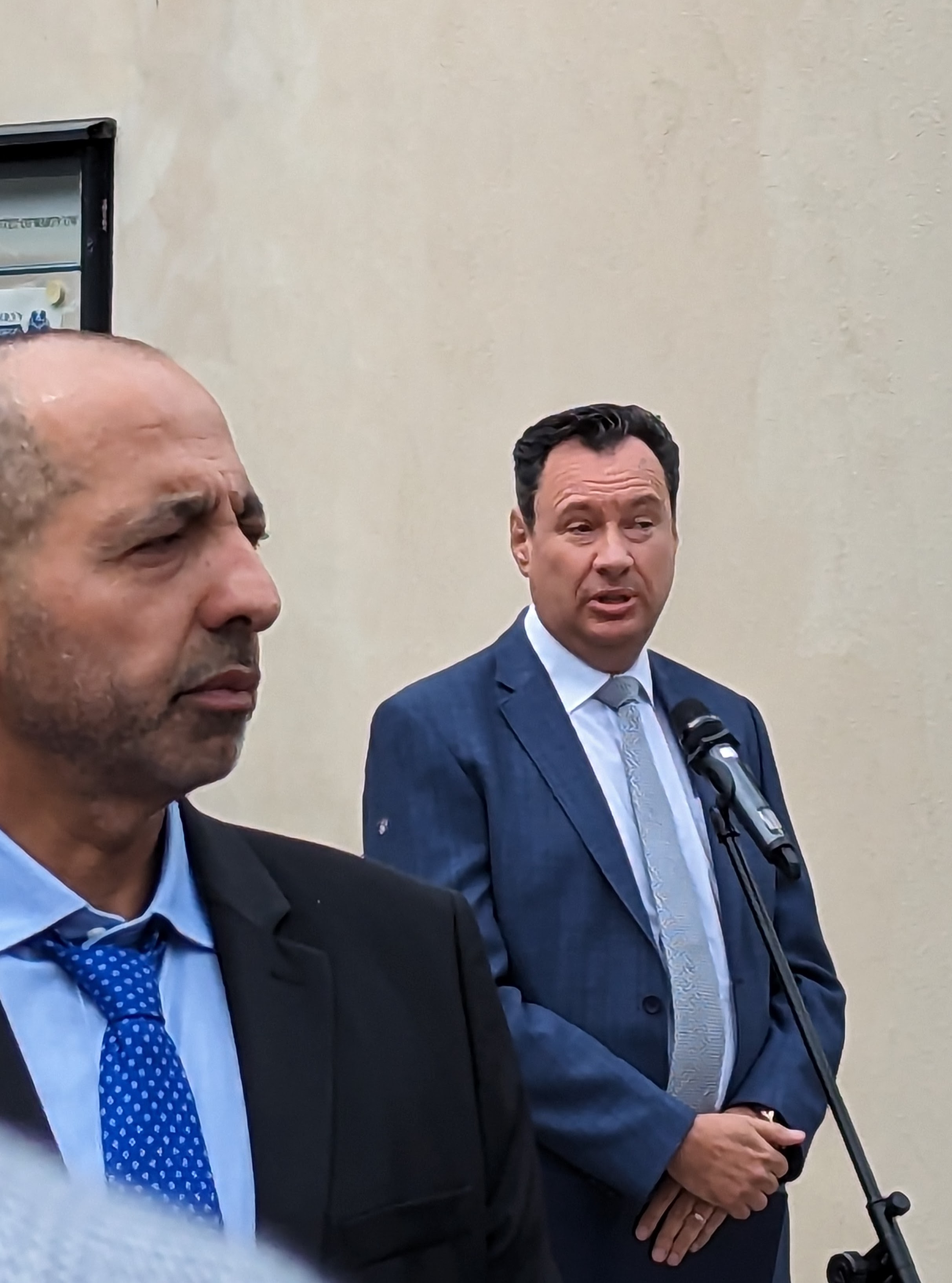
The audience’s enthusiastic applause was reserved for the third speaker, Antonina Dukowicz from the Student Antifascist Committee. It didn’t come in response to her diplomatic discussion of the five years it took to persuade the administration and work out the appropriate language for the marker. Rather, the crowd responded to her expression of support for the Institute of Philosophy and Sociology at the Polish Academy of Science, which is under attack by the government because of the work scholars are doing there that highlights some of the less noble behavior of Polish people against Jews during the Nazi occupation. The specific trigger for the latest attack was a brief comment by Holocaust Scholar Barbara Engelking that “Jews were unbelievably disappointed with Poles during the war.” The remark caused such a strong reaction because it challenges the official narrative that Poles helped the Jews more than any other nation and that they couldn’t do more because they were under occupation and subject to persecution themselves.
The student speaker called the commemorative marker a symbol that sheds light on the current darkness in Poland, and urged viewers to let it be a model for remembering the difficult truth. She ended with a call to cut out all kinds of antisemitism and oppression, so that it is never repeated. The final applause erupted, falling into rhythm as it continued.
Some commentators criticized the university for failing to issue an apology, or for not making a bolder statement. I’m impressed by the way Antonina Dukowicz connected historical discrimination with contemporary political battles, and the way those in attendance affirmed those connections. Battles are being fought here to acknowledge the less noble moments in Polish Jewish history and to reaffirm values of unity and diversity.

19 Friday May 2023
Posted in Association of Descendants of Jewish Central Poland, Commemoration, Memory, Poland, Polish-Jewish Heritage, Polish-Jewish relations, Włocławek
≈ Comments Off on We’re From Here/Jesteśmy stąd: ADJCP memorial tour

Subscribe to get access to the rest of this post and other subscriber-only content.
06 Friday Jan 2023
On September 28, I returned to Żychlin so I could visit the Jewish cemetery. I was eager to see the area that had been cleared earlier in the year as part of the “In the Footsteps of Żychlin Jews” program spearheaded by Bożena Gajewska and funded by the Forum for Dialogue.
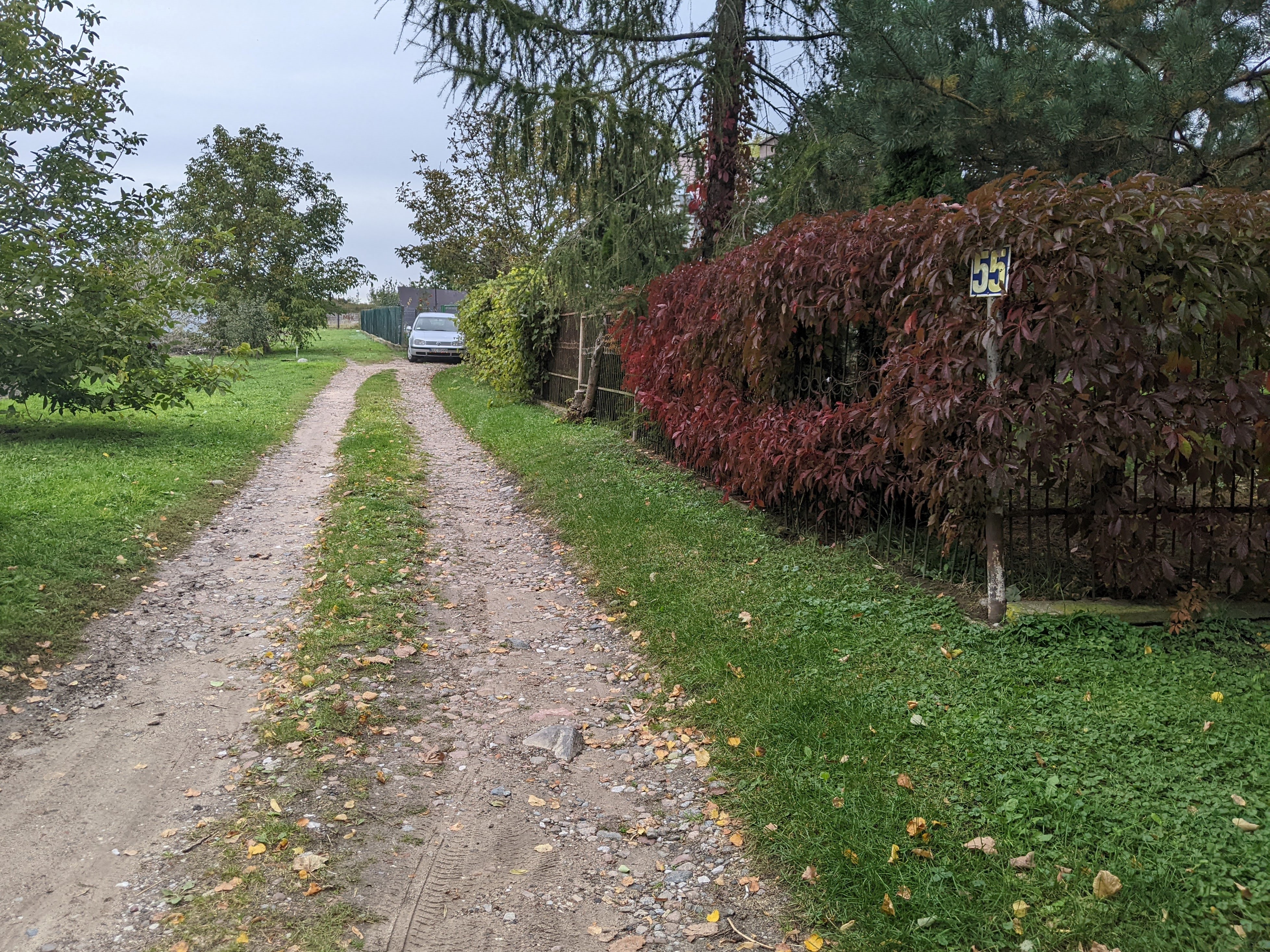
The first challenge was finding the cemetery. Even though I have been there several times and I had checked the location on Google Maps, I passed it the first time. I recognized the houses along the road from Google street view and guessed that the cemetery must be mismarked on the map. I backtracked to #55 Łukasińskiego Street and spied the cemetery gate at the end of a narrow gravel and grass-covered driveway. I parked on the shoulder of the road, careful not to block the driveway which leads to a farmhouse on the right-hand side. A plowed agricultural field is on the left side of the drive. The homeowners and their ducks and chickens watched me as I walked by their yard to the cemetery gate.
The cemetery gate needs repainting, though it remains sold. A padlock hangs from the latch but the gate is unlocked. The area that was cleared around the monuments remains accessible. I took a closer look at the three irregular monuments made from matzevot fragments held together with concrete. Some of the tombstones have come loose and lie on the ground. Others appear to be missing. Red graffiti scars the front of one.
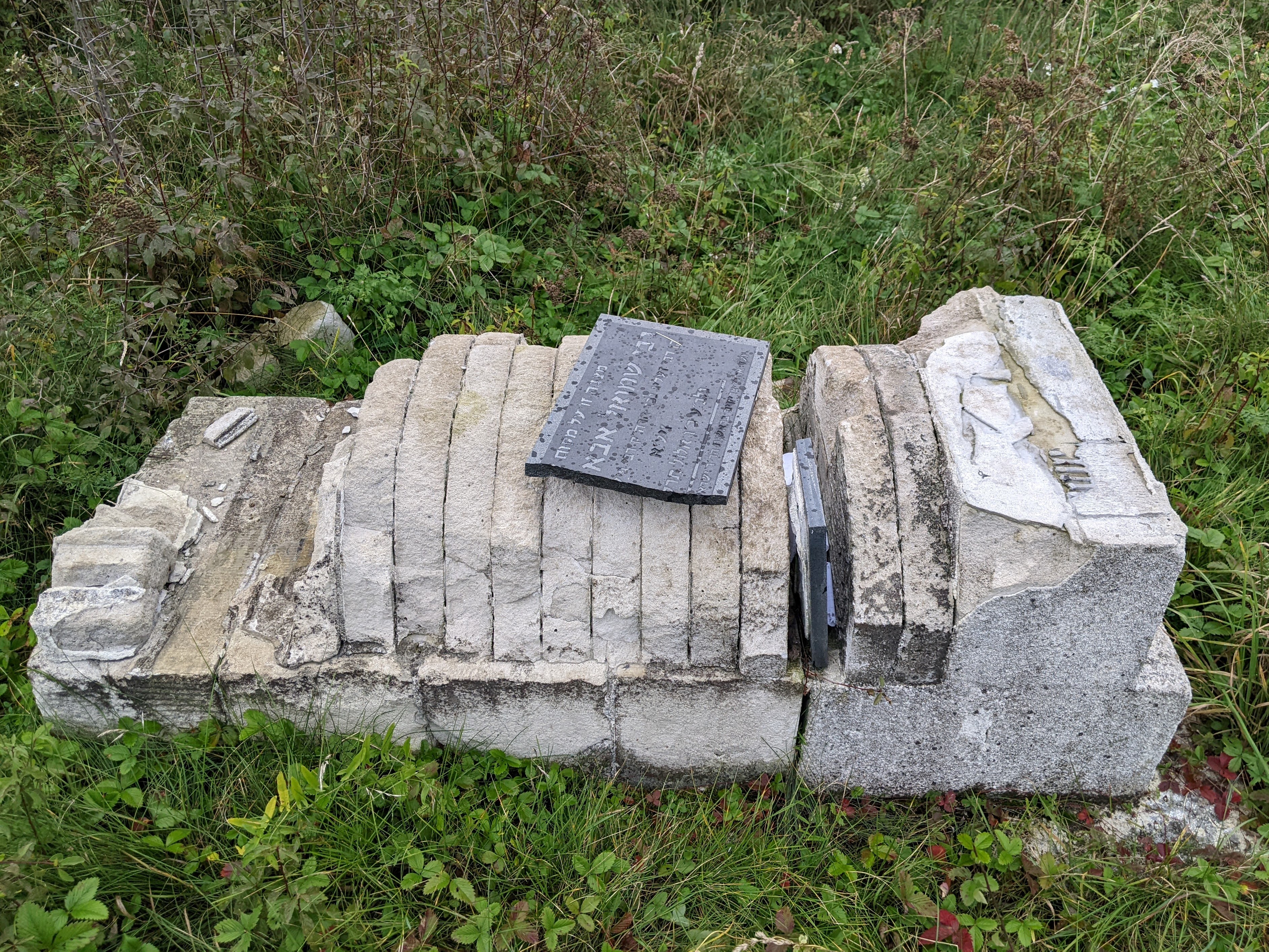
Rabbi Shmuel Abba‘s grave marker has fallen into disrepair. The curved stone over the site seems to have lost its top layer, and the vertical section of the marker has collapsed. The black stone with the inscription that used to be mounted on this vertical section has broken in half; part sits half-hidden in a groove and half lies flat on the broken surface of the monument. Notes left by visitors poke out of the cracks, and the remains of an Israeli candle sits on the ground near the grave. Photos show that this grave has deteriorated over the past few years.

The rest of the cemetery ground is overgrown with 9-foot blackthorn shrubs that make an impenetrable thicket. The sharp thorns on this plant pose a particular problem for cemetery maintenance. Bożena told me that it took a crew of four to clear a narrow pathway through the overgrowth to the memorial monument and a fourth concrete-and-matzevah obelisk. I had to watch my step to avoid the stumps of the blackthorn bushes that were cut six inches from the surface of the ground. I didn’t see signs that the bushes were growing back, but I have been warned that they will unless everything is trimmed back again before next spring.
Old candle lanterns sit below the monuments—a testament that someone remembers this place.

I inspected the fence from the outside of the cemetery, walking from the gate to the southwest corner. Only a small section of fence around the gate is constructed of solid iron spikes; the rest is made of rusty chain-link. The fence continues along the west side as far as I could see, which wasn’t far because of the small trees along the fence line. Stone curbs below the fence seem to mark the cemetery boundary.

The Żychlin Jewish cemetery needs help. Fortunately, the ADJCP has good allies in Bożena Gajewska, Żychlin mayor Grzegorz Ambroziak, regional organizations TMHŻ (Association of Żychlin History Enthusiasts) and TPŻK (Association of Friends of the Kutno Region), Steven Reece and the Matzevah Foundation, and Rabbi Yehoshua Ellis and the Jewish Community of Warsaw. Together, I’m hopeful we can make lasting improvements on the cemetery and maintain it as a testament to the Jewish community that called Żychlin home for centuries.
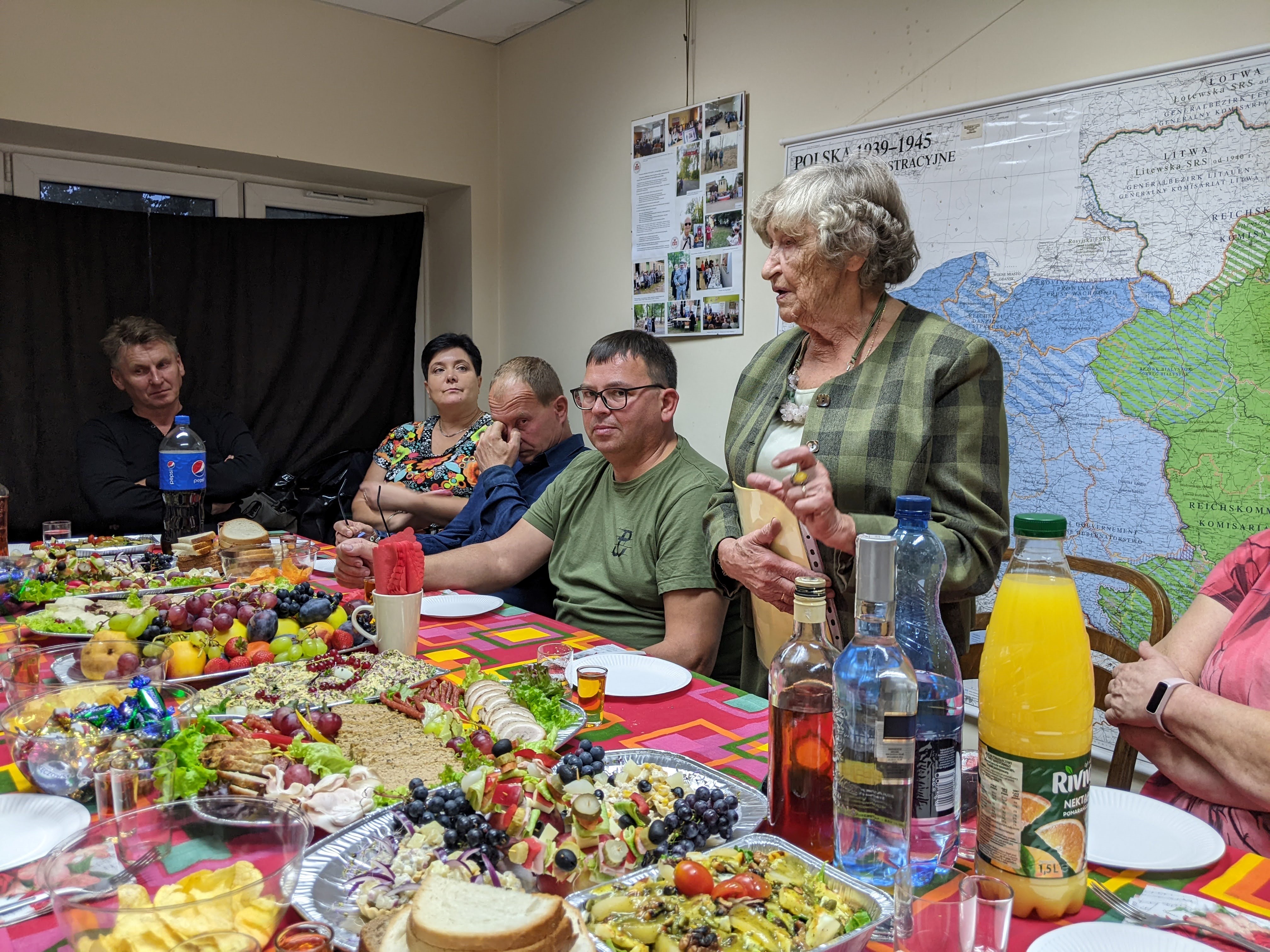
I ended the evening with the Association of Żychlin History Enthusiasts. My intention was to record some of the members’ recollections about wartime in Żychin. Serendipitously, my visit coincided with that of a guest of honor, Marianna Rybicka, who was a child during WWII; her memoir was published by the TMHŻ. She arrived from Płock with her daughter Iwona who brought a table full of food. Here, Marianna is telling her story:
Since September, Bożena has done more research about cleaning up the cemetery. The biggest challenge is the the blackthorn that grows over most of the terrain. Jewish law restricts any disturbance of the ground which means the blackthorn can’t be dug out by the roots or treated with herbicide. A professional landscaping firm told Bożena that the charge for cutting it all down by hand will be 80,000-100,000 zloties ($19,000-$24,000). Without additional treatment, it will grow right back.
Steven Reece of the Matzevah Foundation has some experience with blackthorn and he is confident a dedicated group of volunteers can use loppers to remove it. He hopes to join us in May to inspect the cemetery and suggest a course of action. A lot depends on how much territory needs to be cleared and the size of the bushes that need to be cut.
Can you help us? What do you suggest for removing a thicket of thorny bushes? Would you like to join a clean-up project and help restore the Żychlin Jewish cemetery? Let me know!
21 Wednesday Dec 2022
Longin Graczyk, the director of the Ari Ari Foundation, promised to meet us in Kowal at 1 PM for a meeting with the mayor and others involved in Jewish heritage work. From there, he said we could meet some activists in Lubień Kujawski and still make it to Chodecz in time for our scheduled 5 PM meeting with heritage association members there. Roberta and I were understandably skeptical everything could be accomplished within such a narrow timeframe. But true to his word, Longin shepherded us through the afternoon and made sure that we did everything as planned. Longin and Justyna Marcinkowska, another activist with the Ari Ari Foundation, met us outside city hall and accompanied us up to the second-floor office of Mayor Eugeniusz Gołembiewski. The room overflowed with people eager to share their knowledge of local history.
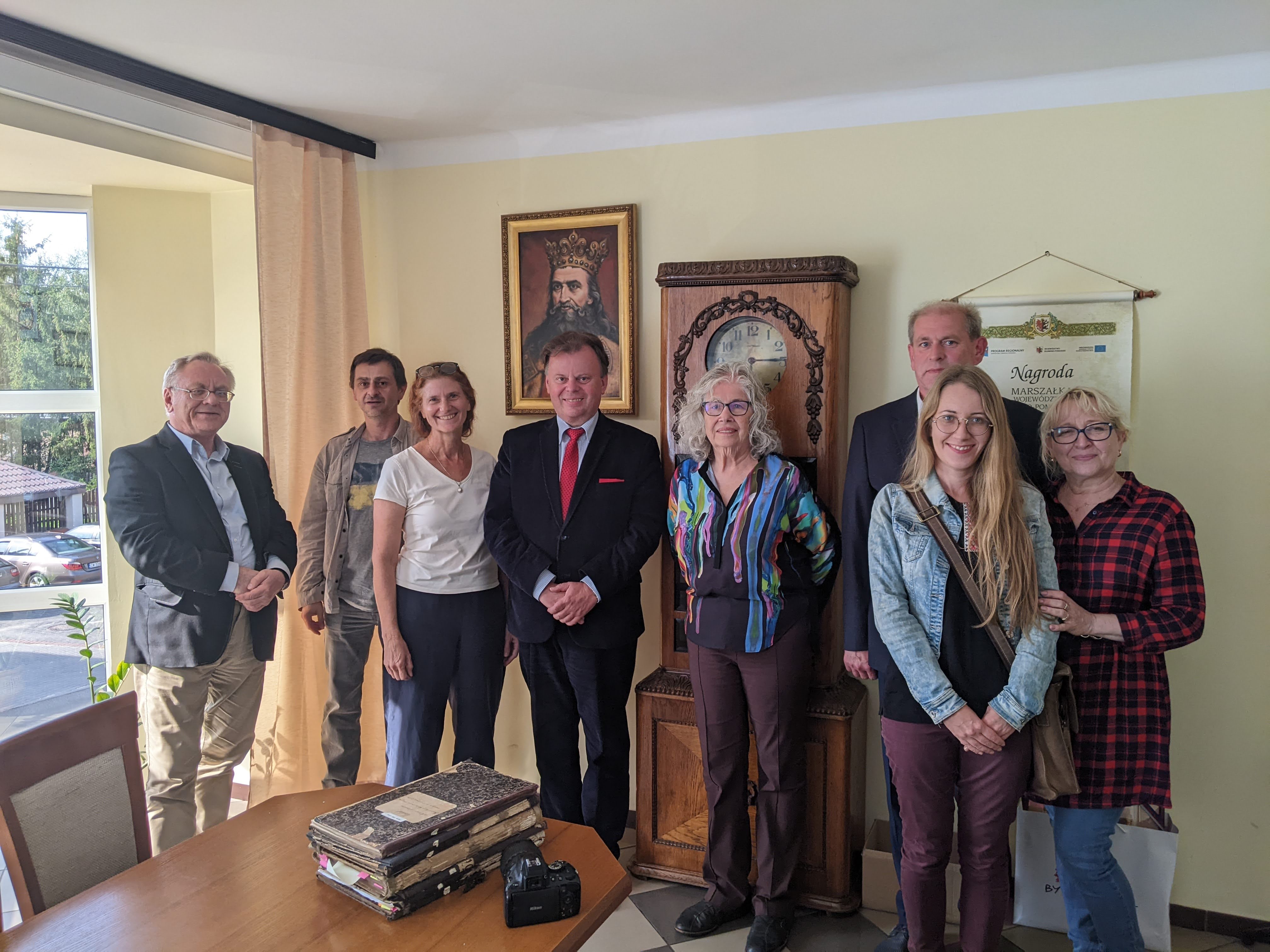
Several conversations ensued at once, providing a flood of information about past heritage projects as well as future plans. Notably, Edyta Dorsz had brought vital records books dating from between the world wars. The town retains these records until they are 100 years old, and then they will be sent to the National Archive. Tears came to Mayor Gołembiewski’s eyes as he explained that the books document the life transitions of the Jewish community that was wiped out during World War II. He said studying history is one thing but holding a physical trace of that community in your hands is another. The book contains the names of 1300 Jewish residents. He feels their loss viscerally. He asked, what would their city have been like if not for the war? Probably, it would have been a much more vital place with 30,000 residents instead of their current 2000.

Kowal resident Tomasz Kulicki shared his family story, explaining how his Jewish father survived the war. Roberta and I were also led into a neighboring office to view photographs of recent commemorative activities.
The mayor affirmed his commitment to recognizing the Jewish history of Kowal and his willingness to greet descendants during the memorial trip. He asked for any photographs or historical information that our members may have and be willing to share. This is something he has asked of others, and been promised, but no one has ever followed through with resources. Does anyone have photographs or historical information about Kowal’s Jewish residents? Please let me know!
We could have talked for much longer, but Longin cut the conversation short, reminding everyone of our tight schedule.
Longin guided us to the Jewish cemetery, a grassy field on the outskirts of town. Residential houses sit across the street and to the right is the fenced yard of a building supply company. Since there is no fence or marker to indicate the cemetery boundaries, Longin pointed them out to us. The cemetery begins somewhere in the middle of the field, extends beyond a brush-covered mound at the far end of the field, and includes part of the terrain under the water treatment plant (see the blue roof ). Longin was told that for some reason the plant had to be built in this spot. He didn’t elaborate.

The Ari Ari Foundation plans to mount a commemorative marker since nothing indicates this field is a cemetery. The marker will be wooden, in the shape of a tall matzevah. He showed us a photograph on his phone of one already on display in another town.
We continued to Lubień Kujawski, to a dirt and gravel parking lot at the site of the Jewish cemetery. During the summer, swimmers park there and walk down a narrow dirt trail to the river.

The Ari Ari Foundation plans to mount a wooden memorial marker here, too. On December 13, they posted photographs of the marker on their Facebook page. It will be installed very soon.
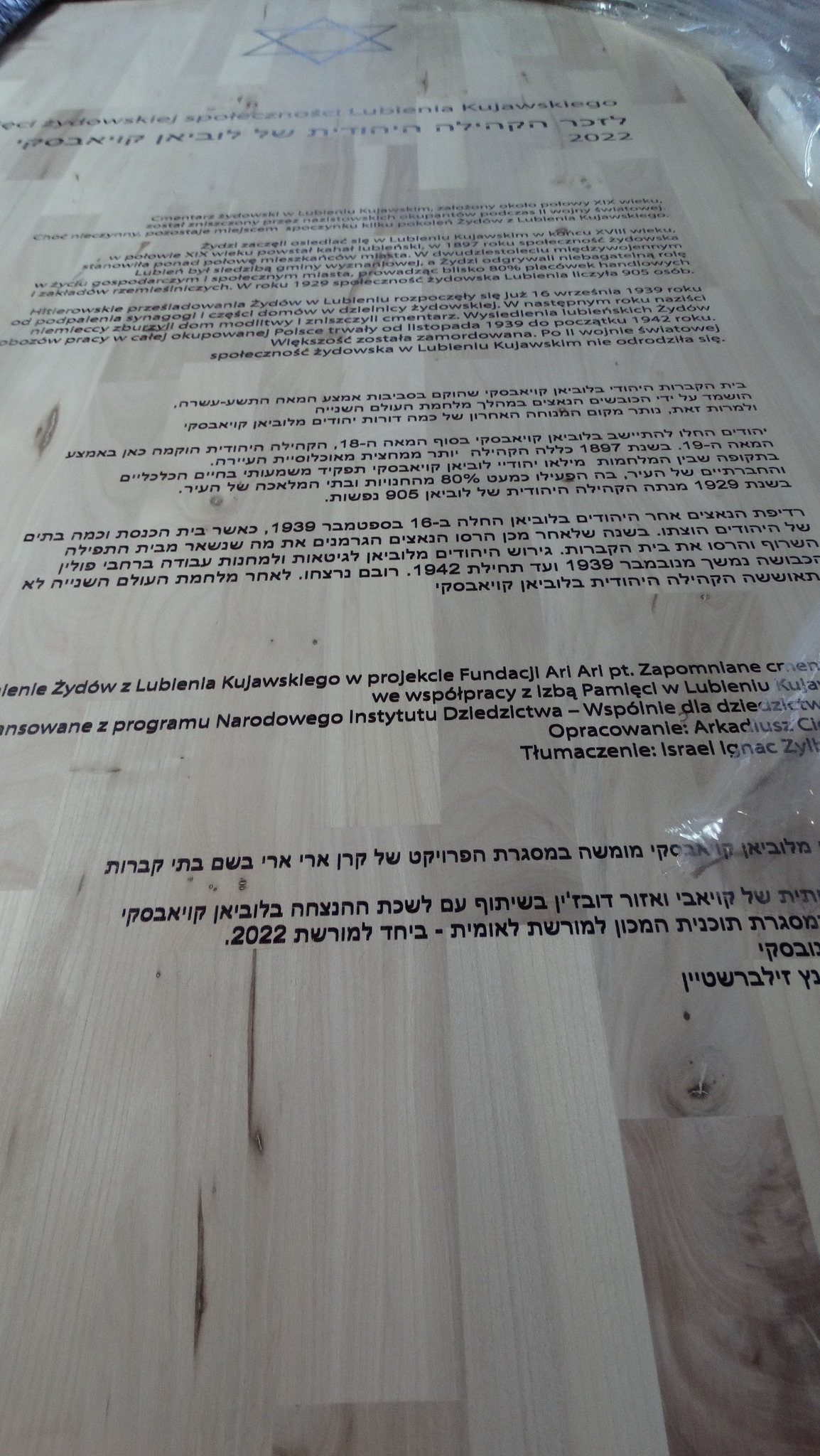
Andrzej and Magdalena Dominowski, Lubień Kujawski residents who have collaborated with the Ari Ari Foundation on regional history projects, met us for a brief conversation on the edge of the cemetery/parking lot. They described some of the activities they have helped spearhead. Both are schoolteachers, and Andrzej has led historical walks that feature the town’s Jewish history. His next walk occurred several days after our visit, on September 26. Andrzej also sent the ADJCP materials about the Jewish community of Lubień Kujawski: the relevant section of Tomasz Kawski’s book Gminy Żydowskie Pogranicza Wielkopolski, Mazowsza, i Pomorza w latach 1918-1942 (Jewish Communities in the Wielkopolski, Mazowsza, and Pomorza Regions 1918-1942), and archival postwar questionnaires documenting material and personal losses during World War II.
We didn’t have time to learn more about the Jewish history of the town, but Virtual Sztetl provides a good outline. Jews first settled in Lubień in the 2nd half of the 18th century. They filled important positions in the local economy and in local government. Jewish community properties included a wooden synagogue, prayer houses, schools, rabbi’s apartment, and the partially fenced cemetery. At the beginning of the War, most of these properties were burned and the Jewish population was sent to work camps and ghettos. Only a few survivors returned briefly in 1946.
12 Monday Dec 2022
Our contact in Izbica Kujawska, Premysław Nowicki, was called out of town and unable to meet us. He did, however, affirm his willingness to help us plan our memorial visit to the town.
Roberta and I stopped by anyway on our way to Kowal. We wanted to see the synagogue, one of the few remaining in the region and only the second we visited that retains the external appearance of a synagogue. According to an article in Izbica Kujawska Online, found by ADJCP member Michael Schoenholtz, the Jewish Community of Wrocław sold the building in 2007 to a businessman who renovated it and restored some features of the prewar exterior. The exact use of the building wasn’t decided yet. Originally, it was intended for “social and cultural purposes,” but in 2014 the when the article was written, it was being used as a warehouse for the neighboring Biedronka, a discount grocery store.

Eight years later, instead of serving social and cultural purposes or being used as a warehouse, the building houses a clothing store. The exterior retains the distinctive appearance of a synagogue with tall, curve-topped windows and a Star of David motif at the top of metal grates over the windows. This solid stone structure stands tall enough to have two or three stories, though doubtless the sanctuary was originally open to the ceiling with a women’s gallery reached by a staircase.

The exterior has been restored to its original glory, with the anachronistic addition of an electronic sign mounted high on its façade. Scrolling red letters advertise suits, shoes, and other forms of clothing. We had to walk all the way around the building to the western side to find the entrance. Without any sign beside the door, I expected it to be locked, but I tried entering anyway. It opened.
The interior looks nothing like a synagogue. The grey-painted space is broken up by large square columns, and although there is a high ceiling it doesn’t go up all the way to the roof. Stairs to the left behind a glass partition lead to an upper story. The former sanctuary is packed with racks of clothing for men, women, and children. A passageway at the back leads directly into the Biedronka.

Roberta offered to buy me something. She said that she did something similar in the store she imagined was in the same location as her grandfather’s butcher shop in Przedecz. She went in a bought a red hat. She never wore it.
I feel ambivalent about the presence of a store in a synagogue. On the one hand, it is a kind of erasure of the Jewish presence in the town. On the other, the restored exterior provides public evidence of the former Jewish community. Sadly, no Jewish population remains to frequent the building as a house of worship.
Because the building meets the contemporary needs of the current town residents, it continues to be cared for. Its roof remains intact and its walls strong, unlike the ruin in Żychlin. And unlike the Włocławek synagogues that were burned on Rosh Hashanah when the Nazis invaded, leaving no trace behind. Still, a more appropriate use would be for it to serve social and educational functions like the heritage center in the Lubraniec synagogue.
What do you think? How do you feel about shopping in a synagogue? Old houses of worship are repurposed all the time. The former synagogue in Tuscaloosa became a private residence until it was torn down several years ago to make way for an apartment complex. Are some uses more appropriate than others?
09 Friday Dec 2022
The Lubraniec Synagogue stands as a testament to the Jewish residents of the town. It is one of only two synagogues in the ADJCP region that maintains the outward appearance of its original purpose, and the only one that retains original interior features.

Currently, the building houses the Lubraniec Center for Cultural Heritage. During World War II, the synagogue became a warehouse, and it maintained that function until about 1980 when it was renovated for its current use. Historical features remain inside and out, including fragments of the original polychrome wall paintings, the women’s gallery, and a hidden doorway with narrow stone steps leading up to the attic. The building was also adapted to its current function: the second-floor landing was enclosed for the director’s office, and a stage was added on one side of the sanctuary.



Director Zbigniew Wojciechowski and local historian Andrzej Tomczak shared some background information about the synagogue, the Jewish cemetery, and the Jewish community of Lubraniec. The community center has occasionally sponsored public events featuring Jewish history and culture, and Tomczak has written about the history of the town’s Jewish community. Wojciechowski is also a music teacher. He proposed moving the date of their annual Day of Jewish Culture event so it corresponds with our visit in May.
After touring the building, we drove to the Jewish cemetery, a rectangular grass-covered field off a narrow dirt road.


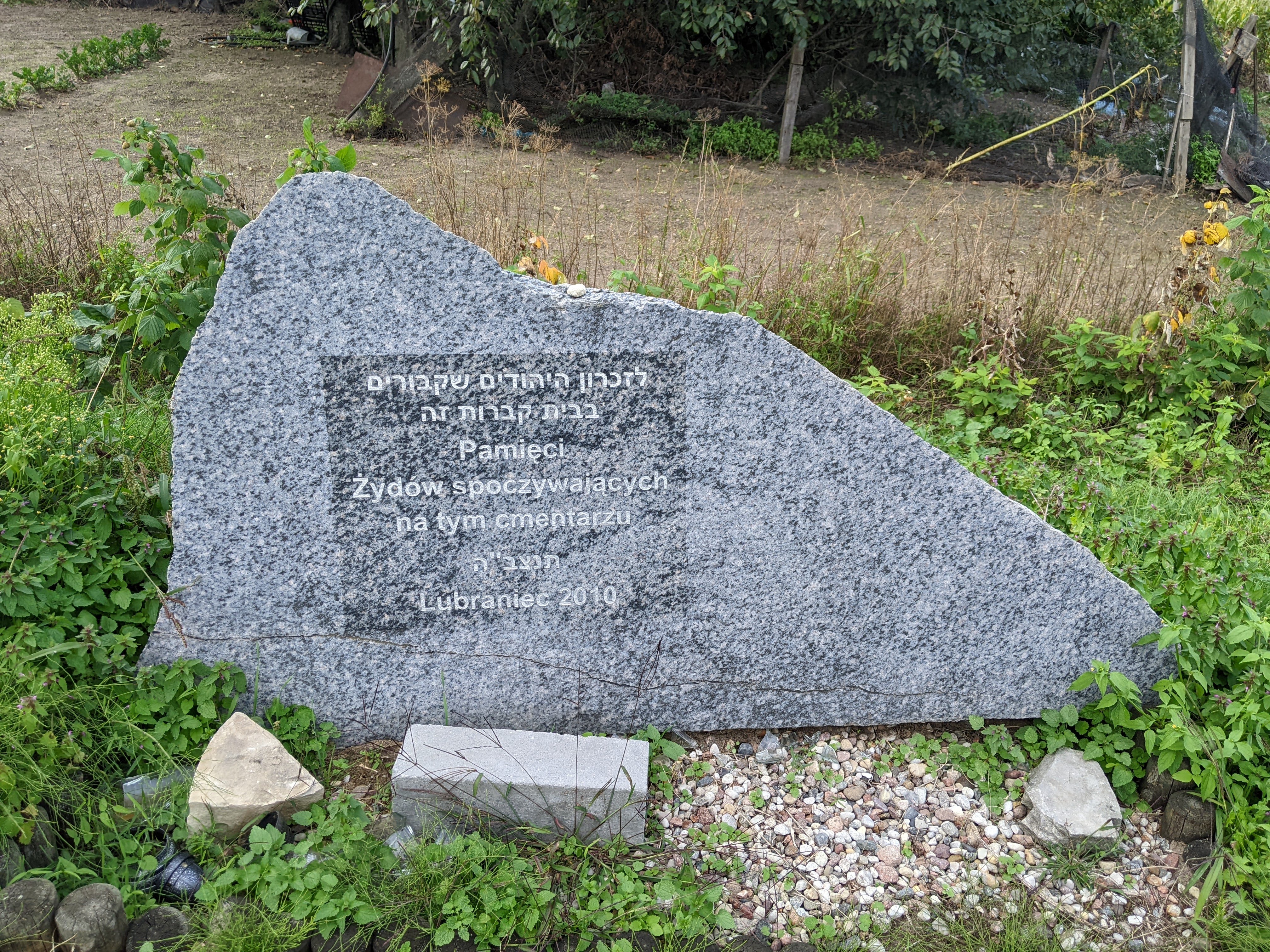
The site has a memorial stone, installed in 2010, with the simple inscription “Jews rest in this cemetery” written in Hebrew and Polish.
We walked up a few steps from the road, where a wall has been constructed out of matzevah fragments. There is a noticeable seam running about five feet from the ground which marks the original height of the lapidarium. After it was installed, more fragments were located and added on top, raising the wall another couple of feet. Many of these added fragments came from the rounded tops of matzevot. They contain symbols including crowns, candles, or water being poured from a pitcher into a cup. Three additional fragments sit at the base of the wall, brought individually from other sources. One small fragment has deep incisions cut into the inscription, probably where it was used to sharpen knives.

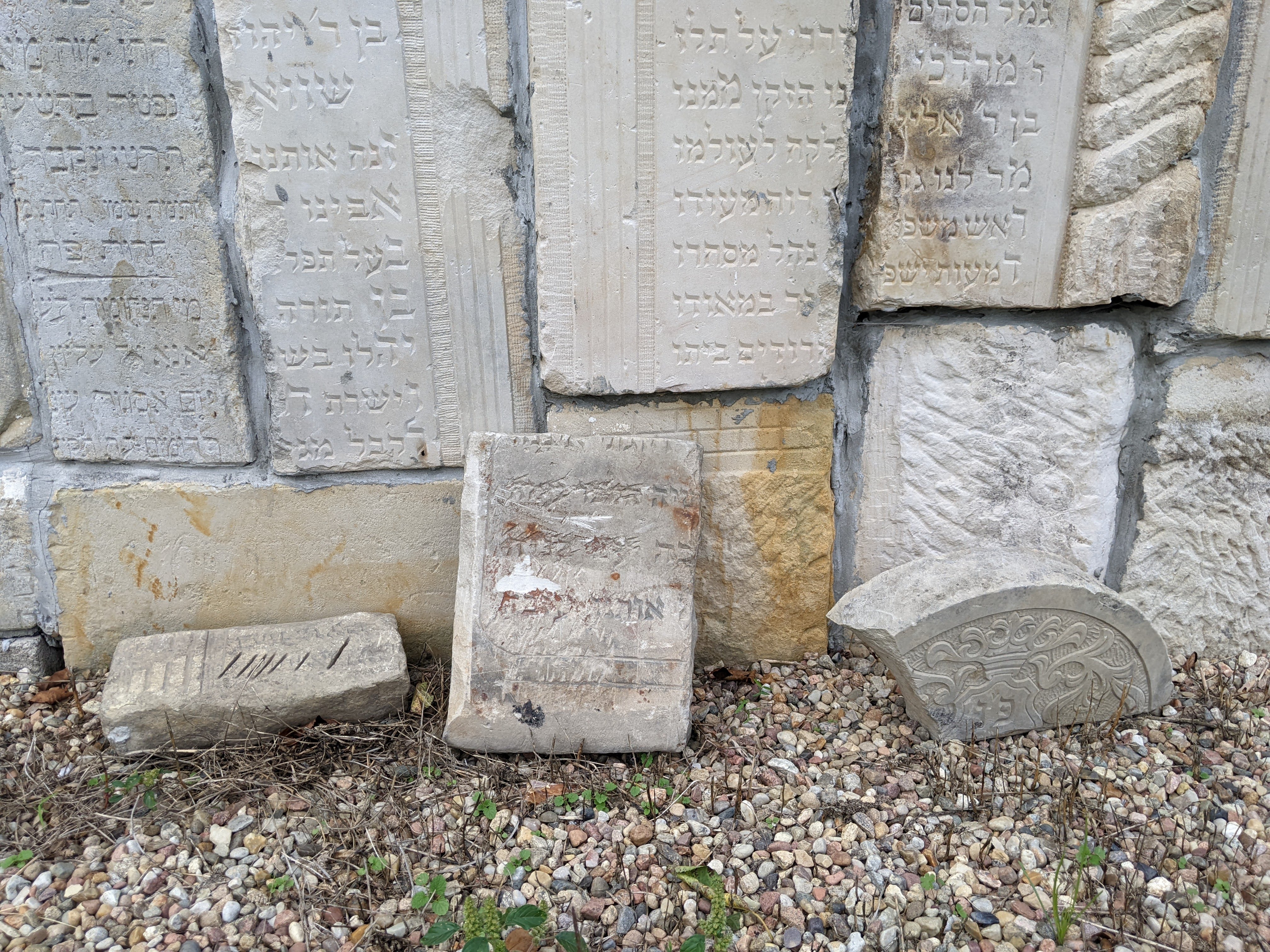
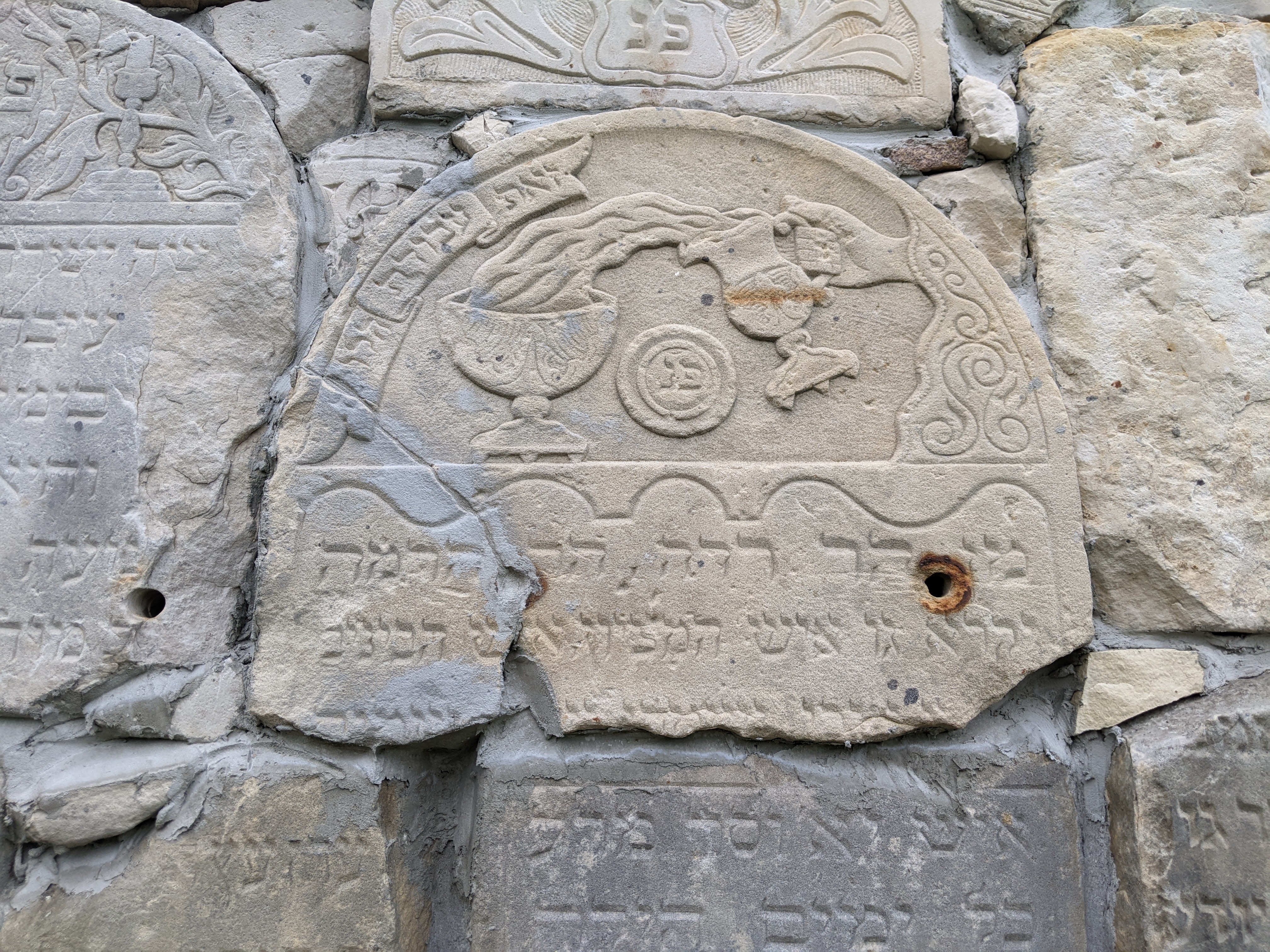
Even though there is no fence, the cemetery looks well-maintained. The grass isn’t too long and the path up to the lapidarium is in good condition.
Why did the synagogue and all of these matzevah fragments survive in Lubraniec, when so little remains in surrounding places? It’s a mystery I would like to solve.

