• About
  • The Photo that Started it All

Uncovering Jewish Heritage

Uncovering Jewish Heritage

Category Archives: Poland

Warszawa

11 Monday Jan 2016

Posted by Marysia Galbraith in Poland, Post-World War II

≈ Leave a comment

Tags

David Bowie

Interesting commentary on David Bowie’s “Warszawa,” which he did with Brian Eno in the 1970s. I remember listening to this song, but don’t think I ever connected it to Warsaw or communism or Poland. RIP David Bowie. “Pushing Ahead of the Dame” is a blog about David Bowie’s music written by Chris O’Leary.

Memory in Fragments: the talk at UA

31 Thursday Dec 2015

Posted by Marysia Galbraith in Brześć Kujawski, Buk, Cemeteries, Family, Heritage work, Israel, Jewish Culture, Lutowiska, Memory, Poland, Polish Culture, Polish-Jewish Heritage, Polish-Jewish relations, Post-World War II, Poznan, Pre-World War II, Research Methodology, Skierniewice, Synagogues, World War II, Wronki, Włocławek

≈ 2 Comments

Tags

Fulbright Program, Postmemory, University of Alabama

The lecture I gave at UA September 3, 2015 about my research during my Fulbright Fellowship is now available on vimeo. I’ve never seen myself lecture before. It’s a little unsettling. Still, here it is, flaws and all (for instance I know that Poland entered the European Union in 2004, even though I misspoke here).

I talk a little about the Fulbright Program–the kinds of grants available and some tips for applying.

It’s also a good introduction to my ideas about reassembling Jewish life: the strands that I’m following, what has been lost, what can be recovered, and how memory projects at sites throughout Poland intertwine with my own search for my family history. I hear echoes of some of the scholars I’ve read–Iwona Irwin Zarecka and Marianne Hirsch, as well as my sometime collaborator Malgosia Wosińska. There is no way to bring back what has been lost, but fragments of the past can be reassembled to form a new kind of life that allows for connection with what used to be and what yet might be.

Tracking Down Jewish Radymno

13 Sunday Dec 2015

Posted by Marysia Galbraith in Cemeteries, Jewish Culture, Memory, Polish-Jewish Heritage, Polish-Jewish relations, Post-World War II, Pre-World War II, Radymno, Synagogues, World War II

≈ 3 Comments

Although I knew the former synagogue still stands in Radymno, had to look several times before I actually found it. I’ve visited for years, and yet my friends never even told me the town had a prewar Jewish population. But until June, I never thought to ask them about it, either.

When I finally did ask, my friend couldn’t tell me much. She repeated a common refrain, especially in southeastern Poland: Jews used to say “nasze kamienicy, wasze ulicy” [“our buildings, your streets”]. It’s not clear that any Jews ever actually said this, but nevertheless, this is often what is remembered about them—Poles may have been the majority but Jews were richer. It’s a telling way of marking the distinction between Poles and Jews. Rather than all residents being regarded as Poles of various religions, Jews remained separate. Moreover Jews are remembered as being complicit in asserting their difference, and indeed their superiority. My friend didn’t mean it this way, but I’ve commonly heard this expression deployed as a justification for why Poles didn’t like Jews. Not only were Jews the property owners, they rubbed it in.

Jewish property ownership poses different challenges today. Some current residents fear prewar owners will return to claim what was theirs. My friend told me about two men who came to Radymno a few years ago and looked at some buildings that had once belonged to Jews. She also described a building in the center of town that is falling apart, but nothing can be done about it. It can’t be torn down because it is a historic structure, but no one will invest in its renovation for fear they will lose possession of it if the owner comes back. She also mentioned another property, a plot of land surrounded by fields whose last owners were Jews. The town hasn’t pursued a clarification of ownership because it isn’t worth enough to hire a lawyer and try and collect the few zloties of tax owed on it each year. So it just stands fallow. I suggested the owner is probably dead. She said of course, it’s been so many years. I clarified there probably aren’t even any descendants, and she responded “of course, because of what happened to Jews.” She didn’t elaborate, nor did she use the words Holocaust, murder, or genocide.

My friend’s mother-in-law had heard her mother’s stories about Jews. She grew up right next door to where they live now. Still, when we asked her about it, she responded she doesn’t know much. She was too young, and her mother didn’t tell her much. She remembers her mother complaining about the sound of the calves at the slaughterhouse across the fields. Kosher law demanded that they be killed with a single knife stroke, and with an empty stomach. Her mother could hear the calves crying in hunger as they awaited slaughter. There still is a slaughterhouse in the same spot, but it has been rebuilt and expanded. At first, my friend’s mother said it used to be owned by Jews, but then she said she wasn’t sure. Jews definitely used it, even if they weren’t the owners.

Her father opened a grocery store in Jarosław, a nearby town. All his neighbors were Jewish shopkeepers. He had to give up the business after a year and a half because they lowered their prices to the point that he could not compete.

Her mother also told her how all the Jews were collected by the Germans and taken to the cemetery where they were shot. She mourned the loss of two young pretty Jewesses, whom she knew because they did seamstress work together.

My friend’s mother-in-law said some Jews and Poles się przyjaźnili [were friendly with each other]. They lived side by side.

She also recalled where the Jewish cemetery was, not far from the water treatment plant.

My friend drove me down a dirt road past the plant, but there was no cemetery. When the road narrowed to two wheel tracks in tall grass, we turned around. My friend pointed to a stand of trees in the distance, saying she thought the cemetery was there. She tried to find someone at the water treatment plant but no one responded. From there, she stopped at a store, but chanced on a man who lives in a nearby city.  The young men working at the car wash knew nothing about the cemetery, either. She finally found an older woman who pointed to a different, less traveled dirt road. We drove up it, but it didn’t get us to that stand of trees. My friend kept looking for a road leading in that direction. I can’t help wondering if maybe at some point in the past she hd been told the cemetery was there.

We drove past the slaughterhouse her mother-in-law had mentioned. It’s a big operation, rebuilt and expanded since the war. The building closer to the road, essentially a box shape, is probably the oldest.

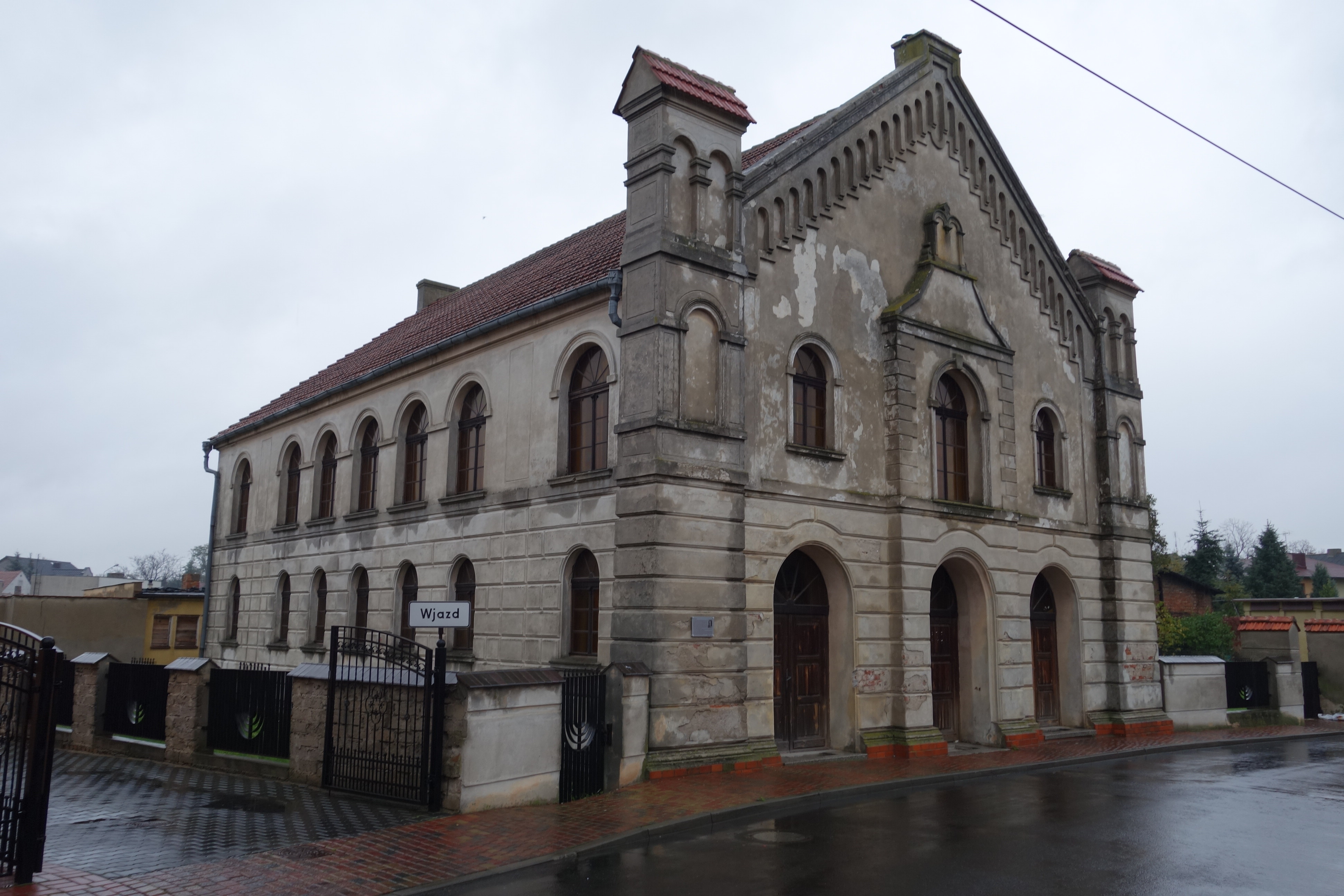
From there, we took a back road up the hill into town and I finally got to see the former synagogue. It is now a beverage wholesaler. My friend’s uncle lives next door. I took some photos while she went to ask him if he knew where the cemetery might be.

DSC06762

The Radymno synagogue now houses a beverage wholesaler.

The front of the synagogue is an imposing two-story square façade that has been renovated, leaving no clear elements of synagogue architecture. From the back, though, the bricked-in semicircular tops of the former synagogue windows are visible. Through windows, you can also see staircases on either side that used to go to the “babiniec,” the upstairs balcony for women. My friend’s uncle used this term when he described it to us, so clearly he knows a bit about the building’s former life as a synagogue. He said nothing has been added to the building. It still has the same footprint, and it stands at its original height. I asked him how he knows, and he simply responded, “after all, I live next door.”

The synagogue from the back
Brick arches used to be the tops of the synagogue windows.

My friend’s uncle also knew how to get to the cemetery. He said he last went there over 30 years ago. As a high school student and a young man, he and his friends used to go there sometimes to have fun (in other words to drink). He remembers some tombstones were still standing, though many others had been brought to the river where people would wash their clothes on them. The writing was still visible on them, but later, the stones fell apart. Today there is nothing left.

Looking back toward Radymno from the cornfield beside the Jewish cemetery
The overgrown site of the Radymno Jewish cemetery.

He took us past the slaughterhouse and up a different dirt road. It petered out in a cornfield, right beside the stand of overgrowth and trees that Jasia had kept pointing toward. Still, we still couldn’t reach it because of a deep gully that separated it from the cornfield. Besides, the overgrowth would not have been penetrable without proper footwear, pants, and probably a machete. I suggested returning in the winter might be best.

At least I know the site to return to.

Cousins in the Warsaw Ghetto

22 Sunday Nov 2015

Posted by Marysia Galbraith in Bereda, Cemeteries, Jewish Culture, Jewish Ghetto, Kolski, Warsaw, World War II

≈ 2 Comments

Tags

Mirka Kolski, Okopowa Cemetery, Pinchas Kolski, Rachel Piwko Kolski, Warsaw Ghetto

My cousin Pini (Pinchas) Doron, reminded me that his grandfather and namesake died in the Warsaw Ghetto. This is the story he sent me this morning:

“The Okopowe Cemetery is the old big cemetery in Warsaw that we visited with the whole family in 1995, including Pnina’s (his wife) parents.

“Her mother used to run from the Ghetto through the cemetery to the fields to bring potatoes to her family when she was 13 years old.

“Amazing stories.

“I have seen in your post the stone sign for the people who died in the Ghetto. As I told you, my grandfather Pinchas Kolski died in the Warsaw Ghetto in 1940 and was buried in a temporary cemetery inside the ghetto. As we know, in 1940 they no longer allowed anyone to bury the dead  in the Okopowa Cemetery outside the Ghetto.

1941RachelMirkaKolskiAtPinchasGraveInGhetto

Mirka and Rachel Kolski at Pinchas Kolski’s grave in the Warsaw Ghetto. He died in 1940.

“We have this picture of Grandmother Rachel Kolski and her daughter Mirka (see the white sleeve with the [Star of David]-I think this was before they introduced the yellow star)?

“Mirka told me that after this visit to the grave, they managed to escape the Ghetto and to meet your step grandfather (that would have been Zygmunt Bereda) who hid them.”

Okopowa: Warsaw’s Jewish Cemetery, All Souls Day 2014

21 Saturday Nov 2015

Posted by Marysia Galbraith in Catholicism, Cemeteries, Family, Jewish Culture, Memory, Warsaw

≈ 5 Comments

Tags

All Saints Day, Mourning, Okopowa Cemetery, Powązki Cemetery

November is the month when I think about death the most. It starts with the Catholic holidays All Saints Day (November 1) and All Souls Day (November 2). It’s the month when the leaves fall from the trees and the long nights settle in. But it’s also the anniversary of my more personal encounters with death. My brother Ron’s accident was a few days before Thanksgiving in 1990. Nine years later, on the Friday after Thanksgiving, my dad had his accident while visiting me in my new home in Alabama. Both were injured in a fall. Both were in the hospital for two to three weeks before dying.

I think we all learned how to deal with this kind of loss from the first experience. The first time, no matter how dire the news was from New York, I held on to the certainty that Ron would pull through. I let my mother persuade me that it made no sense to come home right away, when he was still in such bad shape. I should finish the semester in graduate school in San Diego and come home as scheduled on December 11 when Ron would be well enough to appreciate my presence. I think she was trying to protect me from the shock of his injuries. And I believed her because she was my mom, and because it was easier, and because the prospect of him dying was inconceivable. But he didn’t last that long and I never got to see him alive again.

The second time, we knew not to assume anything. We held on to hope until the last moment, but we were more prepared for Dad’s passing. My brother Chris was already there, but my other brother Wiley flew in from California. We all sat vigil, visiting Dad every chance we could get and supporting each other in our grief.

So while I love Thanksgiving, this is also the time of year I think about my brother and my father. And I grieve for them all over again.

Especially after Ron died, I struggled with grief. There didn’t seem to be any way to talk about it or express it publicly. I think this is particularly difficult in California, a place that celebrates life and youth. The cemeteries are hidden from view or turned into parks. That’s why it resonated with me to spend All Saints Day in Poland. During this holiday, families visit their relatives in the cemetery (those who are living and those who are dead). They clean the graves and decorate them with chrysanthemums and candle lanterns. At night, the whole cemetery glows with candlelight, and throngs fill the cemetery pathways. Death isn’t hidden away, and the people you love remain a part of your life even after they die.

Whenever I’m in Warsaw, I make a point of visiting my step-grandfather’s grave in Warsaw’s Powązki Cemetery. I clean the stone, place flowers, and light candles. This is the closest thing to a relative I have in Poland, and one of the only remaining traces of my family’s lives there. Last year was the first time I was able to make it there on All Saints Day. I went with my son, who by now is familiar with the custom of visiting, cleaning, and decorating graves. He likes to watch the candles burn.

DSC01729

Ian watching the candles at his great grandfather’s grave, Powązki Cemetery in Warsaw, November 1, 2014

The first time I went to Powązki was in 1986, during my first visit to Poland. I spent a couple of days with Marta, a professor of American literature who had worked as my grandmother’s companion back in New York. She took me to my grandfather’s grave. She knew where it was because my grandmother had told her where to find it. She made a point of visiting every time she visited her own relatives in the cemetery, and she kept the grave tidy for Babcia.

I vaguely remember we stopped in at the Jewish cemetery also. But it’s also possible I’m confusing my memories of the large Jewish cemetery in Krakow, or the one in Prague, which was in a more confined space. It’s possible I visited Okopowa, the Jewish cemetery in Warsaw, on a later trip to Poland.

Last August, when I was at Powązki with my brothers, I noticed what looked like a synagogue on the other side of the wall, right there near my grandfather’s grave. Looking at a map, I realized that the Okopowa Jewish Cemetery abuts Powązki (a Catholic cemetery), as does the Evangelical Cemetery. Either I had forgotten this, or simply never knew how close they all were to each other.

On November 2, All Souls Day, I visited Okopowa with my friend Beata. She has lived in Warsaw for close to 20 years, but had never been there before. Beata said she had been wanting to visit the Jewish Cemetery for a long time. We parked in front of her friends’ glass high-rise apartment building right across the street from the entrance.

The regular admission fee was waived for the holiday. A good number of people strolled the alleys. A man in a yarmulke led a tour. Beata, Ian, and I made our way past a reconstruction of the original cemetery gate and a low wall made of the fragments of tombstones. The wall also includes commemorative plaques for Holocaust survivors who emigrated and were buried elsewhere.

The reconstructed gate and wall constructed of fragments of tombstones
"Father, You wanted to, so you symbolically returned to your country." Alia Skowronek died in the USA
“Father, You wanted to, so you symbolically returned to your country.” Alia Skowronek died in the USA

Okopowa remains an active burial ground, and people have continued to be buried there after World War II through to the present. The cemetery shows signs of ongoing attention and care, though broken and overgrown stones fill the vast expanses beyond the main walkways. There are many large tombstones and some family plots, suggesting affluent families. Even older tombstones include Polish as well as Hebrew inscriptions, and some have writing in Polish only. This signals to me a higher degree of assimilation in Warsaw relative to the smaller towns I have visited in central and eastern Poland (Lesko, Żychlin, Lutowiska, Skierniewice, to name a few) where most if not all inscriptions are in Hebrew. It’s different in western Poland, where tombstones were commonly in both Hebrew and German.

Off to one side, I found an area partially filled with older tombstones that have clearly been reset because they are all upright and evenly spaced in rows. These have the larger lettering characteristic of tombstones dating from an earlier period. They fill about 1/3 of the space; the remaining 2/3 are covered in weeds. Along the opposite wall more tombstones are stacked as if they are waiting to be set out in rows. I wonder what is being done here. Might these stones have been recovered from other locations?

Tombstones waiting to be set in rows? Where did they come from?
Older looking graves reset in rows

The cemetery also contains an area filled with symbolic graves for the victims of the Holocaust, and another large round depression marked by a ring of rough stones painted white with a thin black stripe through the middle. This is where victims of the Warsaw Ghetto are buried. Numerous candles were lit on and below the plaque explaining this, as well as on some sand fill that seems to have been recently placed in part of the depression. Some of the candles are in cans with Hebrew writing on the outside. I’m told these are from Israel.

Symbolic graves of Holocaust victims
Candles left on the site where victims of the Warsaw Ghetto are buried
"Here rest the victims of the Warsaw Ghetto 1941-1943" The plaque looks like a tombstone. The top is covered with stones and lighted candles cluster around its base
“Here rest the victims of the Warsaw Ghetto 1941-1943” The plaque looks like a tombstone. The top is covered with stones and lighted candles cluster around its base

Several headstones are adorned with white and red ribbons and Polish flags with “PW,” the symbol of the Polish Underground Army. These are soldiers who died during their service in the war, clearly both Jews and Polish patriots. Some resisted the pressures to identify as just one or the other. They were both, despite the antisemitism, despite Hitler.

Blima Mikanowska, AK soldier
Tombstone of Józef Walfisz. A distant ancestor?

I passed the grave of Józef Walfisz, who died 15 Aug 1874 at the age of 13. Walfisz was my great grandmother’s maiden name. Could this be a relative?

We had to leave because a man told us the cemetery closes at 4 PM. I understand why. Dusk was falling and the cemetery has no electric lights. A few candles glowed, but not enough to light the way as in the Catholic cemeteries on All Saint’s Day.

The Okopowa Cemetery evokes the rich life of Jews in Warsaw—it’s a physical reminder of their numbers and their affluence (and their level of assimilation). It also embodies how Jewish life in Poland was cut off, brutally and decidedly. But I also see here evidence of continued care and use, something that is not present in places where no Jews are left to visit their relatives and eventually be buried themselves.

Memory in Fragments: Reassembling Jewish Life in Poland

03 Thursday Sep 2015

Posted by Marysia Galbraith in Anthropology, Heritage work, Jewish Culture, Memory, Poland, Polish-Jewish Heritage, Polish-Jewish relations

≈ Leave a comment

A summary of Dr. Marysia Galbraith’s year as a Fulbright Scholar in Poznan, Poland

September 3, 2015

Lloyd Hall 319

6:00 p.m.

Dr. Galbraith will also answer questions about the Fulbright Program and fellowship opportunities.

Former synagogue in Buk, Poland

Former synagogue in Buk, Poland

My research on Jewish heritage asks what can be done with the fragments of Jewish culture that remain in Poland, sometimes hidden and sometimes in plain sight? And what value does such memory work have? I explore these questions on two levels: the social level where I focus on what is actually being done with physical traces of Jewish culture in the absence of living Jewish communities, and on the personal level via the archeology of my own hidden Jewish ancestry. These fragments can reveal something about the past, even if it is just in an incomplete and shattered form. And they can point toward the future—the possibilities that might emerge out of traces of memory.

Life and Death in Poland

03 Thursday Sep 2015

Posted by Marysia Galbraith in Identity, Israel, Jewish Culture, Memory, Warsaw

≈ Leave a comment

Tags

Embodiment, Israeli youth voyages to Poland, Jackie Feldman

One of the things I like about the blog format is that it is episodic. A flash of vision or memory appears from nowhere, and then stays around for a while. I can examine it for a while, tossing it around in my mind until its outlines grow more clear. Rarely does it unfold chronologically. So here it is September in Alabama, six months and half a world away from my trip to Israel, and yet Israel is what I have on my mind.FeldmanAbove

A big part of it is that I just finished Jackie Feldman’s book about Israeli youth voyages to Poland. Each year, thousands of Israeli youth participate in organized trips to Poland to visit the death camps and to connect more strongly with their Israeli national identity. Feldman shows how the voyages (because that’s what the trips are called) reinforce a particular narrative dividing Jewish history into three epochs: Antiquity, Exile, and Zionist settlement of the Land of Israel (p. 12). Antiquity refers to the period of sovereignty of the Isrealite kingdom. A narrative of the other two epochs plays out on the voyages—from suffering and persecution in Europe during the long period of Exile culminating in the Holocaust, to revival of Jewish national life in the contemporary state of Israel. As such, Poland represents oppression and death in Exile, while Israel represents freedom and life in the homeland.

Feldman argues that these trips, most of which are subsidized by the Israeli government, are akin to pilgrimages—a journey to a sacred place involving a break from everyday social lives and hierarchies into a liminal space filled with intense physical and emotional experiences as well as transmission of cultural, symbolic knowledge. Pilgrims return transformed, ready to reintegrate into society, but in a new social status (in this case, they transform from youths to adults and ambassadors of the lessons learned about their Jewish heritage and Israeli citizenship). I like Feldman’s book because he effectively shows how this transformation is fueled primarily by emotion and sensation—through the body—more than through cognition and learning. This is consistent with my own observations on a Polish pilgrimage to Częstochowa many years ago.

Muranów, Warsaw

Muranów, Warsaw

The book also brings home to me another thing I have observed: that the symbolic significance of Poland is quite different for me than it is for most Jews I have met. So are the emotional associations. Many Jews view Poland both symbolically and materially as a vast killing ground and graveyard. I have felt this myself, especially in places like Muranów in Warsaw, the prewar Jewish quarter that was at the heart of the Jewish ghetto during World War II. When the district was rebuilt in the postwar period, the rubble heaps (doubtless containing the bodies of victims) were left in place and new buildings were built right on top of them. This has created a district that is jarringly pleasant. The raised terraces break up the mostly flat city terrain creating intimate interior courtyards and slopes for lush gardens. But knowing the district’s history, it is hard to not feel uneasy about walking on the victims of the Holocaust.

Muranów, Warsaw

Muranów, Warsaw

Still, for me, Poland is the lost homeland of my mother—a place she mythologized and longed for. These associations were also tragic, because she knew return was not possible. But no doubt that also contributed to the magic. As an imagined place, Poland did not need to accommodate the harsh realities of postwar devastation or state socialism–or the Holocaust. And also, I’ve built my own memories of Poland over the past 25 years. I’ve witnessed the country’s “colorization” as it evolved from state socialist greyness into consumer-fueled color. My time there has always been marked as “special,” separate from the humdrum of everyday life. It’s become a second home to me. Marked as it is by my use of a second language, I also visit another version of myself in Poland, the Polish-speaking one, the foreigner, but also the native daughter returning to the homeland. In short, unlike the Israeli voyagers (for whom Poland represents death and Israel life), I return to life in Poland. Life in the face of displacement and death, perhaps even in defiance of that difficult history.

I thought I was going to write a description of my visit to Israel, but this has turned into a more reflective piece about place and identity. I’ll have to get to my memories of Israel next time.

Bogdan was Daniel

16 Sunday Aug 2015

Posted by Marysia Galbraith in Family, Israel, Kolski, Names, Warsaw

≈ 2 Comments

Tags

Danek Kolski

A photo from my grandmother's papers of Mirka (Rachel's daughter), Rachel (Babcia's sister), Czesław Mochorowski, and Nelly. The boy who is standing is Bogdan, Rachel's grandson, the son of Samek and Nelly. I don't know who the man on the right or the boy at the very bottom are.

A photo from my grandmother’s papers of Mirka (Rachel’s daughter), Rachel (Babcia’s sister), Czesław Mochorowski, and Nelly. The boy who is standing is Danek, Rachel’s grandson, the son of Samek and Nelly. I don’t know who the man on the right or the boy at the very bottom are.

Following up on yesterday’s post, cousin Nelly Kolski Kampf who is the granddaughter and namesake of Nelly Kolska Mochorowska and daughter of the standing boy in the photo, wrote:

The child in the picture named Bogdan is my father. He was born as Danek Kolski and during the war his name was changed to Bogdan to help him to hide and when he came to Israel he changed his name again to Daniel (Danek) Kolski.

He was with my grandfather Samek my grandmother Nelly, Babcha Rachel and Mirka together in the Ghetto.

The name Bereda was mentioned by my father (who was a child during the war) that help them to escape from the Ghetto.

So Bogdan was Daniel; he was also Danek. Some cousins call him Dani.

Daniel/Bogdan/Danek/Dani Kolski c. 1939

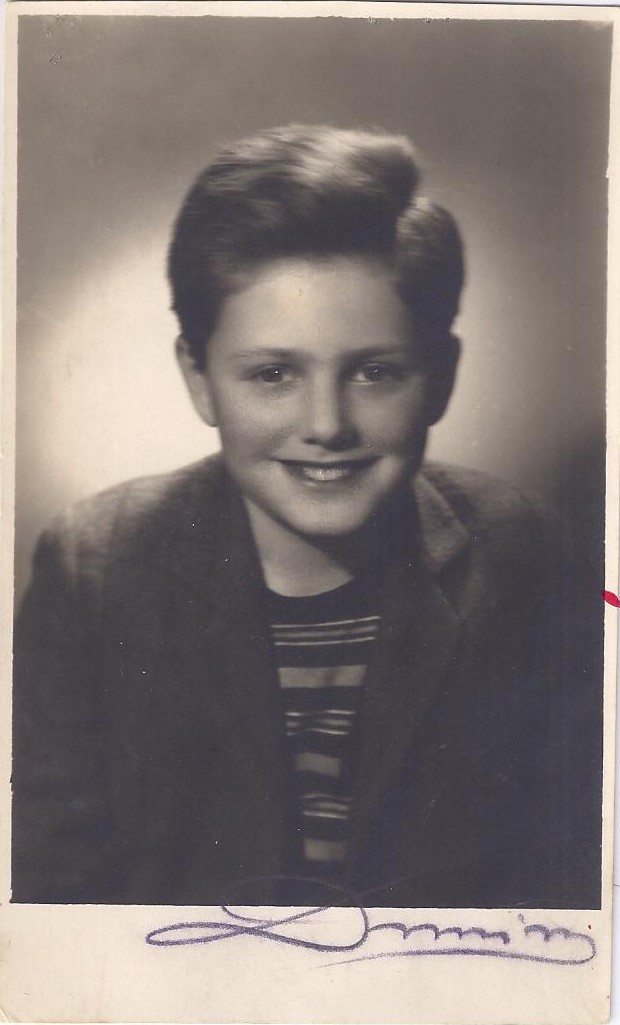
Daniel/Bogdan/Danek/Dani Kolski c. 1949

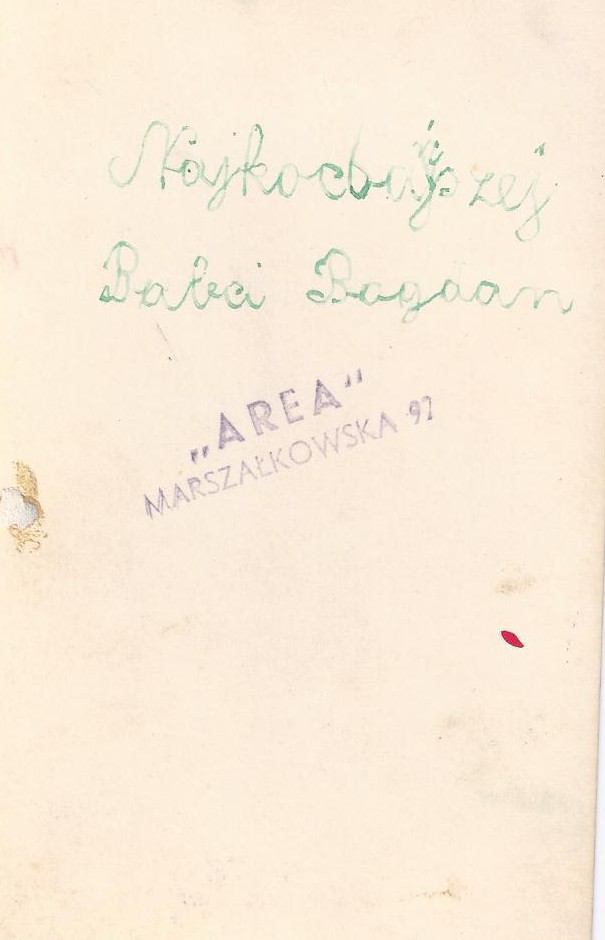
Back of Danek's photo. The first word was corrected, but probably meant to be something like

Back of Danek’s photo. The first word was corrected, but probably was intended to be “Najkochańszej” which means “most beloved.” The printer stamp shows the photo was from Poland.

This is a photo of young Danek. Written in Polish on the back in a child’s hand is: “To my most beloved grandmother, Bogdan.” I can’t make out the word on the front though it clearly begins with a “D” and is in an adult’s hand. He was born in 1937, so he would have been around 7 when the war ended. Danek looks here like he is about the age of my almost-twelve-year-old son, so this was after the war–around 1949?

I asked Nelly (Kampf) if they used the term “Babcia” at home. She said yes; her parents spoke Polish to each other, so Danek’s grandmother Rachel was called  “Babcia.”

Samek and Nelly (Służewska) Kolski's wedding photo.

Samek and Nelly (Służewska) Kolski’s wedding photo.

I met Nelly (the granddaughter of Samek and Nelly), her husband, and two younger children at Pini (another grandchild of Rachel’s) and Pnina’s house in Israel. I felt an immediate strong connection with her. She brought her father’s family album, as well as pages from a book about the Jewish history of Włocławek. I’ve been going through old photos and notes, but creating a narrative out of everything is taking too much time. Better to post this update now and get to the rest of the story in a later post.

Nelly and her husband Nir, February 2015

Nelly and her husband Nir, February 2015

Cousins--my son Ian on the left and Nelly's son Asaf on the right. I see a resemblance between Asaf and his grandfather Danek.

Cousins–my son Ian on the left and Nelly’s son Asaf on the right. I see a resemblance between Asaf and his grandfather Danek.

Babcia and her sister Rachel

16 Sunday Aug 2015

Posted by Marysia Galbraith in Bereda, Family, Kolski, Polish-Jewish relations, Post-World War II, Warsaw

≈ 3 Comments

Tags

Halina Piwko Bereda, Nelly Kolska Mochorowska, Rachel Piwko Kolski

There was one silence that drowned out any mention of a relative very close to us– my grandmother’s sister Rachel.

I grew up knowing Babcia (the Polish term for grandmother) came from a large family, though on the rare occasions this was mentioned, it remained unclear how many siblings she had. The number of siblings was fluid, probably in part because even simple quantitative questions like this often have no absolute answer. It depends on temporal factors–who was living at a given time–and also on who was counted. As best I can tell, my great grandmother Hinda gave birth to twelve children; two died in infancy, leaving ten; one more committed suicide as a teenager and another died in her early twenties during childbirth, leaving eight; The older siblings died before I was born–one in the 1920s, two more in the 1940s, and another probably in the second half of the 1930s. This left four sisters, two who lived into the 1960s, one who died in the 1980s, and my grandmother who died in 1993. From oldest to youngest these four were Sarah, Hanna, Rachel, and my babcia Halina.

My mom told me about Sarah (though we called her Lusia), and I knew Hanna (whom we called Nunia) well, but I don’t recall any mention of Rachel. This is despite the fact that she was the sister closest in age to my grandmother. I’m sure that part of the reason for this silence was that it would have been difficult to talk about her without revealing she lived in Israel, and that would have further revealed she and the rest of Babcia’s family were Jewish. Another reason I never heard about her may well be because Rachel passed away when I was just five or six years old. Still, I was only a few months old when Sarah died and yet I did know about her.

I just don’t know; I can only guess why no one told me about Rachel.

When I first started to learn about Babcia’s family, I thought that maybe there wasn’t any contact between Halina and Rachel, but the more I find, the clearer it is that relations were not cut off between them. In fact, the secret of our Jewish heritage was hiding in plain sight. No one denied it. They just refrained from talking to my generation about it.

It’s likely Babcia never had much to do with her oldest siblings. Liba was 22 years older and married with two children of her own before Babcia was born; Jakob was 20 years older and Abraham/Jon was 17 years older. Abraham and Efraim/Philip (12 years her senior) moved to the United States when Babcia was just ten years old. Sarah, though two years older than Philip, stayed in Poland until the 1930s so Babcia probably knew her better. Still, Philip visited Poland regularly; he seems to have valued family and worked to maintain relationships. He sponsored a steady stream of relatives to the US, including eventually Babcia and my mother.

I have found some fragments—bits of information and partial vignettes—confirming Rachel and Halina were in regular contact, and even came to each other’s assistance during and after World War II. Some traces suggest, however, that these two sisters may not have always seen eye to eye.

I remember being told that “Papa” (what my mother and my grandmother called Zygmunt Bereda, my grandmother’s second husband) saved a number of Jews during the war. It seems possible Rachel was one of them. She spent some time in the Warsaw ghetto. After her husband Pinkas Kolski died in 1940, she escaped with her youngest child Mirka and spent the rest of the war on the Aryan side under false papers. Papa had both the connections and the money to arrange such things. Stanley, Sarah’s son, credits Bereda with saving Jews including family members. Aunt Pat (the wife of Bereda’s son and namesake) told me last month that when Mirka came to the US in the late 1960s, she went out of her way to find Uncle Sig to thank him because his father (namely Zygmunt Bereda) saved her and her mother. I wonder if anyone else in the family knows this story. Did Rachel and Mirka tell their descendants anything about this? That would have meant acknowledging they had Catholic relatives; was there a mirrored silence about that among my Jewish relatives?

Immediately after the war, fortunes reversed. Babcia and Papa’s properties were mostly destroyed and they lived for a time with Rachel and the Mochorowskis. The Mochorowskis’ connection to the family is interesting. Rachel’s son Samek was murdered by Nazis in 1942. His widow Kornelia (Nelly) remarried an engineer named Czesław Mochorowski. Babcia, Papa, and Maria (my mother) are listed as residing at two addresses in 1945 “u Mochorowskich” which means “at the Mochorowskis’ [home].” One was on Lwowska Street in the Mokotów district which was not bombed because it was where the occupying Germans had lived; the other was across the river in the Praga district that was not severely damaged, either.

What led me to discover that Babcia lived with Rachel after the war was the electronic database of Warsaw ghetto survivors. But why were the Beredas (Halina, Maria, and Zygmunt) in this database? As far as I know, they never lived in the ghetto, and Zygmunt was never a Jew. Further, I was under the impression that Babcia and Mama had hid their Jewish roots for years before the war, and especially vigilantly during the war. Why would they report themselves as Jews after the war ended?

It’s a good thing the Jewish Historical Institute (ŻIH) in Warsaw keeps the original records. Even though they don’t answer the basic question why my family was listed at all, the original documents contain additional information about them, information that was not recorded in the digitized database. The archivists at ŻIH also explained to me that immediately after the war ended, all surviving European Jews were asked to register, not just those who had been in the Warsaw ghetto. Over 58,000 names were collected in Poland.

Paper was hard to come by right after the war, so the registry cards from 1945 are written on the backs of old business records (accounting information and the like) cut into small rectangles. By 1946, printed “information cards” had spaces for specific data, including name, age, residence before and after the war, profession, and means of survival. I will say more about these cards in a future blog post. The key point here is that Halina, Maria, and Zygmunt Bereda were listed at the same addresses as Rachel Kolska and Nelly Kolska (later Mochorowska). In other words, although Babcia’s father declared her dead after she married a Catholic (Bereda), Babcia and her sister Rachel were on good enough terms in 1945 to share an apartment.

A photo from my grandmother's papers of Mirka (Rachel's daughter), Rachel (Babcia's sister), Czesław Mochorowski, and Nelly. The boy who is standing is Bogdan, Rachel's grandson, the son of Samek and Nelly. I don't know who the man on the right or the boy at the very bottom are.

A photo from my grandmother’s papers of Mirka (Rachel’s daughter), Rachel (Babcia’s sister), Czesław Mochorowski, and Nelly. The boy who is standing is Bogdan, Rachel’s grandson, the son of Samek and Nelly. I don’t know who the man on the right or the boy at the very bottom are. This was probably taken in Warsaw right after the war ended.

I recently came across another document linking Babcia and Czesław Mochorowski. In a letter to George (Halina’s son and my mother’s brother), my grandmother included Mochorowski in a list of people he should visit on his trip to Poland. I don’t know the year this was written but There is no mention of visiting Nelly, so it was probably after her death in 1957. I believe George visited Poland in the early 1960s. Significantly, in the letter Babcia explained who Mochorowski was: “Samek was my sister’s son, he was murdered by the Germans and his wife, Nelly, married Czesław Mochorowski…but during/after the war/ we lived in the same apartment and he called me auntie and Papa uncle [she uses the diminutive form of uncle, wujaszek].”

While I was visiting Israel in February, a few of Rachel’s descendants told me an anecdote that may well point to ongoing correspondence between Halina and Rachel even after Rachel moved to Israel, but also some tensions. As the story goes, a sister of Rachel’s fell out of touch for three years after Rachel sent her a letter in which she had written on both sides of the paper. This was somehow offensive to the sister. The cousins said they weren’t sure which sister this was, but it definitely sounds like something Babcia might have done. She was the one who took pride in her gentility. Nunia, as far as I recall, was far less concerned with formality, and Sarah has been described to me as very sweet. Neither sounds like they would have taken offense over a point of etiquette.

But who knows? I can only assemble these fragments, and occasionally draw tentative lines between them. If Rachel was anything like my grandmother (and her descendants have indicated to me she was), she was a formidable individual with definite ideas about the world. It’s not hard to imagine that she and her sister, my grandmother, would have locked horns sometimes.
Island of remembrance: the Jewish cemetery in Piła

21 Tuesday Jul 2015

Posted by Marysia Galbraith in Cemeteries, Heritage work, Memory, Piła

≈ Leave a comment

A fragment of the lecture I gave at the unveiling of the monument at the 17th century Jewish cemetery in Piła on June 2, 2015, translated into English:

Monument commemorating the Jewish cemetery in Piła

Monument commemorating the Jewish cemetery in Piła

What can be communicated through objects, and often just fragments of objects? What value do the broken mementos of the past have? Material remains of history can seem more and more distant from us. Preoccupied with our daily concerns, we rarely think them. The fragment of the Jewish cemetery in Piła, destroyed during the war, reminds us of earlier times of prosperity and peaceful coexistence among the city’s residents; it simultaneously reminds us of events that even today inspire anguish and opposition. It is understandable why people might try to forget painful memories. It might seem easier to look toward the future instead of back at the past. But reality is not so simple. Something connects us to the past, especially to tragic memories. They function below the level of consciousness and influence us in spite of our desire to forget.

A monument like this one on the remaining fragment of the Jewish cemetery in Piła is an expression not only of respect for the people buried in this place, but also a tool for focusing attention on what used to be. That life will never return, but recognizing its passage can serve as a reminder and a warning. A monument can help us establish a connection with the past and also with the future. It is impossible to think of the future without also thinking about the past. A monument invites us to learn about the history of this city and its residents. It encourages us to reflect on what remains—a fragment of the cemetery wall and several preserved tombstones. We can also have a dialog with nature as we stand under the oldest trees that were witnesses of the history of this place. This island of remembrance helps us connect with our humanity; it makes Piła a more beautiful city and its contemporary citizens better people. Standing in the preserved fragment of the cemetery, we remember all of the former residents of Piła who, like us, had their worries and dreams. From these memories, hope for a better future can emerge.

DSC06457

It is worth getting to know and understand what came before us so that we can understand ourselves better. The way we treat the tangible and intangible fragments of the city’s past communicates to those we associate with everyday, and to those who watch us from afar, including those who seek their own identity and roots.

When we listen to what fragments of the past have to tell us, the past comes alive. Fragments speak to us regardless of whether we try to remember or forget them. Although memories can cause us pain, the absence of memory can also wound us. This can happen when we close ourselves from the past and we don’t want to understand it. That is why it is better to remember and to try to understand the past as well as its influence on us. That is the only way we can heal the trauma of the horrors that transformed this place and so many other places like it.

Marked by a monument, this space functions differently than it did without the monument. The monument fills, however incompletely, the void left behind by loss. Left empty, the void could be interpreted as indifference, disrespect, and even a sign of hatred. A monument inspires memory work and contemplation. The cemetery has been returned to the map of the city and to the consciousness of its residents. It is once again a place for focusing on the experience of loss, and simultaneously on respect for the phenomenon of life. We are not alone. We share common feelings. Memory brings us closer to each other, making us a community despite our differences.

This translation is a little different from the Polish text. Even translating my own writing, some things are easier to express in one language than the other.

← Older posts
Newer posts →

Categories

  • Anthropology (37)
    • Archives (14)
    • Fieldwork (7)
    • Ground Penetrating Radar (GPR (4)
    • Research Methodology (8)
  • antisemitism (14)
  • Association of Descendants of Jewish Central Poland (32)
  • Catholicism (8)
  • Conference (1)
  • Discrimination (2)
  • Family (69)
    • Bereda (17)
    • Kolski (13)
    • Piwko (22)
    • Rotblit (3)
    • Walfisz (4)
    • Winawer (7)
  • Genealogy (11)
  • Heritage work (66)
    • Commemoration (23)
  • Identity (18)
  • Israel (6)
  • Jewish Culture (89)
    • Cemeteries (51)
    • Museum (7)
    • Synagogues (33)
  • Jewish immigrants (8)
  • Jewish Religion (1)
  • Memory (70)
  • Names (14)
  • Photographs (6)
  • Pifko-Winawer Circle (5)
  • Poland (125)
    • Baligród (1)
    • Bolimów (1)
    • Brześć Kujawski (5)
    • Buk (1)
    • Chodecz (1)
    • Dukla (2)
    • Dąbrowice (1)
    • Gdynia (1)
    • Gostynin (2)
    • Gąbin (1)
    • Izbica Kujawska (1)
    • Kazimierz (4)
    • Kowal (1)
    • Koło (1)
    • Krakow (7)
    • Krośniewice (1)
    • Kutno (6)
    • Kłodawa (1)
    • Lesko (8)
    • Leszno (1)
    • Lubień Kujawski (1)
    • Lubraniec (1)
    • Lutowiska (3)
    • Piła (3)
    • Podgórze (2)
    • Poznan (11)
    • Przemyśl (2)
    • Pzedecz (1)
    • Radom (1)
    • Radymno (1)
    • Sanok (1)
    • Skierniewice (5)
    • Sobota (2)
    • Tarnów (2)
    • Warsaw (22)
    • Wielkopolska (1)
    • Wronki (7)
    • Włocławek (20)
    • Zasław (2)
    • Łódź (1)
    • Żychlin (30)
  • Polish Culture (10)
  • Polish-Jewish Heritage (60)
  • Polish-Jewish relations (60)
  • Post-World War II (24)
  • Pre-World War II (22)
  • Reclaimed Property (1)
  • stereotypes (3)
  • Survival (9)
  • Trauma (3)
  • Uncategorized (5)
  • Victims and perpetrators (4)
  • World War II (45)
    • Jewish Ghetto (12)
    • Nazi Camps (5)
    • Polish Underground Army (3)
  • Yiddish (5)

Enter your email address to follow this blog and receive notifications of new posts by email. Your email address will not be shared.

Archives

  • October 2025 (1)
  • July 2025 (8)
  • June 2025 (1)
  • April 2025 (1)
  • August 2024 (3)
  • July 2024 (3)
  • May 2024 (2)
  • April 2024 (1)
  • May 2023 (2)
  • January 2023 (2)
  • December 2022 (7)
  • November 2022 (2)
  • October 2022 (5)
  • September 2022 (1)
  • January 2022 (1)
  • August 2021 (1)
  • December 2020 (2)
  • July 2020 (1)
  • May 2020 (3)
  • April 2020 (1)
  • March 2020 (1)
  • January 2020 (2)
  • May 2019 (1)
  • February 2019 (1)
  • November 2018 (1)
  • September 2018 (1)
  • August 2018 (3)
  • July 2018 (1)
  • June 2018 (1)
  • May 2018 (1)
  • April 2018 (2)
  • March 2018 (2)
  • February 2018 (2)
  • January 2018 (2)
  • December 2017 (2)
  • November 2017 (2)
  • October 2017 (1)
  • September 2017 (3)
  • August 2017 (3)
  • June 2017 (2)
  • May 2017 (3)
  • April 2017 (1)
  • March 2017 (2)
  • February 2017 (1)
  • January 2017 (2)
  • December 2016 (2)
  • November 2016 (4)
  • October 2016 (1)
  • September 2016 (6)
  • August 2016 (2)
  • July 2016 (1)
  • May 2016 (4)
  • April 2016 (2)
  • March 2016 (3)
  • February 2016 (4)
  • January 2016 (3)
  • December 2015 (3)
  • November 2015 (5)
  • October 2015 (5)
  • September 2015 (3)
  • August 2015 (4)
  • July 2015 (3)
  • June 2015 (3)
  • May 2015 (4)
  • April 2015 (9)
  • March 2015 (3)
  • February 2015 (2)
  • January 2015 (5)
  • December 2014 (4)
  • November 2014 (9)
  • October 2014 (2)
  • September 2014 (1)

Copyright Notice

All original text and images are copyright © Marysia Galbraith. Please contact the author before quoting.

Blog at WordPress.com.

  • Subscribe Subscribed
    • Uncovering Jewish Heritage
    • Join 147 other subscribers
    • Already have a WordPress.com account? Log in now.
    • Uncovering Jewish Heritage
    • Subscribe Subscribed
    • Sign up
    • Log in
    • Report this content
    • View site in Reader
    • Manage subscriptions
    • Collapse this bar
 

Loading Comments...