• About
  • The Photo that Started it All

Uncovering Jewish Heritage

Uncovering Jewish Heritage

Category Archives: Memory

Włocławek’s Forgotten Street: The Street of Death (Ulica Śmierci)

04 Thursday Aug 2016

Posted by Marysia Galbraith in Heritage work, Memory, Polish-Jewish Heritage, Synagogues, World War II, Wronki, Włocławek

≈ 4 Comments

Tags

Facebook Fan Page, Memory for the Future, Miejsce Pamięci Zagłady Blisko Nas, Pamięć dla Przyszłości, Places of Holocaust Memory Near Us, Włocławek’s Forgotten Street, Włocławska Zapomniana Ulica

“Here and then” (“Tu i wtedy”)…that was the recurring line in Deputy Mayor Robert Dorna’s speech at the unveiling of the lapidarium in the Jewish cemetery in Wronki in December 2014. He linked the place we were standing (tu—here) to various moments in history (wtedy—then).

This could be an apt description of many of the heritage projects I have observed. They are efforts to gather together the fragments that can be recovered, and to reassemble them so they bring back to everyday landscapes the memories of multiple historical events in the lives of former Jewish residents. Seeing the past in the present has also been the touchstone of my recent trip to Poland. Everywhere, it seemed I was walking through streets as they look today, and at the same time carrying envisioning the way they looked back then (wtedy). Linking a particular place concretely to its past was also the goal of the contest that led the students and teachers at the Automotive High School in Włocławek (Zespół Szkół Samochodowych im. Tadeusza Kościuszki) to develop their Facebook “fan page” Włocławek’s Forgotten Street (Włocławska Zapomniana Ulica). They decided to focus on Piwna Street, which despite its small size (just two blocks long) became a focal point for viewing Jewish life and death in this city.

Screen Shot 2016-08-04 at 12.05.30 PM

Włocławska Zapomniana Ulica–the Facebook fanpage documenting the history of Włocławek’s Jews, on Piwna Street and beyond.

For thirteen years, the program “Memory for the Future” (“Pamięć dla Przyszłości”) has held annual contests for middle and high school students, challenging them to explore some aspect of Holocaust history. Initiated by the Association of Children of the Holocaust in Poland, and joined in recent years by the Polin Museum, Jewish Historical Institute, and Center for Educational Development, students have produced a variety of projects—essays, posters, and drawings. This year, the sponsors decided to try something new, more in keeping with the way young people communicate today. That’s why this year’s challenge “Places of Holocaust Memory Near Us” (“Miejsce Pamięci Zagłady Blisko Nas”) involved the production of a Facebook page.

Włocławek is a city of about 114,000 residents; the population has been declining since the fall of state socialism as local industries have closed and residents have sought better opportunities in more prosperous places within and outside of Poland. A century earlier, the city experienced rapid growth; during the four decades before World War II, it became a regional industrial center and the population tripled, reaching 68,000 by 1939. Jews were important contributors to the city’s development, and comprised nearly 20% of residents. My family was among the migrants to the city during this time. By the end of the war, most of Włocławek’s Jews had been murdered, the synagogues burned, and the cemetery desecrated.
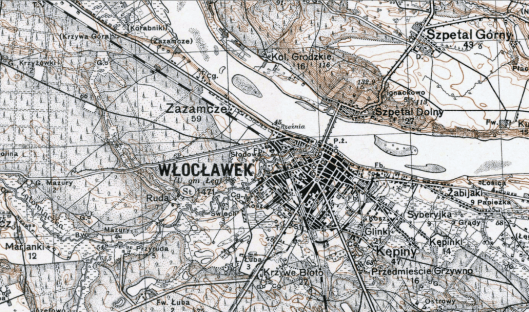
Screen Shot 2016-08-03 at 4.33.01 PM

Map of Włocławek in 1930. Piwna Street is to the left of the bridge, just past an estuary opening out to the river. Map by Wojskowy Instytut Geograficzny.

Piwna Street is located off of Wyszyński Street (one of the main routes through town). About one third of the way along its short length it makes a 90 degree turn and runs for another block parallel to the Vistula River. On the river side is a massive two story building and dock that includes the Rejs na Przystani Café. Across the street, colorful depictions of fruits and the products made with them decorate the wall around the Delecta factory (see the cover photo of the Facebook page above). Until the Forgotten Street project, nothing indicated that Piwna was called the “Street of Death” after the Nazi occupation.

In September of 1939, the city’s synagogues were burned to the ground and the Jewish population was terrorized (read more about this here); some were arrested while others were killed. The retreating Polish forces had blown up the bridge across the Vistula, so the Nazis decided to replace it with a pontoon bridge at Piwna Street. But first the riverbank had to be reinforced. Captive Jews were forced to do this backbreaking work, using the stone and concrete remnants of the synagogue as building materials. Many died in the process, hence the name “Street of Death.”

What’s extraordinary about the high schoolers’ project is how effectively it brings into the present an awareness of the past. It does so with a wide variety of archival information, photographs, and first-person recollections. The public nature of the fan page also meant that other people learned about this history and could even contribute to it. For instance, one viewer posted this gouache painting of Piwna Street from the mid-19th century.

WloclawekUlPiwna1853

The view across Zgłowiączki Estuary and Piwna Street. Gouache by Alfons Matuszkiewicz, c. 1853. Posted on Włocławkska Zapomniana Ulica

To date the fan page has 1773 “likes.” Another component of the project was the posting of a QR code that when scanned with a smartphone connects to a brief explanation of the history of Piwna Street in four languages. QR codes were also posted at several other sites around town that are associated with Jewish culture (listen here).

DSC08097

QR code linking to a brief history of Piwna Street.

For now, these notices are just on laminated paper, but the hope is that something more permanent will be installed so visitors will continue to connect here and then—this particular location with the events that occurred in the past. When I visited in June, the city’s president expressed his support for the project. The question remains where the money will come from to pay for a more lasting marker. Still, with people of good will and extraordinary energy like the teachers and students at the Automotive High School, I’m hopeful something will be done in the not too distant future.

DSC08098

The teachers who worked on the project Włocławska Zapomniana Ulica: from the left, Anita Kaniewska-Kwiatkowska, Monika Lamka-Czerwińska, and Robert Feter.

Threading the Needle

27 Wednesday Jul 2016

Posted by Marysia Galbraith in antisemitism, Baligród, Commemoration, Fieldwork, Heritage work, Jewish Culture, Kazimierz, Krakow, Lesko, Memory, Poland, Polish Culture, Polish-Jewish Heritage, Polish-Jewish relations, Tarnów, Warsaw, Wronki, Włocławek, Zasław, Żychlin

≈ Leave a comment

Tags

Erica Lehrer, Jacek Nowak, Jewish Poland Revisited, Katka Reszke, Return of the Jew

I am back from six weeks in Poland. I envisioned regular posts from the field in this blog. But instead, doing fieldwork left little time for writing and reflecting about it. Nevertheless, a structure for my next book project has been emerging. The challenge will be threading the needle between celebrating the renewal of interest in Jewish life in Poland, captured so well in Erica Lehrer’s Jewish Poland Revisited and Katka Reszke’s Return of the Jew, and addressing the ongoing silences, distaste, even hatred expressed toward Jews, as revealed in Jacek Nowak’s interviews with ordinary Poles. Because both are happening at the same time, often in the same places, and sometimes even within the same people.

And I’ve seen evidence of both in my own research. People all over Poland are doing incredible work to preserve cemeteries, renovate synagogues, document first-person accounts, and celebrate Jewish music and culture, often in the absence of any involvement from living Jews. They work with passion to fill what they feel to be a void in their local communities. And they do so despite the resistance they sometimes face from fellow residents and local government representatives. Every place tells a different story, even though many of the same elements can be found in each of them. Over the next several posts, I’ll highlight the places and projects I visited. Watch for the place names to become links to more details.

Włocławek

DSC08792

Students and teachers from the Automotive High School in Włocławek receive the first place award for their Facebook “fan page” “Włocławska zapomniania ulica” (“Wloclawek’s forgotten street”) at the Polin Museum in Warsaw, June 22, 2016. The contest was “Places of Holocaust Memory Near Us” and the challenge was to highlight a place in the local community. The team from Włocławek chose Piwna Street, called “the street of death” during World War II.

Żychlin

DSC08396

Detail of the synagogue in Żychlin, converted into a warehouse by the Nazis and used as such for many years after. The roof caved in several years ago. Traces of frescos are barely visible through the empty windows.

Kutno

KutnoCemetery

New signs at the Kutno Jewish cemetery provide historical information and urge residents to keep in mind this green hillside is a cemetery. Installed by Towarzystwo Przyjaciół Ziemi Kutnowski (Association of the Friends of the Kutno Region).

Wronki

An arial view of the Lapidarium in Wronki that shows the shape of the raised beds, meant to evoke an open book.

Warsaw

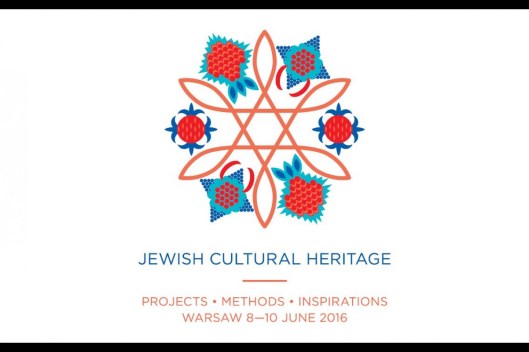
konferencja_zdk_polin-eng_1600_rgbIn Warsaw, the conference Jewish Cultural Heritage: Projects, Methods, Inspirations at the Polin Museum of the History of Polish Jews gave me a good idea of the scope of heritage work throughout Europe, as well as ongoing debates about Jewish heritage projects.

Krakow

IMG_0956

Glass House Orchestra performing at Shalom on Szeroka, the outdoor concert culminating the Krakow Jewish Culture Festival.

Tarnów

DSC09413

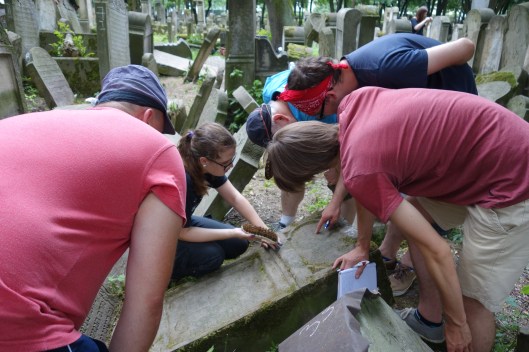
Professor Hońdo of the Jagiellonian University helps participants in the Tarnów Tombstone camp for volunteers (Tarnowskie macewy – obóz dla wolontariuszy) decipher the text on a tombstone.

Baligród

IMG_0998

The weeds grow tall in the Jewish cemetery in Baligród, despite indications of maintenance done not too long ago. It takes constant attention to keep these sites from slipping back into obscurity.

Zasław

ZaslawSignZagorz

Historical information about the Nazi Work Camp in Zasław marking the beginning of the trail from the Zagórz train station to the monument on the mass grave at Zasław. A project of the Stowarzyszenie Dziedzictwo Mniejszości Karpackich (Association of the Heritage of Minorities of the Carpathians).

Lesko

DSC09276

The synagogue in my beloved Lesko–much of the front facade was rebuilt and reinvented around 1960.


Traveling with Babcia

31 Tuesday May 2016

Posted by Marysia Galbraith in Bereda, Family, Memory

≈ 2 Comments

Tags

Halina Bereday

Babcia died over twenty years ago, shortly before I returned from my doctoral fieldwork in Poland. The last time I saw her was a few months before she passed, when she was already on her way. She did not recognize me, or my brother Chris, and didn’t even acknowledge our presence. Except, she grabbed my hand—at first, I thought it was because she knew who I was, but in fact she just used my finger to scratch her ear. It was an intimate and disturbing final contact between us.

The last time we spoke was a year and a half earlier, right before I left for Poland. Babcia was already 97, in assisted living, but still sharp. She became agitated about my trip, cajoling me, “Don’t fall in love with a Polish man.” She warned me against life in Poland, she said a Polish man would not treat me well; she was afraid I would not return. She insisted there was nothing for me there, that she and the rest of the family decided to leave Poland to seek a better life in the US.

BabciaPuertoRico

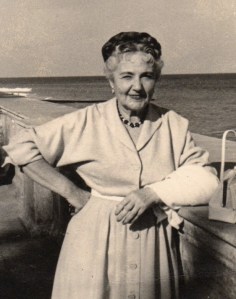
Babcia in Florida, late 1950s.

Babcia was a mystic. She believed she could see the future, and even though I did not fall in love with a Polish man and I did come back, often it seemed like her premonitions were right. Mama also had an uncanny ability to sense things, but with her it was more psychological. Mama was deeply empathetic and could intuit the emotional states of others.

There was very little fanfare when Babcia died. I missed the funeral because I wasn’t told about it. Mama didn’t want me to cut my trip short to attend. Babcia was cremated, in accordance with her wishes. She also wanted to be buried in Poland with her husband Zygmunt who died nearly fifty years earlier in 1945, but no one seemed to have the will to make it happen. Instead, my cousin Alexandra brought the ashes home and placed them on an altar in her home, where they stayed for many years.

In 2015, when I returned from my year in Poland, we had a family reunion. I took it as an opportunity to offer to take Babcia back home to Poland. It’s something I have thought about doing for a long time, and I finally I got up the nerve to make it happen. I’m the one who can do it. I speak the language and know my way around.

At first, it seemed my cousin would be reluctant to give Babcia up. But when I visited her mother a short time after the family reunion, the ashes were there waiting for me in their metal box.

So I brought her to my home in Alabama, where she has rested in my pottery studio awaiting this trip to Poland.

I knew I would not be able to bring a metal box through airport security, but still was reluctant to remove Babcia from her resting place. I waited until the night before my departure. I apprehensively removed the screws from the lid, and found a metal tin like a paint can inside labeled with Babcia’s name and the date she died. I have been told that surprisingly little is left after cremation, but I still was taken aback that even the tin, quite a bit smaller and lighter than the box, was filled halfway with paper. A whole body reduced to little more than a quart of ashes. I transferred them to the plastic bag nestled in the bottom of the box (no doubt for this purpose), and put that into a zippered bag I got at the Black Sea in Israel. She will be buried in a ceramic urn I made.

I had read that it’s not a problem bringing cremated remains on airplanes, so I set them in the bottom of my carry-on luggage. It was detected in the x-ray screening at the Birmingham Airport. I apprehensively explained what it was as the bag was being searched. The screener was very kind. She did some sort of test for explosives but let me through without otherwise disturbing the ashes.

So Babcia is on her way back to Poland. We’ll see what happens at the cemetery. When I called several months ago to inquire about the procedure, the person I spoke with was initially very confused. However, once he understood that Babcia was cremated, she died over twenty years ago, and there is already a family plot, he told me to just call once I get to Poland and we’ll make arrangements then. I hope it’s really that easy.

An Evening of Renia Spiegel

26 Thursday May 2016

Posted by Marysia Galbraith in Memory, Poland, World War II

≈ Leave a comment

Tags

Polish Consulate, Renia Spiegel

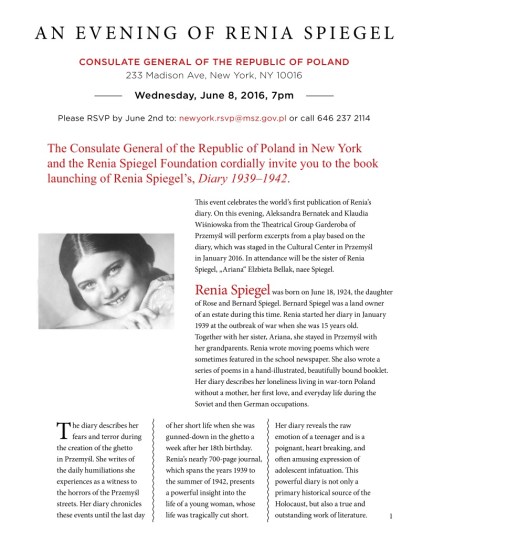
ReniaEvent1ReniaEvent2

The Polish Shirley Temple and her sister the poet

25 Wednesday May 2016

Posted by Marysia Galbraith in Memory, Names, Poland, Polish-Jewish Heritage, Pre-World War II, World War II

≈ 3 Comments

Tags

Ariana Spiegel, Elizabeth Bellak, Polish Consulate, Renia Spiegel

ReniaEvent1


Elizabeth Bellak and my mother met in Poland, when Elizabeth was just a child and mama a teenager. Years later, they reconnected in New York and have been best friends and confidants ever since. Elizabeth, her husband George, and their children Andrew and Alexandra visited us on Long Island more often than our biological relatives did. In fact, I’ve grown up calling her my aunt.

Elizabeth is as outgoing as my mother is shy. She loves to socialize, to tell stories, even to sing and dance. She dresses elegantly in heels and designer clothes, her hair and make up always perfect. I don’t think I’ve ever seen her in pants.

But she and my mother share a deep fondness for each other. They also share a hidden Jewish heritage that they kept silent about until recently. Elizabeth was actually Ariana Spiegel, born in eastern Poland in what is now Ukraine. Her talent was recognized at a young age, when she appeared in films like Gehenna, and was called “the Polish Shirley Temple.”

Ariana as the Gypsy girl in Gehenna, 1938.
Review of Ariana Spigiel's performance in Gehenna. She is called the "Polish Shirley Temple." In Kurier Filmowy 1938, vol. 12, nr.27.
Review of Ariana Spigiel’s performance in Gehenna. She is called the “Polish Shirley Temple.” In Kurier Filmowy 1938, vol. 12, nr.27.
Ariana Spigiel
Ariana Spigiel

Her older sister Renia was equally talented, though as a writer and poet. Renia kept a diary for the last few years of her short life which has just been published along with her poetry (in Polish, though there are plans for it to be published in English as well).

I can’t wait to read it.


ReniaEvent2


Tornado and Trauma

09 Monday May 2016

Posted by Marysia Galbraith in Memory, Trauma

≈ Leave a comment

Tags

Running, Tuscaloosa Tornado

On May 1, some friends and I ran 7.4 miles from one side of town to the other tracing the route of the tornado that tore through the heart of Tuscaloosa five years ago. I’d run the same course just a few weeks after the storm. I took photos both times.

Six sweaty runners!

With my running buddies after we traced the path of the Tuscaloosa tornado five years after it came through town. Some greenery behind us, but before the storm there would have been tall trees.

In retrospect, it is remarkable to me how little attention I paid to the severe weather predictions throughout the day on April 27, 2011. It was nearing the end of the semester so I was busy with final classes. Besides, National Weather Service warnings, tornado sirens, and weatherman James Spann’s call to “get into your safe place” had become commonplace over my 14 years in Alabama. Of course, when the sirens went off in my neighborhood, I went down to the basement with Ian, who was seven years old at the time. I also checked in on Jeremy, who had been teaching on campus. He was waiting out the storm in the basement of Phifer Hall, which had been a fallout shelter during the Cold War. So I felt reassured Jeremy would be okay there.

Jeremy is a belt and suspenders man, so our unfinished basement has a television, camp chairs, and a battery-powered radio. I watched as James Spann, who knows every town and intersection in Alabama, reported on dozens of tornados tracking through the state.

One of the biggest came straight through Tuscaloosa, leaving a trail of rubble and downed trees six miles long and a half mile wide, running diagonally from one side of town to the other. Until it happened, I would never have imagined it ever could happen. Even as reports came in about the path of the tornado, I couldn’t quite grasp it. In Northport where I live, just two miles to the north, it wasn’t even raining. It was ominously still and an eerie yellow glow filled the sky. The rain came only after the tornado passed

Understanding the scale of the damage was also slowed by the destruction of infrastructure—phone lines and cell towers down, roads impassable. Our family was lucky. None of us were harmed. The tornado ran south of campus. We never even lost power, phones, or Internet. But nevertheless, the storm touched us deeply, and in a way that still affects us.

Rosedale Court 2011
Rosedale Court 2011
Rosedale Court 2016
Rosedale Court 2016
Wood Manor neighborhood 2011. Metal wrapped in tree
New apartments where Wood Manor used to be 2016

Fifty-three people died in Tuscaloosa (and 252 in the state). Considering the extent of the physical damage, we’re lucky the number was not much higher. In an instant, 12% of the city was destroyed. Follow this link to a video of the tornado, filmed from the parking lot of University Mall. The voice at the beginning is James Spann reporting on the track of the storm.

The experience gives me a glimpse of what it might have been like to endure the trauma of war. In an instant everything is changed. The physical world that seemed so permanent is suddenly obliterated. And it doesn’t make a lot of sense why some people survived and others died. But as horrible as the storm was, it can’t compare to the scale of World War II. And I can only imagine how much more emotionally damaging it would have been to face a human threat rather than a natural one. The former requires accommodating the fact of human agency—that people chose to wreak that destruction on others.

The five-year-anniversary run left me unsettled. I was transported back to the shock of the days following the storm, when the magnitude of the destruction sank in. I passed by the places where people died—Rosedale Court, a housing project that was nearly leveled; Charleston Square Apartments, parts of which lost all but their foundation while others stood battered but whole; the corner of 6th Avenue and 27th Street where a University of Alabama student was sucked out of her home and dropped in a field across the street. I also passed by the places where I helped clean out destroyed homes together with a crew of two-dozen anthropology faculty and students.

Shopping Center Mcfarland Blvd. and 13th St. 2011
Apartments McFarland and 13th St. 2016
9 1/2 Street E. Alberta City 2011
10th St. E. Alberta City 2016

For days, we all lived the storm. It seemed the whole city came together to give food, shelter, and comfort to those who needed it. But after a period of intensive engagement, I had to block it all out. I didn’t want to see any more videos of the twister. I even avoided driving through the tornado zone because each time, my shock was renewed. I couldn’t get used to the long vistas, more like the deserts of the southwest than the southeast’s dense forests. Without the tall trees dividing them, places that used to seem so far apart appeared to be much closer. The blue water tower near Rosedale Court and the Druid City Hospital became landmarks visible for miles. Even Forest Lake stood out as a blue patch surrounded by barren land.

27th St 2016. The Blue Water Tower, now a landmark, used to be obscured by trees.
Lake Ave. 2016. New bike trail.

Today the city is rebuilding. Shopping centers and apartment complexes are filling in the corridor along 15th Street and McFarland Boulevard. Greenery has returned to the landscape, though it will be decades before the trees grow tall enough to once again block the view of the water tower and the hospital.

Five years after the storm, social and economic inequalities continue to be inscribed in the landscape. The fancy houses on the hill were rebuilt almost immediately, while just a few blocks away, whole city blocks remain empty fields. Stores and shopping centers east of the university have not returned. But there are also some signs of change. Subsidized housing, functional brick boxes before the storm, have been replaced by gorgeous two-story buildings with steeply pitched roofs. The new Alberta Elementary has been designated an arts magnet school. A bike trail will wind through the heart of town. Plans have just been revealed for a new park with three fountains. You could call it a rebirth. Still patchy. But remarkable considering the magnitude of the destruction.

TornadoTrackFading

The scar left from the tornado is fading. See more here: https://weather.com/storms/tornado/news/tuscaloosa-tornado-scar-fades

Council for European Studies Conference

15 Friday Apr 2016

Posted by Marysia Galbraith in antisemitism, Brześć Kujawski, Commemoration, Family, Fieldwork, Heritage work, Jewish Culture, Kolski, Memory, Piwko, Poland, Polish Culture, Polish-Jewish Heritage, Polish-Jewish relations, Research Methodology, Włocławek

≈ 5 Comments

Tags

Absence of Memory, Council for European Studies Conference, Postmemory, Reassembling Jewish Life in Poland, Włocławska Zapomniana Ulica

Yesterday, I presented a paper titled, “Reassembling Jewish Life in Poland.” It starts like this:

It is easy to get the impression that we have entered an era of retrenchment of exclusionary national, ethnic, and religious categories, making minorities of any kind suspect. Specific objects of fear, such as terrorists, raise suspicions about broader categories, such as Muslims; the economic threat attributed to immigrants extends to all Mexicans, Syrians, North Africans, or Eastern Europeans. And Jews have once again become the object of attacks in Western Europe, leading Atlantic journalist Jeffrey Goldberg (2015) to title his recent cover article, “Is it Time for the Jews to Leave Europe?” In the current climate of exclusionary politics, the quiet emergence in Poland of efforts to embrace the long history of Jewish residence is all the more striking. Recent studies have “revisited” Jewish Poland (Lehrer 2013) and documented the “return of the Jew” (Reszke 2013), challenging the common assumption that antisemitism rests at the heart of what it means to be Polish. I have been studying contemporary memory projects, including commemorative sites, museums, and cultural festivals that endeavor to reassemble the remaining fragments that provide a window into what Jewish life (and its destruction) was like in Poland. These fragments can reveal something about the past, even if it is just in an incomplete and shattered form. Perhaps of greater significance, they can point toward the future—the possibilities for reengaging with ethnic and religious categories in ways that acknowledge difference without encouraging exclusion. 

Placing a lantern at the opening of the Lapidarium in Wronki
The Atlantic, April 2015

The figure of the Jew remains a multivalent symbol in Poland, even after the destruction of Jewish culture during the Holocaust and further erasure of its traces during state socialism. My research on Jewish heritage asks what can be done with the fragments of Jewish culture that remain, sometimes hidden and sometimes in plain sight. And what value does such memory work have? It might appear that too little is left, or that any attempt to piece together fragments will just expose more horror, trauma, and death. Nevertheless, the steady growth of interest in Jewish culture in Poland can be seen in major projects like Warsaw’s Polin Museum of the History of Polish Jews, and in much quieter ways in smaller communities throughout the country. Even President Duda, whose Law and Justice Party tends to support nationalism and exclusionary practices, recently spoke against antisemitism at the opening of the Ulma Family Museum of Poles Saving Jews. To set the stage for my reflections about reassembled fragments of Jewish culture, I first situate Jews within the disrupted history of Poland, and discuss the consequences of postwar trauma under state socialism. This is also a first attempt at integrating an ethnographic approach to the topic, through exploration of commemorative sites and practices, and a more personal one, in the form of interwoven stories about my own Jewish-Polish heritage. Building on concepts of postmemory (Hirsch) and absence of memory (Irwin-Zarecka), I consider what reassembly projects promise for the reconciliation of Polish-Jewish relations on both social and personal levels.

I focused on Włocławek for my case material: Places embodying the “absence of memory” such as the swimming pool in the Jewish cemetery in Brześć Kujawski, the crumbling buildings formerly owned by Jews in the center of Włocławek, and the monument to the Jewish ghetto in the schoolyard that used to be the Jewish cemetery. I discussed what such places communicate about the history of Jewish life (and death) in Poland, as well as the personal, emotional resonances of such places.

DSC03544

Pre-World War II facade on Tumska Street, Włocławek

Then, I contrasted the impression left by the the Facebook page, “Włocławska Zapomniana Ulica (Forgotten Street of Włocławek),” in which students and teachers at the Automotive High School in Włocławek document “Places of the Holocaust close to us.” The site features historic photographs, brief histories, and excerpts from interviews with local historians and residents who remember the Nazi occupation of the city. This is heavy stuff, and yet the project reflects a different orientation toward the past than do the crumbling buildings on abandoned streets and the swimming pool in a burial ground. It is a public display of intangible heritage, a space for documenting the murder and destruction that occurred during the Holocaust in very personal, localized terms. The Facebook page announces, “These events happened here, on our streets.” It is all the more notable because the primary organizers and audience in this project are young people, probably in most cases the post-postmemory generation that was supposed to be too distant from events to feel any personal connection to them.

And the story doesn’t stop here. I am looking forward to visiting the high school students and their teachers in June. And now my cousins are also interested in the project and maybe even getting involved with it somehow. The ethnographic and personal strands of my work continue to become more strongly intertwined.


Włocławek Youth Document Jewish History

10 Sunday Apr 2016

Posted by Marysia Galbraith in Heritage work, Jewish Culture, Kolski, Memory, Piwko, Polish-Jewish Heritage, Post-World War II, Synagogues, World War II, Włocławek

≈ 5 Comments

When I visited Włocławek last February, I was disheartened by the crumbling historic buildings that were formerly owned by pre-World War II Jewish residents. Still, I met a few people actively involved in documenting and preserving the memory of the city’s Jewish population. They include: Mirosława Stojak, who writes about Włocławek’s Jews and manages the website zydzi.wloclawek.pl, Tomasz Wąsik, the historian and director of the Museum of History in Włocławek, and Tomasz Kawski, a historian and professor at Kazimierz the Great University in Bydgoszcz, and author of several books on the history of Polish Jews.

And now high school students in Włocławek have been collecting photographs, writing historical accounts, and doing interviews with people who remember the events of World War II. Their work can be seen on their Facebook page. Here are just a few of the photos they have posted. The synagogue on Królowiecka Street:

Synagogue on ul. Królowiecka, Włocławek

Synagogue on ul. Królowiecka, Włocławek

The synagogue on Zabia Street:

Synagogue ul. Żabia, Włocławek


And here the synagogue in flames:

The synagogue in flames. Source: http://www.4ict.pl/szlaki_pamieci/
Jews in front of the burned Włocławek synagogue. Source: http://www.4ict.pl/szlaki_pamieci/

The students write on their Facebook page:

“On September 24, 1939, Germans ordered Jews they selected to bring a barrel full of tar to the synagogue on Żabia Street. Then they forced them to ignite the fire.

In this way, one of the prettiest synagogues in Poland ceased to exist. The synagogue on Królowiecka Street met the same fate.”

“24 września 1939 roku Niemcy nakazali wyznaczonym przez siebie Żydom wprowadzenie do Synagogi na ulicy Żabiej beczek wypełnionych smołą. Następnie zmusili ich do wzniecenia pożaru.
“Tym samym przestała istnieć jedna z najpiękniejszych Synagog w Polsce.
Podobny los spotkał Synagogę przy ulicy Królewieckiej.”

So while horrible truths are communicated, this project and the Facebook page that documents it stand out to me as a marker of hope. A new generation of Włocławek residents are learning about this difficult history, and returning the story of what happened to the city’s Jews to the center of the narrative about their hometown.


Southern Conference on Slavic Studies

18 Friday Mar 2016

Posted by Marysia Galbraith in Anthropology, Cemeteries, Heritage work, Identity, Jewish Culture, Memory, Polish-Jewish Heritage, Polish-Jewish relations, Wronki

≈ Leave a comment

The Southern Conference on Slavic Studies has its annual meeting right here in Tuscaloosa starting today until March 19. Tomorrow, I will present a paper about my heritage work in Poland. Here is the abstract:

From Curbstones to Commemoration: Reincorporating the Memory of Jewish Life in a Polish Town

The figure of the Jew remains a multivalent symbol in Poland, resilient even in the face of the destruction of Jewish culture during the Holocaust and erasure of its traces during state socialism. My research on Jewish heritage asks what can be done with the fragments of Jewish culture that remain in Poland, sometimes hidden and sometimes in plain sight. And what value does such memory work have? The growth of interest in Jewish culture in Poland can be seen not just in major cities, but also in smaller communities throughout the country. I focus on one commemorative project in one Polish town to illustrate changing, though still contested, orientations toward the history of Jewish residence in Poland. Specifically, I examine the rescue of fragments of Jewish tombstones from a street curb where they rested for sixty years, and the decade-long effort of multiple stakeholders to return the stones to a place of commemoration. I argue that an essential component of the project was to reincorporate the history of Jews into the wider history of the town—a kind of making what was regarded as “other” (“obcy”) into something that is one’s own (swój). The Lapidarium of tombstones from the old Jewish cemetery in Wronki has literally become a place on the map, and has returned the memory of Jewish lives to town residents and visitors. The fragments of tombstones, historical sign, and commemorative marker reveal something about the past, even if it is just in an incomplete and shattered form. And they point toward the future—the possibilities that might emerge out of reassembling Jewish life in Poland.

In memory of the Jewish community that inhabited Wronki from 1507-1939. Lapidarium of tombstones from the destroyed Jewish cemeteries of Wronki
Lapidarium of Jewish Tombstones, Wronki
Stone offering on the monument at the lapidarium in Wronki

This is my first effort to make sense of one of the most inspiring heritage projects I witnessed while in Poland last year–the lapidarium of Jewish tombstones in Wronki. I describe the project as a collective representation–symbolic of an inclusive concept of Wronki history (and by extension Polish history). Jewish residents, although they are no longer present, nevertheless comprise an essential element of that history. As such, this new resting place for Jewish tombstones represents the return of the memory of Jews back into the center of town and the center of residents’ consciousness.

But more tomorrow–my panel is from 10:15-12 PM at the Embassy Suites in downtown Tuscaloosa.

Jewish Krakow 1992

01 Tuesday Mar 2016

Posted by Marysia Galbraith in Cemeteries, Fieldwork, Jewish Culture, Kazimierz, Krakow, Memory, Poland, Polish-Jewish Heritage, Polish-Jewish relations

≈ Leave a comment

Tags

1992, Erica Lehrer, Jewish Poland Revisited, Postcommunism

During my photography expeditions in 1992, Krakow’s Kazimierz district caught my eye. Kazimierz has long been associated with Krakow’s Jewish population. It became a separate city for Jews when new regulations restricted their access to Krakow’s center during the 15th century. Before World War II, Kazimierz was incorporated into Krakow, but still most residents were Jewish. After the war, a tiny Jewish community congregated in a few remaining Jewish organizations. Despite their small numbers, the district continued to be associated with Jewish culture.

img110

A menorah motif on the fence around the green space on Szeroka Street, 1992

Over the past 25 years, Jewish life has returned to Kazimierz. It’s an eclectic community of people who define their links to Judaism and Jewish culture in a wide range of ways, including Poles who have recently rediscovered or reconnected with their Jewish heritage, Jews from the US or Israel or elsewhere, and people who simply appreciate Jewish culture. This is not a return to the prewar Jewish community; it is its own unique hybrid. Erica Lehrer describes the disparate strands that are woven together in Kazimierz in her book Jewish Poland Revisited: Heritage Tourism in Unquiet Places. It’s well worth reading for anyone interested in understanding something about what’s happening in Kazimierz today.

But back in 1992, the main site of active Jewish culture in Poland was the Remuh synagogue and adjoining cemetery.

Remuh cemetery, 1992. Stones left on a tombstone
Inside the Remuh synagogue courtyard, 1992
Remuh cemetery, the synagogue in the background, 1992

These are some of the older graves in Kazimierz, with the distinctive vaulted grave covers.

Part of the cemetery is surrounded by a wall made of fragments of tombstones. During World War II, many of these stones had been repurposed around the city as sidewalks and roadbeds, but they were recovered and placed in this wall.

img097

Wall around the Remuh cemetery, composed of fragments of tombstones recovered from building projects after World War II.

I also visited the larger Jewish cemetery off of Miodowa Street. Here are newer graves, dating from the 19th-20th centuries, including some postwar burials. The opulence of some of the tombstones attests to the prominence of the people buried here.

New Jewish Cemetery, Krakow 1992
New Jewish
New Jewish

But much of the cemetery was in disrepair. The tree above that is engulfing a tombstone attests to the length of time this neglect had lasted.

A final place that caught my eye, pointed out to me by a friend, Krystyna, was some graffiti inside the courtyard of a broken-down (though still occupied) building in Kazimierz. Someone painted a Madonna, but where her face should have been was a tiny door. I don’t remember what was behind the door, but it looks like there might have been

Madonna graffiti, Kazimierz 1992
Madonna painted in a recess of a courtyard full of trash and broken down walls, Kazimierz 1992

electrical circuits or perhaps water pipes. I remember Krystyna being captivated by this image. An artist herself, she wondered about its larger meaning: who would have drawn it, and why they would have put it where a door replaced the face? And why place it in a trashy courtyard in Kazimierz? I can’t remember if she said anything explicitly about the placement of Catholic imagery in the former Jewish district, but I think she did. And I certainly ponder this. It wasn’t a reclaiming of territory for Catholics–if it had been it would not have been placed where it was without a painted face. It was meant to be ironic, I believe. The Madonna of Trash and Disintegration.


← Older posts
Newer posts →

Categories

  • Anthropology (37)
    • Archives (14)
    • Fieldwork (7)
    • Ground Penetrating Radar (GPR (4)
    • Research Methodology (8)
  • antisemitism (14)
  • Association of Descendants of Jewish Central Poland (32)
  • Catholicism (8)
  • Conference (1)
  • Discrimination (2)
  • Family (69)
    • Bereda (17)
    • Kolski (13)
    • Piwko (22)
    • Rotblit (3)
    • Walfisz (4)
    • Winawer (7)
  • Genealogy (11)
  • Heritage work (66)
    • Commemoration (23)
  • Identity (18)
  • Israel (6)
  • Jewish Culture (89)
    • Cemeteries (51)
    • Museum (7)
    • Synagogues (33)
  • Jewish immigrants (8)
  • Jewish Religion (1)
  • Memory (70)
  • Names (14)
  • Photographs (6)
  • Pifko-Winawer Circle (5)
  • Poland (125)
    • Baligród (1)
    • Bolimów (1)
    • Brześć Kujawski (5)
    • Buk (1)
    • Chodecz (1)
    • Dukla (2)
    • Dąbrowice (1)
    • Gdynia (1)
    • Gostynin (2)
    • Gąbin (1)
    • Izbica Kujawska (1)
    • Kazimierz (4)
    • Kowal (1)
    • Koło (1)
    • Krakow (7)
    • Krośniewice (1)
    • Kutno (6)
    • Kłodawa (1)
    • Lesko (8)
    • Leszno (1)
    • Lubień Kujawski (1)
    • Lubraniec (1)
    • Lutowiska (3)
    • Piła (3)
    • Podgórze (2)
    • Poznan (11)
    • Przemyśl (2)
    • Pzedecz (1)
    • Radom (1)
    • Radymno (1)
    • Sanok (1)
    • Skierniewice (5)
    • Sobota (2)
    • Tarnów (2)
    • Warsaw (22)
    • Wielkopolska (1)
    • Wronki (7)
    • Włocławek (20)
    • Zasław (2)
    • Łódź (1)
    • Żychlin (30)
  • Polish Culture (10)
  • Polish-Jewish Heritage (60)
  • Polish-Jewish relations (60)
  • Post-World War II (24)
  • Pre-World War II (22)
  • Reclaimed Property (1)
  • stereotypes (3)
  • Survival (9)
  • Trauma (3)
  • Uncategorized (5)
  • Victims and perpetrators (4)
  • World War II (45)
    • Jewish Ghetto (12)
    • Nazi Camps (5)
    • Polish Underground Army (3)
  • Yiddish (5)

Enter your email address to follow this blog and receive notifications of new posts by email. Your email address will not be shared.

Archives

  • October 2025 (1)
  • July 2025 (8)
  • June 2025 (1)
  • April 2025 (1)
  • August 2024 (3)
  • July 2024 (3)
  • May 2024 (2)
  • April 2024 (1)
  • May 2023 (2)
  • January 2023 (2)
  • December 2022 (7)
  • November 2022 (2)
  • October 2022 (5)
  • September 2022 (1)
  • January 2022 (1)
  • August 2021 (1)
  • December 2020 (2)
  • July 2020 (1)
  • May 2020 (3)
  • April 2020 (1)
  • March 2020 (1)
  • January 2020 (2)
  • May 2019 (1)
  • February 2019 (1)
  • November 2018 (1)
  • September 2018 (1)
  • August 2018 (3)
  • July 2018 (1)
  • June 2018 (1)
  • May 2018 (1)
  • April 2018 (2)
  • March 2018 (2)
  • February 2018 (2)
  • January 2018 (2)
  • December 2017 (2)
  • November 2017 (2)
  • October 2017 (1)
  • September 2017 (3)
  • August 2017 (3)
  • June 2017 (2)
  • May 2017 (3)
  • April 2017 (1)
  • March 2017 (2)
  • February 2017 (1)
  • January 2017 (2)
  • December 2016 (2)
  • November 2016 (4)
  • October 2016 (1)
  • September 2016 (6)
  • August 2016 (2)
  • July 2016 (1)
  • May 2016 (4)
  • April 2016 (2)
  • March 2016 (3)
  • February 2016 (4)
  • January 2016 (3)
  • December 2015 (3)
  • November 2015 (5)
  • October 2015 (5)
  • September 2015 (3)
  • August 2015 (4)
  • July 2015 (3)
  • June 2015 (3)
  • May 2015 (4)
  • April 2015 (9)
  • March 2015 (3)
  • February 2015 (2)
  • January 2015 (5)
  • December 2014 (4)
  • November 2014 (9)
  • October 2014 (2)
  • September 2014 (1)

Copyright Notice

All original text and images are copyright © Marysia Galbraith. Please contact the author before quoting.

Blog at WordPress.com.

  • Subscribe Subscribed
    • Uncovering Jewish Heritage
    • Join 147 other subscribers
    • Already have a WordPress.com account? Log in now.
    • Uncovering Jewish Heritage
    • Subscribe Subscribed
    • Sign up
    • Log in
    • Report this content
    • View site in Reader
    • Manage subscriptions
    • Collapse this bar
 

Loading Comments...