• About
  • The Photo that Started it All

Uncovering Jewish Heritage

Uncovering Jewish Heritage

Category Archives: Memory

Restoring Peace and Justice in America

06 Friday Jul 2018

Posted by Marysia Galbraith in Commemoration, Discrimination, Identity, Memory, Victims and perpetrators

≈ 4 Comments

Tags

Equal Justice Initiative, Montgomery, National Memorial for Peace and Justice, Racial Injustice, Supreme Court

The new National Memorial for Peace and Justice opened in Montgomery, Alabama on April 26, 2018. It stands as a reminder of the many acts of discrimination against African Americans over the course of American history, and in particular memorializes over 4400 documented lynchings that occurred between 1877 and 1950.

img_20180627_100113817_hdr

National Peace and Justice Memorial, Montgomery, Alabama

800 rectangular iron blocks hang several layers deep in rows around a square. Each block contains the name of a county and state where lynching occurred, as well as the names of the victims and the dates they were lynched. Some contain the name of just one victim, others contain dozens.

My husband, son, and I visited the memorial last week. The monument looms large atop an elevated earth mound. We walked past a sculpture of life-sized bronze figures in chains, and up the path from the entrance. The wall to our right got shorter as we climbed to the level of the memorial.
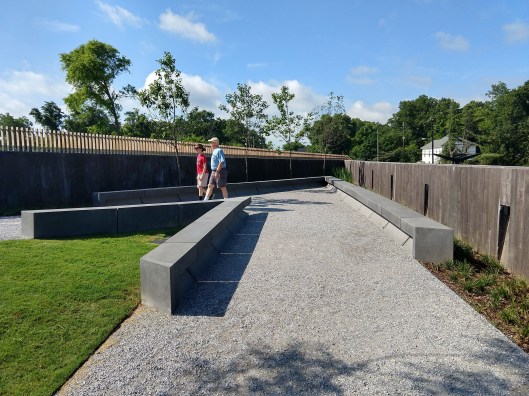
img_20180627_091844954_hdr

The wall to our right got shorter as we climbed to the level of the memorial.

We should have been climbing out of slavery and into freedom, but instead were confronted by the sea of iron blocks. The first ones we approached were set on the ground. At six feet tall, they approximate the height of a person. At the next corner of the monument, a path leads downward.


Blocks incised with county, state, and names of people who were lynched there.
We turn a corner and descend. The iron blocks hang around us.

The blocks in the first row are marked with counties in Alabama, each deeper row listing counties in other states and their victims. We couldn’t figure out how the inscriptions are ordered, so we asked one of the guards. He explained the blocks are arranged alphabetically by state and county in a spiral that starts in the outside row, goes all the way around the square, and then continues through each successive row ending with the most interior blocks.

As we walked downward, the blocks became suspended from iron poles. By the time we reached the bottom, they loomed above us, eerily echoing the hanging victims they document.

Hanging blocks loom above

On either side of this below-ground passage, signs describe the circumstances in which people were lynched—for frightening a white child, or asking a white man for money they were owed, or for “standing around” in a white neighborhood.

img_20180627_093903565
img_20180627_094746871

On the lawn outside the monument, we walked by a second set of blocks, twins of the ones hanging in the memorial. Laid on their side as they are, they resemble coffins. The intent is for counties to claim the block with their name on it and to each set up their own memorial site. Over time, as such monuments proliferate, more and more gaps will appear in the blocks resting on the lawn. In effect, the memorial will become a network of sites mapping the places where lynching occurred.

Between 1884 and 1933, 10 people were lynched in Tuscaloosa, Alabama
Duplicate blocks await placement in the counties where lynching occurred.

Clearly, parallels can be made between the National Memorial for Peace and Justice and sites throughout the world memorializing the Holocaust. Rather than commemorating moments of national pride, they compel us to remember our failures. It doesn’t matter that I wasn’t born when these events took place. I’m an American, and proud to be one. And it is because of that sense of connection to my nation that I feel a sense of responsibility for what happened in my country, for the injustices that Americans perpetrated against other Americans. Even if I weren’t American, if it weren’t a failing of my nation, of people with whom I share a national affiliation, I would feel guilty—as a human being. Like I feel guilty that the Holocaust ever happened. It was a failure of humanity, of empathy that is only conceivable in its monumental horror because it actually occurred.

But no.

That’s not the entire truth. The fact is that, as a person of Jewish descent, I identify with the group that was victimized in the Holocaust. As a person of European descent, however, my group was responsible for the victimization of people of African descent. This shift in perception, from victim to victimizer, is a difficult one.

And the harm caused by racial bias and discrimination continues.
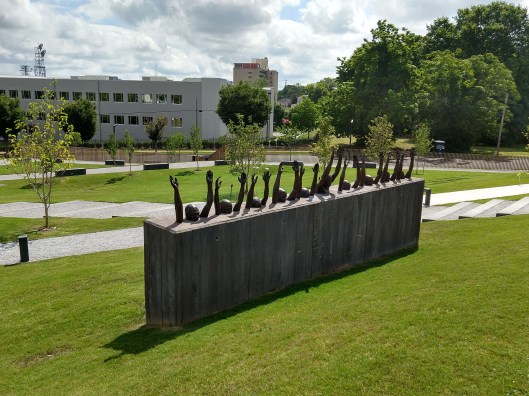
img_20180627_100344336_hdr

“Raise Up,” sculpture by Hank Willis Thomas at the Peace and Justice Memorial. Represents continued racial bias and discrimination by the criminal justice system.

Several blocks from the Peace and Justice Memorial, the Equal Justice Initiative’s Legacy Museum further highlights racial injustice in the United States. One exhibition has left me with a nagging feeling of distress, maybe because of uneasy associations with current conflicts about the highest courts in both the US and in Poland.

A single illuminated display summarizes all of the US Supreme Court’s rulings that address racial justice issues. Alongside the decisions most often discussed and celebrated, like expanding the right to vote and defending equal access to education, are many more that maintained or reinstitutionalized discriminatory practices. I didn’t know how complicit the Supreme Court has been in perpetuating injustice, but there it was made visible right in front of me.

For a brief period right after the Civil War, African Americans gained the right to vote and were elected into political offices. But then, Jim Crow laws imposed poll taxes and literacy tests that kept them from voting, and enforced segregation in businesses, buses, and public institutions. With one decision after another, the Supreme Court upheld such discriminatory practices, and whittled away at the rights of freed people of color. The 1896 Plessy vs. Ferguson ruling, in which the Supreme Court defended the constitutionality of segregation as long as African Americans had “separate but equal” facilities, is only the most well-known of many decisions upholding segregation and discrimination.

We like to see ourselves in a positive light. We identify more with Brown vs. The Board of Education than we do with Plessy vs. Ferguson. We celebrate the Civil Rights Movement, but shy away from a deeper acknowledgement of the harm inflicted by slavery, discrimination, and deeply entrenched biases. There is still a lot we need to come to terms with. I’m glad to see this new museum and memorial taking steps in that direction, and that they are in my adopted state of Alabama.

Pavement of Memory

17 Tuesday Apr 2018

Posted by Marysia Galbraith in Cemeteries, Commemoration, Heritage work, Memory, Polish-Jewish Heritage, Poznan

≈ 1 Comment

Tags

Janusz Marciniak

“We recover history…we record history.”

That is what the Jewish Community of Poznan wrote when they announced a new memorial, “Pavement of Memory,” built with fragments of Jewish tombstones that were recovered during roadwork in Poznan.

1_Jewish Cemetery in Poznan

“Pavement of Memory” composed with fragments of matzevot (Jewish Tombstones), Poznan                            Source: Janusz Marciniak

When the road crew dug up the old pavement, they noticed some stones with strange writing on them. Realizing the letters were in Hebrew, they contacted the Jewish Community. The fragments are too small to make out names or details about whose tombstones they were, but at least they have returned to the cemetery where they belong. All over Poland, fragments like this are being found, out of place, reinforcing road beds, bridge foundations, and lake beds. They were harvested during the terror of the Nazi occupation, and sometimes afterwards under state socialism. With only ghosts to look over them, Jewish cemeteries became a source for scarce building materials.

The extraordinary thing is that when public spaces are designated as repositories of Jewish memory and culture, objects return to them. As cemeteries are cleaned up, fenced, and marked, tombstones come back. In some cases, it’s as if people have known for a long time about these objects. They felt they were out of place and it has sat uneasily on their minds. They are relieved to finally know where these objects should go. In others, as with this road project, people are surprised to find these fragments, but they feel a sense of obligation to honor the memory of the past. To put things back into place.

3_Jewish Cemetery in Poznan.JPG

“Pavement of Memory” at the memorial site in a corner of Poznan’s Jewish cemetery.

These fragments are back home on a wall in the corner of the Poznan Jewish Cemetery.

“Pavement of Memory” was designed by Janusz Marciniak, who also designed the memorial at the Jewish cemetery in Piła and did a series of installations in the Poznan synagogue when it still housed a swimming pool. Janusz’s design is simple and powerful, honoring the integrity of each fragment by hanging them in three rows of ten. And yet together, like a mosaic, they make a unified statement.

4_Jewish Cemetery in Poznan.JPG

Detail of macevot fragments in Pavement of Memory

The words on the memorial plaque, in Polish, Hebrew and English, read:

Był czas, kiedy z macew robiono bruk. Czas, w którym najdosłowniej rozbijano, deptano i kaleczono pamięć o ludziach pochowanych pod macewami. Niektóre z kamiennych okruchów tej pamięci przetrwały i dziś ta pamięć łączy się z wdzięcznością dla wszystkich, którzy przyczynili się do jej ocalenia. „Z owocu swoich ust nasycony będzie człowiek dobrem, a odpłacone mu będzie według tego, co zrobity jego rece” (Prz 12, 14).

הייתה עת שבה עשו ממצבות אבני מדרכת, עת שבה היו באופן ממשי מנתצים, רומסים ופוצעים את זכרם של האנשים הטמונים מתחת למצבות. אחדים מהשברים של אבני הזיכרון

אותן הזיכרון מתאחד שרדו, וכיום עם הכרת טובה לכל אלה שתרמו להצלתו. “מפְרִי פי־אישׁ יִשְׂבַּע־טוֹב וּגְמוּל יְדֵי־אָדָם יָשִׁיב לוֹ” (משלי י”נ יד).

There was a time when matzevot [Jewish tombstones] were used for pavement; a time when the memory of the people buried under the matzevot was most literally broken, trampled, and maimed. Some remnants have survived and today this memory is connected with the gratitude to those who contributed to its rescue. “A man shall be satisfied with good by the fruit of his mouth, and the doings of a man’s hands shall be rendered unto him” (Prov. 12:14).

6_Jewish Cemetery in Poznan.JPG

Bird on an old boulder tombstone in the corner of the Poznan Jewish Cemetery that has been designated as a memorial site.

Mama’s Room

16 Friday Mar 2018

Posted by Marysia Galbraith in Family, Memory

≈ 1 Comment

Tags

Maria Bereda(y) Galbraith

It would be easy to avoid this room, to bypass the emptiness left behind by Mama. But instead, I find myself drawn to this space, where memories run in my head like movies, and also where I feel the pain of loss.

IMG_1001

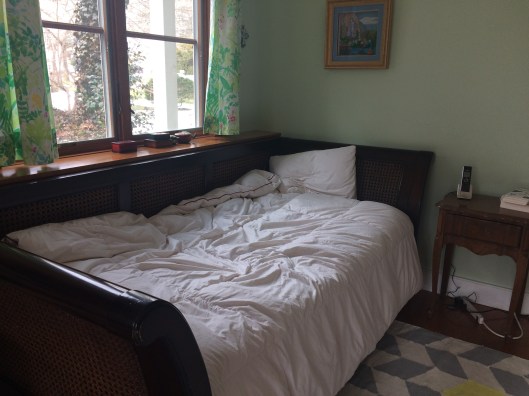
Mama’s place

Here is where Mama spent more and more of her time, in her hospital bed. Though nothing is there now, it still feels full.

IMG_0994

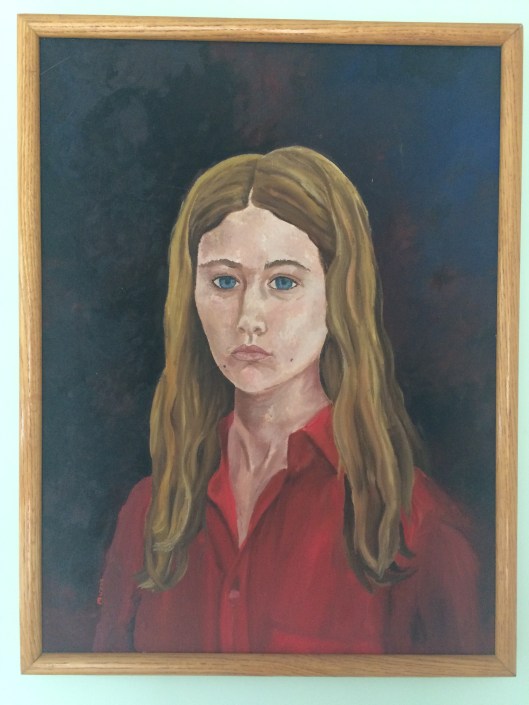
Self Portrait, 1980, oil on canvas

The self-portrait I did in high school hung on the wall behind her.

Small gifts from various visits
Some of Mama's favorite books
Some of Mama’s favorite books
Family photos
Family photos

Traces remain of Mama’s life in this space. Small gifts I brought her, or others gave her. Garden books. Mama leafed through the pages over and over again. She enjoyed the colors and shapes of the plants long after she stopped reading. Photographs of family. Our images surrounded her even when we couldn’t be there in the flesh.

IMG_0996

Krystyna’s bed

The place left behind by Krystyna, who loved her like a daughter, and whom I loved like a sister. There’s a double hole without Krystyna, who survived barely a month longer than Mama.

IMG_0999

The view of the garden

I still love this room, not only for what it was—a safe haven for Mama as she faded from this world—but also for what it is. Its walls of windows show off the garden. I watch as the sun slowly melts the remaining patches of snow, until clouds blow in and threaten another storm. It’s bright and spring-like inside, with the green and white walls and honey wood floor. A space waiting to be reinvented, maybe into a playroom for the kids, or a sitting room for guests, but where I’ll still be able to visit Mama resting quietly in her bed, while Krystyna swirls around her, a source of both company and comfort.

“The Polish Anne Frank” in The Forward

12 Monday Feb 2018

Posted by Marysia Galbraith in Family, Memory, Przemyśl, World War II

≈ Leave a comment

Tags

Ariana Spiegel, Elizabeth Bellak, Renia Spiegel

Today in The Forward is an article Why Renia Spiegel is Called ‘The Polish Anne Frank‘.

During the Nazi occupation of Przesmyśl, Poland, she filled notebooks with her poetry and diary. Renia was only 18 when she was shot on the street, after someone reported her hiding place to the Nazis. Ariana, her younger sister, survived because she had been brought to Warsaw just a few days before that. Ariana became Elizabeth, whom I grew up calling Aunt Elizabeth. She was my mother’s friend for nearly 80 years.

Holocaust Remembrance Day in Włocławek

29 Monday Jan 2018

Posted by Marysia Galbraith in Cemeteries, Commemoration, Jewish Ghetto, Memory, Polish-Jewish relations, Włocławek

≈ 2 Comments

Tags

International Holocaust Remembrance Day, January 27

Thanks to Mirosława Stojak for all the work she does to preserve the memory of Jewish history and culture in Włocławek.

Here is a video from Holocaust Remembrance Day (January 27) when she and students and teachers from the Automotive High School visited the memorial at the site of the World War II Jewish ghetto, also the prewar Jewish cemetery.

Flim credit: Q4.pl, http://q4.pl/?id=17&news=170583

The interviews are in Polish, but even if you can’t understand the words, you can see that these people remember the Jewish history of their city. And they are passing on those memories to the next generation.  They lit candle lanterns in front of the commemorative monument, and the students placed pebbles upon which they had written words like “traditions,” “love,” and “memories.”

There’s more about Włocławek’s Jews on Ms. Stojak’s website Zydzi.Wloclawek.pl. The tagline of her site: “Ku pamięci, z nadzieją, na pojednanie,” “In memory, with hope, for reconciliation.”

The Photo that Started it All: What Year Was It?

22 Friday Dec 2017

Posted by Marysia Galbraith in Family, Genealogy, Jewish immigrants, Kolski, Memory, Photographs, Piwko, Włocławek

≈ 9 Comments

Tags

1910s fashion, Efraim/Philip Piwko

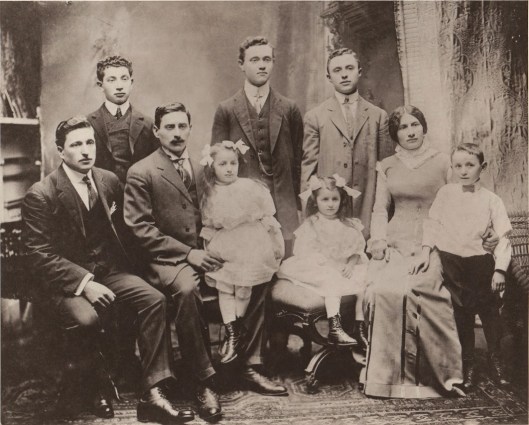
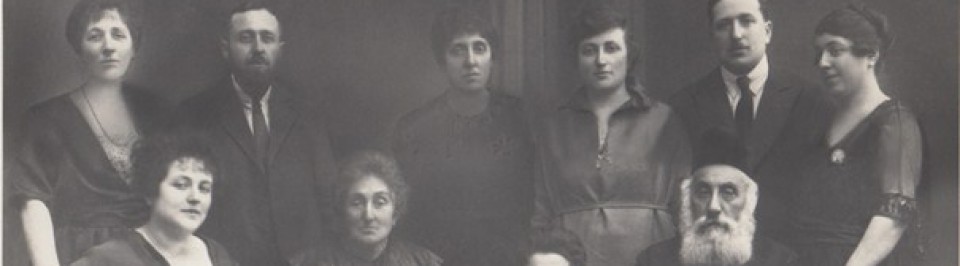
This blog started with a photograph. A family portrait of adult siblings with their parents. The photo also instigated my search for my hidden Jewish ancestors.

JechielHindaAndChildren

The Photo that started it all

Here, in my great grandfather’s long beard, head covering, and black robe, I saw for the first time visible proof that I descend from Jews. It took a long time, but I managed to identify everyone in the photo, including my grandmother (Babcia) who appears in the bottom left, her hand resting proprietarily on her mother’s wrist.

Based on their clothing and ages, I have guessed this photo was taken sometime around World War I. But I just came across some new information about my grand uncle Philip, the man standing to the right, that throws this date into question. Let me walk through what I have figured out.

Two Pifko brothers came to America, Abraham in 1906 and Philip in 1907. Here they are with Abraham’s wife and children and some other relatives:

BerthaPiwkoNathanPaulineEwa c1908

The Pifko brothers around 1908, New York. Front from left: Philip, Abraham, Paulina, Ewa, Bertha, Nathan. Back from left: Raphael Kolski, Sam and Max Alexander

This photo is easy to date; everything fits together. It must have been taken after Bertha and the children arrived in New York in May 1907, and Philip arrived in December 1907, but before Abraham and Bertha had their fourth child in October 1909. The style of Bertha’s dress is also consistent with this time period. Census records add another piece of supporting evidence; in 1910, all the people in the photo lived in the same household in Manhattan. So the photo was taken sometime between 1908 and the middle of 1909.

2Brothers

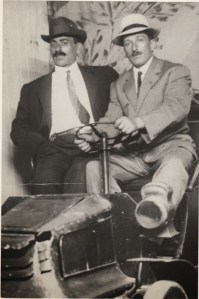
Philip and Abraham Pifko in the US.

In another photo of Philip and Abraham (on the right), they look a bit older, and Philip has grown a mustache. In my last post, I said that Philip is on the left, but my cousin Joan, who knew Philip when he was older, says she’s pretty sure he is on the right, driving the car. She also has no idea why his complexion was labeled “light brown” on an official document I found. His skin was not dark.

The photo that started this blog, and my search for ancestors, would seem to have been taken next, sometime around 1914-1918. Except it seems strange that Philip visited Poland during World War I.

Then, while looking through Philip’s documents on Ancestry.com, I clicked on a passport application from 1920. It was for both him and his wife Goldie, to go to England and France. According to what is written, Philip became a US citizen in January 1916, and resided in the US uninterruptedly since arriving in 1907. In response to a question about where he has lived outside of the US since his naturalization, the space is stamped, “I have never resided outside of the U.S.” Below, in response to a question about previous passports, it’s stamped “I have never had a passport.”

So this got me wondering. If Philip didn’t leave the country between 1907 and 1920, could the photo have been made later than I thought, in 1920? Could it have been when he traveled on this passport?

1920PPifkoPassportAppln

Goldie and Philip Pifko 1920, passport application photo

I found this passport application a while ago, but it didn’t occur to me until now that it might have a back. Sure enough, when I clicked to the next page in the database, there it was. The back of the form includes a place where a lawyer verified the truth of everything on it. There is also a handwritten note, “Applicant says he will not go to Russia or Poland. Instruct Amer consul [American Consulate] at France and England.” And even more convincingly, Philip and Goldie’s photo is attached at the bottom.

At age 37, Philip clearly seems older than in any of the other photos. His hair is receding (and, by the way, his skin does not look particularly dark).

It seems unlikely, after all, that the photo was taken in 1920. Could it have been taken before Philip’s departure in 1907? I went back to the photo itself, to reconsider all the details. First, I checked everyone’s ages. In 1907, my grandmother would have only been 13, but clearly she is older in the photo. The boy in front, sitting between his grandparents is Nathan Kolski, whose mother Regina died when he was born; several of my cousins have confirmed his identity. But Nathan was born in 1905, and he is definitely not a toddler in the photo. He almost certainly isn’t 15 either, making it unlikely the photo was taken in 1920. Also, the oldest sister Liba was 20 years older than Babcia. It’s really hard to tell for sure, but I would say that none of the women who are standing in the photo look as old as 48. Perhaps a couple are around 40. So again, considering everyone’s ages, it seems most likely the photo was taken around 1915, when Babcia was 21, Nathan was 10, Liba was 42, and Philip was 32.

It is also worth noting that the youngest child in the family, Malka, is missing, making me think the photo was taken after she died in 1913. Otherwise she would have been in it.

Next, I looked at the way everyone is dressed. Clearly, there is a great deal of variation between my great grandmother’s conservative dress and my grandmother’s short hemline and high heels. The dresses of the younger women flow; they are not fitted and buttoned up like Bertha’s in the photo from 1908. Fashion catalogs from the period show that during World War I, fashions changed markedly. Hemlines went up, waistlines became higher, and clothes used less fabric to conserve resources for the war. Other characteristics from the period include the “V” neckline with a lace inset, as well as attractive high heeled shoes, like Babcia and her sisters wear. The clothes date this photo back at my original estimate, 1914-1918.

I even considered whether I could be mistaken about the identity of the man standing to the right. Could it be the spouse of one of the sisters beside him? But several relatives have identified him as Philip, and he looks like Philip based on the other photos. Rachel’s husband Pinkus Kolski looked completely different. I don’t have a photo of Nunia’s husband, so I can’t compare.

But if the photo was taken around 1914-1918, how can Philip have been there? Occam’s razor says when there are multiple explanations, the simplest is probably the best one. The simplest explanation in this case is that Philip was indeed in Poland at some point during World War I. Maybe the photo was taken in celebration of his visit. Maybe a space was left between Jacob and Nunia to symbolically mark where Abraham, the brother who stayed in the US, would have stood. Maybe it was taken for Abraham, so he would have a memento of his kin back in Poland. That would explain why the photo was passed down in Abraham’s family. Many years later, his grandson made copies for my grandmother and other branches of the family.

Does that mean Philip lied on his passport application? Maybe not. If he traveled to Poland before he became a US citizen in 1916, maybe he didn’t need to report it on the form. And if that’s what happened, maybe I can pinpoint the photo more specifically to 1914-1916, before his hair had receded quite so much, and before the US entered the war. That seems like the simplest solution, even though it still doesn’t explain why Philip went back to Europe in the middle of a war.

Two Pifko Brothers Came to America

20 Wednesday Dec 2017

Posted by Marysia Galbraith in Family, Genealogy, Jewish immigrants, Kolski, Memory, Names, Pifko-Winawer Circle, Piwko, Winawer

≈ 3 Comments

Tags

Abram Janas Piwko, Census data, Efraim/Philip Piwko

Two of Babcia’s brothers sailed to America during the first decade of the 20th century. They both established bakeries in Manhattan and Brooklyn, and the younger brother Philip also made a small fortune in real estate. Philip never had any children of his own, but he became the patriarch of the family in the US. For many years, he maintained the family circle that met monthly, and helped to sponsor relatives who came from Poland. At first relatives came to work, often starting out in his bakery. Later, during and after World War II, efforts to bring relatives over from Europe became more urgent. He wanted to save their lives.

The older brother came first. He is listed as “Abram,” on the ship manifest, though some relatives called him Abraham and others used his middle name Jan (the Polish form of John). He arrived in New York on the SS Moltke on January 24, 1906, and was released into the custody of his uncle Samuel Jaretzky, who was probably related to him through his wife Bertha/Blima. There is some confusion whether Bertha’s maiden name was Kolski or Jaretzky. Bertha’s great grandson Bob has heard different stories about this—either the names were used interchangeably or one branch of the family changed their name. As if that weren’t complicated enough, In the US, the Jaretzkys dropped the Slavic ending and became the Jarets.

Bertha joined her husband in May 1907 with their three young children, Nathan, Paulina, and Ewa. Their fourth child, Sarah, was born in 1909.

BerthaPiwkoNathanPaulineEwa c1908

The Pifko brothers around 1908, New York. Front from left: Philip, Abraham, Paulina, Ewa, Bertha, Nathan. Back from left: Raphael Kolski, Sam and Max Alexander

The younger brother, Philip/Efraim arrived in December 1907. Philip was twenty-six and still a bachelor. At first, he lived with Abraham and worked as a driver of a bakery wagon. In 1910, Abraham was foreman at a pants manufacturer.

I love this photo of them.

2Brothers

Philip and Abraham Pifko in the US.

The photo was in my grandmother’s collection, inside the envelope she labeled “do not open,” along with the others in this post. I’m guessing it was taken in New York sometime in the 1910s. They seem to be inside, so maybe the automobile was just a prop of the photographer. I’ve tried to figure out what kind of car it is. It might be some sort of runabout from the earliest years of the 20th century.

Both brothers had dark hair, and usually wore a mustache without a beard. Abraham, as described by his sister Nunia, had “devil eyes;” he “liked girls and girls liked him.” She described Philip as “shy, pockmarked, and sweet.” Nunia described both as tall, but official documents list Philip’s height as 5’ 7”. He had grey eyes and a “light brown” complexion. That’s one reason I think Philip is on the left in this photo; he looks dark, like a gypsy. Also, I imagine Abraham, as the older brother, would have been in the driver’s seat. But then again, Philip was the bakery wagon driver so maybe I have it backwards.

BabciasSisterMarja

The youngest sister, Malka/Maria c. 1912 in Poland

Nunia described the youngest sibling Maria/Malka as dark like a gypsy.

In 1911, Philip married Goldie Przedecka, though her name might have been Gertrude Jacobs. In my aunt’s tree, she is listed as the former, but their marriage record says the latter. Names are complicated in my family; Goldie’s sister and mother had the last name Jacobs or Posner. I’m still working on this.

Philip and Goldie never had any children, but his memory lives on, much more strongly than that of his brother. Abraham died at the age of 47 in 1925, and even though he had children and grandchildren, the cousins I have spoken with know very little about him. They have personal memories of his wife Bertha, who lived until 1968.

Census records show that by 1920, Philip had his own bakery. In 1930, his occupation is “employer.” In 1940, he is listed as a manager of real estate.

Philip’s legacy lives on thanks to everything he did for others during his lifetime. The census shows that he opened his home to a niece, sister-in-law, nephew, and mother-in-law. In 1925, his sister Sarah’s son Nathan Winawer, age 22, lived there, as well as Goldie’s much younger sister Sallie Jacobs, who was 21 years old. Around this time, Nathan and Sallie married. In 1930, Nathan and Sallie were no longer living with Philip, but Nathan was working in a bakery which may well have been Philip’s. In 1940, Bertha’s mother Nicha Posner and Abraham’s daughter Pauline lived with Philip and Goldie.

Other relatives also worked in Philip’s bakery, including Nathan’s brother Stanley Winawer. Stanley went on to open his own bakery, which he had for many years in Brooklyn. Philip helped family members in other ways. Joan, Philip’s grand niece, says he was involved in relatives’ schooling, and he was important for opening doors for them. She was just a child at the time, but she remembers anxious discussions about getting the family out of Poland during World War II.

I don’t have to look any further than my immediate family to see Philip’s generosity. When Babcia, my mother, and uncles came the US, Philip helped them, too. I’m not 100% sure whether they stayed with him, or just in an apartment he owned.

AbrahamBerthaPiwko

Bertha and Abraham Pifko in the US.

Philip may well have been following in his older brother’s footsteps. After all, Philip was one of several boarders at his brother’s in 1910. Others included the brother of Abraham’s wife, as well as two cousins, all of whom are in the photo from 1908 that’s at the top of this post. In the 1920 census, Abraham is listed as “proprietor” of a “bakerstore,” and a boarder named Charles Jacobs lived with them. Charles, age 35, had come from Poland in 1913 and worked as a bakery clerk. Could he be related to Philip’s wife Goldie, whose maiden name might also have been Jacobs?

I keep trying to fit the pieces together, to tell a story about their  lives.


AK Verification, Part III

02 Saturday Sep 2017

Posted by Marysia Galbraith in Archives, Bereda, Family, Memory, Polish Culture, Polish Underground Army, Warsaw, World War II

≈ Leave a comment

Tags

AK, Armia Krajowa, Maria Bereda(y) Galbraith, patriotism

NOTE: This overview of my recent discoveries at the Polish Underground Movement Study Trust, Studium Polskiej Podziemniej (SPP) got so long I am publishing it in three separate posts. Here is part III. During the German occupation of Poland during World War II, the Polish Underground Army worked in secret to resist, sabotage, and fight against the Nazis. Another name for the Polish forces is “AK,” short for “Armia Krajowa,” or “Home Army.” I talk about the soldiers as “the partisans;” in Polish sources they are also called “konspiracja,” “the conspiracy.”

Sorry it’s taken a while for me to get to part III. The semester has begun which means I’ve been very busy.

DSC00534

Pencil sketch of Maria Bereday from the 1950s, signed Ditri. Friends tell me she looks like a spy.

All of the questions the archivist Krystyna asked me about the names Mama went by paid off because she found another file; the envelope was mislabeled “Maria Fijułkowska.” Inside was a six-page report, relacja, Mama had written titled, “Outline of Courier Work.”

Initially, neither Krystyna nor I found this file because not only was “Bereda” missing, but Fijałkowska was also misspelled. Krystyna wrote “Fijałkowska” on a new envelope; I don’t know why she didn’t also add the Bereda, even after I pointed out that Mama’s full name was hand-written in large letters along the left margin of the document’s first page. Around World War II, the family usually used the name Bereda-Fijałkowska. Mama told me they added the Fijałkowski/a, which was grandpa Bereda’s mother’s maiden name and a name associated with the Polish gentry, because of Babcia’s social aspirations.

DSC00333

Mama’s name (Bereda-Fijałkowska) and pseudonym “Renata” in the margins of her typewritten report.

Mama’s report matches up with some of the stories she told me, and confirms some of what she did during the occupation. It also gives more details about the way her courier unit “Zadra,” was organized, and how couriers carried out their duties. The report is dry and factual. It contains no specifics about her emotional engagement or personal thoughts. A historian might find it interesting for what it reveals about the operations of the Underground conspiracy. I keep trying to look beyond the words to find the person behind them.

She writes, that “Zadra” started out very small, and because the work wasn’t systematized, the couriers were on call at all times. “By the end of 1942,” she writes, “the number of couriers stabilized at 15, and that group became close and experienced, and worked together for a long time without changing members.” This all changed in the fall of 1943 when the occupier, okupant, limited train travel to Germans only. Overnight, the courier corps dropped from 60 to just six who spoke German well and had German papers. “The work for these couriers during this time was nonstop,” she continues, “The number of trips for each courier came to 10-12 per month, depending on the route.” My mother doesn’t state it in the report, but she must have been one of the couriers who carried out missions during this time. Some of her most vivid stories were about traveling in the train cars with an assumed identity as a “volksdeutch,” a half-German whose father was fighting for the Reich on the Eastern front.

After about two months, the courier corps were reorganized and expanded, with more reserve couriers brought into regular service. In the half year before the Warsaw Uprising, the number of couriers in her unit approached 40, and overall reached 100.

The duties of the couriers included delivering coded and uncoded orders hidden in ordinary objects such as candles or paint, special messages that had to be handed to specific commanders, and large sums of money (1/4-12 million zloties in 500 zloty bills). Some missions involved carrying the messages brought by paratroopers they called “ptaszki,” “little birds.” This is the code name for the cichociemni, the officers who parachuted in from the West carrying money and messages from the Polish Government in Exile.

The report includes an example of a special mission Mama undertook at the end of 1943. Instead of being briefed by her usual commander “Wanda”, “Beata,” the head of communication with the west, did it. “Wanda” gave her a special coded message she had to hand directly to the chief of staff or the commander of the Radom District. This was to occur in private with no witnesses. Mama also had to memorize and deliver the oral message, “The commanders of the divisions and subdivisions of “Burza” require complete secrecy in the event of the invasion of the Russians.” Burza, Tempest, was the code name for the Warsaw Uprising.

Because the chief of staff wasn’t available on the day Mama arrived, she had to spend the night at a safe house. The next day, she delivered the messages to Chief of Staff “Rawicz” [his real name was Jan Stencel or Stenzel], but had to spend another two days before “Rawicz” returned from the forest, where the partisans were hiding out, with the required response for the Central Command in Warsaw.

Reading this sparked another memory for me. I think it was a big deal for Mama to stay away from home for so long, especially because her father didn’t know she was in the Underground. Her mother did know, though, and they hatched an alibi about a visit to Mama’s fiance’s family. Or maybe this is the story she told the authorities on the train to explain why she was returning several days late. Hopefully, my brothers remember this story, too, and can confirm one of these versions.

The documents from the Studium Polski Podziemnej in London have been a lynch pin that holds together information from a variety of sources. While I was there, I also found a citation for Communication, Sabotage, and Diversion: Women in the Home Army, Łączność, Sabotaż, Dywersja: Kobiety w Armii Krajowej, published in 1985. The book was written in Polish but published in London. I found a copy of it at an online used bookstore whose brick and mortar shop is in Warsaw. I called, and sure enough they had it in the shop, so I picked it up while I was in Warsaw. It contains the recollections of the head of the Women’s division of Central Command (VK) Janina Karasiówna, the oficer who confirmed Mama’s verification file. Another chapter contains the report of Natalia Żukowska who was the assistant commander of Mama’s courier unit; Mama identifies her by her pseudonym “Klara.” From Żukowska’s report, I learned that “Zadra” was the name used by the couriers who had been working with the unit for the longest, but in 1943 the name was changed to “Dworzec Zachodni.” Reviewing Mama’s documents, I see now that she identified her unit as Zadra-Dworzec Zachodni in one place. She underlined it, too. Until I read this book, I had thought Dworzec Zachodni, which means Western Station, referred to Zadra’s location, not an alternative cryptonym. And then there’s this: the names of the 15 couriers, including “Renata.” That’s Mama’s pseudonym; her last name is misidentified as “Brodzka” instead of “Bereda,” but Natalia writes, “Unfortunately, it wasn’t possible to decrypt all of the last names” (p. 118).

Mama was proud of her service for her country, but she was also painfully aware of the cost of war. She called herself a pacifist and the war solidified her abhorrence of armed conflict. I remember her asking, “Are there times when fighting is necessary?” I could tell from her voice that she wanted to believe all conflicts can be resolved peaceably. But her experience had taught her otherwise.

Jewish Warsaw in the Shadow of Skyscrapers

30 Friday Jun 2017

Posted by Marysia Galbraith in Jewish Culture, Memory, Polish-Jewish Heritage, Polish-Jewish relations, Post-World War II, Synagogues, Warsaw

≈ Leave a comment

Tags

Plac Grzybowski

I discovered Jewish Warsaw tucked between streets I’ve walked dozens of times. My first surprise was that the apartment I rented in an ugly green socialist-era tower is literally around the corner from Plac Grzybowski (Grzybowski Square), where Jewish life survived into the communist era.

DSC00155

6th floor view of Plac Grzybowski. From the left, a socialist era apartment, All Saints’ Church, modern skyscraper, (at the center) green space, with the site of Jewish Theater behind it and the roof of the Gmina Żydowska behind that, (bottom right) back of building with Charlotte Menora Cafe.

I’ll say more about Plac Grzybowski in a minute, but I was even more surprised when, while mapping out a running route, I saw that I was also just a block away from Nożyk Synagogue, the only synagogue in Warsaw that survived the war. I’m embarrassed to admit that I had never been there before, nor is this the first time I’ve been so close and didn’t even realize it. When my best friend from childhood Kim visited with her father in November 2014, we stayed at a hotel on Grzybowska Street, and were it not for the newer building across the street, we could have seen the synagogue from the hotel entrance. Kim and her family introduced me to Passover Seders, and bagels with lox and cream cheese, and I’m sure they would have loved to see the synagogue. In my defense, the synagogue sits in the green space at the center of the block, with tall buildings all around it. It’s easy to miss. The street access to the synagogue looks like the entrance to a parking lot, and from Grzybowska Street, the only access is via pedestrian walkways.

DSC02259

My friend Kim with her father Sandy and my son Ian in Saski Park, Grzybowska Street in the background, November 2014

This isn’t the first time I have seen a synagogue tucked within the central courtyard of a city block. I wonder what the historic reasons were for that. Regardless, I imagine that in the difficult years after the Holocaust, this location offered the synagogue some protection; only people looking for it would find it. This is also where the Gmina Żydowska—the Association of Jewish Communities—has its offices. I should have come here before.

Nożyk Synagogue, Warsaw
"About the Jewish Community"
“About the Jewish Community”

Built in 1902, the synagogue is a solid stone rectangle with arch-topped windows all around. Above the front door, two arch-topped tablets contain the Ten Commandments, and above them is a Star of David. The building survived World War II because the Nazis used it as a warehouse. Jews returned to worship there after the War, and at present, it remains the main synagogue of Warsaw, home to the Orthodox community. The offices of the Gmina Żydowska fill a modern addition across the back of the building.

Both times I walked by the synagogue, a few men were inside praying. More people walked by briskly, probably residents of surrounding buildings. Along the edge of the parking area, large information boards contain headlines like “We, the Jews of Warsaw,” “About the community,” and “Kosher…what does it mean?”

All the pieces fit together from my 6th floor balcony. I can see the metal roof of the synagogue’s modern addition. I also look down at the corner of Charlotte Menora in Plac Grzybowski; this is one of four Charlotte Cafes in Poland. They all specialize in French pastries, but this one also includes Jewish offerings such as bagels and rugelach. My friend Beata took me there last summer. She also pointed out the center of the square that has been converted into a shaggy grassland and wildflower garden. Pathways lined with benches lead down to a central fountain. This novel use of space started out as an art installation by Joanna Rajkowska called “Dotleniacz,” which in English means “Oxegenator;” The project was later reworked into its present, more permanent form.  Beata also showed me Próżna Street, the only street in the ghetto where the original buildings weren’t destroyed in the systematic bombing after the Ghetto Uprising in 1943. On one side of the street, the townhouses have been painstakingly restored. On the other, netting covers the buildings to prevent pedestrians from being harmed by falling elements of the crumbling façade. One of the renovated buildings is home to the Austrian Cultural Forum. Some of my Polish friends say they feel uncomfortable about this because of Austrian support for the Nazis.

Park in the middle of Plac Grzybowski
Próżna Street at night

Grzybowski Square is actually shaped more like a triangle. Charlotte Menora and the intersection with Próżna Street are on one long side. At the second long side, a pile of debris peaks above a barrier fence where the Jewish Theater was torn down last year. This theatre continued to operate all through the communist period, offering performances in Yiddish. Posters on the fence announce that the theater will be rebuilt, along with the TSKŻ, which stands for Towarzystwo Społeczno – Kulturalne Żydów, The Social and Cultural Association of Jews. Sophie, whom I met because she shares the last name of my great grandmother, lived in Warsaw until 1968. Her face lit up as she recalled going to youth activities at the TSKŻ. But she, like most of Poland’s remaining Jews, left in 1968 when the government waged a campaign against Jews. That’s also when many of the TSKŻ branches closed. In Warsaw, the organization hobbled along until after the end of communism, and has since been growing once again.

"Coming here, The new location of the TSKŻ. Jewish Theater and Office-Services Building"
“Coming here, The new location of the TSKŻ. Jewish Theater and Office-Services Building”
All Saints Church
All Saints Church
Pope John Paul II statue in front of All Saints' Church
Pope John Paul II statue in front of All Saints’ Church

At the third, shorter side of the triangle stands the All Saints Church, where Christian Poland asserts itself even in this Jewish part of town. I’ve read that the church was right along the border of the ghetto, and it was where converts to Catholicism living in the ghetto would come to pray. More recently, symbols of Polish nationalism have been placed across the front of the church. Numerous plaques commemorate Home Army soldiers who fought against the Nazi occupation and in the Warsaw Uprising of 1944. These soldiers belonged to companies with names like “Buttress,” and “Brave,” and had wartime pseudonyms such as “Goliath,” “Fisherman,” and “Rooster.” A sculpture of Pope John Paul II stands on the steps leading up to the church, and a monument honoring the Home Army soldiers who produced weapons for the partisans is in the park across the street.

Plac Grzybowski is virtually unrecognizable from the first time I saw it. Marta, a family friend from Warsaw, pointed out the Jewish theatre to me in what I remember as a wide, crowded, dirty intersection with no central green space. It might have been 1990 or 1991, or maybe even 1986. Marta also painted a picture for me of how the square looked still earlier in time, before the war, when the streets were filled with Jews, many of them orthodox men with long beards and black coats, and women wearing wigs or kerchiefs.

The view from my window encapsulates this city–a mishmash of old and new, Catholic and Jewish, nationalism and subversion. Add to this the layers of memory every place contains, along with the energy of a capital city, and you can feel the beating heart of Warsaw.

More Jewish Heritage Work in Kutno

26 Wednesday Apr 2017

Posted by Marysia Galbraith in Cemeteries, Heritage work, Jewish Culture, Jewish Ghetto, Kutno, Memory, Names, Polish-Jewish Heritage, Polish-Jewish relations, Synagogues, World War II

≈ 2 Comments

Tags

Friends of Kutno, Polin Museum, Reclaiming "Jew", Towarzystwo Przyjaciół Ziemi Kutnowski

This is part II about heritage work in Kutno. The first is Jewish History of Kutno.

While in Kutno, I visited the Society of Friends of Kutno (Towarzystwo Przyjaciół Ziemi Kutnowski). The organization has been active since the early 1970s, and has put out an annual periodical about local history and customs for about 20 years. Most issues of the publication contain an article about Jews. In 2016, these articles were compiled in a book along with other historical materials about Kutno’s Jews, including Holocaust witness reports and photographs, and a list of people who lived in the Kutno ghetto.

okladka zarys historii

Outline of the History of Kutno Area Jews, published by the Friends of Kutno

The chairwoman of the Friends of Kutno Bożena Gajewska is an energetic and upbeat woman. She accepted the position because of her interest in local history and her desire to promote that history among local residents. She isn’t paid for this; she volunteers for the organization after getting off work. The Friends of Kutno have their office in a historic wooden villa that was recently renovated by the city. Most of their funding comes from grants. Over the years, they have placed historical markers where the synagogue, Jewish cemetery, and ghetto used to be. Other recent projects related to Jewish culture include field trips for local residents to the Polin Museum in Warsaw, to a production of a Sholem Asch play at the Yiddish Theatre in Warsaw, and to the Chełmno Extermination Camp, where Kutno Jews were transported when the ghetto was liquidated. Kutno was selected as a site where the Museum on Wheels (a traveling branch of the Polin Museum of the History of Polish Jews) would visit; this happened in August 2016.

DSC08529

Marker reads, “In this place the 18th century synagogue stood. It was destroyed by the Nazis during World War II, evidence of the hatred of one human to another, and to his works.”

Pani Bożena says she’s noticed that orientations toward Jews have improved since the Polin Museum has opened. Thanks to the Museum, you can talk about Jews, whereas before, the word “Jew” had negative connotations, and was even used as an insult. This made people unsure what to call practitioners of the Jewish faith. Polin has helped to rehabilitate the term. While this may seem like a manifestation of the particularly fraught relationship between Poles and Jews, Mark Oppenheimer just published an opinion piece in the New York Times (Sunday, April 23, 2017, “Reclaiming ‘Jew’”) in which he notes that it’s the same in the US. “Jew” is almost never used as a noun; rather, the adjective “Jewish” is used, as in “Jewish people” or “I’m Jewish” (never “I’m a Jew”). Oppenheimer quotes the comedian Louis C. K. who called “Jew” a funny word “because ‘Jew’ is the only word that is the polite thing to call a group of people and a slur for the same group.”

The Polin Museum has also contributed to a surge of activity related to Jewish history and culture throughout Poland. This has led some townspeople to complain to the Friends of Kutno, “Why is everything always about Jews?” Bożena says she reminds these people that the Friends are interested in all aspects of regional history, and Jews were a part of that history. They address plenty of other topics, as well. For example, they recently published the biography of a native son who was an ultra nationalist during the period when the majority of Kutno residents were Jews (I can’t remember his name but maybe someone reading this can remind me).

Pani Bożena drove me to see some historical sites around town. The Jewish cemetery is on a hill overlooking a neighborhood of concrete apartment buildings. The hillside is covered with tall grass and wildflowers, and crisscrossed by dirt tracks where people walk their dogs, kids play, and people hang out. Many leave their trash behind. The Friends of Kutno recently put up signs around the cemetery that say “Here is the resting place of Kutno Jews, who settled in the city from the beginning of the 16th century. The cemetery located on this hill was established in 1793. Jews were buried here until March 1943. Please maintain its solemnity.” Below this historical information is the reminder, “Keep in mind as you go into this vast expanse that this is a cemetery; people are buried here, you walk on their graves, even though there are no longer tombstones…” Further, the sign states the cemetery is a registered monument and thus legally protected, and any vandalism is subject to a sentence of imprisonment. Nevertheless, within just a few months, four out of six such signs were vandalized. The metal poles were snapped at ground level. Bożena condemned the destruction, but also minimized it as the work of thoughtless hooligans (as opposed to a deliberately antisemitic act). In September, the poles were replaced and the signs stand once again.

Bożena showing me the new sign at the Jewish cemetery in Kutno
An older monument at the top of the cemetery hill

We passed people with dogs as we walked to the top of the hill to an older monument. It contains the same historical information as the new metal signs in Polish and Hebrew (but not the reminders about proper behavior and legal issues), and is shaped like two adjoining tombstones. Heading back down the hill, past some children playing, we saw the bases of some grave markers peaking out of the grass. Many tombstones were recovered and are stored at the Kutno Museum.

Bożena dreams of building a fence around the cemetery so there will be a more substantial barrier against further vandalism. They have received all the necessary approvals, but are in need of funding.

From the cemetery, we went on to the site of the ghetto, which is outside the center of town on the grounds of a former sugar factory. The factory was used by various industries after the war, but now is closed. The buildings, some dating from the late 19th century, stand behind a high fence and a guard patrols the site. Historic markers tell the story of the ghetto. A granite plaque reads:

Here on the terrain of the former Konstancja Sugar Factory

Germans established a ghetto for the Jewish population of Kutno and the surrounding area.

After its liquidation in 1942, the surviving Jews perished in the camp at Chelmno.

Honoring their memory, the People of Kutno.

Kutno, April 1993

A more recent sign contains a bit more historical information in both Polish and English (if you want to read it, click on the photo below to enlarge it).

Former site of the Kutno ghetto.
Wall plaque at the site of the Kutno ghetto
Historical marker in front of the main gate of the factory where the Kutno ghetto used to be.

Bożena told me that over 8000 people lived in the ghetto from 1940-1942. Those who got there first occupied all the most obvious places, so later arrivals had to build shacks from scrap wood, or find ways of populating balconies and any other inhabitable space throughout the large factory hall. In 1942, they were all transported to the camp at Chełmno by train (the tracks are right across the street from the factory) and by truck.

Thinking about the people I met in Kutno (and elsewhere), one thing I am trying to sort out is why Christian Poles get involved in Jewish heritage projects. Not surprisingly, the reasons are varied. One is interested in historical artifacts; he has no political agenda. Another of my companions tried to place this history into a more pro-Polish framework. He explained that the Nazis forced Christian townspeople to do horrible things as part of a strategy to damage relations between Poles and Jews. “All people really want is to live in peace (Chcą w spokoju żyć)”, he continued, “Poland is in the heart of Europe, a pretty terrain that has historically been attacked from all sides.” Others feel personally drawn to Jewish culture. One of my acquaintances in Kutno believes she has Jewish heritage. She seems to understand my quest for my own family history. “It’s important to know where you’re from,” she told me. She hasn’t found anything as concrete as my family photograph (the one I use at the top of the blog) to confirm her feeling that she has Jewish roots. All she can point to are allusions in family stories she remembers from childhood, and sometimes people have told her she looks Jewish. But anyone she could have asked has passed away.

But what’s clear from my visits to Kutno is that fragments of Jewish history remain, and some have been marked as such thanks to the efforts of a small group of residents who think it is important to include the stories of Kutno’s Jews in the history of their town.

← Older posts
Newer posts →

Categories

  • Anthropology (37)
    • Archives (14)
    • Fieldwork (7)
    • Ground Penetrating Radar (GPR (4)
    • Research Methodology (8)
  • antisemitism (14)
  • Association of Descendants of Jewish Central Poland (32)
  • Catholicism (8)
  • Conference (1)
  • Discrimination (2)
  • Family (69)
    • Bereda (17)
    • Kolski (13)
    • Piwko (22)
    • Rotblit (3)
    • Walfisz (4)
    • Winawer (7)
  • Genealogy (11)
  • Heritage work (66)
    • Commemoration (23)
  • Identity (18)
  • Israel (6)
  • Jewish Culture (89)
    • Cemeteries (51)
    • Museum (7)
    • Synagogues (33)
  • Jewish immigrants (8)
  • Jewish Religion (1)
  • Memory (70)
  • Names (14)
  • Photographs (6)
  • Pifko-Winawer Circle (5)
  • Poland (125)
    • Baligród (1)
    • Bolimów (1)
    • Brześć Kujawski (5)
    • Buk (1)
    • Chodecz (1)
    • Dukla (2)
    • Dąbrowice (1)
    • Gdynia (1)
    • Gostynin (2)
    • Gąbin (1)
    • Izbica Kujawska (1)
    • Kazimierz (4)
    • Kowal (1)
    • Koło (1)
    • Krakow (7)
    • Krośniewice (1)
    • Kutno (6)
    • Kłodawa (1)
    • Lesko (8)
    • Leszno (1)
    • Lubień Kujawski (1)
    • Lubraniec (1)
    • Lutowiska (3)
    • Piła (3)
    • Podgórze (2)
    • Poznan (11)
    • Przemyśl (2)
    • Pzedecz (1)
    • Radom (1)
    • Radymno (1)
    • Sanok (1)
    • Skierniewice (5)
    • Sobota (2)
    • Tarnów (2)
    • Warsaw (22)
    • Wielkopolska (1)
    • Wronki (7)
    • Włocławek (20)
    • Zasław (2)
    • Łódź (1)
    • Żychlin (30)
  • Polish Culture (10)
  • Polish-Jewish Heritage (60)
  • Polish-Jewish relations (60)
  • Post-World War II (24)
  • Pre-World War II (22)
  • Reclaimed Property (1)
  • stereotypes (3)
  • Survival (9)
  • Trauma (3)
  • Uncategorized (5)
  • Victims and perpetrators (4)
  • World War II (45)
    • Jewish Ghetto (12)
    • Nazi Camps (5)
    • Polish Underground Army (3)
  • Yiddish (5)

Enter your email address to follow this blog and receive notifications of new posts by email. Your email address will not be shared.

Archives

  • October 2025 (1)
  • July 2025 (8)
  • June 2025 (1)
  • April 2025 (1)
  • August 2024 (3)
  • July 2024 (3)
  • May 2024 (2)
  • April 2024 (1)
  • May 2023 (2)
  • January 2023 (2)
  • December 2022 (7)
  • November 2022 (2)
  • October 2022 (5)
  • September 2022 (1)
  • January 2022 (1)
  • August 2021 (1)
  • December 2020 (2)
  • July 2020 (1)
  • May 2020 (3)
  • April 2020 (1)
  • March 2020 (1)
  • January 2020 (2)
  • May 2019 (1)
  • February 2019 (1)
  • November 2018 (1)
  • September 2018 (1)
  • August 2018 (3)
  • July 2018 (1)
  • June 2018 (1)
  • May 2018 (1)
  • April 2018 (2)
  • March 2018 (2)
  • February 2018 (2)
  • January 2018 (2)
  • December 2017 (2)
  • November 2017 (2)
  • October 2017 (1)
  • September 2017 (3)
  • August 2017 (3)
  • June 2017 (2)
  • May 2017 (3)
  • April 2017 (1)
  • March 2017 (2)
  • February 2017 (1)
  • January 2017 (2)
  • December 2016 (2)
  • November 2016 (4)
  • October 2016 (1)
  • September 2016 (6)
  • August 2016 (2)
  • July 2016 (1)
  • May 2016 (4)
  • April 2016 (2)
  • March 2016 (3)
  • February 2016 (4)
  • January 2016 (3)
  • December 2015 (3)
  • November 2015 (5)
  • October 2015 (5)
  • September 2015 (3)
  • August 2015 (4)
  • July 2015 (3)
  • June 2015 (3)
  • May 2015 (4)
  • April 2015 (9)
  • March 2015 (3)
  • February 2015 (2)
  • January 2015 (5)
  • December 2014 (4)
  • November 2014 (9)
  • October 2014 (2)
  • September 2014 (1)

Copyright Notice

All original text and images are copyright © Marysia Galbraith. Please contact the author before quoting.

Blog at WordPress.com.

  • Subscribe Subscribed
    • Uncovering Jewish Heritage
    • Join 145 other subscribers
    • Already have a WordPress.com account? Log in now.
    • Uncovering Jewish Heritage
    • Subscribe Subscribed
    • Sign up
    • Log in
    • Report this content
    • View site in Reader
    • Manage subscriptions
    • Collapse this bar
 

Loading Comments...