• About
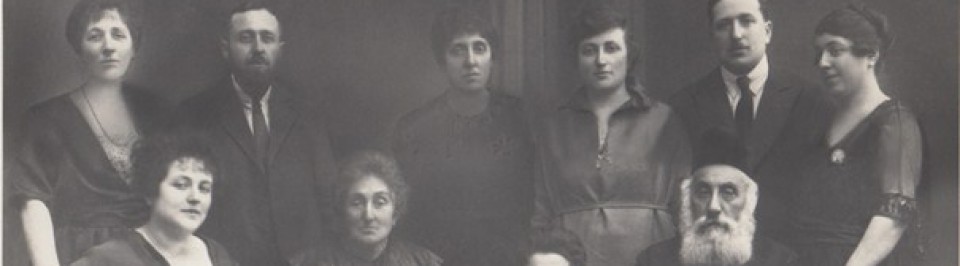
  • The Photo that Started it All

Uncovering Jewish Heritage

Uncovering Jewish Heritage

Category Archives: Identity

In the Garden of Memory: A Family Memoir by Joanna Olczak-Ronikier

08 Wednesday May 2024

Posted by Marysia Galbraith in antisemitism, Family, Identity, Polish-Jewish relations, Pre-World War II, Warsaw, World War II

≈ 2 Comments

Tags

assimilation, In the Garden of Memory, Joanna Olczak-Ronikier

I have been calling my project a family memoir since the beginning, well before I read In the Garden of Memory (the English translation was published by Weidenfield and Nicolson in 2004). My family’s story overlaps with author Joanna Olczak-Ronikier’s in other ways, too. The social world of Warsaw was intimate enough that it seems likely our families knew about each other even if they weren’t directly acquainted. Joanna’s relatives, the Horwitzs and the Mortkowiczes, were central figures in the social circles my Babcia also frequented, those occupied by writers, artists, publishers, and professionals. Both families have Jewish origins, and each assimilated, though to varying degrees.

Joanna, her mother Hanna Olczak, and her grandmother Janina Mortkowicz didn’t deny their Jewish origins in the way my mother and grandmother did. Still, they frequented many of the same places around Warsaw. When Janina, then Horwitz, was a child, her “consolation prize” for check-ups at the dentist were a visit to Lourse Café on Krakowskie Przedmieście for chocolate (15). This was in the 1880s, so decades before my grandfather Zygmunt Bereda gained an interest in the business. During the 1930s, Joanna’s cousins attended the same high schools as my mother and uncle. Girls attended the Klementyna Hoffmanowa High School, while boys went to the Stefan Batory High School.

The book also gives me some insight into marriage customs during my Babcia’s generation. “According to Jewish tradition, finding suitable husbands for one’s daughters was a basic parental duty,” Olczak-Ronikier writes. “Marriage was too serious a matter to be contracted for love. After all, it concerned two people’s future, and that of their offspring. The older generation took charge of bringing the couples together, involving family, friends and a professional matchmaker” (32). Things were changing rapidly in the late 19th century, though, and just like I have observed among Babcia’s siblings, older children were more bound by tradition while younger children were more inclined to choose their own pathway. In Olczak-Ronikier’s family, the younger children were drawn to socialism and communism.

By the next generation, Joanna’s mother Hanna was the first and only family member to marry a non-Jeweven and to change her religion. Olczak-Ronikier says, it “did not provoke any particular reaction among her relatives” (184). She was not excluded from the family because of it, unlike my grandmother Halina, whose father sat shiva and treated her as dead after her marriage to a Catholic. Olczak-Ronikier’s family was far more secular than Babcia’s, though. Perhaps in part this is because the Piwkos lived in provincial cities where the pull of religious tradition was stronger. My grandmother was drawn to Warsaw for the opportunities it offered for her to remake her life.

Another parallel I see between our family stories is in the internalized antisemitism Joanna experienced. As a child in the 1930s, she didn’t want to be Jewish, especially when she became the object of the anti-Jewish taunts of other children. She explains, “Among Jews who had decided to assimilate, a huge role was played by ambitions relating to the level of Polonization they had achieved. When the parents, through their looks, language and religious customs, were a reminder of the environment that the children had made such an effort to get out of, family love and loyalty were severely put to the test. Nowadays it is hard to imagine how painful this process of tearing oneself away from one’s roots must have been” (71).

Maks Horwitz, her great uncle, put it this way: “They were ashamed of their origin. Understandably, they never denied it among those who knew about it. But even here, in deed, word and gesture they tried to prove and convince others that they felt themselves to be completely and utterly Polish and that they were entirely rid of their Jewishness” (111).

Members of both families survived the war by adopting Aryan identities. Babcia was able to live more in the open than Olczak-Ronikier’s family because she had been distanced from her Jewish origins since the 1920s, and also because her Catholic husband was well enough positioned to bribe the Nazi authorities to look the other way. As in my family, the women of Joanna’s family took a few years off their age on their false documents (92). During the Warsaw Uprising, when the area they lived in was overrun by the Germans, Olczak-Ronikier’s family escaped via the underground sewers, as did my mother. With the destruction of the capital, both families took the same path out of the city, traveling with a crowd of refugees south to Krakow, where they remained until the end of the German occupation. (268)

Joanna’s cousin Ryś Bychowski was born the same year as my mother. He attended Stefan Batory High School, just like my Uncle George who was just a couple of years older. It seems likely they knew each other, and its possible they could have been friends. Their lives might have overlapped during the war, as well. Ryś escaped to safety in the US with his parents in 1941, only to volunteer for the Polish Airforce, which operated out of Britain. My uncle was a paratrooper, while Ryś became a navigator. Ryś joined as a Polish patriot, unwilling to remain in safety when his people were subject to Nazi oppression. For him, the fact that he was Jewish only added to his resolve. He wanted to liberate Poland and the Jewish people. While in Britain, he confronted the horror of the mass annihilation of the Jews, made even more unbearable when his friends and comrades exhibited indifference, or in some instances satisfaction, that the Jews were killed.  Olczak-Ronikier explains, “His Polish-Jewish identity had always seemed something quite natural to him, yet in view of this and similar episodes he came to the conclusion that he had to make a choice” (295). He decided he could never live in Poland again, even though he remained committed to the fight against Nazism.

A photo from my grandmother’s papers taken in Warsaw right after the war. From the left: Mirka (Rachel’s daughter), Rachel (Babcia’s sister), Czesław Mochorowski, and Nelly. The boy who is standing is Bogdan, Rachel’s grandson, the son of Samek and Nelly. I don’t know who the man on the right or the boy at the very bottom are.

The evolution of Ryszard’s view of Poles helps me understand the deep anger and resentment so many Jews feel toward Poland. It’s something I have recognized before, and wondered why they direct their fury more strongly toward Poles than to Germans. In a letter to his father in 1943, Ryś Bychowski explained in clear and emotionally resonant terms; “I do not want to be a second-class citizen ever again […] Above all I’m afraid of knowing the whole truth about the reaction of Polish society to the extermination of the Jews. I cannot live with or talk to, I am not able to work with people who found it possible to ignore their destruction, occupy their homes and denounce or blackmail the survivors” (296). This was an intimate betrayal, not by a sworn enemy but by comrades and neighbors. It was exclusion from the group he felt himself to be a part of. No wonder it cut so deeply.
Our Story in MyHeritage Blog

04 Monday May 2020

Posted by Marysia Galbraith in Bereda, Family, Genealogy, Identity, Israel, Kolski, Photographs, Polish-Jewish relations, Post-World War II, Pre-World War II, Warsaw, World War II, Włocławek

≈ 4 Comments

Tags

Colorized photos, MyHeritage

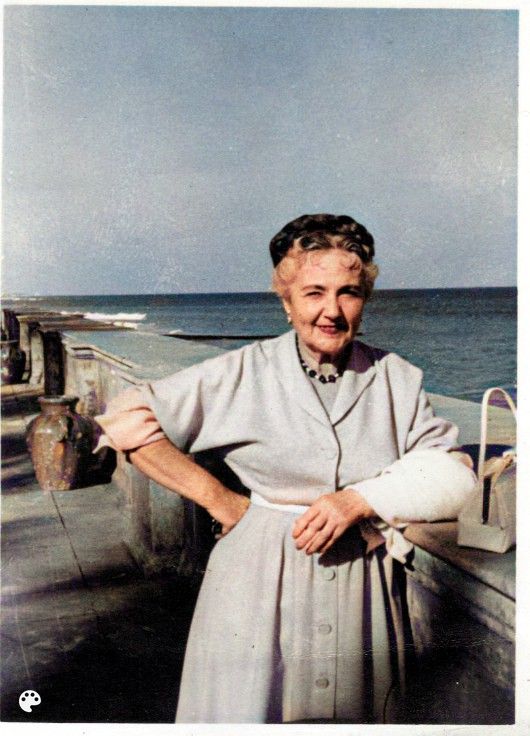
Now, the English-language MyHeritage blog has a story about us: Hidden Photo Reveals a Secret Past and Reunites a Family, written by Talya Ladell.

The article also contains cool colorized photos. You can compare the black and white originals with the color copies by dragging the cursor over the image.

helena-Colorized

Babcia Halina in Florida during the 1950s. Colorized photo

Inheritance

02 Monday Mar 2020

Posted by Marysia Galbraith in Family, Identity, Memory

≈ Leave a comment

Tags

biological inheritance, Dani Shapiro, genealogical heritage, Genetic testing, Inheritance: A Memoir, reproductive technology, semen donors, unthought known

Inheritance: A Memoir of Genealogy, Paternity, and Love takes a deep dive into the meaning of family and identity, and how our genealogical heritage shapes who we are. The way we are raised clearly matters, but so does biological inheritance. Shapiro knew and cherished the Jewish culture of the family she grew up with. She only learned about her non-Jewish genetic paternity when, at the age of 50, she took a DNA test.

inheritance

Dani Shapiro’s book reminds me how powerful language can be. She focuses less on what happens than how it affects her, giving voice to her inner thoughts and feelings. It’s a good reminder for me, as a social scientist preoccupied with documentation of social worlds. Sometimes it’s better to provide fewer details, taking the time to plumb their deeper meanings.

As much as she embraced and was embraced by her family, Shapiro writes about the feeling of not quite fitting in. She would gaze at her father’s face and not see herself reflected in his dark hair, eyes, and complexion. Only when she met her blue-eyed, pink-cheeked biological father did she have that moment of recognition. Although she was raised in a household where her Jewish credentials were never in question, her physical appearance made her feel pressured to prove her Jewishness—by reciting Hebrew prayers, by referencing her kosher upbringing.

This isn’t to say that all Jews need to look a certain way. That’s not Shapiro’s point, and it’s not mine. But I do understand the urge to find yourself in the features of your parents.

Through it all, Shapiro never questioned the story of her heritage that was told to her, even when her mother let slip that her parents struggled to conceive and so they sought help for fertility issues. Even when her half-sister told her it was common practice at the time of her conception to mix the sperm of the husband with that of a sperm donor to increase the chances of pregnancy. Even when a poet stared at her and concluded, “You’re not Jewish.” She never doubted her origins, even when she looked in the mirror and saw her own blond hair, blue eyes, and pink and white skin.

What resonates the most strongly with my own experiences is that failure to know, even when you kind of do know. Shapiro’s mother knew how her daughter was conceived. She must have had some idea that her daughter’s biological paternity might be in question, but she nevertheless provided doctors with her husband’s family medical history and worried Dani might have inherited health issues from them. Similar things happened in my family. In fact, I did this kind of thing myself, when for instance I did not even consider my Jewish heritage while researching all the genetic diseases I should watch for while pregnant with my son. I had learned that my grandmother’s family was Jewish when I was in my 20s, but it didn’t really enter my consciousness as an expectant mother in my 30s. That’s how strong my identification was with my mom’s adopted Polish Catholic heritage.

Shapiro refers to the psychoanalytic concept of “unthought known,” experiences that are indescribable in words but that nevertheless influence thoughts and behavior later in life. The concept refers to awareness derived from early, preverbal childhood experiences, so it’s not an exact match to what I’m describing. But certain aspects apply. Even though I “knew” the secret of my mom’s family origin, I chose not to include it in my self-identity. I excluded it from the way I thought about myself, and also how I presented myself to others. I’m sure my mom did the same. She identified as a Catholic Pole and refused her Jewish heritage. She felt offended if anyone ever alluded to it. For her, and I guess for me too, who we were supposed to be was more real than who we actually were, who we actually came from.

Except that growing up, I felt something was hidden. Here my experiences come closer to the psychoanalytic meaning of unthought known. I felt the silences in my family history, and the feeling of displacement they produced. Shapiro’s story is a little different, because she fully embraced the Jewish heritage of her family, confident in her deep roots in that community. So for her, learning that her biological father was not Jewish led to a sense of loss and of disconnection. For me, by contrast, learning about my Jewish family has filled the empty spaces in my own family story. I know who I came from, which helps me know who I am. I’ve been embraced by my complex, heterogeneous extended family.

Restoring Peace and Justice in America

06 Friday Jul 2018

Posted by Marysia Galbraith in Commemoration, Discrimination, Identity, Memory, Victims and perpetrators

≈ 4 Comments

Tags

Equal Justice Initiative, Montgomery, National Memorial for Peace and Justice, Racial Injustice, Supreme Court

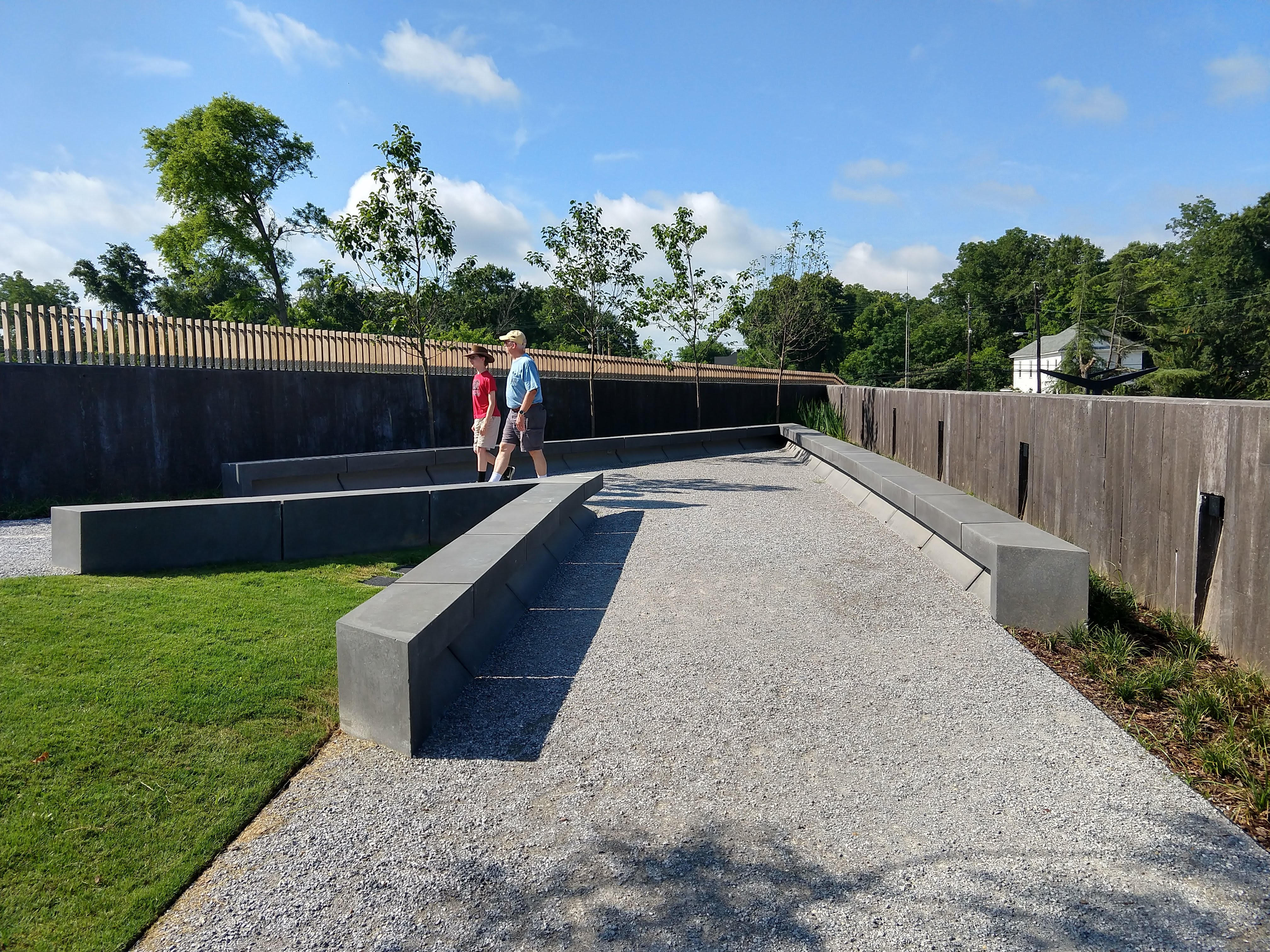
The new National Memorial for Peace and Justice opened in Montgomery, Alabama on April 26, 2018. It stands as a reminder of the many acts of discrimination against African Americans over the course of American history, and in particular memorializes over 4400 documented lynchings that occurred between 1877 and 1950.

img_20180627_100113817_hdr

National Peace and Justice Memorial, Montgomery, Alabama

800 rectangular iron blocks hang several layers deep in rows around a square. Each block contains the name of a county and state where lynching occurred, as well as the names of the victims and the dates they were lynched. Some contain the name of just one victim, others contain dozens.

My husband, son, and I visited the memorial last week. The monument looms large atop an elevated earth mound. We walked past a sculpture of life-sized bronze figures in chains, and up the path from the entrance. The wall to our right got shorter as we climbed to the level of the memorial.

img_20180627_091844954_hdr

The wall to our right got shorter as we climbed to the level of the memorial.

We should have been climbing out of slavery and into freedom, but instead were confronted by the sea of iron blocks. The first ones we approached were set on the ground. At six feet tall, they approximate the height of a person. At the next corner of the monument, a path leads downward.


Blocks incised with county, state, and names of people who were lynched there.
We turn a corner and descend. The iron blocks hang around us.

The blocks in the first row are marked with counties in Alabama, each deeper row listing counties in other states and their victims. We couldn’t figure out how the inscriptions are ordered, so we asked one of the guards. He explained the blocks are arranged alphabetically by state and county in a spiral that starts in the outside row, goes all the way around the square, and then continues through each successive row ending with the most interior blocks.

As we walked downward, the blocks became suspended from iron poles. By the time we reached the bottom, they loomed above us, eerily echoing the hanging victims they document.

Hanging blocks loom above

On either side of this below-ground passage, signs describe the circumstances in which people were lynched—for frightening a white child, or asking a white man for money they were owed, or for “standing around” in a white neighborhood.

img_20180627_093903565
img_20180627_094746871

On the lawn outside the monument, we walked by a second set of blocks, twins of the ones hanging in the memorial. Laid on their side as they are, they resemble coffins. The intent is for counties to claim the block with their name on it and to each set up their own memorial site. Over time, as such monuments proliferate, more and more gaps will appear in the blocks resting on the lawn. In effect, the memorial will become a network of sites mapping the places where lynching occurred.

Between 1884 and 1933, 10 people were lynched in Tuscaloosa, Alabama
Duplicate blocks await placement in the counties where lynching occurred.

Clearly, parallels can be made between the National Memorial for Peace and Justice and sites throughout the world memorializing the Holocaust. Rather than commemorating moments of national pride, they compel us to remember our failures. It doesn’t matter that I wasn’t born when these events took place. I’m an American, and proud to be one. And it is because of that sense of connection to my nation that I feel a sense of responsibility for what happened in my country, for the injustices that Americans perpetrated against other Americans. Even if I weren’t American, if it weren’t a failing of my nation, of people with whom I share a national affiliation, I would feel guilty—as a human being. Like I feel guilty that the Holocaust ever happened. It was a failure of humanity, of empathy that is only conceivable in its monumental horror because it actually occurred.

But no.

That’s not the entire truth. The fact is that, as a person of Jewish descent, I identify with the group that was victimized in the Holocaust. As a person of European descent, however, my group was responsible for the victimization of people of African descent. This shift in perception, from victim to victimizer, is a difficult one.

And the harm caused by racial bias and discrimination continues.

img_20180627_100344336_hdr

“Raise Up,” sculpture by Hank Willis Thomas at the Peace and Justice Memorial. Represents continued racial bias and discrimination by the criminal justice system.

Several blocks from the Peace and Justice Memorial, the Equal Justice Initiative’s Legacy Museum further highlights racial injustice in the United States. One exhibition has left me with a nagging feeling of distress, maybe because of uneasy associations with current conflicts about the highest courts in both the US and in Poland.

A single illuminated display summarizes all of the US Supreme Court’s rulings that address racial justice issues. Alongside the decisions most often discussed and celebrated, like expanding the right to vote and defending equal access to education, are many more that maintained or reinstitutionalized discriminatory practices. I didn’t know how complicit the Supreme Court has been in perpetuating injustice, but there it was made visible right in front of me.

For a brief period right after the Civil War, African Americans gained the right to vote and were elected into political offices. But then, Jim Crow laws imposed poll taxes and literacy tests that kept them from voting, and enforced segregation in businesses, buses, and public institutions. With one decision after another, the Supreme Court upheld such discriminatory practices, and whittled away at the rights of freed people of color. The 1896 Plessy vs. Ferguson ruling, in which the Supreme Court defended the constitutionality of segregation as long as African Americans had “separate but equal” facilities, is only the most well-known of many decisions upholding segregation and discrimination.

We like to see ourselves in a positive light. We identify more with Brown vs. The Board of Education than we do with Plessy vs. Ferguson. We celebrate the Civil Rights Movement, but shy away from a deeper acknowledgement of the harm inflicted by slavery, discrimination, and deeply entrenched biases. There is still a lot we need to come to terms with. I’m glad to see this new museum and memorial taking steps in that direction, and that they are in my adopted state of Alabama.

Inclusion and Exclusion in the Polish Nation

20 Tuesday Mar 2018

Posted by Marysia Galbraith in antisemitism, Catholicism, Family, Genealogy, Identity, Jewish immigrants, Poland, Polish-Jewish Heritage, Polish-Jewish relations, Pre-World War II, Włocławek

≈ 1 Comment

Tags

Honorary Citizen of the Russian Empire, Mizrahi Party

Were Jews included as part of the Polish nation or were they excluded from it? This was one of my driving questions when I started to uncover the Jewish roots of my (Polish) mother’s family. I wondered if I might find my ancestors in some kind of hybrid Polish-Jewish space in which they identified as both Polish and Jewish. Or perhaps they lived in a world that ran parallel to that of their non-Jewish neighbors, with limited points of interaction. What I have found so far is neither straightforward nor consistent. It doesn’t fit entirely nor unambiguously into a narrative of hostile separation nor of peaceful coexistence. I’ll be focusing here on my ancestors’ lives before World War II. The Holocaust was such a devastating event that it needs to considered in its own terms, something I’ll try to do in another post.

The Polish lands were hospitable to my Jewish ancestors, allowing them to prosper for generations. My grandfather Jacob Rotblit owned a Ford dealership in the 1930s, and before then he was a manager of an international trading firm. Or maybe he sold jewelry. It’s hard to find absolute proof, but either way, he maintained important business interests.

Poland PartitionMap

Poland was under Russian, Prussian, and Austrian rule from the end of the 18th century until World War I. The region around Warsaw, where my family lived, was under Russian rule, though it had some degree of autonomy for some of this time. Map source and more information about the partitions of Poland: http://www.britannica.com/EBchecked/topic/466910/Partitions-of-Poland

My grandmother’s father Hil Majer Piwko was in the lumber trade. Documents from the National Archive in Włocławek show he owned a building supply store in the 1920s, and according to Aunt Pat, he owned a sawmill before then. Pat also writes that he was recognized as an “honorary citizen of the Russian Empire” for his service during a cholera epidemic. This was sometime before 1918, when the region near Warsaw was part of the Russian Empire. Apparently, the title “honorary citizen” came with some of the rights that were normally reserved for the nobility.

So there was separation but also opportunity. It was not very easy for Jews to become gentry, unless perhaps through marriage, but there were other means by which they were granted special honors and rights. By comparison, different social classes faced road blocks against entering the gentry, regardless of ethnicity or religion. For instance, most peasants lacked the financial means and cultural capital to gain such social standing. At least in some times and places, wealthy, educated Jews would have had more avenues to social advancement.

More about my family’s prosperity can be read from the family portrait that was taken around 1916. Hil Majer and his wife Hinda had many children. They were wealthy enough to dress in fine fabrics. Hil Majer’s traditional clothing suggests that he had the freedom to practice his faith and customs, while his children were free to assimilate, as indicated by their modern clothing. Separation wasn’t just enforced by the majority, but also sometimes chosen to preserve cultural and religious distinctiveness.

JechielHindaAndChildren

The Piwkos c. 1916. For more about this photo see: The Photo That Started it All, Some Reassembled Stories, and What Year Was It?


Why did the family move from Hil Majer’s native Skierniewice to the village of Sobota, before settling down in Brześć Kujawski and then Włocławek? It seems likely they were following economic opportunities, but also possibly they were seeking a place more hospitable to Jews. This fits a common narrative about the Jews as wanderers. They arrived in Eastern Europe as tradespeople, financial advisers, and estate managers, and eventually established settled communities. But I’ve also been told that by the 19th century, most Jewish families stayed put. That’s why knowing the place of origin of one relative usually leads to many more relations.

Włocławek hadn’t always welcomed Jews. Until the end of the 18th century, it was a Church town, home to a bishop’s cathedral, with restrictions against Jewish residents. But then the city secularized, and as it industrialized and became an engine of commerce, the Jewish population also grew. Located as it was between Warsaw and the Baltic Coast on the Vistula River, Włocławek became an important port, and home to paper, ceramic, metal, chemical, and food processing factories.

Włocławek-Wyszyński_street_on_photograph_by_Sztejner

Włocławek before 1898. Note the factories near the river. By Bolesław Julian Sztejner (1861-1921) (http://www.wuja.republika.pl/widoki_ogolne_wl.html) [Public domain], via Wikimedia Commons


In addition to economics and religion, political factors shaped the degree of inclusion available to Jews within the broader society. Antisemitism grew in the 1880s throughout the Polish lands, as Polish nationalists became more active in their pursuit of national sovereignty. Once Poland gained its autonomy in 1918, tensions deepened. Some political forces, led by Józef Piłsudski, argued for a broad definition of citizenship within the new Polish state, insuring equal rights for the 1/3 of the population that was Ukrainian, German, Jewish, and other minorities. Another political faction, led by Roman Dmowski, advocated for a narrower definition of Polishness, based on an idea of “pure blood,” by which he meant shared descent that also tied the nation to Catholicism. At the same time, Jewish nationalism grew, and took on a number of forms, leading some to embrace  Yiddish culture, and others to espouse Zionism. Some Jewish nationalists dreamed of a safe place within the countries in which they lived, while others turned their eyes toward Palestine.

Włocławek became a crossroad for different varieties of Judaism, including Zionism, Hasidism, and Reform. Around the time that my great grandfather moved there, a new rabbi, Jehuda Lejb Kowalski, also arrived. He was very popular, and succeeded in reconciling the factions within the Jewish community. In 1902, Kowalski helped found the Mizrahi Party, and was a key leader in this Orthodox Zionist organization. Perhaps Kowalski is what drew the family to Włocławek? I’m not sure of Hil Majer’s affiliation, but his son-in-law, Rachel’s husband Pinkas, was a member of the Mizrahi Party in Włocławek, and a representative of the governing board of the city’s Jewish Community in 1931. Hil Majer’s oldest son Jacob represented the Zionist Party on the governing board from 1917 until 1922, and he was on the City Council from 1917-19. In other words, Jacob wasn’t only involved in Jewish political life; he also held a position in city government.

So there were opportunities to integrate into the broader society, to pursue economic and political goals, and to flourish as a distinct religious and cultural group.

But clearly there were problems that caused my relatives to leave for other countries, long before the German occupation and Nazi assaults against Jews. One of Hil Majer’s brothers went to Canada in the 1880s; the son of another went to Switzerland. In 1906-7, two of Hil Majer’s sons went to New York. Over the years, Philip sponsored many of the next generation who started out in the US at his bakery. Four more sisters, including my grandmother, also came to the US. Jacob’s children, as well as Rachel and her children, went to Palestine starting in the 1930s. Still, choosing, or even being forced, to leave didn’t necessarily signal a lack of attachment to Poland. For over a century, there have been mass migrations from the Polish lands by Catholics, Protestants, and Jews who, regardless of their national or ethnic affiliation, chased after their dreams in distant lands.

Are Members of the Jewish Community Still Welcome in Poland?

26 Monday Feb 2018

Posted by Marysia Galbraith in antisemitism, Identity, Jewish Culture, Krakow, Poland, Polish-Jewish Heritage, Polish-Jewish relations, Post-World War II

≈ Leave a comment

Tags

JCC Krakow, Jonathan Ornstein, Should you visit Poland?

A reader just asked me whether members of the Jewish community are still welcome in Poland. Fortunately, Jonathan Ornstein, the director of the Jewish Community Center in Krakow, answered this very question in his New York Times op-ed, In Poland, a Grass-Roots Jewish Revival Endures.

JCCJewishFutureDezco_Co_Uk

Building a Jewish Future in Krakow: Jonathan Ornstein at the entrance to the JCC Krakow. Source: http://dezco.co.uk/life/jewish-life-in-krakow-poland/

It’s worth reading the whole article, but here is an excerpt:

“The concern is genuine, warranted and appreciated. We, the Polish Jewish community, are weathering challenging times. The country we call home can feel a little less welcoming these days. On one hand, young people who only recently discovered their Jewish roots have eagerly joined newly opened Hillel student organizations in Warsaw and Krakow. But they hold in the back of their minds a question of what the future may bring.

“Polish Jewish leaders, too, are grappling with an uncertain future as we continue to build Jewish life in an environment that has taken a turn away from democracy toward populism. That shift is never a good sign for Jews — or anyone in a free and open society. And now the Holocaust bill, which criminalizes statements that the Polish nation had any responsibility in the Holocaust, may complicate our good relationship with our non-Jewish neighbors.

“What we have managed to rebuild over the last 30 years with the help of those neighbors is real. It is strong and it has emerged not only from government policy, but also from grass-roots efforts. We’ve built Jewish schools, synagogues, community centers and museums by working hand in hand with non-Jewish high school students, senior citizens and many others. Not only have they allowed these institutions to be born and flourish, but many have stood up and taken an active part in Jewish rebirth.

…

“So the answer is: Yes, come visit Poland. Walk down the historic streets that I walk without fear as a proud Jew. See beyond the camps. Go beyond the history, both the beautiful and the tragic. Stand with a community that has been through so much suffering, yet has emerged optimistic and eager to rejoin the Jewish world.”

Jonathan can be trusted on this. He has been at the forefront of the revival of Jewish life in Krakow since the JCC opened there ten years ago. It’s an extraordinary organization, and I was lucky enough to help out as a Shabbos Goy during the Jewish Culture Festival in 2016, when hundreds of people attended the largest shabbat dinner in Poland since World War II.

IMG_0951

JCC Shabbat Dinner, July 1, 2016

The JCC welcomes Holocaust survivors, Jewish visitors from around the world, and Poles rediscovering their Jewish heritage or who just feel an affinity to Jewish culture and history. It was a space where I felt right at home, as an American raised in a secular Christian household with a Polish-Catholic mother who descended from Polish Jews. It’s a space where I can be Jewish or Christian, Polish or American, but regardless I’m welcomed simply because I’m there and I want to learn more about what it means to be Jewish in Poland.

Polish Independence Day is International News

16 Thursday Nov 2017

Posted by Marysia Galbraith in antisemitism, Identity, Poland, Warsaw

≈ 1 Comment

Tags

American Anthropological Association Meeting 2017, International press, Marsz Niepodległości, Nationalism, patriotism, Polish Independence Day, xenophobia

The Marsz Niepodlegołości, March of Freedom, has gotten a lot of attention from the international press, no doubt because of parallels with rising nationalism in other parts of the world. The march, organized by radical nationalist parties, was on November 11, Polish Independence Day. Started in 2010, it has attracted more attendees than the official Independence Day celebrations almost since it began.

2017NYTPolishIndependenceMarch

2017 March of Freedom under the shadow of the Palace of Culture. Photo credit: Radek Pietruszka/European Pressphoto Agency

Here are links to a few articles. Unfortunately, some of them are behind pay walls.

From The Wall Street Journal, “Polish Nationalist Youth March Draws Thousands in Capital”

The next day, “Polish Leaders Condemn Nationalist March” was published.

From BuzzFeed: “March Led By White Nationalist Group In Poland Draws Tens Of Thousands From Across Europe“

From Politico, “White nationalists call for ethnic purity at Polish demonstration“

From The New York Times: “Nationalist March Dominates Poland’s Independence Day”

And a couple days later: “Polish President Sharply Condemns Weekend Nationalist March”

From The Guardian: “‘White Europe’: 60,000 nationalists march on Poland’s independence day”

And a couple days later: “Polish president condemns far-right scenes at Independence Day march”

And in Haaretz: “Tens of Thousands Join Far-right Nationalist March for Polish Independence”

My post about the march: Independence Day: The Emotional Tenor of Populism in Poland

I’ll give a paper about it at the American Anthropological Association Meeting on November 30.


The Next Generation Visits Poland

07 Monday Aug 2017

Posted by Marysia Galbraith in Bereda, Family, Identity

≈ Leave a comment

Tags

Roots trip to Poland 2017

I’m just back from a roots trip to Warsaw, Poland with twelve relatives including six children. Here are most of the kids on the steps at Kościelna Street. These are the ones their grandmother would take everyday when she walked to and from the Bereda home at the bottom of the hill.

20170731PolandReunionIMG_0682

The next generation in Poland: grandchildren of Maria: Ian and Bessie (lower steps) and of George: Sammy, Ziggy, and Mo (upper steps). My brother Chris is on the left.

It’s extraordinary that we could agree upon a date and make the journey. I’ll write more about it soon.

Neo-Nazis in the Mainstream?

12 Monday Dec 2016

Posted by Marysia Galbraith in antisemitism, Identity

≈ 1 Comment

Tags

Alt-Right, European nationalism, Joshua Rothman, Nazi symbols, Noxious ideology as traditional values, Politics

As a follow-up to Josh Rothman’s article about the KKK in the 1920s, this came out in the New York Times yesterday:


Apparently, the neo-Nazi National Socialist Movement is seeking more mainstream appeal by dropping the swastika as its official symbol and replacing it with a more obscure pre-Roman symbol the Nazis also used. This sounds eerily like the broad appeal the KKK gained in the 1920s when it highlighted traditional (white-only) values through civic events like parades and picnics.

According to the Times article, what unites the disparate organizations now called the “Alt-right” is an assertion of European identity, and the fundamental divisions between races. Groups may be divided on “the vexing ‘J.Q.’ — the ‘Jewish Question,'” but Nazi salutes are nevertheless common at gatherings such as the one in Washington last month.

These movements have been on the fringe, but are now finding more pathways into the public sphere. So what comes next?


The Curious Tale of the Fake Rabbi

29 Tuesday Nov 2016

Posted by Marysia Galbraith in Identity, Jewish Culture, Polish-Jewish relations, Poznan, stereotypes

≈ 3 Comments

Tags

Fake rabbi, Jacek Niszczota, Jacoob Ben Nistell, Ruth Ellen Gruber, Virtually Jewish

Purim 2015
Purim 2015
http://www.gloswielkopolski.pl/

Not long ago, a reporter revealed that that the man acting as Poznan’s rabbi was not in fact a rabbi. He called himself Jacoob Ben Nistell and claimed to be an Israeli from Haifa, but it turns out he is actually Jacek Niszczota, a Catholic Pole from Ciechanów, a town 60 miles north of Warsaw.

I’m not quite sure what to think of the story, but it resonates with Ruth Ellen Gruber’s characterization of much of Jewish activity in contemporary Europe as “virtual.” In her book Virtually Jewish: Reinventing Jewish Culture in Europe (2002), Gruber describes the myriad ways Jewish spaces, performances, and even people are in fact idealizations, representations, or stylizations of Jewishness. They are done up in “Jewish style” but often without actual Jews. This has occurred throughout Europe, where the interest in all things Jewish far exceeds the capacity of the tiny or absent populations of Jews to fulfill. Instead, non-Jews renovate synagogues, restore cemeteries, run Jewish restaurants, perform Klezmer music, and lead Jewish heritage tours.

Jacoob/Jacek’s self-presentation as Hasidic rabbi can be added to this long list of virtual Jewish performances, with the important qualification that his role was deceptive. He claimed to be a real Hasidic Jew, not someone just dressed up as one. He wore his hair long, with the distinctive side curls. He also dressed in a black brimmed hat and long black jacket. I don’t believe his intentions were malicious. Nor am I sure how much he deliberately deceived people, and how much people saw him as they wanted him to be. When I met him, he didn’t tell me “I’m a rabbi.” Rather, he said “They call me a rabbi,” his sweet smile and amused tone suggesting he was willing to go along with what others were saying about him. He did, however, claim to be from Israel. I didn’t quite believe him; more accurately, I questioned whether I heard him correctly because it didn’t fit my reading of him. He seemed Polish to me. Others tell me he put on an Israeli accent, but I can’t always recognize accents of Polish speakers. When I talked with him about a possible interview, he did not refuse, but he did not seem very eager either so I never pursued it. He seemed quirky and harmless, a bit of a happy jester.

Nevertheless, Jacoob/Jacek was deceptive and his actions are highly offensive. I saw him at a number of commemorative events: praying at the grave of Akiva Eger, a respected early 19th century Poznan rabbi; saying kaddish at the unveiling of the commemorative monument and lapidarium in Wronki; leading prayers at the Jewish Religious Community in Poznan. What got him caught was the media attention he received when he appeared at an ecumenical meeting with a Catholic priest and a Muslim imam. Someone from his hometown recognized him and alerted the media.

At that point, it became clear that there had been rumblings among Israelis and other Hebrew speakers that Jacoob/Jacek didn’t actually know Hebrew. Rather he read texts phonetically, putting emphasis and accents in the wrong places.

So that leaves me with the question why no one at the Jewish Religious Community (which is an official religious association for practicing Jews) challenged the veracity of his claims. Either they were genuinely deceived or they chose not to do anything about it. It’s problematic either way. If they didn’t know, it reveals how tenuous their knowledge of Jewish religious practice, culture, and language is. If they did know, it suggests they allowed the deception to go on. Even though Jacoob/Jacek was never declared a rabbi officially, I did hear him referred to affectionately as “our rabbi” (“nasz rabin”) and he was allowed to lead prayers in contexts that everyone expected would be done by a real rabbi. The Jewish Religious Community has a legal status. It is supposed to be the official institution for practicing Jews. What it turned out to be instead in this case is part of the virtual Jewish space. The idea, look, and performance of Jewishness was deemed sufficient.

I feel sympathy for Jacoob/Jacek, who has disappeared since his deception was revealed. I wonder what compelled him to pretend he was Jewish, and why he adopted the stereotypical form of a Hasidic Jew. It’s anachronistic in so many ways. Being any kind of Jew is a rarity in Poland, and the only Hasidic Jews in Poznan are occasional foreign visitors. Even historically, when Jews lived in Poznan in greater numbers, very few were Hasidic. This was even pointed out to me by a prominent member of the Jewish Religious Community. He gestured toward Jacoob/Jacek and assured me that even in the past, Poznan Jews tended to be more modernized.

“Who, 30 years ago in this country, would have pretended to be a rabbi, to say nothing of 70 years ago?”asked the Chief Rabbi of Poland Michael Schudrich in an article in the Times of Israel. He described Jacoob/Jacek as “very sweet and smiley,” much the same as I saw him.

← Older posts

Categories

  • Anthropology (37)
    • Archives (14)
    • Fieldwork (7)
    • Ground Penetrating Radar (GPR (4)
    • Research Methodology (8)
  • antisemitism (14)
  • Association of Descendants of Jewish Central Poland (32)
  • Catholicism (8)
  • Conference (1)
  • Discrimination (2)
  • Family (69)
    • Bereda (17)
    • Kolski (13)
    • Piwko (22)
    • Rotblit (3)
    • Walfisz (4)
    • Winawer (7)
  • Genealogy (11)
  • Heritage work (66)
    • Commemoration (23)
  • Identity (18)
  • Israel (6)
  • Jewish Culture (89)
    • Cemeteries (51)
    • Museum (7)
    • Synagogues (33)
  • Jewish immigrants (8)
  • Jewish Religion (1)
  • Memory (70)
  • Names (14)
  • Photographs (6)
  • Pifko-Winawer Circle (5)
  • Poland (125)
    • Baligród (1)
    • Bolimów (1)
    • Brześć Kujawski (5)
    • Buk (1)
    • Chodecz (1)
    • Dukla (2)
    • Dąbrowice (1)
    • Gdynia (1)
    • Gostynin (2)
    • Gąbin (1)
    • Izbica Kujawska (1)
    • Kazimierz (4)
    • Kowal (1)
    • Koło (1)
    • Krakow (7)
    • Krośniewice (1)
    • Kutno (6)
    • Kłodawa (1)
    • Lesko (8)
    • Leszno (1)
    • Lubień Kujawski (1)
    • Lubraniec (1)
    • Lutowiska (3)
    • Piła (3)
    • Podgórze (2)
    • Poznan (11)
    • Przemyśl (2)
    • Pzedecz (1)
    • Radom (1)
    • Radymno (1)
    • Sanok (1)
    • Skierniewice (5)
    • Sobota (2)
    • Tarnów (2)
    • Warsaw (22)
    • Wielkopolska (1)
    • Wronki (7)
    • Włocławek (20)
    • Zasław (2)
    • Łódź (1)
    • Żychlin (30)
  • Polish Culture (10)
  • Polish-Jewish Heritage (60)
  • Polish-Jewish relations (60)
  • Post-World War II (24)
  • Pre-World War II (22)
  • Reclaimed Property (1)
  • stereotypes (3)
  • Survival (9)
  • Trauma (3)
  • Uncategorized (5)
  • Victims and perpetrators (4)
  • World War II (45)
    • Jewish Ghetto (12)
    • Nazi Camps (5)
    • Polish Underground Army (3)
  • Yiddish (5)

Enter your email address to follow this blog and receive notifications of new posts by email. Your email address will not be shared.

Archives

  • October 2025 (1)
  • July 2025 (8)
  • June 2025 (1)
  • April 2025 (1)
  • August 2024 (3)
  • July 2024 (3)
  • May 2024 (2)
  • April 2024 (1)
  • May 2023 (2)
  • January 2023 (2)
  • December 2022 (7)
  • November 2022 (2)
  • October 2022 (5)
  • September 2022 (1)
  • January 2022 (1)
  • August 2021 (1)
  • December 2020 (2)
  • July 2020 (1)
  • May 2020 (3)
  • April 2020 (1)
  • March 2020 (1)
  • January 2020 (2)
  • May 2019 (1)
  • February 2019 (1)
  • November 2018 (1)
  • September 2018 (1)
  • August 2018 (3)
  • July 2018 (1)
  • June 2018 (1)
  • May 2018 (1)
  • April 2018 (2)
  • March 2018 (2)
  • February 2018 (2)
  • January 2018 (2)
  • December 2017 (2)
  • November 2017 (2)
  • October 2017 (1)
  • September 2017 (3)
  • August 2017 (3)
  • June 2017 (2)
  • May 2017 (3)
  • April 2017 (1)
  • March 2017 (2)
  • February 2017 (1)
  • January 2017 (2)
  • December 2016 (2)
  • November 2016 (4)
  • October 2016 (1)
  • September 2016 (6)
  • August 2016 (2)
  • July 2016 (1)
  • May 2016 (4)
  • April 2016 (2)
  • March 2016 (3)
  • February 2016 (4)
  • January 2016 (3)
  • December 2015 (3)
  • November 2015 (5)
  • October 2015 (5)
  • September 2015 (3)
  • August 2015 (4)
  • July 2015 (3)
  • June 2015 (3)
  • May 2015 (4)
  • April 2015 (9)
  • March 2015 (3)
  • February 2015 (2)
  • January 2015 (5)
  • December 2014 (4)
  • November 2014 (9)
  • October 2014 (2)
  • September 2014 (1)

Copyright Notice

All original text and images are copyright © Marysia Galbraith. Please contact the author before quoting.

Blog at WordPress.com.

  • Subscribe Subscribed
    • Uncovering Jewish Heritage
    • Join 145 other subscribers
    • Already have a WordPress.com account? Log in now.
    • Uncovering Jewish Heritage
    • Subscribe Subscribed
    • Sign up
    • Log in
    • Report this content
    • View site in Reader
    • Manage subscriptions
    • Collapse this bar
 

Loading Comments...