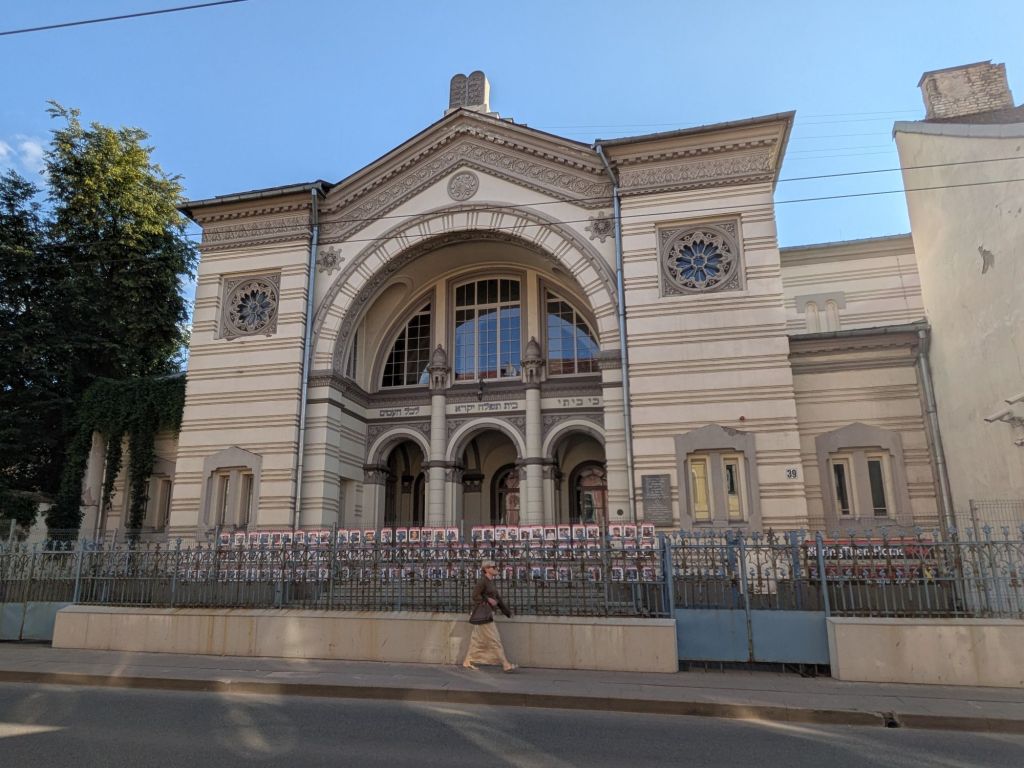
I wasn’t looking for Jewish history in Vilnius but it found me. The synagogue, still functioning as a house of prayer for the few thousand remaining Lithuanian Jews, is a half block from my hotel.
The Choral Synagogue in Vilnius. “Bring Them Home” along with photos of the hostages sits right behind the metal fence
I signed up for a Vilnius with Locals walking tour of Jewish Vilnius, the so-called Jerusalem of Lithuania. We spent 3 hours exploring the Jewish quarter. In some sections, Soviet-era concrete buildings took the place of the prewar structures blown to rubble when the WW II ghetto was dismantled.
It’s hard to picture the prewar buildings that once filled this area
Other areas escaped destruction and retain their prewar appearance. As we meandered through narrow cobblestone lanes, Kristina our tour guide explained how much of the city’s Jewish story was silenced during the Soviet occupation, the period from 1940 to 1990 when the country was a republic within the Soviet Union. During that time, nobody talked about the Jews who had made up 45% of the city’s inhabitants before the war.
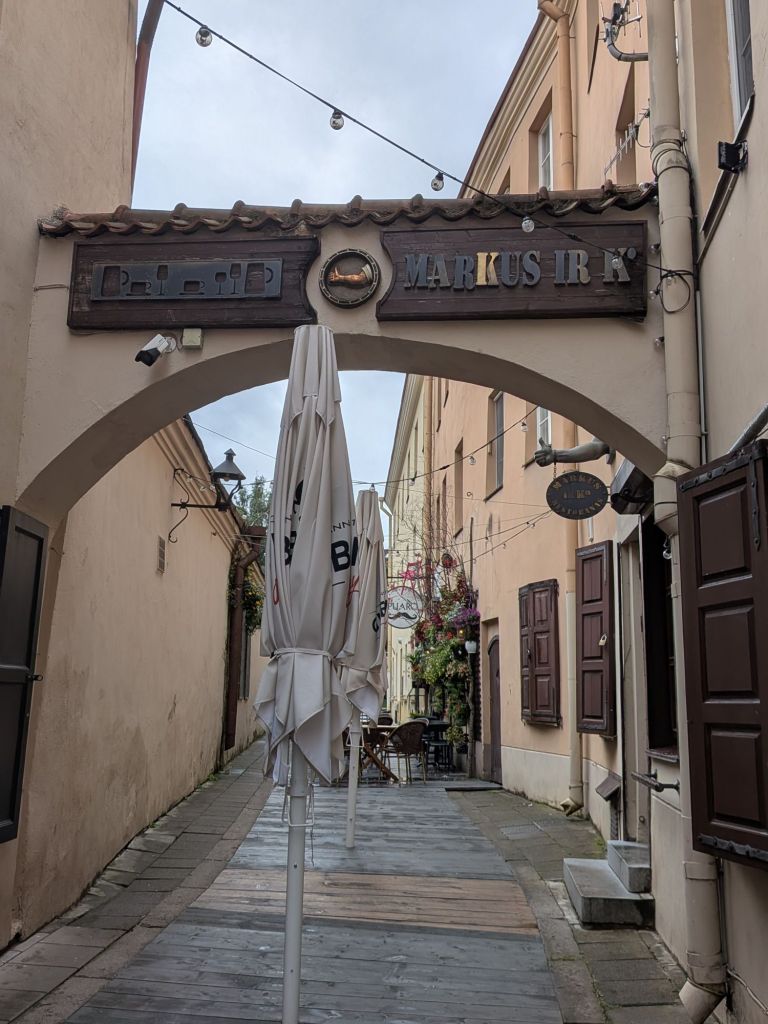
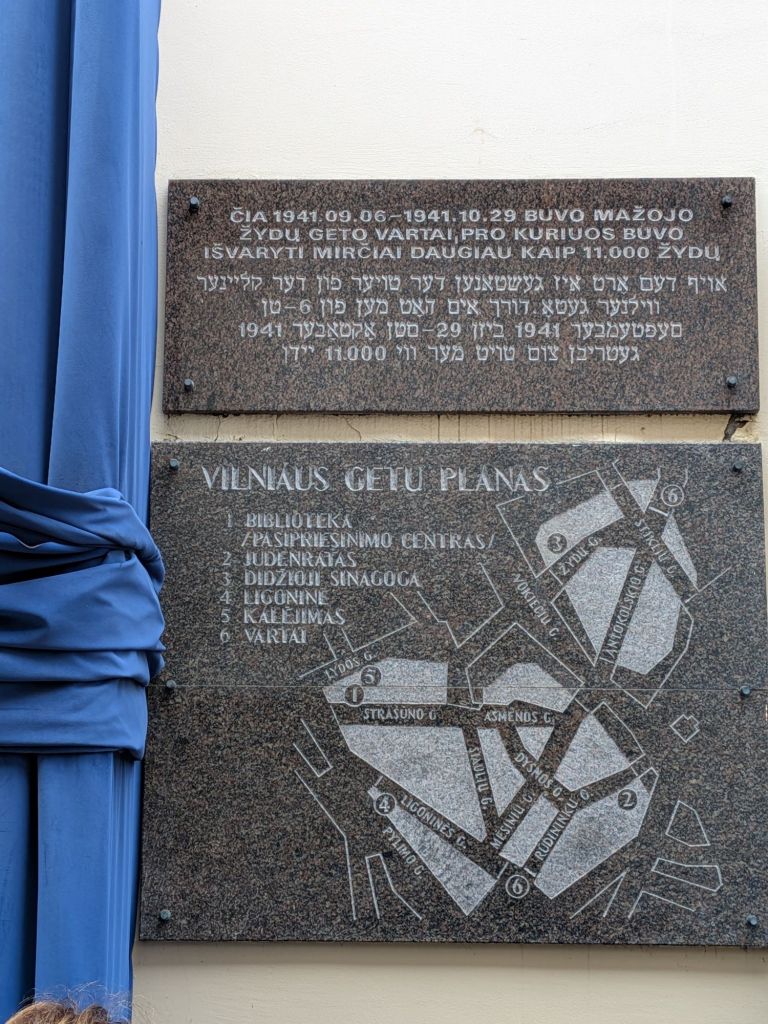
An iconic street in the Jewish district Map of the WW II ghettoJewish library scheduled for renovation
Kristina explained that this lost history only began to be rediscovered after Lithuania regained independence in 1990. Since then, scholars have been translating and writing about thousands of pages of documents that survived in hiding for 50 years. Many were collected by a group of people called the Paper Brigade who made it their mission to preserve all the documents in the YIVO Archive, a massive repository of Yiddish resources. Much of the archive found safety in New York. Today, the archive is split between Vilnius and New York.
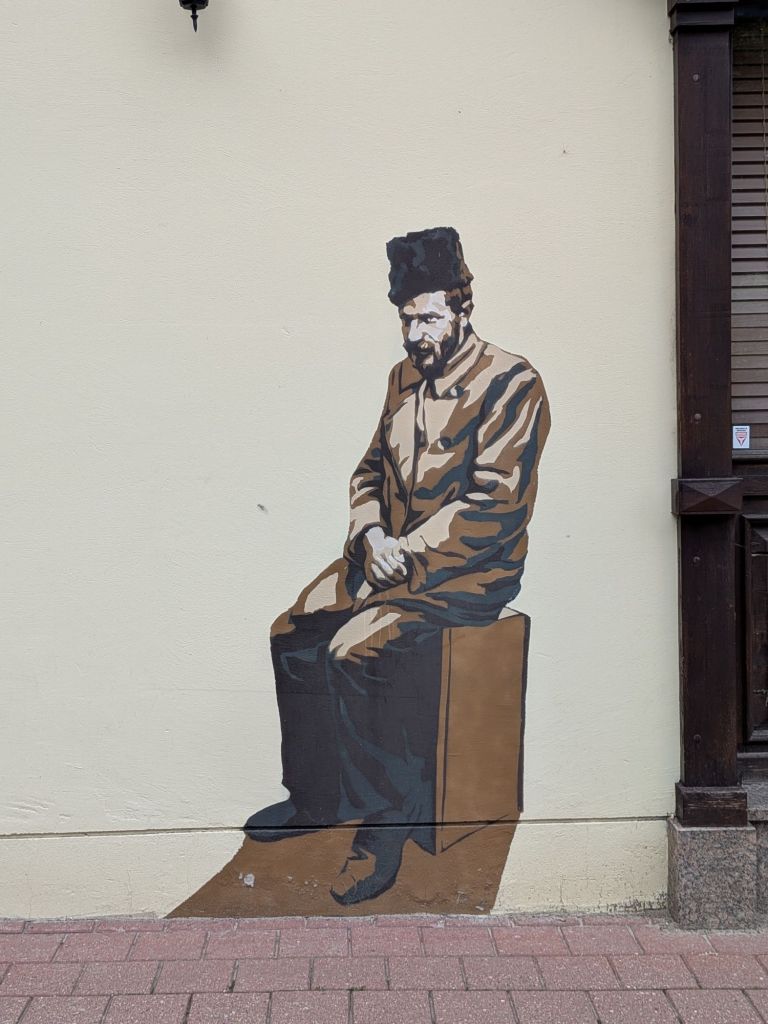
As more has been learned about The Jews of Vilnius, artwork, memorials, and institutions have made the story public. The Walls That Remember project stencils images from archival photos onto the walls of the former Jewish Quarter.
Kristina tells us about The Walls that Remember
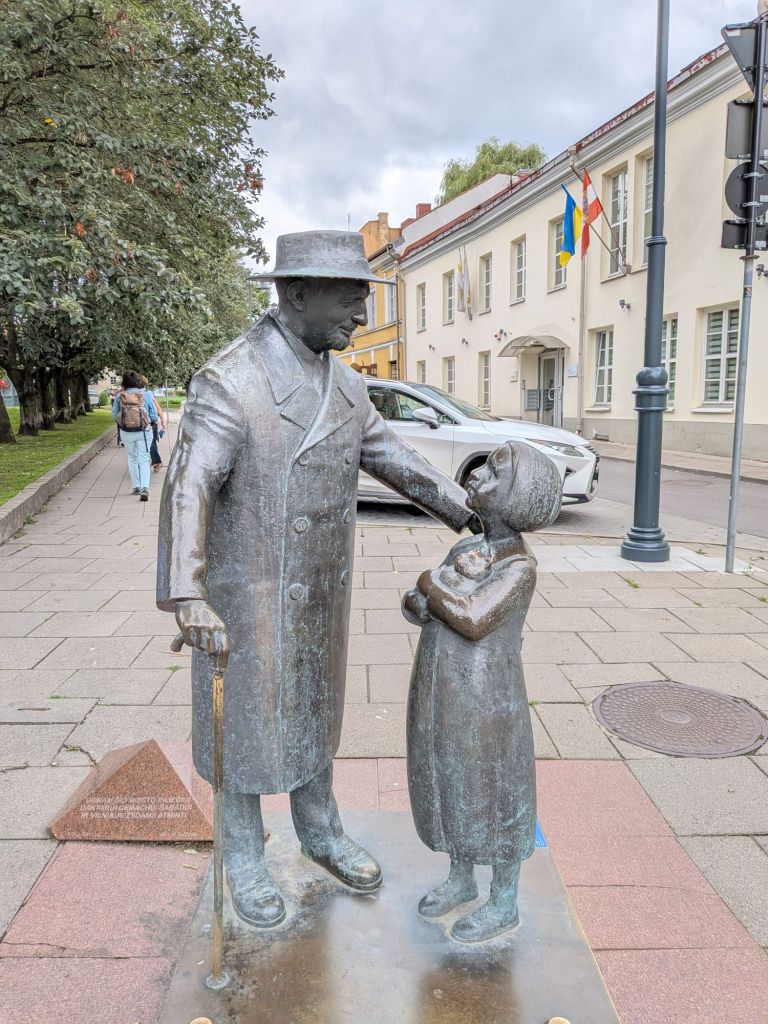
Remembered with a statue are: Zemach Shabad, a doctor known for his kindness who cared for the poor; Rabbi Elijah Ben Solomon (1720 – 1797), also called the Gaon of Vilnius; and singer Leonard Cohen, who had roots in Lithuania.
Zemach ShabadThe GaonLeonard Cohen
Jews first came to Vilnius as merchants before the 14th century. They were granted privileges by the Lithuanian rulers by the late 14th century. In Vilnius, they settled in the Jewish Quarter; other ethnic groups like Germans each settled in their own quarter of the city. By the time Lithuania was absorbed into the Russian Empire at the end of the 18th century, these ethnic enclaves were less rigid, and Jews could be found throughout the city along with other ethnic and religious inhabitants.
Vilnius was an important center for the growth of Yiddish language and culture, which explains why it was one of the places the Yiddish Scientific Institute (YIVO) was founded in 1925.
After a brief period of national autonomy from 1922 to 1940, Lithuania, like the other Baltic States, became a battleground between Stalinist USSR and Nazi Germany. When Hitler’s forces invaded in 1941, as many as 95% of the Jewish inhabitants were murdered.
Under Communism, the Choral Synagogue continued to operate, though it functioned more as a cultural organization than a religious one (at least officially). Since 1990, the Jewish community remains active at the synagogue. The interior can be viewed for just 2€. Whereas before the war, this was more of a reform synagogue, the current congregation is conservative. Women attend services on the upstairs balcony or behind a curtain on the ground floor.
Choral Synagogue
While on the tour, another participant and I struck up a conversation. Suzanne just completed a two-week tour of Jewish Poland with others of Jewish descent seeking to reconnect with the homeland of their ancestors. It was more than a historical trip, fusing spirituality and rituals within their encounters with Jewish spaces. For instance, at the grave of one participant’s ancestor, they did their own version of feldmestn, a ritual practiced by women; they measured the grave with wax, from which they made a candle.
I bonded with Suzanne over the importance of reconnecting with your Jewish origins, and also because of our shared appreciation for the individuals working in Poland to preserve Jewish memory. She called them memory keepers, a name that perfectly captures the role they play. I will use the term in my future writing about these memory keepers.
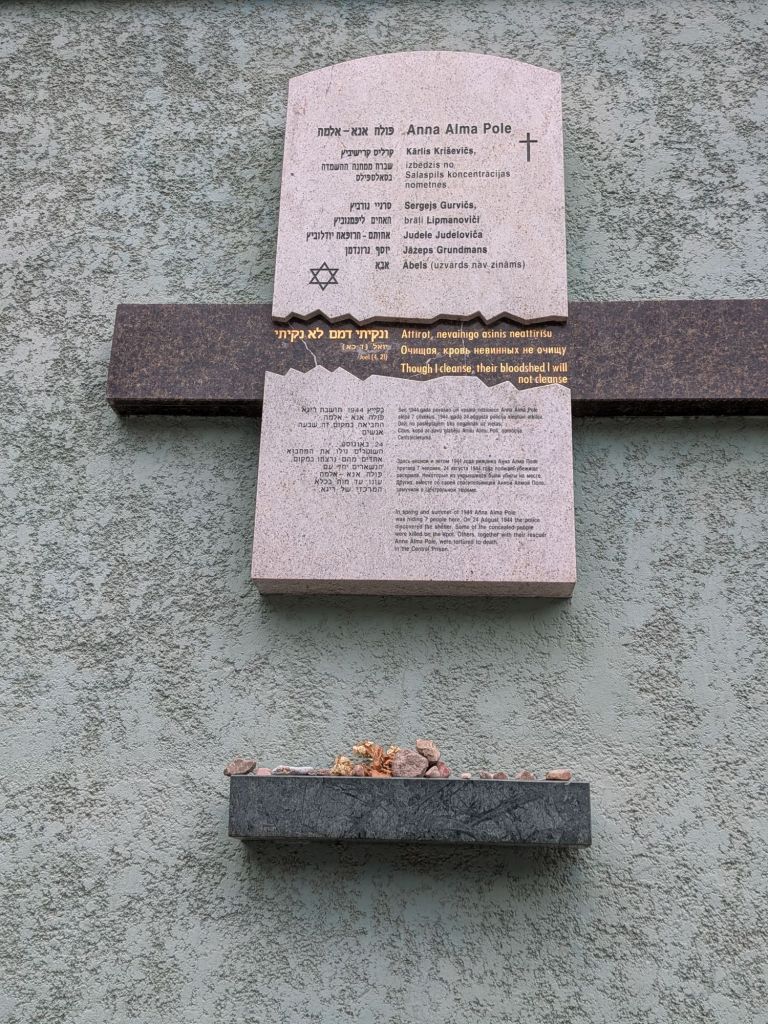
In Riga, the capitol of neighboring Latvia, Jewish markers continued to find me. On the building next to my hotel is a memorial marker for someone who saved Jews during the German occupation, and around the corner stands the synagogue. Also, during a walking tour of the city, I met Dimitri and his son Shiloh, reconnecting with their Jewish Latvian roots.
Day two began with beautiful sunshine. The first for days, we were told.
We met our guide Tomasz where we left off yesterday, outside the POLIN Museum.
The Heroes
The Monument to the Ghetto Heroes was dedicated in 1948, 5 years after the ghetto uprising. The relief sculpture features a heroic central figure that Szymon compared to a socialist realist superhero. Most of the figures around him are young, as were most of the ghetto uprising fighters. Behind the central hero floats a woman with her breast exposed holding a baby, perhaps symbolic of Matka Polka–the idealized Polish mother, though perhaps also reminiscent of Madonna and the Christ child. The image emphasizes the heroism of the ghetto fighters. This is the best known side of the monument.
The relief on the back paints a different portrait of suffering and oppression. A line of robed figures tread heavily with down-turned faces. On this side, the central figure looks like a rabbi; he’s older with a flowing beard, holding a Torah scroll in his hand. The helmets and bayonets of Nazi soldiers hover above the line of hunched figures. Szymon pointed out the glittering black stone along the front of the platform, intended for a Nazi monument that never was built, and repurposed by survivors as a symbolic act of defiance.
The oppressed
We continued along the trail of the ghetto heroes, recognized on a series of metal cubes, then stopped at 18 Miła Street, where a dirt mound and monument mark the location of a bunker where ghetto heroes and civilians chose suicide rather than death at the hands of the occupiers.
These weren’t the only Jewish leaders who committed suicide. Judenrat leader Adam Czerniaków took his own life when he realized he couldn’t stop the final removals of ghetto residents to the death camps. Szmul Zygielbojm, a Jewish representative in the Polish government in exile, died by suicide after he learned the details of the murder of the Jewish people back in Poland. I wonder what my students think of this. It seems that for many Americans, suicide is an individual choice, not one motivated by a sense of collective grief or defiance. We aren’t facing down genocide, either…
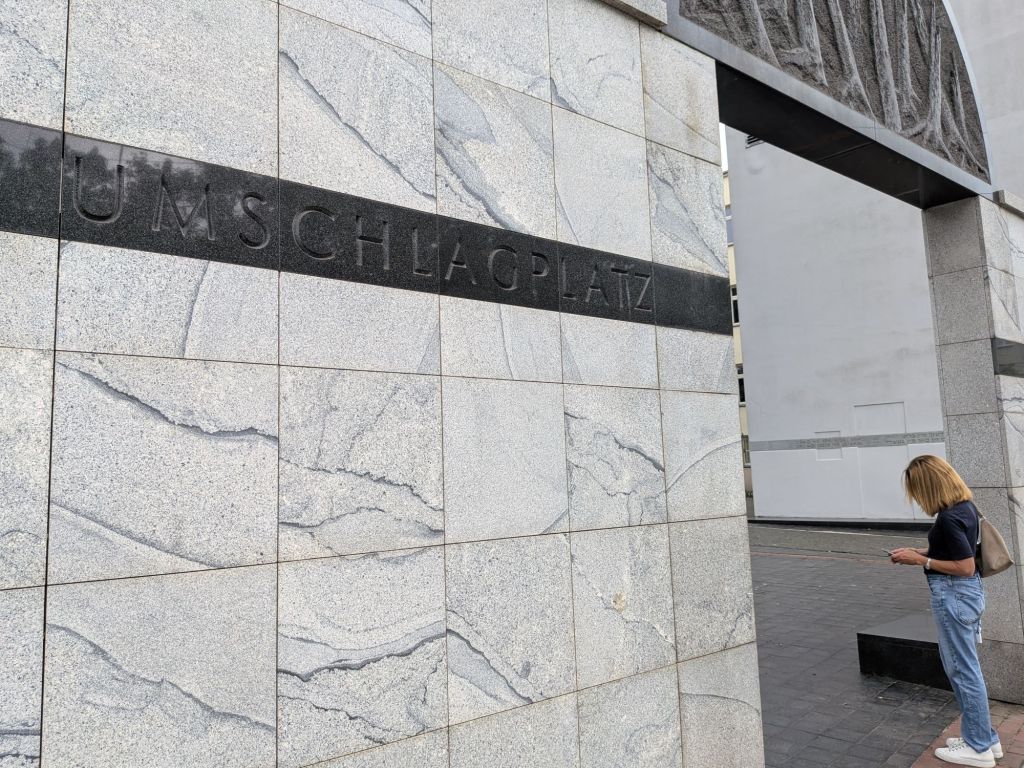
We continued on to Umschlagplatz, where captives were gathered for transport to the camps.
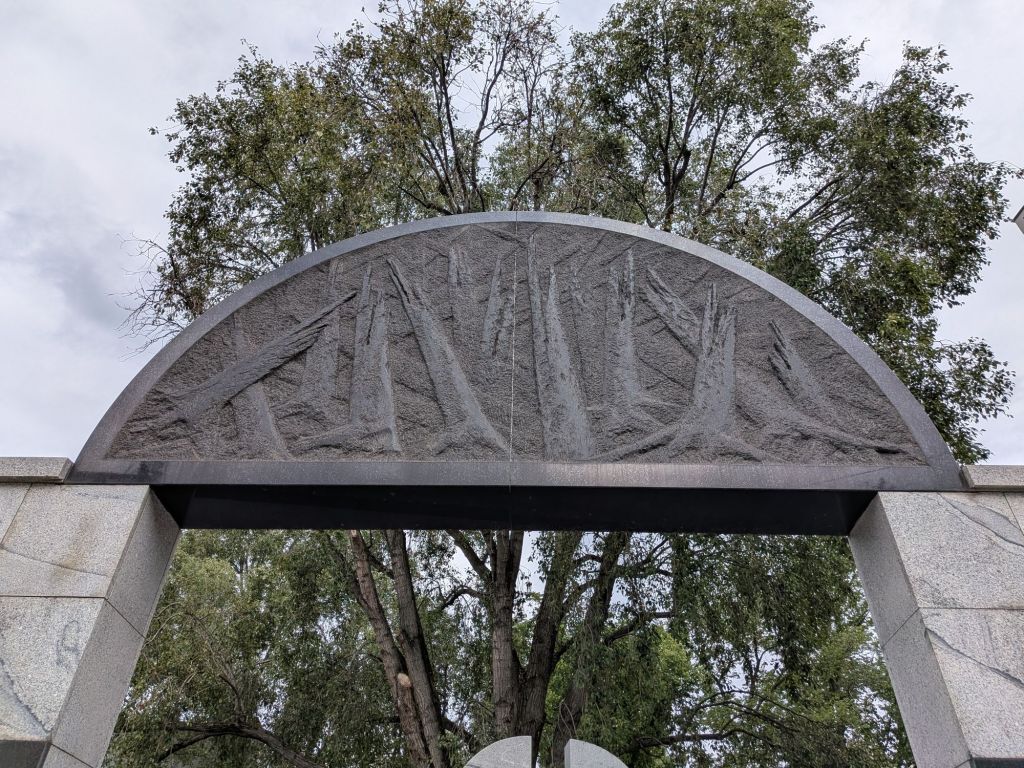
The broken trees on a tombstone-like feature symbolizes untimely deathThe tree behind the break in the wall symbolizes life
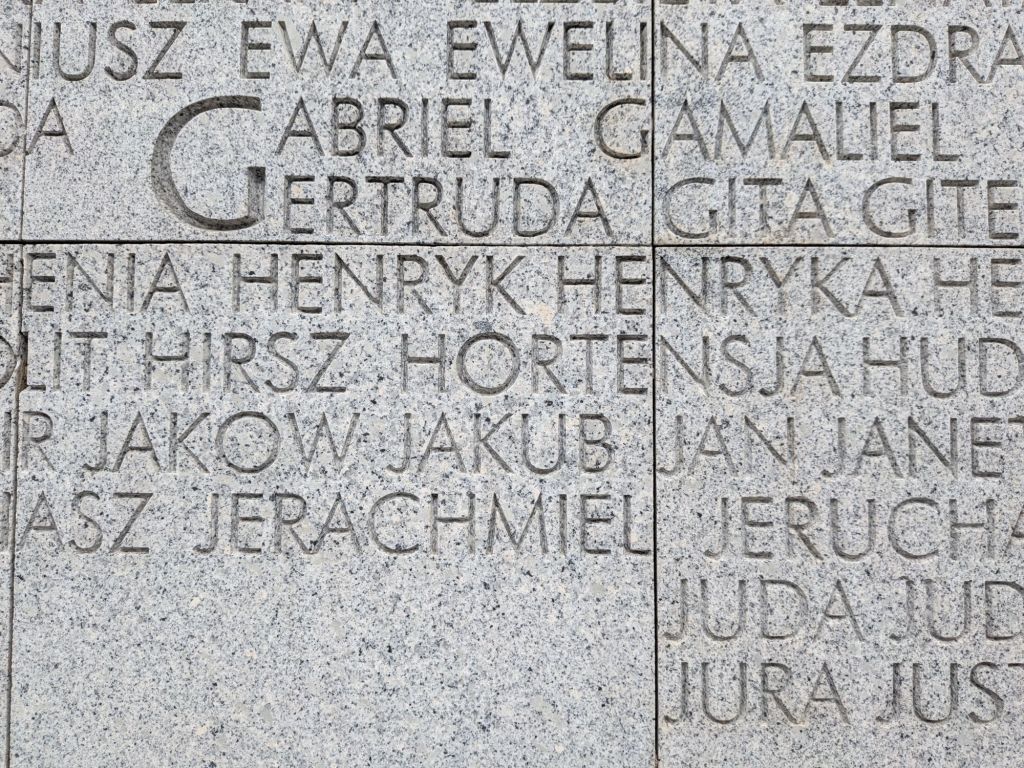
The walls inside are inscribed with the first names of victims. I took a photo of Jakub in memory of my grandfather Jakub Rotblit and my grandmother’s brother Jakub Piwko, both of whom died in 1942, likely victims of the Holocaust
Jakub among the names of victims
We finished our tour at the Jewish Historical Institute, where many of the victims’ personal words are displayed along with one of the milk cans where Ringelblum hid the archive documenting life in the ghetto. Some of the saved documents are on display, including poetry, personal accounts, and official reports. One listing the number of victims in different towns says there were 3500 in Żychlin and 6500 in Kutno.
As we departed, thunder rumbled, the sky opened up and rain turned to hail.
Some of the students with our guide right before the hail came down.
“Is the weather always like this here?” a student asked. “No,” I replied. “That was really unusual.”
Żychlin mayor Grzegorz Ambroziak sent me photos of daffodils blooming around the memorial to the city’s Jewish community. These flowers, planted by local school children, are a symbol of remembrance. Daffodils are also associated with the upcoming anniversary of the Warsaw Ghetto Uprising, which started on April 19, 1943.
These small markers of remembrance matter. They offer a time and place to contemplate what used to be, what was lost.
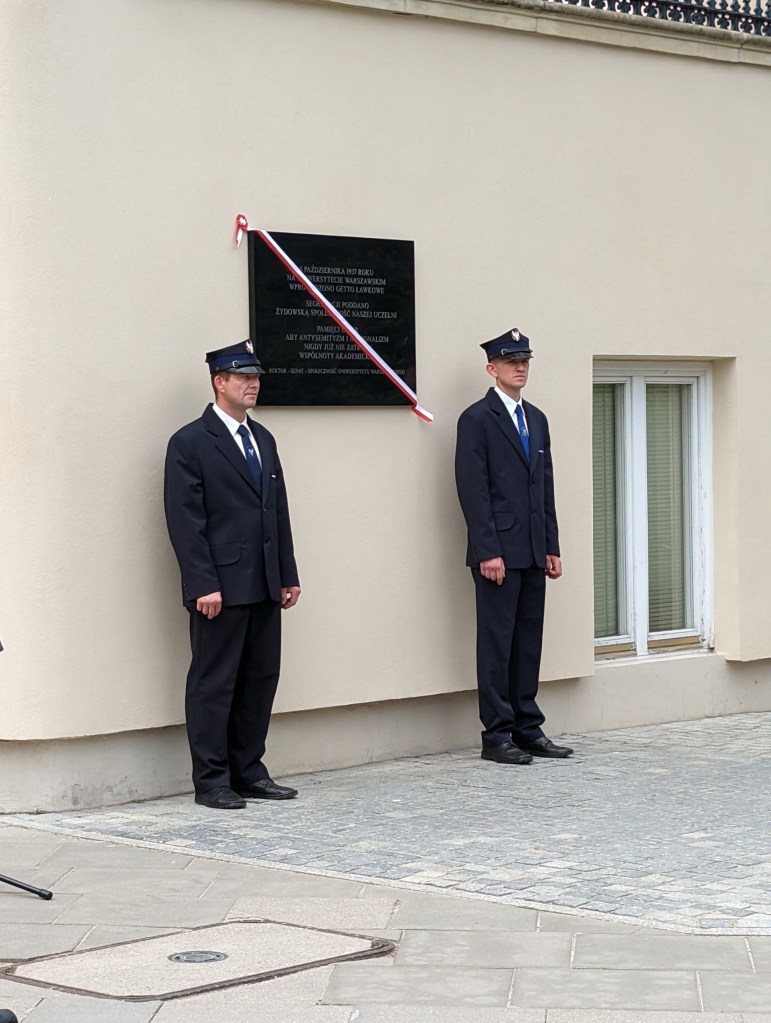
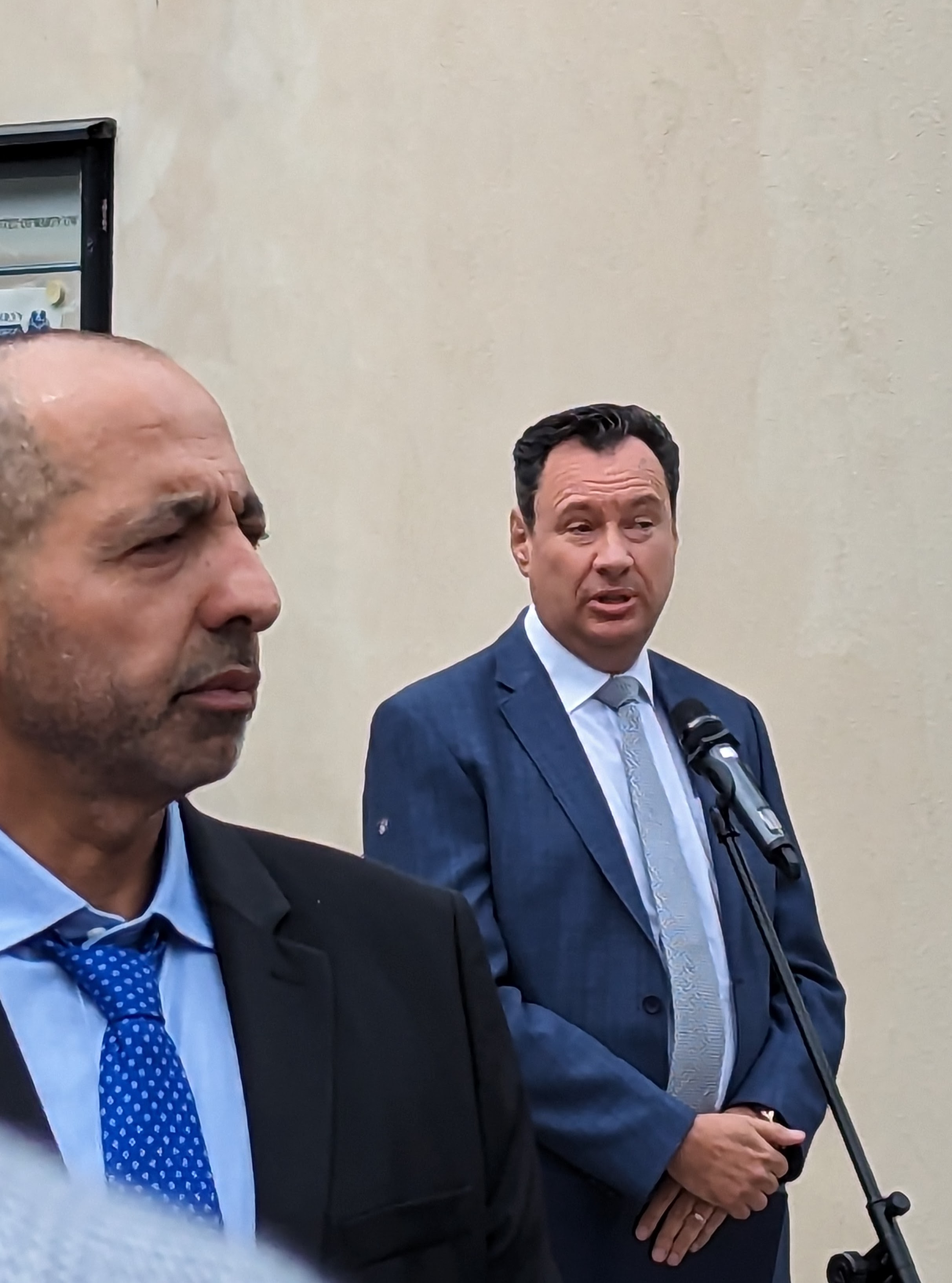
A dark stain in the history of Warsaw University was the decision to follow a nationalist trend in the 1930s and mandate segregated seating for the university’s Jewish students. Over 80 years later, a student-initiated campaign resulted in a permanent, public acknowledgement of this institutionalized discrimination. On May 22, University Rector Alojzy Nowak and Israeli Ambassador Yacov Livne dedicated a commemorative plaque before a crowd of about 200. Dignitaries, scholars of Jewish history and culture, and prominent members of Warsaw’s Jewish community gathered behind a red retractable belt barrier under the watchful eye of an Israeli guard, while a younger crowd of students and onlookers looked on from the other side.
Commemorative monument before the ceremonyDignitaries behind the red barrier belt. Journalist Konstanty Gebert on rightThe red barrier
I learned about the event serendipitously, when fellow ADJCP board member Ken Drabinsky invited me to accompany him to the Warsaw University Department of History to donate a copy of the self-published autobiography of Henry Balaban, nephew of renowned historian Meir Bałaban. I accompanied Ken as he presented the book to Łukasz Niesiołowski and Marzena Zawanowska at the Department of History.
Ken Drabinsky presenting Marzena Zawanowska, and Łukasz Niesiołowski with Henry Balaban’s autobiography
The commemorative ceremony began with songs in Yiddish performed by students from the Multicultural High School of Humanities named after Solidarity hero Jacek Kuroń, followed by predictable remarks by the rector and the Israeli ambassador about the need for unity across cultural and religious differences and the importance of remembering the dark as well as light moments in history. Both celebrated the university students who initiated the project.
Israeli Ambassador Yacov Livne with his security detail
The audience’s enthusiastic applause was reserved for the third speaker, Antonina Dukowicz from the Student Antifascist Committee. It didn’t come in response to her diplomatic discussion of the five years it took to persuade the administration and work out the appropriate language for the marker. Rather, the crowd responded to her expression of support for the Institute of Philosophy and Sociology at the Polish Academy of Science, which is under attack by the government because of the work scholars are doing there that highlights some of the less noble behavior of Polish people against Jews during the Nazi occupation. The specific trigger for the latest attack was a brief comment by Holocaust Scholar Barbara Engelking that “Jews were unbelievably disappointed with Poles during the war.” The remark caused such a strong reaction because it challenges the official narrative that Poles helped the Jews more than any other nation and that they couldn’t do more because they were under occupation and subject to persecution themselves.
The student speaker called the commemorative marker a symbol that sheds light on the current darkness in Poland, and urged viewers to let it be a model for remembering the difficult truth. She ended with a call to cut out all kinds of antisemitism and oppression, so that it is never repeated. The final applause erupted, falling into rhythm as it continued.
Some commentators criticized the university for failing to issue an apology, or for not making a bolder statement. I’m impressed by the way Antonina Dukowicz connected historical discrimination with contemporary political battles, and the way those in attendance affirmed those connections. Battles are being fought here to acknowledge the less noble moments in Polish Jewish history and to reaffirm values of unity and diversity.
October 5, 1937 at the University of Warsaw the bench ghetto was introduced; Segregation was given to the Jewish community of our academic institution; In memory of the victims so that antisemitism and nationalism will never again poison the academic community; rector-senate-community of the University of Warsaw
Report #16 about Roberta Books and Marysia Galbraith’s trip to meet Polish partners in preparation for the ADJCP‘s memorial visit to central Poland.
Chodecz, September 15
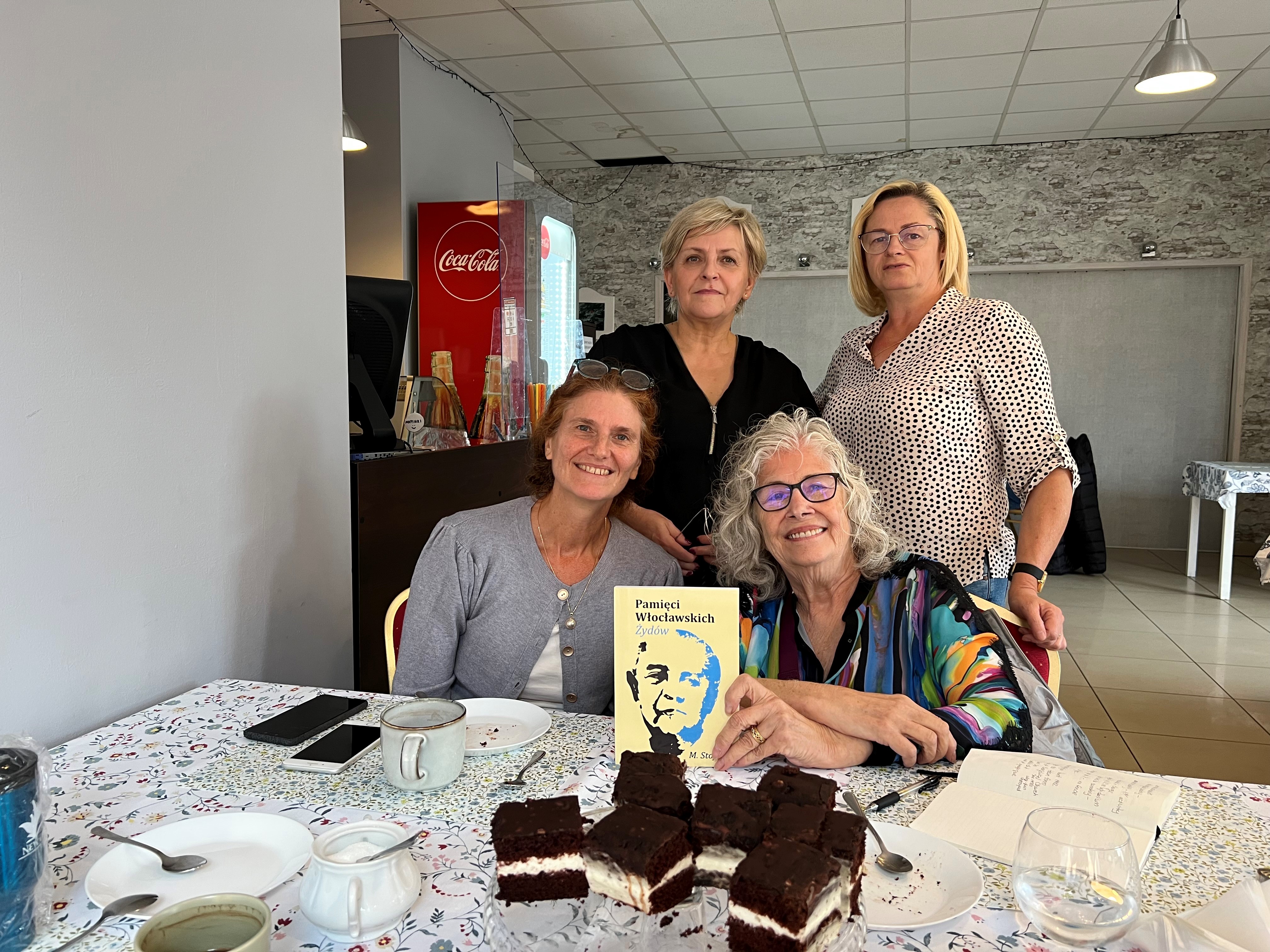
We met Irena Grabowska and Joanna Modrzejewska of the Brotherhood of Lovers of the Chodecz Region (BMZCh, Bractwo Miłośników Ziemi Chodeckiej) in a restaurant called Stara Gospoda located at Plac Kościuszki in the center of town. We ate large squares of homemade chocolate cake with tiny spoons while Irena and Joanna told us about their organization, which was founded in 2009. Irena is the vice president. The president, her husband Grzegorz, had another commitment that afternoon.
Irena Grabowska and Joanna Modrzejewska standing, Marysia and Roberta sitting. Notice that cake! Roberta is holding up Remembering Włocławek Jews, Mirka Stojak’s latest book which Irena and Joanna showed us
Over the years, the BMZCh has organized a variety of activities as part of their effort to inform residents about the fate of the Jewish community during World War II, including trips to the death camp at Chełmno nad Nerem where most Jews from this region perished.
They told us the prewar Jewish population of Chodecz was comprised of craftspeople and traders mostly, though there was one doctor. The BMZCh has done research on Jewish survivors, including Roman Halter, a sculptor and artist who was born in Chodecz in 1927. He wrote a memoir called Roman’s Journey. Other Jewish survivors include Sala Lubieńska, whom they have interviewed. Her two daughters visit sometimes. In addition, three sisters named Nadja, Henia, and Sala Pinczewska all went to Australia. The son of one of the sisters, Jeff Katz, has visited from Australia.
Their most tangible efforts have involved the preservation of the Jewish cemetery. We drove a short distance to see it. In 2011, the BMZCh mounted a sign outlining the history of the cemetery and the Jewish community, written in English on one side and in Polish on the other. The English side remains in good shape, but the Polish side is cracked and faded from time, sunshine, and weather.
The BMZCh installed a sign outlining the history of the cemetery
In 2012, they added a commemorative boulder up the slope near the center of the cemetery.
Commemorative boulder in Chodecz Jewish Cemetery
They placed a row of large stones to prevent cars from driving on the cemetery grounds, and they have also planted small trees along the edge of the cemetery nearest the dirt road, careful to avoid the actual cemetery terrain. A very recent project involved painting the border stones along the path to the commemorative boulder. Irena was not sure that painting the stones bright white was the best idea, but it demonstrates continued efforts to care for the Jewish cemetery.
A special oak tree was planted on the edge of the cemetery groundsStones and boulders protect the cemetery
The next project the organization hopes to realize is a commemorative wall that will incorporate the few tombstone fragments they have recovered. They have drawn up architectural plans and received the necessary approvals from government agencies, but they haven’t been successful in obtaining funding for the project.
Organization president Grzegorz Grabowski sent links to reports on BMZCh activities:
Report #11 about Roberta Books and Marysia Galbraith’s trip to meet Polish partners in preparation for the ADJCP‘s memorial visit to central Poland.
Gostynin, September 13
Our partner for Gostynin and the nearby town of Gombin (written Gąbin in Polish) is Piotr Syska, a high school geography teacher. We met at Wasiak’s Bakery on Gostynin’s main square. Despite intermittent showers, we sat under a tree in the café’s courtyard. Piotr showed us some materials from previous projects he’s worked on as well as the memoir of a Gostynin Jew, Living in the Shadow of Tyranny: How I Deceived the Nazis to Survive the War – The Isaac Kraicer Story, written by Stephan Helgesen on the basis of Kraicer’s recollections. Piotr said that he dreams of translating the Gostynin Yizkor Book into Polish, and also to translate the Kraicer story into Polish.
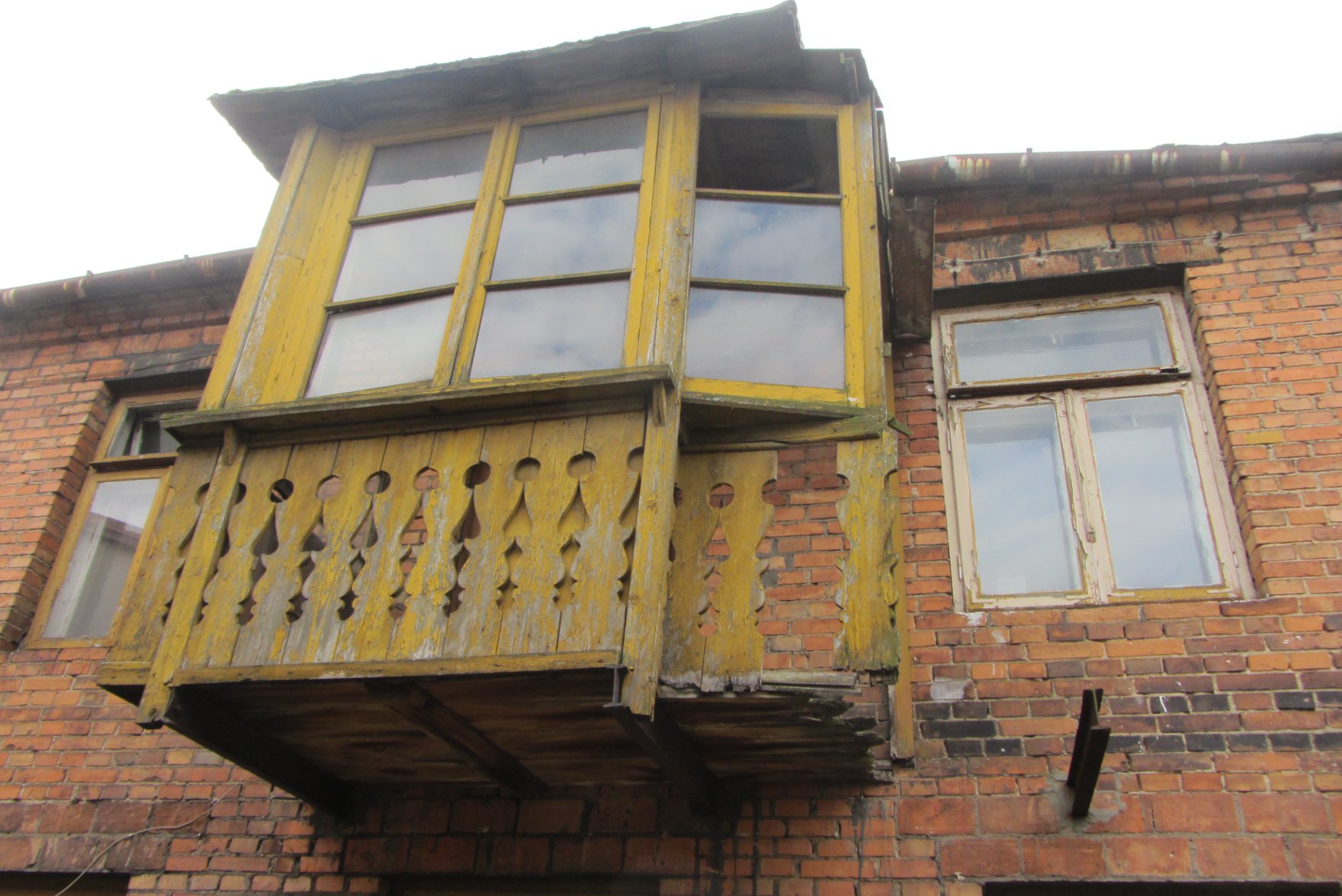
Piotr showed us a surviving kuczka, a narrow wooden balcony that was used by Jewish residents to build their sukkah. We peeked over the garden fence to look at the structure on the neighboring building.
Piotr got involved in Jewish memory projects just a few years ago, in 2016, as he was pursuing his master’s degree. Soft spoken, but clearly devoted and effective, he has accomplished a lot in a short period of time. His wife Elwira teaches English through private lessons. She usually translates for him when he meets foreign visitors, but she had students on this particular day.
Piotr helped Leon Zamosc with the Gostynin and Gombin memorial trip he led in 2019. The trip included a March of Remembrance commemorating the liquidation of the town’s ghetto. It was also documented in a film.
Gostynin is larger than Gombin, with nearly 20,000 residents in contrast to Gombin’s 2500 residents. Piotr noted that Gostynin had been 35% Jewish and Gombin, 75% Jewish before the war. Piotr has mostly done Jewish heritage work in Gostynin, although last year, Gombin placed a marker at the former site of the synagogue.
Despite some challenges, Piotr has completed some exemplary projects. The first is a multicultural historical trail with key locations marked with informational sign boards. He got pushback on the idea of an exclusively Jewish history trail but found support for a multicultural trail recognizing the Jewish, German, and Russian influences in Gostynin, especially in the 19th and early 20th centuries. Notably, many of the signs include texts in German, Russian, English, and Hebrew in addition to the more detailed Polish texts. The first sign on the trail explains:
The project named “Multicultural Gostynin” arose to preserve the memory of the past. We invite you to take a journey on the miniature tourist trail so you can get to know the interesting history of our town and the fate of its residents.
The banner at the top of the sign includes photographs of four houses of worship: the Catholic church, synagogue, Evangelical (Protestant) church, and the Russian Orthodox church. A map shows the location of the ten stops along the trail, three of which focus on the town’s Jewish history: at the town square, the site of the World War II ghetto, and the Jewish cemetery.
Piotr Syska at the start of the start of the “Multicultural Gostynin” trail
The tenth stop takes visitors to Gostynin’s Jewish cemetery, a short drive from the center of town. In addition to historical information in Polish, English and Hebrew, this sign includes information about Jewish cemeteries, written only in Polish: “In keeping with Jewish law, the human body is holy even after death and will stay that way until the Final Judgement. The land in which the dead are laid to rest belongs to them forever.” It goes on to explain proper behavior within a cemetery: men should cover their heads; people should remember the dead by placing small stones on their grave markers. Restricted activities include: any kind of work during the Sabbath; disturbing graves or any kind of digging within the cemetery; eating and drinking in the cemetery; and treating the road through the cemetery as a shortcut. “This is a place for the dead and they deserve respect,” it concludes.
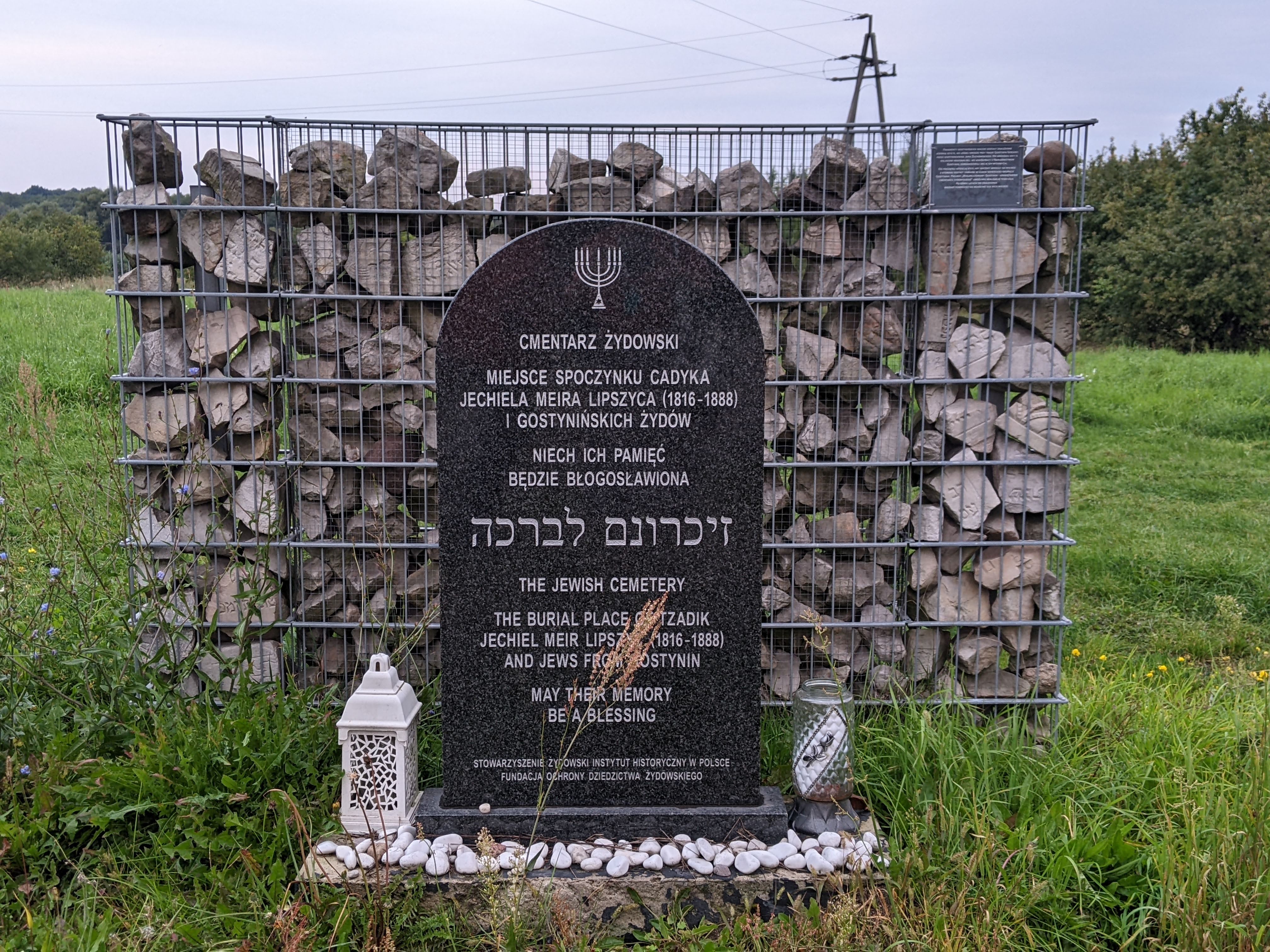
The cemetery grounds are mowed but unfenced. They contain another project Piotr helped realize: a commemorative monument composed of matzevah fragments piled within iron mesh. Both projects were officially opened on September 20, 2018 with Israeli ambassador Anna Azari, mayor Paweł Kalinowski, and descendants of a holocaust survivor (Jacob and Tomer Naveh) in attendance.
Memorial at the Gostynin Jewish Cemetery
A well-traveled dirt road goes along one edge of the cemetery and provides access to several houses outside the cemetery boundary.
Residents drive over cemetery ground to get to their homes
Piotr said they tried to close that road, but they met with too much local opposition. He communicated his frustration about this with a look and a shrug. Perhaps what he left unsaid is that sometimes you have to settle for what is possible to achieve. Maintaining the goodwill of the local community requires difficult compromises. The final admonition on the sign for the Multicultural Gostynin trail, to respect the dead and refrain from driving over cemetery grounds, serves only as an unenforced request. Hopefully, it will move residents to reconsider their actions.
Report #9 about Roberta Books and Marysia Galbraith’s trip to meet Polish partners in preparation for the ADJCP‘s memorial visit to central Poland.
Koło, September 11
Roberta, Yosef, and I met Koło museum employee Tomasz Nuszkiewicz at the Town Hall, and we walked across the street to the city’s museum of ceramics. Like Włocławek, Koło had factories specializing in faience, tin-glaze ware with painted designs, usually floral motifs. These factories were started by Jewish industrialists, who owned them until they were taken over by the German occupiers during World War II; after the war, they were nationalized by the Polish government.
We sat in an upstairs room at a table, where Tomasz had set out a copy of the Koło Yizkor Book for us, along with copies of a book of town postcards which he gave to each of us. The museum publishes a historical periodical that occasionally has articles about the town’s Jewish community. The room also has a Torah on display; it was found after the war and probably came from a neighboring town. Roberta suggested that based on its modest size, it might have belonged to someone wealthy enough to have a Torah at home.
Roberta, Tomasz, and Yosef at the Ceramics Museum in KołoThe Torah on exhibition in the Koło museum
We walked back past the Town Hall, which has a plaque mounted on its back wall inscribed in Hebrew, Polish, and Yiddish:
In the years 1939-1943 German occupiers murdered about 5000 Jews, citizens of the city of Koło. Honor their memory! The community and city council of Koło, September 1, 2009.
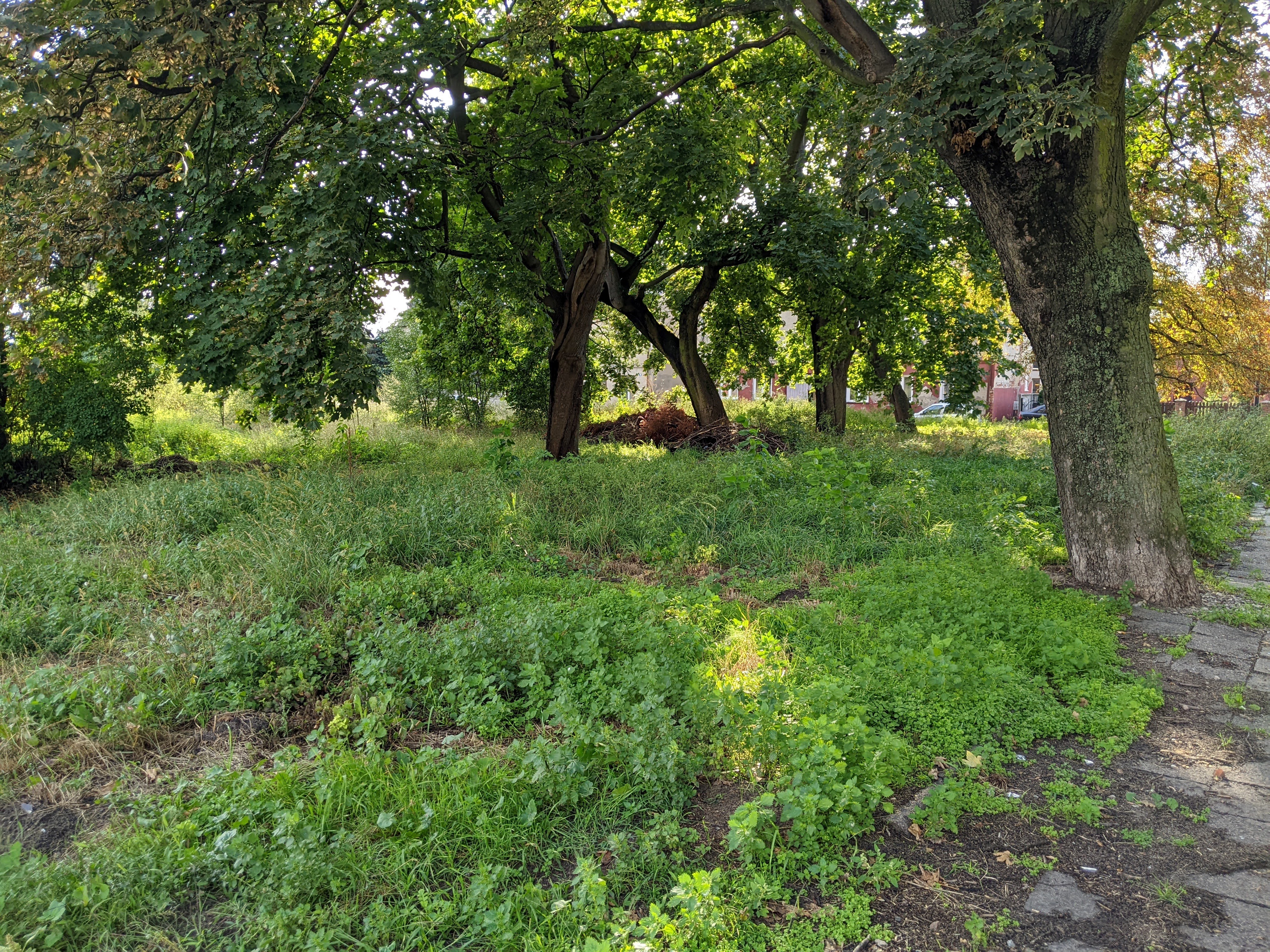
We continued another block to the former site of the synagogue, an overgrown lot with a pile of organic debris under some trees. The site is owned by the Jewish Community in Wrocław, but they don’t maintain it. Tomasz said maybe the city should clean it up, but they rarely do because it is not their property.
These issues of ownership are fundamental and challenging. How do you maintain property when the owners are absent? Who has the rights? Who has the responsibility? What is legally mandated and what is morally correct?
Location of the Koło synagogue, now an undeveloped, overgrown lot
A commemorative monument sits behind a fence in a square filled with trees, walkways, and grass across the street from the synagogue site. A plaque on a tall boulder reads (in Hebrew, Polish, and Yiddish):
Next to this place stood two synagogues built in 1860. The Nazis destroyed the larger synagogue and turned the smaller one into a resettlement point.
Inscribed in metal along the base, it reads:
In the years 1939-1943, Nazis resettled about 7500 Jews from Koło and the surrounding area to camps of torment and murder. Honor their eternal memory.
The buildings all around the square used to be owned and occupied by the Jewish population. Without clear ownership after the war, the city took over their management and rented them to people in need of social assistance. The same thing happened to Jewish property in Włocławek and other cities throughout Poland.
Monument recognizing the site of the former synagogue in Koło
We continued by car to the Jewish cemetery, which is on the other side of the river on a hilltop behind the community center. A fence surrounds the cemetery, which can be accessed through an unlocked gate. The front section is covered with with trees and grass, and the cemetery extends across a grassy field. The city maintains this site because they own it. They keep the grass cut. Under the trees, a brick wall adorned with a Star of David pattern serves as a monument, with a plaque saying “The cemetery was destroyed by Nazis 1940-1943 and the Koło municipality 1945-1968; Koło June 24, 1993.”
Three matzevot, the only ones that have been recovered, lie on the ground in front of the wall.
Monument in the Koło Jewish community. One of the remaining matzevot lies in the grass in front of it.
As we left, Yosef commented that of all the towns we have visited so far, Koło has probably done the most to protect their Jewish cemetery. It has a fence all around it, a commemorative memorial, and benefits from regular maintenance.
Report #8 about Roberta Books and Marysia Galbraith’s trip to meet Polish partners in preparation for the ADJCP‘s memorial visit to central Poland.
Chełmno nad Nerem, September 11
On September 11, we started the day at the Chełmno Death Camp. Though the parking lot was full, the camp itself was empty. Most people were in the neighboring church. It was Sunday. The mass, emitted from speakers outside the church, wafted across the remains of the death camp.
No English-language guide was available, so the woman at the office/ticket desk showed us around herself.
The camp is on the site of a former pałac, or mansion. Prisoners would be told it was a health resort. They were given postcards and encouraged to write home that they were safe and taken care of. Then, they were told they needed to wash before entering, which made sense to many because diseases like typhus were common in the ghettos they came from. Prisoners were brought to the basement of the mansion to undress. They were instructed to fill out inventories of the valuables they had with them and then hand everything over for safe keeping while they showered. They were told they can present their inventory later to get their valuables back. Instead, they were murdered.
Map of the mansion at Chełmno. “E” marks the location of the trucks converted into gas chambers.
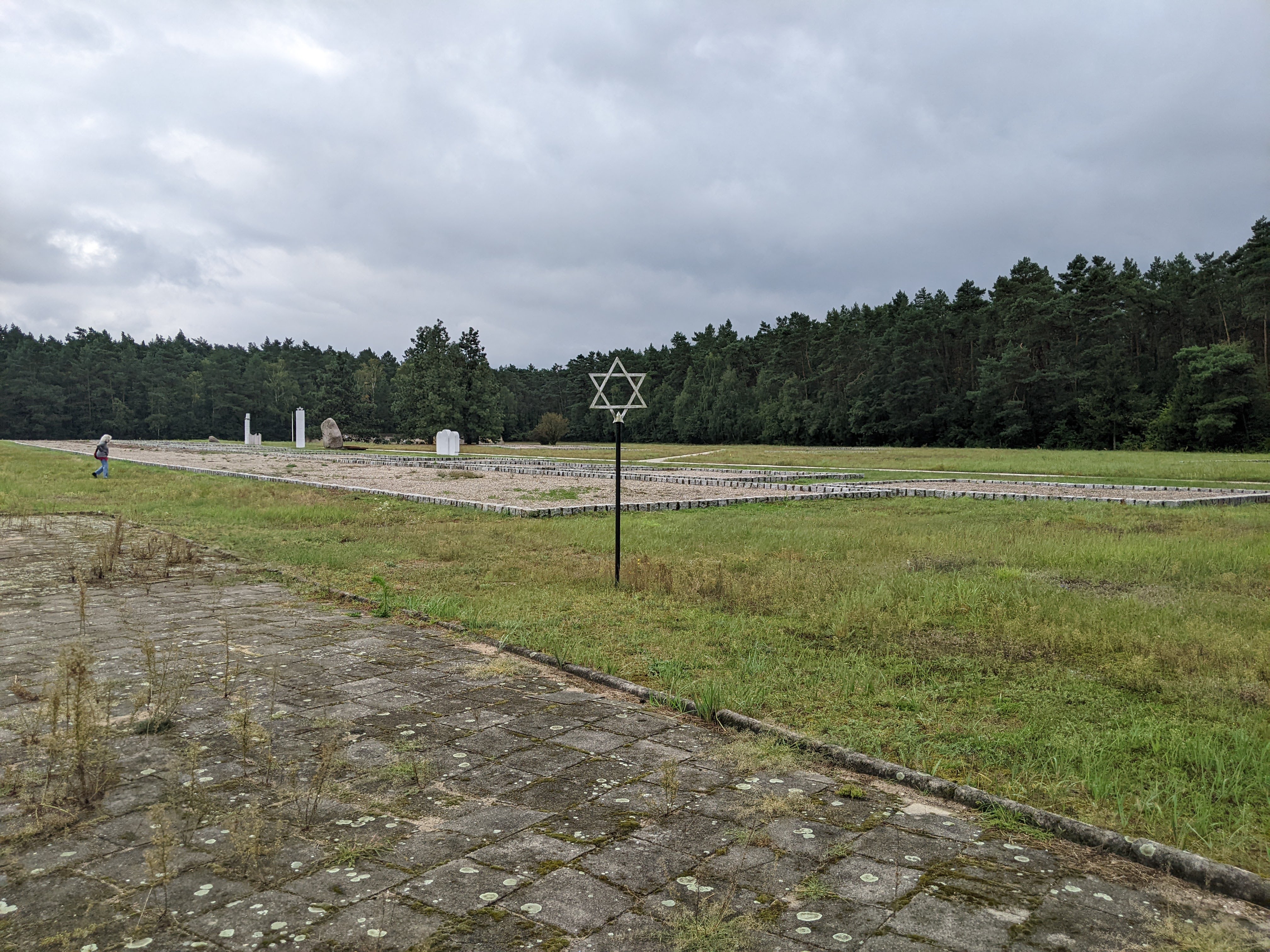
The Nazis destroyed the camp when they retreated. But the outline of the mansion’s basement walls remain. We walked along a raised walkway and looked down into the spaces where people undressed and then were led down a corridor and outside into a truck set up with what looked like shower heads inside. Sometimes, prisoners were even given slivers of soap as they entered. In actuality, these trucks were designed for mass murder, their backs converted into the Nazis’ first gas chambers. Up to 100 people were gassed at a time and then prison work units would remove the bodies, which were taken by truck to the forest about 7 km away. Initially the bodies were buried, but later they were burned and the ashes buried.
They knew that what they were doing was wrong. Why else would they destroy the evidence?
At the burial site in the forest, I needed space to be with my own thoughts. I walked alone under an imposing Communist-era concrete monument balanced on tapered concrete supports. On the side facing the road is a bas relief of people in various states of suffering, with the single word “We remember” (“Pamiętamy”). On the back side, in uneven block letters, is written, “We were taken, from the elderly to infants, between the cities of Koło and Dąbie. We were taken to the forest and there we were gassed, shot, and burned…Now we ask that our future brothers punish our murderers. The witnesses of our oppression, who live in this area we ask again for these murders to be publicized throughout the world.”
Communist-era monument at Chełmno Death Camp
At some point, the Communist leaders made a point of building commemorative monstrosities like this. There is another one at the Stutthoff Concentration Camp near the Baltic coast.
I caught up with Roberta and Yosef when we got to a big field of mass graves. “This is the most important place to see,” Roberta said. Otherwise, we didn’t talk about it.
The graves are delineated by concrete borders filled with white gravel. This is to mark the burial sites, and also to prevent bone fragments from moving up out of the ground. People have been known to search for bones here and take them home as souvenirs.
Mass graves marked with stone borders and gravel, beyond the Star of David
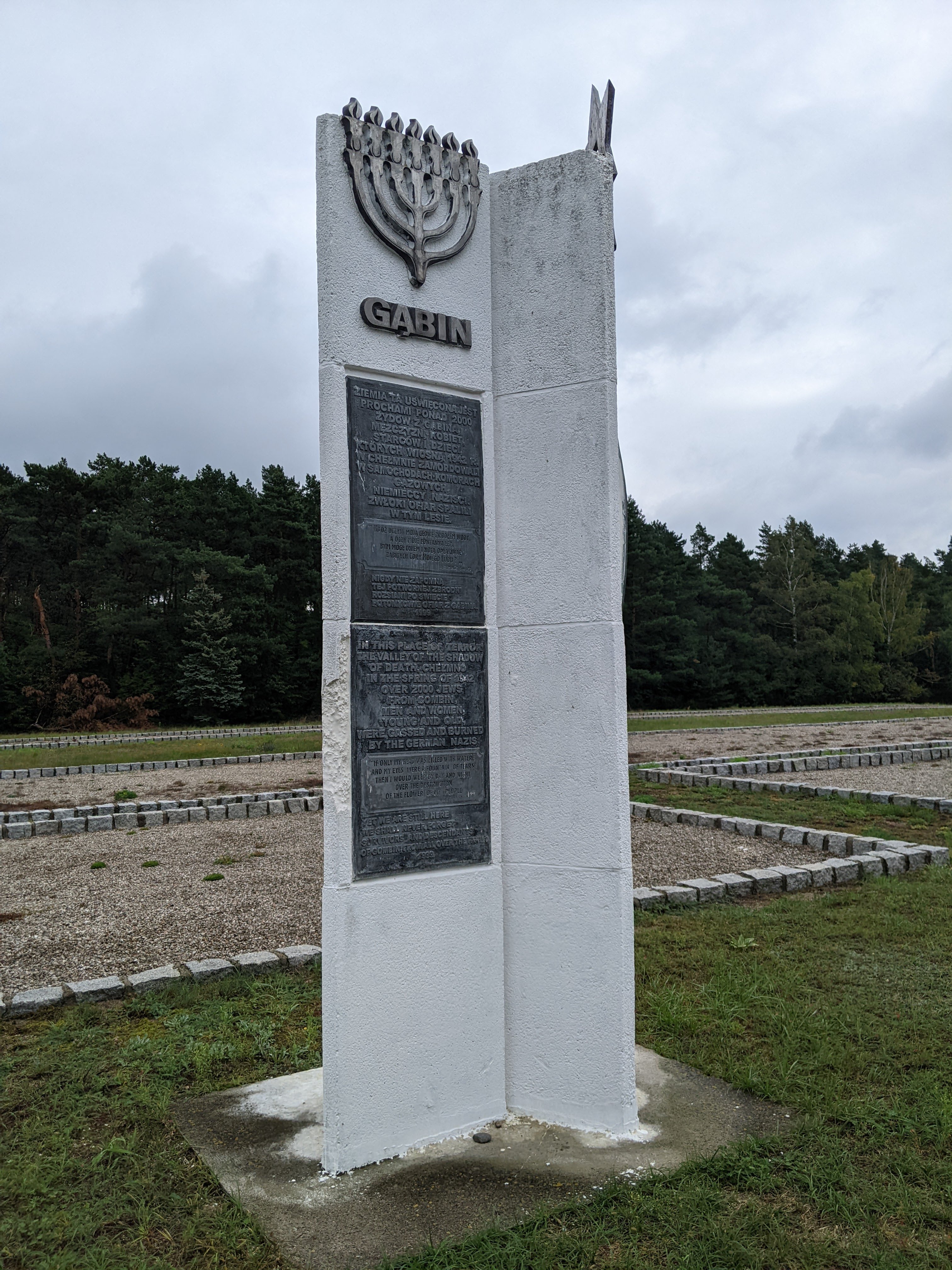
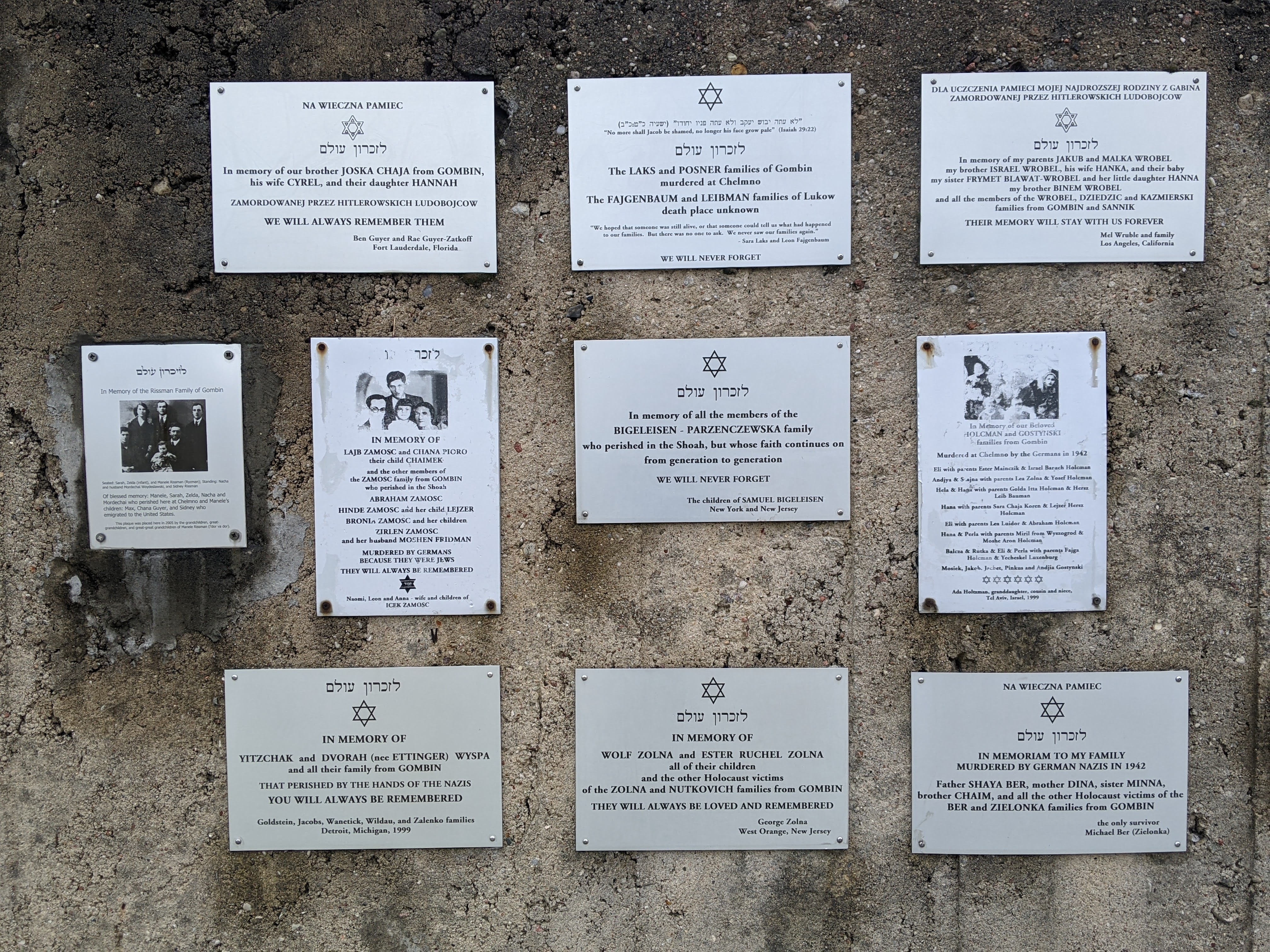
Survivors and their descendants have put up monuments alongside the massive expanses of burials. Some commemorate Jewish communities of particular towns, and some include long lists of the names of those murdered. Near the remains of a crematorium, now mounted in a low concrete wall, is a higher wall with an arched opening. On both sides, smaller plaques were put up by families to commemorate their murdered relatives.
Memorials at Chełmno
Several years ago, a friend told me that people would come here for picnics. As we left, Roberta said there used to be rock concerts near the Communist-era monument, too. What were they thinking? Or, rather, how is it that they weren’t thinking about this as a place of martyrdom and tragedy?
Roberta looks back at the mass graves
Over lunch in Koło, we didn’t talk about any of this. Maybe we just needed a break. Or maybe it was the result of a kind of protective amnesia. If you think about it too much it will just drive you crazy.
Report #4 about Roberta Books and Marysia Galbraith’s trip to meet Polish partners in preparation for the ADJCP‘s memorial visit to central Poland. Reports include contributions by Roberta.
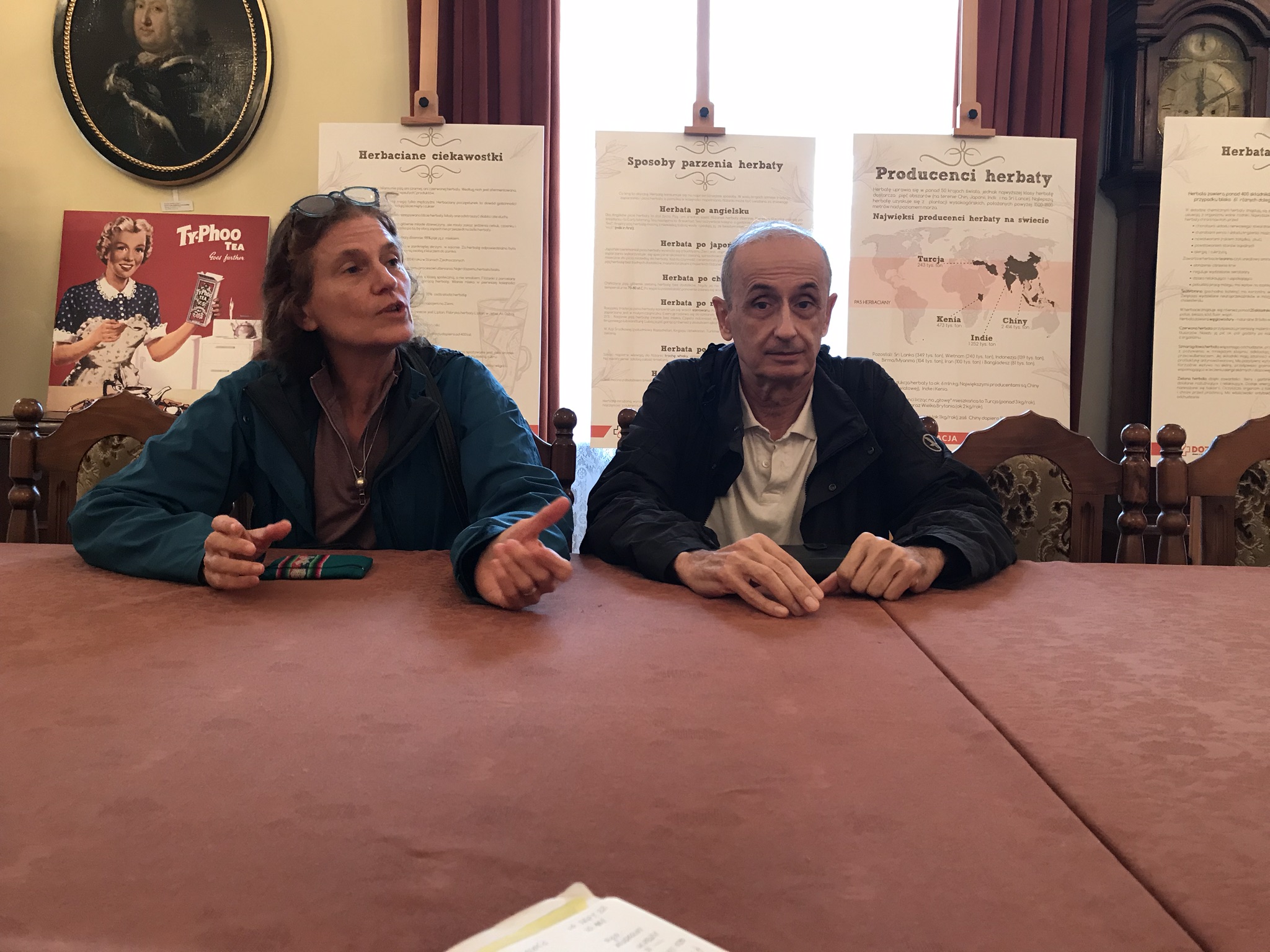
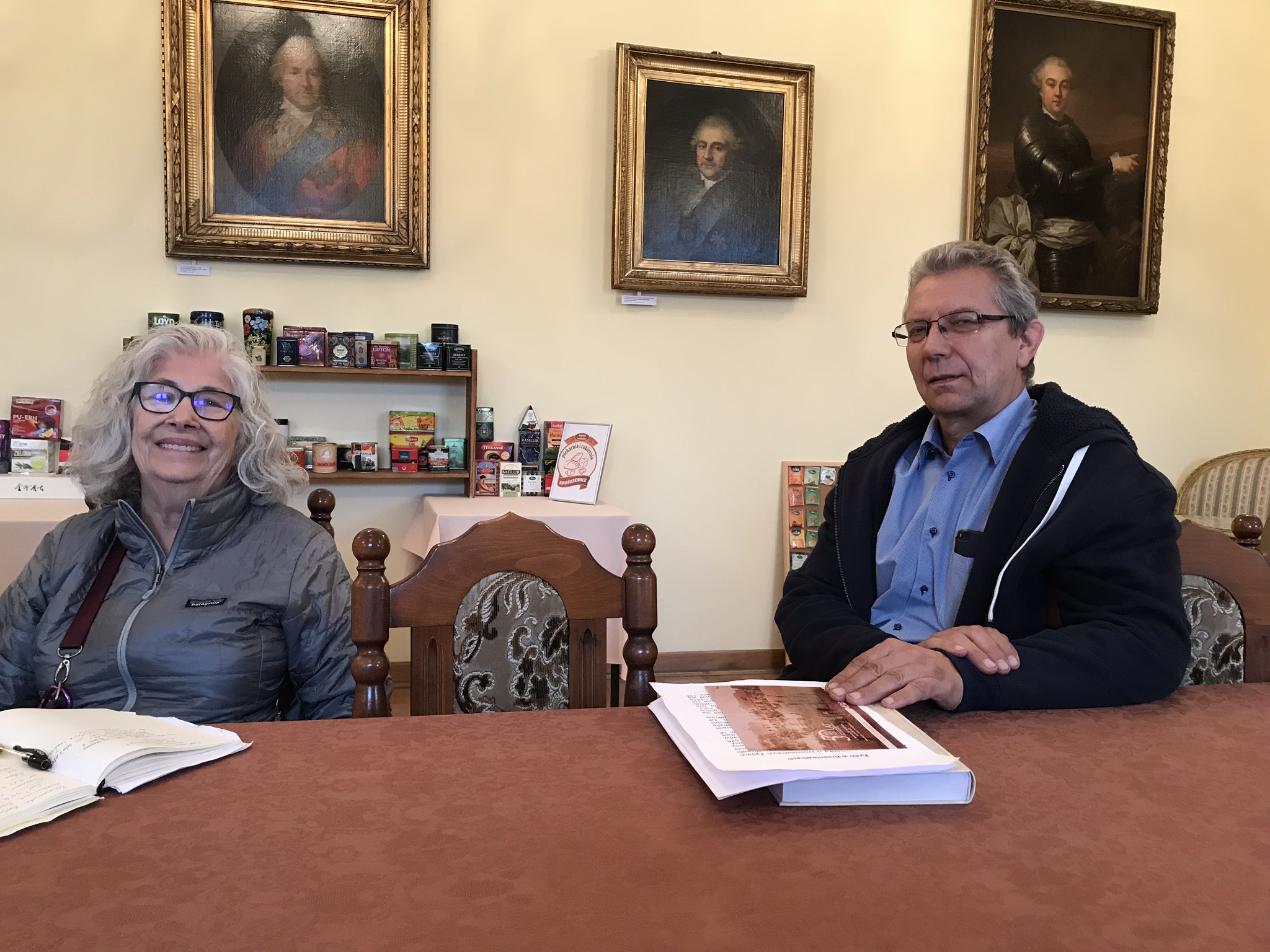
Krośniewice Mayor Katarzyna Erdman, Sławomir Mikołajczyk, and his son Adam Mikołajczyk stood on the side of the main road from Kutno, sheltered from the rain under two umbrellas. Sławomir, a member of the Krośniewice branch of the Friends of Kutno (TPŻK), works at the city museum, while Adam a City Hall employee, shares his father’s passion for local history. They waited for Roberta, Yosef, and me in the rain so they could start our tour of Jewish sites at a memorial stone engraved with the statement:
People today should bring back the memory of those who are no more
At the 70th Anniversary of the liquidation of the ghetto III X 1942
The Krośniewice Community
2012 (my translation from Polish)
Monument commemorating the Krośniewice Jewish community. Behind the chain-link fence is the synagogue, transformed into a funeral home
They pointed out that the building next to us was the synagogue. For years it served as a movie theatre, but when it was sold in 2004, the new owner converted it into a funeral home. The walls of the synagogue are hidden behind the utilitarian exterior of the current plaster façade.
Adam Mikołajczyk and Mayor Katarzyna Erdman in the Dunin-Burkowski Museum, Krośniewice
During our meeting all participants affirmed their willingness to help organize a half-day event for descendants in May. Our hosts told us about Sol Rosenkranz, a Holocaust survivor who returned to his hometown and built a fence and monument at the Jewish cemetery. They told us that Sol’s son still returns regularly to maintain the cemetery. The mayor had the impression that the town does not have permission to cut the grass themselves. She also said they know about tombstones under roads, including 20 or more in a nearby town. The Jewish cemetery has a few tombstones incorporated into a makeshift monument, and she hopes more can be recovered.
Roberta asked Mayor Erdman what she considers Krośniewice’s biggest challenges. Erdman replied employment and investment. As with so many small towns in Poland (and throughout the world, really) young people are leaving in search of work and a better life. Her greatest task as mayor is finding investors who will build businesses and create jobs. Later, I asked Adam what motivated him to return to Krośniewice. He responded, “Someone needs to stay.” Also, he feels such a strong attachment to the place and its history he decided to try and make a life for himself there.
Sławomir and Adam told us about other Holocaust survivors. 92-year-old Róża Aleksander (now Krysia Nowak) still lives in town. As a young child, she and her mother Saba were hidden by Józefa Dziewierska, a righteous gentile acknowledged for her actions in 1997. Saba’s maiden name was Flaster; her husband’s name was Gabriel Alexander. Their daughter Róża was born in 1931 to Gabriel Aleksander and Saba Flaster Aleksander. During the war, mother and daughter adopted false identities Zofia and Krysia Marczak. Róża, now Krysia Nowak (her married name), used to meet with descendants but is no longer well enough to do so. Her testimony was recorded by the Shoah Foundation.
Another child survivor, (Hanna Kałużna?) lives in Wrocław. She and Krysia remain friends. Hanna used to visit Krysia in Krośniewice, but now that she is in her late 80s she hasn’t been able to.
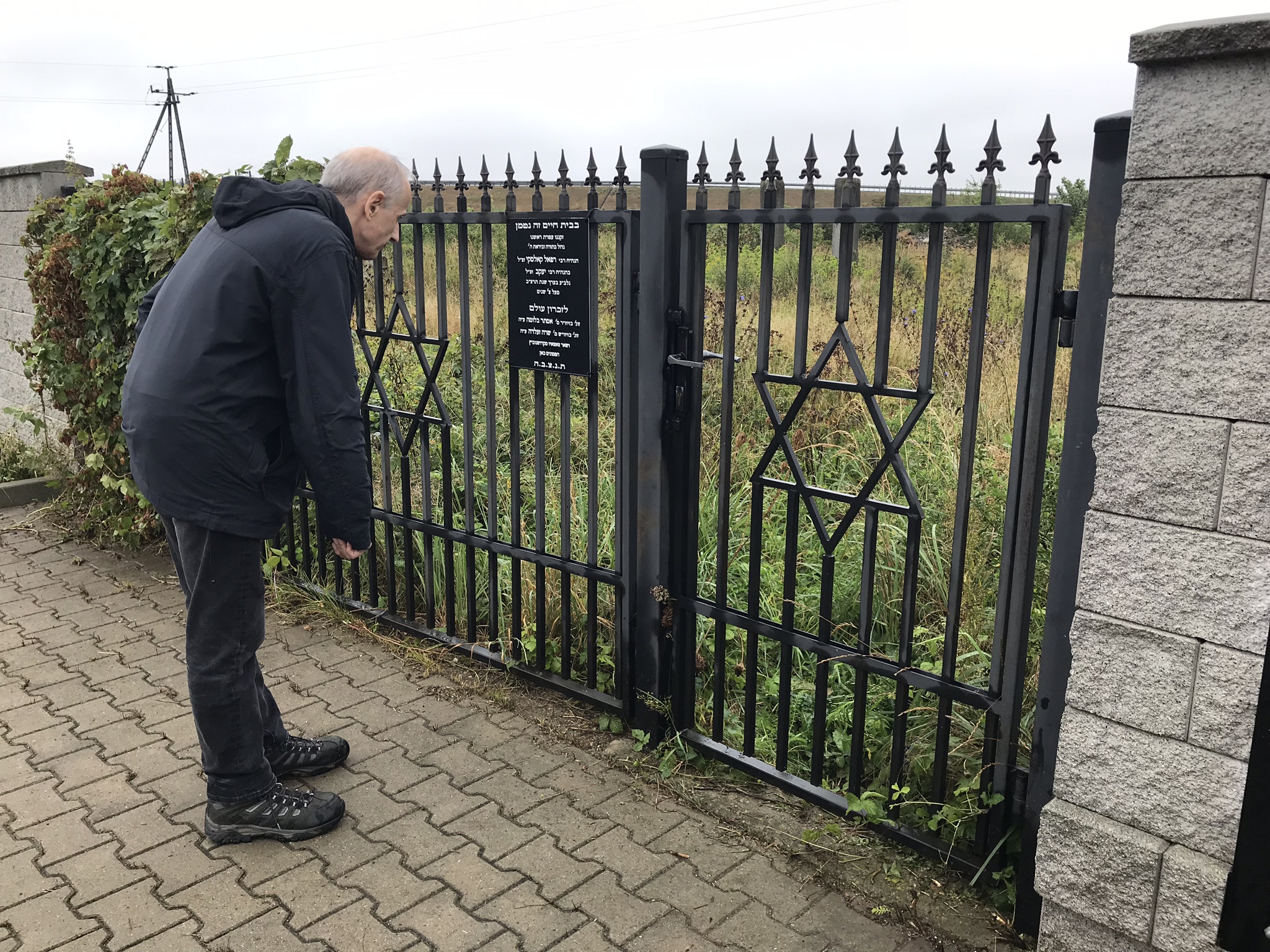
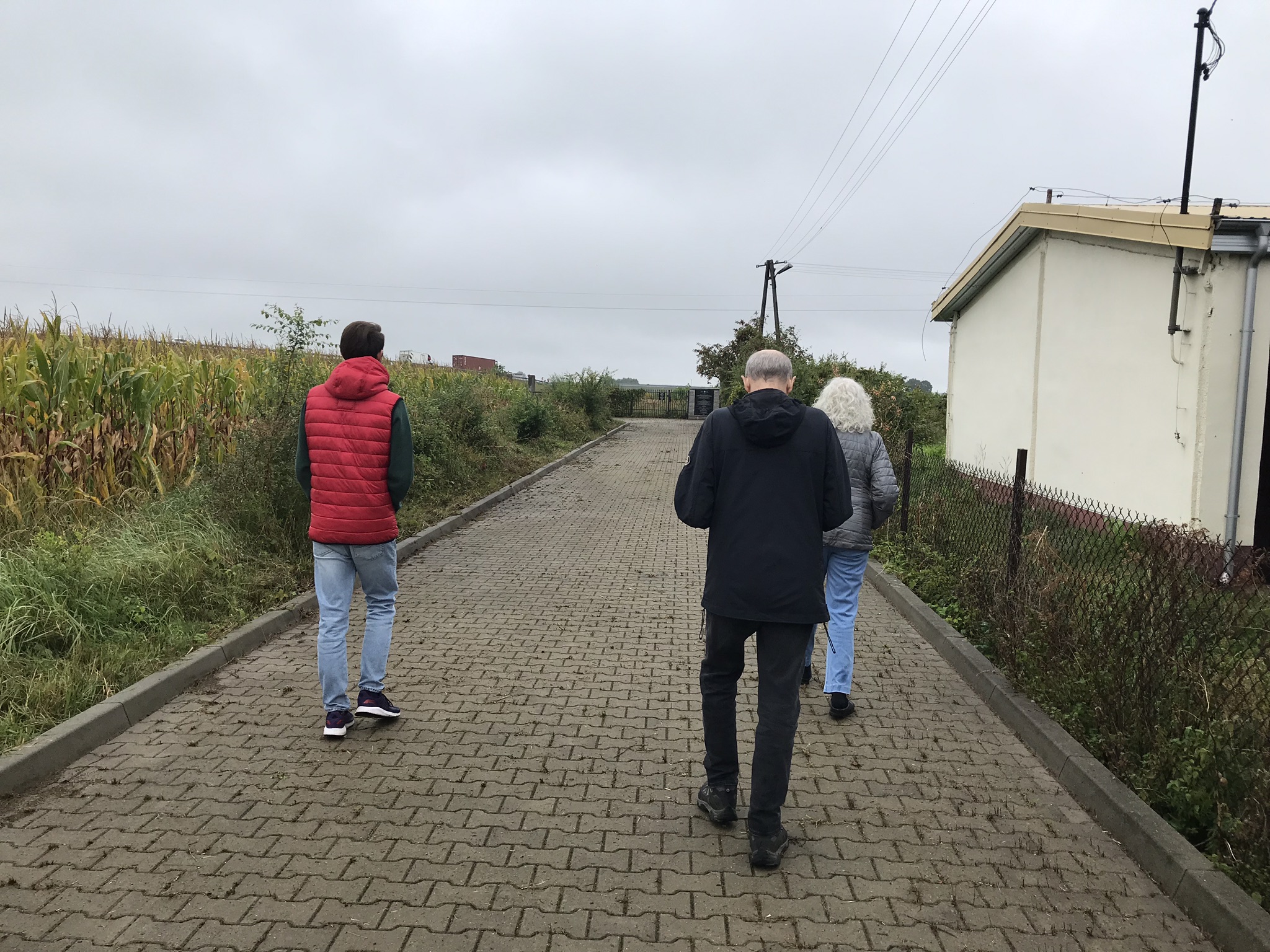
We concluded our visit at the cemetery, which is 900 meters from the center of town. Cars whizzed by on the city bypass running up the slope from the cemetery. A paved drive leads to a metal gate, and a plaque on the right contains a brief history of the city’s Jews in Polish, English, and Hebrew. The Foundation for the Preservation of Jewish Heritage (FODŻ) installed it in 2014.
Jewish Cemetery, Bypass road on the horizonYosef reads the plaque on the cemetery gateMemorial plaquePaved path to the Krośniewice Jewish Cemetery
Only Adam and Yosef ventured through the long grass inside, to the pile of debris that someone topped with matzevah fragments and cynically labelled a monument.
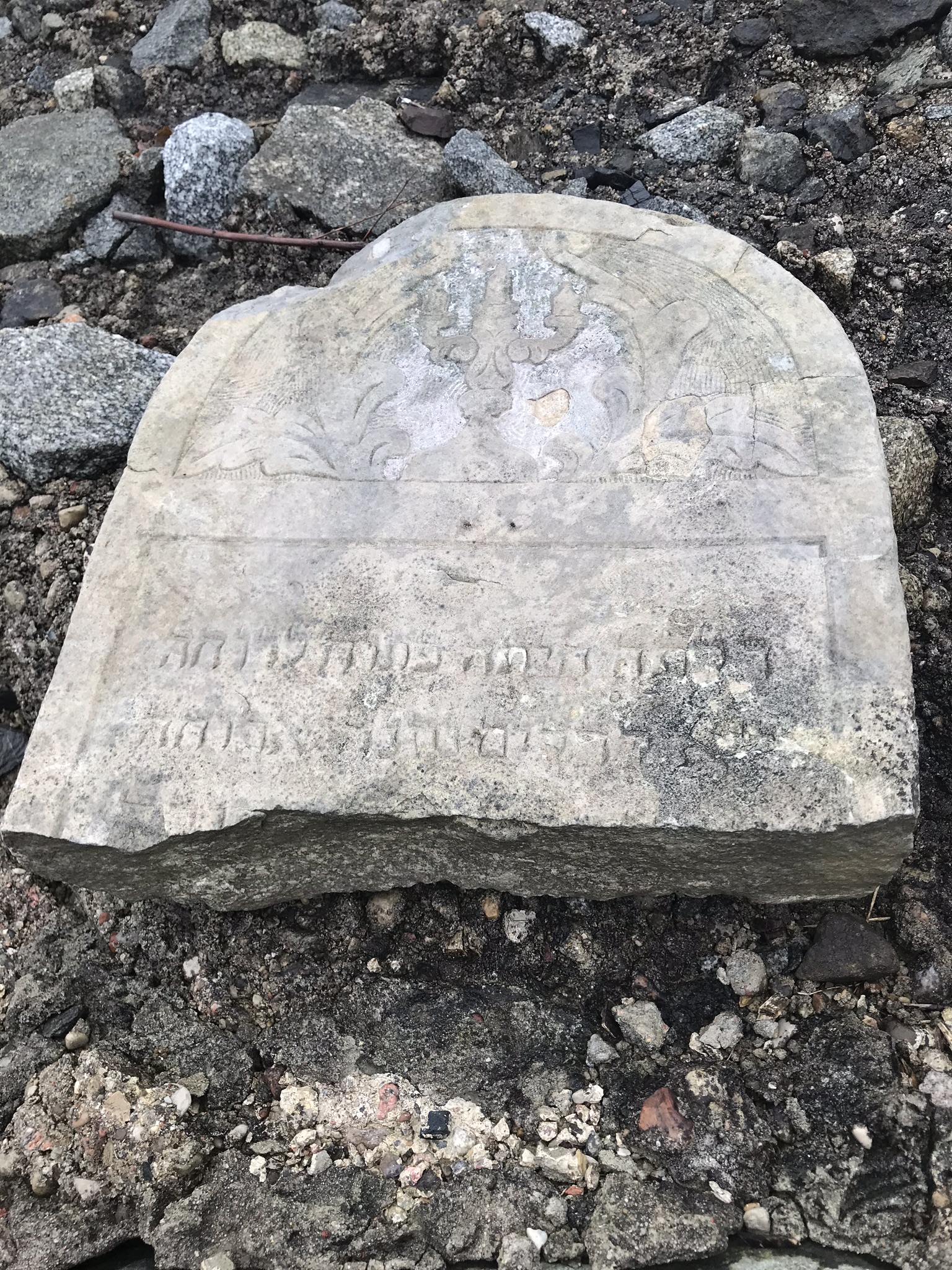
In the 1980’s, an unscrupulous businessman decided the abandoned cemetery would be an ideal place to dump construction debris. His illegal use was reported to the authorities, and he was told to remove the debris. Instead, to avoid the expense of clean-up and a fine, he mounted tombstone fragments atop the rubble and claimed that since it is now a monument none of it can be disturbed.
Adam made photos with my phone, so I can share them here.
Tombstone fragments in the make-shift memorial, Krośniewice Jewish Cemetery
An important update to this report
ADJCP president Leon Zamosc shared what he knows about Sol Rosenkranz and Sol’s efforts to restore the cemetery.
“The initiative to restore the cemetery came from Sol Rosenkranz, a survivor from Krosniewice. He had been born in Grabow, but the family moved to Krosniewice when he was a child. “During the war, Sol Rosenkranz was in six labor camps until his liberation in Theresienstadt. He and one of his brothers were the only survivors of his family. He came to the US in 1946, lived in New York and Los Angeles (where he worked as a volunteer speaker in the Simon Wiesenthal Center), and spent his final years back in New York (where he was an active gallery educator at the Museum of Jewish Heritage in Battery Park). He passed away in 2019 at the age of 101. “After his liberation in 1945, Sol returned to Krosniewice and saw that the Germans had paved the town square with gravestones removed from the Jewish cemetery (all deliberately placed with the inscriptions up). That memory stayed with him for decades. In 2002, Sol visited Krosniewice and found that the communist administration had re-surfaced the town square in the early 1950s. The matzevot had been removed but there was no record of their whereabouts. “In 2013, Sol went to Krosniewice again. At the dilapidated cemetery site, there were only half a dozen fragments of matzevot that someone had cemented together. Sol was not a wealthy man, but during that visit he decided that he would fund the restoration of the cemetery (placement of a fence around the perimeter of the cemetery and installation of an iron-wrought gate with a memorial plaque). The works were carried out by FODZ (the Foundation for the Preservation of Jewish Heritage in Poland) and the dedication took place in 2014.”
Leon also reached out to Sol’s son Joel who tells a slightly different story about the ongoing maintenance of the cemetery.
“When we dedicated the cemetery in 2014 we were hopeful that city officials including the then mayor Juliana Herman, the clergy and teachers would advocate support and maintenance – however that did not materialize.”
Joel also reached out to me with more details:
At the Wiesenthal Center, Sol worked in the library translating Yiddish and Hebrew letters and other documents for families, asking only that they make a donation to the Center in return. He started talking about the Shoah after Joel’s mother Sally died in 1996. He returned to New York and began to volunteer for the Museum of Jewish Heritage even before it had a physical space. He “embraced his role as a witness, speaking to students at schools of all denominations. After the MJH was established, he was a member of the Speakers Bureau for more than 20 years and by their estimate had told his story to more than 10,000 people, one class or group at a time.”
He further explains “Regarding Krosniewice cemetery maintenance, because Nature remained unchecked in that spot for decades, trees and shrubs developed deep roots. According to Rabbinic law as Rabbi Schudrich stated, in clearing the cemetery grounds, it was not permitted to use any heavy equipment that would disturb bodies below the surface. As a result, the tools we used were chainsaws to cut trunks as close to the ground as possible, clippers and weed whackers. Within a year, certainly two, nature asserted herself again and so a program of perpetual care is what is required. Local authorities don’t have any ownership authority, but they could certainly play a helpful, respectful role in maintenance if they wanted.”
Sol Rosenkranz (right) with Rabbi Michael Schudrich at the rededication of the Krosniewice Jewish cemetery
This just goes to show how hard it can be to maintain cemeteries and other memorial sites. Even when all sides approach a project with good will, plenty of room remains for misunderstanding. It is also a real challenge for information to be passed down from one government administration to the next, and from one activist to another.






























 Uncovering Jewish Heritage