• About
  • The Photo that Started it All

Uncovering Jewish Heritage

Uncovering Jewish Heritage

Category Archives: Archives

Testimonies from Żychlin

02 Wednesday Apr 2025

Posted by Marysia Galbraith in Archives, Heritage work, Jewish Ghetto, Memory, Synagogues, Victims and perpetrators, World War II, Żychlin

≈ Leave a comment

Tags

Association of Friends of the Kutno Lands, holocaust, Poland, Towarzystwo Przyjaciół Ziemi Kutnowski, TPZK

As I piece together information about wartime mass burials in the Żychlin Jewish Cemetery, I’m finding other valuable records like this photograph of the Żychlin synagogue:

Synagogue built around 1880. Source: collection of Andrzej Kubiak

The Association of Friends of the Kutno Lands (TPZK) posted excerpts from Anna Wrzesińska’s article about Żychlin’s Jews. Mostly, they are wartime memories passed down in Żychlin families. The original post is here: https://tpzk.eu/getto-w-zychlinie/.

These difficult truths are what compel me to contribute to the memorialization of those who suffered and died during the Shoah.

The Google translation:

(…) After the outbreak of World War II and the occupation of the town by the Germans, there were about 3,600 Jews in Żychlin, including many refugees. From the beginning, Jews were treated badly: they were humiliated and beaten, their apartments, workshops and shops were searched and robbed. Then came the obligation to wear emblems with a star. In April 1940, the Germans arrested Jewish intellectuals, who were deported to concentration camps. In June 1940, a ghetto was established on the premises of the so-called Fabianówka, i.e. Karol Fabian’s complex of industrial buildings. In July 1940, a second ghetto was established. In total, over 4,000 Jews were gathered in them. About 800 people died of hunger and disease in the ghettos. In February 1942, the German police killed 100 Jews on the streets of the large ghetto. In March 1942, the Germans carried out an action to liquidate the ghettos, deporting over 3,000. Jews to Krośniewice and then to the Kulmhof Nazi extermination camp in Chełmno nad Nerem. The members of the Żychlin History Lovers Society often talk about the ordeal of Jews during World War II. They shared their memories once again on March 9, 2016.

Józef Staszewski: “After the Germans entered Żychlin, initially they were not harsh towards the Jews. Until July 1940, that is, until the creation of the ghetto, they lived rather freely. On July 15, the decision was made to create a ghetto, or rather a second ghetto. The large ghetto was along Narutowicza Street, partly Łukasińskiego Street and today’s Traugutta Street. It reached all the way to the river. Several buildings were excluded from this area, including the Kumm house and Sędkiewicz bakery.

The large ghetto was created in one day, within four hours. The Germans simply relocated the residents of Narutowicza Street, where most Jews lived. They were relocated from the left side of the street to the right, just as they stood, both Jews and Poles. The German mayor led all this, he had it perfectly planned.

Looking from the church, the ghetto was on the left side of Narutowicza Street. The gate to the ghetto was from the Narutowicza side, like the billboard is today. The ghetto was not surrounded by a wall, but fenced with pickets. It was relatively easy to leave it, and Jews often did so. It had its own board and police. On its territory there was Rabinówka and a hospital.

The small ghetto was located on ul. 1 Maja, then Pierackiego, in the buildings of the so-called Fabianówka. It was established almost at the same time as the large one. Jews who did not fit into the large ghetto were sent there.

Information on this subject is supplemented by Jerzy Banasiak: “The ghetto was large on Narutowicza from the river to the right. My uncles Edek and Tadek had a mechanical workshop there, he did not join the..and they were richer than them. in Yiddish. ghetto, like Andrzejewski’s workshop, was taken over by the German Krebs. This area was fenced off. From the river, on the corner, there was a second gate to the ghetto, it was made of planks and reinforced with barbed wire. I lived near the smaller ghetto – Aleje Racławickie 20. In Fabianówka there were wealthier Jews, displaced from the left side of the city. There was a brickyard, to which a gate led, a palace, two large buildings, a brickyard, to which a gate led. buildings and a row of workers’ houses, still stand today. It was very cramped there, when it was warm, people slept under the roof of the brickyard.

Jews had to wear Jewish stars, initially on their backs, then on the sleeve. The stars were painted on the clothes or sewn on. My father, who worked in a dairy, made stars from sheet metal for sale.”

Tadeusz Kafarski: “The Germans also resettled my family. We lived near today’s veterinary clinic, and they resettled us to ul. Kościuszki 3, to a former Jewish house. I saw how in the summer the Germans would drive the Jews to the nearby ponds to swim. If they didn’t want to go into the water, they would shoot them. They ordered us, the children, to throw pebbles at them.”

The Jews were used for various cleaning jobs in the city. On the orders of the Germans, they dismantled crosses and chapels. They also built a villa for the mayor of Żychlin, Hempel, in the city park on the site of the demolished Kościuszko Stone (today it houses the Municipal Public Library).

“The most terrible thing I saw, recalls Mr. Staszewski, was the image of exhausted Jewish children. How hungry they were! We had orders from the scouts to deliver food to the ghetto, and that’s what we did: we brought bread, beets, potatoes, carrots…”.

It wasn’t safe. As Mirosław Zomerfeld recalls: “My father wasn’t displaced because he had a forge. We lived nearby. My aunt helped Jews in the ghetto. They deported her to Germany for work, she was not far from Dachau.” (…)

People’s behaviors varied. This is how Father Roman Indrzejczyk recalls the events of 1942: “I experienced the war and the German occupation in Żychlin near Kutno as a small boy. I came across people’s terror, helplessness, suffering, humiliation, persecution, injustice… I also saw the ghetto – I felt the great injustice done to these people, closed, fenced offfrom “our” world. A world that was already very limited by the violence and cruelty of the harsh, ruthless Nazi rule. I know that some of us tried to do something to give a little help and hope or at least show kindness and solidarity, but we always did it marked by great fear. Fear was widespread then, because “they” – the occupiers – could do everything worst. I don’t remember exactly when it was, but it was definitely before the liquidation of the ghetto: one of my peers, Stasiek, told me that tomorrow there would be a “deportation” in the city, “they will be deporting Jews from the ghetto” and his father would have to participate in it. I didn’t fully understand this information, but my father said then: “You don’t have to, an adult doesn’t have to do what is wrong, even if they tell you to. (…) You have to help, you have to defend the wronged, and not participate in doing wrong”. I understood that my father was talking about something very difficult, but I remember it to this day as an oracle. This “does not have to”, “should not do evil”, “should save, help the wronged” is more important than all fear and egoism. In my little heart, this awareness remained that only such a person deserves respect and recognition. I guessed that such an attitude rarely happens…”.

And this is how the Jewish woman Helena Bodek recounts the last days of her stay in the Żychlin ghetto (Jak tropione zwierząt. Wspomnienia, Wydawnictwo Literackie, Kraków 1993, p. 66): “General panic. The ground is burning under people’s feet. They walk as if unconscious. In their eyes there is mad fear, fear of death. Everything indicates that the time of liquidation is approaching. Finally, the mail to the ghetto is stopped. The interruption of contact with the outside world is a warning signal for us: we have to escape – now or never”.

Helena Bodek and her mother managed to escape from the ghetto. They reach Gąbin on a horse-drawn carriage they accidentally meet. They stop in the local ghetto, where there is still peace. There, three days later, they learn from other escapees – several young boys – about the liquidation of the Żychlin ghetto.

“They avoided arrest completely by accident. […] the navy blue policeman Ćwik, for his friendly attitude – he went from house to house with words of comfort – received many valuable gifts. These things were brought to his apartment by these young men. When they were about to return to the ghetto, it turned out that it was surrounded by the Gestapo. Ćwik, fearing for his own skin, ordered them to flee. The boys tell the story of the last moments of the Żychlin ghetto. Shortly before its liquidation, the local police went crazy. All the Jewish policemen were ordered to line up and were shot one by one. Hilek Zygier was killed shouting: “Long live the Jewish nation!” Under the pretext of contacting her husband, she was led out of the Oberman home. After taking a few steps, she fell to the ground, shot in the back. The same fate befell Oberman’s elderly parents. Of the entire family, only a several-year-old son remained. When a neighbor tried to take care of him, the Germans killed her on the spot. The child stood in the cold and cried, and people were afraid to approach him. On the evening of Oberman’s death, Altek’s brother was also shot.

The terror intensified with each hour. The police led groups of people to the Jewish cemetery. There they were murdered – among them the young Halusia Chude. Blood flowed in streams, leaking into the gutter outside the ghetto. Dr. Winogron died – a large diamond was noticed on her finger. According to other rumors, at the last moment she tried to contact her former maid Aryan to entrust her with little Maciuś. Desperate people went mad: a young married woman in the last month of pregnancy, Rachcia Gelman, threw herself into a river in front of the Gestapo, where she was hit by German bullets. Chałemski’s mother, an old woman, locked herself in a wardrobe, fearing the Germans, and died of suffocation. At dawn, the carriages commandeered from peasants from the surrounding villages arrived. People were loaded onto them. They stood and, so as not to fall out of the carriages, held each other’s hands tightly. Amid the cries of children, the lamentations and screams of women, the line of carriages moved towards the railway station. There, the unfortunate were packed into cattle wagons for their last journey…

The small, Jewish town of Żychlin is “Judenfrei”, the ghetto has ceased to exist. And it happened on Purim. It was on this holiday – a holiday of joy, a holiday of children – that thousands of innocent beings were sent to death and torture together with their fathers and mothers…”

After the Jewish residents of Żychlin were deported to Kulmhof, the Germans searched their homes for hidden valuables. At that time, the manor house and factory buildings of Fabianówka, Rabinówka on Narutowicza Street and several other buildings were demolished to their foundations. Only after systematic plundering were the Polish population ordered to settle the area of ​​the former ghetto.

We have presented fragments of the article by Anna Maria Wrzesińska entitled “Jews in Żychlin”, which was published in the 20th volume of Kutnowskie Zeszyty Regionalne.
Finding Family at the Jewish Historical Institute

24 Sunday Sep 2017

Posted by Marysia Galbraith in Archives, Family, Genealogy, Piwko, Research Methodology, Rotblit, Warsaw

≈ 2 Comments

Tags

Jewish Historical Institute, JewishGen, Żydowski Instytut Historyczny

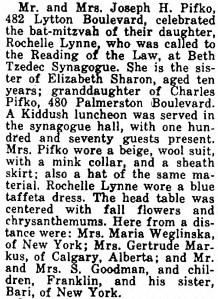
When my cousin Krysia and I first started searching for our Jewish roots, we barely knew where to start. Our Aunt Pat, a genealogist, had shared an impressive record of names, places, and even stories. Obsessive Internet searches yielded limited results–things like a notice in the Canadian Jewish Review from October 1963 that listed my grandmother’s sister Maria Weglinska among the out-of-town guests at Rochelle Pifko’s bat mitzvah in Toronto. Pifko/Piwko was my grandmother and her sister’s maiden name. But how were they related to these Canadian Pifkos?

1963CanadianJewishReviewBatMizvah

Notice in the Canadian Jewish Review on October 18, 1963 about Rochelle Pifko’s bat mitzvah.

How could we push beyond these tidbits? What more could we learn about our family?

Thanks to the Jewish Historical Institute (JHI, Żydowski Instytut Historyczny) in Warsaw we made some breakthroughs that have helped us piece together our family tree. Krysia’s husband Steve stopped in during a business trip to Warsaw and met Anna Przybyszewska-Drozd at the genealogical division of the JHI. She did a preliminary search on JewishGen, and found references to vital records of some of our ancestors. A few months later, Krysia and I went on our first roots trip to Poland. We still had no idea what we were doing so we stopped in at the JHI, meeting with Anna’s associate Aleksandra (Ola) Dybkowska-Grefkowicz who stayed after hours to help us with our search. She prefaced everything with her usual caution, “Don’t be disappointed if you don’t find anything” because so many records were destroyed and most Holocaust deaths were not recorded. Then, she showed us how to make use of the records in JewishGen and the databases of  the Polish National Archives, and suggested other places we could search for records.

I learned enough at that meeting to make some breakthroughs. I discovered my Zurich cousins through the Family Finder database on JewishGen, and shortly after my Israeli cousins through myHeritage.

On successive trips to Warsaw, Anna and Ola helped me learn more about my grandfather Jakob Rotblit. I was speaking with Ola about his automobile dealership in Gdansk when Anna walked in. A look of recognition flashed across her face; she pulled a book off the shelf about Jewish business owners in Gdansk between the World Wars. Sure enough, Jakob Rotblit was listed with information about his Ford dealership and with details about his wife and his parents. Another time, I mentioned that my mother and grandmother are on the list of Jewish survivors who registered after World War II ended. With a satisfied smile, Ola told me that the original registration cards are in the JHI archive. I walked upstairs to the archive and was able to hold those cards in my hand. The archivist showed me how the earliest records, from 1945, were handwritten on the backs of cut up prewar accounting records. Paper was scarce, so they used what they could find. By 1946, information was filled in on larger, pre-printed cards made especially for this purpose.

Once again, just a few months ago, the genealogical division helped me with my search. Anna e-mailed me that a woman, Ellen, had contacted her to find out about her Piwko ancestors. Anna thought we were related and asked if she could share my contact information with her. Of course I agreed, and since then Ellen and I have been in ongoing communication. She is an avid genealogist who turns out to be my 3rd cousin. Her great grandfather was my great grandfather Hiel Majer Piwko’s younger brother Urish. I knew nothing about him, maybe in part because he moved to Canada in the 1880s.

DSC00199

3rd Cousins in Krakow, Poland in June 2017

Ellen and I had the extraordinary good fortune to be in Poland at the same time this June. She was on a once in a lifetime Jewish history tour of Eastern Europe with Professor Stephen Berk. Although I didn’t know anything about her or her great grandfather, I had an inkling about her branch of the family from that notice I found years ago about my Auntie Nunia’s (Maria Weglinska) visit to Toronto in 1963. Rochelle Pifko, the girl whose bat mitzvah she attended, was Ellen’s cousin and another descendent of Urish. So another mystery is solved. Some contact was maintained between my great aunt and her uncle who migrated to Canada shortly after she was born. And when Nunia/Maria came to the US in the 1950s, she renewed that connection and even visited. Ellen remembers when Nunia came to Canada some years later for another family event.

AK Verification, Part III

02 Saturday Sep 2017

Posted by Marysia Galbraith in Archives, Bereda, Family, Memory, Polish Culture, Polish Underground Army, Warsaw, World War II

≈ Leave a comment

Tags

AK, Armia Krajowa, Maria Bereda(y) Galbraith, patriotism

NOTE: This overview of my recent discoveries at the Polish Underground Movement Study Trust, Studium Polskiej Podziemniej (SPP) got so long I am publishing it in three separate posts. Here is part III. During the German occupation of Poland during World War II, the Polish Underground Army worked in secret to resist, sabotage, and fight against the Nazis. Another name for the Polish forces is “AK,” short for “Armia Krajowa,” or “Home Army.” I talk about the soldiers as “the partisans;” in Polish sources they are also called “konspiracja,” “the conspiracy.”

Sorry it’s taken a while for me to get to part III. The semester has begun which means I’ve been very busy.

DSC00534

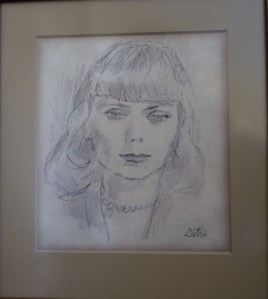
Pencil sketch of Maria Bereday from the 1950s, signed Ditri. Friends tell me she looks like a spy.

All of the questions the archivist Krystyna asked me about the names Mama went by paid off because she found another file; the envelope was mislabeled “Maria Fijułkowska.” Inside was a six-page report, relacja, Mama had written titled, “Outline of Courier Work.”

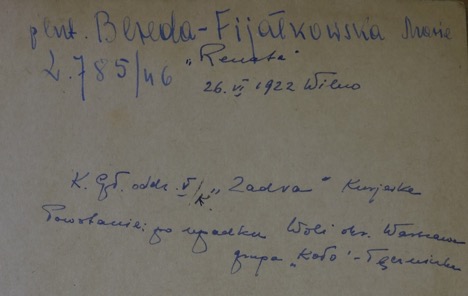
Initially, neither Krystyna nor I found this file because not only was “Bereda” missing, but Fijałkowska was also misspelled. Krystyna wrote “Fijałkowska” on a new envelope; I don’t know why she didn’t also add the Bereda, even after I pointed out that Mama’s full name was hand-written in large letters along the left margin of the document’s first page. Around World War II, the family usually used the name Bereda-Fijałkowska. Mama told me they added the Fijałkowski/a, which was grandpa Bereda’s mother’s maiden name and a name associated with the Polish gentry, because of Babcia’s social aspirations.

DSC00333

Mama’s name (Bereda-Fijałkowska) and pseudonym “Renata” in the margins of her typewritten report.

Mama’s report matches up with some of the stories she told me, and confirms some of what she did during the occupation. It also gives more details about the way her courier unit “Zadra,” was organized, and how couriers carried out their duties. The report is dry and factual. It contains no specifics about her emotional engagement or personal thoughts. A historian might find it interesting for what it reveals about the operations of the Underground conspiracy. I keep trying to look beyond the words to find the person behind them.

She writes, that “Zadra” started out very small, and because the work wasn’t systematized, the couriers were on call at all times. “By the end of 1942,” she writes, “the number of couriers stabilized at 15, and that group became close and experienced, and worked together for a long time without changing members.” This all changed in the fall of 1943 when the occupier, okupant, limited train travel to Germans only. Overnight, the courier corps dropped from 60 to just six who spoke German well and had German papers. “The work for these couriers during this time was nonstop,” she continues, “The number of trips for each courier came to 10-12 per month, depending on the route.” My mother doesn’t state it in the report, but she must have been one of the couriers who carried out missions during this time. Some of her most vivid stories were about traveling in the train cars with an assumed identity as a “volksdeutch,” a half-German whose father was fighting for the Reich on the Eastern front.

After about two months, the courier corps were reorganized and expanded, with more reserve couriers brought into regular service. In the half year before the Warsaw Uprising, the number of couriers in her unit approached 40, and overall reached 100.

The duties of the couriers included delivering coded and uncoded orders hidden in ordinary objects such as candles or paint, special messages that had to be handed to specific commanders, and large sums of money (1/4-12 million zloties in 500 zloty bills). Some missions involved carrying the messages brought by paratroopers they called “ptaszki,” “little birds.” This is the code name for the cichociemni, the officers who parachuted in from the West carrying money and messages from the Polish Government in Exile.

The report includes an example of a special mission Mama undertook at the end of 1943. Instead of being briefed by her usual commander “Wanda”, “Beata,” the head of communication with the west, did it. “Wanda” gave her a special coded message she had to hand directly to the chief of staff or the commander of the Radom District. This was to occur in private with no witnesses. Mama also had to memorize and deliver the oral message, “The commanders of the divisions and subdivisions of “Burza” require complete secrecy in the event of the invasion of the Russians.” Burza, Tempest, was the code name for the Warsaw Uprising.

Because the chief of staff wasn’t available on the day Mama arrived, she had to spend the night at a safe house. The next day, she delivered the messages to Chief of Staff “Rawicz” [his real name was Jan Stencel or Stenzel], but had to spend another two days before “Rawicz” returned from the forest, where the partisans were hiding out, with the required response for the Central Command in Warsaw.

Reading this sparked another memory for me. I think it was a big deal for Mama to stay away from home for so long, especially because her father didn’t know she was in the Underground. Her mother did know, though, and they hatched an alibi about a visit to Mama’s fiance’s family. Or maybe this is the story she told the authorities on the train to explain why she was returning several days late. Hopefully, my brothers remember this story, too, and can confirm one of these versions.

The documents from the Studium Polski Podziemnej in London have been a lynch pin that holds together information from a variety of sources. While I was there, I also found a citation for Communication, Sabotage, and Diversion: Women in the Home Army, Łączność, Sabotaż, Dywersja: Kobiety w Armii Krajowej, published in 1985. The book was written in Polish but published in London. I found a copy of it at an online used bookstore whose brick and mortar shop is in Warsaw. I called, and sure enough they had it in the shop, so I picked it up while I was in Warsaw. It contains the recollections of the head of the Women’s division of Central Command (VK) Janina Karasiówna, the oficer who confirmed Mama’s verification file. Another chapter contains the report of Natalia Żukowska who was the assistant commander of Mama’s courier unit; Mama identifies her by her pseudonym “Klara.” From Żukowska’s report, I learned that “Zadra” was the name used by the couriers who had been working with the unit for the longest, but in 1943 the name was changed to “Dworzec Zachodni.” Reviewing Mama’s documents, I see now that she identified her unit as Zadra-Dworzec Zachodni in one place. She underlined it, too. Until I read this book, I had thought Dworzec Zachodni, which means Western Station, referred to Zadra’s location, not an alternative cryptonym. And then there’s this: the names of the 15 couriers, including “Renata.” That’s Mama’s pseudonym; her last name is misidentified as “Brodzka” instead of “Bereda,” but Natalia writes, “Unfortunately, it wasn’t possible to decrypt all of the last names” (p. 118).

Mama was proud of her service for her country, but she was also painfully aware of the cost of war. She called herself a pacifist and the war solidified her abhorrence of armed conflict. I remember her asking, “Are there times when fighting is necessary?” I could tell from her voice that she wanted to believe all conflicts can be resolved peaceably. But her experience had taught her otherwise.

AK Verification: Part II

13 Sunday Aug 2017

Posted by Marysia Galbraith in Archives, Bereda, Family, Poland, Polish Culture, Polish Underground Army, Warsaw, World War II

≈ Leave a comment

Tags

"Zadra", AK, Armia Krajowa, Courier, General Bór Komorowski, Grupa "Koło", Major Janina Karaś, Maria Bereda(y) Galbraith, Polish Home Army, Polish Underground Study Trust, Studium Polski Podziemnej, Warsaw Uprising

NOTE: This overview of my recent discoveries at the Polish Underground Movement Study Trust, Studium Polskiej Podziemniej (SPP) got so long I am publishing it in three separate posts. Here is part II. During the German occupation of Poland during World War II, the Polish Underground Army worked in secret to resist, sabotage, and fight against the Nazis. Another name for the Polish forces is “AK,” short for “Armia Krajowa,” or “Home Army.” I talk about the soldiers as “the partisans;” in Polish sources they are also called “konspiracja,” “the conspiracy.”


The file at the archive of the Polish Underground Movement Study Trust, Studium Polski Podziemnej (SPP), contained the same verification questionnaire I had from my mother’s papers and so much more. On the envelope itself is the following identifying information:

VerificationEnvelope

Information on the envelope containing Mama’s papers at the SPP

I ‘ve learned how to decipher all of this. Here’s what it means:

Cadet Bereda-Fijałkowska Maria

2.785/46 [record #]     “Renata” [her pseudonym]

   26. VI 1922 Wilno [birth date and place of birth]


            Central Command division V/Women “Zadra” courier

Uprising: after the fall of the Wola district of Warsaw

                                    “Koło” Group-liaison officer [the names of her units]

The documents inside the envelope confirm Mama’s service and rank in the AK [Home Army], as well as her receipt of the Cross of Bravery. She submitted her questionnaire on March 9, 1946, her commanding officer confirmed her claims on April 15th of the same year, and the official report was completed the next day on April 16. The final report says the head of the Polish Army himself, General Bór-Komorowski, confirmed her receipt of the Cross of Bravery. Here is what looks like his signature on the document:

BórSignature

General Bór Komorowski’s signature verifying Mama’s service in the Polish Home Army. It looks like he wrote “Stwierdzam (I confirm)  16/IV 46” above his signature. Note the “gn” for “generał.”

Mama started military training in middle school, gimnasium, at the Klementyna Hoffman School in the mid-1930s. She continued training in high school, liceum, and entered the Underground in June 1941, right after finishing high school. She took courses on how to be a courier, the organization of the Underground and of the German military, as well as marksmanship, topography, and first aid. She was in “Zadra” Group, part of the women’s courier corps in the 5th Division of the Central Command. She delivered encoded communications, money, and oral messages on the routes between Warsaw and Krakow, Radom and Skarżysko-Kamienna. In these latter two places, she acted as a go-between for the partisans in the surrounding forests and Central Command in Warsaw. From 1942-4, she also worked as an instructor training other women to serve in the Underground.

When the Warsaw Uprising began on August 1, 1944, she was with her unit “Zadra” in Wola, a district to the northwest of downtown. A handwritten note on her typed questionnaire says “wounded on route from Wola to the Old City.” The handwriting is different from Mama’s distinctive, almost calligraphic style, so somebody else must have added it after Mama submitted her answers.

The archivist Krystyna Zatylna said that the heaviest fighting in the first days of the Uprising was in Wola. Mama was lucky to have survived. By August 8, 40,000 civilians died in Wola.

The Home Army regrouped in the Old City. Mama got separated from her unit and joined “Koło” group. She is referred to here as a “liaison,” “lączniczka,” rather than “courier,” “kurierka.” Both terms refer to people entrusted with delivering critical information. Initially, however, she worked as a medic on Długa Street. When the Germans pushed the partisans out of the Old City, they escaped to the City Center, Śródmieście, via the sewers.

14SPPVerificationDossier

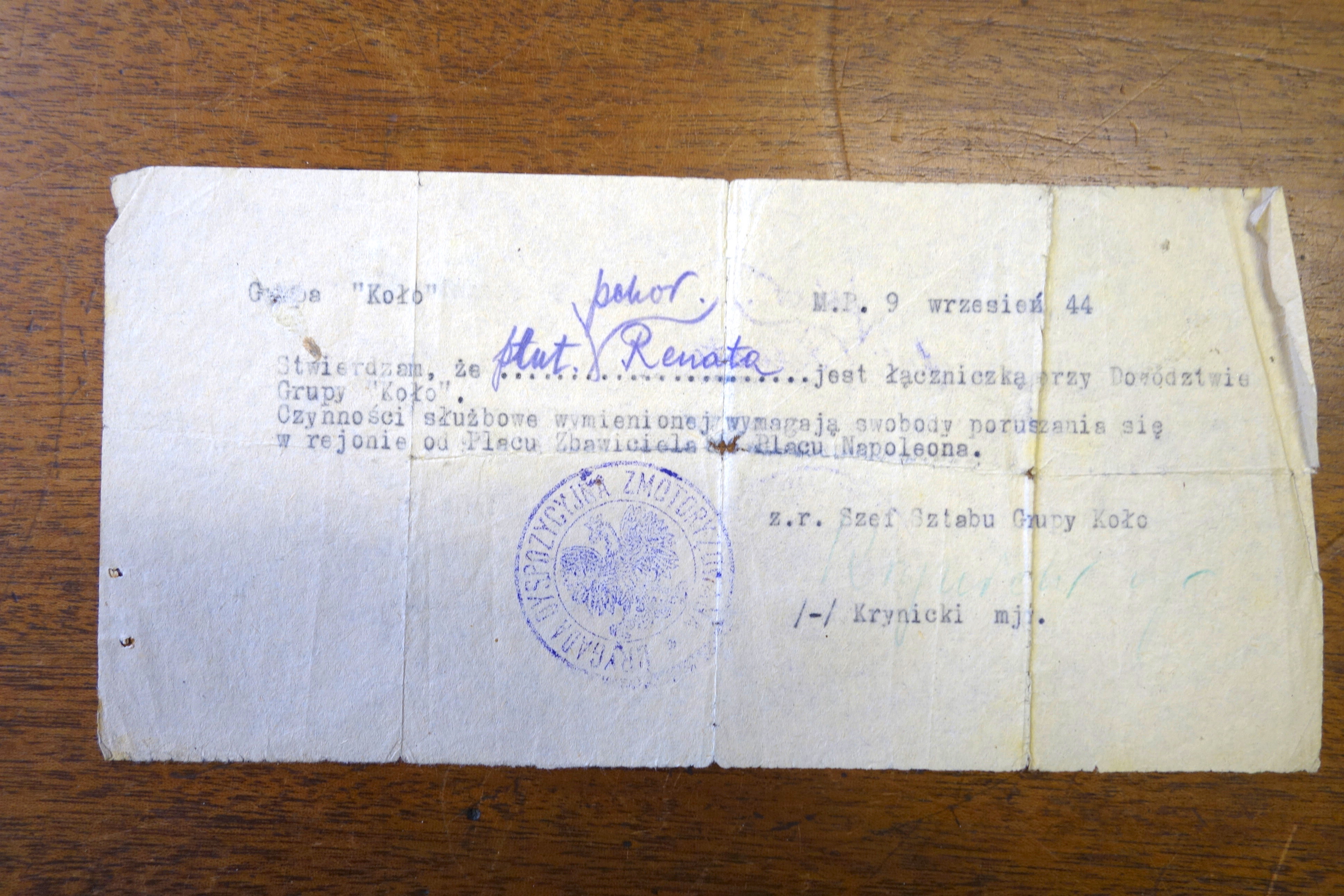
Document dated September 9, 1944 that allowed “Renata” to travel through the City Center during the Warsaw Uprising.

The file contains two papers dated from the Uprising. No doubt Mama brought them with her to London to help corroborate her report. These tattered notes—physical proof of her service—must have been very precious to her. The first, on a third of a piece of paper that has deep creases from having been folded many times, is dated September 9, 1944. It states:

I assert that cadet Renata is a liaison of “Koło” Group. The conditions of her service require movement within the region between Savior Square and Napoleon Square.

The note is signed by the Chief of Staff of “Koło” Group, Major Krynicki. The document contains a round stamp with a crowned eagle in the middle surrounded by the words “Motorized Transport Brigade, “Brygada Dyspozycyjna Zmotoryzowana.” Mama must have shown this note at barricades on the streets so the AK soldiers would let her pass. Savior Square and Napoleon Square are in the City Center, which means she retreated through the sewers before September 9. I can, however, imagine her dodging Nazi bullets as she ran across the barricaded Jerusalem Street carrying messages from Napoleon Square to Savior Square. These names would sound good in a poem. Too bad I’m not a poet.

The second paper dates from October 3, 1944, the last day of the Uprising. Signed by Colonel Bolesław Kołodziejski, the commander of “Koło” Group, it is titled, “Provisional certificate (to be exchanged after the war for official recognition).” The text reads:

I confirm that “Renata Lewandowska” was decorated for her activity during the Uprising from August 1 to October 3 1944 with the Cross of Bravery for the first time.

Based on: the personal confirmation of the head of the Warsaw Corps of the A.K. Brigadier General Montera and his assistant Colonel Wachowski, as told to the commander of “Koło” Group during the last days of the Uprising.

“Montera” was the code name for General Antoni Chruściel, who led the Home Army (AK) in Warsaw during the Uprising. Kołodziejski was also a code name. Elsewhere in the documents, Mama writes that his real name was Zygmunt Trzaska-Reliszko.

Mama writes that she was promoted twice; in September 1944 she became a cadet, plutonowy podchorązy and in October she was promoted again to ensign, podporucznik. It looks as though the Verification Commission could only confirm the first promotion. A handwritten note on Mama’s questionnaire says they weren’t able to contact her commanding officer from “Koło” Group to verify the second promotion.

Also in the file are two statements written by the commander of the women’s branch of the 5th division of Central Command (V.K. KG) Major Janina Karaś, dated April 15, 1946. In them Karaś, also known as Karasiówna, confirmed that Mama earned the rank of cadet in “Koło” Group, and was also granted the Cross of Bravery for her service. Clearly, the Verification Commission contacted Karaś to corroborate Mama’s claims on her questionnaire. One of Karaś’s statements reads:

As the chief of the V.K. [5th Women’s] Central Command I certify that in the course of her service as a courier, “Renata” Maria Bereda Fijałkowska distinguished herself on the route Warsaw-Krakow and Warsaw-Skarzysko-Radom with bravery and decision to take risks. Traveling with German false papers she carried money, mail, and oral orders /for example related to the order for [Operation] Tempest. She earned the Cross of Bravery for her service.

Operation Tempest, “Burza,” was the code name for the beginning of the Warsaw Uprising. In other words, some of the messages Mama carried between Central Command and the partisans in the forest involved critical details about the Polish Underground’s battle to free the capital city from German occupation. I’m reminded of something the archivist at the Warsaw Uprising Museum kept repeating when I showed him Mama’s verification questionnaire two years ago: “She must have been very high in the conspiracy.” He couldn’t find the exact connection, but I believe I have it right here.

Krystyna Zatylna helped me put the pieces together. The forests around Radom are where the so-called “cichociemni,” “the quiet unseen” soldiers parachuted in from the West, bringing messages and money from the Polish Government in Exile for the leaders of the Underground in Poland. I believe Mama was given these items from the cichociemni and carried them back to Central Command in Warsaw. It fits with stories she sometimes told, and it fits with the seven-page report she filed with her verification papers. And that will be the subject of the third part of this blog post.

AK Verification, Part I

12 Saturday Aug 2017

Posted by Marysia Galbraith in Archives, Bereda, Family, Polish Culture, Polish Underground Army, World War II

≈ 3 Comments

Tags

AK, Armia Krajowa, Cross of Bravery, Krzyż Waleczny, Maria Bereda(y) Galbraith, Polish Home Army, Polish Underground Study Trust, Studium Polski Podziemnej

NOTE: This overview of my recent discoveries at the Polish Underground Movement Study Trust, Studium Polskiej Podziemniej (SPP) got so long I will publish it in three separate posts over the next few days. Here is part I. During the German occupation of Poland during World War II, the Polish Underground Army worked in secret to resist, sabotage, and fight against the Nazis. Another name for the Polish forces is “AK,” short for “Armia Krajowa,” or “Home Army.” I talk about the soldiers as “the partisans;” in Polish sources they are also called “konspiracja,” “the conspiracy.”

MamaPrewar

Mama in Poland


The extraordinary story of my mother’s service in the Polish Underground can be hard to reconcile with the person I knew. Mama would hide when strangers visited the house because she was afraid they would stare at her scars. How could she have carried secret messages to the partisans in the forest or talked calmly with Nazi officers on the German-only trains right under signs that read, “Danger! The Enemy is Listening!”? And yet, as her daughter I also knew her strength and persistence, especially when matters of principal were involved.

I couldn’t find much specific information about my mother at the Warsaw Uprising Museum or the Polish National Archive of New Records in Warsaw. Next, I turned to the Studium Polski Podziemnej (SSP), Polish Underground Movement Study Trust in London. But when the archivist responded they have no record of Maria Bereda in their indexes, a part of me wondered if Mama could have fabricated her whole story.

Logo-spp-londyn_0c8ba9117ddbff8485e5dca98f7fae14

Logo of the Polish Underground Movement Study Trust (SPP)

But that made no sense. My mother didn’t lie. She struggled with guilt even when she tried to tell the smallest untruth. Instead, she would avoid certain subjects, and would keep silent when people came to their own incorrect conclusions about them. That’s why for instance I thought she was the same age as my dad when I was a child. My oldest brother inferred it from the sequence of their birthdays—Dad’s was on March 1 and Mom’s was a few months later on June 26—and Mama didn’t bother to correct us.

Mama didn’t like talking about her past, but the story about how she was verified after the war was one she was more willing to tell. She had to go to London to do it because wartime records were scattered and incomplete. During the war, the Underground Army didn’t have the infrastructure to maintain centralized records. Often, lists of personnel and promotions were memorized or scribbled on any available scrap of paper. Also, to prevent the Nazis from infiltrating the underground forces, details of separate units were kept from each other. Most partisans only knew about those serving directly above and below them, and even members of the same unit referred to each other by code name. All of these were strategies for insuring that if someone was caught or compromised, they would have minimal information to share and so could inflict a minimum of damage to the organization. Also, few records remained after Warsaw was bombed to the ground following the Warsaw Uprising. The Central Verification Commission was in London, where the Polish Government in Exile had been throughout the war.

Mama travelled from Poland to London in March 1946. She wanted to be sure that an official record would exist to mark her participation in the war, and she wanted to get the Cross of Bravery she had been granted but never received. At the Commission, she reported on her training, her unit, her superior officers, and her activities. When she told me this story many years later, she was very proud of her ability to recall all these details from memory, things that could only be known by someone who actually served in the Underground.  The commission checked everything for accuracy before the verification was confirmed.

I already had a copy of the “Special Questionnaire” Mama had filled out as part of this process; I had found it in her papers. At minimum, I should have been able to find the original at the Polish Underground Movement Study Trust (SPP), which houses the archive of the Verification Commission. Fortunately during a recent trip to London, some focused digging at the SPP turned up a treasure trove of documents. Already in our e-mail correspondence, the SPP archivist Krystyna Zatylna had seemed confident that something would turn up if we looked harder. She eventually found Mama’s records where they had been mislabeled and misfiled.

Home_01_about_spp_londyn-b87ae1de57

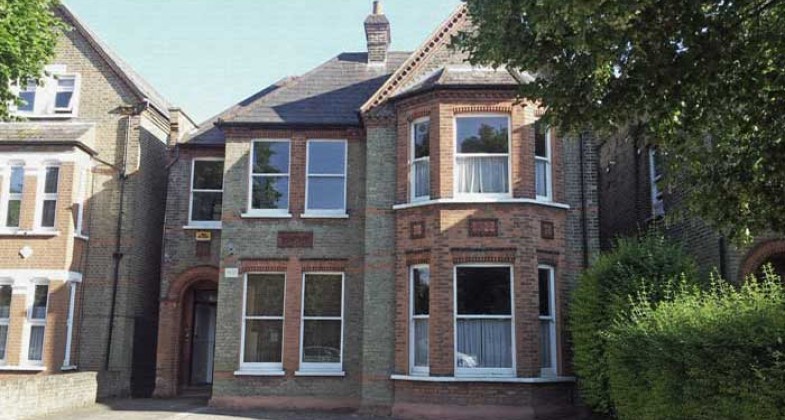
Headquarters of the Polish Underground Movement Study Trust at 11 Leopold Road, Ealing, London. Photo from studium.org.uk website.

According to their website, “The Polish Underground Movement (1939-1945) Study Trust (PUMST), was founded in London in 1947. It is a research and academic institution, which contains historical material on the Polish Underground State (the Underground Administration and the Polish Home Army – Armia Krajowa) during the Second World War.” Included among their materials, the verification papers sit on high shelves right in the reading room in accordion folders shelved alphabetically. Personal files are arranged alphabetically inside the folders, each in a separate manila envelope.

The first folder Krystyna pulled out for me contained last names starting with “Br” instead of “Be.” My heart fell when I didn’t find Mama’s records. But then Krystyna climbed up a wooden ladder and found the folder with the “Be” names. There it was: an envelope labeled Maria Bereda-Fijałkowska. For a time, Mama used this hyphenated name, tacking on the maiden name of her grandmother.

Krystyna explained that much of the work at the archive has been done by volunteers so there are a lot of mistakes. She also asked me a lot of questions. Was Mama’s name always hyphenated? Did she use any other names? Did she ever go by Fijałkowska? Was she ever married? She also asked the names of my mother’s units. I rattled off what I knew: she belonged to “Zadra” in the Women’s 5th Division of the Central Command stationed in the Wola District of Warsaw; shortly after the Warsaw Uprising began, she joined “Koło” Group, and served in the Old City–Stare Miasto and City Center–Śródmieście Districts . I also gave her the names of Mama’s superior officers. It was as if I was being verified myself.

To be continued…

Jewish history of Kutno

18 Saturday Feb 2017

Posted by Marysia Galbraith in Archives, Fieldwork, Heritage work, Jewish Culture, Kutno

≈ 10 Comments

Tags

Kutno Museum, Kutno Public Library

When I first visited Kutno in 2013, I only stopped for a few minutes on the way from Poznan to Warsaw. I had found a record of my great grandmother on JewishGen, and the original document from the 1860s was in the Kutno archive. I got there too late to see the record (the archive was about to close), but I spoke briefly with one of the archivists, and asked her if any traces of Kutno’s Jewish culture can be found today. She said she didn’t know of anything, except perhaps some fragments of tombstones in the municipal museum.

I returned to that museum in early 2015, and the director showed me their small display of Jewish artifacts.

Jewish candleholders in the Kutno Museum
Torah in the Kutno Museum
Fragment of a tombstone in Kutno Museum

Finally last summer, I met some people who have spent years documenting the history of Kutno’s Jews. It turns out a lot is going on. There is a biannual festival in honor of Sholem Asch, a highly regarded Yiddish writer who was from Kutno. There are also commemorative markers at a number of sites around town. And a book was just published—a collection of articles about the Jews of Kutno (Karol Koszada, Elżbieta Świątkowska, Bożena Gajewska, Zaryz Historii Żydów Ziemi Kutnowski, 2016, Kutno: Towarzystwo Przyjaciół Ziemi Kutnowskiej).

I’ve been to the archive a few times now, often enough to break through the reserve of the archivists a couple of times. One told me that school groups sometimes come to visit. “This is a good thing,” she told me “because youths need to know that heritage is not always as straightforward as some people make it out to be. Things change.” She also said that youth don’t necessarily value the past, but seeing the records in the archive helps them to connect with history.

At the Kutno public library, I met Andrzej Olewnik, a librarian with a deep interest in town history. He seemed delighted to meet someone who shared his interest; his whole face smiled as we talked. Pan Andrzej is also a collector, and finds documents associated with Kutno in auctions. He showed me old postcards and photos, including a photo taken in the Kutno ghetto during the Nazi occupation. He also showed me one of Sholem Asch’s business cards, given to him by Asch’s great grandson. He keeps these treasures in protective plastic covers, but slid them out so I could examine them more closely.

Sketch of Kutno synagogue, in Kutno Museum. My shadow reflection is on the far left.
Postcard of the Sugar Factory in Kutno
Passport application of Icek and Ruchla Holeman, 1865. In the collection of the Kutno Museum

The library has a collection of books about Kutno history. One features historic passport photos from the Kutno museum collection, many of which belonged to Jewish residents of the region. It turns out that the museum has other items related to Jewish culture they keep in storage. Some tombstones were found in a sidewalk and brought to the museum. The museum has them in storage, but took photographs of the inscriptions, which are in Yiddish and Hebrew. They are looking for someone to transcribe and translate them.

Another book Andrzej showed me was the Kutno Yizkor book. Yizkor books were compiled after World War II; in them, Jews who survived the Holocaust collected all the information they could about the Jewish population of their hometowns, including historic documents, demographic data, and personal accounts. This one was written in Hebrew—only some Yizkor books have been translated into English. Other books are by or about Sholem Asch, including precious Polish language translations of some of Asch’s plays.

Andrzej showed me digital photos of the prewar synagogue. It was right in the center of the street. Traffic would go around it on both sides. It had columns on one side, and the main entrance on the other. A map from the 1820s shows there was a long narrow green area in front of the building. Across the street from the synagogue there used to be the Jewish school, and behind that the ritual bathes. Andrzej had photos that were taken from the air showing synagogue’s destruction. First the roof was removed in 1940. Later, explosives were embedded in the pillars and the building was blown up.

Grażyna Baranowska, another librarian, organizes the Sholem Asch Festival which takes place every other year. It started as a literature contest, in which contestants competed for prizes for their original writing or their reading of literary texts. Then, it expanded into a culture festival. Next, an academic conference on the life and work of Sholem Asch was added. For the past two festivals, the great-grandson of Asch, David Mazower, has come from England. The next conference is in September 2017 and the festival is in October or November 2017. I’m trying to work out a way to attend this year.

Mapping Family Roots

23 Sunday Oct 2016

Posted by Marysia Galbraith in Archives, Family, Identity, Polish-Jewish Heritage, Pre-World War II, Walfisz, Żychlin

≈ 2 Comments

Tags

map

I made an extraordinary find in the Kutno archive—a map of Żychlin dating from 1869. I found reference to it in an article, but the archivists had a little difficulty locating it because it didn’t have an identification number (signatura). One archivist said something about it being so fragile they don’t show it. But another found it hanging on the wall and brought it out for me. The writing is in Russian. At that time, Żychlin was in the Russian partition of Poland. After the January Insurrection in 1863, the Russians mandated all public documents had to be in Russian, not Polish. That is why archival documents before the 1860s are in Polish while the later ones are mostly in Russian.

Russian writing on the 1869 map of Żychlin

I don’t know what is written here–maybe a reader could translate it for me?

dsc08463

Map of Żychlin dated 1869

Properties are numbered on the map, but not by street address. That means the numbers are scattered throughout the city making it difficult to find particular locations. According to the Żychlin Books of Residents (Akta Miasta Żychlina, also in the archive), my Walfisz ancestors lived at various times at numbers 28, 53, and 63. My great grandmother Hinda Walfisz married my great grandfather Hiel Majer Piwko. I wrote about them in previous posts: Piwko Saga, The Photo, and Super Kosher Cookies and Sliced Ham.

The map is hard to read, patched, and creased. The cross-shaped church stands out in the top half. Below it is the market square, and #53 is in the row of buildings along its lower edge. #63 is further to the left, and #28 is on the street running down from the market square.Not surprisingly, these properties are all near the synagogue, which as best as I can tell is #86 on the map (a bit below #63).

I had already seen one Book of Residents in 2013, but in 2016 I found my great grandmother’s family listed in three others, as well. Since the books have been indexed, the archivist was able to tell me what page to look on. And even though these records are only a few years older than the map, they are in Polish. There is only one Walfisz family in the books (my great grandmother with her sisters and parents), but other more distant family names also appear: many Losmans, a couple of Kolskis, and one Jakubowicz. Each household has its own page in the book, but there can be several households in the same building. Because religion is one of the things recorded in the Books, I could see that it wasn’t uncommon for addresses with multiple households to include families of multiple faiths: some Catholic, some Jewish, some Evangelical.

I know this is just an old map, but being able to pore over it, to touch it, helped to transport me back in time, and to once again (for the first time?) connect with the place where I’m from. It doesn’t matter that I never actually lived there (nor did my mother nor even my grandmother). Some of my people did. Right there in that place. With this newfound knowledge, I drove back through Żychlin one more time, this time gazing at the buildings that once housed my family. It didn’t really matter that the buildings had changed, nor that I was still unsure how exactly the old building numbers match the contemporary ones. Once this was their home.

Guide to the United States for the Jewish Immigrant

19 Saturday Dec 2015

Posted by Marysia Galbraith in Archives, Jewish immigrants, Pre-World War II

≈ 2 Comments

Here’s something a friend uncovered: Guide to the United States for the Jewish Immigrant, published in 1916.

Besides providing helpful information about transportation options in the US, the benefits of farming as a profession, and how to become a citizen, it includes legal advice; bigamy, spitting in public, and beating or shaking a rug are illegal. The second of these, spitting, is also disgusting.

It advises, “The Jew, like any other foreigner, is appreciated when he lives the American social life. Until then he counts for nothing.” Though it also urges, “Be proud of your race, your birth and your family, a Jew is all the better an American for being a good Jew.”

Guide

Title page of Guide to the United States for the Jewish Immigrant (1916)

Available at archive.org.

Chil Majer Piwko’s death notices in the Yiddish press

01 Monday Jun 2015

Posted by Marysia Galbraith in Archives, Family, Piwko, Polish-Jewish relations, Yiddish

≈ 2 Comments

Tags

Hil Majer Piwko

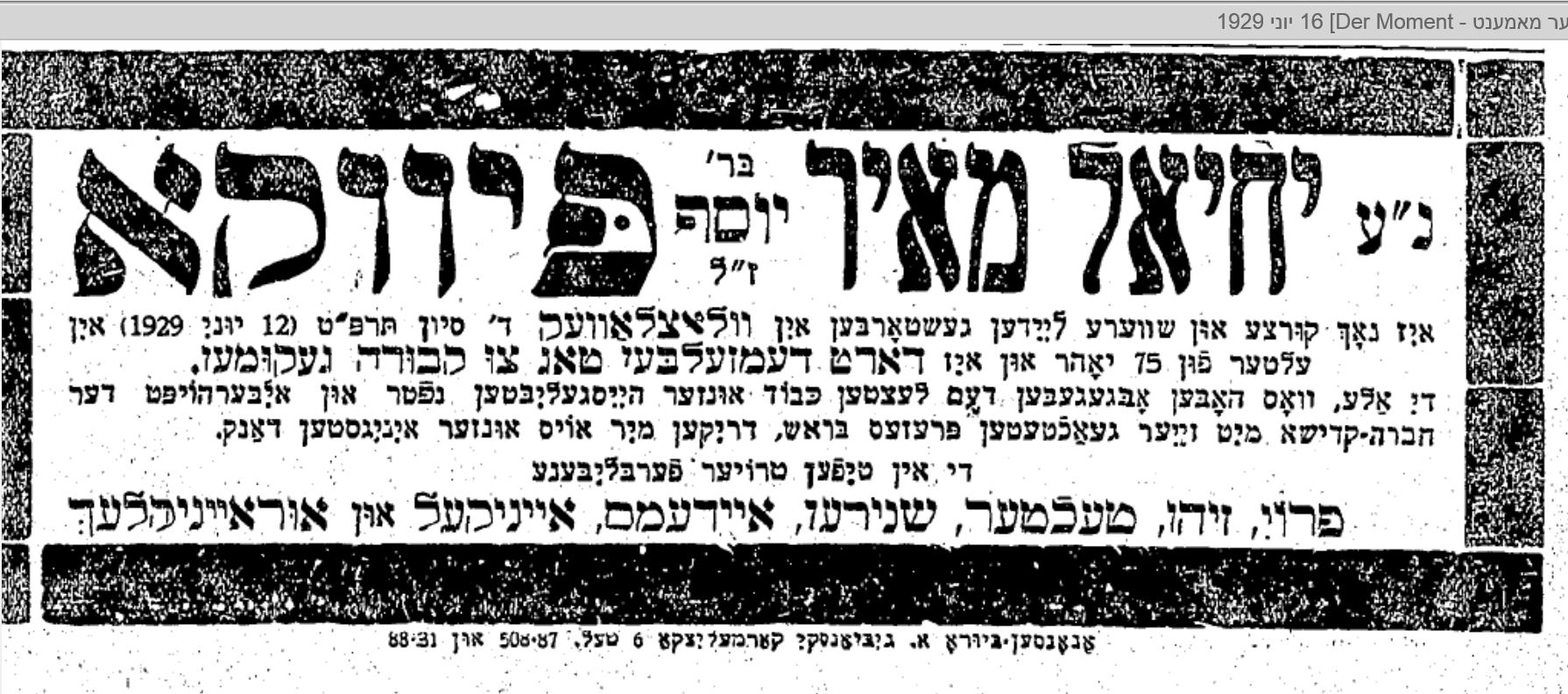
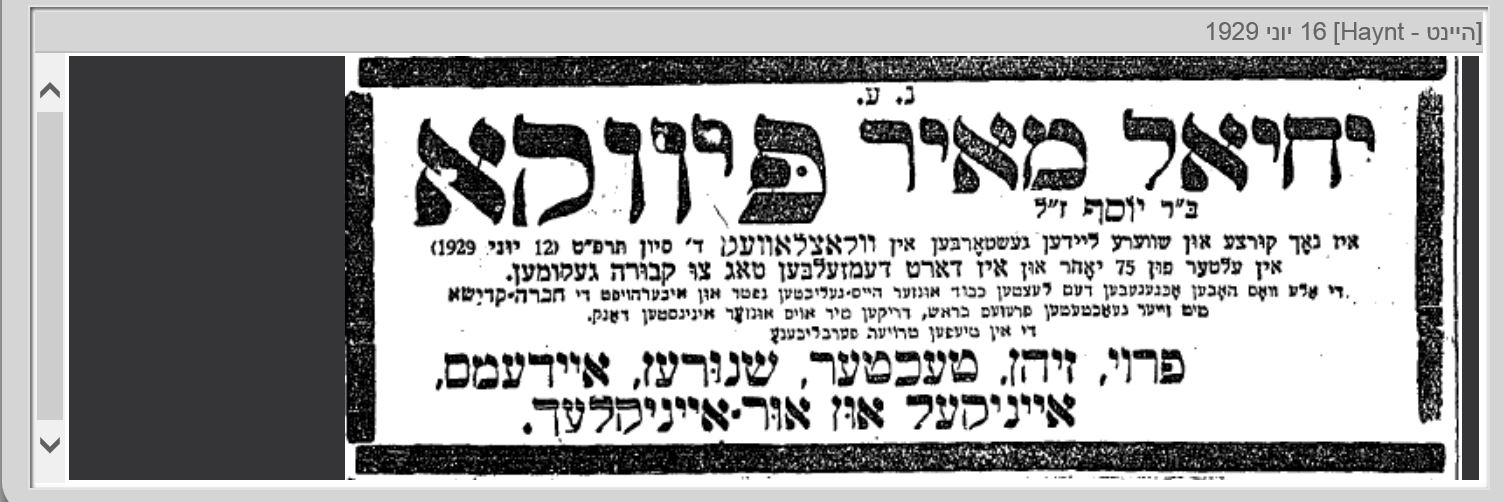
After reading my previous post about Chil Majer Piwko’s death notice, my cousin Raphael from Switzerland sent me a couple more that were published the same day (June 16 1929). These were in the Yiddish newspapers Hajnt and Der Moment.

Chil Majer Piwko's death notice from the Yiddish-language newspaper Der Moment

Chil Majer Piwko’s death notice from the Yiddish-language newspaper Der Moment

Chil Majer Piwko's death notice from the Yiddish-langugage newspaper Hajnt

Chil Majer Piwko’s death notice from the Yiddish-langugage newspaper Hajnt

Besides wanting to share them, this gives me the opportunity to revise what I said about Chil Majer. My conversations with a couple of readers helps me realize my hasty use of the term “assimilated” (even though it is widely used in the historic literature) probably does not communicate what I intended. What I meant to signal was that Chil Majer likely considered himself Polish as well as Jewish. But I have no doubt that he was also a very religious man. Nor did I mean to suggest he was on the road to adopting Polish culture in replacement of his Jewish faith. On the contrary, I’m interested in the places and spaces where Polish and Jewish affiliations intersected, complemented each other, or existed side by side.

The fact that his death notice appeared in three Jewish newspapers emphasizes even more strongly the important position Chil Majer filled in the community. The Polish-language Nasz Przegląd tended to take a more integrationist stance, in the sense that it catered to Jews who were comfortable operating in the Polish language, and who tended to invision a place for Jews within the broader Polish society. The Yiddish-language Haynt and Der Moment were competing papers that were Zionist in orientation. As such, they tended to highlight the interests of Jews as distinct from the Polish (Catholic) majority. The publication of the death notice in both languages shifts the emphasis, indicating an allegiance to both Jewish autonomy and to Polish-Jewish allegiances.

For more information about the Jewish press, see a brief summary by the Yivo Institute or Angela White’s dissertation on the Polish language Jewish press.

Warsaw archive weekend

31 Sunday May 2015

Posted by Marysia Galbraith in Archives, Family, Piwko, Polish-Jewish relations

≈ 4 Comments

Tags

Hil Majer Piwko

The first find of the weekend, at the National Library in Warsaw: my great grandfather Hil Majer Piwko’s death notice in Nasz Przegląd, one of the main Polish-language Jewish newspapers in interwar Poland.

DSC06314

Chil Majer Piwko’s death notice in Nasz Przegląd, June 16, 1929.

The text reads:

B. P. [Blessed in memory] Chil Majer Piwko died in Włocławek after brief but heavy suffering on the 12th of June 1929 (4 Siwon), at the age of 75, and was buried the same day.

To everyone who helped him on his final road, lamenting our husband and father, and especially the Funeral Brotherhood with its honorable president at its head. Wishing to express “God bless,” left in deep sadness,

Wife, sons, daughters, daughters-in-law, sons-in-law, grandchildren and great grandchildren.

The size and placement of the notice indicates my great grandfather held a position of relative prominence in the Jewish community. Also, appearing in Nasz Przegląd as opposed to any of the Yiddish or Hebrew language newspapers indicates that he identified as a Pole as well as a Jew. He was assimilated into the broader society, even though he maintained conservative modes of dress and religious practices.

I’m also struck by the mention of great grandchildren in the death notice. That’s also me, even though I wouldn’t be born for another 35 years

← Older posts

Categories

  • Anthropology (37)
    • Archives (14)
    • Fieldwork (7)
    • Ground Penetrating Radar (GPR (4)
    • Research Methodology (8)
  • antisemitism (14)
  • Association of Descendants of Jewish Central Poland (32)
  • Catholicism (8)
  • Conference (1)
  • Discrimination (2)
  • Family (69)
    • Bereda (17)
    • Kolski (13)
    • Piwko (22)
    • Rotblit (3)
    • Walfisz (4)
    • Winawer (7)
  • Genealogy (11)
  • Heritage work (66)
    • Commemoration (23)
  • Identity (18)
  • Israel (6)
  • Jewish Culture (89)
    • Cemeteries (51)
    • Museum (7)
    • Synagogues (33)
  • Jewish immigrants (8)
  • Jewish Religion (1)
  • Memory (70)
  • Names (14)
  • Photographs (6)
  • Pifko-Winawer Circle (5)
  • Poland (125)
    • Baligród (1)
    • Bolimów (1)
    • Brześć Kujawski (5)
    • Buk (1)
    • Chodecz (1)
    • Dukla (2)
    • Dąbrowice (1)
    • Gdynia (1)
    • Gostynin (2)
    • Gąbin (1)
    • Izbica Kujawska (1)
    • Kazimierz (4)
    • Kowal (1)
    • Koło (1)
    • Krakow (7)
    • Krośniewice (1)
    • Kutno (6)
    • Kłodawa (1)
    • Lesko (8)
    • Leszno (1)
    • Lubień Kujawski (1)
    • Lubraniec (1)
    • Lutowiska (3)
    • Piła (3)
    • Podgórze (2)
    • Poznan (11)
    • Przemyśl (2)
    • Pzedecz (1)
    • Radom (1)
    • Radymno (1)
    • Sanok (1)
    • Skierniewice (5)
    • Sobota (2)
    • Tarnów (2)
    • Warsaw (22)
    • Wielkopolska (1)
    • Wronki (7)
    • Włocławek (20)
    • Zasław (2)
    • Łódź (1)
    • Żychlin (30)
  • Polish Culture (10)
  • Polish-Jewish Heritage (60)
  • Polish-Jewish relations (60)
  • Post-World War II (24)
  • Pre-World War II (22)
  • Reclaimed Property (1)
  • stereotypes (3)
  • Survival (9)
  • Trauma (3)
  • Uncategorized (5)
  • Victims and perpetrators (4)
  • World War II (45)
    • Jewish Ghetto (12)
    • Nazi Camps (5)
    • Polish Underground Army (3)
  • Yiddish (5)

Enter your email address to follow this blog and receive notifications of new posts by email. Your email address will not be shared.

Archives

  • October 2025 (1)
  • July 2025 (8)
  • June 2025 (1)
  • April 2025 (1)
  • August 2024 (3)
  • July 2024 (3)
  • May 2024 (2)
  • April 2024 (1)
  • May 2023 (2)
  • January 2023 (2)
  • December 2022 (7)
  • November 2022 (2)
  • October 2022 (5)
  • September 2022 (1)
  • January 2022 (1)
  • August 2021 (1)
  • December 2020 (2)
  • July 2020 (1)
  • May 2020 (3)
  • April 2020 (1)
  • March 2020 (1)
  • January 2020 (2)
  • May 2019 (1)
  • February 2019 (1)
  • November 2018 (1)
  • September 2018 (1)
  • August 2018 (3)
  • July 2018 (1)
  • June 2018 (1)
  • May 2018 (1)
  • April 2018 (2)
  • March 2018 (2)
  • February 2018 (2)
  • January 2018 (2)
  • December 2017 (2)
  • November 2017 (2)
  • October 2017 (1)
  • September 2017 (3)
  • August 2017 (3)
  • June 2017 (2)
  • May 2017 (3)
  • April 2017 (1)
  • March 2017 (2)
  • February 2017 (1)
  • January 2017 (2)
  • December 2016 (2)
  • November 2016 (4)
  • October 2016 (1)
  • September 2016 (6)
  • August 2016 (2)
  • July 2016 (1)
  • May 2016 (4)
  • April 2016 (2)
  • March 2016 (3)
  • February 2016 (4)
  • January 2016 (3)
  • December 2015 (3)
  • November 2015 (5)
  • October 2015 (5)
  • September 2015 (3)
  • August 2015 (4)
  • July 2015 (3)
  • June 2015 (3)
  • May 2015 (4)
  • April 2015 (9)
  • March 2015 (3)
  • February 2015 (2)
  • January 2015 (5)
  • December 2014 (4)
  • November 2014 (9)
  • October 2014 (2)
  • September 2014 (1)

Copyright Notice

All original text and images are copyright © Marysia Galbraith. Please contact the author before quoting.

Blog at WordPress.com.

  • Subscribe Subscribed
    • Uncovering Jewish Heritage
    • Join 145 other subscribers
    • Already have a WordPress.com account? Log in now.
    • Uncovering Jewish Heritage
    • Subscribe Subscribed
    • Sign up
    • Log in
    • Report this content
    • View site in Reader
    • Manage subscriptions
    • Collapse this bar
 

Loading Comments...