• About
  • The Photo that Started it All

Uncovering Jewish Heritage

Uncovering Jewish Heritage

Author Archives: Marysia Galbraith

Babcia and her sister Rachel

16 Sunday Aug 2015

Posted by Marysia Galbraith in Bereda, Family, Kolski, Polish-Jewish relations, Post-World War II, Warsaw

≈ 3 Comments

Tags

Halina Piwko Bereda, Nelly Kolska Mochorowska, Rachel Piwko Kolski

There was one silence that drowned out any mention of a relative very close to us– my grandmother’s sister Rachel.

I grew up knowing Babcia (the Polish term for grandmother) came from a large family, though on the rare occasions this was mentioned, it remained unclear how many siblings she had. The number of siblings was fluid, probably in part because even simple quantitative questions like this often have no absolute answer. It depends on temporal factors–who was living at a given time–and also on who was counted. As best I can tell, my great grandmother Hinda gave birth to twelve children; two died in infancy, leaving ten; one more committed suicide as a teenager and another died in her early twenties during childbirth, leaving eight; The older siblings died before I was born–one in the 1920s, two more in the 1940s, and another probably in the second half of the 1930s. This left four sisters, two who lived into the 1960s, one who died in the 1980s, and my grandmother who died in 1993. From oldest to youngest these four were Sarah, Hanna, Rachel, and my babcia Halina.

My mom told me about Sarah (though we called her Lusia), and I knew Hanna (whom we called Nunia) well, but I don’t recall any mention of Rachel. This is despite the fact that she was the sister closest in age to my grandmother. I’m sure that part of the reason for this silence was that it would have been difficult to talk about her without revealing she lived in Israel, and that would have further revealed she and the rest of Babcia’s family were Jewish. Another reason I never heard about her may well be because Rachel passed away when I was just five or six years old. Still, I was only a few months old when Sarah died and yet I did know about her.

I just don’t know; I can only guess why no one told me about Rachel.

When I first started to learn about Babcia’s family, I thought that maybe there wasn’t any contact between Halina and Rachel, but the more I find, the clearer it is that relations were not cut off between them. In fact, the secret of our Jewish heritage was hiding in plain sight. No one denied it. They just refrained from talking to my generation about it.

It’s likely Babcia never had much to do with her oldest siblings. Liba was 22 years older and married with two children of her own before Babcia was born; Jakob was 20 years older and Abraham/Jon was 17 years older. Abraham and Efraim/Philip (12 years her senior) moved to the United States when Babcia was just ten years old. Sarah, though two years older than Philip, stayed in Poland until the 1930s so Babcia probably knew her better. Still, Philip visited Poland regularly; he seems to have valued family and worked to maintain relationships. He sponsored a steady stream of relatives to the US, including eventually Babcia and my mother.

I have found some fragments—bits of information and partial vignettes—confirming Rachel and Halina were in regular contact, and even came to each other’s assistance during and after World War II. Some traces suggest, however, that these two sisters may not have always seen eye to eye.

I remember being told that “Papa” (what my mother and my grandmother called Zygmunt Bereda, my grandmother’s second husband) saved a number of Jews during the war. It seems possible Rachel was one of them. She spent some time in the Warsaw ghetto. After her husband Pinkas Kolski died in 1940, she escaped with her youngest child Mirka and spent the rest of the war on the Aryan side under false papers. Papa had both the connections and the money to arrange such things. Stanley, Sarah’s son, credits Bereda with saving Jews including family members. Aunt Pat (the wife of Bereda’s son and namesake) told me last month that when Mirka came to the US in the late 1960s, she went out of her way to find Uncle Sig to thank him because his father (namely Zygmunt Bereda) saved her and her mother. I wonder if anyone else in the family knows this story. Did Rachel and Mirka tell their descendants anything about this? That would have meant acknowledging they had Catholic relatives; was there a mirrored silence about that among my Jewish relatives?

Immediately after the war, fortunes reversed. Babcia and Papa’s properties were mostly destroyed and they lived for a time with Rachel and the Mochorowskis. The Mochorowskis’ connection to the family is interesting. Rachel’s son Samek was murdered by Nazis in 1942. His widow Kornelia (Nelly) remarried an engineer named Czesław Mochorowski. Babcia, Papa, and Maria (my mother) are listed as residing at two addresses in 1945 “u Mochorowskich” which means “at the Mochorowskis’ [home].” One was on Lwowska Street in the Mokotów district which was not bombed because it was where the occupying Germans had lived; the other was across the river in the Praga district that was not severely damaged, either.

What led me to discover that Babcia lived with Rachel after the war was the electronic database of Warsaw ghetto survivors. But why were the Beredas (Halina, Maria, and Zygmunt) in this database? As far as I know, they never lived in the ghetto, and Zygmunt was never a Jew. Further, I was under the impression that Babcia and Mama had hid their Jewish roots for years before the war, and especially vigilantly during the war. Why would they report themselves as Jews after the war ended?

It’s a good thing the Jewish Historical Institute (ŻIH) in Warsaw keeps the original records. Even though they don’t answer the basic question why my family was listed at all, the original documents contain additional information about them, information that was not recorded in the digitized database. The archivists at ŻIH also explained to me that immediately after the war ended, all surviving European Jews were asked to register, not just those who had been in the Warsaw ghetto. Over 58,000 names were collected in Poland.

Paper was hard to come by right after the war, so the registry cards from 1945 are written on the backs of old business records (accounting information and the like) cut into small rectangles. By 1946, printed “information cards” had spaces for specific data, including name, age, residence before and after the war, profession, and means of survival. I will say more about these cards in a future blog post. The key point here is that Halina, Maria, and Zygmunt Bereda were listed at the same addresses as Rachel Kolska and Nelly Kolska (later Mochorowska). In other words, although Babcia’s father declared her dead after she married a Catholic (Bereda), Babcia and her sister Rachel were on good enough terms in 1945 to share an apartment.

A photo from my grandmother's papers of Mirka (Rachel's daughter), Rachel (Babcia's sister), Czesław Mochorowski, and Nelly. The boy who is standing is Bogdan, Rachel's grandson, the son of Samek and Nelly. I don't know who the man on the right or the boy at the very bottom are.

A photo from my grandmother’s papers of Mirka (Rachel’s daughter), Rachel (Babcia’s sister), Czesław Mochorowski, and Nelly. The boy who is standing is Bogdan, Rachel’s grandson, the son of Samek and Nelly. I don’t know who the man on the right or the boy at the very bottom are. This was probably taken in Warsaw right after the war ended.

I recently came across another document linking Babcia and Czesław Mochorowski. In a letter to George (Halina’s son and my mother’s brother), my grandmother included Mochorowski in a list of people he should visit on his trip to Poland. I don’t know the year this was written but There is no mention of visiting Nelly, so it was probably after her death in 1957. I believe George visited Poland in the early 1960s. Significantly, in the letter Babcia explained who Mochorowski was: “Samek was my sister’s son, he was murdered by the Germans and his wife, Nelly, married Czesław Mochorowski…but during/after the war/ we lived in the same apartment and he called me auntie and Papa uncle [she uses the diminutive form of uncle, wujaszek].”

While I was visiting Israel in February, a few of Rachel’s descendants told me an anecdote that may well point to ongoing correspondence between Halina and Rachel even after Rachel moved to Israel, but also some tensions. As the story goes, a sister of Rachel’s fell out of touch for three years after Rachel sent her a letter in which she had written on both sides of the paper. This was somehow offensive to the sister. The cousins said they weren’t sure which sister this was, but it definitely sounds like something Babcia might have done. She was the one who took pride in her gentility. Nunia, as far as I recall, was far less concerned with formality, and Sarah has been described to me as very sweet. Neither sounds like they would have taken offense over a point of etiquette.

But who knows? I can only assemble these fragments, and occasionally draw tentative lines between them. If Rachel was anything like my grandmother (and her descendants have indicated to me she was), she was a formidable individual with definite ideas about the world. It’s not hard to imagine that she and her sister, my grandmother, would have locked horns sometimes.

Odd Birdz back in New York

11 Tuesday Aug 2015

Posted by Marysia Galbraith in Family

≈ Leave a comment

Tags

Tziporela Theatre Company

My cousin Omri Doron’s theatre company Tziporela is performing again in New York City. The show is called Odd Birdz and it runs through September 6 at the Players Theatre. The theatre company is based in Tel Aviv. Omri will perform this weekend only.

Omri is the one looking left near the middle of the photo.

Omri is the one looking left near the middle of the photo.

As described in the Huffington Post, “They combine zany satire with (frequently impressive) physical comedy, poking fun at awkward first dates, talk show hosts and selfies. They sing, they dance, they contort. You’ll never see the next bit coming.” The New York Times says the “company’s exuberance is contagious.”

Odd Birdz at the Players Theatre in New York City through September 6

Odd Birdz at the Players Theatre in New York City through September 6

Omri and I are 2nd cousins once removed; his great-grandmother and my grandmother were sisters. We met in Israel in February shortly after the theatre company’s first run in New York.

Halina’s legacy

10 Monday Aug 2015

Posted by Marysia Galbraith in Bereda, Family

≈ 4 Comments

Tags

Halina Bereday

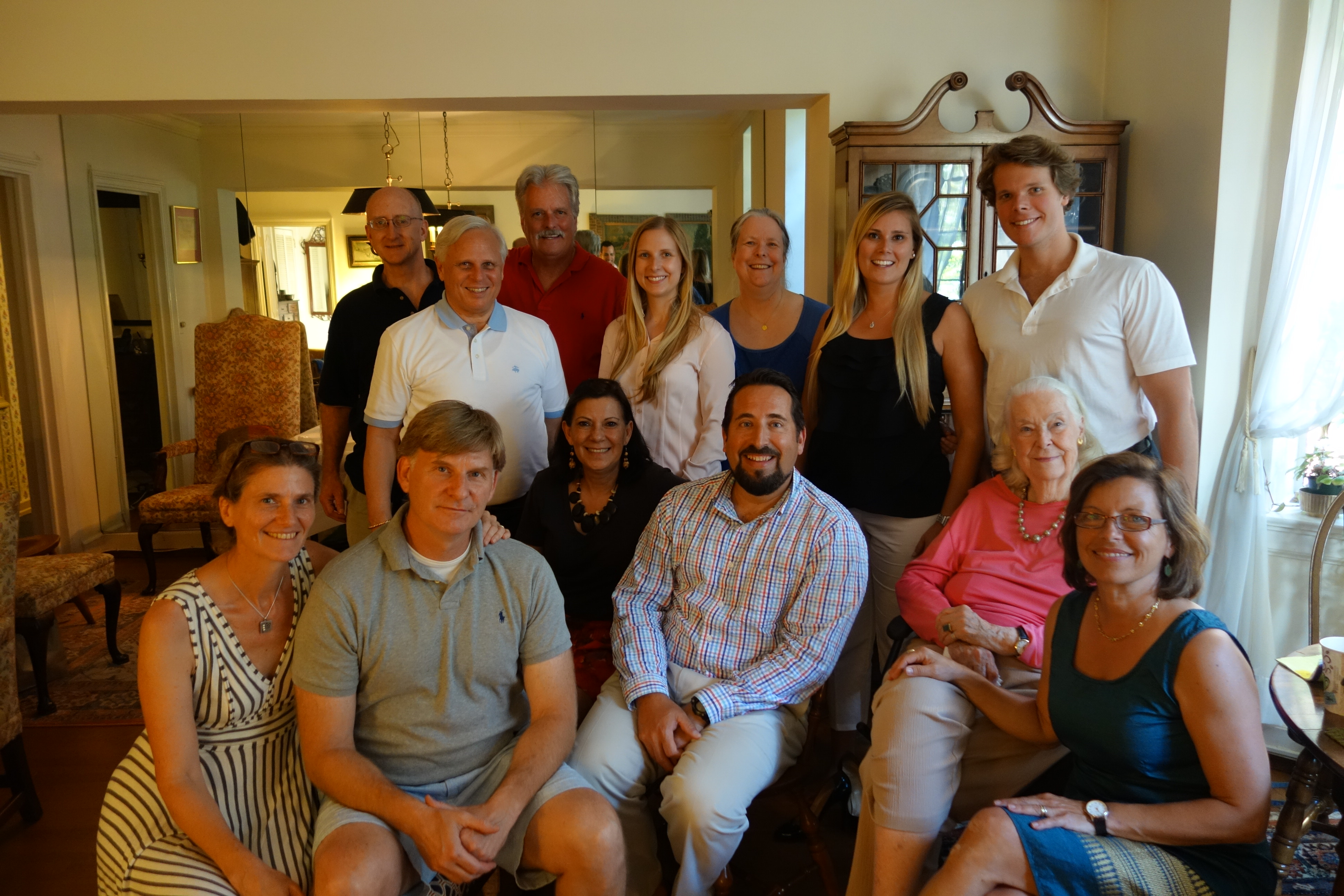
The Bereday cousins met at Aunt Pat’s in late July. Nearly all Halina’s grandchildren were there.

Family reunion--Halina Bereday's grandchildren and great grandchildren

Family reunion–Halina Bereday’s grandchildren and great grandchildren

We are Halina’s legacy.

It has long been my desire to fulfill my Babcia’s wish to be buried in Poland. Our reunion seemed like a good time to take steps toward making that happen. Babcia was cremated over twenty years ago; I offered to bring her ashes to Warsaw, where she can be buried beside her husband Zygmunt Bereda. This is what she wanted. Fortunately, everyone agreed. I’m now in possession of Babcia’s remains and all that is left is to make the arrangements.

Island of remembrance: the Jewish cemetery in Piła

21 Tuesday Jul 2015

Posted by Marysia Galbraith in Cemeteries, Heritage work, Memory, Piła

≈ Leave a comment

A fragment of the lecture I gave at the unveiling of the monument at the 17th century Jewish cemetery in Piła on June 2, 2015, translated into English:

Monument commemorating the Jewish cemetery in Piła

Monument commemorating the Jewish cemetery in Piła

What can be communicated through objects, and often just fragments of objects? What value do the broken mementos of the past have? Material remains of history can seem more and more distant from us. Preoccupied with our daily concerns, we rarely think them. The fragment of the Jewish cemetery in Piła, destroyed during the war, reminds us of earlier times of prosperity and peaceful coexistence among the city’s residents; it simultaneously reminds us of events that even today inspire anguish and opposition. It is understandable why people might try to forget painful memories. It might seem easier to look toward the future instead of back at the past. But reality is not so simple. Something connects us to the past, especially to tragic memories. They function below the level of consciousness and influence us in spite of our desire to forget.

A monument like this one on the remaining fragment of the Jewish cemetery in Piła is an expression not only of respect for the people buried in this place, but also a tool for focusing attention on what used to be. That life will never return, but recognizing its passage can serve as a reminder and a warning. A monument can help us establish a connection with the past and also with the future. It is impossible to think of the future without also thinking about the past. A monument invites us to learn about the history of this city and its residents. It encourages us to reflect on what remains—a fragment of the cemetery wall and several preserved tombstones. We can also have a dialog with nature as we stand under the oldest trees that were witnesses of the history of this place. This island of remembrance helps us connect with our humanity; it makes Piła a more beautiful city and its contemporary citizens better people. Standing in the preserved fragment of the cemetery, we remember all of the former residents of Piła who, like us, had their worries and dreams. From these memories, hope for a better future can emerge.

DSC06457

It is worth getting to know and understand what came before us so that we can understand ourselves better. The way we treat the tangible and intangible fragments of the city’s past communicates to those we associate with everyday, and to those who watch us from afar, including those who seek their own identity and roots.

When we listen to what fragments of the past have to tell us, the past comes alive. Fragments speak to us regardless of whether we try to remember or forget them. Although memories can cause us pain, the absence of memory can also wound us. This can happen when we close ourselves from the past and we don’t want to understand it. That is why it is better to remember and to try to understand the past as well as its influence on us. That is the only way we can heal the trauma of the horrors that transformed this place and so many other places like it.

Marked by a monument, this space functions differently than it did without the monument. The monument fills, however incompletely, the void left behind by loss. Left empty, the void could be interpreted as indifference, disrespect, and even a sign of hatred. A monument inspires memory work and contemplation. The cemetery has been returned to the map of the city and to the consciousness of its residents. It is once again a place for focusing on the experience of loss, and simultaneously on respect for the phenomenon of life. We are not alone. We share common feelings. Memory brings us closer to each other, making us a community despite our differences.

This translation is a little different from the Polish text. Even translating my own writing, some things are easier to express in one language than the other.

The photo: some reassembled stories

10 Friday Jul 2015

Posted by Marysia Galbraith in Family, Names, Piwko, Polish-Jewish Heritage, Włocławek

≈ 4 Comments

Tags

Abram Janas Piwko, Efraim/Philip Piwko, Halina Bereda/Haja Piwko, Hanna Cytryn, Hil Majer Piwko, Hinda Walfisz Piwko, Jakub Piwko, Liba Piwko Winawer, Natan Kolski, Rachel Piwko Kolski, Sarah Piwko Winawer

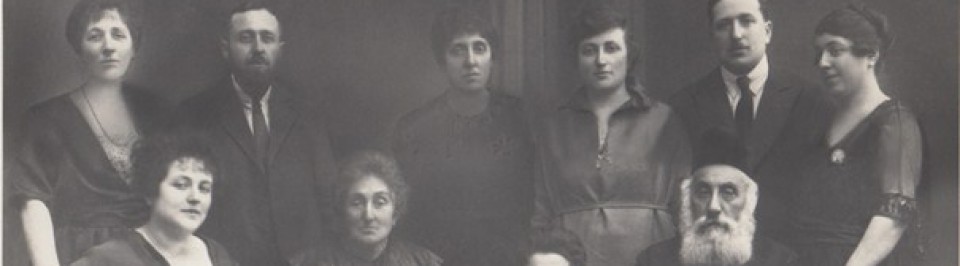
When I first saw this photo in the summer of 2011, I knew almost nothing— I didn’t know who was in it, nor even my grandmother’s maiden name. I figured the older couple was my grandmother’s parents. Were the others their children? Could one of them be my grandmother? And who was the boy in the front row?

JechielHindaAndChildren

My brother Chris and cousin Krysia almost immediately recognized the woman on the bottom left, as our grandmother. With her coquettishly tilted head, her stylish clothes, and her hand resting on her mother’s wrist, it seemed likely to me, too. But I wanted to be sure.

This photo has proven to be an essential clue in my search for family history. Many of the cousins I have met are familiar with the photo and helped me identify everyone in it. In fact, it has helped me establish connections with cousins, and served as proof that we are actually related. When I contacted Pini in Israel, he was skeptical at first that we were cousins. But when I sent him this photo, he responded, “Welcome back to the family.” And he meant it. I feel embraced by the large clan of descendants of my great grandparents, the elderly couple in the photo whom I now know are Hinda (nee Walfisz) and Hil Majer Piwko.

Hil Majer Piwko

Hil Majer Piwko

Hinda Piwko

Hinda Piwko

And it is indeed my grandmother Halina in the bottom left corner.

Halka Piwko

Halka Piwko, my grandmother

This photo has led me to living relatives, and back to the time depicted in the image. It helps me see and feel what family life was like back then, and adds depth to my understanding of the dry genealogical facts I have gathered.

Even my uncle Stanley Winawar has spoken to me from the grave in the form of a letter he wrote to Pini in 2002 (just two years before his death) in which he identifies everyone in this photo, and lists many of their descendants as well. One of my regrets is not having started this search sooner so I could have talked with Stanley and others before they died. At least through the letters, I’ve had a taste of the conversations we might have had.

So let me introduce my family:

Sarah Winawer

Sarah Winawer

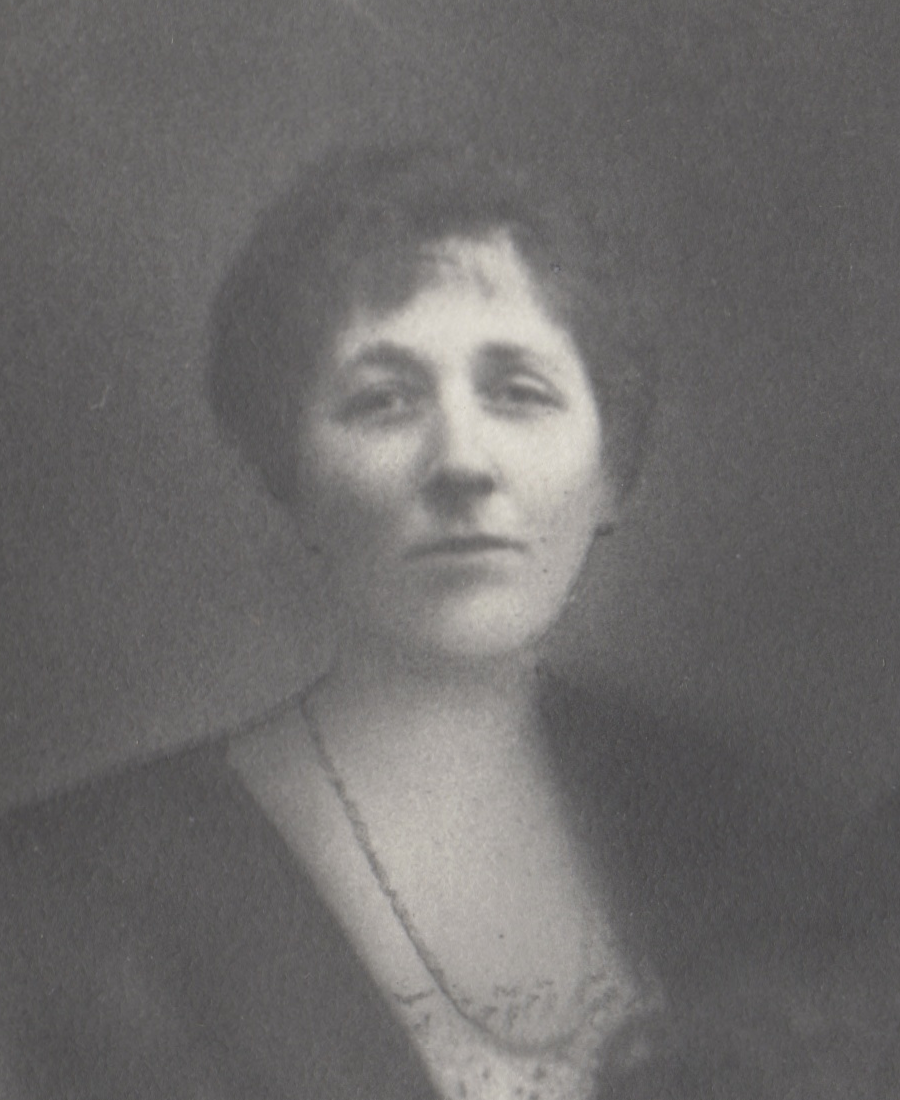
Starting at the top left, most people identify the elegantly dressed woman as Sara (Piwko) Winawer, Uncle Stanley’s mother. Born in 1880, she was the second daughter of my great grandparents. On a list compiled by my Aunt Pat (probably based on a conversation with my grandmother’s sister Hanna/Nunia), she is described as having “beautiful hair.” She married Saul Winawer in 1899, and they had four children (Nathan, Milton, Stanley, and Paulina). My mom stayed in touch with her aunt Sara in the United States, though she was known in my family as Lusia (apparently no one besides our branch of the family called her that). She died in 1964 when I was 6 months old. She was too sick to visit me, but told my Mom on the phone that she would watch over me from heaven. I only heard this story once or twice when I was a child, but it left an impression on me. I liked the idea of having a guardian angel of sorts. Who knows? Maybe it foreshadowed this search for deeper connections with my mother’s extended family.

Jakub Piwko

Jakub Piwko

Next in the top row is Jakub, the oldest son born around 1874. Aunt Pat says he had four wives, including Helen Esther Kirsten, Genia Ellinberg, and Rozalia Kirsten. She (Nunia?) describes him as blond, delicate, of medium height, resembling his maternal grandfather Natan Walfisz. He was a Zionist and member of the governing board of the Jewish Community of Włocławek from December 1917 until resigning on March 3, 1922. He was also a representative on the City Council from 1917-19 (see virtual sztetl). Jakub died in 1942; by one cousin’s account he owned a small hotel in Otwock and was shot by Nazis for being out on the street after curfew. He had a son Natan who emigrated to Israel and a daughter, Pola.

In a letter to Pini, Stanley (Sara’s son) wrote, “The space missing between Jacob and Liba was obviously reserved for Yona…” Abraham/Abram, the second-born son, was called by his middle name John/Yona/Janas. Born around 1876, Pat (Nunia?) describes him “devil eyes, tall, brunette, liked girls and girls liked him, 6’ 2”-6’ 4”.” He was the first in the family to come to the United States, arriving in New York in January 1906. His wife Bertha/Blima (they married in 1901) followed in May 1907 with their children Nathan, Paula/Pauline, and Ewa. A fourth child, Sarah, was born in New York. Abraham owned a bakery in Brooklyn until his death in 1925.

Liba Winawer

Liba Winawer

In the middle of the top row is the oldest child Liba, born around 1872. Aunt Pat’s list (Nunia’s description?) says she was tall, blond, and beautiful. At the age of 17 or 18 she married Jakob/Jankiel Winawer. I don’t know how he was related to Saul Winawer (Sarah’s husband), but some say they were cousins. Liba and Jakob had four sons—Nusen, Sol/Saloman, Max, and Morris. In 1928, Liba and Jakob came to the US, where their three younger sons were living. Jakob died there in 1932, but I haven’t found a record of Liba’s death. Did she die in the US? If so, why isn’t it documented? Could she have returned to Poland, where her oldest son still lived? Could she have died in the death camp at Treblinka in 1942, as some say Natan did?

Hanna Cytryn

Hanna Cytryn

Next to Liba is Hanna (born around 1886), though everyone in the family called her Nunia. I’ve already written about her, but briefly, she married Stanisław/Samson Cytryn and had one daughter, Teresa. She and Samson lived in Warsaw where they ran a shop that has variously been described as a pharmacy or a supplier of lotions and toiletries. Maybe she was an herbalist and so offered products that crossed the boundary between health and beauty? She took over the shop after her husband’s death in 1927. Nunia spent World War II in Warsaw under the false identity of Maria Weglinska (the name she kept until her death in 1984) After the war, she lived in Paris, and then in 1951 she moved to the US.

Philip Piwko

Philip Piwko

Next is Philip/Efraim, described by Pat (Nunia?) as “six foot, blond, pock marked, shy, sweet.” Born around 1882, he came to the US a couple of years after his brother, at the end of 1907. He, too, owned a bakery though I don’t know if it was the same one as his brother or a different one. Philip married Goldie. They never had any children of their own, but they took care of siblings, nieces, and nephews as they immigrated to the US. Many of the cousins remember him as the glue that held the family together in the US. Philip died tragically in an auto accident in 1947 on his way home from Boston.

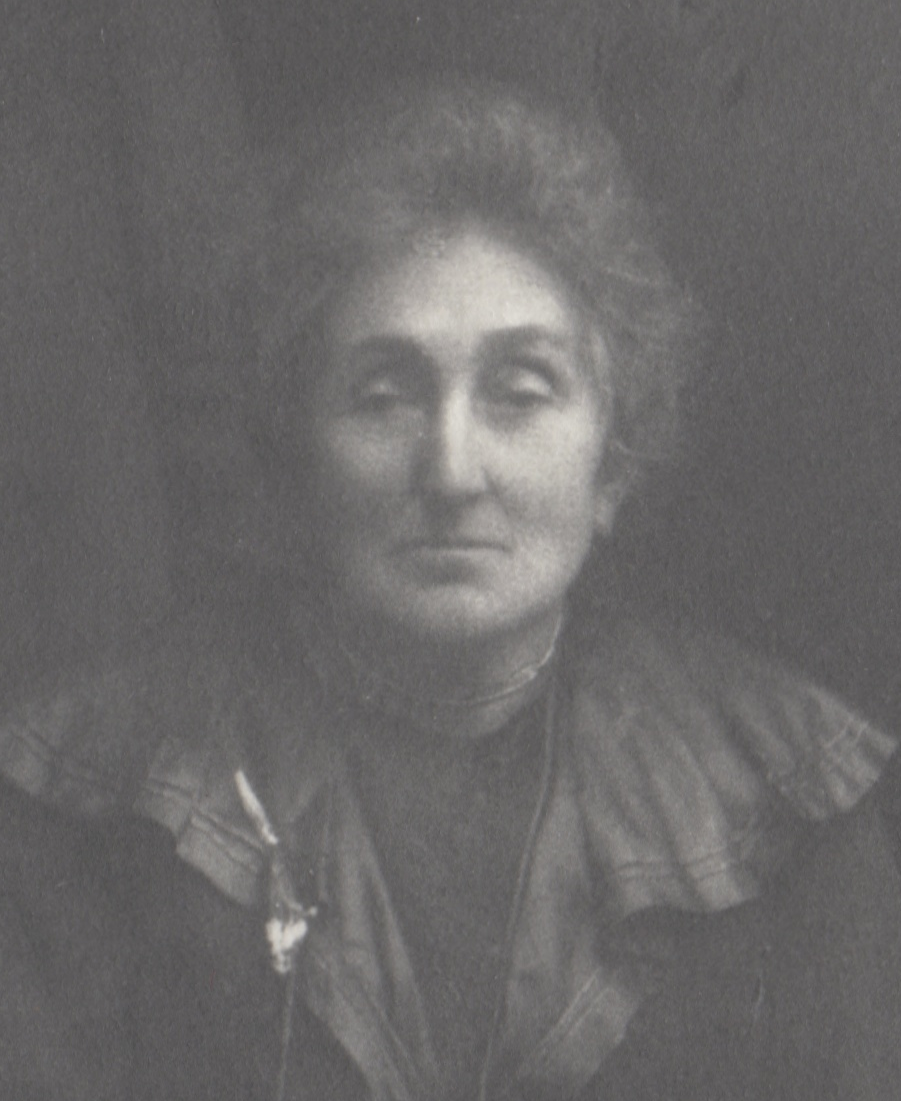
Rachel Kolska

Rachel Kolska

At the far right of the top row is Rachel, who was born around 1890 between Hanna and Halina (my grandmother). Pat (Nunia?) describes her as shorter than her sisters, with thick thick hair. She married Pinkus/Pinchas Kolski, the widow of her older sister Regina who died giving birth to a son, Natan. Rachel raised Natan, and had four more children with Pinkus—Samek, Abram, Naftali/Maniek, and Mirka. They settled in Włocławek, where they had a store right in the center of town. After the war broke out, Rachel, Pinkus, and Mirka (who was just a teenager—she was ten years younger than her youngest brother) were moved to the ghetto in Warsaw. Pinkus, who was in ill health, died there in 1940, and Rachel and Mirka escaped and lived on the Aryan side under false papers. After the war ended, they joined Natan, Abram, and Maniek who were living in Israel. Rachel died in 1969.

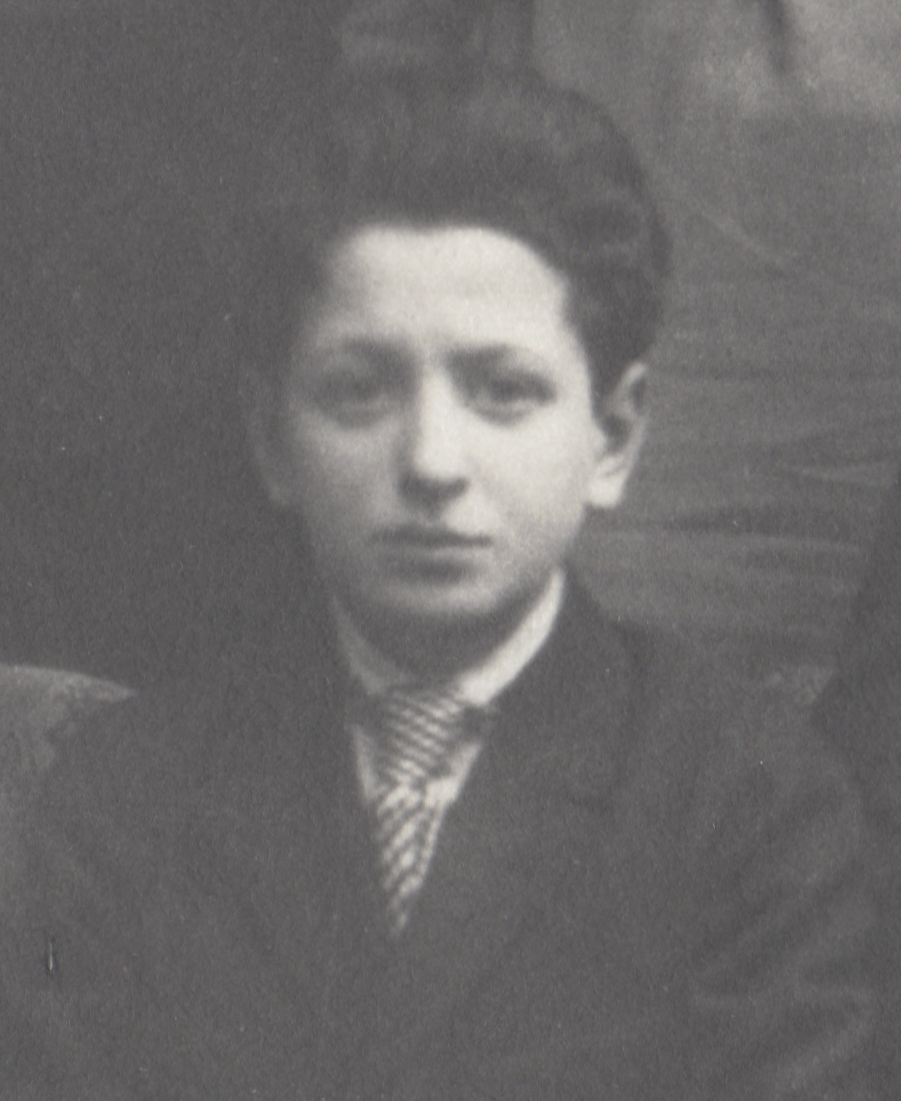
Natan Kolski

Natan Kolski

On the bottom left, as I have already said, is my grandmother Haja/Halina, born in 1894. Seated beside her is her mother, Hinda (Walfisz) Piwko, while her father Hil Majer Piwko is on the far right. The young boy is Natan, the son of Regina and Pinkus Kolski. Perhaps he was there in his mother’s place, just like a gap was left for Abraham/John? Natan is said to have spent a lot of time with his grandparents. His position between them suggests they were very fond of each other. And I almost forgot one more member of the family—the dog under the couch behind Natan’s feet. Could this have been Natan’s dog? Another sign of the favor of his grandparents? I don’t know but I like to think of it that way.

So that’s my grandmother’s family, excluding only Małka who died as a teenager and two other siblings who died as infants.

Considering Natan was born in October 1905, I would guess this photo was taken near the end of the 1910s, maybe in 1919. Natan looks like he’s about 12, like my son is now, or maybe a little older. It seems unlikely the photo would have been taken during World War I, especially because of Philip’s presence. Philip was living in the US already (he is listed in both the 1910 and 1920 US census) and I don’t think he would have made the journey during the war. I don’t know enough about the history of fashion to be sure, but Halina’s dress seems scandalously short for the period, and even Rachel’s hemline is a few inches above her ankles. Still, I read that hemlines started to rise in Europe in 1915. I wonder, as well, whether Hanna’s comparatively simple dress was because she was less well off than her sisters, or perhaps was rather due to a more practical nature (which fits with how I remember her).

The photo is a window into the past. In it, I see a large, affluent, close family, but one in which social and cultural divisions were growing through the generations. While father Hil’s thick beard, black cap and long coat were characteristic of a conservative, religious Jew, his older son (the Zionist) had a shorter, more trimmed beard, and his younger son, by now an American citizen, sported only a moustache. The twenty-two-year gap between Liba, the oldest sibling, and Halina, the youngest, also seems apparent in the way they carried themselves and dressed.

I’ve learned a lot since I pulled this photo out of the envelope my grandmother had marked “Do Not Open.” And yet it all remains fragmentary. Most of the richer details are tentative, based on stories I try to piece together into something more substantial. But the fragments stand stubbornly apart from each other, and sometimes even in opposition to each other. Did Rachel accept her sister’s son Natan as one of her own, or did he spend much of his time with his grandparents? Perhaps it was both, since Hinda and Hil also lived in Włocławek later in life. Why does Liba seem to be retreating into the background? Is it just an accident of the lighting or a reflection of her character? Why was my grandmother holding her mother’s hand like that? Was it a sign of affection or perhaps an assertion of autonomy? The more I sit with this photo, the stronger I feel a connection with these people. And still, how distant they remain from me.

Americans in Lesko: Project Preservation

04 Saturday Jul 2015

Posted by Marysia Galbraith in Cemeteries, Heritage work, Lesko

≈ 1 Comment

Tags

Dartmouth College, Project Preservation, Rabbi Edward Boraz

Sometimes things just fall into place better than could been planned. I got in touch with Arkadiusz Komski to discuss Jewish heritage work in Sanok. We met at the Słotki Domek Café in Lesko. In addition to being a wealth of knowledge about the history of Jews in the Sanok region, Arek told me that Rabbi Edward Boraz was scheduled to come with a group of Dartmouth students to clean up and inventory the Jewish cemetery in Lesko. I knew I needed to stay an extra day to meet them, and I’m glad I did.

Boraz has been at Dartmouth since 1998. As town rabbi, head of the campus Hillel, and professor in the medical school, he wears many hats. Also, for the past fifteen years, he has led a summer trip to a different town in Eastern Europe to clean up a Jewish cemetery (called Project Preservation). Students receive no academic credit for participating. Before the trip, they attend ten weekly seminars, and read and discuss a range of relevant literature. This year, they focused on the intellectual foundations for the Holocaust, and how science and medicine were used as tools to develop the techniques for mass murder.

The group spent about a week in Poland. They flew into Krakow, visited Auschwitz, the synagogue in Łańcut, and the death camp at Bełżec (where many Jews from the Lesko region were taken). Then they came to Lesko. They were scheduled to work about four days at the cemetery, with a day off for Shabbat. They also held a short Shabbat ceremony in the Lesko synagogue building.

When I met Boraz the night he arrived, I spoke more than I should have. He asks good questions, and is a good listener. He explained that he likes to hear peoples’ stories. Still, as an ethnographer, usually I’m the one who asks the questions and listens to peoples’ stories.

Ewa Bryła speaks with Marek Duszyński of MojeLesko.pl

Ewa Bryła, of the Carpathian Minority Heritage Association, speaks with Marek Duszyński of MojeLesko.pl

Rabbi Boraz says thanks to the help of Arek Komski, Ewa Bryła, and her brother Piotr, this is the fifth time he has returned to southeast Poland. They help coordinate all the logistics, bring equipment and people to help cut the grass, act as translators, and provide information about the region.

Meeting with Rabbi Boraz and his students seems like a fitting bookend to my year in Poland. When I arrived in Poland last August, I just missed them. In Lutowiska, I walked up the new steps they had built and through the gate they had mounted at the cemetery entrance. I followed in their footsteps along the paths through the cemetery and looked at the tombstones they had cleaned.

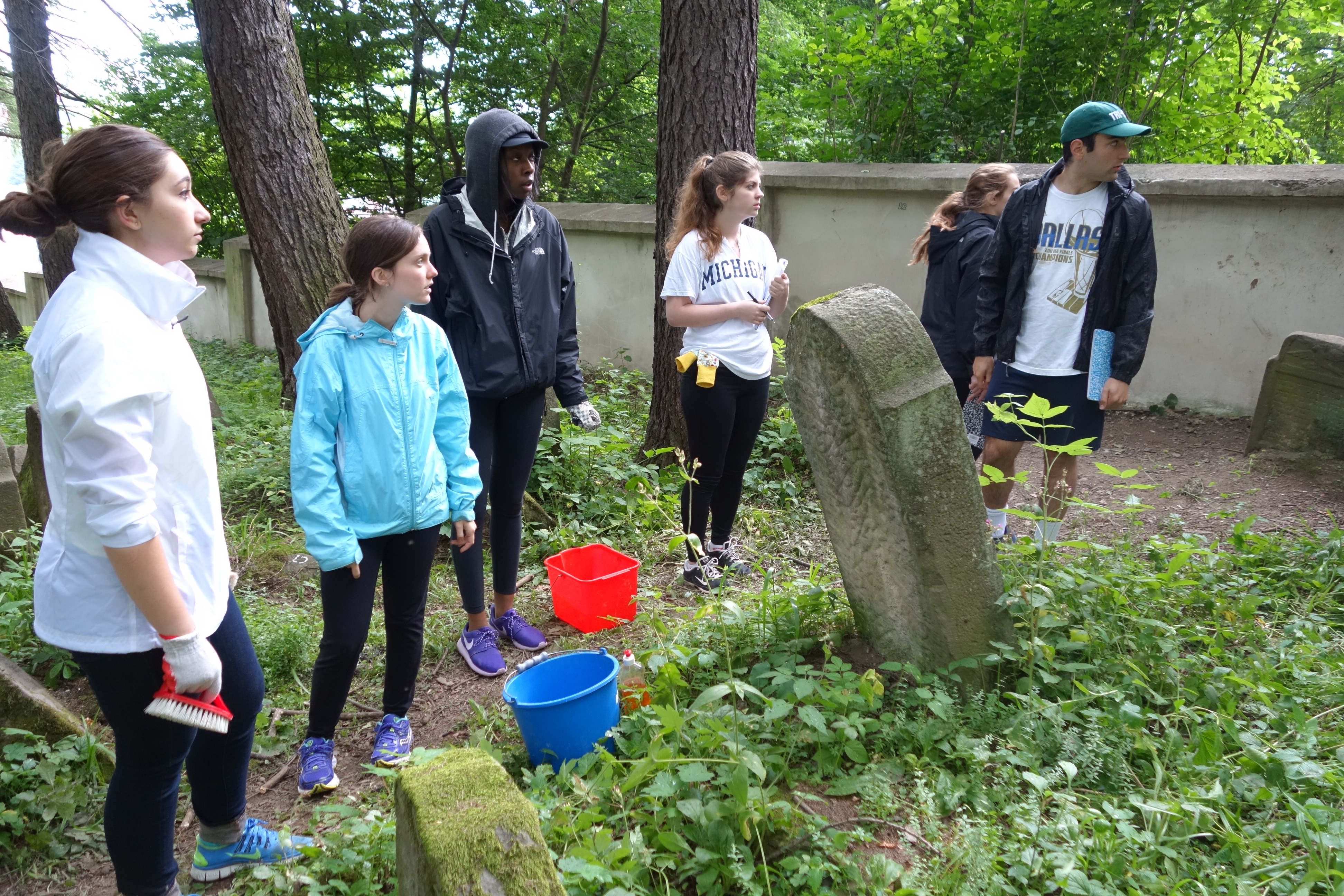
This year in Lesko, I chatted with the students before they began work and asked them what motivated them to sign up for the trip. About half were raised in Jewish households, some more reformed and some more conservative, while the rest were from a variety of backgrounds. Some grew up in neighborhoods with a lot of Jews, others with almost none. They had various levels of familiarity with the history of European Jews and the Holocaust. Some were interested in the project because they knew Holocaust survivors or because their own distant ancestors came from this part of the world. Others focused on the service component of the trip; they wanted to contribute to the preservation of Jewish culture. Still others expressed an interest in history.

The students were impressed by the age and charm of Krakow, although they weren’t so sure about some Polish food practices. It struck some as odd that normal life goes on in the Polish city of Oświęcim right next to the death camp of Auschwitz. They found the tour of the death camp was unsettling, though one student said reading about Holocaust history had a greater personal impact.

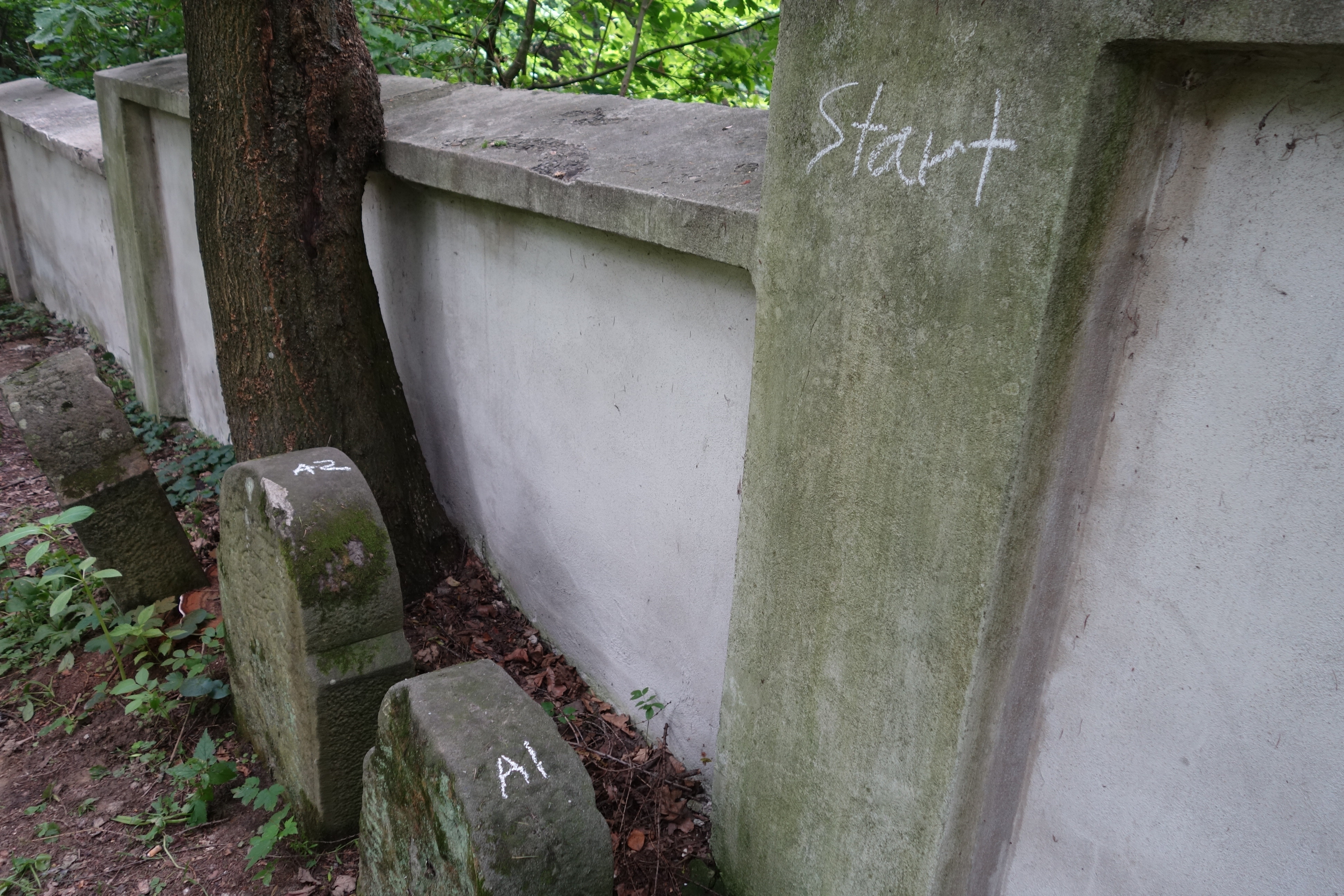
Start

Start

The students got started in the area of the cemetery with the densest concentration of tombstones. One began numbering the stones with chalk, DSC06897

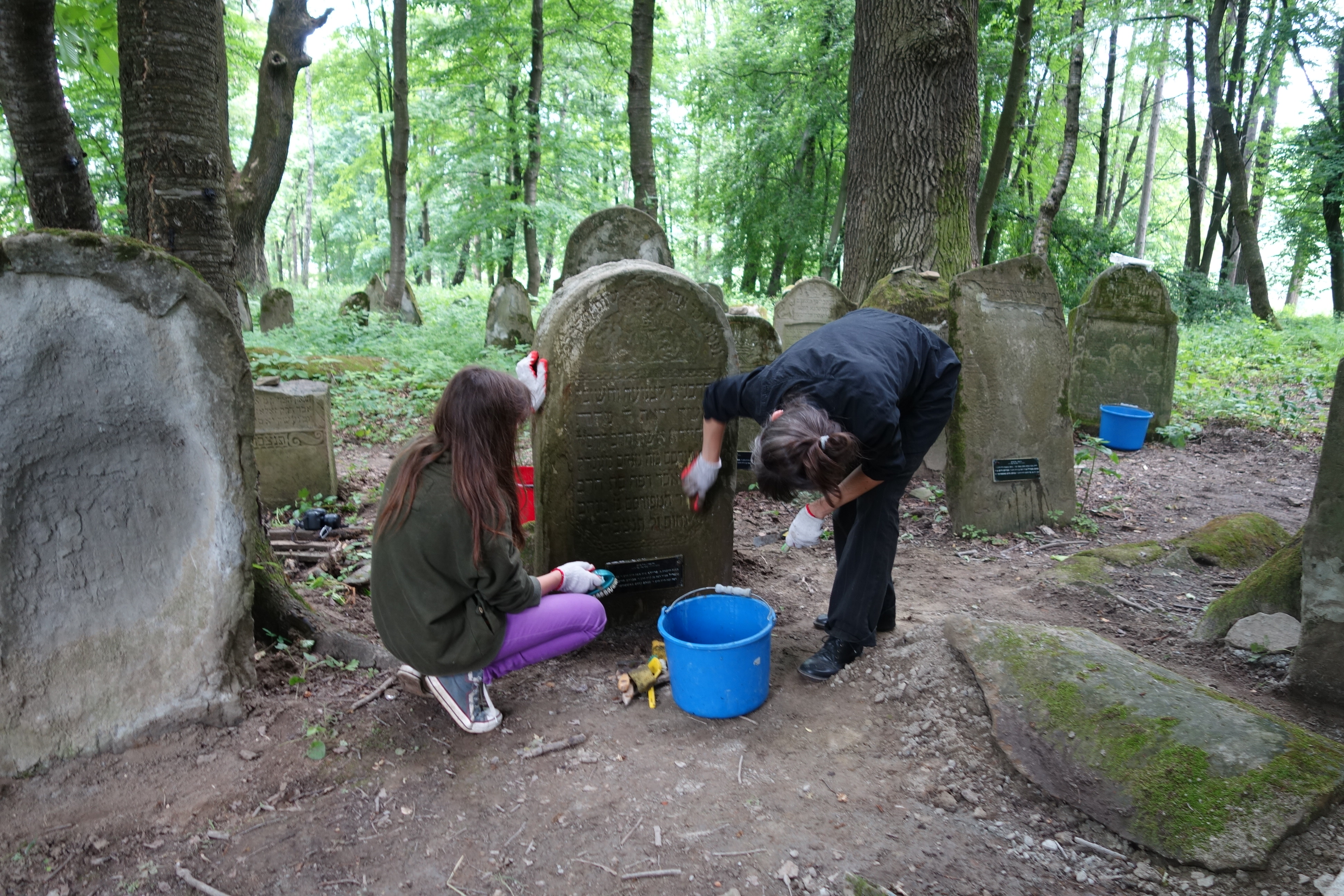
Deciphering inscriptions

Deciphering inscriptions

some set about photographing, transcribing, and translating inscriptions, others used soft brushes and water to gently clean the stones’ surfaces. DSC06895They had to be especially careful because most are of a soft sandstone which is prone to fracturing and wearing away. Many are covered with moss that provides a degree of protection but can also obscure the inscriptions. An additional complication is that some varieties of moss are endangered and protected, and thus not to be disturbed.

The Americans were joined by Poles—a woman who moved to the area from Warsaw with her two teenage daughters and another teenage girl. Some more local residents joined the group in the Lesko synagogue for the Shabbat service Friday afternoon (see mojelesko).

Local residents help clean the tombstones in Lesko

Local residents help clean the tombstones in Lesko

The Jewish cemetery in Lesko is the oldest and largest in the region. The earliest tombstone dates from 1548, and over 2000 stones remain on the site. It was one of the first places I was taken by a couple of local teens who showed me around town when I moved there in 1992. Nevertheless, the cemetery was talked about as a place to hang out with friends away from the scrutiny of adults. Little was known about the former Jewish population, and even less was discussed in public. I hope this is changing, even though (or perhaps because?) few witnesses remain of the prewar community and the removal and murder of Jews.

Grassroots heritage work in Bieszczady

21 Sunday Jun 2015

Posted by Marysia Galbraith in Cemeteries, Dukla, Heritage work, Lesko, Nazi Camps, Polish-Jewish relations, Pre-World War II, Sanok, Synagogues, World War II, Zasław

≈ 6 Comments

Tags

Bieszczady, Jewish culture and history

There is a pattern in the frequency (or rareness) of my posts. When I’m focused on other writing projects, I also write more for the blog. When I’m traveling, interviewing, and attending events, I write less. This month I’ve been traveling.

It seemed important to bring my new research focus to my old fieldsite, and see what is happening in relation to Jewish culture and history in the Bieszczady Mountain region.

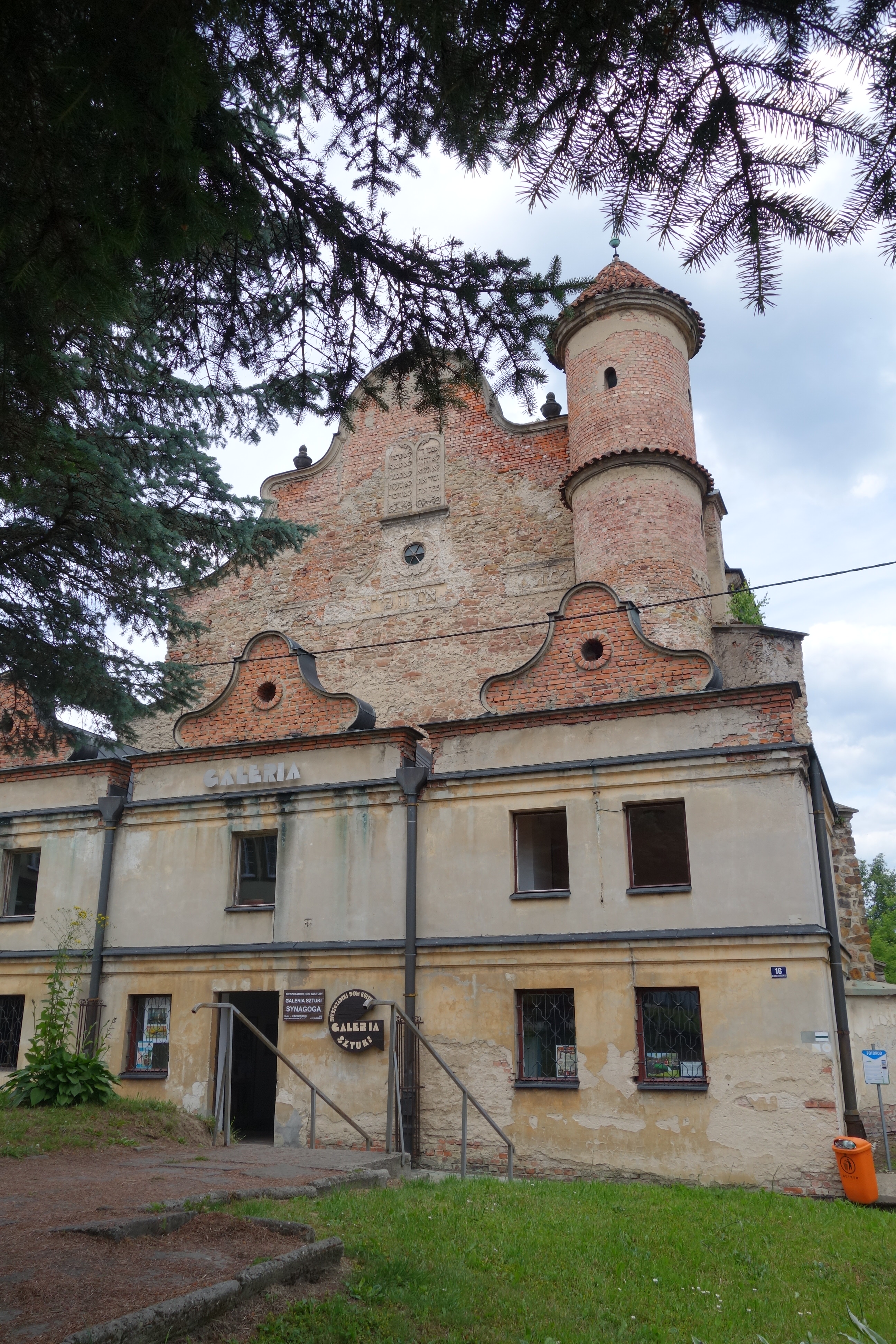
The Lesko synagogue. Destroyed in World War II, it was rebuilt in the 1960s.

The Lesko synagogue. Destroyed in World War II, it was rebuilt in the 1960s.

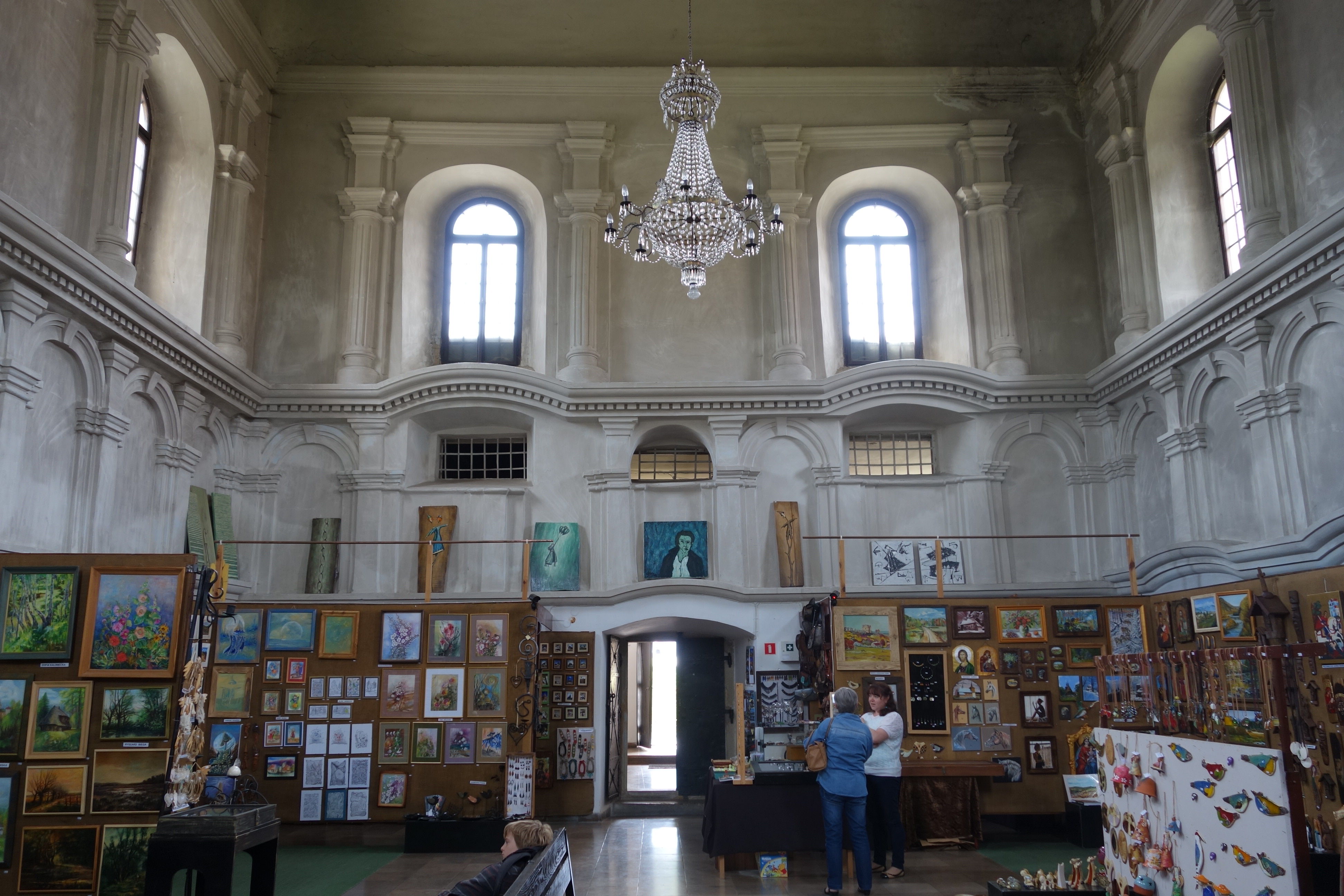
I’ve written elsewhere about how striking it is that, despite the fact that before World War II more Jews lived in Lesko than Poles, only very rarely have contemporary residents volunteered any information about the former Jewish residents. Even though I walked by the former synagogue (bigger than the Catholic Church) and the massive Jewish cemetery countless times, it really only sunk in to me last November that Lesko was a sztetl. One of my friends in Lesko described it really clearly. She said that somehow she always knew that the Jewish history of the town was something that you don’t talk about. It was a taboo topic. This has only recently started to change. Only in the past few years has she noticed that people talk about Jewish culture and history openly. She thinks this is a good thing. Realizing how little she knows about the subject, she has started to educate herself about prewar Jewish life and the Holocaust in Bieszczady.

Interior of the Lesko Synagogue. Now owned by the town, it functions as a gallery of regional art.

Interior of the Lesko Synagogue. Now owned by the town, it functions as a gallery of regional art.

Generally, I have found that when I ask, most people have a story or two to tell about Jews in Bieszczady, either something they have read or a some fragmentary memory their grandmother told them. Though also when I told one friend about my interest in Jewish culture and history, she responded, “There were Jews in Bieszczady?” Even though she went to high school in Lesko, she only vaguely remembered the Jewish cemetery and had no recollection of the synagogue. Whether she really didn’t know or just continues to think this is a topic that polite people don’t talk about, I’m not sure.

Nevertheless, some important grass roots work is being done: by Arkadiusz (Arek) Komski in Sanok, Ewa Bryła and her brother Piotr in Zagórz, and Jacek Koszczan in Dukla. Arek is working on a dissertation about the Jews of Sanok. We met at the Słotki Domek Cafe in Lesko after he finished work, and then the next day he showed me the places associated with Jewish life in Sanok.

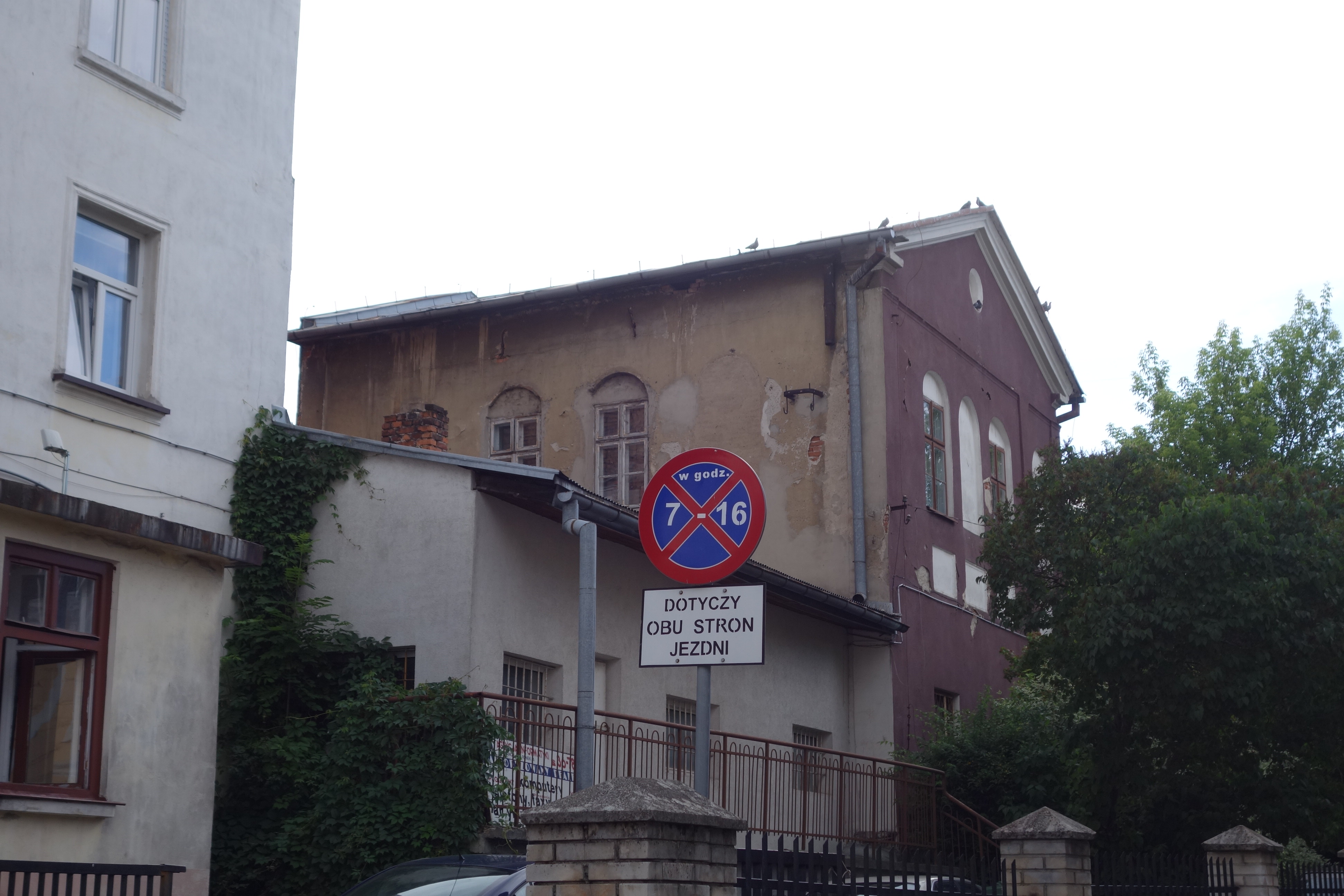
One of the former synagogues in Sanok

One of the former synagogues in Sanok

Commemorative marker, Sanok

Commemorative marker, Sanok

His interest in the topic originated with a curiosity about history, and particularly the history of his hometown. He has published articles about the Nazi work camp in neighboring Zasław and about the locks that were found at the Jewish cemetery. Last year, he realized a project to place a commemorative marker across the street from the former site of the great synagogue.

Arek also let me know that he was awaiting the arrival of a group of students from Dartmouth College, led by Rabbi Edward Boraz, who were going to clean up and inventory the tombstones in the Jewish cemetery in Lesko (see Project Preservation). He has helped them already, first when they came to the cemetery in Sanok, then to Ustrzyki Dolne, Korczyna, and last year to Lutowiska.

Through Arek, I met Ewa, who helped found the Stowarzyszenie Dziedzictwo Mniejszości Karpackich (Association for the Heritage of Carpathian Minorities). Arek joked that for Ewa, working on heritage preservation is a full time hobby. Her interest emerged out of her own Bojko/Ukrainian roots; her parents and grandparents spoke Ukrainian among themselves, though they only spoke Polish with her and her brother. To date, the association has helped clean up as many as thirty Uniate (Ukrainian) and Jewish cemeteries in the region.

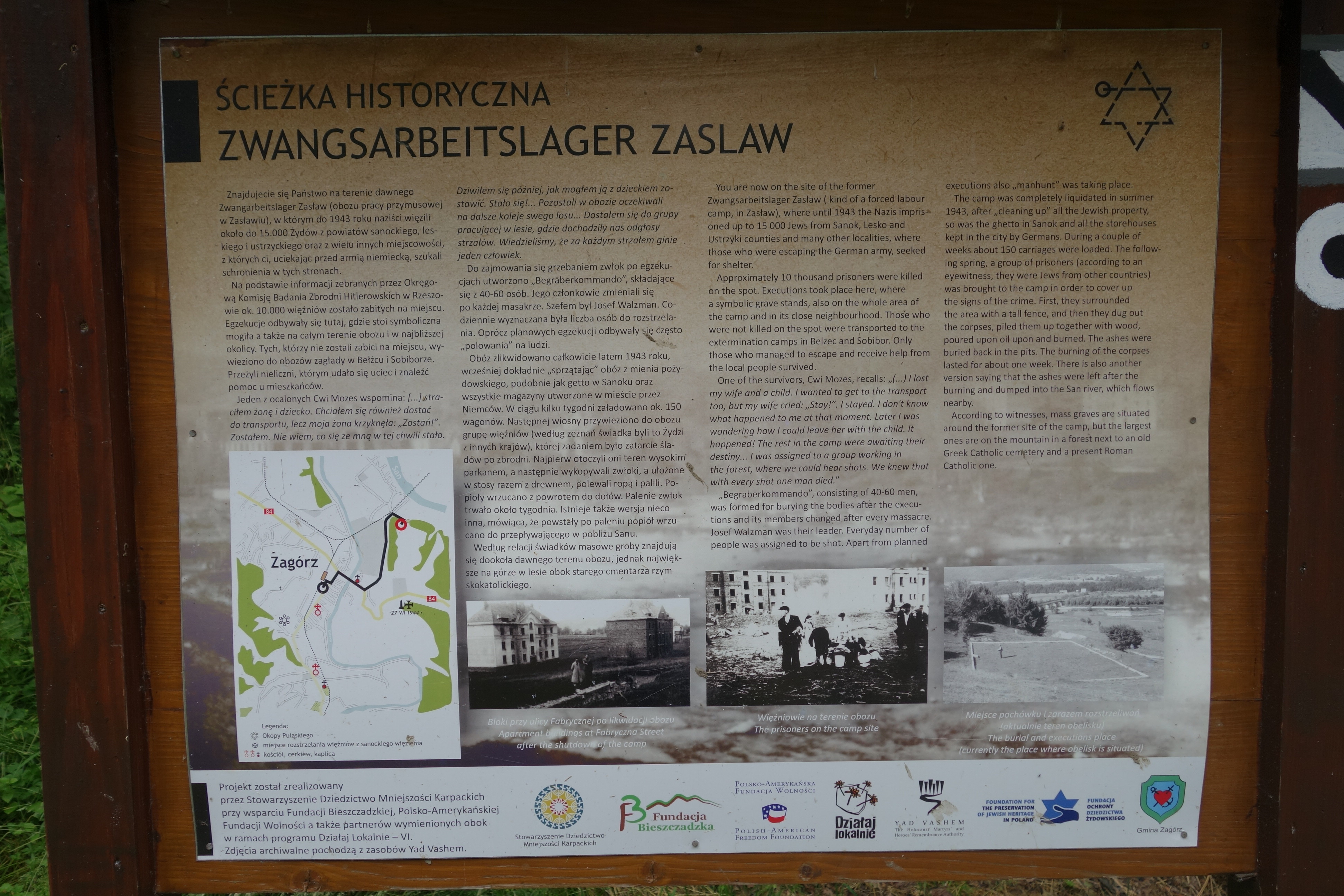
Information about the prison camp and murder of Bieszczady Jews in Zasław, near Zagórz

Information about the prison camp and murder of Bieszczady Jews in Zasław, near Zagórz

Another of the association’s projects is a heritage trail and information sign at the site of the Nazi work camp in Zasław. This is where most Jews from Lesko and neighboring communities were taken and forced to work at a neighboring factory. Approximately 10,000 prisoners were shot on the site, while perhaps 5,000 were sent to extermination camps at Belżec and Sobibor.

Monument at the site of mass murders in Zasław, near Zagórz

Monument at the site of mass murders in Zasław, near Zagórz

I stopped by Dukla on my way back to Krakow, and despite the rain Jacek and Ania, who works at the local tourist office, showed me around. Jacek had already started collecting Judaica around the time of his retirement from the border patrol. An infectiously upbeat and energetic man, he needed something to occupy himself and so decided to get to work protecting and publicizing the sites associated with Dukla’s prewar Jewish population. He told me that the town was as much as 80% Jewish. We walked by the former Jewish school, where boys learned various trades. It is across the street from the old government building; Jacek says that the associate mayor used to be selected from among the Jewish population. Similarly, most of the stone buildings around the market square (rynek) were owned by Jews. Jacek told me the fate of the last rabbi who hid under his rynek home, but then was caught and killed by the Nazis when he tried to escape to Krosno.

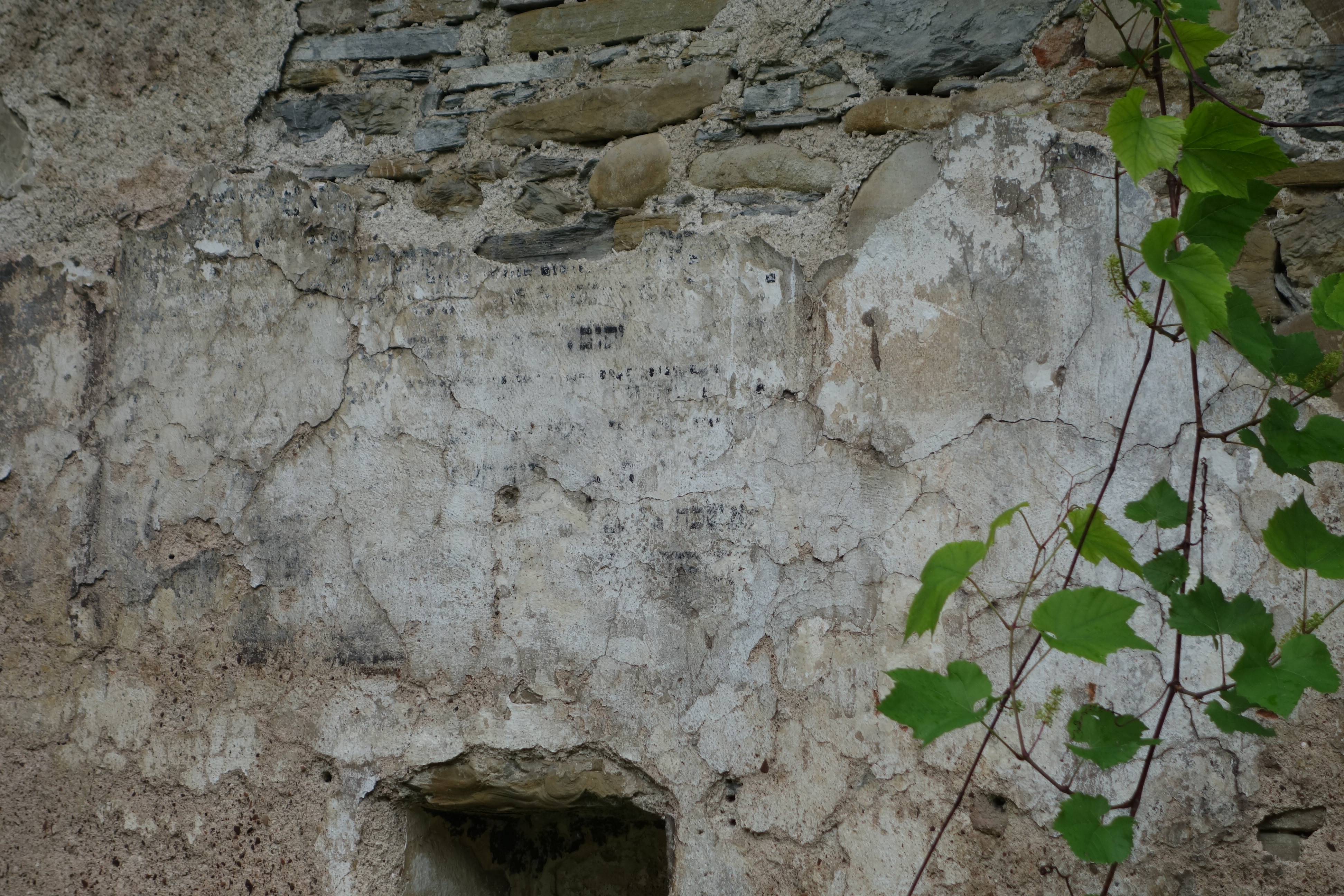
Writing still visible on the wall of the ruined synagogue in Dukla

Writing still visible on the wall of the ruined synagogue in Dukla

Ruin of the 18th century synagogue in Dukla

Ruin of the 18th century synagogue in Dukla


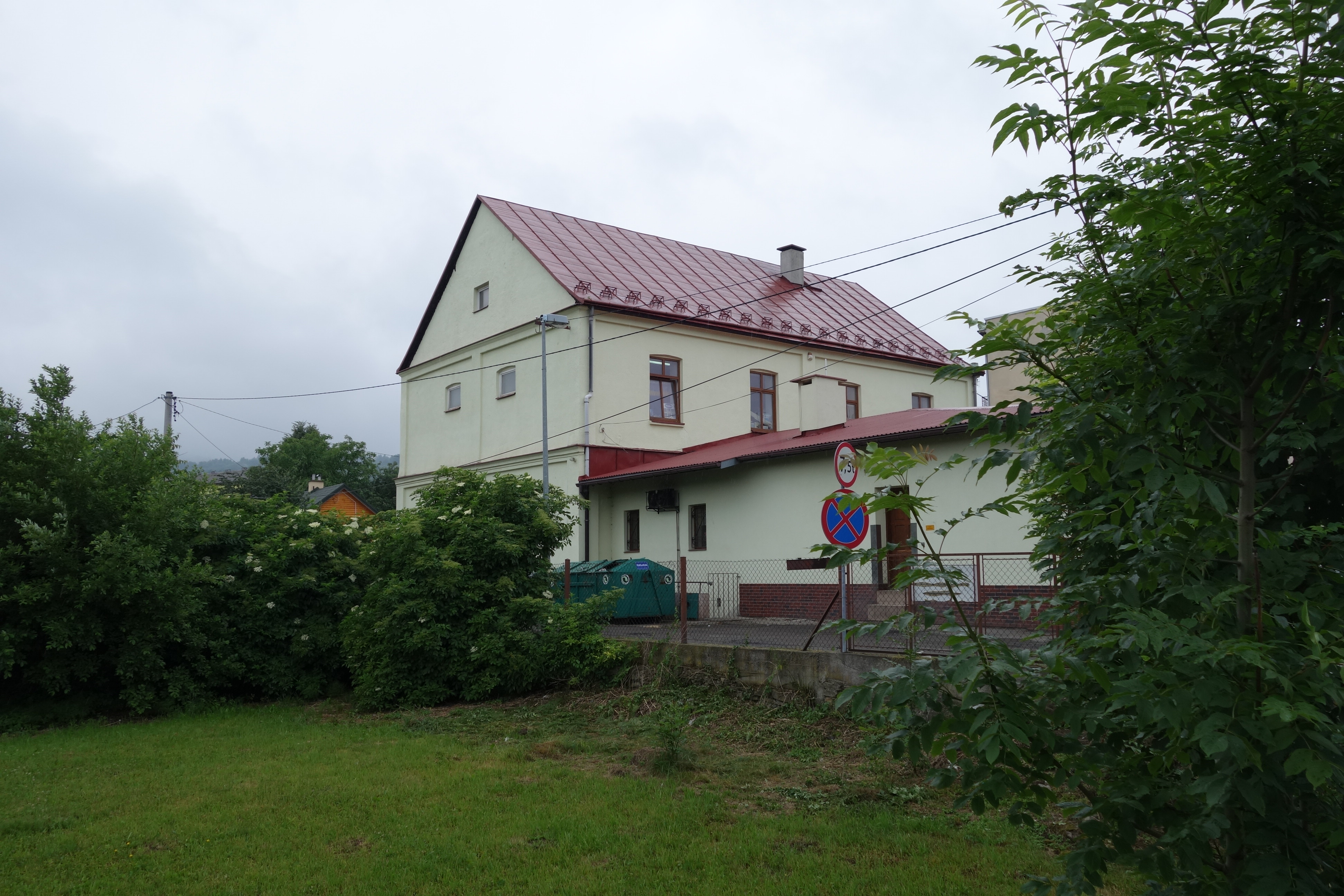
Former synagogue, now a grocery store in Dukla

Former synagogue, now a grocery store in Dukla

Two synagogues stood side by side. The one dating from the 18th century was burned by the Nazis with Jewish residents inside. The neighboring mykwa was also destroyed. Jacek would like to see the remains of this synagogue conserved. All it would take is reinforcing the window arches and putting in a platform on the inside for viewers to walk on; right now a chain link fence surrounds the site. The other synagogue, dating from the late 19th century, is now a grocery store. Dukla also has two Jewish cemeteries, the older one with burials up to World War I, and the newer one beside it used during the interwar period. Jacek mows them himself.

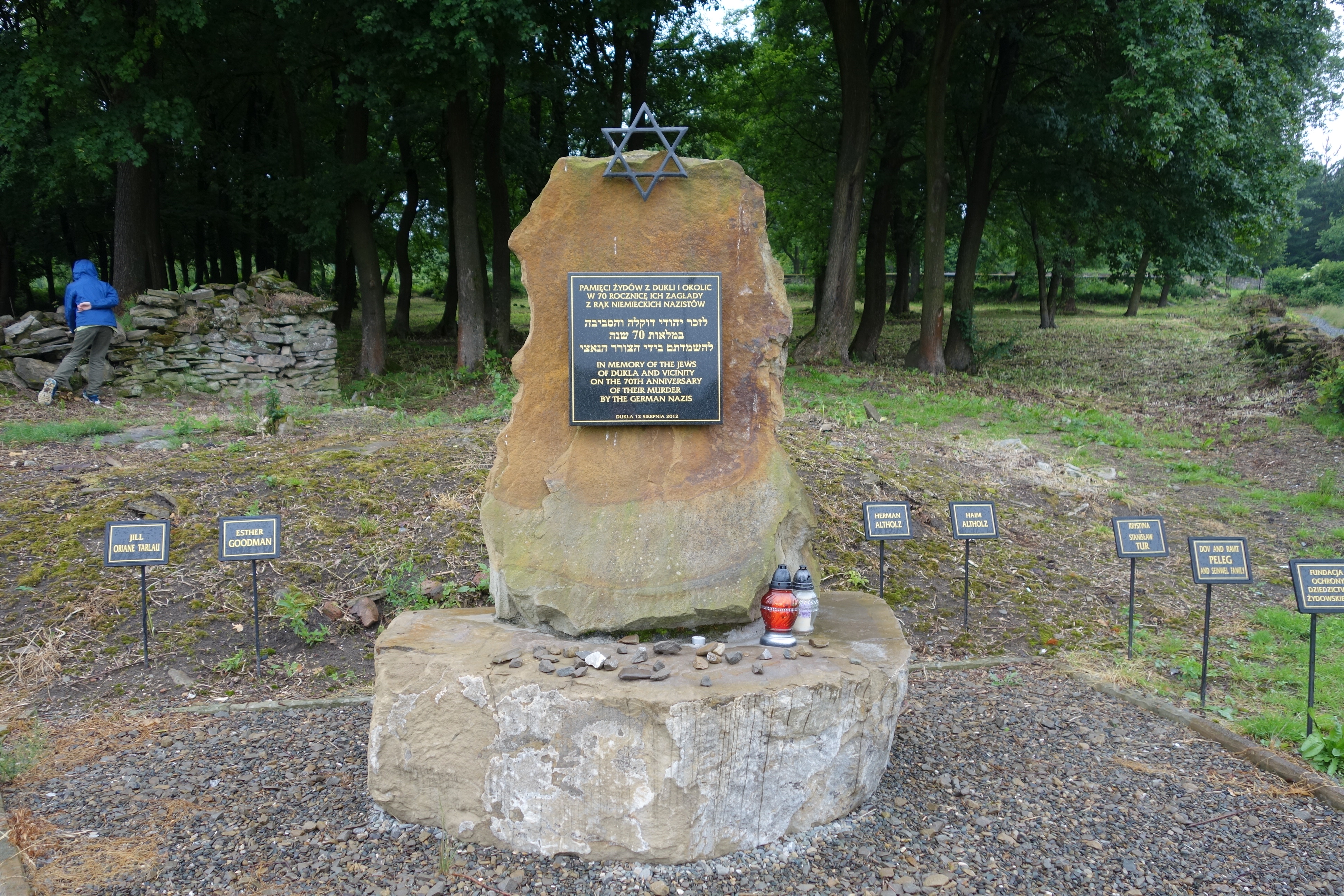
Jacek also coordinated the construction of a monument near the entrance of the old cemetery recognizing the 70th anniversary of the murder of Dukla’s Jewish population. Funders include the Foundation for the Preservation of Jewish Heritage (FODŻ) and descendants of former Jewish residents. While there have been many contributors to these various projects, Jacek is clearly the energy behind them, insuring that they are realized, and doing much of the physical labor himself.

Jacek reading a tombstone in the new Jewish cemetery, Dukla

Jacek reading a tombstone in the new Jewish cemetery, Dukla

Remembering the murder of Dukla's Jews

Remembering the murder of Dukla’s Jews

In each of these cases, someone (or several people) from the local community has taken the initiative to insure that Jewish culture and history is brought back into the public landscape. They are not Jewish themselves, but something compels them to remember, and to teach others about the former residents of their towns.

Chil Majer Piwko’s death notices in the Yiddish press

01 Monday Jun 2015

Posted by Marysia Galbraith in Archives, Family, Piwko, Polish-Jewish relations, Yiddish

≈ 2 Comments

Tags

Hil Majer Piwko

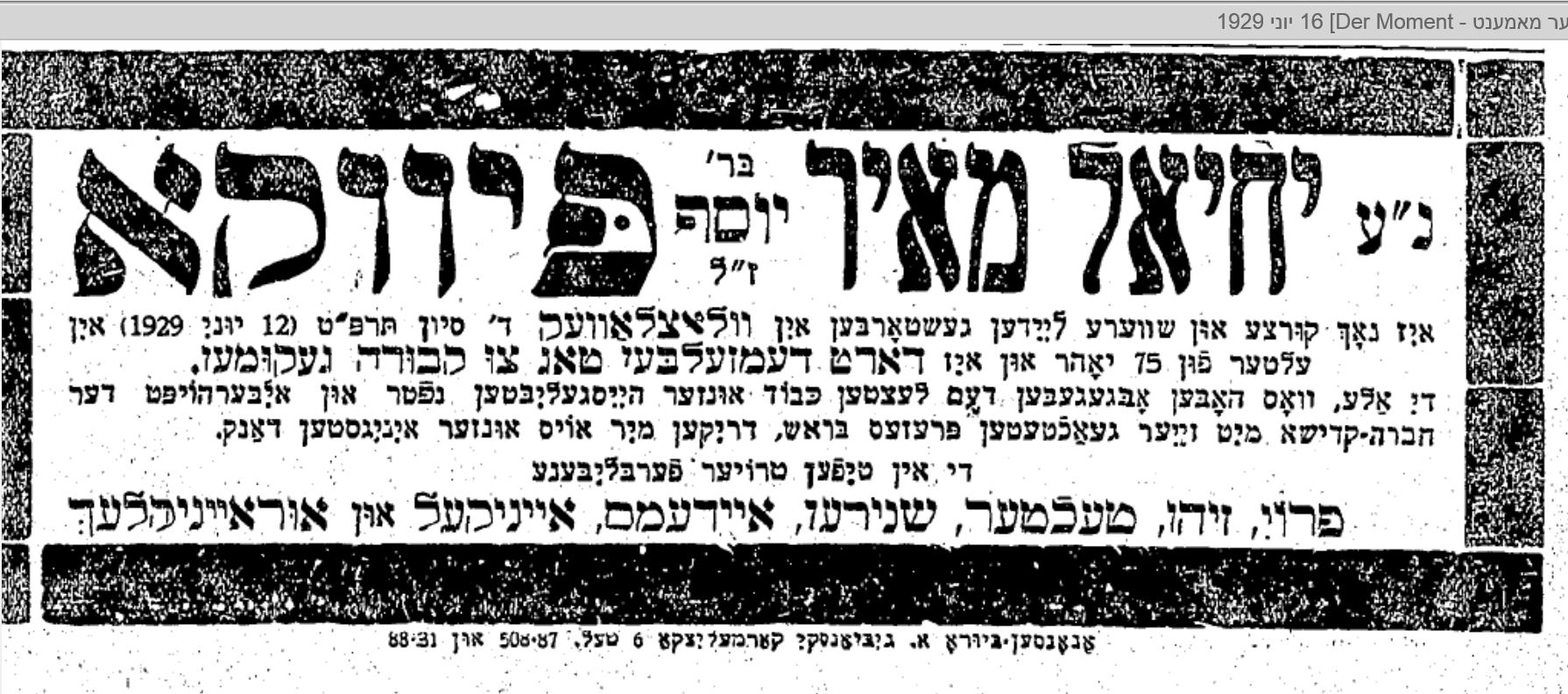
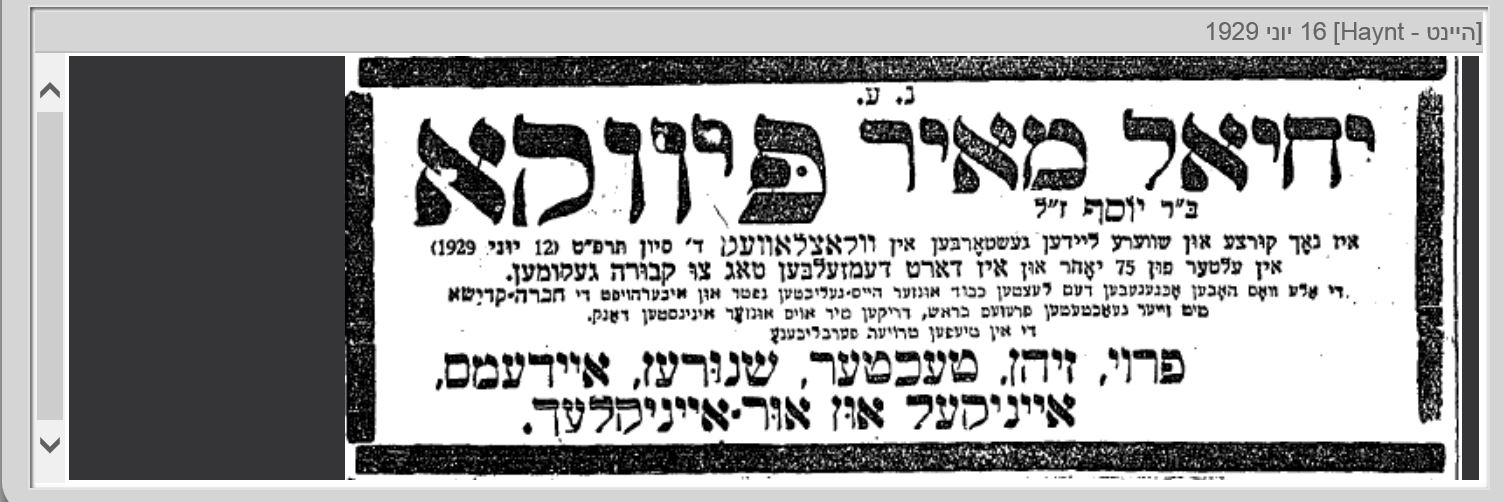
After reading my previous post about Chil Majer Piwko’s death notice, my cousin Raphael from Switzerland sent me a couple more that were published the same day (June 16 1929). These were in the Yiddish newspapers Hajnt and Der Moment.

Chil Majer Piwko's death notice from the Yiddish-language newspaper Der Moment

Chil Majer Piwko’s death notice from the Yiddish-language newspaper Der Moment

Chil Majer Piwko's death notice from the Yiddish-langugage newspaper Hajnt

Chil Majer Piwko’s death notice from the Yiddish-langugage newspaper Hajnt

Besides wanting to share them, this gives me the opportunity to revise what I said about Chil Majer. My conversations with a couple of readers helps me realize my hasty use of the term “assimilated” (even though it is widely used in the historic literature) probably does not communicate what I intended. What I meant to signal was that Chil Majer likely considered himself Polish as well as Jewish. But I have no doubt that he was also a very religious man. Nor did I mean to suggest he was on the road to adopting Polish culture in replacement of his Jewish faith. On the contrary, I’m interested in the places and spaces where Polish and Jewish affiliations intersected, complemented each other, or existed side by side.

The fact that his death notice appeared in three Jewish newspapers emphasizes even more strongly the important position Chil Majer filled in the community. The Polish-language Nasz Przegląd tended to take a more integrationist stance, in the sense that it catered to Jews who were comfortable operating in the Polish language, and who tended to invision a place for Jews within the broader Polish society. The Yiddish-language Haynt and Der Moment were competing papers that were Zionist in orientation. As such, they tended to highlight the interests of Jews as distinct from the Polish (Catholic) majority. The publication of the death notice in both languages shifts the emphasis, indicating an allegiance to both Jewish autonomy and to Polish-Jewish allegiances.

For more information about the Jewish press, see a brief summary by the Yivo Institute or Angela White’s dissertation on the Polish language Jewish press.

Commemorative monument in Piła

01 Monday Jun 2015

Posted by Marysia Galbraith in Cemeteries, Heritage work, Piła

≈ 2 Comments

The unveiling of the monument at the 17th century Jewish cemetery in Piła will be tomorrow (June 2) at 10 AM. The monument is on the grounds of the Police Academy, who funded the project together with the Piła City Council.

Cemetery monument in Piła, designed by Janusz Marciniak

Cemetery monument in Piła, designed by Janusz Marciniak

Poznan artist Janusz Marciniak designed the monument. He explains (and this comes from Samuel Gruber’s blog which includes a good description of the project):

“I tried to make the monument simple and minimalist in form, and at the same time full of content. The granite’s color is reminiscent of human ashes. The disc was mounted on a steel frame to create the impression that the star floats above the ground. The monument is an open book, which invites you to read. The top of the star was slightly raised  – according to tradition – facing east (towards Jerusalem). On its smooth surface, like a mirror, is reflected the sky and trees. Under the star is a concrete replica of its shadow. This is the basis of the monument and at the same time symbolic seal the memory of the people buried in this place and to emphasize the permanence of this memory.” 

The inscription reads in Polish, Hebrew, and English:

You are standing in a 17th century Jewish cemetery destroyed by the German Nazis during World War II

The dust returns to the earth from which it came and the spirit returns to God who gave it, Eccl. 12:7

As we remember, thus we shall be remembered

The monument was funded by the Piła commune and the Police School in Piła.

More in Polish about the monument is posted on the Police Academy website.

Warsaw archive weekend

31 Sunday May 2015

Posted by Marysia Galbraith in Archives, Family, Piwko, Polish-Jewish relations

≈ 4 Comments

Tags

Hil Majer Piwko

The first find of the weekend, at the National Library in Warsaw: my great grandfather Hil Majer Piwko’s death notice in Nasz Przegląd, one of the main Polish-language Jewish newspapers in interwar Poland.

DSC06314

Chil Majer Piwko’s death notice in Nasz Przegląd, June 16, 1929.

The text reads:

B. P. [Blessed in memory] Chil Majer Piwko died in Włocławek after brief but heavy suffering on the 12th of June 1929 (4 Siwon), at the age of 75, and was buried the same day.

To everyone who helped him on his final road, lamenting our husband and father, and especially the Funeral Brotherhood with its honorable president at its head. Wishing to express “God bless,” left in deep sadness,

Wife, sons, daughters, daughters-in-law, sons-in-law, grandchildren and great grandchildren.

The size and placement of the notice indicates my great grandfather held a position of relative prominence in the Jewish community. Also, appearing in Nasz Przegląd as opposed to any of the Yiddish or Hebrew language newspapers indicates that he identified as a Pole as well as a Jew. He was assimilated into the broader society, even though he maintained conservative modes of dress and religious practices.

I’m also struck by the mention of great grandchildren in the death notice. That’s also me, even though I wouldn’t be born for another 35 years

← Older posts
Newer posts →

Categories

  • Anthropology (37)
    • Archives (14)
    • Fieldwork (7)
    • Ground Penetrating Radar (GPR (4)
    • Research Methodology (8)
  • antisemitism (14)
  • Association of Descendants of Jewish Central Poland (32)
  • Catholicism (8)
  • Conference (1)
  • Discrimination (2)
  • Family (69)
    • Bereda (17)
    • Kolski (13)
    • Piwko (22)
    • Rotblit (3)
    • Walfisz (4)
    • Winawer (7)
  • Genealogy (11)
  • Heritage work (66)
    • Commemoration (23)
  • Identity (18)
  • Israel (6)
  • Jewish Culture (89)
    • Cemeteries (51)
    • Museum (7)
    • Synagogues (33)
  • Jewish immigrants (8)
  • Jewish Religion (1)
  • Memory (70)
  • Names (14)
  • Photographs (6)
  • Pifko-Winawer Circle (5)
  • Poland (125)
    • Baligród (1)
    • Bolimów (1)
    • Brześć Kujawski (5)
    • Buk (1)
    • Chodecz (1)
    • Dukla (2)
    • Dąbrowice (1)
    • Gdynia (1)
    • Gostynin (2)
    • Gąbin (1)
    • Izbica Kujawska (1)
    • Kazimierz (4)
    • Kowal (1)
    • Koło (1)
    • Krakow (7)
    • Krośniewice (1)
    • Kutno (6)
    • Kłodawa (1)
    • Lesko (8)
    • Leszno (1)
    • Lubień Kujawski (1)
    • Lubraniec (1)
    • Lutowiska (3)
    • Piła (3)
    • Podgórze (2)
    • Poznan (11)
    • Przemyśl (2)
    • Pzedecz (1)
    • Radom (1)
    • Radymno (1)
    • Sanok (1)
    • Skierniewice (5)
    • Sobota (2)
    • Tarnów (2)
    • Warsaw (22)
    • Wielkopolska (1)
    • Wronki (7)
    • Włocławek (20)
    • Zasław (2)
    • Łódź (1)
    • Żychlin (30)
  • Polish Culture (10)
  • Polish-Jewish Heritage (60)
  • Polish-Jewish relations (60)
  • Post-World War II (24)
  • Pre-World War II (22)
  • Reclaimed Property (1)
  • stereotypes (3)
  • Survival (9)
  • Trauma (3)
  • Uncategorized (5)
  • Victims and perpetrators (4)
  • World War II (45)
    • Jewish Ghetto (12)
    • Nazi Camps (5)
    • Polish Underground Army (3)
  • Yiddish (5)

Enter your email address to follow this blog and receive notifications of new posts by email. Your email address will not be shared.

Archives

  • October 2025 (1)
  • July 2025 (8)
  • June 2025 (1)
  • April 2025 (1)
  • August 2024 (3)
  • July 2024 (3)
  • May 2024 (2)
  • April 2024 (1)
  • May 2023 (2)
  • January 2023 (2)
  • December 2022 (7)
  • November 2022 (2)
  • October 2022 (5)
  • September 2022 (1)
  • January 2022 (1)
  • August 2021 (1)
  • December 2020 (2)
  • July 2020 (1)
  • May 2020 (3)
  • April 2020 (1)
  • March 2020 (1)
  • January 2020 (2)
  • May 2019 (1)
  • February 2019 (1)
  • November 2018 (1)
  • September 2018 (1)
  • August 2018 (3)
  • July 2018 (1)
  • June 2018 (1)
  • May 2018 (1)
  • April 2018 (2)
  • March 2018 (2)
  • February 2018 (2)
  • January 2018 (2)
  • December 2017 (2)
  • November 2017 (2)
  • October 2017 (1)
  • September 2017 (3)
  • August 2017 (3)
  • June 2017 (2)
  • May 2017 (3)
  • April 2017 (1)
  • March 2017 (2)
  • February 2017 (1)
  • January 2017 (2)
  • December 2016 (2)
  • November 2016 (4)
  • October 2016 (1)
  • September 2016 (6)
  • August 2016 (2)
  • July 2016 (1)
  • May 2016 (4)
  • April 2016 (2)
  • March 2016 (3)
  • February 2016 (4)
  • January 2016 (3)
  • December 2015 (3)
  • November 2015 (5)
  • October 2015 (5)
  • September 2015 (3)
  • August 2015 (4)
  • July 2015 (3)
  • June 2015 (3)
  • May 2015 (4)
  • April 2015 (9)
  • March 2015 (3)
  • February 2015 (2)
  • January 2015 (5)
  • December 2014 (4)
  • November 2014 (9)
  • October 2014 (2)
  • September 2014 (1)

Copyright Notice

All original text and images are copyright © Marysia Galbraith. Please contact the author before quoting.

Blog at WordPress.com.

  • Subscribe Subscribed
    • Uncovering Jewish Heritage
    • Join 147 other subscribers
    • Already have a WordPress.com account? Log in now.
    • Uncovering Jewish Heritage
    • Subscribe Subscribed
    • Sign up
    • Log in
    • Report this content
    • View site in Reader
    • Manage subscriptions
    • Collapse this bar
 

Loading Comments...