• About
  • The Photo that Started it All

Uncovering Jewish Heritage

Uncovering Jewish Heritage

Category Archives: Pre-World War II

Vilnius and Riga: Jews in the Baltic States

26 Saturday Jul 2025

Posted by Marysia Galbraith in Commemoration, Jewish Culture, Jewish Ghetto, Memory, Post-World War II, Pre-World War II, Synagogues, World War II, Yiddish

≈ 4 Comments

Tags

Latvia, Lithuania, memorial art, Memory keepers, Riga, Vilnius

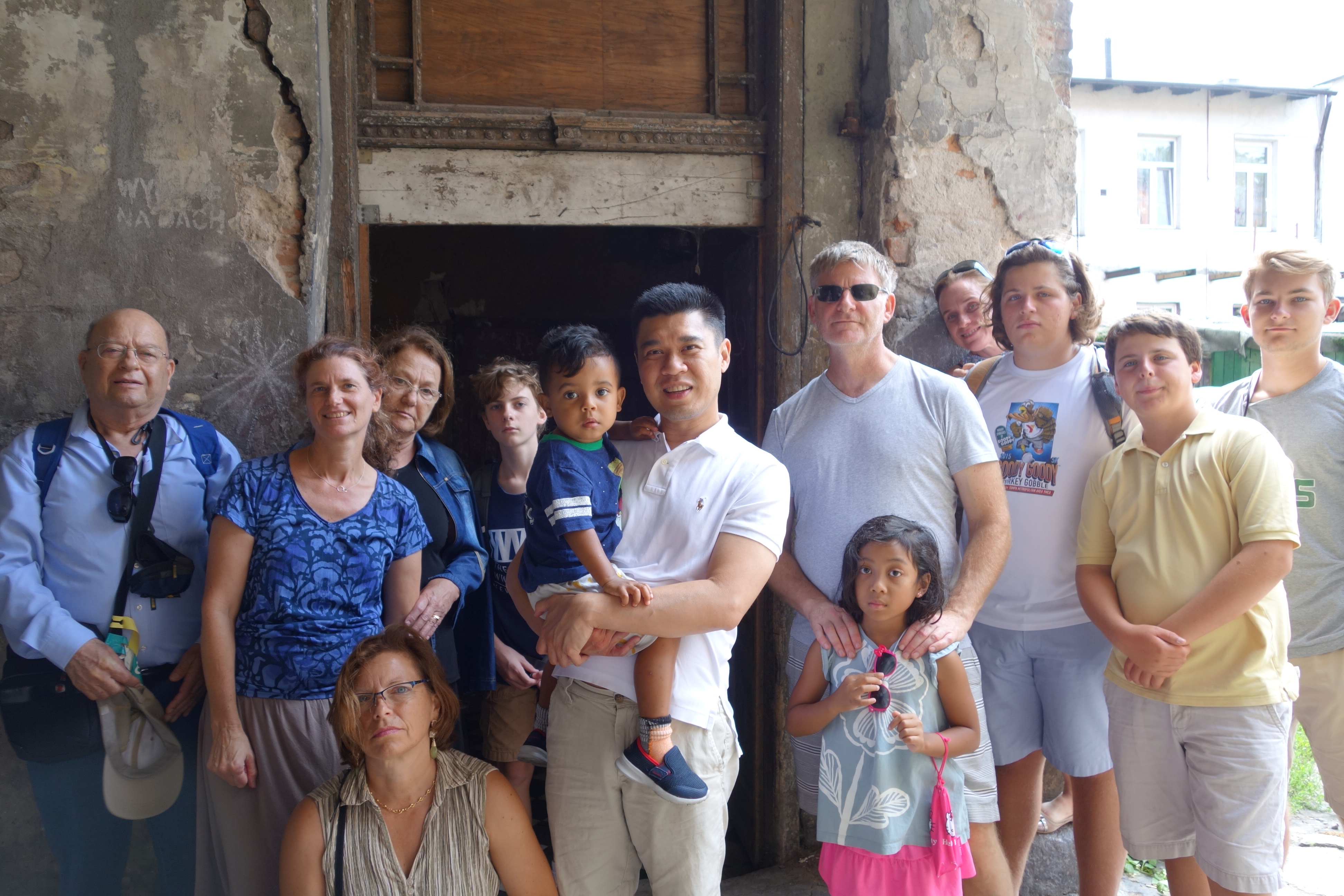
I wasn’t looking for Jewish history in Vilnius but it found me. The synagogue, still functioning as a house of prayer for the few thousand remaining Lithuanian Jews, is a half block from my hotel.
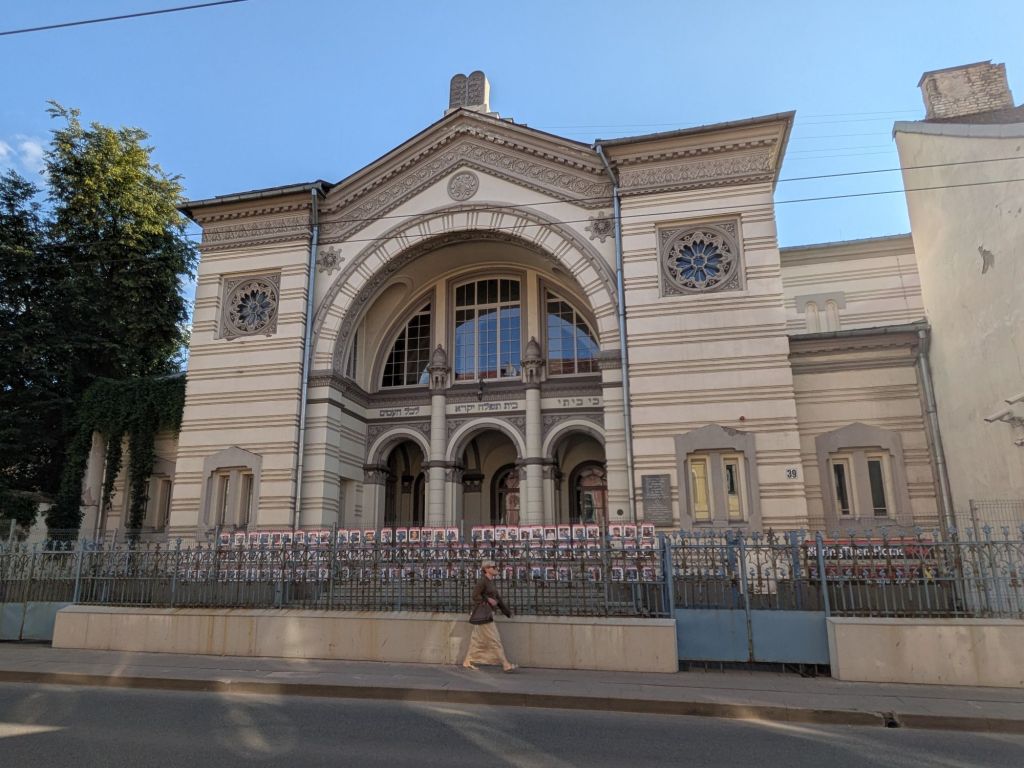
The Choral Synagogue in Vilnius. “Bring Them Home” along with photos of the hostages sits right behind the metal fence

I signed up for a Vilnius with Locals walking tour of Jewish Vilnius, the so-called Jerusalem of Lithuania. We spent 3 hours exploring the Jewish quarter. In some sections, Soviet-era concrete buildings took the place of the prewar structures blown to rubble when the WW II ghetto was dismantled.

It’s hard to picture the prewar buildings that once filled this area

Other areas escaped destruction and retain their prewar appearance. As we meandered through narrow cobblestone lanes, Kristina our tour guide explained how much of the city’s Jewish story was silenced during the Soviet occupation, the period from 1940 to 1990 when the country was a republic within the Soviet Union. During that time, nobody talked about the Jews who had made up 45% of the city’s inhabitants before the war.
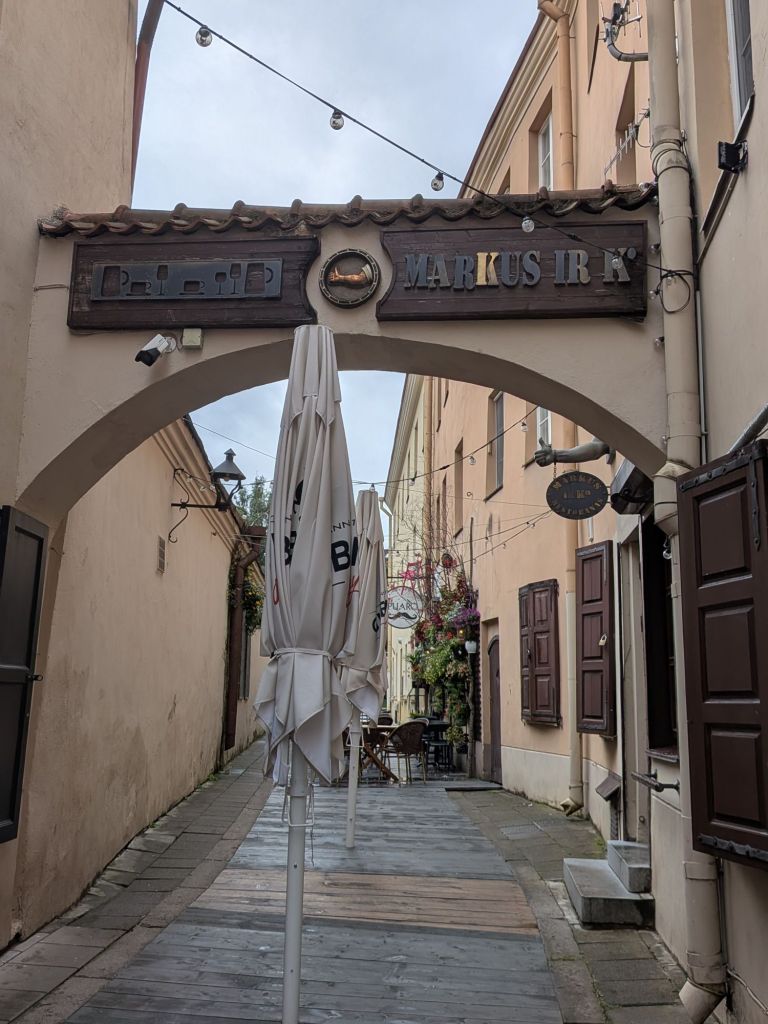
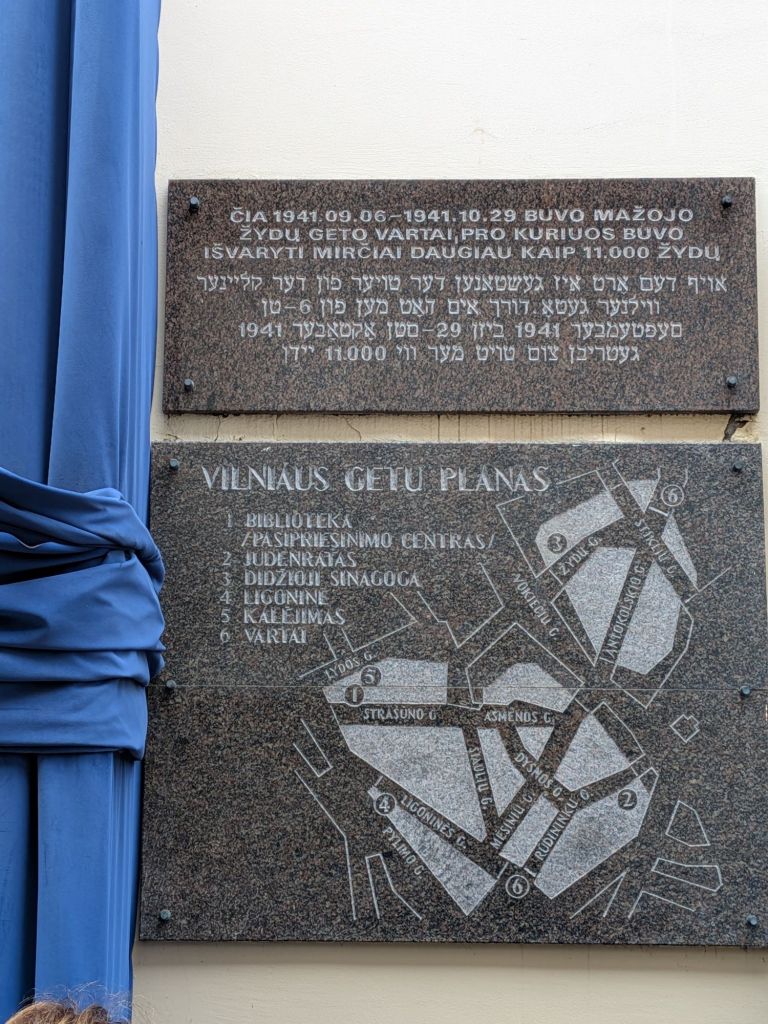
An iconic street in the Jewish district
Map of the WW II ghetto
Jewish library scheduled for renovation

Kristina explained that this lost history only began to be rediscovered after Lithuania regained independence in 1990. Since then, scholars have been translating and writing about thousands of pages of documents that survived in hiding for 50 years. Many were collected by a group of people called the Paper Brigade who made it their mission to preserve all the documents in the YIVO Archive, a massive repository of Yiddish resources. Much of the archive found safety in New York. Today, the archive is split between Vilnius and New York.

As more has been learned about The Jews of Vilnius, artwork, memorials, and institutions have made the story public. The Walls That Remember project stencils images from archival photos onto the walls of the former Jewish Quarter.

Kristina tells us about The Walls that Remember

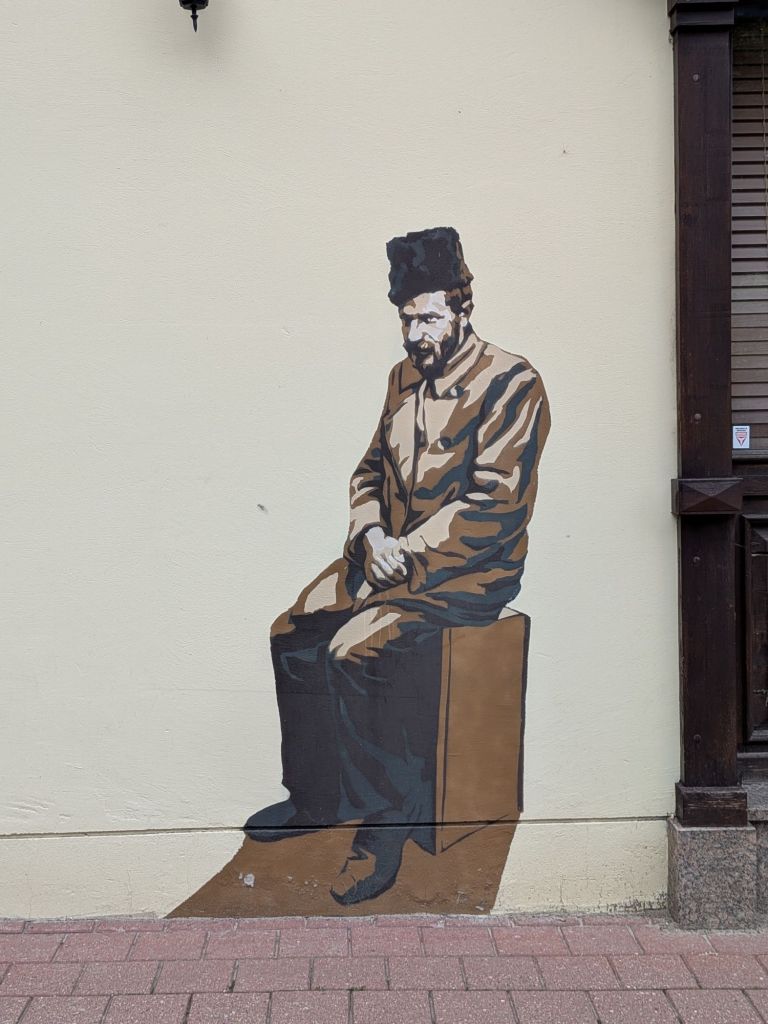
Remembered with a statue are: Zemach Shabad, a doctor known for his kindness who cared for the poor; Rabbi Elijah Ben Solomon (1720 – 1797), also called the Gaon of Vilnius; and singer Leonard Cohen, who had roots in Lithuania.
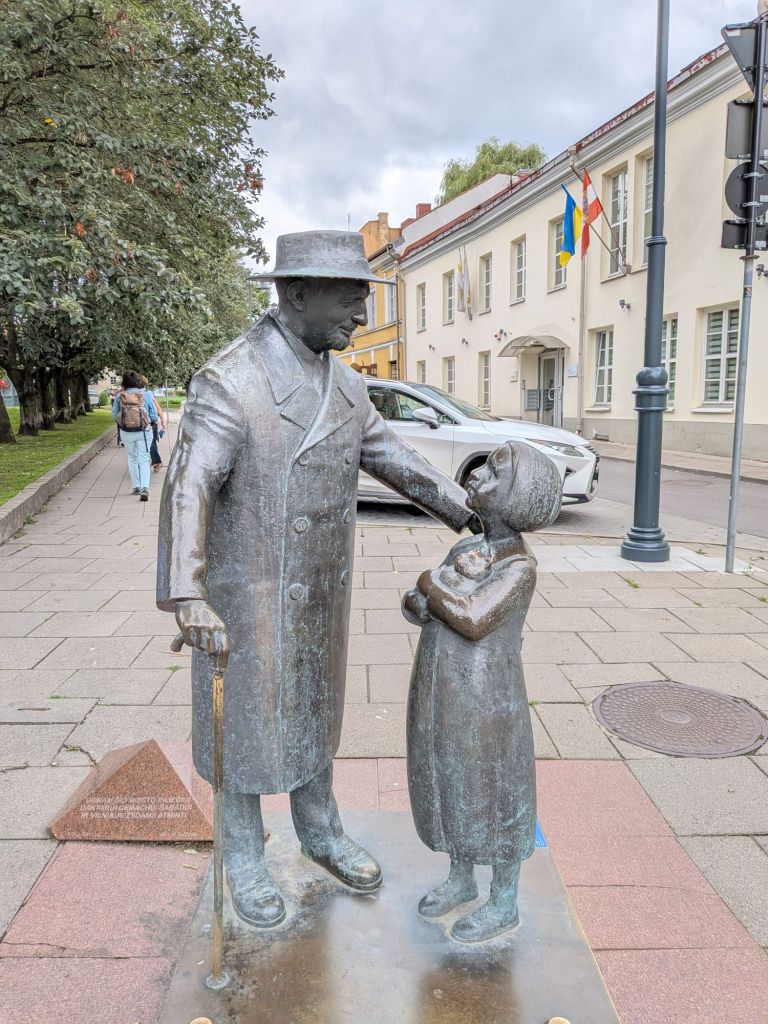
Zemach Shabad
The Gaon
Leonard Cohen

Jews first came to Vilnius as merchants before the 14th century. They were granted privileges by the Lithuanian rulers by the late 14th century. In Vilnius, they settled in the Jewish Quarter; other ethnic groups like Germans each settled in their own quarter of the city. By the time Lithuania was absorbed into the Russian Empire at the end of the 18th century, these ethnic enclaves were less rigid, and Jews could be found throughout the city along with other ethnic and religious inhabitants.

Vilnius was an important center for the growth of Yiddish language and culture, which explains why it was one of the places the Yiddish Scientific Institute (YIVO) was founded in 1925.

After a brief period of national autonomy from 1922 to 1940, Lithuania, like the other Baltic States, became a battleground between Stalinist USSR and Nazi Germany. When Hitler’s forces invaded in 1941, as many as 95% of the Jewish inhabitants were murdered.

Under Communism, the Choral Synagogue continued to operate, though it functioned more as a cultural organization than a religious one (at least officially). Since 1990, the Jewish community remains active at the synagogue. The interior can be viewed for just 2€. Whereas before the war, this was more of a reform synagogue, the current congregation is conservative. Women attend services on the upstairs balcony or behind a curtain on the ground floor.

Choral Synagogue

While on the tour, another participant and I struck up a conversation. Suzanne just completed a two-week tour of Jewish Poland with others of Jewish descent seeking to reconnect with the homeland of their ancestors. It was more than a historical trip, fusing spirituality and rituals within their encounters with Jewish spaces. For instance, at the grave of one participant’s ancestor, they did their own version of feldmestn, a ritual practiced by women; they measured the grave with wax, from which they made a candle.

I bonded with Suzanne over the importance of reconnecting with your Jewish origins, and also because of our shared appreciation for the individuals working in Poland to preserve Jewish memory. She called them memory keepers, a name that perfectly captures the role they play. I will use the term in my future writing about these memory keepers.

In Riga, the capitol of neighboring Latvia, Jewish markers continued to find me. On the building next to my hotel is a memorial marker for someone who saved Jews during the German occupation, and around the corner stands the synagogue. Also, during a walking tour of the city, I met Dimitri and his son Shiloh, reconnecting with their Jewish Latvian roots.
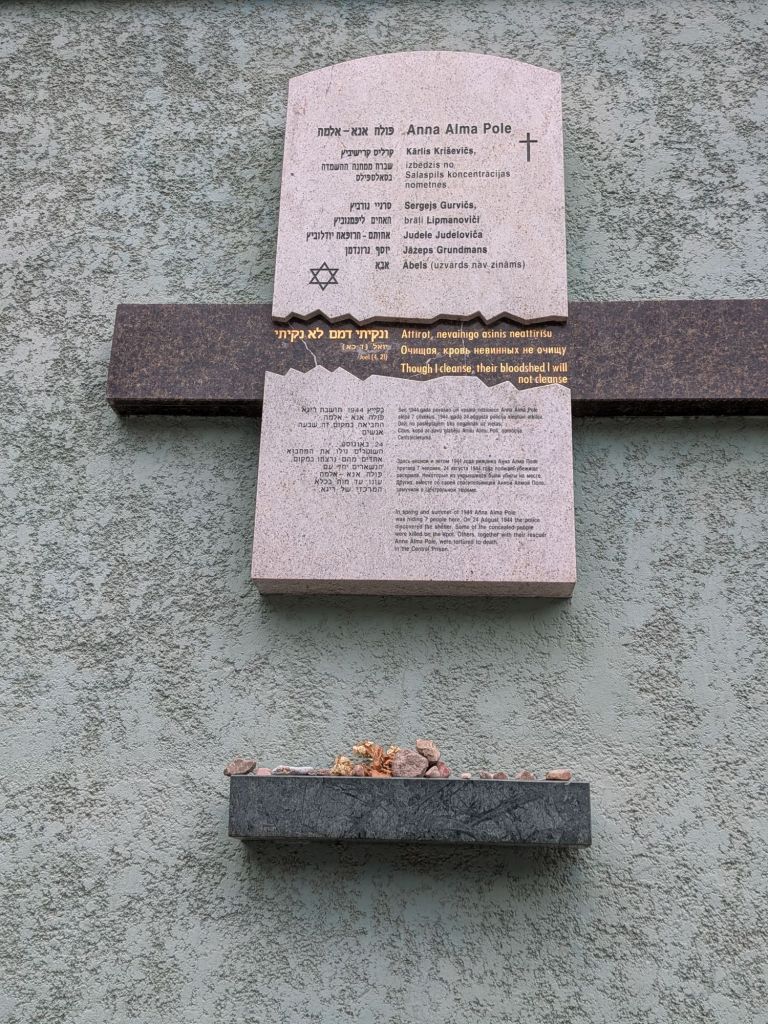
Recognition for a righteous gentile
Riga Synagogue

Żychlin Cemetery Project 2025: Volunteers Arrive in Warsaw

12 Saturday Jul 2025

Posted by Marysia Galbraith in Association of Descendants of Jewish Central Poland, Jewish Culture, Jewish Ghetto, Polish-Jewish Heritage, Polish-Jewish relations, Pre-World War II, Synagogues, Walfisz, Warsaw, World War II

≈ 7 Comments

Tags

Matzevah Foundation, University of Alabama, Żychlin Cemetery Project 2025

Nothing like spending the whole day on your feet the day after an overnight plane trip. But our group is intrepid.

Dinner on Friday night

The day began with a walking tour “The Unremovable Traces of the Warsaw Ghetto” led by Dr. Szymon Pietrzykowski of the Jewish Historical Institute. We started in the JHI in the lobby where the stone floor retains the burn stains caused by the fire bombs that destroyed the Great Synagogue in 1943 after the Warsaw Ghetto Uprising

Great Synagogue in Warsaw. Photo source: Wikipedia
Burn marks dating from the destruction of the neighboring Great Synagogue in 1943.

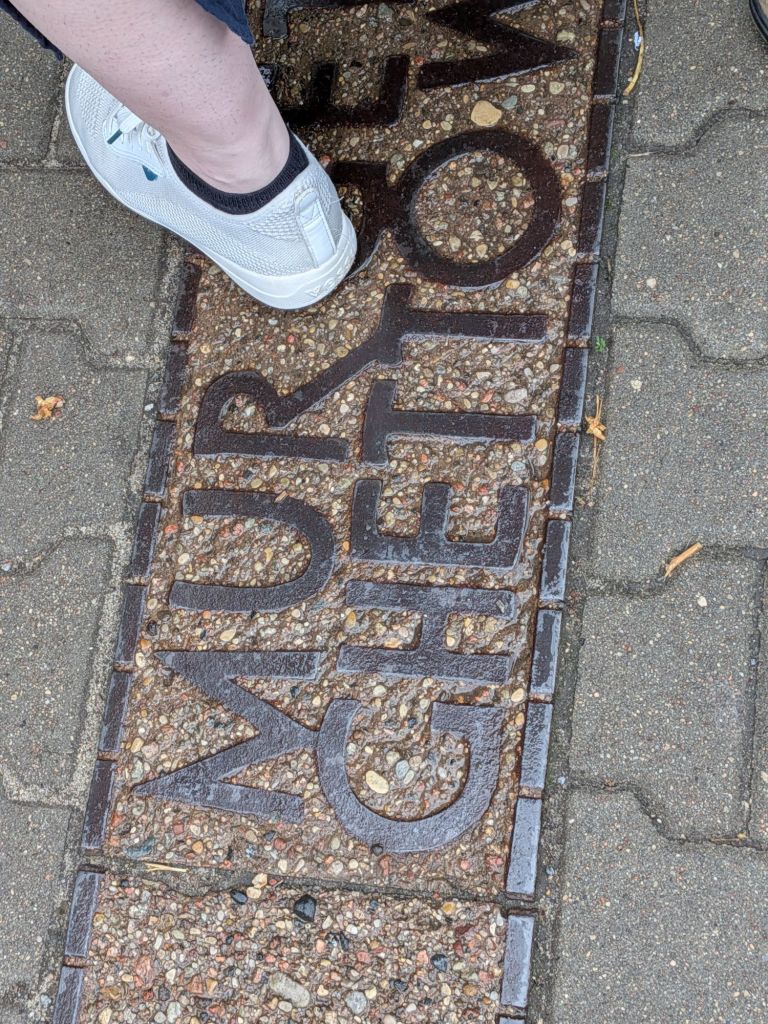
We visited places where the former location of the ghetto walls are marked by metal plaques in the sidewalk, buildings reconstructed after the war, sites where important Jewish institutions were destroyed and never rebuilt, and places significant to the Jewish Ghetto Uprising and the archive of Jewish life in the ghetto collected by historian Emanuel Ringelblum.

Jewish Historical Institute on Tłomacka Street
The building that replaced the Great Synagogue. Note the arched feature evocative of synagogue windows.
Location of the ghetto wall
Traditional courtyard, one of the few showing what prewar Warsaw was like
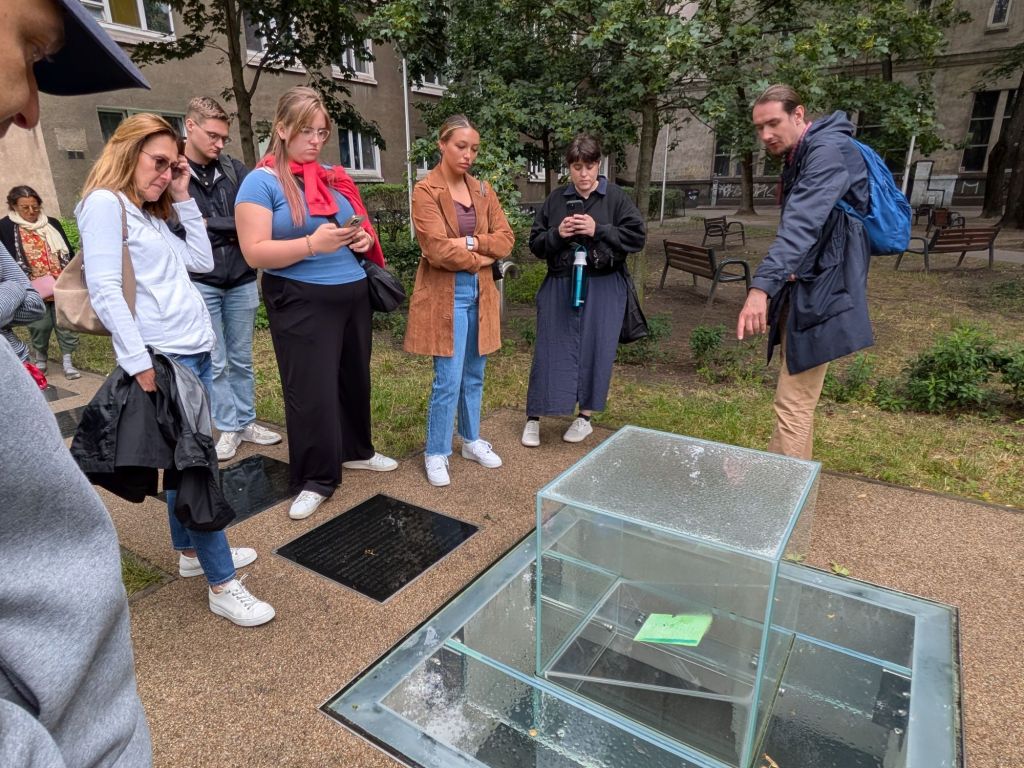
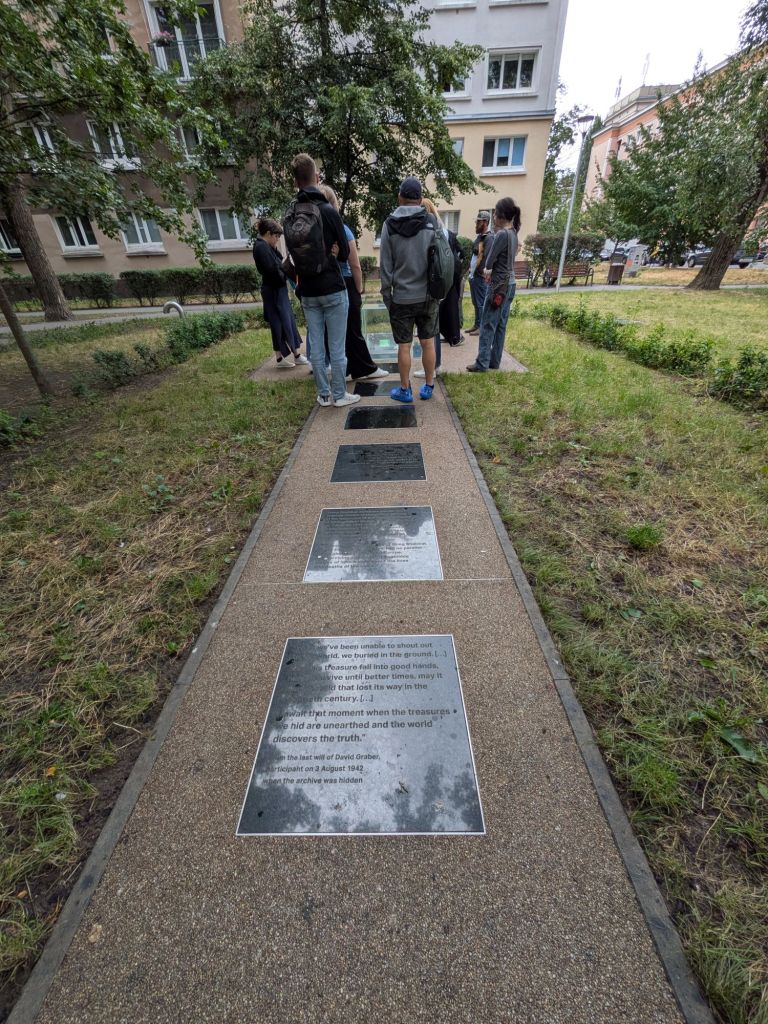
Monument where part of the Ringelblum archive was found in milk cans under the rubble on Nowolipie Street

Our tour continued at the POLIN Museum of the History of Polish Jews, led by our guide Martina.

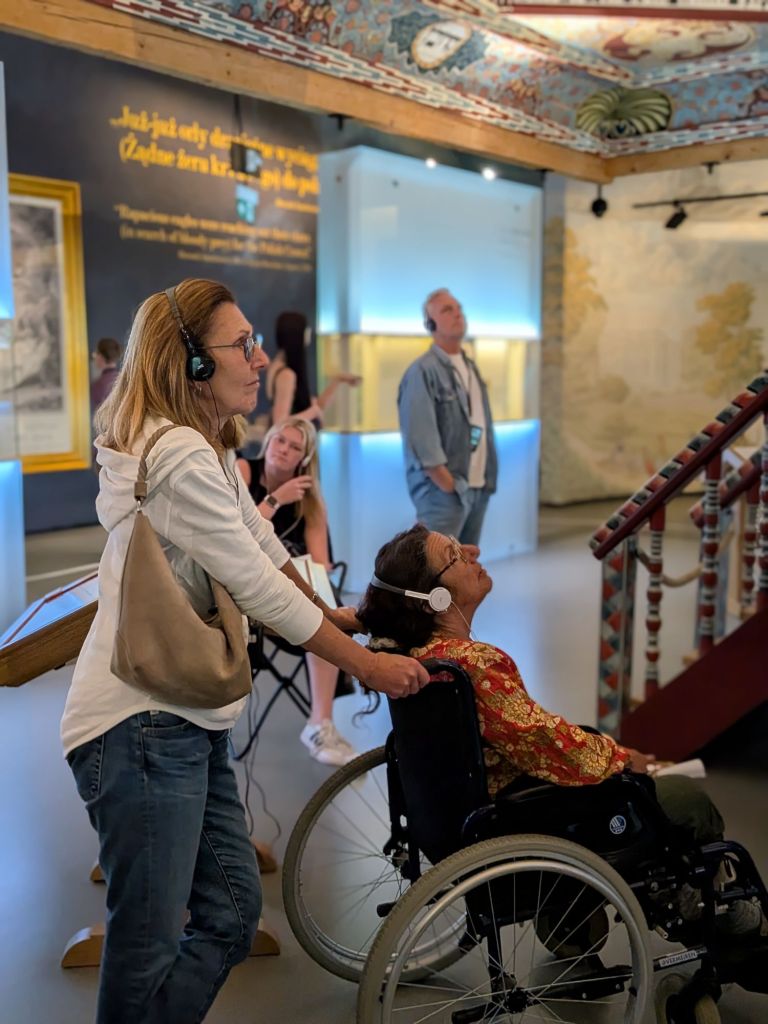
Our group at POLIN in the reproduction of a wooden painted synagogue
Model of the Great Synagogue

After six hours of walking, we were ready to sit down. Paula, whose ancestor Tema Walfisz Jakubowicz grew up in Żychlin, treated us to a well-deserved meal. Many in our group got to try pierogi for the first time!

In the Garden of Memory: A Family Memoir by Joanna Olczak-Ronikier

08 Wednesday May 2024

Posted by Marysia Galbraith in antisemitism, Family, Identity, Polish-Jewish relations, Pre-World War II, Warsaw, World War II

≈ 2 Comments

Tags

assimilation, In the Garden of Memory, Joanna Olczak-Ronikier

I have been calling my project a family memoir since the beginning, well before I read In the Garden of Memory (the English translation was published by Weidenfield and Nicolson in 2004). My family’s story overlaps with author Joanna Olczak-Ronikier’s in other ways, too. The social world of Warsaw was intimate enough that it seems likely our families knew about each other even if they weren’t directly acquainted. Joanna’s relatives, the Horwitzs and the Mortkowiczes, were central figures in the social circles my Babcia also frequented, those occupied by writers, artists, publishers, and professionals. Both families have Jewish origins, and each assimilated, though to varying degrees.

Joanna, her mother Hanna Olczak, and her grandmother Janina Mortkowicz didn’t deny their Jewish origins in the way my mother and grandmother did. Still, they frequented many of the same places around Warsaw. When Janina, then Horwitz, was a child, her “consolation prize” for check-ups at the dentist were a visit to Lourse Café on Krakowskie Przedmieście for chocolate (15). This was in the 1880s, so decades before my grandfather Zygmunt Bereda gained an interest in the business. During the 1930s, Joanna’s cousins attended the same high schools as my mother and uncle. Girls attended the Klementyna Hoffmanowa High School, while boys went to the Stefan Batory High School.

The book also gives me some insight into marriage customs during my Babcia’s generation. “According to Jewish tradition, finding suitable husbands for one’s daughters was a basic parental duty,” Olczak-Ronikier writes. “Marriage was too serious a matter to be contracted for love. After all, it concerned two people’s future, and that of their offspring. The older generation took charge of bringing the couples together, involving family, friends and a professional matchmaker” (32). Things were changing rapidly in the late 19th century, though, and just like I have observed among Babcia’s siblings, older children were more bound by tradition while younger children were more inclined to choose their own pathway. In Olczak-Ronikier’s family, the younger children were drawn to socialism and communism.

By the next generation, Joanna’s mother Hanna was the first and only family member to marry a non-Jeweven and to change her religion. Olczak-Ronikier says, it “did not provoke any particular reaction among her relatives” (184). She was not excluded from the family because of it, unlike my grandmother Halina, whose father sat shiva and treated her as dead after her marriage to a Catholic. Olczak-Ronikier’s family was far more secular than Babcia’s, though. Perhaps in part this is because the Piwkos lived in provincial cities where the pull of religious tradition was stronger. My grandmother was drawn to Warsaw for the opportunities it offered for her to remake her life.

Another parallel I see between our family stories is in the internalized antisemitism Joanna experienced. As a child in the 1930s, she didn’t want to be Jewish, especially when she became the object of the anti-Jewish taunts of other children. She explains, “Among Jews who had decided to assimilate, a huge role was played by ambitions relating to the level of Polonization they had achieved. When the parents, through their looks, language and religious customs, were a reminder of the environment that the children had made such an effort to get out of, family love and loyalty were severely put to the test. Nowadays it is hard to imagine how painful this process of tearing oneself away from one’s roots must have been” (71).

Maks Horwitz, her great uncle, put it this way: “They were ashamed of their origin. Understandably, they never denied it among those who knew about it. But even here, in deed, word and gesture they tried to prove and convince others that they felt themselves to be completely and utterly Polish and that they were entirely rid of their Jewishness” (111).

Members of both families survived the war by adopting Aryan identities. Babcia was able to live more in the open than Olczak-Ronikier’s family because she had been distanced from her Jewish origins since the 1920s, and also because her Catholic husband was well enough positioned to bribe the Nazi authorities to look the other way. As in my family, the women of Joanna’s family took a few years off their age on their false documents (92). During the Warsaw Uprising, when the area they lived in was overrun by the Germans, Olczak-Ronikier’s family escaped via the underground sewers, as did my mother. With the destruction of the capital, both families took the same path out of the city, traveling with a crowd of refugees south to Krakow, where they remained until the end of the German occupation. (268)

Joanna’s cousin Ryś Bychowski was born the same year as my mother. He attended Stefan Batory High School, just like my Uncle George who was just a couple of years older. It seems likely they knew each other, and its possible they could have been friends. Their lives might have overlapped during the war, as well. Ryś escaped to safety in the US with his parents in 1941, only to volunteer for the Polish Airforce, which operated out of Britain. My uncle was a paratrooper, while Ryś became a navigator. Ryś joined as a Polish patriot, unwilling to remain in safety when his people were subject to Nazi oppression. For him, the fact that he was Jewish only added to his resolve. He wanted to liberate Poland and the Jewish people. While in Britain, he confronted the horror of the mass annihilation of the Jews, made even more unbearable when his friends and comrades exhibited indifference, or in some instances satisfaction, that the Jews were killed.  Olczak-Ronikier explains, “His Polish-Jewish identity had always seemed something quite natural to him, yet in view of this and similar episodes he came to the conclusion that he had to make a choice” (295). He decided he could never live in Poland again, even though he remained committed to the fight against Nazism.

A photo from my grandmother’s papers taken in Warsaw right after the war. From the left: Mirka (Rachel’s daughter), Rachel (Babcia’s sister), Czesław Mochorowski, and Nelly. The boy who is standing is Bogdan, Rachel’s grandson, the son of Samek and Nelly. I don’t know who the man on the right or the boy at the very bottom are.

The evolution of Ryszard’s view of Poles helps me understand the deep anger and resentment so many Jews feel toward Poland. It’s something I have recognized before, and wondered why they direct their fury more strongly toward Poles than to Germans. In a letter to his father in 1943, Ryś Bychowski explained in clear and emotionally resonant terms; “I do not want to be a second-class citizen ever again […] Above all I’m afraid of knowing the whole truth about the reaction of Polish society to the extermination of the Jews. I cannot live with or talk to, I am not able to work with people who found it possible to ignore their destruction, occupy their homes and denounce or blackmail the survivors” (296). This was an intimate betrayal, not by a sworn enemy but by comrades and neighbors. It was exclusion from the group he felt himself to be a part of. No wonder it cut so deeply.

Prewar Discrimination against Jews: Commemorative Plaque at Warsaw University

22 Monday May 2023

Posted by Marysia Galbraith in antisemitism, Commemoration, Discrimination, Heritage work, Israel, Memory, Polish-Jewish relations, Pre-World War II, Warsaw

≈ 3 Comments

Tags

Getto Ławkowe, Warsaw University

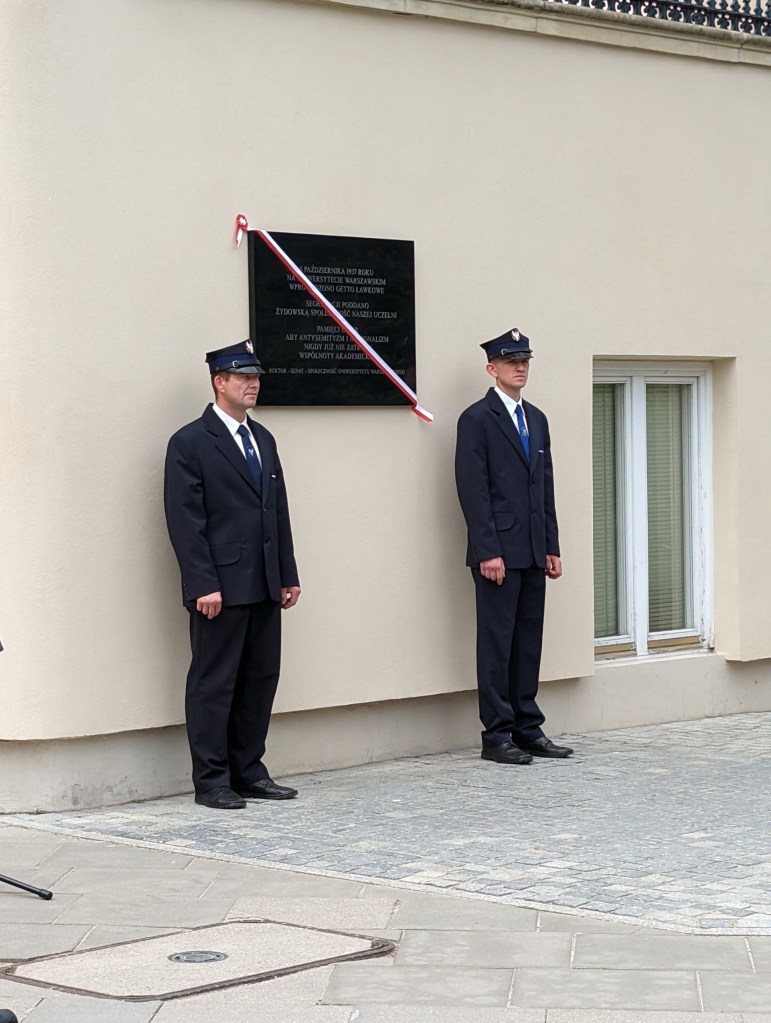
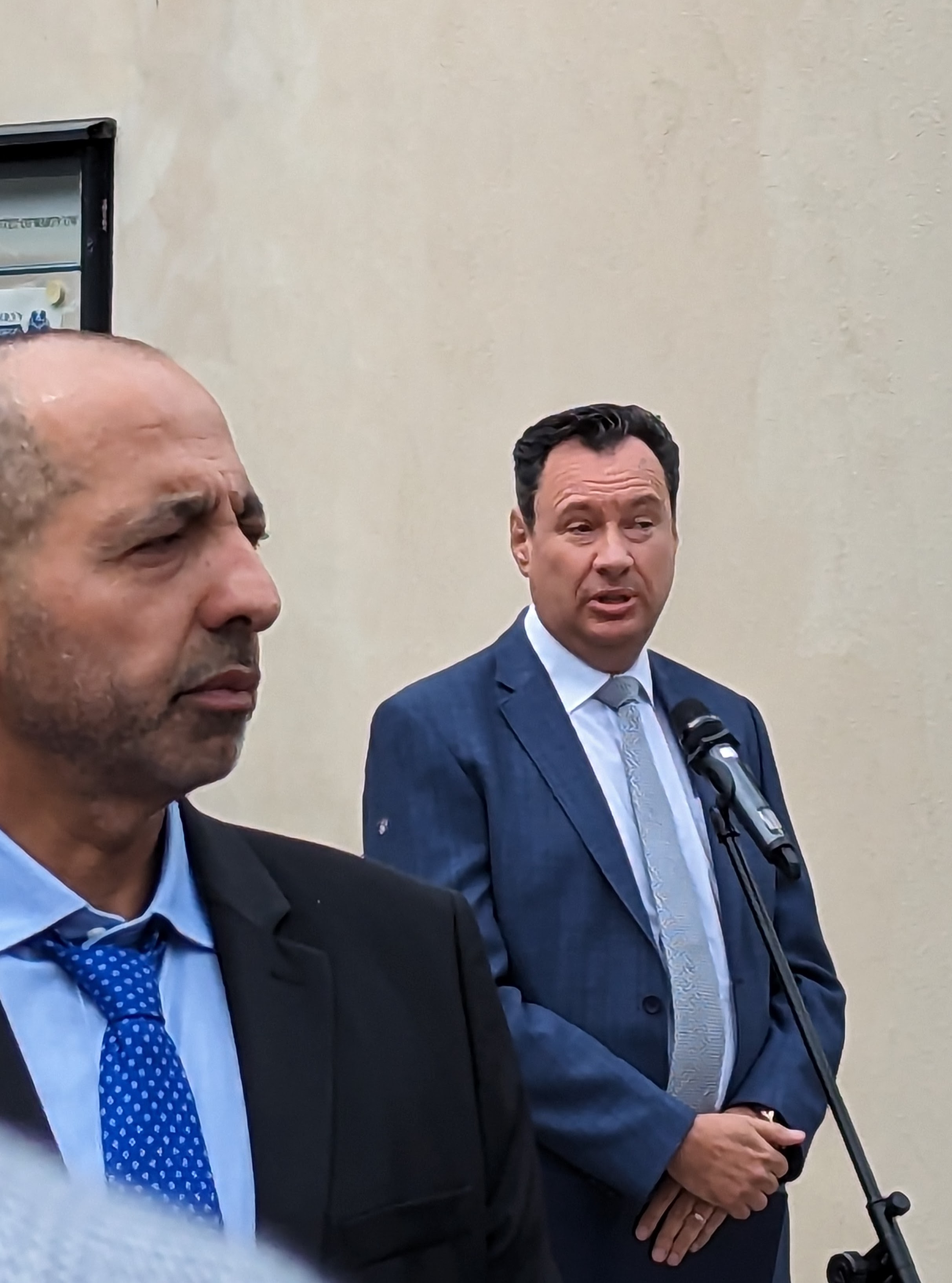
A dark stain in the history of Warsaw University was the decision to follow a nationalist trend in the 1930s and mandate segregated seating for the university’s Jewish students. Over 80 years later, a student-initiated campaign resulted in a permanent, public acknowledgement of this institutionalized discrimination. On May 22, University Rector Alojzy Nowak and Israeli Ambassador Yacov Livne dedicated a commemorative plaque before a crowd of about 200. Dignitaries, scholars of Jewish history and culture, and prominent members of Warsaw’s Jewish community gathered behind a red retractable belt barrier under the watchful eye of an Israeli guard, while a younger crowd of students and onlookers looked on from the other side.

Commemorative monument before the ceremony
Dignitaries behind the red barrier belt. Journalist Konstanty Gebert on right
The red barrier

I learned about the event serendipitously, when fellow ADJCP board member Ken Drabinsky invited me to accompany him to the Warsaw University Department of History to donate a copy of the self-published autobiography of Henry Balaban, nephew of renowned historian Meir Bałaban. I accompanied Ken as he presented the book to Łukasz Niesiołowski and Marzena Zawanowska at the Department of History.

Ken Drabinsky presenting Marzena Zawanowska, and Łukasz Niesiołowski with Henry Balaban’s autobiography

The commemorative ceremony began with songs in Yiddish performed by students from the Multicultural High School of Humanities named after Solidarity hero Jacek Kuroń, followed by predictable remarks by the rector and the Israeli ambassador about the need for unity across cultural and religious differences and the importance of remembering the dark as well as light moments in history. Both celebrated the university students who initiated the project.

Israeli Ambassador Yacov Livne with his security detail

The audience’s enthusiastic applause was reserved for the third speaker, Antonina Dukowicz from the Student Antifascist Committee. It didn’t come in response to her diplomatic discussion of the five years it took to persuade the administration and work out the appropriate language for the marker. Rather, the crowd responded to her expression of support for the Institute of Philosophy and Sociology at the Polish Academy of Science, which is under attack by the government because of the work scholars are doing there that highlights some of the less noble behavior of Polish people against Jews during the Nazi occupation. The specific trigger for the latest attack was a brief comment by Holocaust Scholar Barbara Engelking that “Jews were unbelievably disappointed with Poles during the war.” The remark caused such a strong reaction because it challenges the official narrative that Poles helped the Jews more than any other nation and that they couldn’t do more because they were under occupation and subject to persecution themselves.

The student speaker called the commemorative marker a symbol that sheds light on the current darkness in Poland, and urged viewers to let it be a model for remembering the difficult truth. She ended with a call to cut out all kinds of antisemitism and oppression, so that it is never repeated. The final applause erupted, falling into rhythm as it continued.
Some commentators criticized the university for failing to issue an apology, or for not making a bolder statement. I’m impressed by the way Antonina Dukowicz connected historical discrimination with contemporary political battles, and the way those in attendance affirmed those connections. Battles are being fought here to acknowledge the less noble moments in Polish Jewish history and to reaffirm values of unity and diversity.

October 5, 1937 at the University of Warsaw the bench ghetto was introduced; Segregation was given to the Jewish community of our academic institution; In memory of the victims so that antisemitism and nationalism will never again poison the academic community; rector-senate-community of the University of Warsaw

Our Story in MyHeritage Blog

04 Monday May 2020

Posted by Marysia Galbraith in Bereda, Family, Genealogy, Identity, Israel, Kolski, Photographs, Polish-Jewish relations, Post-World War II, Pre-World War II, Warsaw, World War II, Włocławek

≈ 4 Comments

Tags

Colorized photos, MyHeritage

Now, the English-language MyHeritage blog has a story about us: Hidden Photo Reveals a Secret Past and Reunites a Family, written by Talya Ladell.

The article also contains cool colorized photos. You can compare the black and white originals with the color copies by dragging the cursor over the image.

helena-Colorized

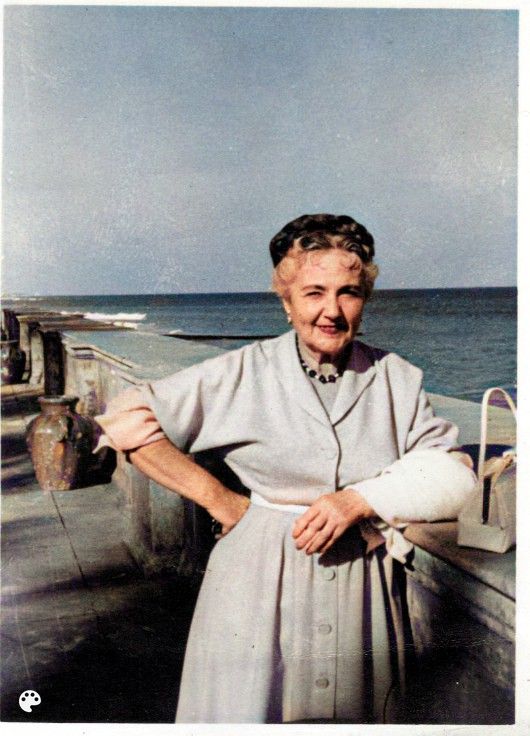
Babcia Halina in Florida during the 1950s. Colorized photo

Cousins Reunited by a Photo and a Family Tree

23 Thursday Apr 2020

Posted by Marysia Galbraith in Bereda, Family, Genealogy, Israel, Kolski, Photographs, Polish-Jewish relations, Post-World War II, Pre-World War II, Survival, Trauma, Warsaw, World War II, Włocławek

≈ 4 Comments

Tags

Cousins reunite, Finding family, MyHeritage

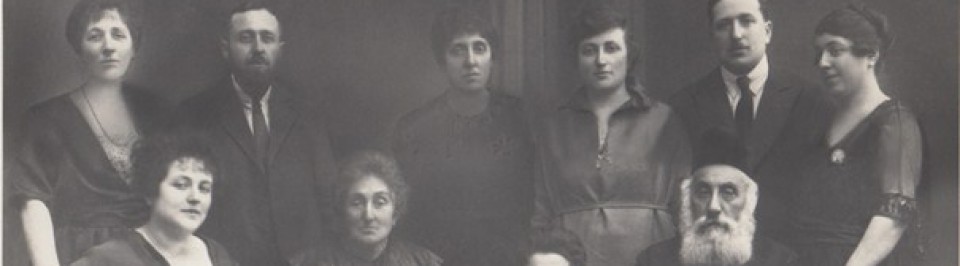
I met my cousin Pini Doron in 2013 when I found his family tree online and wrote to ask if we might be related. He asked for proof, so I sent him the photo in the header of this blog, which he recognized from his own copy. He wrote back “welcome to the family” and ever since I have felt embraced by my extended family in Israel, with Pini at the heart of it. The photo, which includes both of our grandmothers, confirmed that we are cousins.

Last week, we were contacted by Nitay Elboym, who writes for the MyHeritage Hebrew-language blog. He decided to write about our family in commemoration of Holocaust Remembrance Day. It’s a story of connections and separations that span a century.

You can find it in Hebrew at the Internet news service YNet:

אחרי 70 שנות נתק: גילה בארה”ב בני משפחה שנעלמו לאחר השואה

and in the MyHeritage blog:

בזכות תמונה ואילן יוחסין: בן לניצולת שואה גילה בני משפחה שנעלמו

I’ve attached the text in English. I used Google Translate and then edited it. This is the article that appeared in the MyHeritage blog. The YNet version only has minor differences.

1916BabiasFamily_color

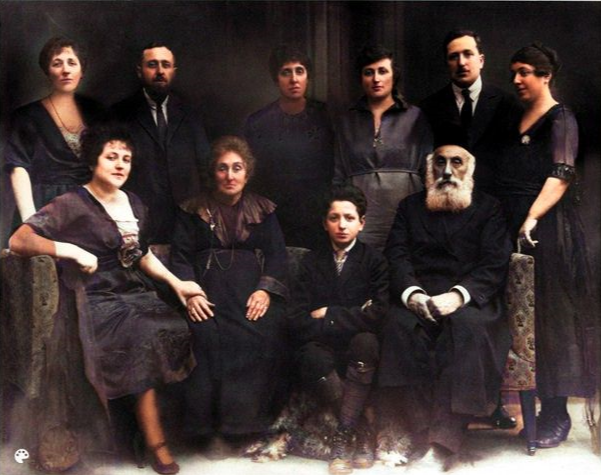
Colorized photo of the family from about 1916. Marysia’s grandmother is sitting on the left and Pini’s grandmother is standing on the right

Thanks to a photo and a family tree: a Holocaust survivor son has found family members who disappeared

 By Nitay Elboym

April 21, 2020

74-year-old Pini Doron of Hod Hasharon is a longtime MyHeritage user who built a family tree for many years dating back to 1800. Pini thought he had already finished his search, when he received a message with an old family picture. This time, he realized immediately, it was an extraordinary discovery.

“I get a lot of inquiries from people who think they’re related to me,” Pini says. “I am usually skeptical of my relation to them, so I politely ask everyone to explain how we are connected. In this case too, when I received the message, I responded that I would love to know what our family relationship is,” he recalls.

“Actually, at that time, I was pretty much at the beginning of my family history research,” recalls Marysia Galbraith, a professor of anthropology at the University of Alabama, USA. “I was looking for bits of information wherever possible. But when I saw Pini’s family tree on MyHeritage, I knew it was about me, I just didn’t know how. In short, I had no idea how to prove to him how I was related to his family tree, so I just sent the only picture I had. Besides my grandmother, I didn’t know who the people were. Then he answered me ‘Welcome to family.’ His reply almost made me cry. ”

Operation Rescue

The Piwko family lived in the town of Wloclawek, Poland. At the outbreak of World War II, Pini’s grandparents – Pinchas Kolski and his wife Rachel (nee Piwko) – and their two children, Mirka and Samek, were left there while Pini’s father was saved because he and his two brothers were sent to Israel before the war to work the family lands in Kfar Ata. “Because their city of residence was close to Warsaw, they were transferred to the Warsaw ghetto right at the beginning of the war, around 1940,” Pini says. “In the ghetto, Samek was murdered, and my grandfather died of illness. So my grandmother and her daughter Mirka were left alone, looking for a way to survive.”

1941RachelMirkaKolskiAtPinchasGraveInGhetto

Mirka and Rachel Kolski at Pinchas Kolski’s grave in the Warsaw Ghetto

Meanwhile, Rachel’s sister, Halina, lived in relative safety outside the Warsaw ghetto, because after divorcing her first Jewish husband, she remarried a Christian man named Zygmunt Bereda. “Rachel and Halina’s father were not ready to hear about this relationship. So, when she married a Christian, he sat shiva on her,” said Pini. “Her sisters tried from time to time to keep in touch, but because of their father, the connection got weaker.” Halina and Rachel’s father, who passed away around 1930, could not have imagined that it was precisely the person who, because of his religious identity, he rejected, would save not only his daughters, but also his other descendants.

When Halina told Zygmunt that her sister was in the ghetto alone with her daughter, he decided to come to their aid despite the risk involved. “Zygmunt was a very successful businessman with a lot of property. In addition, he probably had many connections, which opened doors to him that were closed to others,” explains Marysia. “He used these connections to forge documents for Rachel and her sister, which allowed them to escape the ghetto.”

BabciaPuertoRico

Halina Bereda, Marysia’s grandmother. She and her Christian husband saved the family

ZBeredayoung

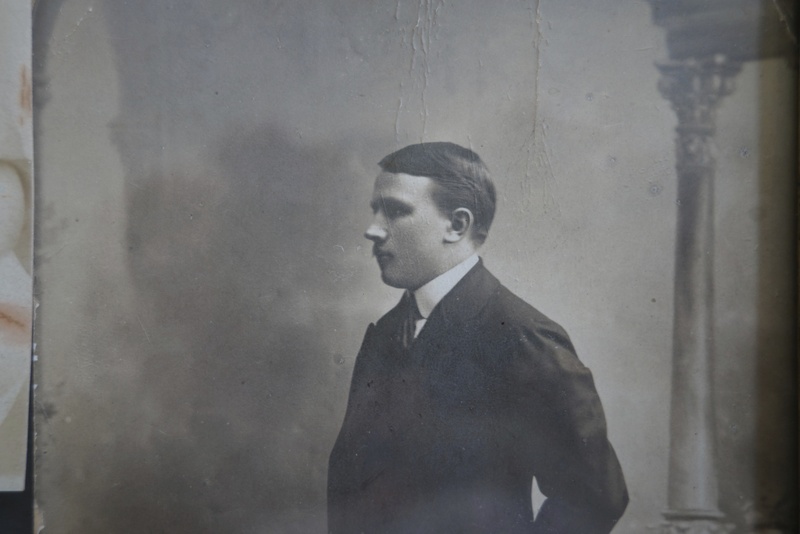
Zygmunt Bereda. A Polish Christian who saved the family of his Jewish wife

But the matter did not end here. Zygmunt and Halina protected the two after they left the ghetto and hid them in buildings they owned throughout the war. At the same time, they were able to forge additional documents that allowed them to leave Poland to Switzerland, and from there, in 1949, the two immigrated to Israel.

“Years of disconnection ended thanks to a surviving photo and family tree on the MyHeritage website. Ever since we started chatting, I have found that Marysia isn’t only a wonderful person, she is also a thoughtful researcher,” says Pini. “She has set up a blog where she writes personally and collects her interesting findings. Everything she does is well organized, backed up by documents, and she knows how to find almost everything. She even studied Polish, which probably helps her a lot in genealogical research.”

The wheel turns over

At the end of the war, Warsaw was devastated by the bombings. The many businesses and houses that Zygmunt owned were also destroyed. He and Halina lost their property and had no place to live. The rescuers now needed help, and the one who came to their aid was the former wife of Samek, Rachel’s son who died in the Holocaust. After the war Halina and her daughter Maria, Marysia’s mother, immigrated to the United States and settled there.

“The truth was kept from us,” says Marysia, who has grown up as a Christian all her life. “For years, family members have been whispering about being Jewish, but never really getting into it. I have spent a long time trying to figure out why my mother and grandmother hid their Jewish heritage and why they were not in contact with Rachel. I think the trauma of the Holocaust left a deep scar on my grandmother. She thought, “If they don’t know, then it won’t hurt them.” That’s probably why they didn’t keep in touch with Rachel and her descendants in Israel.”

Since the family tree has linked Pini to Marysia the two speak regularly, and they have also met in Israel and in Poland with other family members. “When we went to the graves of our families, the sight was unusual. On one side of the cemetery wall are Jews with a rabbi, and on the other side are Christians with a priest,” Pini recalls. “But what is important? In the end, we are human beings and destiny connected us together.”

DSC00438

During the roots journey to Poland. Pini stands to the left and beside him Marysia

PinisTree

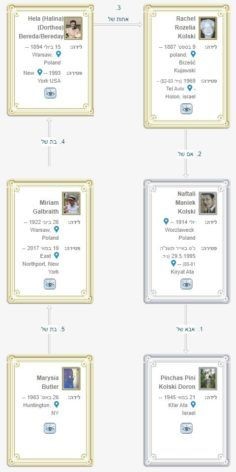
Pini’s Tree showing the family connection between Pini and Marysia

The image that led to the discovery – now in color

To revive the old image that made the exciting discovery, the company’s investigators used the MyHeritage In Color ™ auto-coloring tool and sent the result to Pini and Marysia. “It’s wonderful,” says Marysia. “I’m going to share the colorized picture with my family, including my 90-year-old aunt who will be especially happy.”

1916BabiasFamily_color

Colorized photo of the family from about 1916

The Odyssey of a Polish Jew

28 Tuesday Jan 2020

Posted by Marysia Galbraith in antisemitism, Jewish Culture, Memory, Names, Polish-Jewish relations, Pre-World War II, Survival, Tarnów, Warsaw, World War II

≈ 2 Comments

Tags

Roman Szancer, Roman Szydłowski, The War Began in Tarnow

Roman Szydłowski grew up in an affluent assimilated Jewish family in prewar Tarnów, a medium-sized city southeast of Krakow. His “Recollections,” published under the name The War Began in Tarnów, breezily describe the many relatives and acquaintances who populated his youth, though it is jarring how many of their lives were cut short by wartime assaults against Jews.

Szydlowksi_Wojna_cover

The War Began in Tarnów, by Roman Szydłowski

Szydłowski’s book reminds me that Poland is a small country, in the sense that citizens who travel in elite circles know each other, or know of each other. A person raised in a family like Szydłowski’s rubbed shoulders with famous actors, writers, and politicians. Simultaneously, World War II lurks on the edges, and at times overtakes Szydłowski’s narrative, as for example when he describes the explosions at the Tarnów train station, an act of German sabotage that happened on August 23, 1939, a week before the official invasion of Poland began.

The book is interesting for its intimate portrait of everyday life before, during, and immediately after World War II, but it does so from the particular lens of the moment in which it was written: 1982, when Poland was under martial law following the suppression of the Solidarity Movement that had sought to reform the state socialist system. Szydłowski was 63 years old and looking back on his life as he approached retirement. That time and place might explain the glaring absences in his otherwise vivid, detailed, and immediate recollections.

Born Roman Szancer in 1918, the author grew up in comfort in a large apartment at the center of Tarnów. His family owned an enormous mill which his great grandfather established in the early 1800s. It is notable how little Judaism figured in his early life story—it was a factor but hardly a defining one. His first recollection of anti-Jewish sentiment involved one of his classmates who called him “you Jew” in a way that sounded like a slur. Roman couldn’t understanding why being Jewish would be an insult, but he replied in kind, “you Catholic.” When their teacher found out, he made them stop, threatening them with corporal punishment. Later, Roman and the other boy became good friends.

The Szancer family took pride in their unaccented Polish and their assimilation, not only into Polish culture, but also into elite European culture more broadly. As a child, Roman visited relatives in Germany and Austria. His grandmother, a cousin of Austrian philosopher Martin Buber, was the only one in the family who spoke Polish with a strong accent; they had to talk to her in German.

Roman portrays himself as a proud defender of Poland. About the rise of Hitler in Germany, he writes “We feared for the future of Poland, though none of us anticipated that our country, which we considered stable, would soon be pillaged by the Third Reich” (p. 60-1). Szydłowski mentions just a few instances when his early life was touched by prejudice. The first girl he fell in love with was Catholic, and “there were those who couldn’t reconcile with the fact that ‘that Jew goes out with such a pretty Polish girl’,” so they spread rumors that broke them up (p. 74). A few years later at the Jagiellonian University, Jews were separated from the Catholic students and confined to the so-called “ghetto benches.” This didn’t affect Roman directly because he had what people called “a good look.” In other words, he didn’t have the stereotypical features or mannerisms associated with Jews and so could sit wherever he wanted. He makes a point of saying that only the leftist students objected to the “Aryan paragraph” restricting Jews from student organizations; the majority of the student body voted in favor of the restrictions.

Another incident illustrates how distant Roman felt from traditional Jewish life. He describes a Hassidic wedding he attended in the summer of 1939 in a mostly Jewish town. The residents dressed differently than he was used to seeing in the towns around Tarnów, in round hats with small rims, shorter jackets and their pants tucked into manure-covered shoes. About the wedding he writes, “I’m left with an impression of something very colorful, but so far away and foreign as if I found myself suddenly on a distant continent” (p. 125).

Szydłowski’s wartime experiences read like an adventure story, making startling shifts from descriptions of carefree youthful high jinx to hair-raising brushes with death. Because he had connections, he was able to drive east ahead of the invading German army and find refuge with relatives near Lviv (part of Poland before the war, the Soviet Union after 1939, and Ukraine today). He describes his apprehension by Soviet authorities, deportation to the Far East, and eventful return to Lviv, one chance encounter leading to another that eventually got him back to relative safety.

After Hitler broke the German-Soviet nonaggression pact, he witnessed the most horrific events of his own wartime experiences. Thousands of Jews were slaughtered in Lviv, their blood running through the streets. He returned to Tarnów, where he moved freely, neither wearing the Star of David nor staying in the ghetto as dictated by the Nazi occupiers. By December 1941, he settled in Warsaw, where he changed his last name to Szydłowski, thus gaining the protection of a Polish surname. He writes breathlessly about the richness of the culture in the city, where he attended classical concerts, theatre productions, and university classes. All of these activities occurred “underground,” without the knowledge or sanction of the occupying forces.

He explains, “Warsaw during those years was a city impossible to describe. Terrifying contrasts collided at every corner. Luxury alongside poverty, tragedy next to debauchery, death and delight, everything compounded to the maximum. People lived as if in a trance, unsure of tomorrow. Everyone knew they could die soon, so they wanted to get the most out of life” (p. 155). After being arrested under suspicion of conspiracy, and imprisoned in Pawlak Prison, Szydłowski was mysteriously released. He made a quick retreat to the countryside near Krakow, where his “most carefree period of occupied life began” (p. 162). He spent the summer at the ancestral palace of a gentry family who treated him like an esteemed guest. The refuge was an illusion, he admits. A year later, months after he had moved on, German police came and shot the whole family.

What might explain the absences in Szyłowski’s narrative? Why doesn’t he mention the Warsaw Ghetto Uprising in 1943, even though he was living in Warsaw at the time? He lived in the “Aryan” part of the city under his assumed name, but he must have witnessed the armed revolt mounted by the last remaining Jews in the ghetto. The fighting continued for 28 days until most of the partisans were either killed or took their own lives. Why doesn’t he discuss the massive scale of the Holocaust? He makes no mention of the millions who died, nor any details about the death camps. He does not address the nearly complete absence of a Jewish population in Poland after the war. The annihilation of Poland’s Jews only peaks out in the many biographies of family and acquaintances that ended with them murdered by military police or Germans.

Szydłowski’s recollections also elide any direct criticism of communism. He simply gives a matter-of-fact description of the arrival of Soviet troops after the Germans retreated , without addressing the heavy hand the Soviet Union played in shaping the postwar state-socialist republic. He writes directly about joining the Communist Party in 1946, but only indirectly about his disillusionment and retreat from the party just a few years later. Throughout his narrative, he acknowledges his socialist leanings, as well as the socialist and communist affiliations of his friends, but he also makes a point of emphasizing his disinterest in politics.

Szydłowski ran out of time to finish writing about his 35-year career as a theatre critic and journalist. He died in 1983.

What a difficult way to walk through life, carrying so many ghosts in your memories. And yet, Szydłowski speaks with the voice of an optimist.

img_20190625_140213202_hdr

Remains of the Szancer mill, June 2019

George Bereday and His Vision of Education

09 Thursday Jan 2020

Posted by Marysia Galbraith in Bereda, Family, Photographs, Pre-World War II

≈ 6 Comments

Tags

George Z. F. Bereday/Jerzy Bereda, Halina Piwko Bereda, Maria Bereda(y) Galbraith, Maria Weglinska/Hana Piwko

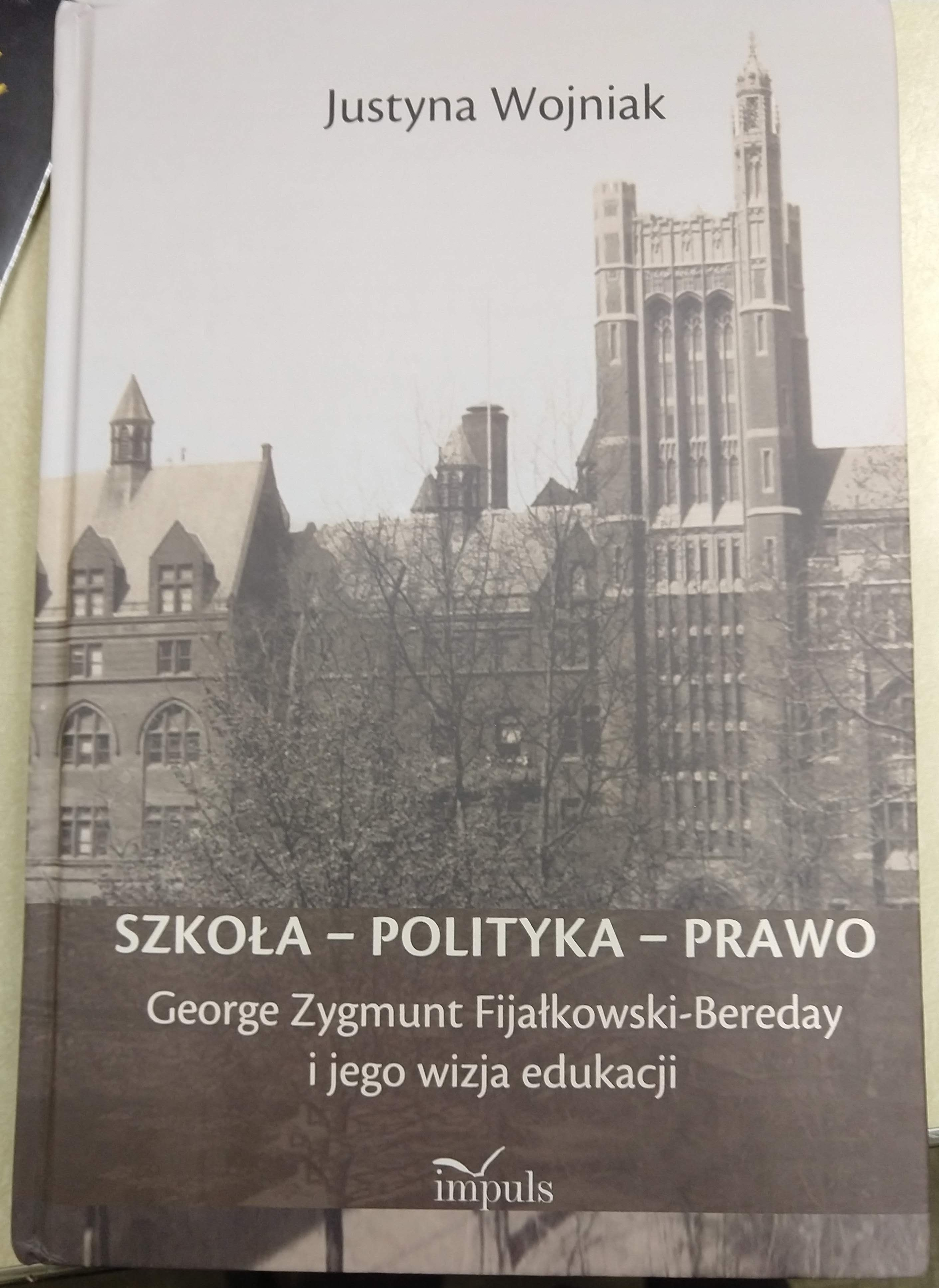
I was happy to receive a package from Poland yesterday–a surprise post-holiday gift? In fact, it was a book by Justyna Wojniak titled Szkoła – Polityka – Prawo: George Zygmunt Fijałkowsky-Bereday i Jego Wizja Edukacji (School, Politics, Law: George Z. F. Bereday and His Vision of Education).

img_20200108_160148_01

School, Politics, Law: George Z. F. Bereday and His Vision of Education by Justyna Wojniak

The author contacted me a year ago to talk about my mother and her brother for her doctoral dissertation about my uncle George Bereday, who was instrumental in establishing the discipline of Comparative Education. Most of the book focuses on Bereday’s scholarly work on the idea of equal education for all, methods for comparing educational systems in different countries, as well as his concerns about equal rights and social justice generally. I will read the whole book eventually, but the first chapter is most relevant to my search for family heritage. Wojniak cites this blog in the chapter about my uncle’s childhood and early life in Poland, and even discusses my mom’s service in the Polish Underground Army during World War II. It’s great to see my work being put to use, and translated into Polish for Polish speakers to read.

I was also amazed to find a photo on page 28 of my babcia with a young George/Jurek on one side and a young Maria/my Mama on the other. They are all smiling, and Babcia holds both children by the hand. It’s winter–they are wrapped up in warm coats, hats, gloves, and boots, walking along a gravel road with barren trees in the background. I would guess my mom is about six years old and Uncle George about eight, which would make it around 1928 or 1929. Based on the time and rural setting, my guess is it was taken at Dębinki, the estate outside of Warsaw where they lived from about 1928-1934. Mama always said those were the happiest years of her life.

img_20200109_150120152

George/Jerzy, Halina/my Babcia, and Maria/my Mama Bereda in Poland around 1928 or 1929.

I have never seen this photo before. In fact, I don’t recall ever seeing a photo of my mother as a child. And even more surprisingly, the source of the photo is my own cousin Krysia! We’ve been in touch, and I’m counting on her to send me a better copy than this one.

Inclusion and Exclusion in the Polish Nation

20 Tuesday Mar 2018

Posted by Marysia Galbraith in antisemitism, Catholicism, Family, Genealogy, Identity, Jewish immigrants, Poland, Polish-Jewish Heritage, Polish-Jewish relations, Pre-World War II, Włocławek

≈ 1 Comment

Tags

Honorary Citizen of the Russian Empire, Mizrahi Party

Were Jews included as part of the Polish nation or were they excluded from it? This was one of my driving questions when I started to uncover the Jewish roots of my (Polish) mother’s family. I wondered if I might find my ancestors in some kind of hybrid Polish-Jewish space in which they identified as both Polish and Jewish. Or perhaps they lived in a world that ran parallel to that of their non-Jewish neighbors, with limited points of interaction. What I have found so far is neither straightforward nor consistent. It doesn’t fit entirely nor unambiguously into a narrative of hostile separation nor of peaceful coexistence. I’ll be focusing here on my ancestors’ lives before World War II. The Holocaust was such a devastating event that it needs to considered in its own terms, something I’ll try to do in another post.

The Polish lands were hospitable to my Jewish ancestors, allowing them to prosper for generations. My grandfather Jacob Rotblit owned a Ford dealership in the 1930s, and before then he was a manager of an international trading firm. Or maybe he sold jewelry. It’s hard to find absolute proof, but either way, he maintained important business interests.

Poland PartitionMap

Poland was under Russian, Prussian, and Austrian rule from the end of the 18th century until World War I. The region around Warsaw, where my family lived, was under Russian rule, though it had some degree of autonomy for some of this time. Map source and more information about the partitions of Poland: http://www.britannica.com/EBchecked/topic/466910/Partitions-of-Poland

My grandmother’s father Hil Majer Piwko was in the lumber trade. Documents from the National Archive in Włocławek show he owned a building supply store in the 1920s, and according to Aunt Pat, he owned a sawmill before then. Pat also writes that he was recognized as an “honorary citizen of the Russian Empire” for his service during a cholera epidemic. This was sometime before 1918, when the region near Warsaw was part of the Russian Empire. Apparently, the title “honorary citizen” came with some of the rights that were normally reserved for the nobility.

So there was separation but also opportunity. It was not very easy for Jews to become gentry, unless perhaps through marriage, but there were other means by which they were granted special honors and rights. By comparison, different social classes faced road blocks against entering the gentry, regardless of ethnicity or religion. For instance, most peasants lacked the financial means and cultural capital to gain such social standing. At least in some times and places, wealthy, educated Jews would have had more avenues to social advancement.

More about my family’s prosperity can be read from the family portrait that was taken around 1916. Hil Majer and his wife Hinda had many children. They were wealthy enough to dress in fine fabrics. Hil Majer’s traditional clothing suggests that he had the freedom to practice his faith and customs, while his children were free to assimilate, as indicated by their modern clothing. Separation wasn’t just enforced by the majority, but also sometimes chosen to preserve cultural and religious distinctiveness.

JechielHindaAndChildren

The Piwkos c. 1916. For more about this photo see: The Photo That Started it All, Some Reassembled Stories, and What Year Was It?


Why did the family move from Hil Majer’s native Skierniewice to the village of Sobota, before settling down in Brześć Kujawski and then Włocławek? It seems likely they were following economic opportunities, but also possibly they were seeking a place more hospitable to Jews. This fits a common narrative about the Jews as wanderers. They arrived in Eastern Europe as tradespeople, financial advisers, and estate managers, and eventually established settled communities. But I’ve also been told that by the 19th century, most Jewish families stayed put. That’s why knowing the place of origin of one relative usually leads to many more relations.

Włocławek hadn’t always welcomed Jews. Until the end of the 18th century, it was a Church town, home to a bishop’s cathedral, with restrictions against Jewish residents. But then the city secularized, and as it industrialized and became an engine of commerce, the Jewish population also grew. Located as it was between Warsaw and the Baltic Coast on the Vistula River, Włocławek became an important port, and home to paper, ceramic, metal, chemical, and food processing factories.

Włocławek-Wyszyński_street_on_photograph_by_Sztejner

Włocławek before 1898. Note the factories near the river. By Bolesław Julian Sztejner (1861-1921) (http://www.wuja.republika.pl/widoki_ogolne_wl.html) [Public domain], via Wikimedia Commons


In addition to economics and religion, political factors shaped the degree of inclusion available to Jews within the broader society. Antisemitism grew in the 1880s throughout the Polish lands, as Polish nationalists became more active in their pursuit of national sovereignty. Once Poland gained its autonomy in 1918, tensions deepened. Some political forces, led by Józef Piłsudski, argued for a broad definition of citizenship within the new Polish state, insuring equal rights for the 1/3 of the population that was Ukrainian, German, Jewish, and other minorities. Another political faction, led by Roman Dmowski, advocated for a narrower definition of Polishness, based on an idea of “pure blood,” by which he meant shared descent that also tied the nation to Catholicism. At the same time, Jewish nationalism grew, and took on a number of forms, leading some to embrace  Yiddish culture, and others to espouse Zionism. Some Jewish nationalists dreamed of a safe place within the countries in which they lived, while others turned their eyes toward Palestine.

Włocławek became a crossroad for different varieties of Judaism, including Zionism, Hasidism, and Reform. Around the time that my great grandfather moved there, a new rabbi, Jehuda Lejb Kowalski, also arrived. He was very popular, and succeeded in reconciling the factions within the Jewish community. In 1902, Kowalski helped found the Mizrahi Party, and was a key leader in this Orthodox Zionist organization. Perhaps Kowalski is what drew the family to Włocławek? I’m not sure of Hil Majer’s affiliation, but his son-in-law, Rachel’s husband Pinkas, was a member of the Mizrahi Party in Włocławek, and a representative of the governing board of the city’s Jewish Community in 1931. Hil Majer’s oldest son Jacob represented the Zionist Party on the governing board from 1917 until 1922, and he was on the City Council from 1917-19. In other words, Jacob wasn’t only involved in Jewish political life; he also held a position in city government.

So there were opportunities to integrate into the broader society, to pursue economic and political goals, and to flourish as a distinct religious and cultural group.

But clearly there were problems that caused my relatives to leave for other countries, long before the German occupation and Nazi assaults against Jews. One of Hil Majer’s brothers went to Canada in the 1880s; the son of another went to Switzerland. In 1906-7, two of Hil Majer’s sons went to New York. Over the years, Philip sponsored many of the next generation who started out in the US at his bakery. Four more sisters, including my grandmother, also came to the US. Jacob’s children, as well as Rachel and her children, went to Palestine starting in the 1930s. Still, choosing, or even being forced, to leave didn’t necessarily signal a lack of attachment to Poland. For over a century, there have been mass migrations from the Polish lands by Catholics, Protestants, and Jews who, regardless of their national or ethnic affiliation, chased after their dreams in distant lands.

Sholem Asch: A Yiddish Playwright Ahead of His Time

11 Thursday May 2017

Posted by Marysia Galbraith in Jewish Culture, Kutno, Pre-World War II, Yiddish

≈ 1 Comment

Tags

God of Vengence, Indecent: the play, Paula Vogel, Sholem Asch


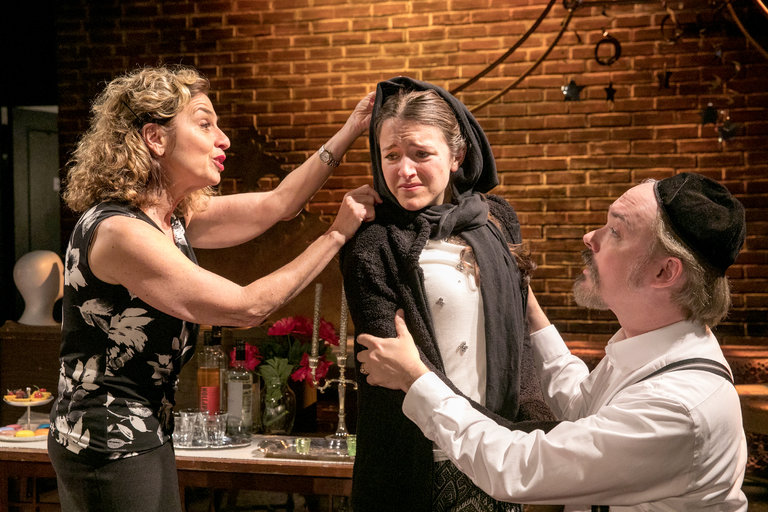
Kutno’s native son Sholem Asch is in the news a hundred years after writing a play that deals with issues that remain controversial today. His work also shatters a lot of assumptions about Jewish life in Poland in the early 20th century–Written in Yiddish, it features a brothel, a Torah scroll, and love between two women. Asch’s play God of Vengeance was written in Yiddish in 1907 and first produced in Berlin in 1910. I found an electronic version of the 1918 English translation (you can follow the hotlink above). In the play, Yekel, who lives with his family above the brothel he owns, tries to improve his family’s status by commissioning a Torah scroll and marrying his daughter Rifkele to a Yeshiva student. Instead, the young daughter falls in love with one of the prostitutes and in a pivotal scene, they kiss. The play highlights the tension between piety, reflected in the Holy Scroll that is supposed to bring respectability to the family and the economic and sensual attraction of the brothel downstairs, as well as observations about women’s empowerment and oppression.

The play has been getting attention recently because of Paula Vogel’s Broadway play Indecent, a play about a Yiddish play that was ahead of its time (as the NPR report about Indecent is titled). Vogel’s play centers around the 1923 staging of God of Vengeance in New York’s Apollo Theater (also on Broadway), notable because the whole cast, the producer, and one of the theatre owners were arrested and eventually convicted of indecency. The play had been controversial where it had been staged throughout Europe, but it also received critical acclaim.

The popularity of Indecent has led to renewed interest in Asch and his play, which was recently produced at LaMaMa Experimental Theater in the East Village (In God of Vengeance, a Nice Jewish Family Lives Above a Brothel).

30godofvengeance-master768

From left, Eleanor Reissa, Shayna Schmidt and Shane Baker as Orthodox Jewish parents and their marriageable young daughter in Sholem Asch’s “God of Vengeance,” at La MaMa. Credit Richard Termine for The New York Times


← Older posts

Categories

  • Anthropology (37)
    • Archives (14)
    • Fieldwork (7)
    • Ground Penetrating Radar (GPR (4)
    • Research Methodology (8)
  • antisemitism (14)
  • Association of Descendants of Jewish Central Poland (32)
  • Catholicism (8)
  • Conference (1)
  • Discrimination (2)
  • Family (69)
    • Bereda (17)
    • Kolski (13)
    • Piwko (22)
    • Rotblit (3)
    • Walfisz (4)
    • Winawer (7)
  • Genealogy (11)
  • Heritage work (66)
    • Commemoration (23)
  • Identity (18)
  • Israel (6)
  • Jewish Culture (89)
    • Cemeteries (51)
    • Museum (7)
    • Synagogues (33)
  • Jewish immigrants (8)
  • Jewish Religion (1)
  • Memory (70)
  • Names (14)
  • Photographs (6)
  • Pifko-Winawer Circle (5)
  • Poland (125)
    • Baligród (1)
    • Bolimów (1)
    • Brześć Kujawski (5)
    • Buk (1)
    • Chodecz (1)
    • Dukla (2)
    • Dąbrowice (1)
    • Gdynia (1)
    • Gostynin (2)
    • Gąbin (1)
    • Izbica Kujawska (1)
    • Kazimierz (4)
    • Kowal (1)
    • Koło (1)
    • Krakow (7)
    • Krośniewice (1)
    • Kutno (6)
    • Kłodawa (1)
    • Lesko (8)
    • Leszno (1)
    • Lubień Kujawski (1)
    • Lubraniec (1)
    • Lutowiska (3)
    • Piła (3)
    • Podgórze (2)
    • Poznan (11)
    • Przemyśl (2)
    • Pzedecz (1)
    • Radom (1)
    • Radymno (1)
    • Sanok (1)
    • Skierniewice (5)
    • Sobota (2)
    • Tarnów (2)
    • Warsaw (22)
    • Wielkopolska (1)
    • Wronki (7)
    • Włocławek (20)
    • Zasław (2)
    • Łódź (1)
    • Żychlin (30)
  • Polish Culture (10)
  • Polish-Jewish Heritage (60)
  • Polish-Jewish relations (60)
  • Post-World War II (24)
  • Pre-World War II (22)
  • Reclaimed Property (1)
  • stereotypes (3)
  • Survival (9)
  • Trauma (3)
  • Uncategorized (5)
  • Victims and perpetrators (4)
  • World War II (45)
    • Jewish Ghetto (12)
    • Nazi Camps (5)
    • Polish Underground Army (3)
  • Yiddish (5)

Enter your email address to follow this blog and receive notifications of new posts by email. Your email address will not be shared.

Archives

  • October 2025 (1)
  • July 2025 (8)
  • June 2025 (1)
  • April 2025 (1)
  • August 2024 (3)
  • July 2024 (3)
  • May 2024 (2)
  • April 2024 (1)
  • May 2023 (2)
  • January 2023 (2)
  • December 2022 (7)
  • November 2022 (2)
  • October 2022 (5)
  • September 2022 (1)
  • January 2022 (1)
  • August 2021 (1)
  • December 2020 (2)
  • July 2020 (1)
  • May 2020 (3)
  • April 2020 (1)
  • March 2020 (1)
  • January 2020 (2)
  • May 2019 (1)
  • February 2019 (1)
  • November 2018 (1)
  • September 2018 (1)
  • August 2018 (3)
  • July 2018 (1)
  • June 2018 (1)
  • May 2018 (1)
  • April 2018 (2)
  • March 2018 (2)
  • February 2018 (2)
  • January 2018 (2)
  • December 2017 (2)
  • November 2017 (2)
  • October 2017 (1)
  • September 2017 (3)
  • August 2017 (3)
  • June 2017 (2)
  • May 2017 (3)
  • April 2017 (1)
  • March 2017 (2)
  • February 2017 (1)
  • January 2017 (2)
  • December 2016 (2)
  • November 2016 (4)
  • October 2016 (1)
  • September 2016 (6)
  • August 2016 (2)
  • July 2016 (1)
  • May 2016 (4)
  • April 2016 (2)
  • March 2016 (3)
  • February 2016 (4)
  • January 2016 (3)
  • December 2015 (3)
  • November 2015 (5)
  • October 2015 (5)
  • September 2015 (3)
  • August 2015 (4)
  • July 2015 (3)
  • June 2015 (3)
  • May 2015 (4)
  • April 2015 (9)
  • March 2015 (3)
  • February 2015 (2)
  • January 2015 (5)
  • December 2014 (4)
  • November 2014 (9)
  • October 2014 (2)
  • September 2014 (1)

Copyright Notice

All original text and images are copyright © Marysia Galbraith. Please contact the author before quoting.

Blog at WordPress.com.

  • Subscribe Subscribed
    • Uncovering Jewish Heritage
    • Join 145 other subscribers
    • Already have a WordPress.com account? Log in now.
    • Uncovering Jewish Heritage
    • Subscribe Subscribed
    • Sign up
    • Log in
    • Report this content
    • View site in Reader
    • Manage subscriptions
    • Collapse this bar
 

Loading Comments...