• About
  • The Photo that Started it All

Uncovering Jewish Heritage

Uncovering Jewish Heritage

Category Archives: Post-World War II

Revisioning Jewish Poland through Art

11 Friday Nov 2016

Posted by Marysia Galbraith in Anthropology, Memory, Poland, Polish-Jewish Heritage, Post-World War II

≈ Leave a comment

Tags

American Anthropological Association Meeting 2016, Andrzej Niziołek, art, Janusz Marciniak, moral self, political action, Wojtek Wilczyk

The abstract for the paper I will be giving at the American Anthropological Association Meeting next week:

Artistic expression can be a powerful means to challenge the hegemonic power structure and to imagine an alternative social and moral order. In this paper, I highlight the work of three Polish artists who experienced a moral awakening during the Solidarity Movement in the early 1980s which made them sensitive to the repression of memories of Poland’s multi-ethnic, multi-religious past. In the ensuing years, they have engaged politically through their art to expose what remains of Jewish material culture (such as synagogues, cemeteries, and photographs), and to bring back into the public sphere a recognition of the space Jews once filled in everyday life in Poland. This artwork is both documentary and affective; it is intended to simultaneously inform viewers and to generate in them deep emotional responses that encourage ethical reflection.  Through various media, the artists seek to communicate that Jews were an essential part of Polish culture until the Holocaust, and also to give form to a collective sense of loss experienced after their violent removal. The cases examined are Wojtek Wilczyk’s photographs of former synagogues, called “There is no Innocent Eye,” Janusz Marciniak’s installations in the former synagogue in Poznan, and Andrzej Niziołek’s book Fira which traces the everyday life of a Jewish woman as revealed in her photo album of snapshots taken between the World Wars. These artists engage their moral selves to challenge political exclusion, public indifference, and antisemitism that until recently has kept Jewish spaces outside of everyday public and personal memories.

Synagogue by Wojtek Wilczyk
Atlantis, 2004, by Janusz Marciniak. Star of David floating on water and lit by hundreds of blue candle lanterns, while the Academic Choir sang "Meditation on Peace."
Atlantis, 2004, by Janusz Marciniak. Star of David floating on water and lit by hundreds of blue candle lanterns, while the Academic Choir sang “Meditation on Peace.”
Fira by Andrzej Niziołek

It’s part of a panel organized by Natasa Garic-Humphrey at UCSD:

The Politics of Indignation, Resistance, and Reconstitution of the Moral Self

This panel explores the intersections of governmentality, citizenship, political subjectivity, activism, ethics, and morality, and critically examines the importance of inserting “the moral self” within political theory to better understand how citizens come to confront political organizations and policies. Recent years have provided unprecedented examples of large-scale resistance, uprising, protest, and violent confrontation to authoritarian regimes, invidious state policies, and localized manifestations of neoliberal political-economics. To explain current confrontations to prevailing forms of state power, scholars have successfully highlighted the gaps between policy making from above and people’s on-the-ground experiences, resulting in citizens’ alienation from governmental ideologies, programs, and practices, while another line of research explored the various ways in which experiences of subjectivity and suffering are shaped within particular contexts of political economy.

This panel however, takes a closer look at the ways people manage to change their moral orientations within the context of hegemonic power and (re)make their moral selves to engage in and confront larger political and socioeconomic processes. How do specific situations, events, and visceral experiences in people’s lives evoke moments of self-reflection, engender reorientations towards the self, and inspire courses of action that cultivate a new sense of moral personhood? How does this experience of generating a new moral self shape one’s perceptions of government ineptitude and prepare them to engage in citizen-based action to confront political injustices and socio-political reforms? What motivates people to resist, initiate change, and form new senses of themselves as moral actors in the midst of stifling crises brought by socioeconomic and political transformations, war, genocide, fear, and other examples of structural violence?

Dwie Butelki Wódki

21 Wednesday Sep 2016

Posted by Marysia Galbraith in Memory, Polish-Jewish relations, Post-World War II, Żychlin

≈ Leave a comment

Historia “Dwie Butelki Wódki,” napisana przez Mirosława Stojak, prezentacja opracowana przez Henryk Olszewski:

dwie-butelki

Two Bottles of Vodka

19 Monday Sep 2016

Posted by Marysia Galbraith in Heritage work, Jewish Culture, Memory, Polish-Jewish relations, Post-World War II, Survival, Włocławek, Żychlin

≈ Leave a comment

Two times over the course of my visit to Żychlin, my host Henryk told me a story about a young Jewish boy who survived the war and returned to the town to collect his family’s jewels. A bad Pole threatened the boy’s life unless he showed him where the valuables were hidden. The frightened boy showed him. They sat down at a table and for each one item the bad Pole gave the boy, he took several for himself. The boy took out a roll of money and offered to buy the jewelry. Then, the brother of the bad Pole came in and saw what was going on. He told his brother, “Here, I have two bottles of vodka. We’ll drink together.” Then he gave the boy all his money and jewels back.

The story made an impression on Henryk. He said a woman from Włocławek had told it to him. Because they were talking on the phone, he didn’t want her to tell him the real names of the men. He wants to save it for when they meet in person. That kind of information is better shared face-to-face. The second time he told me this story, it occurred to me I might know the woman he had spoken with. Indeed, it turned out that it was Mirosława Stojak, who has made it her personal quest to learn all she can about Włocławek Jews. Henryk promptly called Mira so we could talk. I met Mira during my first visit to Włocławek in 2014, and then again when I was there in June.

Mira uses her talents as a poet, writer, and actress to share the stories of Włocławek Jews. In her book Utkane Sercem Włocławskim Żydom, she includes the story that so captivated Henryk, called “Two Bottles of Vodka.” Here is the translation of the story:

Two Bottles of Vodka

Utkane Sercem Włocławskim Żydom by Mirosława StojakWinter 1946 was cold. All around, snow covered homes, roads, and trees. Long icicles hung from the roofs. On a January afternoon, Ariel came on the snowy road to the home of his relatives. Before the war, together with his sisters, he was there a few times. During his last visit in 1939 Ariel’s father, a merchant from Żychlin, knew that soon Germans would attack Poland militarily. Sixteen-year-old Ariel, a short boy, emaciated after the experience of the camp, walked pensively listening to the scrape of his creaking shoes. In his ears rang what his father once told him:

“You have to save yourself, and whoever survives should return here…”

He knew perfectly well that his visit would not be viewed happily by the new owners of the house. He was even afraid that he would be treated poorly. He wasn’t sure, either, if the home still stood, or if it was bombed during the war. He hoped not. He walked slowly, every once in a while touching an icy rock. He passed ruins of houses and ashes, people shoveled snow. He heard dogs barking. Before the war he loved dogs, and they even had two beautiful German shepherds at home. Now, they reminded him of scenes from the camp and he was horribly afraid of them. In Auschwitz they were trained to murder. Ariel picked up his pace. Soon the sun would set and it would be dark. After a while, he saw the home of his uncles and aunts, who didn’t much care for visitors during the war. Fearfully, he knocked on the door. A young man stood before him, tall and well built. He had an unfriendly expression on his face, as if he had been expecting him. With his strong hand, he pulled Ariel inside, shutting the door, and yelled,

“Where is it?”

The frightened Jew led him down the stairs to the basement, and then the “brute” pushed him against a wall and demanded he say where the treasure is. A few strikes of a hammer against a wall and in the hands of his “captor” appeared a casket. Now, the boy was led upstairs and into the kitchen. The man grabbed his shirt and sat him on a chair at the table, then sat down across from him and opened the box. Inside was the ancestral jewelry of Ariel’s family. There were brilliantly shiny rings, broaches, and necklaces. Taking the valuables out of the casket, the man put them on the table, between himself and Ariel, loudly counting:

“Mine, mine, yours, mine, mine, mine, yours, mine, mine…”

When he finished, there were just three family heirlooms in front of Ariel. Tears appeared in his eyes. They reminded him of his mother, who always wore a string of white pearls around her neck when she went to synagogue. Now they lay in front of him on the table awaiting their verdict. The boy slowly reached into his pocket and pulled out a role of banknotes, explaining that for him the jewelry has sentimental value for his family and he would gladly buy them back. The “brute,” without thinking, took all the valuables lying on the table for himself, and in a deep resonant voice called out,

“Józek!”

In the kitchen doorway appeared a “man like an oak,” big and broad-shouldered, who asked contemptuously,

“What?” and looked at the table.

The brute moved aside, his eyes not leaving the valuables. Józek who was much older was supposed to settle the matter. Ariel began quickly explaining, persuading him to agree to his proposition to buy the jewelry. He asked Józek to take the money and give back the valuables and then everyone would be satisfied. Józek thought; he silently looked at the young Jew and the table with an appraising eye. Frightened, Ariel imagined them closing him in the basement and starving him, or God forbid, murdering him. Wouldn’t it be ironic to die here and now, after he had the good fortune to miss death at the hands of the Nazis? After a while, Józek broke the silence, yelling:

“Karol!”

A boy who was perhaps eight years old came into the kitchen. Freckled, with wavy hair and an intelligent look. From the pile of money lying on the table, Józek took one bill, gave it to the boy and told him:

“Go and buy two bottles of vodka.”

The boy, like a shot, ran from the cottage. Józek pushed the jewelry and money in the direction of Arial and said:

“Take it and go!”

Ariel ran as fast as his legs would take him. It was a marathon. He didn’t even touch the rock; he didn’t hear the barking dogs. He sped ahead with all the strength in his legs, not looking back. When he got to the station, the train stood ready for departure.

Mirosława Stojak recounting stories about Włocławek Jews, October 1, 2015

Mirosława Stojak recounting stories about Włocławek Jews, October 1, 2015

Mirka told me she met the boy from the story when he visited Włocławek (now of course, he’s an elderly man). His wife wore some beautiful jewelry; she doesn’t know if these were pieces he recovered, but it is nice to think that they were. At his request, she changed all the names when she wrote down the story. Nor did she write about the further misfortunes the boy experienced before he found his way to safety in Israel. I won’t either—the most important thing is that he survived.

How Żychlin Remembers, part 2

01 Thursday Sep 2016

Posted by Marysia Galbraith in antisemitism, Jewish Ghetto, Memory, Polish-Jewish Heritage, Polish-Jewish relations, Post-World War II, Pre-World War II, stereotypes, Synagogues, World War II, Żychlin

≈ Leave a comment

The next morning I met Tadeusz Kafarski for a tour of the city. He was with Józef Staszewski, the director of the Żychlin branch of the Association of Children of War. Because Józef was born in 1929, he remembers wartime better than Tadeusz, who was only a year old when the Nazis invaded. The two sometimes disagreed about details, but together they reconstructed for me Jewish life in Żychlin. As they pointed to the buildings that stand here and now, their descriptions transported me back and forth through time, to prewar life, wartime murder, and communist era absence. I had the odd sensation as I did so many times on this trip of being both here (in the present) and then (in the past), my mind trying to reconcile what stood before my eyes with what used to be. My guides led me back in time with varied fragments of information:

On Łukasieńskiego Street, we passed concrete apartment buildings built in the 1970s on the site of the second, larger Jewish ghetto.

Mr. Helmer, the richest Jew in town, lived across from the market square, to the left of Narutowicza Street, in what is now a well maintained two story building.

One block south, near the synagogue (the blue Star of David on the map below) on Kilińskiego Street, we passed the former home of a Jewish doctor, a building that used to be a dairy collection point, and another that was the preschool Tadeusz attended. A man named Merc lived nearer the synagogue. Behind some houses was the Jewish slaughterhouse, but Christian Poles also bought meat from there.

Jews and Poles lived side by side, even though this part of town was predominantly Jewish. Today, this section of town is run down though these particular buildings seem in good shape.
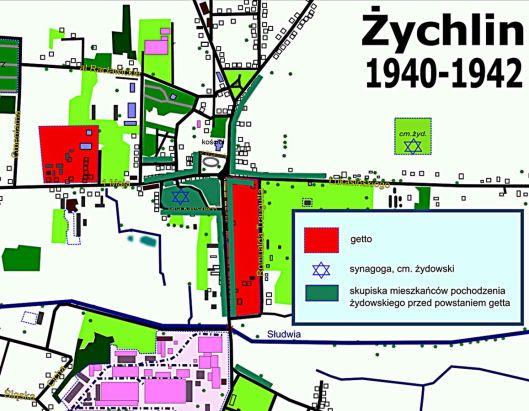
Map of Żychlin 1940-42 showing the ghettos in red, the first one is on the left and the second is on the right. The dark green shows the main areas where Jews lived--note that most were not in what became the ghetto. That meant gentiles had to move out of those areas when the Jews were forced to move in.

Map of Żychlin 1940-42 showing the ghettos in red, the first one is on the left and the second is on the right. The dark green shows the main areas where Jews lived–note that most were not in what became the ghetto. That meant gentiles had to move out of the ghetto areas when the Jews were forced to move into them.

As we wound through the dusty streets, the contemporary residents stared at us suspiciously, though some who know my guides greeted them, “Dzień dobry (Good day).”

The patch of tall weeds in front of the synagogue (on Jana Kulińskiego Street) used to be a fenced garden. The garden continued to be maintained after the war, even though the Polish residents used the synagogue as a warehouse, as did the Nazis. The lower sections of the windows were bricked in and new doorways were installed in the sides of the building to facilitate loading and unloading.

What's left of the Żychlin synagogue. Note the windows used to extend much father down, and the more recent doorway (now blocked) added when the building was used as a warehouse. The weedy area in the foreground used to be a fenced garden.
What’s left of the Żychlin synagogue. Note the windows used to extend much father down, and the more recent doorway (now blocked) added when the building was used as a warehouse. The weedy area in the foreground used to be a fenced garden.
Pan Józef beside the site of the well and mikvah
Worn stones--something I learned to value as a student archeologist. These were used in place of asphalt before World War II
Worn stones–something I learned to value as a student archeologist. These were used in place of asphalt before World War II

As a child, Józef went inside several times with his parents, though he could only describe the general layout of the interior. The candlelit altar was on the east wall, the main entrance on the west. Above the entrance was a balcony that would have been for the choir in a church but in the synagogue was for women to pray in. In a neighboring building, the rabbi would change. On the other side of the synagogue were a well (with the best water in town) and mikvah. After the war, everyone used that bathhouse.

Józef said, “There is just one faith; Jews believe in God just like we do.” He declared children played together regardless of religion. He described distinctive aspects of the Jewish population. Men wore head covers and beards. They would take their shoes off in the synagogue, but had to keep their head covered. The Jewish “priest” was the only one with side curls. He wore a black hat, black clothes, and a white shirt. Jews stayed home Friday and Saturday; they didn’t work. They held their hands at their waist and rocked as they prayed. They read scrolls. Jews used to bury their dead in a sitting position with money on their eyes. Men carried the unclothed, shrouded body to the cemetery. They returned to God as they began. When they left the cemetery after the burial, mourners dispersed in different directions . He asked why and was told it was so the spirit doesn’t return home with them.

Are these personal memories or stereotypes picked up from other sources?

My guides told me about a man named Rozenberg. They pointed to the yard of his bakery, and then we walked around to what used to be its storefront on Narutowicza Street. Rozenberg lived in a multi-story home on the other side of the street. He married a Christian named Czajka. Jozek said the Rozenbergs’ children Krysia and Rudek were Jewish. He played with the boy. After her husband died, Czajka married her brother-in-law, a judge. They had two more children. After the war, the family was harassed by the police so they sold all their buildings and went to Israel. One child moved to Norway.

The Germans occupied the town on September 15. At first, they didn’t treat anyone harshly, but they did take their property—first the stores and richer buildings owned by Jews, and then jewelry and everything anyone had that was valuable.

The main entrance to the ghetto used to be across from Rozenberg’s bakery. This was the second ghetto, established later for the poorer Jews. The first ghetto, where the richer Jews were sent, was on the grounds of an old factory outside the center of town. As Jews were forced into the ghetto, Poles whose homes were within the ghetto territory had to move to homes on the other side of the street—homes that had been emptied of their Jewish residents.

In July 1942, the second ghetto was liquidated. It took five hours because thousands of people were loaded onto wagons, and then everything was removed from their homes and segregated into piles. Some Poles helped, forced to work under threat of death. My guides disputed claims that Poles plundered Jewish possessions. They insisted the Germans took everything valuable, then piled up all the remaining dirty and broken things and burned them.

We crossed the street to the main square. Right there in front of the church there used to be a row of market stalls run by Jews. The church owned the land, but didn’t have any problem with Jewish venders. We continued behind the church and across another market square to the town library. This solid stone structure was originally built for Hempel, the Nazi mayor of the town remembered for his cruelty.

My guides Tadeusz Kafarski and Józef Staszewski in the town square
The Żychlin town square
Director of the Żychlin Library, Ewa Andrzejewska
Nazi Mayor Hempel's villa is now the Żychlin Public Library
Nazi Mayor Hempel’s villa is now the Żychlin Public Library

Tadeusz told me the wartime mayor’s villa was built with tombstones from the Jewish cemetery. Jews were pressed into service carrying the heavy stones. It was backbreaking labor made more difficult by the extreme heat. When one of the workers asked for a drink of water, the Nazi officer shot and killed him. Then, he held up a stick threateningly and asked who else wants a drink. No one dared ask for water after that. Józef told the story a little differently. He said the man who asked for water was dragged to the nearby lake and drowned.

Pani Ewa Andrzejewska, the director of the library, said her aunt who took care of Hempel’s children described him as ruthless, “A typical German.” He furnished his house with things he took from the richer people in the city. He rode a white horse. She also suggested my guides were a little too invested in showing Poles in a positive light to me—emphasizing heroism and victimization and minimizing complicity. She said that on one hand, Jews and Poles lived peacefully together. She was raised to not feel any prejudice. But on the other, many have negative sentiments toward Jews. She even went further to say Poles are genetically indisposed toward Jews. I challenged her on this saying that since sentiments toward Jews have changed over time, it’s a matter of history, not biology. She still didn’t agree, and repeated that Poles have a problem with this.

A dream of mine would be to help preserve and maybe even rebuild the town synagogue. My hosts said the TMHŻ has looked into turning it into their meeting space. Ewa said the ownership of the building is in dispute. So for now it just sits there, slowly crumbling away.

Leaving town the next day, I was once again stopped at the railway crossing as a train sped by. I didn’t mind having one last moment in this town where my great grandmother lived. I felt saddened and rooted by what I had learned, and grateful for the acquaintances who showed me Żychlin as it is now and as it was then.
How Żychlin Remembers, part 1

01 Thursday Sep 2016

Posted by Marysia Galbraith in Bolimów, Jewish Ghetto, Memory, Polish-Jewish Heritage, Polish-Jewish relations, Post-World War II, Pre-World War II, Sobota, Synagogues, World War II, Żychlin

≈ 1 Comment

My visit to Żychlin began and ended at the railway crossing. I had meandered up from the highway, passing through the small communities of Bolimów and Sobota where my ancestors lived over a century ago, and had to stop as a train sped by. I called pan Henryk to make sure I was on the right road. He assured me I was, and met me a few minutes later. Henryk, whom I met in 2014 through his website Historia Żychlina, had arranged meetings, tours, and interviews for me with resident fans of local history.

Bolimów synagogue, now the police station at 6 Farna Street
Central Square, Sobota

Tadeusz Kafarski, Vice President of the Association of Enthusiasts of Żychlin History (TMHŻ) joined us for a look around the train station. He and Henryk pointed across the tracks where during World War II transports took 2500 Jews from the Żychlin ghetto to Kulmhof (Chełmno) Camp near Poznań. They debated exactly where the trains had stood, but later, Henryk and his wife took me to a platform across from the main train station, saying that is where it happened.

Pan Tadeusz describing the transports that took away the Jewish residents of Żychlin in 1942.
Żychlin Train station, boarded up and unused
Looking across the express train tracks to the platform where Jews were loaded onto transports
A closer look at the same platform

The station building signals the effects of communism and its demise on this community. My guides told me the prewar station was imposing and beautiful. The postwar building that stands today—boarded up in places, broken windows and graffiti in others—is more functional than attractive. Its size shows that this used to be a major stop on the route from Moscow to Berlin. But since the express tracks were laid following the fall of communism, only a few trains stop here each day. Instead, every few minutes, one zips by at breakneck speed. The place was deserted, except for a group of teenagers who were hanging out.

Tadeusz told me he remembers the transports as they left the station with their human cargo in 1942, even though he was only four years old. During the war, when his family was forced to move from their home, as were many residents, they were resettled in a former Jewish residence. From the street it looked like a normal cottage with a living room on one side and a kitchen on the other. A distinctive feature of this house, though, was the stairs from the kitchen to the basement and the door from the basement to the courtyard behind the house. This private entrance was used sometimes by the men of the family who didn’t want to be seen returning in their dirty clothes.

Others whom I met during my visit shared similar memories of childhood. Janusz Tomczak, who was a teenager during the war, remembers seeing the land covered with wagons. Only later, he understood that these belonged to the Jews who were being taken to the camps. Józef Staszewski was with some older boys when the ghetto was being liquidated. It was a few days before Easter. He was a scout at the time and he made a vow to God he that he would choose death before he betrayed his friends. A couple of blocks from where they stood, Nazis loaded people into wagons and took them away. Now he knows that the captives were segregated by age and ability, and the children and elderly were led to special vehicles and then gassed inside them.

To be continued….


Włocławek Youth Document Jewish History

10 Sunday Apr 2016

Posted by Marysia Galbraith in Heritage work, Jewish Culture, Kolski, Memory, Piwko, Polish-Jewish Heritage, Post-World War II, Synagogues, World War II, Włocławek

≈ 5 Comments

When I visited Włocławek last February, I was disheartened by the crumbling historic buildings that were formerly owned by pre-World War II Jewish residents. Still, I met a few people actively involved in documenting and preserving the memory of the city’s Jewish population. They include: Mirosława Stojak, who writes about Włocławek’s Jews and manages the website zydzi.wloclawek.pl, Tomasz Wąsik, the historian and director of the Museum of History in Włocławek, and Tomasz Kawski, a historian and professor at Kazimierz the Great University in Bydgoszcz, and author of several books on the history of Polish Jews.

And now high school students in Włocławek have been collecting photographs, writing historical accounts, and doing interviews with people who remember the events of World War II. Their work can be seen on their Facebook page. Here are just a few of the photos they have posted. The synagogue on Królowiecka Street:

Synagogue on ul. Królowiecka, Włocławek

Synagogue on ul. Królowiecka, Włocławek

The synagogue on Zabia Street:

Synagogue ul. Żabia, Włocławek


And here the synagogue in flames:

The synagogue in flames. Source: http://www.4ict.pl/szlaki_pamieci/
Jews in front of the burned Włocławek synagogue. Source: http://www.4ict.pl/szlaki_pamieci/

The students write on their Facebook page:

“On September 24, 1939, Germans ordered Jews they selected to bring a barrel full of tar to the synagogue on Żabia Street. Then they forced them to ignite the fire.

In this way, one of the prettiest synagogues in Poland ceased to exist. The synagogue on Królowiecka Street met the same fate.”

“24 września 1939 roku Niemcy nakazali wyznaczonym przez siebie Żydom wprowadzenie do Synagogi na ulicy Żabiej beczek wypełnionych smołą. Następnie zmusili ich do wzniecenia pożaru.
“Tym samym przestała istnieć jedna z najpiękniejszych Synagog w Polsce.
Podobny los spotkał Synagogę przy ulicy Królewieckiej.”

So while horrible truths are communicated, this project and the Facebook page that documents it stand out to me as a marker of hope. A new generation of Włocławek residents are learning about this difficult history, and returning the story of what happened to the city’s Jews to the center of the narrative about their hometown.


Swimming in the Synagogue?

20 Sunday Mar 2016

Posted by Marysia Galbraith in Commemoration, Jewish Culture, Polish-Jewish Heritage, Post-World War II, Poznan, Pre-World War II, Synagogues, World War II

≈ 5 Comments

Tags

Janusz Marciniak, swimming pool in a synagogue

How, realistically, can Jewish heritage be preserved in Poland? Some projects are easy to get behind, like the lapidarium in Wronki. Others fall into more problematic ethical territory. The fact remains that there are many more sites in need of preservation than there are funds for such projects. And yet, I would argue that because of the magnitude of the destruction of Jewish life in Poland, every fragment has enhanced value.

The survival of a building as grand as the New Synagogue in Poznań is thus of particular worth. As with most remaining synagogues in Poland, the New Synagogue was not destroyed because it was repurposed. The Nazis converted the building into a swimming pool; after World War II, it remained a municipal pool until 2011. Although there has been ongoing public debate about more appropriate uses of the space, which at some point was passed back into the hands of the Jewish Community, the main reason the pool was finally closed was because of its deteriorating condition.

The New Synagogue was built in 1907 on Stawna Street between Wroniecka and Żydowska (Jewish) Street, just a few blocks from the central market square of the old city. Intended for Poznań’s wealthier Jewish citizens, the imposing structure had a seating capacity of 1200 and a large copper-covered cupola. Its size and grandeur is all the more striking, considering the Jewish population of the city was under 6000 when the synagogue was built, and further dwindled to perhaps 3000 right before World War II (statistics from Virtual Sztetl).

synagogue_1907-2011A

Poznań’s New Synagogue in 1907 when it was first opened and in 2011, around the time the swimming pool closed (photos from: http://www.januszmarciniak.pl/synagogue)

As these photos show, the German occupiers also removed the cupola and other ornate features, leaving a far less elaborate structure. For several years, starting in 2004, artists like Janusz Marciniak were involved in installations and commemorative events that used the pool as a focal point. Some of these include Marciniak’s  Atlantis (2004),  Alphabet (2005), and 9/09/1939 (2006).

4_ATLANTIS

Poznań’s New Synagogue in 1907 when it was first opened and in 2011, around the time the swimming pool closed (photos from: http://www.januszmarciniak.pl/synagogue)

The Jewish Community, together with others interested in preserving the New Synagogue, proposed restoring the building to its prewar shape and condition, and housing a Center for Dialog and Tolerance. Unfortunately, the plan failed to gain the institutional support and financial backing necessary for it to be realized.

But now there is a new plan in the works, to turn the synagogue into a hotel. In and of itself, that is not the worst outcome; investors will preserve and upgrade the structure, which will include a mini-museum with information about the building’s origins and the history of Poznań’s Jews. So while a museum, or memorial, or center for dialog and tolerance would be preferable, at least the synagogue won’t be torn down, as some city leaders suggested as recently as 2006.

Artist's rendering of the proposed hotel project. The prewar copper-clad dome is reimagined in glass. Photo from article in Gazeta Wyborcza
Artist’s rendering of the proposed hotel project. The prewar copper-clad dome is reimagined in glass. Photo from article in Gazeta Wyborcza
Elements of the pool being disassembled. Photo by Łukasz Cynalewski

But putting another pool in the synagogue is, as my husband put it, kind of tone deaf. It’s insensitive to the cruel history of the place.

A recent article in Gazeta Wyborcza about the planned hotel begins with the following fable:

(my translation) “Summer 2020. Early morning at the hotel on Wroniecki Street at the corner of Stawna Street. In a luxury room in the former Jewish synagogue Alessandro Gianini, a tourist from Rome, wakes up. He flew into Poznan the night before and stayed in the modern hotel with intriguing architecture. In the guidebook, he read that the glass copula of the building recreates the old outline of an imposing synagogue. Now he wants to look around the city.

“But before Alessandro sets out for the Old Market Square, he goes down to the second floor for a swim in the hotel pool. The swim helps to relax and awaken him. He changes, and full of life goes down to the ground floor to the restaurant. After a light breakfast and a cappuccino, he heads to the exit. In the hall, however, he sees an open door to a small space. A sign in English hangs on it: “Museum of the Jews of Wielkopolski.”

“Intrigued, Gianini looks inside. He sees large boards–reproductions of sepia-colored photographs. On the first of these–a long swimming pool under a high vaulted ceiling. On the wall of the pool–a fascist eagle.

“Surprised, the Italian looks at the caption below the photo: “In 1940 Nazi occupiers profaned the synagogue, removing the Star of David from it and building a pool inside of it.

“Alessandro suddenly feels ashamed. Because of his morning swim in the place where 80 years earlier Nazis showed complete contempt for the feelings and religion of Jews, and then sentenced them to a horrible death. He is ashamed and embarrassed. And more than anything surprised that history could be repeated in this cruelly perverse way…”

(the original Polish is in the article)

I don’t know anything more about these plans, except for rumors I heard while I was in Poznań last year, and the contents of this article. Perhaps if they do include a pool, it will be located in some new addition to the structure, in a less offensive place than the main sanctuary. I certainly hope so.

Warszawa

11 Monday Jan 2016

Posted by Marysia Galbraith in Poland, Post-World War II

≈ Leave a comment

Tags

David Bowie

Interesting commentary on David Bowie’s “Warszawa,” which he did with Brian Eno in the 1970s. I remember listening to this song, but don’t think I ever connected it to Warsaw or communism or Poland. RIP David Bowie. “Pushing Ahead of the Dame” is a blog about David Bowie’s music written by Chris O’Leary.

Memory in Fragments: the talk at UA

31 Thursday Dec 2015

Posted by Marysia Galbraith in Brześć Kujawski, Buk, Cemeteries, Family, Heritage work, Israel, Jewish Culture, Lutowiska, Memory, Poland, Polish Culture, Polish-Jewish Heritage, Polish-Jewish relations, Post-World War II, Poznan, Pre-World War II, Research Methodology, Skierniewice, Synagogues, World War II, Wronki, Włocławek

≈ 2 Comments

Tags

Fulbright Program, Postmemory, University of Alabama

The lecture I gave at UA September 3, 2015 about my research during my Fulbright Fellowship is now available on vimeo. I’ve never seen myself lecture before. It’s a little unsettling. Still, here it is, flaws and all (for instance I know that Poland entered the European Union in 2004, even though I misspoke here).

I talk a little about the Fulbright Program–the kinds of grants available and some tips for applying.

It’s also a good introduction to my ideas about reassembling Jewish life: the strands that I’m following, what has been lost, what can be recovered, and how memory projects at sites throughout Poland intertwine with my own search for my family history. I hear echoes of some of the scholars I’ve read–Iwona Irwin Zarecka and Marianne Hirsch, as well as my sometime collaborator Malgosia Wosińska. There is no way to bring back what has been lost, but fragments of the past can be reassembled to form a new kind of life that allows for connection with what used to be and what yet might be.

Tracking Down Jewish Radymno

13 Sunday Dec 2015

Posted by Marysia Galbraith in Cemeteries, Jewish Culture, Memory, Polish-Jewish Heritage, Polish-Jewish relations, Post-World War II, Pre-World War II, Radymno, Synagogues, World War II

≈ 3 Comments

Although I knew the former synagogue still stands in Radymno, had to look several times before I actually found it. I’ve visited for years, and yet my friends never even told me the town had a prewar Jewish population. But until June, I never thought to ask them about it, either.

When I finally did ask, my friend couldn’t tell me much. She repeated a common refrain, especially in southeastern Poland: Jews used to say “nasze kamienicy, wasze ulicy” [“our buildings, your streets”]. It’s not clear that any Jews ever actually said this, but nevertheless, this is often what is remembered about them—Poles may have been the majority but Jews were richer. It’s a telling way of marking the distinction between Poles and Jews. Rather than all residents being regarded as Poles of various religions, Jews remained separate. Moreover Jews are remembered as being complicit in asserting their difference, and indeed their superiority. My friend didn’t mean it this way, but I’ve commonly heard this expression deployed as a justification for why Poles didn’t like Jews. Not only were Jews the property owners, they rubbed it in.

Jewish property ownership poses different challenges today. Some current residents fear prewar owners will return to claim what was theirs. My friend told me about two men who came to Radymno a few years ago and looked at some buildings that had once belonged to Jews. She also described a building in the center of town that is falling apart, but nothing can be done about it. It can’t be torn down because it is a historic structure, but no one will invest in its renovation for fear they will lose possession of it if the owner comes back. She also mentioned another property, a plot of land surrounded by fields whose last owners were Jews. The town hasn’t pursued a clarification of ownership because it isn’t worth enough to hire a lawyer and try and collect the few zloties of tax owed on it each year. So it just stands fallow. I suggested the owner is probably dead. She said of course, it’s been so many years. I clarified there probably aren’t even any descendants, and she responded “of course, because of what happened to Jews.” She didn’t elaborate, nor did she use the words Holocaust, murder, or genocide.

My friend’s mother-in-law had heard her mother’s stories about Jews. She grew up right next door to where they live now. Still, when we asked her about it, she responded she doesn’t know much. She was too young, and her mother didn’t tell her much. She remembers her mother complaining about the sound of the calves at the slaughterhouse across the fields. Kosher law demanded that they be killed with a single knife stroke, and with an empty stomach. Her mother could hear the calves crying in hunger as they awaited slaughter. There still is a slaughterhouse in the same spot, but it has been rebuilt and expanded. At first, my friend’s mother said it used to be owned by Jews, but then she said she wasn’t sure. Jews definitely used it, even if they weren’t the owners.

Her father opened a grocery store in Jarosław, a nearby town. All his neighbors were Jewish shopkeepers. He had to give up the business after a year and a half because they lowered their prices to the point that he could not compete.

Her mother also told her how all the Jews were collected by the Germans and taken to the cemetery where they were shot. She mourned the loss of two young pretty Jewesses, whom she knew because they did seamstress work together.

My friend’s mother-in-law said some Jews and Poles się przyjaźnili [were friendly with each other]. They lived side by side.

She also recalled where the Jewish cemetery was, not far from the water treatment plant.

My friend drove me down a dirt road past the plant, but there was no cemetery. When the road narrowed to two wheel tracks in tall grass, we turned around. My friend pointed to a stand of trees in the distance, saying she thought the cemetery was there. She tried to find someone at the water treatment plant but no one responded. From there, she stopped at a store, but chanced on a man who lives in a nearby city.  The young men working at the car wash knew nothing about the cemetery, either. She finally found an older woman who pointed to a different, less traveled dirt road. We drove up it, but it didn’t get us to that stand of trees. My friend kept looking for a road leading in that direction. I can’t help wondering if maybe at some point in the past she hd been told the cemetery was there.

We drove past the slaughterhouse her mother-in-law had mentioned. It’s a big operation, rebuilt and expanded since the war. The building closer to the road, essentially a box shape, is probably the oldest.

From there, we took a back road up the hill into town and I finally got to see the former synagogue. It is now a beverage wholesaler. My friend’s uncle lives next door. I took some photos while she went to ask him if he knew where the cemetery might be.

DSC06762

The Radymno synagogue now houses a beverage wholesaler.

The front of the synagogue is an imposing two-story square façade that has been renovated, leaving no clear elements of synagogue architecture. From the back, though, the bricked-in semicircular tops of the former synagogue windows are visible. Through windows, you can also see staircases on either side that used to go to the “babiniec,” the upstairs balcony for women. My friend’s uncle used this term when he described it to us, so clearly he knows a bit about the building’s former life as a synagogue. He said nothing has been added to the building. It still has the same footprint, and it stands at its original height. I asked him how he knows, and he simply responded, “after all, I live next door.”

The synagogue from the back
Brick arches used to be the tops of the synagogue windows.

My friend’s uncle also knew how to get to the cemetery. He said he last went there over 30 years ago. As a high school student and a young man, he and his friends used to go there sometimes to have fun (in other words to drink). He remembers some tombstones were still standing, though many others had been brought to the river where people would wash their clothes on them. The writing was still visible on them, but later, the stones fell apart. Today there is nothing left.

Looking back toward Radymno from the cornfield beside the Jewish cemetery
The overgrown site of the Radymno Jewish cemetery.

He took us past the slaughterhouse and up a different dirt road. It petered out in a cornfield, right beside the stand of overgrowth and trees that Jasia had kept pointing toward. Still, we still couldn’t reach it because of a deep gully that separated it from the cornfield. Besides, the overgrowth would not have been penetrable without proper footwear, pants, and probably a machete. I suggested returning in the winter might be best.

At least I know the site to return to.

← Older posts
Newer posts →

Categories

  • Anthropology (37)
    • Archives (14)
    • Fieldwork (7)
    • Ground Penetrating Radar (GPR (4)
    • Research Methodology (8)
  • antisemitism (14)
  • Association of Descendants of Jewish Central Poland (32)
  • Catholicism (8)
  • Conference (1)
  • Discrimination (2)
  • Family (69)
    • Bereda (17)
    • Kolski (13)
    • Piwko (22)
    • Rotblit (3)
    • Walfisz (4)
    • Winawer (7)
  • Genealogy (11)
  • Heritage work (66)
    • Commemoration (23)
  • Identity (18)
  • Israel (6)
  • Jewish Culture (89)
    • Cemeteries (51)
    • Museum (7)
    • Synagogues (33)
  • Jewish immigrants (8)
  • Jewish Religion (1)
  • Memory (70)
  • Names (14)
  • Photographs (6)
  • Pifko-Winawer Circle (5)
  • Poland (125)
    • Baligród (1)
    • Bolimów (1)
    • Brześć Kujawski (5)
    • Buk (1)
    • Chodecz (1)
    • Dukla (2)
    • Dąbrowice (1)
    • Gdynia (1)
    • Gostynin (2)
    • Gąbin (1)
    • Izbica Kujawska (1)
    • Kazimierz (4)
    • Kowal (1)
    • Koło (1)
    • Krakow (7)
    • Krośniewice (1)
    • Kutno (6)
    • Kłodawa (1)
    • Lesko (8)
    • Leszno (1)
    • Lubień Kujawski (1)
    • Lubraniec (1)
    • Lutowiska (3)
    • Piła (3)
    • Podgórze (2)
    • Poznan (11)
    • Przemyśl (2)
    • Pzedecz (1)
    • Radom (1)
    • Radymno (1)
    • Sanok (1)
    • Skierniewice (5)
    • Sobota (2)
    • Tarnów (2)
    • Warsaw (22)
    • Wielkopolska (1)
    • Wronki (7)
    • Włocławek (20)
    • Zasław (2)
    • Łódź (1)
    • Żychlin (30)
  • Polish Culture (10)
  • Polish-Jewish Heritage (60)
  • Polish-Jewish relations (60)
  • Post-World War II (24)
  • Pre-World War II (22)
  • Reclaimed Property (1)
  • stereotypes (3)
  • Survival (9)
  • Trauma (3)
  • Uncategorized (5)
  • Victims and perpetrators (4)
  • World War II (45)
    • Jewish Ghetto (12)
    • Nazi Camps (5)
    • Polish Underground Army (3)
  • Yiddish (5)

Enter your email address to follow this blog and receive notifications of new posts by email. Your email address will not be shared.

Archives

  • October 2025 (1)
  • July 2025 (8)
  • June 2025 (1)
  • April 2025 (1)
  • August 2024 (3)
  • July 2024 (3)
  • May 2024 (2)
  • April 2024 (1)
  • May 2023 (2)
  • January 2023 (2)
  • December 2022 (7)
  • November 2022 (2)
  • October 2022 (5)
  • September 2022 (1)
  • January 2022 (1)
  • August 2021 (1)
  • December 2020 (2)
  • July 2020 (1)
  • May 2020 (3)
  • April 2020 (1)
  • March 2020 (1)
  • January 2020 (2)
  • May 2019 (1)
  • February 2019 (1)
  • November 2018 (1)
  • September 2018 (1)
  • August 2018 (3)
  • July 2018 (1)
  • June 2018 (1)
  • May 2018 (1)
  • April 2018 (2)
  • March 2018 (2)
  • February 2018 (2)
  • January 2018 (2)
  • December 2017 (2)
  • November 2017 (2)
  • October 2017 (1)
  • September 2017 (3)
  • August 2017 (3)
  • June 2017 (2)
  • May 2017 (3)
  • April 2017 (1)
  • March 2017 (2)
  • February 2017 (1)
  • January 2017 (2)
  • December 2016 (2)
  • November 2016 (4)
  • October 2016 (1)
  • September 2016 (6)
  • August 2016 (2)
  • July 2016 (1)
  • May 2016 (4)
  • April 2016 (2)
  • March 2016 (3)
  • February 2016 (4)
  • January 2016 (3)
  • December 2015 (3)
  • November 2015 (5)
  • October 2015 (5)
  • September 2015 (3)
  • August 2015 (4)
  • July 2015 (3)
  • June 2015 (3)
  • May 2015 (4)
  • April 2015 (9)
  • March 2015 (3)
  • February 2015 (2)
  • January 2015 (5)
  • December 2014 (4)
  • November 2014 (9)
  • October 2014 (2)
  • September 2014 (1)

Copyright Notice

All original text and images are copyright © Marysia Galbraith. Please contact the author before quoting.

Blog at WordPress.com.

  • Subscribe Subscribed
    • Uncovering Jewish Heritage
    • Join 145 other subscribers
    • Already have a WordPress.com account? Log in now.
    • Uncovering Jewish Heritage
    • Subscribe Subscribed
    • Sign up
    • Log in
    • Report this content
    • View site in Reader
    • Manage subscriptions
    • Collapse this bar
 

Loading Comments...