• About
  • The Photo that Started it All

Uncovering Jewish Heritage

Uncovering Jewish Heritage

Category Archives: Polish-Jewish Heritage

More Jewish Heritage Work in Kutno

26 Wednesday Apr 2017

Posted by Marysia Galbraith in Cemeteries, Heritage work, Jewish Culture, Jewish Ghetto, Kutno, Memory, Names, Polish-Jewish Heritage, Polish-Jewish relations, Synagogues, World War II

≈ 2 Comments

Tags

Friends of Kutno, Polin Museum, Reclaiming "Jew", Towarzystwo Przyjaciół Ziemi Kutnowski

This is part II about heritage work in Kutno. The first is Jewish History of Kutno.

While in Kutno, I visited the Society of Friends of Kutno (Towarzystwo Przyjaciół Ziemi Kutnowski). The organization has been active since the early 1970s, and has put out an annual periodical about local history and customs for about 20 years. Most issues of the publication contain an article about Jews. In 2016, these articles were compiled in a book along with other historical materials about Kutno’s Jews, including Holocaust witness reports and photographs, and a list of people who lived in the Kutno ghetto.

okladka zarys historii

Outline of the History of Kutno Area Jews, published by the Friends of Kutno

The chairwoman of the Friends of Kutno Bożena Gajewska is an energetic and upbeat woman. She accepted the position because of her interest in local history and her desire to promote that history among local residents. She isn’t paid for this; she volunteers for the organization after getting off work. The Friends of Kutno have their office in a historic wooden villa that was recently renovated by the city. Most of their funding comes from grants. Over the years, they have placed historical markers where the synagogue, Jewish cemetery, and ghetto used to be. Other recent projects related to Jewish culture include field trips for local residents to the Polin Museum in Warsaw, to a production of a Sholem Asch play at the Yiddish Theatre in Warsaw, and to the Chełmno Extermination Camp, where Kutno Jews were transported when the ghetto was liquidated. Kutno was selected as a site where the Museum on Wheels (a traveling branch of the Polin Museum of the History of Polish Jews) would visit; this happened in August 2016.

DSC08529

Marker reads, “In this place the 18th century synagogue stood. It was destroyed by the Nazis during World War II, evidence of the hatred of one human to another, and to his works.”

Pani Bożena says she’s noticed that orientations toward Jews have improved since the Polin Museum has opened. Thanks to the Museum, you can talk about Jews, whereas before, the word “Jew” had negative connotations, and was even used as an insult. This made people unsure what to call practitioners of the Jewish faith. Polin has helped to rehabilitate the term. While this may seem like a manifestation of the particularly fraught relationship between Poles and Jews, Mark Oppenheimer just published an opinion piece in the New York Times (Sunday, April 23, 2017, “Reclaiming ‘Jew’”) in which he notes that it’s the same in the US. “Jew” is almost never used as a noun; rather, the adjective “Jewish” is used, as in “Jewish people” or “I’m Jewish” (never “I’m a Jew”). Oppenheimer quotes the comedian Louis C. K. who called “Jew” a funny word “because ‘Jew’ is the only word that is the polite thing to call a group of people and a slur for the same group.”

The Polin Museum has also contributed to a surge of activity related to Jewish history and culture throughout Poland. This has led some townspeople to complain to the Friends of Kutno, “Why is everything always about Jews?” Bożena says she reminds these people that the Friends are interested in all aspects of regional history, and Jews were a part of that history. They address plenty of other topics, as well. For example, they recently published the biography of a native son who was an ultra nationalist during the period when the majority of Kutno residents were Jews (I can’t remember his name but maybe someone reading this can remind me).

Pani Bożena drove me to see some historical sites around town. The Jewish cemetery is on a hill overlooking a neighborhood of concrete apartment buildings. The hillside is covered with tall grass and wildflowers, and crisscrossed by dirt tracks where people walk their dogs, kids play, and people hang out. Many leave their trash behind. The Friends of Kutno recently put up signs around the cemetery that say “Here is the resting place of Kutno Jews, who settled in the city from the beginning of the 16th century. The cemetery located on this hill was established in 1793. Jews were buried here until March 1943. Please maintain its solemnity.” Below this historical information is the reminder, “Keep in mind as you go into this vast expanse that this is a cemetery; people are buried here, you walk on their graves, even though there are no longer tombstones…” Further, the sign states the cemetery is a registered monument and thus legally protected, and any vandalism is subject to a sentence of imprisonment. Nevertheless, within just a few months, four out of six such signs were vandalized. The metal poles were snapped at ground level. Bożena condemned the destruction, but also minimized it as the work of thoughtless hooligans (as opposed to a deliberately antisemitic act). In September, the poles were replaced and the signs stand once again.

Bożena showing me the new sign at the Jewish cemetery in Kutno
An older monument at the top of the cemetery hill

We passed people with dogs as we walked to the top of the hill to an older monument. It contains the same historical information as the new metal signs in Polish and Hebrew (but not the reminders about proper behavior and legal issues), and is shaped like two adjoining tombstones. Heading back down the hill, past some children playing, we saw the bases of some grave markers peaking out of the grass. Many tombstones were recovered and are stored at the Kutno Museum.

Bożena dreams of building a fence around the cemetery so there will be a more substantial barrier against further vandalism. They have received all the necessary approvals, but are in need of funding.

From the cemetery, we went on to the site of the ghetto, which is outside the center of town on the grounds of a former sugar factory. The factory was used by various industries after the war, but now is closed. The buildings, some dating from the late 19th century, stand behind a high fence and a guard patrols the site. Historic markers tell the story of the ghetto. A granite plaque reads:

Here on the terrain of the former Konstancja Sugar Factory

Germans established a ghetto for the Jewish population of Kutno and the surrounding area.

After its liquidation in 1942, the surviving Jews perished in the camp at Chelmno.

Honoring their memory, the People of Kutno.

Kutno, April 1993

A more recent sign contains a bit more historical information in both Polish and English (if you want to read it, click on the photo below to enlarge it).

Former site of the Kutno ghetto.
Wall plaque at the site of the Kutno ghetto
Historical marker in front of the main gate of the factory where the Kutno ghetto used to be.

Bożena told me that over 8000 people lived in the ghetto from 1940-1942. Those who got there first occupied all the most obvious places, so later arrivals had to build shacks from scrap wood, or find ways of populating balconies and any other inhabitable space throughout the large factory hall. In 1942, they were all transported to the camp at Chełmno by train (the tracks are right across the street from the factory) and by truck.

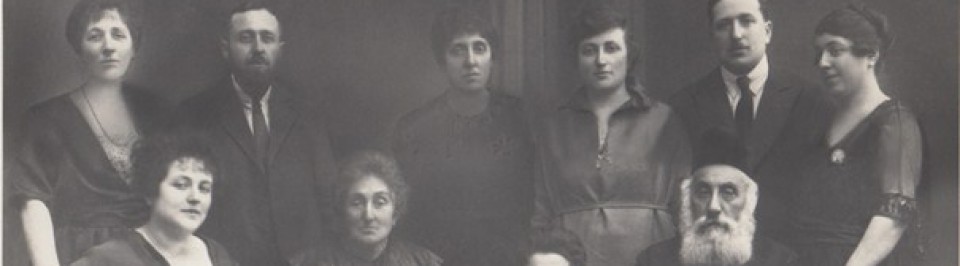
Thinking about the people I met in Kutno (and elsewhere), one thing I am trying to sort out is why Christian Poles get involved in Jewish heritage projects. Not surprisingly, the reasons are varied. One is interested in historical artifacts; he has no political agenda. Another of my companions tried to place this history into a more pro-Polish framework. He explained that the Nazis forced Christian townspeople to do horrible things as part of a strategy to damage relations between Poles and Jews. “All people really want is to live in peace (Chcą w spokoju żyć)”, he continued, “Poland is in the heart of Europe, a pretty terrain that has historically been attacked from all sides.” Others feel personally drawn to Jewish culture. One of my acquaintances in Kutno believes she has Jewish heritage. She seems to understand my quest for my own family history. “It’s important to know where you’re from,” she told me. She hasn’t found anything as concrete as my family photograph (the one I use at the top of the blog) to confirm her feeling that she has Jewish roots. All she can point to are allusions in family stories she remembers from childhood, and sometimes people have told her she looks Jewish. But anyone she could have asked has passed away.

But what’s clear from my visits to Kutno is that fragments of Jewish history remain, and some have been marked as such thanks to the efforts of a small group of residents who think it is important to include the stories of Kutno’s Jews in the history of their town.

Healing Collective Trauma: Jewish Heritage Work in Poland

18 Saturday Mar 2017

Posted by Marysia Galbraith in Cemeteries, Commemoration, Fieldwork, Heritage work, Memory, Polish-Jewish Heritage, Trauma, Wronki

≈ Leave a comment

Tags

affect, Aleida Assmann, collective memory, lapidarium in Wronki, Piotr Pojasek, Shadows of Trauma, Society for Psychological Anthropology Meeting

Healing Collective Trauma: Jewish Heritage Work in Poland is the title of the paper I presented at the Society for Psychological Anthropology Meeting in New Orleans on March 12. Here is the abstract I submitted:

The legacy of the Holocaust weighs heavily on Polish communities that were witness to unspeakable events. The paper examines how collective and personal trauma and recovery are intertwined, particularly in relation to Jewish heritage work in Poland. It emphasizes the affective engagement of heritage workers, most of whom are Catholic Poles, working on local projects intended to bring the history and culture of the community’s absent Jews back into the public sphere. Person-centered ethnography helps to reveal how participants talk about the work they do in relation to notions of self and society, and associated personal and social meanings. It further reveals their particular narratives about past and present relationships between Catholics and Jews in Poland, which they often pose as a challenge to the silences of the socialist era and the present-day reemergence of xenophobic nationalism. As members of the post-memory generation—they grew up with stories about former Jewish residents and the destruction of their communities, but they did not actually experience these events themselves—heritage workers are able to work towards reconciliation in ways that older generations could not. They have coming-of-age stories associated with the moment historical events became real to them, and their emotional distress about the past became the force that compelled them to do something about it in the present. Their personal narratives suggest motivation stems from the convergence of attachment to their native place, a sense of responsibility to those who are no longer present, and a desire to realize a more inclusive community that accepts past and present diversity within the Polish polity.

In memory of the Jewish community that inhabited Wronki from 1507-1939. Lapidarium of tombstones from the destroyed Jewish cemeteries of Wronki
Lapidarium of Jewish Tombstones, Wronki
Piotr Pojasek pointing to one of Wronki's Jewish cemeteries. Some pedestals of tombstones remain buried, as well as a large spruce tree that was planted when the cemetery was still functioning.
Piotr Pojasek pointing to one of Wronki’s Jewish cemeteries. Some pedestals of tombstones remain buried, as well as a large spruce tree that was planted when the cemetery was still functioning.

The paper starts with the story of Piotr Pojasek, who grew up in an old farmhouse near Wronki. From childhood, he knew that the curb on his street had been made out of Jewish tombstones during the Nazi occupation, but it was only as an adult that he really realized how wrong that was. And once he became engaged emotionally and morally, he knew he had to do something about it. It took many years, but in 2014, the lapidarium of the tombstones was completed. Applying the categories of memory as defined by Aleida Assmann, I use this case to explore how individual memories can shape social memory, and in turn national and cultural (collective) memory. The point is that individual connections to the past, as Piotr had through the uneasy presence of the tombstones outside his front door and the stories his father told him, are what compelled action. By collecting and sharing historical evidence and the stories of witnesses, social memory about the impact of the Holocaust grew, and developed a resonance for others. Eventually, a large coalition of local, national, and even international sponsors succeeded in building a public monument that revives and perpetuates collective memory of the Jews who lived there, of the inhuman circumstances of their death, and of the Polish citizens who recognize this as an important part of the history of their community.

Commonly, scholarship on collective memory focuses on public symbols and commemorative spaces, and has little to say about the transmission of meaning on the individual level. In my work, I am trying to show the relevance of individual memory workers and their personal engagement with the past as well as their local community. They are the ones who can bring things together, forging personal, affective links that make others care about far distant people and events.

Erik Ross, a priest, blogs about Poznan’s Jewish history and heritage

15 Wednesday Mar 2017

Posted by Marysia Galbraith in antisemitism, Catholicism, Polish-Jewish Heritage, Poznan

≈ Leave a comment

Tags

Erik Ross

I came across some extraordinary posts about the fragments of Jewish life in Poznan, written by Erik Ross, a priest of the Dominican order, whose blog appears in the Times of Israel.

His posts are heart-wrenching and entertaining, full of photos, personal reflections, and difficult facts.

In Walk down Jew Street, he describes the frescoes in the Church of the Holy Blood of the Lord Jesus (Kościół Najświętszej Krwi Pana Jezusa). The church is on what is now called “Jewish Street” but inside, the recently renovated paintings depict the story of the desecration of the host by three Jews. Most striking to me, Ross points out the many places around town where this story is renewed–in the weekly opportunities to get miraculous water from the well below the church (where according to legend the Jews tried to wash off the blood that ran from the stolen hosts where they had stabbed them); in the fresh gold leaf on the Latin words recounting the story in the Corpus Christi Church, as well as three newly painted doll-sized figures of Jews around a well under a fragment of alter (marking the site where the stolen hosts were discarded in what was originally a swamp, reclaimed by a priest who brought them to another church, but then miraculously flew back to the swamp leading to the decision to build the church there).

But you should read his post, which goes into much more detail.

Frescos over the alter depicting the profaning of the host, Church of the Most Holy Blood of the Lord Jesus in Poznan
DSC03871
DSC03873

Ross has also written Fake Lake, about the beautiful Lake Rusałka that was built with Jewish slave labor and reinforced with Jewish tombstones, and Swim-a-gogue about the pool that until recently filled the main sanctuary of the synagogue (I’ve written about it too, in Swimming in the Synagogue).

IMG_0465

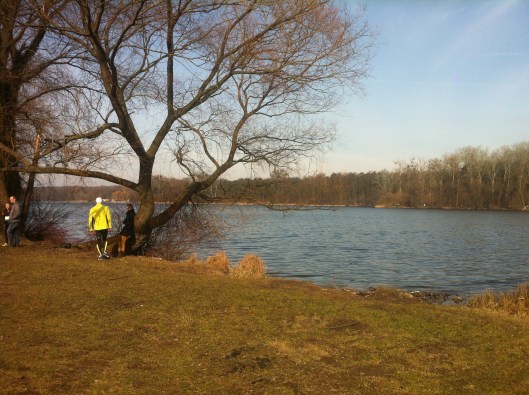
Lake Rusałka, where the CityTrail runs are held in Poznań. Built with the forced labor of Jews during World War II, many of whom died in the process.


Revisioning Jewish Poland through Art

11 Friday Nov 2016

Posted by Marysia Galbraith in Anthropology, Memory, Poland, Polish-Jewish Heritage, Post-World War II

≈ Leave a comment

Tags

American Anthropological Association Meeting 2016, Andrzej Niziołek, art, Janusz Marciniak, moral self, political action, Wojtek Wilczyk

The abstract for the paper I will be giving at the American Anthropological Association Meeting next week:

Artistic expression can be a powerful means to challenge the hegemonic power structure and to imagine an alternative social and moral order. In this paper, I highlight the work of three Polish artists who experienced a moral awakening during the Solidarity Movement in the early 1980s which made them sensitive to the repression of memories of Poland’s multi-ethnic, multi-religious past. In the ensuing years, they have engaged politically through their art to expose what remains of Jewish material culture (such as synagogues, cemeteries, and photographs), and to bring back into the public sphere a recognition of the space Jews once filled in everyday life in Poland. This artwork is both documentary and affective; it is intended to simultaneously inform viewers and to generate in them deep emotional responses that encourage ethical reflection.  Through various media, the artists seek to communicate that Jews were an essential part of Polish culture until the Holocaust, and also to give form to a collective sense of loss experienced after their violent removal. The cases examined are Wojtek Wilczyk’s photographs of former synagogues, called “There is no Innocent Eye,” Janusz Marciniak’s installations in the former synagogue in Poznan, and Andrzej Niziołek’s book Fira which traces the everyday life of a Jewish woman as revealed in her photo album of snapshots taken between the World Wars. These artists engage their moral selves to challenge political exclusion, public indifference, and antisemitism that until recently has kept Jewish spaces outside of everyday public and personal memories.

Synagogue by Wojtek Wilczyk
Atlantis, 2004, by Janusz Marciniak. Star of David floating on water and lit by hundreds of blue candle lanterns, while the Academic Choir sang "Meditation on Peace."
Atlantis, 2004, by Janusz Marciniak. Star of David floating on water and lit by hundreds of blue candle lanterns, while the Academic Choir sang “Meditation on Peace.”
Fira by Andrzej Niziołek

It’s part of a panel organized by Natasa Garic-Humphrey at UCSD:

The Politics of Indignation, Resistance, and Reconstitution of the Moral Self

This panel explores the intersections of governmentality, citizenship, political subjectivity, activism, ethics, and morality, and critically examines the importance of inserting “the moral self” within political theory to better understand how citizens come to confront political organizations and policies. Recent years have provided unprecedented examples of large-scale resistance, uprising, protest, and violent confrontation to authoritarian regimes, invidious state policies, and localized manifestations of neoliberal political-economics. To explain current confrontations to prevailing forms of state power, scholars have successfully highlighted the gaps between policy making from above and people’s on-the-ground experiences, resulting in citizens’ alienation from governmental ideologies, programs, and practices, while another line of research explored the various ways in which experiences of subjectivity and suffering are shaped within particular contexts of political economy.

This panel however, takes a closer look at the ways people manage to change their moral orientations within the context of hegemonic power and (re)make their moral selves to engage in and confront larger political and socioeconomic processes. How do specific situations, events, and visceral experiences in people’s lives evoke moments of self-reflection, engender reorientations towards the self, and inspire courses of action that cultivate a new sense of moral personhood? How does this experience of generating a new moral self shape one’s perceptions of government ineptitude and prepare them to engage in citizen-based action to confront political injustices and socio-political reforms? What motivates people to resist, initiate change, and form new senses of themselves as moral actors in the midst of stifling crises brought by socioeconomic and political transformations, war, genocide, fear, and other examples of structural violence?

Poles Remember

01 Tuesday Nov 2016

Posted by Marysia Galbraith in Catholicism, Cemeteries, Commemoration, Dukla, Memory, Polish Culture, Polish-Jewish Heritage, Polish-Jewish relations

≈ Leave a comment

Tags

All Saints Day

Today is the Catholic holiday, All Saints Day, the time to honor the dead. Customarily, Poles visit cemeteries to clean and decorate the graves of their family members. During the day, chrysanthemums in all shades adorn tombstones. At night, candle lanterns on graves make the cemeteries glow. Twinkling hillsides can be seen from far away.

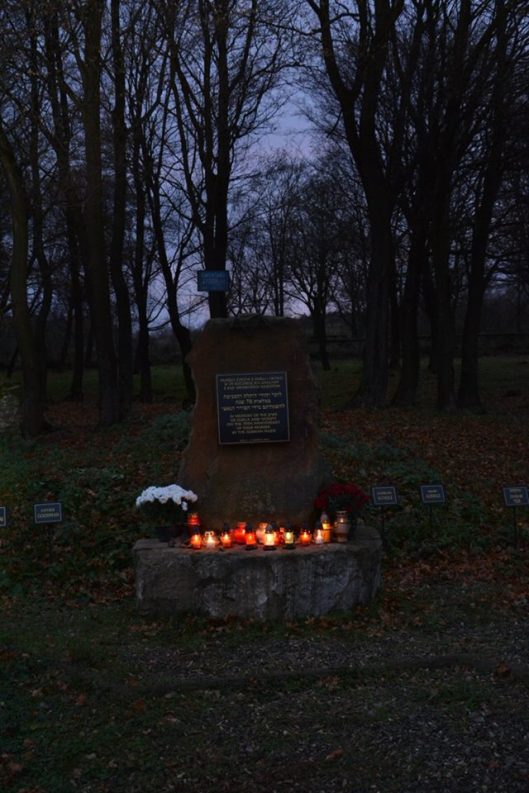
I’m pleased to see that some Poles also remember Poland’s now-absent Jewish population on November 1. I’ve seen this in Warsaw and in Lutowiska. And here is a photo Jacek Koszczan posted on Facebook today showing the candle lanterns on the commemorative monument at the town of Dukla’s Jewish cemetery.

Candle lanterns on the monument commemorating Dukla's Jewish population, November 1, 2016, All Saint's Day.

Candle lanterns on the monument commemorating Dukla’s Jewish population, November 1, 2016, All Saint’s Day.

He and other citizens of Dukla made the trip out to the cemetery to light a candle for the dead. In this, I see an expression of honor that transcends religious difference.

Jacek has done a great deal to reassemble the memory of Jewish life in Dukla. In fact, he was honored last month by the Polin Museum for his work. The Polin website explains, “Jacek Koszczan is the founder and director of the Organization for the Preservation of Jewish Heritage in the Dukla Region–Dukla Shtetl. His work involves both obtaining and archiving knowledge about the Jews of Dukla and its surroundings, as well as educational activities. Jacek Koszczan is the initiator and builder of a monument commemorating the 70th anniversary of the murder of Dukla’s Jews, the volunteer caretaker of the Jewish cemeteries, mass grave, as well as the ruins of the Dukla synagogue. Thanks to his efforts and knowledge, he succeeded in facilitating the honoring of two Dukla-region families with the medal for the Righteous among Nations.”

Jacek Koszczan receiving his award from the Polin Museum for his work on Jewish heritage in Dukla, October 21, 2016. Photo by Janusz Czamarski

Jacek Koszczan receiving his award from the Polin Museum for his work on Jewish heritage in Dukla, October 21, 2016. Photo by Janusz Czamarski

All in all, Jacek has been instrumental in the return of the memory of Jews to his community. I have been impressed by his energy, enthusiasm, and generosity. For him, this is a labor of love–for his community, for the memory of those who suffered, and for humanity in the face of evil.

Mapping Family Roots

23 Sunday Oct 2016

Posted by Marysia Galbraith in Archives, Family, Identity, Polish-Jewish Heritage, Pre-World War II, Walfisz, Żychlin

≈ 2 Comments

Tags

map

I made an extraordinary find in the Kutno archive—a map of Żychlin dating from 1869. I found reference to it in an article, but the archivists had a little difficulty locating it because it didn’t have an identification number (signatura). One archivist said something about it being so fragile they don’t show it. But another found it hanging on the wall and brought it out for me. The writing is in Russian. At that time, Żychlin was in the Russian partition of Poland. After the January Insurrection in 1863, the Russians mandated all public documents had to be in Russian, not Polish. That is why archival documents before the 1860s are in Polish while the later ones are mostly in Russian.

Russian writing on the 1869 map of Żychlin

I don’t know what is written here–maybe a reader could translate it for me?

dsc08463

Map of Żychlin dated 1869

Properties are numbered on the map, but not by street address. That means the numbers are scattered throughout the city making it difficult to find particular locations. According to the Żychlin Books of Residents (Akta Miasta Żychlina, also in the archive), my Walfisz ancestors lived at various times at numbers 28, 53, and 63. My great grandmother Hinda Walfisz married my great grandfather Hiel Majer Piwko. I wrote about them in previous posts: Piwko Saga, The Photo, and Super Kosher Cookies and Sliced Ham.

The map is hard to read, patched, and creased. The cross-shaped church stands out in the top half. Below it is the market square, and #53 is in the row of buildings along its lower edge. #63 is further to the left, and #28 is on the street running down from the market square.Not surprisingly, these properties are all near the synagogue, which as best as I can tell is #86 on the map (a bit below #63).

I had already seen one Book of Residents in 2013, but in 2016 I found my great grandmother’s family listed in three others, as well. Since the books have been indexed, the archivist was able to tell me what page to look on. And even though these records are only a few years older than the map, they are in Polish. There is only one Walfisz family in the books (my great grandmother with her sisters and parents), but other more distant family names also appear: many Losmans, a couple of Kolskis, and one Jakubowicz. Each household has its own page in the book, but there can be several households in the same building. Because religion is one of the things recorded in the Books, I could see that it wasn’t uncommon for addresses with multiple households to include families of multiple faiths: some Catholic, some Jewish, some Evangelical.

I know this is just an old map, but being able to pore over it, to touch it, helped to transport me back in time, and to once again (for the first time?) connect with the place where I’m from. It doesn’t matter that I never actually lived there (nor did my mother nor even my grandmother). Some of my people did. Right there in that place. With this newfound knowledge, I drove back through Żychlin one more time, this time gazing at the buildings that once housed my family. It didn’t really matter that the buildings had changed, nor that I was still unsure how exactly the old building numbers match the contemporary ones. Once this was their home.

How Żychlin Remembers, part 2

01 Thursday Sep 2016

Posted by Marysia Galbraith in antisemitism, Jewish Ghetto, Memory, Polish-Jewish Heritage, Polish-Jewish relations, Post-World War II, Pre-World War II, stereotypes, Synagogues, World War II, Żychlin

≈ Leave a comment

The next morning I met Tadeusz Kafarski for a tour of the city. He was with Józef Staszewski, the director of the Żychlin branch of the Association of Children of War. Because Józef was born in 1929, he remembers wartime better than Tadeusz, who was only a year old when the Nazis invaded. The two sometimes disagreed about details, but together they reconstructed for me Jewish life in Żychlin. As they pointed to the buildings that stand here and now, their descriptions transported me back and forth through time, to prewar life, wartime murder, and communist era absence. I had the odd sensation as I did so many times on this trip of being both here (in the present) and then (in the past), my mind trying to reconcile what stood before my eyes with what used to be. My guides led me back in time with varied fragments of information:

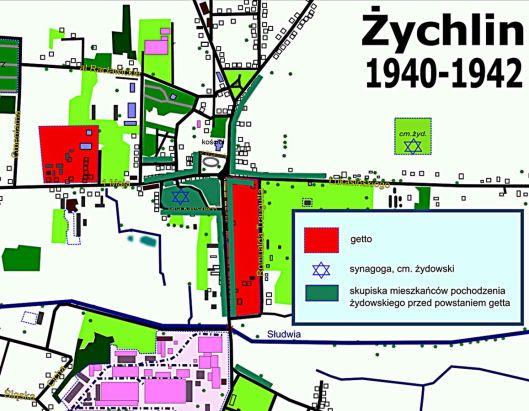
On Łukasieńskiego Street, we passed concrete apartment buildings built in the 1970s on the site of the second, larger Jewish ghetto.

Mr. Helmer, the richest Jew in town, lived across from the market square, to the left of Narutowicza Street, in what is now a well maintained two story building.

One block south, near the synagogue (the blue Star of David on the map below) on Kilińskiego Street, we passed the former home of a Jewish doctor, a building that used to be a dairy collection point, and another that was the preschool Tadeusz attended. A man named Merc lived nearer the synagogue. Behind some houses was the Jewish slaughterhouse, but Christian Poles also bought meat from there.

Jews and Poles lived side by side, even though this part of town was predominantly Jewish. Today, this section of town is run down though these particular buildings seem in good shape.

Map of Żychlin 1940-42 showing the ghettos in red, the first one is on the left and the second is on the right. The dark green shows the main areas where Jews lived--note that most were not in what became the ghetto. That meant gentiles had to move out of those areas when the Jews were forced to move in.

Map of Żychlin 1940-42 showing the ghettos in red, the first one is on the left and the second is on the right. The dark green shows the main areas where Jews lived–note that most were not in what became the ghetto. That meant gentiles had to move out of the ghetto areas when the Jews were forced to move into them.

As we wound through the dusty streets, the contemporary residents stared at us suspiciously, though some who know my guides greeted them, “Dzień dobry (Good day).”

The patch of tall weeds in front of the synagogue (on Jana Kulińskiego Street) used to be a fenced garden. The garden continued to be maintained after the war, even though the Polish residents used the synagogue as a warehouse, as did the Nazis. The lower sections of the windows were bricked in and new doorways were installed in the sides of the building to facilitate loading and unloading.

What's left of the Żychlin synagogue. Note the windows used to extend much father down, and the more recent doorway (now blocked) added when the building was used as a warehouse. The weedy area in the foreground used to be a fenced garden.
What’s left of the Żychlin synagogue. Note the windows used to extend much father down, and the more recent doorway (now blocked) added when the building was used as a warehouse. The weedy area in the foreground used to be a fenced garden.
Pan Józef beside the site of the well and mikvah
Worn stones--something I learned to value as a student archeologist. These were used in place of asphalt before World War II
Worn stones–something I learned to value as a student archeologist. These were used in place of asphalt before World War II

As a child, Józef went inside several times with his parents, though he could only describe the general layout of the interior. The candlelit altar was on the east wall, the main entrance on the west. Above the entrance was a balcony that would have been for the choir in a church but in the synagogue was for women to pray in. In a neighboring building, the rabbi would change. On the other side of the synagogue were a well (with the best water in town) and mikvah. After the war, everyone used that bathhouse.

Józef said, “There is just one faith; Jews believe in God just like we do.” He declared children played together regardless of religion. He described distinctive aspects of the Jewish population. Men wore head covers and beards. They would take their shoes off in the synagogue, but had to keep their head covered. The Jewish “priest” was the only one with side curls. He wore a black hat, black clothes, and a white shirt. Jews stayed home Friday and Saturday; they didn’t work. They held their hands at their waist and rocked as they prayed. They read scrolls. Jews used to bury their dead in a sitting position with money on their eyes. Men carried the unclothed, shrouded body to the cemetery. They returned to God as they began. When they left the cemetery after the burial, mourners dispersed in different directions . He asked why and was told it was so the spirit doesn’t return home with them.

Are these personal memories or stereotypes picked up from other sources?

My guides told me about a man named Rozenberg. They pointed to the yard of his bakery, and then we walked around to what used to be its storefront on Narutowicza Street. Rozenberg lived in a multi-story home on the other side of the street. He married a Christian named Czajka. Jozek said the Rozenbergs’ children Krysia and Rudek were Jewish. He played with the boy. After her husband died, Czajka married her brother-in-law, a judge. They had two more children. After the war, the family was harassed by the police so they sold all their buildings and went to Israel. One child moved to Norway.

The Germans occupied the town on September 15. At first, they didn’t treat anyone harshly, but they did take their property—first the stores and richer buildings owned by Jews, and then jewelry and everything anyone had that was valuable.

The main entrance to the ghetto used to be across from Rozenberg’s bakery. This was the second ghetto, established later for the poorer Jews. The first ghetto, where the richer Jews were sent, was on the grounds of an old factory outside the center of town. As Jews were forced into the ghetto, Poles whose homes were within the ghetto territory had to move to homes on the other side of the street—homes that had been emptied of their Jewish residents.

In July 1942, the second ghetto was liquidated. It took five hours because thousands of people were loaded onto wagons, and then everything was removed from their homes and segregated into piles. Some Poles helped, forced to work under threat of death. My guides disputed claims that Poles plundered Jewish possessions. They insisted the Germans took everything valuable, then piled up all the remaining dirty and broken things and burned them.

We crossed the street to the main square. Right there in front of the church there used to be a row of market stalls run by Jews. The church owned the land, but didn’t have any problem with Jewish venders. We continued behind the church and across another market square to the town library. This solid stone structure was originally built for Hempel, the Nazi mayor of the town remembered for his cruelty.

My guides Tadeusz Kafarski and Józef Staszewski in the town square
The Żychlin town square
Director of the Żychlin Library, Ewa Andrzejewska
Nazi Mayor Hempel's villa is now the Żychlin Public Library
Nazi Mayor Hempel’s villa is now the Żychlin Public Library

Tadeusz told me the wartime mayor’s villa was built with tombstones from the Jewish cemetery. Jews were pressed into service carrying the heavy stones. It was backbreaking labor made more difficult by the extreme heat. When one of the workers asked for a drink of water, the Nazi officer shot and killed him. Then, he held up a stick threateningly and asked who else wants a drink. No one dared ask for water after that. Józef told the story a little differently. He said the man who asked for water was dragged to the nearby lake and drowned.

Pani Ewa Andrzejewska, the director of the library, said her aunt who took care of Hempel’s children described him as ruthless, “A typical German.” He furnished his house with things he took from the richer people in the city. He rode a white horse. She also suggested my guides were a little too invested in showing Poles in a positive light to me—emphasizing heroism and victimization and minimizing complicity. She said that on one hand, Jews and Poles lived peacefully together. She was raised to not feel any prejudice. But on the other, many have negative sentiments toward Jews. She even went further to say Poles are genetically indisposed toward Jews. I challenged her on this saying that since sentiments toward Jews have changed over time, it’s a matter of history, not biology. She still didn’t agree, and repeated that Poles have a problem with this.

A dream of mine would be to help preserve and maybe even rebuild the town synagogue. My hosts said the TMHŻ has looked into turning it into their meeting space. Ewa said the ownership of the building is in dispute. So for now it just sits there, slowly crumbling away.

Leaving town the next day, I was once again stopped at the railway crossing as a train sped by. I didn’t mind having one last moment in this town where my great grandmother lived. I felt saddened and rooted by what I had learned, and grateful for the acquaintances who showed me Żychlin as it is now and as it was then.
How Żychlin Remembers, part 1

01 Thursday Sep 2016

Posted by Marysia Galbraith in Bolimów, Jewish Ghetto, Memory, Polish-Jewish Heritage, Polish-Jewish relations, Post-World War II, Pre-World War II, Sobota, Synagogues, World War II, Żychlin

≈ 1 Comment

My visit to Żychlin began and ended at the railway crossing. I had meandered up from the highway, passing through the small communities of Bolimów and Sobota where my ancestors lived over a century ago, and had to stop as a train sped by. I called pan Henryk to make sure I was on the right road. He assured me I was, and met me a few minutes later. Henryk, whom I met in 2014 through his website Historia Żychlina, had arranged meetings, tours, and interviews for me with resident fans of local history.

Bolimów synagogue, now the police station at 6 Farna Street
Central Square, Sobota

Tadeusz Kafarski, Vice President of the Association of Enthusiasts of Żychlin History (TMHŻ) joined us for a look around the train station. He and Henryk pointed across the tracks where during World War II transports took 2500 Jews from the Żychlin ghetto to Kulmhof (Chełmno) Camp near Poznań. They debated exactly where the trains had stood, but later, Henryk and his wife took me to a platform across from the main train station, saying that is where it happened.

Pan Tadeusz describing the transports that took away the Jewish residents of Żychlin in 1942.
Żychlin Train station, boarded up and unused
Looking across the express train tracks to the platform where Jews were loaded onto transports
A closer look at the same platform

The station building signals the effects of communism and its demise on this community. My guides told me the prewar station was imposing and beautiful. The postwar building that stands today—boarded up in places, broken windows and graffiti in others—is more functional than attractive. Its size shows that this used to be a major stop on the route from Moscow to Berlin. But since the express tracks were laid following the fall of communism, only a few trains stop here each day. Instead, every few minutes, one zips by at breakneck speed. The place was deserted, except for a group of teenagers who were hanging out.

Tadeusz told me he remembers the transports as they left the station with their human cargo in 1942, even though he was only four years old. During the war, when his family was forced to move from their home, as were many residents, they were resettled in a former Jewish residence. From the street it looked like a normal cottage with a living room on one side and a kitchen on the other. A distinctive feature of this house, though, was the stairs from the kitchen to the basement and the door from the basement to the courtyard behind the house. This private entrance was used sometimes by the men of the family who didn’t want to be seen returning in their dirty clothes.

Others whom I met during my visit shared similar memories of childhood. Janusz Tomczak, who was a teenager during the war, remembers seeing the land covered with wagons. Only later, he understood that these belonged to the Jews who were being taken to the camps. Józef Staszewski was with some older boys when the ghetto was being liquidated. It was a few days before Easter. He was a scout at the time and he made a vow to God he that he would choose death before he betrayed his friends. A couple of blocks from where they stood, Nazis loaded people into wagons and took them away. Now he knows that the captives were segregated by age and ability, and the children and elderly were led to special vehicles and then gassed inside them.

To be continued….


Włocławek’s Forgotten Street: The Street of Death (Ulica Śmierci)

04 Thursday Aug 2016

Posted by Marysia Galbraith in Heritage work, Memory, Polish-Jewish Heritage, Synagogues, World War II, Wronki, Włocławek

≈ 4 Comments

Tags

Facebook Fan Page, Memory for the Future, Miejsce Pamięci Zagłady Blisko Nas, Pamięć dla Przyszłości, Places of Holocaust Memory Near Us, Włocławek’s Forgotten Street, Włocławska Zapomniana Ulica

“Here and then” (“Tu i wtedy”)…that was the recurring line in Deputy Mayor Robert Dorna’s speech at the unveiling of the lapidarium in the Jewish cemetery in Wronki in December 2014. He linked the place we were standing (tu—here) to various moments in history (wtedy—then).

This could be an apt description of many of the heritage projects I have observed. They are efforts to gather together the fragments that can be recovered, and to reassemble them so they bring back to everyday landscapes the memories of multiple historical events in the lives of former Jewish residents. Seeing the past in the present has also been the touchstone of my recent trip to Poland. Everywhere, it seemed I was walking through streets as they look today, and at the same time carrying envisioning the way they looked back then (wtedy). Linking a particular place concretely to its past was also the goal of the contest that led the students and teachers at the Automotive High School in Włocławek (Zespół Szkół Samochodowych im. Tadeusza Kościuszki) to develop their Facebook “fan page” Włocławek’s Forgotten Street (Włocławska Zapomniana Ulica). They decided to focus on Piwna Street, which despite its small size (just two blocks long) became a focal point for viewing Jewish life and death in this city.

Screen Shot 2016-08-04 at 12.05.30 PM

Włocławska Zapomniana Ulica–the Facebook fanpage documenting the history of Włocławek’s Jews, on Piwna Street and beyond.

For thirteen years, the program “Memory for the Future” (“Pamięć dla Przyszłości”) has held annual contests for middle and high school students, challenging them to explore some aspect of Holocaust history. Initiated by the Association of Children of the Holocaust in Poland, and joined in recent years by the Polin Museum, Jewish Historical Institute, and Center for Educational Development, students have produced a variety of projects—essays, posters, and drawings. This year, the sponsors decided to try something new, more in keeping with the way young people communicate today. That’s why this year’s challenge “Places of Holocaust Memory Near Us” (“Miejsce Pamięci Zagłady Blisko Nas”) involved the production of a Facebook page.

Włocławek is a city of about 114,000 residents; the population has been declining since the fall of state socialism as local industries have closed and residents have sought better opportunities in more prosperous places within and outside of Poland. A century earlier, the city experienced rapid growth; during the four decades before World War II, it became a regional industrial center and the population tripled, reaching 68,000 by 1939. Jews were important contributors to the city’s development, and comprised nearly 20% of residents. My family was among the migrants to the city during this time. By the end of the war, most of Włocławek’s Jews had been murdered, the synagogues burned, and the cemetery desecrated.

Screen Shot 2016-08-03 at 4.33.01 PM

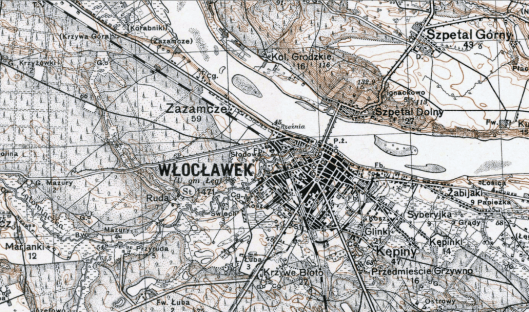
Map of Włocławek in 1930. Piwna Street is to the left of the bridge, just past an estuary opening out to the river. Map by Wojskowy Instytut Geograficzny.

Piwna Street is located off of Wyszyński Street (one of the main routes through town). About one third of the way along its short length it makes a 90 degree turn and runs for another block parallel to the Vistula River. On the river side is a massive two story building and dock that includes the Rejs na Przystani Café. Across the street, colorful depictions of fruits and the products made with them decorate the wall around the Delecta factory (see the cover photo of the Facebook page above). Until the Forgotten Street project, nothing indicated that Piwna was called the “Street of Death” after the Nazi occupation.

In September of 1939, the city’s synagogues were burned to the ground and the Jewish population was terrorized (read more about this here); some were arrested while others were killed. The retreating Polish forces had blown up the bridge across the Vistula, so the Nazis decided to replace it with a pontoon bridge at Piwna Street. But first the riverbank had to be reinforced. Captive Jews were forced to do this backbreaking work, using the stone and concrete remnants of the synagogue as building materials. Many died in the process, hence the name “Street of Death.”

What’s extraordinary about the high schoolers’ project is how effectively it brings into the present an awareness of the past. It does so with a wide variety of archival information, photographs, and first-person recollections. The public nature of the fan page also meant that other people learned about this history and could even contribute to it. For instance, one viewer posted this gouache painting of Piwna Street from the mid-19th century.

WloclawekUlPiwna1853

The view across Zgłowiączki Estuary and Piwna Street. Gouache by Alfons Matuszkiewicz, c. 1853. Posted on Włocławkska Zapomniana Ulica

To date the fan page has 1773 “likes.” Another component of the project was the posting of a QR code that when scanned with a smartphone connects to a brief explanation of the history of Piwna Street in four languages. QR codes were also posted at several other sites around town that are associated with Jewish culture (listen here).

DSC08097

QR code linking to a brief history of Piwna Street.

For now, these notices are just on laminated paper, but the hope is that something more permanent will be installed so visitors will continue to connect here and then—this particular location with the events that occurred in the past. When I visited in June, the city’s president expressed his support for the project. The question remains where the money will come from to pay for a more lasting marker. Still, with people of good will and extraordinary energy like the teachers and students at the Automotive High School, I’m hopeful something will be done in the not too distant future.

DSC08098

The teachers who worked on the project Włocławska Zapomniana Ulica: from the left, Anita Kaniewska-Kwiatkowska, Monika Lamka-Czerwińska, and Robert Feter.

Threading the Needle

27 Wednesday Jul 2016

Posted by Marysia Galbraith in antisemitism, Baligród, Commemoration, Fieldwork, Heritage work, Jewish Culture, Kazimierz, Krakow, Lesko, Memory, Poland, Polish Culture, Polish-Jewish Heritage, Polish-Jewish relations, Tarnów, Warsaw, Wronki, Włocławek, Zasław, Żychlin

≈ Leave a comment

Tags

Erica Lehrer, Jacek Nowak, Jewish Poland Revisited, Katka Reszke, Return of the Jew

I am back from six weeks in Poland. I envisioned regular posts from the field in this blog. But instead, doing fieldwork left little time for writing and reflecting about it. Nevertheless, a structure for my next book project has been emerging. The challenge will be threading the needle between celebrating the renewal of interest in Jewish life in Poland, captured so well in Erica Lehrer’s Jewish Poland Revisited and Katka Reszke’s Return of the Jew, and addressing the ongoing silences, distaste, even hatred expressed toward Jews, as revealed in Jacek Nowak’s interviews with ordinary Poles. Because both are happening at the same time, often in the same places, and sometimes even within the same people.

And I’ve seen evidence of both in my own research. People all over Poland are doing incredible work to preserve cemeteries, renovate synagogues, document first-person accounts, and celebrate Jewish music and culture, often in the absence of any involvement from living Jews. They work with passion to fill what they feel to be a void in their local communities. And they do so despite the resistance they sometimes face from fellow residents and local government representatives. Every place tells a different story, even though many of the same elements can be found in each of them. Over the next several posts, I’ll highlight the places and projects I visited. Watch for the place names to become links to more details.

Włocławek

DSC08792

Students and teachers from the Automotive High School in Włocławek receive the first place award for their Facebook “fan page” “Włocławska zapomniania ulica” (“Wloclawek’s forgotten street”) at the Polin Museum in Warsaw, June 22, 2016. The contest was “Places of Holocaust Memory Near Us” and the challenge was to highlight a place in the local community. The team from Włocławek chose Piwna Street, called “the street of death” during World War II.

Żychlin

DSC08396

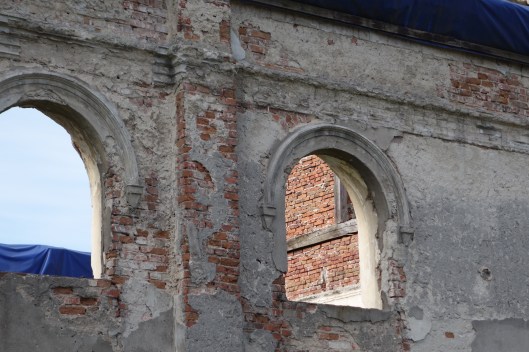
Detail of the synagogue in Żychlin, converted into a warehouse by the Nazis and used as such for many years after. The roof caved in several years ago. Traces of frescos are barely visible through the empty windows.

Kutno

KutnoCemetery

New signs at the Kutno Jewish cemetery provide historical information and urge residents to keep in mind this green hillside is a cemetery. Installed by Towarzystwo Przyjaciół Ziemi Kutnowski (Association of the Friends of the Kutno Region).

Wronki

An arial view of the Lapidarium in Wronki that shows the shape of the raised beds, meant to evoke an open book.

Warsaw

konferencja_zdk_polin-eng_1600_rgbIn Warsaw, the conference Jewish Cultural Heritage: Projects, Methods, Inspirations at the Polin Museum of the History of Polish Jews gave me a good idea of the scope of heritage work throughout Europe, as well as ongoing debates about Jewish heritage projects.

Krakow

IMG_0956

Glass House Orchestra performing at Shalom on Szeroka, the outdoor concert culminating the Krakow Jewish Culture Festival.

Tarnów

DSC09413

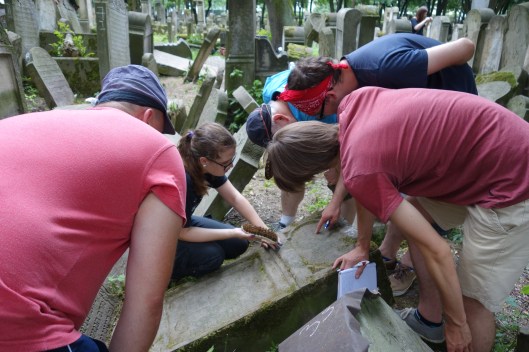
Professor Hońdo of the Jagiellonian University helps participants in the Tarnów Tombstone camp for volunteers (Tarnowskie macewy – obóz dla wolontariuszy) decipher the text on a tombstone.

Baligród

IMG_0998

The weeds grow tall in the Jewish cemetery in Baligród, despite indications of maintenance done not too long ago. It takes constant attention to keep these sites from slipping back into obscurity.

Zasław

ZaslawSignZagorz

Historical information about the Nazi Work Camp in Zasław marking the beginning of the trail from the Zagórz train station to the monument on the mass grave at Zasław. A project of the Stowarzyszenie Dziedzictwo Mniejszości Karpackich (Association of the Heritage of Minorities of the Carpathians).

Lesko

DSC09276

The synagogue in my beloved Lesko–much of the front facade was rebuilt and reinvented around 1960.


← Older posts
Newer posts →

Categories

  • Anthropology (37)
    • Archives (14)
    • Fieldwork (7)
    • Ground Penetrating Radar (GPR (4)
    • Research Methodology (8)
  • antisemitism (14)
  • Association of Descendants of Jewish Central Poland (32)
  • Catholicism (8)
  • Conference (1)
  • Discrimination (2)
  • Family (69)
    • Bereda (17)
    • Kolski (13)
    • Piwko (22)
    • Rotblit (3)
    • Walfisz (4)
    • Winawer (7)
  • Genealogy (11)
  • Heritage work (66)
    • Commemoration (23)
  • Identity (18)
  • Israel (6)
  • Jewish Culture (89)
    • Cemeteries (51)
    • Museum (7)
    • Synagogues (33)
  • Jewish immigrants (8)
  • Jewish Religion (1)
  • Memory (70)
  • Names (14)
  • Photographs (6)
  • Pifko-Winawer Circle (5)
  • Poland (125)
    • Baligród (1)
    • Bolimów (1)
    • Brześć Kujawski (5)
    • Buk (1)
    • Chodecz (1)
    • Dukla (2)
    • Dąbrowice (1)
    • Gdynia (1)
    • Gostynin (2)
    • Gąbin (1)
    • Izbica Kujawska (1)
    • Kazimierz (4)
    • Kowal (1)
    • Koło (1)
    • Krakow (7)
    • Krośniewice (1)
    • Kutno (6)
    • Kłodawa (1)
    • Lesko (8)
    • Leszno (1)
    • Lubień Kujawski (1)
    • Lubraniec (1)
    • Lutowiska (3)
    • Piła (3)
    • Podgórze (2)
    • Poznan (11)
    • Przemyśl (2)
    • Pzedecz (1)
    • Radom (1)
    • Radymno (1)
    • Sanok (1)
    • Skierniewice (5)
    • Sobota (2)
    • Tarnów (2)
    • Warsaw (22)
    • Wielkopolska (1)
    • Wronki (7)
    • Włocławek (20)
    • Zasław (2)
    • Łódź (1)
    • Żychlin (30)
  • Polish Culture (10)
  • Polish-Jewish Heritage (60)
  • Polish-Jewish relations (60)
  • Post-World War II (24)
  • Pre-World War II (22)
  • Reclaimed Property (1)
  • stereotypes (3)
  • Survival (9)
  • Trauma (3)
  • Uncategorized (5)
  • Victims and perpetrators (4)
  • World War II (45)
    • Jewish Ghetto (12)
    • Nazi Camps (5)
    • Polish Underground Army (3)
  • Yiddish (5)

Enter your email address to follow this blog and receive notifications of new posts by email. Your email address will not be shared.

Archives

  • October 2025 (1)
  • July 2025 (8)
  • June 2025 (1)
  • April 2025 (1)
  • August 2024 (3)
  • July 2024 (3)
  • May 2024 (2)
  • April 2024 (1)
  • May 2023 (2)
  • January 2023 (2)
  • December 2022 (7)
  • November 2022 (2)
  • October 2022 (5)
  • September 2022 (1)
  • January 2022 (1)
  • August 2021 (1)
  • December 2020 (2)
  • July 2020 (1)
  • May 2020 (3)
  • April 2020 (1)
  • March 2020 (1)
  • January 2020 (2)
  • May 2019 (1)
  • February 2019 (1)
  • November 2018 (1)
  • September 2018 (1)
  • August 2018 (3)
  • July 2018 (1)
  • June 2018 (1)
  • May 2018 (1)
  • April 2018 (2)
  • March 2018 (2)
  • February 2018 (2)
  • January 2018 (2)
  • December 2017 (2)
  • November 2017 (2)
  • October 2017 (1)
  • September 2017 (3)
  • August 2017 (3)
  • June 2017 (2)
  • May 2017 (3)
  • April 2017 (1)
  • March 2017 (2)
  • February 2017 (1)
  • January 2017 (2)
  • December 2016 (2)
  • November 2016 (4)
  • October 2016 (1)
  • September 2016 (6)
  • August 2016 (2)
  • July 2016 (1)
  • May 2016 (4)
  • April 2016 (2)
  • March 2016 (3)
  • February 2016 (4)
  • January 2016 (3)
  • December 2015 (3)
  • November 2015 (5)
  • October 2015 (5)
  • September 2015 (3)
  • August 2015 (4)
  • July 2015 (3)
  • June 2015 (3)
  • May 2015 (4)
  • April 2015 (9)
  • March 2015 (3)
  • February 2015 (2)
  • January 2015 (5)
  • December 2014 (4)
  • November 2014 (9)
  • October 2014 (2)
  • September 2014 (1)

Copyright Notice

All original text and images are copyright © Marysia Galbraith. Please contact the author before quoting.

Blog at WordPress.com.

  • Subscribe Subscribed
    • Uncovering Jewish Heritage
    • Join 145 other subscribers
    • Already have a WordPress.com account? Log in now.
    • Uncovering Jewish Heritage
    • Subscribe Subscribed
    • Sign up
    • Log in
    • Report this content
    • View site in Reader
    • Manage subscriptions
    • Collapse this bar
 

Loading Comments...