• About
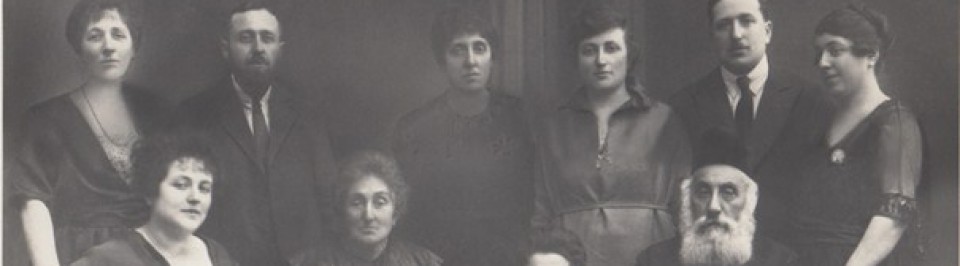
  • The Photo that Started it All

Uncovering Jewish Heritage

Uncovering Jewish Heritage

Category Archives: Memory

Hiding in Plain Sight: Lesko 1992

29 Monday Feb 2016

Posted by Marysia Galbraith in Cemeteries, Jewish Culture, Lesko, Memory, Polish-Jewish Heritage, Polish-Jewish relations, Synagogues

≈ Leave a comment

Funny what we forget. I got an SLR camera for my ethnographic fieldwork in the early 1990s, thinking it would be an important tool for documenting everyday life. I even experimented with shooting and developing black and white film (this was a film camera). The photos are interesting because they capture things I deliberately went out to photograph. As it turns out, fragments of Jewish culture figure prominently; they’re the subject of 28 out of 112 photos. Here are some of them from Lesko:

Tombstones (some painted) in the Lesko Jewish Cemetery. 1992
Marcin beside a tombstone taller than he is. 1992
Front facade of the former synagogue in Lesko. 1992

This ornate facade of the synagogue features the Ten Commandments and the inscription in Hebrew: “How awesome is this place! This is none other than the house of God; this is the gate of heaven” (see Virtual Sztetl). The building was partially destroyed during World War II, and rebuilt in the 1960s and 70s. That’s when the round tower was enlarged and the curved roofline was added. You can tell because the newer features are made of brick instead of the original stone. Here are photos of the interior and exterior of the synagogue in 1932 (from fotopolska.eu):

Lesko Synagogue 1932
Lesko Synagogue 1932 interior


Last spring, I learned that the iron railing that used to surround the central alter is now a balcony on a building in the center of town. I actually took this photo of it in 1992, but had no idea where the balcony came from.

img133

The balcony on this building used to be the iron railing around the alter in the synagogue, Lesko 1992

It’s one of the prettiest buildings in town, especially since it was renovated and repainted golden orange. Still, this railing brings to home the fact that fragments of Jewish life and its destruction are hiding in plain sight. I suppose its appropriation is what preserved this particular part of the synagogue. But knowing what it is and where it came from, it seems horribly, terribly, out of place.

The Phantom Limb

24 Wednesday Feb 2016

Posted by Marysia Galbraith in antisemitism, Catholicism, Cemeteries, Jewish Culture, Lesko, Memory, Poland, Polish Culture, Polish-Jewish Heritage, Polish-Jewish relations, stereotypes

≈ 2 Comments

Tags

Fieldwork 1991-3

It was a beautiful sunny day in Alabama. As I walked across the quad enjoying the promise of spring, I bumped into a colleague, Joanna Biermann, who is going to Warsaw next month to participate in a conference associated with the annual Beethoven Festival. She has been an invited guest several times already, and has made some good friends in Warsaw as a result. We took a half hour to catch up, sipping tea on a bench under the large oaks behind the library. In response to my current research, she quoted a friend of hers who describes Polish Jews as the nation’s phantom limb; the pain remains even after the Jews are gone.

The beauty of ethnographic fieldwork is you record everything, even what seems at the times peripheral to your area of focus. That means I have over twenty years of fieldnotes I continue to mine for information about other aspects of Polish culture. Recently, I returned to the notes from my earliest fieldwork in 1991-1993 looking for references to Jews and Jewish culture. I coded them using ethnographic software, and now I’m trying to pull out patterns in the way Poles talked about and acted toward Jewish subjects. The first thing that strikes me is how often Jews were mentioned in interviews and informal conversations, despite the fact that most of the people I spoke with had limited or no contact with actual Jews. Most of the participants in my study were still in high school in the early 1990s. That means that by the time they were born in the 1970s, most of the Polish Jews who had survived the Holocaust had left, pushed out by organized political campaigns and by everyday prejudice.
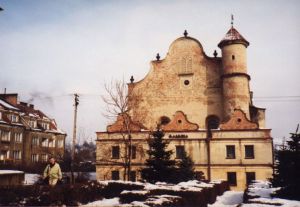
LeskoSynagog

Lesko Synagogue in 1992

The comments I recorded are mostly superficial, and usually fall back on stock phrases, sentiments, and stereotypes. Since I mostly did group interviews in the early 1990s, I was able to witness young peoples’ debates about the role of Jews in Polish life. Their views were so varied that no unified perspective emerged. One person would claim that Jews are still prevalent in government, or in journalism, and others would disagree. One criticized Poles for intolerance, while others interjected that tolerance was a fundamental value that has made Poland a hospitable environment for minorities (including Jews) for most of the nation’s history. Some addressed a lingering distaste, or even hatred of Jews; others countered that these are dying artifacts of an older generation that young people do not share.

Most commonly, Jews were linked to property and wealth. I was told that Jews used to say, “You own the streets but we own the buildings.” Even today, this phrase is repeated. Usually, it’s a way of highlighting the discrepancy between the political domination of Poles and the economic power of Jews. Some imply that because Jews expressed disdain for the impoverished Poles, it justifies Poles’ resentment and dislike of Jews. But also, because I’ve heard this phrase so many times in so many ways, I know it’s often repeated without much thought at all, as one of the few things anyone ever told them about Jews.

Some participants in my study expressed continued concern about Jews reclaiming property or Jewish capital flooding into Poland and buying up the country, yet again leaving Poles with nothing. Others defended everyone’s right to invest in Poland, emphasizing the importance of being open to other groups, or countered that Poles are envious of anyone who gets ahead. One person suggested that Jews should be admired for their ability to create and organize; Poles should learn from them, not assume that they are schemers.

On the ten-day walking pilgrimage to Częstochowa (I really did this—all 300 km—to the monastery housing Poland’s most important icon, the Black Madonna), a priest entertained the pilgrims on the journey with stories that used humor as a vehicle for discussing the differences between Catholics and Jews. Although he tried to show that the two faiths have shared origins and fundamental similarities, he sometimes crossed the line toward mockery. For instance, when explaining why Catholics don’t abide by Sabbath restrictions, he told a story about an Orthodox Jew who hadn’t locked his business before sunset on the Sabbath, so he used his cat to turn the key.

On another occasion, I spoke with a priest who felt the Polish people and the Catholic Church are under attack by accusations of intolerance and antisemitism. He talked about slander in the press, and referred to an article that linked antisemitism in Germany to the irrational antisemitism that persists in Poland despite the virtual absence of Jews. He complained that this view is biased and has no place in an article about Germany. He further complained that when Poles tell the truth, for instance that most communists in Poland during and after WWII were Jews, Jews accuse them of antisemitism. These are the same Jews, he went on, who told Poles, “You own the streets but we own the buildings.” The priest also argued that press reports are overwhelmingly negative and misrepresent the Church, giving it a bad name. But then he went on to label as Jews two prominent journalists—Adam Michnik, the editor of the newspaper Gazeta Wyborcza and Jerzy Urban, editor of the satirical news weekly Nie. On another occasion, he got into a heated defense of Poles, saying he doesn’t understand why they have a reputation in the West for antisemitism.

Both of the priests reinforced the distance between Poles and Jews, though in different ways and with different degrees of vitriol. They offered little possibility for Jews to be regarded as Poles.

The person who expressed the most nuanced view of Poles’ relations with other ethnic and religious groups was the director of one of the high schools in Lesko, a small town in the southeastern mountain region of Bieszczady. Even before I started the taped interview with him, he told me that the biggest ethnic problem in Poland was going to be with Lithuanians and Jews who want their former properties back. For example, the dormitory of the high school is claimed by prewar owners who were Jews. At the time, it wasn’t yet clear if the building would be returned, and if the money spent on its renovation would be reimbursed. During the interview, he had this to say:

“There are minorities [in Poland], everyone knows that. It’s an interesting situation. The typical American may not understand because in the US there are many nationalities that cultivate their own traditions, but nevertheless remain primarily American. But because of the unjust politics toward minorities during the Interwar period, hatred was awakened between Poles and Jews and Poles and Ukrainians. This was easy to do because Poles were in their own country but poor, while Jews owned the buildings and businesses. Jews are condemned for being rich, while Ukrainians are pushing for higher positions. But there are no attacks. Everyone lived together, went to school together, met and got to know each other’s culture. They were all free to study their religion. Also, in Lesko, there was a Greek Catholic church, a Catholic church, and a Jewish place of worship, and nothing happened. Everyone could believe what they wanted, and no one was persecuted for what they think. Jews were destroyed by Germans[…] After the war, state politics was also in error. It acted as if minorities didn’t exist at all.”

Although he reiterated stereotypes, he also sought to balance positive and negative views of Jews and their history in Poland.

Others hinted at an ethos of tolerance. They talked about historically mixed communities that functioned peacefully, and about the need for acceptance of all people. One student in Krakow said, “If we are really are democratic now, there has to be a place for Jews [in Poland]. We can’t say ‘Polska dla Polakow’ [‘Poland for Poles’].” Others, like the student who showed me the Jewish cemetery in Lesko shortly after I moved there in 1992, expressed sadness that Jews are no longer present. He said it’s too bad the cemetery is neglected, but Poles have no money and there are no more Jews to insure its upkeep. He said he likes to come to the cemetery; it’s a peaceful place.

Much of the talk I recorded in the early 1990s seems predicated on the assumption that there were more Jews present than actually were at the time, and they were hiding in plain sight. Some felt threatened by the potential wealth and power of these covert Jews. But others asserted that there are no more Jews in Poland. If any remained, they assimilated— it was Jews who felt threatened by Poles after the war and during communism, so they stopped admitting their ethnicity, changed their last names, and forgot their culture and traditions. These are two sides of the same coin because in fact, public Jewish life and religion disappeared from nearly every Polish village, town, and city. But the past 25 years have shown that a notable proportion of contemporary Poles have some Jewish heritage and an increasing number of them (though still a tiny fraction of the contemporary Polish population, and a tiny fraction of the prewar Polish-Jewish population) is becoming more curious about their origins. Already in 1992-3, the sense was growing among the teenagers I spoke with that it isn’t necessary to hide one’s ethnic/religious roots anymore. After the fall of communism in 1989, something significant had shifted and institutional barriers against ethnic and religious minorities had weakened.

Still, so much about Jewish lives and deaths were left out of the comments I collected, as if the pain of their amputation from Polish communities was too much to bear.
Where’s Ralph?

13 Saturday Feb 2016

Posted by Marysia Galbraith in Jewish Culture, Kazimierz, Krakow, Memory, Polish-Jewish Heritage, World War II

≈ Leave a comment

Tags

Amon Goeth, Ralph Fiennes, Schindler's List

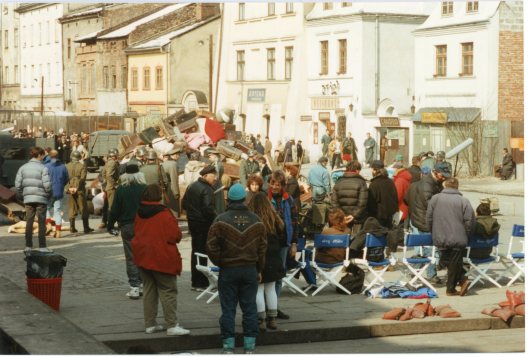
I should have remarked yesterday how strange it was to see Nazi uniforms and people wearing yellow stars in the middle of Kazimierz. Even though the atmosphere was relaxed–people were play acting, or really just standing around and waiting. Those piles of suitcases stood out as a stark reminder of the destruction the scene was designed to recall. Also, the energy shifted when Ralph Fiennes/Amon Goeth strode purposefully to the top of the pile. He exuded an authority that even at a distance was unsettling. And in case you’ve been wondering where Ralph Fiennes is in this photo:

1993SchindlersList3

Filming Schindler’s List, 1993. Ralph Fiennes is in the background, playing Amon Goeth

Here he is:

RFiennes

Ralph Fiennes preparing to climb to the top of the pile of suitcases while playing Amon Goeth

Kazimierz

13 Saturday Feb 2016

Posted by Marysia Galbraith in Cemeteries, Identity, Jewish Culture, Kazimierz, Krakow, Memory, Polish-Jewish Heritage, Polish-Jewish relations, Synagogues

≈ Leave a comment

Tags

Schindler's List

Raised on stories about Mama’s magical homeland of Poland, I visited for the first time in 1986. This was before the fall of communism, when the country was still in the grips of a state socialist government. But although I went in search of my roots, I didn’t think about my heritage as being Jewish. I knew nothing about Polish Jews, and I didn’t identify as Jewish. Nor did I mention it to anyone; there would not have been much to tell since I didn’t know anything about this aspect of my family history. Moreover, and perhaps primarily, I had somehow internalized the unspoken understanding that Poles are Catholic, and Jewish heritage wasn’t supposed to be talked about.

I review the memories in my mind, searching for clues about how I thought about Polish Jews. Again, I am reminded that I didn’t think about my own Jewish heritage during my first visits to Poland, except perhaps to repress it. I preferred the family narrative about our Polish Catholic background to the reality of our more complex past. From time to time, I saw anti-Semitic graffiti, or heard prejudicial remarks about Jews. But mostly, neither I nor the Poles I met paid much attention to the past lives of Polish Jews.

But not entirely. For instance, during the summer school I attended in Krakow, a fieldtrip was organized to Kazimierz, the former Jewish quarter of the city. Jews settled there near the end of the 15th century when faced with restrictions against living in the city center. By the 1930s the population of Kazimierz reached about 60,000 Jews. Most died in the Holocaust, leaving the district abandoned. After the war, it was not a popular place to live and those who moved in did little to maintain or update the historic buildings. By the 1980s, most of Kazimierz was in disrepair. Some buildings had fallen down completely while others had cracked, grey, and dirty walls. In fact, much of the Old City of Krakow looked run down. But Kazimierz was worse, even on Szeroka Street, the historic center of the Jewish district.

Trace of a mezuzah in a doorway, Kazimierz 1986
Kazimierz 1986
Kazimierz 1986
Old Synagogue in Kazimierz, 1986

It’s hard for me to distinguish memories from my first visit to Poland and subsequent ones in the early 1990s, but I think I went to the Remuh Synagogue already in 1986. That’s where a small group of older Jews continued to congregate. I also visited the walled cemetery next to the synagogue, where at least some of the gravestones and arched grave coverings were maintained and, judging by the small stones left on them, visited regularly. I think it was in the 1990s I was told that many of these older Jews were not in fact Polish, but rather came from the former Soviet Union. Such talk left me with the impression they weren’t real Polish Jews, but rather opportunists exploiting the growing interest in Jewish heritage tourism.

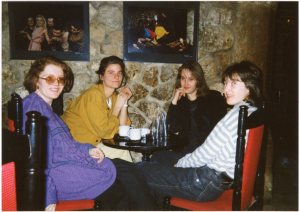
Some of the historic buildings started to be renovated already in the early 1990s. The first Jewish-themed business I remember was Ariel, a restaurant and café on Szeroka Street. It featured Jewish food and displayed Jewish memorabilia and artwork. I took some of my friends from Bieszczady, my rural fieldsite in the southeast of the country, to Ariel. I wanted to impress them with the cultural diversity of Krakow. Looking back at my fieldnotes from that time, I was surprised to see I noted that my friends were fascinated by this former Jewish district. They asked me if the café was in a Jewish style, and if the people around us were Jewish. So perhaps even then, Poles were more interested in Jewish culture than I realized.

1993Ariel

Ariel Cafe in Kazimierz 1993

Over the years, Kazimierz has become more and more popular. The first to come were artists and students seeking an edgier, cheaper part of the city to live in, as well as tourists seeking traces of Poland’s Jewish past. I have read that a turning point came after Steven Spielberg filmed Schindler’s List in the district. This was in early 1993, while I was still living in Krakow. A fake wall was built to enclose Szeroka Street near Starowiślna Street, and movie-set facades resembling World War II era businesses were painted on abandoned buildings. In effect, Spielberg turned the area into the Jewish ghetto, even though the actual ghetto was a few miles away in the district of Płaszów. I watched filming one day. An actor dressed as a Nazi officer (I now realize it was Ralph Fiennes playing Amon Goeth) strode to the top of a pile of suitcases over and over again. Mostly, everyone was just standing around. I was able to pick Spielberg himself out; he was wearing one of his signature ball caps. Some of his kids were there, and I think I saw his wife as well.

Filming Schindler's List, 1993. Ralph Fiennes is in the background, playing Amon Goeth
Filming Schindler’s List, 1993. Ralph Fiennes is in the background, playing Amon Goeth
Filming Schindler's List, Kazimierz 1993. Note Ariel Cafe in the background and the fake facades on the surrounding buildings.
Filming Schindler’s List, Kazimierz 1993. Note Ariel Cafe in the background and the fake facades on the surrounding buildings.

After witnessing the filming of Schindler’s List, I couldn’t suspend my disbelief and become absorbed into the story when I watched the movie in the theatre. It didn’t help that one of my friends, a swarthy Brazilian whose father’s family was Polish, appeared larger than life in the first “Jewish” crowd scene.

Today, so many parts of Kazimierz have been reconstructed or renovated that it can be easy to forget how derelict it used to be. In addition to the many cafes and restaurants, the synagogues, prayer houses, and other Jewish institutions have been restored. Even more significantly, eclectic forms of Jewish life have returned to the district, most visibly at the Jewish Community Center, which holds Shabbat dinners and Jewish cultural events, and functions as both a gathering point and an information center for Jewish residents of Krakow and visitors from around the world.

Inside the Tempel Synagogue, Kazimierz
Inside the Tempel Synagogue, Miodowa Street, Kazimierz 2015
Izaak Synagogue, Kazimierz
I gave a talk at the Jewish Community Center in Kazimierz, June 2015

Memory in Fragments: the talk at UA

31 Thursday Dec 2015

Posted by Marysia Galbraith in Brześć Kujawski, Buk, Cemeteries, Family, Heritage work, Israel, Jewish Culture, Lutowiska, Memory, Poland, Polish Culture, Polish-Jewish Heritage, Polish-Jewish relations, Post-World War II, Poznan, Pre-World War II, Research Methodology, Skierniewice, Synagogues, World War II, Wronki, Włocławek

≈ 2 Comments

Tags

Fulbright Program, Postmemory, University of Alabama

The lecture I gave at UA September 3, 2015 about my research during my Fulbright Fellowship is now available on vimeo. I’ve never seen myself lecture before. It’s a little unsettling. Still, here it is, flaws and all (for instance I know that Poland entered the European Union in 2004, even though I misspoke here).

I talk a little about the Fulbright Program–the kinds of grants available and some tips for applying.

It’s also a good introduction to my ideas about reassembling Jewish life: the strands that I’m following, what has been lost, what can be recovered, and how memory projects at sites throughout Poland intertwine with my own search for my family history. I hear echoes of some of the scholars I’ve read–Iwona Irwin Zarecka and Marianne Hirsch, as well as my sometime collaborator Malgosia Wosińska. There is no way to bring back what has been lost, but fragments of the past can be reassembled to form a new kind of life that allows for connection with what used to be and what yet might be.

Tracking Down Jewish Radymno

13 Sunday Dec 2015

Posted by Marysia Galbraith in Cemeteries, Jewish Culture, Memory, Polish-Jewish Heritage, Polish-Jewish relations, Post-World War II, Pre-World War II, Radymno, Synagogues, World War II

≈ 3 Comments

Although I knew the former synagogue still stands in Radymno, had to look several times before I actually found it. I’ve visited for years, and yet my friends never even told me the town had a prewar Jewish population. But until June, I never thought to ask them about it, either.

When I finally did ask, my friend couldn’t tell me much. She repeated a common refrain, especially in southeastern Poland: Jews used to say “nasze kamienicy, wasze ulicy” [“our buildings, your streets”]. It’s not clear that any Jews ever actually said this, but nevertheless, this is often what is remembered about them—Poles may have been the majority but Jews were richer. It’s a telling way of marking the distinction between Poles and Jews. Rather than all residents being regarded as Poles of various religions, Jews remained separate. Moreover Jews are remembered as being complicit in asserting their difference, and indeed their superiority. My friend didn’t mean it this way, but I’ve commonly heard this expression deployed as a justification for why Poles didn’t like Jews. Not only were Jews the property owners, they rubbed it in.

Jewish property ownership poses different challenges today. Some current residents fear prewar owners will return to claim what was theirs. My friend told me about two men who came to Radymno a few years ago and looked at some buildings that had once belonged to Jews. She also described a building in the center of town that is falling apart, but nothing can be done about it. It can’t be torn down because it is a historic structure, but no one will invest in its renovation for fear they will lose possession of it if the owner comes back. She also mentioned another property, a plot of land surrounded by fields whose last owners were Jews. The town hasn’t pursued a clarification of ownership because it isn’t worth enough to hire a lawyer and try and collect the few zloties of tax owed on it each year. So it just stands fallow. I suggested the owner is probably dead. She said of course, it’s been so many years. I clarified there probably aren’t even any descendants, and she responded “of course, because of what happened to Jews.” She didn’t elaborate, nor did she use the words Holocaust, murder, or genocide.

My friend’s mother-in-law had heard her mother’s stories about Jews. She grew up right next door to where they live now. Still, when we asked her about it, she responded she doesn’t know much. She was too young, and her mother didn’t tell her much. She remembers her mother complaining about the sound of the calves at the slaughterhouse across the fields. Kosher law demanded that they be killed with a single knife stroke, and with an empty stomach. Her mother could hear the calves crying in hunger as they awaited slaughter. There still is a slaughterhouse in the same spot, but it has been rebuilt and expanded. At first, my friend’s mother said it used to be owned by Jews, but then she said she wasn’t sure. Jews definitely used it, even if they weren’t the owners.

Her father opened a grocery store in Jarosław, a nearby town. All his neighbors were Jewish shopkeepers. He had to give up the business after a year and a half because they lowered their prices to the point that he could not compete.

Her mother also told her how all the Jews were collected by the Germans and taken to the cemetery where they were shot. She mourned the loss of two young pretty Jewesses, whom she knew because they did seamstress work together.

My friend’s mother-in-law said some Jews and Poles się przyjaźnili [were friendly with each other]. They lived side by side.

She also recalled where the Jewish cemetery was, not far from the water treatment plant.

My friend drove me down a dirt road past the plant, but there was no cemetery. When the road narrowed to two wheel tracks in tall grass, we turned around. My friend pointed to a stand of trees in the distance, saying she thought the cemetery was there. She tried to find someone at the water treatment plant but no one responded. From there, she stopped at a store, but chanced on a man who lives in a nearby city.  The young men working at the car wash knew nothing about the cemetery, either. She finally found an older woman who pointed to a different, less traveled dirt road. We drove up it, but it didn’t get us to that stand of trees. My friend kept looking for a road leading in that direction. I can’t help wondering if maybe at some point in the past she hd been told the cemetery was there.

We drove past the slaughterhouse her mother-in-law had mentioned. It’s a big operation, rebuilt and expanded since the war. The building closer to the road, essentially a box shape, is probably the oldest.

From there, we took a back road up the hill into town and I finally got to see the former synagogue. It is now a beverage wholesaler. My friend’s uncle lives next door. I took some photos while she went to ask him if he knew where the cemetery might be.
DSC06762

The Radymno synagogue now houses a beverage wholesaler.

The front of the synagogue is an imposing two-story square façade that has been renovated, leaving no clear elements of synagogue architecture. From the back, though, the bricked-in semicircular tops of the former synagogue windows are visible. Through windows, you can also see staircases on either side that used to go to the “babiniec,” the upstairs balcony for women. My friend’s uncle used this term when he described it to us, so clearly he knows a bit about the building’s former life as a synagogue. He said nothing has been added to the building. It still has the same footprint, and it stands at its original height. I asked him how he knows, and he simply responded, “after all, I live next door.”

The synagogue from the back
Brick arches used to be the tops of the synagogue windows.

My friend’s uncle also knew how to get to the cemetery. He said he last went there over 30 years ago. As a high school student and a young man, he and his friends used to go there sometimes to have fun (in other words to drink). He remembers some tombstones were still standing, though many others had been brought to the river where people would wash their clothes on them. The writing was still visible on them, but later, the stones fell apart. Today there is nothing left.

Looking back toward Radymno from the cornfield beside the Jewish cemetery
The overgrown site of the Radymno Jewish cemetery.

He took us past the slaughterhouse and up a different dirt road. It petered out in a cornfield, right beside the stand of overgrowth and trees that Jasia had kept pointing toward. Still, we still couldn’t reach it because of a deep gully that separated it from the cornfield. Besides, the overgrowth would not have been penetrable without proper footwear, pants, and probably a machete. I suggested returning in the winter might be best.

At least I know the site to return to.

Okopowa: Warsaw’s Jewish Cemetery, All Souls Day 2014

21 Saturday Nov 2015

Posted by Marysia Galbraith in Catholicism, Cemeteries, Family, Jewish Culture, Memory, Warsaw

≈ 5 Comments

Tags

All Saints Day, Mourning, Okopowa Cemetery, Powązki Cemetery

November is the month when I think about death the most. It starts with the Catholic holidays All Saints Day (November 1) and All Souls Day (November 2). It’s the month when the leaves fall from the trees and the long nights settle in. But it’s also the anniversary of my more personal encounters with death. My brother Ron’s accident was a few days before Thanksgiving in 1990. Nine years later, on the Friday after Thanksgiving, my dad had his accident while visiting me in my new home in Alabama. Both were injured in a fall. Both were in the hospital for two to three weeks before dying.

I think we all learned how to deal with this kind of loss from the first experience. The first time, no matter how dire the news was from New York, I held on to the certainty that Ron would pull through. I let my mother persuade me that it made no sense to come home right away, when he was still in such bad shape. I should finish the semester in graduate school in San Diego and come home as scheduled on December 11 when Ron would be well enough to appreciate my presence. I think she was trying to protect me from the shock of his injuries. And I believed her because she was my mom, and because it was easier, and because the prospect of him dying was inconceivable. But he didn’t last that long and I never got to see him alive again.

The second time, we knew not to assume anything. We held on to hope until the last moment, but we were more prepared for Dad’s passing. My brother Chris was already there, but my other brother Wiley flew in from California. We all sat vigil, visiting Dad every chance we could get and supporting each other in our grief.

So while I love Thanksgiving, this is also the time of year I think about my brother and my father. And I grieve for them all over again.

Especially after Ron died, I struggled with grief. There didn’t seem to be any way to talk about it or express it publicly. I think this is particularly difficult in California, a place that celebrates life and youth. The cemeteries are hidden from view or turned into parks. That’s why it resonated with me to spend All Saints Day in Poland. During this holiday, families visit their relatives in the cemetery (those who are living and those who are dead). They clean the graves and decorate them with chrysanthemums and candle lanterns. At night, the whole cemetery glows with candlelight, and throngs fill the cemetery pathways. Death isn’t hidden away, and the people you love remain a part of your life even after they die.

Whenever I’m in Warsaw, I make a point of visiting my step-grandfather’s grave in Warsaw’s Powązki Cemetery. I clean the stone, place flowers, and light candles. This is the closest thing to a relative I have in Poland, and one of the only remaining traces of my family’s lives there. Last year was the first time I was able to make it there on All Saints Day. I went with my son, who by now is familiar with the custom of visiting, cleaning, and decorating graves. He likes to watch the candles burn.

DSC01729

Ian watching the candles at his great grandfather’s grave, Powązki Cemetery in Warsaw, November 1, 2014

The first time I went to Powązki was in 1986, during my first visit to Poland. I spent a couple of days with Marta, a professor of American literature who had worked as my grandmother’s companion back in New York. She took me to my grandfather’s grave. She knew where it was because my grandmother had told her where to find it. She made a point of visiting every time she visited her own relatives in the cemetery, and she kept the grave tidy for Babcia.

I vaguely remember we stopped in at the Jewish cemetery also. But it’s also possible I’m confusing my memories of the large Jewish cemetery in Krakow, or the one in Prague, which was in a more confined space. It’s possible I visited Okopowa, the Jewish cemetery in Warsaw, on a later trip to Poland.

Last August, when I was at Powązki with my brothers, I noticed what looked like a synagogue on the other side of the wall, right there near my grandfather’s grave. Looking at a map, I realized that the Okopowa Jewish Cemetery abuts Powązki (a Catholic cemetery), as does the Evangelical Cemetery. Either I had forgotten this, or simply never knew how close they all were to each other.

On November 2, All Souls Day, I visited Okopowa with my friend Beata. She has lived in Warsaw for close to 20 years, but had never been there before. Beata said she had been wanting to visit the Jewish Cemetery for a long time. We parked in front of her friends’ glass high-rise apartment building right across the street from the entrance.

The regular admission fee was waived for the holiday. A good number of people strolled the alleys. A man in a yarmulke led a tour. Beata, Ian, and I made our way past a reconstruction of the original cemetery gate and a low wall made of the fragments of tombstones. The wall also includes commemorative plaques for Holocaust survivors who emigrated and were buried elsewhere.

The reconstructed gate and wall constructed of fragments of tombstones
"Father, You wanted to, so you symbolically returned to your country." Alia Skowronek died in the USA
“Father, You wanted to, so you symbolically returned to your country.” Alia Skowronek died in the USA

Okopowa remains an active burial ground, and people have continued to be buried there after World War II through to the present. The cemetery shows signs of ongoing attention and care, though broken and overgrown stones fill the vast expanses beyond the main walkways. There are many large tombstones and some family plots, suggesting affluent families. Even older tombstones include Polish as well as Hebrew inscriptions, and some have writing in Polish only. This signals to me a higher degree of assimilation in Warsaw relative to the smaller towns I have visited in central and eastern Poland (Lesko, Żychlin, Lutowiska, Skierniewice, to name a few) where most if not all inscriptions are in Hebrew. It’s different in western Poland, where tombstones were commonly in both Hebrew and German.

Off to one side, I found an area partially filled with older tombstones that have clearly been reset because they are all upright and evenly spaced in rows. These have the larger lettering characteristic of tombstones dating from an earlier period. They fill about 1/3 of the space; the remaining 2/3 are covered in weeds. Along the opposite wall more tombstones are stacked as if they are waiting to be set out in rows. I wonder what is being done here. Might these stones have been recovered from other locations?

Tombstones waiting to be set in rows? Where did they come from?
Older looking graves reset in rows

The cemetery also contains an area filled with symbolic graves for the victims of the Holocaust, and another large round depression marked by a ring of rough stones painted white with a thin black stripe through the middle. This is where victims of the Warsaw Ghetto are buried. Numerous candles were lit on and below the plaque explaining this, as well as on some sand fill that seems to have been recently placed in part of the depression. Some of the candles are in cans with Hebrew writing on the outside. I’m told these are from Israel.

Symbolic graves of Holocaust victims
Candles left on the site where victims of the Warsaw Ghetto are buried
"Here rest the victims of the Warsaw Ghetto 1941-1943" The plaque looks like a tombstone. The top is covered with stones and lighted candles cluster around its base
“Here rest the victims of the Warsaw Ghetto 1941-1943” The plaque looks like a tombstone. The top is covered with stones and lighted candles cluster around its base

Several headstones are adorned with white and red ribbons and Polish flags with “PW,” the symbol of the Polish Underground Army. These are soldiers who died during their service in the war, clearly both Jews and Polish patriots. Some resisted the pressures to identify as just one or the other. They were both, despite the antisemitism, despite Hitler.

Blima Mikanowska, AK soldier
Tombstone of Józef Walfisz. A distant ancestor?

I passed the grave of Józef Walfisz, who died 15 Aug 1874 at the age of 13. Walfisz was my great grandmother’s maiden name. Could this be a relative?

We had to leave because a man told us the cemetery closes at 4 PM. I understand why. Dusk was falling and the cemetery has no electric lights. A few candles glowed, but not enough to light the way as in the Catholic cemeteries on All Saint’s Day.

The Okopowa Cemetery evokes the rich life of Jews in Warsaw—it’s a physical reminder of their numbers and their affluence (and their level of assimilation). It also embodies how Jewish life in Poland was cut off, brutally and decidedly. But I also see here evidence of continued care and use, something that is not present in places where no Jews are left to visit their relatives and eventually be buried themselves.

Running for Ronnie

31 Saturday Oct 2015

Posted by Marysia Galbraith in Family, Memory

≈ 5 Comments

Tags

All Saints Day, New York City Marathon, Ron Galbraith

Ron was my big brother, my role model, and my friend. He was five years older than me—old enough to be the teacher in our imaginary school and the inventor of the neighborhood paper, but close enough in age to get down on the floor and play with me.

Ron during the summer of 1991, the last time I saw him.

Ron during the summer of 1991, the last time I saw him.

We sometimes called him a gentle giant. It wasn’t because of his weight—even though at one point he was well over 250 pounds—but because he was 6’ 4” with broad shoulders like a linebacker. And yet, he was the gentlest soul. After an explosive childhood, he stopped getting angry sometime around age twelve. He had an encyclopedic knowledge of history, music, and movies. He loved watching football on TV but never played any sports himself.

He started jogging before he left home. I can’t remember if he was in high school or already in college. I think he was in college. It was part of his plan for losing weight. At first, he was too shy to run outside so instead, he would jog in place inside the house. Eventually, he became an outdoor runner, and after moving to New York City, he started running in races. He decided that before his 30th birthday, he would run in the New York City Marathon. He didn’t quite make that deadline, but he did run it in 1989 when he was 31. He got in again the next year, but couldn’t participate because of a running injury. A month later, he died in a stupid, freak accident.

Ron's medal for completing the 1989 New York City Marathon.

Ron’s medal for completing the 1989 New York City Marathon.

1989RonMarathonMedal1

Losing Ronnie was and continues to be the most painful experience of my life. It’s when I confronted mortality personally, viscerally, emotionally for the first time. I lost a part of myself. I don’t think you ever get over that kind of grief. You just get used to it. You get used to the fact that the unimaginable has occurred and it can’t be undone.

Ron has remained an important person to me even after his death, and nowhere more so than when I run. I’ve often felt that he’s running there alongside me, a gentle supportive companion. I started doing races myself sometime in my 30s, but had no interest in ever doing a marathon. Until one day about five years ago I had a vision of running with Ron through the streets of New York City. And suddenly it made sense to try and sign up for my first marathon. But getting into the NYC Marathon isn’t easy. Either you have to be faster than I’ll ever be, or raise thousands of dollars for charity, or win an entry in the lottery. After four years of trying through the lottery, I got in in 2014 but had to postpone because of my trip to Poland. So here I am, finally about to run in the New York City Marathon.

I didn’t expect them, but walking from Penn Station to the Javitz Center to pick up my bib number today, there they were. Those raw emotions—love and grief intertwined with the excitement of the upcoming race. And there I was, bawling on 34th Street.

It’s fitting that the marathon is on November 1st this year, All Saints Day. It’s one of my favorite holidays in Poland, the day to remember the spirits of those who have left us. The day to visit the cemetery, clean the graves and decorate them with flowers and candle lanterns. I’m sure the cemeteries are already glowing with candlelight at night. I won’t clean graves or light candles this year. But I will run with my big brother as my companion, together with 50,000 other people, through the streets of New York City.

Hints and Memories

13 Tuesday Oct 2015

Posted by Marysia Galbraith in Family, Memory

≈ Leave a comment

Tags

Maria Bereda(y) Galbraith

Going through boxes of hastily collected papers from Mom’s house I find so many unwritten cards. Sympathy cards: “Thinking of You. I know you’ll make it through this.” A Thomas the Tank Engine birthday card: “Peep-peep grandson!” I like to think that one was meant for Ian… There are also postcards: Salvadore Dali’s “Portrait of Gala;” two views of the Biltmore House; a café scene in New Orleans; the Isabella Stewart Gardner Museum in Boston. I find random addresses of people I don’t know, torn off envelopes, Three envelopes with “Maria” written on them in my dad’s hand—but they’re empty; his cards are missing. How do I dispose of this stuff? But why would I keep it?

I hold on to the memories they evoke. The bits of my mom’s story they signal. Mama liked to send cards. She always took the trouble to include a personal note.

I seem to recall she and my dad went to the Biltmore Estate on their way to Texas once. This might have been in December 1991 since I also found an unfinished Christmas card to my friends Kara and Bob and their daughters Paula and Maria (yes, she was named after my mother) with the heading “Austin, Texas December 16, 1991.” Mom wrote:

We arrived by car yesterday at 5 PM. It was an exhausting trip but we are happy to visit with our son Chris. We stopped in Virginia and drove through the Skyline Drive with the Blue Ridge Mountains all around us. A heavy rain stopped and there was no one on the road.

It stops there. Why didn’t she finish the letter? Why didn’t she send it? Maybe she lost track of it? Or couldn’t find the address?

“Return to sender, Addressee deceased” is stamped on the envelope of a letter to Dr. Gustave Aufricht, M.D.,. This was probably Mama’s plastic surgeon. Inside is a Christmas card “May the spirit of Christmas abide with you throughout the new year” and in her hand the note “Sincerest wishes from your devoted patient.” On the website of the American Society of Plastic Surgeons, Dr. Aufricht is described as a founder of the society:

Two Founding Fathers

Like most great American institutions, the American Society of Plastic Surgeons (ASPS) — known until 1999 as the American Society of Plastic and Reconstructive Surgeons (ASPRS) — developed mainly through the sweat and toil of immigrants. In this case, it was two surgeons from Europe who came to the United States after World War I, Jacques Maliniac and Gustave Aufricht.

The two doctors were as unalike as any two men could be, except for their dedication to their craft. Despite his French-sounding name, Dr. Maliniac was born in 1889 in Warsaw, Poland. After studying with the leading plastic surgeons on the continent before the war, he was called into the Russian Army at the outbreak of hostilities. A small, intense man, Dr. Maliniac, who was Jewish, came to the United States in 1923 and decided to stay as anti-Semitism was on the rise in Europe in the 1920s. Settling in New York City in 1925, he opened a thriving private practice, and convinced the administrators of the City Hospital system to establish the first division of plastic surgery at a public hospital.

Dr. Aufricht, born in 1894, was a native of Budapest, Hungary. Like Dr. Maliniac, he treated wounded soldiers during the war, studied with the leading practitioners in Europe and arrived in New York in 1923. And like Dr. Maliniac, he was Jewish and decided to stay here when things became inhospitable in the Old World. However, the similarities ended there.

Where Dr. Maliniac was considered bombastic and dictatorial with his students and residents, Dr. Aufricht, who went by the nickname “Gusti,” was genial and outgoing, but no less a commanding figure, loved and revered by his charges.

Interesting that Mama sent her Jewish doctor a Christmas card. Did she know his religion? The card was postmarked December 1981. If she was his patient around 1950, she probably sent cards to him for 30 years.

Another card was written by my friend Kimmy, thanking Mama after a visit in 1981. Kim also asks for my address at school so it must have been sent in the fall, soon after I started college. Jumping forward again, I find a postcard from me, written from Poland. This one was also written around Christmastime so it must have been 1991:

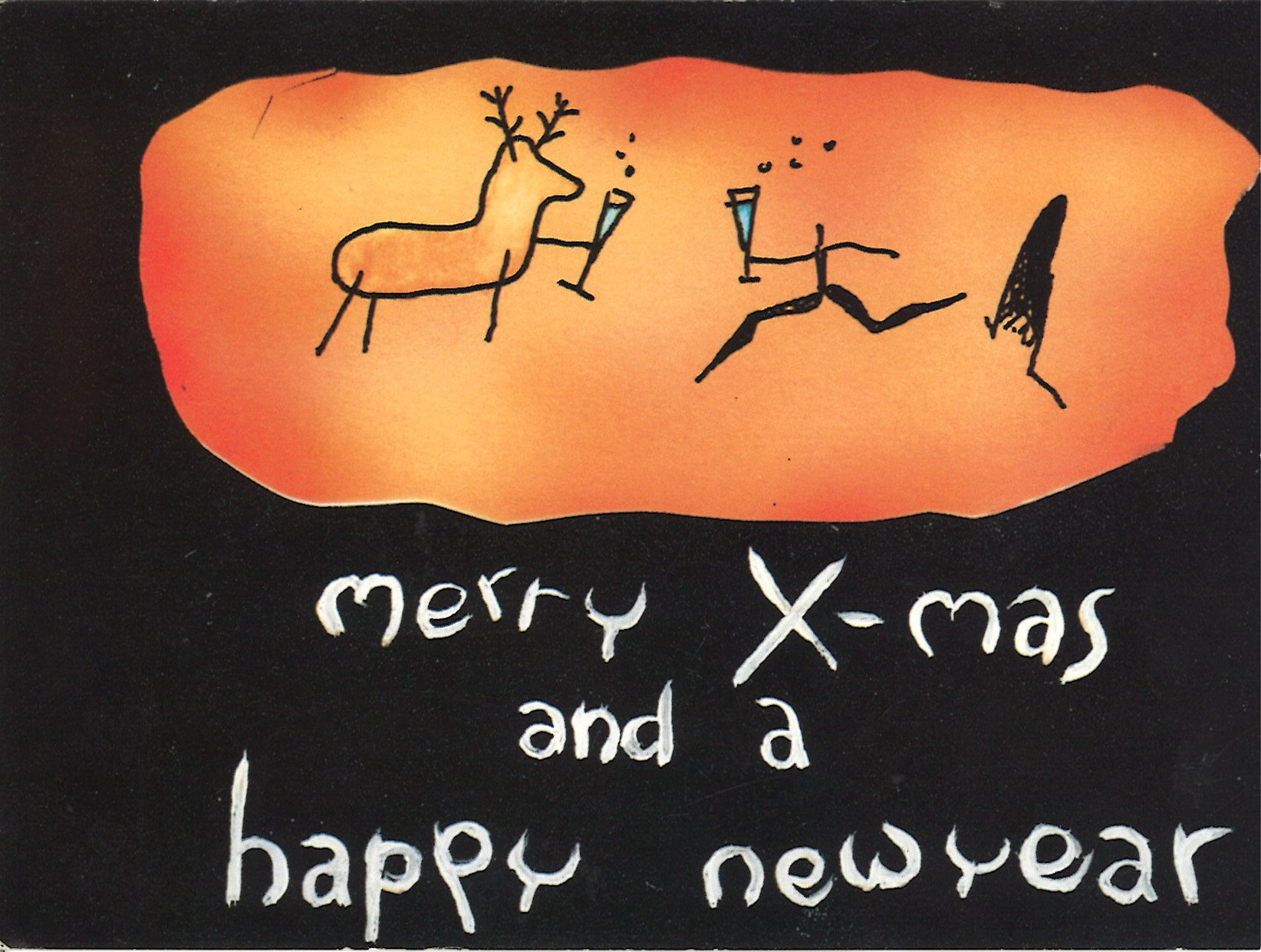
A postcard I found in Poland and sent home, probably in 1991.

A postcard I sent from Poland, probably in 1991.

Dear Chris, Mom, & Pop, The Happiest of holidays to you all. I hope you find some snow somewhere. Sorry I can’t be with you but know I’m thinking about you. Can you believe I found this card in Poland? Love, Marysia

In the living room on Long Island, probably Christmastime 1991

In the living room on Long Island, probably Christmastime 1991

And then this photo of Mama and Babcia on the couch in the living room at home. The tree and ornament in the left foreground signal it was around Christmas, also. Mama is in silhouette, eyes downcast. She appears to be spooning something out of a mug to give to Babcia, who is leaning toward her with closed eyes. Or maybe the camera just caught her blinking? She is bundled up in a down jacket and a blanket, like a child. When was this? Near the very end of Babcia’s life. Could it also be 1991? Maybe Mom and Dad returned from Texas before the holiday? It’s so rare that I have seen photos of my Mama and Babcia together. There seems to be so much tenderness in my mother’s attention, as if in this moment of caring all the tension between them dissolved.

Memory in Fragments: Reassembling Jewish Life in Poland

03 Thursday Sep 2015

Posted by Marysia Galbraith in Anthropology, Heritage work, Jewish Culture, Memory, Poland, Polish-Jewish Heritage, Polish-Jewish relations

≈ Leave a comment

A summary of Dr. Marysia Galbraith’s year as a Fulbright Scholar in Poznan, Poland

September 3, 2015

Lloyd Hall 319

6:00 p.m.

Dr. Galbraith will also answer questions about the Fulbright Program and fellowship opportunities.

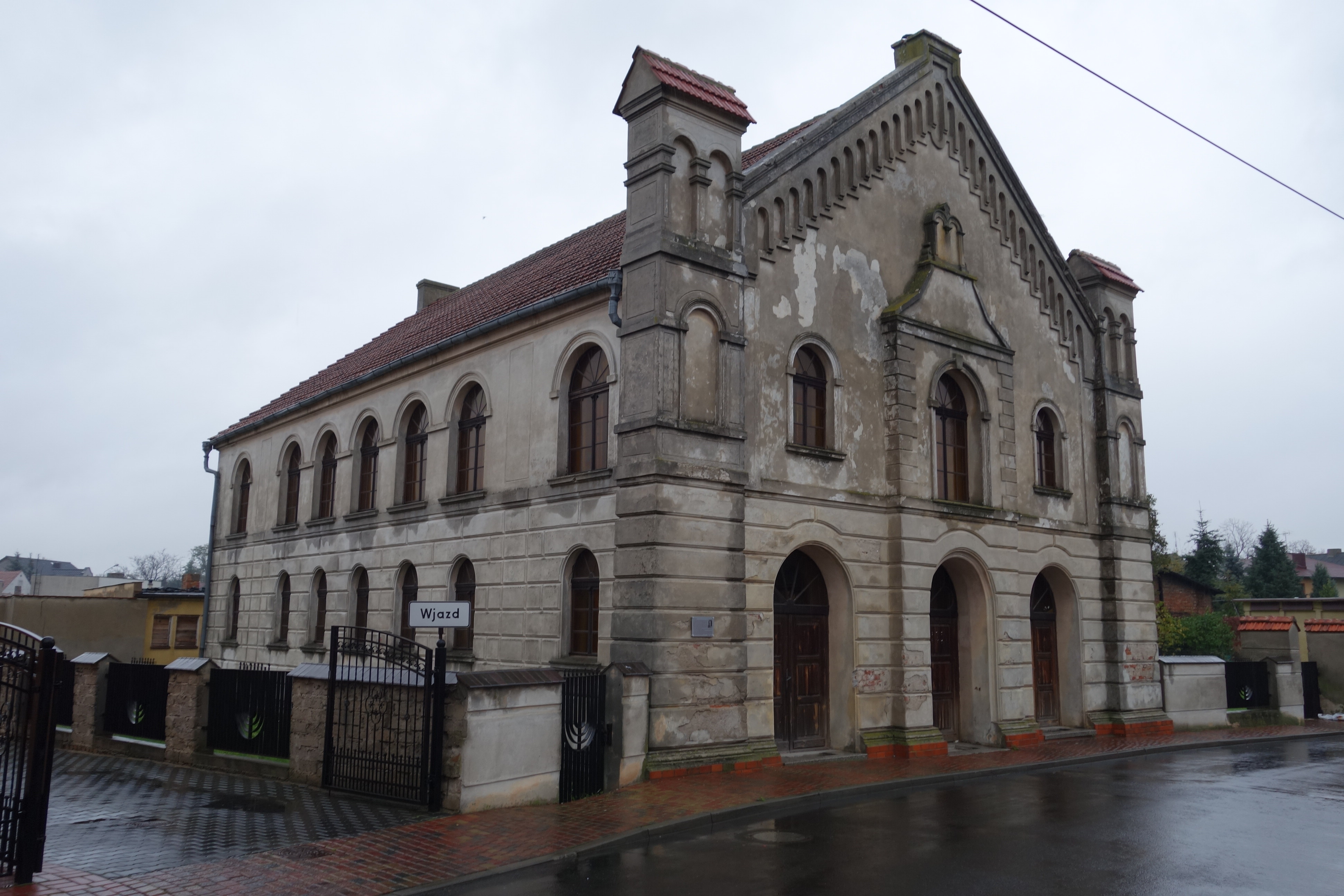
Former synagogue in Buk, Poland

Former synagogue in Buk, Poland

My research on Jewish heritage asks what can be done with the fragments of Jewish culture that remain in Poland, sometimes hidden and sometimes in plain sight? And what value does such memory work have? I explore these questions on two levels: the social level where I focus on what is actually being done with physical traces of Jewish culture in the absence of living Jewish communities, and on the personal level via the archeology of my own hidden Jewish ancestry. These fragments can reveal something about the past, even if it is just in an incomplete and shattered form. And they can point toward the future—the possibilities that might emerge out of traces of memory.

← Older posts
Newer posts →

Categories

  • Anthropology (37)
    • Archives (14)
    • Fieldwork (7)
    • Ground Penetrating Radar (GPR (4)
    • Research Methodology (8)
  • antisemitism (14)
  • Association of Descendants of Jewish Central Poland (32)
  • Catholicism (8)
  • Conference (1)
  • Discrimination (2)
  • Family (69)
    • Bereda (17)
    • Kolski (13)
    • Piwko (22)
    • Rotblit (3)
    • Walfisz (4)
    • Winawer (7)
  • Genealogy (11)
  • Heritage work (66)
    • Commemoration (23)
  • Identity (18)
  • Israel (6)
  • Jewish Culture (89)
    • Cemeteries (51)
    • Museum (7)
    • Synagogues (33)
  • Jewish immigrants (8)
  • Jewish Religion (1)
  • Memory (70)
  • Names (14)
  • Photographs (6)
  • Pifko-Winawer Circle (5)
  • Poland (125)
    • Baligród (1)
    • Bolimów (1)
    • Brześć Kujawski (5)
    • Buk (1)
    • Chodecz (1)
    • Dukla (2)
    • Dąbrowice (1)
    • Gdynia (1)
    • Gostynin (2)
    • Gąbin (1)
    • Izbica Kujawska (1)
    • Kazimierz (4)
    • Kowal (1)
    • Koło (1)
    • Krakow (7)
    • Krośniewice (1)
    • Kutno (6)
    • Kłodawa (1)
    • Lesko (8)
    • Leszno (1)
    • Lubień Kujawski (1)
    • Lubraniec (1)
    • Lutowiska (3)
    • Piła (3)
    • Podgórze (2)
    • Poznan (11)
    • Przemyśl (2)
    • Pzedecz (1)
    • Radom (1)
    • Radymno (1)
    • Sanok (1)
    • Skierniewice (5)
    • Sobota (2)
    • Tarnów (2)
    • Warsaw (22)
    • Wielkopolska (1)
    • Wronki (7)
    • Włocławek (20)
    • Zasław (2)
    • Łódź (1)
    • Żychlin (30)
  • Polish Culture (10)
  • Polish-Jewish Heritage (60)
  • Polish-Jewish relations (60)
  • Post-World War II (24)
  • Pre-World War II (22)
  • Reclaimed Property (1)
  • stereotypes (3)
  • Survival (9)
  • Trauma (3)
  • Uncategorized (5)
  • Victims and perpetrators (4)
  • World War II (45)
    • Jewish Ghetto (12)
    • Nazi Camps (5)
    • Polish Underground Army (3)
  • Yiddish (5)

Enter your email address to follow this blog and receive notifications of new posts by email. Your email address will not be shared.

Archives

  • October 2025 (1)
  • July 2025 (8)
  • June 2025 (1)
  • April 2025 (1)
  • August 2024 (3)
  • July 2024 (3)
  • May 2024 (2)
  • April 2024 (1)
  • May 2023 (2)
  • January 2023 (2)
  • December 2022 (7)
  • November 2022 (2)
  • October 2022 (5)
  • September 2022 (1)
  • January 2022 (1)
  • August 2021 (1)
  • December 2020 (2)
  • July 2020 (1)
  • May 2020 (3)
  • April 2020 (1)
  • March 2020 (1)
  • January 2020 (2)
  • May 2019 (1)
  • February 2019 (1)
  • November 2018 (1)
  • September 2018 (1)
  • August 2018 (3)
  • July 2018 (1)
  • June 2018 (1)
  • May 2018 (1)
  • April 2018 (2)
  • March 2018 (2)
  • February 2018 (2)
  • January 2018 (2)
  • December 2017 (2)
  • November 2017 (2)
  • October 2017 (1)
  • September 2017 (3)
  • August 2017 (3)
  • June 2017 (2)
  • May 2017 (3)
  • April 2017 (1)
  • March 2017 (2)
  • February 2017 (1)
  • January 2017 (2)
  • December 2016 (2)
  • November 2016 (4)
  • October 2016 (1)
  • September 2016 (6)
  • August 2016 (2)
  • July 2016 (1)
  • May 2016 (4)
  • April 2016 (2)
  • March 2016 (3)
  • February 2016 (4)
  • January 2016 (3)
  • December 2015 (3)
  • November 2015 (5)
  • October 2015 (5)
  • September 2015 (3)
  • August 2015 (4)
  • July 2015 (3)
  • June 2015 (3)
  • May 2015 (4)
  • April 2015 (9)
  • March 2015 (3)
  • February 2015 (2)
  • January 2015 (5)
  • December 2014 (4)
  • November 2014 (9)
  • October 2014 (2)
  • September 2014 (1)

Copyright Notice

All original text and images are copyright © Marysia Galbraith. Please contact the author before quoting.

Blog at WordPress.com.

  • Subscribe Subscribed
    • Uncovering Jewish Heritage
    • Join 147 other subscribers
    • Already have a WordPress.com account? Log in now.
    • Uncovering Jewish Heritage
    • Subscribe Subscribed
    • Sign up
    • Log in
    • Report this content
    • View site in Reader
    • Manage subscriptions
    • Collapse this bar
 

Loading Comments...