• About
  • The Photo that Started it All

Uncovering Jewish Heritage

Uncovering Jewish Heritage

Category Archives: Synagogues

Krośniewice Brings Back Jewish Memory

20 Thursday Oct 2022

Posted by Marysia Galbraith in Association of Descendants of Jewish Central Poland, Cemeteries, Commemoration, Heritage work, Krośniewice, Polish-Jewish Heritage, Polish-Jewish relations, Survival, Synagogues

≈ 2 Comments

Report #4 about Roberta Books and Marysia Galbraith’s trip to meet Polish partners in preparation for the ADJCP‘s memorial visit to central Poland. Reports include contributions by Roberta.

Krośniewice Mayor Katarzyna Erdman, Sławomir Mikołajczyk, and his son Adam Mikołajczyk stood on the side of the main road from Kutno, sheltered from the rain under two umbrellas. Sławomir, a member of the Krośniewice branch of the Friends of Kutno (TPŻK), works at the city museum, while Adam a City Hall employee, shares his father’s passion for local history. They waited for Roberta, Yosef, and me in the rain so they could start our tour of Jewish sites at a memorial stone engraved with the statement:

People today should bring back the memory of those who are no more

At the 70th Anniversary of the liquidation of the ghetto III X 1942

The Krośniewice Community

2012 (my translation from Polish)

Monument commemorating the Krośniewice Jewish community. Behind the chain-link fence is the synagogue, transformed into a funeral home

They pointed out that the building next to us was the synagogue. For years it served as a movie theatre, but when it was sold in 2004, the new owner converted it into a funeral home. The walls of the synagogue are hidden behind the utilitarian exterior of the current plaster façade.

We walked a couple of blocks to a solid historic building that houses the town museum (Muzeum im. J Dunin-Borkowskiego w Krośniewicach). The museum has co-sponsored activities related to the city’s Jewish history, including the program, “Bringing Back the Memory of the Krośniewice Jewish Community” (with the Friends of Kutno Association).
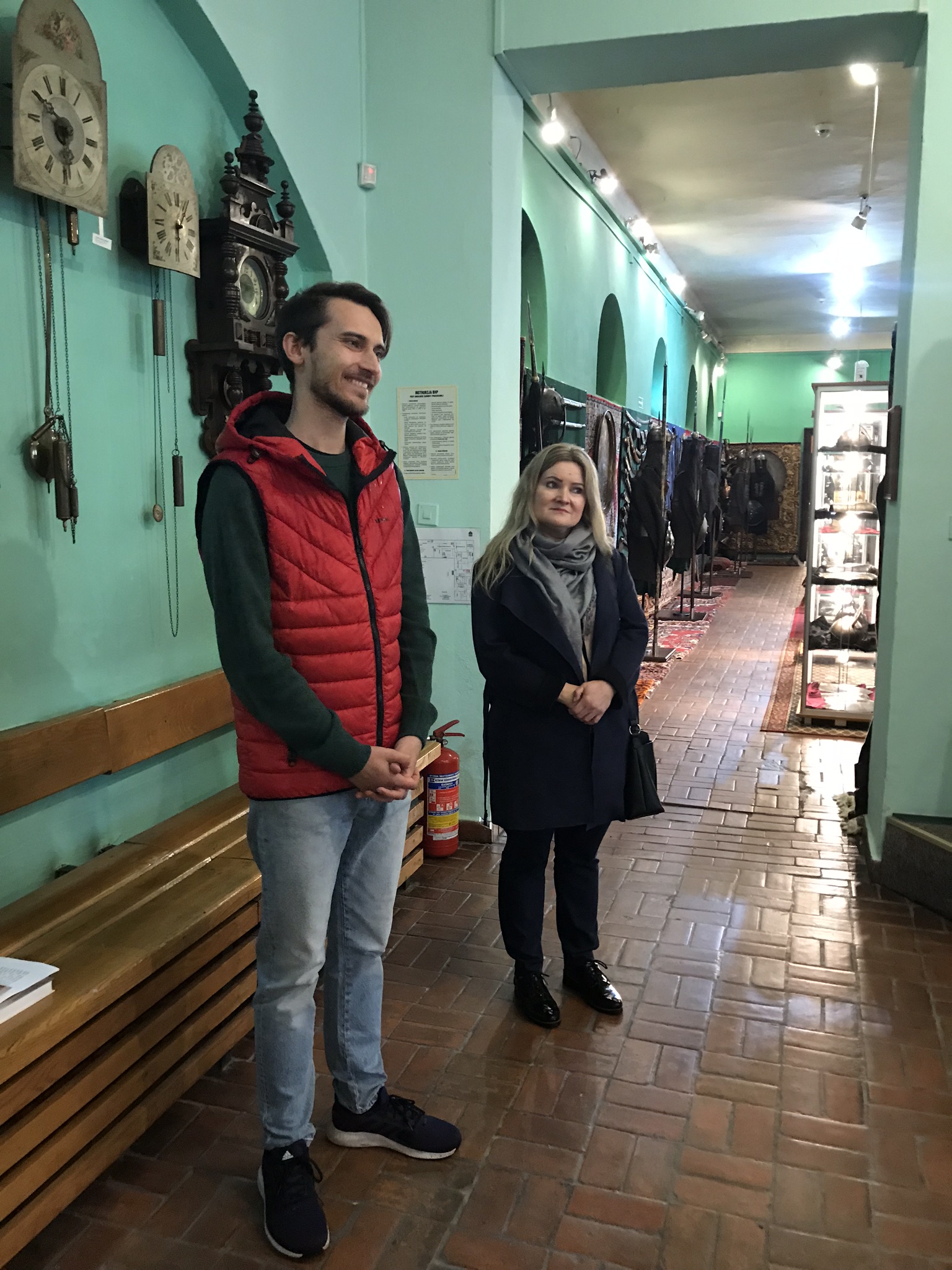
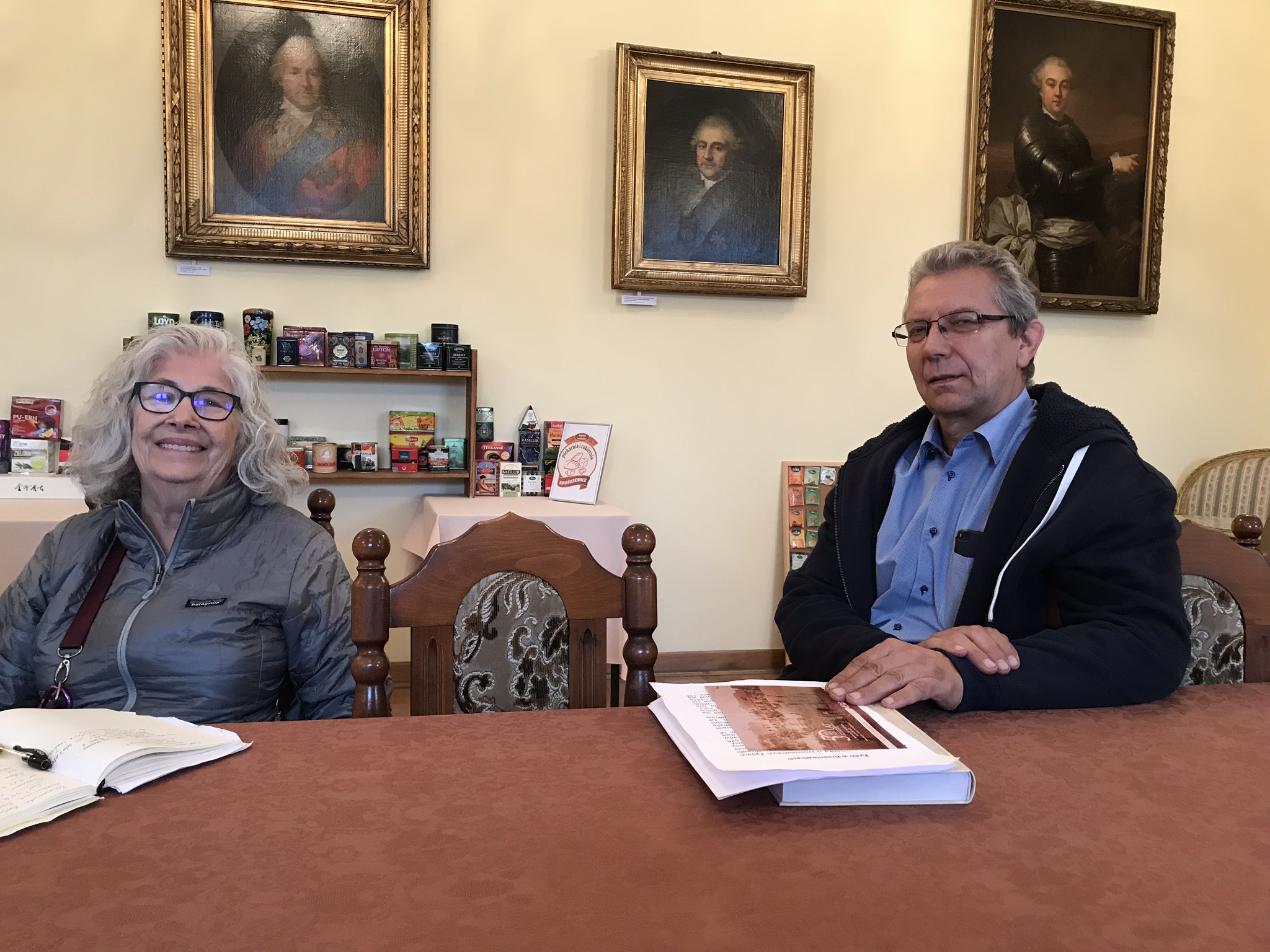
Adam Mikołajczyk and Mayor Katarzyna Erdman in the Dunin-Burkowski Museum, Krośniewice

During our meeting all participants affirmed their willingness to help organize a half-day event for descendants in May. Our hosts told us about Sol Rosenkranz, a Holocaust survivor who returned to his hometown and built a fence and monument at the Jewish cemetery. They told us that Sol’s son still returns regularly to maintain the cemetery. The mayor had the impression that the town does not have permission to cut the grass themselves. She also said they know about tombstones under roads, including 20 or more in a nearby town. The Jewish cemetery has a few tombstones incorporated into a makeshift monument, and she hopes more can be recovered. 
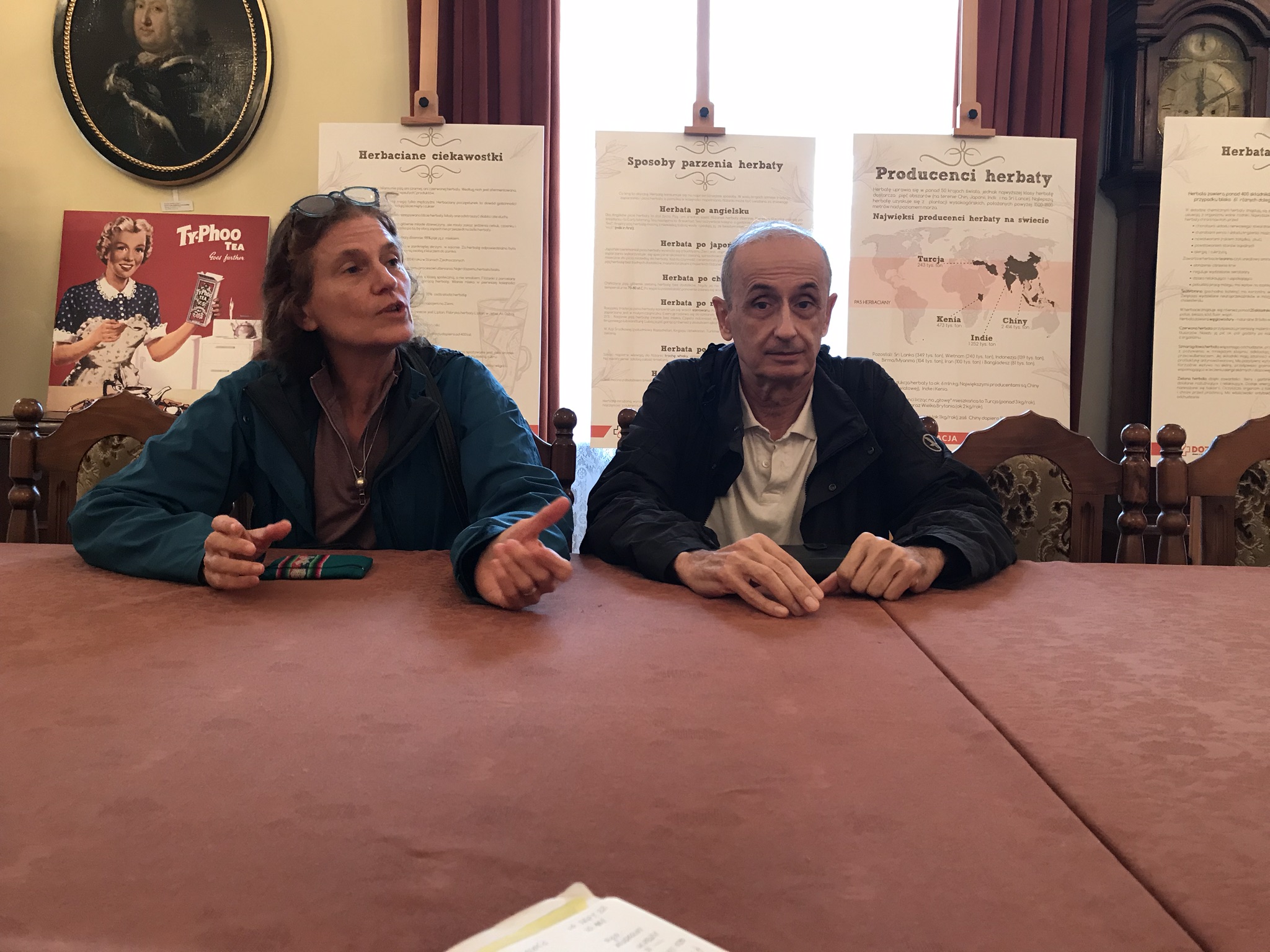
Roberta asked Mayor Erdman what she considers Krośniewice’s biggest challenges. Erdman replied employment and investment. As with so many small towns in Poland (and throughout the world, really) young people are leaving in search of work and a better life. Her greatest task as mayor is finding investors who will build businesses and create jobs. Later, I asked Adam what motivated him to return to Krośniewice. He responded, “Someone needs to stay.” Also, he feels such a strong attachment to the place and its history he decided to try and make a life for himself there.

Sławomir and Adam told us about other Holocaust survivors. 92-year-old Róża Aleksander (now Krysia Nowak) still lives in town. As a young child, she and her mother Saba were hidden by Józefa Dziewierska, a righteous gentile acknowledged for her actions in 1997. Saba’s maiden name was Flaster; her husband’s name was Gabriel Alexander. Their daughter Róża was born in 1931 to Gabriel Aleksander and Saba Flaster Aleksander. During the war, mother and daughter adopted false identities Zofia and Krysia Marczak. Róża, now Krysia Nowak (her married name), used to meet with descendants but is no longer well enough to do so. Her testimony was recorded by the Shoah Foundation.

Another child survivor, (Hanna Kałużna?) lives in Wrocław. She and Krysia remain friends. Hanna used to visit Krysia in Krośniewice, but now that she is in her late 80s she hasn’t been able to.

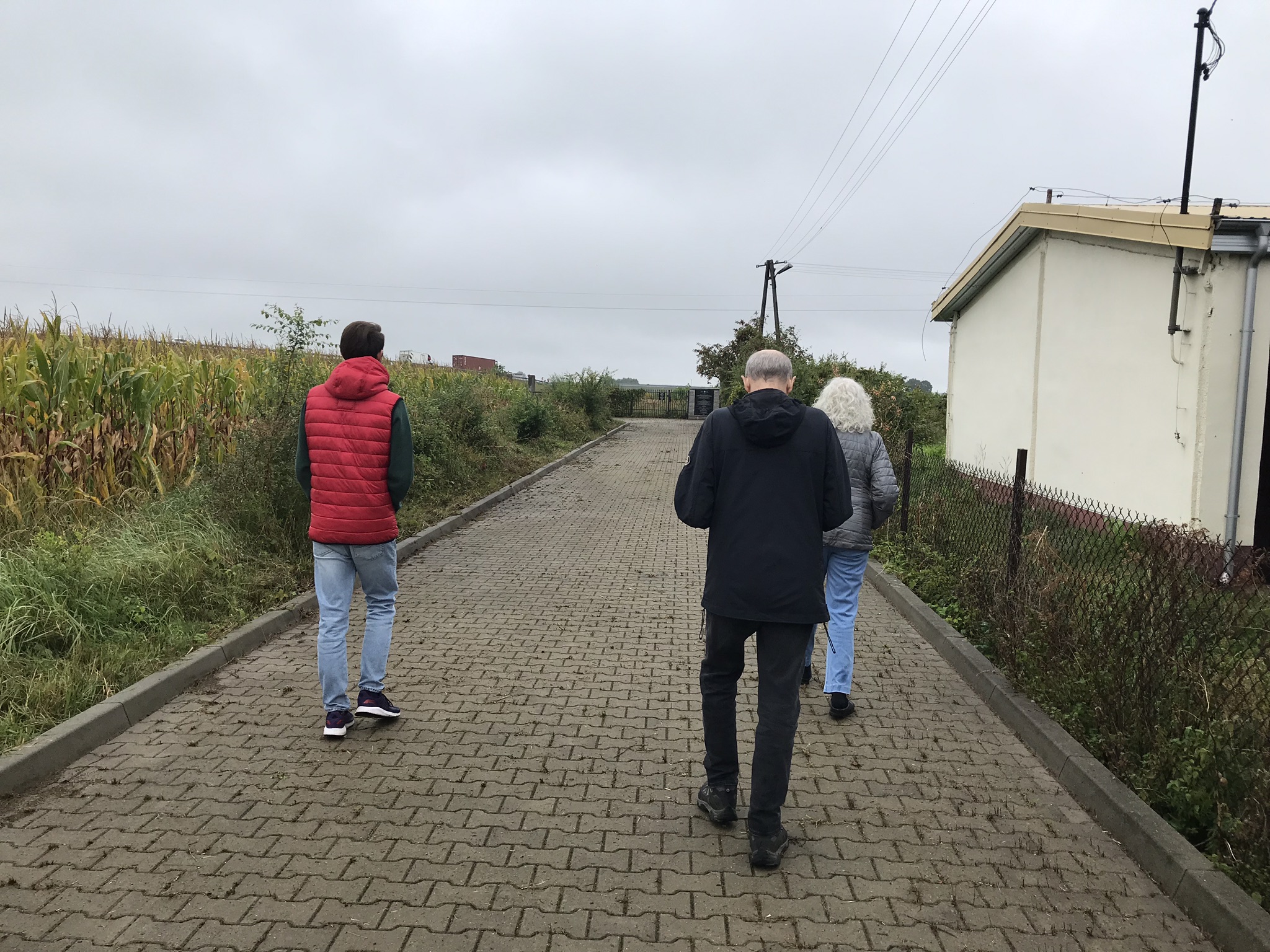
We concluded our visit at the cemetery, which is 900 meters from the center of town. Cars whizzed by on the city bypass running up the slope from the cemetery. A paved drive leads to a metal gate, and a plaque on the right contains a brief history of the city’s Jews in Polish, English, and Hebrew. The Foundation for the Preservation of Jewish Heritage (FODŻ) installed it in 2014.

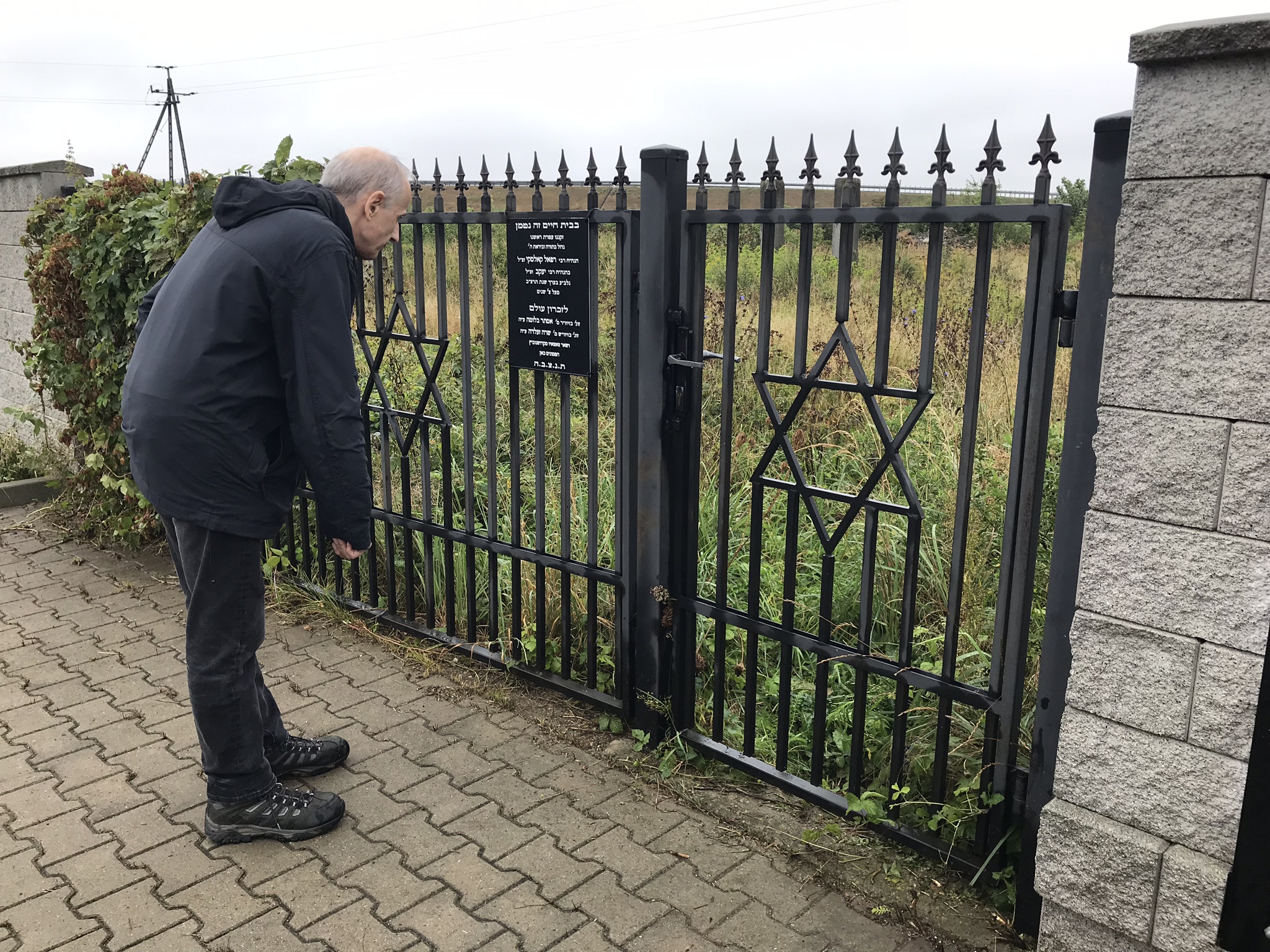
Jewish Cemetery, Bypass road on the horizon
Yosef reads the plaque on the cemetery gate
Memorial plaque
Paved path to the Krośniewice Jewish Cemetery

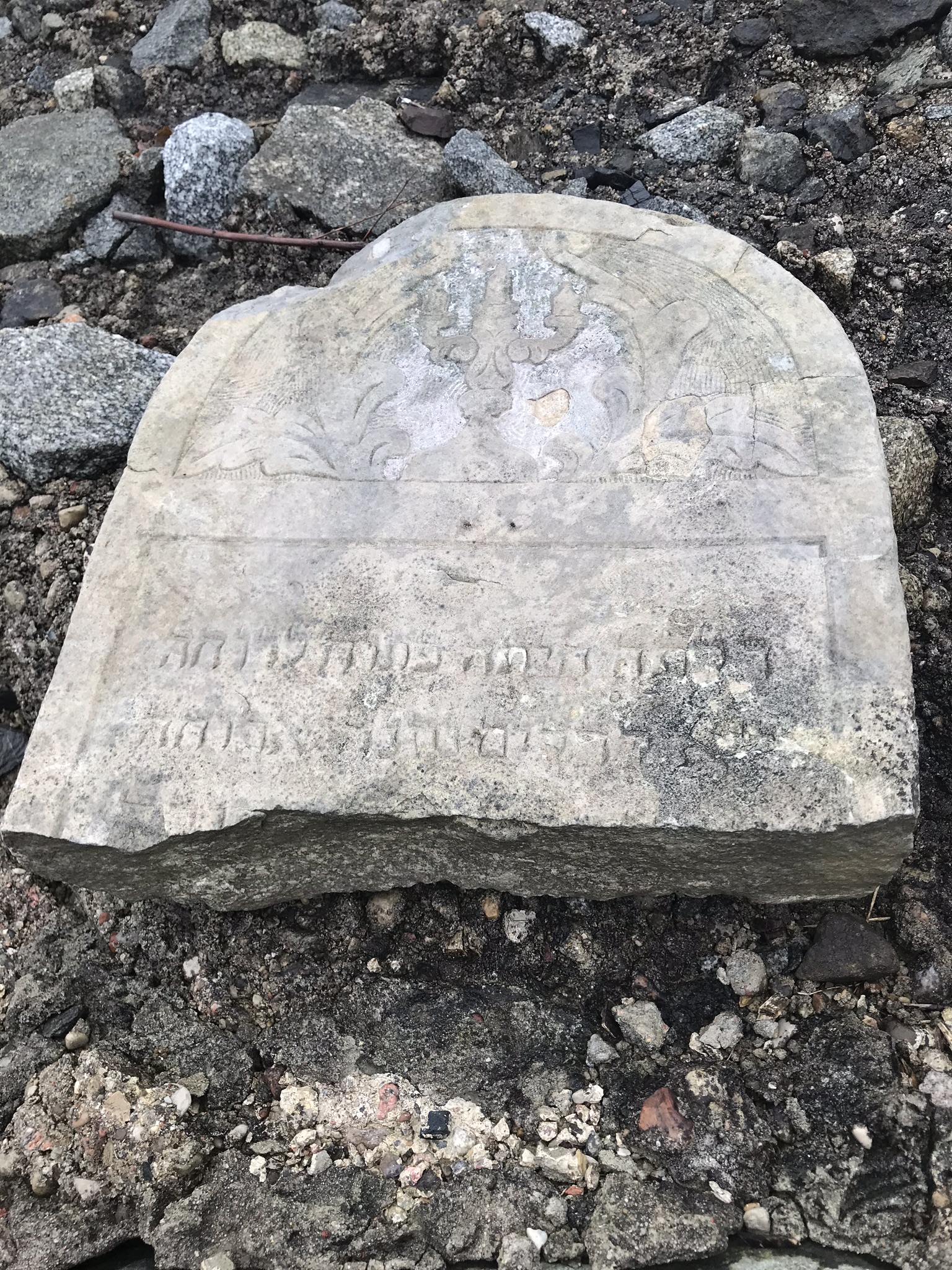
Only Adam and Yosef ventured through the long grass inside, to the pile of debris that someone topped with matzevah fragments and cynically labelled a monument.

In the 1980’s, an unscrupulous businessman decided the abandoned cemetery would be an ideal place to dump construction debris. His illegal use was reported to the authorities, and he was told to remove the debris. Instead, to avoid the expense of clean-up and a fine, he mounted tombstone fragments atop the rubble and claimed that since it is now a monument none of it can be disturbed. 

Adam made photos with my phone, so I can share them here.

Tombstone fragments in the make-shift memorial, Krośniewice Jewish Cemetery

An important update to this report

ADJCP president Leon Zamosc shared what he knows about Sol Rosenkranz and Sol’s efforts to restore the cemetery.

“The initiative to restore the cemetery came from Sol Rosenkranz, a survivor from Krosniewice. He had been born in Grabow, but the family moved to Krosniewice when he was a child.
“During the war, Sol Rosenkranz was in six labor camps until his liberation in Theresienstadt. He and one of his brothers were the only survivors of his family. He came to the US in 1946, lived in New York and Los Angeles (where he worked as a volunteer speaker in the Simon Wiesenthal Center), and spent his final years back in New York (where he was an active gallery educator at the Museum of Jewish Heritage in Battery Park). He passed away in 2019 at the age of 101.
“After his liberation in 1945, Sol returned to Krosniewice and saw that the Germans had paved the town square with gravestones removed from the Jewish cemetery (all deliberately placed with the inscriptions up). That memory stayed with him for decades. In 2002, Sol visited Krosniewice and found that the communist administration had re-surfaced the town square in the early 1950s. The matzevot had been removed but there was no record of their whereabouts.
“In 2013, Sol went to Krosniewice again. At the dilapidated cemetery site, there were only half a dozen fragments of matzevot that someone had cemented together. Sol was not a wealthy man, but during that visit he decided that he would fund the restoration of the cemetery (placement of a fence around the perimeter of the cemetery and installation of an iron-wrought gate with a memorial plaque). The works were carried out by FODZ (the Foundation for the Preservation of Jewish Heritage in Poland) and the dedication took place in 2014.”


More details: 
  https://www.jta.org/2014/11/19/ny/a-cemeterys-renovation-and-a-responsibility-fulfilled
Links to pages in Polish (can be translated right-clicking “Translate to English):
  https://tpzk.eu/z-historii-cmentarza-zydowskiego-w-krosniewicach/
  https://tpzk.eu/sol-rosenkranz-nowy-jork-wspomnienia-z-lat-1939%E2%88%921946/
  http://cmentarze-zydowskie.pl/krosniewice.htm

Leon also reached out to Sol’s son Joel who tells a slightly different story about the ongoing maintenance of the cemetery.

“When we dedicated the cemetery in 2014 we were hopeful that city officials including the then mayor Juliana Herman, the clergy and teachers would advocate support and maintenance – however that did not materialize.”

Joel also reached out to me with more details:

At the Wiesenthal Center, Sol worked in the library translating Yiddish and Hebrew letters and other documents for families, asking only that they make a donation to the Center in return. He started talking about the Shoah after Joel’s mother Sally died in 1996. He returned to New York and began to volunteer for the Museum of Jewish Heritage even before it had a physical space. He “embraced his role as a witness, speaking to students at schools of all denominations. After the MJH was established, he was a member of the Speakers Bureau for more than 20 years and by their estimate had told his story to more than 10,000 people, one class or group at a time.”

He further explains “Regarding Krosniewice cemetery maintenance, because Nature remained unchecked in that spot for decades, trees and shrubs developed deep roots. According to Rabbinic law as Rabbi Schudrich stated, in clearing the cemetery grounds, it was not permitted to use any heavy equipment that would disturb bodies below the surface. As a result, the tools we used were chainsaws to cut trunks as close to the ground as possible, clippers  and weed whackers. Within a year, certainly two, nature asserted herself again and so a program of perpetual care is what is required. Local authorities don’t have any ownership authority, but they could certainly play a helpful, respectful role in maintenance if they wanted.”

Sol Rosenkranz (right) with Rabbi Michael Schudrich at the rededication of the Krosniewice Jewish cemetery

This just goes to show how hard it can be to maintain cemeteries and other memorial sites. Even when all sides approach a project with good will, plenty of room remains for misunderstanding. It is also a real challenge for information to be passed down from one government administration to the next, and from one activist to another.

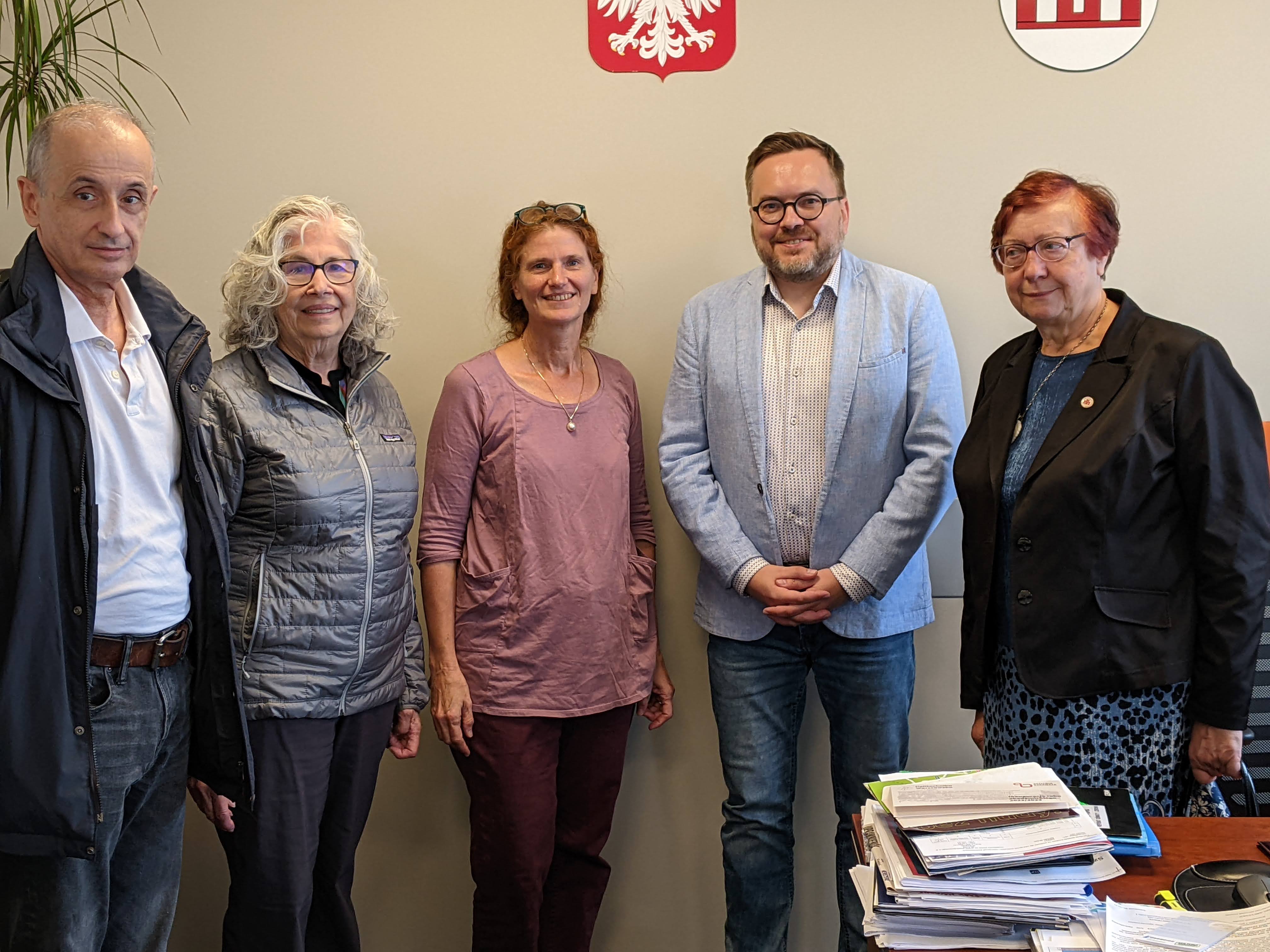
Restoring Jewish Memory in Żychlin

12 Wednesday Oct 2022

Posted by Marysia Galbraith in Association of Descendants of Jewish Central Poland, Commemoration, Heritage work, Polish-Jewish Heritage, Polish-Jewish relations, Synagogues, Żychlin

≈ 2 Comments

Report #3 about Roberta Books and Marysia Galbraith’s trip to meet Polish partners in preparation for the ADJCP‘s memorial visit to central Poland. Reports include contributions by Roberta.

Our visit to Żychlin began with a meeting at Town Hall with 8th graders and their teachers from the local school. The children were shy—reluctant to speak in English or in Polish with us—but clearly we had their full attention as we shared our family connection to central Poland and explained why we were visiting. We used a question and answer format to gauge their knowledge about Jewish culture, history, and religion, and to share some basic knowledge with them.

8th grade students with Yosef, Roberta, and Marysia. Their teacher is on the right

Because I heard Żychlin Mayor Grzegorz Ambroziak speak at the unveiling of the new monument commemorating Żychlin’s Jewish community, I had the sense he wants to preserve the memory of the town’s Jews. At our meeting, he confirmed this. He led the conversation with his concerns about the fate of the synagogue ruins, which are situated in an impoverished area just off the central town square. After the war, the city used the building as a warehouse, and they maintained it until the Jewish Community of Warsaw reclaimed the property. For years it stood empty as the city negotiated with the Jewish Community to obtain legal possession of the building. They envisioned turning it into a museum of regional history. The city was granted possession of the synagogue in 2007-8, exactly when the roof caved in. Since then, the decay of the building has accelerated due to the lack of a roof. Currently, wooden supports hold up the shorter walls of the building, but it looks like it could fall down at any moment.  The city would like to use the space for a museum.

Meeting at Żychlin Town Hall: Yosef Kutner, Roberta Books, Marysia Galbraith, Mayor Grzegorz Ambroziak, President of the Association of Żychlin History Enthusiasts (TMHŻ) Anna Wrzesińska

Mayor Ambroziak invited the ADJCP to cosign a Letter of Intent attesting to our interest in rebuilding the synagogue. With this affirmation that interest in the synagogue extends beyond the immediate needs of Żychlin residents, he is confident the city can obtain funds from the Ministry of Culture and the EU for the renovation. All such funding requires cost-sharing by the municipality, and he is prepared to provide those matching funds from the city budget.

We also gained the mayor’s support for 3 other ADJCP projects in Żychlin: the plaque for righteous gentile Szułdrzyński, cemetery restoration, and help organizing our memorial trip.

  • The ADJCP will provide a plaque commemorating a righteous gentile from Zychlin named Stanisław Szułdrzynski; Bożena Gajewska will arrange its manufacture for us. The mayor agreed to find an appropriate place for the plaque, and to arrange for it to be officially unveiled during our memorial visit in May 2023. 
  • The mayor welcomes our efforts to clean up and restore the Jewish Cemetery.  The cemetery is managed by the Foundation for the Preservation of Jewish Heritage (FODŻ). The city does not take responsibility for regular maintenance. When they do cut the vegetation (as they did for the recent Forum for Dialogue project “In the Footsteps of Żychlin’s Jews”) they have to cut back thorny bushes (trzcina, black thorn). They said they are not allowed to dig the roots out or use pesticides, which means within a few months the bushes grow right back. Roberta has contacted Rabbi Schudrich for clarification of what maintenance practices are allowed and to confirm who owns the cemetery.
  • The Mayor will be pleased to greet ADJCP in May 2023. Anna Wrzesińska will walk around with them.

After the meeting, we stepped across the street to see the monument to Żychlin’s Jews, unveiled in June as part of the project “In the Footsteps of Zychlin Jews.” Bożena Gajewska of the Friends of the Kutno Region (TPŻK) ran the program with the help of Anna Wrzesińska and funding from the Forum for Dialogue. Mayor Ambroziak also contributed funds for the plaque; because of the length of the inscription, it exceeded the approved budget.

Memorial to Żychlin’s Jewish community

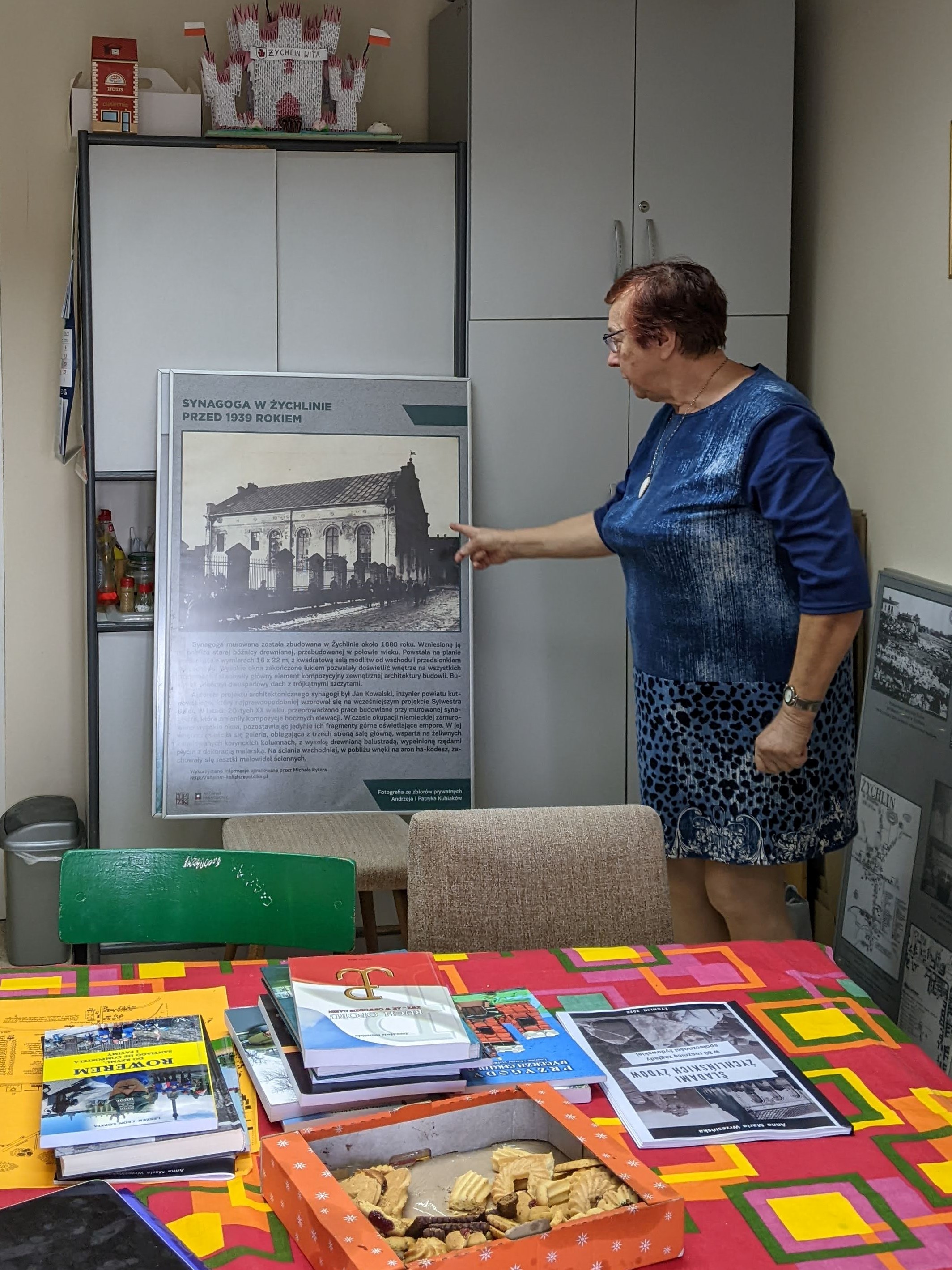
Anna Wrzesińksa took us to the office of the Association of Żychlin History Enthusiasts (Towarzyszenie Miłośników Histori Żychlinskiej, TMHŻ) where we met with members of the organization and learned about their recent projects. They showed us the display boards from an exhibition they put together about Żychlin’s Jewish Community. It was on display this spring during the Forum for Dialogue project “In the Footsteps of Żychlin’s Jews.” They also showed us the numerous publications they have released, including a photocopy of their latest work, still awaiting publication, about Żychlin’s Jewish history.

Jerzy Werwiński, 92-year-old member (born in 1931) shared his recollections of wartime, starting with the liquidation of the Jewish ghetto in 1942. He was just a boy; he hid in an attic across the street and watched from a window as the Jewish residents were rounded up and placed in horse-drawn farmer’s wagons and carted 2 km to the train station. From there, they were transported by train to the Chełmno Death Camp. Once Jerzy started talking he couldn’t stop. Visibly shaken, he described his own wartime experiences. Essentially, he spent the next three years in work camps and prison, until he was liberated by the advancing Soviet Army in January 1944. He recounted living in barracks, sleeping on hard wooden planks with no blankets even in the coldest winter nights. They had very little to eat; each morning a loaf of bread would be cut in six pieces for six people for the whole day. He was told he can eat it all at once but then go hungry the rest of the day or he could nibble on it throughout the day. At night, they got a cup of soup that was mostly water with just a few chunks of potato or other vegetables. The other TMHŻ members were born after the war, but their parents told them stories of deprivation and forced labor. Clearly, they have more to say about the hardships experienced during the war; I asked if I can return so they can tell me more and I can record their stories.

We finished our visit with a walk to the synagogue ruins. The remaining walls are in bad shape and look like they could collapse at any moment. This is a shame because even a few years ago when I first visited, the walls were reasonably sturdy. Some of the interior wall paintings could still be seen through the empty windows; these all appear to have been erased by the weather. The first step of any project will need to be to assess the condition of the remaining structure.

Lesko Synagogue Model

31 Monday Jan 2022

Posted by Marysia Galbraith in Lesko, Synagogues

≈ Leave a comment

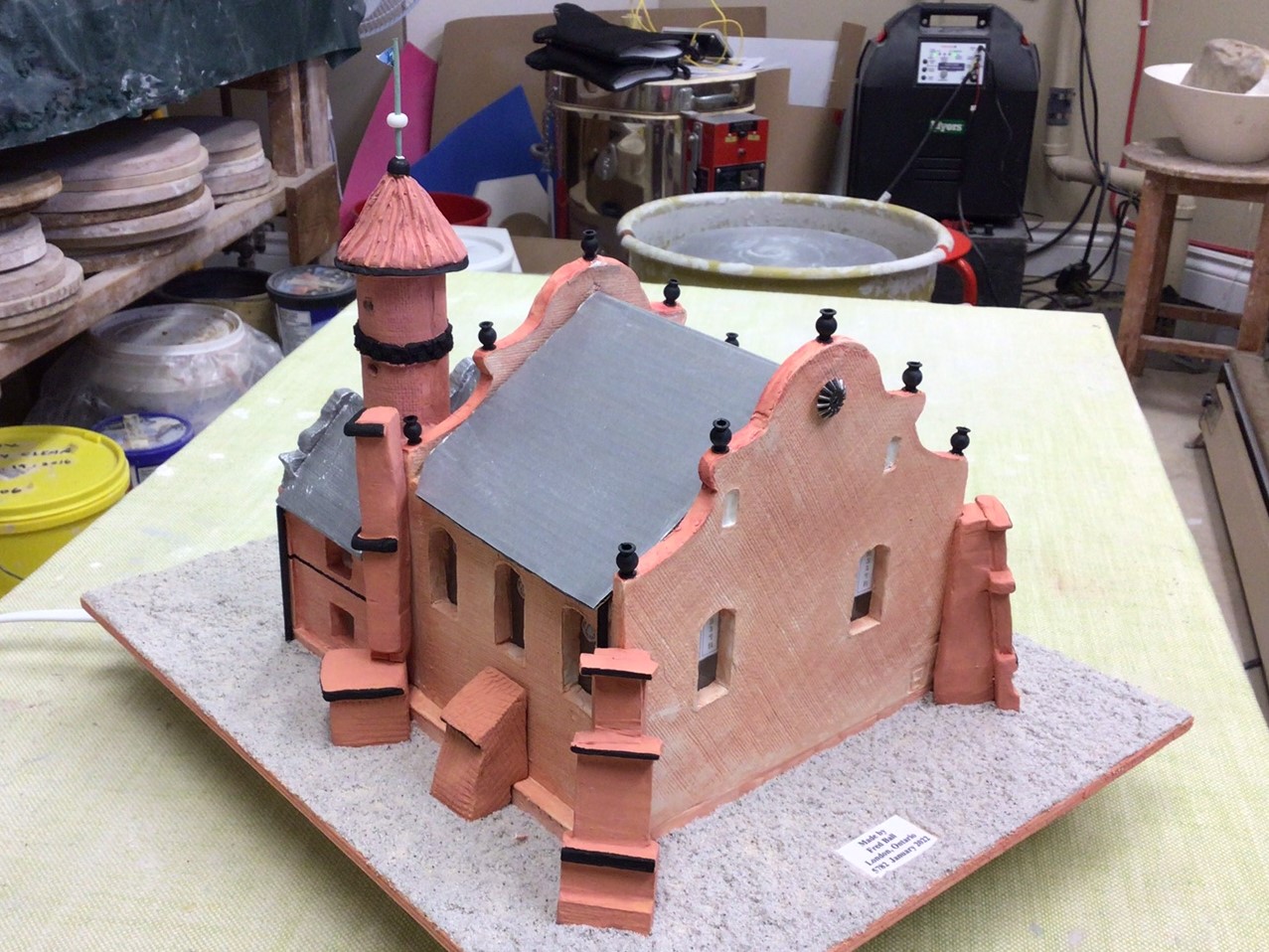
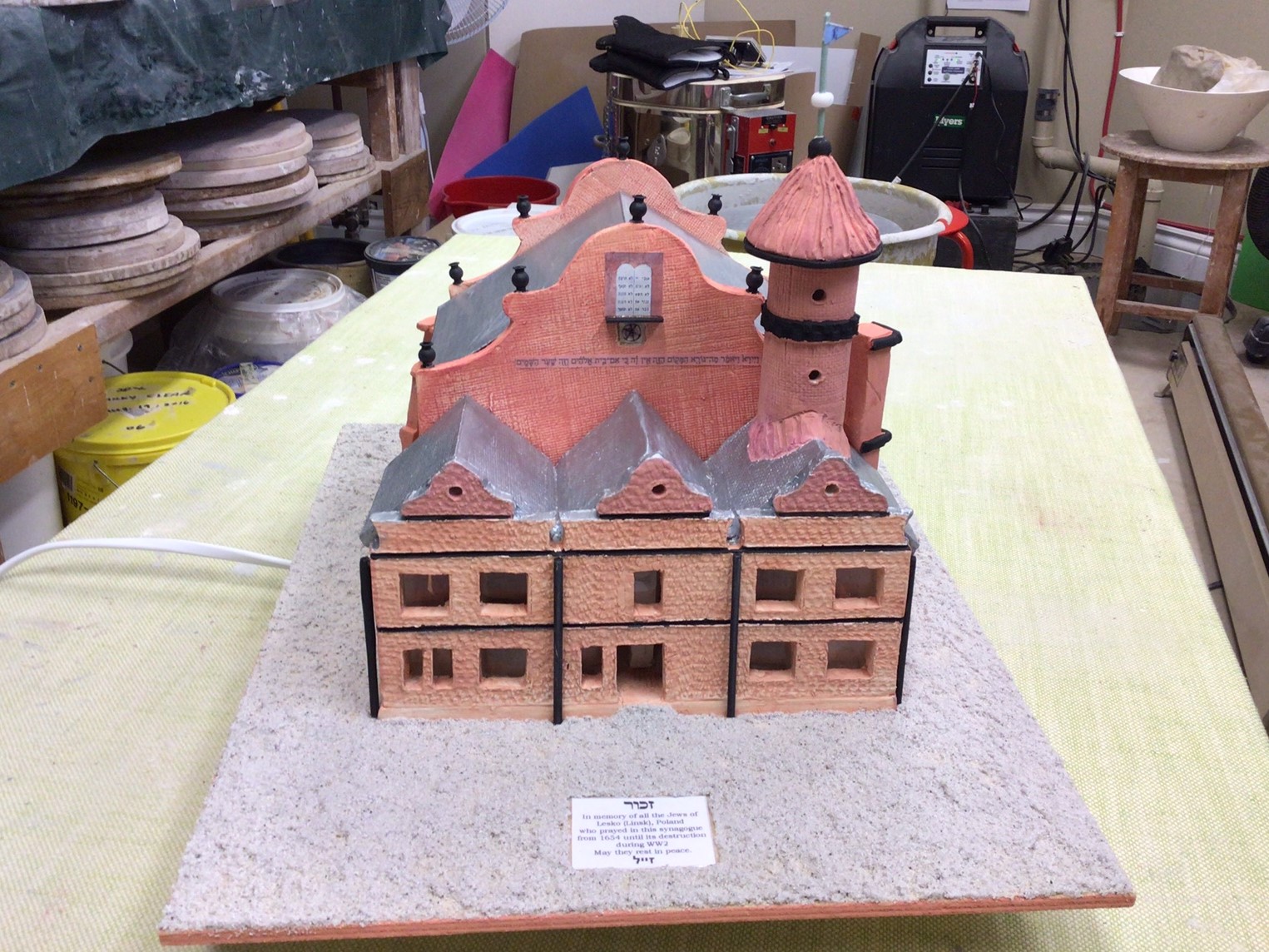
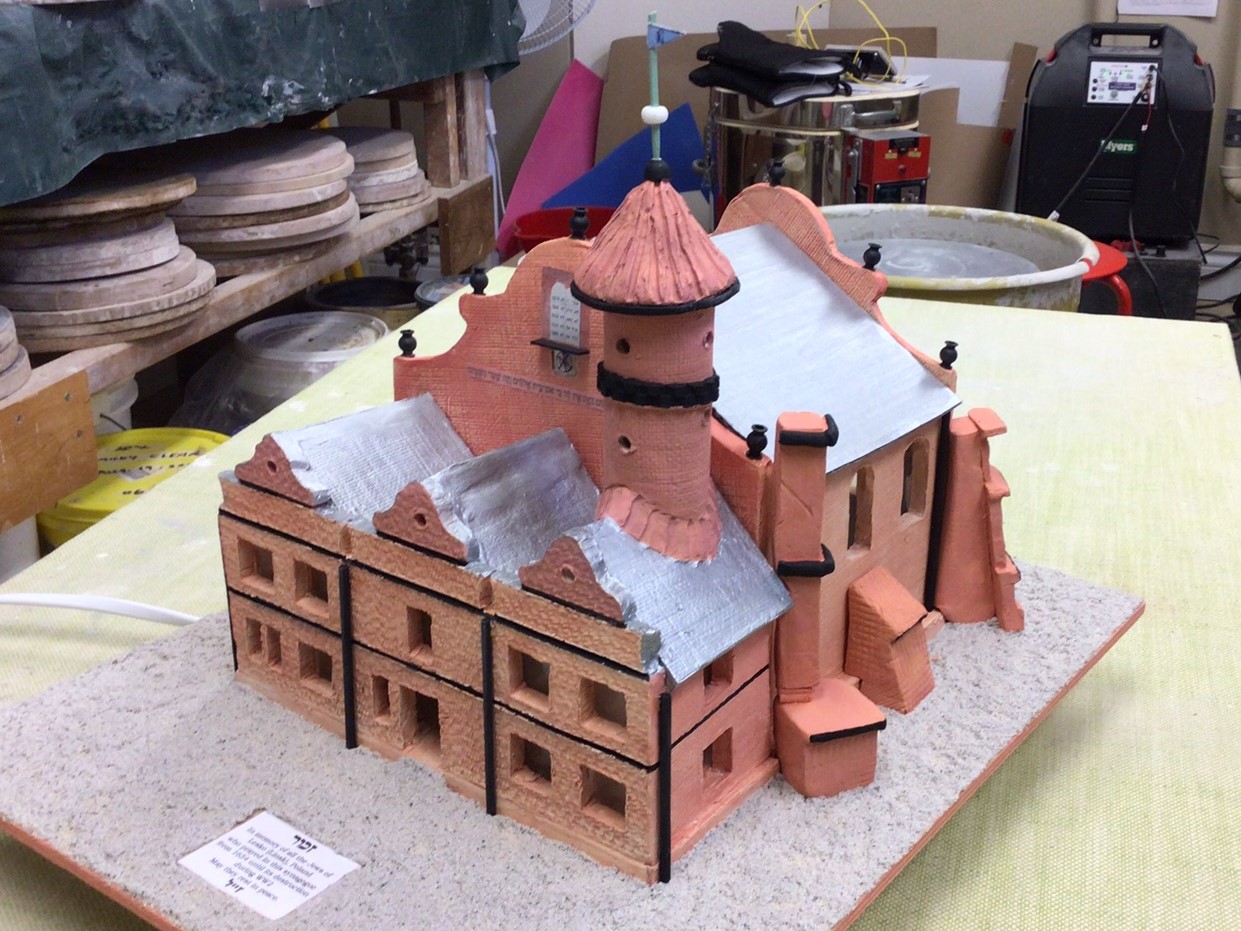
Fred Ball’s model of the Lesko synagogue, made mostly of clay with some mixed media details.

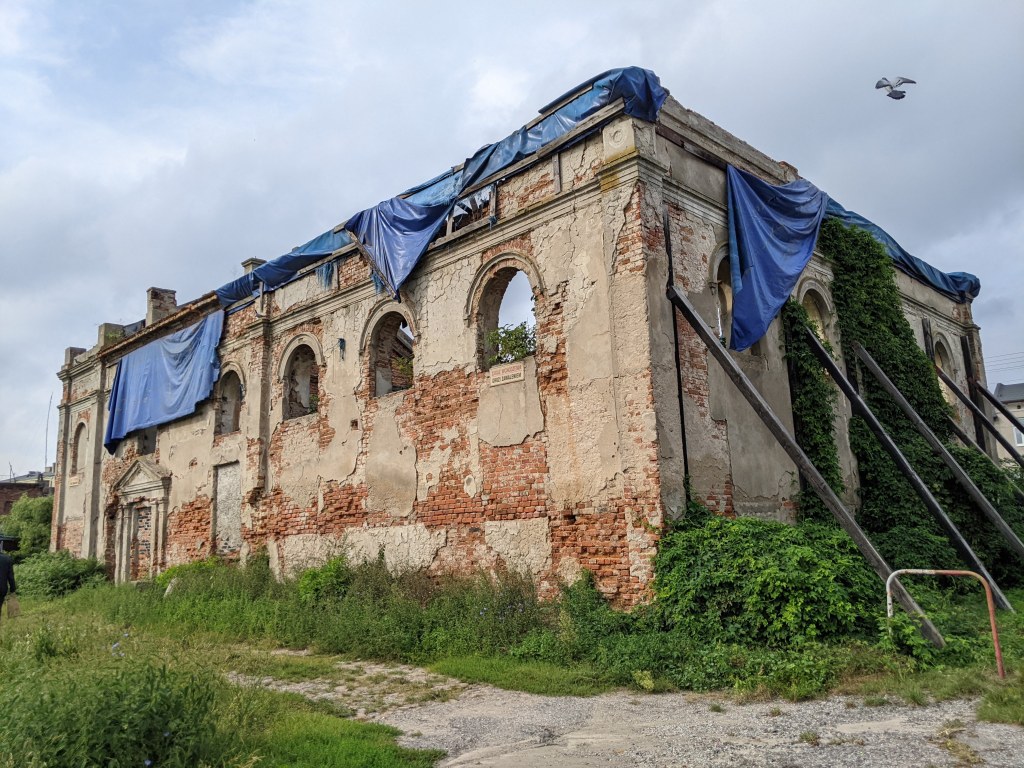
Fred Ball contacted me a while back because he wanted to make a clay model of the synagogue in Lesko. He calls himself an amateur, but I think you’ll agree that this model shows remarkable skill in capturing the details and contours of this distinctive structure. Fred says this is his 8th synagogue model. He mostly does Polish synagogues because that is where his own family roots are; he says he finds the wooden ones particularly appealing. He looks for buildings with interesting and unusual architecture, and he also makes sure he can find plenty of photographs of all four sides of the structure. The model is 8″ wide X 8.5″ long X 7″ high to the top of the tower. The flagpole adds a little additional height.

Can you guess what the roof is made of?

Cardboard! That silver paint is a very convincing approximation of metal.

Memory Map Exhibition includes Skierniewice, the Piwkos’ Hometown

08 Friday May 2020

Posted by Marysia Galbraith in Cemeteries, Heritage work, Jewish Culture, Memory, Museum, Piwko, Post-World War II, Skierniewice, Synagogues, Yiddish

≈ 23 Comments

Tags

Cousins in Poland, Grodzka Gate-NN Theatre Center, map

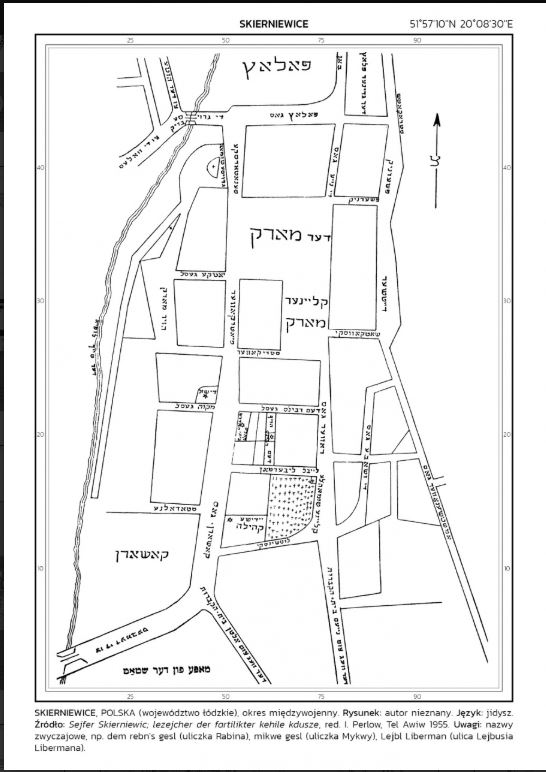
The Atlas of Memory Maps exhibit features maps drafted by non-experts in an effort to preserve the memory of their hometowns, which had been destroyed or radically transformed during and after World War II. Most were published in Yizkor books, memorial books compiled by Jewish survivors. The exhibition is mostly in Polish, but includes some English-language information. The maps contain notations in Yiddish or Hebrew. This virtual exhibition by Grodzka Gate-NN Theatre Center includes maps from Poland, Belarus, Ukraine, Lithuania, Moldavia and Slovakia.

I found a map of Skierniewice among over 150 included in the exhibition. My grandfather Hil Majer Piwko was born in there in 1854, as were his siblings Jankel Wolf (1857), Urysz (c. 1861), Dawid (1862, d. 1865), Nusen Dawid (1866), Chawa (c. 1871), and Fajga (c. 1878). It’s where Hil Majer brought his bride Hinda Walfisz in 1873, and where they started their own family. It’s also where his parents were buried (Cywia Rajch in 1862 and Chaim Josef in 1912), and probably his stepmothers, too.

Here is the map from the exhibition:

SkierniewiceMapInterwar_onlineexhibit

Map of prewar Skierniewice drawn from memory by an unknown author

Comparing it with a contemporary map, it’s hard to figure out exactly how they match up. Maybe someone who can read Yiddish can help me by translating the words on the map. Please leave me a comment if you do! I think the rivers on each map are the same, and the space marked with crosses in the bottom center of the prewar map may be the green space marked “Church of St. Stanislaus” in the bottom right of the contemporary map.

SkierniewiceMap2020

Map of contemporary Skierniewice. The site of the synagogue is marked with a black dot surrounded by a grey circle. Source: Google Maps

I’ve been to Skierniewice twice, with my cousin Krysia in 2013 and with my cousin Bob in 2018. Little remains of the town’s Jewish heritage.

Skierniewice Rynek in 2013
Krysia and me in Skierniewice, the birthplace of our great grandfather. April 2013

img_20180810_131720710_hdr

With cousin Bob, the former synagogue in the background–it’s now an electrical supply store

The synagogue, though the exterior is well maintained, now houses an electrical supply store. On the road running parallel to the river, a few tombstones have survived in the old Jewish cemetery, but they are in what is currently the backyard of a private residence. I wonder if this cemetery was included on the prewar map? The newer Jewish cemetery contains  many more surviving tombstones as well as commemorative markers outlining the history of the town’s Jewish population. It is located beyond the bottom edges of these maps, off a dirt road a short ride south of town.


Located in Lublin, Grodzka Gate-NN Theatre is one of the oldest and most active Jewish heritage organizations in Poland. About its origins, Tomasz Pietrasiewicz writes:

The changes brought about by the fall of communism in Poland in 1989 initiated the process of regaining Memory by the Polish society, and Lublin was among many Polish cities which had to face their forgotten past.

When we began our activities at the Grodzka Gate [which historically separated the Jewish and Catholic districts of the city] in the early 1990s, we knew nothing about the history of Jews in Lublin. We were not aware that the enormous empty space on one side of the Gate conceals the Memory of the Jewish Quarter. We did not realize that the Gate leads to the non-existent town, the Jewish Atlantis.There is a huge parking area, lawns and new roads where there used to be houses, synagogues and streets. A large part of this area, including the foundations of the former Jewish houses, was buried under a concrete cover, and the memory of those who lived here was hidden as well. You cannot  understand Lublin’s history without these empty spaces near the Gate. For the NN Theatre, they have become a natural setting for artistic actions, Mysteries of Memory, which uncover the memory of the past while mourning the victims of the Holocaust. (from “History of Grodzka Gate-NN Theatre“).

More information about the exhibition and Grodzka Gate-NN Theatre can be found at the following websites:

Jewish Heritage Europe

Grodzka Gate-NN Theatre Center


Learning about Jewish Religion and Culture in Leszno

07 Thursday Jun 2018

Posted by Marysia Galbraith in Catholicism, Fieldwork, Heritage work, Jewish Culture, Jewish Religion, Leszno, Museum, Polish-Jewish Heritage, Polish-Jewish relations, Synagogues

≈ Leave a comment

Tags

Leszno Regional Museum, Muzeum Okręgowe w Lesznie, Religious Instruction in Schools

“Why should we learn about Judaism?” Mirosława Maćkowiak asked, gazing kindly at my son’s 5th grade class. The twenty-five ten-year-olds sat in chairs in the Jewish Gallery of the Leszno Regional Museum, which is housed in the former synagogue. I hurried to translate Maćkowiak’s question; the language of instruction at the International School of Poznan is English, and only some of the students speak Polish. Maćkowiak, the curator of the Museum’s Jewish collection, answered her own question: We should learn about Judaism because Jesus was a Jew. He celebrated all the Jewish holidays, followed all the Jewish laws, and dressed like a Jew. It’s important to know about the older religion from which Christians came. Judaism is that older religion.

DSC03937

ISOP students heading to the museum in Leszno, 2015.

Ian’s teacher, Ms. Ania grew up in Leszno, which is about 50 miles south of Poznan. Blond, with the perky beauty of a cheerleader, she is perhaps the only Pole I have ever met who openly declares herself an atheist. She developed a special interest in Judaism after getting to know some Jewish people in London. She lived on a kibbutz in Israel, where she absolutely loved the country and the people. When she returned to Poland, she made a point of learning more about its Jewish history. She brings her students to Leszno every year so they can see artifacts that once were part of the Jewish life that filled the city. She said there isn’t really an equivalent space in Poznan, where the historic synagogue housed a public swimming pool for years, and closed to the public in 2012.

Ania and Mirosława have known each other for years, but each has a very different perspective on religion. Both are positively oriented toward Judaism, and celebrate the historic cultural and religious diversity of Poland, but Mirosława also makes the assumption that the Polish nation is Catholic, and so legitimizes Judaism for her young Polish audience by linking it to the origins of Christianity. Segments of the Catholic Church promote the perspective that Jews are “older brothers in faith, as I witnessed during Judaism Day, which has been a holiday of the Polish Catholic Church since 1997.

During our visit, Ania kept reminding Mirosława that her students were not there to study Judaism from a Catholic theological perspective. “Not all of my students are Catholic,” she insisted. When Ania took a turn translating, she distanced herself from statements framed in a Christian perspective by prefacing them “According to Ms. Mirosława.”

Jewish memory work in Leszno shows us a few things about what can be done with Jewish heritage in Poland. In Leszno, important tangible heritage survived the war, providing a foundation for building public awareness about the history of Leszno’s Jewish population. Additionally, a local institution, the Leszno Regional Museum (Muzeum Okręgowe w Lesznie), became active in historical preservation right after the fall of communism, making Leszno one of the first communities in Poland to renovate Jewish structures, mount Jewish-themed exhibitions, and organize related public events. A central cornerstone of museum activity includes programs for school children, such as the one attended by my son’s class.

Leszno is a regional center with a population of about 64,000. More than a century of Prussian rule contributed to German cultural influences, and in the mid-19th century, the Jewish population began to emigrate to other German cities. By 1923 the last Leszno rabbi departed and was not replaced; only 160 Jews remained in Leszno. When Leszno was absorbed into Hitler’s Third Reich, the few remaining Jews were forced to move to places further east and then became victims of the Holocaust.

Besides the synagogue, several other buildings remain of the city’s Jewish past: a mortuary building where bodies were prepared for burial, now the public library; a mikvah; and multiple houses within the narrow, winding streets of the Jewish district. Little remains of the cemetery, on which socialist-era concrete apartments were built in the 1970s. Some tombstones have returned, however, rediscovered in farmyards and under roads, and now wait in a pile outside the mortuary building until someone gathers the funds and the initiative to create a lapidarium.

Former synagogue, Leszno
Childhood home of Leo Baeck (1987-1958), rabbi and theologian of Liberal Judaism. Leszno.
Mortuary building, Leszno. Apartments behind it were built on the Jewish cemetery
Grave stones outside the former mortuary house, Leszno
Mikvah, Leszno
Mikvah, Leszno
Jewish quarter, Leszno
Old House of Prayer, dating from the first half of the 18th century, Leszno Jewish quarter

The Leszno Regional Museum’s impressive collection of Jewish sacred and everyday objects are mostly on loan from other regional museums. They are arranged in wood-framed glass display cases, each containing objects associated with a religious holiday. A laminated sheet on top of each case describes the historical and religious significance of the holiday, typical activities and meals, as well as characteristic objects associated with the holiday. For instance, one case contains artifacts relevant to Hanukah, mostly nine-candle menorahs called hanukiahs. The written description explains Hanukah, the Holiday of Lights, is “the eight-day holiday commemorating the triumph of Judah Maccabee against the Syrian army in 165 BC….” and explains, “Each day a successive candle is lit.” Words like “hanukiah,” “gelt,” and “dreidel” are written in bold, followed by their definition and their significance for the holiday.

Students meet Mirosława Maćkowiak, Director of the Jewish Division of the Leszno Museum, in the former sanctuary of the synagogue
Maćkowiak, Director of the Jewish Division of the Leszno Museum, discusses Jewish religion and culture. On the wall hangs an ornately embroidered parochet, a curtain that would go in front of the wooden cabinet containing the Torah scrolls.
Shabbat artifacts, including cups, tray, spice tower, and challah draped by a white cloth, Leszno Museum.
Torah, crown and cover, Leszno Museum.
Barrel and dippers for ablution, Leszno Museum.
Maćkowiak explains to the the children how to use a yad, a Torah pointer, Leszno Museum.

Another case labeled “Shabbat table” contains silver cups, goblets, spice towers, candlesticks, a tray, and a knife, all arranged atop a white linen cloth. Two loaves of challah covered with a white cloth complete the display. The information sheet says, “Shabbat (rest) is the most important weekly Jewish holiday, in which there is an obligatory restriction on doing any kind of work. It begins on Friday at sunset and ends on Saturday at dusk. It is a joyful holiday.” It goes on to describe how candles are lit by a woman, while the father of the family says a prayer called kaddish (written in bold). Further, it explains that herbs are placed in the spice tower (bessamin, the Hebrew word is written in bold) and lit on fire. It describes typical Shabbat food, including challah, chicken soup, and the single-dish meal for Saturday dinner called cholent (again, this term is in bold).

The texts signal continuity over change. Jewish culture is portrayed as something that does not modernize. But this emphasis on normative customs also relegates Jewish culture to the past. The objects on display are old, most dating back to the 19th and early 20th centuries. While many of the objects, such as hanukiahs and Shabbat goblets, have contemporary equivalents that remain part of standard Jewish cultural and religious practice, other objects on display are artifacts of a former era. For instance, one of particular interest to the ten-year-olds on my son’s fieldtrip was a massive copper barrel set on the floor in a corner. Mirosława Maćkowiak explained that it would have been placed at the entrance of a mortuary building or some other place where it was customary for Jews to wash their hands. She pointed to two two-handled containers tacked to the wall above the barrel, and said they would have been used to scoop out and pour the water. She related this practice to the importance of cleanliness in the Jewish tradition.

Maćkowiak made similar generalizations about the value Jews placed on education, their kosher dietary practices, as well as the kinds of activities restricted on the Sabbath, such as cooking or turning lights on or off. She made no mention of the fact that many contemporary Jews dispense with these practices, nor did she discuss historical variation among Jewish populations. Even though Mirosława Maćkowiak talked about Judaism as a living religion, still practiced by millions of people worldwide, the static portrayal within the museum exhibition reflects the absence of Jews within contemporary Polish society.

My son’s class, when given the opportunity, gazed at the articles in the display cases with curiosity. Of far greater interest to them, however, was the hands-on demonstration by Maćkowiak in front of a two-meter tall display case intended as the focal point of the room. She explained that this was meant to evoke the most sacred part of a synagogue—the Aron haKodesh, where the Torah scrolls are stored. She pointed out the parochet hanging on the wall to the right of the case, explaining elaborately embroidered curtains such as this would cover the front of the wooden Torah cabinet. She pointed out the items in the case, including a silver crown set atop a fabric Torah cover, as well as some Torah scrolls wound around wooden dowels. Then she put on white archivist gloves, and took out a silver yad with a pointing end shaped like a tiny hand with its index finger extended, and demonstrated how such pointers were used to read the Torah from right to left without touching the parchment.

My son’s class was not the traditional school group. Their teacher brought them as part of a unit on world religions, where the emphasis was on cultural and religious diversity. By contrast, most school trips are initiated by religion teachers.

In most cases, religion is taught by Catholic clergy during the regular school day. This is an artifact of a law passed in 1991 in reaction to the Communist rejection of religion. As a reassertion of the centrality of religion for the Polish nation, religious education in schools became standard. Over the years, many have complained to me about it, but very few go to the trouble of filing the necessary paperwork to have their children attend “ethics” classes instead. After all, 90% of Poles identify as Catholic, and children risk ostracization if they are singled out like that.

Notably, this law passed at the same time that Jewish heritage work came out of the shadows and spurred public projects like the one that established the Jewish exhibition in Leszno. Poland is a complicated place, and relations between Jewish and non-Jewish Polish culture and history are a fundamental knot at the center of that complexity.

Jewish Warsaw in the Shadow of Skyscrapers

30 Friday Jun 2017

Posted by Marysia Galbraith in Jewish Culture, Memory, Polish-Jewish Heritage, Polish-Jewish relations, Post-World War II, Synagogues, Warsaw

≈ Leave a comment

Tags

Plac Grzybowski

I discovered Jewish Warsaw tucked between streets I’ve walked dozens of times. My first surprise was that the apartment I rented in an ugly green socialist-era tower is literally around the corner from Plac Grzybowski (Grzybowski Square), where Jewish life survived into the communist era.

DSC00155

6th floor view of Plac Grzybowski. From the left, a socialist era apartment, All Saints’ Church, modern skyscraper, (at the center) green space, with the site of Jewish Theater behind it and the roof of the Gmina Żydowska behind that, (bottom right) back of building with Charlotte Menora Cafe.

I’ll say more about Plac Grzybowski in a minute, but I was even more surprised when, while mapping out a running route, I saw that I was also just a block away from Nożyk Synagogue, the only synagogue in Warsaw that survived the war. I’m embarrassed to admit that I had never been there before, nor is this the first time I’ve been so close and didn’t even realize it. When my best friend from childhood Kim visited with her father in November 2014, we stayed at a hotel on Grzybowska Street, and were it not for the newer building across the street, we could have seen the synagogue from the hotel entrance. Kim and her family introduced me to Passover Seders, and bagels with lox and cream cheese, and I’m sure they would have loved to see the synagogue. In my defense, the synagogue sits in the green space at the center of the block, with tall buildings all around it. It’s easy to miss. The street access to the synagogue looks like the entrance to a parking lot, and from Grzybowska Street, the only access is via pedestrian walkways.

DSC02259

My friend Kim with her father Sandy and my son Ian in Saski Park, Grzybowska Street in the background, November 2014

This isn’t the first time I have seen a synagogue tucked within the central courtyard of a city block. I wonder what the historic reasons were for that. Regardless, I imagine that in the difficult years after the Holocaust, this location offered the synagogue some protection; only people looking for it would find it. This is also where the Gmina Żydowska—the Association of Jewish Communities—has its offices. I should have come here before.

Nożyk Synagogue, Warsaw
"About the Jewish Community"
“About the Jewish Community”

Built in 1902, the synagogue is a solid stone rectangle with arch-topped windows all around. Above the front door, two arch-topped tablets contain the Ten Commandments, and above them is a Star of David. The building survived World War II because the Nazis used it as a warehouse. Jews returned to worship there after the War, and at present, it remains the main synagogue of Warsaw, home to the Orthodox community. The offices of the Gmina Żydowska fill a modern addition across the back of the building.

Both times I walked by the synagogue, a few men were inside praying. More people walked by briskly, probably residents of surrounding buildings. Along the edge of the parking area, large information boards contain headlines like “We, the Jews of Warsaw,” “About the community,” and “Kosher…what does it mean?”

All the pieces fit together from my 6th floor balcony. I can see the metal roof of the synagogue’s modern addition. I also look down at the corner of Charlotte Menora in Plac Grzybowski; this is one of four Charlotte Cafes in Poland. They all specialize in French pastries, but this one also includes Jewish offerings such as bagels and rugelach. My friend Beata took me there last summer. She also pointed out the center of the square that has been converted into a shaggy grassland and wildflower garden. Pathways lined with benches lead down to a central fountain. This novel use of space started out as an art installation by Joanna Rajkowska called “Dotleniacz,” which in English means “Oxegenator;” The project was later reworked into its present, more permanent form.  Beata also showed me Próżna Street, the only street in the ghetto where the original buildings weren’t destroyed in the systematic bombing after the Ghetto Uprising in 1943. On one side of the street, the townhouses have been painstakingly restored. On the other, netting covers the buildings to prevent pedestrians from being harmed by falling elements of the crumbling façade. One of the renovated buildings is home to the Austrian Cultural Forum. Some of my Polish friends say they feel uncomfortable about this because of Austrian support for the Nazis.

Park in the middle of Plac Grzybowski
Próżna Street at night

Grzybowski Square is actually shaped more like a triangle. Charlotte Menora and the intersection with Próżna Street are on one long side. At the second long side, a pile of debris peaks above a barrier fence where the Jewish Theater was torn down last year. This theatre continued to operate all through the communist period, offering performances in Yiddish. Posters on the fence announce that the theater will be rebuilt, along with the TSKŻ, which stands for Towarzystwo Społeczno – Kulturalne Żydów, The Social and Cultural Association of Jews. Sophie, whom I met because she shares the last name of my great grandmother, lived in Warsaw until 1968. Her face lit up as she recalled going to youth activities at the TSKŻ. But she, like most of Poland’s remaining Jews, left in 1968 when the government waged a campaign against Jews. That’s also when many of the TSKŻ branches closed. In Warsaw, the organization hobbled along until after the end of communism, and has since been growing once again.

"Coming here, The new location of the TSKŻ. Jewish Theater and Office-Services Building"
“Coming here, The new location of the TSKŻ. Jewish Theater and Office-Services Building”
All Saints Church
All Saints Church
Pope John Paul II statue in front of All Saints' Church
Pope John Paul II statue in front of All Saints’ Church

At the third, shorter side of the triangle stands the All Saints Church, where Christian Poland asserts itself even in this Jewish part of town. I’ve read that the church was right along the border of the ghetto, and it was where converts to Catholicism living in the ghetto would come to pray. More recently, symbols of Polish nationalism have been placed across the front of the church. Numerous plaques commemorate Home Army soldiers who fought against the Nazi occupation and in the Warsaw Uprising of 1944. These soldiers belonged to companies with names like “Buttress,” and “Brave,” and had wartime pseudonyms such as “Goliath,” “Fisherman,” and “Rooster.” A sculpture of Pope John Paul II stands on the steps leading up to the church, and a monument honoring the Home Army soldiers who produced weapons for the partisans is in the park across the street.

Plac Grzybowski is virtually unrecognizable from the first time I saw it. Marta, a family friend from Warsaw, pointed out the Jewish theatre to me in what I remember as a wide, crowded, dirty intersection with no central green space. It might have been 1990 or 1991, or maybe even 1986. Marta also painted a picture for me of how the square looked still earlier in time, before the war, when the streets were filled with Jews, many of them orthodox men with long beards and black coats, and women wearing wigs or kerchiefs.

The view from my window encapsulates this city–a mishmash of old and new, Catholic and Jewish, nationalism and subversion. Add to this the layers of memory every place contains, along with the energy of a capital city, and you can feel the beating heart of Warsaw.

More Jewish Heritage Work in Kutno

26 Wednesday Apr 2017

Posted by Marysia Galbraith in Cemeteries, Heritage work, Jewish Culture, Jewish Ghetto, Kutno, Memory, Names, Polish-Jewish Heritage, Polish-Jewish relations, Synagogues, World War II

≈ 2 Comments

Tags

Friends of Kutno, Polin Museum, Reclaiming "Jew", Towarzystwo Przyjaciół Ziemi Kutnowski

This is part II about heritage work in Kutno. The first is Jewish History of Kutno.

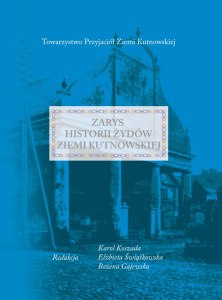
While in Kutno, I visited the Society of Friends of Kutno (Towarzystwo Przyjaciół Ziemi Kutnowski). The organization has been active since the early 1970s, and has put out an annual periodical about local history and customs for about 20 years. Most issues of the publication contain an article about Jews. In 2016, these articles were compiled in a book along with other historical materials about Kutno’s Jews, including Holocaust witness reports and photographs, and a list of people who lived in the Kutno ghetto.

okladka zarys historii

Outline of the History of Kutno Area Jews, published by the Friends of Kutno

The chairwoman of the Friends of Kutno Bożena Gajewska is an energetic and upbeat woman. She accepted the position because of her interest in local history and her desire to promote that history among local residents. She isn’t paid for this; she volunteers for the organization after getting off work. The Friends of Kutno have their office in a historic wooden villa that was recently renovated by the city. Most of their funding comes from grants. Over the years, they have placed historical markers where the synagogue, Jewish cemetery, and ghetto used to be. Other recent projects related to Jewish culture include field trips for local residents to the Polin Museum in Warsaw, to a production of a Sholem Asch play at the Yiddish Theatre in Warsaw, and to the Chełmno Extermination Camp, where Kutno Jews were transported when the ghetto was liquidated. Kutno was selected as a site where the Museum on Wheels (a traveling branch of the Polin Museum of the History of Polish Jews) would visit; this happened in August 2016.

DSC08529

Marker reads, “In this place the 18th century synagogue stood. It was destroyed by the Nazis during World War II, evidence of the hatred of one human to another, and to his works.”

Pani Bożena says she’s noticed that orientations toward Jews have improved since the Polin Museum has opened. Thanks to the Museum, you can talk about Jews, whereas before, the word “Jew” had negative connotations, and was even used as an insult. This made people unsure what to call practitioners of the Jewish faith. Polin has helped to rehabilitate the term. While this may seem like a manifestation of the particularly fraught relationship between Poles and Jews, Mark Oppenheimer just published an opinion piece in the New York Times (Sunday, April 23, 2017, “Reclaiming ‘Jew’”) in which he notes that it’s the same in the US. “Jew” is almost never used as a noun; rather, the adjective “Jewish” is used, as in “Jewish people” or “I’m Jewish” (never “I’m a Jew”). Oppenheimer quotes the comedian Louis C. K. who called “Jew” a funny word “because ‘Jew’ is the only word that is the polite thing to call a group of people and a slur for the same group.”

The Polin Museum has also contributed to a surge of activity related to Jewish history and culture throughout Poland. This has led some townspeople to complain to the Friends of Kutno, “Why is everything always about Jews?” Bożena says she reminds these people that the Friends are interested in all aspects of regional history, and Jews were a part of that history. They address plenty of other topics, as well. For example, they recently published the biography of a native son who was an ultra nationalist during the period when the majority of Kutno residents were Jews (I can’t remember his name but maybe someone reading this can remind me).

Pani Bożena drove me to see some historical sites around town. The Jewish cemetery is on a hill overlooking a neighborhood of concrete apartment buildings. The hillside is covered with tall grass and wildflowers, and crisscrossed by dirt tracks where people walk their dogs, kids play, and people hang out. Many leave their trash behind. The Friends of Kutno recently put up signs around the cemetery that say “Here is the resting place of Kutno Jews, who settled in the city from the beginning of the 16th century. The cemetery located on this hill was established in 1793. Jews were buried here until March 1943. Please maintain its solemnity.” Below this historical information is the reminder, “Keep in mind as you go into this vast expanse that this is a cemetery; people are buried here, you walk on their graves, even though there are no longer tombstones…” Further, the sign states the cemetery is a registered monument and thus legally protected, and any vandalism is subject to a sentence of imprisonment. Nevertheless, within just a few months, four out of six such signs were vandalized. The metal poles were snapped at ground level. Bożena condemned the destruction, but also minimized it as the work of thoughtless hooligans (as opposed to a deliberately antisemitic act). In September, the poles were replaced and the signs stand once again.

Bożena showing me the new sign at the Jewish cemetery in Kutno
An older monument at the top of the cemetery hill

We passed people with dogs as we walked to the top of the hill to an older monument. It contains the same historical information as the new metal signs in Polish and Hebrew (but not the reminders about proper behavior and legal issues), and is shaped like two adjoining tombstones. Heading back down the hill, past some children playing, we saw the bases of some grave markers peaking out of the grass. Many tombstones were recovered and are stored at the Kutno Museum.

Bożena dreams of building a fence around the cemetery so there will be a more substantial barrier against further vandalism. They have received all the necessary approvals, but are in need of funding.

From the cemetery, we went on to the site of the ghetto, which is outside the center of town on the grounds of a former sugar factory. The factory was used by various industries after the war, but now is closed. The buildings, some dating from the late 19th century, stand behind a high fence and a guard patrols the site. Historic markers tell the story of the ghetto. A granite plaque reads:

Here on the terrain of the former Konstancja Sugar Factory

Germans established a ghetto for the Jewish population of Kutno and the surrounding area.

After its liquidation in 1942, the surviving Jews perished in the camp at Chelmno.

Honoring their memory, the People of Kutno.

Kutno, April 1993

A more recent sign contains a bit more historical information in both Polish and English (if you want to read it, click on the photo below to enlarge it).

Former site of the Kutno ghetto.
Wall plaque at the site of the Kutno ghetto
Historical marker in front of the main gate of the factory where the Kutno ghetto used to be.

Bożena told me that over 8000 people lived in the ghetto from 1940-1942. Those who got there first occupied all the most obvious places, so later arrivals had to build shacks from scrap wood, or find ways of populating balconies and any other inhabitable space throughout the large factory hall. In 1942, they were all transported to the camp at Chełmno by train (the tracks are right across the street from the factory) and by truck.

Thinking about the people I met in Kutno (and elsewhere), one thing I am trying to sort out is why Christian Poles get involved in Jewish heritage projects. Not surprisingly, the reasons are varied. One is interested in historical artifacts; he has no political agenda. Another of my companions tried to place this history into a more pro-Polish framework. He explained that the Nazis forced Christian townspeople to do horrible things as part of a strategy to damage relations between Poles and Jews. “All people really want is to live in peace (Chcą w spokoju żyć)”, he continued, “Poland is in the heart of Europe, a pretty terrain that has historically been attacked from all sides.” Others feel personally drawn to Jewish culture. One of my acquaintances in Kutno believes she has Jewish heritage. She seems to understand my quest for my own family history. “It’s important to know where you’re from,” she told me. She hasn’t found anything as concrete as my family photograph (the one I use at the top of the blog) to confirm her feeling that she has Jewish roots. All she can point to are allusions in family stories she remembers from childhood, and sometimes people have told her she looks Jewish. But anyone she could have asked has passed away.

But what’s clear from my visits to Kutno is that fragments of Jewish history remain, and some have been marked as such thanks to the efforts of a small group of residents who think it is important to include the stories of Kutno’s Jews in the history of their town.

How Żychlin Remembers, part 2

01 Thursday Sep 2016

Posted by Marysia Galbraith in antisemitism, Jewish Ghetto, Memory, Polish-Jewish Heritage, Polish-Jewish relations, Post-World War II, Pre-World War II, stereotypes, Synagogues, World War II, Żychlin

≈ Leave a comment

The next morning I met Tadeusz Kafarski for a tour of the city. He was with Józef Staszewski, the director of the Żychlin branch of the Association of Children of War. Because Józef was born in 1929, he remembers wartime better than Tadeusz, who was only a year old when the Nazis invaded. The two sometimes disagreed about details, but together they reconstructed for me Jewish life in Żychlin. As they pointed to the buildings that stand here and now, their descriptions transported me back and forth through time, to prewar life, wartime murder, and communist era absence. I had the odd sensation as I did so many times on this trip of being both here (in the present) and then (in the past), my mind trying to reconcile what stood before my eyes with what used to be. My guides led me back in time with varied fragments of information:

On Łukasieńskiego Street, we passed concrete apartment buildings built in the 1970s on the site of the second, larger Jewish ghetto.

Mr. Helmer, the richest Jew in town, lived across from the market square, to the left of Narutowicza Street, in what is now a well maintained two story building.

One block south, near the synagogue (the blue Star of David on the map below) on Kilińskiego Street, we passed the former home of a Jewish doctor, a building that used to be a dairy collection point, and another that was the preschool Tadeusz attended. A man named Merc lived nearer the synagogue. Behind some houses was the Jewish slaughterhouse, but Christian Poles also bought meat from there.

Jews and Poles lived side by side, even though this part of town was predominantly Jewish. Today, this section of town is run down though these particular buildings seem in good shape.

Map of Żychlin 1940-42 showing the ghettos in red, the first one is on the left and the second is on the right. The dark green shows the main areas where Jews lived--note that most were not in what became the ghetto. That meant gentiles had to move out of those areas when the Jews were forced to move in.

Map of Żychlin 1940-42 showing the ghettos in red, the first one is on the left and the second is on the right. The dark green shows the main areas where Jews lived–note that most were not in what became the ghetto. That meant gentiles had to move out of the ghetto areas when the Jews were forced to move into them.

As we wound through the dusty streets, the contemporary residents stared at us suspiciously, though some who know my guides greeted them, “Dzień dobry (Good day).”

The patch of tall weeds in front of the synagogue (on Jana Kulińskiego Street) used to be a fenced garden. The garden continued to be maintained after the war, even though the Polish residents used the synagogue as a warehouse, as did the Nazis. The lower sections of the windows were bricked in and new doorways were installed in the sides of the building to facilitate loading and unloading.

What's left of the Żychlin synagogue. Note the windows used to extend much father down, and the more recent doorway (now blocked) added when the building was used as a warehouse. The weedy area in the foreground used to be a fenced garden.
What’s left of the Żychlin synagogue. Note the windows used to extend much father down, and the more recent doorway (now blocked) added when the building was used as a warehouse. The weedy area in the foreground used to be a fenced garden.
Pan Józef beside the site of the well and mikvah
Worn stones--something I learned to value as a student archeologist. These were used in place of asphalt before World War II
Worn stones–something I learned to value as a student archeologist. These were used in place of asphalt before World War II

As a child, Józef went inside several times with his parents, though he could only describe the general layout of the interior. The candlelit altar was on the east wall, the main entrance on the west. Above the entrance was a balcony that would have been for the choir in a church but in the synagogue was for women to pray in. In a neighboring building, the rabbi would change. On the other side of the synagogue were a well (with the best water in town) and mikvah. After the war, everyone used that bathhouse.

Józef said, “There is just one faith; Jews believe in God just like we do.” He declared children played together regardless of religion. He described distinctive aspects of the Jewish population. Men wore head covers and beards. They would take their shoes off in the synagogue, but had to keep their head covered. The Jewish “priest” was the only one with side curls. He wore a black hat, black clothes, and a white shirt. Jews stayed home Friday and Saturday; they didn’t work. They held their hands at their waist and rocked as they prayed. They read scrolls. Jews used to bury their dead in a sitting position with money on their eyes. Men carried the unclothed, shrouded body to the cemetery. They returned to God as they began. When they left the cemetery after the burial, mourners dispersed in different directions . He asked why and was told it was so the spirit doesn’t return home with them.

Are these personal memories or stereotypes picked up from other sources?

My guides told me about a man named Rozenberg. They pointed to the yard of his bakery, and then we walked around to what used to be its storefront on Narutowicza Street. Rozenberg lived in a multi-story home on the other side of the street. He married a Christian named Czajka. Jozek said the Rozenbergs’ children Krysia and Rudek were Jewish. He played with the boy. After her husband died, Czajka married her brother-in-law, a judge. They had two more children. After the war, the family was harassed by the police so they sold all their buildings and went to Israel. One child moved to Norway.

The Germans occupied the town on September 15. At first, they didn’t treat anyone harshly, but they did take their property—first the stores and richer buildings owned by Jews, and then jewelry and everything anyone had that was valuable.

The main entrance to the ghetto used to be across from Rozenberg’s bakery. This was the second ghetto, established later for the poorer Jews. The first ghetto, where the richer Jews were sent, was on the grounds of an old factory outside the center of town. As Jews were forced into the ghetto, Poles whose homes were within the ghetto territory had to move to homes on the other side of the street—homes that had been emptied of their Jewish residents.

In July 1942, the second ghetto was liquidated. It took five hours because thousands of people were loaded onto wagons, and then everything was removed from their homes and segregated into piles. Some Poles helped, forced to work under threat of death. My guides disputed claims that Poles plundered Jewish possessions. They insisted the Germans took everything valuable, then piled up all the remaining dirty and broken things and burned them.

We crossed the street to the main square. Right there in front of the church there used to be a row of market stalls run by Jews. The church owned the land, but didn’t have any problem with Jewish venders. We continued behind the church and across another market square to the town library. This solid stone structure was originally built for Hempel, the Nazi mayor of the town remembered for his cruelty.

My guides Tadeusz Kafarski and Józef Staszewski in the town square
The Żychlin town square
Director of the Żychlin Library, Ewa Andrzejewska
Nazi Mayor Hempel's villa is now the Żychlin Public Library
Nazi Mayor Hempel’s villa is now the Żychlin Public Library

Tadeusz told me the wartime mayor’s villa was built with tombstones from the Jewish cemetery. Jews were pressed into service carrying the heavy stones. It was backbreaking labor made more difficult by the extreme heat. When one of the workers asked for a drink of water, the Nazi officer shot and killed him. Then, he held up a stick threateningly and asked who else wants a drink. No one dared ask for water after that. Józef told the story a little differently. He said the man who asked for water was dragged to the nearby lake and drowned.

Pani Ewa Andrzejewska, the director of the library, said her aunt who took care of Hempel’s children described him as ruthless, “A typical German.” He furnished his house with things he took from the richer people in the city. He rode a white horse. She also suggested my guides were a little too invested in showing Poles in a positive light to me—emphasizing heroism and victimization and minimizing complicity. She said that on one hand, Jews and Poles lived peacefully together. She was raised to not feel any prejudice. But on the other, many have negative sentiments toward Jews. She even went further to say Poles are genetically indisposed toward Jews. I challenged her on this saying that since sentiments toward Jews have changed over time, it’s a matter of history, not biology. She still didn’t agree, and repeated that Poles have a problem with this.

A dream of mine would be to help preserve and maybe even rebuild the town synagogue. My hosts said the TMHŻ has looked into turning it into their meeting space. Ewa said the ownership of the building is in dispute. So for now it just sits there, slowly crumbling away.

Leaving town the next day, I was once again stopped at the railway crossing as a train sped by. I didn’t mind having one last moment in this town where my great grandmother lived. I felt saddened and rooted by what I had learned, and grateful for the acquaintances who showed me Żychlin as it is now and as it was then.

How Żychlin Remembers, part 1

01 Thursday Sep 2016

Posted by Marysia Galbraith in Bolimów, Jewish Ghetto, Memory, Polish-Jewish Heritage, Polish-Jewish relations, Post-World War II, Pre-World War II, Sobota, Synagogues, World War II, Żychlin

≈ 1 Comment

My visit to Żychlin began and ended at the railway crossing. I had meandered up from the highway, passing through the small communities of Bolimów and Sobota where my ancestors lived over a century ago, and had to stop as a train sped by. I called pan Henryk to make sure I was on the right road. He assured me I was, and met me a few minutes later. Henryk, whom I met in 2014 through his website Historia Żychlina, had arranged meetings, tours, and interviews for me with resident fans of local history.

Bolimów synagogue, now the police station at 6 Farna Street
Central Square, Sobota

Tadeusz Kafarski, Vice President of the Association of Enthusiasts of Żychlin History (TMHŻ) joined us for a look around the train station. He and Henryk pointed across the tracks where during World War II transports took 2500 Jews from the Żychlin ghetto to Kulmhof (Chełmno) Camp near Poznań. They debated exactly where the trains had stood, but later, Henryk and his wife took me to a platform across from the main train station, saying that is where it happened.

Pan Tadeusz describing the transports that took away the Jewish residents of Żychlin in 1942.
Żychlin Train station, boarded up and unused
Looking across the express train tracks to the platform where Jews were loaded onto transports
A closer look at the same platform

The station building signals the effects of communism and its demise on this community. My guides told me the prewar station was imposing and beautiful. The postwar building that stands today—boarded up in places, broken windows and graffiti in others—is more functional than attractive. Its size shows that this used to be a major stop on the route from Moscow to Berlin. But since the express tracks were laid following the fall of communism, only a few trains stop here each day. Instead, every few minutes, one zips by at breakneck speed. The place was deserted, except for a group of teenagers who were hanging out.

Tadeusz told me he remembers the transports as they left the station with their human cargo in 1942, even though he was only four years old. During the war, when his family was forced to move from their home, as were many residents, they were resettled in a former Jewish residence. From the street it looked like a normal cottage with a living room on one side and a kitchen on the other. A distinctive feature of this house, though, was the stairs from the kitchen to the basement and the door from the basement to the courtyard behind the house. This private entrance was used sometimes by the men of the family who didn’t want to be seen returning in their dirty clothes.

Others whom I met during my visit shared similar memories of childhood. Janusz Tomczak, who was a teenager during the war, remembers seeing the land covered with wagons. Only later, he understood that these belonged to the Jews who were being taken to the camps. Józef Staszewski was with some older boys when the ghetto was being liquidated. It was a few days before Easter. He was a scout at the time and he made a vow to God he that he would choose death before he betrayed his friends. A couple of blocks from where they stood, Nazis loaded people into wagons and took them away. Now he knows that the captives were segregated by age and ability, and the children and elderly were led to special vehicles and then gassed inside them.

To be continued….


Włocławek’s Forgotten Street: The Street of Death (Ulica Śmierci)

04 Thursday Aug 2016

Posted by Marysia Galbraith in Heritage work, Memory, Polish-Jewish Heritage, Synagogues, World War II, Wronki, Włocławek

≈ 4 Comments

Tags

Facebook Fan Page, Memory for the Future, Miejsce Pamięci Zagłady Blisko Nas, Pamięć dla Przyszłości, Places of Holocaust Memory Near Us, Włocławek’s Forgotten Street, Włocławska Zapomniana Ulica

“Here and then” (“Tu i wtedy”)…that was the recurring line in Deputy Mayor Robert Dorna’s speech at the unveiling of the lapidarium in the Jewish cemetery in Wronki in December 2014. He linked the place we were standing (tu—here) to various moments in history (wtedy—then).

This could be an apt description of many of the heritage projects I have observed. They are efforts to gather together the fragments that can be recovered, and to reassemble them so they bring back to everyday landscapes the memories of multiple historical events in the lives of former Jewish residents. Seeing the past in the present has also been the touchstone of my recent trip to Poland. Everywhere, it seemed I was walking through streets as they look today, and at the same time carrying envisioning the way they looked back then (wtedy). Linking a particular place concretely to its past was also the goal of the contest that led the students and teachers at the Automotive High School in Włocławek (Zespół Szkół Samochodowych im. Tadeusza Kościuszki) to develop their Facebook “fan page” Włocławek’s Forgotten Street (Włocławska Zapomniana Ulica). They decided to focus on Piwna Street, which despite its small size (just two blocks long) became a focal point for viewing Jewish life and death in this city.

Screen Shot 2016-08-04 at 12.05.30 PM

Włocławska Zapomniana Ulica–the Facebook fanpage documenting the history of Włocławek’s Jews, on Piwna Street and beyond.

For thirteen years, the program “Memory for the Future” (“Pamięć dla Przyszłości”) has held annual contests for middle and high school students, challenging them to explore some aspect of Holocaust history. Initiated by the Association of Children of the Holocaust in Poland, and joined in recent years by the Polin Museum, Jewish Historical Institute, and Center for Educational Development, students have produced a variety of projects—essays, posters, and drawings. This year, the sponsors decided to try something new, more in keeping with the way young people communicate today. That’s why this year’s challenge “Places of Holocaust Memory Near Us” (“Miejsce Pamięci Zagłady Blisko Nas”) involved the production of a Facebook page.

Włocławek is a city of about 114,000 residents; the population has been declining since the fall of state socialism as local industries have closed and residents have sought better opportunities in more prosperous places within and outside of Poland. A century earlier, the city experienced rapid growth; during the four decades before World War II, it became a regional industrial center and the population tripled, reaching 68,000 by 1939. Jews were important contributors to the city’s development, and comprised nearly 20% of residents. My family was among the migrants to the city during this time. By the end of the war, most of Włocławek’s Jews had been murdered, the synagogues burned, and the cemetery desecrated.

Screen Shot 2016-08-03 at 4.33.01 PM

Map of Włocławek in 1930. Piwna Street is to the left of the bridge, just past an estuary opening out to the river. Map by Wojskowy Instytut Geograficzny.

Piwna Street is located off of Wyszyński Street (one of the main routes through town). About one third of the way along its short length it makes a 90 degree turn and runs for another block parallel to the Vistula River. On the river side is a massive two story building and dock that includes the Rejs na Przystani Café. Across the street, colorful depictions of fruits and the products made with them decorate the wall around the Delecta factory (see the cover photo of the Facebook page above). Until the Forgotten Street project, nothing indicated that Piwna was called the “Street of Death” after the Nazi occupation.

In September of 1939, the city’s synagogues were burned to the ground and the Jewish population was terrorized (read more about this here); some were arrested while others were killed. The retreating Polish forces had blown up the bridge across the Vistula, so the Nazis decided to replace it with a pontoon bridge at Piwna Street. But first the riverbank had to be reinforced. Captive Jews were forced to do this backbreaking work, using the stone and concrete remnants of the synagogue as building materials. Many died in the process, hence the name “Street of Death.”

What’s extraordinary about the high schoolers’ project is how effectively it brings into the present an awareness of the past. It does so with a wide variety of archival information, photographs, and first-person recollections. The public nature of the fan page also meant that other people learned about this history and could even contribute to it. For instance, one viewer posted this gouache painting of Piwna Street from the mid-19th century.

WloclawekUlPiwna1853

The view across Zgłowiączki Estuary and Piwna Street. Gouache by Alfons Matuszkiewicz, c. 1853. Posted on Włocławkska Zapomniana Ulica

To date the fan page has 1773 “likes.” Another component of the project was the posting of a QR code that when scanned with a smartphone connects to a brief explanation of the history of Piwna Street in four languages. QR codes were also posted at several other sites around town that are associated with Jewish culture (listen here).

DSC08097

QR code linking to a brief history of Piwna Street.

For now, these notices are just on laminated paper, but the hope is that something more permanent will be installed so visitors will continue to connect here and then—this particular location with the events that occurred in the past. When I visited in June, the city’s president expressed his support for the project. The question remains where the money will come from to pay for a more lasting marker. Still, with people of good will and extraordinary energy like the teachers and students at the Automotive High School, I’m hopeful something will be done in the not too distant future.

DSC08098

The teachers who worked on the project Włocławska Zapomniana Ulica: from the left, Anita Kaniewska-Kwiatkowska, Monika Lamka-Czerwińska, and Robert Feter.

← Older posts
Newer posts →

Categories

  • Anthropology (37)
    • Archives (14)
    • Fieldwork (7)
    • Ground Penetrating Radar (GPR (4)
    • Research Methodology (8)
  • antisemitism (14)
  • Association of Descendants of Jewish Central Poland (32)
  • Catholicism (8)
  • Conference (1)
  • Discrimination (2)
  • Family (69)
    • Bereda (17)
    • Kolski (13)
    • Piwko (22)
    • Rotblit (3)
    • Walfisz (4)
    • Winawer (7)
  • Genealogy (11)
  • Heritage work (66)
    • Commemoration (23)
  • Identity (18)
  • Israel (6)
  • Jewish Culture (89)
    • Cemeteries (51)
    • Museum (7)
    • Synagogues (33)
  • Jewish immigrants (8)
  • Jewish Religion (1)
  • Memory (70)
  • Names (14)
  • Photographs (6)
  • Pifko-Winawer Circle (5)
  • Poland (125)
    • Baligród (1)
    • Bolimów (1)
    • Brześć Kujawski (5)
    • Buk (1)
    • Chodecz (1)
    • Dukla (2)
    • Dąbrowice (1)
    • Gdynia (1)
    • Gostynin (2)
    • Gąbin (1)
    • Izbica Kujawska (1)
    • Kazimierz (4)
    • Kowal (1)
    • Koło (1)
    • Krakow (7)
    • Krośniewice (1)
    • Kutno (6)
    • Kłodawa (1)
    • Lesko (8)
    • Leszno (1)
    • Lubień Kujawski (1)
    • Lubraniec (1)
    • Lutowiska (3)
    • Piła (3)
    • Podgórze (2)
    • Poznan (11)
    • Przemyśl (2)
    • Pzedecz (1)
    • Radom (1)
    • Radymno (1)
    • Sanok (1)
    • Skierniewice (5)
    • Sobota (2)
    • Tarnów (2)
    • Warsaw (22)
    • Wielkopolska (1)
    • Wronki (7)
    • Włocławek (20)
    • Zasław (2)
    • Łódź (1)
    • Żychlin (30)
  • Polish Culture (10)
  • Polish-Jewish Heritage (60)
  • Polish-Jewish relations (60)
  • Post-World War II (24)
  • Pre-World War II (22)
  • Reclaimed Property (1)
  • stereotypes (3)
  • Survival (9)
  • Trauma (3)
  • Uncategorized (5)
  • Victims and perpetrators (4)
  • World War II (45)
    • Jewish Ghetto (12)
    • Nazi Camps (5)
    • Polish Underground Army (3)
  • Yiddish (5)

Enter your email address to follow this blog and receive notifications of new posts by email. Your email address will not be shared.

Archives

  • October 2025 (1)
  • July 2025 (8)
  • June 2025 (1)
  • April 2025 (1)
  • August 2024 (3)
  • July 2024 (3)
  • May 2024 (2)
  • April 2024 (1)
  • May 2023 (2)
  • January 2023 (2)
  • December 2022 (7)
  • November 2022 (2)
  • October 2022 (5)
  • September 2022 (1)
  • January 2022 (1)
  • August 2021 (1)
  • December 2020 (2)
  • July 2020 (1)
  • May 2020 (3)
  • April 2020 (1)
  • March 2020 (1)
  • January 2020 (2)
  • May 2019 (1)
  • February 2019 (1)
  • November 2018 (1)
  • September 2018 (1)
  • August 2018 (3)
  • July 2018 (1)
  • June 2018 (1)
  • May 2018 (1)
  • April 2018 (2)
  • March 2018 (2)
  • February 2018 (2)
  • January 2018 (2)
  • December 2017 (2)
  • November 2017 (2)
  • October 2017 (1)
  • September 2017 (3)
  • August 2017 (3)
  • June 2017 (2)
  • May 2017 (3)
  • April 2017 (1)
  • March 2017 (2)
  • February 2017 (1)
  • January 2017 (2)
  • December 2016 (2)
  • November 2016 (4)
  • October 2016 (1)
  • September 2016 (6)
  • August 2016 (2)
  • July 2016 (1)
  • May 2016 (4)
  • April 2016 (2)
  • March 2016 (3)
  • February 2016 (4)
  • January 2016 (3)
  • December 2015 (3)
  • November 2015 (5)
  • October 2015 (5)
  • September 2015 (3)
  • August 2015 (4)
  • July 2015 (3)
  • June 2015 (3)
  • May 2015 (4)
  • April 2015 (9)
  • March 2015 (3)
  • February 2015 (2)
  • January 2015 (5)
  • December 2014 (4)
  • November 2014 (9)
  • October 2014 (2)
  • September 2014 (1)

Copyright Notice

All original text and images are copyright © Marysia Galbraith. Please contact the author before quoting.

Blog at WordPress.com.

  • Subscribe Subscribed
    • Uncovering Jewish Heritage
    • Join 145 other subscribers
    • Already have a WordPress.com account? Log in now.
    • Uncovering Jewish Heritage
    • Subscribe Subscribed
    • Sign up
    • Log in
    • Report this content
    • View site in Reader
    • Manage subscriptions
    • Collapse this bar
 

Loading Comments...