• About
  • The Photo that Started it All

Uncovering Jewish Heritage

Uncovering Jewish Heritage

Category Archives: Identity

Polish Anthropologists against Discrimination

15 Tuesday Nov 2016

Posted by Marysia Galbraith in Anthropology, Identity

≈ Leave a comment

Tags

Adam Mickiewicz University, globalization, immigrants, Institute of Ethnology and Cultural Anthropology, minorities, national mythology, patriotism, populism, presidential election, refugees, xenophobia

Poland is having its own troubles with a turn toward intolerance and the reassertion of a monoethnic Polish–and Catholic–norm. It parallels trends in numerous countries, including my own, against immigrants, Muslims, Syrian refugees, and minorities. I’m proud to say my friends and colleagues in the Institute of Ethnology and Cultural Anthropology at Adam Mickiewicz Univeristy in Poznan are organizing in support of multiculturalism and migration. An article in Gazeta Wyborcza, Anthropologists against Racism in Discussions about Refugees, begins:
“Different terms have become politicized. The word patriotism begins to be identified with aggressive nationalism, culture becomes an instrument of exclusion,” assert anthropologists. They are convening a special meeting in which they want to oppose racism and the appropriation of concepts by radicals and xenophobes.”

The original text in Polish reads- Różne terminy zostały upolitycznione. Słowo patriotyzm zaczyna być utożsamiane z agresywnym nacjonalizmem, kultura staje się narzędziem wykluczenia – twierdzą antropolodzy. Zwołują nadzwyczajny zjazd, na którym chcą się sprzeciwić rasizmowi i zawłaszczaniu pojęć przez radykałów i ksenofobów.

In Poland’s election in 2014, the Law and Justice Party, riding a wave of populist frustration with the status quo, won in a surprise victory over then-President Komorowski. They have since won a plurality in the parliament and are more powerful than ever. Joanna Kakissis examined this in her report Populist Party Campaigns on Making Poland Great Again on All Things Considered today.

I’m fearful about what will happen next in Poland, and in the US. Already last summer, some heritage workers in Poland said they are confronting more road blocks against raising money for projects. Some people in government are also trying to limit free speech by making it a crime to speak out against the Polish nation. Scholars and journalists who investigate historic events and uncover evidence of crimes Poles committed against Jews feel threatened they might be accused of treason; it doesn’t seem to matter whether they are reporting the truth or not. What matters to some is that they may besmirch Poland’s good name; Nothing should challenge the national mythology that Poles were heroes who were themselves victims of Nazi oppression. There is no room for ambiguity, for dealing with cases where victims were also perpetrators. After our own election, I worry that the need for a simple collective narrative about American exceptionalism will now challenge free speech in the US. I already see hints of it in the anger some have expressed toward the people who are protesting the election results.

Something is definitely shifting all over the world. I believe it is a reaction to globalization and the failed promises of neoliberalism. I fear, though, it is easier to look for a scapegoat than it is to fix these fundamental institutional problems.


Mapping Family Roots

23 Sunday Oct 2016

Posted by Marysia Galbraith in Archives, Family, Identity, Polish-Jewish Heritage, Pre-World War II, Walfisz, Żychlin

≈ 2 Comments

Tags

map

I made an extraordinary find in the Kutno archive—a map of Żychlin dating from 1869. I found reference to it in an article, but the archivists had a little difficulty locating it because it didn’t have an identification number (signatura). One archivist said something about it being so fragile they don’t show it. But another found it hanging on the wall and brought it out for me. The writing is in Russian. At that time, Żychlin was in the Russian partition of Poland. After the January Insurrection in 1863, the Russians mandated all public documents had to be in Russian, not Polish. That is why archival documents before the 1860s are in Polish while the later ones are mostly in Russian.

Russian writing on the 1869 map of Żychlin

I don’t know what is written here–maybe a reader could translate it for me?

dsc08463

Map of Żychlin dated 1869

Properties are numbered on the map, but not by street address. That means the numbers are scattered throughout the city making it difficult to find particular locations. According to the Żychlin Books of Residents (Akta Miasta Żychlina, also in the archive), my Walfisz ancestors lived at various times at numbers 28, 53, and 63. My great grandmother Hinda Walfisz married my great grandfather Hiel Majer Piwko. I wrote about them in previous posts: Piwko Saga, The Photo, and Super Kosher Cookies and Sliced Ham.

The map is hard to read, patched, and creased. The cross-shaped church stands out in the top half. Below it is the market square, and #53 is in the row of buildings along its lower edge. #63 is further to the left, and #28 is on the street running down from the market square.Not surprisingly, these properties are all near the synagogue, which as best as I can tell is #86 on the map (a bit below #63).

I had already seen one Book of Residents in 2013, but in 2016 I found my great grandmother’s family listed in three others, as well. Since the books have been indexed, the archivist was able to tell me what page to look on. And even though these records are only a few years older than the map, they are in Polish. There is only one Walfisz family in the books (my great grandmother with her sisters and parents), but other more distant family names also appear: many Losmans, a couple of Kolskis, and one Jakubowicz. Each household has its own page in the book, but there can be several households in the same building. Because religion is one of the things recorded in the Books, I could see that it wasn’t uncommon for addresses with multiple households to include families of multiple faiths: some Catholic, some Jewish, some Evangelical.

I know this is just an old map, but being able to pore over it, to touch it, helped to transport me back in time, and to once again (for the first time?) connect with the place where I’m from. It doesn’t matter that I never actually lived there (nor did my mother nor even my grandmother). Some of my people did. Right there in that place. With this newfound knowledge, I drove back through Żychlin one more time, this time gazing at the buildings that once housed my family. It didn’t really matter that the buildings had changed, nor that I was still unsure how exactly the old building numbers match the contemporary ones. Once this was their home.

Southern Conference on Slavic Studies

18 Friday Mar 2016

Posted by Marysia Galbraith in Anthropology, Cemeteries, Heritage work, Identity, Jewish Culture, Memory, Polish-Jewish Heritage, Polish-Jewish relations, Wronki

≈ Leave a comment

The Southern Conference on Slavic Studies has its annual meeting right here in Tuscaloosa starting today until March 19. Tomorrow, I will present a paper about my heritage work in Poland. Here is the abstract:

From Curbstones to Commemoration: Reincorporating the Memory of Jewish Life in a Polish Town

The figure of the Jew remains a multivalent symbol in Poland, resilient even in the face of the destruction of Jewish culture during the Holocaust and erasure of its traces during state socialism. My research on Jewish heritage asks what can be done with the fragments of Jewish culture that remain in Poland, sometimes hidden and sometimes in plain sight. And what value does such memory work have? The growth of interest in Jewish culture in Poland can be seen not just in major cities, but also in smaller communities throughout the country. I focus on one commemorative project in one Polish town to illustrate changing, though still contested, orientations toward the history of Jewish residence in Poland. Specifically, I examine the rescue of fragments of Jewish tombstones from a street curb where they rested for sixty years, and the decade-long effort of multiple stakeholders to return the stones to a place of commemoration. I argue that an essential component of the project was to reincorporate the history of Jews into the wider history of the town—a kind of making what was regarded as “other” (“obcy”) into something that is one’s own (swój). The Lapidarium of tombstones from the old Jewish cemetery in Wronki has literally become a place on the map, and has returned the memory of Jewish lives to town residents and visitors. The fragments of tombstones, historical sign, and commemorative marker reveal something about the past, even if it is just in an incomplete and shattered form. And they point toward the future—the possibilities that might emerge out of reassembling Jewish life in Poland.

In memory of the Jewish community that inhabited Wronki from 1507-1939. Lapidarium of tombstones from the destroyed Jewish cemeteries of Wronki
Lapidarium of Jewish Tombstones, Wronki
Stone offering on the monument at the lapidarium in Wronki

This is my first effort to make sense of one of the most inspiring heritage projects I witnessed while in Poland last year–the lapidarium of Jewish tombstones in Wronki. I describe the project as a collective representation–symbolic of an inclusive concept of Wronki history (and by extension Polish history). Jewish residents, although they are no longer present, nevertheless comprise an essential element of that history. As such, this new resting place for Jewish tombstones represents the return of the memory of Jews back into the center of town and the center of residents’ consciousness.

But more tomorrow–my panel is from 10:15-12 PM at the Embassy Suites in downtown Tuscaloosa.

Kazimierz

13 Saturday Feb 2016

Posted by Marysia Galbraith in Cemeteries, Identity, Jewish Culture, Kazimierz, Krakow, Memory, Polish-Jewish Heritage, Polish-Jewish relations, Synagogues

≈ Leave a comment

Tags

Schindler's List

Raised on stories about Mama’s magical homeland of Poland, I visited for the first time in 1986. This was before the fall of communism, when the country was still in the grips of a state socialist government. But although I went in search of my roots, I didn’t think about my heritage as being Jewish. I knew nothing about Polish Jews, and I didn’t identify as Jewish. Nor did I mention it to anyone; there would not have been much to tell since I didn’t know anything about this aspect of my family history. Moreover, and perhaps primarily, I had somehow internalized the unspoken understanding that Poles are Catholic, and Jewish heritage wasn’t supposed to be talked about.

I review the memories in my mind, searching for clues about how I thought about Polish Jews. Again, I am reminded that I didn’t think about my own Jewish heritage during my first visits to Poland, except perhaps to repress it. I preferred the family narrative about our Polish Catholic background to the reality of our more complex past. From time to time, I saw anti-Semitic graffiti, or heard prejudicial remarks about Jews. But mostly, neither I nor the Poles I met paid much attention to the past lives of Polish Jews.

But not entirely. For instance, during the summer school I attended in Krakow, a fieldtrip was organized to Kazimierz, the former Jewish quarter of the city. Jews settled there near the end of the 15th century when faced with restrictions against living in the city center. By the 1930s the population of Kazimierz reached about 60,000 Jews. Most died in the Holocaust, leaving the district abandoned. After the war, it was not a popular place to live and those who moved in did little to maintain or update the historic buildings. By the 1980s, most of Kazimierz was in disrepair. Some buildings had fallen down completely while others had cracked, grey, and dirty walls. In fact, much of the Old City of Krakow looked run down. But Kazimierz was worse, even on Szeroka Street, the historic center of the Jewish district.

Trace of a mezuzah in a doorway, Kazimierz 1986
Kazimierz 1986
Kazimierz 1986
Old Synagogue in Kazimierz, 1986

It’s hard for me to distinguish memories from my first visit to Poland and subsequent ones in the early 1990s, but I think I went to the Remuh Synagogue already in 1986. That’s where a small group of older Jews continued to congregate. I also visited the walled cemetery next to the synagogue, where at least some of the gravestones and arched grave coverings were maintained and, judging by the small stones left on them, visited regularly. I think it was in the 1990s I was told that many of these older Jews were not in fact Polish, but rather came from the former Soviet Union. Such talk left me with the impression they weren’t real Polish Jews, but rather opportunists exploiting the growing interest in Jewish heritage tourism.

Some of the historic buildings started to be renovated already in the early 1990s. The first Jewish-themed business I remember was Ariel, a restaurant and café on Szeroka Street. It featured Jewish food and displayed Jewish memorabilia and artwork. I took some of my friends from Bieszczady, my rural fieldsite in the southeast of the country, to Ariel. I wanted to impress them with the cultural diversity of Krakow. Looking back at my fieldnotes from that time, I was surprised to see I noted that my friends were fascinated by this former Jewish district. They asked me if the café was in a Jewish style, and if the people around us were Jewish. So perhaps even then, Poles were more interested in Jewish culture than I realized.

1993Ariel

Ariel Cafe in Kazimierz 1993

Over the years, Kazimierz has become more and more popular. The first to come were artists and students seeking an edgier, cheaper part of the city to live in, as well as tourists seeking traces of Poland’s Jewish past. I have read that a turning point came after Steven Spielberg filmed Schindler’s List in the district. This was in early 1993, while I was still living in Krakow. A fake wall was built to enclose Szeroka Street near Starowiślna Street, and movie-set facades resembling World War II era businesses were painted on abandoned buildings. In effect, Spielberg turned the area into the Jewish ghetto, even though the actual ghetto was a few miles away in the district of Płaszów. I watched filming one day. An actor dressed as a Nazi officer (I now realize it was Ralph Fiennes playing Amon Goeth) strode to the top of a pile of suitcases over and over again. Mostly, everyone was just standing around. I was able to pick Spielberg himself out; he was wearing one of his signature ball caps. Some of his kids were there, and I think I saw his wife as well.

Filming Schindler's List, 1993. Ralph Fiennes is in the background, playing Amon Goeth
Filming Schindler’s List, 1993. Ralph Fiennes is in the background, playing Amon Goeth
Filming Schindler's List, Kazimierz 1993. Note Ariel Cafe in the background and the fake facades on the surrounding buildings.
Filming Schindler’s List, Kazimierz 1993. Note Ariel Cafe in the background and the fake facades on the surrounding buildings.

After witnessing the filming of Schindler’s List, I couldn’t suspend my disbelief and become absorbed into the story when I watched the movie in the theatre. It didn’t help that one of my friends, a swarthy Brazilian whose father’s family was Polish, appeared larger than life in the first “Jewish” crowd scene.

Today, so many parts of Kazimierz have been reconstructed or renovated that it can be easy to forget how derelict it used to be. In addition to the many cafes and restaurants, the synagogues, prayer houses, and other Jewish institutions have been restored. Even more significantly, eclectic forms of Jewish life have returned to the district, most visibly at the Jewish Community Center, which holds Shabbat dinners and Jewish cultural events, and functions as both a gathering point and an information center for Jewish residents of Krakow and visitors from around the world.

Inside the Tempel Synagogue, Kazimierz
Inside the Tempel Synagogue, Miodowa Street, Kazimierz 2015
Izaak Synagogue, Kazimierz
I gave a talk at the Jewish Community Center in Kazimierz, June 2015

Jewish Youth and Identity in Postwar France

30 Monday Nov 2015

Posted by Marysia Galbraith in Family, Identity, Post-World War II

≈ Leave a comment

Tags

Daniella Doron, France, Jewish Youth and Identity

My cousin’s book was just published by Indiana University Press: Jewish Youth and Identity in Postwar France: Rebuilding Family and Nation.

The book description:

“At the end of World War II, French Jews faced a devastating demographic reality: thousands of orphaned children, large numbers of single-parent households, and families in emotional and financial distress. Daniella Doron suggests that after years of occupation and collaboration, French Jews and non-Jews held contrary opinions about the future of the nation and the institution of the family. At the center of the disagreement was what was to become of the children. Doron traces emerging notions about the postwar family and its role in strengthening Jewish ethnicity and French republicanism in the shadow of Vichy and the Holocaust.”

9780253017413_med

Cover of Daniella Doron’s new book Jewish Youth and Identity in Postwar France

The author Daniella Doron and I share great-grandparents; her father’s mother was the sister of my mother’s mother. We started corresponding after I discovered her parents live twenty miles from where I grew up. It’s interesting how our scholarly interests have converged even though our family connection was broken until just a couple of years ago.

My Post on Hair Struck a Nerve

12 Monday Oct 2015

Posted by Marysia Galbraith in Identity

≈ 4 Comments

A number of readers commented on last month’s post about hair. It’s interesting to me that most reached out to me in private. Here are some of the comments I received:

So I just read your blog post quickly. I know you don’t like stereotypes (who does?), but I can’t resist telling you that I thought you were Jewish the first time I met you. And it did have something to do with your hair, but also with your way of being. I love Jewish-looking hair myself and wish I had it! Sorry if I’m being lazy in this short cut.
Loved the post!

My response: Thanks. I wonder, too if there can be some sort of recognition of ethnicity/culture–a reading of multiple clues such as hair, gestures, etc. Whatever it is, I don’t believe it can be a simple reading of physiology. Regardless, I wear my hair proudly!

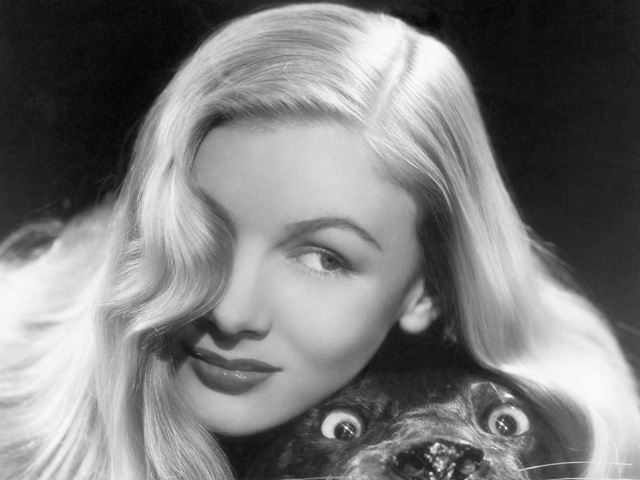
Another reader: I had to respond to what you said. Growing up Jewish, I knew/was told that Jewish hair was different. I could never (nor could any of my family or friends) wear the straight bob. I always wanted Veronica Lake’s hair. Straight, just hung there, no body. (You may not know who Veronica Lake was, but if you go on the internet you would probably get a picture of her.) I had thick hair – not curly. It is only recently with all the straighten products that one can have that straight look. I, and all my friends, had our hair thinned. We certainly wanted to look like the movie stars. Straight hair, small noses. I never thought it was a way to stereotype someone. It just was the way it was. Didn’t all young girls want to look like the movie stars? I was grateful when Barbra Streisand became famous. Although she never had the “Hollywood” image she was glamorous, which kind of made the big nose, thick hair seem more acceptable.

The question I occasionally ask myself – Why growing up didn’t we question any of this and just accepted it?

Interesting that we both used Veronica Lake as our archetype for hair. She was thinking of this:

VLake1

When I referred to Veronica Lake, I was thinking of soft, luxurious curls like this:

VLake2

More than likely, any wave in Veronica Lake’s hair was added with curlers.

And an exchange with a third reader who is not Jewish, but has full, curly hair: A wonderful essay that resonates with many things I’ve heard about my hair my whole life. You know, in Poland I had always been told I had beautiful hair. Then I came to the US at 18 and was surprised to hear that my hair was “frizzy” and apparently in need of stuff(s) that would get rid of that undesirable quality. I was thinking to myself then: “What? My hair is unusual [in Poland] and great, it’s crazy to say that anything about it should be “fixed.” But in the US, it sounded like in that particular situation (I’m talking about one person) my hair was seen as almost African-American or something. Then I realized “frizzy” was a concept here; it had never been in Poland, at least not in the Poland of my youth and childhood (where there were almost no “products” whatsoever to begin with).

My response: That’s really interesting. I think you know I’ve always loved your untamed hair. You are from the generation that was tired of the relative homogeneity of Polish culture, and would find your amazing ringlets exotic and beautiful. And it’s really interesting to learn that “frizzy” is an American concept. It’s definitely something I grew up trying to control.

Her response: I mean we have had ways to talk about thick wavy hair that’s out of control, and these days there are definitely “products” for “frizzy” hair sold in Poland (I wondered last summer at a Rossmann how many people actually buy them in Poland…). But in Polish I think these expressions are somehow more colorful/funny and they seem to refer to the state of unruly curly hair–at a particular moment–, not as a permanent feature that always should be controlled (not that I want to overanalyze it). So in my high school times you used to say “szopa” (“a barn”: meaning your hair looks like a bunch of straw stored together in a barn) or “jakby piorun strzelil w rabarbar” which translates into “as if a thunderbolt went through a piece of rhubarb”). But these expressions were somehow less definitive and diagnostic than “frizzy.”

Another reader recommended the book Coiffure to me, which is about the social significance of women’s hair in 19th century France. The review notes: “Hair, it turns out, is quite a bit more complex than it would seem, linked as it was to concepts such as ideal beauty, respectability, fashion, sexuality and even nostalgia.”

So yes. Hair seems to be wrapped up in our sense of identity, of being “like” some people and not like others. But these things aren’t fixed, either. Sometimes we feel compelled to do things with it so that we better fit Hollywood images, or what others tell us we should be like, or how we imagine ourselves (ideally) to be. And sometimes it’s good to just appreciate what we have.

Hair

13 Sunday Sep 2015

Posted by Marysia Galbraith in Family, Identity

≈ Leave a comment

Tags

categories, Halina Piwko Bereda, Maria Bereda(y) Galbraith, stereotypes

1st generation I have photos of: my great-granmother Hinda (Walfisz) Piwko with an impressive mass of hair.

1st generation I have photos of: my great-granmother Hinda (Walfisz) Piwko with an impressive mass of hair.

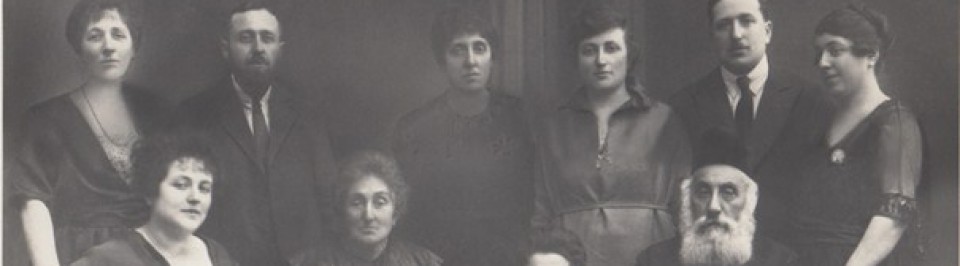
The women in my family have thick, wavy hair. My great-grandmother Hinda and her daughters all had it (see the photo at the head of this blog). In fact, in Aunt Pat’s notes (probably dictated from a conversation with Auntie Nunia), Sarah was identified by her “beautiful hair,” and Rachel by her “thick, thick hair.” When I was a child, Babcia and Auntie Nunia wore their long silver locks in buns piled high on their heads; I now know from photos that their sisters Liba, Sarah, and Rachel did the same.

I remember watching as Babcia let down her hair at night, and brushed it until it formed an undulating frame around her that extended past her waist. Then she plaited it into two braids. During the day, she wound the braids around her head and held them in place with pins and a hair net.

2nd generation: Babcia wound two braids high on her head and held them in place with pins and a hair net.

2nd generation: Babcia wound two braids high on her head and held them in place with pins and a hair net.

I can’t remember exactly when this was. Could it have been in Puerto Rico when I was five? That seems too early, but I think I was still a child. She kept her hair long until it got too difficult for her to lift her arms and pin it back. Cut short, her hair made a curly silver halo around her face.

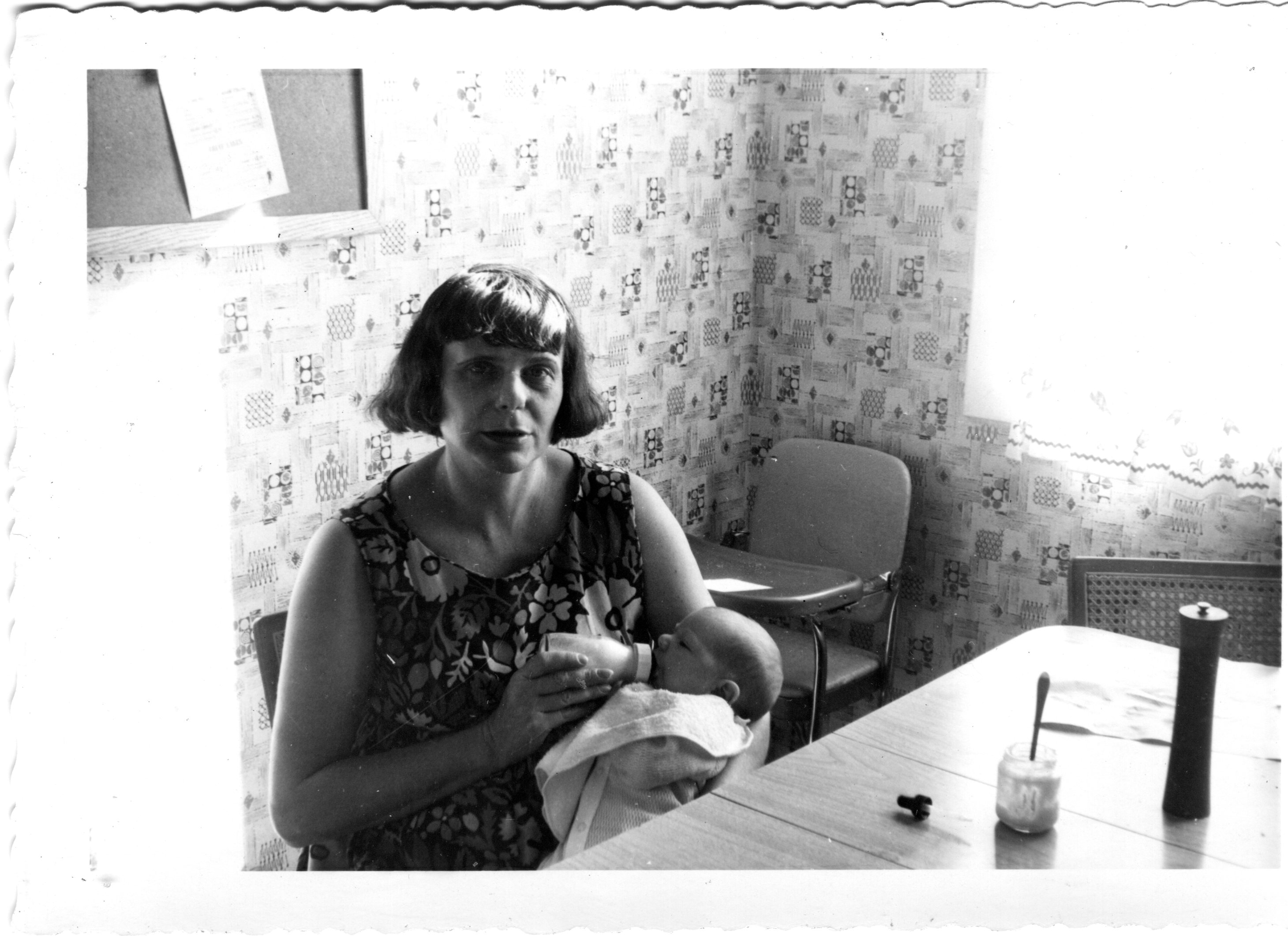
My mama inherited this wavy hair, only she wore it differently. She favored a blunt cut to the shoulders, with long straight bangs across her forehead. The bangs were styled to cover the the uneven discolored surface that grew back after the skin of her forehead was removed to use in the reconstruction of her nose. While she couldn’t hide the imperfect nose left by numerous failed surgeries, she could use her hair to hide the scars on her forehead. But it was a struggle. Left to itself, her hair curled in different directions. What she longed for was an even, thick curtain that would lie flat across the terrain she sought to conceal.

3rd generation: Mama with her unruly bangs around 1965 feeding my brother Chris

3rd generation: Mama with her unruly bangs around 1965 feeding my brother Chris

Over the years, she developed a technique where she would tie a scarf around her wet head so the bangs would dry in place. She joked it made her look like an Indian. The struggle didn’t end there. To protect against the wind exposing her scars, she held her bangs in place with hats—when I was younger she favored berets, an exotic but elegant choice that stood out in suburban Long Island.

Even as she battled her wayward locks, I admired Mama’s soft waves. I liked to stroke her head, and wished my light stringy hair were more like hers. Luckily, when I grew older, my hair became darker, and along with it, thicker and more curly. On a good day, I might have waves like Veronica Lake, or even sometimes ringlets.

4th generation: my curls

4th generation: my curls

I’ve almost always worn my own hair long. Only once, right after my brother Ron died, I cut it short. So short I looked like a boy. Perhaps it was an act of mourning. Definitely, I was motivated by the desire for a radical change. I was just a few months away from beginning my dissertation fieldwork in Poland. Short hair was liberating. It dried almost instantly, and didn’t even need combing. When it grew just a bit longer, it curled around my face much as my grandmother’s had. But still, I didn’t like it and have never cut it short again.

When I first started looking into my Jewish heritage, I told a good friend about what I was learning. Before then, he hadn’t known; it wasn’t something I had talked about with anyone, really. At some point in the conversation, he remarked that I have Jewish hair. Surprised, I asked what he means. He described my hair as wavy (though he might even have said frizzy) and coarse. This unsettled me. I have often returned to this moment, and tried to understand why. Perhaps it’s as simple as hearing something I love about myself described negatively (who wants to have coarse hair?) But it’s more than that. I like my freckles, too, and when people have encouraged me to try to hide them I’ve only been amused. So maybe my uneasiness has something to do with being stereotyped, or maybe even with stereotypes in general.

Nevertheless, this idea of Jewish hair has continued to bother me. I spent a lot of time on the trams in Poland inspecting everyone’s hair. Sure enough, it seems that most Poles have straight, thin hair. So could there be something to this idea that my curls mark me as Jewish? I hate this kind of categorical thinking, though. This is probably the key thing; it may well be that most Poles have straight hair, but many have curly hair, too. Furthermore, maybe my waves come from my Dad’s side of the family. Scots can have wavy hair, as well. In fact, lots of people from many different backgrounds have hair like mine. Genetic inheritance is not as simple as “Jewish hair” suggests.

I hesitate to even write about this because it has the potential to just perpetuate the kind of categorical thinking I want to argue against. I mentioned my hair in a talk I gave at a conference in Poland, and I feel it backfired. Afterwards a couple of people talked to me about “Jewish hair,” trying it out as a new physical trait to assign to a category of people. It left me feeling uneasy.

I’m still trying to sort this all out. I love my hair, and I love that I share it with a long line of women, from my mother to her mother to her mother. I feel richer knowing that I have Jewish roots. But I have a problem with stereotypes, and the lazy way designations like “Jewish hair” can be used to make traits that may well be common in a population into essentialized markers.

So standing in solidarity with all the straight-haired Jews, curly-haired Poles, and everyone else who does and doesn’t fit ethnic stereotypes, I wish you a Happy New Year. May the coming year bring health, happiness, and better understanding regardless of our similarities and differences.

Life and Death in Poland

03 Thursday Sep 2015

Posted by Marysia Galbraith in Identity, Israel, Jewish Culture, Memory, Warsaw

≈ Leave a comment

Tags

Embodiment, Israeli youth voyages to Poland, Jackie Feldman

One of the things I like about the blog format is that it is episodic. A flash of vision or memory appears from nowhere, and then stays around for a while. I can examine it for a while, tossing it around in my mind until its outlines grow more clear. Rarely does it unfold chronologically. So here it is September in Alabama, six months and half a world away from my trip to Israel, and yet Israel is what I have on my mind.FeldmanAbove

A big part of it is that I just finished Jackie Feldman’s book about Israeli youth voyages to Poland. Each year, thousands of Israeli youth participate in organized trips to Poland to visit the death camps and to connect more strongly with their Israeli national identity. Feldman shows how the voyages (because that’s what the trips are called) reinforce a particular narrative dividing Jewish history into three epochs: Antiquity, Exile, and Zionist settlement of the Land of Israel (p. 12). Antiquity refers to the period of sovereignty of the Isrealite kingdom. A narrative of the other two epochs plays out on the voyages—from suffering and persecution in Europe during the long period of Exile culminating in the Holocaust, to revival of Jewish national life in the contemporary state of Israel. As such, Poland represents oppression and death in Exile, while Israel represents freedom and life in the homeland.

Feldman argues that these trips, most of which are subsidized by the Israeli government, are akin to pilgrimages—a journey to a sacred place involving a break from everyday social lives and hierarchies into a liminal space filled with intense physical and emotional experiences as well as transmission of cultural, symbolic knowledge. Pilgrims return transformed, ready to reintegrate into society, but in a new social status (in this case, they transform from youths to adults and ambassadors of the lessons learned about their Jewish heritage and Israeli citizenship). I like Feldman’s book because he effectively shows how this transformation is fueled primarily by emotion and sensation—through the body—more than through cognition and learning. This is consistent with my own observations on a Polish pilgrimage to Częstochowa many years ago.

Muranów, Warsaw

Muranów, Warsaw

The book also brings home to me another thing I have observed: that the symbolic significance of Poland is quite different for me than it is for most Jews I have met. So are the emotional associations. Many Jews view Poland both symbolically and materially as a vast killing ground and graveyard. I have felt this myself, especially in places like Muranów in Warsaw, the prewar Jewish quarter that was at the heart of the Jewish ghetto during World War II. When the district was rebuilt in the postwar period, the rubble heaps (doubtless containing the bodies of victims) were left in place and new buildings were built right on top of them. This has created a district that is jarringly pleasant. The raised terraces break up the mostly flat city terrain creating intimate interior courtyards and slopes for lush gardens. But knowing the district’s history, it is hard to not feel uneasy about walking on the victims of the Holocaust.

Muranów, Warsaw

Muranów, Warsaw

Still, for me, Poland is the lost homeland of my mother—a place she mythologized and longed for. These associations were also tragic, because she knew return was not possible. But no doubt that also contributed to the magic. As an imagined place, Poland did not need to accommodate the harsh realities of postwar devastation or state socialism–or the Holocaust. And also, I’ve built my own memories of Poland over the past 25 years. I’ve witnessed the country’s “colorization” as it evolved from state socialist greyness into consumer-fueled color. My time there has always been marked as “special,” separate from the humdrum of everyday life. It’s become a second home to me. Marked as it is by my use of a second language, I also visit another version of myself in Poland, the Polish-speaking one, the foreigner, but also the native daughter returning to the homeland. In short, unlike the Israeli voyagers (for whom Poland represents death and Israel life), I return to life in Poland. Life in the face of displacement and death, perhaps even in defiance of that difficult history.

I thought I was going to write a description of my visit to Israel, but this has turned into a more reflective piece about place and identity. I’ll have to get to my memories of Israel next time.

Newer posts →

Categories

  • Anthropology (37)
    • Archives (14)
    • Fieldwork (7)
    • Ground Penetrating Radar (GPR (4)
    • Research Methodology (8)
  • antisemitism (14)
  • Association of Descendants of Jewish Central Poland (32)
  • Catholicism (8)
  • Conference (1)
  • Discrimination (2)
  • Family (69)
    • Bereda (17)
    • Kolski (13)
    • Piwko (22)
    • Rotblit (3)
    • Walfisz (4)
    • Winawer (7)
  • Genealogy (11)
  • Heritage work (66)
    • Commemoration (23)
  • Identity (18)
  • Israel (6)
  • Jewish Culture (89)
    • Cemeteries (51)
    • Museum (7)
    • Synagogues (33)
  • Jewish immigrants (8)
  • Jewish Religion (1)
  • Memory (70)
  • Names (14)
  • Photographs (6)
  • Pifko-Winawer Circle (5)
  • Poland (125)
    • Baligród (1)
    • Bolimów (1)
    • Brześć Kujawski (5)
    • Buk (1)
    • Chodecz (1)
    • Dukla (2)
    • Dąbrowice (1)
    • Gdynia (1)
    • Gostynin (2)
    • Gąbin (1)
    • Izbica Kujawska (1)
    • Kazimierz (4)
    • Kowal (1)
    • Koło (1)
    • Krakow (7)
    • Krośniewice (1)
    • Kutno (6)
    • Kłodawa (1)
    • Lesko (8)
    • Leszno (1)
    • Lubień Kujawski (1)
    • Lubraniec (1)
    • Lutowiska (3)
    • Piła (3)
    • Podgórze (2)
    • Poznan (11)
    • Przemyśl (2)
    • Pzedecz (1)
    • Radom (1)
    • Radymno (1)
    • Sanok (1)
    • Skierniewice (5)
    • Sobota (2)
    • Tarnów (2)
    • Warsaw (22)
    • Wielkopolska (1)
    • Wronki (7)
    • Włocławek (20)
    • Zasław (2)
    • Łódź (1)
    • Żychlin (30)
  • Polish Culture (10)
  • Polish-Jewish Heritage (60)
  • Polish-Jewish relations (60)
  • Post-World War II (24)
  • Pre-World War II (22)
  • Reclaimed Property (1)
  • stereotypes (3)
  • Survival (9)
  • Trauma (3)
  • Uncategorized (5)
  • Victims and perpetrators (4)
  • World War II (45)
    • Jewish Ghetto (12)
    • Nazi Camps (5)
    • Polish Underground Army (3)
  • Yiddish (5)

Enter your email address to follow this blog and receive notifications of new posts by email. Your email address will not be shared.

Archives

  • October 2025 (1)
  • July 2025 (8)
  • June 2025 (1)
  • April 2025 (1)
  • August 2024 (3)
  • July 2024 (3)
  • May 2024 (2)
  • April 2024 (1)
  • May 2023 (2)
  • January 2023 (2)
  • December 2022 (7)
  • November 2022 (2)
  • October 2022 (5)
  • September 2022 (1)
  • January 2022 (1)
  • August 2021 (1)
  • December 2020 (2)
  • July 2020 (1)
  • May 2020 (3)
  • April 2020 (1)
  • March 2020 (1)
  • January 2020 (2)
  • May 2019 (1)
  • February 2019 (1)
  • November 2018 (1)
  • September 2018 (1)
  • August 2018 (3)
  • July 2018 (1)
  • June 2018 (1)
  • May 2018 (1)
  • April 2018 (2)
  • March 2018 (2)
  • February 2018 (2)
  • January 2018 (2)
  • December 2017 (2)
  • November 2017 (2)
  • October 2017 (1)
  • September 2017 (3)
  • August 2017 (3)
  • June 2017 (2)
  • May 2017 (3)
  • April 2017 (1)
  • March 2017 (2)
  • February 2017 (1)
  • January 2017 (2)
  • December 2016 (2)
  • November 2016 (4)
  • October 2016 (1)
  • September 2016 (6)
  • August 2016 (2)
  • July 2016 (1)
  • May 2016 (4)
  • April 2016 (2)
  • March 2016 (3)
  • February 2016 (4)
  • January 2016 (3)
  • December 2015 (3)
  • November 2015 (5)
  • October 2015 (5)
  • September 2015 (3)
  • August 2015 (4)
  • July 2015 (3)
  • June 2015 (3)
  • May 2015 (4)
  • April 2015 (9)
  • March 2015 (3)
  • February 2015 (2)
  • January 2015 (5)
  • December 2014 (4)
  • November 2014 (9)
  • October 2014 (2)
  • September 2014 (1)

Copyright Notice

All original text and images are copyright © Marysia Galbraith. Please contact the author before quoting.

Blog at WordPress.com.

  • Subscribe Subscribed
    • Uncovering Jewish Heritage
    • Join 145 other subscribers
    • Already have a WordPress.com account? Log in now.
    • Uncovering Jewish Heritage
    • Subscribe Subscribed
    • Sign up
    • Log in
    • Report this content
    • View site in Reader
    • Manage subscriptions
    • Collapse this bar
 

Loading Comments...