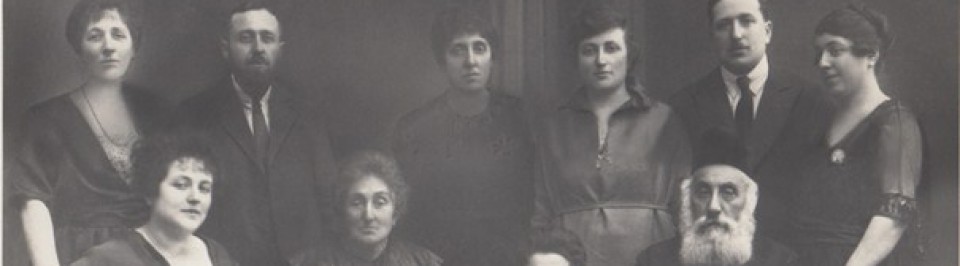
• About
  • The Photo that Started it All

Uncovering Jewish Heritage

Uncovering Jewish Heritage

Category Archives: Anthropology

Posts about anthropology and anthropological methods.

Threading the Needle

27 Wednesday Jul 2016

Posted by Marysia Galbraith in antisemitism, Baligród, Commemoration, Fieldwork, Heritage work, Jewish Culture, Kazimierz, Krakow, Lesko, Memory, Poland, Polish Culture, Polish-Jewish Heritage, Polish-Jewish relations, Tarnów, Warsaw, Wronki, Włocławek, Zasław, Żychlin

≈ Leave a comment

Tags

Erica Lehrer, Jacek Nowak, Jewish Poland Revisited, Katka Reszke, Return of the Jew

I am back from six weeks in Poland. I envisioned regular posts from the field in this blog. But instead, doing fieldwork left little time for writing and reflecting about it. Nevertheless, a structure for my next book project has been emerging. The challenge will be threading the needle between celebrating the renewal of interest in Jewish life in Poland, captured so well in Erica Lehrer’s Jewish Poland Revisited and Katka Reszke’s Return of the Jew, and addressing the ongoing silences, distaste, even hatred expressed toward Jews, as revealed in Jacek Nowak’s interviews with ordinary Poles. Because both are happening at the same time, often in the same places, and sometimes even within the same people.

And I’ve seen evidence of both in my own research. People all over Poland are doing incredible work to preserve cemeteries, renovate synagogues, document first-person accounts, and celebrate Jewish music and culture, often in the absence of any involvement from living Jews. They work with passion to fill what they feel to be a void in their local communities. And they do so despite the resistance they sometimes face from fellow residents and local government representatives. Every place tells a different story, even though many of the same elements can be found in each of them. Over the next several posts, I’ll highlight the places and projects I visited. Watch for the place names to become links to more details.

Włocławek

DSC08792

Students and teachers from the Automotive High School in Włocławek receive the first place award for their Facebook “fan page” “Włocławska zapomniania ulica” (“Wloclawek’s forgotten street”) at the Polin Museum in Warsaw, June 22, 2016. The contest was “Places of Holocaust Memory Near Us” and the challenge was to highlight a place in the local community. The team from Włocławek chose Piwna Street, called “the street of death” during World War II.
Żychlin

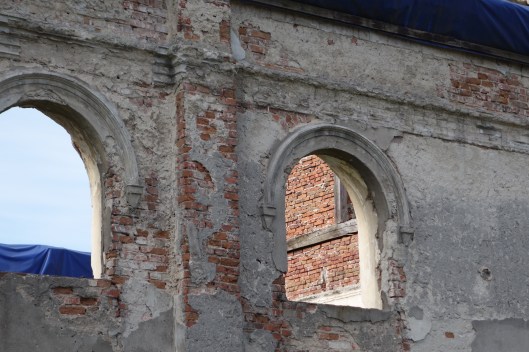
DSC08396

Detail of the synagogue in Żychlin, converted into a warehouse by the Nazis and used as such for many years after. The roof caved in several years ago. Traces of frescos are barely visible through the empty windows.

Kutno

KutnoCemetery

New signs at the Kutno Jewish cemetery provide historical information and urge residents to keep in mind this green hillside is a cemetery. Installed by Towarzystwo Przyjaciół Ziemi Kutnowski (Association of the Friends of the Kutno Region).

Wronki

An arial view of the Lapidarium in Wronki that shows the shape of the raised beds, meant to evoke an open book.

Warsaw
konferencja_zdk_polin-eng_1600_rgbIn Warsaw, the conference Jewish Cultural Heritage: Projects, Methods, Inspirations at the Polin Museum of the History of Polish Jews gave me a good idea of the scope of heritage work throughout Europe, as well as ongoing debates about Jewish heritage projects.

Krakow

IMG_0956

Glass House Orchestra performing at Shalom on Szeroka, the outdoor concert culminating the Krakow Jewish Culture Festival.

Tarnów
DSC09413

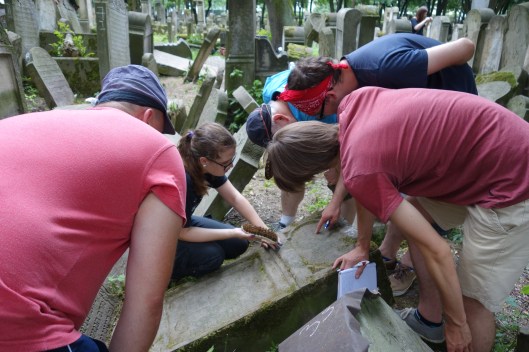
Professor Hońdo of the Jagiellonian University helps participants in the Tarnów Tombstone camp for volunteers (Tarnowskie macewy – obóz dla wolontariuszy) decipher the text on a tombstone.

Baligród

IMG_0998

The weeds grow tall in the Jewish cemetery in Baligród, despite indications of maintenance done not too long ago. It takes constant attention to keep these sites from slipping back into obscurity.

Zasław

ZaslawSignZagorz

Historical information about the Nazi Work Camp in Zasław marking the beginning of the trail from the Zagórz train station to the monument on the mass grave at Zasław. A project of the Stowarzyszenie Dziedzictwo Mniejszości Karpackich (Association of the Heritage of Minorities of the Carpathians).

Lesko

DSC09276

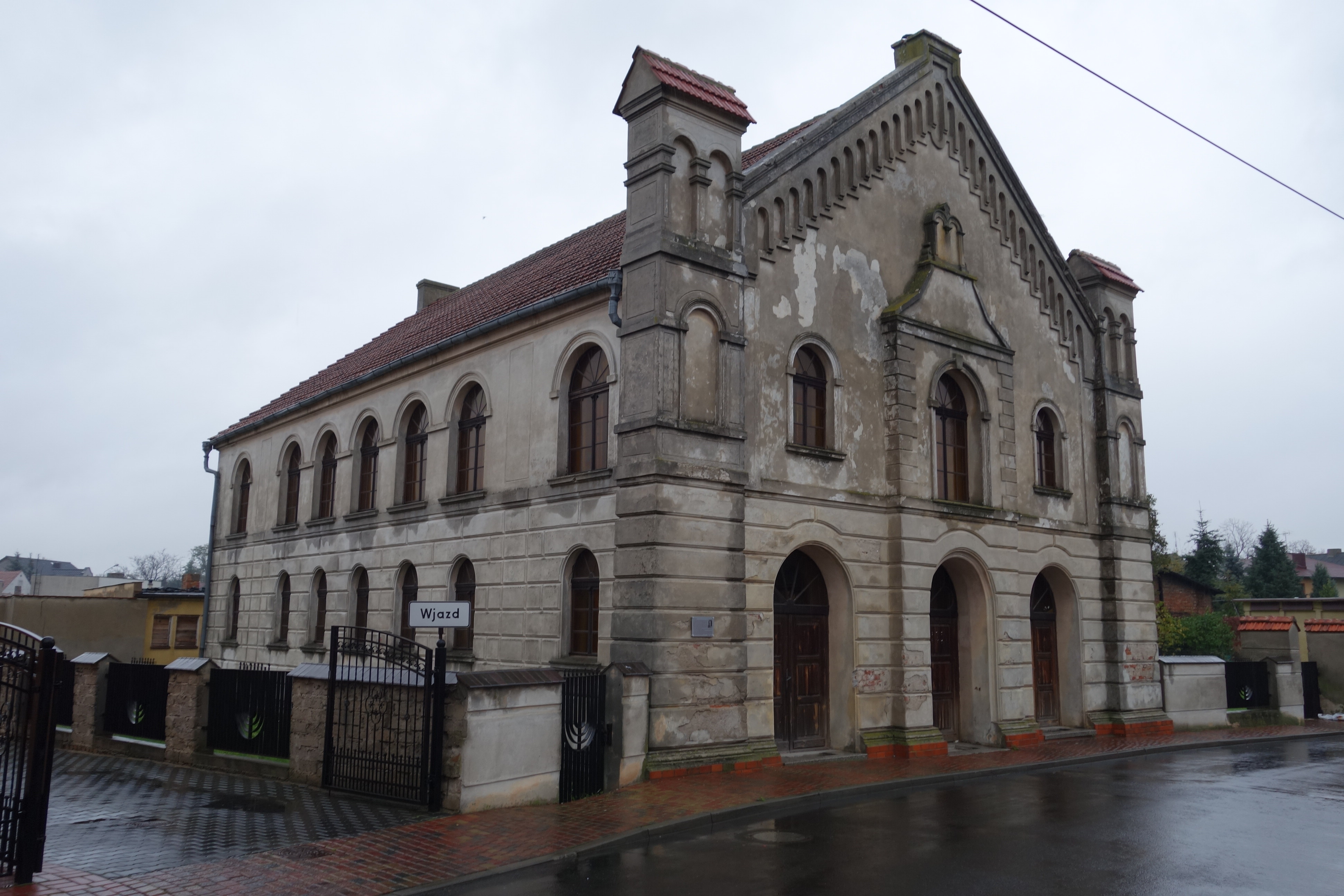
The synagogue in my beloved Lesko–much of the front facade was rebuilt and reinvented around 1960.


Council for European Studies Conference

15 Friday Apr 2016

Posted by Marysia Galbraith in antisemitism, Brześć Kujawski, Commemoration, Family, Fieldwork, Heritage work, Jewish Culture, Kolski, Memory, Piwko, Poland, Polish Culture, Polish-Jewish Heritage, Polish-Jewish relations, Research Methodology, Włocławek

≈ 5 Comments

Tags

Absence of Memory, Council for European Studies Conference, Postmemory, Reassembling Jewish Life in Poland, Włocławska Zapomniana Ulica

Yesterday, I presented a paper titled, “Reassembling Jewish Life in Poland.” It starts like this:

It is easy to get the impression that we have entered an era of retrenchment of exclusionary national, ethnic, and religious categories, making minorities of any kind suspect. Specific objects of fear, such as terrorists, raise suspicions about broader categories, such as Muslims; the economic threat attributed to immigrants extends to all Mexicans, Syrians, North Africans, or Eastern Europeans. And Jews have once again become the object of attacks in Western Europe, leading Atlantic journalist Jeffrey Goldberg (2015) to title his recent cover article, “Is it Time for the Jews to Leave Europe?” In the current climate of exclusionary politics, the quiet emergence in Poland of efforts to embrace the long history of Jewish residence is all the more striking. Recent studies have “revisited” Jewish Poland (Lehrer 2013) and documented the “return of the Jew” (Reszke 2013), challenging the common assumption that antisemitism rests at the heart of what it means to be Polish. I have been studying contemporary memory projects, including commemorative sites, museums, and cultural festivals that endeavor to reassemble the remaining fragments that provide a window into what Jewish life (and its destruction) was like in Poland. These fragments can reveal something about the past, even if it is just in an incomplete and shattered form. Perhaps of greater significance, they can point toward the future—the possibilities for reengaging with ethnic and religious categories in ways that acknowledge difference without encouraging exclusion. 

Placing a lantern at the opening of the Lapidarium in Wronki
The Atlantic, April 2015

The figure of the Jew remains a multivalent symbol in Poland, even after the destruction of Jewish culture during the Holocaust and further erasure of its traces during state socialism. My research on Jewish heritage asks what can be done with the fragments of Jewish culture that remain, sometimes hidden and sometimes in plain sight. And what value does such memory work have? It might appear that too little is left, or that any attempt to piece together fragments will just expose more horror, trauma, and death. Nevertheless, the steady growth of interest in Jewish culture in Poland can be seen in major projects like Warsaw’s Polin Museum of the History of Polish Jews, and in much quieter ways in smaller communities throughout the country. Even President Duda, whose Law and Justice Party tends to support nationalism and exclusionary practices, recently spoke against antisemitism at the opening of the Ulma Family Museum of Poles Saving Jews. To set the stage for my reflections about reassembled fragments of Jewish culture, I first situate Jews within the disrupted history of Poland, and discuss the consequences of postwar trauma under state socialism. This is also a first attempt at integrating an ethnographic approach to the topic, through exploration of commemorative sites and practices, and a more personal one, in the form of interwoven stories about my own Jewish-Polish heritage. Building on concepts of postmemory (Hirsch) and absence of memory (Irwin-Zarecka), I consider what reassembly projects promise for the reconciliation of Polish-Jewish relations on both social and personal levels.

I focused on Włocławek for my case material: Places embodying the “absence of memory” such as the swimming pool in the Jewish cemetery in Brześć Kujawski, the crumbling buildings formerly owned by Jews in the center of Włocławek, and the monument to the Jewish ghetto in the schoolyard that used to be the Jewish cemetery. I discussed what such places communicate about the history of Jewish life (and death) in Poland, as well as the personal, emotional resonances of such places.

DSC03544

Pre-World War II facade on Tumska Street, Włocławek

Then, I contrasted the impression left by the the Facebook page, “Włocławska Zapomniana Ulica (Forgotten Street of Włocławek),” in which students and teachers at the Automotive High School in Włocławek document “Places of the Holocaust close to us.” The site features historic photographs, brief histories, and excerpts from interviews with local historians and residents who remember the Nazi occupation of the city. This is heavy stuff, and yet the project reflects a different orientation toward the past than do the crumbling buildings on abandoned streets and the swimming pool in a burial ground. It is a public display of intangible heritage, a space for documenting the murder and destruction that occurred during the Holocaust in very personal, localized terms. The Facebook page announces, “These events happened here, on our streets.” It is all the more notable because the primary organizers and audience in this project are young people, probably in most cases the post-postmemory generation that was supposed to be too distant from events to feel any personal connection to them.

And the story doesn’t stop here. I am looking forward to visiting the high school students and their teachers in June. And now my cousins are also interested in the project and maybe even getting involved with it somehow. The ethnographic and personal strands of my work continue to become more strongly intertwined.


Southern Conference on Slavic Studies

18 Friday Mar 2016

Posted by Marysia Galbraith in Anthropology, Cemeteries, Heritage work, Identity, Jewish Culture, Memory, Polish-Jewish Heritage, Polish-Jewish relations, Wronki

≈ Leave a comment

The Southern Conference on Slavic Studies has its annual meeting right here in Tuscaloosa starting today until March 19. Tomorrow, I will present a paper about my heritage work in Poland. Here is the abstract:

From Curbstones to Commemoration: Reincorporating the Memory of Jewish Life in a Polish Town

The figure of the Jew remains a multivalent symbol in Poland, resilient even in the face of the destruction of Jewish culture during the Holocaust and erasure of its traces during state socialism. My research on Jewish heritage asks what can be done with the fragments of Jewish culture that remain in Poland, sometimes hidden and sometimes in plain sight. And what value does such memory work have? The growth of interest in Jewish culture in Poland can be seen not just in major cities, but also in smaller communities throughout the country. I focus on one commemorative project in one Polish town to illustrate changing, though still contested, orientations toward the history of Jewish residence in Poland. Specifically, I examine the rescue of fragments of Jewish tombstones from a street curb where they rested for sixty years, and the decade-long effort of multiple stakeholders to return the stones to a place of commemoration. I argue that an essential component of the project was to reincorporate the history of Jews into the wider history of the town—a kind of making what was regarded as “other” (“obcy”) into something that is one’s own (swój). The Lapidarium of tombstones from the old Jewish cemetery in Wronki has literally become a place on the map, and has returned the memory of Jewish lives to town residents and visitors. The fragments of tombstones, historical sign, and commemorative marker reveal something about the past, even if it is just in an incomplete and shattered form. And they point toward the future—the possibilities that might emerge out of reassembling Jewish life in Poland.

In memory of the Jewish community that inhabited Wronki from 1507-1939. Lapidarium of tombstones from the destroyed Jewish cemeteries of Wronki
Lapidarium of Jewish Tombstones, Wronki
Stone offering on the monument at the lapidarium in Wronki

This is my first effort to make sense of one of the most inspiring heritage projects I witnessed while in Poland last year–the lapidarium of Jewish tombstones in Wronki. I describe the project as a collective representation–symbolic of an inclusive concept of Wronki history (and by extension Polish history). Jewish residents, although they are no longer present, nevertheless comprise an essential element of that history. As such, this new resting place for Jewish tombstones represents the return of the memory of Jews back into the center of town and the center of residents’ consciousness.

But more tomorrow–my panel is from 10:15-12 PM at the Embassy Suites in downtown Tuscaloosa.

Jewish Krakow 1992

01 Tuesday Mar 2016

Posted by Marysia Galbraith in Cemeteries, Fieldwork, Jewish Culture, Kazimierz, Krakow, Memory, Poland, Polish-Jewish Heritage, Polish-Jewish relations

≈ Leave a comment

Tags

1992, Erica Lehrer, Jewish Poland Revisited, Postcommunism

During my photography expeditions in 1992, Krakow’s Kazimierz district caught my eye. Kazimierz has long been associated with Krakow’s Jewish population. It became a separate city for Jews when new regulations restricted their access to Krakow’s center during the 15th century. Before World War II, Kazimierz was incorporated into Krakow, but still most residents were Jewish. After the war, a tiny Jewish community congregated in a few remaining Jewish organizations. Despite their small numbers, the district continued to be associated with Jewish culture.

img110

A menorah motif on the fence around the green space on Szeroka Street, 1992

Over the past 25 years, Jewish life has returned to Kazimierz. It’s an eclectic community of people who define their links to Judaism and Jewish culture in a wide range of ways, including Poles who have recently rediscovered or reconnected with their Jewish heritage, Jews from the US or Israel or elsewhere, and people who simply appreciate Jewish culture. This is not a return to the prewar Jewish community; it is its own unique hybrid. Erica Lehrer describes the disparate strands that are woven together in Kazimierz in her book Jewish Poland Revisited: Heritage Tourism in Unquiet Places. It’s well worth reading for anyone interested in understanding something about what’s happening in Kazimierz today.

But back in 1992, the main site of active Jewish culture in Poland was the Remuh synagogue and adjoining cemetery.

Remuh cemetery, 1992. Stones left on a tombstone
Inside the Remuh synagogue courtyard, 1992
Remuh cemetery, the synagogue in the background, 1992

These are some of the older graves in Kazimierz, with the distinctive vaulted grave covers.

Part of the cemetery is surrounded by a wall made of fragments of tombstones. During World War II, many of these stones had been repurposed around the city as sidewalks and roadbeds, but they were recovered and placed in this wall.

img097

Wall around the Remuh cemetery, composed of fragments of tombstones recovered from building projects after World War II.

I also visited the larger Jewish cemetery off of Miodowa Street. Here are newer graves, dating from the 19th-20th centuries, including some postwar burials. The opulence of some of the tombstones attests to the prominence of the people buried here.

New Jewish Cemetery, Krakow 1992
New Jewish
New Jewish

But much of the cemetery was in disrepair. The tree above that is engulfing a tombstone attests to the length of time this neglect had lasted.

A final place that caught my eye, pointed out to me by a friend, Krystyna, was some graffiti inside the courtyard of a broken-down (though still occupied) building in Kazimierz. Someone painted a Madonna, but where her face should have been was a tiny door. I don’t remember what was behind the door, but it looks like there might have been

Madonna graffiti, Kazimierz 1992
Madonna painted in a recess of a courtyard full of trash and broken down walls, Kazimierz 1992

electrical circuits or perhaps water pipes. I remember Krystyna being captivated by this image. An artist herself, she wondered about its larger meaning: who would have drawn it, and why they would have put it where a door replaced the face? And why place it in a trashy courtyard in Kazimierz? I can’t remember if she said anything explicitly about the placement of Catholic imagery in the former Jewish district, but I think she did. And I certainly ponder this. It wasn’t a reclaiming of territory for Catholics–if it had been it would not have been placed where it was without a painted face. It was meant to be ironic, I believe. The Madonna of Trash and Disintegration.


Memory in Fragments: the talk at UA

31 Thursday Dec 2015

Posted by Marysia Galbraith in Brześć Kujawski, Buk, Cemeteries, Family, Heritage work, Israel, Jewish Culture, Lutowiska, Memory, Poland, Polish Culture, Polish-Jewish Heritage, Polish-Jewish relations, Post-World War II, Poznan, Pre-World War II, Research Methodology, Skierniewice, Synagogues, World War II, Wronki, Włocławek

≈ 2 Comments

Tags

Fulbright Program, Postmemory, University of Alabama

The lecture I gave at UA September 3, 2015 about my research during my Fulbright Fellowship is now available on vimeo. I’ve never seen myself lecture before. It’s a little unsettling. Still, here it is, flaws and all (for instance I know that Poland entered the European Union in 2004, even though I misspoke here).

I talk a little about the Fulbright Program–the kinds of grants available and some tips for applying.

It’s also a good introduction to my ideas about reassembling Jewish life: the strands that I’m following, what has been lost, what can be recovered, and how memory projects at sites throughout Poland intertwine with my own search for my family history. I hear echoes of some of the scholars I’ve read–Iwona Irwin Zarecka and Marianne Hirsch, as well as my sometime collaborator Malgosia Wosińska. There is no way to bring back what has been lost, but fragments of the past can be reassembled to form a new kind of life that allows for connection with what used to be and what yet might be.

Guide to the United States for the Jewish Immigrant

19 Saturday Dec 2015

Posted by Marysia Galbraith in Archives, Jewish immigrants, Pre-World War II

≈ 2 Comments

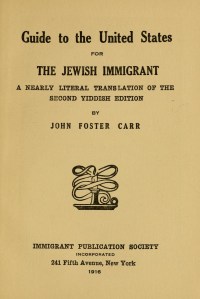
Here’s something a friend uncovered: Guide to the United States for the Jewish Immigrant, published in 1916.

Besides providing helpful information about transportation options in the US, the benefits of farming as a profession, and how to become a citizen, it includes legal advice; bigamy, spitting in public, and beating or shaking a rug are illegal. The second of these, spitting, is also disgusting.

It advises, “The Jew, like any other foreigner, is appreciated when he lives the American social life. Until then he counts for nothing.” Though it also urges, “Be proud of your race, your birth and your family, a Jew is all the better an American for being a good Jew.”

Guide

Title page of Guide to the United States for the Jewish Immigrant (1916)

Available at archive.org.

Memory in Fragments: Reassembling Jewish Life in Poland

03 Thursday Sep 2015

Posted by Marysia Galbraith in Anthropology, Heritage work, Jewish Culture, Memory, Poland, Polish-Jewish Heritage, Polish-Jewish relations

≈ Leave a comment

A summary of Dr. Marysia Galbraith’s year as a Fulbright Scholar in Poznan, Poland

September 3, 2015

Lloyd Hall 319

6:00 p.m.

Dr. Galbraith will also answer questions about the Fulbright Program and fellowship opportunities.

Former synagogue in Buk, Poland

Former synagogue in Buk, Poland

My research on Jewish heritage asks what can be done with the fragments of Jewish culture that remain in Poland, sometimes hidden and sometimes in plain sight? And what value does such memory work have? I explore these questions on two levels: the social level where I focus on what is actually being done with physical traces of Jewish culture in the absence of living Jewish communities, and on the personal level via the archeology of my own hidden Jewish ancestry. These fragments can reveal something about the past, even if it is just in an incomplete and shattered form. And they can point toward the future—the possibilities that might emerge out of traces of memory.

Chil Majer Piwko’s death notices in the Yiddish press

01 Monday Jun 2015

Posted by Marysia Galbraith in Archives, Family, Piwko, Polish-Jewish relations, Yiddish

≈ 2 Comments

Tags

Hil Majer Piwko

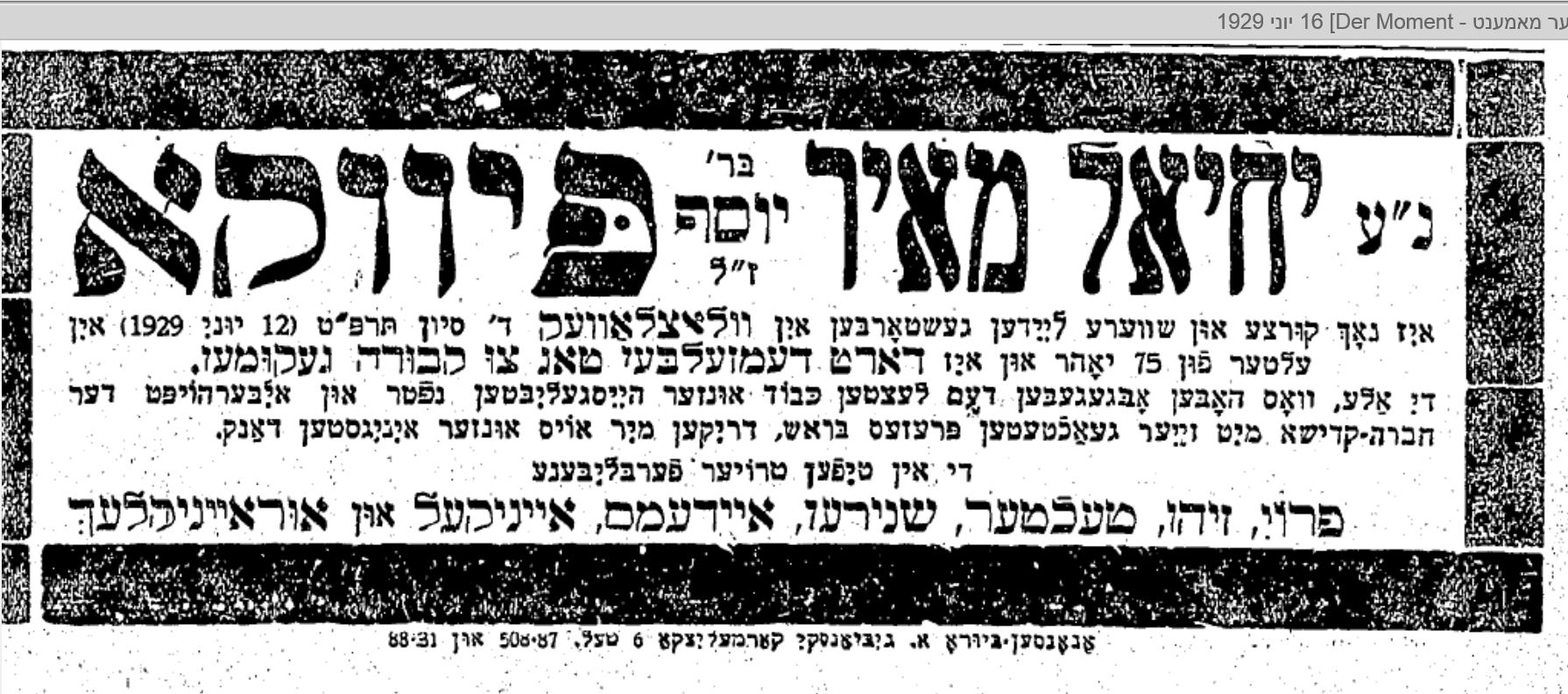
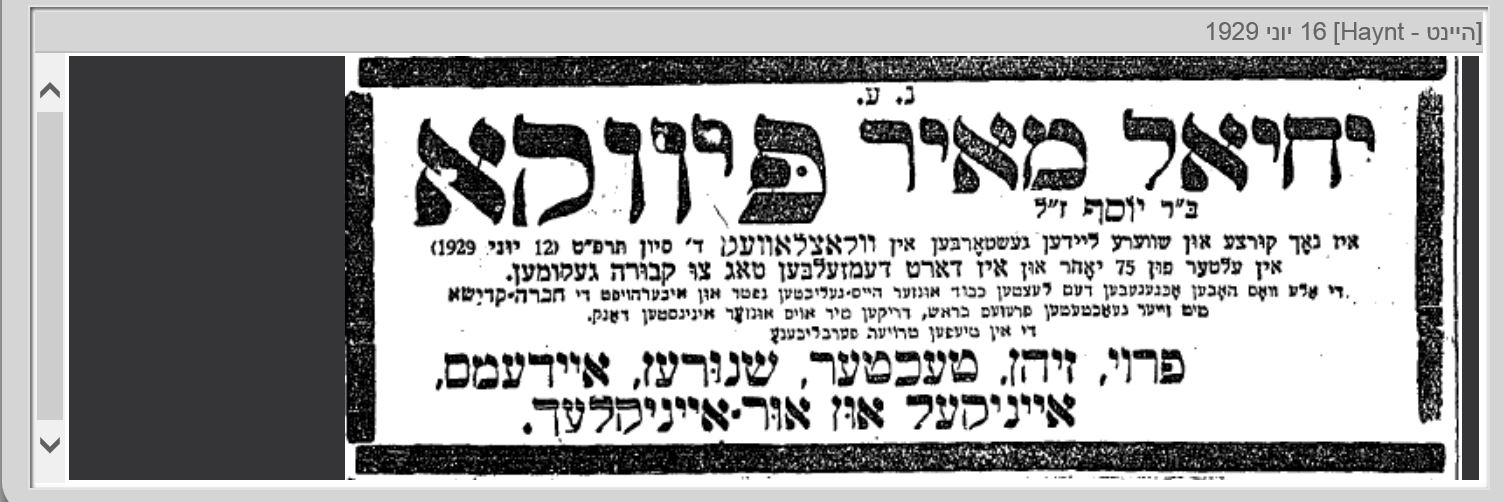
After reading my previous post about Chil Majer Piwko’s death notice, my cousin Raphael from Switzerland sent me a couple more that were published the same day (June 16 1929). These were in the Yiddish newspapers Hajnt and Der Moment.

Chil Majer Piwko's death notice from the Yiddish-language newspaper Der Moment

Chil Majer Piwko’s death notice from the Yiddish-language newspaper Der Moment

Chil Majer Piwko's death notice from the Yiddish-langugage newspaper Hajnt

Chil Majer Piwko’s death notice from the Yiddish-langugage newspaper Hajnt

Besides wanting to share them, this gives me the opportunity to revise what I said about Chil Majer. My conversations with a couple of readers helps me realize my hasty use of the term “assimilated” (even though it is widely used in the historic literature) probably does not communicate what I intended. What I meant to signal was that Chil Majer likely considered himself Polish as well as Jewish. But I have no doubt that he was also a very religious man. Nor did I mean to suggest he was on the road to adopting Polish culture in replacement of his Jewish faith. On the contrary, I’m interested in the places and spaces where Polish and Jewish affiliations intersected, complemented each other, or existed side by side.

The fact that his death notice appeared in three Jewish newspapers emphasizes even more strongly the important position Chil Majer filled in the community. The Polish-language Nasz Przegląd tended to take a more integrationist stance, in the sense that it catered to Jews who were comfortable operating in the Polish language, and who tended to invision a place for Jews within the broader Polish society. The Yiddish-language Haynt and Der Moment were competing papers that were Zionist in orientation. As such, they tended to highlight the interests of Jews as distinct from the Polish (Catholic) majority. The publication of the death notice in both languages shifts the emphasis, indicating an allegiance to both Jewish autonomy and to Polish-Jewish allegiances.

For more information about the Jewish press, see a brief summary by the Yivo Institute or Angela White’s dissertation on the Polish language Jewish press.

Warsaw archive weekend

31 Sunday May 2015

Posted by Marysia Galbraith in Archives, Family, Piwko, Polish-Jewish relations

≈ 4 Comments

Tags

Hil Majer Piwko

The first find of the weekend, at the National Library in Warsaw: my great grandfather Hil Majer Piwko’s death notice in Nasz Przegląd, one of the main Polish-language Jewish newspapers in interwar Poland.

DSC06314

Chil Majer Piwko’s death notice in Nasz Przegląd, June 16, 1929.

The text reads:

B. P. [Blessed in memory] Chil Majer Piwko died in Włocławek after brief but heavy suffering on the 12th of June 1929 (4 Siwon), at the age of 75, and was buried the same day.

To everyone who helped him on his final road, lamenting our husband and father, and especially the Funeral Brotherhood with its honorable president at its head. Wishing to express “God bless,” left in deep sadness,

Wife, sons, daughters, daughters-in-law, sons-in-law, grandchildren and great grandchildren.

The size and placement of the notice indicates my great grandfather held a position of relative prominence in the Jewish community. Also, appearing in Nasz Przegląd as opposed to any of the Yiddish or Hebrew language newspapers indicates that he identified as a Pole as well as a Jew. He was assimilated into the broader society, even though he maintained conservative modes of dress and religious practices.

I’m also struck by the mention of great grandchildren in the death notice. That’s also me, even though I wouldn’t be born for another 35 years

A crowded field

22 Friday May 2015

Posted by Marysia Galbraith in Anthropology, Polish-Jewish Heritage

≈ 1 Comment

I find myself working here in a very crowded field. At all the commemorative events, concerts, and exhibitions, I’m one of many taking photos, writing notes, and doing interviews. The press is there, along with filmmakers, and even other ethnographers. And more often than not, the organizers of events are doing their own documentation for their websites or promotional materials. All of this is a testament of the widespread interest in Jewish heritage in Poland. It’s also, I think, reflective of our mediated lives. Everything is posted on Facebook or a blog such as this one.

It was very different when I began fieldwork 25 years ago. In the Bieszczady Mountains in particular, local residents sometimes wondered if I was a spy. Why else would I spend so much time in such a remote place asking all kinds of questions? I was the only foreigner and the only anthropologist in the small town of Lesko, where I lived for a year.

I’ve had two interesting experiences in the last week alone. First, I interviewed an Israeli woman who lives in Poland. She works as a Hebrew teacher and she is doing a documentary film about what it means to be a Jew (Żyd) in Poland. Over the course of our conversation, I shared some of my own quest for information about my family. Now she wants to interview me for her film. And then today, while attending an educational event sponsored by the Polin Museum of the History of Polish Jews and coordinated by a local museum curator and schoolteacher, I met another ethnographer who is traveling with the exhibition and interviewing people involved with Jewish heritage work in each of the places that are part of the tour.

And next week, I will be the guest speaker at the unveiling of a commemorative monument at the site of the Jewish cemetery in Piła.

This all brings home the impossibility of being an invisible, objective observer in the research I am doing. The participant side of participant-observation is far more robust. I am a collaborator, a lecturer, and myself a subject of other peoples’ projects. All I can do is keep writing notes about how intertwined I become in the various projects I witness. In Jewish Poland Revisted, Erica Lehrer made a similar observation about her “postmodern field site” in Kazimierz, Krakow’s former Jewish quarter which she describes as “transnational, increasingly cyber-mediated, tangled up with flows of tourism” and a site for “the confrontation, dialogue, or at times blurring among ethnography and other practices of cultural representation, translation and brokering” (2014:7; she also describes it as a crowded field of endeavor). I can only wonder at how invisible this all was to me until I started asking the right questions and finding people who are seeking their own answers to them.

← Older posts
Newer posts →

Categories

  • Anthropology (37)
    • Archives (14)
    • Fieldwork (7)
    • Ground Penetrating Radar (GPR (4)
    • Research Methodology (8)
  • antisemitism (14)
  • Association of Descendants of Jewish Central Poland (32)
  • Catholicism (8)
  • Conference (1)
  • Discrimination (2)
  • Family (69)
    • Bereda (17)
    • Kolski (13)
    • Piwko (22)
    • Rotblit (3)
    • Walfisz (4)
    • Winawer (7)
  • Genealogy (11)
  • Heritage work (66)
    • Commemoration (23)
  • Identity (18)
  • Israel (6)
  • Jewish Culture (89)
    • Cemeteries (51)
    • Museum (7)
    • Synagogues (33)
  • Jewish immigrants (8)
  • Jewish Religion (1)
  • Memory (70)
  • Names (14)
  • Photographs (6)
  • Pifko-Winawer Circle (5)
  • Poland (125)
    • Baligród (1)
    • Bolimów (1)
    • Brześć Kujawski (5)
    • Buk (1)
    • Chodecz (1)
    • Dukla (2)
    • Dąbrowice (1)
    • Gdynia (1)
    • Gostynin (2)
    • Gąbin (1)
    • Izbica Kujawska (1)
    • Kazimierz (4)
    • Kowal (1)
    • Koło (1)
    • Krakow (7)
    • Krośniewice (1)
    • Kutno (6)
    • Kłodawa (1)
    • Lesko (8)
    • Leszno (1)
    • Lubień Kujawski (1)
    • Lubraniec (1)
    • Lutowiska (3)
    • Piła (3)
    • Podgórze (2)
    • Poznan (11)
    • Przemyśl (2)
    • Pzedecz (1)
    • Radom (1)
    • Radymno (1)
    • Sanok (1)
    • Skierniewice (5)
    • Sobota (2)
    • Tarnów (2)
    • Warsaw (22)
    • Wielkopolska (1)
    • Wronki (7)
    • Włocławek (20)
    • Zasław (2)
    • Łódź (1)
    • Żychlin (30)
  • Polish Culture (10)
  • Polish-Jewish Heritage (60)
  • Polish-Jewish relations (60)
  • Post-World War II (24)
  • Pre-World War II (22)
  • Reclaimed Property (1)
  • stereotypes (3)
  • Survival (9)
  • Trauma (3)
  • Uncategorized (5)
  • Victims and perpetrators (4)
  • World War II (45)
    • Jewish Ghetto (12)
    • Nazi Camps (5)
    • Polish Underground Army (3)
  • Yiddish (5)

Enter your email address to follow this blog and receive notifications of new posts by email. Your email address will not be shared.

Archives

  • October 2025 (1)
  • July 2025 (8)
  • June 2025 (1)
  • April 2025 (1)
  • August 2024 (3)
  • July 2024 (3)
  • May 2024 (2)
  • April 2024 (1)
  • May 2023 (2)
  • January 2023 (2)
  • December 2022 (7)
  • November 2022 (2)
  • October 2022 (5)
  • September 2022 (1)
  • January 2022 (1)
  • August 2021 (1)
  • December 2020 (2)
  • July 2020 (1)
  • May 2020 (3)
  • April 2020 (1)
  • March 2020 (1)
  • January 2020 (2)
  • May 2019 (1)
  • February 2019 (1)
  • November 2018 (1)
  • September 2018 (1)
  • August 2018 (3)
  • July 2018 (1)
  • June 2018 (1)
  • May 2018 (1)
  • April 2018 (2)
  • March 2018 (2)
  • February 2018 (2)
  • January 2018 (2)
  • December 2017 (2)
  • November 2017 (2)
  • October 2017 (1)
  • September 2017 (3)
  • August 2017 (3)
  • June 2017 (2)
  • May 2017 (3)
  • April 2017 (1)
  • March 2017 (2)
  • February 2017 (1)
  • January 2017 (2)
  • December 2016 (2)
  • November 2016 (4)
  • October 2016 (1)
  • September 2016 (6)
  • August 2016 (2)
  • July 2016 (1)
  • May 2016 (4)
  • April 2016 (2)
  • March 2016 (3)
  • February 2016 (4)
  • January 2016 (3)
  • December 2015 (3)
  • November 2015 (5)
  • October 2015 (5)
  • September 2015 (3)
  • August 2015 (4)
  • July 2015 (3)
  • June 2015 (3)
  • May 2015 (4)
  • April 2015 (9)
  • March 2015 (3)
  • February 2015 (2)
  • January 2015 (5)
  • December 2014 (4)
  • November 2014 (9)
  • October 2014 (2)
  • September 2014 (1)

Copyright Notice

All original text and images are copyright © Marysia Galbraith. Please contact the author before quoting.

Blog at WordPress.com.

  • Subscribe Subscribed
    • Uncovering Jewish Heritage
    • Join 145 other subscribers
    • Already have a WordPress.com account? Log in now.
    • Uncovering Jewish Heritage
    • Subscribe Subscribed
    • Sign up
    • Log in
    • Report this content
    • View site in Reader
    • Manage subscriptions
    • Collapse this bar
 

Loading Comments...