• About
  • The Photo that Started it All

Uncovering Jewish Heritage

Uncovering Jewish Heritage

Author Archives: Marysia Galbraith

Two Pifko Brothers Came to America

20 Wednesday Dec 2017

Posted by Marysia Galbraith in Family, Genealogy, Jewish immigrants, Kolski, Memory, Names, Pifko-Winawer Circle, Piwko, Winawer

≈ 3 Comments

Tags

Abram Janas Piwko, Census data, Efraim/Philip Piwko

Two of Babcia’s brothers sailed to America during the first decade of the 20th century. They both established bakeries in Manhattan and Brooklyn, and the younger brother Philip also made a small fortune in real estate. Philip never had any children of his own, but he became the patriarch of the family in the US. For many years, he maintained the family circle that met monthly, and helped to sponsor relatives who came from Poland. At first relatives came to work, often starting out in his bakery. Later, during and after World War II, efforts to bring relatives over from Europe became more urgent. He wanted to save their lives.

The older brother came first. He is listed as “Abram,” on the ship manifest, though some relatives called him Abraham and others used his middle name Jan (the Polish form of John). He arrived in New York on the SS Moltke on January 24, 1906, and was released into the custody of his uncle Samuel Jaretzky, who was probably related to him through his wife Bertha/Blima. There is some confusion whether Bertha’s maiden name was Kolski or Jaretzky. Bertha’s great grandson Bob has heard different stories about this—either the names were used interchangeably or one branch of the family changed their name. As if that weren’t complicated enough, In the US, the Jaretzkys dropped the Slavic ending and became the Jarets.

Bertha joined her husband in May 1907 with their three young children, Nathan, Paulina, and Ewa. Their fourth child, Sarah, was born in 1909.
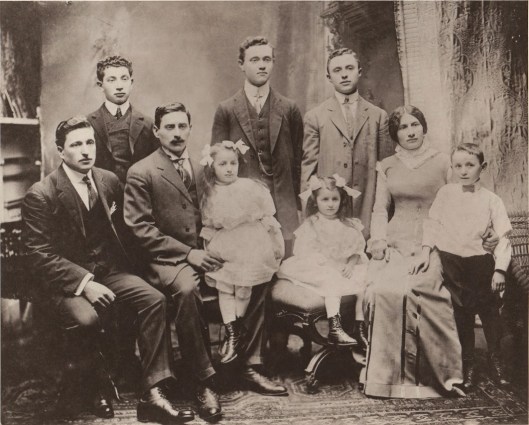
BerthaPiwkoNathanPaulineEwa c1908

The Pifko brothers around 1908, New York. Front from left: Philip, Abraham, Paulina, Ewa, Bertha, Nathan. Back from left: Raphael Kolski, Sam and Max Alexander

The younger brother, Philip/Efraim arrived in December 1907. Philip was twenty-six and still a bachelor. At first, he lived with Abraham and worked as a driver of a bakery wagon. In 1910, Abraham was foreman at a pants manufacturer.

I love this photo of them.

2Brothers

Philip and Abraham Pifko in the US.

The photo was in my grandmother’s collection, inside the envelope she labeled “do not open,” along with the others in this post. I’m guessing it was taken in New York sometime in the 1910s. They seem to be inside, so maybe the automobile was just a prop of the photographer. I’ve tried to figure out what kind of car it is. It might be some sort of runabout from the earliest years of the 20th century.

Both brothers had dark hair, and usually wore a mustache without a beard. Abraham, as described by his sister Nunia, had “devil eyes;” he “liked girls and girls liked him.” She described Philip as “shy, pockmarked, and sweet.” Nunia described both as tall, but official documents list Philip’s height as 5’ 7”. He had grey eyes and a “light brown” complexion. That’s one reason I think Philip is on the left in this photo; he looks dark, like a gypsy. Also, I imagine Abraham, as the older brother, would have been in the driver’s seat. But then again, Philip was the bakery wagon driver so maybe I have it backwards.
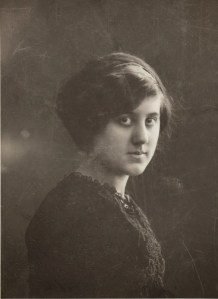
BabciasSisterMarja

The youngest sister, Malka/Maria c. 1912 in Poland

Nunia described the youngest sibling Maria/Malka as dark like a gypsy.

In 1911, Philip married Goldie Przedecka, though her name might have been Gertrude Jacobs. In my aunt’s tree, she is listed as the former, but their marriage record says the latter. Names are complicated in my family; Goldie’s sister and mother had the last name Jacobs or Posner. I’m still working on this.

Philip and Goldie never had any children, but his memory lives on, much more strongly than that of his brother. Abraham died at the age of 47 in 1925, and even though he had children and grandchildren, the cousins I have spoken with know very little about him. They have personal memories of his wife Bertha, who lived until 1968.

Census records show that by 1920, Philip had his own bakery. In 1930, his occupation is “employer.” In 1940, he is listed as a manager of real estate.

Philip’s legacy lives on thanks to everything he did for others during his lifetime. The census shows that he opened his home to a niece, sister-in-law, nephew, and mother-in-law. In 1925, his sister Sarah’s son Nathan Winawer, age 22, lived there, as well as Goldie’s much younger sister Sallie Jacobs, who was 21 years old. Around this time, Nathan and Sallie married. In 1930, Nathan and Sallie were no longer living with Philip, but Nathan was working in a bakery which may well have been Philip’s. In 1940, Bertha’s mother Nicha Posner and Abraham’s daughter Pauline lived with Philip and Goldie.

Other relatives also worked in Philip’s bakery, including Nathan’s brother Stanley Winawer. Stanley went on to open his own bakery, which he had for many years in Brooklyn. Philip helped family members in other ways. Joan, Philip’s grand niece, says he was involved in relatives’ schooling, and he was important for opening doors for them. She was just a child at the time, but she remembers anxious discussions about getting the family out of Poland during World War II.

I don’t have to look any further than my immediate family to see Philip’s generosity. When Babcia, my mother, and uncles came the US, Philip helped them, too. I’m not 100% sure whether they stayed with him, or just in an apartment he owned.

AbrahamBerthaPiwko

Bertha and Abraham Pifko in the US.

Philip may well have been following in his older brother’s footsteps. After all, Philip was one of several boarders at his brother’s in 1910. Others included the brother of Abraham’s wife, as well as two cousins, all of whom are in the photo from 1908 that’s at the top of this post. In the 1920 census, Abraham is listed as “proprietor” of a “bakerstore,” and a boarder named Charles Jacobs lived with them. Charles, age 35, had come from Poland in 1913 and worked as a bakery clerk. Could he be related to Philip’s wife Goldie, whose maiden name might also have been Jacobs?

I keep trying to fit the pieces together, to tell a story about their  lives.
 

Polish Independence Day is International News

16 Thursday Nov 2017

Posted by Marysia Galbraith in antisemitism, Identity, Poland, Warsaw

≈ 1 Comment

Tags

American Anthropological Association Meeting 2017, International press, Marsz Niepodległości, Nationalism, patriotism, Polish Independence Day, xenophobia

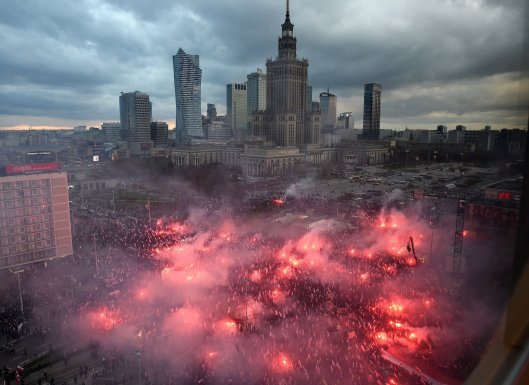
The Marsz Niepodlegołości, March of Freedom, has gotten a lot of attention from the international press, no doubt because of parallels with rising nationalism in other parts of the world. The march, organized by radical nationalist parties, was on November 11, Polish Independence Day. Started in 2010, it has attracted more attendees than the official Independence Day celebrations almost since it began.

2017NYTPolishIndependenceMarch

2017 March of Freedom under the shadow of the Palace of Culture. Photo credit: Radek Pietruszka/European Pressphoto Agency

Here are links to a few articles. Unfortunately, some of them are behind pay walls.

From The Wall Street Journal, “Polish Nationalist Youth March Draws Thousands in Capital”

The next day, “Polish Leaders Condemn Nationalist March” was published.

From BuzzFeed: “March Led By White Nationalist Group In Poland Draws Tens Of Thousands From Across Europe“

From Politico, “White nationalists call for ethnic purity at Polish demonstration“

From The New York Times: “Nationalist March Dominates Poland’s Independence Day”

And a couple days later: “Polish President Sharply Condemns Weekend Nationalist March”

From The Guardian: “‘White Europe’: 60,000 nationalists march on Poland’s independence day”

And a couple days later: “Polish president condemns far-right scenes at Independence Day march”

And in Haaretz: “Tens of Thousands Join Far-right Nationalist March for Polish Independence”

My post about the march: Independence Day: The Emotional Tenor of Populism in Poland

I’ll give a paper about it at the American Anthropological Association Meeting on November 30.


Independence Day: The Emotional Tenor of Populism in Poland

05 Sunday Nov 2017

Posted by Marysia Galbraith in Anthropology

≈ 1 Comment

Tags

American Anthropological Association Meeting 2017, cultural relativism, Ethics, globalization, minorities, November 11, Polish Independence Day, populism, xenophobia

As November 11, Polish Independence Day, approaches, I am preparing a paper about the official and unofficial marches in Warsaw that took place in 2014. I’ll present it at the American Anthropological Association Meeting in Washington DC on a panel entitled “Cycles of Hatred and Rage: What Right Wing Extremists in Europe and Their Parties Tell Us About the U.S.” on Thursday, November 30.

The unofficial March of Freedom
DSC02382
DSC02394
DSC02429

The panel will examine the dissatisfaction with the status quo that seems to have overtaken people in Europe, the US, and beyond, and the associated movements pushing for change. Anthropological studies of resistance and revolution tend to view popular dissent as a positive expression of agency by people who are underrepresented or oppressed by powerful political and economic interests. However, many of these contemporary movements are closely allied with xenophobia, making it harder to celebrate the changes they wish for.

Anthropologists usually work very closely with people, on the ground and in their everyday lives, giving voice to their thoughts, beliefs, values, aspirations and frustrations. They try to explain why they feel what they feel, and why they do what they do, so that their perspective is comprehensible for others who don’t necessarily share those beliefs, values, and experiences. Hopefully, what comes out of the effort is a broader understanding of the varied expressions of culture throughout the globe. I also think that anthropologists have tended to argue that such understanding can be grounds for greater tolerance, and even help to alleviate suffering. However, these assumptions are difficult to reconcile with the the recent rise of nationalism, nativism, and rejection of anyone and anything perceived as different.

I’ve been struggling with this myself since the last presidential election. It’s made me realize how much much my own world view is based on a belief in human progress, despite the fact that I have been critical of the so-called “metanarrative of progress” that assumes that modernization, industrialization, and for that matter globalization, lead inevitably to better lives. Other notions of progress have had a fundamental impact on my perceptions. For example, I thought I was witnessing the growth of tolerance, and the possibility of people working together toward common goals regardless of ethnic, religious, gender, cultural, and even political differences. This was part of the promise of globalization–a world more deeply interconnected, and thus interdependent. The global spread of democracy was supposed to limit warfare and global networks were supposed to contribute to economic prosperity.

Anthropologists have pointed out for decades that the benefits of globalization are unequally distributed. Some people feel left out; for them, the prosperity of others just deepens their sense of stagnation and frustration. And this brings me back to the favorable view anthropologists have tended to have of popular revolts. We’ve written about hegemony, and the failure of the oppressed to question the power structures that prevent them from getting ahead. We’ve celebrated the moments when underprivileged groups have organized and fought for civil rights and greater voice in leadership. Well, people are rising up right now. They are fighting against the structures that they see as limiting their freedom and opportunities. Cultural relativism, one of the foundational principals of anthropology, compels us to withhold judgement and understand the views of others in their own terms.

But as I tell my students when I introduce the concept to them, while it’s important to take a culturally relativistic approach in order to understand others’ beliefs and actions, that doesn’t mean we withhold critical evaluation or moral judgement. Some viewpoints need to be challenged, especially when they are dangerous to whole classes of people, whether it be because of their religion, or ethnicity, or gender.

In my paper about the official and opposition Independence Day celebrations in Poland. I will explore the reasons for the raw anger expressed by marchers in the opposition, showing how they are grounded in a legitimate critique of the failed promises of globalization. But I’ll also challenge the retreat into xenophobic nationalism. There is room in Poland  (and in the US and elsewhere) for different ethnicities and religions. There has to be, because the alternative will be worse. We’ll be back to forced resettlement, battles over territory, maybe even genocide.

See, I still hold out hope for progress–social progress where people rely on deliberation and negotiation to work out disagreements. They don’t immediately throw bottles and call each other names.

Official ceremony at Pilsudski Square.
Soldiers from the four branches of the military line up for the parade.
"I'm with Bronek," one of the few political banners in the parade, expressing support for President Bronisław Komorowski.
“I’m with Bronek,” one of the few political banners in the parade, expressing support for President Bronisław Komorowski.

Here is the panel abstract:

Cycles of Hatred and Rage: What Right Wing Extremists in Europe and Their Parties Tell Us About the U.S

The growing support for extreme right wing movements and authoritarianism in the United States and Europe has caused apprehension among political analysts and scholars. Anthropologists are uniquely positioned to make a difference and have a direct impact on understanding these events that are of such grave importance in the U.S. and abroad. This panel underscores this year’s theme, “Anthropology Matters,” precisely because anthropologists’ commitment to long-term, in-depth research on the ground with participants in these movements and through inquiry into reception to the ideas transmitted during and after election campaigns contributes to a layered understanding of these movements. The support for these movements has occurred even in well-established, formerly stable democracies. These movements are nothing new, and many have origins in the later nineteenth century. Curiously, supporters of these movements often sacrifice their own economic and social best interests in elections in order to achieve ideological goals. Anthropologists have long been interested in this phenomenon, and David Kertzer, in Ritual, Politics and Power (1988) developed salient theoretical explanations for such voters, incorporating, among other sources, his own research in Italy. This panel of anthropologists working in Europe, from Poland to Germany to Italy to France to Great Britain, addresses these concerns, drawing on their own recent fieldwork and historical research.
Attitudes toward the European Union, economic nationalism, immigration and the acceptance of refugees, deindustrialization, and globalization are among the themes discussed in this panel. A number of questions will be addressed: 1) What motivates such support? 2) Is this support something new, or is a cyclical process at work? 3) If cyclical, can existing or new theoretical explanations be derived from the process? 4) Are these movements and their supporters increasingly becoming a threat to democracy? 5) Have effective countermeasures minimized such a threat?
Discussants from Europe and North America will use these findings to analyze the impact of these European movements on current developments in the U.S. and to reflect on the cross-cutting relationships of these developments with these European social and political movements.

And here is my paper abstract:

Independence Day: The Emotional Tenor of Populism in Poland

Just as David Kertzer (1988) points to the emotional and cognitive power of symbols to shape popular support, or opposition, for political authority, Jan Kubik (1994) showed how both the state socialist authorities and the opposition Solidarity Movement made use of national and religious symbols in their competition for popular approval during the waning days of state socialism in Poland. In recent years, with market liberalization and European integration firmly established, the same national symbols are employed once again in both official and opposition rituals. Independence Day events in Warsaw (November 11, 2014) reveal the stark contrast between the official ceremony, characterized by formality and pomp, and the opposition march, full of energy and anger. Notably, both events employed national symbols and claimed to be the legitimate heirs of past struggles for freedom, but the contrasting emotional tenor of each signals fundamentally opposed orientations toward open borders, global markets, and indeed the character of the Polish nation. Considered in the context of nationalist/populist movements elsewhere, it points to a global shift toward fragmentation and isolationism. I argue that the populist reassertion of nationalism in Poland can be viewed as the rejection of neoliberal hegemony. My point is not to support or condone the concurrent rise of xenophobia, but rather to understand how the turn to a protectionist vision of Poland free of external influences emerges from disillusionment with the failed promises of open markets, especially for the working class men who dominate the opposition Independence Day March of Freedom.

The Encore

05 Thursday Oct 2017

Posted by Marysia Galbraith in Family, Survival

≈ Leave a comment

Tags

Charity Tillemann-Dick, Idiopathic Pulmonary Arterial Hypertension, Lung Transplants, Opera, The Encore

Charity Tillemann-Dick is a cousin by marriage, married to my second cousin Yonathan, and she has just published her memoir, The Encore, about her incredible journey as an opera singer who underwent lung replacement surgery—twice. I can’t wait to read this book.

This is a story about survival–a different kind of survival than I usually focus on in this blog but important nevertheless.

Cover of Tillemann-Dick's book The Encore

This is from The Encore‘s website:

“The remarkable true story of acclaimed opera singer Charity Tillemann-Dick, who received not one but two double lung transplants and went from struggling to draw a single breath to singing at the most prestigious venues in the world.

“Charity Tillemann-Dick was a vivacious young American soprano studying at the celebrated Franz Liszt Academy of Music in Budapest when she received devastating news: her lungs were failing, her heart was three and a half sizes too big, and she would die within five years. Inexplicably, despite her fatal pulmonary condition, she could still sing. Medical experts advised Charity to abandon her musical dreams, but if her time was running out, she wanted to spend it doing what she loved.

“In just three years, she endured two double lung transplants. Teetering between life and death, she slowly learned to breathe, walk, talk, eat, and sing again. With new lungs and fierce determination, she eventually fell in love, rebuilt her career, and reclaimed her life. Over a decade after her diagnosis, she has a chart-topping album, performs around the globe, and is a leading voice for organ donation.

“Weaving Charity’s extraordinary tale of triumph with those of opera’s greatest heroines, The Encore illuminates the indomitable human spirit. It’s the story of confronting devastating challenges with love: the intimate love of a mother for her daughter, a man for a woman, a doctor for her craft, and a singer for her music. Ultimately, grace from God and strangers enabled the work of love to save one young woman’s breath and allowed her to reclaim her life.”

Finding Family at the Jewish Historical Institute

24 Sunday Sep 2017

Posted by Marysia Galbraith in Archives, Family, Genealogy, Piwko, Research Methodology, Rotblit, Warsaw

≈ 2 Comments

Tags

Jewish Historical Institute, JewishGen, Żydowski Instytut Historyczny

When my cousin Krysia and I first started searching for our Jewish roots, we barely knew where to start. Our Aunt Pat, a genealogist, had shared an impressive record of names, places, and even stories. Obsessive Internet searches yielded limited results–things like a notice in the Canadian Jewish Review from October 1963 that listed my grandmother’s sister Maria Weglinska among the out-of-town guests at Rochelle Pifko’s bat mitzvah in Toronto. Pifko/Piwko was my grandmother and her sister’s maiden name. But how were they related to these Canadian Pifkos?

1963CanadianJewishReviewBatMizvah

Notice in the Canadian Jewish Review on October 18, 1963 about Rochelle Pifko’s bat mitzvah.

How could we push beyond these tidbits? What more could we learn about our family?

Thanks to the Jewish Historical Institute (JHI, Żydowski Instytut Historyczny) in Warsaw we made some breakthroughs that have helped us piece together our family tree. Krysia’s husband Steve stopped in during a business trip to Warsaw and met Anna Przybyszewska-Drozd at the genealogical division of the JHI. She did a preliminary search on JewishGen, and found references to vital records of some of our ancestors. A few months later, Krysia and I went on our first roots trip to Poland. We still had no idea what we were doing so we stopped in at the JHI, meeting with Anna’s associate Aleksandra (Ola) Dybkowska-Grefkowicz who stayed after hours to help us with our search. She prefaced everything with her usual caution, “Don’t be disappointed if you don’t find anything” because so many records were destroyed and most Holocaust deaths were not recorded. Then, she showed us how to make use of the records in JewishGen and the databases of  the Polish National Archives, and suggested other places we could search for records.

I learned enough at that meeting to make some breakthroughs. I discovered my Zurich cousins through the Family Finder database on JewishGen, and shortly after my Israeli cousins through myHeritage.

On successive trips to Warsaw, Anna and Ola helped me learn more about my grandfather Jakob Rotblit. I was speaking with Ola about his automobile dealership in Gdansk when Anna walked in. A look of recognition flashed across her face; she pulled a book off the shelf about Jewish business owners in Gdansk between the World Wars. Sure enough, Jakob Rotblit was listed with information about his Ford dealership and with details about his wife and his parents. Another time, I mentioned that my mother and grandmother are on the list of Jewish survivors who registered after World War II ended. With a satisfied smile, Ola told me that the original registration cards are in the JHI archive. I walked upstairs to the archive and was able to hold those cards in my hand. The archivist showed me how the earliest records, from 1945, were handwritten on the backs of cut up prewar accounting records. Paper was scarce, so they used what they could find. By 1946, information was filled in on larger, pre-printed cards made especially for this purpose.

Once again, just a few months ago, the genealogical division helped me with my search. Anna e-mailed me that a woman, Ellen, had contacted her to find out about her Piwko ancestors. Anna thought we were related and asked if she could share my contact information with her. Of course I agreed, and since then Ellen and I have been in ongoing communication. She is an avid genealogist who turns out to be my 3rd cousin. Her great grandfather was my great grandfather Hiel Majer Piwko’s younger brother Urish. I knew nothing about him, maybe in part because he moved to Canada in the 1880s.

DSC00199

3rd Cousins in Krakow, Poland in June 2017

Ellen and I had the extraordinary good fortune to be in Poland at the same time this June. She was on a once in a lifetime Jewish history tour of Eastern Europe with Professor Stephen Berk. Although I didn’t know anything about her or her great grandfather, I had an inkling about her branch of the family from that notice I found years ago about my Auntie Nunia’s (Maria Weglinska) visit to Toronto in 1963. Rochelle Pifko, the girl whose bat mitzvah she attended, was Ellen’s cousin and another descendent of Urish. So another mystery is solved. Some contact was maintained between my great aunt and her uncle who migrated to Canada shortly after she was born. And when Nunia/Maria came to the US in the 1950s, she renewed that connection and even visited. Ellen remembers when Nunia came to Canada some years later for another family event.

Crossing Boarders

07 Thursday Sep 2017

Posted by Marysia Galbraith in Commemoration, Polish-Jewish Heritage, Polish-Jewish relations, Radom

≈ 1 Comment

Here’s a post from a heritage seeker on a similar quest to my own. She attended the commemoration of the 75th anniversary of the liquidation of the Radom ghetto, which took place in Radom last month.

radommusings1945's avatarRadom Musings

After a few weeks of decompression, I am finally able to sort through some of my feelings about last month’s commemoration ceremony in Radom.  At times solemn, while at other times celebratory, the event was a reflection of how present day Catholic Poles choose to confront Poland’s complicated relationship between Christians and Jews.

Poland’s internal and external struggles to reconcile its past were highlighted by the incongruity of a klezmer band playing music at the entrance of the Jewish cemetery, and by the reverence demonstrated when a Holocaust Survivor spoke about his fond pre-War memories, followed by a concert of a well-known Polish performer.  While one can say that this combination of somber commemoration and entertaining celebration reflects the merger of past and present, not all of us are ready for the journey.  Poland’s past has a long way to travel before it catches up to present day Jewry.  At…

View original post 287 more words

AK Verification, Part III

02 Saturday Sep 2017

Posted by Marysia Galbraith in Archives, Bereda, Family, Memory, Polish Culture, Polish Underground Army, Warsaw, World War II

≈ Leave a comment

Tags

AK, Armia Krajowa, Maria Bereda(y) Galbraith, patriotism

NOTE: This overview of my recent discoveries at the Polish Underground Movement Study Trust, Studium Polskiej Podziemniej (SPP) got so long I am publishing it in three separate posts. Here is part III. During the German occupation of Poland during World War II, the Polish Underground Army worked in secret to resist, sabotage, and fight against the Nazis. Another name for the Polish forces is “AK,” short for “Armia Krajowa,” or “Home Army.” I talk about the soldiers as “the partisans;” in Polish sources they are also called “konspiracja,” “the conspiracy.”

Sorry it’s taken a while for me to get to part III. The semester has begun which means I’ve been very busy.

DSC00534

Pencil sketch of Maria Bereday from the 1950s, signed Ditri. Friends tell me she looks like a spy.

All of the questions the archivist Krystyna asked me about the names Mama went by paid off because she found another file; the envelope was mislabeled “Maria Fijułkowska.” Inside was a six-page report, relacja, Mama had written titled, “Outline of Courier Work.”

Initially, neither Krystyna nor I found this file because not only was “Bereda” missing, but Fijałkowska was also misspelled. Krystyna wrote “Fijałkowska” on a new envelope; I don’t know why she didn’t also add the Bereda, even after I pointed out that Mama’s full name was hand-written in large letters along the left margin of the document’s first page. Around World War II, the family usually used the name Bereda-Fijałkowska. Mama told me they added the Fijałkowski/a, which was grandpa Bereda’s mother’s maiden name and a name associated with the Polish gentry, because of Babcia’s social aspirations.

DSC00333

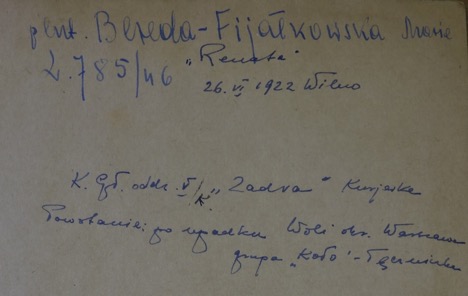
Mama’s name (Bereda-Fijałkowska) and pseudonym “Renata” in the margins of her typewritten report.

Mama’s report matches up with some of the stories she told me, and confirms some of what she did during the occupation. It also gives more details about the way her courier unit “Zadra,” was organized, and how couriers carried out their duties. The report is dry and factual. It contains no specifics about her emotional engagement or personal thoughts. A historian might find it interesting for what it reveals about the operations of the Underground conspiracy. I keep trying to look beyond the words to find the person behind them.

She writes, that “Zadra” started out very small, and because the work wasn’t systematized, the couriers were on call at all times. “By the end of 1942,” she writes, “the number of couriers stabilized at 15, and that group became close and experienced, and worked together for a long time without changing members.” This all changed in the fall of 1943 when the occupier, okupant, limited train travel to Germans only. Overnight, the courier corps dropped from 60 to just six who spoke German well and had German papers. “The work for these couriers during this time was nonstop,” she continues, “The number of trips for each courier came to 10-12 per month, depending on the route.” My mother doesn’t state it in the report, but she must have been one of the couriers who carried out missions during this time. Some of her most vivid stories were about traveling in the train cars with an assumed identity as a “volksdeutch,” a half-German whose father was fighting for the Reich on the Eastern front.

After about two months, the courier corps were reorganized and expanded, with more reserve couriers brought into regular service. In the half year before the Warsaw Uprising, the number of couriers in her unit approached 40, and overall reached 100.

The duties of the couriers included delivering coded and uncoded orders hidden in ordinary objects such as candles or paint, special messages that had to be handed to specific commanders, and large sums of money (1/4-12 million zloties in 500 zloty bills). Some missions involved carrying the messages brought by paratroopers they called “ptaszki,” “little birds.” This is the code name for the cichociemni, the officers who parachuted in from the West carrying money and messages from the Polish Government in Exile.

The report includes an example of a special mission Mama undertook at the end of 1943. Instead of being briefed by her usual commander “Wanda”, “Beata,” the head of communication with the west, did it. “Wanda” gave her a special coded message she had to hand directly to the chief of staff or the commander of the Radom District. This was to occur in private with no witnesses. Mama also had to memorize and deliver the oral message, “The commanders of the divisions and subdivisions of “Burza” require complete secrecy in the event of the invasion of the Russians.” Burza, Tempest, was the code name for the Warsaw Uprising.

Because the chief of staff wasn’t available on the day Mama arrived, she had to spend the night at a safe house. The next day, she delivered the messages to Chief of Staff “Rawicz” [his real name was Jan Stencel or Stenzel], but had to spend another two days before “Rawicz” returned from the forest, where the partisans were hiding out, with the required response for the Central Command in Warsaw.

Reading this sparked another memory for me. I think it was a big deal for Mama to stay away from home for so long, especially because her father didn’t know she was in the Underground. Her mother did know, though, and they hatched an alibi about a visit to Mama’s fiance’s family. Or maybe this is the story she told the authorities on the train to explain why she was returning several days late. Hopefully, my brothers remember this story, too, and can confirm one of these versions.

The documents from the Studium Polski Podziemnej in London have been a lynch pin that holds together information from a variety of sources. While I was there, I also found a citation for Communication, Sabotage, and Diversion: Women in the Home Army, Łączność, Sabotaż, Dywersja: Kobiety w Armii Krajowej, published in 1985. The book was written in Polish but published in London. I found a copy of it at an online used bookstore whose brick and mortar shop is in Warsaw. I called, and sure enough they had it in the shop, so I picked it up while I was in Warsaw. It contains the recollections of the head of the Women’s division of Central Command (VK) Janina Karasiówna, the oficer who confirmed Mama’s verification file. Another chapter contains the report of Natalia Żukowska who was the assistant commander of Mama’s courier unit; Mama identifies her by her pseudonym “Klara.” From Żukowska’s report, I learned that “Zadra” was the name used by the couriers who had been working with the unit for the longest, but in 1943 the name was changed to “Dworzec Zachodni.” Reviewing Mama’s documents, I see now that she identified her unit as Zadra-Dworzec Zachodni in one place. She underlined it, too. Until I read this book, I had thought Dworzec Zachodni, which means Western Station, referred to Zadra’s location, not an alternative cryptonym. And then there’s this: the names of the 15 couriers, including “Renata.” That’s Mama’s pseudonym; her last name is misidentified as “Brodzka” instead of “Bereda,” but Natalia writes, “Unfortunately, it wasn’t possible to decrypt all of the last names” (p. 118).

Mama was proud of her service for her country, but she was also painfully aware of the cost of war. She called herself a pacifist and the war solidified her abhorrence of armed conflict. I remember her asking, “Are there times when fighting is necessary?” I could tell from her voice that she wanted to believe all conflicts can be resolved peaceably. But her experience had taught her otherwise.

AK Verification: Part II

13 Sunday Aug 2017

Posted by Marysia Galbraith in Archives, Bereda, Family, Poland, Polish Culture, Polish Underground Army, Warsaw, World War II

≈ Leave a comment

Tags

"Zadra", AK, Armia Krajowa, Courier, General Bór Komorowski, Grupa "Koło", Major Janina Karaś, Maria Bereda(y) Galbraith, Polish Home Army, Polish Underground Study Trust, Studium Polski Podziemnej, Warsaw Uprising

NOTE: This overview of my recent discoveries at the Polish Underground Movement Study Trust, Studium Polskiej Podziemniej (SPP) got so long I am publishing it in three separate posts. Here is part II. During the German occupation of Poland during World War II, the Polish Underground Army worked in secret to resist, sabotage, and fight against the Nazis. Another name for the Polish forces is “AK,” short for “Armia Krajowa,” or “Home Army.” I talk about the soldiers as “the partisans;” in Polish sources they are also called “konspiracja,” “the conspiracy.”


The file at the archive of the Polish Underground Movement Study Trust, Studium Polski Podziemnej (SPP), contained the same verification questionnaire I had from my mother’s papers and so much more. On the envelope itself is the following identifying information:

VerificationEnvelope

Information on the envelope containing Mama’s papers at the SPP

I ‘ve learned how to decipher all of this. Here’s what it means:

Cadet Bereda-Fijałkowska Maria

2.785/46 [record #]     “Renata” [her pseudonym]

   26. VI 1922 Wilno [birth date and place of birth]


            Central Command division V/Women “Zadra” courier

Uprising: after the fall of the Wola district of Warsaw

                                    “Koło” Group-liaison officer [the names of her units]

The documents inside the envelope confirm Mama’s service and rank in the AK [Home Army], as well as her receipt of the Cross of Bravery. She submitted her questionnaire on March 9, 1946, her commanding officer confirmed her claims on April 15th of the same year, and the official report was completed the next day on April 16. The final report says the head of the Polish Army himself, General Bór-Komorowski, confirmed her receipt of the Cross of Bravery. Here is what looks like his signature on the document:

BórSignature

General Bór Komorowski’s signature verifying Mama’s service in the Polish Home Army. It looks like he wrote “Stwierdzam (I confirm)  16/IV 46” above his signature. Note the “gn” for “generał.”

Mama started military training in middle school, gimnasium, at the Klementyna Hoffman School in the mid-1930s. She continued training in high school, liceum, and entered the Underground in June 1941, right after finishing high school. She took courses on how to be a courier, the organization of the Underground and of the German military, as well as marksmanship, topography, and first aid. She was in “Zadra” Group, part of the women’s courier corps in the 5th Division of the Central Command. She delivered encoded communications, money, and oral messages on the routes between Warsaw and Krakow, Radom and Skarżysko-Kamienna. In these latter two places, she acted as a go-between for the partisans in the surrounding forests and Central Command in Warsaw. From 1942-4, she also worked as an instructor training other women to serve in the Underground.

When the Warsaw Uprising began on August 1, 1944, she was with her unit “Zadra” in Wola, a district to the northwest of downtown. A handwritten note on her typed questionnaire says “wounded on route from Wola to the Old City.” The handwriting is different from Mama’s distinctive, almost calligraphic style, so somebody else must have added it after Mama submitted her answers.

The archivist Krystyna Zatylna said that the heaviest fighting in the first days of the Uprising was in Wola. Mama was lucky to have survived. By August 8, 40,000 civilians died in Wola.

The Home Army regrouped in the Old City. Mama got separated from her unit and joined “Koło” group. She is referred to here as a “liaison,” “lączniczka,” rather than “courier,” “kurierka.” Both terms refer to people entrusted with delivering critical information. Initially, however, she worked as a medic on Długa Street. When the Germans pushed the partisans out of the Old City, they escaped to the City Center, Śródmieście, via the sewers.

14SPPVerificationDossier

Document dated September 9, 1944 that allowed “Renata” to travel through the City Center during the Warsaw Uprising.

The file contains two papers dated from the Uprising. No doubt Mama brought them with her to London to help corroborate her report. These tattered notes—physical proof of her service—must have been very precious to her. The first, on a third of a piece of paper that has deep creases from having been folded many times, is dated September 9, 1944. It states:

I assert that cadet Renata is a liaison of “Koło” Group. The conditions of her service require movement within the region between Savior Square and Napoleon Square.

The note is signed by the Chief of Staff of “Koło” Group, Major Krynicki. The document contains a round stamp with a crowned eagle in the middle surrounded by the words “Motorized Transport Brigade, “Brygada Dyspozycyjna Zmotoryzowana.” Mama must have shown this note at barricades on the streets so the AK soldiers would let her pass. Savior Square and Napoleon Square are in the City Center, which means she retreated through the sewers before September 9. I can, however, imagine her dodging Nazi bullets as she ran across the barricaded Jerusalem Street carrying messages from Napoleon Square to Savior Square. These names would sound good in a poem. Too bad I’m not a poet.

The second paper dates from October 3, 1944, the last day of the Uprising. Signed by Colonel Bolesław Kołodziejski, the commander of “Koło” Group, it is titled, “Provisional certificate (to be exchanged after the war for official recognition).” The text reads:

I confirm that “Renata Lewandowska” was decorated for her activity during the Uprising from August 1 to October 3 1944 with the Cross of Bravery for the first time.

Based on: the personal confirmation of the head of the Warsaw Corps of the A.K. Brigadier General Montera and his assistant Colonel Wachowski, as told to the commander of “Koło” Group during the last days of the Uprising.

“Montera” was the code name for General Antoni Chruściel, who led the Home Army (AK) in Warsaw during the Uprising. Kołodziejski was also a code name. Elsewhere in the documents, Mama writes that his real name was Zygmunt Trzaska-Reliszko.

Mama writes that she was promoted twice; in September 1944 she became a cadet, plutonowy podchorązy and in October she was promoted again to ensign, podporucznik. It looks as though the Verification Commission could only confirm the first promotion. A handwritten note on Mama’s questionnaire says they weren’t able to contact her commanding officer from “Koło” Group to verify the second promotion.

Also in the file are two statements written by the commander of the women’s branch of the 5th division of Central Command (V.K. KG) Major Janina Karaś, dated April 15, 1946. In them Karaś, also known as Karasiówna, confirmed that Mama earned the rank of cadet in “Koło” Group, and was also granted the Cross of Bravery for her service. Clearly, the Verification Commission contacted Karaś to corroborate Mama’s claims on her questionnaire. One of Karaś’s statements reads:

As the chief of the V.K. [5th Women’s] Central Command I certify that in the course of her service as a courier, “Renata” Maria Bereda Fijałkowska distinguished herself on the route Warsaw-Krakow and Warsaw-Skarzysko-Radom with bravery and decision to take risks. Traveling with German false papers she carried money, mail, and oral orders /for example related to the order for [Operation] Tempest. She earned the Cross of Bravery for her service.

Operation Tempest, “Burza,” was the code name for the beginning of the Warsaw Uprising. In other words, some of the messages Mama carried between Central Command and the partisans in the forest involved critical details about the Polish Underground’s battle to free the capital city from German occupation. I’m reminded of something the archivist at the Warsaw Uprising Museum kept repeating when I showed him Mama’s verification questionnaire two years ago: “She must have been very high in the conspiracy.” He couldn’t find the exact connection, but I believe I have it right here.

Krystyna Zatylna helped me put the pieces together. The forests around Radom are where the so-called “cichociemni,” “the quiet unseen” soldiers parachuted in from the West, bringing messages and money from the Polish Government in Exile for the leaders of the Underground in Poland. I believe Mama was given these items from the cichociemni and carried them back to Central Command in Warsaw. It fits with stories she sometimes told, and it fits with the seven-page report she filed with her verification papers. And that will be the subject of the third part of this blog post.

AK Verification, Part I

12 Saturday Aug 2017

Posted by Marysia Galbraith in Archives, Bereda, Family, Polish Culture, Polish Underground Army, World War II

≈ 3 Comments

Tags

AK, Armia Krajowa, Cross of Bravery, Krzyż Waleczny, Maria Bereda(y) Galbraith, Polish Home Army, Polish Underground Study Trust, Studium Polski Podziemnej

NOTE: This overview of my recent discoveries at the Polish Underground Movement Study Trust, Studium Polskiej Podziemniej (SPP) got so long I will publish it in three separate posts over the next few days. Here is part I. During the German occupation of Poland during World War II, the Polish Underground Army worked in secret to resist, sabotage, and fight against the Nazis. Another name for the Polish forces is “AK,” short for “Armia Krajowa,” or “Home Army.” I talk about the soldiers as “the partisans;” in Polish sources they are also called “konspiracja,” “the conspiracy.”

MamaPrewar

Mama in Poland


The extraordinary story of my mother’s service in the Polish Underground can be hard to reconcile with the person I knew. Mama would hide when strangers visited the house because she was afraid they would stare at her scars. How could she have carried secret messages to the partisans in the forest or talked calmly with Nazi officers on the German-only trains right under signs that read, “Danger! The Enemy is Listening!”? And yet, as her daughter I also knew her strength and persistence, especially when matters of principal were involved.

I couldn’t find much specific information about my mother at the Warsaw Uprising Museum or the Polish National Archive of New Records in Warsaw. Next, I turned to the Studium Polski Podziemnej (SSP), Polish Underground Movement Study Trust in London. But when the archivist responded they have no record of Maria Bereda in their indexes, a part of me wondered if Mama could have fabricated her whole story.

Logo-spp-londyn_0c8ba9117ddbff8485e5dca98f7fae14

Logo of the Polish Underground Movement Study Trust (SPP)

But that made no sense. My mother didn’t lie. She struggled with guilt even when she tried to tell the smallest untruth. Instead, she would avoid certain subjects, and would keep silent when people came to their own incorrect conclusions about them. That’s why for instance I thought she was the same age as my dad when I was a child. My oldest brother inferred it from the sequence of their birthdays—Dad’s was on March 1 and Mom’s was a few months later on June 26—and Mama didn’t bother to correct us.

Mama didn’t like talking about her past, but the story about how she was verified after the war was one she was more willing to tell. She had to go to London to do it because wartime records were scattered and incomplete. During the war, the Underground Army didn’t have the infrastructure to maintain centralized records. Often, lists of personnel and promotions were memorized or scribbled on any available scrap of paper. Also, to prevent the Nazis from infiltrating the underground forces, details of separate units were kept from each other. Most partisans only knew about those serving directly above and below them, and even members of the same unit referred to each other by code name. All of these were strategies for insuring that if someone was caught or compromised, they would have minimal information to share and so could inflict a minimum of damage to the organization. Also, few records remained after Warsaw was bombed to the ground following the Warsaw Uprising. The Central Verification Commission was in London, where the Polish Government in Exile had been throughout the war.

Mama travelled from Poland to London in March 1946. She wanted to be sure that an official record would exist to mark her participation in the war, and she wanted to get the Cross of Bravery she had been granted but never received. At the Commission, she reported on her training, her unit, her superior officers, and her activities. When she told me this story many years later, she was very proud of her ability to recall all these details from memory, things that could only be known by someone who actually served in the Underground.  The commission checked everything for accuracy before the verification was confirmed.

I already had a copy of the “Special Questionnaire” Mama had filled out as part of this process; I had found it in her papers. At minimum, I should have been able to find the original at the Polish Underground Movement Study Trust (SPP), which houses the archive of the Verification Commission. Fortunately during a recent trip to London, some focused digging at the SPP turned up a treasure trove of documents. Already in our e-mail correspondence, the SPP archivist Krystyna Zatylna had seemed confident that something would turn up if we looked harder. She eventually found Mama’s records where they had been mislabeled and misfiled.

Home_01_about_spp_londyn-b87ae1de57

Headquarters of the Polish Underground Movement Study Trust at 11 Leopold Road, Ealing, London. Photo from studium.org.uk website.

According to their website, “The Polish Underground Movement (1939-1945) Study Trust (PUMST), was founded in London in 1947. It is a research and academic institution, which contains historical material on the Polish Underground State (the Underground Administration and the Polish Home Army – Armia Krajowa) during the Second World War.” Included among their materials, the verification papers sit on high shelves right in the reading room in accordion folders shelved alphabetically. Personal files are arranged alphabetically inside the folders, each in a separate manila envelope.

The first folder Krystyna pulled out for me contained last names starting with “Br” instead of “Be.” My heart fell when I didn’t find Mama’s records. But then Krystyna climbed up a wooden ladder and found the folder with the “Be” names. There it was: an envelope labeled Maria Bereda-Fijałkowska. For a time, Mama used this hyphenated name, tacking on the maiden name of her grandmother.

Krystyna explained that much of the work at the archive has been done by volunteers so there are a lot of mistakes. She also asked me a lot of questions. Was Mama’s name always hyphenated? Did she use any other names? Did she ever go by Fijałkowska? Was she ever married? She also asked the names of my mother’s units. I rattled off what I knew: she belonged to “Zadra” in the Women’s 5th Division of the Central Command stationed in the Wola District of Warsaw; shortly after the Warsaw Uprising began, she joined “Koło” Group, and served in the Old City–Stare Miasto and City Center–Śródmieście Districts . I also gave her the names of Mama’s superior officers. It was as if I was being verified myself.

To be continued…

The Next Generation Visits Poland

07 Monday Aug 2017

Posted by Marysia Galbraith in Bereda, Family, Identity

≈ Leave a comment

Tags

Roots trip to Poland 2017

I’m just back from a roots trip to Warsaw, Poland with twelve relatives including six children. Here are most of the kids on the steps at Kościelna Street. These are the ones their grandmother would take everyday when she walked to and from the Bereda home at the bottom of the hill.

20170731PolandReunionIMG_0682

The next generation in Poland: grandchildren of Maria: Ian and Bessie (lower steps) and of George: Sammy, Ziggy, and Mo (upper steps). My brother Chris is on the left.

It’s extraordinary that we could agree upon a date and make the journey. I’ll write more about it soon.

← Older posts
Newer posts →

Categories

  • Anthropology (37)
    • Archives (14)
    • Fieldwork (7)
    • Ground Penetrating Radar (GPR (4)
    • Research Methodology (8)
  • antisemitism (14)
  • Association of Descendants of Jewish Central Poland (32)
  • Catholicism (8)
  • Conference (1)
  • Discrimination (2)
  • Family (69)
    • Bereda (17)
    • Kolski (13)
    • Piwko (22)
    • Rotblit (3)
    • Walfisz (4)
    • Winawer (7)
  • Genealogy (11)
  • Heritage work (66)
    • Commemoration (23)
  • Identity (18)
  • Israel (6)
  • Jewish Culture (89)
    • Cemeteries (51)
    • Museum (7)
    • Synagogues (33)
  • Jewish immigrants (8)
  • Jewish Religion (1)
  • Memory (70)
  • Names (14)
  • Photographs (6)
  • Pifko-Winawer Circle (5)
  • Poland (125)
    • Baligród (1)
    • Bolimów (1)
    • Brześć Kujawski (5)
    • Buk (1)
    • Chodecz (1)
    • Dukla (2)
    • Dąbrowice (1)
    • Gdynia (1)
    • Gostynin (2)
    • Gąbin (1)
    • Izbica Kujawska (1)
    • Kazimierz (4)
    • Kowal (1)
    • Koło (1)
    • Krakow (7)
    • Krośniewice (1)
    • Kutno (6)
    • Kłodawa (1)
    • Lesko (8)
    • Leszno (1)
    • Lubień Kujawski (1)
    • Lubraniec (1)
    • Lutowiska (3)
    • Piła (3)
    • Podgórze (2)
    • Poznan (11)
    • Przemyśl (2)
    • Pzedecz (1)
    • Radom (1)
    • Radymno (1)
    • Sanok (1)
    • Skierniewice (5)
    • Sobota (2)
    • Tarnów (2)
    • Warsaw (22)
    • Wielkopolska (1)
    • Wronki (7)
    • Włocławek (20)
    • Zasław (2)
    • Łódź (1)
    • Żychlin (30)
  • Polish Culture (10)
  • Polish-Jewish Heritage (60)
  • Polish-Jewish relations (60)
  • Post-World War II (24)
  • Pre-World War II (22)
  • Reclaimed Property (1)
  • stereotypes (3)
  • Survival (9)
  • Trauma (3)
  • Uncategorized (5)
  • Victims and perpetrators (4)
  • World War II (45)
    • Jewish Ghetto (12)
    • Nazi Camps (5)
    • Polish Underground Army (3)
  • Yiddish (5)

Enter your email address to follow this blog and receive notifications of new posts by email. Your email address will not be shared.

Archives

  • October 2025 (1)
  • July 2025 (8)
  • June 2025 (1)
  • April 2025 (1)
  • August 2024 (3)
  • July 2024 (3)
  • May 2024 (2)
  • April 2024 (1)
  • May 2023 (2)
  • January 2023 (2)
  • December 2022 (7)
  • November 2022 (2)
  • October 2022 (5)
  • September 2022 (1)
  • January 2022 (1)
  • August 2021 (1)
  • December 2020 (2)
  • July 2020 (1)
  • May 2020 (3)
  • April 2020 (1)
  • March 2020 (1)
  • January 2020 (2)
  • May 2019 (1)
  • February 2019 (1)
  • November 2018 (1)
  • September 2018 (1)
  • August 2018 (3)
  • July 2018 (1)
  • June 2018 (1)
  • May 2018 (1)
  • April 2018 (2)
  • March 2018 (2)
  • February 2018 (2)
  • January 2018 (2)
  • December 2017 (2)
  • November 2017 (2)
  • October 2017 (1)
  • September 2017 (3)
  • August 2017 (3)
  • June 2017 (2)
  • May 2017 (3)
  • April 2017 (1)
  • March 2017 (2)
  • February 2017 (1)
  • January 2017 (2)
  • December 2016 (2)
  • November 2016 (4)
  • October 2016 (1)
  • September 2016 (6)
  • August 2016 (2)
  • July 2016 (1)
  • May 2016 (4)
  • April 2016 (2)
  • March 2016 (3)
  • February 2016 (4)
  • January 2016 (3)
  • December 2015 (3)
  • November 2015 (5)
  • October 2015 (5)
  • September 2015 (3)
  • August 2015 (4)
  • July 2015 (3)
  • June 2015 (3)
  • May 2015 (4)
  • April 2015 (9)
  • March 2015 (3)
  • February 2015 (2)
  • January 2015 (5)
  • December 2014 (4)
  • November 2014 (9)
  • October 2014 (2)
  • September 2014 (1)

Copyright Notice

All original text and images are copyright © Marysia Galbraith. Please contact the author before quoting.

Blog at WordPress.com.

  • Subscribe Subscribed
    • Uncovering Jewish Heritage
    • Join 147 other subscribers
    • Already have a WordPress.com account? Log in now.
    • Uncovering Jewish Heritage
    • Subscribe Subscribed
    • Sign up
    • Log in
    • Report this content
    • View site in Reader
    • Manage subscriptions
    • Collapse this bar
 

Loading Comments...