A Guest Post by Michael Mooney of the Matzevah Foundation
Day two has wrapped up for the Matzevah Foundation, our core team of volunteers, three individuals from a local reintegration program, and several local residents who stepped forward to lend their hands. These community members have their own reasons for joining us—personal, deeply-felt convictions about the importance of this work. They rarely say much about it, but their quiet presence speaks volumes. Their support adds a layer of silent solidarity that is deeply moving.
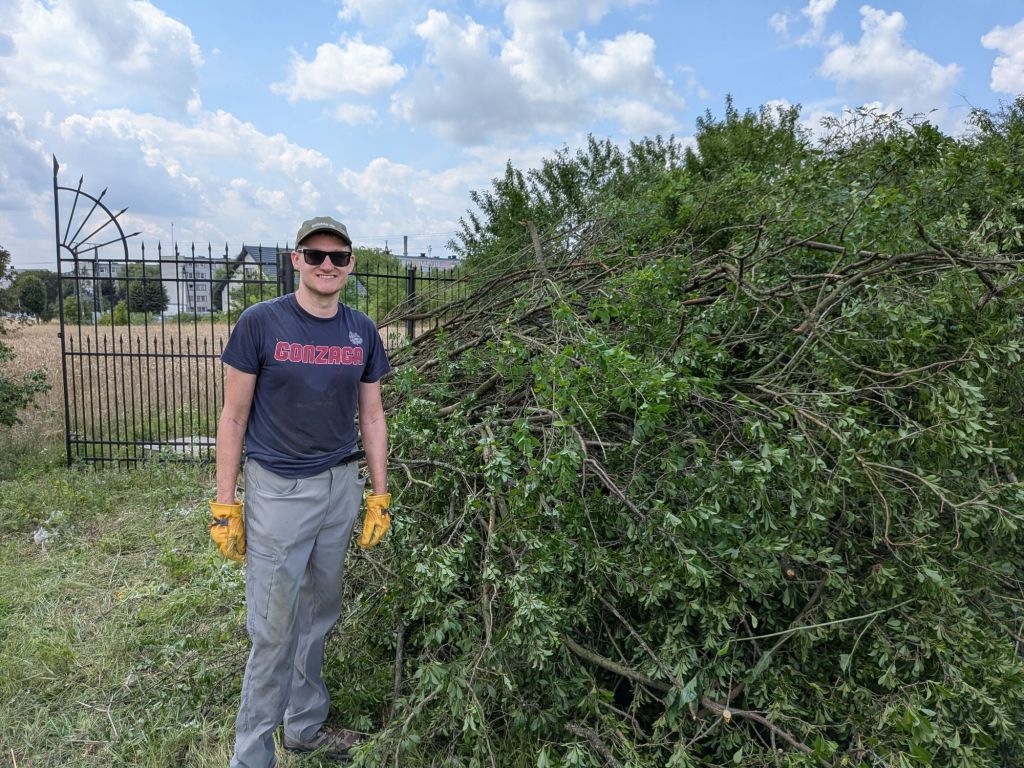
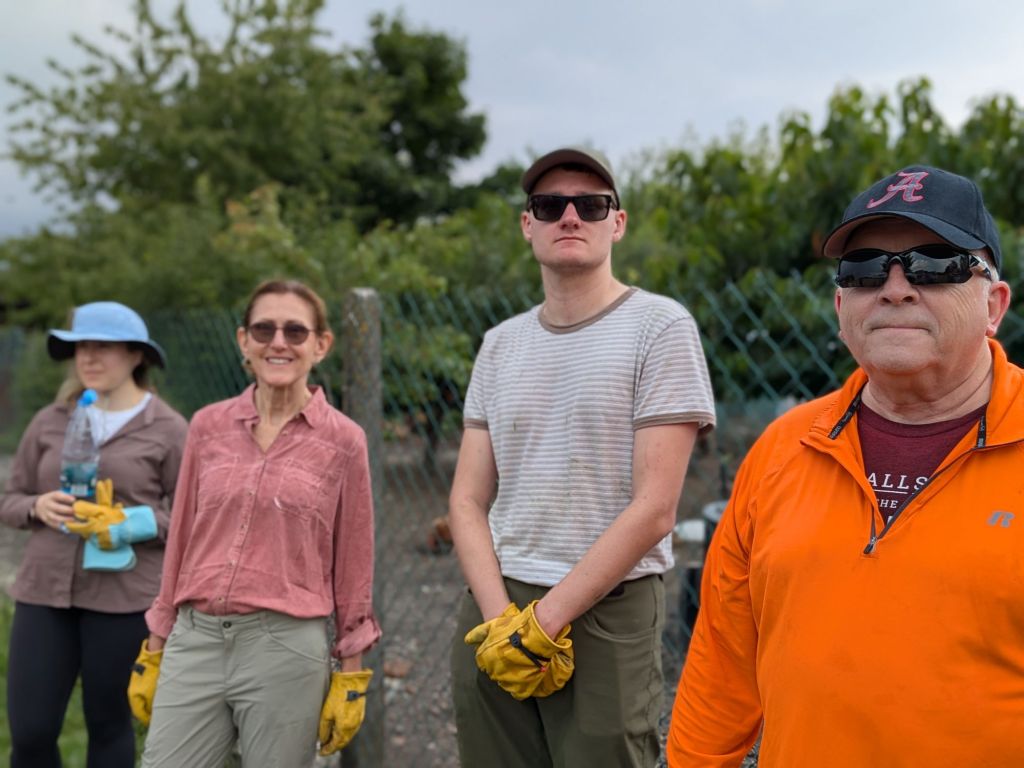
Our main task today focused on continuing the physically intensive work of clearing the brush and thick overgrowth from the depressed area believed to mark the site of a mass grave—just outside Żychlin. The sunken terrain could be the final resting place of hundreds of Jews—families and children—who were massacred during the German occupation of Poland. Step by step, we’re reclaiming this space from years of neglect, trying to bring dignity to a site long obscured both by vegetation and silence. Evidence and testimonies collected over the years suggest this area may be one of many unmarked mass graves, now hidden within the landscape yet never truly forgotten.
Before the war, Żychlin was home to a thriving Jewish community, with Jews making up over 40% of the town’s population. They had their own schools, synagogues, businesses, and institutions woven into the daily life of the town. The Nazi invasion brought devastation—ghettoization, mass deportations, executions, and widespread destruction. Few Jews from Żychlin survived the war.
Later in the day, our group visited what remains of the town’s historic Jewish quarter. Only the gutted walls of a 19th-century synagogue still stand—silent and broken. The cheder (Jewish school) and mikveh (ritual bath) that once operated nearby were destroyed long ago. The courtyard is cracked pavement, overrun with weeds and scattered debris. There is no plaque. No sign. Just the vacant presence of what was once central to community life.
Żychlin synagogue
As we surveyed the site, a few residents peered from behind curtains or doorways, then disappeared back inside. One person reportedly remarked to a member of our team that the synagogue “should just be torn down.” Is this concern about safety and dereliction? Or is it also a quiet wish to erase uncomfortable history—to bury the memory of a tragically obliterated community? Is forgetting easier than remembering?
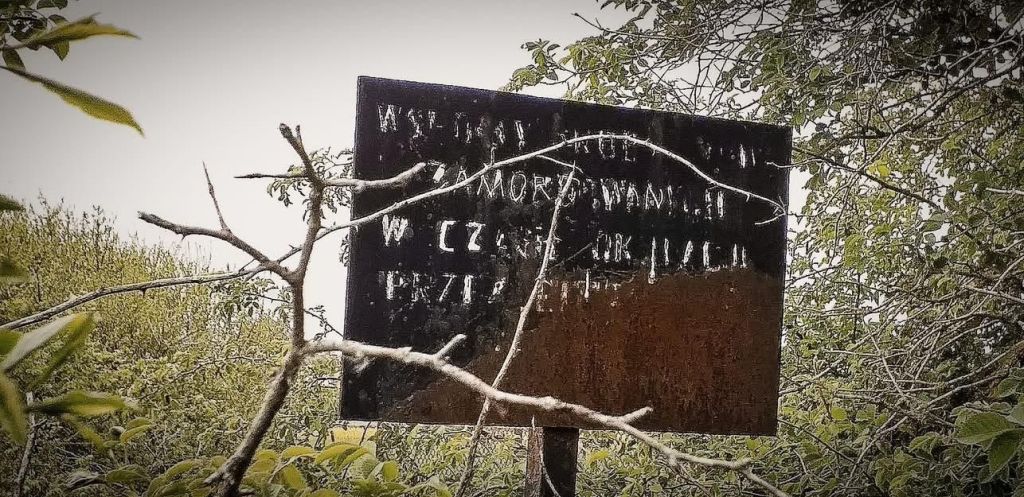
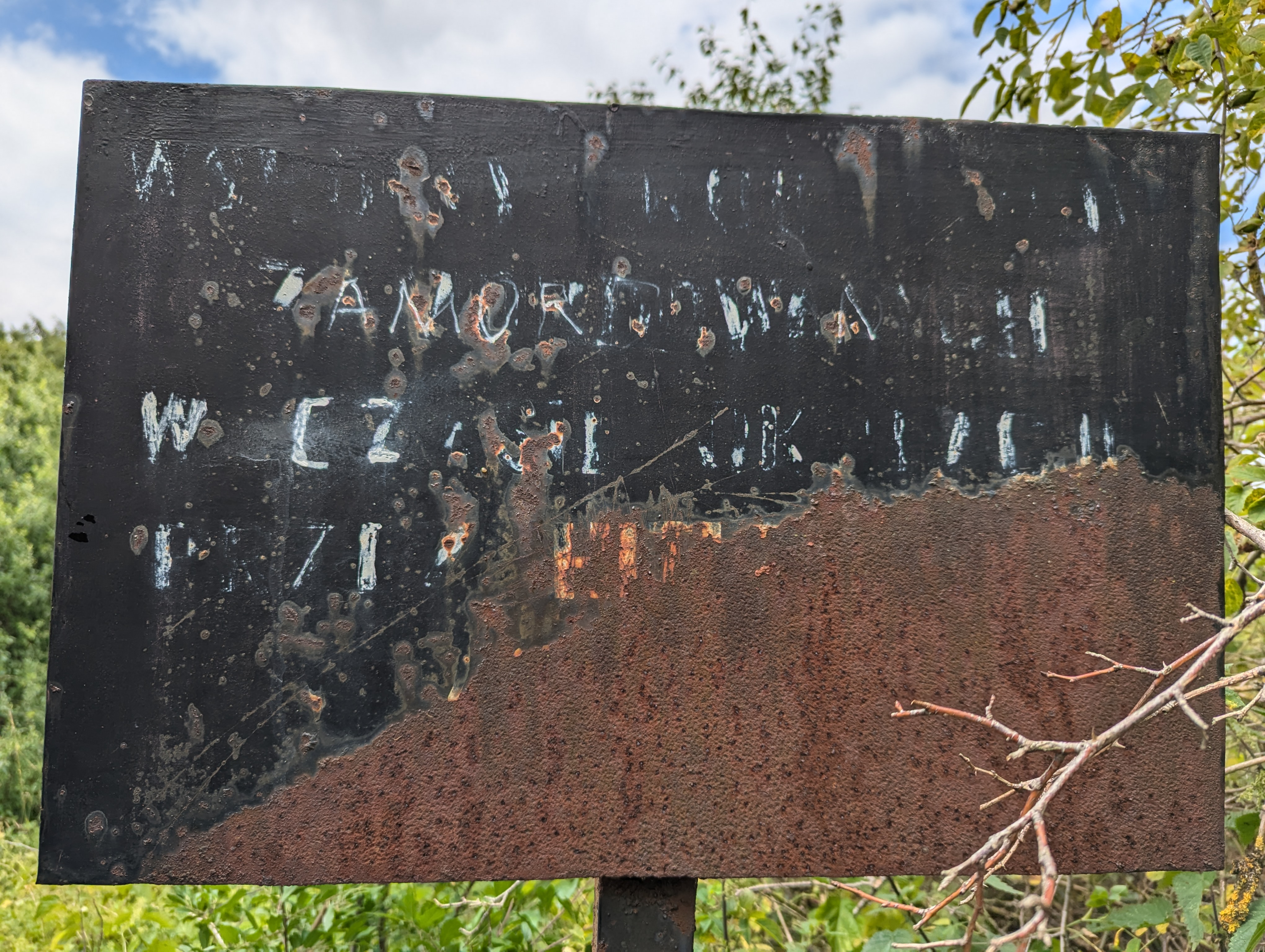
Near the clearing at the suspected grave site, we stumbled upon a weathered old sign—almost completely obscured by plants and exposure to the elements. The sign matches a photograph taken about eight years ago at (or near) this same location that once surfaced online. Most of the paint has worn away, but a few phrases remain legible:
– **”WSPÓLNY GRÓB”** – “In this place rest”
– **”ZAMORDOWANYCH”** – “Murdered people”
– **”W CZASIE OKUPACJI PRZEZ”** – “During the occupation by”
– One barely visible word at the bottom: **”HITLEROWCÓW,”** meaning “Nazis”
Metal sign indicating a collective grave is nearby
This style of memorial wording is common on World War II-era markers around Poland. It typically refers to civilians—often Jews or resistance members—murdered by the Nazis and buried in unmarked sites like this one.
Even in its deteriorated state, that plaque whispers a truth: this place is hallowed ground. And while some might look away, we cannot. Our work is about remembrance, dignity, and bearing witness to what many would rather forget.
When I return home, I plan to read *Neighbors: The Destruction of the Jewish Community in Jedwabne, Poland* by Jan T. Gross. The book tells the horrifying account of how, in 1941, the Jews of Jedwabne were not killed by distant Nazis, but by their own non-Jewish neighbors in an act of unspeakable violence. The story Gross tells echoes here in Żychlin and many other towns across Poland—places once filled with Jewish life, now emptied of memory, unless someone comes to uncover it. https://amzn.to/3Ixc0rK
Tomorrow, on Day Three, we’ll begin with a sobering visit to Chełmno—the extermination camp where most of Żychlin’s Jews were murdered and incinerated for the simple “crime” of being Jewish.
Our day started with a quick trip to the grocery store to pick up food for lunch. How fitting that we found matzo!
Annice and Matzo at Kaufland
Our next surprise was the large matzevah fragment left in front of the cemetery gate by an anonymous donor who found it buried under grass in a private garden. It memorialized a 60-year-old man, though his name is not on this fragment.
Lawrence reading the Hebrew inscription on the tombstone fragment. Look how big it is, even without it’s top
Bożena Gajewska was there to greet us with all of the saws and other equipment I had arranged to be delivered to her for our project. She also brought Pringles from the local factory.
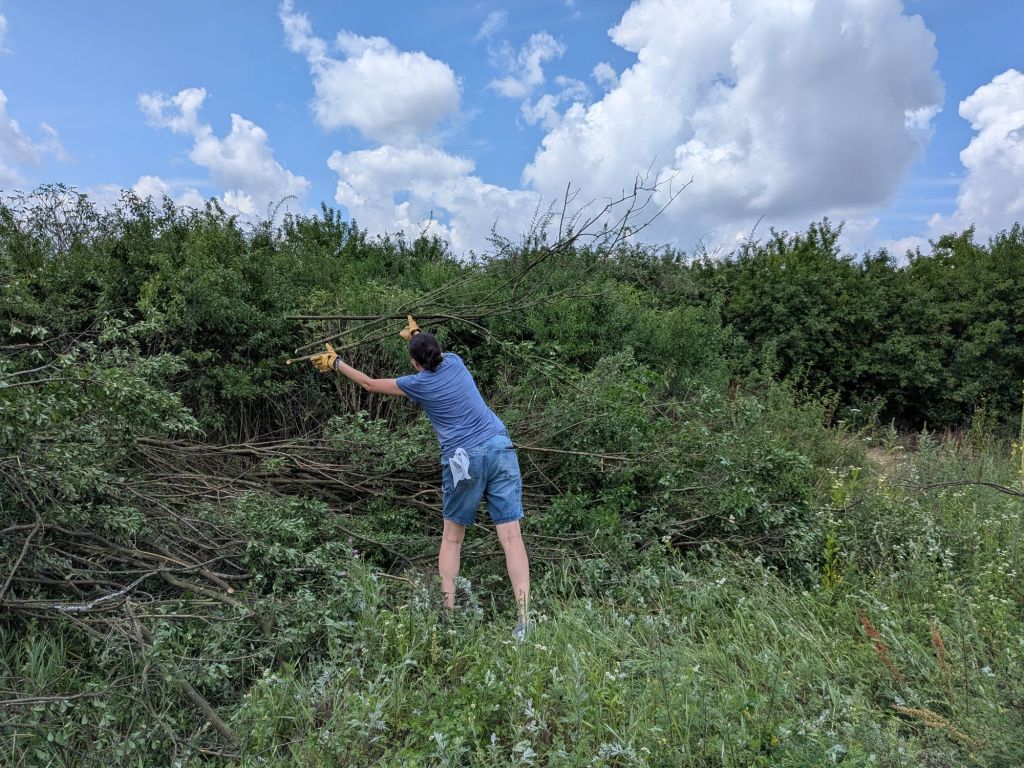
We got right to work clearing a path to the depression we plan to inspect with non-invasive ground penetrating radar. Some got hold of the loppers and others grabbed the branches as they were cut and hauled them out of the cemetery, where archaeology graduate student Caleb took charge of stacking them. In fact, he did this task systematically and neatly all day.
Working
Claibourne, who is heading up the GPR research, crawled and bushwhacked through the dense blackthorn to lay a measuring tape that would keep the cutters working in the right direction. Steven gave Claibourne the nickname “Magnum” when he saw that he is listed as the PI (principal investigator) of the project.
Filip instructing us on proper behavior in the cemetery
We took a break when Filip Szczepański of the Rabbinical Commission arrived. The most important thing, he told us, is not to disturb those who are buried–we are not to dig in the ground or do anything that might expose human remains. If we find any human bones, they are to be left at rest and carefully covered in the location where we find them. Steven suggested we get a bag of topsoil for this purpose.
We had other visitors and helpers, including Ola Głuszcz, who is a high school history teacher, and her daughter, as well as Henryk and Agnieszka Olszewski, and Żychlin mayor Grzegorz Ambroziak.
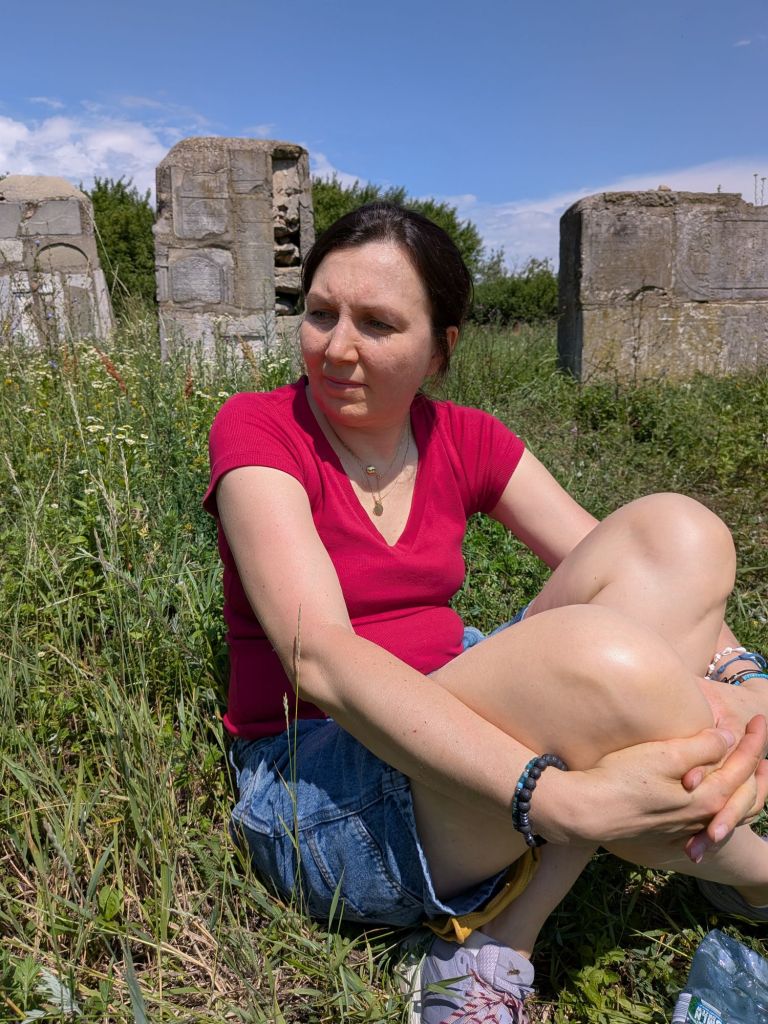
Some guests
We got as much as or more done than we expected, with a path cleared across the middle of the depression. Tomorrow, we’ll continue our work, making sure all the stumps are flush with the ground so the GPR can run over the ground smoothly.
New alleyway to the research site
I refuse to get my hopes up. Even if we find no evidence of a mass grave, that is important information. We will know this disturbance had other causes and we should look elsewhere. But maybe? Filip, whose first impression was that we are looking at a hole made by people digging out sand, said there must be a reason the metal sign nearby refers to a mass grave. There must have been something there that made them put it there.
Our last two days in Żychlin highlight the importance of presence. If we hadn’t stayed here several days, we probably wouldn’t have learned everything we did. As we cleared more of the stubborn blackthorn bushes, the cemetery revealed more secrets. After seeing the progress we were making, the inhabitants of Żychlin opened up to us, too.
Agnieszka Olszewska, a local amateur historian, leads us through brush and brambles to the site of a collective grave (note the back of the rusted sign barely visible at top left). Could these boulders be the remains of a memorial stone?
How would you respond if a group of foreigners come into your town and started weed whacking a cemetery? My guess is most of us would just watch from a distance, curious and a bit suspicious.
By Wednesday, people started telling us stories they pulled out of the depths of their memory. Others claimed ignorance about the town’s Jewish history, but the more we engaged in conversation, the clearer it was they knew more than they had initially let on.
ADJCP member David Goren, whose ancestors came from Żychlin, accompanied me to ask some of the neighbors about the cemetery. We collected important testimony that will help us bring Jewish memory back in this community.
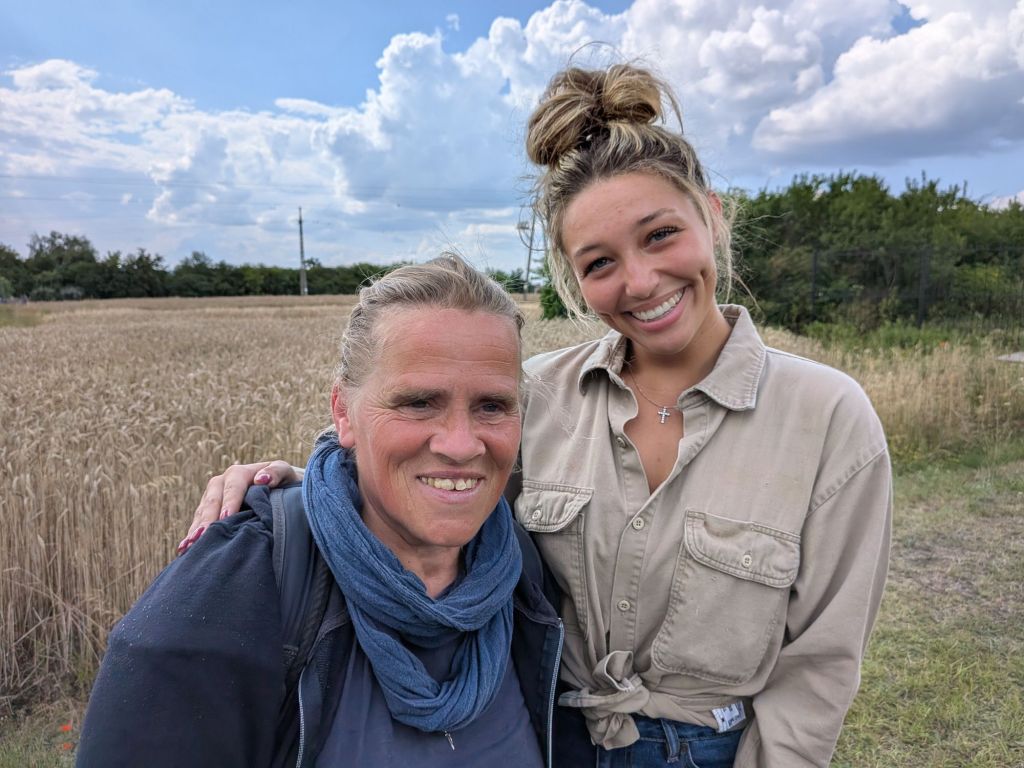
Żychlin descendant David Goren with our tireless Polish partner Bożena Gajewska. After a physically demanding day of weed whacking she went home and baked us raisin and date pastries
The Wujcikowskis live across the street from the cemetery. They had already shown us kindness, letting all the volunteers use their bathroom. David had noticed historical photos in their flower shop suggesting they had lived there a long time. In fact, the large property and house have been in the family since before the war. When Katarzyna (Kasia) didn’t know the answers to our questions, she escorted us to her parents Henryka (Henia) and Grzegorz Wujcikowski who came out of the farm building next to the flower shop. They greeted us warmly. Though they weren’t sure they could help us find old photographs of the cemetery, Grzegorz shared his family history with us. The property originally belonged to Grzegorz’s father’s uncle. Because it was one of the finest houses in town, some of the occupying Gestapo moved in and fenced the land to raise horses. Grzegorz’s aunt and uncle weren’t forced to leave, instead sharing the three-story house with the Germans. After the war, Grzegorz’s parents joined their aunt and uncle, who had no children of their own, and eventually became the owners of the property.
Grzegorz was born after the war. He knew Moshe Zyslander, a Holocaust survivor from Żychlin who emigrated to Israel. In 1989, Zyslander led the initiative to build the memorial monuments in the Jewish cemetery, as well as the surrounding gate and fence. When the Wujcikowskis learned about Zyslander’s plans, they returned the tombstone fragments that the Germans had taken from the cemetery to build a pig sty, the same farm building where Grzegorz and Henia had been working when we arrived. The stones removed from its walls make up the bulk of the 50 tombstone fragments embedded in concrete mounds in the cemetery. Whenever Zyslander returned to visit the cemetery, he would stop by the Wujcikowski’s for a visit.
The Wujcikowskis showed kindness to Jewish descendants in the past and continue to do so today.
Descendants Marysia, Liana, and David took our student volunteers out for ice cream. They were a great help, painting the gate and clearing brush. They didn’t seem to know a lot about the Jewish history of Żychlin but seemed interested in learning more
I’ve been very concerned about properly marking and memorializing the mass graves in the cemetery. Reports in the archive of the National Institute of Memory document the shooting of 200 people in 1942. Other sources indicate that when the ghetto was liquidated, the infirm were shot on the spot rather than being transported to the Chełmno death camp. For the site to be designated officially, it’s important to obtain testimony from witnesses. We were able to talk to two people who were not witnesses themselves but were told about the murders by a close relative who saw what happened.
We spoke with the neighbor next door to the cemetery the day before we started our work. She confirmed she knew we were coming; the city had informed her. She showed us where the city had dropped off a dumpster for the brush we cleared. A big goat was chained up outside the cemetery along the dirt drive leading from the road. “We put her there to eat the grass, so the drive is passable,” she explained.
Over the next two days, she and her son were in and out of their yard feeding their fowl, doing their farm work, and keeping a covert eye on us. As we cleaned up on our third day of work, David and I approached their fence to invite them to the memorial service we planned for the next afternoon. Mrs. Anna came over with her son Marcin and grandchildren Marceli and Lena. Anna has observed the comings and goings at the cemetery since she married over 40 years ago. Her husband, who grew up in the house, did so even longer, until his death in February.
Anna remembers how nice the cemetery looked when she first married. People used the space as a kind of commons; they walked their dogs or sunbathed, and her son played soccer with his friends. On holidays (the Catholic holidays like All Saint’s Day), the family would light a candle lantern at the monuments in remembrance of the dead.
As the cemetery became overgrown, people started going there to drink, play music, and get into other kinds of trouble. Anna’s husband would chase them out, threatening to call the police. She understands people sometimes want to get together and drink, but why destroy a cemetery? Why walk their dogs there? The last time she was at the Catholic cemetery where her husband is buried, people were walking their dog there, too. It isn’t right. She doesn’t understand why people would destroy monuments, either. Why? They should respect them. Although she sometimes contradicted herself, her overall orientation towards us and the cemetery was benevolent. It also suggests a growing recognition that the Jewish cemetery is a sacred space.
Then, Anna confided something that might help us get the mass grave demarcated: a personal account of the crime, albeit second-hand.
When her father was a young boy, about the age her 9-year-old grandson is now, he walked across the fields to see what was happening at the cemetery. He witnessed Jews being shot, their bodies falling into a trench. He was so frightened he peed in his pants and ran home to his mother.
Looking out across the field from what is probably the site of a mass grave in the cemetery. This view probably looked pretty much the same over 80 years ago when Anna’s father ran across the field after witnessing the murders
Henryk Olszewski is a local amateur historian whom I have known for ten years. He had a stroke two years ago and has been slowly recovering. He manages the website and Facebook page Żychlin Historia with his wife Agnieszka. He has an unconventional way of presenting information and sometimes his posts perpetuate stereotypes about Jews and Polish-Jewish relations, but he’s a dogged researcher.
Agnieszka visited us at the cemetery with photos she and Henryk took in 2019 of a rusty sign; though the white lettering has faded, enough remains to make out “Wspólny Grób zamordowanych w czasie okupacji przez Hitlerowców” (“Collective Grave of those murdered during the Nazi occupation”). She, David, and I walked around the back of the cemetery, and after a few false turns, we found an entrance to a clearing where the back of the sign was visible. We also found some large boulders. Could they be fragments of a commemorative stone? We asked a few people why there are places in and around the cemetery that are less overgrown or even barren of vegetation. One possibility could be that the lye spread over mass graves made the soil infertile.
Not much is left of the lettering, but it appears to say “Wspólny Grób zamordowanych w czasie okupacji przez Hitlerowców” (“Collective Grave of those murdered during the Nazi occupation”). Photo credit: Agnieszka Olszewska
Thursday evening, Steven and I visited the Olszewskis at their home. While they treated us to pierogi, stuffed pancakes, and a plateful of tasty cakes, I asked Henryk to remind me the name of a man I met during my first visit to Żychlin. Of course he knew, and immediately picked up the phone to call Józef Kowalski so I could check on a story he told me. Józef confirmed that his grandfather, who was a young man during the occupation, was called out by the Gestapo one night and ordered to dig a ditch in the Jewish cemetery. His grandfather, his mother’s father, told him the story directly. Józef also confirmed the ditch was where the people shot in the cemetery were buried.
The dissonance between the social nature of our interactions and the horrific topics we discussed doesn’t escape me. And yet, these kinds of connections are what make possible the recovery of difficult memories. Our work goes beyond the restoration of the physical space of the cemetery, to something deeper. We’re also restoring the memory of the people who inhabited the city over 80 years ago, and the events that took them away forever.
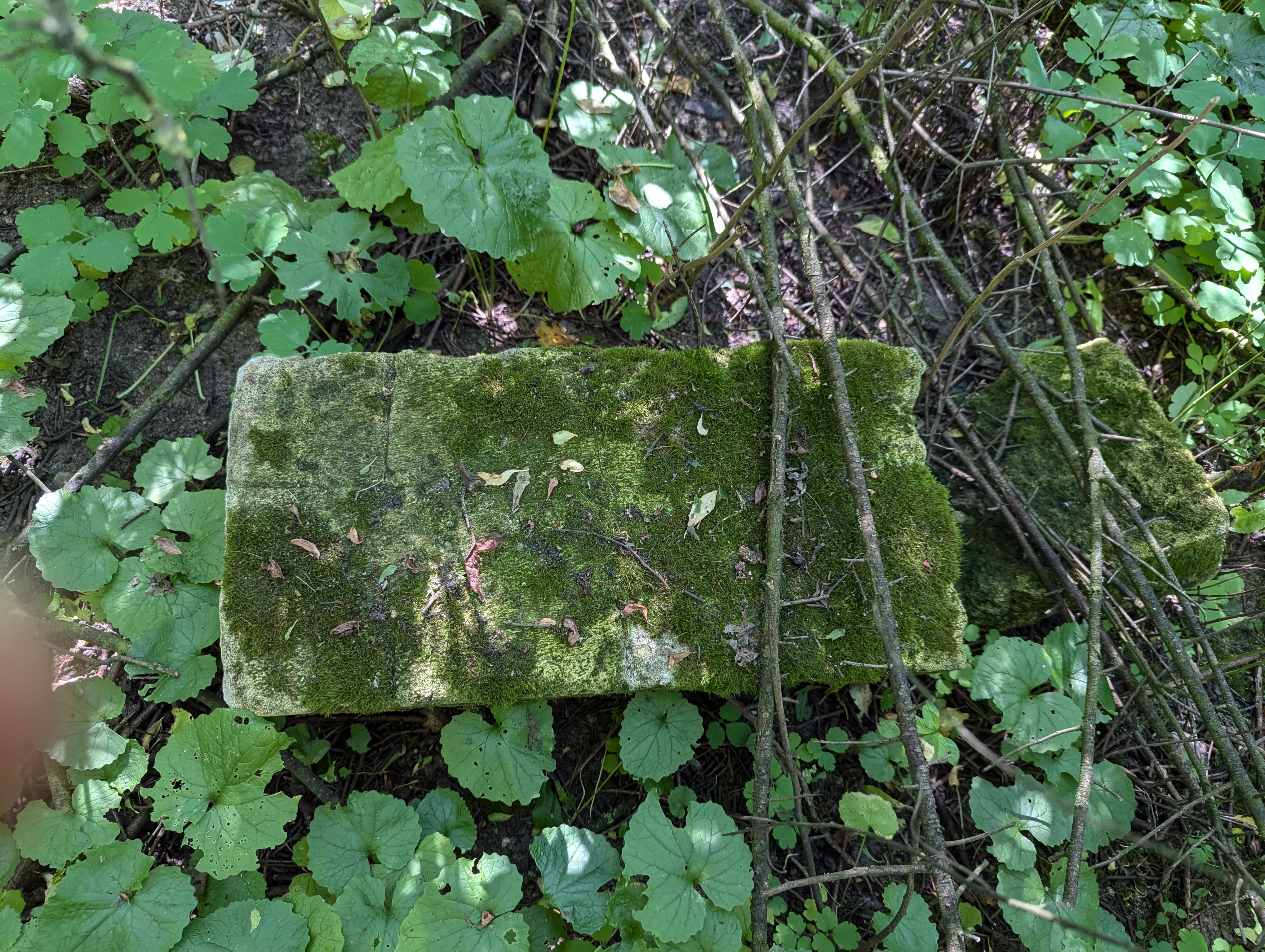
As we cleared underbrush, we found a few stones like these that appear to be fragments of tombstones
Report #8 about Roberta Books and Marysia Galbraith’s trip to meet Polish partners in preparation for the ADJCP‘s memorial visit to central Poland.
Chełmno nad Nerem, September 11
On September 11, we started the day at the Chełmno Death Camp. Though the parking lot was full, the camp itself was empty. Most people were in the neighboring church. It was Sunday. The mass, emitted from speakers outside the church, wafted across the remains of the death camp.
No English-language guide was available, so the woman at the office/ticket desk showed us around herself.
The camp is on the site of a former pałac, or mansion. Prisoners would be told it was a health resort. They were given postcards and encouraged to write home that they were safe and taken care of. Then, they were told they needed to wash before entering, which made sense to many because diseases like typhus were common in the ghettos they came from. Prisoners were brought to the basement of the mansion to undress. They were instructed to fill out inventories of the valuables they had with them and then hand everything over for safe keeping while they showered. They were told they can present their inventory later to get their valuables back. Instead, they were murdered.
Map of the mansion at Chełmno. “E” marks the location of the trucks converted into gas chambers.
The Nazis destroyed the camp when they retreated. But the outline of the mansion’s basement walls remain. We walked along a raised walkway and looked down into the spaces where people undressed and then were led down a corridor and outside into a truck set up with what looked like shower heads inside. Sometimes, prisoners were even given slivers of soap as they entered. In actuality, these trucks were designed for mass murder, their backs converted into the Nazis’ first gas chambers. Up to 100 people were gassed at a time and then prison work units would remove the bodies, which were taken by truck to the forest about 7 km away. Initially the bodies were buried, but later they were burned and the ashes buried.
They knew that what they were doing was wrong. Why else would they destroy the evidence?
At the burial site in the forest, I needed space to be with my own thoughts. I walked alone under an imposing Communist-era concrete monument balanced on tapered concrete supports. On the side facing the road is a bas relief of people in various states of suffering, with the single word “We remember” (“Pamiętamy”). On the back side, in uneven block letters, is written, “We were taken, from the elderly to infants, between the cities of Koło and Dąbie. We were taken to the forest and there we were gassed, shot, and burned…Now we ask that our future brothers punish our murderers. The witnesses of our oppression, who live in this area we ask again for these murders to be publicized throughout the world.”
Communist-era monument at Chełmno Death Camp
At some point, the Communist leaders made a point of building commemorative monstrosities like this. There is another one at the Stutthoff Concentration Camp near the Baltic coast.
I caught up with Roberta and Yosef when we got to a big field of mass graves. “This is the most important place to see,” Roberta said. Otherwise, we didn’t talk about it.
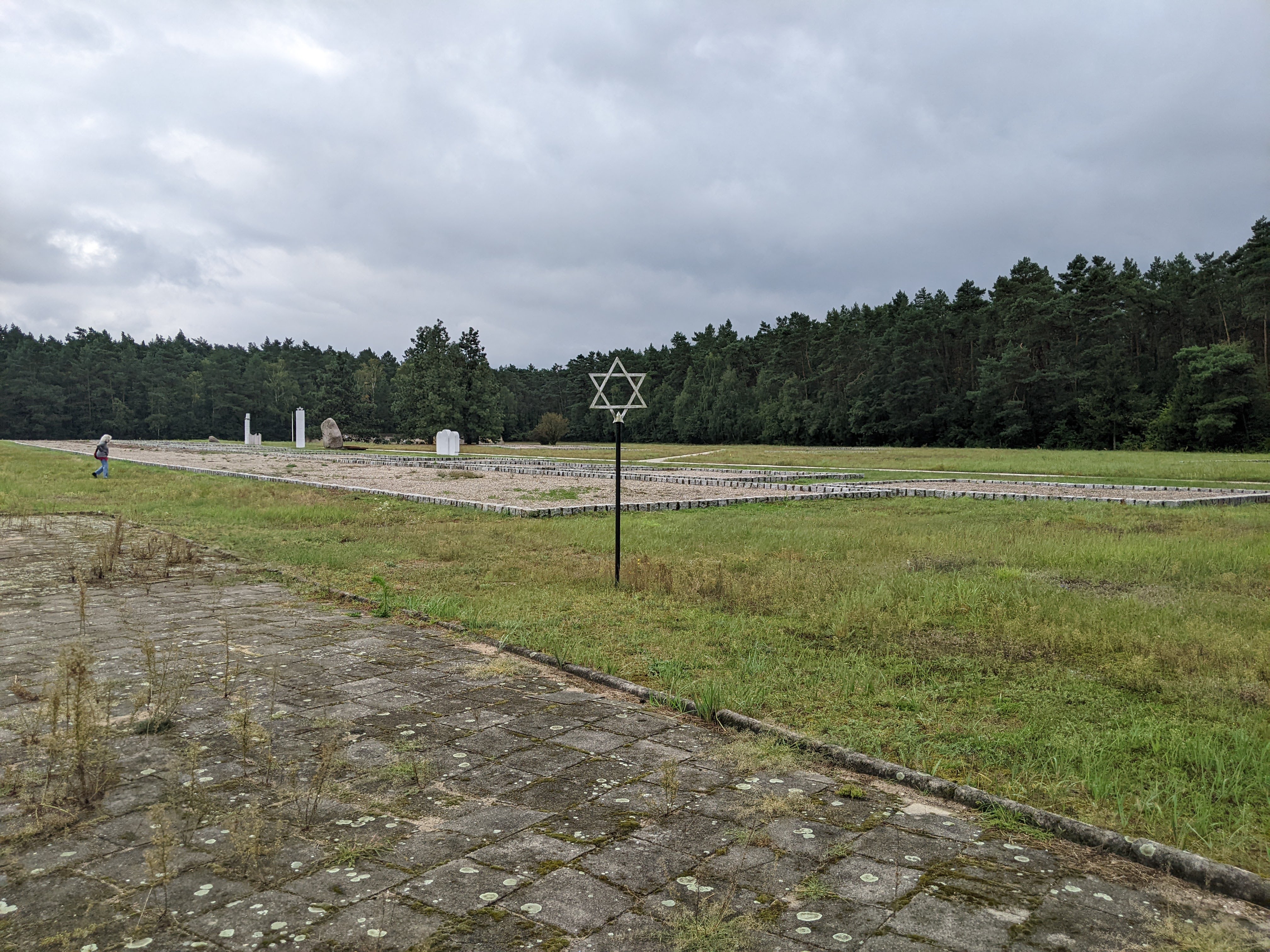
The graves are delineated by concrete borders filled with white gravel. This is to mark the burial sites, and also to prevent bone fragments from moving up out of the ground. People have been known to search for bones here and take them home as souvenirs.
Mass graves marked with stone borders and gravel, beyond the Star of David
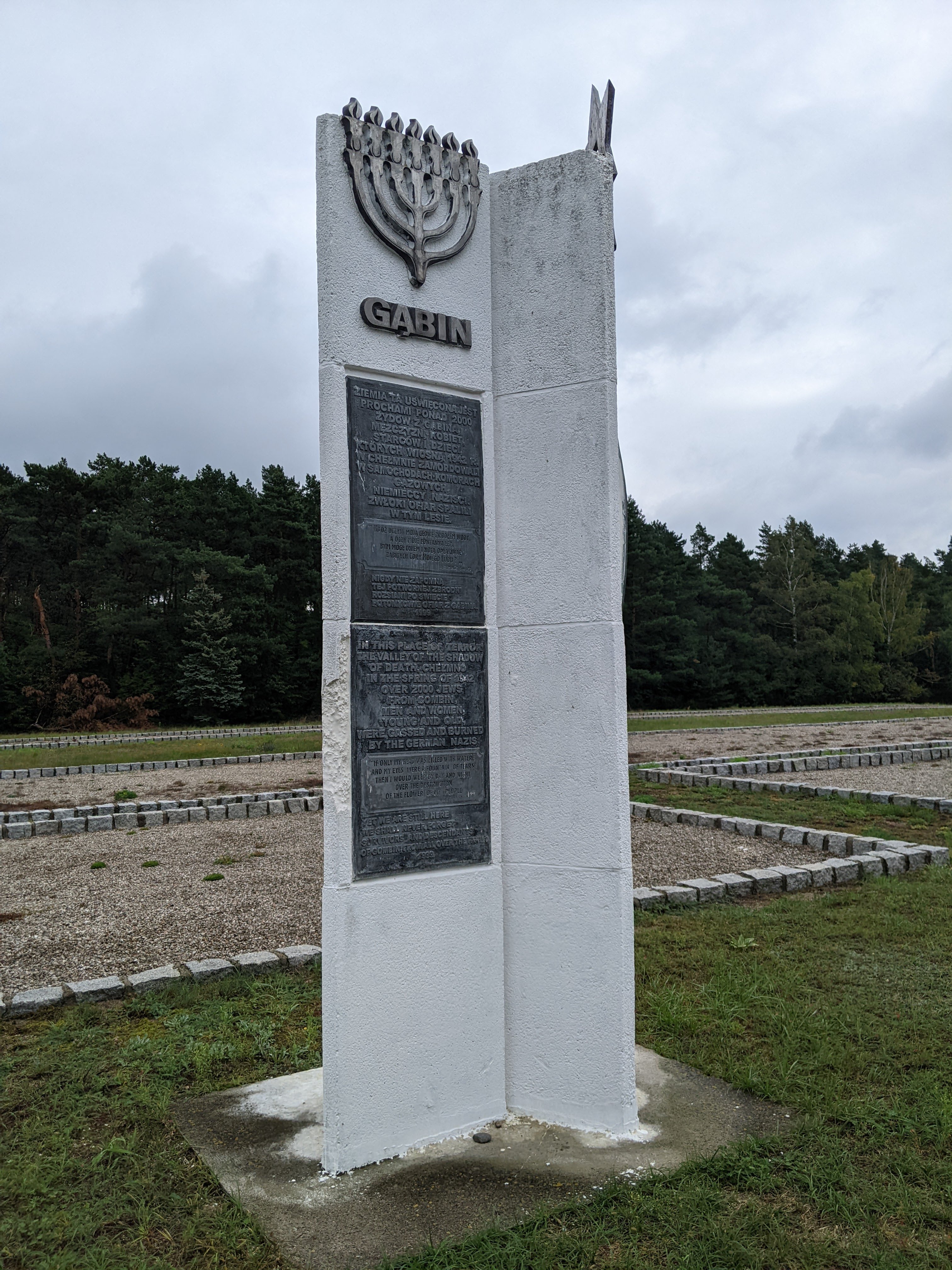
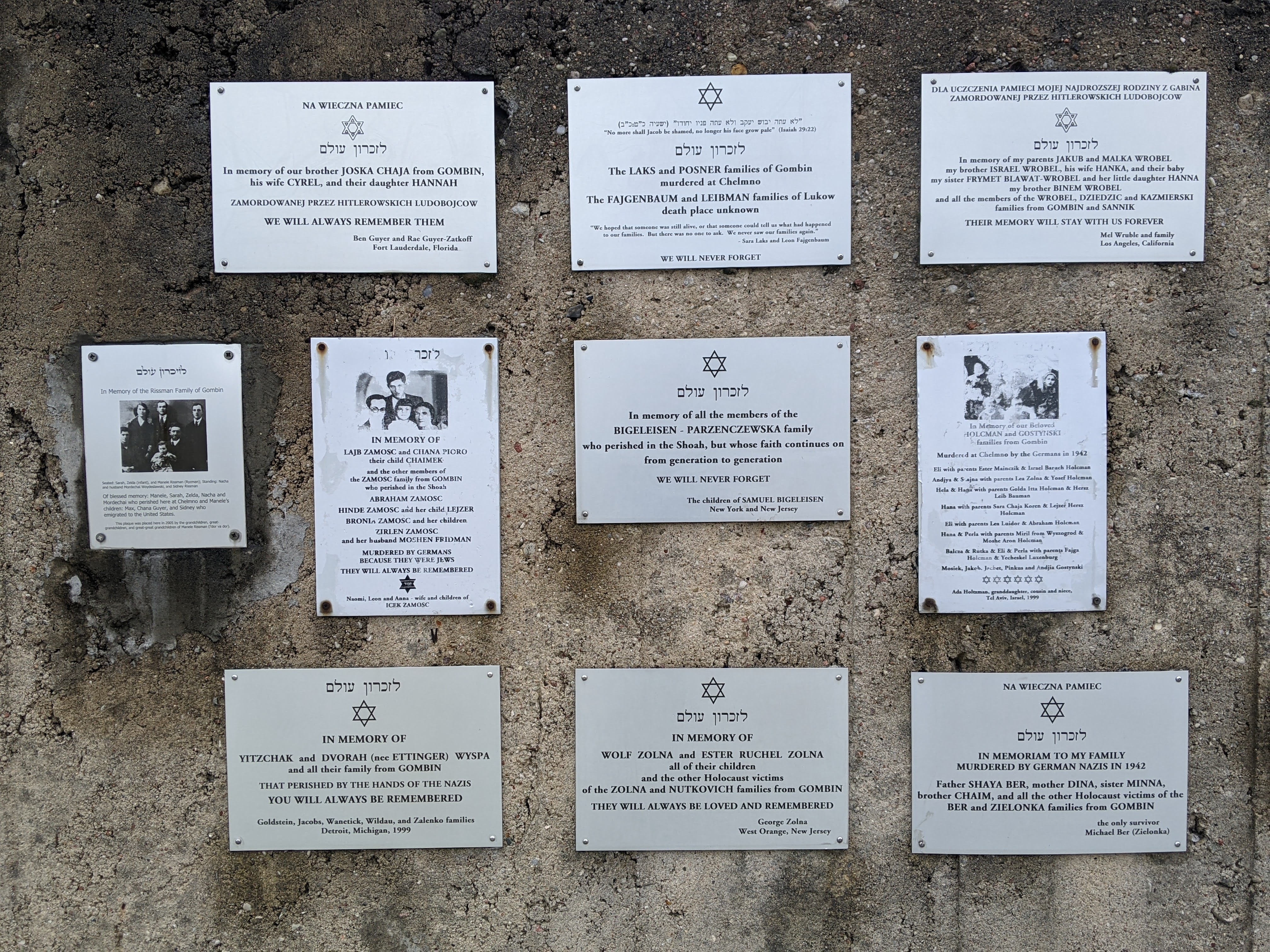
Survivors and their descendants have put up monuments alongside the massive expanses of burials. Some commemorate Jewish communities of particular towns, and some include long lists of the names of those murdered. Near the remains of a crematorium, now mounted in a low concrete wall, is a higher wall with an arched opening. On both sides, smaller plaques were put up by families to commemorate their murdered relatives.
Memorials at Chełmno
Several years ago, a friend told me that people would come here for picnics. As we left, Roberta said there used to be rock concerts near the Communist-era monument, too. What were they thinking? Or, rather, how is it that they weren’t thinking about this as a place of martyrdom and tragedy?
Roberta looks back at the mass graves
Over lunch in Koło, we didn’t talk about any of this. Maybe we just needed a break. Or maybe it was the result of a kind of protective amnesia. If you think about it too much it will just drive you crazy.











 Uncovering Jewish Heritage