• About
  • The Photo that Started it All

Uncovering Jewish Heritage

Uncovering Jewish Heritage

Tag Archives: Jewish Historical Institute

Żychlin Cemetery Project: Sun and Hail

13 Sunday Jul 2025

Posted by Marysia Galbraith in Association of Descendants of Jewish Central Poland, Commemoration, Jewish Culture, Jewish Ghetto, Museum, Polish-Jewish Heritage, Post-World War II, Warsaw, World War II

≈ Leave a comment

Tags

Jewish Ghetto Uprising, Jewish Historical Institute, Matzevah Foundation, University of Alabama

Day two began with beautiful sunshine. The first for days, we were told.

We met our guide Tomasz where we left off yesterday, outside the POLIN Museum.

The Heroes

The Monument to the Ghetto Heroes was dedicated in 1948, 5 years after the ghetto uprising. The relief sculpture features a heroic central figure that Szymon compared to a socialist realist superhero. Most of the figures around him are young, as were most of the ghetto uprising fighters. Behind the central hero floats a woman with her breast exposed holding a baby, perhaps symbolic of Matka Polka–the  idealized Polish mother, though perhaps also reminiscent of Madonna and the Christ child. The image emphasizes the heroism of the ghetto fighters. This is the best known side of the monument.

The relief on the back paints a different portrait of suffering and oppression. A line of robed figures tread heavily with down-turned faces. On this side, the central figure looks like a rabbi; he’s older with a flowing beard, holding a Torah scroll in his hand. The helmets and bayonets of Nazi soldiers hover above the line of hunched figures. Szymon pointed out the glittering black stone along the front of the platform, intended for a Nazi monument that never was built, and repurposed by survivors as a symbolic act of defiance.

The oppressed

We continued along the trail of the ghetto heroes, recognized on a series of metal cubes, then stopped at 18 Miła Street, where a dirt mound and monument mark the location of a bunker where ghetto heroes and civilians chose suicide rather than death at the hands of the occupiers.

These weren’t the only Jewish leaders who committed suicide. Judenrat leader Adam Czerniaków took his own life when he realized he couldn’t stop the final removals of ghetto residents to the death camps. Szmul Zygielbojm, a Jewish representative in the Polish government in exile, died by suicide after he learned the details of the murder of the Jewish people back in Poland. I wonder what my students think of this. It seems that for many Americans, suicide is an individual choice, not one motivated by a sense of collective grief or defiance. We aren’t facing down genocide, either…

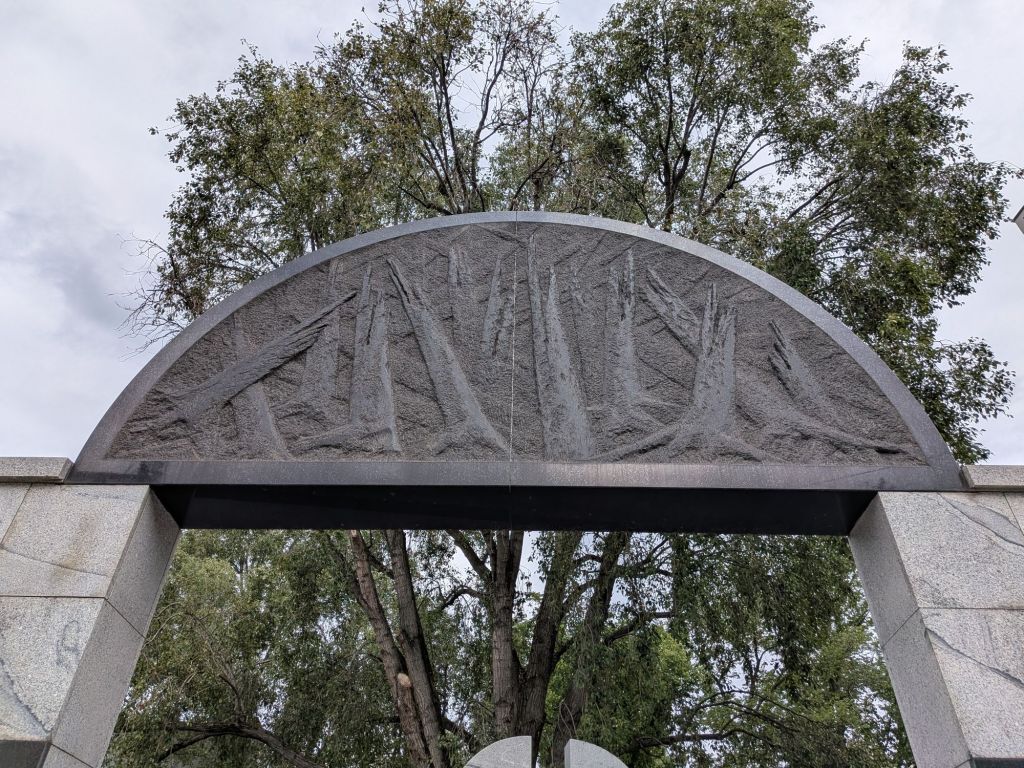
We continued on to Umschlagplatz, where captives were gathered for transport to the camps.
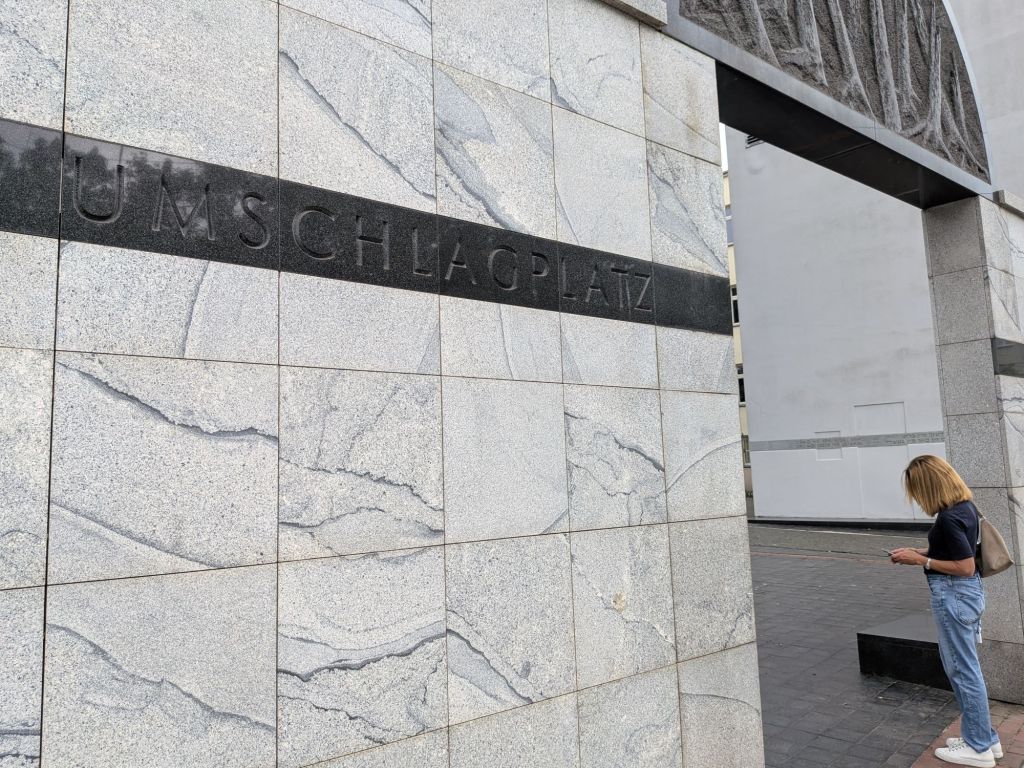
The broken trees on a tombstone-like feature symbolizes untimely death
The tree behind the break in the wall symbolizes life

The walls inside are inscribed with the first names of victims. I took a photo of Jakub in memory of my grandfather Jakub Rotblit and my grandmother’s brother Jakub Piwko, both of whom died in 1942, likely victims of the Holocaust
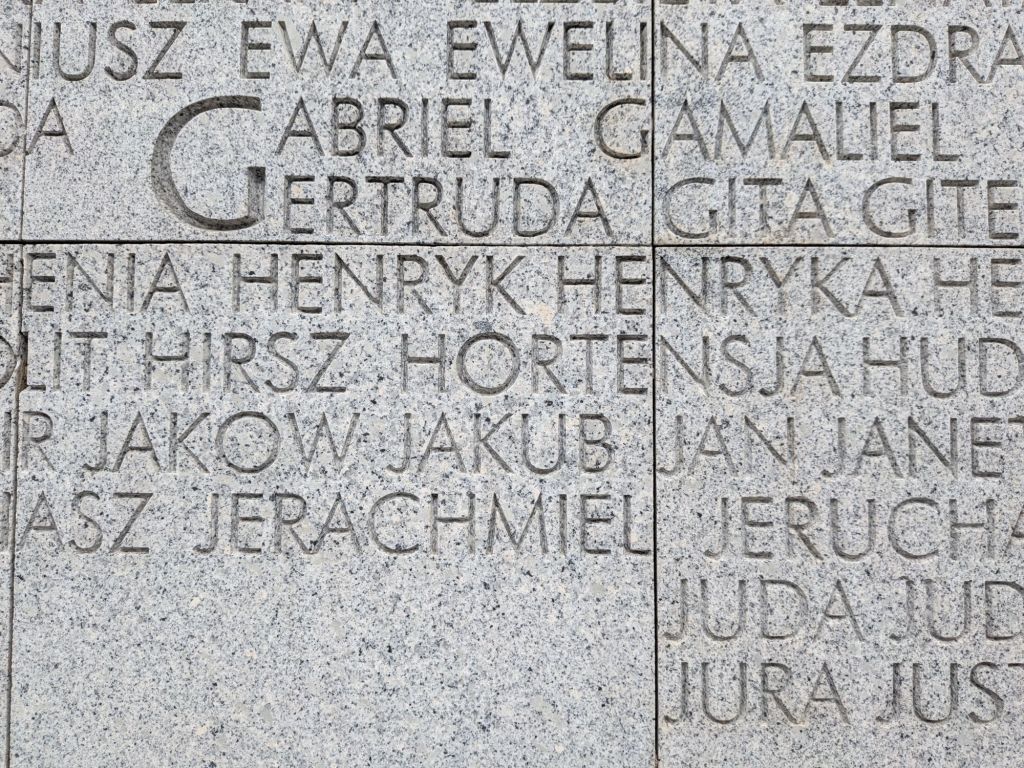
Jakub among the names of victims

We finished our tour at the Jewish Historical Institute, where many of the victims’ personal words are displayed along with one of the milk cans where Ringelblum hid the archive documenting life in the ghetto. Some of the saved documents are on display, including poetry, personal accounts, and official reports. One listing the number of victims in different towns says there were 3500 in Żychlin and 6500 in Kutno.

As we departed, thunder rumbled, the sky opened up and rain turned to hail.

Some of the students with our guide right before the hail came down.

“Is the weather always like this here?” a student asked. “No,” I replied. “That was really unusual.”
Finding Family at the Jewish Historical Institute

24 Sunday Sep 2017

Posted by Marysia Galbraith in Archives, Family, Genealogy, Piwko, Research Methodology, Rotblit, Warsaw

≈ 2 Comments

Tags

Jewish Historical Institute, JewishGen, Żydowski Instytut Historyczny

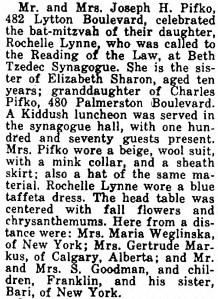
When my cousin Krysia and I first started searching for our Jewish roots, we barely knew where to start. Our Aunt Pat, a genealogist, had shared an impressive record of names, places, and even stories. Obsessive Internet searches yielded limited results–things like a notice in the Canadian Jewish Review from October 1963 that listed my grandmother’s sister Maria Weglinska among the out-of-town guests at Rochelle Pifko’s bat mitzvah in Toronto. Pifko/Piwko was my grandmother and her sister’s maiden name. But how were they related to these Canadian Pifkos?

1963CanadianJewishReviewBatMizvah

Notice in the Canadian Jewish Review on October 18, 1963 about Rochelle Pifko’s bat mitzvah.

How could we push beyond these tidbits? What more could we learn about our family?

Thanks to the Jewish Historical Institute (JHI, Żydowski Instytut Historyczny) in Warsaw we made some breakthroughs that have helped us piece together our family tree. Krysia’s husband Steve stopped in during a business trip to Warsaw and met Anna Przybyszewska-Drozd at the genealogical division of the JHI. She did a preliminary search on JewishGen, and found references to vital records of some of our ancestors. A few months later, Krysia and I went on our first roots trip to Poland. We still had no idea what we were doing so we stopped in at the JHI, meeting with Anna’s associate Aleksandra (Ola) Dybkowska-Grefkowicz who stayed after hours to help us with our search. She prefaced everything with her usual caution, “Don’t be disappointed if you don’t find anything” because so many records were destroyed and most Holocaust deaths were not recorded. Then, she showed us how to make use of the records in JewishGen and the databases of  the Polish National Archives, and suggested other places we could search for records.

I learned enough at that meeting to make some breakthroughs. I discovered my Zurich cousins through the Family Finder database on JewishGen, and shortly after my Israeli cousins through myHeritage.

On successive trips to Warsaw, Anna and Ola helped me learn more about my grandfather Jakob Rotblit. I was speaking with Ola about his automobile dealership in Gdansk when Anna walked in. A look of recognition flashed across her face; she pulled a book off the shelf about Jewish business owners in Gdansk between the World Wars. Sure enough, Jakob Rotblit was listed with information about his Ford dealership and with details about his wife and his parents. Another time, I mentioned that my mother and grandmother are on the list of Jewish survivors who registered after World War II ended. With a satisfied smile, Ola told me that the original registration cards are in the JHI archive. I walked upstairs to the archive and was able to hold those cards in my hand. The archivist showed me how the earliest records, from 1945, were handwritten on the backs of cut up prewar accounting records. Paper was scarce, so they used what they could find. By 1946, information was filled in on larger, pre-printed cards made especially for this purpose.

Once again, just a few months ago, the genealogical division helped me with my search. Anna e-mailed me that a woman, Ellen, had contacted her to find out about her Piwko ancestors. Anna thought we were related and asked if she could share my contact information with her. Of course I agreed, and since then Ellen and I have been in ongoing communication. She is an avid genealogist who turns out to be my 3rd cousin. Her great grandfather was my great grandfather Hiel Majer Piwko’s younger brother Urish. I knew nothing about him, maybe in part because he moved to Canada in the 1880s.

DSC00199

3rd Cousins in Krakow, Poland in June 2017

Ellen and I had the extraordinary good fortune to be in Poland at the same time this June. She was on a once in a lifetime Jewish history tour of Eastern Europe with Professor Stephen Berk. Although I didn’t know anything about her or her great grandfather, I had an inkling about her branch of the family from that notice I found years ago about my Auntie Nunia’s (Maria Weglinska) visit to Toronto in 1963. Rochelle Pifko, the girl whose bat mitzvah she attended, was Ellen’s cousin and another descendent of Urish. So another mystery is solved. Some contact was maintained between my great aunt and her uncle who migrated to Canada shortly after she was born. And when Nunia/Maria came to the US in the 1950s, she renewed that connection and even visited. Ellen remembers when Nunia came to Canada some years later for another family event.

Categories

  • Anthropology (37)
    • Archives (14)
    • Fieldwork (7)
    • Ground Penetrating Radar (GPR (4)
    • Research Methodology (8)
  • antisemitism (14)
  • Association of Descendants of Jewish Central Poland (32)
  • Catholicism (8)
  • Conference (1)
  • Discrimination (2)
  • Family (69)
    • Bereda (17)
    • Kolski (13)
    • Piwko (22)
    • Rotblit (3)
    • Walfisz (4)
    • Winawer (7)
  • Genealogy (11)
  • Heritage work (66)
    • Commemoration (23)
  • Identity (18)
  • Israel (6)
  • Jewish Culture (89)
    • Cemeteries (51)
    • Museum (7)
    • Synagogues (33)
  • Jewish immigrants (8)
  • Jewish Religion (1)
  • Memory (70)
  • Names (14)
  • Photographs (6)
  • Pifko-Winawer Circle (5)
  • Poland (125)
    • Baligród (1)
    • Bolimów (1)
    • Brześć Kujawski (5)
    • Buk (1)
    • Chodecz (1)
    • Dukla (2)
    • Dąbrowice (1)
    • Gdynia (1)
    • Gostynin (2)
    • Gąbin (1)
    • Izbica Kujawska (1)
    • Kazimierz (4)
    • Kowal (1)
    • Koło (1)
    • Krakow (7)
    • Krośniewice (1)
    • Kutno (6)
    • Kłodawa (1)
    • Lesko (8)
    • Leszno (1)
    • Lubień Kujawski (1)
    • Lubraniec (1)
    • Lutowiska (3)
    • Piła (3)
    • Podgórze (2)
    • Poznan (11)
    • Przemyśl (2)
    • Pzedecz (1)
    • Radom (1)
    • Radymno (1)
    • Sanok (1)
    • Skierniewice (5)
    • Sobota (2)
    • Tarnów (2)
    • Warsaw (22)
    • Wielkopolska (1)
    • Wronki (7)
    • Włocławek (20)
    • Zasław (2)
    • Łódź (1)
    • Żychlin (30)
  • Polish Culture (10)
  • Polish-Jewish Heritage (60)
  • Polish-Jewish relations (60)
  • Post-World War II (24)
  • Pre-World War II (22)
  • Reclaimed Property (1)
  • stereotypes (3)
  • Survival (9)
  • Trauma (3)
  • Uncategorized (5)
  • Victims and perpetrators (4)
  • World War II (45)
    • Jewish Ghetto (12)
    • Nazi Camps (5)
    • Polish Underground Army (3)
  • Yiddish (5)

Enter your email address to follow this blog and receive notifications of new posts by email. Your email address will not be shared.

Archives

  • October 2025 (1)
  • July 2025 (8)
  • June 2025 (1)
  • April 2025 (1)
  • August 2024 (3)
  • July 2024 (3)
  • May 2024 (2)
  • April 2024 (1)
  • May 2023 (2)
  • January 2023 (2)
  • December 2022 (7)
  • November 2022 (2)
  • October 2022 (5)
  • September 2022 (1)
  • January 2022 (1)
  • August 2021 (1)
  • December 2020 (2)
  • July 2020 (1)
  • May 2020 (3)
  • April 2020 (1)
  • March 2020 (1)
  • January 2020 (2)
  • May 2019 (1)
  • February 2019 (1)
  • November 2018 (1)
  • September 2018 (1)
  • August 2018 (3)
  • July 2018 (1)
  • June 2018 (1)
  • May 2018 (1)
  • April 2018 (2)
  • March 2018 (2)
  • February 2018 (2)
  • January 2018 (2)
  • December 2017 (2)
  • November 2017 (2)
  • October 2017 (1)
  • September 2017 (3)
  • August 2017 (3)
  • June 2017 (2)
  • May 2017 (3)
  • April 2017 (1)
  • March 2017 (2)
  • February 2017 (1)
  • January 2017 (2)
  • December 2016 (2)
  • November 2016 (4)
  • October 2016 (1)
  • September 2016 (6)
  • August 2016 (2)
  • July 2016 (1)
  • May 2016 (4)
  • April 2016 (2)
  • March 2016 (3)
  • February 2016 (4)
  • January 2016 (3)
  • December 2015 (3)
  • November 2015 (5)
  • October 2015 (5)
  • September 2015 (3)
  • August 2015 (4)
  • July 2015 (3)
  • June 2015 (3)
  • May 2015 (4)
  • April 2015 (9)
  • March 2015 (3)
  • February 2015 (2)
  • January 2015 (5)
  • December 2014 (4)
  • November 2014 (9)
  • October 2014 (2)
  • September 2014 (1)

Copyright Notice

All original text and images are copyright © Marysia Galbraith. Please contact the author before quoting.

Blog at WordPress.com.

  • Subscribe Subscribed
    • Uncovering Jewish Heritage
    • Join 145 other subscribers
    • Already have a WordPress.com account? Log in now.
    • Uncovering Jewish Heritage
    • Subscribe Subscribed
    • Sign up
    • Log in
    • Report this content
    • View site in Reader
    • Manage subscriptions
    • Collapse this bar
 

Loading Comments...