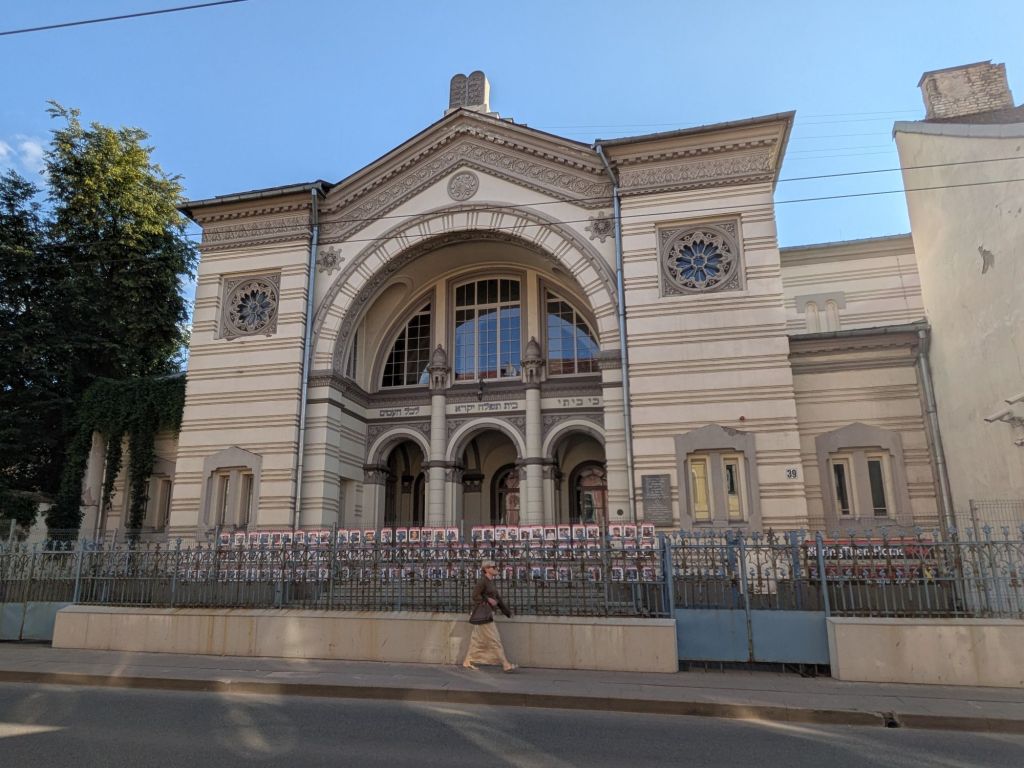
I wasn’t looking for Jewish history in Vilnius but it found me. The synagogue, still functioning as a house of prayer for the few thousand remaining Lithuanian Jews, is a half block from my hotel.
The Choral Synagogue in Vilnius. “Bring Them Home” along with photos of the hostages sits right behind the metal fence
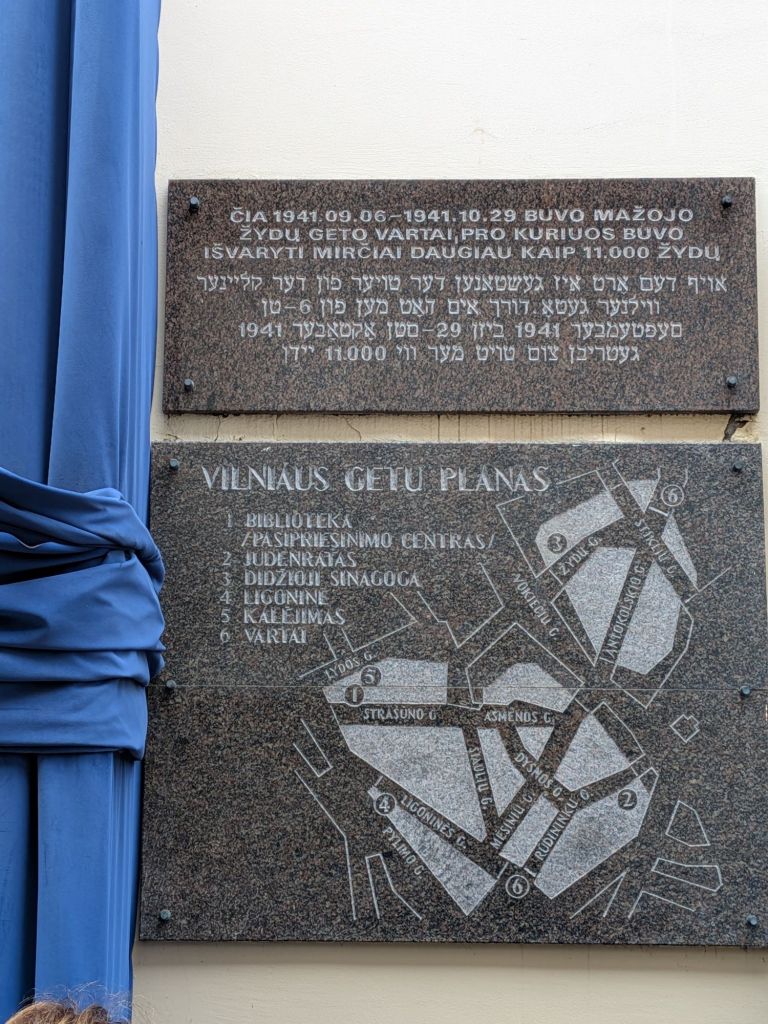
I signed up for a Vilnius with Locals walking tour of Jewish Vilnius, the so-called Jerusalem of Lithuania. We spent 3 hours exploring the Jewish quarter. In some sections, Soviet-era concrete buildings took the place of the prewar structures blown to rubble when the WW II ghetto was dismantled.
It’s hard to picture the prewar buildings that once filled this area
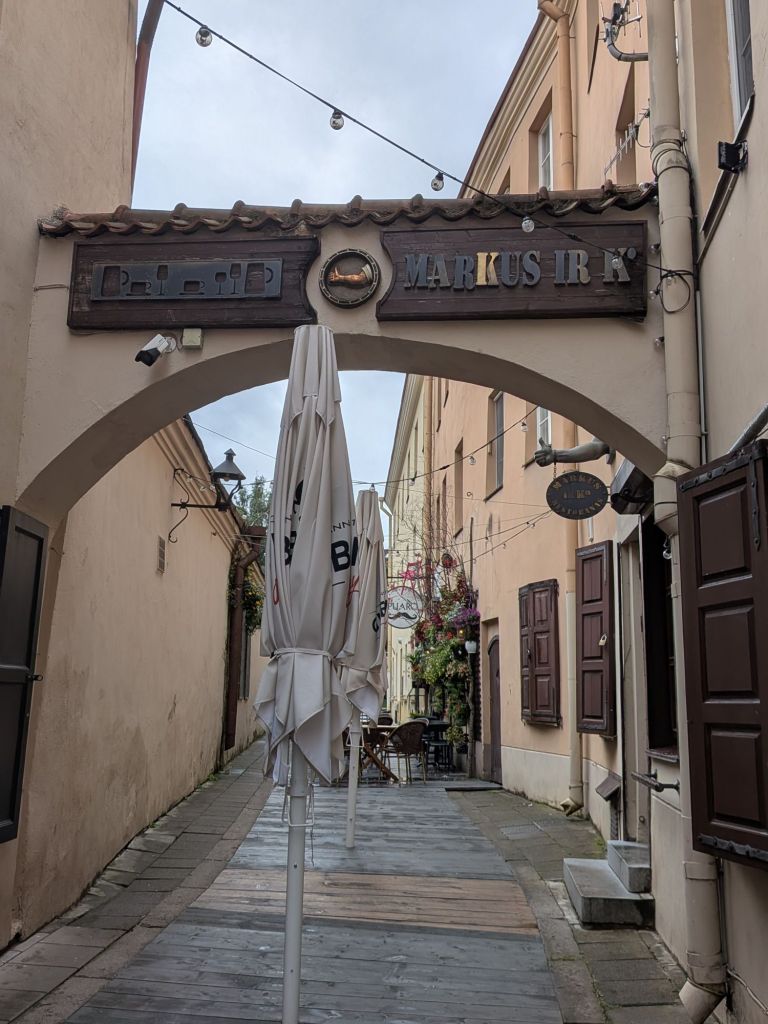
Other areas escaped destruction and retain their prewar appearance. As we meandered through narrow cobblestone lanes, Kristina our tour guide explained how much of the city’s Jewish story was silenced during the Soviet occupation, the period from 1940 to 1990 when the country was a republic within the Soviet Union. During that time, nobody talked about the Jews who had made up 45% of the city’s inhabitants before the war.
An iconic street in the Jewish district Map of the WW II ghettoJewish library scheduled for renovation
Kristina explained that this lost history only began to be rediscovered after Lithuania regained independence in 1990. Since then, scholars have been translating and writing about thousands of pages of documents that survived in hiding for 50 years. Many were collected by a group of people called the Paper Brigade who made it their mission to preserve all the documents in the YIVO Archive, a massive repository of Yiddish resources. Much of the archive found safety in New York. Today, the archive is split between Vilnius and New York.
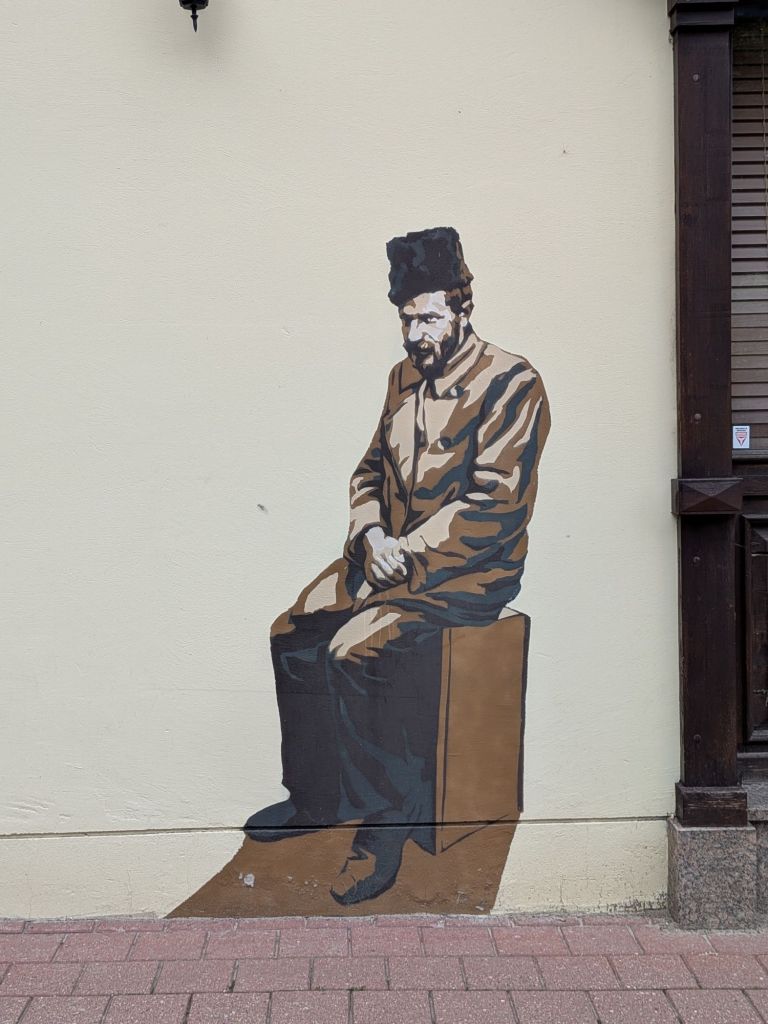
As more has been learned about The Jews of Vilnius, artwork, memorials, and institutions have made the story public. The Walls That Remember project stencils images from archival photos onto the walls of the former Jewish Quarter.
Kristina tells us about The Walls that Remember
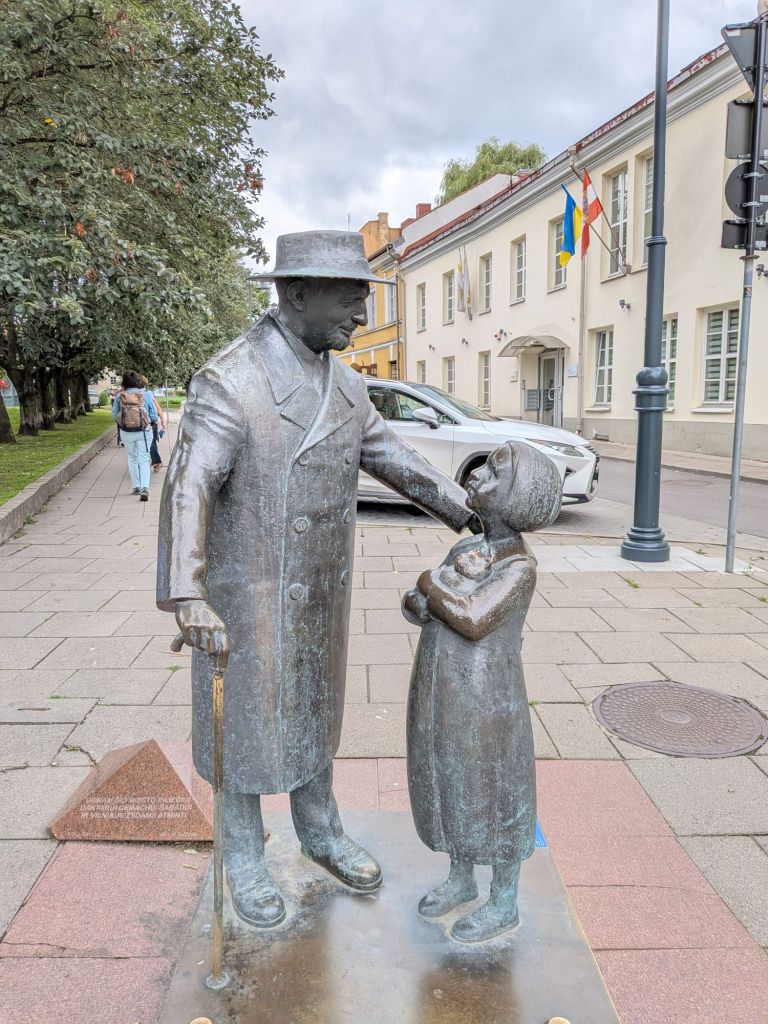
Remembered with a statue are: Zemach Shabad, a doctor known for his kindness who cared for the poor; Rabbi Elijah Ben Solomon (1720 – 1797), also called the Gaon of Vilnius; and singer Leonard Cohen, who had roots in Lithuania.
Zemach ShabadThe GaonLeonard Cohen
Jews first came to Vilnius as merchants before the 14th century. They were granted privileges by the Lithuanian rulers by the late 14th century. In Vilnius, they settled in the Jewish Quarter; other ethnic groups like Germans each settled in their own quarter of the city. By the time Lithuania was absorbed into the Russian Empire at the end of the 18th century, these ethnic enclaves were less rigid, and Jews could be found throughout the city along with other ethnic and religious inhabitants.
Vilnius was an important center for the growth of Yiddish language and culture, which explains why it was one of the places the Yiddish Scientific Institute (YIVO) was founded in 1925.
After a brief period of national autonomy from 1922 to 1940, Lithuania, like the other Baltic States, became a battleground between Stalinist USSR and Nazi Germany. When Hitler’s forces invaded in 1941, as many as 95% of the Jewish inhabitants were murdered.
Under Communism, the Choral Synagogue continued to operate, though it functioned more as a cultural organization than a religious one (at least officially). Since 1990, the Jewish community remains active at the synagogue. The interior can be viewed for just 2€. Whereas before the war, this was more of a reform synagogue, the current congregation is conservative. Women attend services on the upstairs balcony or behind a curtain on the ground floor.
Choral Synagogue
While on the tour, another participant and I struck up a conversation. Suzanne just completed a two-week tour of Jewish Poland with others of Jewish descent seeking to reconnect with the homeland of their ancestors. It was more than a historical trip, fusing spirituality and rituals within their encounters with Jewish spaces. For instance, at the grave of one participant’s ancestor, they did their own version of feldmestn, a ritual practiced by women; they measured the grave with wax, from which they made a candle.
I bonded with Suzanne over the importance of reconnecting with your Jewish origins, and also because of our shared appreciation for the individuals working in Poland to preserve Jewish memory. She called them memory keepers, a name that perfectly captures the role they play. I will use the term in my future writing about these memory keepers.
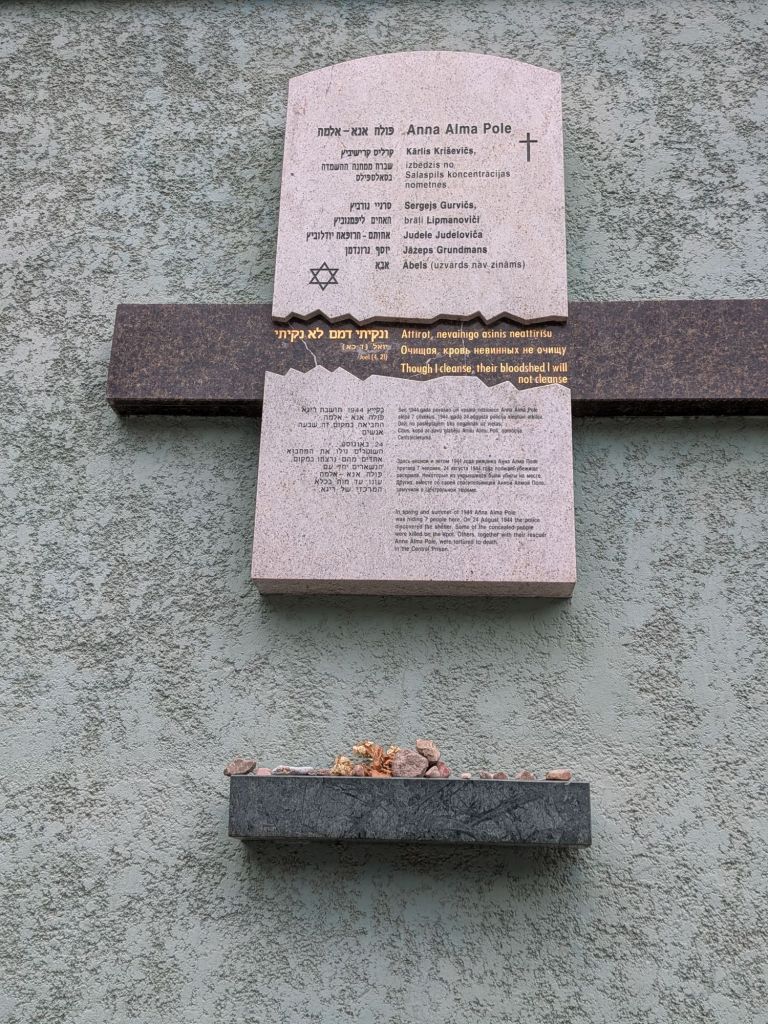
In Riga, the capitol of neighboring Latvia, Jewish markers continued to find me. On the building next to my hotel is a memorial marker for someone who saved Jews during the German occupation, and around the corner stands the synagogue. Also, during a walking tour of the city, I met Dimitri and his son Shiloh, reconnecting with their Jewish Latvian roots.
How do we learn difficult history? What is the most effective way of gaining factual and emotional understanding of what happened?
Memorial wall in the forest
One thing participants are learning is how important it is to consider multiple factors and viewpoints, to resist the urge to tell a simple moralistic story that avoids ambiguity and nuance.
Another is the importance of learning through individuals’ personal stories. These are what make the events of the Holocaust real to the students. By learning the stories of those who survived and those who died, they come to understand the human cost of the dehumanization at the core of the Shoah, and the suffering and resilience of the victims.
A third lesson comes from simply being in the spaces where history happened. The Żychlin Cemetery is one such place. The Chełmno Death Camp is another.
For our tour of Chełmno, we had no guide, each of us instead weaving our own path through the museum exhibit and the remains of the camp buildings. Though less known than Auschwitz, what happened at Chełmno needs to be remembered. There, techniques for mass murder were tested to tragic effect. More than 200,000 Jews, 4000 Roma, and many Poles were gassed in makeshift gas chambers, and then their ashes were buried in the forest five kilometers away.
Most prisoners came via train from towns like Żychlin and Kutno, as well as the city of Łódż, bypassing the tiny town of Chełmno and disembarking at a mansion next to the church. Arrivals were reassured by the fancy façade, the invitation to write postcards to their loved ones describing how nice the place was, and the promise they could relax after cleaning up after their long journey. They were instructed to list their valuables on a form so that they could be returned to them after they washed. They were led into rooms to remove their clothes, then led down a corridor to the back of a waiting truck they were told was a shower. But instead of water, the truck’s exhaust filled the space. With the door locked behind them, they had nowhere to go and no way of saving themselves.
Initially, workers were instructed to bury the dead, but quickly the leadership realized they needed to cremate the bodies, so crematoria were added in the forest and human ashes were spread over clearings.
After viewing the museum exhibitions, we drove on to the ash fields in the forest. Everyone moved through the space in the way that felt most appropriate for themselves–some solo, most in pairs.
Our group got to the memorial wall, solemn as they contemplated this killing space, only to be met by a glimpse of home–a couple from Mobile, Alabama on their own historical tour of Poland. Meeting them helped lighten the mood, a reminder about the living and our own familiar places.
Back in the Żychlin Cemetery, the graduate students and other volunteers were busy. Half of the back depression is cleared.
When we joined them, archaeology graduate student Michele Hoferitza helped us think about artifacts and making sense of their significance. She set up a task for us to remove all the small sticks still covering the surface of the ground so that the rocks and other objects on top of the ground would be more visible. Tomorrow, we’ll map what we see in 1 meter square grids. Maybe it will provide some indication of what happened at this site–how the space was used, what caused the depression, and whether we have located the mass grave.
Our day started with a quick trip to the grocery store to pick up food for lunch. How fitting that we found matzo!
Annice and Matzo at Kaufland
Our next surprise was the large matzevah fragment left in front of the cemetery gate by an anonymous donor who found it buried under grass in a private garden. It memorialized a 60-year-old man, though his name is not on this fragment.
Lawrence reading the Hebrew inscription on the tombstone fragment. Look how big it is, even without it’s top
Bożena Gajewska was there to greet us with all of the saws and other equipment I had arranged to be delivered to her for our project. She also brought Pringles from the local factory.
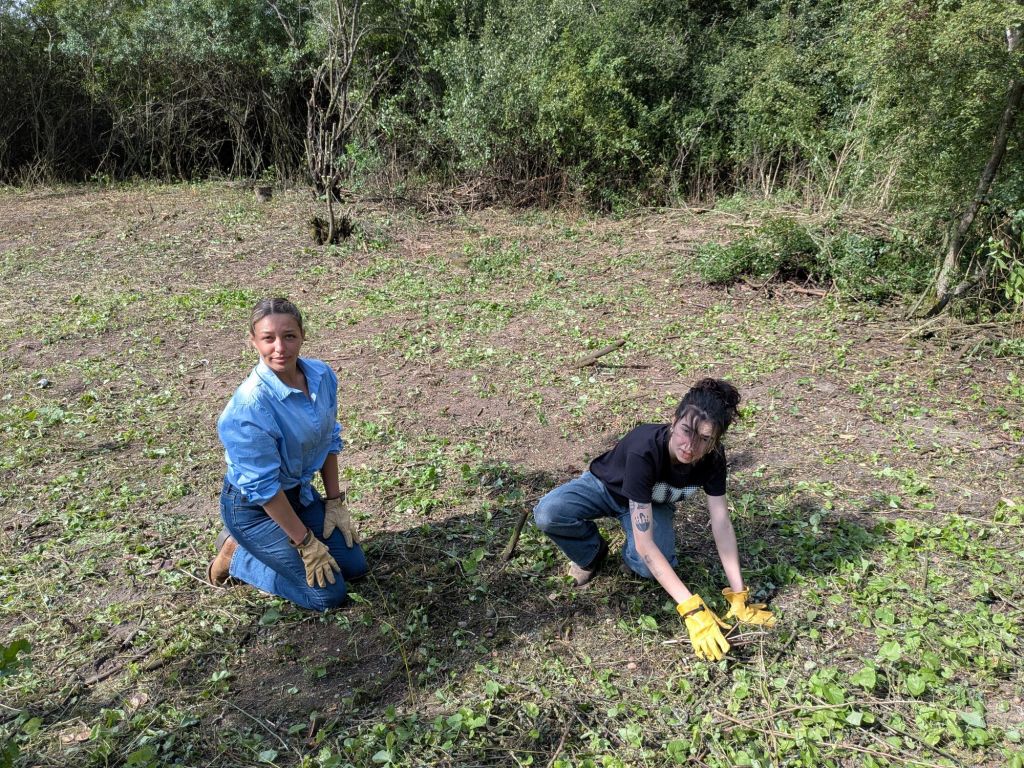
We got right to work clearing a path to the depression we plan to inspect with non-invasive ground penetrating radar. Some got hold of the loppers and others grabbed the branches as they were cut and hauled them out of the cemetery, where archaeology graduate student Caleb took charge of stacking them. In fact, he did this task systematically and neatly all day.
Working
Claibourne, who is heading up the GPR research, crawled and bushwhacked through the dense blackthorn to lay a measuring tape that would keep the cutters working in the right direction. Steven gave Claibourne the nickname “Magnum” when he saw that he is listed as the PI (principal investigator) of the project.
Filip instructing us on proper behavior in the cemetery
We took a break when Filip Szczepański of the Rabbinical Commission arrived. The most important thing, he told us, is not to disturb those who are buried–we are not to dig in the ground or do anything that might expose human remains. If we find any human bones, they are to be left at rest and carefully covered in the location where we find them. Steven suggested we get a bag of topsoil for this purpose.
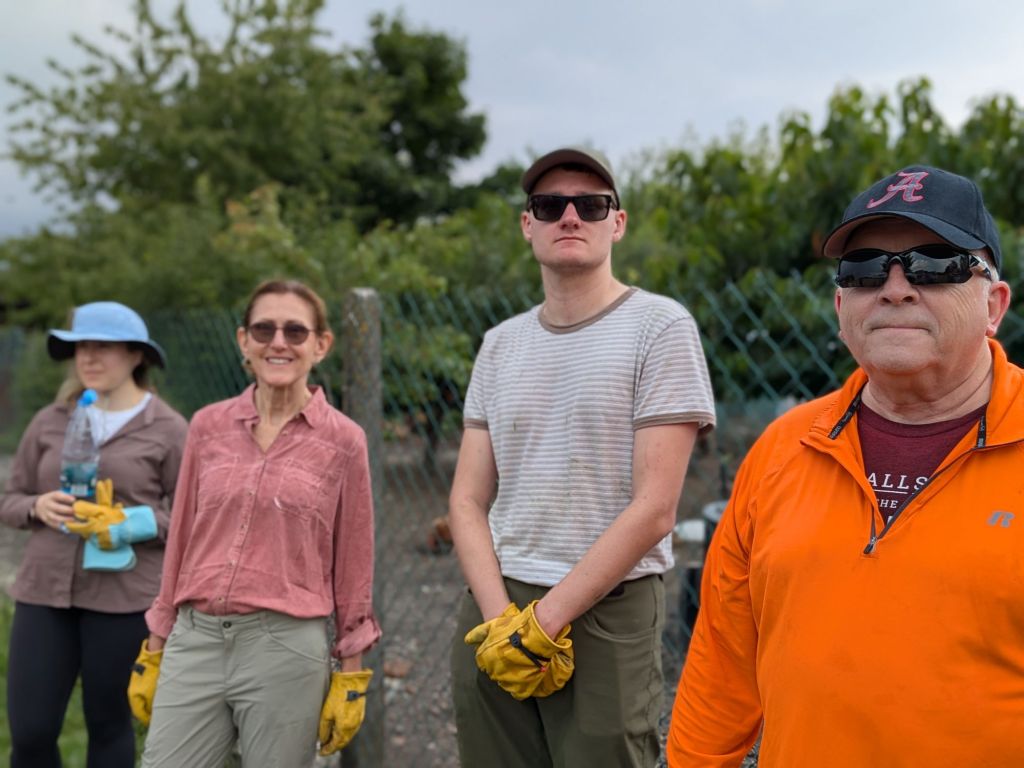
We had other visitors and helpers, including Ola Głuszcz, who is a high school history teacher, and her daughter, as well as Henryk and Agnieszka Olszewski, and Żychlin mayor Grzegorz Ambroziak.
Some guests
We got as much as or more done than we expected, with a path cleared across the middle of the depression. Tomorrow, we’ll continue our work, making sure all the stumps are flush with the ground so the GPR can run over the ground smoothly.
New alleyway to the research site
I refuse to get my hopes up. Even if we find no evidence of a mass grave, that is important information. We will know this disturbance had other causes and we should look elsewhere. But maybe? Filip, whose first impression was that we are looking at a hole made by people digging out sand, said there must be a reason the metal sign nearby refers to a mass grave. There must have been something there that made them put it there.
Day two began with beautiful sunshine. The first for days, we were told.
We met our guide Tomasz where we left off yesterday, outside the POLIN Museum.
The Heroes
The Monument to the Ghetto Heroes was dedicated in 1948, 5 years after the ghetto uprising. The relief sculpture features a heroic central figure that Szymon compared to a socialist realist superhero. Most of the figures around him are young, as were most of the ghetto uprising fighters. Behind the central hero floats a woman with her breast exposed holding a baby, perhaps symbolic of Matka Polka–the idealized Polish mother, though perhaps also reminiscent of Madonna and the Christ child. The image emphasizes the heroism of the ghetto fighters. This is the best known side of the monument.
The relief on the back paints a different portrait of suffering and oppression. A line of robed figures tread heavily with down-turned faces. On this side, the central figure looks like a rabbi; he’s older with a flowing beard, holding a Torah scroll in his hand. The helmets and bayonets of Nazi soldiers hover above the line of hunched figures. Szymon pointed out the glittering black stone along the front of the platform, intended for a Nazi monument that never was built, and repurposed by survivors as a symbolic act of defiance.
The oppressed
We continued along the trail of the ghetto heroes, recognized on a series of metal cubes, then stopped at 18 Miła Street, where a dirt mound and monument mark the location of a bunker where ghetto heroes and civilians chose suicide rather than death at the hands of the occupiers.
These weren’t the only Jewish leaders who committed suicide. Judenrat leader Adam Czerniaków took his own life when he realized he couldn’t stop the final removals of ghetto residents to the death camps. Szmul Zygielbojm, a Jewish representative in the Polish government in exile, died by suicide after he learned the details of the murder of the Jewish people back in Poland. I wonder what my students think of this. It seems that for many Americans, suicide is an individual choice, not one motivated by a sense of collective grief or defiance. We aren’t facing down genocide, either…
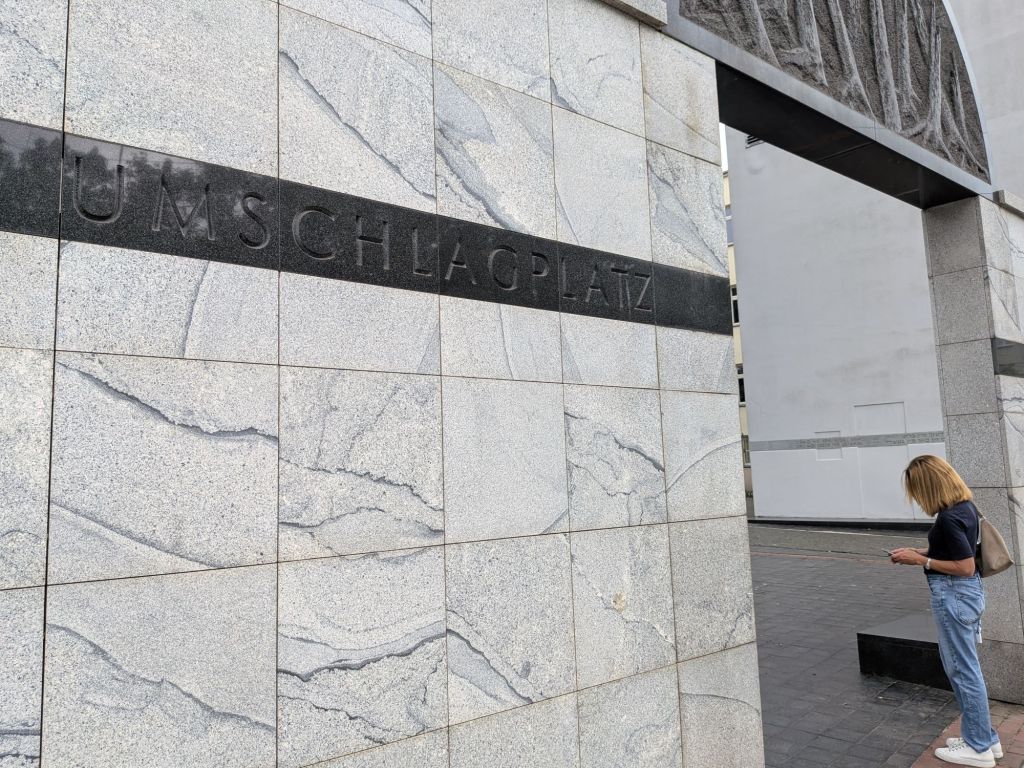
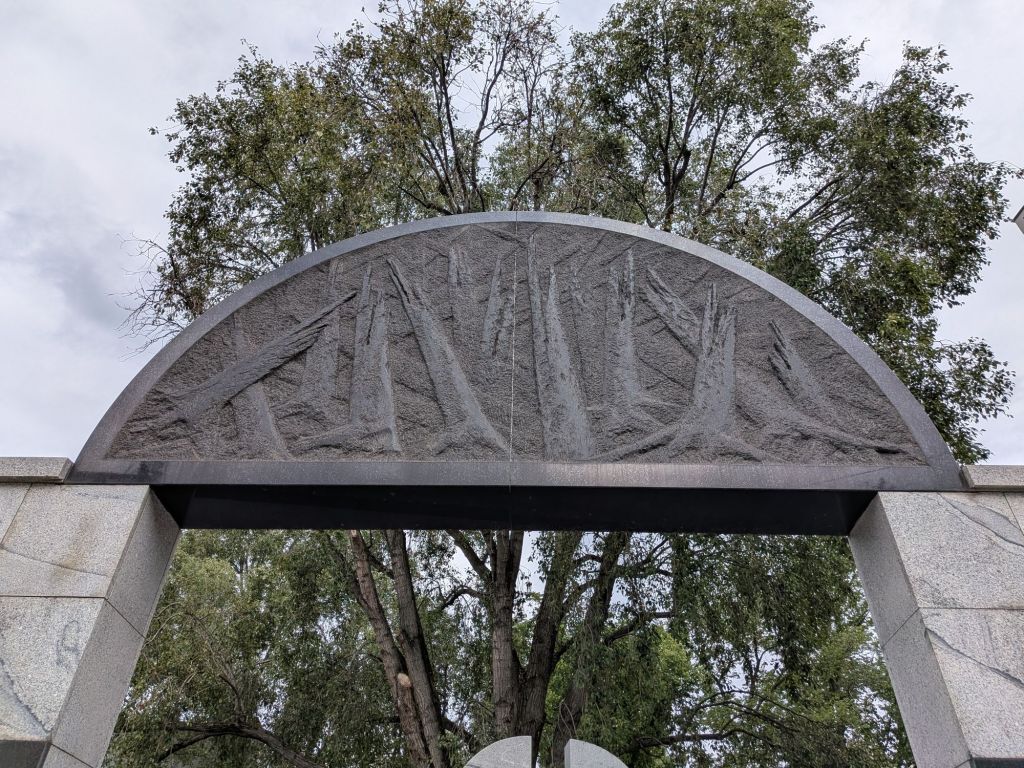
We continued on to Umschlagplatz, where captives were gathered for transport to the camps.
The broken trees on a tombstone-like feature symbolizes untimely deathThe tree behind the break in the wall symbolizes life
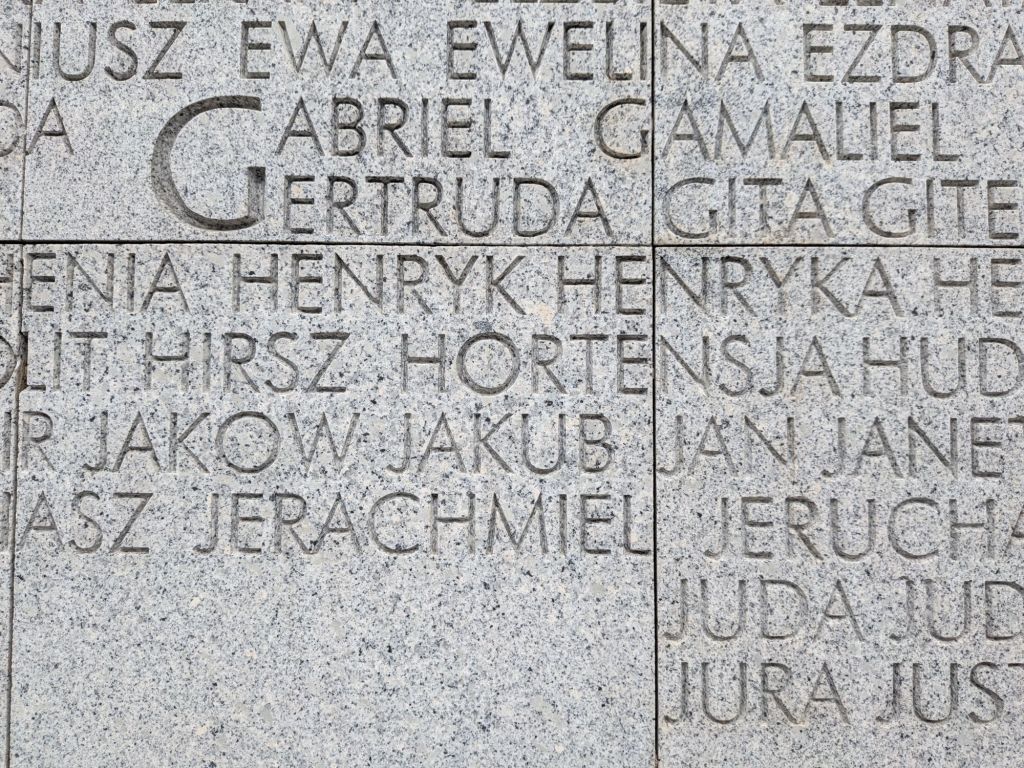
The walls inside are inscribed with the first names of victims. I took a photo of Jakub in memory of my grandfather Jakub Rotblit and my grandmother’s brother Jakub Piwko, both of whom died in 1942, likely victims of the Holocaust
Jakub among the names of victims
We finished our tour at the Jewish Historical Institute, where many of the victims’ personal words are displayed along with one of the milk cans where Ringelblum hid the archive documenting life in the ghetto. Some of the saved documents are on display, including poetry, personal accounts, and official reports. One listing the number of victims in different towns says there were 3500 in Żychlin and 6500 in Kutno.
As we departed, thunder rumbled, the sky opened up and rain turned to hail.
Some of the students with our guide right before the hail came down.
“Is the weather always like this here?” a student asked. “No,” I replied. “That was really unusual.”
Nothing like spending the whole day on your feet the day after an overnight plane trip. But our group is intrepid.
Dinner on Friday night
The day began with a walking tour “The Unremovable Traces of the Warsaw Ghetto” led by Dr. Szymon Pietrzykowski of the Jewish Historical Institute. We started in the JHI in the lobby where the stone floor retains the burn stains caused by the fire bombs that destroyed the Great Synagogue in 1943 after the Warsaw Ghetto Uprising
Great Synagogue in Warsaw. Photo source: WikipediaBurn marks dating from the destruction of the neighboring Great Synagogue in 1943.
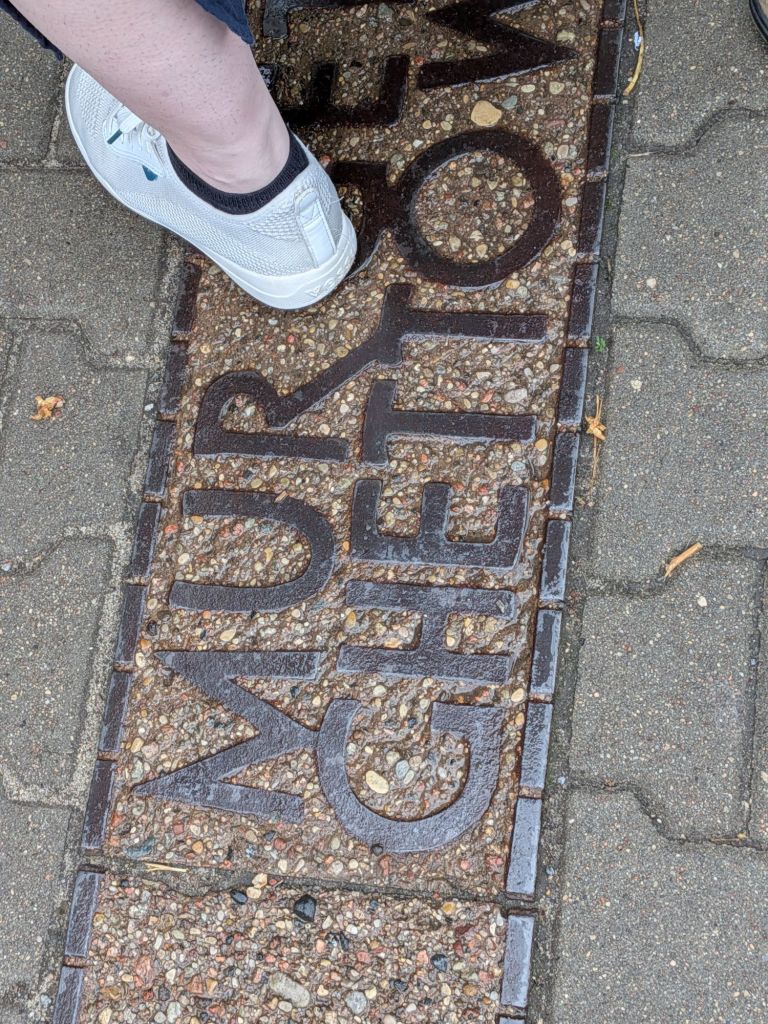
We visited places where the former location of the ghetto walls are marked by metal plaques in the sidewalk, buildings reconstructed after the war, sites where important Jewish institutions were destroyed and never rebuilt, and places significant to the Jewish Ghetto Uprising and the archive of Jewish life in the ghetto collected by historian Emanuel Ringelblum.
Jewish Historical Institute on Tłomacka StreetThe building that replaced the Great Synagogue. Note the arched feature evocative of synagogue windows.Location of the ghetto wallTraditional courtyard, one of the few showing what prewar Warsaw was likeMonument where part of the Ringelblum archive was found in milk cans under the rubble on Nowolipie Street
Our tour continued at the POLIN Museum of the History of Polish Jews, led by our guide Martina.
Our group at POLIN in the reproduction of a wooden painted synagogue Model of the Great Synagogue
After six hours of walking, we were ready to sit down. Paula, whose ancestor Tema Walfisz Jakubowicz grew up in Żychlin, treated us to a well-deserved meal. Many in our group got to try pierogi for the first time!
LiDAR image of the Żychlin Jewish Cemetery reveals two trenches that are likely mass graves. We’ll focus on the one outlined in green this July. Image details added by Claiborne Sea, a doctoral student in archaeology at The University of Alabama who will lead the ground penetrating radar (GPR) research.
As I piece together information about wartime mass burials in the Żychlin Jewish Cemetery, I’m finding other valuable records like this photograph of the Żychlin synagogue:
Synagogue built around 1880. Source: collection of Andrzej Kubiak
The Association of Friends of the Kutno Lands (TPZK) posted excerpts from Anna Wrzesińska’s article about Żychlin’s Jews. Mostly, they are wartime memories passed down in Żychlin families. The original post is here: https://tpzk.eu/getto-w-zychlinie/.
These difficult truths are what compel me to contribute to the memorialization of those who suffered and died during the Shoah.
The Google translation:
(…) After the outbreak of World War II and the occupation of the town by the Germans, there were about 3,600 Jews in Żychlin, including many refugees. From the beginning, Jews were treated badly: they were humiliated and beaten, their apartments, workshops and shops were searched and robbed. Then came the obligation to wear emblems with a star. In April 1940, the Germans arrested Jewish intellectuals, who were deported to concentration camps. In June 1940, a ghetto was established on the premises of the so-called Fabianówka, i.e. Karol Fabian’s complex of industrial buildings. In July 1940, a second ghetto was established. In total, over 4,000 Jews were gathered in them. About 800 people died of hunger and disease in the ghettos. In February 1942, the German police killed 100 Jews on the streets of the large ghetto. In March 1942, the Germans carried out an action to liquidate the ghettos, deporting over 3,000. Jews to Krośniewice and then to the Kulmhof Nazi extermination camp in Chełmno nad Nerem. The members of the Żychlin History Lovers Society often talk about the ordeal of Jews during World War II. They shared their memories once again on March 9, 2016.
Józef Staszewski: “After the Germans entered Żychlin, initially they were not harsh towards the Jews. Until July 1940, that is, until the creation of the ghetto, they lived rather freely. On July 15, the decision was made to create a ghetto, or rather a second ghetto. The large ghetto was along Narutowicza Street, partly Łukasińskiego Street and today’s Traugutta Street. It reached all the way to the river. Several buildings were excluded from this area, including the Kumm house and Sędkiewicz bakery.
The large ghetto was created in one day, within four hours. The Germans simply relocated the residents of Narutowicza Street, where most Jews lived. They were relocated from the left side of the street to the right, just as they stood, both Jews and Poles. The German mayor led all this, he had it perfectly planned.
Looking from the church, the ghetto was on the left side of Narutowicza Street. The gate to the ghetto was from the Narutowicza side, like the billboard is today. The ghetto was not surrounded by a wall, but fenced with pickets. It was relatively easy to leave it, and Jews often did so. It had its own board and police. On its territory there was Rabinówka and a hospital.
The small ghetto was located on ul. 1 Maja, then Pierackiego, in the buildings of the so-called Fabianówka. It was established almost at the same time as the large one. Jews who did not fit into the large ghetto were sent there.
Information on this subject is supplemented by Jerzy Banasiak: “The ghetto was large on Narutowicza from the river to the right. My uncles Edek and Tadek had a mechanical workshop there, he did not join the..and they were richer than them. in Yiddish. ghetto, like Andrzejewski’s workshop, was taken over by the German Krebs. This area was fenced off. From the river, on the corner, there was a second gate to the ghetto, it was made of planks and reinforced with barbed wire. I lived near the smaller ghetto – Aleje Racławickie 20. In Fabianówka there were wealthier Jews, displaced from the left side of the city. There was a brickyard, to which a gate led, a palace, two large buildings, a brickyard, to which a gate led. buildings and a row of workers’ houses, still stand today. It was very cramped there, when it was warm, people slept under the roof of the brickyard.
Jews had to wear Jewish stars, initially on their backs, then on the sleeve. The stars were painted on the clothes or sewn on. My father, who worked in a dairy, made stars from sheet metal for sale.”
Tadeusz Kafarski: “The Germans also resettled my family. We lived near today’s veterinary clinic, and they resettled us to ul. Kościuszki 3, to a former Jewish house. I saw how in the summer the Germans would drive the Jews to the nearby ponds to swim. If they didn’t want to go into the water, they would shoot them. They ordered us, the children, to throw pebbles at them.”
The Jews were used for various cleaning jobs in the city. On the orders of the Germans, they dismantled crosses and chapels. They also built a villa for the mayor of Żychlin, Hempel, in the city park on the site of the demolished Kościuszko Stone (today it houses the Municipal Public Library).
“The most terrible thing I saw, recalls Mr. Staszewski, was the image of exhausted Jewish children. How hungry they were! We had orders from the scouts to deliver food to the ghetto, and that’s what we did: we brought bread, beets, potatoes, carrots…”.
It wasn’t safe. As Mirosław Zomerfeld recalls: “My father wasn’t displaced because he had a forge. We lived nearby. My aunt helped Jews in the ghetto. They deported her to Germany for work, she was not far from Dachau.” (…)
People’s behaviors varied. This is how Father Roman Indrzejczyk recalls the events of 1942: “I experienced the war and the German occupation in Żychlin near Kutno as a small boy. I came across people’s terror, helplessness, suffering, humiliation, persecution, injustice… I also saw the ghetto – I felt the great injustice done to these people, closed, fenced offfrom “our” world. A world that was already very limited by the violence and cruelty of the harsh, ruthless Nazi rule. I know that some of us tried to do something to give a little help and hope or at least show kindness and solidarity, but we always did it marked by great fear. Fear was widespread then, because “they” – the occupiers – could do everything worst. I don’t remember exactly when it was, but it was definitely before the liquidation of the ghetto: one of my peers, Stasiek, told me that tomorrow there would be a “deportation” in the city, “they will be deporting Jews from the ghetto” and his father would have to participate in it. I didn’t fully understand this information, but my father said then: “You don’t have to, an adult doesn’t have to do what is wrong, even if they tell you to. (…) You have to help, you have to defend the wronged, and not participate in doing wrong”. I understood that my father was talking about something very difficult, but I remember it to this day as an oracle. This “does not have to”, “should not do evil”, “should save, help the wronged” is more important than all fear and egoism. In my little heart, this awareness remained that only such a person deserves respect and recognition. I guessed that such an attitude rarely happens…”.
And this is how the Jewish woman Helena Bodek recounts the last days of her stay in the Żychlin ghetto (Jak tropione zwierząt. Wspomnienia, Wydawnictwo Literackie, Kraków 1993, p. 66): “General panic. The ground is burning under people’s feet. They walk as if unconscious. In their eyes there is mad fear, fear of death. Everything indicates that the time of liquidation is approaching. Finally, the mail to the ghetto is stopped. The interruption of contact with the outside world is a warning signal for us: we have to escape – now or never”.
Helena Bodek and her mother managed to escape from the ghetto. They reach Gąbin on a horse-drawn carriage they accidentally meet. They stop in the local ghetto, where there is still peace. There, three days later, they learn from other escapees – several young boys – about the liquidation of the Żychlin ghetto.
“They avoided arrest completely by accident. […] the navy blue policeman Ćwik, for his friendly attitude – he went from house to house with words of comfort – received many valuable gifts. These things were brought to his apartment by these young men. When they were about to return to the ghetto, it turned out that it was surrounded by the Gestapo. Ćwik, fearing for his own skin, ordered them to flee. The boys tell the story of the last moments of the Żychlin ghetto. Shortly before its liquidation, the local police went crazy. All the Jewish policemen were ordered to line up and were shot one by one. Hilek Zygier was killed shouting: “Long live the Jewish nation!” Under the pretext of contacting her husband, she was led out of the Oberman home. After taking a few steps, she fell to the ground, shot in the back. The same fate befell Oberman’s elderly parents. Of the entire family, only a several-year-old son remained. When a neighbor tried to take care of him, the Germans killed her on the spot. The child stood in the cold and cried, and people were afraid to approach him. On the evening of Oberman’s death, Altek’s brother was also shot.
The terror intensified with each hour. The police led groups of people to the Jewish cemetery. There they were murdered – among them the young Halusia Chude. Blood flowed in streams, leaking into the gutter outside the ghetto. Dr. Winogron died – a large diamond was noticed on her finger. According to other rumors, at the last moment she tried to contact her former maid Aryan to entrust her with little Maciuś. Desperate people went mad: a young married woman in the last month of pregnancy, Rachcia Gelman, threw herself into a river in front of the Gestapo, where she was hit by German bullets. Chałemski’s mother, an old woman, locked herself in a wardrobe, fearing the Germans, and died of suffocation. At dawn, the carriages commandeered from peasants from the surrounding villages arrived. People were loaded onto them. They stood and, so as not to fall out of the carriages, held each other’s hands tightly. Amid the cries of children, the lamentations and screams of women, the line of carriages moved towards the railway station. There, the unfortunate were packed into cattle wagons for their last journey…
The small, Jewish town of Żychlin is “Judenfrei”, the ghetto has ceased to exist. And it happened on Purim. It was on this holiday – a holiday of joy, a holiday of children – that thousands of innocent beings were sent to death and torture together with their fathers and mothers…”
After the Jewish residents of Żychlin were deported to Kulmhof, the Germans searched their homes for hidden valuables. At that time, the manor house and factory buildings of Fabianówka, Rabinówka on Narutowicza Street and several other buildings were demolished to their foundations. Only after systematic plundering were the Polish population ordered to settle the area of the former ghetto.
We have presented fragments of the article by Anna Maria Wrzesińska entitled “Jews in Żychlin”, which was published in the 20th volume of Kutnowskie Zeszyty Regionalne.
I have been calling my project a family memoir since the beginning, well before I read In the Garden of Memory (the English translation was published by Weidenfield and Nicolson in 2004). My family’s story overlaps with author Joanna Olczak-Ronikier’s in other ways, too. The social world of Warsaw was intimate enough that it seems likely our families knew about each other even if they weren’t directly acquainted. Joanna’s relatives, the Horwitzs and the Mortkowiczes, were central figures in the social circles my Babcia also frequented, those occupied by writers, artists, publishers, and professionals. Both families have Jewish origins, and each assimilated, though to varying degrees.
Joanna, her mother Hanna Olczak, and her grandmother Janina Mortkowicz didn’t deny their Jewish origins in the way my mother and grandmother did. Still, they frequented many of the same places around Warsaw. When Janina, then Horwitz, was a child, her “consolation prize” for check-ups at the dentist were a visit to Lourse Café on Krakowskie Przedmieście for chocolate (15). This was in the 1880s, so decades before my grandfather Zygmunt Bereda gained an interest in the business. During the 1930s, Joanna’s cousins attended the same high schools as my mother and uncle. Girls attended the Klementyna Hoffmanowa High School, while boys went to the Stefan Batory High School.
The book also gives me some insight into marriage customs during my Babcia’s generation. “According to Jewish tradition, finding suitable husbands for one’s daughters was a basic parental duty,” Olczak-Ronikier writes. “Marriage was too serious a matter to be contracted for love. After all, it concerned two people’s future, and that of their offspring. The older generation took charge of bringing the couples together, involving family, friends and a professional matchmaker” (32). Things were changing rapidly in the late 19th century, though, and just like I have observed among Babcia’s siblings, older children were more bound by tradition while younger children were more inclined to choose their own pathway. In Olczak-Ronikier’s family, the younger children were drawn to socialism and communism.
By the next generation, Joanna’s mother Hanna was the first and only family member to marry a non-Jeweven and to change her religion. Olczak-Ronikier says, it “did not provoke any particular reaction among her relatives” (184). She was not excluded from the family because of it, unlike my grandmother Halina, whose father sat shiva and treated her as dead after her marriage to a Catholic. Olczak-Ronikier’s family was far more secular than Babcia’s, though. Perhaps in part this is because the Piwkos lived in provincial cities where the pull of religious tradition was stronger. My grandmother was drawn to Warsaw for the opportunities it offered for her to remake her life.
Another parallel I see between our family stories is in the internalized antisemitism Joanna experienced. As a child in the 1930s, she didn’t want to be Jewish, especially when she became the object of the anti-Jewish taunts of other children. She explains, “Among Jews who had decided to assimilate, a huge role was played by ambitions relating to the level of Polonization they had achieved. When the parents, through their looks, language and religious customs, were a reminder of the environment that the children had made such an effort to get out of, family love and loyalty were severely put to the test. Nowadays it is hard to imagine how painful this process of tearing oneself away from one’s roots must have been” (71).
Maks Horwitz, her great uncle, put it this way: “They were ashamed of their origin. Understandably, they never denied it among those who knew about it. But even here, in deed, word and gesture they tried to prove and convince others that they felt themselves to be completely and utterly Polish and that they were entirely rid of their Jewishness” (111).
Members of both families survived the war by adopting Aryan identities. Babcia was able to live more in the open than Olczak-Ronikier’s family because she had been distanced from her Jewish origins since the 1920s, and also because her Catholic husband was well enough positioned to bribe the Nazi authorities to look the other way. As in my family, the women of Joanna’s family took a few years off their age on their false documents (92). During the Warsaw Uprising, when the area they lived in was overrun by the Germans, Olczak-Ronikier’s family escaped via the underground sewers, as did my mother. With the destruction of the capital, both families took the same path out of the city, traveling with a crowd of refugees south to Krakow, where they remained until the end of the German occupation. (268)
Joanna’s cousin Ryś Bychowski was born the same year as my mother. He attended Stefan Batory High School, just like my Uncle George who was just a couple of years older. It seems likely they knew each other, and its possible they could have been friends. Their lives might have overlapped during the war, as well. Ryś escaped to safety in the US with his parents in 1941, only to volunteer for the Polish Airforce, which operated out of Britain. My uncle was a paratrooper, while Ryś became a navigator. Ryś joined as a Polish patriot, unwilling to remain in safety when his people were subject to Nazi oppression. For him, the fact that he was Jewish only added to his resolve. He wanted to liberate Poland and the Jewish people. While in Britain, he confronted the horror of the mass annihilation of the Jews, made even more unbearable when his friends and comrades exhibited indifference, or in some instances satisfaction, that the Jews were killed. Olczak-Ronikier explains, “His Polish-Jewish identity had always seemed something quite natural to him, yet in view of this and similar episodes he came to the conclusion that he had to make a choice” (295). He decided he could never live in Poland again, even though he remained committed to the fight against Nazism.
A photo from my grandmother’s papers taken in Warsaw right after the war. From the left: Mirka (Rachel’s daughter), Rachel (Babcia’s sister), Czesław Mochorowski, and Nelly. The boy who is standing is Bogdan, Rachel’s grandson, the son of Samek and Nelly. I don’t know who the man on the right or the boy at the very bottom are.
The evolution of Ryszard’s view of Poles helps me understand the deep anger and resentment so many Jews feel toward Poland. It’s something I have recognized before, and wondered why they direct their fury more strongly toward Poles than to Germans. In a letter to his father in 1943, Ryś Bychowski explained in clear and emotionally resonant terms; “I do not want to be a second-class citizen ever again […] Above all I’m afraid of knowing the whole truth about the reaction of Polish society to the extermination of the Jews. I cannot live with or talk to, I am not able to work with people who found it possible to ignore their destruction, occupy their homes and denounce or blackmail the survivors” (296). This was an intimate betrayal, not by a sworn enemy but by comrades and neighbors. It was exclusion from the group he felt himself to be a part of. No wonder it cut so deeply.
Report #10 about Roberta Books and Marysia Galbraith’s trip to meet Polish partners in preparation for the ADJCP‘s memorial visit to central Poland.
Włocławek, September 12-16 and September 28
With a population of 107,000, Włocławek is the largest town in this part of central Poland, followed by Kutno which has 42,700 residents.
Włocławek will be the home base for the ADJCP memorial trip in May 2023. Roberta and I spent several days there to plan the trip and I returned a couple of weeks later to follow up on a few things. We reserved a block of rooms for the memorial trip in the Pałac Bursztynowy, a three-star hotel built to look like an old manor house, with an elaborate formal garden all around it. Roberta and I sampled the menu at the hotel restaurant. They have a good assortment of soups, salads, appetizers, and main courses, all tastefully prepared. The white asparagus soup with smoked salmon was particularly tasty. We also made arrangements with a bus company that will provide transportation during the memorial trip.
Roberta with a bowl of white asparagus soup at the restaurant in the Pałac Bursztynowy
In Włocławek, we met with partners who agreed to help organize activities for us. Included among our partners are schoolteachers Anita Kaniewska-Kwiatkowska who teaches history at the Automotive High School, Robert Feter who teaches computer science at the same school, and Monika Lamka-Czerwińska who teaches at a school for children with disabilities. They have led several award-winning programs in which their students learned about and did research about the city’s Jewish community. See for example Włocławek Zapomniana Ulica, a Facebook page that was developed as part of one of these projects. Another outcome of this project is a sign posted on Piwna Street with a QR code linking to a recorded message outlining the wartime history of the Jewish population in this place.
Włocławek Forgotten Street: Scan the QR code to hear the history of the street
On the morning of September 13, Roberta and I met students at the Automotive High School. We were escorted to the library, a room the size of a large classroom. Extra chairs filled all the space between the round tables. A reporter from the local paper came and took photos. Two students shot video for a class in television production with the plan to create a short program about our visit.
Students filed in one class at a time. In attendance were students studying psychology/pedagogy, computer science, and technical studies. This school also has classes for students with physical and mental disabilities.
Before we began, I spoke briefly with the first group that arrived, girls studying psychology and pedagogy. Their teacher Anita Kaniewska explained they will work with her on a project about Jewish history and culture and they will participate in our memorial trip. The room filled up. Over 80 students attended. We delivered our presentation in English and I’m surprised how well it went. A good number of the students understood, and those who didn’t know much English seemed attentive nevertheless.
Roberta and I took turns explaining our family connection to central Poland. Then we asked them what they knew about Jewish culture and religion, mostly as a way to fill in some details and point out similarities and differences to Polish culture and Christian faith. Finally, we invited them to ask us questions, which we answered. Their questions included:
What emotions do you experience when telling us your story?
Do you have any relatives in Poland today?
Did you know there is going to be a statue for Jewish people in Brześć Kujawski? There was a public pool but they closed it, because people found out it was a graveyard for Jewish people.
Afterwards, one of the teachers said she was very pleased with the students’ level of engagement. Even one of their students who has autism asked a question. Five girls from Anita’s class thanked us and told us how moved they were by our stories and our presence. They asked if they could give us a hug. It was very sweet.
We had to hurry to our appointment with the mayor. Anita accompanied us. Marek Wojtkowski, whose official title is President of Wloclawek, expressed support for the ADJCP and efforts to memorialize the city’s Jewish history. He agreed to meet memorial trip participants and to welcome us to Włocławek.
Together with Anita, we proposed two projects: a Jewish history trail with signs and QR codes outlining events that occurred in particular places around the city; and a portable exhibition on retractable panels that can be moved and set up easily. President Wojtowski supports both these ideas. He agreed to help obtain permission to mount the historical trail signs on buildings.
President Wojtkowski noted his background as an historian, and said it is important that this history return, especially for young people.
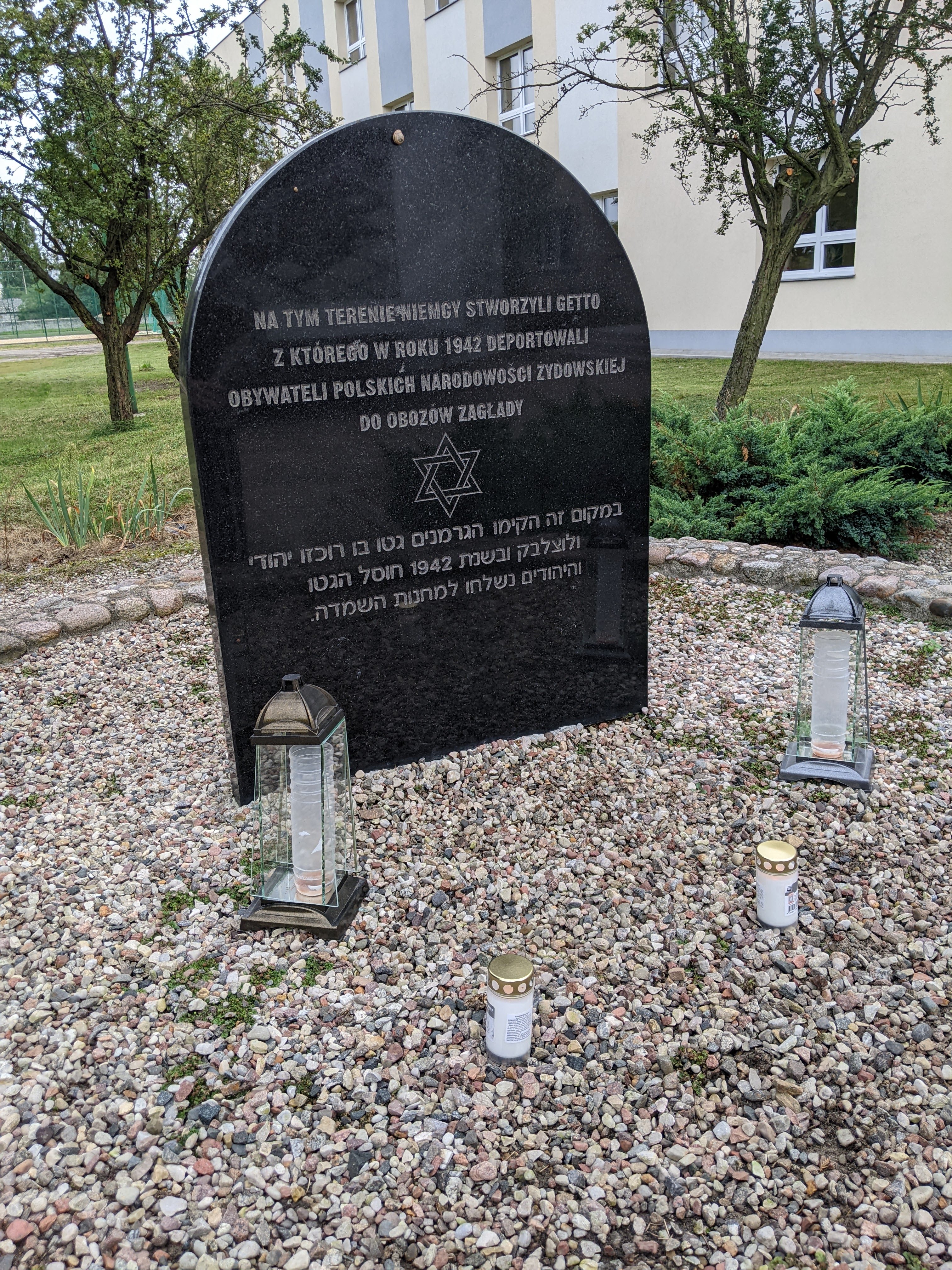
Few traces remain of Włocławek’s Jewish community, which before the war numbered 20,000 people (20% of the city’s population). The two synagogues were burned down during the first days of the Nazi invasion on Rosh Hashana 1939. The cemetery was cleared of tombstones, and during the communist period a school was built on the site. In 2000, a group of descendants in collaboration with the city erected a memorial in front of the school in the shape of a matzevah. The text says in Polish and Hebrew “At this site Germans created a ghetto from which in 1942 they deported Polish citizens of Jewish origin to death camps.” Roberta and I lit candles for my relatives and all the others buried at this site.
Memorial to Włocławek’s Jewish Community at the site of the Jewish cemetery and the wartime ghetto
Meeting with Mirka Stojak, September 28
When I returned to Włocławek on September 28, I met with Mirka Stojak, who for over 20 years has been meeting with and assisting Jewish descendants who have visited Włocławek. Mirka has documented the lives of Włocławek’s Jews in historical texts, prose, poetry, and on her webpage Żydzi Włocławek. Each year, she gives presentations at schools where she tells the stories of the city’s Jewish residents and reads her original poetry and stories. She has also worked with students on theatrical and musical productions on related themes. Longin Graczyk of the Ari Ari Foundation has worked with Anita and Mirka on other projects. Most recently, Mirka led a “Sentimental Walk” around historic Włocławek in which she told the stories of Jewish residents who used to live at various addresses. The Ari Ari Foundation and the local government where among the sponsors of the event. The ADJCP is listed as well!?!
Poster for the “Sentimental Walk”
Mirka will join Anita and Longin on the organizing committee for our memorial trip. She is also happy to prepare a presentation or to lead a walk for our visit, though she does not speak English so it will need to be translated.
Since retiring last year, Mirka has devoted even more time to writing. I bought her latest book Pamięci Włocłaswkich Żydów (In Memory of Włocławek Jews), a combination of history, stories, poems, and the memoir of Jakub Bukowski, who turns out to have been a neighbor of my cousins. Bukowski mentions Mirka Kolska, my mother’s first cousin, was one of classmates.
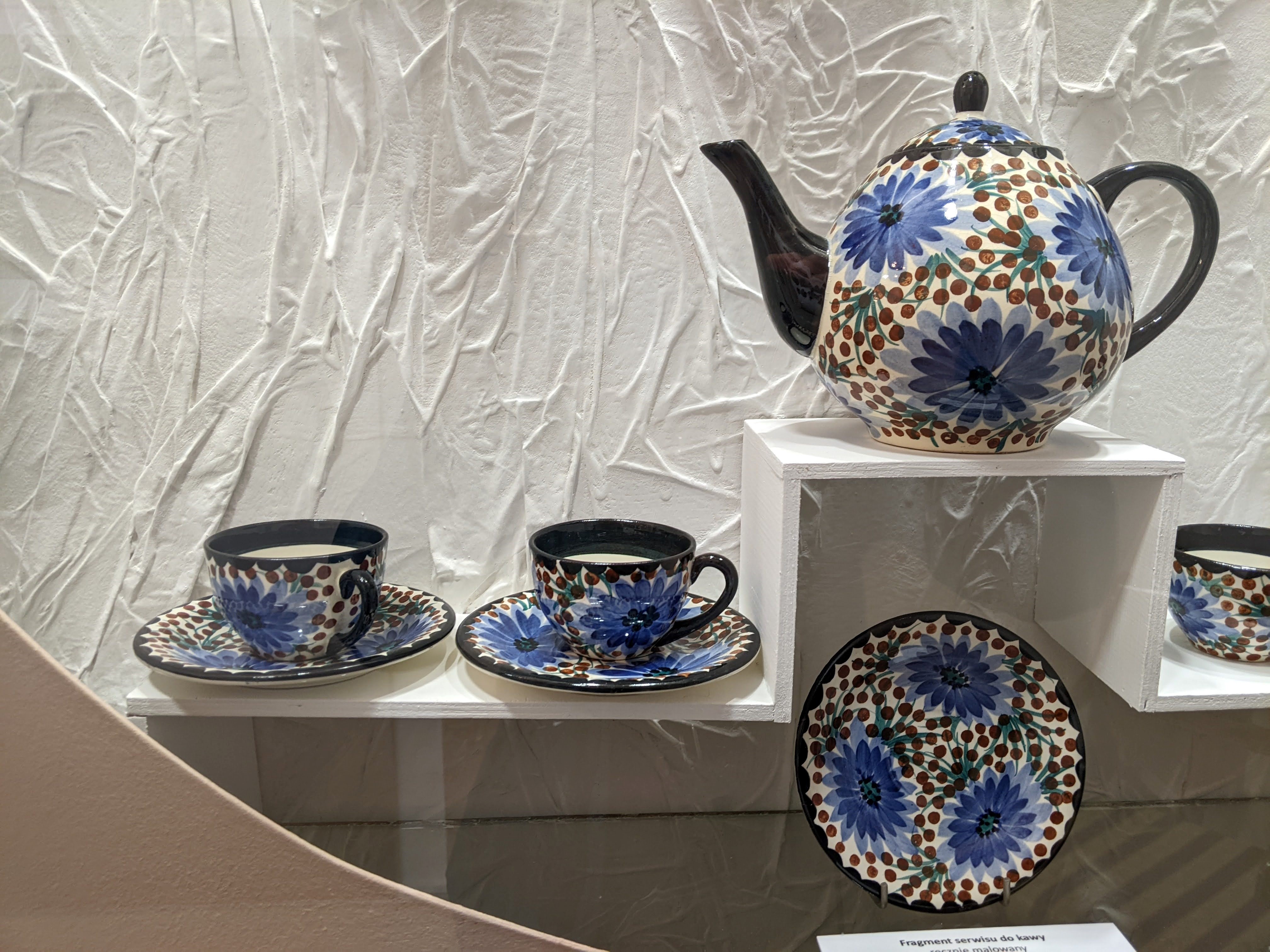
I visited the city museum to see the extraordinary exhibition of faience pottery. This industry was started and dominated by Jewish industrialists. Many of the woman who painted the floral designs were Polish. During the war, the industry was taken over by the Germans and then passed into Polish hands after the war. During communism, the factories became the property of the national government. The last factories closed right around the time communism fell. They were unable to reorganize within the emerging capitalist economy.
I hope we include the exhibition in our memorial trip.
Report #8 about Roberta Books and Marysia Galbraith’s trip to meet Polish partners in preparation for the ADJCP‘s memorial visit to central Poland.
Chełmno nad Nerem, September 11
On September 11, we started the day at the Chełmno Death Camp. Though the parking lot was full, the camp itself was empty. Most people were in the neighboring church. It was Sunday. The mass, emitted from speakers outside the church, wafted across the remains of the death camp.
No English-language guide was available, so the woman at the office/ticket desk showed us around herself.
The camp is on the site of a former pałac, or mansion. Prisoners would be told it was a health resort. They were given postcards and encouraged to write home that they were safe and taken care of. Then, they were told they needed to wash before entering, which made sense to many because diseases like typhus were common in the ghettos they came from. Prisoners were brought to the basement of the mansion to undress. They were instructed to fill out inventories of the valuables they had with them and then hand everything over for safe keeping while they showered. They were told they can present their inventory later to get their valuables back. Instead, they were murdered.
Map of the mansion at Chełmno. “E” marks the location of the trucks converted into gas chambers.
The Nazis destroyed the camp when they retreated. But the outline of the mansion’s basement walls remain. We walked along a raised walkway and looked down into the spaces where people undressed and then were led down a corridor and outside into a truck set up with what looked like shower heads inside. Sometimes, prisoners were even given slivers of soap as they entered. In actuality, these trucks were designed for mass murder, their backs converted into the Nazis’ first gas chambers. Up to 100 people were gassed at a time and then prison work units would remove the bodies, which were taken by truck to the forest about 7 km away. Initially the bodies were buried, but later they were burned and the ashes buried.
They knew that what they were doing was wrong. Why else would they destroy the evidence?
At the burial site in the forest, I needed space to be with my own thoughts. I walked alone under an imposing Communist-era concrete monument balanced on tapered concrete supports. On the side facing the road is a bas relief of people in various states of suffering, with the single word “We remember” (“Pamiętamy”). On the back side, in uneven block letters, is written, “We were taken, from the elderly to infants, between the cities of Koło and Dąbie. We were taken to the forest and there we were gassed, shot, and burned…Now we ask that our future brothers punish our murderers. The witnesses of our oppression, who live in this area we ask again for these murders to be publicized throughout the world.”
Communist-era monument at Chełmno Death Camp
At some point, the Communist leaders made a point of building commemorative monstrosities like this. There is another one at the Stutthoff Concentration Camp near the Baltic coast.
I caught up with Roberta and Yosef when we got to a big field of mass graves. “This is the most important place to see,” Roberta said. Otherwise, we didn’t talk about it.
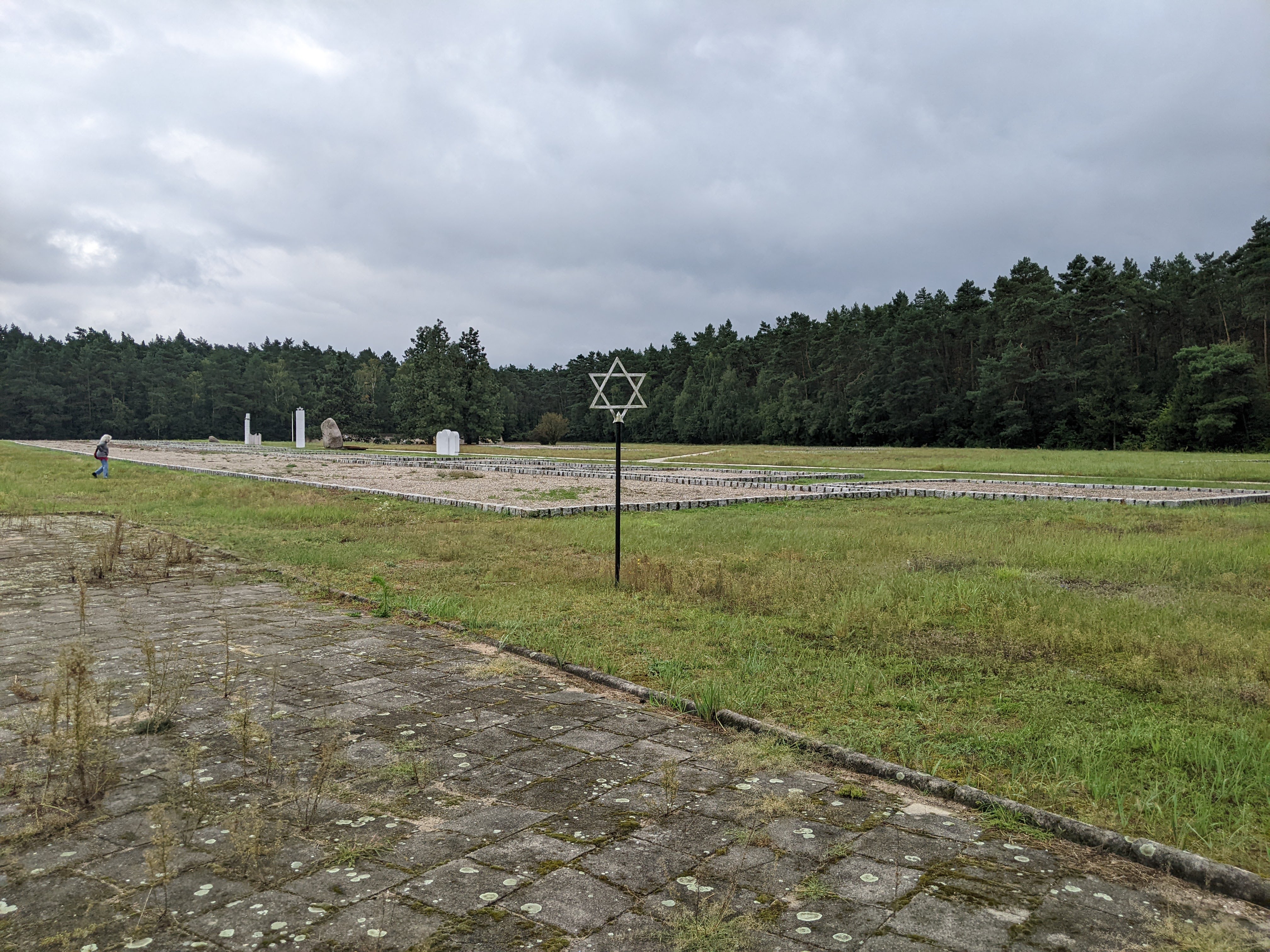
The graves are delineated by concrete borders filled with white gravel. This is to mark the burial sites, and also to prevent bone fragments from moving up out of the ground. People have been known to search for bones here and take them home as souvenirs.
Mass graves marked with stone borders and gravel, beyond the Star of David
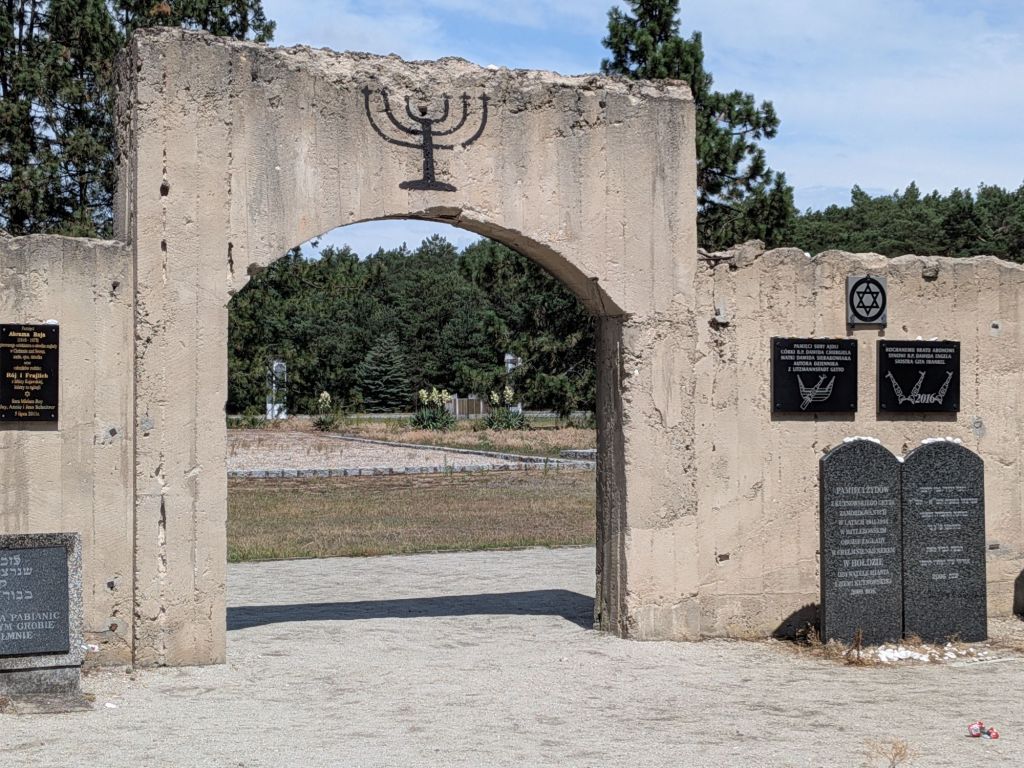
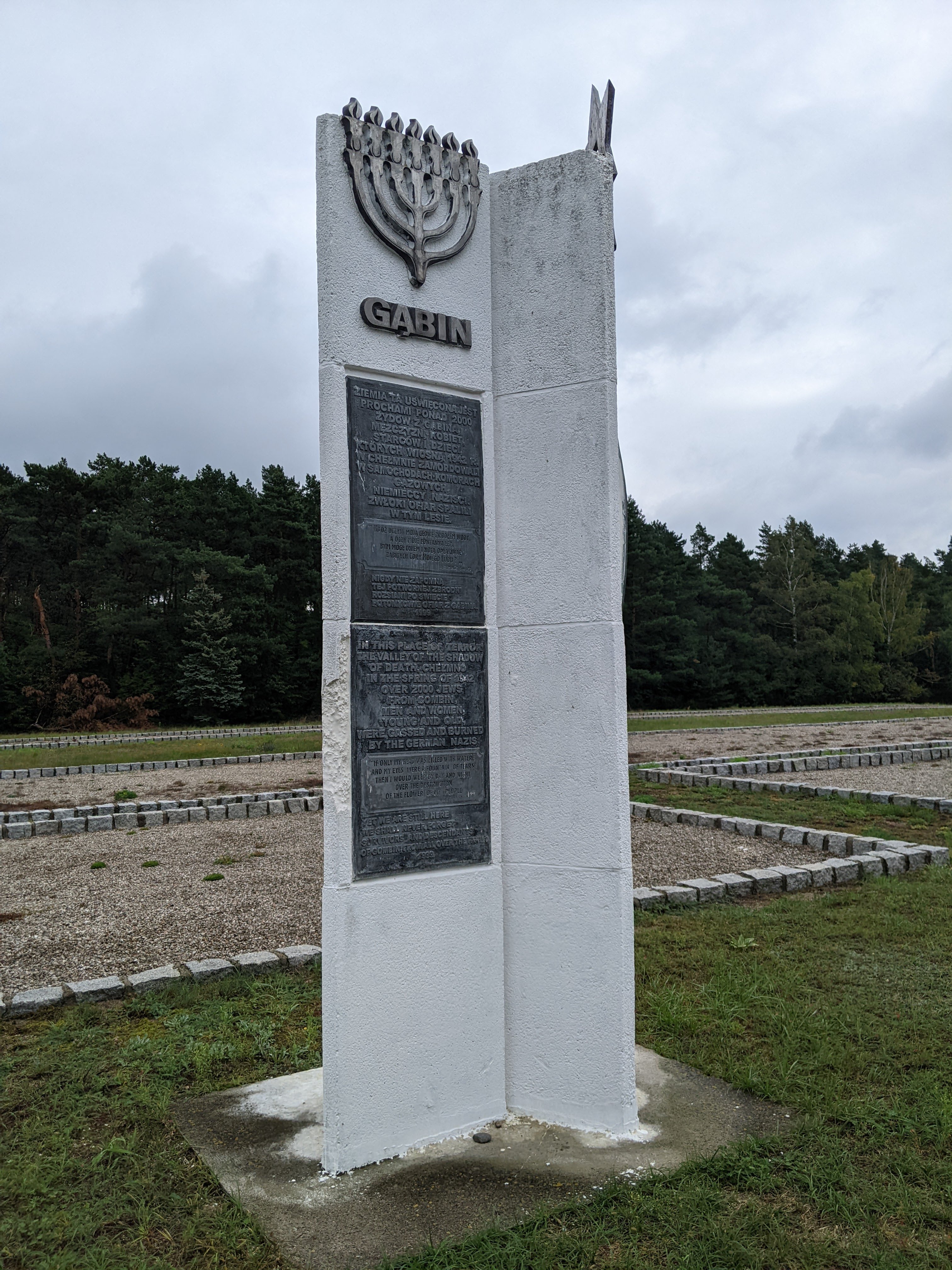
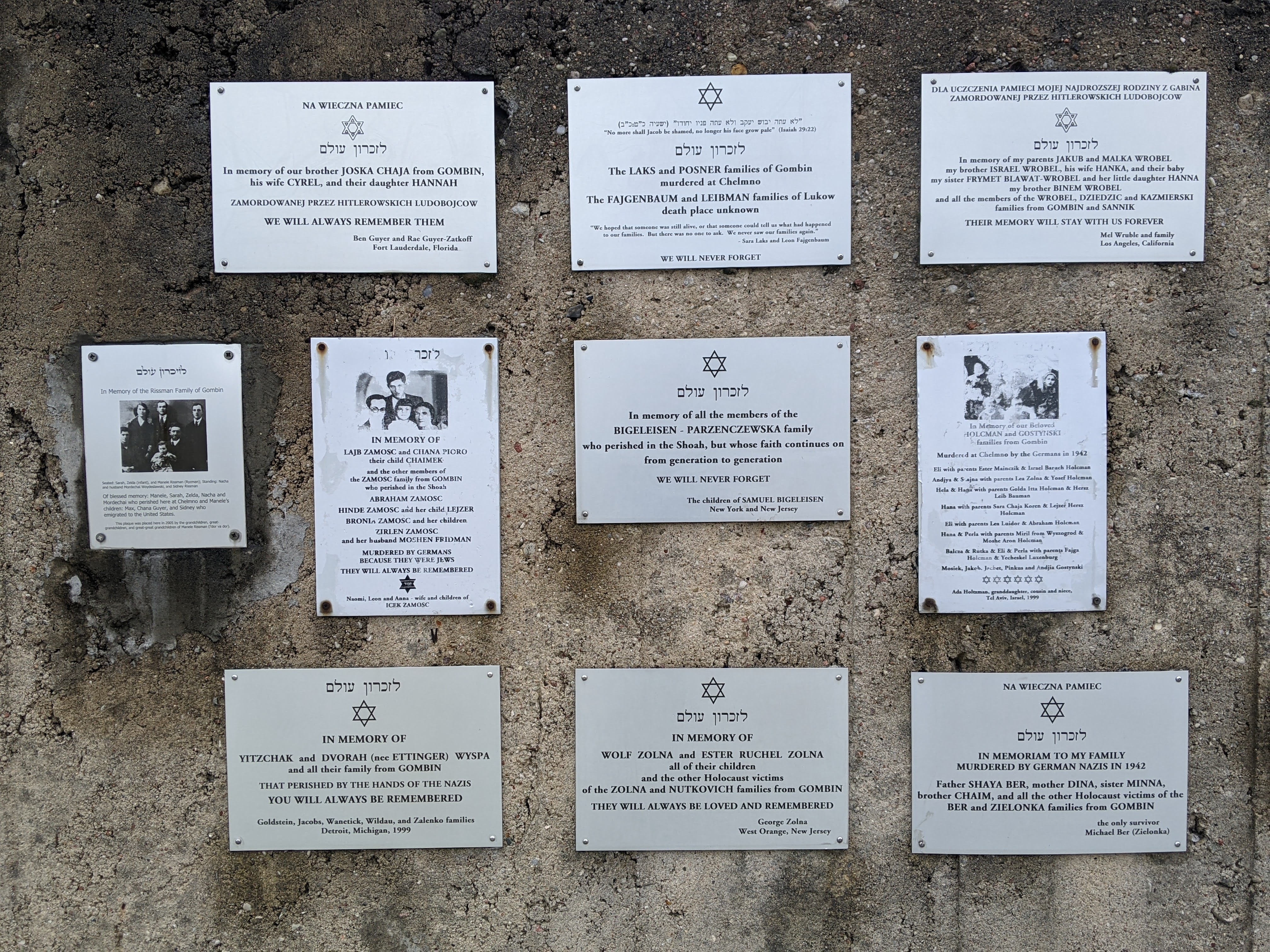
Survivors and their descendants have put up monuments alongside the massive expanses of burials. Some commemorate Jewish communities of particular towns, and some include long lists of the names of those murdered. Near the remains of a crematorium, now mounted in a low concrete wall, is a higher wall with an arched opening. On both sides, smaller plaques were put up by families to commemorate their murdered relatives.
Memorials at Chełmno
Several years ago, a friend told me that people would come here for picnics. As we left, Roberta said there used to be rock concerts near the Communist-era monument, too. What were they thinking? Or, rather, how is it that they weren’t thinking about this as a place of martyrdom and tragedy?
Roberta looks back at the mass graves
Over lunch in Koło, we didn’t talk about any of this. Maybe we just needed a break. Or maybe it was the result of a kind of protective amnesia. If you think about it too much it will just drive you crazy.



























 Uncovering Jewish Heritage