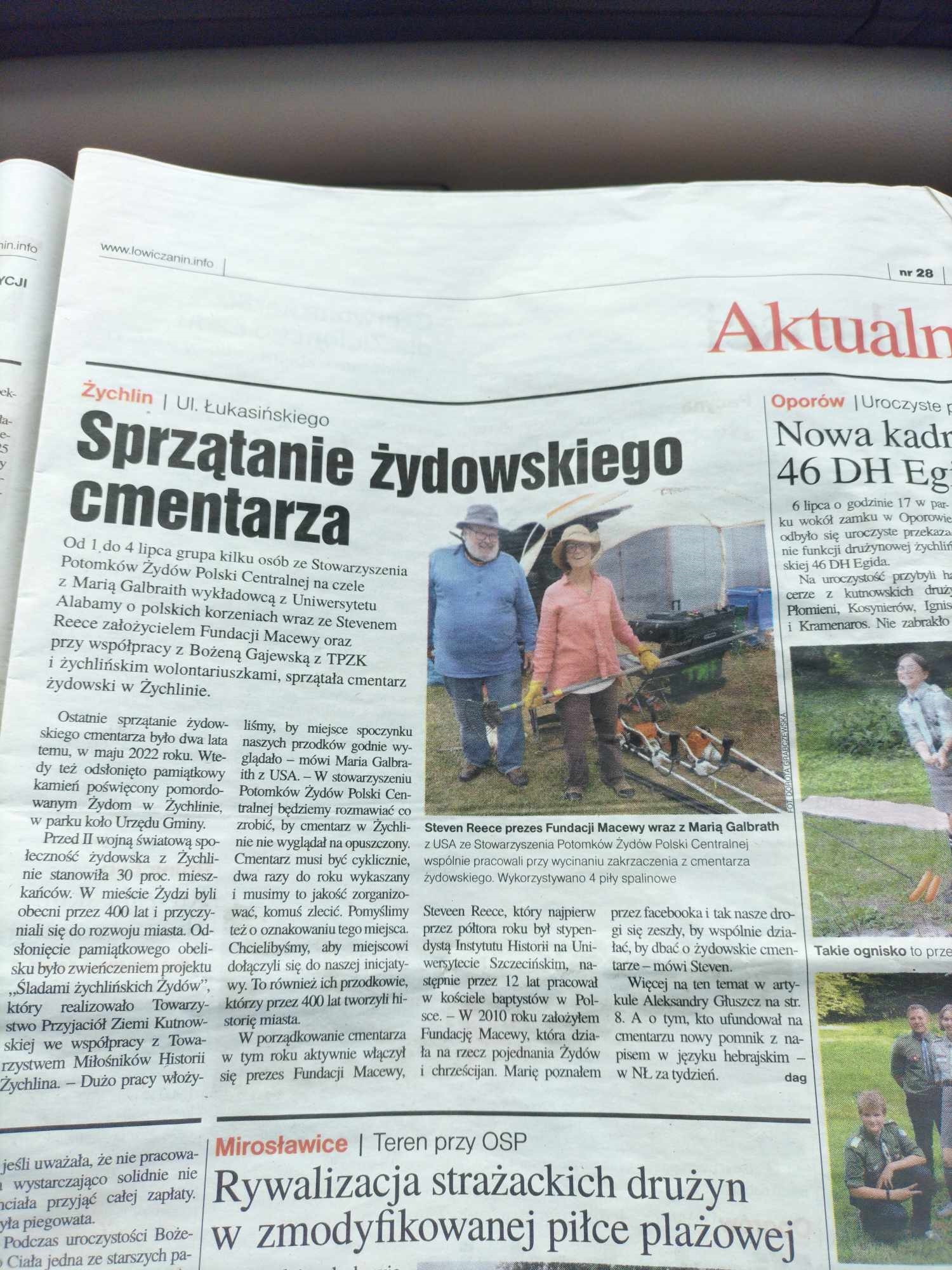
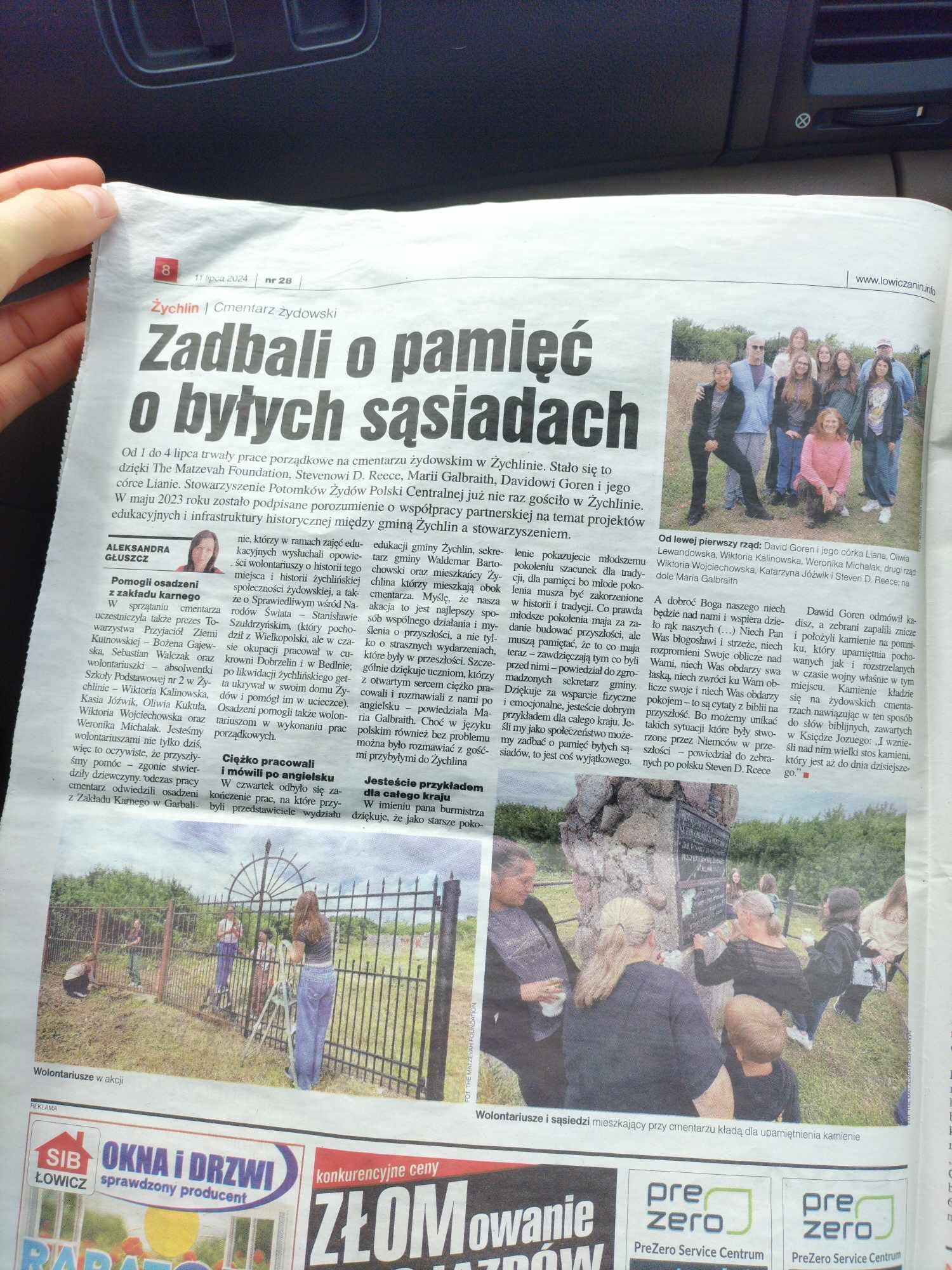
The regional newspaper Nowy Łowiczanin took notice of the ADJCP cemetery restoration project in Żychlin, publishing three articles in July 2024. Two local reporters visited us while we were working. Dorota Grąbczewska explained the project was a collaboration between the ADJCP, Matzevah Foundation, Bożena Gajewska of the Association of Friends of the Kutno Lands (TPZK), and local volunteers. She quotes me explaining the need for regular cleanups, at least twice a year, so the place won’t look abandoned. In her article, Aleksandra Głuszcz wrote about additional volunteers including the graduates of the Żychlin primary school who worked hard painting the fence and made an effort to speak with us in English, even though some of us know Polish. In addition, inmates from the correctional facility in Garbalin came as part of an educational program. They learned about the history of Żychlin’s Jews and also helped with the clean-up. Aleksandra also detailed the memorial service, which I described in Closing Words at the Żychlin Cemetery, Until Next Year.
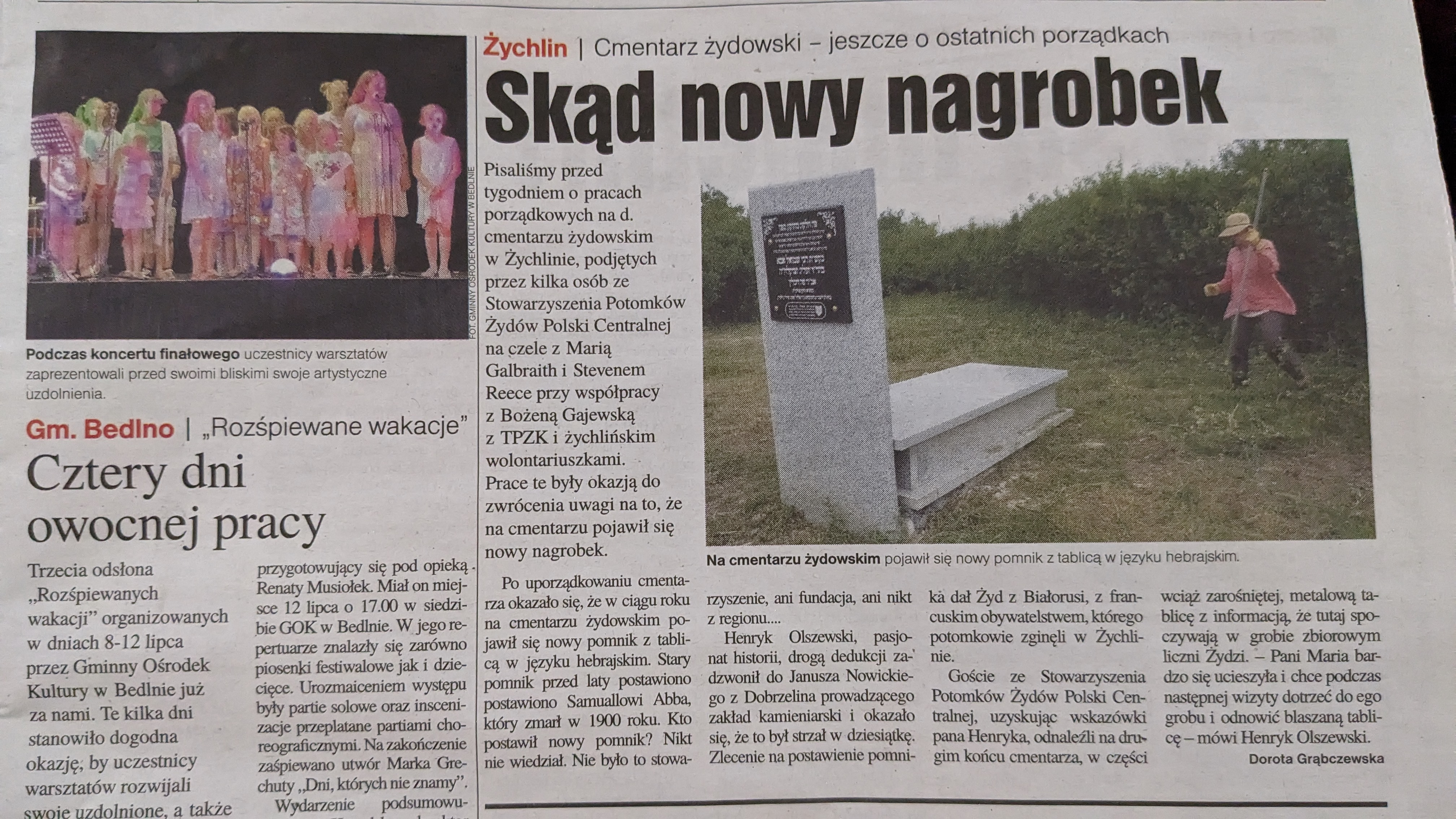
Dorota followed up a week later with an article about the restored grave monument for the first rabbi of Żychlin, Shmuel Abba (1809-1879), who is remembered as an important Hasidic rabbi, Talmudic scholar, and practitioner of practical kabbalah. Local amateur historian Henryk Olszewski found out that stonemasons in a neighboring town were hired to manufacture the monument, which covers the remains of the older, damaged monument below.
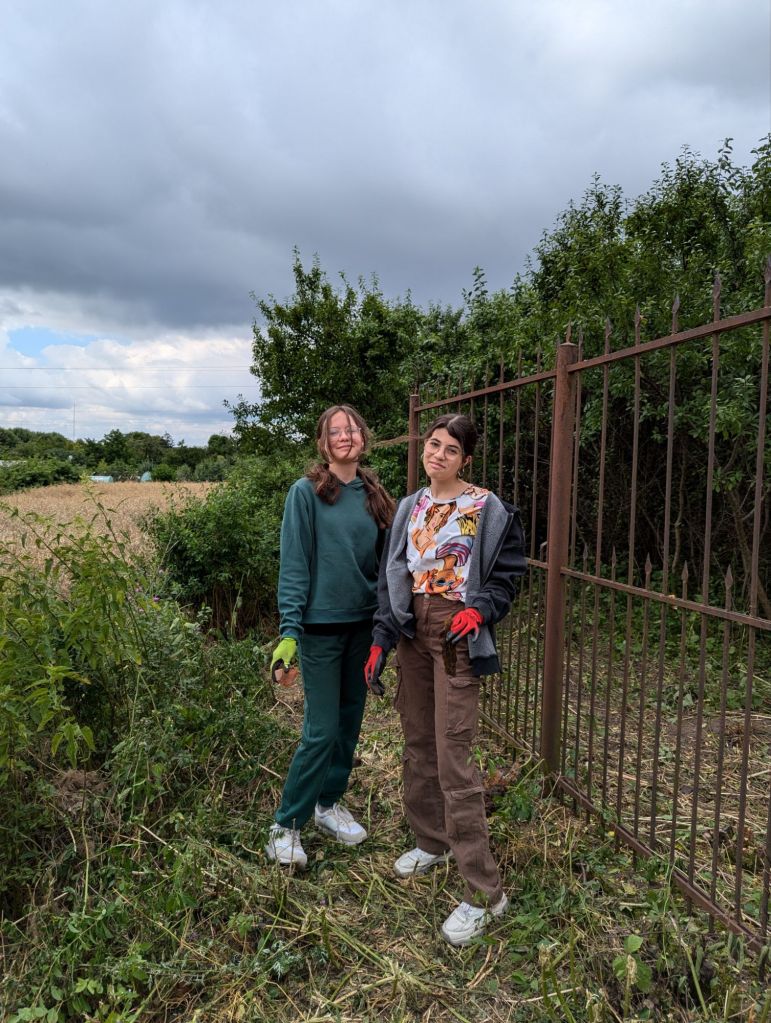
Our work has reached others, as well. A group of young volunteers came a few weeks after we left and continued the restoration, clearing out the overgrowth around the main memorial monument and uncovering a pathway made of pavers in front of it. Nobody knows who they are or why they came, but we thank them for their contributions. The place looks cared for now, a proper tribute to those who lie in rest.
Henryk Olszewski shared these photos with me including the collage he made of the monument as it looked 35 years ago, and how it looks cleaned up.
Steven Reece, who has been coordinating cemetery clean-ups for twenty years through the Matzevah Foundation, believes that that a successful project entails more than the physical labor. He emphasizes the importance of the connections that are forged among descendant communities and contemporary inhabitants, and the knowledge that is gained through those interactions. Steven’s goal goes well beyond leaving behind a neat cemetery. He tries to shape the conditions that will sustain the care of Jewish heritage and memory.
Our memorial gathering on July 4, at the end of our work in the Żychlin Jewish cemetery, indicates we are on our way to establishing lasting relationships and we have a plan for continued maintenance of the cemetery.
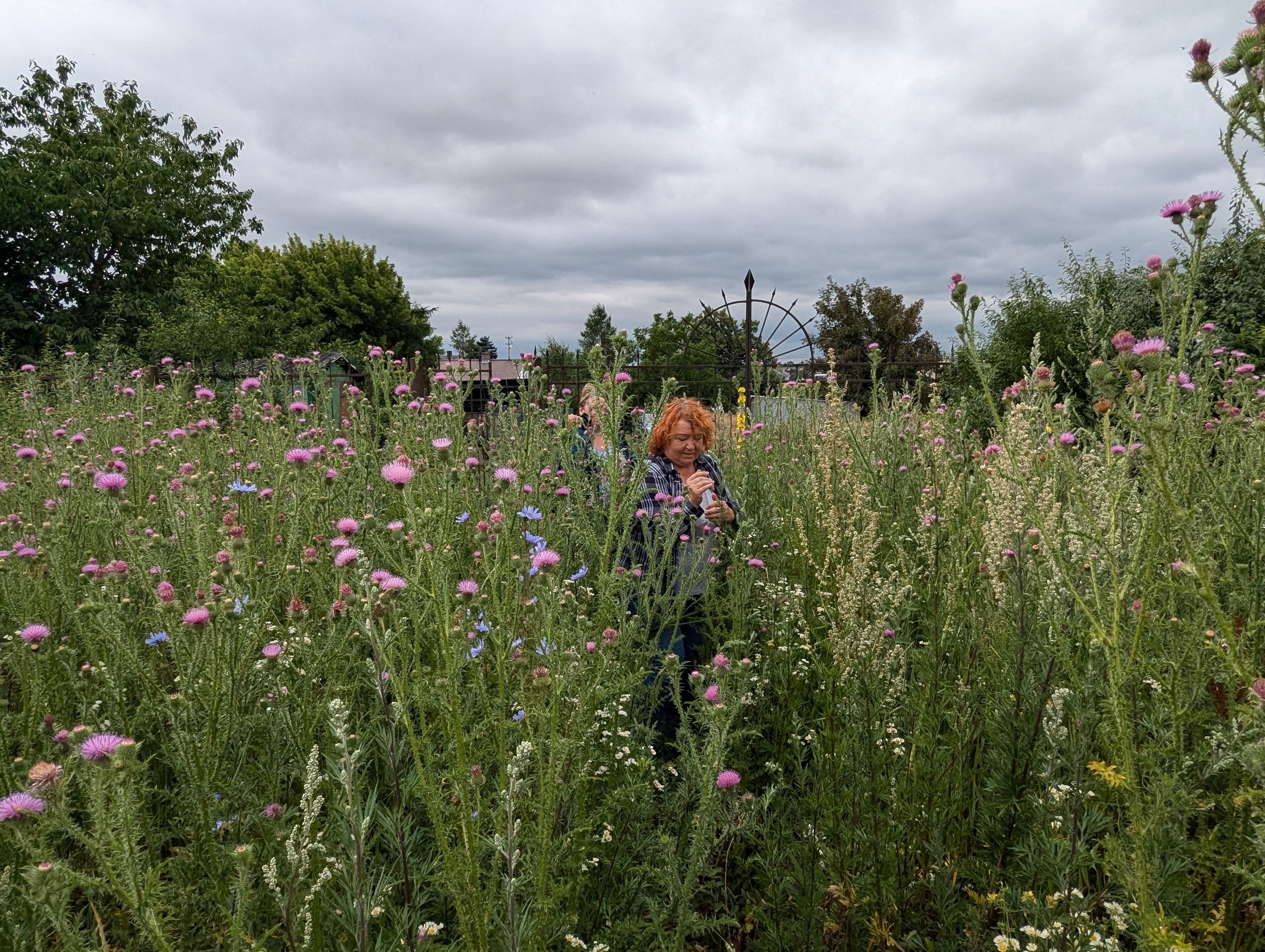
Before and after: the beautiful wildflowers were taller than Bożena when we started. See the painted gate, cleared brush, and new sign when we finished. Photo credits: Marysia Galbraith
The ceremony was meant to be informal, yet local volunteers, representatives from the regional government, a journalist, and neighbors joined the descendants to show their respect for the work we had done and the people who came before us.
Beforehand, the young ladies who had helped paint the gate and remove brush, presented the visiting volunteers with Ptasie Mleczko, chocolate-covered marshmallows (my son’s favorite!), to thank us for giving them the opportunity to help on our project. I, in turn, thanked them with gifts carrying the UA New College logo.
A gift of Ptasie Mleczko (chocolate-covered marshmallows) from the young volunteers. Photo credits: Marysia Galbraith
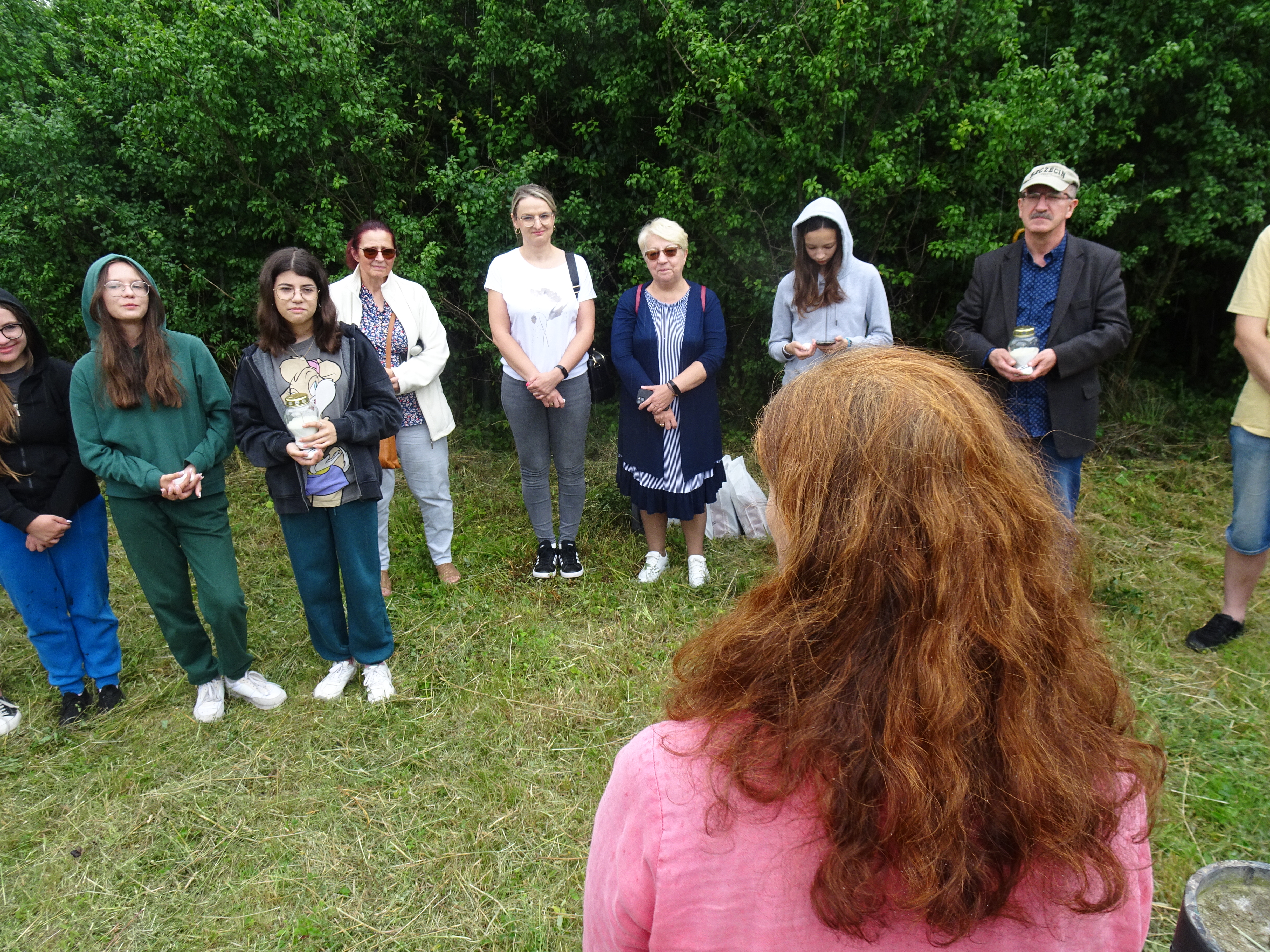
We gathered in front of the memorial monument, now cleared of brush.
After I expressed my gratitude to everyone who contributed to our project, Gmina Secretary Waldemar Bartochowski moved us with his remarks, “I want to thank you, as the older generation, for showing the younger generation respect for tradition and, above all, memory. What you do works against the loss of memory and identity so the younger generation can build a better future.”
Closing remarks in front of the memorial monument. Photo credits: Bożena Gajewska
Steven Reece followed, “I am the animator, the helper and supporter for this work. You all are a good example of what is possible when we as a community come together to care for the memory of your former neighbors. I want to invite you to continue this work in the future.” He shared a psalm in Polish.
The last speaker was David Goren. He said, “This very emotional. I am amazed at the ability of us to make this bridge.” Gesturing to the family that joined us from next door, he added “Having three generations here is unexpected, and neighbors, too.” Then, to the young volunteers, he offered, “You brought the spirit, and you brought the spirit of your families.” David offered special thanks to Bożena, who worked so tirelessly with so much heart. He finished with Kel Maleh Rachamim (Prayer of Mercy).
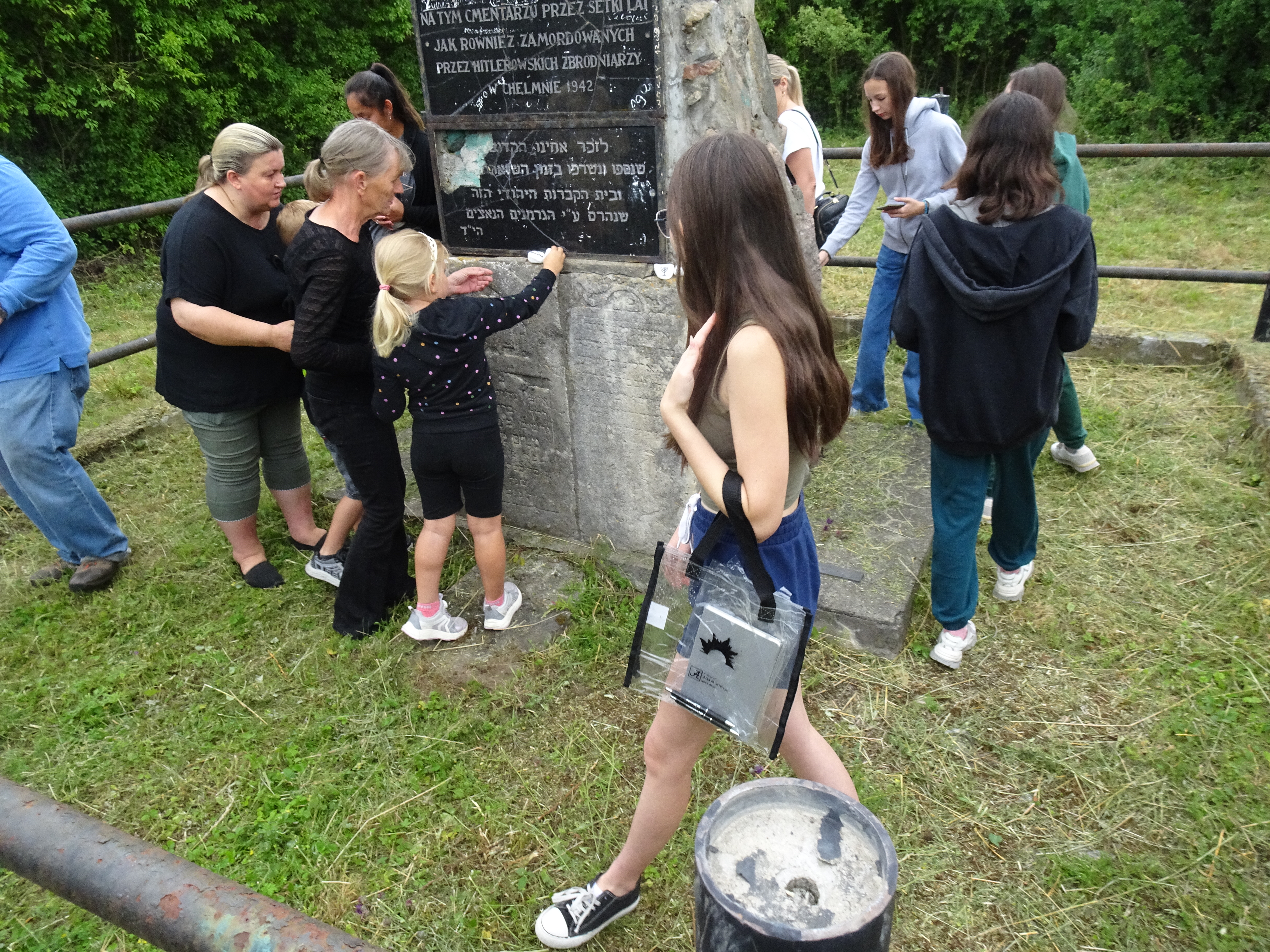
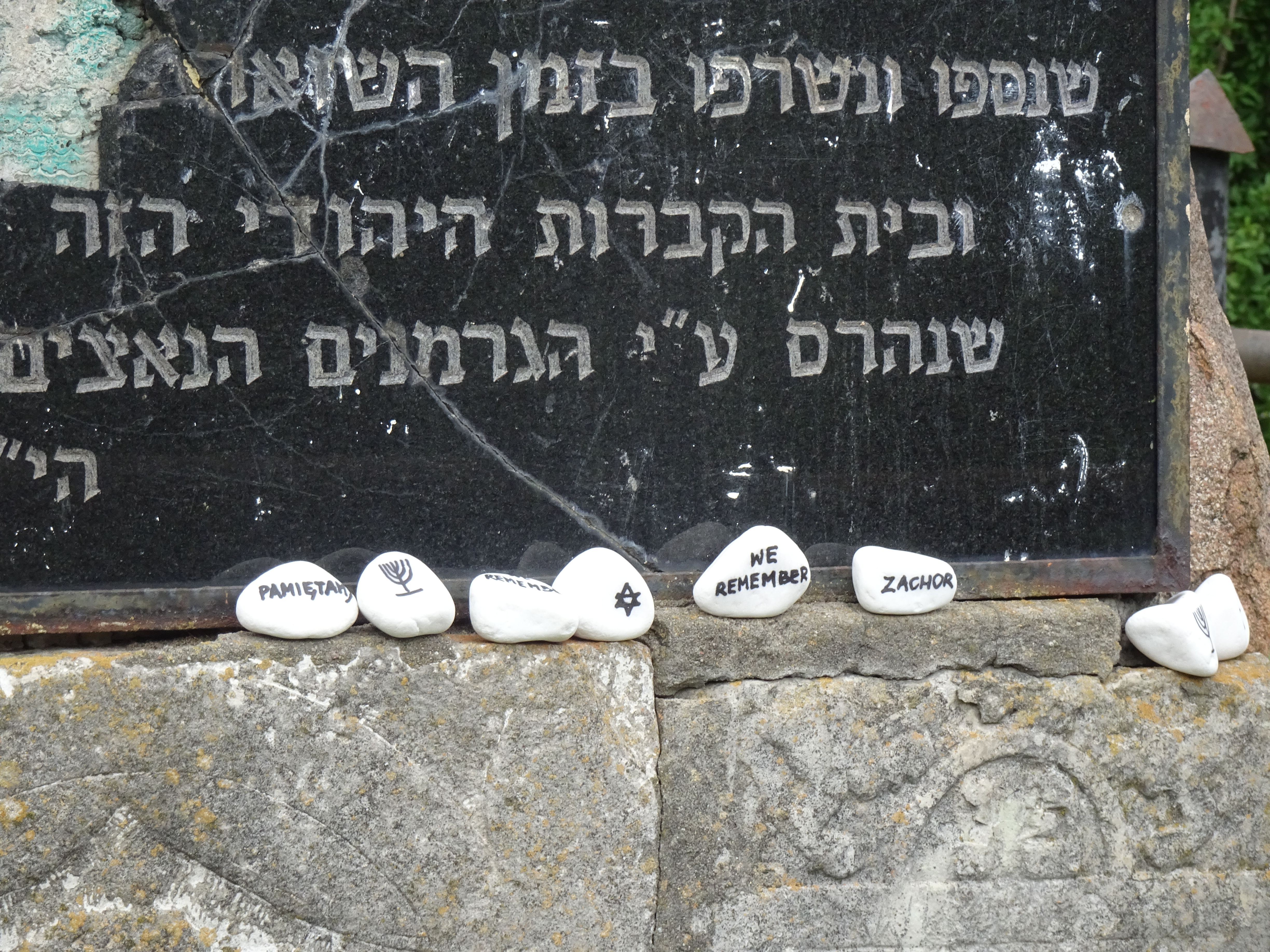
We concluded by lighting candle lanterns and placing stones on the monument. Liana had gathered plain stones, but Bożena brought ones painted white with messages in black: “zachor, “pamięć,” “we remember,” and the Star of David.
Placing stones on the memorial monument. Photo credits: Bożena Gajewska
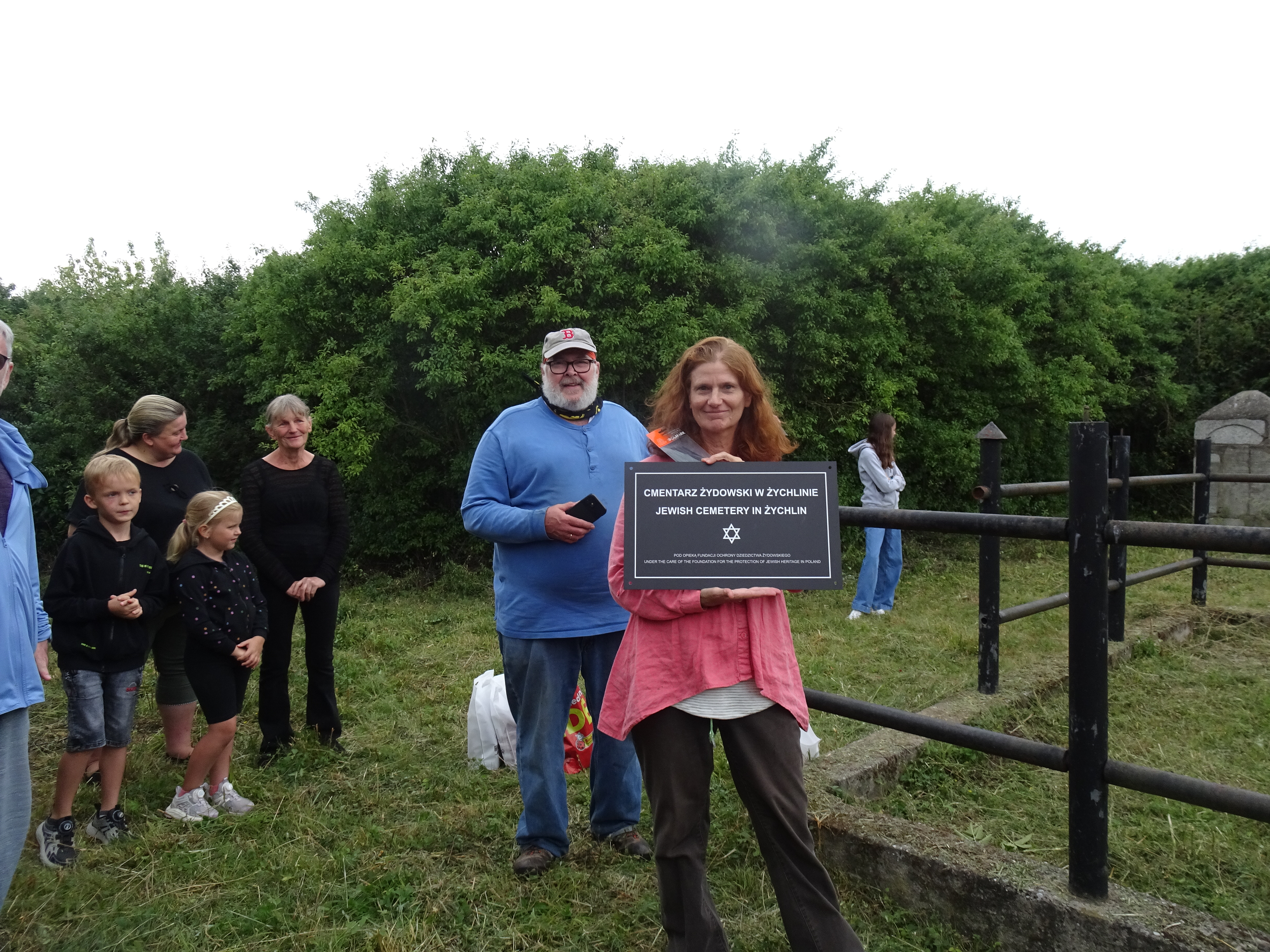
We thought that was it, but Bożena had one more surprise for us: a sign for the gate identifying this as a Jewish cemetery. She thought of it two nights ago, ordered it the next morning, and picked it up shortly before the ceremony.
Bożena Gajewska surprised us with a sign for the cemetery gate. We will work with various heritage organizations to get a more permanent marker. Perhaps in time for next year’s clean-up? Photo credit: Bożena Gajewska
Our last two days in Żychlin highlight the importance of presence. If we hadn’t stayed here several days, we probably wouldn’t have learned everything we did. As we cleared more of the stubborn blackthorn bushes, the cemetery revealed more secrets. After seeing the progress we were making, the inhabitants of Żychlin opened up to us, too.
Agnieszka Olszewska, a local amateur historian, leads us through brush and brambles to the site of a collective grave (note the back of the rusted sign barely visible at top left). Could these boulders be the remains of a memorial stone?
How would you respond if a group of foreigners come into your town and started weed whacking a cemetery? My guess is most of us would just watch from a distance, curious and a bit suspicious.
By Wednesday, people started telling us stories they pulled out of the depths of their memory. Others claimed ignorance about the town’s Jewish history, but the more we engaged in conversation, the clearer it was they knew more than they had initially let on.
ADJCP member David Goren, whose ancestors came from Żychlin, accompanied me to ask some of the neighbors about the cemetery. We collected important testimony that will help us bring Jewish memory back in this community.
Żychlin descendant David Goren with our tireless Polish partner Bożena Gajewska. After a physically demanding day of weed whacking she went home and baked us raisin and date pastries
The Wujcikowskis live across the street from the cemetery. They had already shown us kindness, letting all the volunteers use their bathroom. David had noticed historical photos in their flower shop suggesting they had lived there a long time. In fact, the large property and house have been in the family since before the war. When Katarzyna (Kasia) didn’t know the answers to our questions, she escorted us to her parents Henryka (Henia) and Grzegorz Wujcikowski who came out of the farm building next to the flower shop. They greeted us warmly. Though they weren’t sure they could help us find old photographs of the cemetery, Grzegorz shared his family history with us. The property originally belonged to Grzegorz’s father’s uncle. Because it was one of the finest houses in town, some of the occupying Gestapo moved in and fenced the land to raise horses. Grzegorz’s aunt and uncle weren’t forced to leave, instead sharing the three-story house with the Germans. After the war, Grzegorz’s parents joined their aunt and uncle, who had no children of their own, and eventually became the owners of the property.
Grzegorz was born after the war. He knew Moshe Zyslander, a Holocaust survivor from Żychlin who emigrated to Israel. In 1989, Zyslander led the initiative to build the memorial monuments in the Jewish cemetery, as well as the surrounding gate and fence. When the Wujcikowskis learned about Zyslander’s plans, they returned the tombstone fragments that the Germans had taken from the cemetery to build a pig sty, the same farm building where Grzegorz and Henia had been working when we arrived. The stones removed from its walls make up the bulk of the 50 tombstone fragments embedded in concrete mounds in the cemetery. Whenever Zyslander returned to visit the cemetery, he would stop by the Wujcikowski’s for a visit.
The Wujcikowskis showed kindness to Jewish descendants in the past and continue to do so today.
Descendants Marysia, Liana, and David took our student volunteers out for ice cream. They were a great help, painting the gate and clearing brush. They didn’t seem to know a lot about the Jewish history of Żychlin but seemed interested in learning more
I’ve been very concerned about properly marking and memorializing the mass graves in the cemetery. Reports in the archive of the National Institute of Memory document the shooting of 200 people in 1942. Other sources indicate that when the ghetto was liquidated, the infirm were shot on the spot rather than being transported to the Chełmno death camp. For the site to be designated officially, it’s important to obtain testimony from witnesses. We were able to talk to two people who were not witnesses themselves but were told about the murders by a close relative who saw what happened.
We spoke with the neighbor next door to the cemetery the day before we started our work. She confirmed she knew we were coming; the city had informed her. She showed us where the city had dropped off a dumpster for the brush we cleared. A big goat was chained up outside the cemetery along the dirt drive leading from the road. “We put her there to eat the grass, so the drive is passable,” she explained.
Over the next two days, she and her son were in and out of their yard feeding their fowl, doing their farm work, and keeping a covert eye on us. As we cleaned up on our third day of work, David and I approached their fence to invite them to the memorial service we planned for the next afternoon. Mrs. Anna came over with her son Marcin and grandchildren Marceli and Lena. Anna has observed the comings and goings at the cemetery since she married over 40 years ago. Her husband, who grew up in the house, did so even longer, until his death in February.
Anna remembers how nice the cemetery looked when she first married. People used the space as a kind of commons; they walked their dogs or sunbathed, and her son played soccer with his friends. On holidays (the Catholic holidays like All Saint’s Day), the family would light a candle lantern at the monuments in remembrance of the dead.
As the cemetery became overgrown, people started going there to drink, play music, and get into other kinds of trouble. Anna’s husband would chase them out, threatening to call the police. She understands people sometimes want to get together and drink, but why destroy a cemetery? Why walk their dogs there? The last time she was at the Catholic cemetery where her husband is buried, people were walking their dog there, too. It isn’t right. She doesn’t understand why people would destroy monuments, either. Why? They should respect them. Although she sometimes contradicted herself, her overall orientation towards us and the cemetery was benevolent. It also suggests a growing recognition that the Jewish cemetery is a sacred space.
Then, Anna confided something that might help us get the mass grave demarcated: a personal account of the crime, albeit second-hand.
When her father was a young boy, about the age her 9-year-old grandson is now, he walked across the fields to see what was happening at the cemetery. He witnessed Jews being shot, their bodies falling into a trench. He was so frightened he peed in his pants and ran home to his mother.
Looking out across the field from what is probably the site of a mass grave in the cemetery. This view probably looked pretty much the same over 80 years ago when Anna’s father ran across the field after witnessing the murders
Henryk Olszewski is a local amateur historian whom I have known for ten years. He had a stroke two years ago and has been slowly recovering. He manages the website and Facebook page Żychlin Historia with his wife Agnieszka. He has an unconventional way of presenting information and sometimes his posts perpetuate stereotypes about Jews and Polish-Jewish relations, but he’s a dogged researcher.
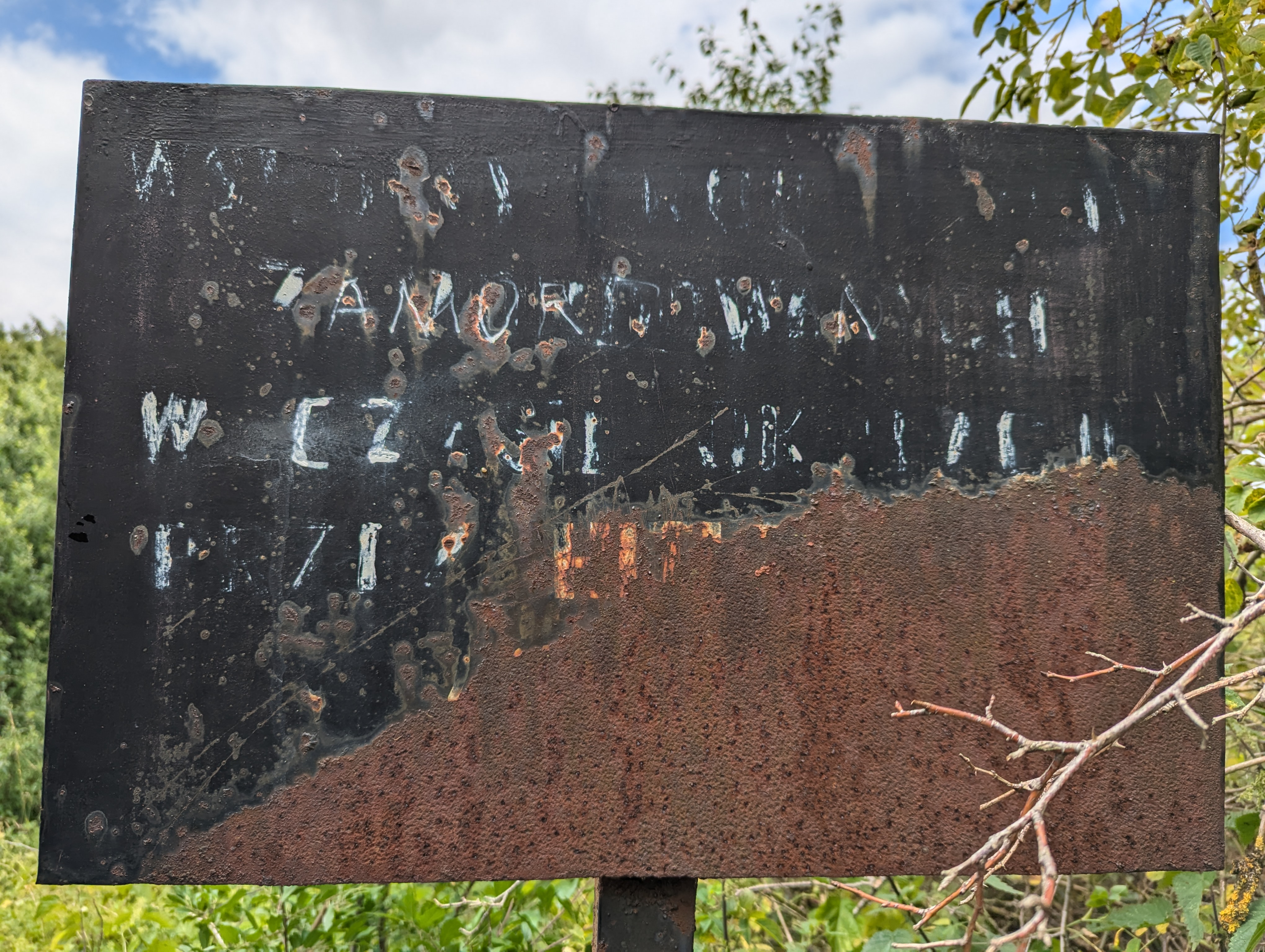
Agnieszka visited us at the cemetery with photos she and Henryk took in 2019 of a rusty sign; though the white lettering has faded, enough remains to make out “Wspólny Grób zamordowanych w czasie okupacji przez Hitlerowców” (“Collective Grave of those murdered during the Nazi occupation”). She, David, and I walked around the back of the cemetery, and after a few false turns, we found an entrance to a clearing where the back of the sign was visible. We also found some large boulders. Could they be fragments of a commemorative stone? We asked a few people why there are places in and around the cemetery that are less overgrown or even barren of vegetation. One possibility could be that the lye spread over mass graves made the soil infertile.
Not much is left of the lettering, but it appears to say “Wspólny Grób zamordowanych w czasie okupacji przez Hitlerowców” (“Collective Grave of those murdered during the Nazi occupation”). Photo credit: Agnieszka Olszewska
Thursday evening, Steven and I visited the Olszewskis at their home. While they treated us to pierogi, stuffed pancakes, and a plateful of tasty cakes, I asked Henryk to remind me the name of a man I met during my first visit to Żychlin. Of course he knew, and immediately picked up the phone to call Józef Kowalski so I could check on a story he told me. Józef confirmed that his grandfather, who was a young man during the occupation, was called out by the Gestapo one night and ordered to dig a ditch in the Jewish cemetery. His grandfather, his mother’s father, told him the story directly. Józef also confirmed the ditch was where the people shot in the cemetery were buried.
The dissonance between the social nature of our interactions and the horrific topics we discussed doesn’t escape me. And yet, these kinds of connections are what make possible the recovery of difficult memories. Our work goes beyond the restoration of the physical space of the cemetery, to something deeper. We’re also restoring the memory of the people who inhabited the city over 80 years ago, and the events that took them away forever.
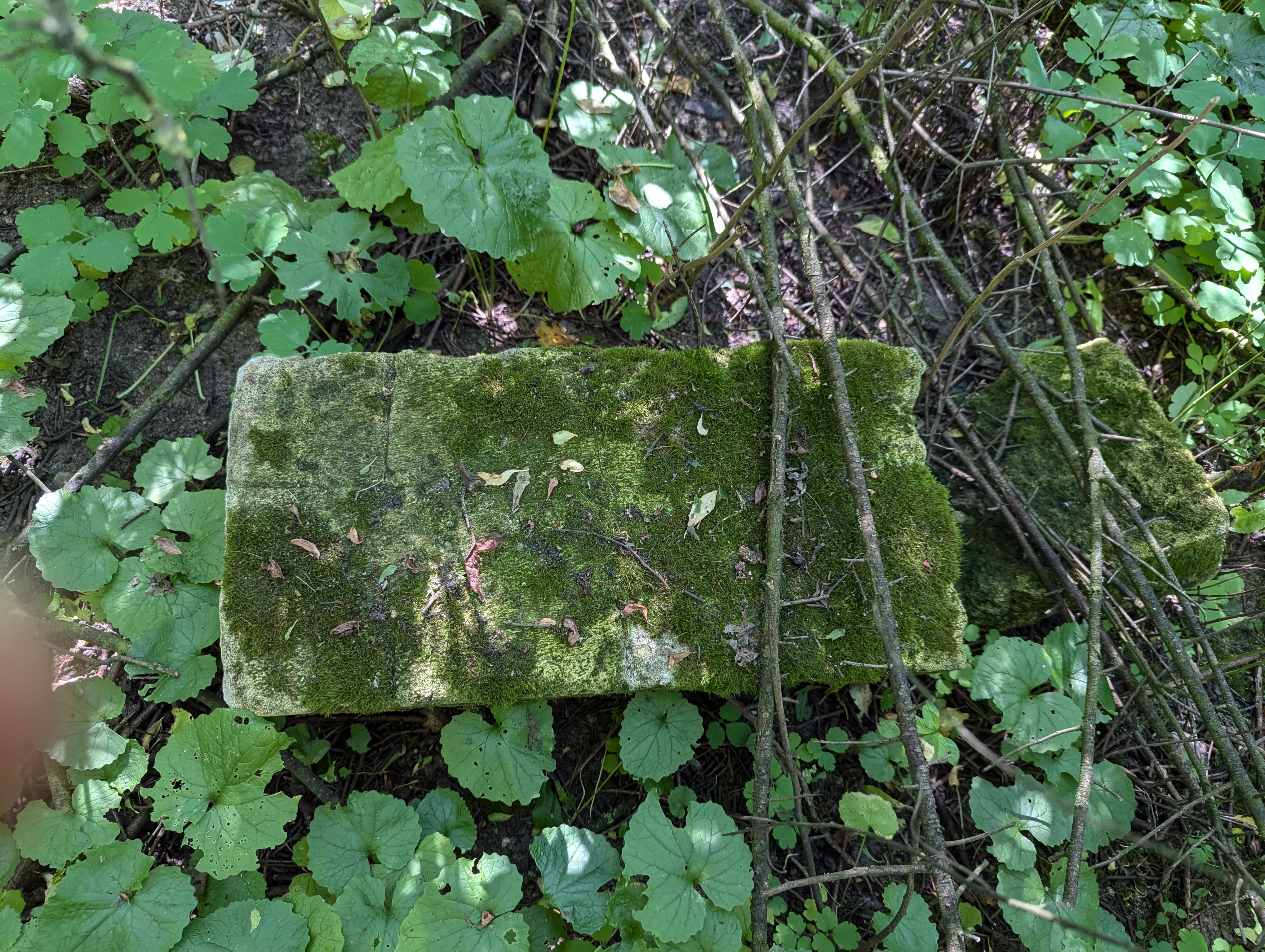
As we cleared underbrush, we found a few stones like these that appear to be fragments of tombstones
Students from the local school came to help us today.
Kasia, Wiktoria, and Oliwia brush rust off the gate in preparation for painting
Wiktoria and Weronika collect trash and debris.
These young ladies just finished 8th grade and are headed to high school in Kutno in September. They tell me they feel excited about the change, but also a little anxious.
We have been talking in English. They have all studied the language so it’s good practice for them.
Before they began their work, I also showed them around the cemetery and talked a little about Żychlin’s Jewish history. I’m not sure they knew that before World War II, half or more of the inhabitants of the city were Jewish.
Asked why they came to help today, they said, simply, they were asked. One added, I wasn’t doing anything else.
We hope we’re planting some seeds of interest and perhaps a sense of recognition that Jewish history is part of Żychlin history. Maybe in future they will continue to preserve the cemetery even when we descendants can’t be here.
Also working hard today are David and Liana Goren. Liana has already mastered all the equipment. Steven calls her his apprentice.
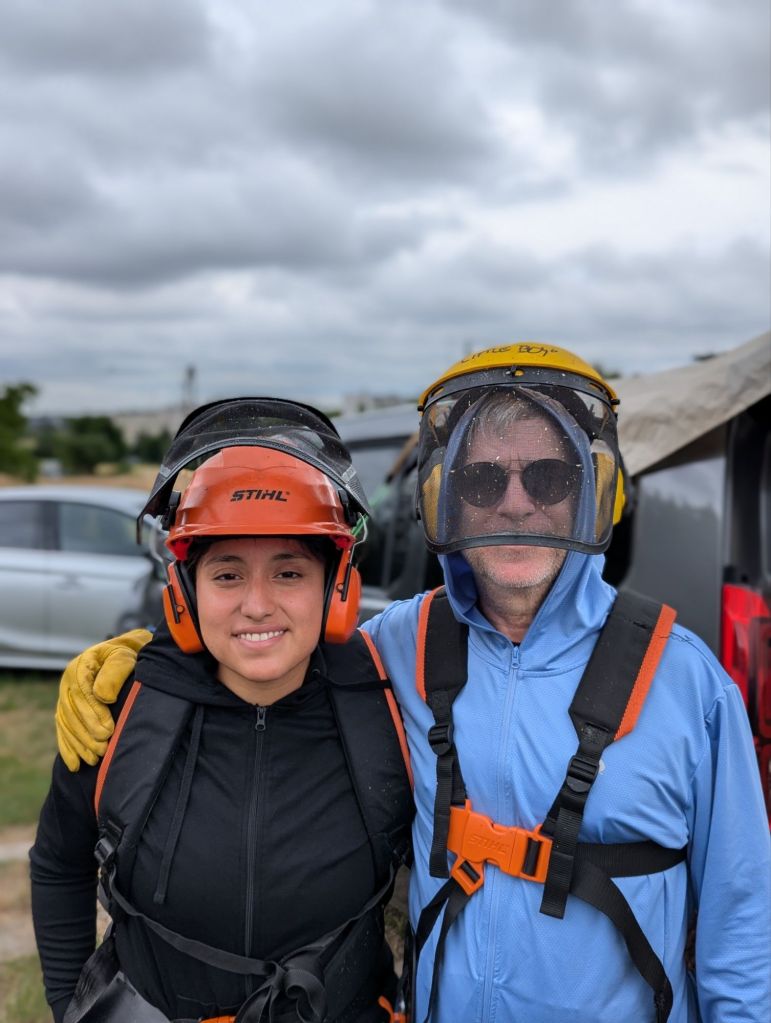
Liana and David suited up to weed whack.
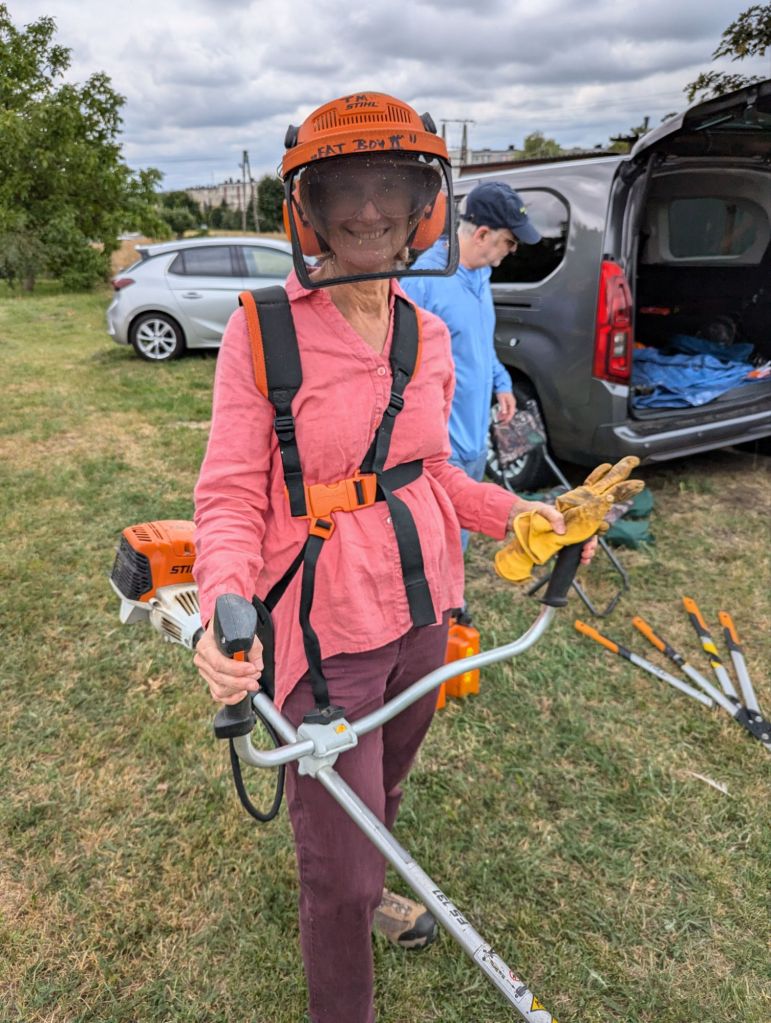
I’m far less capable than anyone else, but I’m stubborn. There’s a lot of ground to cover so even my awkward contributions help.
The Association of Descendants of Jewish Central Poland (ADJCP) will undertake the restoration of the Zychlin Jewish cemetery starting this summer. Like many Jewish cemeteries in Poland, dense vegetation covers most of the space, monuments and fencing are in disrepair, and signage is needed. Please consider joining us from July 1-5.
ADJCP has teamed up with the Matzevah Foundation, a non-profit organization with a wealth of experience restoring Jewish cemeteries. Our local partners Mayor Grzegorz Ambroziak, Bożena Gajewska, and Anna Wrzesińska will coordinate local volunteers and provide other assistance.
Photo: Monument incorporating matzevot fragments in the Żychlin Jewish Cemetery
How can you help?
Join us in Żychlin from July 1-5. This year, we will assess the condition of cemetery, clear vegetation, and determine whether sections of the fence require repair.
Provide financial support for the project by sending a donation via the “donate” link at adjcp.org, and specifying the funds are for “Zychlin memorial projects.”
Put us on your calendar for summer 2025 or summer 2026 when we expect to continue our work!
Żychlin is located about 75 miles west of Warsaw and about 45 miles south of Włocławek. The town’s Jewish Community was established in the second half of the 18th century, and until World War II, more than half of the inhabitants were Jewish.
ADJCP Memorial Tour at the Żychlin Cemetery, May 2023: Roberta Books introduces a short remembrance for Żychlin’s Jewish community. Photo credit: Bożena Gajewska
I have been calling my project a family memoir since the beginning, well before I read In the Garden of Memory (the English translation was published by Weidenfield and Nicolson in 2004). My family’s story overlaps with author Joanna Olczak-Ronikier’s in other ways, too. The social world of Warsaw was intimate enough that it seems likely our families knew about each other even if they weren’t directly acquainted. Joanna’s relatives, the Horwitzs and the Mortkowiczes, were central figures in the social circles my Babcia also frequented, those occupied by writers, artists, publishers, and professionals. Both families have Jewish origins, and each assimilated, though to varying degrees.
Joanna, her mother Hanna Olczak, and her grandmother Janina Mortkowicz didn’t deny their Jewish origins in the way my mother and grandmother did. Still, they frequented many of the same places around Warsaw. When Janina, then Horwitz, was a child, her “consolation prize” for check-ups at the dentist were a visit to Lourse Café on Krakowskie Przedmieście for chocolate (15). This was in the 1880s, so decades before my grandfather Zygmunt Bereda gained an interest in the business. During the 1930s, Joanna’s cousins attended the same high schools as my mother and uncle. Girls attended the Klementyna Hoffmanowa High School, while boys went to the Stefan Batory High School.
The book also gives me some insight into marriage customs during my Babcia’s generation. “According to Jewish tradition, finding suitable husbands for one’s daughters was a basic parental duty,” Olczak-Ronikier writes. “Marriage was too serious a matter to be contracted for love. After all, it concerned two people’s future, and that of their offspring. The older generation took charge of bringing the couples together, involving family, friends and a professional matchmaker” (32). Things were changing rapidly in the late 19th century, though, and just like I have observed among Babcia’s siblings, older children were more bound by tradition while younger children were more inclined to choose their own pathway. In Olczak-Ronikier’s family, the younger children were drawn to socialism and communism.
By the next generation, Joanna’s mother Hanna was the first and only family member to marry a non-Jeweven and to change her religion. Olczak-Ronikier says, it “did not provoke any particular reaction among her relatives” (184). She was not excluded from the family because of it, unlike my grandmother Halina, whose father sat shiva and treated her as dead after her marriage to a Catholic. Olczak-Ronikier’s family was far more secular than Babcia’s, though. Perhaps in part this is because the Piwkos lived in provincial cities where the pull of religious tradition was stronger. My grandmother was drawn to Warsaw for the opportunities it offered for her to remake her life.
Another parallel I see between our family stories is in the internalized antisemitism Joanna experienced. As a child in the 1930s, she didn’t want to be Jewish, especially when she became the object of the anti-Jewish taunts of other children. She explains, “Among Jews who had decided to assimilate, a huge role was played by ambitions relating to the level of Polonization they had achieved. When the parents, through their looks, language and religious customs, were a reminder of the environment that the children had made such an effort to get out of, family love and loyalty were severely put to the test. Nowadays it is hard to imagine how painful this process of tearing oneself away from one’s roots must have been” (71).
Maks Horwitz, her great uncle, put it this way: “They were ashamed of their origin. Understandably, they never denied it among those who knew about it. But even here, in deed, word and gesture they tried to prove and convince others that they felt themselves to be completely and utterly Polish and that they were entirely rid of their Jewishness” (111).
Members of both families survived the war by adopting Aryan identities. Babcia was able to live more in the open than Olczak-Ronikier’s family because she had been distanced from her Jewish origins since the 1920s, and also because her Catholic husband was well enough positioned to bribe the Nazi authorities to look the other way. As in my family, the women of Joanna’s family took a few years off their age on their false documents (92). During the Warsaw Uprising, when the area they lived in was overrun by the Germans, Olczak-Ronikier’s family escaped via the underground sewers, as did my mother. With the destruction of the capital, both families took the same path out of the city, traveling with a crowd of refugees south to Krakow, where they remained until the end of the German occupation. (268)
Joanna’s cousin Ryś Bychowski was born the same year as my mother. He attended Stefan Batory High School, just like my Uncle George who was just a couple of years older. It seems likely they knew each other, and its possible they could have been friends. Their lives might have overlapped during the war, as well. Ryś escaped to safety in the US with his parents in 1941, only to volunteer for the Polish Airforce, which operated out of Britain. My uncle was a paratrooper, while Ryś became a navigator. Ryś joined as a Polish patriot, unwilling to remain in safety when his people were subject to Nazi oppression. For him, the fact that he was Jewish only added to his resolve. He wanted to liberate Poland and the Jewish people. While in Britain, he confronted the horror of the mass annihilation of the Jews, made even more unbearable when his friends and comrades exhibited indifference, or in some instances satisfaction, that the Jews were killed. Olczak-Ronikier explains, “His Polish-Jewish identity had always seemed something quite natural to him, yet in view of this and similar episodes he came to the conclusion that he had to make a choice” (295). He decided he could never live in Poland again, even though he remained committed to the fight against Nazism.
A photo from my grandmother’s papers taken in Warsaw right after the war. From the left: Mirka (Rachel’s daughter), Rachel (Babcia’s sister), Czesław Mochorowski, and Nelly. The boy who is standing is Bogdan, Rachel’s grandson, the son of Samek and Nelly. I don’t know who the man on the right or the boy at the very bottom are.
The evolution of Ryszard’s view of Poles helps me understand the deep anger and resentment so many Jews feel toward Poland. It’s something I have recognized before, and wondered why they direct their fury more strongly toward Poles than to Germans. In a letter to his father in 1943, Ryś Bychowski explained in clear and emotionally resonant terms; “I do not want to be a second-class citizen ever again […] Above all I’m afraid of knowing the whole truth about the reaction of Polish society to the extermination of the Jews. I cannot live with or talk to, I am not able to work with people who found it possible to ignore their destruction, occupy their homes and denounce or blackmail the survivors” (296). This was an intimate betrayal, not by a sworn enemy but by comrades and neighbors. It was exclusion from the group he felt himself to be a part of. No wonder it cut so deeply.
Żychlin mayor Grzegorz Ambroziak sent me photos of daffodils blooming around the memorial to the city’s Jewish community. These flowers, planted by local school children, are a symbol of remembrance. Daffodils are also associated with the upcoming anniversary of the Warsaw Ghetto Uprising, which started on April 19, 1943.
These small markers of remembrance matter. They offer a time and place to contemplate what used to be, what was lost.
A dark stain in the history of Warsaw University was the decision to follow a nationalist trend in the 1930s and mandate segregated seating for the university’s Jewish students. Over 80 years later, a student-initiated campaign resulted in a permanent, public acknowledgement of this institutionalized discrimination. On May 22, University Rector Alojzy Nowak and Israeli Ambassador Yacov Livne dedicated a commemorative plaque before a crowd of about 200. Dignitaries, scholars of Jewish history and culture, and prominent members of Warsaw’s Jewish community gathered behind a red retractable belt barrier under the watchful eye of an Israeli guard, while a younger crowd of students and onlookers looked on from the other side.
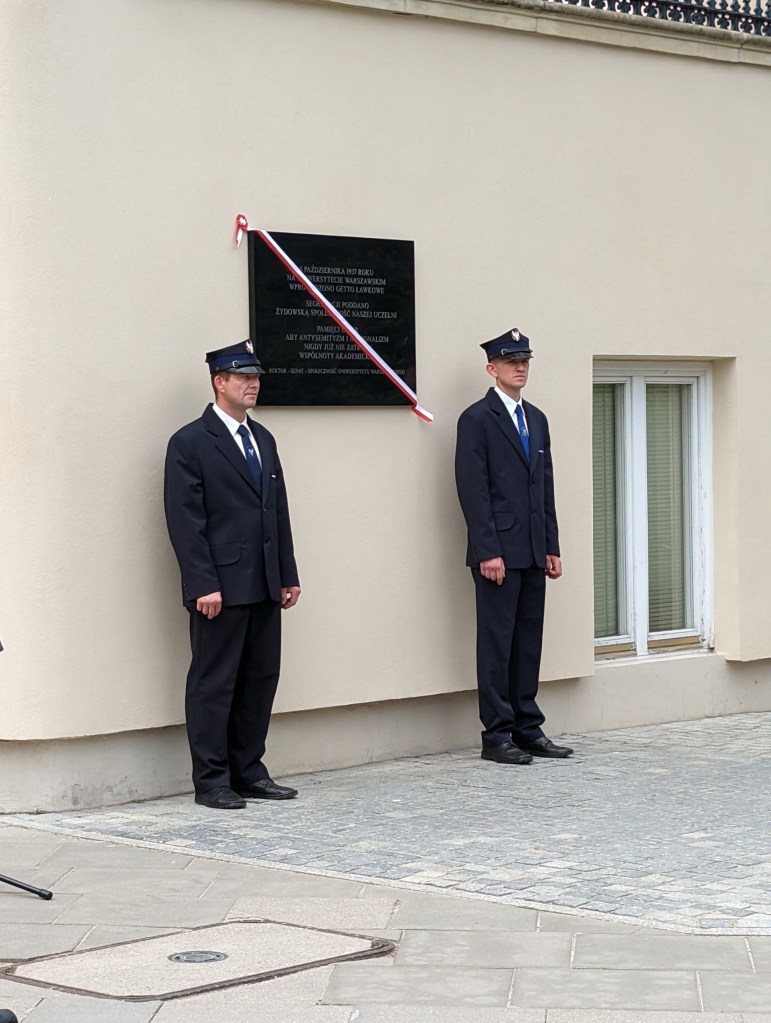
Commemorative monument before the ceremonyDignitaries behind the red barrier belt. Journalist Konstanty Gebert on rightThe red barrier
I learned about the event serendipitously, when fellow ADJCP board member Ken Drabinsky invited me to accompany him to the Warsaw University Department of History to donate a copy of the self-published autobiography of Henry Balaban, nephew of renowned historian Meir Bałaban. I accompanied Ken as he presented the book to Łukasz Niesiołowski and Marzena Zawanowska at the Department of History.
Ken Drabinsky presenting Marzena Zawanowska, and Łukasz Niesiołowski with Henry Balaban’s autobiography
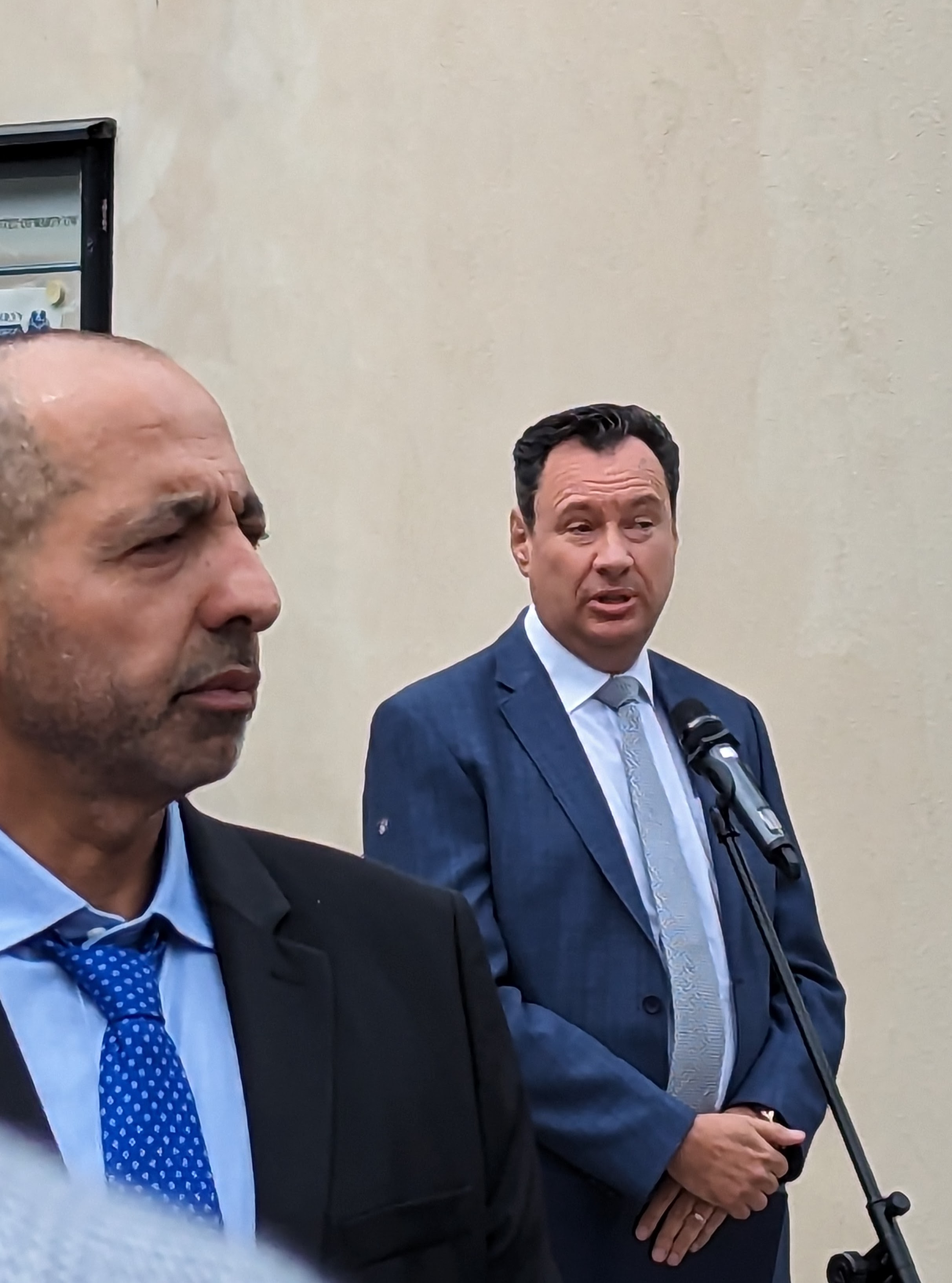
The commemorative ceremony began with songs in Yiddish performed by students from the Multicultural High School of Humanities named after Solidarity hero Jacek Kuroń, followed by predictable remarks by the rector and the Israeli ambassador about the need for unity across cultural and religious differences and the importance of remembering the dark as well as light moments in history. Both celebrated the university students who initiated the project.
Israeli Ambassador Yacov Livne with his security detail
The audience’s enthusiastic applause was reserved for the third speaker, Antonina Dukowicz from the Student Antifascist Committee. It didn’t come in response to her diplomatic discussion of the five years it took to persuade the administration and work out the appropriate language for the marker. Rather, the crowd responded to her expression of support for the Institute of Philosophy and Sociology at the Polish Academy of Science, which is under attack by the government because of the work scholars are doing there that highlights some of the less noble behavior of Polish people against Jews during the Nazi occupation. The specific trigger for the latest attack was a brief comment by Holocaust Scholar Barbara Engelking that “Jews were unbelievably disappointed with Poles during the war.” The remark caused such a strong reaction because it challenges the official narrative that Poles helped the Jews more than any other nation and that they couldn’t do more because they were under occupation and subject to persecution themselves.
The student speaker called the commemorative marker a symbol that sheds light on the current darkness in Poland, and urged viewers to let it be a model for remembering the difficult truth. She ended with a call to cut out all kinds of antisemitism and oppression, so that it is never repeated. The final applause erupted, falling into rhythm as it continued.
Some commentators criticized the university for failing to issue an apology, or for not making a bolder statement. I’m impressed by the way Antonina Dukowicz connected historical discrimination with contemporary political battles, and the way those in attendance affirmed those connections. Battles are being fought here to acknowledge the less noble moments in Polish Jewish history and to reaffirm values of unity and diversity.
October 5, 1937 at the University of Warsaw the bench ghetto was introduced; Segregation was given to the Jewish community of our academic institution; In memory of the victims so that antisemitism and nationalism will never again poison the academic community; rector-senate-community of the University of Warsaw














 Uncovering Jewish Heritage