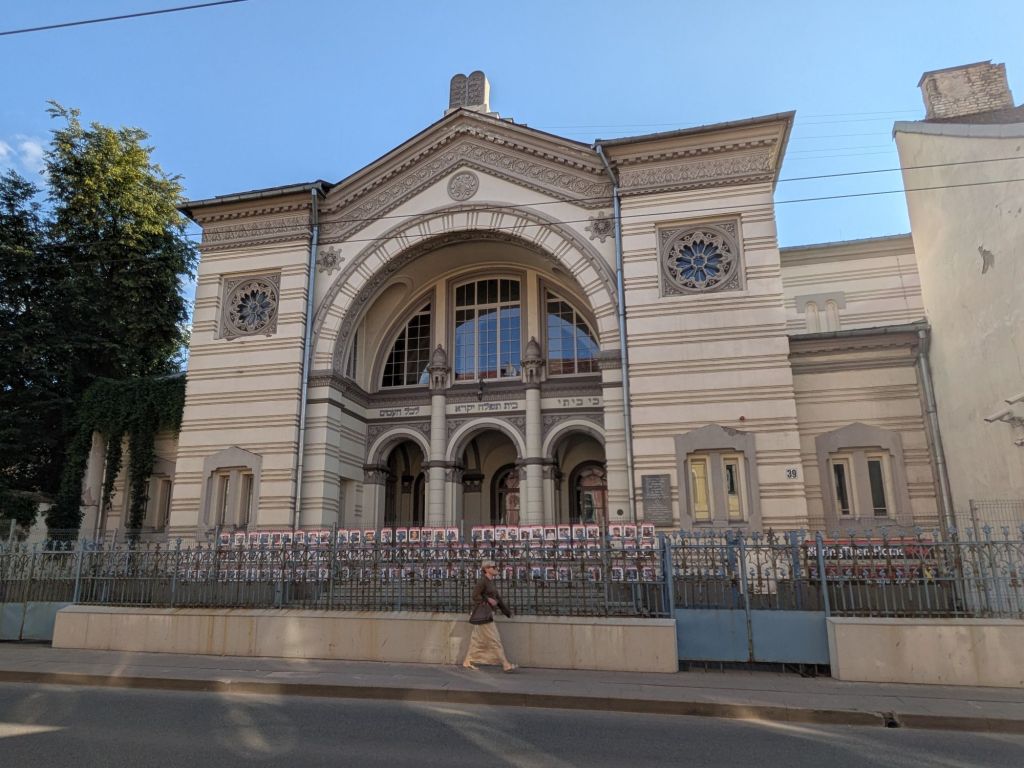
I wasn’t looking for Jewish history in Vilnius but it found me. The synagogue, still functioning as a house of prayer for the few thousand remaining Lithuanian Jews, is a half block from my hotel.
The Choral Synagogue in Vilnius. “Bring Them Home” along with photos of the hostages sits right behind the metal fence
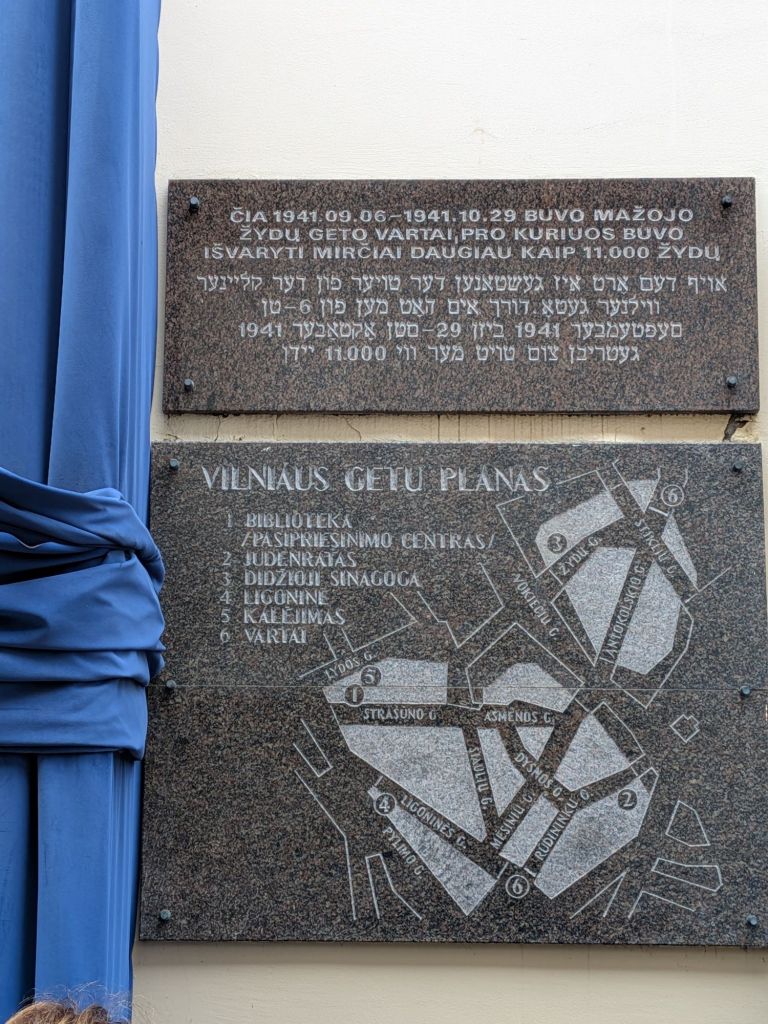
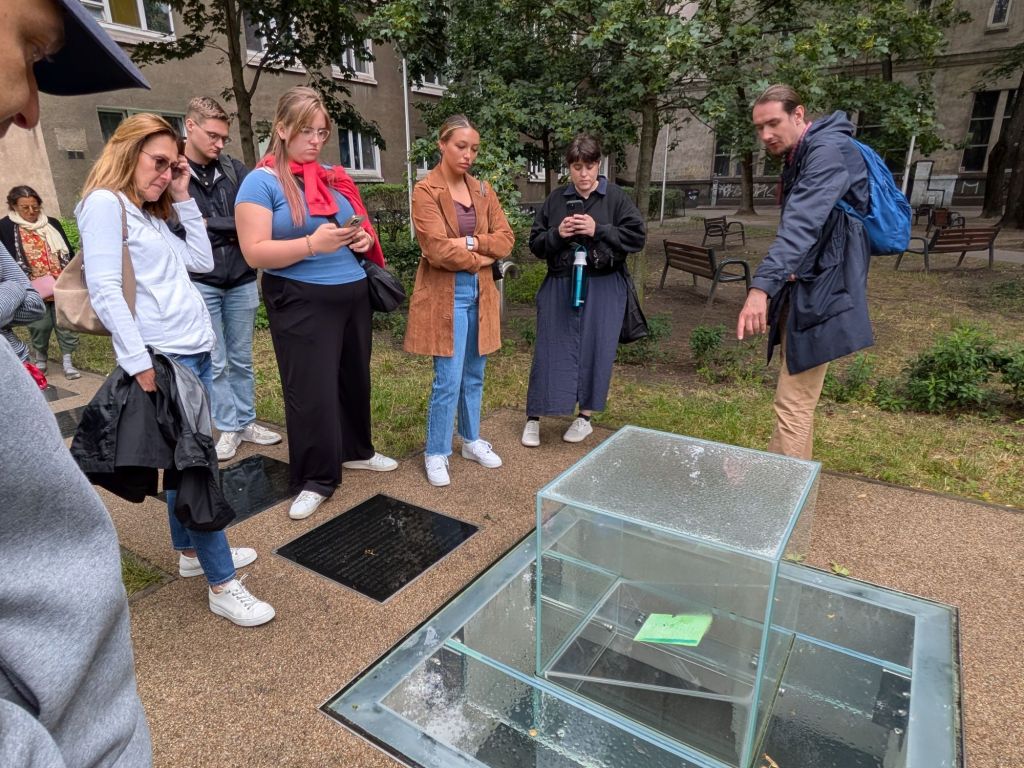
I signed up for a Vilnius with Locals walking tour of Jewish Vilnius, the so-called Jerusalem of Lithuania. We spent 3 hours exploring the Jewish quarter. In some sections, Soviet-era concrete buildings took the place of the prewar structures blown to rubble when the WW II ghetto was dismantled.
It’s hard to picture the prewar buildings that once filled this area
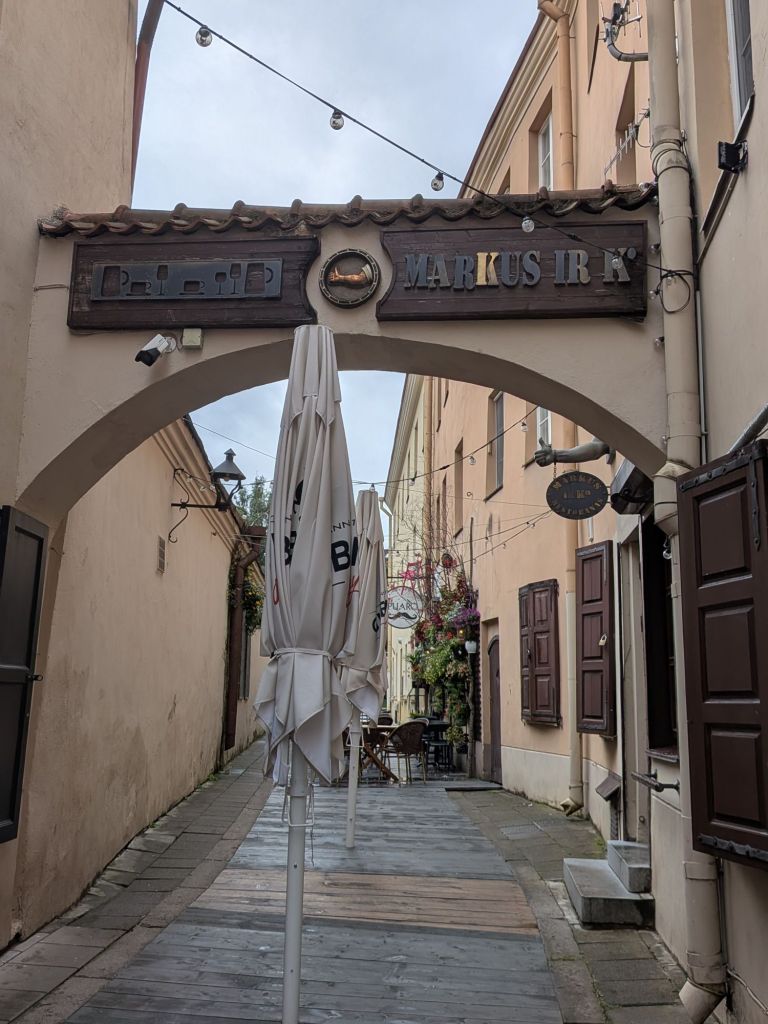
Other areas escaped destruction and retain their prewar appearance. As we meandered through narrow cobblestone lanes, Kristina our tour guide explained how much of the city’s Jewish story was silenced during the Soviet occupation, the period from 1940 to 1990 when the country was a republic within the Soviet Union. During that time, nobody talked about the Jews who had made up 45% of the city’s inhabitants before the war.
An iconic street in the Jewish district Map of the WW II ghettoJewish library scheduled for renovation
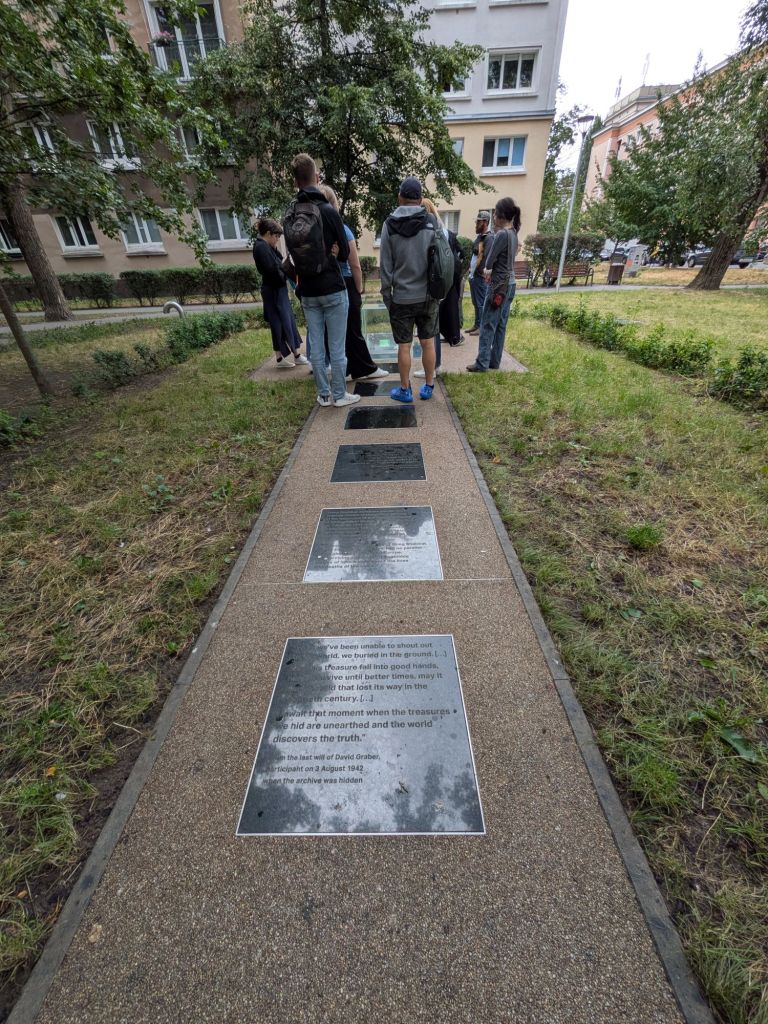
Kristina explained that this lost history only began to be rediscovered after Lithuania regained independence in 1990. Since then, scholars have been translating and writing about thousands of pages of documents that survived in hiding for 50 years. Many were collected by a group of people called the Paper Brigade who made it their mission to preserve all the documents in the YIVO Archive, a massive repository of Yiddish resources. Much of the archive found safety in New York. Today, the archive is split between Vilnius and New York.
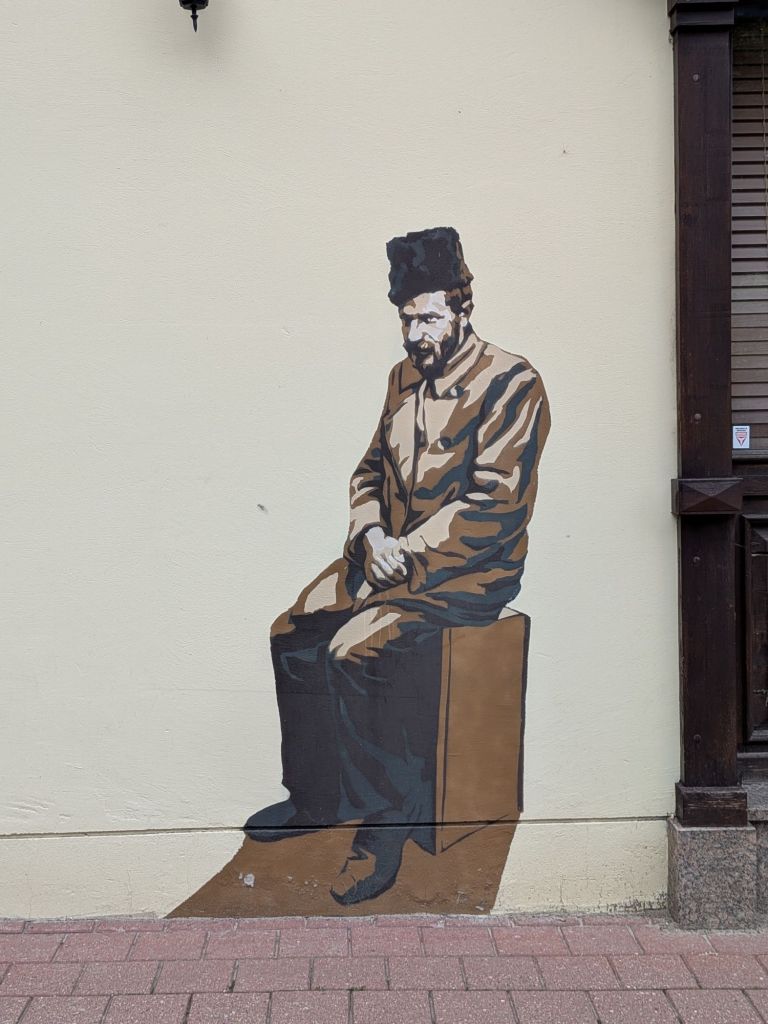
As more has been learned about The Jews of Vilnius, artwork, memorials, and institutions have made the story public. The Walls That Remember project stencils images from archival photos onto the walls of the former Jewish Quarter.
Kristina tells us about The Walls that Remember
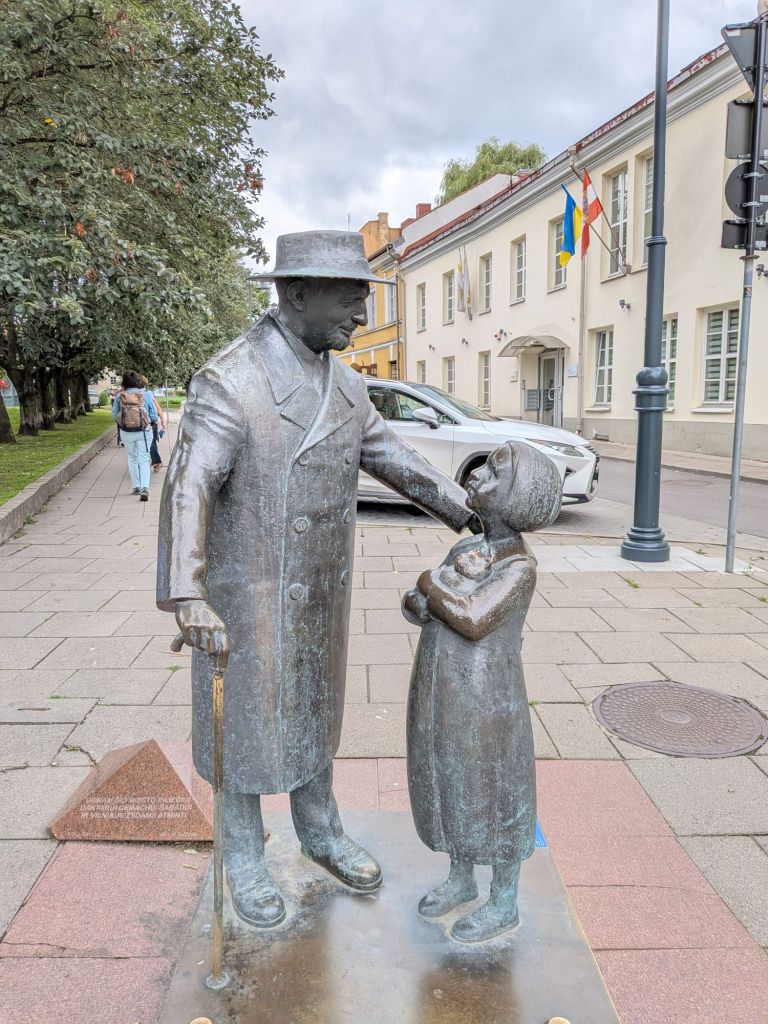
Remembered with a statue are: Zemach Shabad, a doctor known for his kindness who cared for the poor; Rabbi Elijah Ben Solomon (1720 – 1797), also called the Gaon of Vilnius; and singer Leonard Cohen, who had roots in Lithuania.
Zemach ShabadThe GaonLeonard Cohen
Jews first came to Vilnius as merchants before the 14th century. They were granted privileges by the Lithuanian rulers by the late 14th century. In Vilnius, they settled in the Jewish Quarter; other ethnic groups like Germans each settled in their own quarter of the city. By the time Lithuania was absorbed into the Russian Empire at the end of the 18th century, these ethnic enclaves were less rigid, and Jews could be found throughout the city along with other ethnic and religious inhabitants.
Vilnius was an important center for the growth of Yiddish language and culture, which explains why it was one of the places the Yiddish Scientific Institute (YIVO) was founded in 1925.
After a brief period of national autonomy from 1922 to 1940, Lithuania, like the other Baltic States, became a battleground between Stalinist USSR and Nazi Germany. When Hitler’s forces invaded in 1941, as many as 95% of the Jewish inhabitants were murdered.
Under Communism, the Choral Synagogue continued to operate, though it functioned more as a cultural organization than a religious one (at least officially). Since 1990, the Jewish community remains active at the synagogue. The interior can be viewed for just 2€. Whereas before the war, this was more of a reform synagogue, the current congregation is conservative. Women attend services on the upstairs balcony or behind a curtain on the ground floor.
Choral Synagogue
While on the tour, another participant and I struck up a conversation. Suzanne just completed a two-week tour of Jewish Poland with others of Jewish descent seeking to reconnect with the homeland of their ancestors. It was more than a historical trip, fusing spirituality and rituals within their encounters with Jewish spaces. For instance, at the grave of one participant’s ancestor, they did their own version of feldmestn, a ritual practiced by women; they measured the grave with wax, from which they made a candle.
I bonded with Suzanne over the importance of reconnecting with your Jewish origins, and also because of our shared appreciation for the individuals working in Poland to preserve Jewish memory. She called them memory keepers, a name that perfectly captures the role they play. I will use the term in my future writing about these memory keepers.
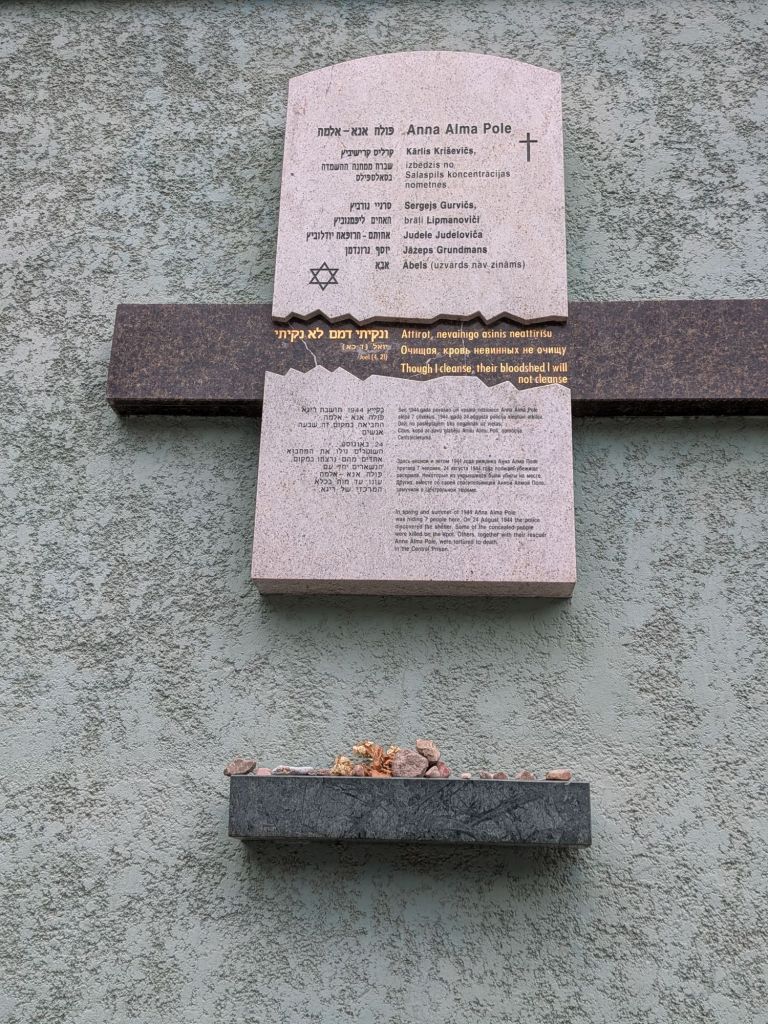
In Riga, the capitol of neighboring Latvia, Jewish markers continued to find me. On the building next to my hotel is a memorial marker for someone who saved Jews during the German occupation, and around the corner stands the synagogue. Also, during a walking tour of the city, I met Dimitri and his son Shiloh, reconnecting with their Jewish Latvian roots.
A Guest Post by Michael Mooney of the Matzevah Foundation
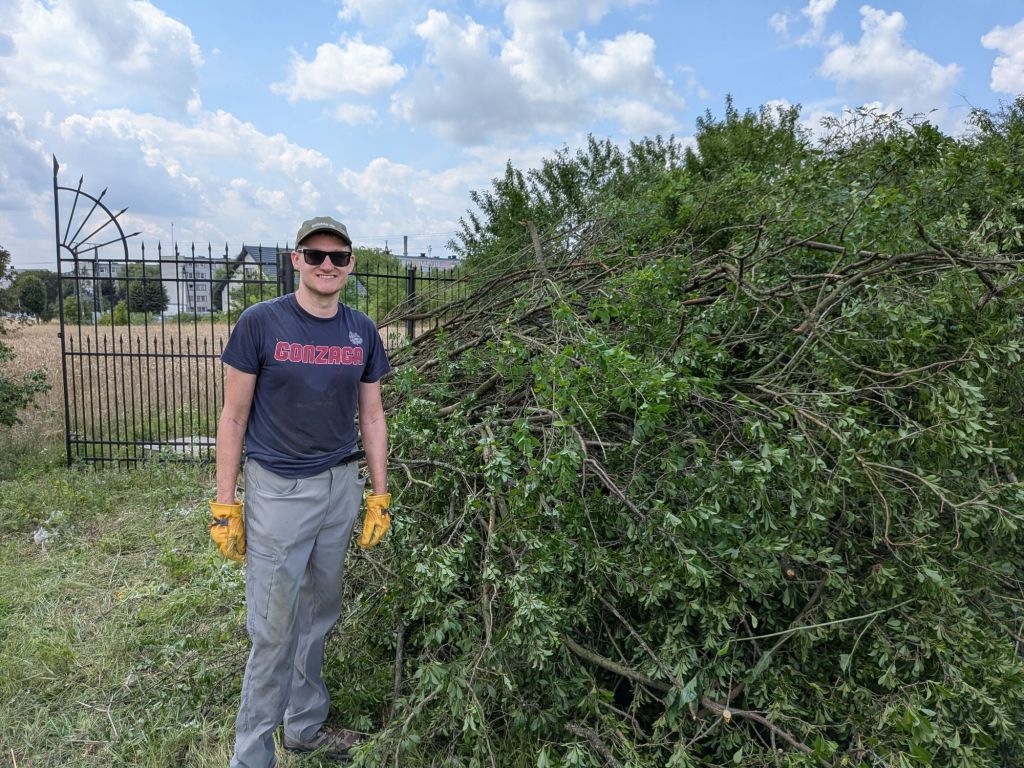
Day two has wrapped up for the Matzevah Foundation, our core team of volunteers, three individuals from a local reintegration program, and several local residents who stepped forward to lend their hands. These community members have their own reasons for joining us—personal, deeply-felt convictions about the importance of this work. They rarely say much about it, but their quiet presence speaks volumes. Their support adds a layer of silent solidarity that is deeply moving.
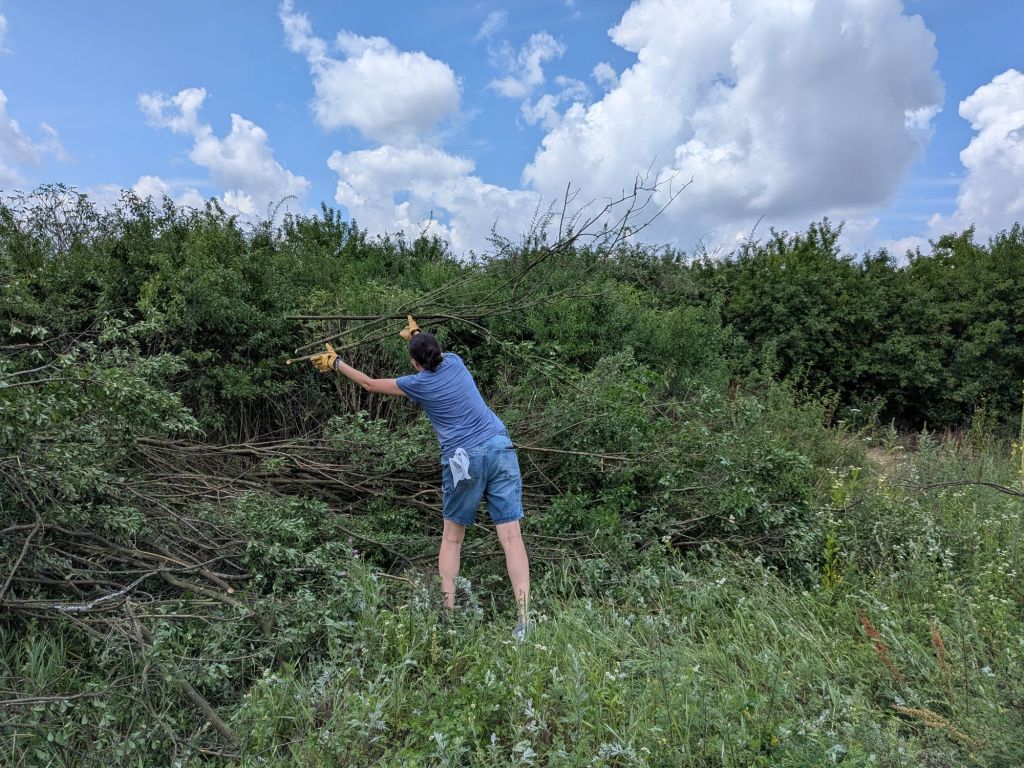
Our main task today focused on continuing the physically intensive work of clearing the brush and thick overgrowth from the depressed area believed to mark the site of a mass grave—just outside Żychlin. The sunken terrain could be the final resting place of hundreds of Jews—families and children—who were massacred during the German occupation of Poland. Step by step, we’re reclaiming this space from years of neglect, trying to bring dignity to a site long obscured both by vegetation and silence. Evidence and testimonies collected over the years suggest this area may be one of many unmarked mass graves, now hidden within the landscape yet never truly forgotten.
Before the war, Żychlin was home to a thriving Jewish community, with Jews making up over 40% of the town’s population. They had their own schools, synagogues, businesses, and institutions woven into the daily life of the town. The Nazi invasion brought devastation—ghettoization, mass deportations, executions, and widespread destruction. Few Jews from Żychlin survived the war.
Later in the day, our group visited what remains of the town’s historic Jewish quarter. Only the gutted walls of a 19th-century synagogue still stand—silent and broken. The cheder (Jewish school) and mikveh (ritual bath) that once operated nearby were destroyed long ago. The courtyard is cracked pavement, overrun with weeds and scattered debris. There is no plaque. No sign. Just the vacant presence of what was once central to community life.
Żychlin synagogue
As we surveyed the site, a few residents peered from behind curtains or doorways, then disappeared back inside. One person reportedly remarked to a member of our team that the synagogue “should just be torn down.” Is this concern about safety and dereliction? Or is it also a quiet wish to erase uncomfortable history—to bury the memory of a tragically obliterated community? Is forgetting easier than remembering?
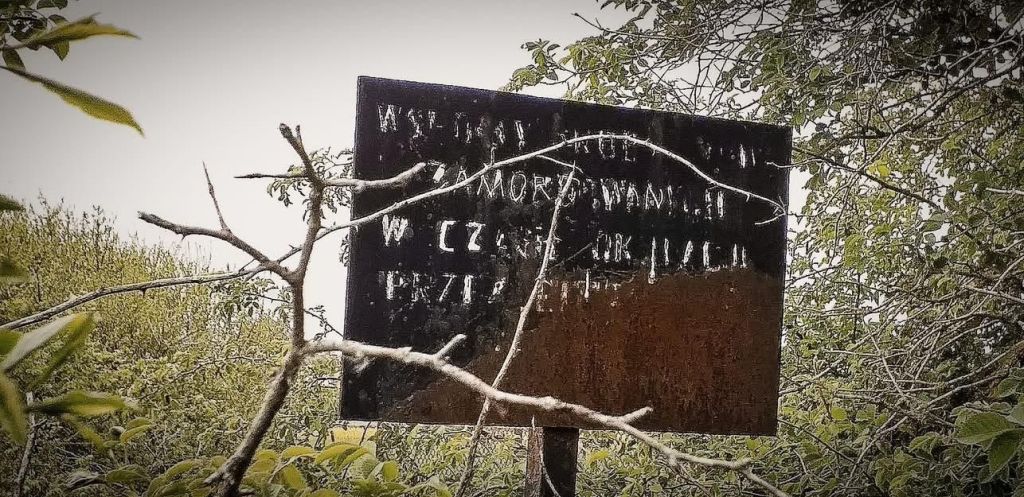
Near the clearing at the suspected grave site, we stumbled upon a weathered old sign—almost completely obscured by plants and exposure to the elements. The sign matches a photograph taken about eight years ago at (or near) this same location that once surfaced online. Most of the paint has worn away, but a few phrases remain legible:
– **”WSPÓLNY GRÓB”** – “In this place rest”
– **”ZAMORDOWANYCH”** – “Murdered people”
– **”W CZASIE OKUPACJI PRZEZ”** – “During the occupation by”
– One barely visible word at the bottom: **”HITLEROWCÓW,”** meaning “Nazis”
Metal sign indicating a collective grave is nearby
This style of memorial wording is common on World War II-era markers around Poland. It typically refers to civilians—often Jews or resistance members—murdered by the Nazis and buried in unmarked sites like this one.
Even in its deteriorated state, that plaque whispers a truth: this place is hallowed ground. And while some might look away, we cannot. Our work is about remembrance, dignity, and bearing witness to what many would rather forget.
When I return home, I plan to read *Neighbors: The Destruction of the Jewish Community in Jedwabne, Poland* by Jan T. Gross. The book tells the horrifying account of how, in 1941, the Jews of Jedwabne were not killed by distant Nazis, but by their own non-Jewish neighbors in an act of unspeakable violence. The story Gross tells echoes here in Żychlin and many other towns across Poland—places once filled with Jewish life, now emptied of memory, unless someone comes to uncover it. https://amzn.to/3Ixc0rK
Tomorrow, on Day Three, we’ll begin with a sobering visit to Chełmno—the extermination camp where most of Żychlin’s Jews were murdered and incinerated for the simple “crime” of being Jewish.
Nothing like spending the whole day on your feet the day after an overnight plane trip. But our group is intrepid.
Dinner on Friday night
The day began with a walking tour “The Unremovable Traces of the Warsaw Ghetto” led by Dr. Szymon Pietrzykowski of the Jewish Historical Institute. We started in the JHI in the lobby where the stone floor retains the burn stains caused by the fire bombs that destroyed the Great Synagogue in 1943 after the Warsaw Ghetto Uprising
Great Synagogue in Warsaw. Photo source: WikipediaBurn marks dating from the destruction of the neighboring Great Synagogue in 1943.
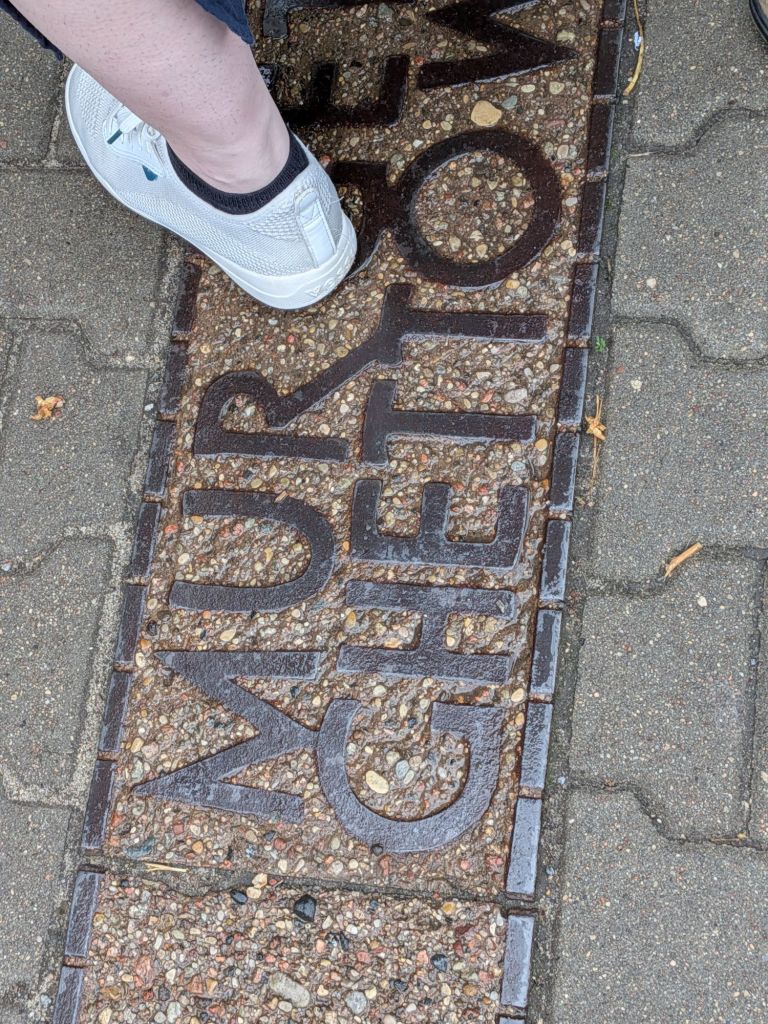
We visited places where the former location of the ghetto walls are marked by metal plaques in the sidewalk, buildings reconstructed after the war, sites where important Jewish institutions were destroyed and never rebuilt, and places significant to the Jewish Ghetto Uprising and the archive of Jewish life in the ghetto collected by historian Emanuel Ringelblum.
Jewish Historical Institute on Tłomacka StreetThe building that replaced the Great Synagogue. Note the arched feature evocative of synagogue windows.Location of the ghetto wallTraditional courtyard, one of the few showing what prewar Warsaw was likeMonument where part of the Ringelblum archive was found in milk cans under the rubble on Nowolipie Street
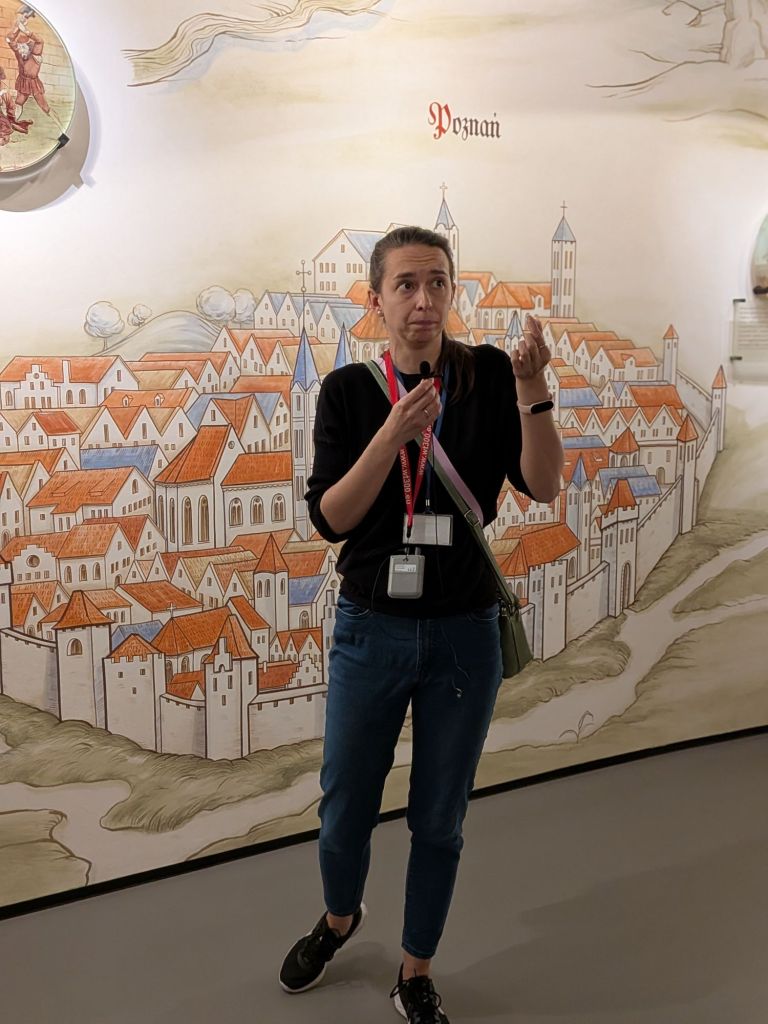
Our tour continued at the POLIN Museum of the History of Polish Jews, led by our guide Martina.
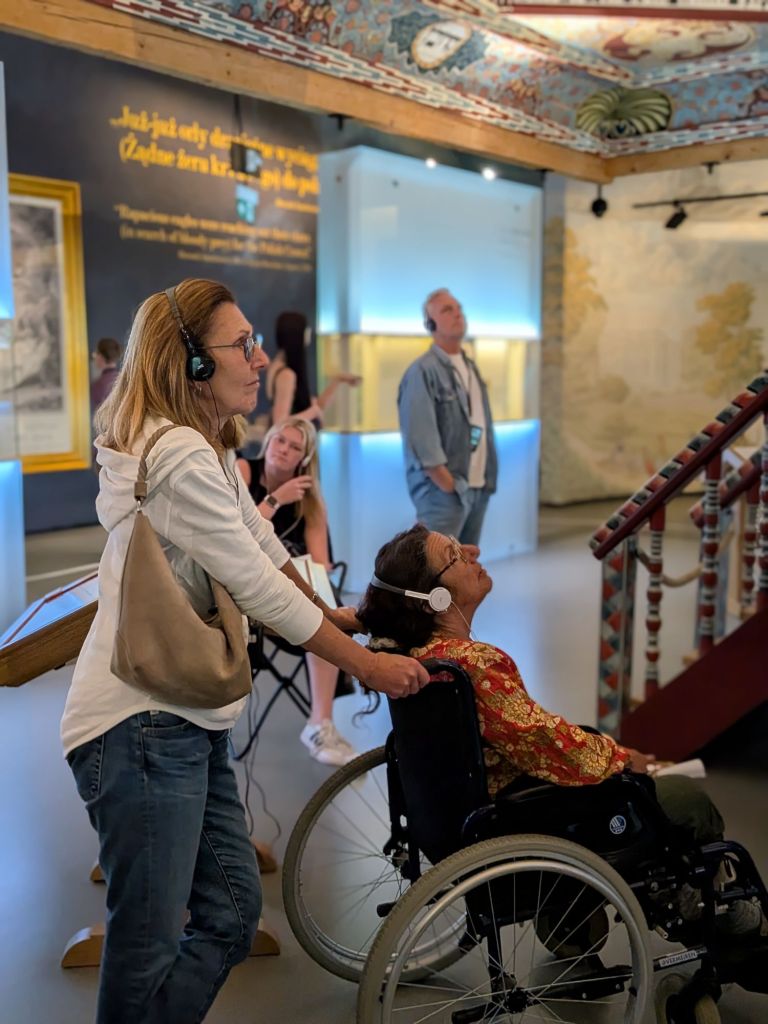
Our group at POLIN in the reproduction of a wooden painted synagogue Model of the Great Synagogue
After six hours of walking, we were ready to sit down. Paula, whose ancestor Tema Walfisz Jakubowicz grew up in Żychlin, treated us to a well-deserved meal. Many in our group got to try pierogi for the first time!
As I piece together information about wartime mass burials in the Żychlin Jewish Cemetery, I’m finding other valuable records like this photograph of the Żychlin synagogue:
Synagogue built around 1880. Source: collection of Andrzej Kubiak
The Association of Friends of the Kutno Lands (TPZK) posted excerpts from Anna Wrzesińska’s article about Żychlin’s Jews. Mostly, they are wartime memories passed down in Żychlin families. The original post is here: https://tpzk.eu/getto-w-zychlinie/.
These difficult truths are what compel me to contribute to the memorialization of those who suffered and died during the Shoah.
The Google translation:
(…) After the outbreak of World War II and the occupation of the town by the Germans, there were about 3,600 Jews in Żychlin, including many refugees. From the beginning, Jews were treated badly: they were humiliated and beaten, their apartments, workshops and shops were searched and robbed. Then came the obligation to wear emblems with a star. In April 1940, the Germans arrested Jewish intellectuals, who were deported to concentration camps. In June 1940, a ghetto was established on the premises of the so-called Fabianówka, i.e. Karol Fabian’s complex of industrial buildings. In July 1940, a second ghetto was established. In total, over 4,000 Jews were gathered in them. About 800 people died of hunger and disease in the ghettos. In February 1942, the German police killed 100 Jews on the streets of the large ghetto. In March 1942, the Germans carried out an action to liquidate the ghettos, deporting over 3,000. Jews to Krośniewice and then to the Kulmhof Nazi extermination camp in Chełmno nad Nerem. The members of the Żychlin History Lovers Society often talk about the ordeal of Jews during World War II. They shared their memories once again on March 9, 2016.
Józef Staszewski: “After the Germans entered Żychlin, initially they were not harsh towards the Jews. Until July 1940, that is, until the creation of the ghetto, they lived rather freely. On July 15, the decision was made to create a ghetto, or rather a second ghetto. The large ghetto was along Narutowicza Street, partly Łukasińskiego Street and today’s Traugutta Street. It reached all the way to the river. Several buildings were excluded from this area, including the Kumm house and Sędkiewicz bakery.
The large ghetto was created in one day, within four hours. The Germans simply relocated the residents of Narutowicza Street, where most Jews lived. They were relocated from the left side of the street to the right, just as they stood, both Jews and Poles. The German mayor led all this, he had it perfectly planned.
Looking from the church, the ghetto was on the left side of Narutowicza Street. The gate to the ghetto was from the Narutowicza side, like the billboard is today. The ghetto was not surrounded by a wall, but fenced with pickets. It was relatively easy to leave it, and Jews often did so. It had its own board and police. On its territory there was Rabinówka and a hospital.
The small ghetto was located on ul. 1 Maja, then Pierackiego, in the buildings of the so-called Fabianówka. It was established almost at the same time as the large one. Jews who did not fit into the large ghetto were sent there.
Information on this subject is supplemented by Jerzy Banasiak: “The ghetto was large on Narutowicza from the river to the right. My uncles Edek and Tadek had a mechanical workshop there, he did not join the..and they were richer than them. in Yiddish. ghetto, like Andrzejewski’s workshop, was taken over by the German Krebs. This area was fenced off. From the river, on the corner, there was a second gate to the ghetto, it was made of planks and reinforced with barbed wire. I lived near the smaller ghetto – Aleje Racławickie 20. In Fabianówka there were wealthier Jews, displaced from the left side of the city. There was a brickyard, to which a gate led, a palace, two large buildings, a brickyard, to which a gate led. buildings and a row of workers’ houses, still stand today. It was very cramped there, when it was warm, people slept under the roof of the brickyard.
Jews had to wear Jewish stars, initially on their backs, then on the sleeve. The stars were painted on the clothes or sewn on. My father, who worked in a dairy, made stars from sheet metal for sale.”
Tadeusz Kafarski: “The Germans also resettled my family. We lived near today’s veterinary clinic, and they resettled us to ul. Kościuszki 3, to a former Jewish house. I saw how in the summer the Germans would drive the Jews to the nearby ponds to swim. If they didn’t want to go into the water, they would shoot them. They ordered us, the children, to throw pebbles at them.”
The Jews were used for various cleaning jobs in the city. On the orders of the Germans, they dismantled crosses and chapels. They also built a villa for the mayor of Żychlin, Hempel, in the city park on the site of the demolished Kościuszko Stone (today it houses the Municipal Public Library).
“The most terrible thing I saw, recalls Mr. Staszewski, was the image of exhausted Jewish children. How hungry they were! We had orders from the scouts to deliver food to the ghetto, and that’s what we did: we brought bread, beets, potatoes, carrots…”.
It wasn’t safe. As Mirosław Zomerfeld recalls: “My father wasn’t displaced because he had a forge. We lived nearby. My aunt helped Jews in the ghetto. They deported her to Germany for work, she was not far from Dachau.” (…)
People’s behaviors varied. This is how Father Roman Indrzejczyk recalls the events of 1942: “I experienced the war and the German occupation in Żychlin near Kutno as a small boy. I came across people’s terror, helplessness, suffering, humiliation, persecution, injustice… I also saw the ghetto – I felt the great injustice done to these people, closed, fenced offfrom “our” world. A world that was already very limited by the violence and cruelty of the harsh, ruthless Nazi rule. I know that some of us tried to do something to give a little help and hope or at least show kindness and solidarity, but we always did it marked by great fear. Fear was widespread then, because “they” – the occupiers – could do everything worst. I don’t remember exactly when it was, but it was definitely before the liquidation of the ghetto: one of my peers, Stasiek, told me that tomorrow there would be a “deportation” in the city, “they will be deporting Jews from the ghetto” and his father would have to participate in it. I didn’t fully understand this information, but my father said then: “You don’t have to, an adult doesn’t have to do what is wrong, even if they tell you to. (…) You have to help, you have to defend the wronged, and not participate in doing wrong”. I understood that my father was talking about something very difficult, but I remember it to this day as an oracle. This “does not have to”, “should not do evil”, “should save, help the wronged” is more important than all fear and egoism. In my little heart, this awareness remained that only such a person deserves respect and recognition. I guessed that such an attitude rarely happens…”.
And this is how the Jewish woman Helena Bodek recounts the last days of her stay in the Żychlin ghetto (Jak tropione zwierząt. Wspomnienia, Wydawnictwo Literackie, Kraków 1993, p. 66): “General panic. The ground is burning under people’s feet. They walk as if unconscious. In their eyes there is mad fear, fear of death. Everything indicates that the time of liquidation is approaching. Finally, the mail to the ghetto is stopped. The interruption of contact with the outside world is a warning signal for us: we have to escape – now or never”.
Helena Bodek and her mother managed to escape from the ghetto. They reach Gąbin on a horse-drawn carriage they accidentally meet. They stop in the local ghetto, where there is still peace. There, three days later, they learn from other escapees – several young boys – about the liquidation of the Żychlin ghetto.
“They avoided arrest completely by accident. […] the navy blue policeman Ćwik, for his friendly attitude – he went from house to house with words of comfort – received many valuable gifts. These things were brought to his apartment by these young men. When they were about to return to the ghetto, it turned out that it was surrounded by the Gestapo. Ćwik, fearing for his own skin, ordered them to flee. The boys tell the story of the last moments of the Żychlin ghetto. Shortly before its liquidation, the local police went crazy. All the Jewish policemen were ordered to line up and were shot one by one. Hilek Zygier was killed shouting: “Long live the Jewish nation!” Under the pretext of contacting her husband, she was led out of the Oberman home. After taking a few steps, she fell to the ground, shot in the back. The same fate befell Oberman’s elderly parents. Of the entire family, only a several-year-old son remained. When a neighbor tried to take care of him, the Germans killed her on the spot. The child stood in the cold and cried, and people were afraid to approach him. On the evening of Oberman’s death, Altek’s brother was also shot.
The terror intensified with each hour. The police led groups of people to the Jewish cemetery. There they were murdered – among them the young Halusia Chude. Blood flowed in streams, leaking into the gutter outside the ghetto. Dr. Winogron died – a large diamond was noticed on her finger. According to other rumors, at the last moment she tried to contact her former maid Aryan to entrust her with little Maciuś. Desperate people went mad: a young married woman in the last month of pregnancy, Rachcia Gelman, threw herself into a river in front of the Gestapo, where she was hit by German bullets. Chałemski’s mother, an old woman, locked herself in a wardrobe, fearing the Germans, and died of suffocation. At dawn, the carriages commandeered from peasants from the surrounding villages arrived. People were loaded onto them. They stood and, so as not to fall out of the carriages, held each other’s hands tightly. Amid the cries of children, the lamentations and screams of women, the line of carriages moved towards the railway station. There, the unfortunate were packed into cattle wagons for their last journey…
The small, Jewish town of Żychlin is “Judenfrei”, the ghetto has ceased to exist. And it happened on Purim. It was on this holiday – a holiday of joy, a holiday of children – that thousands of innocent beings were sent to death and torture together with their fathers and mothers…”
After the Jewish residents of Żychlin were deported to Kulmhof, the Germans searched their homes for hidden valuables. At that time, the manor house and factory buildings of Fabianówka, Rabinówka on Narutowicza Street and several other buildings were demolished to their foundations. Only after systematic plundering were the Polish population ordered to settle the area of the former ghetto.
We have presented fragments of the article by Anna Maria Wrzesińska entitled “Jews in Żychlin”, which was published in the 20th volume of Kutnowskie Zeszyty Regionalne.
Report #14 about Roberta Books and Marysia Galbraith’s trip to meet Polish partners in preparation for the ADJCP‘s memorial visit to central Poland.
Izbica Kujawska, September 15
Our contact in Izbica Kujawska, Premysław Nowicki, was called out of town and unable to meet us. He did, however, affirm his willingness to help us plan our memorial visit to the town.
Roberta and I stopped by anyway on our way to Kowal. We wanted to see the synagogue, one of the few remaining in the region and only the second we visited that retains the external appearance of a synagogue. According to an article in Izbica Kujawska Online, found by ADJCP member Michael Schoenholtz, the Jewish Community of Wrocław sold the building in 2007 to a businessman who renovated it and restored some features of the prewar exterior. The exact use of the building wasn’t decided yet. Originally, it was intended for “social and cultural purposes,” but in 2014 the when the article was written, it was being used as a warehouse for the neighboring Biedronka, a discount grocery store.
West side of the Izbica Kujawska synagogue
Eight years later, instead of serving social and cultural purposes or being used as a warehouse, the building houses a clothing store. The exterior retains the distinctive appearance of a synagogue with tall, curve-topped windows and a Star of David motif at the top of metal grates over the windows. This solid stone structure stands tall enough to have two or three stories, though doubtless the sanctuary was originally open to the ceiling with a women’s gallery reached by a staircase.
Window grates adorned with the Star of David
The exterior has been restored to its original glory, with the anachronistic addition of an electronic sign mounted high on its façade. Scrolling red letters advertise suits, shoes, and other forms of clothing. We had to walk all the way around the building to the western side to find the entrance. Without any sign beside the door, I expected it to be locked, but I tried entering anyway. It opened.
The interior looks nothing like a synagogue. The grey-painted space is broken up by large square columns, and although there is a high ceiling it doesn’t go up all the way to the roof. Stairs to the left behind a glass partition lead to an upper story. The former sanctuary is packed with racks of clothing for men, women, and children. A passageway at the back leads directly into the Biedronka.
Th south side of the synagogue connects with a Biedronka discount grocery store. An electronic sign advertises the offerings in the clothing store
Roberta offered to buy me something. She said that she did something similar in the store she imagined was in the same location as her grandfather’s butcher shop in Przedecz. She went in a bought a red hat. She never wore it.
I feel ambivalent about the presence of a store in a synagogue. On the one hand, it is a kind of erasure of the Jewish presence in the town. On the other, the restored exterior provides public evidence of the former Jewish community. Sadly, no Jewish population remains to frequent the building as a house of worship.
Because the building meets the contemporary needs of the current town residents, it continues to be cared for. Its roof remains intact and its walls strong, unlike the ruin in Żychlin. And unlike the Włocławek synagogues that were burned on Rosh Hashanah when the Nazis invaded, leaving no trace behind. Still, a more appropriate use would be for it to serve social and educational functions like the heritage center in the Lubraniec synagogue.
What do you think? How do you feel about shopping in a synagogue? Old houses of worship are repurposed all the time. The former synagogue in Tuscaloosa became a private residence until it was torn down several years ago to make way for an apartment complex. Are some uses more appropriate than others?
Report #13 about Roberta Books and Marysia Galbraith’s trip to meet Polish partners in preparation for the ADJCP‘s memorial visit to central Poland.
Lubraniec, September 14
The Lubraniec Synagogue stands as a testament to the Jewish residents of the town. It is one of only two synagogues in the ADJCP region that maintains the outward appearance of its original purpose, and the only one that retains original interior features.
Currently, the building houses the Lubraniec Center for Cultural Heritage. During World War II, the synagogue became a warehouse, and it maintained that function until about 1980 when it was renovated for its current use. Historical features remain inside and out, including fragments of the original polychrome wall paintings, the women’s gallery, and a hidden doorway with narrow stone steps leading up to the attic. The building was also adapted to its current function: the second-floor landing was enclosed for the director’s office, and a stage was added on one side of the sanctuary.
From the left, Roberta Books, Andrzej Tomczak, Marysia Galbraith, and Zbigniew Wojciechowski. Photo Source: Lubraniec Center for Cultural Heritage Facebook PageStage added to sanctuaryThe women’s gallery retains its historic appearanceHidden doorwayStairs to the attic
Director Zbigniew Wojciechowski and local historian Andrzej Tomczak shared some background information about the synagogue, the Jewish cemetery, and the Jewish community of Lubraniec. The community center has occasionally sponsored public events featuring Jewish history and culture, and Tomczak has written about the history of the town’s Jewish community. Wojciechowski is also a music teacher. He proposed moving the date of their annual Day of Jewish Culture event so it corresponds with our visit in May.
After touring the building, we drove to the Jewish cemetery, a rectangular grass-covered field off a narrow dirt road.
Lubraniec Jewish cemeteryJewish cemetery to the right of the road
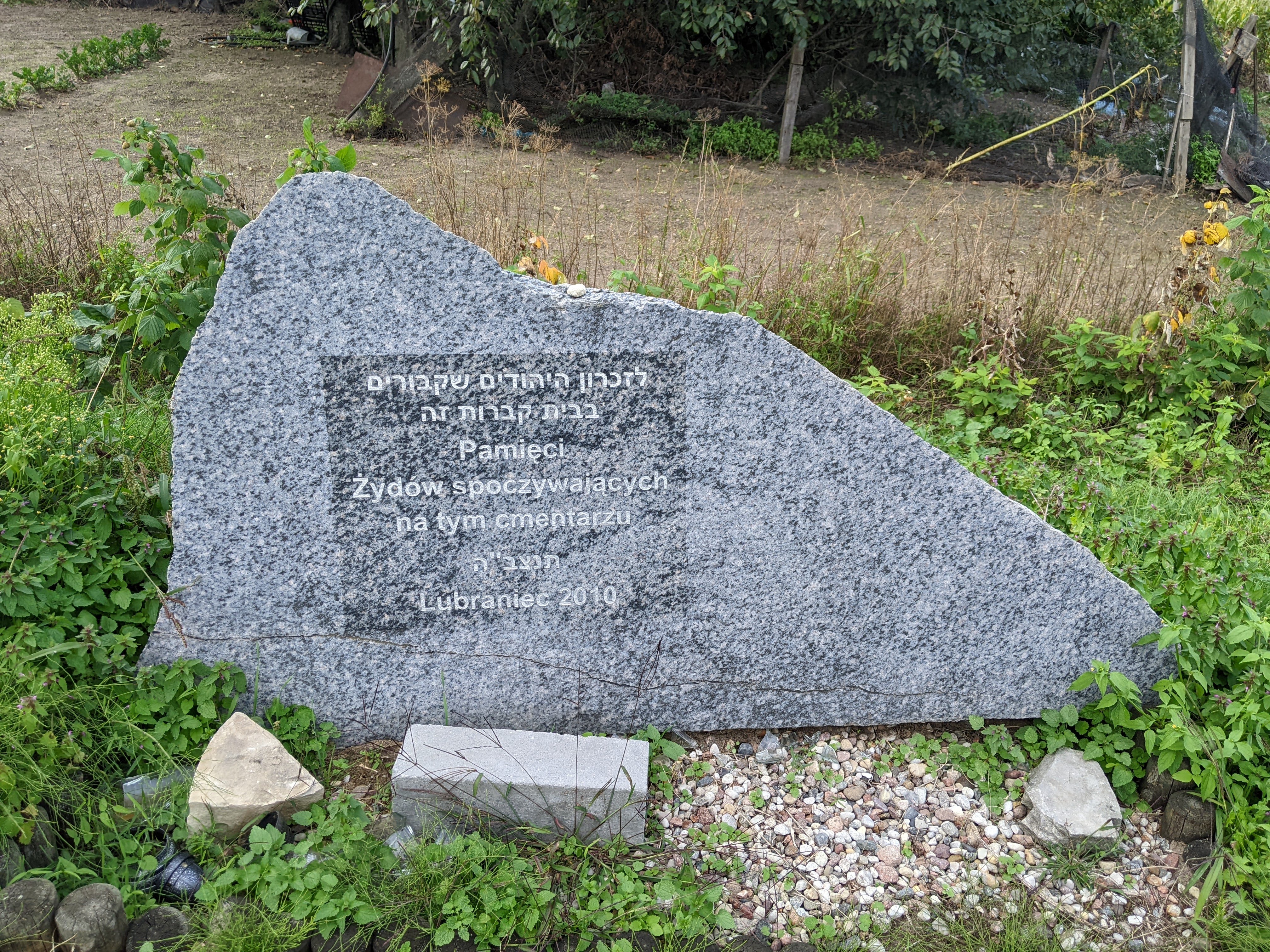
The site has a memorial stone, installed in 2010, with the simple inscription “Jews rest in this cemetery” written in Hebrew and Polish.
Memorial stone at Lubraniec Jewish cemetery
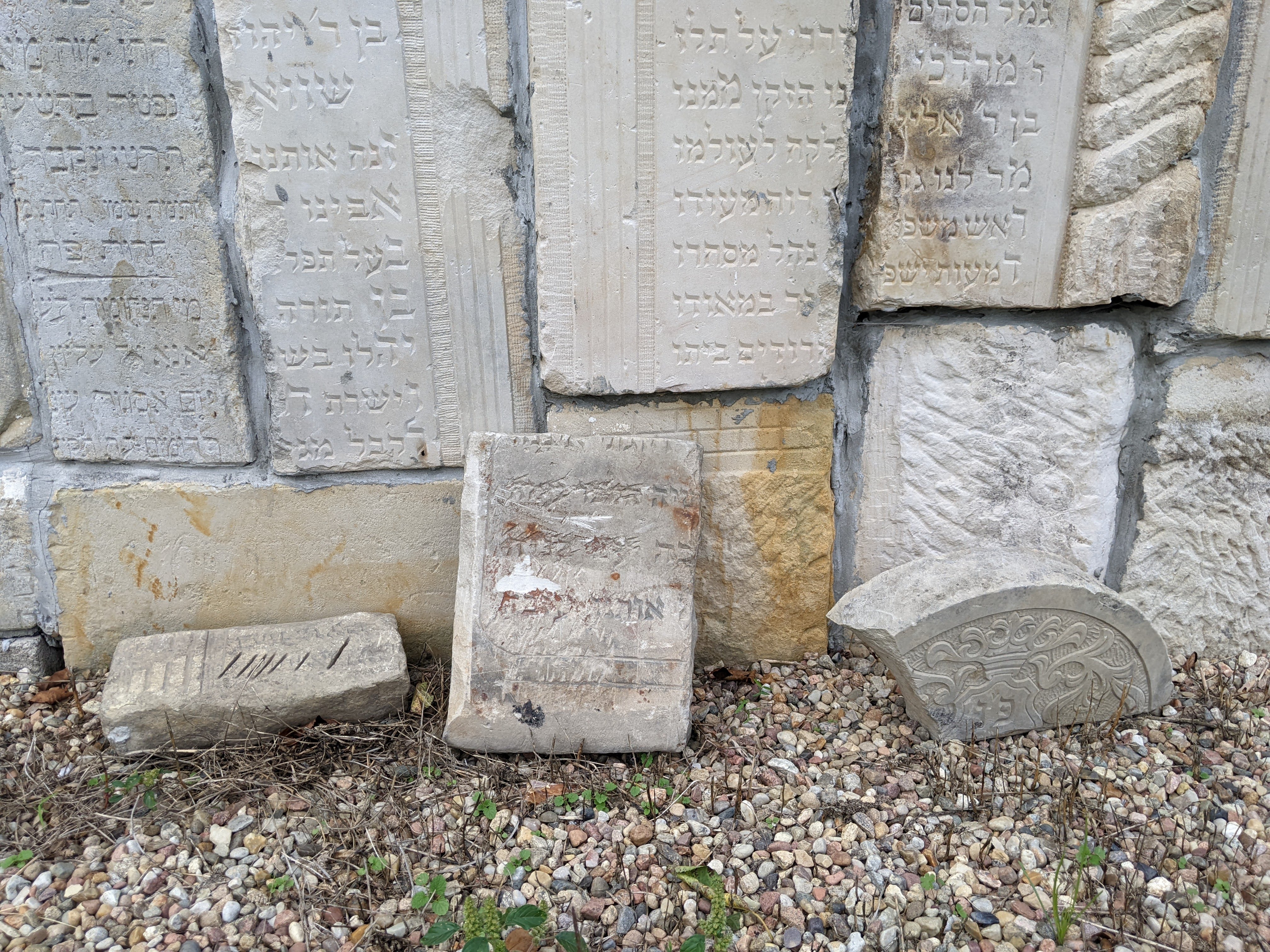
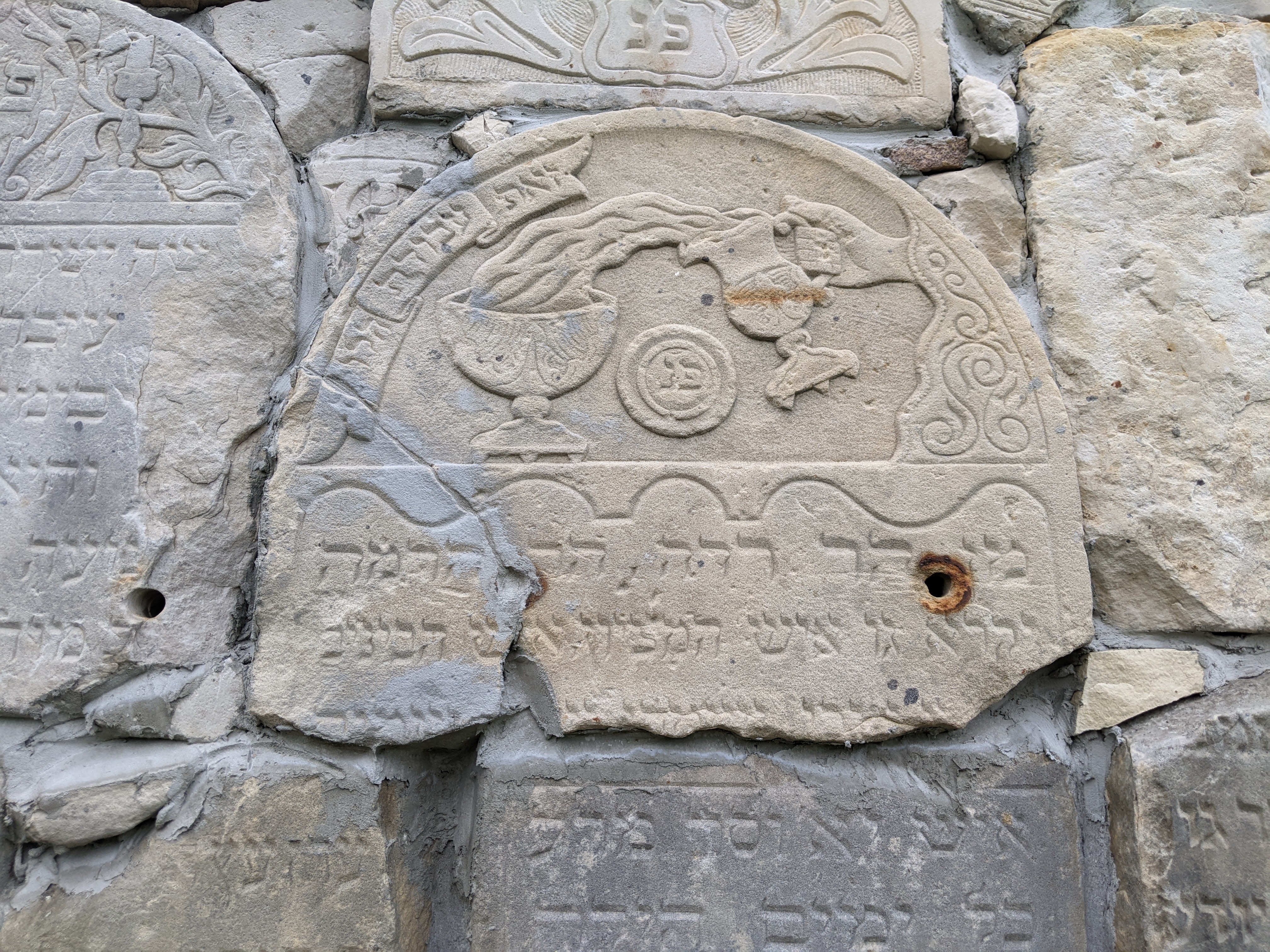
We walked up a few steps from the road, where a wall has been constructed out of matzevah fragments. There is a noticeable seam running about five feet from the ground which marks the original height of the lapidarium. After it was installed, more fragments were located and added on top, raising the wall another couple of feet. Many of these added fragments came from the rounded tops of matzevot. They contain symbols including crowns, candles, or water being poured from a pitcher into a cup. Three additional fragments sit at the base of the wall, brought individually from other sources. One small fragment has deep incisions cut into the inscription, probably where it was used to sharpen knives.
Lapidarium at the Lubraniec cemetery composed of matzevah fragments
Even though there is no fence, the cemetery looks well-maintained. The grass isn’t too long and the path up to the lapidarium is in good condition.
Why did the synagogue and all of these matzevah fragments survive in Lubraniec, when so little remains in surrounding places? It’s a mystery I would like to solve.
Report #12 about Roberta Books and Marysia Galbraith’s trip to meet Polish partners in preparation for the ADJCP‘s memorial visit to central Poland.
Brześć Kujawski, September 14
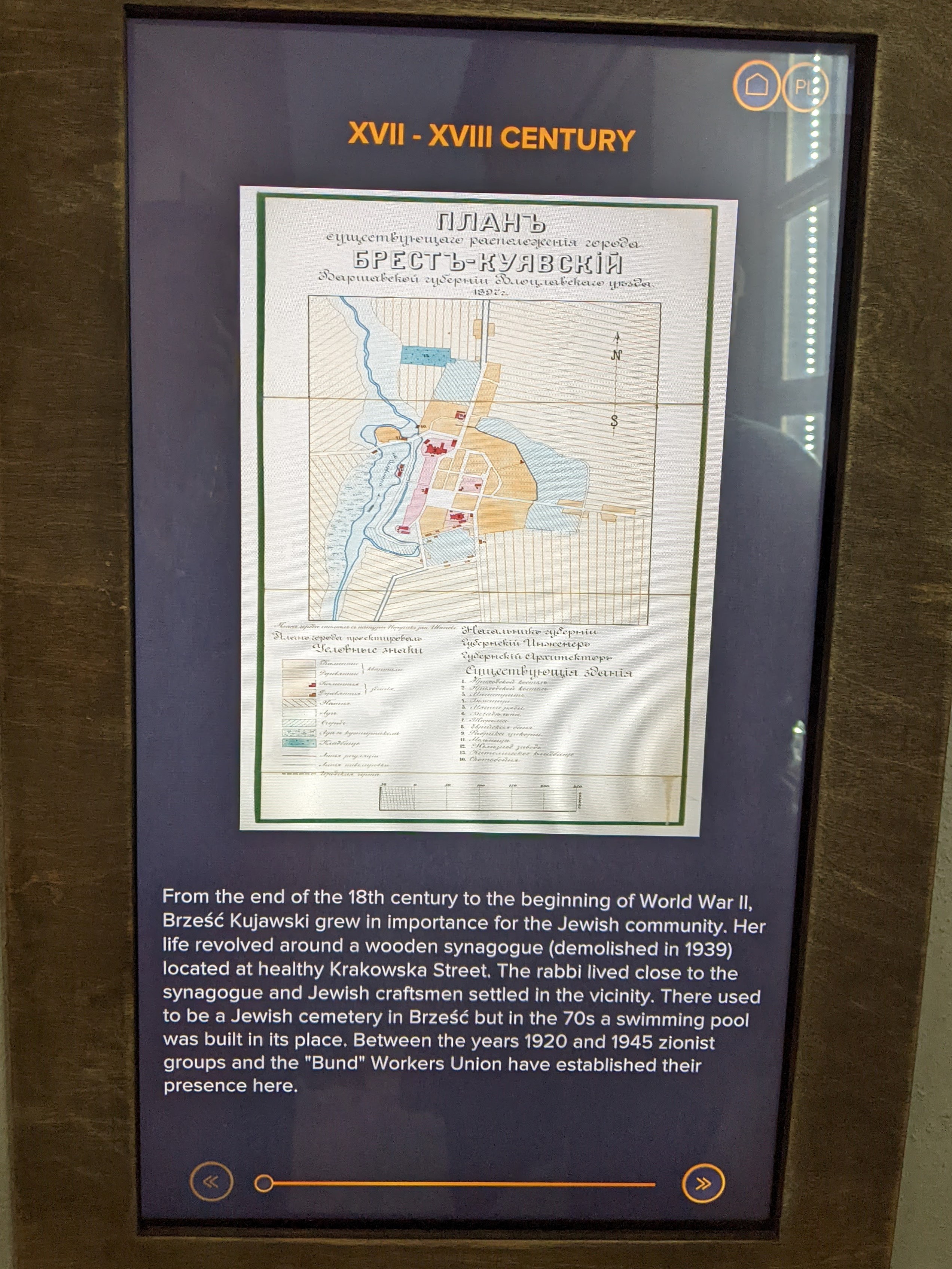
Our visit to Brześć Kujawski illustrates the importance of local institutions and people committed to the restoration of Jewish memory. My first visit to this town in 2015 left me profoundly unsettled. All I could find of the prewar Jewish cemetery was an unkempt field scarred by a crumbling pool. No sign anywhere acknowledged the vibrant prewar Jewish community, which numbered between 630 and 990 people in the first decades of the 20th century. I felt the absence personally because my grandmother was part of that overlooked community.
Hence my surprise when in 2020, Anna Szczepaniak, who works at the Brześć Center of Culture and History: Wahadło, sent an enthusiastic response to my blog post about the ADJCP plans to organize a memorial trip for descendants. Anna said she welcomes the ADJCP to Brześć Kujawski and over the course of the following year, she and the vice-director of the center, Sylwia Czerwińska-Modrzejewska shared their plans for a memorial plaque at the site of the former ghetto as well as cultural programs about Poland’s Jewish community. They wanted to coordinate events to occur during our memorial trip. Sadly, COVID delayed our visit, but the Center of Culture and History, with the support of Mayor Tomasz Chymkowski, has gone ahead with substantive efforts to restore Jewish memory in their town.
As you enter Brześć Kujawski, a 12-kilometer drive from Włocławek, the brand new Center building looms up on the right side of the road. Roberta and I were greeted by Anna, who quickly made clear that they had prepared for our visit. She gave us a thick folder filled with copies of historical documents they have collected: photos, maps, and sketches of the town; artist Maya Gordon’s plans for a memorial monument in the Jewish cemetery; and archival records about the cemetery and official Jewish Community matters.
They told us about Mikołaj Grynberg, a Polish photographer and child of Holocaust survivors, who has published two photo albums and various books and articles, including stories of children of survivors. Grynberg was scheduled to come to Brześć Kujawski on October 15 to show his new film “Dowód Tożsamości” (“Identity Card”; can also mean “Proof of Identity”). According to a post on the Facebook page “Szlakiem Żydów w Brześćiu Kujawskim” (“Trail of the Jews from Brzesc Kujawski” ) the film explores:
how the memory of the Holocaust evolves and what role it plays in the minds of today’s twenty-year-olds. The interviews show a wide panorama of attitudes and experiences – the interviewees come from both large cities and the Polish provinces. The film is an attempt to show the specificity of being a Polish Jew, often incomprehensible to people outside of this circle.
We toured the new multimedia exhibition, located on two stories of the Center, which focuses on the history of Breść Kujawski from prehistoric times through the contemporary period. Reminiscent of the Polin Museum in Warsaw, it emphasizes active engagement with historical information rather than artifacts, although it includes some impressive prehistoric pottery and other items. The exhibition integrates the history of the Jewish community. For instance, one room reproduces a town street during the period between the world wars, complete with reproductions of signs for businesses, some which had Jewish proprietors.
Display outlining Brześć Kujawski’s Jewish history, and Jewish traces in the model town street
We drove with Center Director Agata Kubajka and Anna to the Jewish cemetery at the outskirts of town. Anna couldn’t get the key to open the locked gate so we stepped over the fallen chain-link fence and walked through the knee-high grass to the edge of the empty, blue-painted pool.
Swimming pool in the Brześć Kujawski Jewish cemetery
Last year, the swimming pool was closed and they are seeking funding to transform it into a memorial monument. Recognizing that some people might protest the loss of the pool, they found a location for a new one; the old pool was built in the 1970s so it needed to be replaced anyway. The town wants to transform the space into a park with pathways and benches. Maya Gordon’s design for the memorial would put a circular medallion at the bottom of the former pool depicting a tree with broken branches, meant to represent mourning and destroyed lives, as well as echoing the broken tree motif commonly found on matzevot. In her imagining, water will naturally fill the basin and cover the medallion, representing spiritual cleansing and rebirth. The pool basin will become a part of the memorial and avoid the further disruption that would result from removing it. Maya Gordon lives and works in Amsterdam, Tel Aviv, and Warsaw. She was born in Poland but moved to Israel around age ten. She studied art in Jerusalem and in The Netherlands.
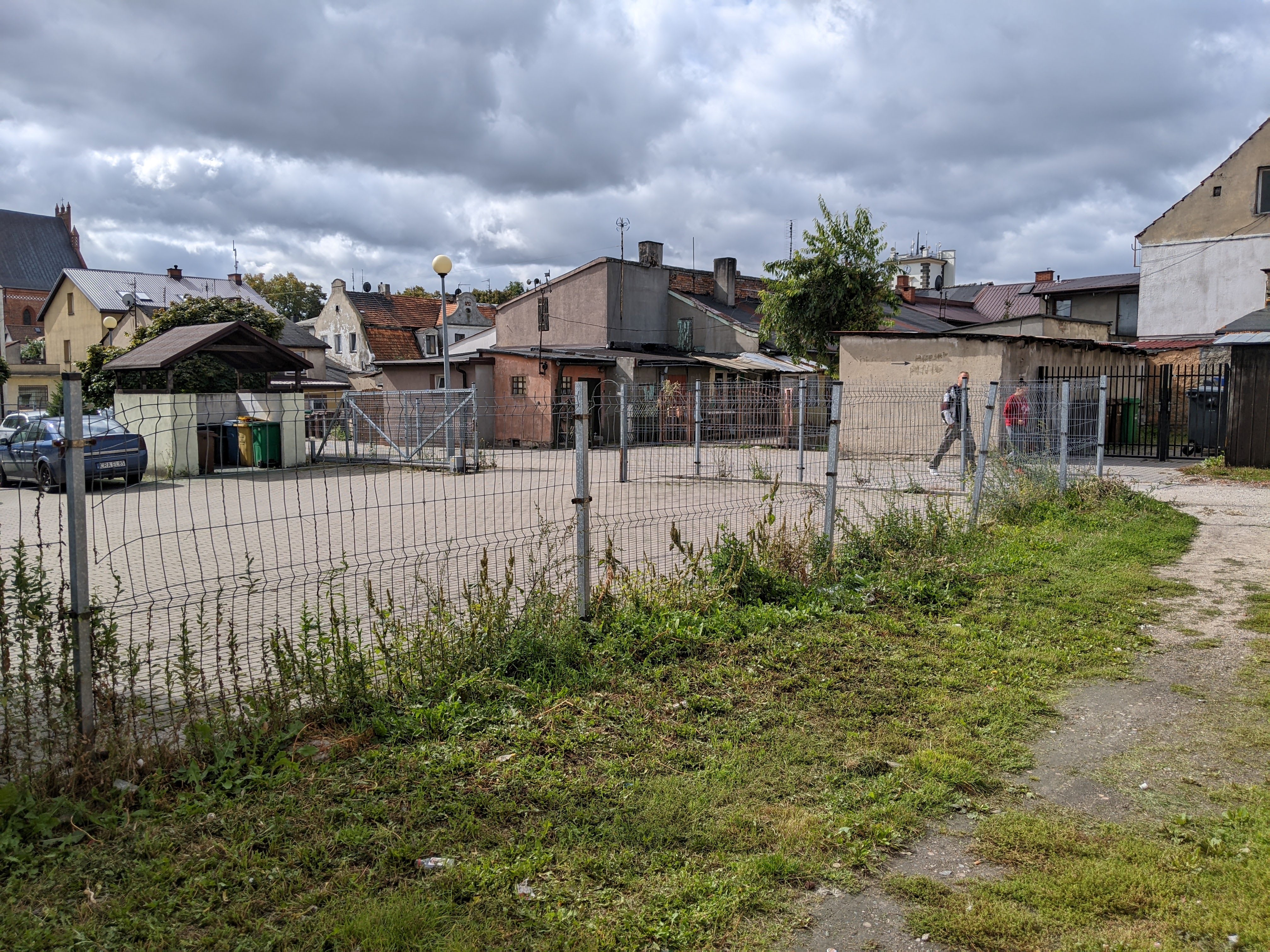
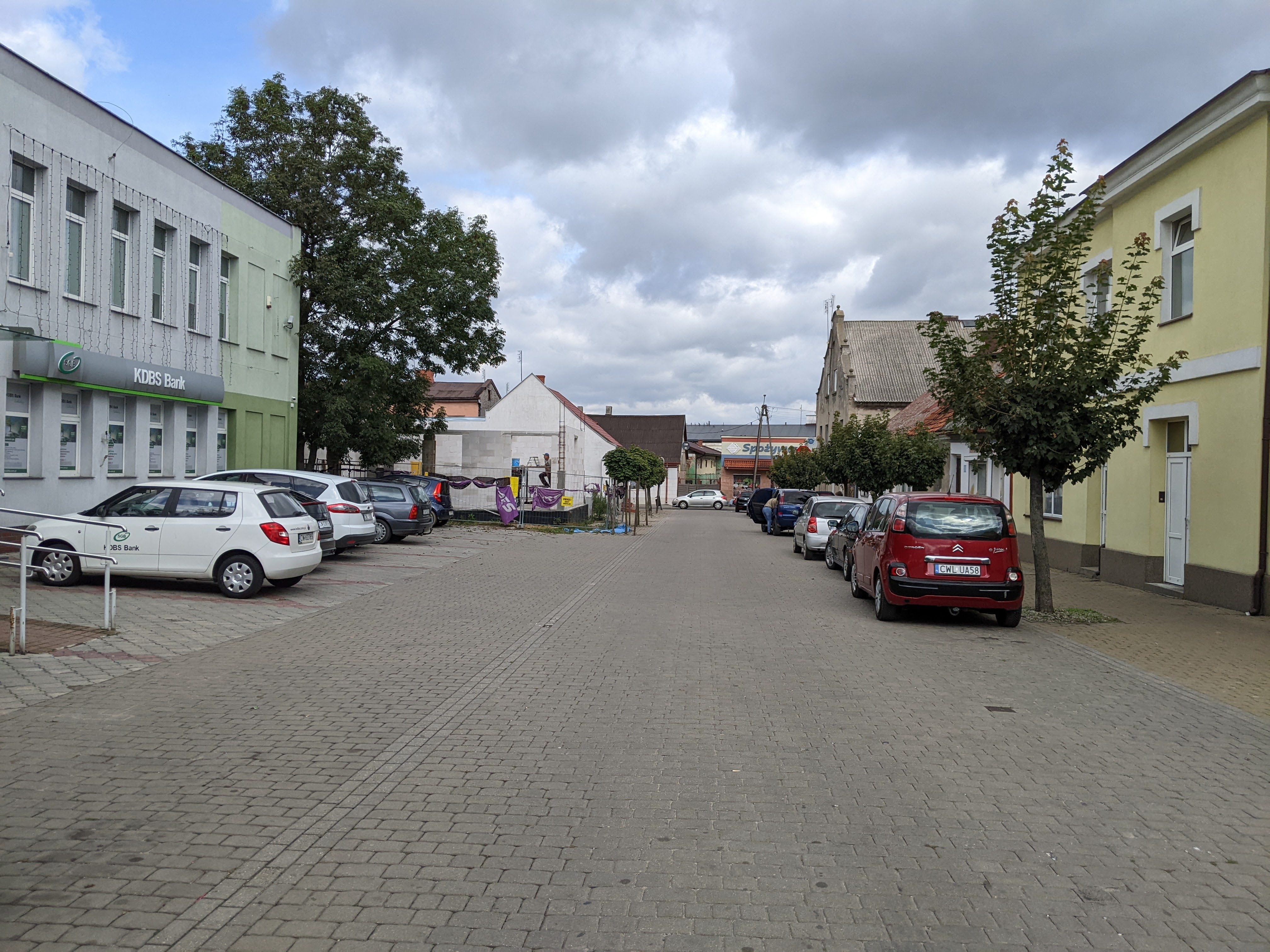
We drove back into town to see the former site of the synagogue (now an empty lot) and the square where Jews were gathered for deportation to the death camp at Chełmno nad Nerem. They have plans to place historical markers in each of these places.
Site of former synagogueSquare where Jews were gathered for deportation to the death camp
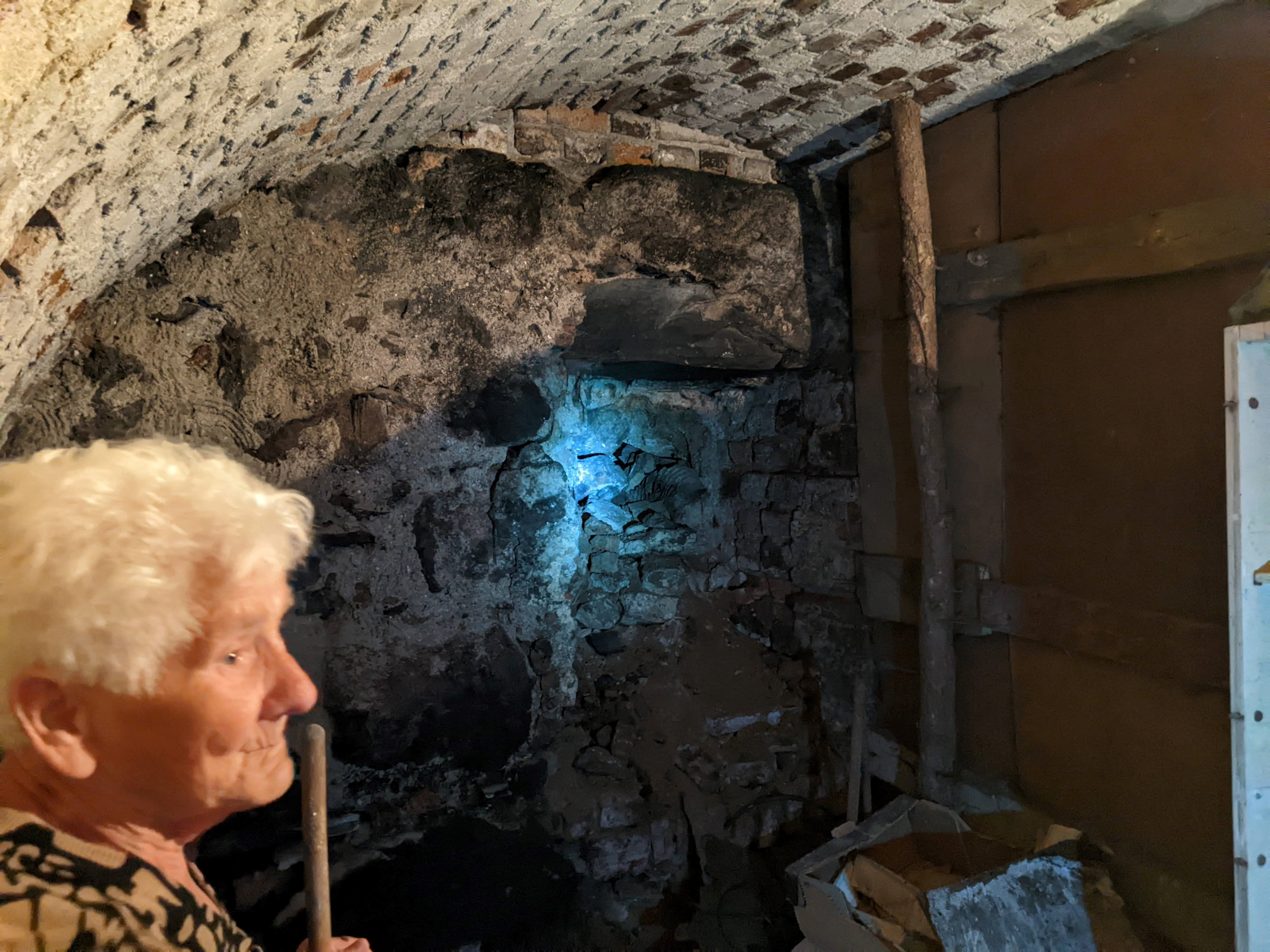
Down the street from the synagogue site, Anna, popped into a doorway to ask an elderly resident if she could show us the basement of the building where they believe there was a ritual bath. The woman grabbed her flashlight and led us down a rickety wooden staircase into a basement with vaulted ceilings made of brick and stone. There was some debate about how the space could have been configured and what the source of the water might have been. Even if it wasn’t the ritual bath, the basement clearly dates back to the 19th century (I would guess even older). It probably saw many uses during its existence.
Basement that might have been the location of the mikvah
We returned to the Center of Culture and History, to the restaurant on the ground floor, where we joined Mayor Tomasz Chymkowski, his assistant Karolina Filipiak, Director of the Center Agata Kubajka, and Vice-director Sylwia Czerwińska-Modrzejewska for lunch.
After an amazing lunch of pierogis and other regional cuisine. From left, Mayor Tomasz Chymkowski, Center Vice-director Sylwia Czerwińska-Modrzejewska, Roberta Books, Marysia Galbraith, Center Director Agata Kubajka, and Mayor’s Assistant Karolina Filipiak
We had a spirited, wide-ranging discussion over our meal. Sylwia made sure we tried some regional specialties, including kluski (homemade noodles) with farmer’s cheese and bacon. Mayor Chymkowski explained why Brześć Kujawski is in better economic shape than many neighboring towns. They built an industrial park before other places got the idea. Manufacturers of items such as clothing, auto parts, and bicycles provide jobs for town residents and commuters. Chymkowski said the town has the financial means to invest in preserving the town’s history. This includes renovating the town center and marking historical places, including those associated with Jewish residents. He described the plans for the Jewish cemetery, and explained the pool had been built by communists. He said there was no regional place of remembrance. That is the function he wants the renovated cemetery to serve.
Report #9 about Roberta Books and Marysia Galbraith’s trip to meet Polish partners in preparation for the ADJCP‘s memorial visit to central Poland.
Koło, September 11
Roberta, Yosef, and I met Koło museum employee Tomasz Nuszkiewicz at the Town Hall, and we walked across the street to the city’s museum of ceramics. Like Włocławek, Koło had factories specializing in faience, tin-glaze ware with painted designs, usually floral motifs. These factories were started by Jewish industrialists, who owned them until they were taken over by the German occupiers during World War II; after the war, they were nationalized by the Polish government.
We sat in an upstairs room at a table, where Tomasz had set out a copy of the Koło Yizkor Book for us, along with copies of a book of town postcards which he gave to each of us. The museum publishes a historical periodical that occasionally has articles about the town’s Jewish community. The room also has a Torah on display; it was found after the war and probably came from a neighboring town. Roberta suggested that based on its modest size, it might have belonged to someone wealthy enough to have a Torah at home.
Roberta, Tomasz, and Yosef at the Ceramics Museum in KołoThe Torah on exhibition in the Koło museum
We walked back past the Town Hall, which has a plaque mounted on its back wall inscribed in Hebrew, Polish, and Yiddish:
In the years 1939-1943 German occupiers murdered about 5000 Jews, citizens of the city of Koło. Honor their memory! The community and city council of Koło, September 1, 2009.
We continued another block to the former site of the synagogue, an overgrown lot with a pile of organic debris under some trees. The site is owned by the Jewish Community in Wrocław, but they don’t maintain it. Tomasz said maybe the city should clean it up, but they rarely do because it is not their property.
These issues of ownership are fundamental and challenging. How do you maintain property when the owners are absent? Who has the rights? Who has the responsibility? What is legally mandated and what is morally correct?
Location of the Koło synagogue, now an undeveloped, overgrown lot
A commemorative monument sits behind a fence in a square filled with trees, walkways, and grass across the street from the synagogue site. A plaque on a tall boulder reads (in Hebrew, Polish, and Yiddish):
Next to this place stood two synagogues built in 1860. The Nazis destroyed the larger synagogue and turned the smaller one into a resettlement point.
Inscribed in metal along the base, it reads:
In the years 1939-1943, Nazis resettled about 7500 Jews from Koło and the surrounding area to camps of torment and murder. Honor their eternal memory.
The buildings all around the square used to be owned and occupied by the Jewish population. Without clear ownership after the war, the city took over their management and rented them to people in need of social assistance. The same thing happened to Jewish property in Włocławek and other cities throughout Poland.
Monument recognizing the site of the former synagogue in Koło
We continued by car to the Jewish cemetery, which is on the other side of the river on a hilltop behind the community center. A fence surrounds the cemetery, which can be accessed through an unlocked gate. The front section is covered with with trees and grass, and the cemetery extends across a grassy field. The city maintains this site because they own it. They keep the grass cut. Under the trees, a brick wall adorned with a Star of David pattern serves as a monument, with a plaque saying “The cemetery was destroyed by Nazis 1940-1943 and the Koło municipality 1945-1968; Koło June 24, 1993.”
Three matzevot, the only ones that have been recovered, lie on the ground in front of the wall.
Monument in the Koło Jewish community. One of the remaining matzevot lies in the grass in front of it.
As we left, Yosef commented that of all the towns we have visited so far, Koło has probably done the most to protect their Jewish cemetery. It has a fence all around it, a commemorative memorial, and benefits from regular maintenance.
Report #6 about Roberta Books and Marysia Galbraith’s trip to meet Polish partners in preparation for the ADJCP‘s memorial visit to central Poland. Reports include contributions by Roberta.
Kłodawa, September 10
It’s thanks to Roberta’s cousin Judy Muratore and her website Klodawa Tribute that I found my cousin Bob at the very beginning of my search for my own cousins ten years ago. He had posted a photo of his ancestors on the site, a photo that I also had found among my grandmother’s papers. Bob’s great grandmother Bertha, seated on the right, was from Kłodawa. I visited Kłodawa a few years later, but without a guide, I didn’t find the town’s Jewish history.
The Pifko brothers around 1908, New York. Front from left: Philip, Abraham, Paulina, Ewa, Bertha, Nathan. Back from left: Raphael Kolski, Sam and Max Alexander
After visiting Dąbrowice, Roberta, Yosef, and I continued 14 km to Kłodawa. All the towns in the scope of ADJCP’s “central Poland” are very close to each other, connected by narrow country roads.
We met Barbara Gańczyk, the founder and president of the Kłodawa Cultural Society (Kłodawskie Towarzystwo Kulturalne), who has been researching Kłodawa’s Jewish community for decades. A small woman with short-cropped white hair and dressed casually in jeans, she gave the impression of someone who is no-nonsense, authoritative, and eager to share her knowledge of Kłodawa’s Jews. Although she has a PhD, she doesn’t expect to be addressed by any title, preferring to be called by her nickname Bachna.
Bachna wanted to start our tour at the Orlen Gas Station outside of town because, she said, “This is where the Jewish history of Kłodawa began.” The first Jews came to the town in the middle-ages, during what she calls the first phase of residence, when the center of the town was closer to this spot. In addition, the Jewish cemetery is a short distance away.
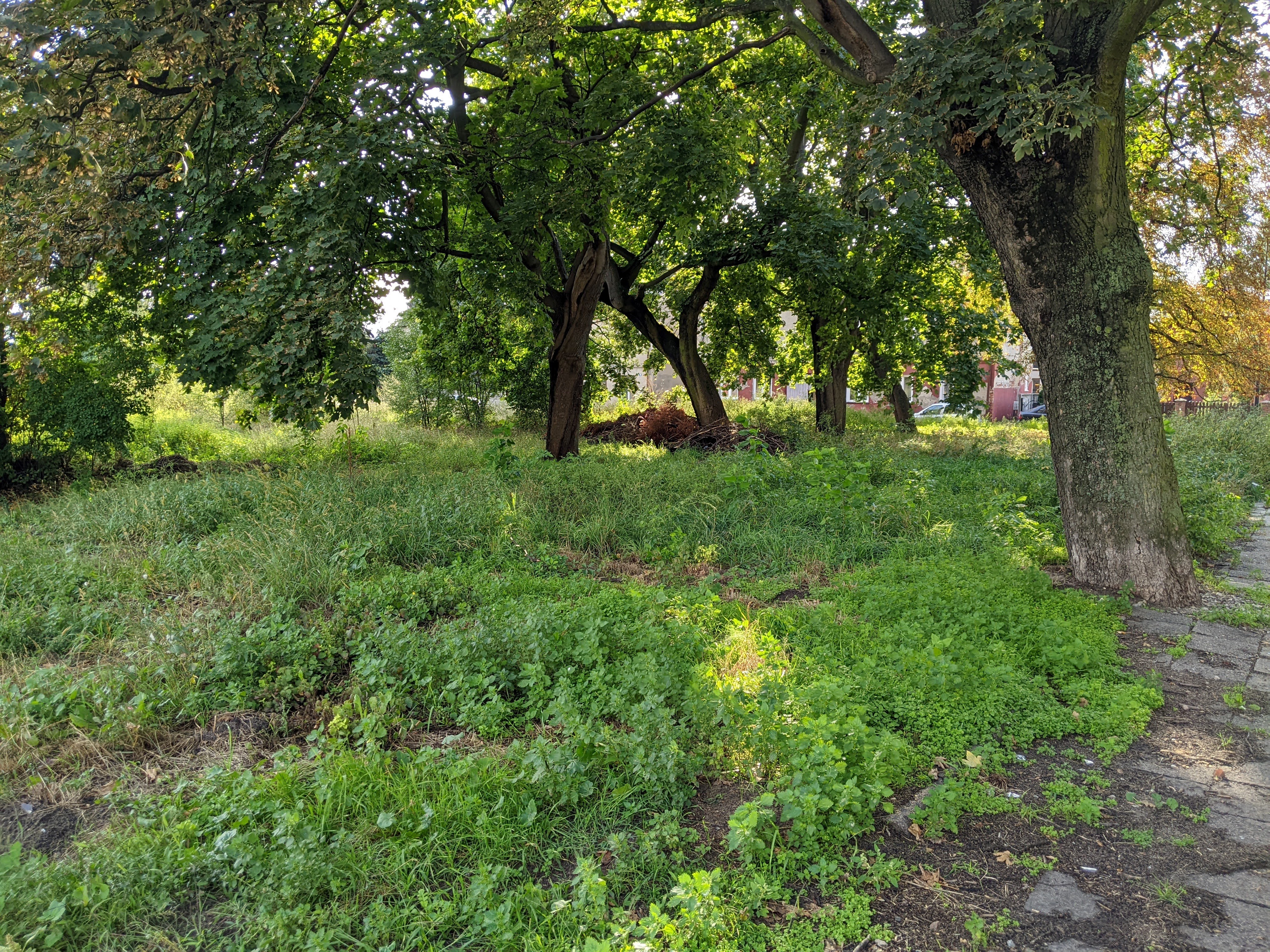
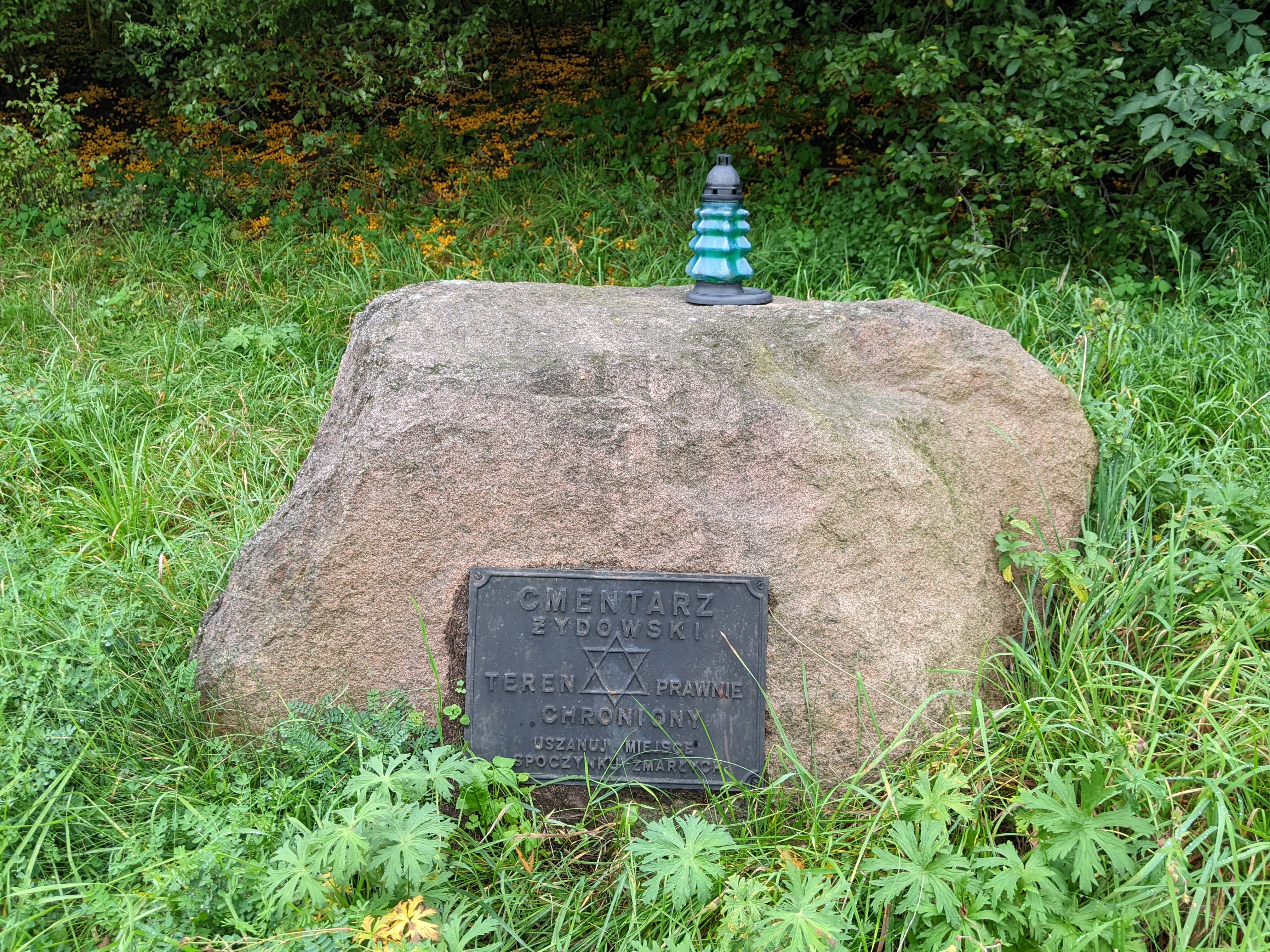
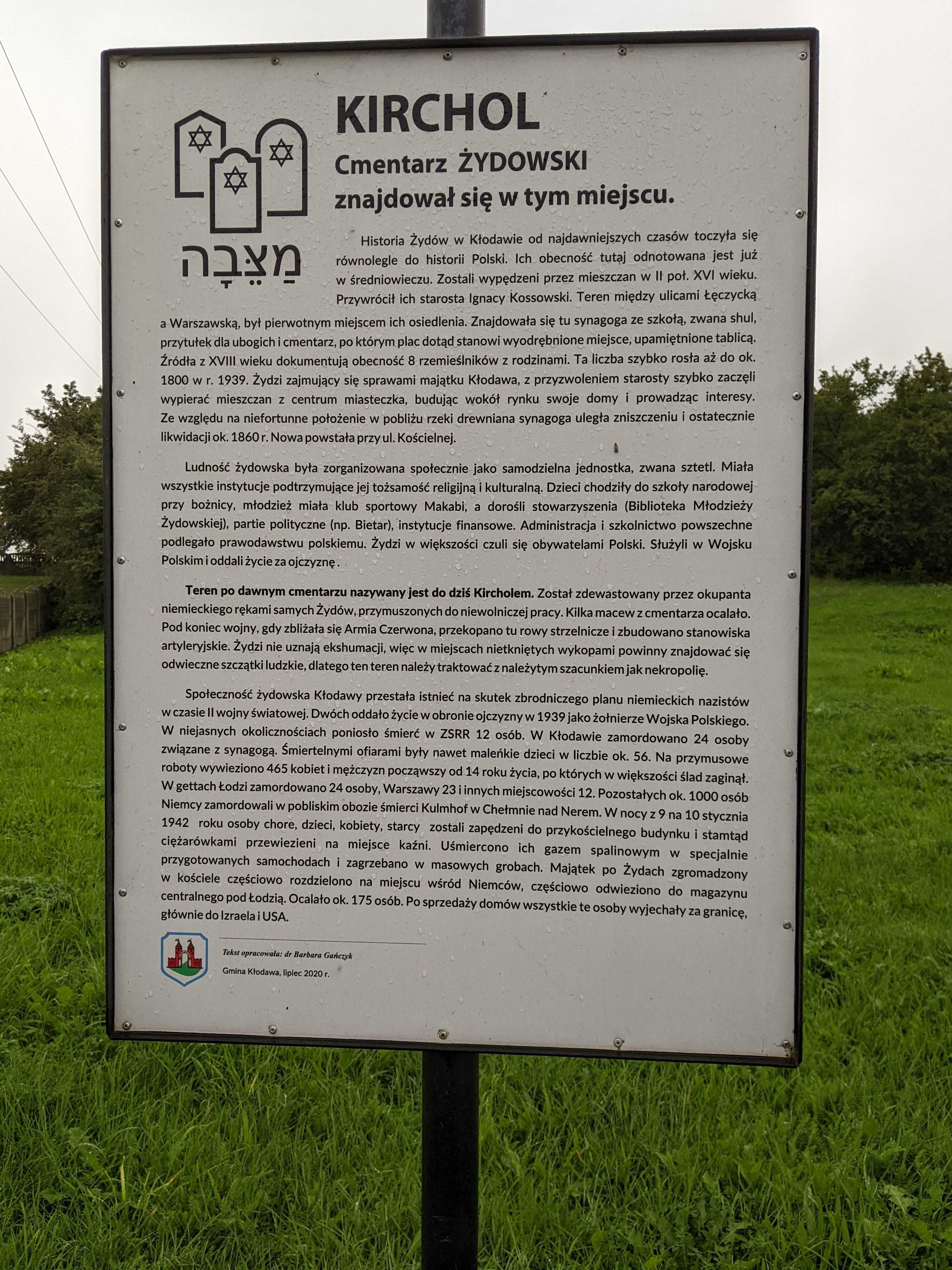
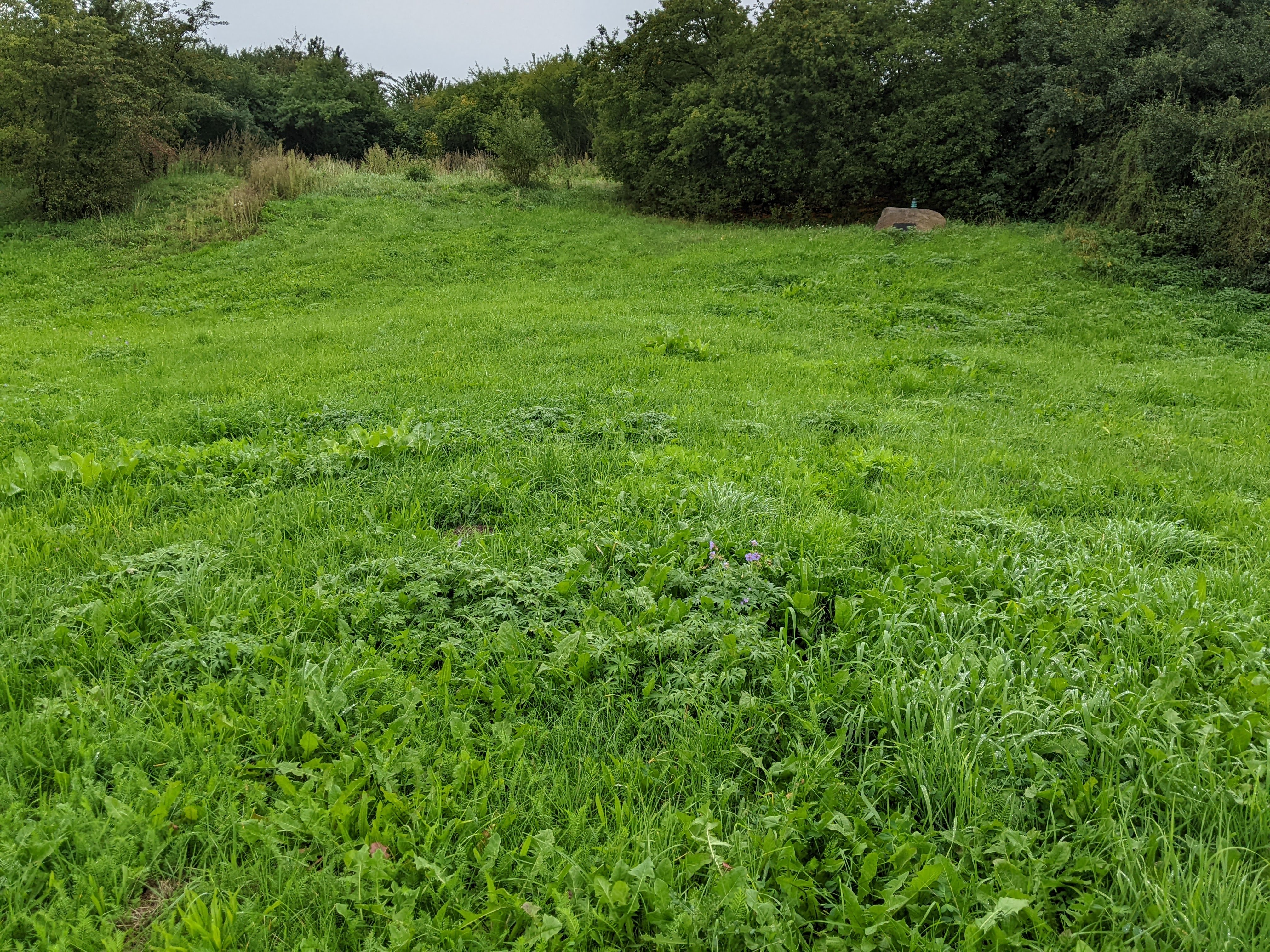
The cemetery is mostly covered by calf-high grass and wildflowers, with small trees toward the back of the plot. Bachna pointed to a building on the other side of the concrete fence along the left-hand border of the cemetery, which she believes was the mortuary house where bodies were prepared for burial. A sign at the edge of the road labels the site “kirchol,” a regional term for a Jewish cemetery, and outlines the history of the town’s Jewish population. Further back, around the place where the land slopes upward, stands a boulder with a plaque saying (in Polish):
Jewish Cemetery
Site is legally protected
Respect this place of rest for the dead
Bachna believes Germans moved the earth from the front part of the cemetery and created the hill at the back as part of their munitions activities.
Plaque identifies this as a Jewish cemeteryHistory of the cemeteryPossible mortuary house on neighboring propertyThe cemetery slopes upwardKłodawa Jewish Cemetery
City landowners forced Jewish residents to leave Kłodawa in the second half of the 16th century, but they were invited back in the 18th century and remained until the Shoah. At that point, they built their synagogue, school, and other institutions closer to the contemporary center of town.
In the center of town, we visited the church where Jews were imprisoned on the night of January 9-10, 1942 a nd then transported to the death camp at Chełmno. An informational sign outlining “the last moments of the the Jewish community in Kłodawa” was mounted here in 2021.
The church where Jews were imprisoned before being sent to the Chełmno death camp in January 1942History of the last days of Kłodawa’s Jews, located near the church
We walked by the site of the synagogue, where the Community Center now stands. Bachna said that curve-topped archways across the front façade were designed to evoke the former synagogue. In front of the building, another informational sign dating from 2020 outlines the history of the synagogue.
Roberta, Bachna, and Yosef in front of the Community Center designed to evoke the former synagogueHistory of the synagogue
Bachna will be a strong ally for ADJCP members with ancestors from Kłodawa. She has studied and written about the town’s Jewish history for decades and has amassed a great deal of knowledge. She is eager to collaborate with Jewish descendants and with our group.
Report #5 about Roberta Books and Marysia Galbraith’s trip to meet Polish partners in preparation for the ADJCP‘s memorial visit to central Poland. Reports include contributions by Roberta.
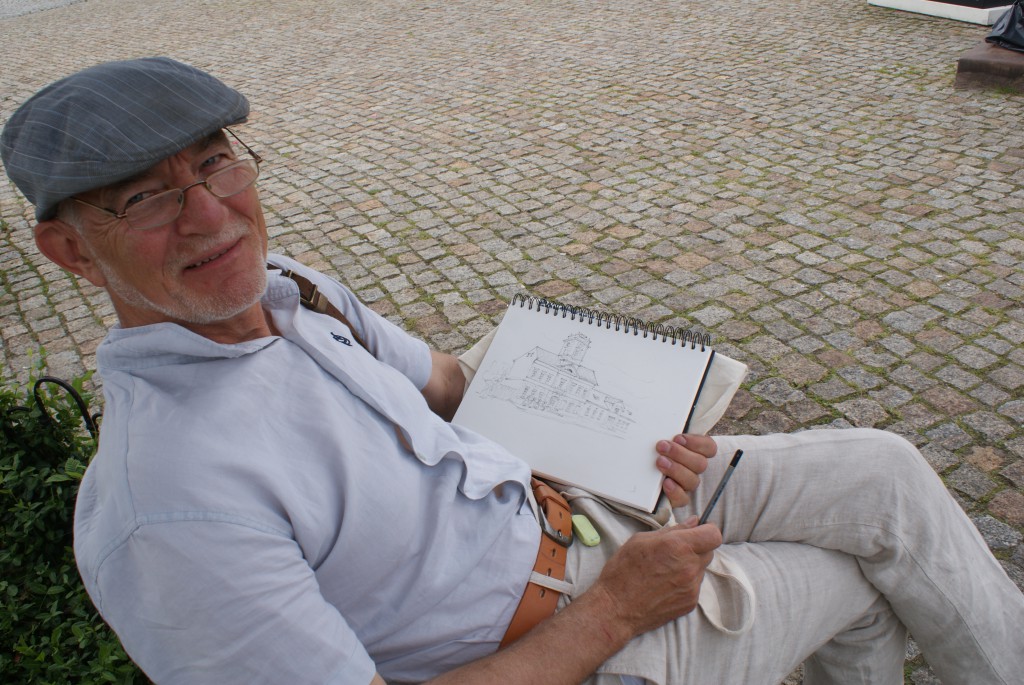
We met Grzegorz Stęplewski on September 9 at the Kutno Community Center so we could talk about what remains from the Jewish community of Dąbrowice. Grzegorz lives in Kutno and is a member of TPŻK (Friends of the Kutno Region), but he grew up in Dąbrowice, a village of about 1,300 residents nearby. Grzegorz likes to paint and sketch; he imagines scenes as they would have looked based on historical records and the current configuration of streets, for example reinserting the synagogue next to his childhood home.
The next day, Grzegorz met us at the Krośniewice cemetery and we followed him to nearby Dąbrowice, just 9 km away. We parked outside his family home, a one-story house with a small covered wooden porch in front, which he continues to own. The house is on a small plaza called the “Nowy Rynek” that functions as green space with grass, pollarded trees and a green-painted kiosk. This rainy Saturday afternoon, the kiosk was closed and no one was on the streets.
Dąbrowice Rynek viewed from Grzegorz’s house
We climbed the rough wood steps and sat out of the rain on a single bench perpendicular to the front door. Grzegorz showed us hand-drawn street plans dated 1959 with his family property facing the plaza and the synagogue plot next to it on Sienkiewicza Street.
1959 map shows lot #4, the former site of the synagogue (labelled gmina żydowska, Jewish community)
The synagogue was destroyed during the war. Some years later, Grzegorz’s father added the synagogue plot to the back garden of his house. He has what is called a dzierzawa wieczysta, a perpetual lease; in effect, he doesn’t own the land but can use it indefinitely. It currently sits behind a stone wall, though we could see into the yard from the neighbor’s driveway gate. Based on the size of the lot and the space Grzegorz paced out for us, the synagogue was not large.
Inside Grzegorz’s gardenGrzegorz shows the approximate length of the former synagogue
We continued on a roundabout route to the site of the cemetery. Gzegorz pointed out where the center of town was visible across agricultural fields, and explained the old, unpaved road takes a more direct route but it’s only suitable for farm vehicles. The cemetery plot stands forlorn, an overgrown thicket surrounded by plowed fields. Getting to it would require walking across those fields. It’s unlikely that any grave markers remain under the shrubs and small trees. Grzegorz said that at minimum, there should be a sign at the side of the road indicating the location of the Jewish cemetery.
Across an agricultural field, the Dąbrowice Jewish cemetery is an island of brush and trees
That was the extent of what remains of the Jewish community of Dąbrowice.






























 Uncovering Jewish Heritage