• About
  • The Photo that Started it All

Uncovering Jewish Heritage

Uncovering Jewish Heritage

Tag Archives: Maria Bereda(y) Galbraith

Hair

13 Sunday Sep 2015

Posted by Marysia Galbraith in Family, Identity

≈ Leave a comment

Tags

categories, Halina Piwko Bereda, Maria Bereda(y) Galbraith, stereotypes

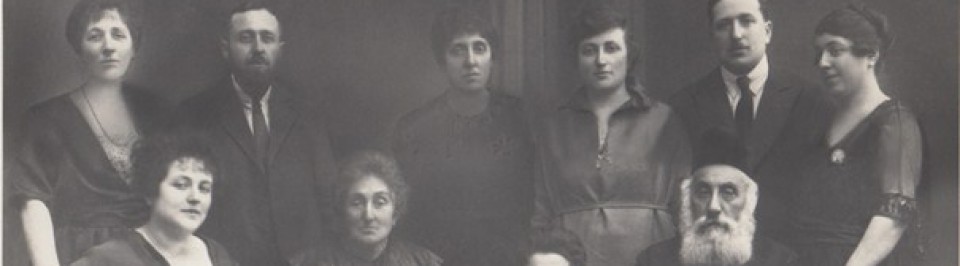
1st generation I have photos of: my great-granmother Hinda (Walfisz) Piwko with an impressive mass of hair.

1st generation I have photos of: my great-granmother Hinda (Walfisz) Piwko with an impressive mass of hair.

The women in my family have thick, wavy hair. My great-grandmother Hinda and her daughters all had it (see the photo at the head of this blog). In fact, in Aunt Pat’s notes (probably dictated from a conversation with Auntie Nunia), Sarah was identified by her “beautiful hair,” and Rachel by her “thick, thick hair.” When I was a child, Babcia and Auntie Nunia wore their long silver locks in buns piled high on their heads; I now know from photos that their sisters Liba, Sarah, and Rachel did the same.

I remember watching as Babcia let down her hair at night, and brushed it until it formed an undulating frame around her that extended past her waist. Then she plaited it into two braids. During the day, she wound the braids around her head and held them in place with pins and a hair net.

2nd generation: Babcia wound two braids high on her head and held them in place with pins and a hair net.

2nd generation: Babcia wound two braids high on her head and held them in place with pins and a hair net.

I can’t remember exactly when this was. Could it have been in Puerto Rico when I was five? That seems too early, but I think I was still a child. She kept her hair long until it got too difficult for her to lift her arms and pin it back. Cut short, her hair made a curly silver halo around her face.

My mama inherited this wavy hair, only she wore it differently. She favored a blunt cut to the shoulders, with long straight bangs across her forehead. The bangs were styled to cover the the uneven discolored surface that grew back after the skin of her forehead was removed to use in the reconstruction of her nose. While she couldn’t hide the imperfect nose left by numerous failed surgeries, she could use her hair to hide the scars on her forehead. But it was a struggle. Left to itself, her hair curled in different directions. What she longed for was an even, thick curtain that would lie flat across the terrain she sought to conceal.
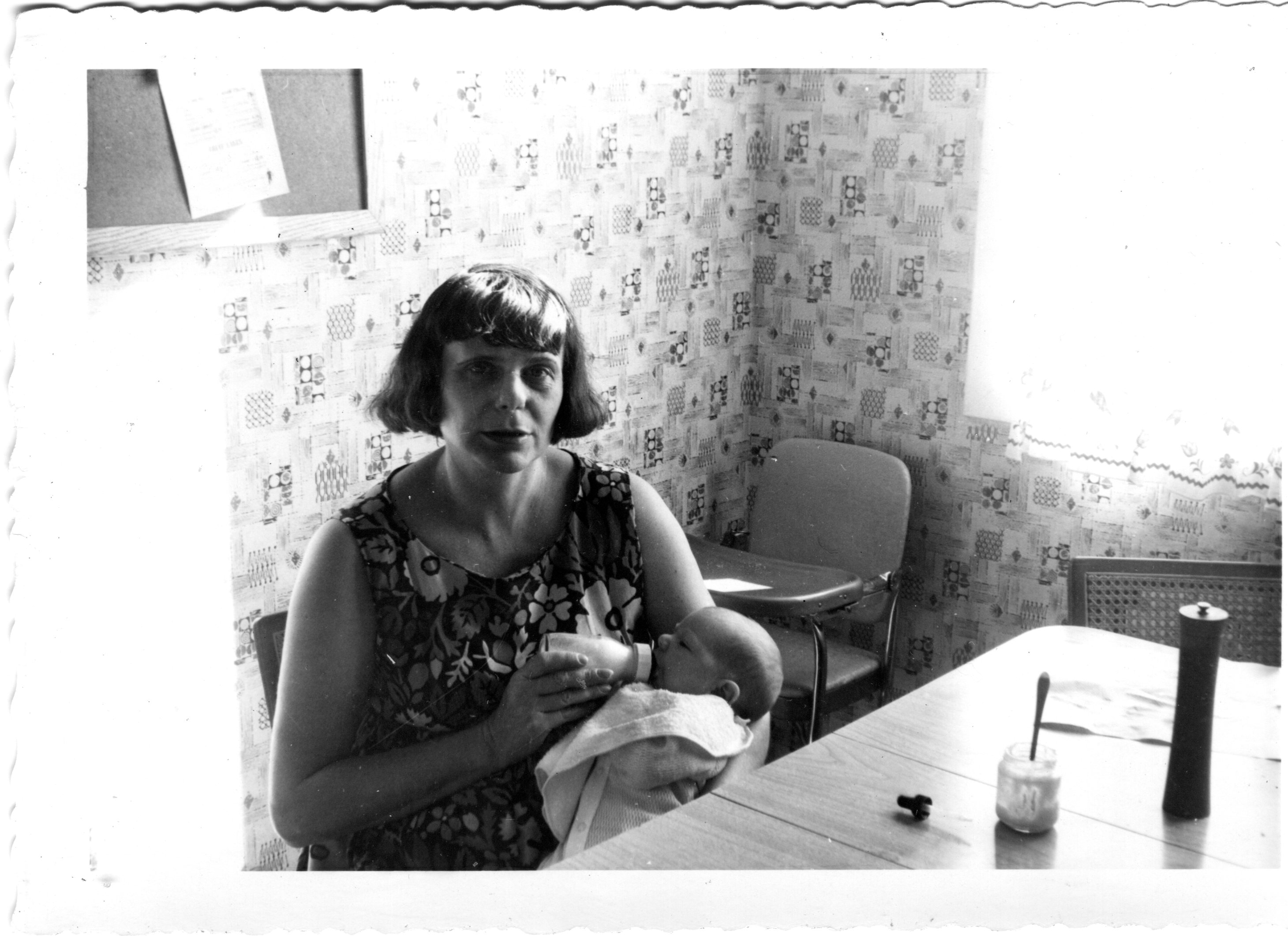
3rd generation: Mama with her unruly bangs around 1965 feeding my brother Chris

3rd generation: Mama with her unruly bangs around 1965 feeding my brother Chris

Over the years, she developed a technique where she would tie a scarf around her wet head so the bangs would dry in place. She joked it made her look like an Indian. The struggle didn’t end there. To protect against the wind exposing her scars, she held her bangs in place with hats—when I was younger she favored berets, an exotic but elegant choice that stood out in suburban Long Island.

Even as she battled her wayward locks, I admired Mama’s soft waves. I liked to stroke her head, and wished my light stringy hair were more like hers. Luckily, when I grew older, my hair became darker, and along with it, thicker and more curly. On a good day, I might have waves like Veronica Lake, or even sometimes ringlets.

4th generation: my curls

4th generation: my curls

I’ve almost always worn my own hair long. Only once, right after my brother Ron died, I cut it short. So short I looked like a boy. Perhaps it was an act of mourning. Definitely, I was motivated by the desire for a radical change. I was just a few months away from beginning my dissertation fieldwork in Poland. Short hair was liberating. It dried almost instantly, and didn’t even need combing. When it grew just a bit longer, it curled around my face much as my grandmother’s had. But still, I didn’t like it and have never cut it short again.

When I first started looking into my Jewish heritage, I told a good friend about what I was learning. Before then, he hadn’t known; it wasn’t something I had talked about with anyone, really. At some point in the conversation, he remarked that I have Jewish hair. Surprised, I asked what he means. He described my hair as wavy (though he might even have said frizzy) and coarse. This unsettled me. I have often returned to this moment, and tried to understand why. Perhaps it’s as simple as hearing something I love about myself described negatively (who wants to have coarse hair?) But it’s more than that. I like my freckles, too, and when people have encouraged me to try to hide them I’ve only been amused. So maybe my uneasiness has something to do with being stereotyped, or maybe even with stereotypes in general.

Nevertheless, this idea of Jewish hair has continued to bother me. I spent a lot of time on the trams in Poland inspecting everyone’s hair. Sure enough, it seems that most Poles have straight, thin hair. So could there be something to this idea that my curls mark me as Jewish? I hate this kind of categorical thinking, though. This is probably the key thing; it may well be that most Poles have straight hair, but many have curly hair, too. Furthermore, maybe my waves come from my Dad’s side of the family. Scots can have wavy hair, as well. In fact, lots of people from many different backgrounds have hair like mine. Genetic inheritance is not as simple as “Jewish hair” suggests.

I hesitate to even write about this because it has the potential to just perpetuate the kind of categorical thinking I want to argue against. I mentioned my hair in a talk I gave at a conference in Poland, and I feel it backfired. Afterwards a couple of people talked to me about “Jewish hair,” trying it out as a new physical trait to assign to a category of people. It left me feeling uneasy.

I’m still trying to sort this all out. I love my hair, and I love that I share it with a long line of women, from my mother to her mother to her mother. I feel richer knowing that I have Jewish roots. But I have a problem with stereotypes, and the lazy way designations like “Jewish hair” can be used to make traits that may well be common in a population into essentialized markers.

So standing in solidarity with all the straight-haired Jews, curly-haired Poles, and everyone else who does and doesn’t fit ethnic stereotypes, I wish you a Happy New Year. May the coming year bring health, happiness, and better understanding regardless of our similarities and differences.

How Catholic were they?

26 Sunday Apr 2015

Posted by Marysia Galbraith in Catholicism, Family

≈ 4 Comments

Tags

Halina Bereday, Maria Bereda(y) Galbraith

I always thought of my babcia as very religious. On her wall, she kept Jesus on the cross and a Madonna in a gilded frame. Her expressions of faith tended toward the mystical. She believed in miracles and blessings. She prayed on the rosary. She blessed my friend Kara’s baby daughter the first time she held her. She must have been about 90 then.

A bad photo, but one of the few I have of Babcia's apartment on Riverside Drive, showing her Madonna in a gilded frame.

A bad photo, but one of the few I have of Babcia’s apartment on Riverside Drive, showing her Madonna in a gilded frame.

And yet, she never took me to a church service. I wonder if any of my brothers or cousins remember going to church with her?

My mother used to say Babcia was “more Catholic than the Pope.” I don’t think mom appreciated such public expressions of faith. Sometime after 1985, Babcia moved to an assisted living facility in Flushing. It had mostly Jewish residents including many Holocaust survivors. It may have even been run by a Jewish service organization. I’m pretty sure one of our Jewish relatives helped her get a place there, though of course at the time no one told me anything about that. Babcia did not like living there. Doubtless, much of it had to do with her declining health that made it impossible to stay independent in her old apartment, but she also seemed disdainful of the other residents. She flaunted her Catholicism and rebuffed their attempts to befriend her. I don’t think the managers cared much for Babcia, either. When her health declined to the point she couldn’t take care of herself, they said they have no place for her in their more advanced care facilities. She moved for the last time to a nursing home back in Manhattan, around the corner from St. John the Devine Cathedral. Babcia spent most of her life denying her Jewish heritage. I suspect it was too uncomfortable for her to be surrounded by Jews in a Jewish-identified institution.

When my mom talked about her Catholic faith, she essentially did so in the past tense. She was very devout as a child, and wanted to become a nun. When she was fifteen, she went to a boarding school in Belgium run by nuns. One story she told me about living there was that her mother sent her a box of chocolates. She gave them all away, believing that kind of self-sacrifice was an expression of her faith. Then, that night she cried herself to sleep because she wanted one so bad.

Mama liked to sit in churches, but she didn’t go to services. Or if she did go, she didn’t take communion. She said it’s because she doesn’t go to confession. When I asked her why not, she said everything she experienced during and after the war made her grow distant from the church. Mama’s temple was our backyard. She called herself a pantheist, and said that when she wants to pray she just goes outside and meditates. Her mantra was “ocean.” For as long as she could, mama had a chair she would move around the yard depending on the sun and which flowers were in bloom. Thanks to Krystyna, she still gets out into her garden most days.

Mama in the garden

Mama in the garden

My brothers and I weren’t even baptized. Mama said it was because my dad didn’t want Catholic kids, and she didn’t stand up to him. Rather, she wanted to let us make our own decision about religion when we grew up. Was this odd? At the time I didn’t think so. My dad was an atheist. He had the mind of a scientist and just couldn’t take the leap of faith that, well, faith requires. Later in life, he tried. Maybe it was because his best friend Max became a believer. He read Thomas Merton, and even bought me one of his books. But he simply couldn’t overcome his skepticism. Instead, after retiring, he studied philosophy. My son seems to have inherited this skepticism; at the age of seven he decided God does not exist; he hasn’t changed his mind yet.

I still wonder, though, what could have turned Mama away from the church. Maybe witnessing the destruction of war made her question the existence of God. At least the Christian God, because she remained deeply attuned to God in nature. I think she said it had something to do with her injuries, the long series of failed surgeries, the scars they left behind, and then the final straw, getting tuberculosis and losing a year of her life at a TB hospital in Denver. I also wonder if it had something to do with her Jewish heritage and her failed love affair with a priest. But I’ll leave that story for another post.

Maria Bereda(y) Galbraith, scars and all

07 Sunday Dec 2014

Posted by Marysia Galbraith in Family

≈ Leave a comment

Tags

Maria Bereda(y) Galbraith, scars

My friend Justyna wrote, “It just occurred to me: would you trust me enough to show me a picture of your mom? I’ve heard and read so much about her that now I just wonder what she looked like during the war and before and after. It just came to me (the desire to see her) strongly today.” She’s right, of course. I write this blog with a picture of my mom in my head so it makes sense to post some photos of her.

Mama in Poland

Mama in Poland

I only have one photo of Mama from Poland. It’s a tiny headshot, perhaps for some form of identification? I would guess she’s somewhere around 20, so it was taken sometime during World War II. I found it among the papers my brother kept when he cleaned out the house in preparation for the renovation. I submitted this photo, along with my mom’s verification papers confirming her service in the Polish Underground, to the Warsaw Rising Museum. It’s posted in their virtual archive of partisan’s biographies:

http://www.1944.pl/historia/powstancze-biogramy/Maria_Bereda__Fijalkowska

Though washed out and unfocused, the photo shows my mom’s remarkable eyes—deep set and sad—and her thick, wavy hair. As a kid, I loved the way her soft curls felt, and wished my thin stringy hair was more like hers. Luckily, as an adult, my hair became wavy, though never as soft. What strikes me about this photo today is how much my brother Wiley resembled her when he was around the same age.

Mama on the roof of Whittier Hall

Mama on the roof of Whittier Hall

This next photo is one of several taken in the 1950s on the roof of Whittier Hall, the dorm my mother lived in when she was a graduate student at Teacher’s College, Columbia University. My mom showed me these when I was child. She was very proud of her figure, and liked these photos because they were taken from far enough away that her scars didn’t show. These are the kinds of things my mom told me.

Mom says she arrived in the US with a bandage on her nose. I don’t know if she had 22 surgeries like my brother remembers, but there were many of them, first to reconstruct damage sustained in the war, and then to fix up botched surgeries. Surgeons took skin grafts from her forehead so the skin on her new nose would match her face. This is why she always kept her bangs long and blunt down to her eyebrows—to cover the scars left on her forehead. Even after the surgeries stopped, she continued to wear a bandage because she was afraid of what people would think of her scars. She proudly explained how artfully she crafted a small bandage that just covered the bridge of her nose. My dad never saw her without it before they married. When she finally dared show her face without the bandage, Dad told her he was relieved; he thought her scars would be far worse. You would think it would be a powerful message to my mom that maybe she didn’t need to be so self-conscious, that maybe her scars weren’t as bad as she pictured them in her own mind. Even years later, she seemed to wonder at the fact Dad married her with a bandage on her nose. I think it’s a tribute to his character.

But it’s also a tribute to something that was very special about her. While at Whittier Hall, she never lacked for dates. Her friends were even jealous that she, a woman with a bandage on her nose (this is my mom speaking), would get more attention than they did from handsome men. One was Hale, Dad’s roommate whom she only dated once. She said he looked “like a Greek god,” but there was no chemistry between them. Dad, by contrast, was also good looking but in a more normal way, and very shy. When he started coming by Whittier Hall, Mom’s dorm-mates were envious that she was going on dates with a man who drove a jaguar.

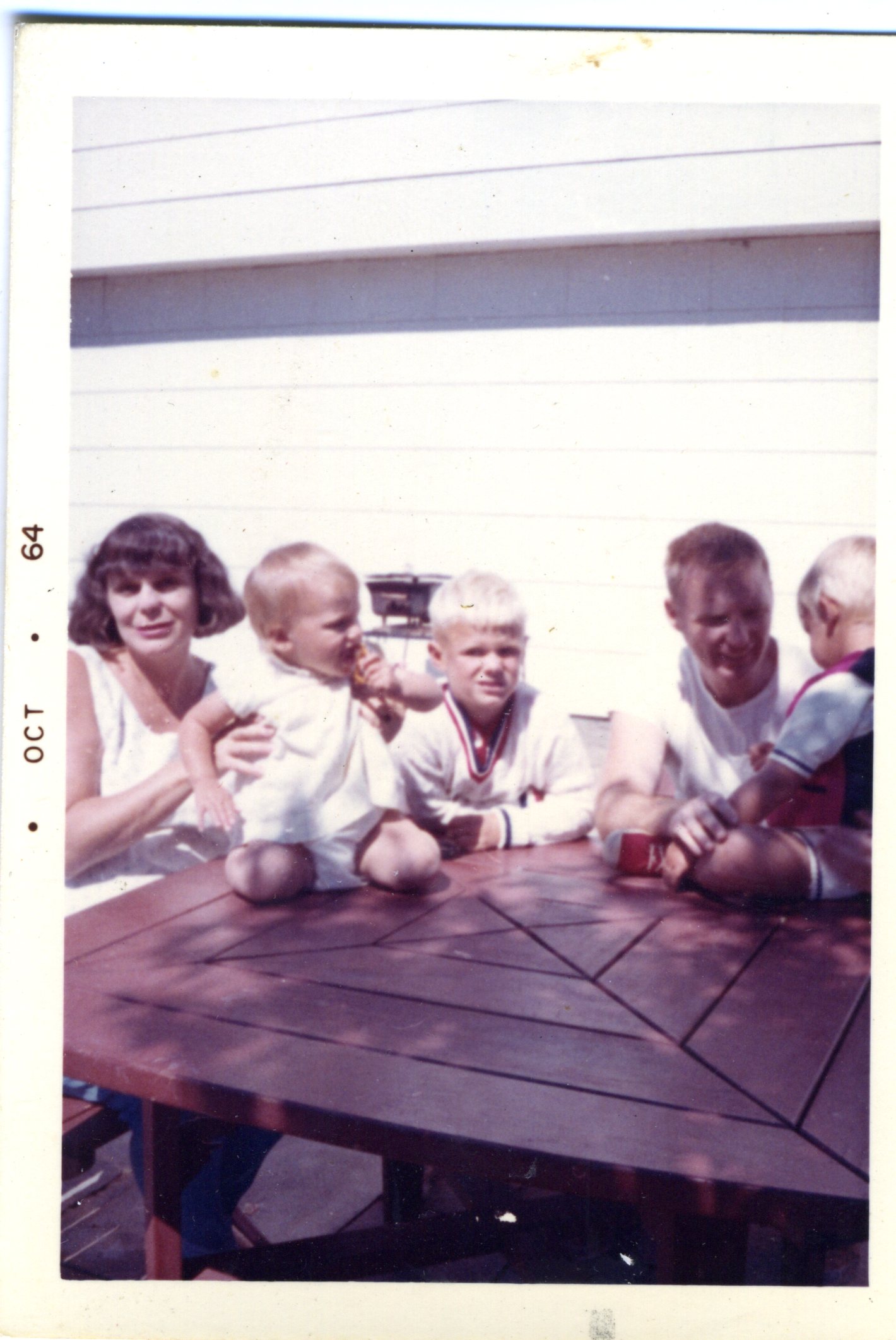
Galbraiths1964

The Galbraiths on the patio behind the house, summer 1964.

Mom and Dad had a volatile relationship. Neither was very happy and they fought a lot. In this photo from the summer of 1964, Mama is pregnant with Chris. She is holding me, with Ron beside us and Wilan by Dad. I was about one year old, Wy was two and a half, and Ron was six. After the four kids left the house, my parents rediscovered common interests and actually got along much better. I would like to have posted a photo of them together later in life, but I don’t have a digital copy with me.

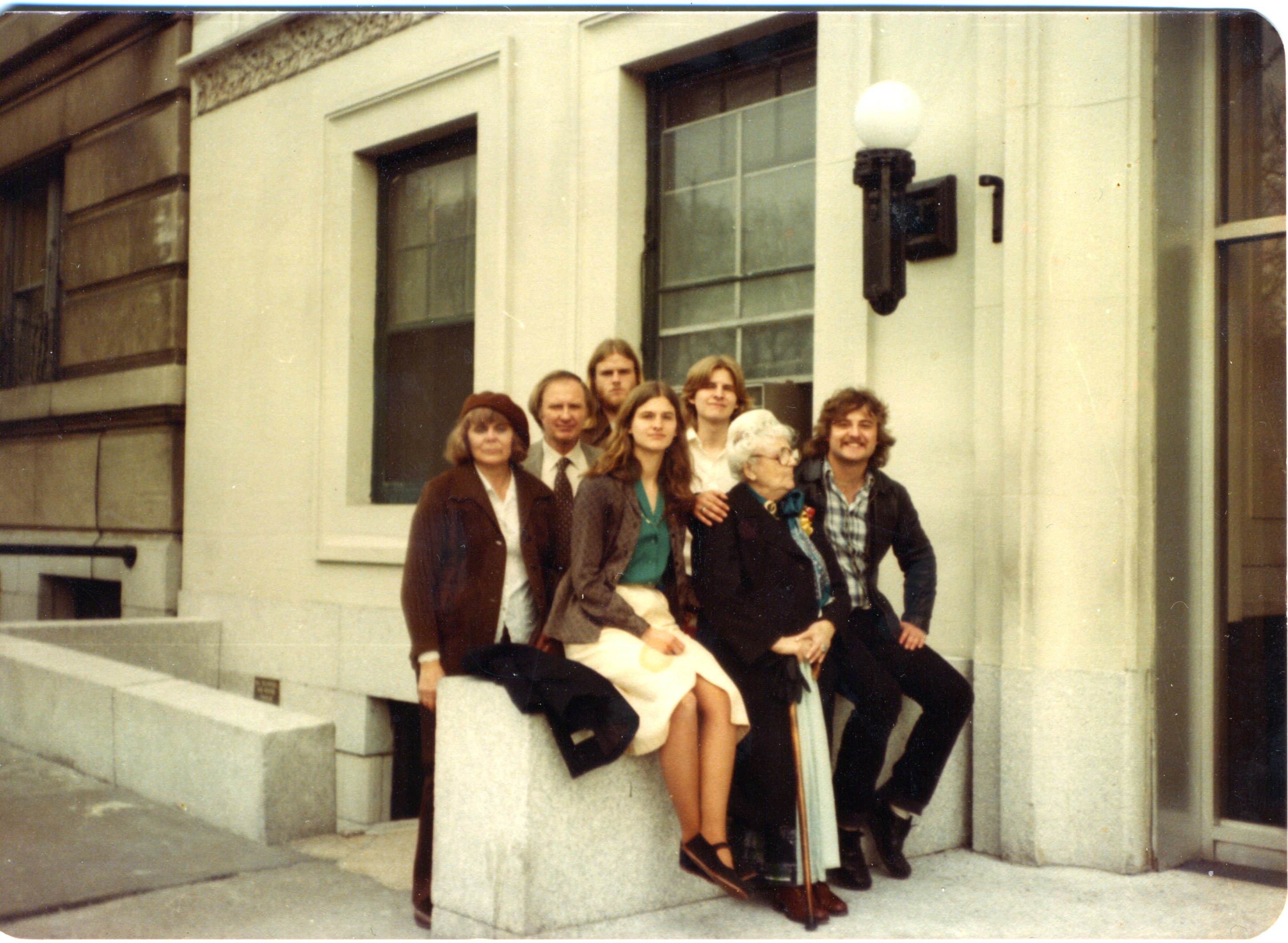
The Galbraiths with Babcia outside Babcia's apartment on Riverside Drive sometime in the early 1980s, Mama in her beret.

The Galbraiths with Babcia outside Babcia’s apartment on Riverside Drive sometime in the early 1980s, Mama in her beret.

Mom struggled with her waves. She would wear a scarf like a headband after washing her hair so that her bangs would dry straight. She put on a beret when she went out to hold her bangs in place against the wind. I became her mirror. It was my job to make sure her bangs were in place at all times. She’s beyond caring now, but I still do it automatically. Her hair is thinner now, brilliant white, but still soft and wavy. I love to stroke it, and I always adjust her bangs.

In more recently years, Mama switched from berets to brimmed hats. Here we are at Friendlies in 2007. She loves ice cream, especially chocolate.

In more recently years, Mama switched from berets to brimmed hats. Here we are at Friendly’s in 2007. She loves ice cream, especially chocolate.

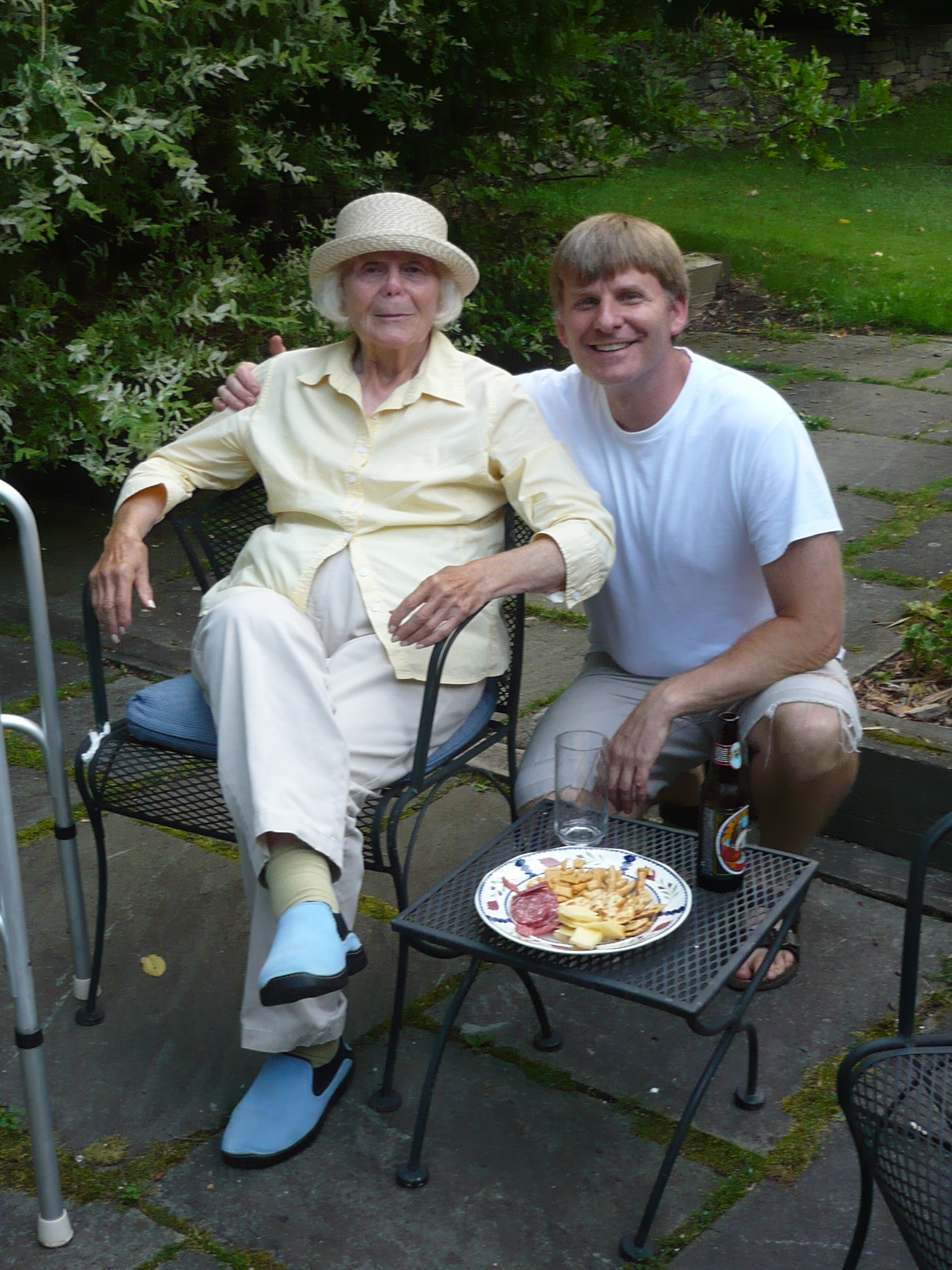
Mama and Chris on the patio, 2008. Mama was already sick but still able to communicate with us.

Mama and Chris on the patio, 2008. Mama was already sick but still able to communicate with us.

Newer posts →

Categories

  • Anthropology (37)
    • Archives (14)
    • Fieldwork (7)
    • Ground Penetrating Radar (GPR (4)
    • Research Methodology (8)
  • antisemitism (14)
  • Association of Descendants of Jewish Central Poland (32)
  • Catholicism (8)
  • Conference (1)
  • Discrimination (2)
  • Family (69)
    • Bereda (17)
    • Kolski (13)
    • Piwko (22)
    • Rotblit (3)
    • Walfisz (4)
    • Winawer (7)
  • Genealogy (11)
  • Heritage work (66)
    • Commemoration (23)
  • Identity (18)
  • Israel (6)
  • Jewish Culture (89)
    • Cemeteries (51)
    • Museum (7)
    • Synagogues (33)
  • Jewish immigrants (8)
  • Jewish Religion (1)
  • Memory (70)
  • Names (14)
  • Photographs (6)
  • Pifko-Winawer Circle (5)
  • Poland (125)
    • Baligród (1)
    • Bolimów (1)
    • Brześć Kujawski (5)
    • Buk (1)
    • Chodecz (1)
    • Dukla (2)
    • Dąbrowice (1)
    • Gdynia (1)
    • Gostynin (2)
    • Gąbin (1)
    • Izbica Kujawska (1)
    • Kazimierz (4)
    • Kowal (1)
    • Koło (1)
    • Krakow (7)
    • Krośniewice (1)
    • Kutno (6)
    • Kłodawa (1)
    • Lesko (8)
    • Leszno (1)
    • Lubień Kujawski (1)
    • Lubraniec (1)
    • Lutowiska (3)
    • Piła (3)
    • Podgórze (2)
    • Poznan (11)
    • Przemyśl (2)
    • Pzedecz (1)
    • Radom (1)
    • Radymno (1)
    • Sanok (1)
    • Skierniewice (5)
    • Sobota (2)
    • Tarnów (2)
    • Warsaw (22)
    • Wielkopolska (1)
    • Wronki (7)
    • Włocławek (20)
    • Zasław (2)
    • Łódź (1)
    • Żychlin (30)
  • Polish Culture (10)
  • Polish-Jewish Heritage (60)
  • Polish-Jewish relations (60)
  • Post-World War II (24)
  • Pre-World War II (22)
  • Reclaimed Property (1)
  • stereotypes (3)
  • Survival (9)
  • Trauma (3)
  • Uncategorized (5)
  • Victims and perpetrators (4)
  • World War II (45)
    • Jewish Ghetto (12)
    • Nazi Camps (5)
    • Polish Underground Army (3)
  • Yiddish (5)

Enter your email address to follow this blog and receive notifications of new posts by email. Your email address will not be shared.

Archives

  • October 2025 (1)
  • July 2025 (8)
  • June 2025 (1)
  • April 2025 (1)
  • August 2024 (3)
  • July 2024 (3)
  • May 2024 (2)
  • April 2024 (1)
  • May 2023 (2)
  • January 2023 (2)
  • December 2022 (7)
  • November 2022 (2)
  • October 2022 (5)
  • September 2022 (1)
  • January 2022 (1)
  • August 2021 (1)
  • December 2020 (2)
  • July 2020 (1)
  • May 2020 (3)
  • April 2020 (1)
  • March 2020 (1)
  • January 2020 (2)
  • May 2019 (1)
  • February 2019 (1)
  • November 2018 (1)
  • September 2018 (1)
  • August 2018 (3)
  • July 2018 (1)
  • June 2018 (1)
  • May 2018 (1)
  • April 2018 (2)
  • March 2018 (2)
  • February 2018 (2)
  • January 2018 (2)
  • December 2017 (2)
  • November 2017 (2)
  • October 2017 (1)
  • September 2017 (3)
  • August 2017 (3)
  • June 2017 (2)
  • May 2017 (3)
  • April 2017 (1)
  • March 2017 (2)
  • February 2017 (1)
  • January 2017 (2)
  • December 2016 (2)
  • November 2016 (4)
  • October 2016 (1)
  • September 2016 (6)
  • August 2016 (2)
  • July 2016 (1)
  • May 2016 (4)
  • April 2016 (2)
  • March 2016 (3)
  • February 2016 (4)
  • January 2016 (3)
  • December 2015 (3)
  • November 2015 (5)
  • October 2015 (5)
  • September 2015 (3)
  • August 2015 (4)
  • July 2015 (3)
  • June 2015 (3)
  • May 2015 (4)
  • April 2015 (9)
  • March 2015 (3)
  • February 2015 (2)
  • January 2015 (5)
  • December 2014 (4)
  • November 2014 (9)
  • October 2014 (2)
  • September 2014 (1)

Copyright Notice

All original text and images are copyright © Marysia Galbraith. Please contact the author before quoting.

Blog at WordPress.com.

  • Subscribe Subscribed
    • Uncovering Jewish Heritage
    • Join 145 other subscribers
    • Already have a WordPress.com account? Log in now.
    • Uncovering Jewish Heritage
    • Subscribe Subscribed
    • Sign up
    • Log in
    • Report this content
    • View site in Reader
    • Manage subscriptions
    • Collapse this bar
 

Loading Comments...