
Subscribe to continue reading
Subscribe to get access to the rest of this post and other subscriber-only content.
19 Friday May 2023
Posted in Association of Descendants of Jewish Central Poland, Commemoration, Memory, Poland, Polish-Jewish Heritage, Polish-Jewish relations, Włocławek
≈ Comments Off on We’re From Here/Jesteśmy stąd: ADJCP memorial tour
Subscribe to get access to the rest of this post and other subscriber-only content.
02 Friday Dec 2022
Włocławek, September 12-16 and September 28
With a population of 107,000, Włocławek is the largest town in this part of central Poland, followed by Kutno which has 42,700 residents.
Włocławek will be the home base for the ADJCP memorial trip in May 2023. Roberta and I spent several days there to plan the trip and I returned a couple of weeks later to follow up on a few things. We reserved a block of rooms for the memorial trip in the Pałac Bursztynowy, a three-star hotel built to look like an old manor house, with an elaborate formal garden all around it. Roberta and I sampled the menu at the hotel restaurant. They have a good assortment of soups, salads, appetizers, and main courses, all tastefully prepared. The white asparagus soup with smoked salmon was particularly tasty. We also made arrangements with a bus company that will provide transportation during the memorial trip.

In Włocławek, we met with partners who agreed to help organize activities for us. Included among our partners are schoolteachers Anita Kaniewska-Kwiatkowska who teaches history at the Automotive High School, Robert Feter who teaches computer science at the same school, and Monika Lamka-Czerwińska who teaches at a school for children with disabilities. They have led several award-winning programs in which their students learned about and did research about the city’s Jewish community. See for example Włocławek Zapomniana Ulica, a Facebook page that was developed as part of one of these projects. Another outcome of this project is a sign posted on Piwna Street with a QR code linking to a recorded message outlining the wartime history of the Jewish population in this place.

On the morning of September 13, Roberta and I met students at the Automotive High School. We were escorted to the library, a room the size of a large classroom. Extra chairs filled all the space between the round tables. A reporter from the local paper came and took photos. Two students shot video for a class in television production with the plan to create a short program about our visit.
Students filed in one class at a time. In attendance were students studying psychology/pedagogy, computer science, and technical studies. This school also has classes for students with physical and mental disabilities.
Before we began, I spoke briefly with the first group that arrived, girls studying psychology and pedagogy. Their teacher Anita Kaniewska explained they will work with her on a project about Jewish history and culture and they will participate in our memorial trip. The room filled up. Over 80 students attended. We delivered our presentation in English and I’m surprised how well it went. A good number of the students understood, and those who didn’t know much English seemed attentive nevertheless.
Roberta and I took turns explaining our family connection to central Poland. Then we asked them what they knew about Jewish culture and religion, mostly as a way to fill in some details and point out similarities and differences to Polish culture and Christian faith. Finally, we invited them to ask us questions, which we answered. Their questions included:
Afterwards, one of the teachers said she was very pleased with the students’ level of engagement. Even one of their students who has autism asked a question. Five girls from Anita’s class thanked us and told us how moved they were by our stories and our presence. They asked if they could give us a hug. It was very sweet.
Photos from our visit were posted on the school website.
We had to hurry to our appointment with the mayor. Anita accompanied us. Marek Wojtkowski, whose official title is President of Wloclawek, expressed support for the ADJCP and efforts to memorialize the city’s Jewish history. He agreed to meet memorial trip participants and to welcome us to Włocławek.
Together with Anita, we proposed two projects: a Jewish history trail with signs and QR codes outlining events that occurred in particular places around the city; and a portable exhibition on retractable panels that can be moved and set up easily. President Wojtowski supports both these ideas. He agreed to help obtain permission to mount the historical trail signs on buildings.
President Wojtkowski noted his background as an historian, and said it is important that this history return, especially for young people.
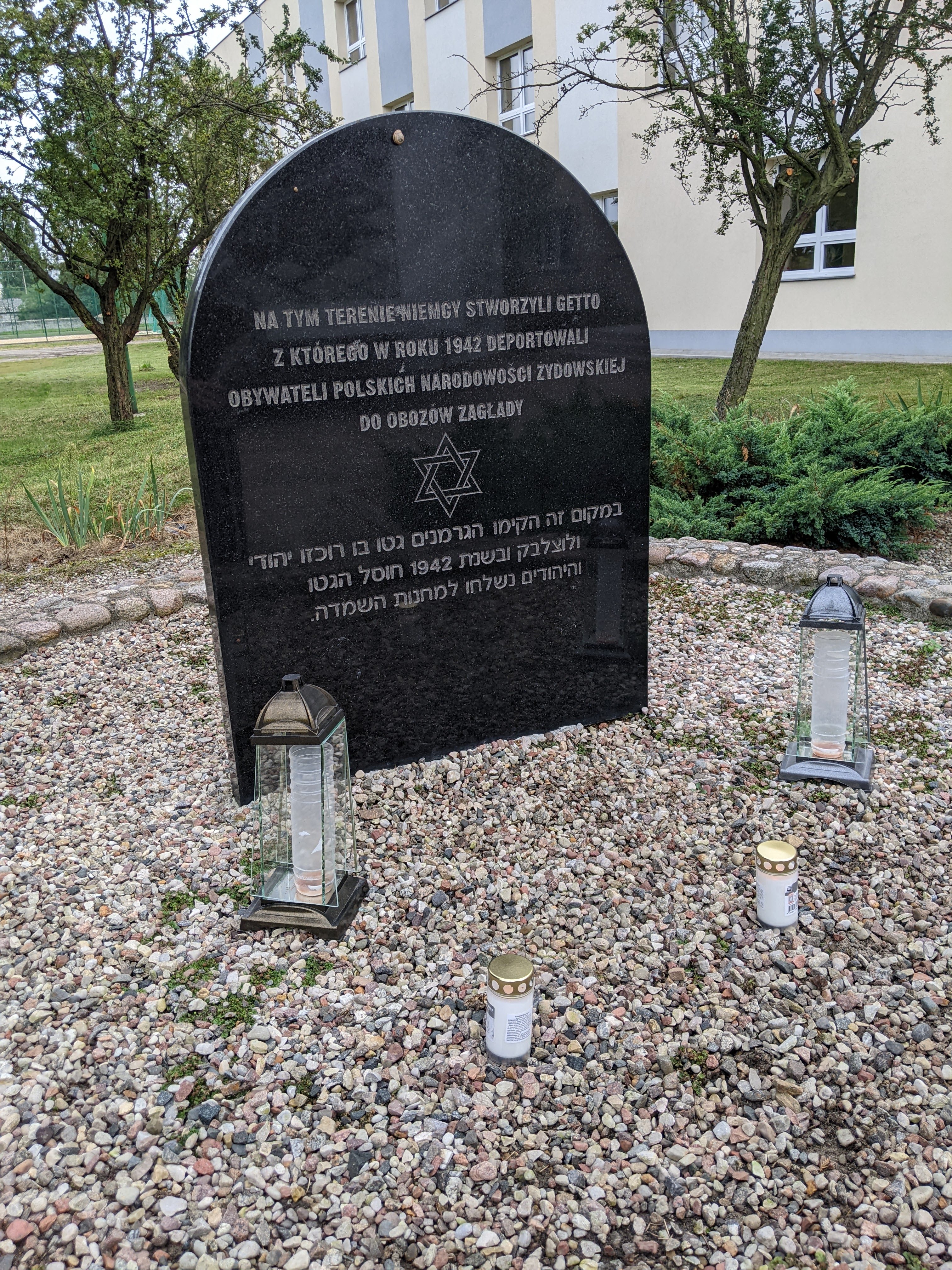
Few traces remain of Włocławek’s Jewish community, which before the war numbered 20,000 people (20% of the city’s population). The two synagogues were burned down during the first days of the Nazi invasion on Rosh Hashana 1939. The cemetery was cleared of tombstones, and during the communist period a school was built on the site. In 2000, a group of descendants in collaboration with the city erected a memorial in front of the school in the shape of a matzevah. The text says in Polish and Hebrew “At this site Germans created a ghetto from which in 1942 they deported Polish citizens of Jewish origin to death camps.” Roberta and I lit candles for my relatives and all the others buried at this site.
Meeting with Mirka Stojak, September 28
When I returned to Włocławek on September 28, I met with Mirka Stojak, who for over 20 years has been meeting with and assisting Jewish descendants who have visited Włocławek. Mirka has documented the lives of Włocławek’s Jews in historical texts, prose, poetry, and on her webpage Żydzi Włocławek. Each year, she gives presentations at schools where she tells the stories of the city’s Jewish residents and reads her original poetry and stories. She has also worked with students on theatrical and musical productions on related themes. Longin Graczyk of the Ari Ari Foundation has worked with Anita and Mirka on other projects. Most recently, Mirka led a “Sentimental Walk” around historic Włocławek in which she told the stories of Jewish residents who used to live at various addresses. The Ari Ari Foundation and the local government where among the sponsors of the event. The ADJCP is listed as well!?!

Mirka will join Anita and Longin on the organizing committee for our memorial trip. She is also happy to prepare a presentation or to lead a walk for our visit, though she does not speak English so it will need to be translated.
Since retiring last year, Mirka has devoted even more time to writing. I bought her latest book Pamięci Włocłaswkich Żydów (In Memory of Włocławek Jews), a combination of history, stories, poems, and the memoir of Jakub Bukowski, who turns out to have been a neighbor of my cousins. Bukowski mentions Mirka Kolska, my mother’s first cousin, was one of classmates.
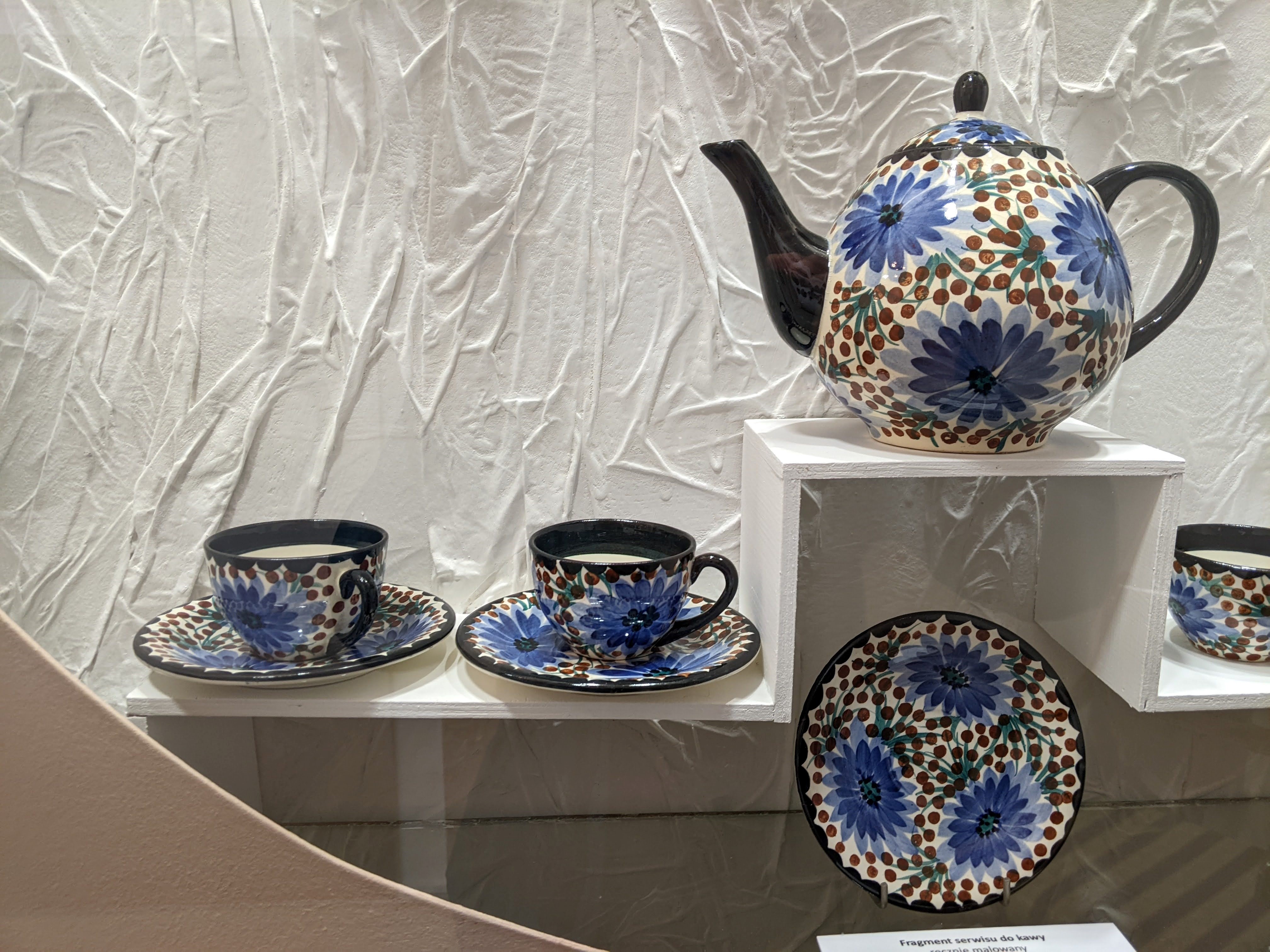
I visited the city museum to see the extraordinary exhibition of faience pottery. This industry was started and dominated by Jewish industrialists. Many of the woman who painted the floral designs were Polish. During the war, the industry was taken over by the Germans and then passed into Polish hands after the war. During communism, the factories became the property of the national government. The last factories closed right around the time communism fell. They were unable to reorganize within the emerging capitalist economy.
I hope we include the exhibition in our memorial trip.
21 Wednesday Sep 2022
What stories were passed down in your families? Do you have any photos from Poland?
Roberta Books and I took a whirlwind trip through central Poland to meet with local government officials, as well as representatives of nonprofit organizations, local history organizations, and schools. Our primary goals were to introduce the the Association of Descendants of Jewish Central Poland (ADJCP), discuss ways we can collaborate on projects that commemorate and preserve Jewish history in the region, and develop partnerships with people who will help coordinate activities for the May 2023 memorial trip. I will post photos and brief outlines of our visits to 15 of the towns in our region, but first let me share some overall impressions.
First and foremost, everywhere we went, we met people interested in the Jewish history of their communities and most of them have already worked on projects preserving and publicizing that history. We are confident they will prepare an interesting program for our memorial trip.
Roberta and I made a great team. I initiated and translated most of the conversations, while Roberta kept notes on who we met and what we discussed. She also asked a lot of great questions that helped clarify what our Polish partners have done and the source of their interest in Jewish heritage.
The working itinerary for our heritage trip is as follows:

We asked our Polish partners to help plan half-day or full-day activities, depending on the size of the town. Specifically, we asked for a tour of Jewish sites, a visit to the Jewish cemetery, and one other organized activity such as a visit to a local school or a museum exhibition about Jewish residents of the town. Partners in Wloclawek and Kutno were asked to organize additional activities since we will be in these places for a full day. They will help us find translators wherever our partners don’t speak English.
We emphasized that our hope is to establish lasting connections. We asked our partners what they would like to see done in their community and how we might help. Pretty much everyone expressed the desire for personal accounts of the experiences of Jewish residents (even those told to our members by older relatives) as well as photographs. Our partners would use these materials in educational programs, exhibitions, and publications.
Do you have any stories or photographs to share? Please let us know and we will make sure they are delivered to our partners in the places where our ancestors lived.
 Uncovering Jewish Heritage