• About
  • The Photo that Started it All

Uncovering Jewish Heritage

Uncovering Jewish Heritage

Category Archives: World War II

AK Verification, Part III

02 Saturday Sep 2017

Posted by Marysia Galbraith in Archives, Bereda, Family, Memory, Polish Culture, Polish Underground Army, Warsaw, World War II

≈ Leave a comment

Tags

AK, Armia Krajowa, Maria Bereda(y) Galbraith, patriotism

NOTE: This overview of my recent discoveries at the Polish Underground Movement Study Trust, Studium Polskiej Podziemniej (SPP) got so long I am publishing it in three separate posts. Here is part III. During the German occupation of Poland during World War II, the Polish Underground Army worked in secret to resist, sabotage, and fight against the Nazis. Another name for the Polish forces is “AK,” short for “Armia Krajowa,” or “Home Army.” I talk about the soldiers as “the partisans;” in Polish sources they are also called “konspiracja,” “the conspiracy.”

Sorry it’s taken a while for me to get to part III. The semester has begun which means I’ve been very busy.

DSC00534

Pencil sketch of Maria Bereday from the 1950s, signed Ditri. Friends tell me she looks like a spy.

All of the questions the archivist Krystyna asked me about the names Mama went by paid off because she found another file; the envelope was mislabeled “Maria Fijułkowska.” Inside was a six-page report, relacja, Mama had written titled, “Outline of Courier Work.”

Initially, neither Krystyna nor I found this file because not only was “Bereda” missing, but Fijałkowska was also misspelled. Krystyna wrote “Fijałkowska” on a new envelope; I don’t know why she didn’t also add the Bereda, even after I pointed out that Mama’s full name was hand-written in large letters along the left margin of the document’s first page. Around World War II, the family usually used the name Bereda-Fijałkowska. Mama told me they added the Fijałkowski/a, which was grandpa Bereda’s mother’s maiden name and a name associated with the Polish gentry, because of Babcia’s social aspirations.

DSC00333

Mama’s name (Bereda-Fijałkowska) and pseudonym “Renata” in the margins of her typewritten report.

Mama’s report matches up with some of the stories she told me, and confirms some of what she did during the occupation. It also gives more details about the way her courier unit “Zadra,” was organized, and how couriers carried out their duties. The report is dry and factual. It contains no specifics about her emotional engagement or personal thoughts. A historian might find it interesting for what it reveals about the operations of the Underground conspiracy. I keep trying to look beyond the words to find the person behind them.

She writes, that “Zadra” started out very small, and because the work wasn’t systematized, the couriers were on call at all times. “By the end of 1942,” she writes, “the number of couriers stabilized at 15, and that group became close and experienced, and worked together for a long time without changing members.” This all changed in the fall of 1943 when the occupier, okupant, limited train travel to Germans only. Overnight, the courier corps dropped from 60 to just six who spoke German well and had German papers. “The work for these couriers during this time was nonstop,” she continues, “The number of trips for each courier came to 10-12 per month, depending on the route.” My mother doesn’t state it in the report, but she must have been one of the couriers who carried out missions during this time. Some of her most vivid stories were about traveling in the train cars with an assumed identity as a “volksdeutch,” a half-German whose father was fighting for the Reich on the Eastern front.

After about two months, the courier corps were reorganized and expanded, with more reserve couriers brought into regular service. In the half year before the Warsaw Uprising, the number of couriers in her unit approached 40, and overall reached 100.

The duties of the couriers included delivering coded and uncoded orders hidden in ordinary objects such as candles or paint, special messages that had to be handed to specific commanders, and large sums of money (1/4-12 million zloties in 500 zloty bills). Some missions involved carrying the messages brought by paratroopers they called “ptaszki,” “little birds.” This is the code name for the cichociemni, the officers who parachuted in from the West carrying money and messages from the Polish Government in Exile.

The report includes an example of a special mission Mama undertook at the end of 1943. Instead of being briefed by her usual commander “Wanda”, “Beata,” the head of communication with the west, did it. “Wanda” gave her a special coded message she had to hand directly to the chief of staff or the commander of the Radom District. This was to occur in private with no witnesses. Mama also had to memorize and deliver the oral message, “The commanders of the divisions and subdivisions of “Burza” require complete secrecy in the event of the invasion of the Russians.” Burza, Tempest, was the code name for the Warsaw Uprising.

Because the chief of staff wasn’t available on the day Mama arrived, she had to spend the night at a safe house. The next day, she delivered the messages to Chief of Staff “Rawicz” [his real name was Jan Stencel or Stenzel], but had to spend another two days before “Rawicz” returned from the forest, where the partisans were hiding out, with the required response for the Central Command in Warsaw.

Reading this sparked another memory for me. I think it was a big deal for Mama to stay away from home for so long, especially because her father didn’t know she was in the Underground. Her mother did know, though, and they hatched an alibi about a visit to Mama’s fiance’s family. Or maybe this is the story she told the authorities on the train to explain why she was returning several days late. Hopefully, my brothers remember this story, too, and can confirm one of these versions.

The documents from the Studium Polski Podziemnej in London have been a lynch pin that holds together information from a variety of sources. While I was there, I also found a citation for Communication, Sabotage, and Diversion: Women in the Home Army, Łączność, Sabotaż, Dywersja: Kobiety w Armii Krajowej, published in 1985. The book was written in Polish but published in London. I found a copy of it at an online used bookstore whose brick and mortar shop is in Warsaw. I called, and sure enough they had it in the shop, so I picked it up while I was in Warsaw. It contains the recollections of the head of the Women’s division of Central Command (VK) Janina Karasiówna, the oficer who confirmed Mama’s verification file. Another chapter contains the report of Natalia Żukowska who was the assistant commander of Mama’s courier unit; Mama identifies her by her pseudonym “Klara.” From Żukowska’s report, I learned that “Zadra” was the name used by the couriers who had been working with the unit for the longest, but in 1943 the name was changed to “Dworzec Zachodni.” Reviewing Mama’s documents, I see now that she identified her unit as Zadra-Dworzec Zachodni in one place. She underlined it, too. Until I read this book, I had thought Dworzec Zachodni, which means Western Station, referred to Zadra’s location, not an alternative cryptonym. And then there’s this: the names of the 15 couriers, including “Renata.” That’s Mama’s pseudonym; her last name is misidentified as “Brodzka” instead of “Bereda,” but Natalia writes, “Unfortunately, it wasn’t possible to decrypt all of the last names” (p. 118).

Mama was proud of her service for her country, but she was also painfully aware of the cost of war. She called herself a pacifist and the war solidified her abhorrence of armed conflict. I remember her asking, “Are there times when fighting is necessary?” I could tell from her voice that she wanted to believe all conflicts can be resolved peaceably. But her experience had taught her otherwise.
AK Verification: Part II

13 Sunday Aug 2017

Posted by Marysia Galbraith in Archives, Bereda, Family, Poland, Polish Culture, Polish Underground Army, Warsaw, World War II

≈ Leave a comment

Tags

"Zadra", AK, Armia Krajowa, Courier, General Bór Komorowski, Grupa "Koło", Major Janina Karaś, Maria Bereda(y) Galbraith, Polish Home Army, Polish Underground Study Trust, Studium Polski Podziemnej, Warsaw Uprising

NOTE: This overview of my recent discoveries at the Polish Underground Movement Study Trust, Studium Polskiej Podziemniej (SPP) got so long I am publishing it in three separate posts. Here is part II. During the German occupation of Poland during World War II, the Polish Underground Army worked in secret to resist, sabotage, and fight against the Nazis. Another name for the Polish forces is “AK,” short for “Armia Krajowa,” or “Home Army.” I talk about the soldiers as “the partisans;” in Polish sources they are also called “konspiracja,” “the conspiracy.”


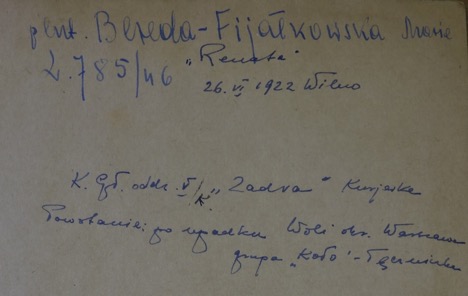
The file at the archive of the Polish Underground Movement Study Trust, Studium Polski Podziemnej (SPP), contained the same verification questionnaire I had from my mother’s papers and so much more. On the envelope itself is the following identifying information:

VerificationEnvelope

Information on the envelope containing Mama’s papers at the SPP

I ‘ve learned how to decipher all of this. Here’s what it means:

Cadet Bereda-Fijałkowska Maria

2.785/46 [record #]     “Renata” [her pseudonym]

   26. VI 1922 Wilno [birth date and place of birth]


            Central Command division V/Women “Zadra” courier

Uprising: after the fall of the Wola district of Warsaw

                                    “Koło” Group-liaison officer [the names of her units]

The documents inside the envelope confirm Mama’s service and rank in the AK [Home Army], as well as her receipt of the Cross of Bravery. She submitted her questionnaire on March 9, 1946, her commanding officer confirmed her claims on April 15th of the same year, and the official report was completed the next day on April 16. The final report says the head of the Polish Army himself, General Bór-Komorowski, confirmed her receipt of the Cross of Bravery. Here is what looks like his signature on the document:

BórSignature

General Bór Komorowski’s signature verifying Mama’s service in the Polish Home Army. It looks like he wrote “Stwierdzam (I confirm)  16/IV 46” above his signature. Note the “gn” for “generał.”

Mama started military training in middle school, gimnasium, at the Klementyna Hoffman School in the mid-1930s. She continued training in high school, liceum, and entered the Underground in June 1941, right after finishing high school. She took courses on how to be a courier, the organization of the Underground and of the German military, as well as marksmanship, topography, and first aid. She was in “Zadra” Group, part of the women’s courier corps in the 5th Division of the Central Command. She delivered encoded communications, money, and oral messages on the routes between Warsaw and Krakow, Radom and Skarżysko-Kamienna. In these latter two places, she acted as a go-between for the partisans in the surrounding forests and Central Command in Warsaw. From 1942-4, she also worked as an instructor training other women to serve in the Underground.

When the Warsaw Uprising began on August 1, 1944, she was with her unit “Zadra” in Wola, a district to the northwest of downtown. A handwritten note on her typed questionnaire says “wounded on route from Wola to the Old City.” The handwriting is different from Mama’s distinctive, almost calligraphic style, so somebody else must have added it after Mama submitted her answers.

The archivist Krystyna Zatylna said that the heaviest fighting in the first days of the Uprising was in Wola. Mama was lucky to have survived. By August 8, 40,000 civilians died in Wola.

The Home Army regrouped in the Old City. Mama got separated from her unit and joined “Koło” group. She is referred to here as a “liaison,” “lączniczka,” rather than “courier,” “kurierka.” Both terms refer to people entrusted with delivering critical information. Initially, however, she worked as a medic on Długa Street. When the Germans pushed the partisans out of the Old City, they escaped to the City Center, Śródmieście, via the sewers.

14SPPVerificationDossier

Document dated September 9, 1944 that allowed “Renata” to travel through the City Center during the Warsaw Uprising.

The file contains two papers dated from the Uprising. No doubt Mama brought them with her to London to help corroborate her report. These tattered notes—physical proof of her service—must have been very precious to her. The first, on a third of a piece of paper that has deep creases from having been folded many times, is dated September 9, 1944. It states:

I assert that cadet Renata is a liaison of “Koło” Group. The conditions of her service require movement within the region between Savior Square and Napoleon Square.

The note is signed by the Chief of Staff of “Koło” Group, Major Krynicki. The document contains a round stamp with a crowned eagle in the middle surrounded by the words “Motorized Transport Brigade, “Brygada Dyspozycyjna Zmotoryzowana.” Mama must have shown this note at barricades on the streets so the AK soldiers would let her pass. Savior Square and Napoleon Square are in the City Center, which means she retreated through the sewers before September 9. I can, however, imagine her dodging Nazi bullets as she ran across the barricaded Jerusalem Street carrying messages from Napoleon Square to Savior Square. These names would sound good in a poem. Too bad I’m not a poet.

The second paper dates from October 3, 1944, the last day of the Uprising. Signed by Colonel Bolesław Kołodziejski, the commander of “Koło” Group, it is titled, “Provisional certificate (to be exchanged after the war for official recognition).” The text reads:

I confirm that “Renata Lewandowska” was decorated for her activity during the Uprising from August 1 to October 3 1944 with the Cross of Bravery for the first time.

Based on: the personal confirmation of the head of the Warsaw Corps of the A.K. Brigadier General Montera and his assistant Colonel Wachowski, as told to the commander of “Koło” Group during the last days of the Uprising.

“Montera” was the code name for General Antoni Chruściel, who led the Home Army (AK) in Warsaw during the Uprising. Kołodziejski was also a code name. Elsewhere in the documents, Mama writes that his real name was Zygmunt Trzaska-Reliszko.

Mama writes that she was promoted twice; in September 1944 she became a cadet, plutonowy podchorązy and in October she was promoted again to ensign, podporucznik. It looks as though the Verification Commission could only confirm the first promotion. A handwritten note on Mama’s questionnaire says they weren’t able to contact her commanding officer from “Koło” Group to verify the second promotion.

Also in the file are two statements written by the commander of the women’s branch of the 5th division of Central Command (V.K. KG) Major Janina Karaś, dated April 15, 1946. In them Karaś, also known as Karasiówna, confirmed that Mama earned the rank of cadet in “Koło” Group, and was also granted the Cross of Bravery for her service. Clearly, the Verification Commission contacted Karaś to corroborate Mama’s claims on her questionnaire. One of Karaś’s statements reads:

As the chief of the V.K. [5th Women’s] Central Command I certify that in the course of her service as a courier, “Renata” Maria Bereda Fijałkowska distinguished herself on the route Warsaw-Krakow and Warsaw-Skarzysko-Radom with bravery and decision to take risks. Traveling with German false papers she carried money, mail, and oral orders /for example related to the order for [Operation] Tempest. She earned the Cross of Bravery for her service.

Operation Tempest, “Burza,” was the code name for the beginning of the Warsaw Uprising. In other words, some of the messages Mama carried between Central Command and the partisans in the forest involved critical details about the Polish Underground’s battle to free the capital city from German occupation. I’m reminded of something the archivist at the Warsaw Uprising Museum kept repeating when I showed him Mama’s verification questionnaire two years ago: “She must have been very high in the conspiracy.” He couldn’t find the exact connection, but I believe I have it right here.

Krystyna Zatylna helped me put the pieces together. The forests around Radom are where the so-called “cichociemni,” “the quiet unseen” soldiers parachuted in from the West, bringing messages and money from the Polish Government in Exile for the leaders of the Underground in Poland. I believe Mama was given these items from the cichociemni and carried them back to Central Command in Warsaw. It fits with stories she sometimes told, and it fits with the seven-page report she filed with her verification papers. And that will be the subject of the third part of this blog post.

AK Verification, Part I

12 Saturday Aug 2017

Posted by Marysia Galbraith in Archives, Bereda, Family, Polish Culture, Polish Underground Army, World War II

≈ 3 Comments

Tags

AK, Armia Krajowa, Cross of Bravery, Krzyż Waleczny, Maria Bereda(y) Galbraith, Polish Home Army, Polish Underground Study Trust, Studium Polski Podziemnej

NOTE: This overview of my recent discoveries at the Polish Underground Movement Study Trust, Studium Polskiej Podziemniej (SPP) got so long I will publish it in three separate posts over the next few days. Here is part I. During the German occupation of Poland during World War II, the Polish Underground Army worked in secret to resist, sabotage, and fight against the Nazis. Another name for the Polish forces is “AK,” short for “Armia Krajowa,” or “Home Army.” I talk about the soldiers as “the partisans;” in Polish sources they are also called “konspiracja,” “the conspiracy.”

MamaPrewar

Mama in Poland


The extraordinary story of my mother’s service in the Polish Underground can be hard to reconcile with the person I knew. Mama would hide when strangers visited the house because she was afraid they would stare at her scars. How could she have carried secret messages to the partisans in the forest or talked calmly with Nazi officers on the German-only trains right under signs that read, “Danger! The Enemy is Listening!”? And yet, as her daughter I also knew her strength and persistence, especially when matters of principal were involved.

I couldn’t find much specific information about my mother at the Warsaw Uprising Museum or the Polish National Archive of New Records in Warsaw. Next, I turned to the Studium Polski Podziemnej (SSP), Polish Underground Movement Study Trust in London. But when the archivist responded they have no record of Maria Bereda in their indexes, a part of me wondered if Mama could have fabricated her whole story.

Logo-spp-londyn_0c8ba9117ddbff8485e5dca98f7fae14

Logo of the Polish Underground Movement Study Trust (SPP)

But that made no sense. My mother didn’t lie. She struggled with guilt even when she tried to tell the smallest untruth. Instead, she would avoid certain subjects, and would keep silent when people came to their own incorrect conclusions about them. That’s why for instance I thought she was the same age as my dad when I was a child. My oldest brother inferred it from the sequence of their birthdays—Dad’s was on March 1 and Mom’s was a few months later on June 26—and Mama didn’t bother to correct us.
Mama didn’t like talking about her past, but the story about how she was verified after the war was one she was more willing to tell. She had to go to London to do it because wartime records were scattered and incomplete. During the war, the Underground Army didn’t have the infrastructure to maintain centralized records. Often, lists of personnel and promotions were memorized or scribbled on any available scrap of paper. Also, to prevent the Nazis from infiltrating the underground forces, details of separate units were kept from each other. Most partisans only knew about those serving directly above and below them, and even members of the same unit referred to each other by code name. All of these were strategies for insuring that if someone was caught or compromised, they would have minimal information to share and so could inflict a minimum of damage to the organization. Also, few records remained after Warsaw was bombed to the ground following the Warsaw Uprising. The Central Verification Commission was in London, where the Polish Government in Exile had been throughout the war.

Mama travelled from Poland to London in March 1946. She wanted to be sure that an official record would exist to mark her participation in the war, and she wanted to get the Cross of Bravery she had been granted but never received. At the Commission, she reported on her training, her unit, her superior officers, and her activities. When she told me this story many years later, she was very proud of her ability to recall all these details from memory, things that could only be known by someone who actually served in the Underground.  The commission checked everything for accuracy before the verification was confirmed.

I already had a copy of the “Special Questionnaire” Mama had filled out as part of this process; I had found it in her papers. At minimum, I should have been able to find the original at the Polish Underground Movement Study Trust (SPP), which houses the archive of the Verification Commission. Fortunately during a recent trip to London, some focused digging at the SPP turned up a treasure trove of documents. Already in our e-mail correspondence, the SPP archivist Krystyna Zatylna had seemed confident that something would turn up if we looked harder. She eventually found Mama’s records where they had been mislabeled and misfiled.

Home_01_about_spp_londyn-b87ae1de57

Headquarters of the Polish Underground Movement Study Trust at 11 Leopold Road, Ealing, London. Photo from studium.org.uk website.

According to their website, “The Polish Underground Movement (1939-1945) Study Trust (PUMST), was founded in London in 1947. It is a research and academic institution, which contains historical material on the Polish Underground State (the Underground Administration and the Polish Home Army – Armia Krajowa) during the Second World War.” Included among their materials, the verification papers sit on high shelves right in the reading room in accordion folders shelved alphabetically. Personal files are arranged alphabetically inside the folders, each in a separate manila envelope.

The first folder Krystyna pulled out for me contained last names starting with “Br” instead of “Be.” My heart fell when I didn’t find Mama’s records. But then Krystyna climbed up a wooden ladder and found the folder with the “Be” names. There it was: an envelope labeled Maria Bereda-Fijałkowska. For a time, Mama used this hyphenated name, tacking on the maiden name of her grandmother.

Krystyna explained that much of the work at the archive has been done by volunteers so there are a lot of mistakes. She also asked me a lot of questions. Was Mama’s name always hyphenated? Did she use any other names? Did she ever go by Fijałkowska? Was she ever married? She also asked the names of my mother’s units. I rattled off what I knew: she belonged to “Zadra” in the Women’s 5th Division of the Central Command stationed in the Wola District of Warsaw; shortly after the Warsaw Uprising began, she joined “Koło” Group, and served in the Old City–Stare Miasto and City Center–Śródmieście Districts . I also gave her the names of Mama’s superior officers. It was as if I was being verified myself.

To be continued…

More Jewish Heritage Work in Kutno

26 Wednesday Apr 2017

Posted by Marysia Galbraith in Cemeteries, Heritage work, Jewish Culture, Jewish Ghetto, Kutno, Memory, Names, Polish-Jewish Heritage, Polish-Jewish relations, Synagogues, World War II

≈ 2 Comments

Tags

Friends of Kutno, Polin Museum, Reclaiming "Jew", Towarzystwo Przyjaciół Ziemi Kutnowski

This is part II about heritage work in Kutno. The first is Jewish History of Kutno.

While in Kutno, I visited the Society of Friends of Kutno (Towarzystwo Przyjaciół Ziemi Kutnowski). The organization has been active since the early 1970s, and has put out an annual periodical about local history and customs for about 20 years. Most issues of the publication contain an article about Jews. In 2016, these articles were compiled in a book along with other historical materials about Kutno’s Jews, including Holocaust witness reports and photographs, and a list of people who lived in the Kutno ghetto.

okladka zarys historii

Outline of the History of Kutno Area Jews, published by the Friends of Kutno

The chairwoman of the Friends of Kutno Bożena Gajewska is an energetic and upbeat woman. She accepted the position because of her interest in local history and her desire to promote that history among local residents. She isn’t paid for this; she volunteers for the organization after getting off work. The Friends of Kutno have their office in a historic wooden villa that was recently renovated by the city. Most of their funding comes from grants. Over the years, they have placed historical markers where the synagogue, Jewish cemetery, and ghetto used to be. Other recent projects related to Jewish culture include field trips for local residents to the Polin Museum in Warsaw, to a production of a Sholem Asch play at the Yiddish Theatre in Warsaw, and to the Chełmno Extermination Camp, where Kutno Jews were transported when the ghetto was liquidated. Kutno was selected as a site where the Museum on Wheels (a traveling branch of the Polin Museum of the History of Polish Jews) would visit; this happened in August 2016.

DSC08529

Marker reads, “In this place the 18th century synagogue stood. It was destroyed by the Nazis during World War II, evidence of the hatred of one human to another, and to his works.”

Pani Bożena says she’s noticed that orientations toward Jews have improved since the Polin Museum has opened. Thanks to the Museum, you can talk about Jews, whereas before, the word “Jew” had negative connotations, and was even used as an insult. This made people unsure what to call practitioners of the Jewish faith. Polin has helped to rehabilitate the term. While this may seem like a manifestation of the particularly fraught relationship between Poles and Jews, Mark Oppenheimer just published an opinion piece in the New York Times (Sunday, April 23, 2017, “Reclaiming ‘Jew’”) in which he notes that it’s the same in the US. “Jew” is almost never used as a noun; rather, the adjective “Jewish” is used, as in “Jewish people” or “I’m Jewish” (never “I’m a Jew”). Oppenheimer quotes the comedian Louis C. K. who called “Jew” a funny word “because ‘Jew’ is the only word that is the polite thing to call a group of people and a slur for the same group.”

The Polin Museum has also contributed to a surge of activity related to Jewish history and culture throughout Poland. This has led some townspeople to complain to the Friends of Kutno, “Why is everything always about Jews?” Bożena says she reminds these people that the Friends are interested in all aspects of regional history, and Jews were a part of that history. They address plenty of other topics, as well. For example, they recently published the biography of a native son who was an ultra nationalist during the period when the majority of Kutno residents were Jews (I can’t remember his name but maybe someone reading this can remind me).

Pani Bożena drove me to see some historical sites around town. The Jewish cemetery is on a hill overlooking a neighborhood of concrete apartment buildings. The hillside is covered with tall grass and wildflowers, and crisscrossed by dirt tracks where people walk their dogs, kids play, and people hang out. Many leave their trash behind. The Friends of Kutno recently put up signs around the cemetery that say “Here is the resting place of Kutno Jews, who settled in the city from the beginning of the 16th century. The cemetery located on this hill was established in 1793. Jews were buried here until March 1943. Please maintain its solemnity.” Below this historical information is the reminder, “Keep in mind as you go into this vast expanse that this is a cemetery; people are buried here, you walk on their graves, even though there are no longer tombstones…” Further, the sign states the cemetery is a registered monument and thus legally protected, and any vandalism is subject to a sentence of imprisonment. Nevertheless, within just a few months, four out of six such signs were vandalized. The metal poles were snapped at ground level. Bożena condemned the destruction, but also minimized it as the work of thoughtless hooligans (as opposed to a deliberately antisemitic act). In September, the poles were replaced and the signs stand once again.

Bożena showing me the new sign at the Jewish cemetery in Kutno
An older monument at the top of the cemetery hill

We passed people with dogs as we walked to the top of the hill to an older monument. It contains the same historical information as the new metal signs in Polish and Hebrew (but not the reminders about proper behavior and legal issues), and is shaped like two adjoining tombstones. Heading back down the hill, past some children playing, we saw the bases of some grave markers peaking out of the grass. Many tombstones were recovered and are stored at the Kutno Museum.

Bożena dreams of building a fence around the cemetery so there will be a more substantial barrier against further vandalism. They have received all the necessary approvals, but are in need of funding.

From the cemetery, we went on to the site of the ghetto, which is outside the center of town on the grounds of a former sugar factory. The factory was used by various industries after the war, but now is closed. The buildings, some dating from the late 19th century, stand behind a high fence and a guard patrols the site. Historic markers tell the story of the ghetto. A granite plaque reads:

Here on the terrain of the former Konstancja Sugar Factory

Germans established a ghetto for the Jewish population of Kutno and the surrounding area.

After its liquidation in 1942, the surviving Jews perished in the camp at Chelmno.

Honoring their memory, the People of Kutno.

Kutno, April 1993

A more recent sign contains a bit more historical information in both Polish and English (if you want to read it, click on the photo below to enlarge it).

Former site of the Kutno ghetto.
Wall plaque at the site of the Kutno ghetto
Historical marker in front of the main gate of the factory where the Kutno ghetto used to be.

Bożena told me that over 8000 people lived in the ghetto from 1940-1942. Those who got there first occupied all the most obvious places, so later arrivals had to build shacks from scrap wood, or find ways of populating balconies and any other inhabitable space throughout the large factory hall. In 1942, they were all transported to the camp at Chełmno by train (the tracks are right across the street from the factory) and by truck.

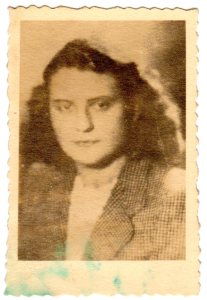
Thinking about the people I met in Kutno (and elsewhere), one thing I am trying to sort out is why Christian Poles get involved in Jewish heritage projects. Not surprisingly, the reasons are varied. One is interested in historical artifacts; he has no political agenda. Another of my companions tried to place this history into a more pro-Polish framework. He explained that the Nazis forced Christian townspeople to do horrible things as part of a strategy to damage relations between Poles and Jews. “All people really want is to live in peace (Chcą w spokoju żyć)”, he continued, “Poland is in the heart of Europe, a pretty terrain that has historically been attacked from all sides.” Others feel personally drawn to Jewish culture. One of my acquaintances in Kutno believes she has Jewish heritage. She seems to understand my quest for my own family history. “It’s important to know where you’re from,” she told me. She hasn’t found anything as concrete as my family photograph (the one I use at the top of the blog) to confirm her feeling that she has Jewish roots. All she can point to are allusions in family stories she remembers from childhood, and sometimes people have told her she looks Jewish. But anyone she could have asked has passed away.

But what’s clear from my visits to Kutno is that fragments of Jewish history remain, and some have been marked as such thanks to the efforts of a small group of residents who think it is important to include the stories of Kutno’s Jews in the history of their town.

Podgórze: Below the hill and through the ghetto

16 Monday Jan 2017

Posted by Marysia Galbraith in antisemitism, Commemoration, Jewish Ghetto, Krakow, Memory, Podgórze, Polish-Jewish relations, Post-World War II, Reclaimed Property, World War II

≈ 2 Comments

Tags

Ghetto Heroes Square, Plac Bohaterów Getta, Places of Holocaust Memory

When Krysia and I visited Poland a few years ago, we walked to her friend Wanda’s apartment in Podgórze, a district across the Vistula River from Krakow’s Old City. Historically, Podgórze was an industrial part of town, and also the site of the Jewish Ghetto during World War II. Until recently, this was not a particularly desirable place to live. I went there for the first time in 1986 when my Polish teacher invited me for dinner. She lived with her doctor husband and baby daughter on Limanowski Street in a ground floor apartment that was a converted storefront. The building was grey and crumbling, and the tram rumbled by loudly and frequently. They couldn’t wait to move somewhere better. In 1992, I met a high school student whose classmates joked he was “from the country” because he lived in Podgórze. Even though you could see Wawel Castle on the opposite shore of the river, Podgórze was considered a remote corner of the city.

I really discovered Podgórze in 2005 when I was back in Kraków for 5 months during my first sabbatical leave. I made a point of exploring all the city’s parks and playgrounds as a way of entertaining my two-year-old son; long afternoon walks were often the only way I could get him to nap. Podgórze charmed me. The buildings along the tramline on Limanowski Street were still grey and crumbling, but there was also a lovely triangular plaza and a beautiful church with a hillside rising up behind it. Maybe that’s the source of the name—Podgórze means “below the hill.” Climbing up the curving street from the plaza, large houses with fenced gardens replaced the apartment buildings, and then a massive park appeared on the right. And yet, despite these explorations, I still didn’t know that I had been moving in and out of the borders of the former ghetto, where the Nazis had forced Jews to live (and die).

Plaza and church in Podgórze
Heading up the hill
Heading up the hill
One of the large houses on the way to the park

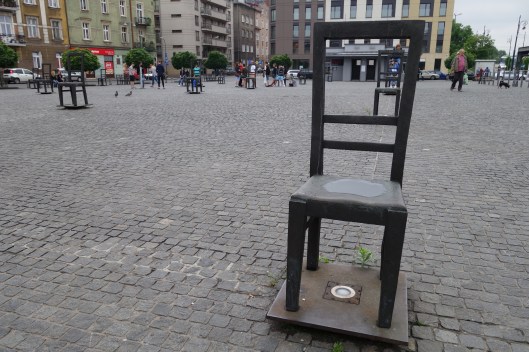
Wanda, a long-time resident of Podgórze, pointed out traces of that difficult era as we walked to her apartment. It was the first time I actually connected the contemporary streets of Podgórze with the places associated with the Holocaust. Just over the bridge, we entered Ghetto Heroes Square (Plac Bohaterów Getta), the site where Jews were assembled before being transported to work, the ghetto, or the camps. It wasn’t until December 2005 that a monument commemorating these historical events was installed. The monument is comprised of 33 large chairs arranged in rows throughout the plaza and 37 smaller chairs scattered around the edges of the square and at the nearby tram stop. These serve as a symbol of the people whose material possessions were taken from them as they were selected for the ghetto and elsewhere. The idea was “to tell the story of the place through the configuration of the urban space itself, so that the memory of the absent ones would be manifested through the presence of everyday objects which compose the urban furniture” (Bordas 2006). The chairs make an impression, especially the big ones. They look like they should be functional but they’re not–another way they symbolize the way ordinary life became abnormal.

Chair monument in Ghetto Heroes Square

Ghetto Heroes Square

Wanda led us to a nearby street where a fragment of the ghetto wall still stands. Its characteristic scalloped top makes it resemble side-by-side tombstones. Flowers rested at the foot of a historical marker, an offering made during a commemorative event in March. Wanda also pointed out where a gate of the ghetto used to cross the street near her apartment. For 23 years, Wanda lived on that street. But then the prewar owners—Jews—regained ownership of the property and doubled the rent. Faced with the option of paying 2000 zloties per month or move, Wanda decided it would be better to invest that kind of money in a place she could own herself. That way, she doesn’t have to worry about being displaced again.

Like many Poles, Wanda feels personally affronted by former owners reasserting their claim over property. These feelings are complicated.

It seems only right that descendants of victims of the Holocaust be compensated. Regaining ownership of a building can only to the slightest degree address what those families lost.

And yet, losing their home to the prewar owner seems particularly unfair to the generation that endured years of communism, and never was able to accumulate much wealth in their own lives. Since the end of communism, prices have risen, unemployment has become common, and wages remain modest. Often it’s the poorest residents who live in former homes of Jews because the government took over their management and made them into low-cost housing for those in greatest need. This affordable housing was a small oasis of security in unsettled times. Many such residents today are elderly; others are unemployed; some have problems with their health or with substance abuse. They don’t have many options.

Wanda was one of the lucky ones with the wherewithal and the financial means to buy her own place. But still she carries the resentment with her that she sometimes translates into resentment of Jews more generally. Who was looking out for her rights when the apartment was returned to the prewar owners? What did some rich foreigner need with her building? Why should they get even wealthier at her expense?

In fact, prewar owners are reclaiming properties all over Poland, and even though they are not all Jewish, the greatest resentment is directed toward those who are.

Ghetto Memory Trail marker
Star of David crossed out--on a storefront in Podgórze
Star of David crossed out–on a storefront in Podgórze

In Podgórze, you can see both the effort to acknowledge sites of Jewish heritage, and also signs of continued antisemitism.

Wanda loves her neighborhood and doesn’t want to live anywhere else (even though she has to spend part of each year in the US to earn enough money to pay her mortgage). The apartment she lives in now is new construction on top of a historic townhouse; an additional floor was added to an existing building. As we climbed the three flights of stairs, she explained that when she bought the place, all that was there were the bare walls. This is standard practice in Poland. The buyer has to select, purchase, and install all the flooring, fixtures, wall coverings cabinets, and appliances. The apartment is long and narrow, with a wall of windows and a sleeping loft. Wanda said she bought it at the peak of the market; today she could find something for half that price. But that would mean moving again.

As we ate a generous spread of Polish dishes, including stuffed cabbage (gołąbki) and two kinds of pickles, Wanda said that Podgórze has become one of the most popular neighborhoods in Krakow. The new heritage sites and museums—including the Ghetto Heroes Square, the Schindler Factory Museum, and the Museum of Modern Art—have brought with them tourists and the amenities that tourists expect. People are moving out of the center of the city because it has become too crowded, cars are restricted on most streets, there are few stores with everyday necessities, and the prices are too high. Podgórze is desirable because it has good public transportation, is within walking distance of the city center, and because of the park, the trees, and the hill that I find so appealing.

OLYMPUS DIGITAL CAMERA

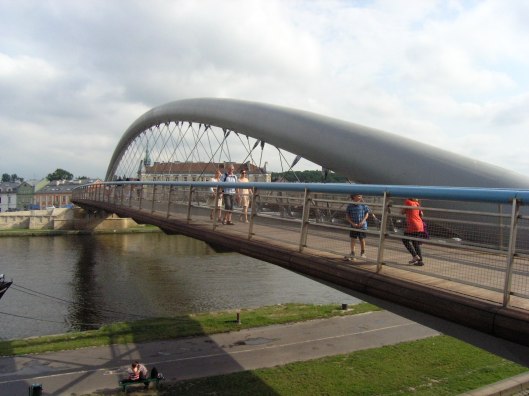
The new pedestrian bridge across the Vistula River to Podgórze.

How Żychlin Remembers, part 2

01 Thursday Sep 2016

Posted by Marysia Galbraith in antisemitism, Jewish Ghetto, Memory, Polish-Jewish Heritage, Polish-Jewish relations, Post-World War II, Pre-World War II, stereotypes, Synagogues, World War II, Żychlin

≈ Leave a comment

The next morning I met Tadeusz Kafarski for a tour of the city. He was with Józef Staszewski, the director of the Żychlin branch of the Association of Children of War. Because Józef was born in 1929, he remembers wartime better than Tadeusz, who was only a year old when the Nazis invaded. The two sometimes disagreed about details, but together they reconstructed for me Jewish life in Żychlin. As they pointed to the buildings that stand here and now, their descriptions transported me back and forth through time, to prewar life, wartime murder, and communist era absence. I had the odd sensation as I did so many times on this trip of being both here (in the present) and then (in the past), my mind trying to reconcile what stood before my eyes with what used to be. My guides led me back in time with varied fragments of information:

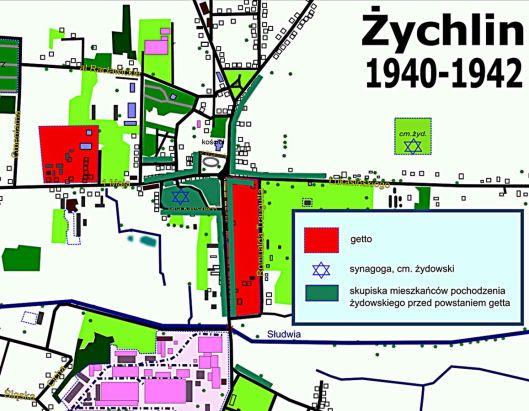
On Łukasieńskiego Street, we passed concrete apartment buildings built in the 1970s on the site of the second, larger Jewish ghetto.

Mr. Helmer, the richest Jew in town, lived across from the market square, to the left of Narutowicza Street, in what is now a well maintained two story building.

One block south, near the synagogue (the blue Star of David on the map below) on Kilińskiego Street, we passed the former home of a Jewish doctor, a building that used to be a dairy collection point, and another that was the preschool Tadeusz attended. A man named Merc lived nearer the synagogue. Behind some houses was the Jewish slaughterhouse, but Christian Poles also bought meat from there.

Jews and Poles lived side by side, even though this part of town was predominantly Jewish. Today, this section of town is run down though these particular buildings seem in good shape.

Map of Żychlin 1940-42 showing the ghettos in red, the first one is on the left and the second is on the right. The dark green shows the main areas where Jews lived--note that most were not in what became the ghetto. That meant gentiles had to move out of those areas when the Jews were forced to move in.

Map of Żychlin 1940-42 showing the ghettos in red, the first one is on the left and the second is on the right. The dark green shows the main areas where Jews lived–note that most were not in what became the ghetto. That meant gentiles had to move out of the ghetto areas when the Jews were forced to move into them.

As we wound through the dusty streets, the contemporary residents stared at us suspiciously, though some who know my guides greeted them, “Dzień dobry (Good day).”

The patch of tall weeds in front of the synagogue (on Jana Kulińskiego Street) used to be a fenced garden. The garden continued to be maintained after the war, even though the Polish residents used the synagogue as a warehouse, as did the Nazis. The lower sections of the windows were bricked in and new doorways were installed in the sides of the building to facilitate loading and unloading.

What's left of the Żychlin synagogue. Note the windows used to extend much father down, and the more recent doorway (now blocked) added when the building was used as a warehouse. The weedy area in the foreground used to be a fenced garden.
What’s left of the Żychlin synagogue. Note the windows used to extend much father down, and the more recent doorway (now blocked) added when the building was used as a warehouse. The weedy area in the foreground used to be a fenced garden.
Pan Józef beside the site of the well and mikvah
Worn stones--something I learned to value as a student archeologist. These were used in place of asphalt before World War II
Worn stones–something I learned to value as a student archeologist. These were used in place of asphalt before World War II

As a child, Józef went inside several times with his parents, though he could only describe the general layout of the interior. The candlelit altar was on the east wall, the main entrance on the west. Above the entrance was a balcony that would have been for the choir in a church but in the synagogue was for women to pray in. In a neighboring building, the rabbi would change. On the other side of the synagogue were a well (with the best water in town) and mikvah. After the war, everyone used that bathhouse.

Józef said, “There is just one faith; Jews believe in God just like we do.” He declared children played together regardless of religion. He described distinctive aspects of the Jewish population. Men wore head covers and beards. They would take their shoes off in the synagogue, but had to keep their head covered. The Jewish “priest” was the only one with side curls. He wore a black hat, black clothes, and a white shirt. Jews stayed home Friday and Saturday; they didn’t work. They held their hands at their waist and rocked as they prayed. They read scrolls. Jews used to bury their dead in a sitting position with money on their eyes. Men carried the unclothed, shrouded body to the cemetery. They returned to God as they began. When they left the cemetery after the burial, mourners dispersed in different directions . He asked why and was told it was so the spirit doesn’t return home with them.

Are these personal memories or stereotypes picked up from other sources?

My guides told me about a man named Rozenberg. They pointed to the yard of his bakery, and then we walked around to what used to be its storefront on Narutowicza Street. Rozenberg lived in a multi-story home on the other side of the street. He married a Christian named Czajka. Jozek said the Rozenbergs’ children Krysia and Rudek were Jewish. He played with the boy. After her husband died, Czajka married her brother-in-law, a judge. They had two more children. After the war, the family was harassed by the police so they sold all their buildings and went to Israel. One child moved to Norway.

The Germans occupied the town on September 15. At first, they didn’t treat anyone harshly, but they did take their property—first the stores and richer buildings owned by Jews, and then jewelry and everything anyone had that was valuable.

The main entrance to the ghetto used to be across from Rozenberg’s bakery. This was the second ghetto, established later for the poorer Jews. The first ghetto, where the richer Jews were sent, was on the grounds of an old factory outside the center of town. As Jews were forced into the ghetto, Poles whose homes were within the ghetto territory had to move to homes on the other side of the street—homes that had been emptied of their Jewish residents.

In July 1942, the second ghetto was liquidated. It took five hours because thousands of people were loaded onto wagons, and then everything was removed from their homes and segregated into piles. Some Poles helped, forced to work under threat of death. My guides disputed claims that Poles plundered Jewish possessions. They insisted the Germans took everything valuable, then piled up all the remaining dirty and broken things and burned them.

We crossed the street to the main square. Right there in front of the church there used to be a row of market stalls run by Jews. The church owned the land, but didn’t have any problem with Jewish venders. We continued behind the church and across another market square to the town library. This solid stone structure was originally built for Hempel, the Nazi mayor of the town remembered for his cruelty.

My guides Tadeusz Kafarski and Józef Staszewski in the town square
The Żychlin town square
Director of the Żychlin Library, Ewa Andrzejewska
Nazi Mayor Hempel's villa is now the Żychlin Public Library
Nazi Mayor Hempel’s villa is now the Żychlin Public Library

Tadeusz told me the wartime mayor’s villa was built with tombstones from the Jewish cemetery. Jews were pressed into service carrying the heavy stones. It was backbreaking labor made more difficult by the extreme heat. When one of the workers asked for a drink of water, the Nazi officer shot and killed him. Then, he held up a stick threateningly and asked who else wants a drink. No one dared ask for water after that. Józef told the story a little differently. He said the man who asked for water was dragged to the nearby lake and drowned.

Pani Ewa Andrzejewska, the director of the library, said her aunt who took care of Hempel’s children described him as ruthless, “A typical German.” He furnished his house with things he took from the richer people in the city. He rode a white horse. She also suggested my guides were a little too invested in showing Poles in a positive light to me—emphasizing heroism and victimization and minimizing complicity. She said that on one hand, Jews and Poles lived peacefully together. She was raised to not feel any prejudice. But on the other, many have negative sentiments toward Jews. She even went further to say Poles are genetically indisposed toward Jews. I challenged her on this saying that since sentiments toward Jews have changed over time, it’s a matter of history, not biology. She still didn’t agree, and repeated that Poles have a problem with this.

A dream of mine would be to help preserve and maybe even rebuild the town synagogue. My hosts said the TMHŻ has looked into turning it into their meeting space. Ewa said the ownership of the building is in dispute. So for now it just sits there, slowly crumbling away.

Leaving town the next day, I was once again stopped at the railway crossing as a train sped by. I didn’t mind having one last moment in this town where my great grandmother lived. I felt saddened and rooted by what I had learned, and grateful for the acquaintances who showed me Żychlin as it is now and as it was then.

How Żychlin Remembers, part 1

01 Thursday Sep 2016

Posted by Marysia Galbraith in Bolimów, Jewish Ghetto, Memory, Polish-Jewish Heritage, Polish-Jewish relations, Post-World War II, Pre-World War II, Sobota, Synagogues, World War II, Żychlin

≈ 1 Comment

My visit to Żychlin began and ended at the railway crossing. I had meandered up from the highway, passing through the small communities of Bolimów and Sobota where my ancestors lived over a century ago, and had to stop as a train sped by. I called pan Henryk to make sure I was on the right road. He assured me I was, and met me a few minutes later. Henryk, whom I met in 2014 through his website Historia Żychlina, had arranged meetings, tours, and interviews for me with resident fans of local history.

Bolimów synagogue, now the police station at 6 Farna Street
Central Square, Sobota

Tadeusz Kafarski, Vice President of the Association of Enthusiasts of Żychlin History (TMHŻ) joined us for a look around the train station. He and Henryk pointed across the tracks where during World War II transports took 2500 Jews from the Żychlin ghetto to Kulmhof (Chełmno) Camp near Poznań. They debated exactly where the trains had stood, but later, Henryk and his wife took me to a platform across from the main train station, saying that is where it happened.

Pan Tadeusz describing the transports that took away the Jewish residents of Żychlin in 1942.
Żychlin Train station, boarded up and unused
Looking across the express train tracks to the platform where Jews were loaded onto transports
A closer look at the same platform

The station building signals the effects of communism and its demise on this community. My guides told me the prewar station was imposing and beautiful. The postwar building that stands today—boarded up in places, broken windows and graffiti in others—is more functional than attractive. Its size shows that this used to be a major stop on the route from Moscow to Berlin. But since the express tracks were laid following the fall of communism, only a few trains stop here each day. Instead, every few minutes, one zips by at breakneck speed. The place was deserted, except for a group of teenagers who were hanging out.

Tadeusz told me he remembers the transports as they left the station with their human cargo in 1942, even though he was only four years old. During the war, when his family was forced to move from their home, as were many residents, they were resettled in a former Jewish residence. From the street it looked like a normal cottage with a living room on one side and a kitchen on the other. A distinctive feature of this house, though, was the stairs from the kitchen to the basement and the door from the basement to the courtyard behind the house. This private entrance was used sometimes by the men of the family who didn’t want to be seen returning in their dirty clothes.

Others whom I met during my visit shared similar memories of childhood. Janusz Tomczak, who was a teenager during the war, remembers seeing the land covered with wagons. Only later, he understood that these belonged to the Jews who were being taken to the camps. Józef Staszewski was with some older boys when the ghetto was being liquidated. It was a few days before Easter. He was a scout at the time and he made a vow to God he that he would choose death before he betrayed his friends. A couple of blocks from where they stood, Nazis loaded people into wagons and took them away. Now he knows that the captives were segregated by age and ability, and the children and elderly were led to special vehicles and then gassed inside them.

To be continued….


Anthropology, objectivity, and activism. Processing the field research experience.

19 Friday Aug 2016

Posted by Marysia Galbraith in Anthropology, Fieldwork, Research Methodology, World War II

≈ Leave a comment

Tags

Disability, Ethics

Interesting reflections by my student Mirjam Holleman about ethics and anthropology. Is there a place for activist ethnography? This is something I’m grappling with in my own research.

mirjam's avatarConstructing Cultural Models of (Dis)ability and Society

There is this image of an anthropologists as a detached observer, who doesn’t let his or her own ideals or visions of how society should function or ethical views of how people ought to treat each other guide her research.  But sometimes it’s hard not to care.  Pressing issues of social justice challenge the border between scientific  disengagement and ethical activism, and “open up important possibilities for rethinking what anthropology is and does, and what contributions it can make to global activism concerning social justice “ (Merry 2005: 241).

While I was in the field, I was working, I was a researcher, and I didn’t feel personally affected by the things I was observing or hearing.  I was (and still am) supper thankful that my ‘informants,’ the people I’ve had the pleasure of speaking with, didn’t treat me with kid gloves. They spoke to me quite candidly about their, or their…

View original post 1,716 more words

Włocławek’s Forgotten Street: The Street of Death (Ulica Śmierci)

04 Thursday Aug 2016

Posted by Marysia Galbraith in Heritage work, Memory, Polish-Jewish Heritage, Synagogues, World War II, Wronki, Włocławek

≈ 4 Comments

Tags

Facebook Fan Page, Memory for the Future, Miejsce Pamięci Zagłady Blisko Nas, Pamięć dla Przyszłości, Places of Holocaust Memory Near Us, Włocławek’s Forgotten Street, Włocławska Zapomniana Ulica

“Here and then” (“Tu i wtedy”)…that was the recurring line in Deputy Mayor Robert Dorna’s speech at the unveiling of the lapidarium in the Jewish cemetery in Wronki in December 2014. He linked the place we were standing (tu—here) to various moments in history (wtedy—then).

This could be an apt description of many of the heritage projects I have observed. They are efforts to gather together the fragments that can be recovered, and to reassemble them so they bring back to everyday landscapes the memories of multiple historical events in the lives of former Jewish residents. Seeing the past in the present has also been the touchstone of my recent trip to Poland. Everywhere, it seemed I was walking through streets as they look today, and at the same time carrying envisioning the way they looked back then (wtedy). Linking a particular place concretely to its past was also the goal of the contest that led the students and teachers at the Automotive High School in Włocławek (Zespół Szkół Samochodowych im. Tadeusza Kościuszki) to develop their Facebook “fan page” Włocławek’s Forgotten Street (Włocławska Zapomniana Ulica). They decided to focus on Piwna Street, which despite its small size (just two blocks long) became a focal point for viewing Jewish life and death in this city.

Screen Shot 2016-08-04 at 12.05.30 PM

Włocławska Zapomniana Ulica–the Facebook fanpage documenting the history of Włocławek’s Jews, on Piwna Street and beyond.

For thirteen years, the program “Memory for the Future” (“Pamięć dla Przyszłości”) has held annual contests for middle and high school students, challenging them to explore some aspect of Holocaust history. Initiated by the Association of Children of the Holocaust in Poland, and joined in recent years by the Polin Museum, Jewish Historical Institute, and Center for Educational Development, students have produced a variety of projects—essays, posters, and drawings. This year, the sponsors decided to try something new, more in keeping with the way young people communicate today. That’s why this year’s challenge “Places of Holocaust Memory Near Us” (“Miejsce Pamięci Zagłady Blisko Nas”) involved the production of a Facebook page.

Włocławek is a city of about 114,000 residents; the population has been declining since the fall of state socialism as local industries have closed and residents have sought better opportunities in more prosperous places within and outside of Poland. A century earlier, the city experienced rapid growth; during the four decades before World War II, it became a regional industrial center and the population tripled, reaching 68,000 by 1939. Jews were important contributors to the city’s development, and comprised nearly 20% of residents. My family was among the migrants to the city during this time. By the end of the war, most of Włocławek’s Jews had been murdered, the synagogues burned, and the cemetery desecrated.

Screen Shot 2016-08-03 at 4.33.01 PM

Map of Włocławek in 1930. Piwna Street is to the left of the bridge, just past an estuary opening out to the river. Map by Wojskowy Instytut Geograficzny.

Piwna Street is located off of Wyszyński Street (one of the main routes through town). About one third of the way along its short length it makes a 90 degree turn and runs for another block parallel to the Vistula River. On the river side is a massive two story building and dock that includes the Rejs na Przystani Café. Across the street, colorful depictions of fruits and the products made with them decorate the wall around the Delecta factory (see the cover photo of the Facebook page above). Until the Forgotten Street project, nothing indicated that Piwna was called the “Street of Death” after the Nazi occupation.

In September of 1939, the city’s synagogues were burned to the ground and the Jewish population was terrorized (read more about this here); some were arrested while others were killed. The retreating Polish forces had blown up the bridge across the Vistula, so the Nazis decided to replace it with a pontoon bridge at Piwna Street. But first the riverbank had to be reinforced. Captive Jews were forced to do this backbreaking work, using the stone and concrete remnants of the synagogue as building materials. Many died in the process, hence the name “Street of Death.”

What’s extraordinary about the high schoolers’ project is how effectively it brings into the present an awareness of the past. It does so with a wide variety of archival information, photographs, and first-person recollections. The public nature of the fan page also meant that other people learned about this history and could even contribute to it. For instance, one viewer posted this gouache painting of Piwna Street from the mid-19th century.

WloclawekUlPiwna1853

The view across Zgłowiączki Estuary and Piwna Street. Gouache by Alfons Matuszkiewicz, c. 1853. Posted on Włocławkska Zapomniana Ulica

To date the fan page has 1773 “likes.” Another component of the project was the posting of a QR code that when scanned with a smartphone connects to a brief explanation of the history of Piwna Street in four languages. QR codes were also posted at several other sites around town that are associated with Jewish culture (listen here).

DSC08097

QR code linking to a brief history of Piwna Street.

For now, these notices are just on laminated paper, but the hope is that something more permanent will be installed so visitors will continue to connect here and then—this particular location with the events that occurred in the past. When I visited in June, the city’s president expressed his support for the project. The question remains where the money will come from to pay for a more lasting marker. Still, with people of good will and extraordinary energy like the teachers and students at the Automotive High School, I’m hopeful something will be done in the not too distant future.

DSC08098

The teachers who worked on the project Włocławska Zapomniana Ulica: from the left, Anita Kaniewska-Kwiatkowska, Monika Lamka-Czerwińska, and Robert Feter.

An Evening of Renia Spiegel

26 Thursday May 2016

Posted by Marysia Galbraith in Memory, Poland, World War II

≈ Leave a comment

Tags

Polish Consulate, Renia Spiegel

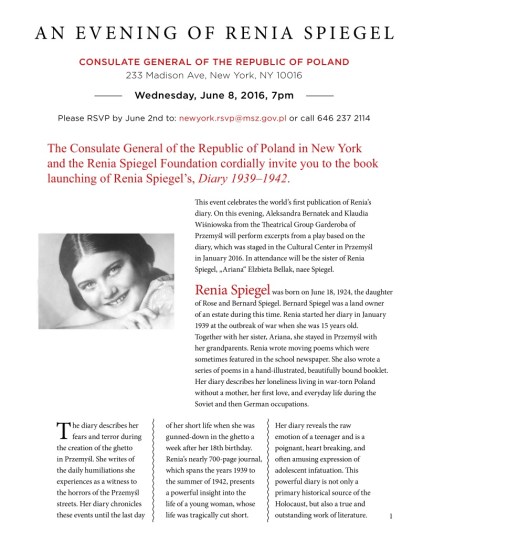
ReniaEvent1ReniaEvent2

← Older posts
Newer posts →

Categories

  • Anthropology (37)
    • Archives (14)
    • Fieldwork (7)
    • Ground Penetrating Radar (GPR (4)
    • Research Methodology (8)
  • antisemitism (14)
  • Association of Descendants of Jewish Central Poland (32)
  • Catholicism (8)
  • Conference (1)
  • Discrimination (2)
  • Family (69)
    • Bereda (17)
    • Kolski (13)
    • Piwko (22)
    • Rotblit (3)
    • Walfisz (4)
    • Winawer (7)
  • Genealogy (11)
  • Heritage work (66)
    • Commemoration (23)
  • Identity (18)
  • Israel (6)
  • Jewish Culture (89)
    • Cemeteries (51)
    • Museum (7)
    • Synagogues (33)
  • Jewish immigrants (8)
  • Jewish Religion (1)
  • Memory (70)
  • Names (14)
  • Photographs (6)
  • Pifko-Winawer Circle (5)
  • Poland (125)
    • Baligród (1)
    • Bolimów (1)
    • Brześć Kujawski (5)
    • Buk (1)
    • Chodecz (1)
    • Dukla (2)
    • Dąbrowice (1)
    • Gdynia (1)
    • Gostynin (2)
    • Gąbin (1)
    • Izbica Kujawska (1)
    • Kazimierz (4)
    • Kowal (1)
    • Koło (1)
    • Krakow (7)
    • Krośniewice (1)
    • Kutno (6)
    • Kłodawa (1)
    • Lesko (8)
    • Leszno (1)
    • Lubień Kujawski (1)
    • Lubraniec (1)
    • Lutowiska (3)
    • Piła (3)
    • Podgórze (2)
    • Poznan (11)
    • Przemyśl (2)
    • Pzedecz (1)
    • Radom (1)
    • Radymno (1)
    • Sanok (1)
    • Skierniewice (5)
    • Sobota (2)
    • Tarnów (2)
    • Warsaw (22)
    • Wielkopolska (1)
    • Wronki (7)
    • Włocławek (20)
    • Zasław (2)
    • Łódź (1)
    • Żychlin (30)
  • Polish Culture (10)
  • Polish-Jewish Heritage (60)
  • Polish-Jewish relations (60)
  • Post-World War II (24)
  • Pre-World War II (22)
  • Reclaimed Property (1)
  • stereotypes (3)
  • Survival (9)
  • Trauma (3)
  • Uncategorized (5)
  • Victims and perpetrators (4)
  • World War II (45)
    • Jewish Ghetto (12)
    • Nazi Camps (5)
    • Polish Underground Army (3)
  • Yiddish (5)

Enter your email address to follow this blog and receive notifications of new posts by email. Your email address will not be shared.

Archives

  • October 2025 (1)
  • July 2025 (8)
  • June 2025 (1)
  • April 2025 (1)
  • August 2024 (3)
  • July 2024 (3)
  • May 2024 (2)
  • April 2024 (1)
  • May 2023 (2)
  • January 2023 (2)
  • December 2022 (7)
  • November 2022 (2)
  • October 2022 (5)
  • September 2022 (1)
  • January 2022 (1)
  • August 2021 (1)
  • December 2020 (2)
  • July 2020 (1)
  • May 2020 (3)
  • April 2020 (1)
  • March 2020 (1)
  • January 2020 (2)
  • May 2019 (1)
  • February 2019 (1)
  • November 2018 (1)
  • September 2018 (1)
  • August 2018 (3)
  • July 2018 (1)
  • June 2018 (1)
  • May 2018 (1)
  • April 2018 (2)
  • March 2018 (2)
  • February 2018 (2)
  • January 2018 (2)
  • December 2017 (2)
  • November 2017 (2)
  • October 2017 (1)
  • September 2017 (3)
  • August 2017 (3)
  • June 2017 (2)
  • May 2017 (3)
  • April 2017 (1)
  • March 2017 (2)
  • February 2017 (1)
  • January 2017 (2)
  • December 2016 (2)
  • November 2016 (4)
  • October 2016 (1)
  • September 2016 (6)
  • August 2016 (2)
  • July 2016 (1)
  • May 2016 (4)
  • April 2016 (2)
  • March 2016 (3)
  • February 2016 (4)
  • January 2016 (3)
  • December 2015 (3)
  • November 2015 (5)
  • October 2015 (5)
  • September 2015 (3)
  • August 2015 (4)
  • July 2015 (3)
  • June 2015 (3)
  • May 2015 (4)
  • April 2015 (9)
  • March 2015 (3)
  • February 2015 (2)
  • January 2015 (5)
  • December 2014 (4)
  • November 2014 (9)
  • October 2014 (2)
  • September 2014 (1)

Copyright Notice

All original text and images are copyright © Marysia Galbraith. Please contact the author before quoting.

Blog at WordPress.com.

  • Subscribe Subscribed
    • Uncovering Jewish Heritage
    • Join 146 other subscribers
    • Already have a WordPress.com account? Log in now.
    • Uncovering Jewish Heritage
    • Subscribe Subscribed
    • Sign up
    • Log in
    • Report this content
    • View site in Reader
    • Manage subscriptions
    • Collapse this bar
 

Loading Comments...