Our day started with a quick trip to the grocery store to pick up food for lunch. How fitting that we found matzo!
Annice and Matzo at Kaufland
Our next surprise was the large matzevah fragment left in front of the cemetery gate by an anonymous donor who found it buried under grass in a private garden. It memorialized a 60-year-old man, though his name is not on this fragment.
Lawrence reading the Hebrew inscription on the tombstone fragment. Look how big it is, even without it’s top
Bożena Gajewska was there to greet us with all of the saws and other equipment I had arranged to be delivered to her for our project. She also brought Pringles from the local factory.
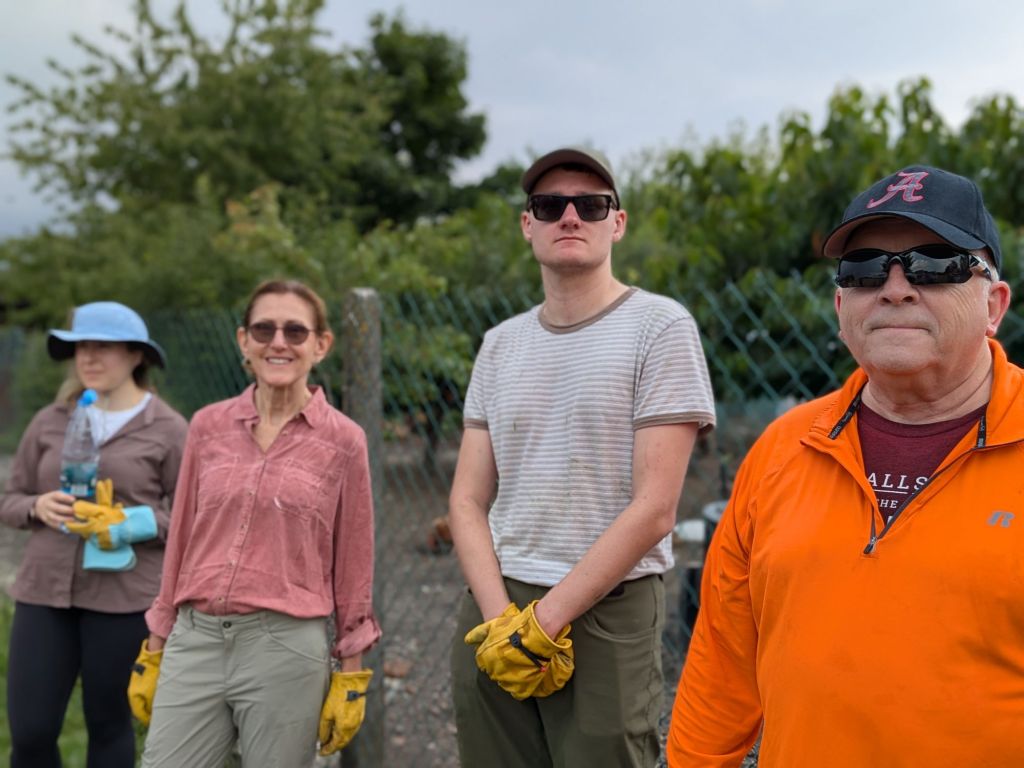
We got right to work clearing a path to the depression we plan to inspect with non-invasive ground penetrating radar. Some got hold of the loppers and others grabbed the branches as they were cut and hauled them out of the cemetery, where archaeology graduate student Caleb took charge of stacking them. In fact, he did this task systematically and neatly all day.
Working
Claibourne, who is heading up the GPR research, crawled and bushwhacked through the dense blackthorn to lay a measuring tape that would keep the cutters working in the right direction. Steven gave Claibourne the nickname “Magnum” when he saw that he is listed as the PI (principal investigator) of the project.
Filip instructing us on proper behavior in the cemetery
We took a break when Filip Szczepański of the Rabbinical Commission arrived. The most important thing, he told us, is not to disturb those who are buried–we are not to dig in the ground or do anything that might expose human remains. If we find any human bones, they are to be left at rest and carefully covered in the location where we find them. Steven suggested we get a bag of topsoil for this purpose.
We had other visitors and helpers, including Ola Głuszcz, who is a high school history teacher, and her daughter, as well as Henryk and Agnieszka Olszewski, and Żychlin mayor Grzegorz Ambroziak.
Some guests
We got as much as or more done than we expected, with a path cleared across the middle of the depression. Tomorrow, we’ll continue our work, making sure all the stumps are flush with the ground so the GPR can run over the ground smoothly.
New alleyway to the research site
I refuse to get my hopes up. Even if we find no evidence of a mass grave, that is important information. We will know this disturbance had other causes and we should look elsewhere. But maybe? Filip, whose first impression was that we are looking at a hole made by people digging out sand, said there must be a reason the metal sign nearby refers to a mass grave. There must have been something there that made them put it there.
As I piece together information about wartime mass burials in the Żychlin Jewish Cemetery, I’m finding other valuable records like this photograph of the Żychlin synagogue:
Synagogue built around 1880. Source: collection of Andrzej Kubiak
The Association of Friends of the Kutno Lands (TPZK) posted excerpts from Anna Wrzesińska’s article about Żychlin’s Jews. Mostly, they are wartime memories passed down in Żychlin families. The original post is here: https://tpzk.eu/getto-w-zychlinie/.
These difficult truths are what compel me to contribute to the memorialization of those who suffered and died during the Shoah.
The Google translation:
(…) After the outbreak of World War II and the occupation of the town by the Germans, there were about 3,600 Jews in Żychlin, including many refugees. From the beginning, Jews were treated badly: they were humiliated and beaten, their apartments, workshops and shops were searched and robbed. Then came the obligation to wear emblems with a star. In April 1940, the Germans arrested Jewish intellectuals, who were deported to concentration camps. In June 1940, a ghetto was established on the premises of the so-called Fabianówka, i.e. Karol Fabian’s complex of industrial buildings. In July 1940, a second ghetto was established. In total, over 4,000 Jews were gathered in them. About 800 people died of hunger and disease in the ghettos. In February 1942, the German police killed 100 Jews on the streets of the large ghetto. In March 1942, the Germans carried out an action to liquidate the ghettos, deporting over 3,000. Jews to Krośniewice and then to the Kulmhof Nazi extermination camp in Chełmno nad Nerem. The members of the Żychlin History Lovers Society often talk about the ordeal of Jews during World War II. They shared their memories once again on March 9, 2016.
Józef Staszewski: “After the Germans entered Żychlin, initially they were not harsh towards the Jews. Until July 1940, that is, until the creation of the ghetto, they lived rather freely. On July 15, the decision was made to create a ghetto, or rather a second ghetto. The large ghetto was along Narutowicza Street, partly Łukasińskiego Street and today’s Traugutta Street. It reached all the way to the river. Several buildings were excluded from this area, including the Kumm house and Sędkiewicz bakery.
The large ghetto was created in one day, within four hours. The Germans simply relocated the residents of Narutowicza Street, where most Jews lived. They were relocated from the left side of the street to the right, just as they stood, both Jews and Poles. The German mayor led all this, he had it perfectly planned.
Looking from the church, the ghetto was on the left side of Narutowicza Street. The gate to the ghetto was from the Narutowicza side, like the billboard is today. The ghetto was not surrounded by a wall, but fenced with pickets. It was relatively easy to leave it, and Jews often did so. It had its own board and police. On its territory there was Rabinówka and a hospital.
The small ghetto was located on ul. 1 Maja, then Pierackiego, in the buildings of the so-called Fabianówka. It was established almost at the same time as the large one. Jews who did not fit into the large ghetto were sent there.
Information on this subject is supplemented by Jerzy Banasiak: “The ghetto was large on Narutowicza from the river to the right. My uncles Edek and Tadek had a mechanical workshop there, he did not join the..and they were richer than them. in Yiddish. ghetto, like Andrzejewski’s workshop, was taken over by the German Krebs. This area was fenced off. From the river, on the corner, there was a second gate to the ghetto, it was made of planks and reinforced with barbed wire. I lived near the smaller ghetto – Aleje Racławickie 20. In Fabianówka there were wealthier Jews, displaced from the left side of the city. There was a brickyard, to which a gate led, a palace, two large buildings, a brickyard, to which a gate led. buildings and a row of workers’ houses, still stand today. It was very cramped there, when it was warm, people slept under the roof of the brickyard.
Jews had to wear Jewish stars, initially on their backs, then on the sleeve. The stars were painted on the clothes or sewn on. My father, who worked in a dairy, made stars from sheet metal for sale.”
Tadeusz Kafarski: “The Germans also resettled my family. We lived near today’s veterinary clinic, and they resettled us to ul. Kościuszki 3, to a former Jewish house. I saw how in the summer the Germans would drive the Jews to the nearby ponds to swim. If they didn’t want to go into the water, they would shoot them. They ordered us, the children, to throw pebbles at them.”
The Jews were used for various cleaning jobs in the city. On the orders of the Germans, they dismantled crosses and chapels. They also built a villa for the mayor of Żychlin, Hempel, in the city park on the site of the demolished Kościuszko Stone (today it houses the Municipal Public Library).
“The most terrible thing I saw, recalls Mr. Staszewski, was the image of exhausted Jewish children. How hungry they were! We had orders from the scouts to deliver food to the ghetto, and that’s what we did: we brought bread, beets, potatoes, carrots…”.
It wasn’t safe. As Mirosław Zomerfeld recalls: “My father wasn’t displaced because he had a forge. We lived nearby. My aunt helped Jews in the ghetto. They deported her to Germany for work, she was not far from Dachau.” (…)
People’s behaviors varied. This is how Father Roman Indrzejczyk recalls the events of 1942: “I experienced the war and the German occupation in Żychlin near Kutno as a small boy. I came across people’s terror, helplessness, suffering, humiliation, persecution, injustice… I also saw the ghetto – I felt the great injustice done to these people, closed, fenced offfrom “our” world. A world that was already very limited by the violence and cruelty of the harsh, ruthless Nazi rule. I know that some of us tried to do something to give a little help and hope or at least show kindness and solidarity, but we always did it marked by great fear. Fear was widespread then, because “they” – the occupiers – could do everything worst. I don’t remember exactly when it was, but it was definitely before the liquidation of the ghetto: one of my peers, Stasiek, told me that tomorrow there would be a “deportation” in the city, “they will be deporting Jews from the ghetto” and his father would have to participate in it. I didn’t fully understand this information, but my father said then: “You don’t have to, an adult doesn’t have to do what is wrong, even if they tell you to. (…) You have to help, you have to defend the wronged, and not participate in doing wrong”. I understood that my father was talking about something very difficult, but I remember it to this day as an oracle. This “does not have to”, “should not do evil”, “should save, help the wronged” is more important than all fear and egoism. In my little heart, this awareness remained that only such a person deserves respect and recognition. I guessed that such an attitude rarely happens…”.
And this is how the Jewish woman Helena Bodek recounts the last days of her stay in the Żychlin ghetto (Jak tropione zwierząt. Wspomnienia, Wydawnictwo Literackie, Kraków 1993, p. 66): “General panic. The ground is burning under people’s feet. They walk as if unconscious. In their eyes there is mad fear, fear of death. Everything indicates that the time of liquidation is approaching. Finally, the mail to the ghetto is stopped. The interruption of contact with the outside world is a warning signal for us: we have to escape – now or never”.
Helena Bodek and her mother managed to escape from the ghetto. They reach Gąbin on a horse-drawn carriage they accidentally meet. They stop in the local ghetto, where there is still peace. There, three days later, they learn from other escapees – several young boys – about the liquidation of the Żychlin ghetto.
“They avoided arrest completely by accident. […] the navy blue policeman Ćwik, for his friendly attitude – he went from house to house with words of comfort – received many valuable gifts. These things were brought to his apartment by these young men. When they were about to return to the ghetto, it turned out that it was surrounded by the Gestapo. Ćwik, fearing for his own skin, ordered them to flee. The boys tell the story of the last moments of the Żychlin ghetto. Shortly before its liquidation, the local police went crazy. All the Jewish policemen were ordered to line up and were shot one by one. Hilek Zygier was killed shouting: “Long live the Jewish nation!” Under the pretext of contacting her husband, she was led out of the Oberman home. After taking a few steps, she fell to the ground, shot in the back. The same fate befell Oberman’s elderly parents. Of the entire family, only a several-year-old son remained. When a neighbor tried to take care of him, the Germans killed her on the spot. The child stood in the cold and cried, and people were afraid to approach him. On the evening of Oberman’s death, Altek’s brother was also shot.
The terror intensified with each hour. The police led groups of people to the Jewish cemetery. There they were murdered – among them the young Halusia Chude. Blood flowed in streams, leaking into the gutter outside the ghetto. Dr. Winogron died – a large diamond was noticed on her finger. According to other rumors, at the last moment she tried to contact her former maid Aryan to entrust her with little Maciuś. Desperate people went mad: a young married woman in the last month of pregnancy, Rachcia Gelman, threw herself into a river in front of the Gestapo, where she was hit by German bullets. Chałemski’s mother, an old woman, locked herself in a wardrobe, fearing the Germans, and died of suffocation. At dawn, the carriages commandeered from peasants from the surrounding villages arrived. People were loaded onto them. They stood and, so as not to fall out of the carriages, held each other’s hands tightly. Amid the cries of children, the lamentations and screams of women, the line of carriages moved towards the railway station. There, the unfortunate were packed into cattle wagons for their last journey…
The small, Jewish town of Żychlin is “Judenfrei”, the ghetto has ceased to exist. And it happened on Purim. It was on this holiday – a holiday of joy, a holiday of children – that thousands of innocent beings were sent to death and torture together with their fathers and mothers…”
After the Jewish residents of Żychlin were deported to Kulmhof, the Germans searched their homes for hidden valuables. At that time, the manor house and factory buildings of Fabianówka, Rabinówka on Narutowicza Street and several other buildings were demolished to their foundations. Only after systematic plundering were the Polish population ordered to settle the area of the former ghetto.
We have presented fragments of the article by Anna Maria Wrzesińska entitled “Jews in Żychlin”, which was published in the 20th volume of Kutnowskie Zeszyty Regionalne.
Our last two days in Żychlin highlight the importance of presence. If we hadn’t stayed here several days, we probably wouldn’t have learned everything we did. As we cleared more of the stubborn blackthorn bushes, the cemetery revealed more secrets. After seeing the progress we were making, the inhabitants of Żychlin opened up to us, too.
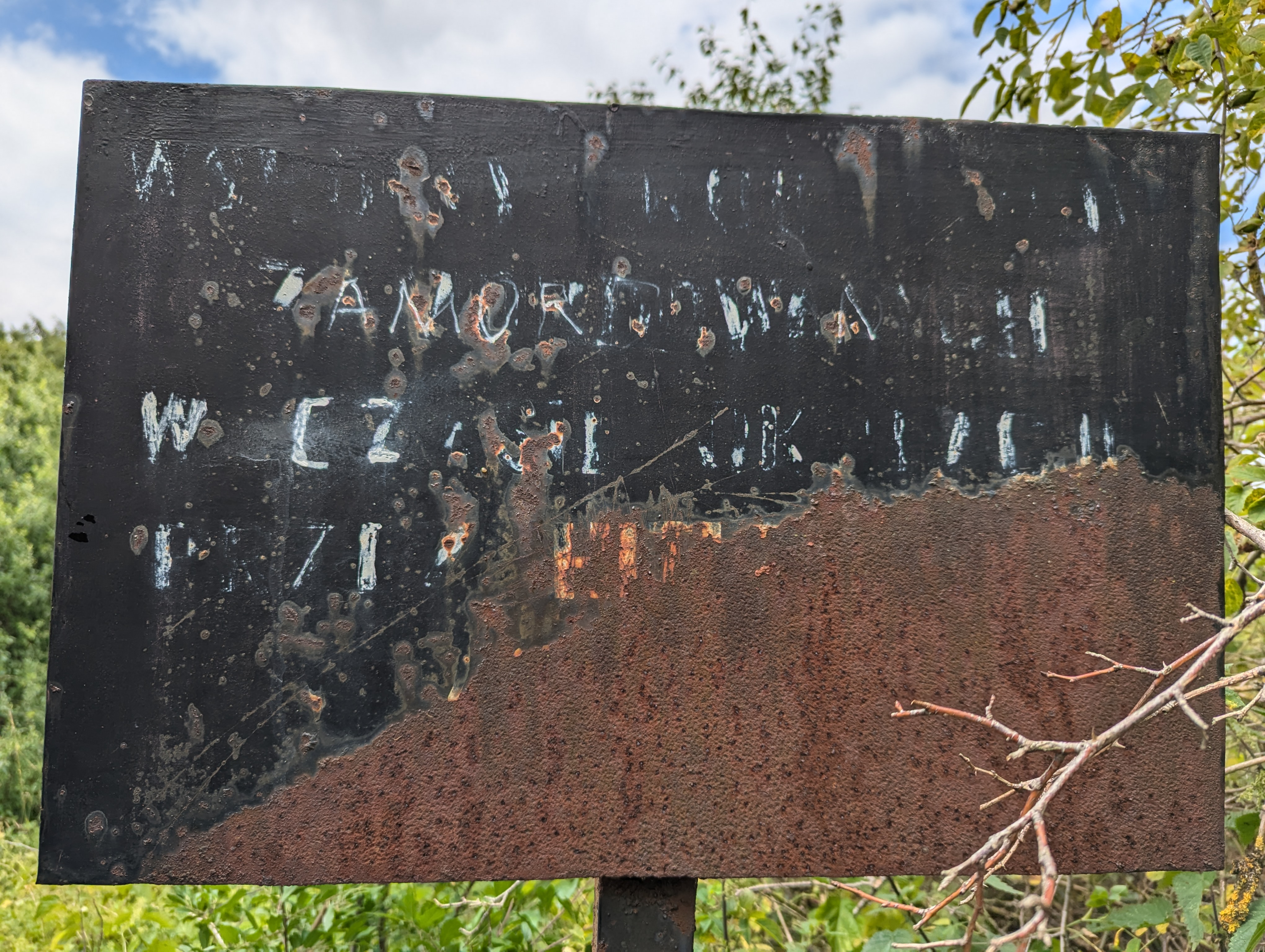
Agnieszka Olszewska, a local amateur historian, leads us through brush and brambles to the site of a collective grave (note the back of the rusted sign barely visible at top left). Could these boulders be the remains of a memorial stone?
How would you respond if a group of foreigners come into your town and started weed whacking a cemetery? My guess is most of us would just watch from a distance, curious and a bit suspicious.
By Wednesday, people started telling us stories they pulled out of the depths of their memory. Others claimed ignorance about the town’s Jewish history, but the more we engaged in conversation, the clearer it was they knew more than they had initially let on.
ADJCP member David Goren, whose ancestors came from Żychlin, accompanied me to ask some of the neighbors about the cemetery. We collected important testimony that will help us bring Jewish memory back in this community.
Żychlin descendant David Goren with our tireless Polish partner Bożena Gajewska. After a physically demanding day of weed whacking she went home and baked us raisin and date pastries
The Wujcikowskis live across the street from the cemetery. They had already shown us kindness, letting all the volunteers use their bathroom. David had noticed historical photos in their flower shop suggesting they had lived there a long time. In fact, the large property and house have been in the family since before the war. When Katarzyna (Kasia) didn’t know the answers to our questions, she escorted us to her parents Henryka (Henia) and Grzegorz Wujcikowski who came out of the farm building next to the flower shop. They greeted us warmly. Though they weren’t sure they could help us find old photographs of the cemetery, Grzegorz shared his family history with us. The property originally belonged to Grzegorz’s father’s uncle. Because it was one of the finest houses in town, some of the occupying Gestapo moved in and fenced the land to raise horses. Grzegorz’s aunt and uncle weren’t forced to leave, instead sharing the three-story house with the Germans. After the war, Grzegorz’s parents joined their aunt and uncle, who had no children of their own, and eventually became the owners of the property.
Grzegorz was born after the war. He knew Moshe Zyslander, a Holocaust survivor from Żychlin who emigrated to Israel. In 1989, Zyslander led the initiative to build the memorial monuments in the Jewish cemetery, as well as the surrounding gate and fence. When the Wujcikowskis learned about Zyslander’s plans, they returned the tombstone fragments that the Germans had taken from the cemetery to build a pig sty, the same farm building where Grzegorz and Henia had been working when we arrived. The stones removed from its walls make up the bulk of the 50 tombstone fragments embedded in concrete mounds in the cemetery. Whenever Zyslander returned to visit the cemetery, he would stop by the Wujcikowski’s for a visit.
The Wujcikowskis showed kindness to Jewish descendants in the past and continue to do so today.
Descendants Marysia, Liana, and David took our student volunteers out for ice cream. They were a great help, painting the gate and clearing brush. They didn’t seem to know a lot about the Jewish history of Żychlin but seemed interested in learning more
I’ve been very concerned about properly marking and memorializing the mass graves in the cemetery. Reports in the archive of the National Institute of Memory document the shooting of 200 people in 1942. Other sources indicate that when the ghetto was liquidated, the infirm were shot on the spot rather than being transported to the Chełmno death camp. For the site to be designated officially, it’s important to obtain testimony from witnesses. We were able to talk to two people who were not witnesses themselves but were told about the murders by a close relative who saw what happened.
We spoke with the neighbor next door to the cemetery the day before we started our work. She confirmed she knew we were coming; the city had informed her. She showed us where the city had dropped off a dumpster for the brush we cleared. A big goat was chained up outside the cemetery along the dirt drive leading from the road. “We put her there to eat the grass, so the drive is passable,” she explained.
Over the next two days, she and her son were in and out of their yard feeding their fowl, doing their farm work, and keeping a covert eye on us. As we cleaned up on our third day of work, David and I approached their fence to invite them to the memorial service we planned for the next afternoon. Mrs. Anna came over with her son Marcin and grandchildren Marceli and Lena. Anna has observed the comings and goings at the cemetery since she married over 40 years ago. Her husband, who grew up in the house, did so even longer, until his death in February.
Anna remembers how nice the cemetery looked when she first married. People used the space as a kind of commons; they walked their dogs or sunbathed, and her son played soccer with his friends. On holidays (the Catholic holidays like All Saint’s Day), the family would light a candle lantern at the monuments in remembrance of the dead.
As the cemetery became overgrown, people started going there to drink, play music, and get into other kinds of trouble. Anna’s husband would chase them out, threatening to call the police. She understands people sometimes want to get together and drink, but why destroy a cemetery? Why walk their dogs there? The last time she was at the Catholic cemetery where her husband is buried, people were walking their dog there, too. It isn’t right. She doesn’t understand why people would destroy monuments, either. Why? They should respect them. Although she sometimes contradicted herself, her overall orientation towards us and the cemetery was benevolent. It also suggests a growing recognition that the Jewish cemetery is a sacred space.
Then, Anna confided something that might help us get the mass grave demarcated: a personal account of the crime, albeit second-hand.
When her father was a young boy, about the age her 9-year-old grandson is now, he walked across the fields to see what was happening at the cemetery. He witnessed Jews being shot, their bodies falling into a trench. He was so frightened he peed in his pants and ran home to his mother.
Looking out across the field from what is probably the site of a mass grave in the cemetery. This view probably looked pretty much the same over 80 years ago when Anna’s father ran across the field after witnessing the murders
Henryk Olszewski is a local amateur historian whom I have known for ten years. He had a stroke two years ago and has been slowly recovering. He manages the website and Facebook page Żychlin Historia with his wife Agnieszka. He has an unconventional way of presenting information and sometimes his posts perpetuate stereotypes about Jews and Polish-Jewish relations, but he’s a dogged researcher.
Agnieszka visited us at the cemetery with photos she and Henryk took in 2019 of a rusty sign; though the white lettering has faded, enough remains to make out “Wspólny Grób zamordowanych w czasie okupacji przez Hitlerowców” (“Collective Grave of those murdered during the Nazi occupation”). She, David, and I walked around the back of the cemetery, and after a few false turns, we found an entrance to a clearing where the back of the sign was visible. We also found some large boulders. Could they be fragments of a commemorative stone? We asked a few people why there are places in and around the cemetery that are less overgrown or even barren of vegetation. One possibility could be that the lye spread over mass graves made the soil infertile.
Not much is left of the lettering, but it appears to say “Wspólny Grób zamordowanych w czasie okupacji przez Hitlerowców” (“Collective Grave of those murdered during the Nazi occupation”). Photo credit: Agnieszka Olszewska
Thursday evening, Steven and I visited the Olszewskis at their home. While they treated us to pierogi, stuffed pancakes, and a plateful of tasty cakes, I asked Henryk to remind me the name of a man I met during my first visit to Żychlin. Of course he knew, and immediately picked up the phone to call Józef Kowalski so I could check on a story he told me. Józef confirmed that his grandfather, who was a young man during the occupation, was called out by the Gestapo one night and ordered to dig a ditch in the Jewish cemetery. His grandfather, his mother’s father, told him the story directly. Józef also confirmed the ditch was where the people shot in the cemetery were buried.
The dissonance between the social nature of our interactions and the horrific topics we discussed doesn’t escape me. And yet, these kinds of connections are what make possible the recovery of difficult memories. Our work goes beyond the restoration of the physical space of the cemetery, to something deeper. We’re also restoring the memory of the people who inhabited the city over 80 years ago, and the events that took them away forever.
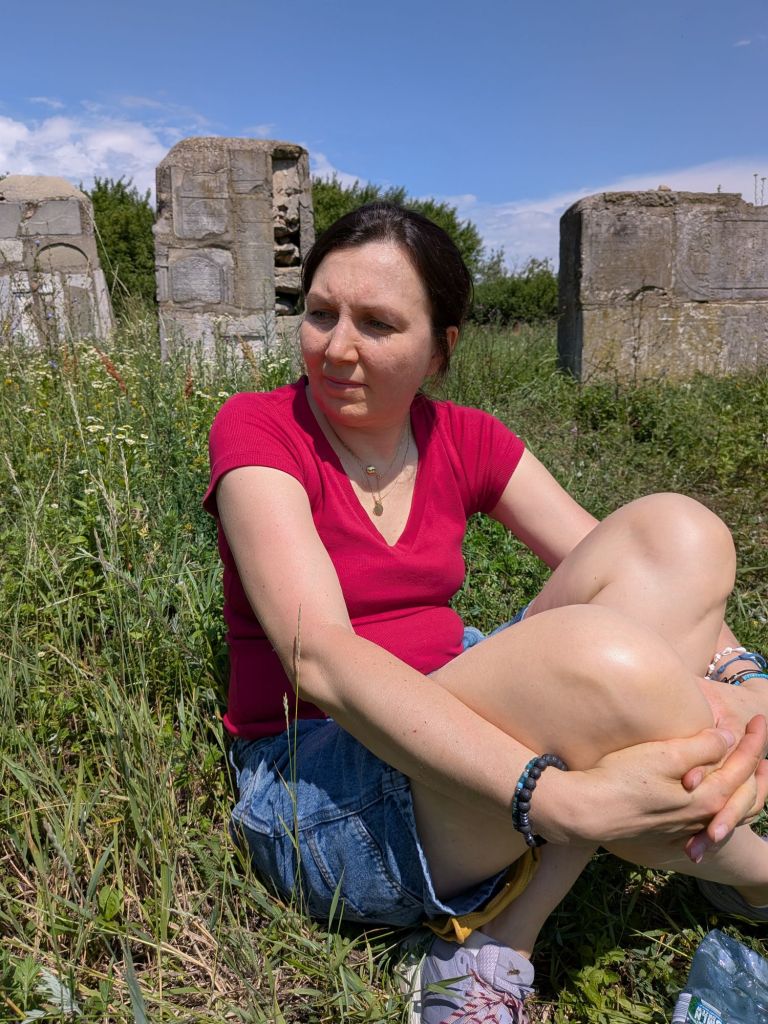
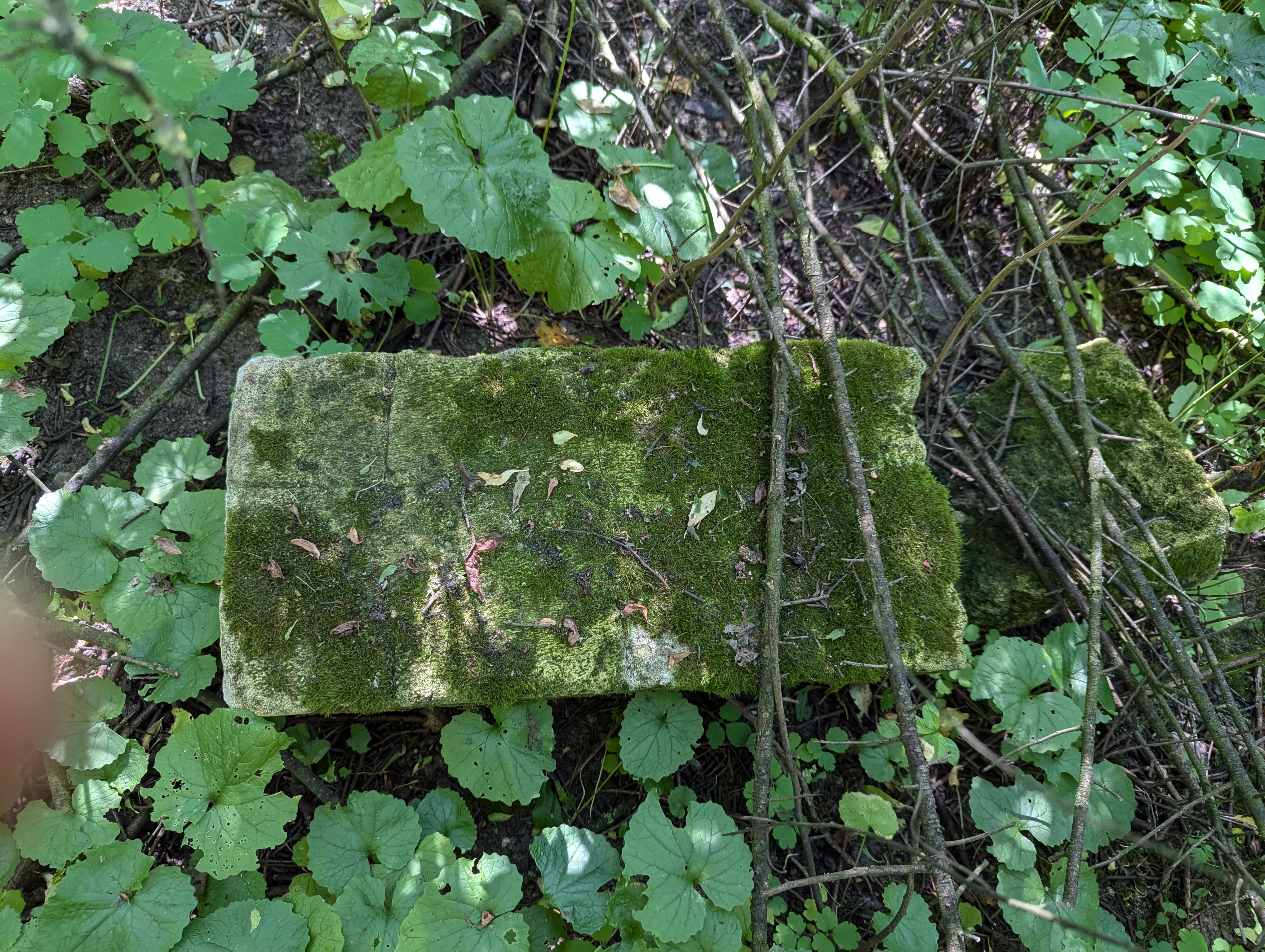
As we cleared underbrush, we found a few stones like these that appear to be fragments of tombstones
The new National Memorial for Peace and Justice opened in Montgomery, Alabama on April 26, 2018. It stands as a reminder of the many acts of discrimination against African Americans over the course of American history, and in particular memorializes over 4400 documented lynchings that occurred between 1877 and 1950.
National Peace and Justice Memorial, Montgomery, Alabama
800 rectangular iron blocks hang several layers deep in rows around a square. Each block contains the name of a county and state where lynching occurred, as well as the names of the victims and the dates they were lynched. Some contain the name of just one victim, others contain dozens.
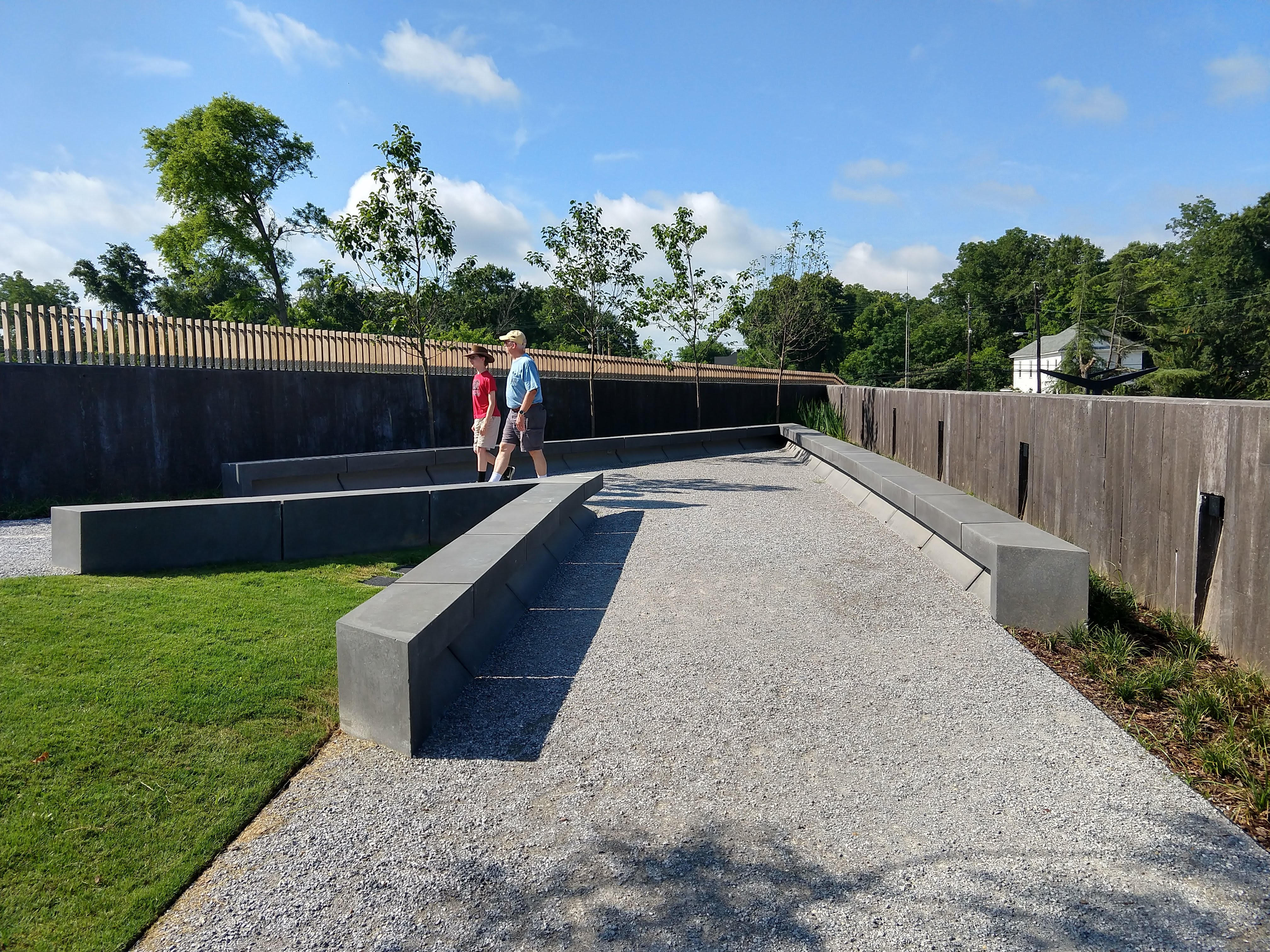
My husband, son, and I visited the memorial last week. The monument looms large atop an elevated earth mound. We walked past a sculpture of life-sized bronze figures in chains, and up the path from the entrance. The wall to our right got shorter as we climbed to the level of the memorial.
The wall to our right got shorter as we climbed to the level of the memorial.
We should have been climbing out of slavery and into freedom, but instead were confronted by the sea of iron blocks. The first ones we approached were set on the ground. At six feet tall, they approximate the height of a person. At the next corner of the monument, a path leads downward.
Blocks incised with county, state, and names of people who were lynched there.
We turn a corner and descend. The iron blocks hang around us.
The blocks in the first row are marked with counties in Alabama, each deeper row listing counties in other states and their victims. We couldn’t figure out how the inscriptions are ordered, so we asked one of the guards. He explained the blocks are arranged alphabetically by state and county in a spiral that starts in the outside row, goes all the way around the square, and then continues through each successive row ending with the most interior blocks.
As we walked downward, the blocks became suspended from iron poles. By the time we reached the bottom, they loomed above us, eerily echoing the hanging victims they document.
Hanging blocks loom above
Hanging blocks loom above
On either side of this below-ground passage, signs describe the circumstances in which people were lynched—for frightening a white child, or asking a white man for money they were owed, or for “standing around” in a white neighborhood.
On the lawn outside the monument, we walked by a second set of blocks, twins of the ones hanging in the memorial. Laid on their side as they are, they resemble coffins. The intent is for counties to claim the block with their name on it and to each set up their own memorial site. Over time, as such monuments proliferate, more and more gaps will appear in the blocks resting on the lawn. In effect, the memorial will become a network of sites mapping the places where lynching occurred.
Between 1884 and 1933, 10 people were lynched in Tuscaloosa, Alabama
Duplicate blocks await placement in the counties where lynching occurred.
Clearly, parallels can be made between the National Memorial for Peace and Justice and sites throughout the world memorializing the Holocaust. Rather than commemorating moments of national pride, they compel us to remember our failures. It doesn’t matter that I wasn’t born when these events took place. I’m an American, and proud to be one. And it is because of that sense of connection to my nation that I feel a sense of responsibility for what happened in my country, for the injustices that Americans perpetrated against other Americans. Even if I weren’t American, if it weren’t a failing of my nation, of people with whom I share a national affiliation, I would feel guilty—as a human being. Like I feel guilty that the Holocaust ever happened. It was a failure of humanity, of empathy that is only conceivable in its monumental horror because it actually occurred.
But no.
That’s not the entire truth. The fact is that, as a person of Jewish descent, I identify with the group that was victimized in the Holocaust. As a person of European descent, however, my group was responsible for the victimization of people of African descent. This shift in perception, from victim to victimizer, is a difficult one.
And the harm caused by racial bias and discrimination continues.
“Raise Up,” sculpture by Hank Willis Thomas at the Peace and Justice Memorial. Represents continued racial bias and discrimination by the criminal justice system.
Several blocks from the Peace and Justice Memorial, the Equal Justice Initiative’s Legacy Museum further highlights racial injustice in the United States. One exhibition has left me with a nagging feeling of distress, maybe because of uneasy associations with current conflicts about the highest courts in both the US and in Poland.
A single illuminated display summarizes all of the US Supreme Court’s rulings that address racial justice issues. Alongside the decisions most often discussed and celebrated, like expanding the right to vote and defending equal access to education, are many more that maintained or reinstitutionalized discriminatory practices. I didn’t know how complicit the Supreme Court has been in perpetuating injustice, but there it was made visible right in front of me.
For a brief period right after the Civil War, African Americans gained the right to vote and were elected into political offices. But then, Jim Crow laws imposed poll taxes and literacy tests that kept them from voting, and enforced segregation in businesses, buses, and public institutions. With one decision after another, the Supreme Court upheld such discriminatory practices, and whittled away at the rights of freed people of color. The 1896 Plessy vs. Ferguson ruling, in which the Supreme Court defended the constitutionality of segregation as long as African Americans had “separate but equal” facilities, is only the most well-known of many decisions upholding segregation and discrimination.
We like to see ourselves in a positive light. We identify more with Brown vs. The Board of Education than we do with Plessy vs. Ferguson. We celebrate the Civil Rights Movement, but shy away from a deeper acknowledgement of the harm inflicted by slavery, discrimination, and deeply entrenched biases. There is still a lot we need to come to terms with. I’m glad to see this new museum and memorial taking steps in that direction, and that they are in my adopted state of Alabama.









 Uncovering Jewish Heritage