Students from the local school came to help us today.
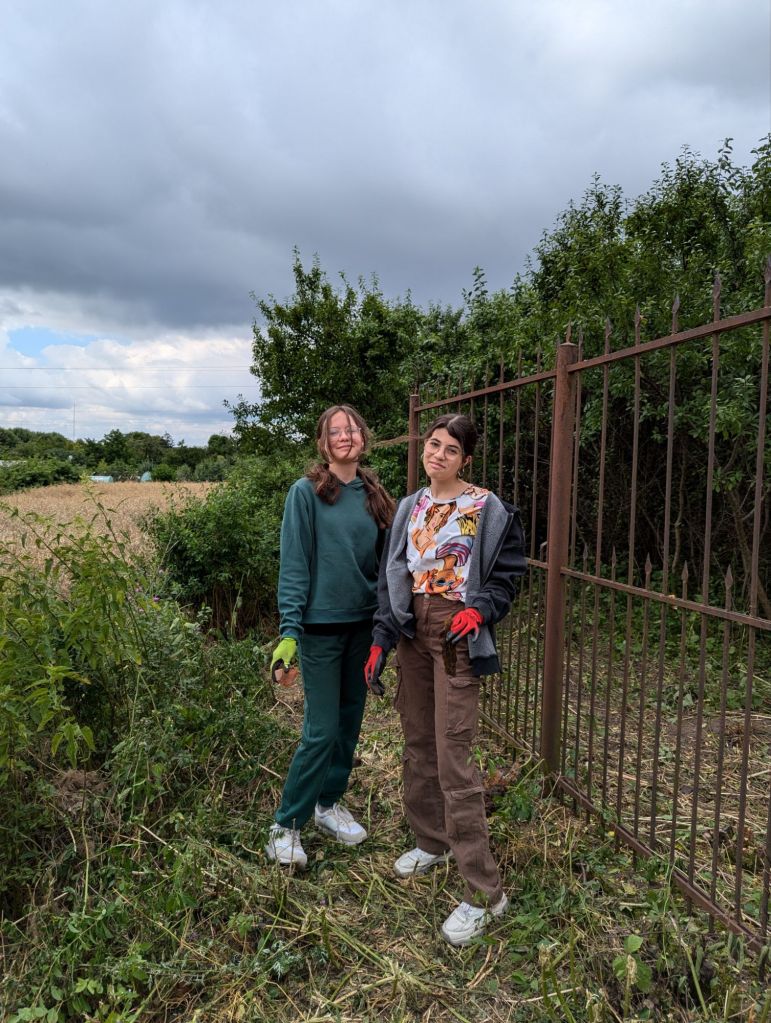
Kasia, Wiktoria, and Oliwia brush rust off the gate in preparation for painting
Wiktoria and Weronika collect trash and debris.
These young ladies just finished 8th grade and are headed to high school in Kutno in September. They tell me they feel excited about the change, but also a little anxious.
We have been talking in English. They have all studied the language so it’s good practice for them.
Before they began their work, I also showed them around the cemetery and talked a little about Żychlin’s Jewish history. I’m not sure they knew that before World War II, half or more of the inhabitants of the city were Jewish.
Asked why they came to help today, they said, simply, they were asked. One added, I wasn’t doing anything else.
We hope we’re planting some seeds of interest and perhaps a sense of recognition that Jewish history is part of Żychlin history. Maybe in future they will continue to preserve the cemetery even when we descendants can’t be here.
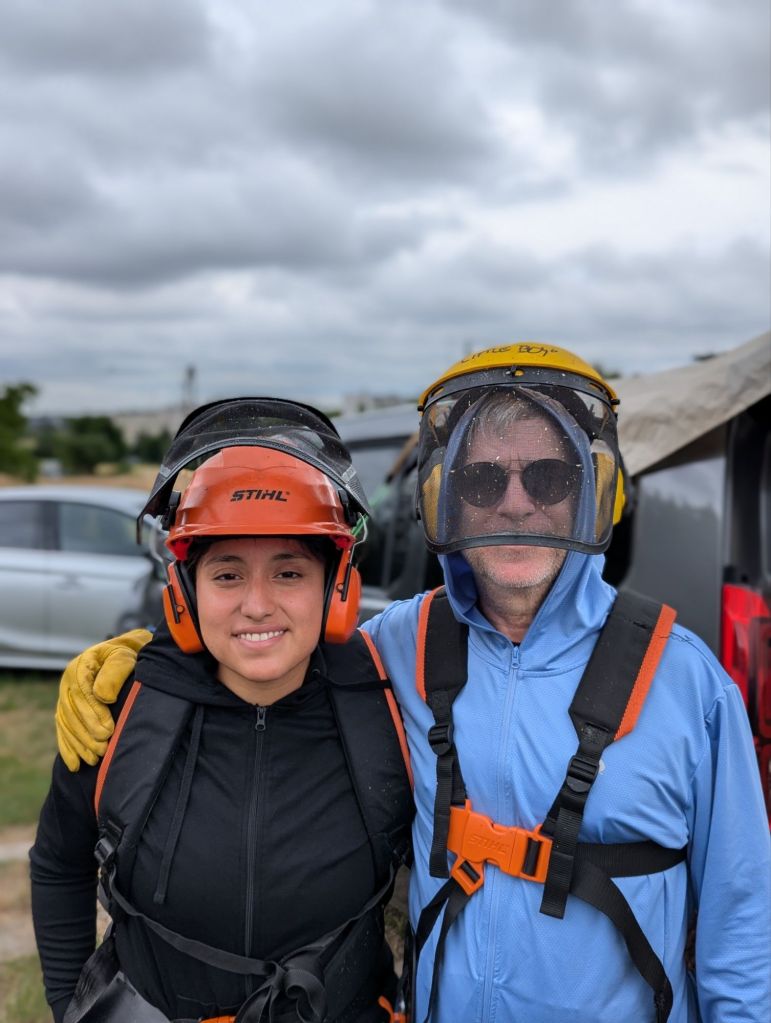
Also working hard today are David and Liana Goren. Liana has already mastered all the equipment. Steven calls her his apprentice.
Liana and David suited up to weed whack.
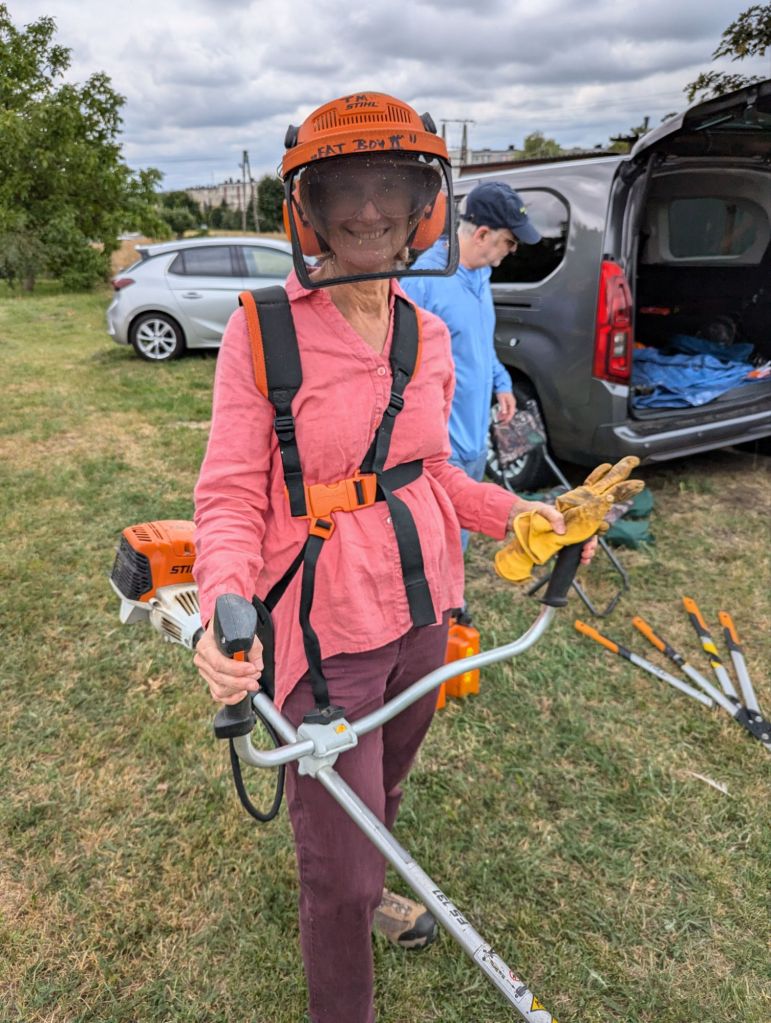
I’m far less capable than anyone else, but I’m stubborn. There’s a lot of ground to cover so even my awkward contributions help.
The Association of Descendants of Jewish Central Poland (ADJCP) will undertake the restoration of the Zychlin Jewish cemetery starting this summer. Like many Jewish cemeteries in Poland, dense vegetation covers most of the space, monuments and fencing are in disrepair, and signage is needed. Please consider joining us from July 1-5.
ADJCP has teamed up with the Matzevah Foundation, a non-profit organization with a wealth of experience restoring Jewish cemeteries. Our local partners Mayor Grzegorz Ambroziak, Bożena Gajewska, and Anna Wrzesińska will coordinate local volunteers and provide other assistance.
Photo: Monument incorporating matzevot fragments in the Żychlin Jewish Cemetery
How can you help?
Join us in Żychlin from July 1-5. This year, we will assess the condition of cemetery, clear vegetation, and determine whether sections of the fence require repair.
Provide financial support for the project by sending a donation via the “donate” link at adjcp.org, and specifying the funds are for “Zychlin memorial projects.”
Put us on your calendar for summer 2025 or summer 2026 when we expect to continue our work!
Żychlin is located about 75 miles west of Warsaw and about 45 miles south of Włocławek. The town’s Jewish Community was established in the second half of the 18th century, and until World War II, more than half of the inhabitants were Jewish.
ADJCP Memorial Tour at the Żychlin Cemetery, May 2023: Roberta Books introduces a short remembrance for Żychlin’s Jewish community. Photo credit: Bożena Gajewska
Żychlin mayor Grzegorz Ambroziak sent me photos of daffodils blooming around the memorial to the city’s Jewish community. These flowers, planted by local school children, are a symbol of remembrance. Daffodils are also associated with the upcoming anniversary of the Warsaw Ghetto Uprising, which started on April 19, 1943.
These small markers of remembrance matter. They offer a time and place to contemplate what used to be, what was lost.
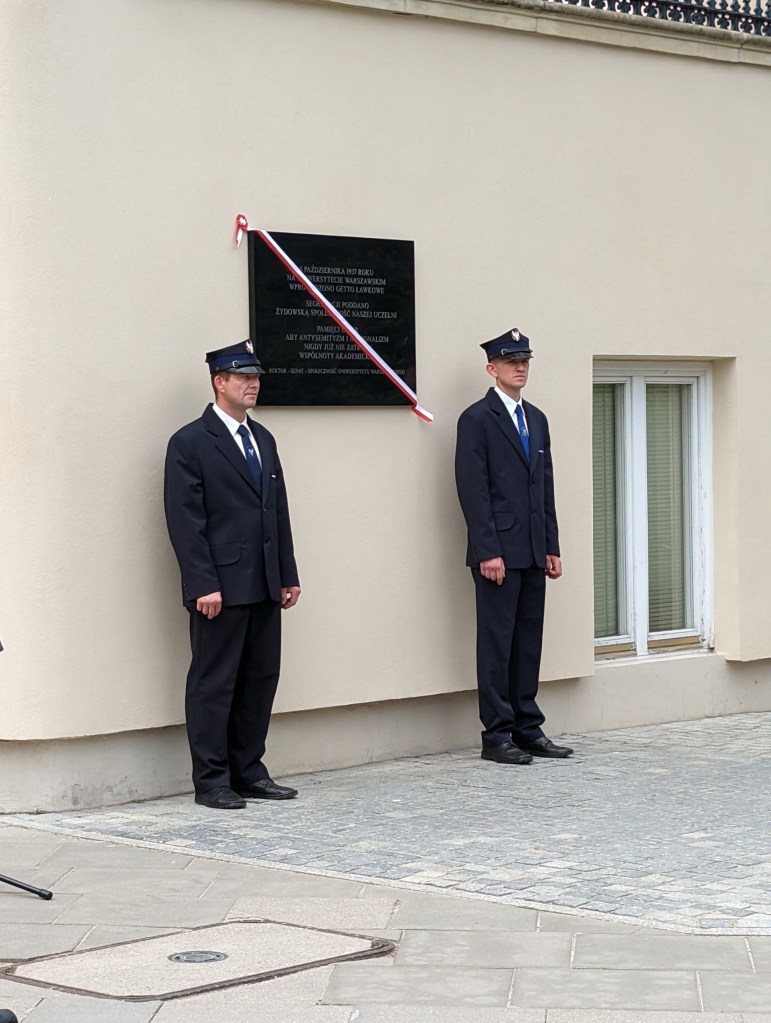
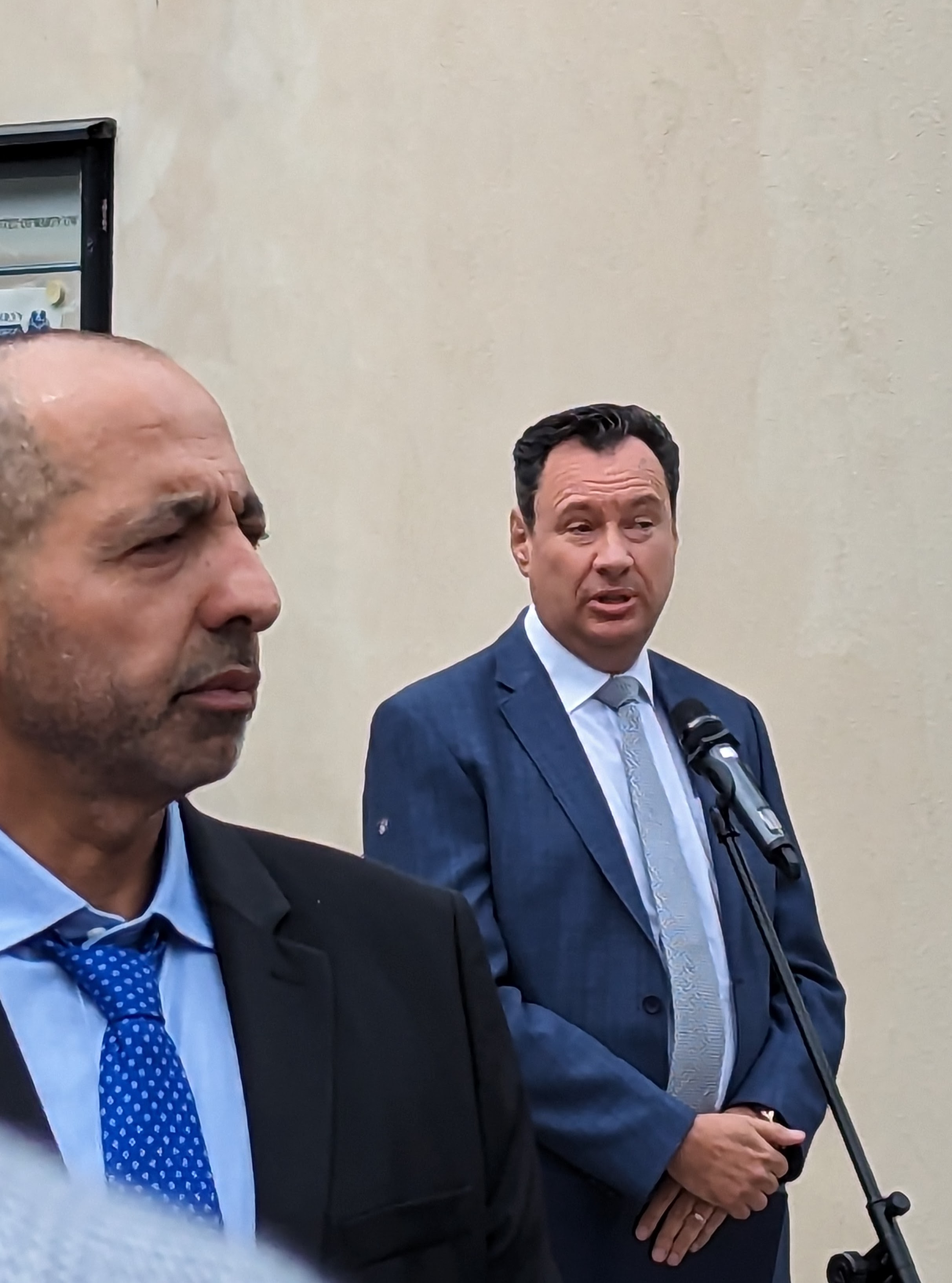
A dark stain in the history of Warsaw University was the decision to follow a nationalist trend in the 1930s and mandate segregated seating for the university’s Jewish students. Over 80 years later, a student-initiated campaign resulted in a permanent, public acknowledgement of this institutionalized discrimination. On May 22, University Rector Alojzy Nowak and Israeli Ambassador Yacov Livne dedicated a commemorative plaque before a crowd of about 200. Dignitaries, scholars of Jewish history and culture, and prominent members of Warsaw’s Jewish community gathered behind a red retractable belt barrier under the watchful eye of an Israeli guard, while a younger crowd of students and onlookers looked on from the other side.
Commemorative monument before the ceremonyDignitaries behind the red barrier belt. Journalist Konstanty Gebert on rightThe red barrier
I learned about the event serendipitously, when fellow ADJCP board member Ken Drabinsky invited me to accompany him to the Warsaw University Department of History to donate a copy of the self-published autobiography of Henry Balaban, nephew of renowned historian Meir Bałaban. I accompanied Ken as he presented the book to Łukasz Niesiołowski and Marzena Zawanowska at the Department of History.
Ken Drabinsky presenting Marzena Zawanowska, and Łukasz Niesiołowski with Henry Balaban’s autobiography
The commemorative ceremony began with songs in Yiddish performed by students from the Multicultural High School of Humanities named after Solidarity hero Jacek Kuroń, followed by predictable remarks by the rector and the Israeli ambassador about the need for unity across cultural and religious differences and the importance of remembering the dark as well as light moments in history. Both celebrated the university students who initiated the project.
Israeli Ambassador Yacov Livne with his security detail
The audience’s enthusiastic applause was reserved for the third speaker, Antonina Dukowicz from the Student Antifascist Committee. It didn’t come in response to her diplomatic discussion of the five years it took to persuade the administration and work out the appropriate language for the marker. Rather, the crowd responded to her expression of support for the Institute of Philosophy and Sociology at the Polish Academy of Science, which is under attack by the government because of the work scholars are doing there that highlights some of the less noble behavior of Polish people against Jews during the Nazi occupation. The specific trigger for the latest attack was a brief comment by Holocaust Scholar Barbara Engelking that “Jews were unbelievably disappointed with Poles during the war.” The remark caused such a strong reaction because it challenges the official narrative that Poles helped the Jews more than any other nation and that they couldn’t do more because they were under occupation and subject to persecution themselves.
The student speaker called the commemorative marker a symbol that sheds light on the current darkness in Poland, and urged viewers to let it be a model for remembering the difficult truth. She ended with a call to cut out all kinds of antisemitism and oppression, so that it is never repeated. The final applause erupted, falling into rhythm as it continued.
Some commentators criticized the university for failing to issue an apology, or for not making a bolder statement. I’m impressed by the way Antonina Dukowicz connected historical discrimination with contemporary political battles, and the way those in attendance affirmed those connections. Battles are being fought here to acknowledge the less noble moments in Polish Jewish history and to reaffirm values of unity and diversity.
October 5, 1937 at the University of Warsaw the bench ghetto was introduced; Segregation was given to the Jewish community of our academic institution; In memory of the victims so that antisemitism and nationalism will never again poison the academic community; rector-senate-community of the University of Warsaw
On September 28, I returned to Żychlin so I could visit the Jewish cemetery. I was eager to see the area that had been cleared earlier in the year as part of the “In the Footsteps of Żychlin Jews” program spearheaded by Bożena Gajewska and funded by the Forum for Dialogue.
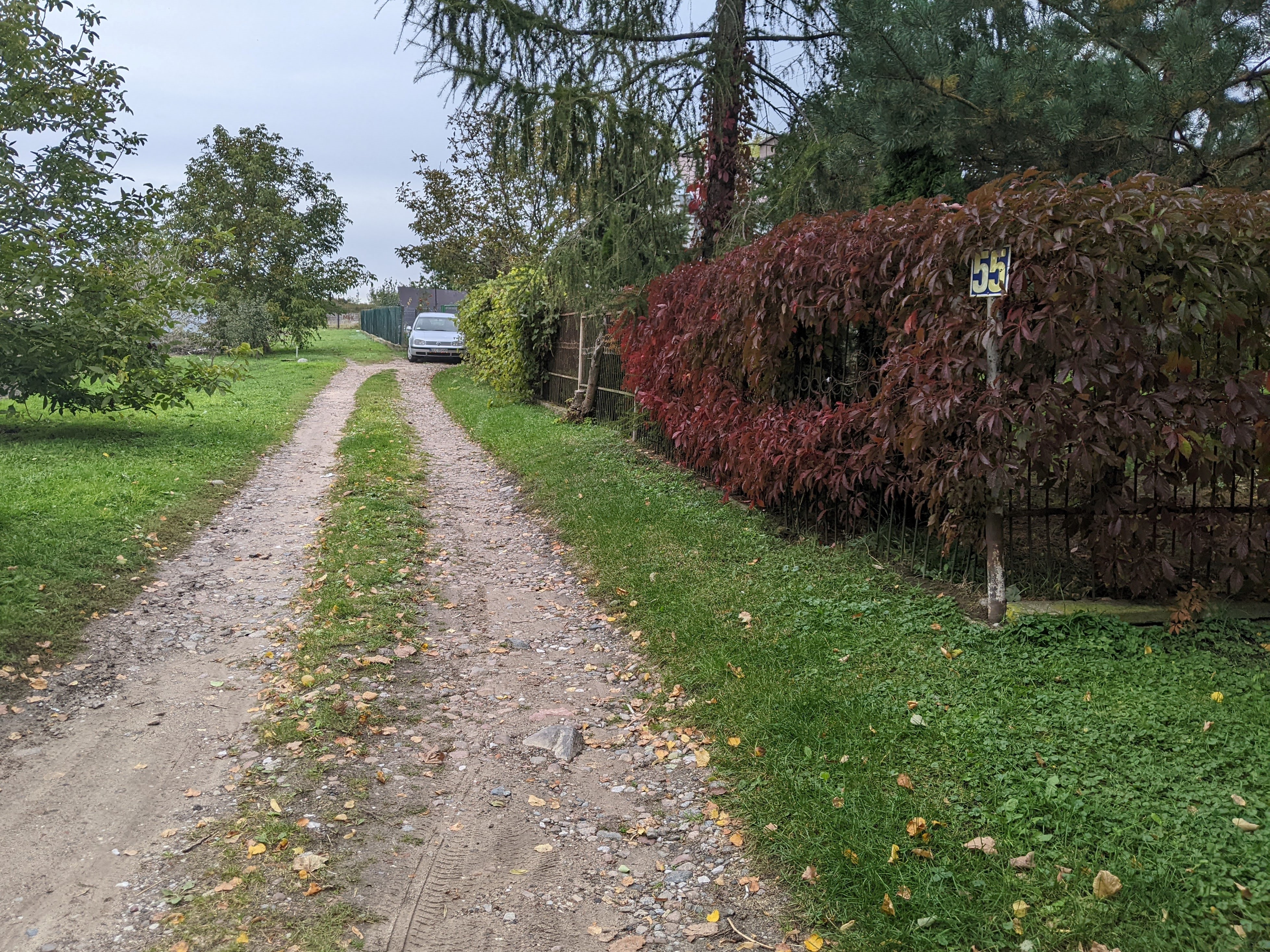
The first challenge was finding the cemetery. Even though I have been there several times and I had checked the location on Google Maps, I passed it the first time. I recognized the houses along the road from Google street view and guessed that the cemetery must be mismarked on the map. I backtracked to #55 Łukasińskiego Street and spied the cemetery gate at the end of a narrow gravel and grass-covered driveway. I parked on the shoulder of the road, careful not to block the driveway which leads to a farmhouse on the right-hand side. A plowed agricultural field is on the left side of the drive. The homeowners and their ducks and chickens watched me as I walked by their yard to the cemetery gate.
Access to Żychlin Jewish Cemetery, Łukasińskiego Street
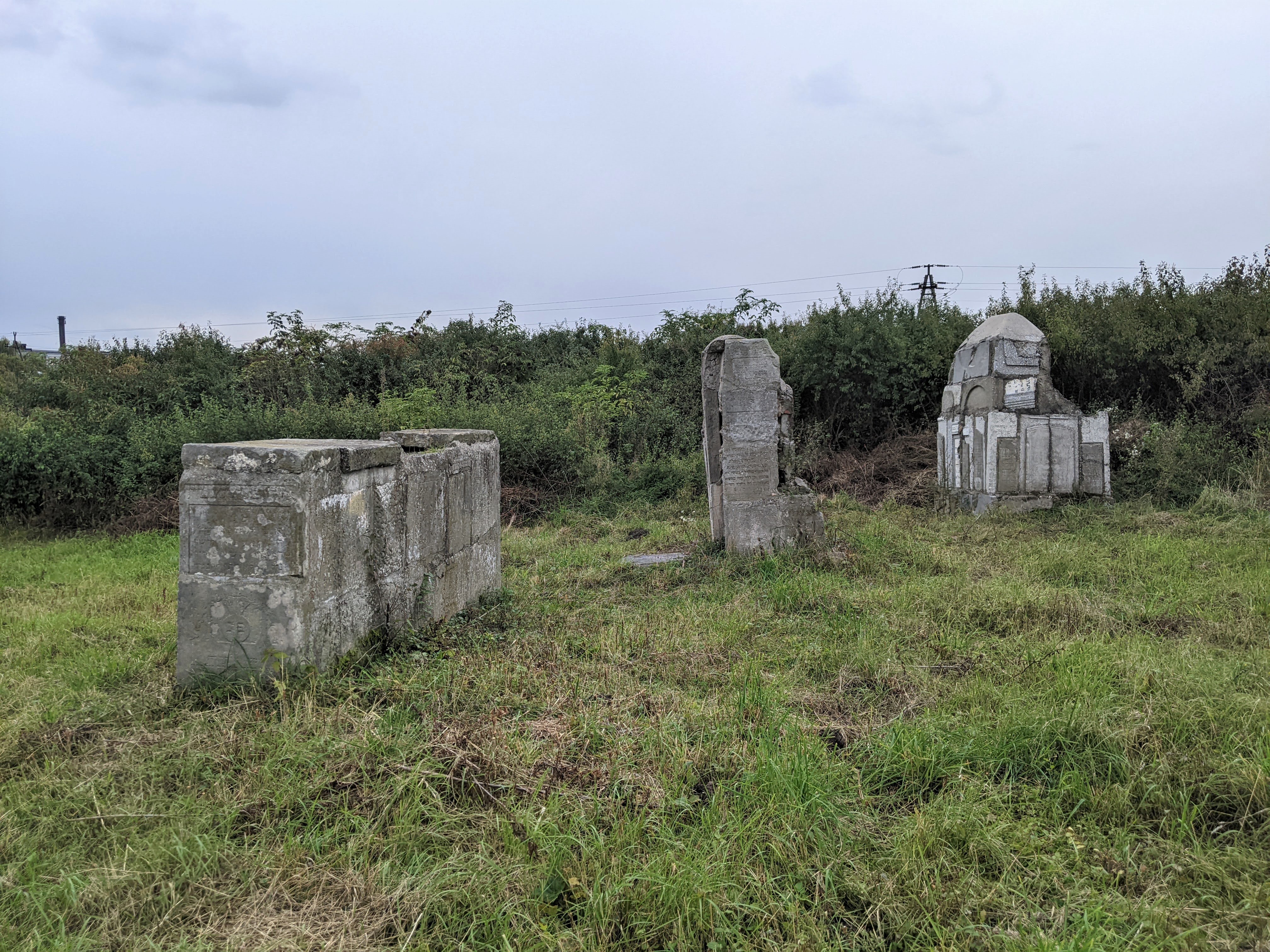
The cemetery gate needs repainting, though it remains sold. A padlock hangs from the latch but the gate is unlocked. The area that was cleared around the monuments remains accessible. I took a closer look at the three irregular monuments made from matzevot fragments held together with concrete. Some of the tombstones have come loose and lie on the ground. Others appear to be missing. Red graffiti scars the front of one.
Memorial monuments constructed of matzevot, Żychlin Jewish cemetery
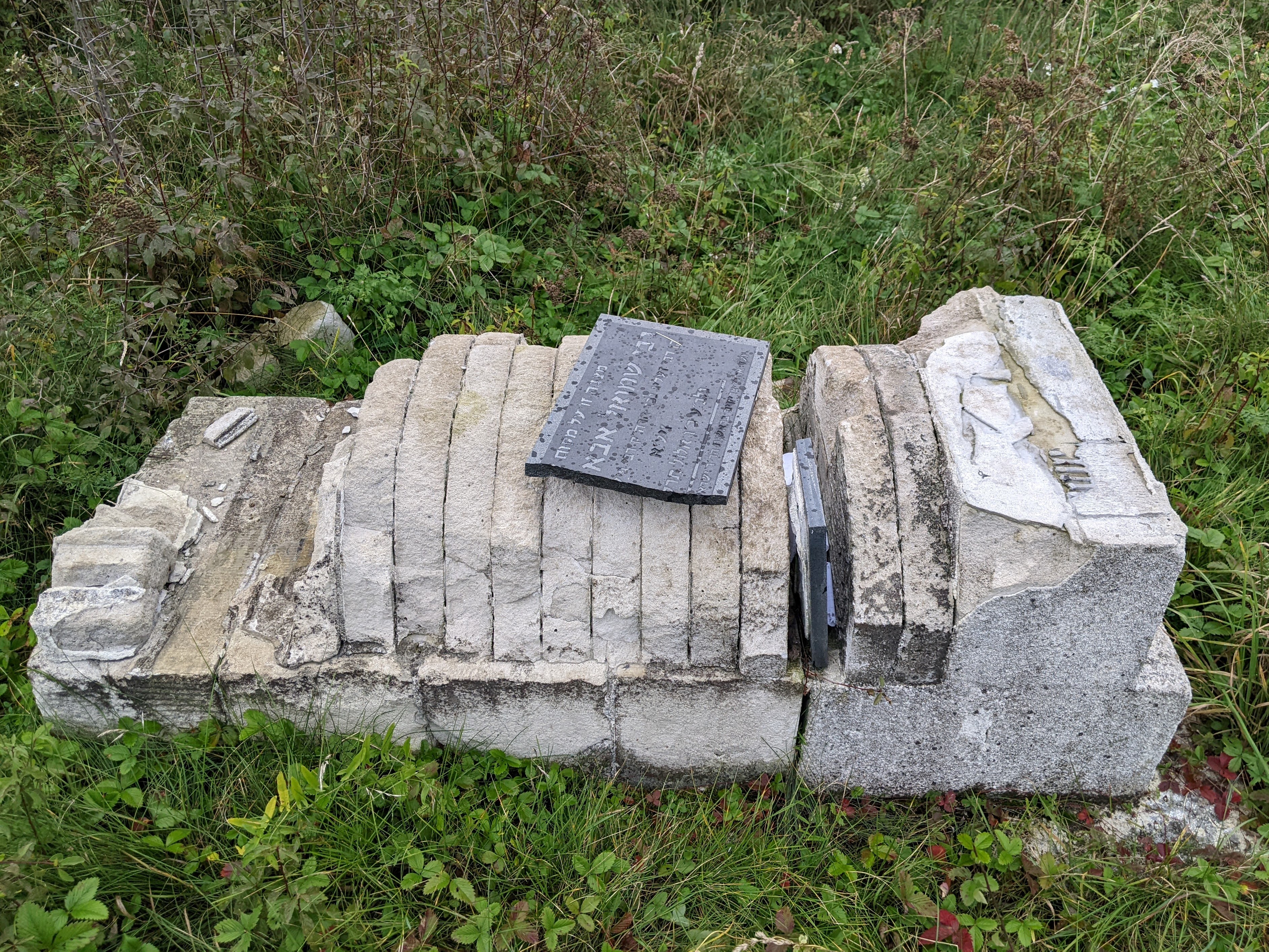
Rabbi Shmuel Abba‘s grave marker has fallen into disrepair. The curved stone over the site seems to have lost its top layer, and the vertical section of the marker has collapsed. The black stone with the inscription that used to be mounted on this vertical section has broken in half; part sits half-hidden in a groove and half lies flat on the broken surface of the monument. Notes left by visitors poke out of the cracks, and the remains of an Israeli candle sits on the ground near the grave. Photos show that this grave has deteriorated over the past few years.
Rabbi Shmuel Abba’s grave marker has deteriorated. It was still intact in 2019.Rabbi Shmuel Abba’s grave as it looked in November 2014
The rest of the cemetery ground is overgrown with 9-foot blackthorn shrubs that make an impenetrable thicket. The sharp thorns on this plant pose a particular problem for cemetery maintenance. Bożena told me that it took a crew of four to clear a narrow pathway through the overgrowth to the memorial monument and a fourth concrete-and-matzevah obelisk. I had to watch my step to avoid the stumps of the blackthorn bushes that were cut six inches from the surface of the ground. I didn’t see signs that the bushes were growing back, but I have been warned that they will unless everything is trimmed back again before next spring.
Old candle lanterns sit below the monuments—a testament that someone remembers this place.
Memorial monument, Żychlin Jewish cemetery.
I inspected the fence from the outside of the cemetery, walking from the gate to the southwest corner. Only a small section of fence around the gate is constructed of solid iron spikes; the rest is made of rusty chain-link. The fence continues along the west side as far as I could see, which wasn’t far because of the small trees along the fence line. Stone curbs below the fence seem to mark the cemetery boundary.
Fence and stone curb mark the border of the Żychlin Jewish cemetery
The Żychlin Jewish cemetery needs help. Fortunately, the ADJCP has good allies in Bożena Gajewska, Żychlin mayor Grzegorz Ambroziak, regional organizations TMHŻ (Association of Żychlin History Enthusiasts) and TPŻK (Association of Friends of the Kutno Region), Steven Reece and the Matzevah Foundation, and Rabbi Yehoshua Ellis and the Jewish Community of Warsaw. Together, I’m hopeful we can make lasting improvements on the cemetery and maintain it as a testament to the Jewish community that called Żychlin home for centuries.
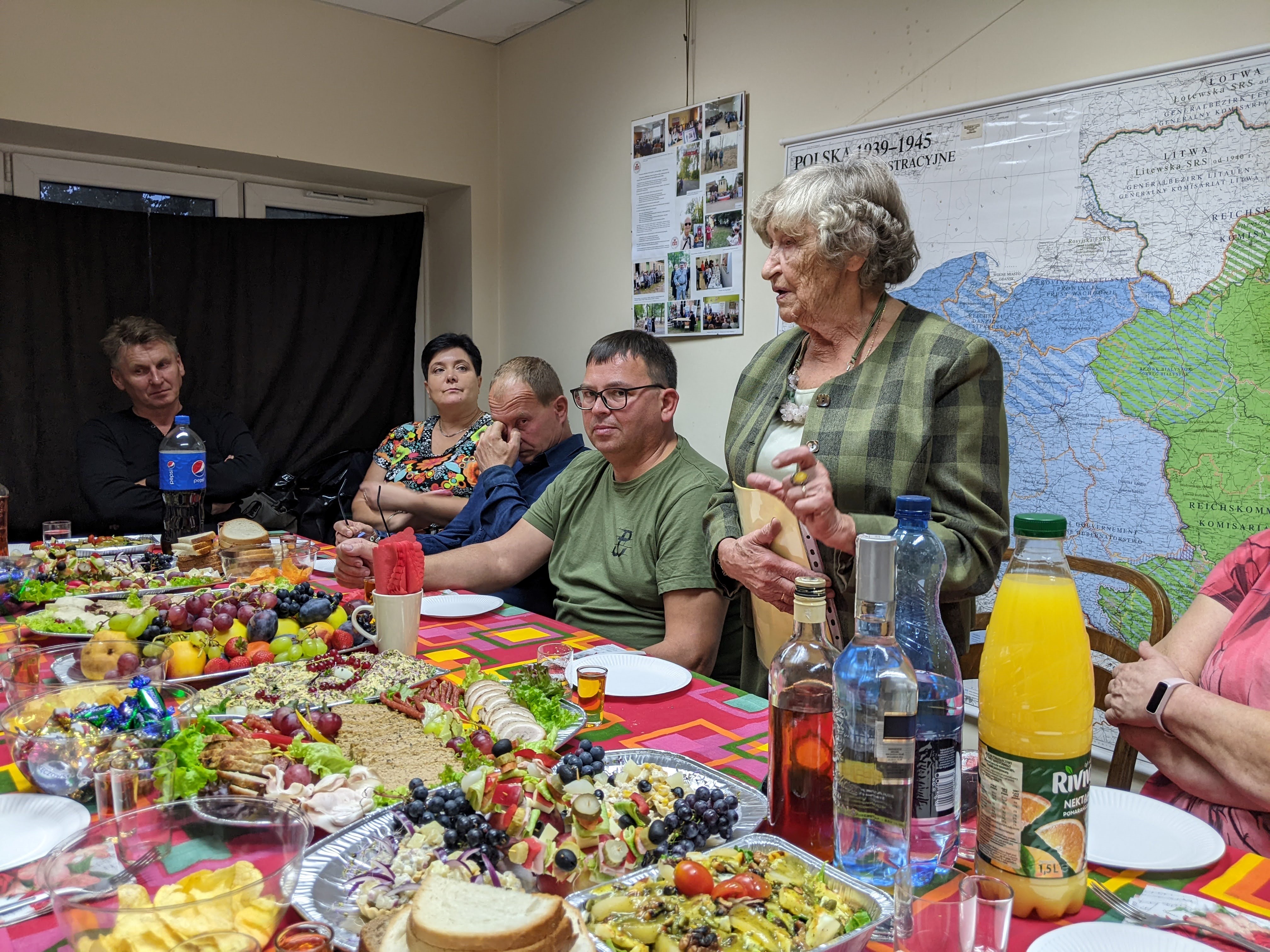
I ended the evening with the Association of Żychlin History Enthusiasts. My intention was to record some of the members’ recollections about wartime in Żychin. Serendipitously, my visit coincided with that of a guest of honor, Marianna Rybicka, who was a child during WWII; her memoir was published by the TMHŻ. She arrived from Płock with her daughter Iwona who brought a table full of food. Here, Marianna is telling her story:
Marianna Rybicka tells her story to the members of the Association of Żychlin History Enthusiasts (TMHŻ)
Can you help us restore the Żychlin Jewish Cemetery?
Since September, Bożena has done more research about cleaning up the cemetery. The biggest challenge is the the blackthorn that grows over most of the terrain. Jewish law restricts any disturbance of the ground which means the blackthorn can’t be dug out by the roots or treated with herbicide. A professional landscaping firm told Bożena that the charge for cutting it all down by hand will be 80,000-100,000 zloties ($19,000-$24,000). Without additional treatment, it will grow right back.
Steven Reece of the Matzevah Foundation has some experience with blackthorn and he is confident a dedicated group of volunteers can use loppers to remove it. He hopes to join us in May to inspect the cemetery and suggest a course of action. A lot depends on how much territory needs to be cleared and the size of the bushes that need to be cut.
Can you help us? What do you suggest for removing a thicket of thorny bushes? Would you like to join a clean-up project and help restore the Żychlin Jewish cemetery? Let me know!
Report #16 about Roberta Books and Marysia Galbraith’s trip to meet Polish partners in preparation for the ADJCP‘s memorial visit to central Poland.
Chodecz, September 15
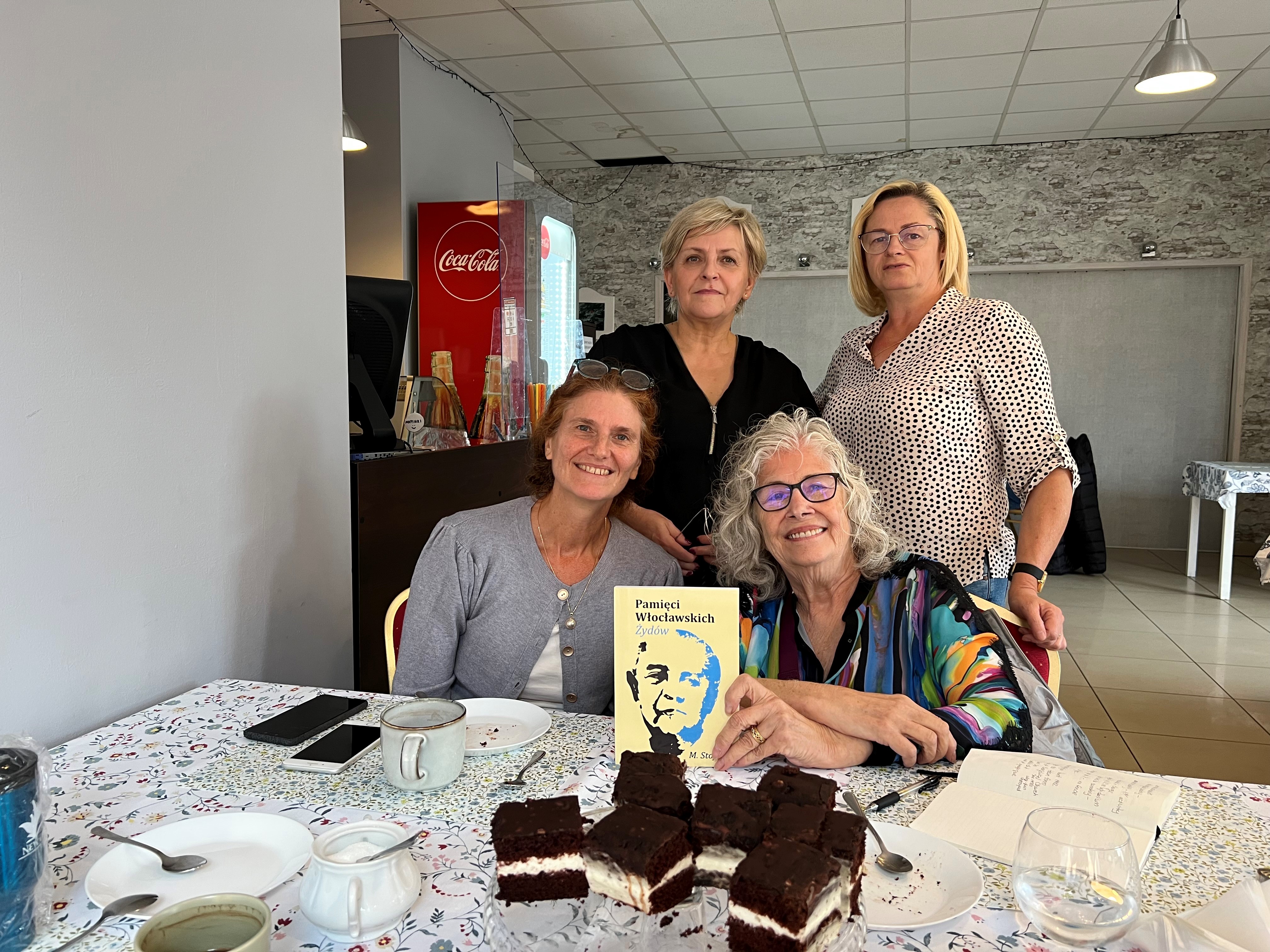
We met Irena Grabowska and Joanna Modrzejewska of the Brotherhood of Lovers of the Chodecz Region (BMZCh, Bractwo Miłośników Ziemi Chodeckiej) in a restaurant called Stara Gospoda located at Plac Kościuszki in the center of town. We ate large squares of homemade chocolate cake with tiny spoons while Irena and Joanna told us about their organization, which was founded in 2009. Irena is the vice president. The president, her husband Grzegorz, had another commitment that afternoon.
Irena Grabowska and Joanna Modrzejewska standing, Marysia and Roberta sitting. Notice that cake! Roberta is holding up Remembering Włocławek Jews, Mirka Stojak’s latest book which Irena and Joanna showed us
Over the years, the BMZCh has organized a variety of activities as part of their effort to inform residents about the fate of the Jewish community during World War II, including trips to the death camp at Chełmno nad Nerem where most Jews from this region perished.
They told us the prewar Jewish population of Chodecz was comprised of craftspeople and traders mostly, though there was one doctor. The BMZCh has done research on Jewish survivors, including Roman Halter, a sculptor and artist who was born in Chodecz in 1927. He wrote a memoir called Roman’s Journey. Other Jewish survivors include Sala Lubieńska, whom they have interviewed. Her two daughters visit sometimes. In addition, three sisters named Nadja, Henia, and Sala Pinczewska all went to Australia. The son of one of the sisters, Jeff Katz, has visited from Australia.
Their most tangible efforts have involved the preservation of the Jewish cemetery. We drove a short distance to see it. In 2011, the BMZCh mounted a sign outlining the history of the cemetery and the Jewish community, written in English on one side and in Polish on the other. The English side remains in good shape, but the Polish side is cracked and faded from time, sunshine, and weather.
The BMZCh installed a sign outlining the history of the cemetery
In 2012, they added a commemorative boulder up the slope near the center of the cemetery.
Commemorative boulder in Chodecz Jewish Cemetery
They placed a row of large stones to prevent cars from driving on the cemetery grounds, and they have also planted small trees along the edge of the cemetery nearest the dirt road, careful to avoid the actual cemetery terrain. A very recent project involved painting the border stones along the path to the commemorative boulder. Irena was not sure that painting the stones bright white was the best idea, but it demonstrates continued efforts to care for the Jewish cemetery.
A special oak tree was planted on the edge of the cemetery groundsStones and boulders protect the cemetery
The next project the organization hopes to realize is a commemorative wall that will incorporate the few tombstone fragments they have recovered. They have drawn up architectural plans and received the necessary approvals from government agencies, but they haven’t been successful in obtaining funding for the project.
Organization president Grzegorz Grabowski sent links to reports on BMZCh activities:
Report #15 about Roberta Books and Marysia Galbraith’s trip to meet Polish partners in preparation for the ADJCP‘s memorial visit to central Poland.
Kowal and Lubień Kujawski, September 15
Longin Graczyk, the director of the Ari Ari Foundation, promised to meet us in Kowal at 1 PM for a meeting with the mayor and others involved in Jewish heritage work. From there, he said we could meet some activists in Lubień Kujawski and still make it to Chodecz in time for our scheduled 5 PM meeting with heritage association members there. Roberta and I were understandably skeptical everything could be accomplished within such a narrow timeframe. But true to his word, Longin shepherded us through the afternoon and made sure that we did everything as planned. Longin and Justyna Marcinkowska, another activist with the Ari Ari Foundation, met us outside city hall and accompanied us up to the second-floor office of Mayor Eugeniusz Gołembiewski. The room overflowed with people eager to share their knowledge of local history.
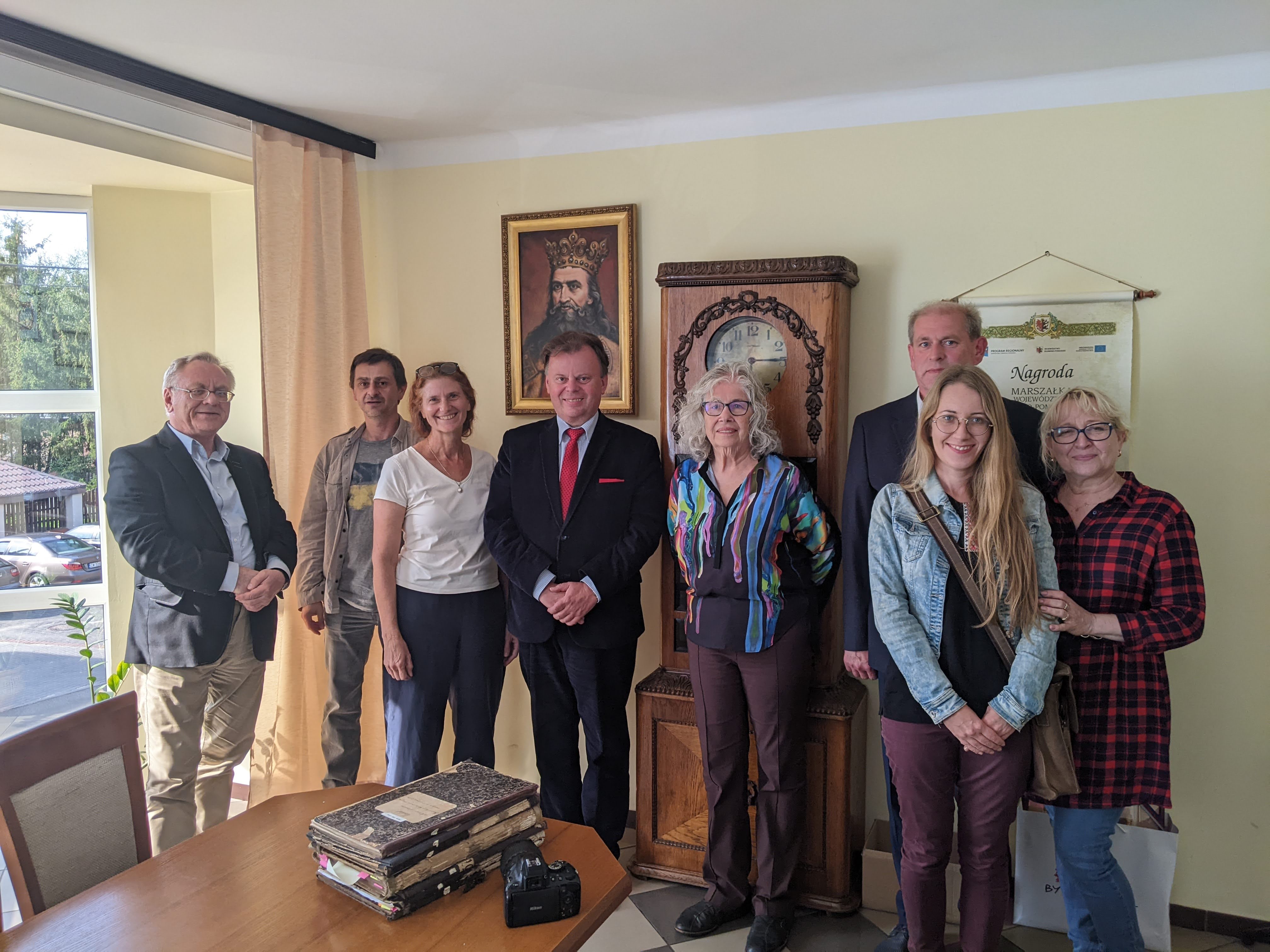
Meeting in Kowal City Hall with (among others) Arkadiusz Ciechalski (regionalist, photographer, and vice-director of the School of Agriculture), Longin Graczyk (Ari Ari Foundation), Marysia Galbraith (ADJCP), Eugeniusz Gołembiewski (Kowal Mayor), Roberta Books (ADJCP), Tomasz Kulicki (Kowal resident of Jewish ancestry who writes about regional history), Justyna Marcinkowska (Ari Ari Foundation), Edyta Dorsz (manager of the Civil Records Office), and Grażyna Snopkowska(?) (Kowal Director of Promotion)
Several conversations ensued at once, providing a flood of information about past heritage projects as well as future plans. Notably, Edyta Dorsz had brought vital records books dating from between the world wars. The town retains these records until they are 100 years old, and then they will be sent to the National Archive. Tears came to Mayor Gołembiewski’s eyes as he explained that the books document the life transitions of the Jewish community that was wiped out during World War II. He said studying history is one thing but holding a physical trace of that community in your hands is another. The book contains the names of 1300 Jewish residents. He feels their loss viscerally. He asked, what would their city have been like if not for the war? Probably, it would have been a much more vital place with 30,000 residents instead of their current 2000.
Kowal resident Tomasz Kulicki shared his family story, explaining how his Jewish father survived the war. Roberta and I were also led into a neighboring office to view photographs of recent commemorative activities.
The mayor affirmed his commitment to recognizing the Jewish history of Kowal and his willingness to greet descendants during the memorial trip. He asked for any photographs or historical information that our members may have and be willing to share. This is something he has asked of others, and been promised, but no one has ever followed through with resources. Does anyone have photographs or historical information about Kowal’s Jewish residents?Please let me know!
We could have talked for much longer, but Longin cut the conversation short, reminding everyone of our tight schedule.
Longin guided us to the Jewish cemetery, a grassy field on the outskirts of town. Residential houses sit across the street and to the right is the fenced yard of a building supply company. Since there is no fence or marker to indicate the cemetery boundaries, Longin pointed them out to us. The cemetery begins somewhere in the middle of the field, extends beyond a brush-covered mound at the far end of the field, and includes part of the terrain under the water treatment plant (see the blue roof ). Longin was told that for some reason the plant had to be built in this spot. He didn’t elaborate.
The Ari Ari Foundation plans to mount a commemorative marker since nothing indicates this field is a cemetery. The marker will be wooden, in the shape of a tall matzevah. He showed us a photograph on his phone of one already on display in another town.
We continued to Lubień Kujawski, to a dirt and gravel parking lot at the site of the Jewish cemetery. During the summer, swimmers park there and walk down a narrow dirt trail to the river.
Justyna Marcinkowska of the Ari Ari Foundation at the dirt lot located on the Lubień Kujawski Jewish Cemetery
Historical marker for the Lubień Kujawski Jewish cemetery. Photo credit: Bożena Ciesielska, photo source: Ari Ari Foundation Facebook page
Andrzej and Magdalena Dominowski, Lubień Kujawski residents who have collaborated with the Ari Ari Foundation on regional history projects, met us for a brief conversation on the edge of the cemetery/parking lot. They described some of the activities they have helped spearhead. Both are schoolteachers, and Andrzej has led historical walks that feature the town’s Jewish history. His next walk occurred several days after our visit, on September 26. Andrzej also sent the ADJCP materials about the Jewish community of Lubień Kujawski: the relevant section of Tomasz Kawski’s book Gminy Żydowskie Pogranicza Wielkopolski, Mazowsza, i Pomorza w latach 1918-1942 (Jewish Communities in the Wielkopolski, Mazowsza, and Pomorza Regions 1918-1942), and archival postwar questionnaires documenting material and personal losses during World War II.
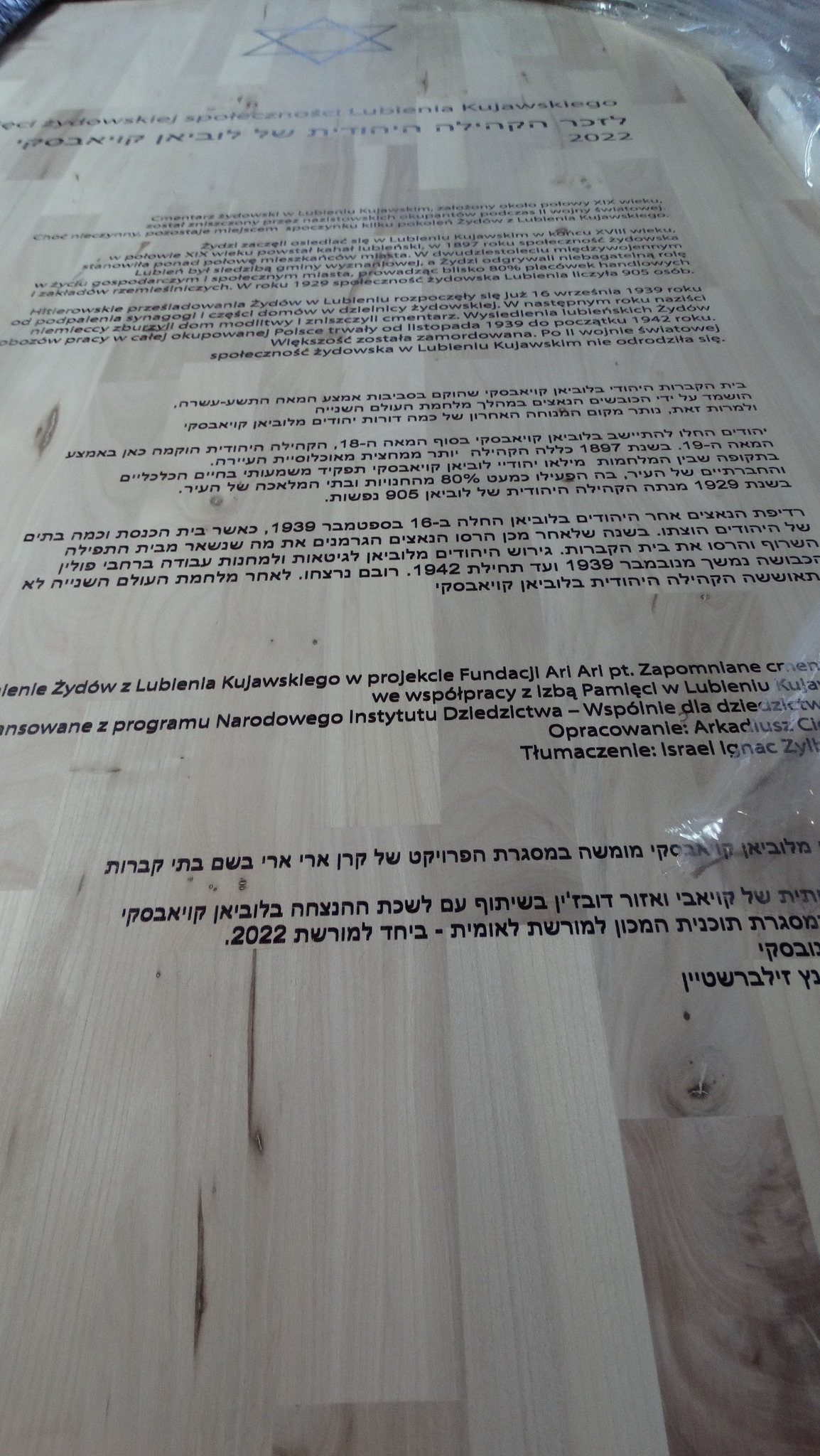
We didn’t have time to learn more about the Jewish history of the town, but Virtual Sztetl provides a good outline. Jews first settled in Lubień in the 2nd half of the 18th century. They filled important positions in the local economy and in local government. Jewish community properties included a wooden synagogue, prayer houses, schools, rabbi’s apartment, and the partially fenced cemetery. At the beginning of the War, most of these properties were burned and the Jewish population was sent to work camps and ghettos. Only a few survivors returned briefly in 1946.
Report #12 about Roberta Books and Marysia Galbraith’s trip to meet Polish partners in preparation for the ADJCP‘s memorial visit to central Poland.
Brześć Kujawski, September 14
Our visit to Brześć Kujawski illustrates the importance of local institutions and people committed to the restoration of Jewish memory. My first visit to this town in 2015 left me profoundly unsettled. All I could find of the prewar Jewish cemetery was an unkempt field scarred by a crumbling pool. No sign anywhere acknowledged the vibrant prewar Jewish community, which numbered between 630 and 990 people in the first decades of the 20th century. I felt the absence personally because my grandmother was part of that overlooked community.
Hence my surprise when in 2020, Anna Szczepaniak, who works at the Brześć Center of Culture and History: Wahadło, sent an enthusiastic response to my blog post about the ADJCP plans to organize a memorial trip for descendants. Anna said she welcomes the ADJCP to Brześć Kujawski and over the course of the following year, she and the vice-director of the center, Sylwia Czerwińska-Modrzejewska shared their plans for a memorial plaque at the site of the former ghetto as well as cultural programs about Poland’s Jewish community. They wanted to coordinate events to occur during our memorial trip. Sadly, COVID delayed our visit, but the Center of Culture and History, with the support of Mayor Tomasz Chymkowski, has gone ahead with substantive efforts to restore Jewish memory in their town.
As you enter Brześć Kujawski, a 12-kilometer drive from Włocławek, the brand new Center building looms up on the right side of the road. Roberta and I were greeted by Anna, who quickly made clear that they had prepared for our visit. She gave us a thick folder filled with copies of historical documents they have collected: photos, maps, and sketches of the town; artist Maya Gordon’s plans for a memorial monument in the Jewish cemetery; and archival records about the cemetery and official Jewish Community matters.
They told us about Mikołaj Grynberg, a Polish photographer and child of Holocaust survivors, who has published two photo albums and various books and articles, including stories of children of survivors. Grynberg was scheduled to come to Brześć Kujawski on October 15 to show his new film “Dowód Tożsamości” (“Identity Card”; can also mean “Proof of Identity”). According to a post on the Facebook page “Szlakiem Żydów w Brześćiu Kujawskim” (“Trail of the Jews from Brzesc Kujawski” ) the film explores:
how the memory of the Holocaust evolves and what role it plays in the minds of today’s twenty-year-olds. The interviews show a wide panorama of attitudes and experiences – the interviewees come from both large cities and the Polish provinces. The film is an attempt to show the specificity of being a Polish Jew, often incomprehensible to people outside of this circle.
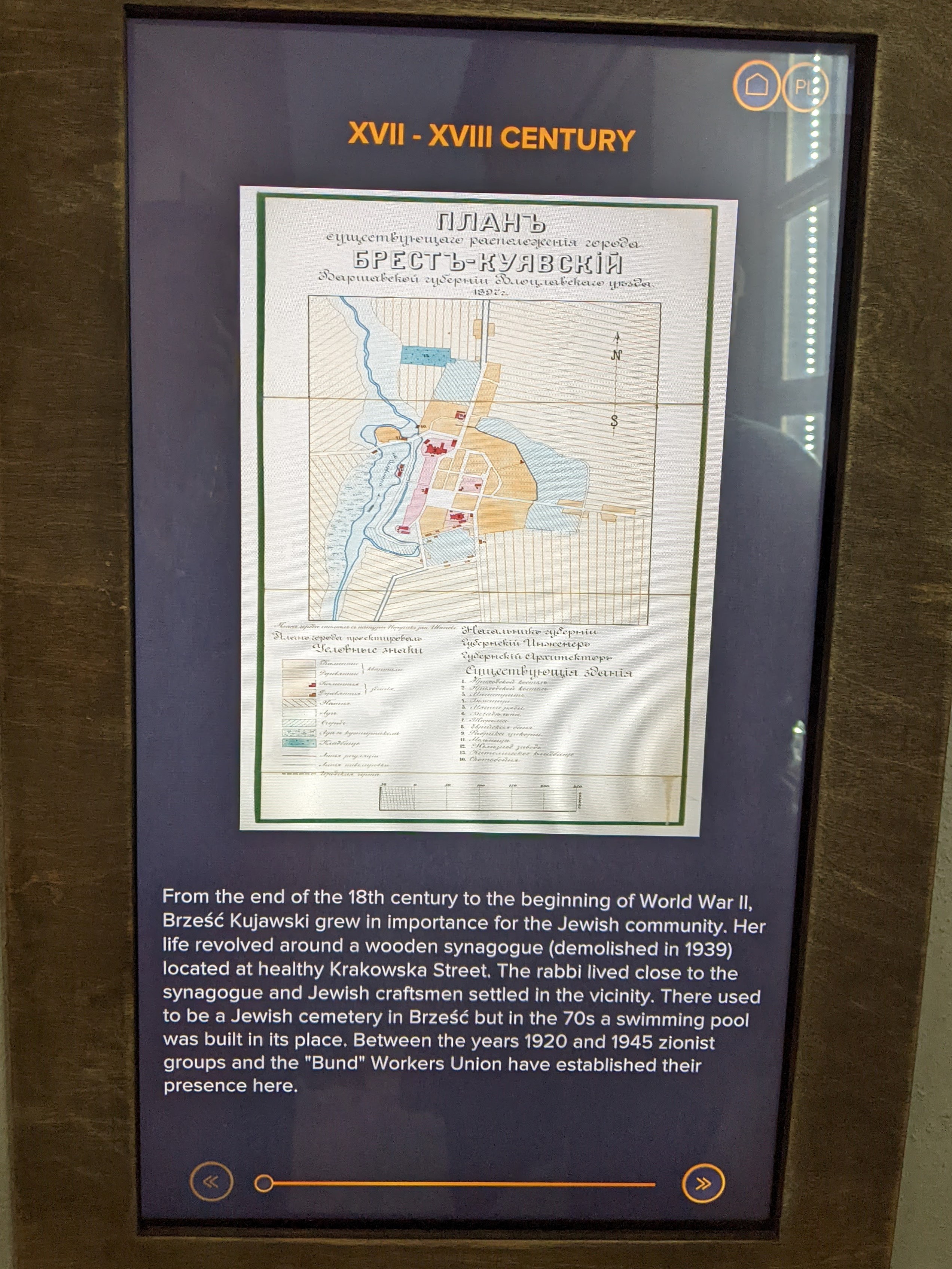
We toured the new multimedia exhibition, located on two stories of the Center, which focuses on the history of Breść Kujawski from prehistoric times through the contemporary period. Reminiscent of the Polin Museum in Warsaw, it emphasizes active engagement with historical information rather than artifacts, although it includes some impressive prehistoric pottery and other items. The exhibition integrates the history of the Jewish community. For instance, one room reproduces a town street during the period between the world wars, complete with reproductions of signs for businesses, some which had Jewish proprietors.
Display outlining Brześć Kujawski’s Jewish history, and Jewish traces in the model town street
We drove with Center Director Agata Kubajka and Anna to the Jewish cemetery at the outskirts of town. Anna couldn’t get the key to open the locked gate so we stepped over the fallen chain-link fence and walked through the knee-high grass to the edge of the empty, blue-painted pool.
Swimming pool in the Brześć Kujawski Jewish cemetery
Last year, the swimming pool was closed and they are seeking funding to transform it into a memorial monument. Recognizing that some people might protest the loss of the pool, they found a location for a new one; the old pool was built in the 1970s so it needed to be replaced anyway. The town wants to transform the space into a park with pathways and benches. Maya Gordon’s design for the memorial would put a circular medallion at the bottom of the former pool depicting a tree with broken branches, meant to represent mourning and destroyed lives, as well as echoing the broken tree motif commonly found on matzevot. In her imagining, water will naturally fill the basin and cover the medallion, representing spiritual cleansing and rebirth. The pool basin will become a part of the memorial and avoid the further disruption that would result from removing it. Maya Gordon lives and works in Amsterdam, Tel Aviv, and Warsaw. She was born in Poland but moved to Israel around age ten. She studied art in Jerusalem and in The Netherlands.
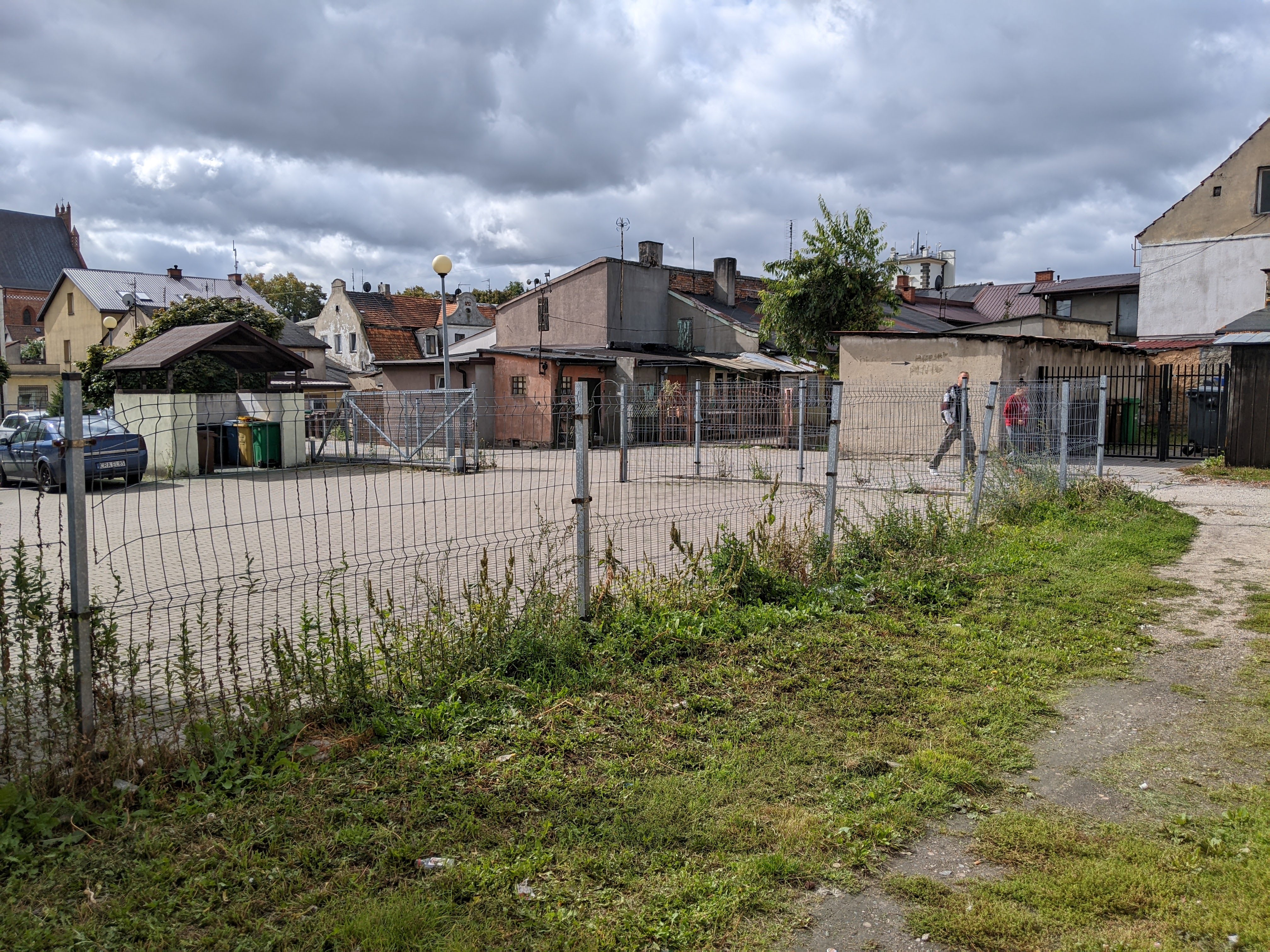
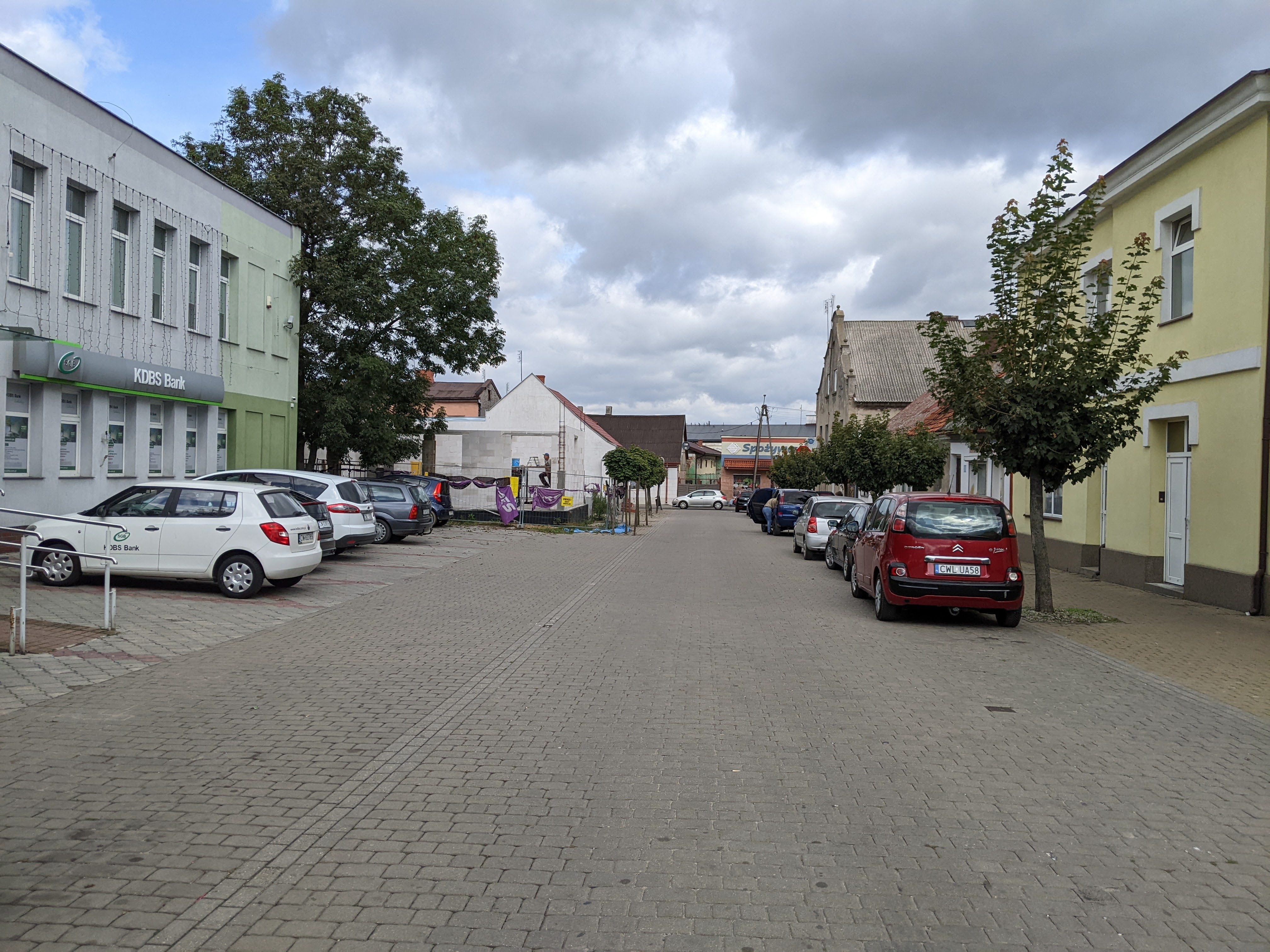
We drove back into town to see the former site of the synagogue (now an empty lot) and the square where Jews were gathered for deportation to the death camp at Chełmno nad Nerem. They have plans to place historical markers in each of these places.
Site of former synagogueSquare where Jews were gathered for deportation to the death camp
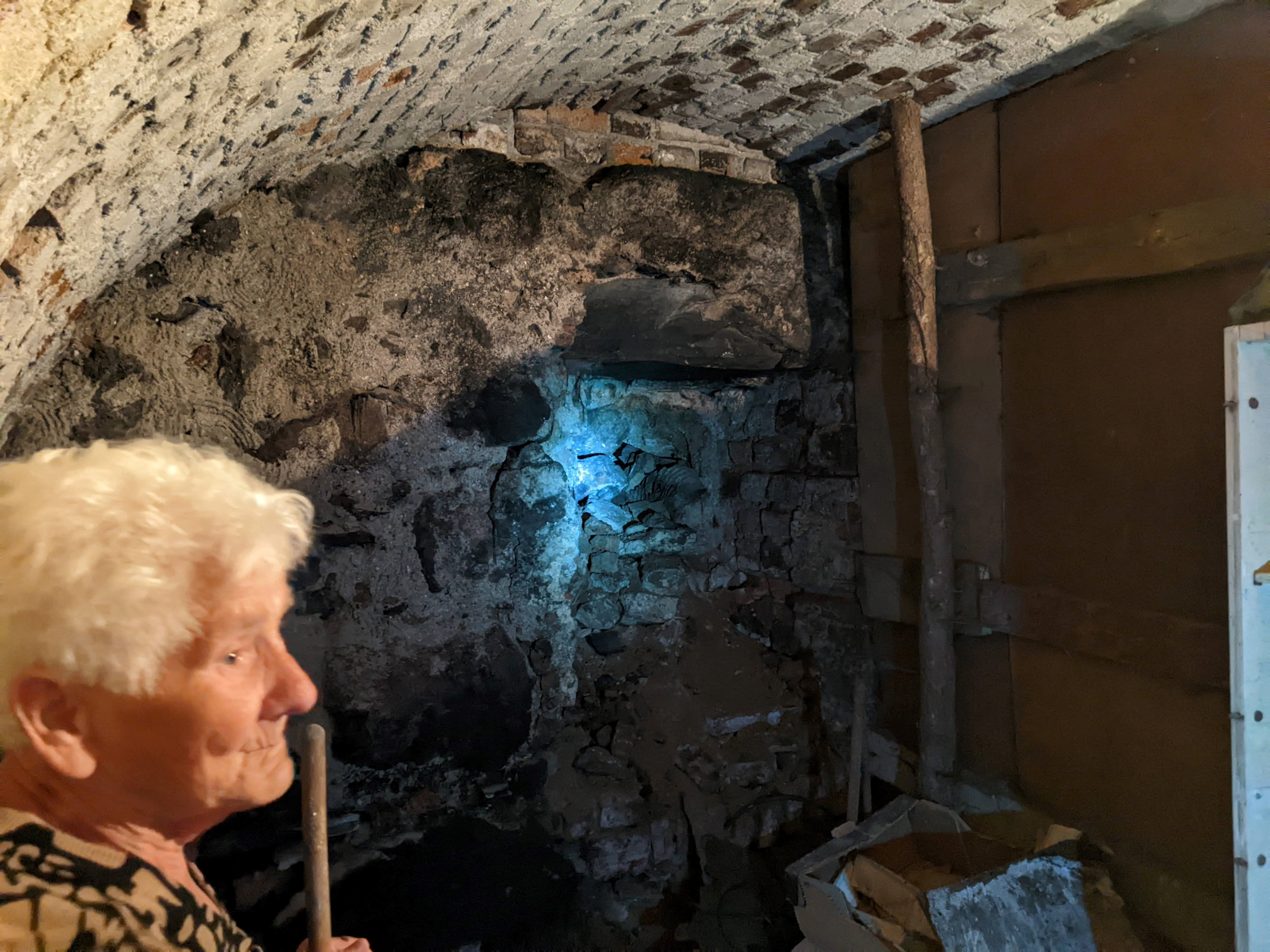
Down the street from the synagogue site, Anna, popped into a doorway to ask an elderly resident if she could show us the basement of the building where they believe there was a ritual bath. The woman grabbed her flashlight and led us down a rickety wooden staircase into a basement with vaulted ceilings made of brick and stone. There was some debate about how the space could have been configured and what the source of the water might have been. Even if it wasn’t the ritual bath, the basement clearly dates back to the 19th century (I would guess even older). It probably saw many uses during its existence.
Basement that might have been the location of the mikvah
We returned to the Center of Culture and History, to the restaurant on the ground floor, where we joined Mayor Tomasz Chymkowski, his assistant Karolina Filipiak, Director of the Center Agata Kubajka, and Vice-director Sylwia Czerwińska-Modrzejewska for lunch.
After an amazing lunch of pierogis and other regional cuisine. From left, Mayor Tomasz Chymkowski, Center Vice-director Sylwia Czerwińska-Modrzejewska, Roberta Books, Marysia Galbraith, Center Director Agata Kubajka, and Mayor’s Assistant Karolina Filipiak
We had a spirited, wide-ranging discussion over our meal. Sylwia made sure we tried some regional specialties, including kluski (homemade noodles) with farmer’s cheese and bacon. Mayor Chymkowski explained why Brześć Kujawski is in better economic shape than many neighboring towns. They built an industrial park before other places got the idea. Manufacturers of items such as clothing, auto parts, and bicycles provide jobs for town residents and commuters. Chymkowski said the town has the financial means to invest in preserving the town’s history. This includes renovating the town center and marking historical places, including those associated with Jewish residents. He described the plans for the Jewish cemetery, and explained the pool had been built by communists. He said there was no regional place of remembrance. That is the function he wants the renovated cemetery to serve.

















 Uncovering Jewish Heritage