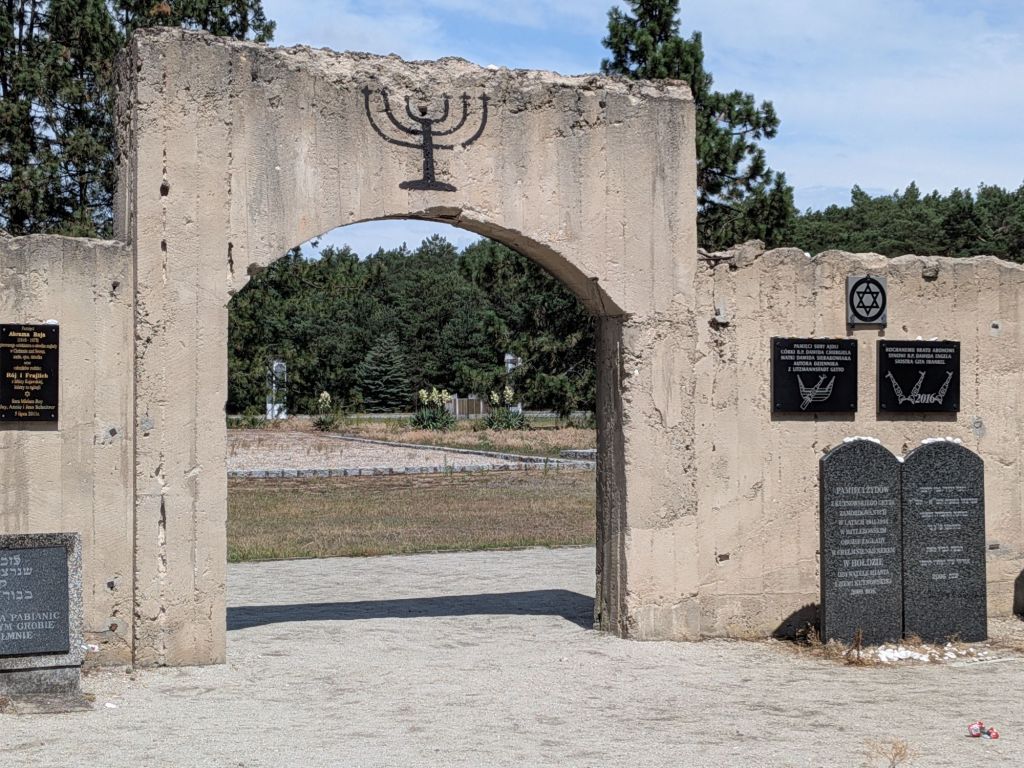
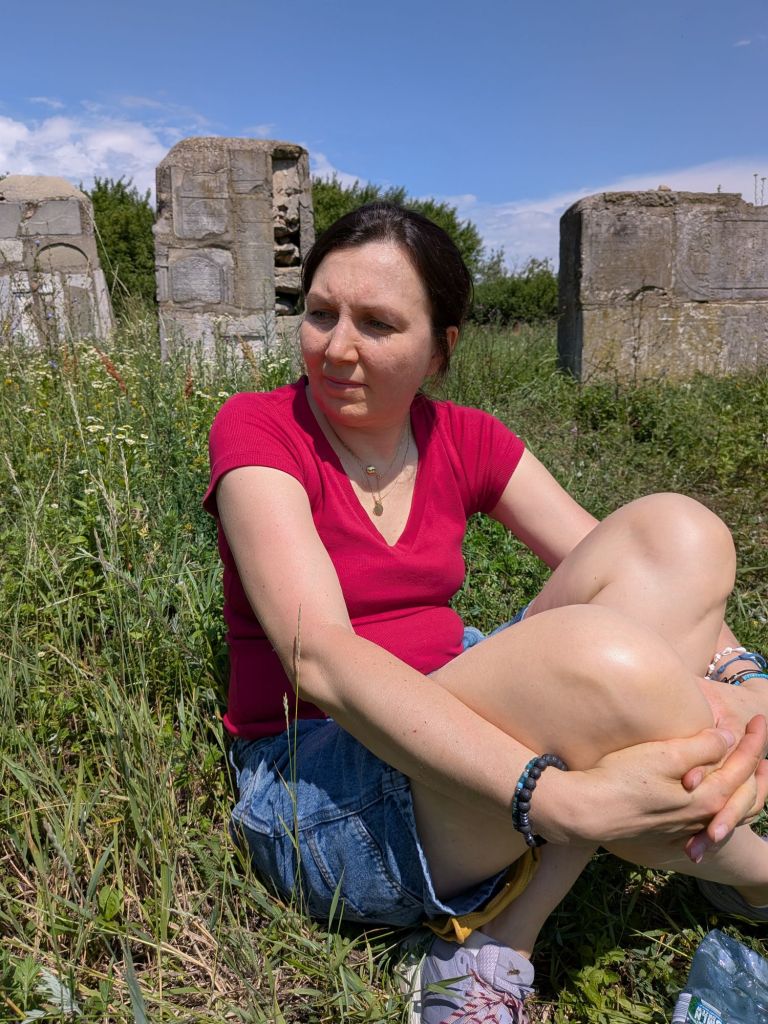
My cousin Annice captured the spirit of the memorial monuments in the Żychlin Jewish cemetery during our summer clean-up and research.
Depicted in watercolor and ink are two of the monuments constructed out of concrete and matzevah fragments, designed and engineered by descendant Moshe Zyslander shortly after Poland regained her autonomy from communism and Soviet influence. Annice captures the poignant contrast between the stark grey monuments and the wild green weeds surrounding them.
Her text reads, “Honoring and never forget the Jews of Zychlin the day before the liquidation of the ghetto March 2, 1942 at the cemetery buried in a mass grave at the Jewish cemetery Desecrated headstones returned and assembled by generation holding their memory Nature returing life L’chaim July 2025 For Marysia her […dom] and vision Annice Jacoby descendant”
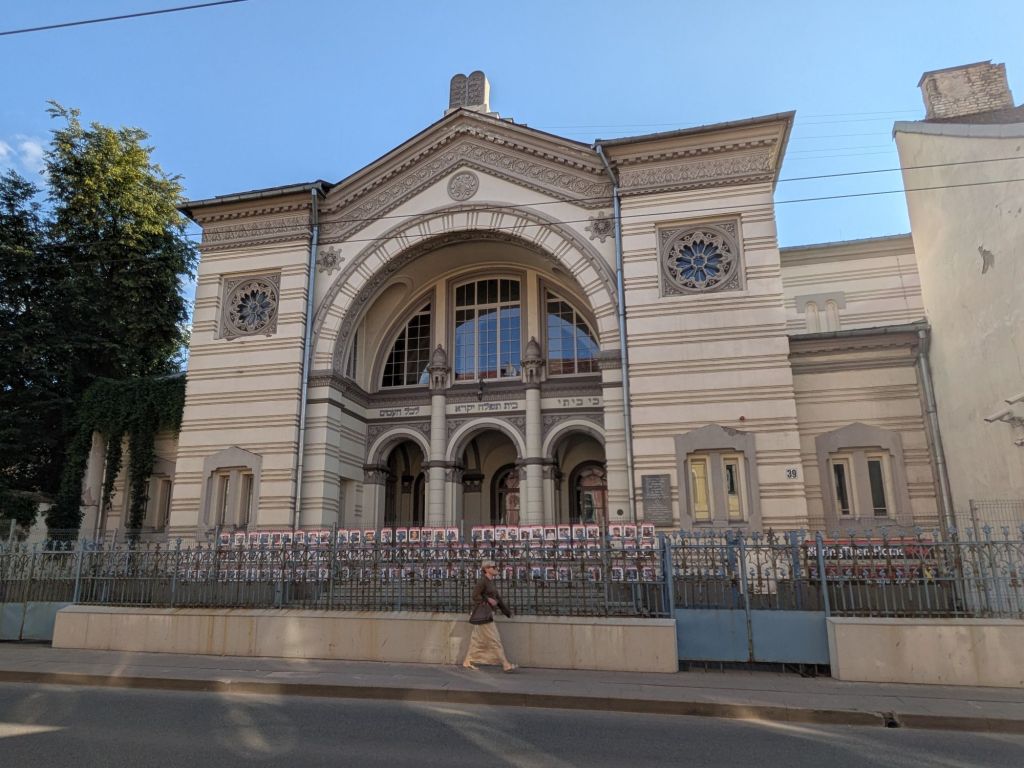
I wasn’t looking for Jewish history in Vilnius but it found me. The synagogue, still functioning as a house of prayer for the few thousand remaining Lithuanian Jews, is a half block from my hotel.
The Choral Synagogue in Vilnius. “Bring Them Home” along with photos of the hostages sits right behind the metal fence
I signed up for a Vilnius with Locals walking tour of Jewish Vilnius, the so-called Jerusalem of Lithuania. We spent 3 hours exploring the Jewish quarter. In some sections, Soviet-era concrete buildings took the place of the prewar structures blown to rubble when the WW II ghetto was dismantled.
It’s hard to picture the prewar buildings that once filled this area
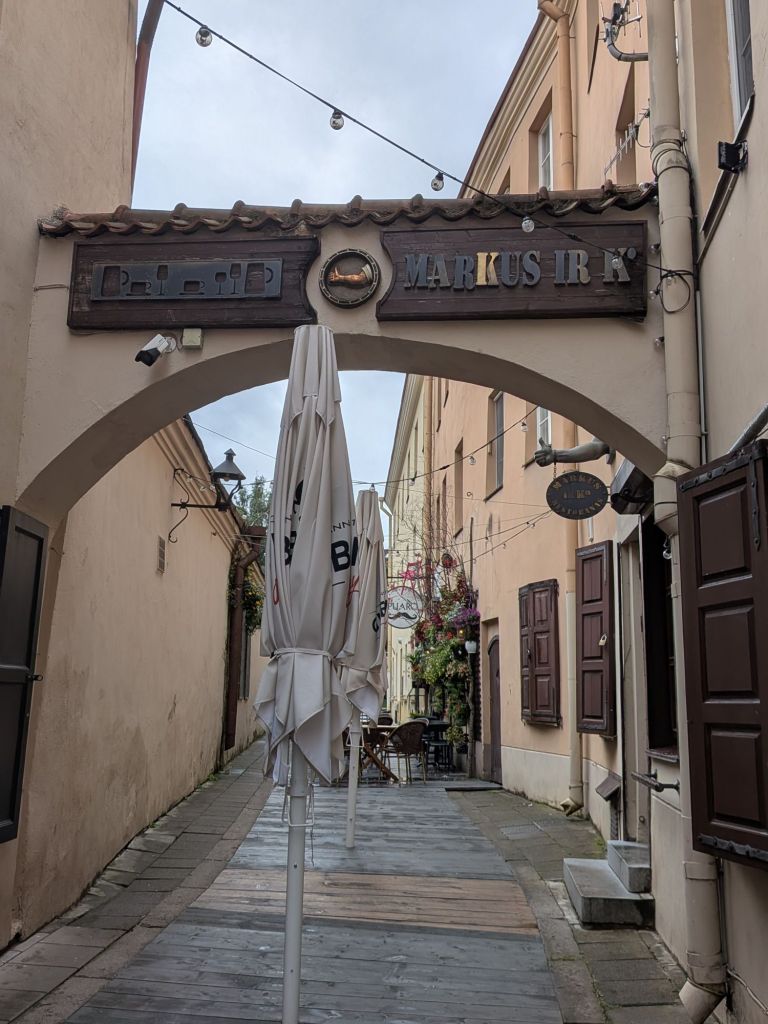
Other areas escaped destruction and retain their prewar appearance. As we meandered through narrow cobblestone lanes, Kristina our tour guide explained how much of the city’s Jewish story was silenced during the Soviet occupation, the period from 1940 to 1990 when the country was a republic within the Soviet Union. During that time, nobody talked about the Jews who had made up 45% of the city’s inhabitants before the war.
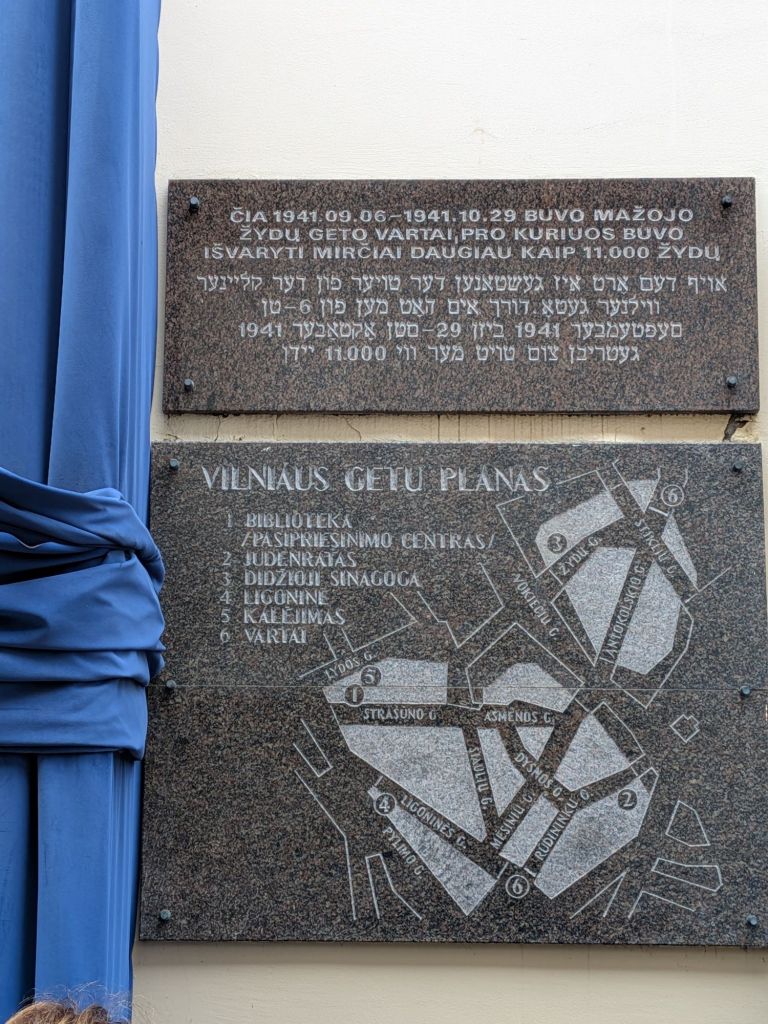
An iconic street in the Jewish district Map of the WW II ghettoJewish library scheduled for renovation
Kristina explained that this lost history only began to be rediscovered after Lithuania regained independence in 1990. Since then, scholars have been translating and writing about thousands of pages of documents that survived in hiding for 50 years. Many were collected by a group of people called the Paper Brigade who made it their mission to preserve all the documents in the YIVO Archive, a massive repository of Yiddish resources. Much of the archive found safety in New York. Today, the archive is split between Vilnius and New York.
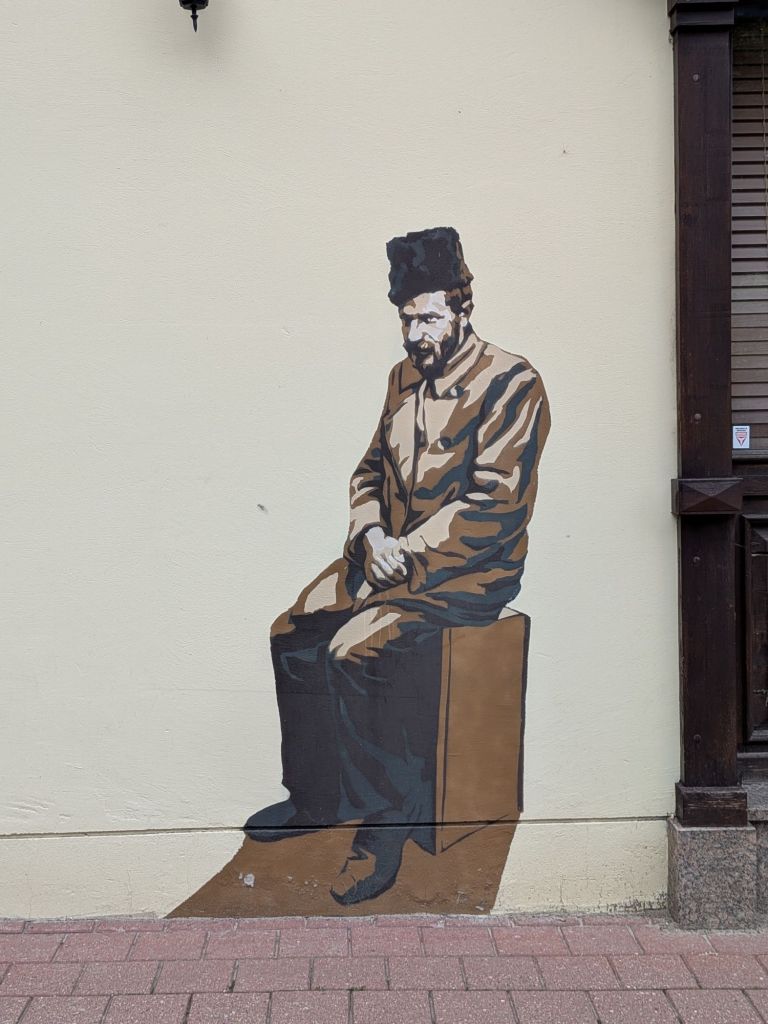
As more has been learned about The Jews of Vilnius, artwork, memorials, and institutions have made the story public. The Walls That Remember project stencils images from archival photos onto the walls of the former Jewish Quarter.
Kristina tells us about The Walls that Remember
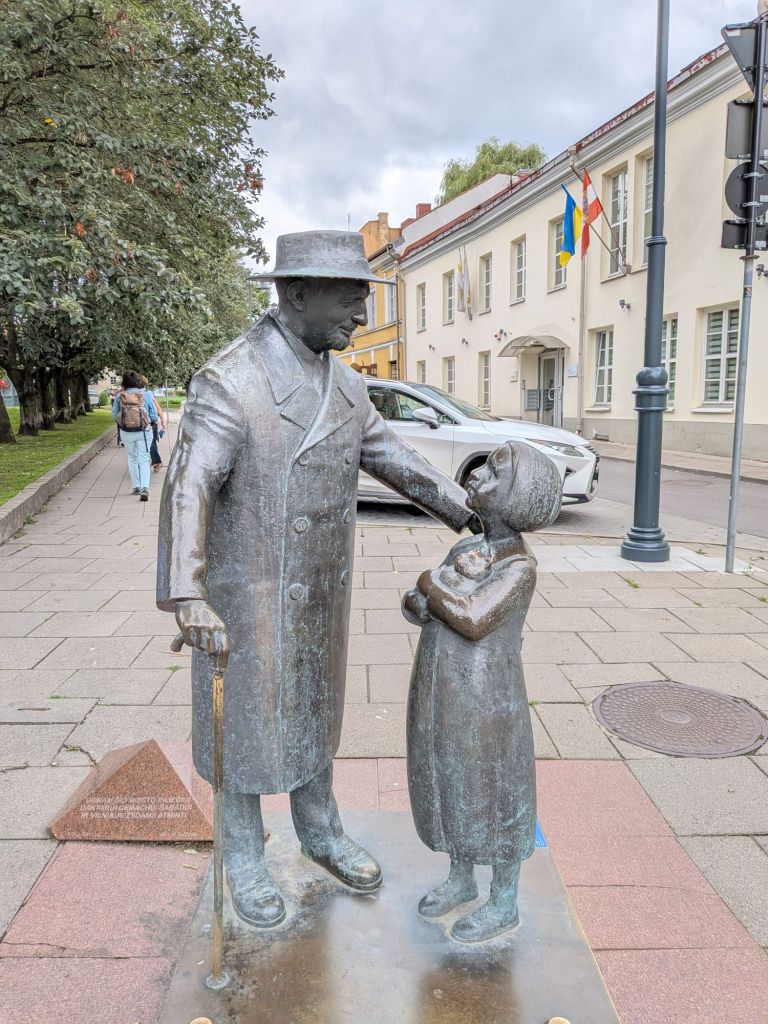
Remembered with a statue are: Zemach Shabad, a doctor known for his kindness who cared for the poor; Rabbi Elijah Ben Solomon (1720 – 1797), also called the Gaon of Vilnius; and singer Leonard Cohen, who had roots in Lithuania.
Zemach ShabadThe GaonLeonard Cohen
Jews first came to Vilnius as merchants before the 14th century. They were granted privileges by the Lithuanian rulers by the late 14th century. In Vilnius, they settled in the Jewish Quarter; other ethnic groups like Germans each settled in their own quarter of the city. By the time Lithuania was absorbed into the Russian Empire at the end of the 18th century, these ethnic enclaves were less rigid, and Jews could be found throughout the city along with other ethnic and religious inhabitants.
Vilnius was an important center for the growth of Yiddish language and culture, which explains why it was one of the places the Yiddish Scientific Institute (YIVO) was founded in 1925.
After a brief period of national autonomy from 1922 to 1940, Lithuania, like the other Baltic States, became a battleground between Stalinist USSR and Nazi Germany. When Hitler’s forces invaded in 1941, as many as 95% of the Jewish inhabitants were murdered.
Under Communism, the Choral Synagogue continued to operate, though it functioned more as a cultural organization than a religious one (at least officially). Since 1990, the Jewish community remains active at the synagogue. The interior can be viewed for just 2€. Whereas before the war, this was more of a reform synagogue, the current congregation is conservative. Women attend services on the upstairs balcony or behind a curtain on the ground floor.
Choral Synagogue
While on the tour, another participant and I struck up a conversation. Suzanne just completed a two-week tour of Jewish Poland with others of Jewish descent seeking to reconnect with the homeland of their ancestors. It was more than a historical trip, fusing spirituality and rituals within their encounters with Jewish spaces. For instance, at the grave of one participant’s ancestor, they did their own version of feldmestn, a ritual practiced by women; they measured the grave with wax, from which they made a candle.
I bonded with Suzanne over the importance of reconnecting with your Jewish origins, and also because of our shared appreciation for the individuals working in Poland to preserve Jewish memory. She called them memory keepers, a name that perfectly captures the role they play. I will use the term in my future writing about these memory keepers.
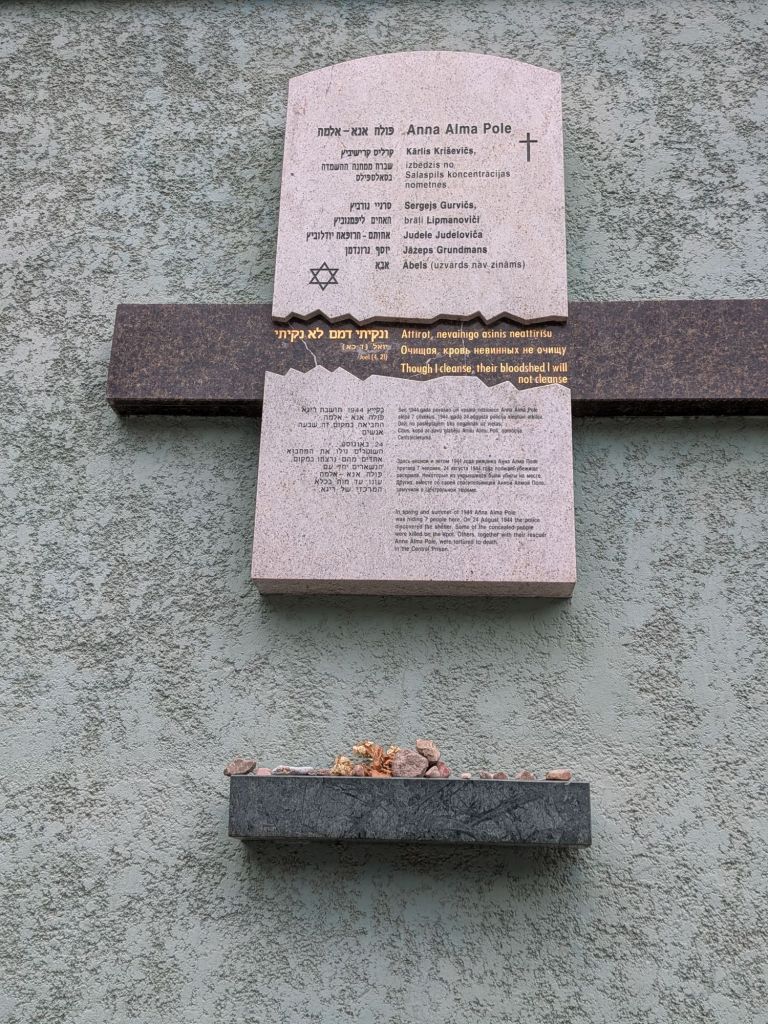
In Riga, the capitol of neighboring Latvia, Jewish markers continued to find me. On the building next to my hotel is a memorial marker for someone who saved Jews during the German occupation, and around the corner stands the synagogue. Also, during a walking tour of the city, I met Dimitri and his son Shiloh, reconnecting with their Jewish Latvian roots.
Today, we left central Poland and travelled down to Kraków for a final weekend of sight seeing and learning about the history of Poland. Tomorrow, we go to Wawel Castle, the seat of Polish kings. Sunday we have a guided tour of the Jewish district. Tonight, we had a feast at Hamsa, an Israeli restaurant.
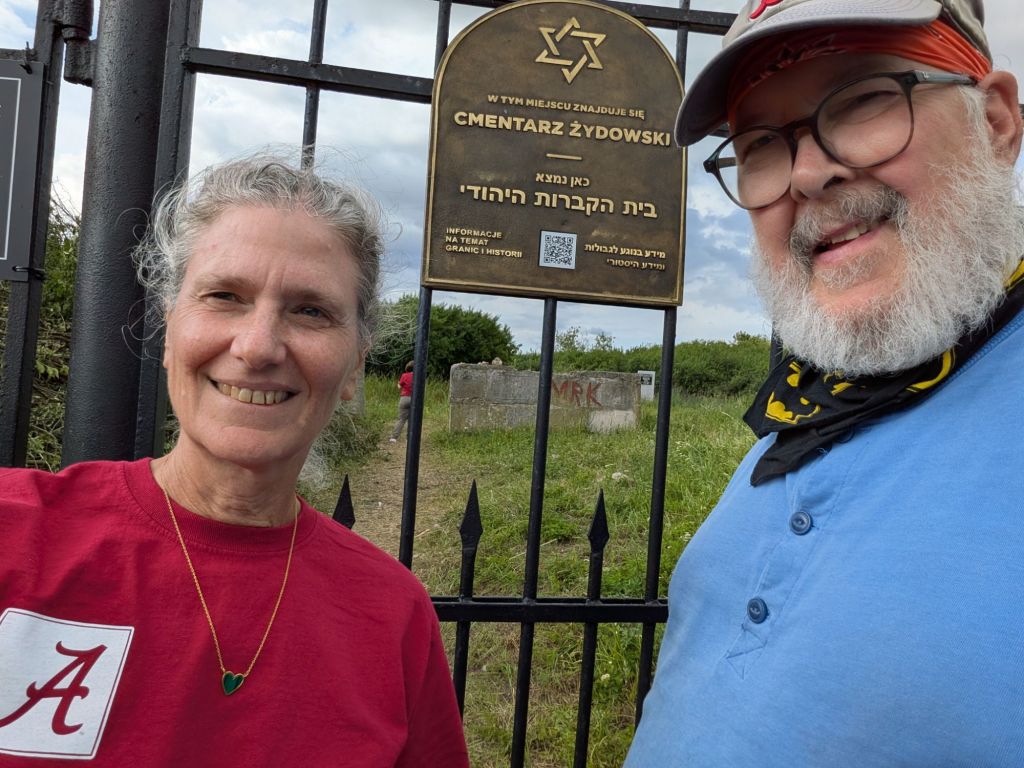
Presence matters. By spending time in the Żychlin Jewish cemetery, we’ve accumulated more knowledge about the town’s Jewish community and we’ve deepened connections with local inhabitants.
The stones come back. Photo credit Michele Hoferitza
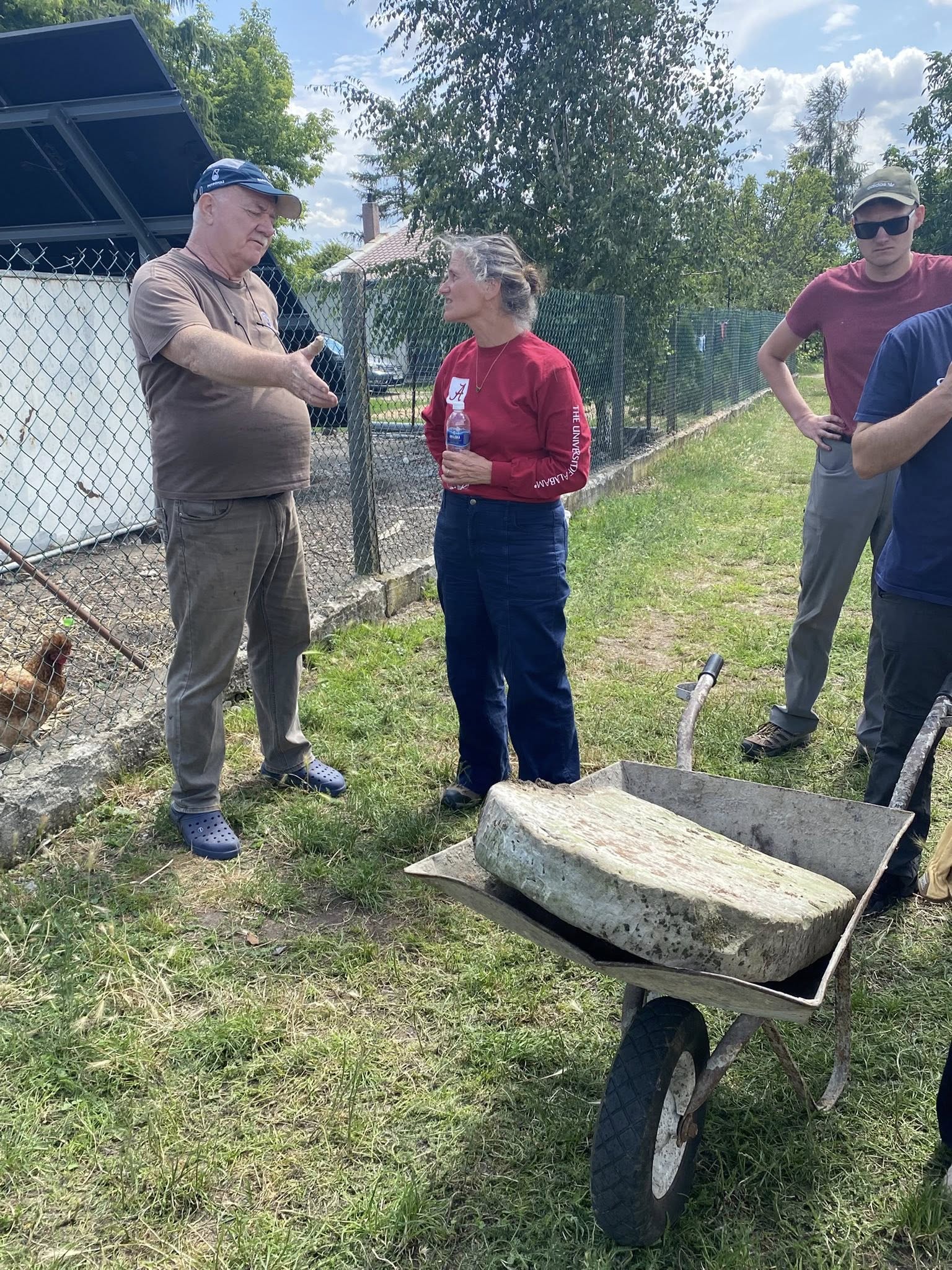
Toward the end of the day, a man living a few doors down from the cemetery stopped by to tell us he had found a tombstone in his garden about three years ago when he built a fence. He noticed from the lettering it came from the Jewish cemetery but didn’t know who to contact or how to return it. He just kept it leaning up against his new fence until he heard we are in town. With the help of a couple of volunteers, he brought it to us in his wheelbarrow and now it stands beside the one that was returned several days ago. People have told me that tombstones return once residents know that someone is taking care of the cemetery. Our presence here in Żychlin attests to that.
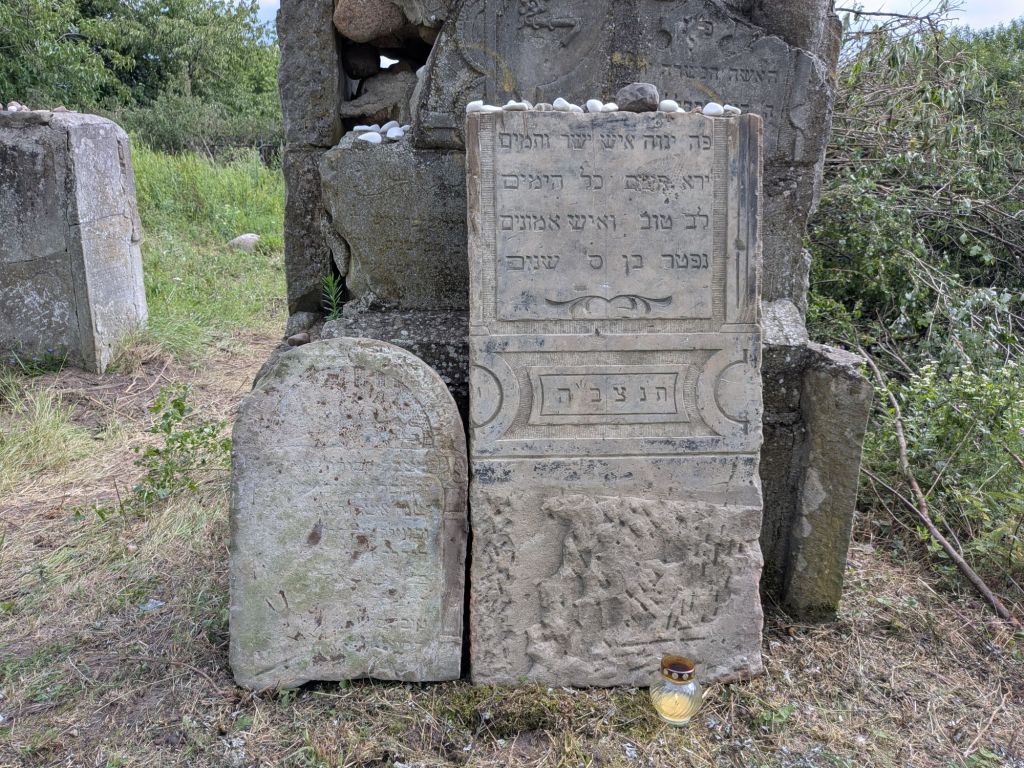
Two returned matzevot
A candle lantern still burned in front of the first tombstone that returned, a reminder of the informal ceremony we had in the morning, lead by Żychlin descendant Lawrence Zlatkin. He told us about his connection to the town; something has drawn him back 5 or 6 times since he first came in 1985 with his father.
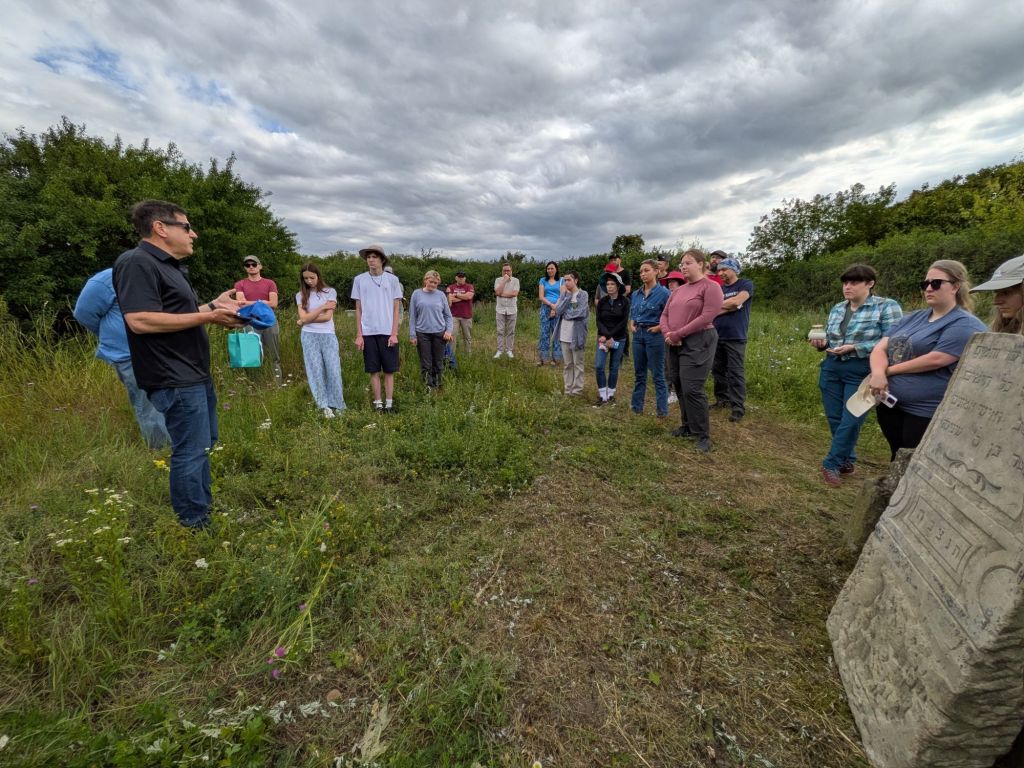
Lawrence shares his father’s story by the first returned Matzevah
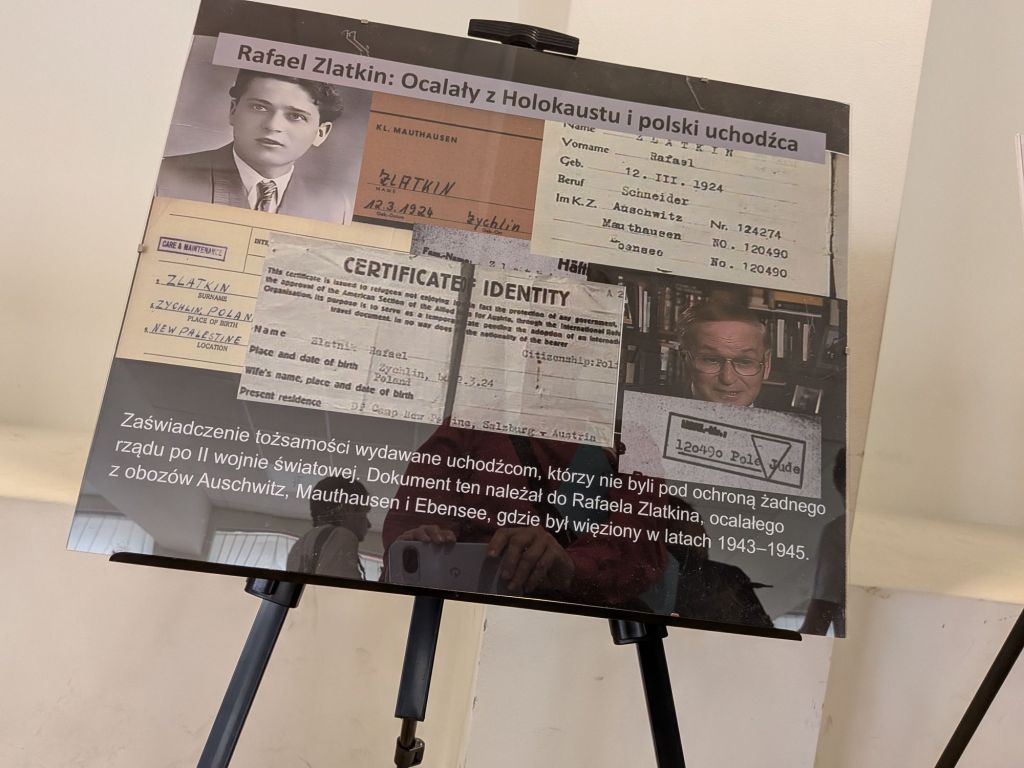
Raphael Zlatkin was born in Żychlin in 1924 and he was just a teenager when the war broke out. His younger brother was sent to a work camp, but he managed to avoid capture. He didn’t want to leave his mother all alone. Then, he was warned that staying was a death sentence so at the age of 17 he signed up for transport to a work camp. He spent two years in Auschwitz working in food procurement and making himself indispensable to his captors. He was able to smuggle food to his younger brother and others he knew from Żychlin, helping to keep them alive. In January 1945, as the Soviet troops were approaching Raphael elected not to stay, instead traveling west where he spent time in two other camps before he was finally liberated. From his modest beginnings in a basement apartment at 3 Narutowicza Street in Żychlin, he became a successful businessman in the US.
Lawrence said Kaddish in Hebrew and then in English, explaining it doesn’t say anything about the dead but it rather praises God and calls for peace. Everyone laid stones on the tombstone as a mark of remembrance for those who were buried in the cemetery.
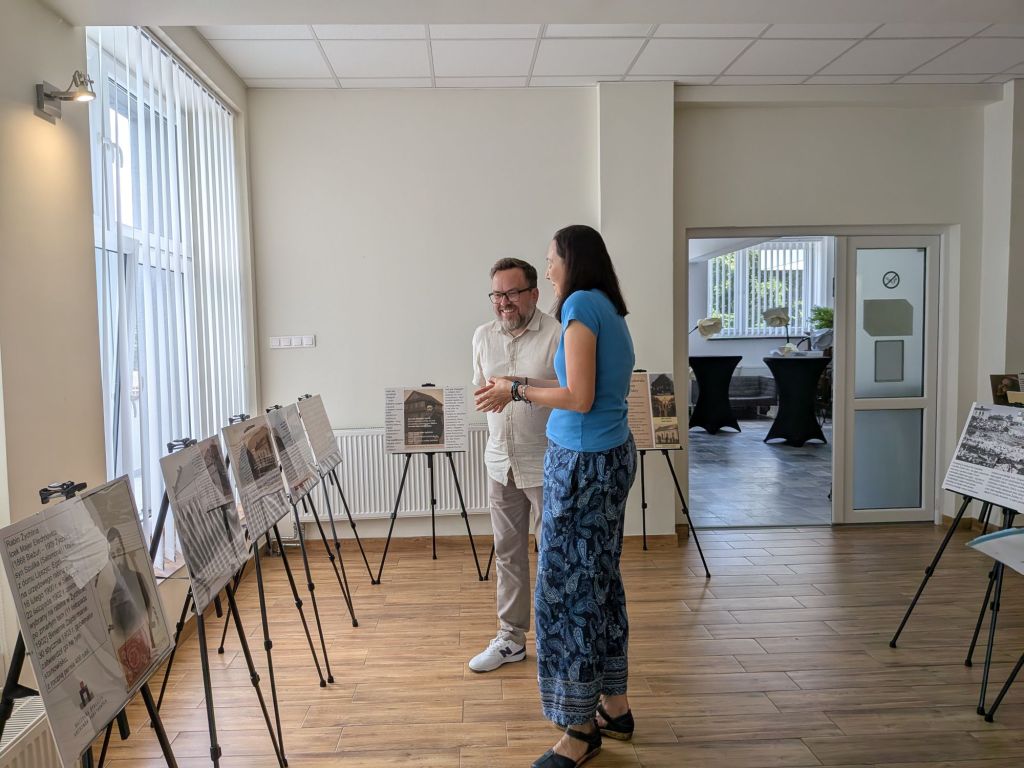
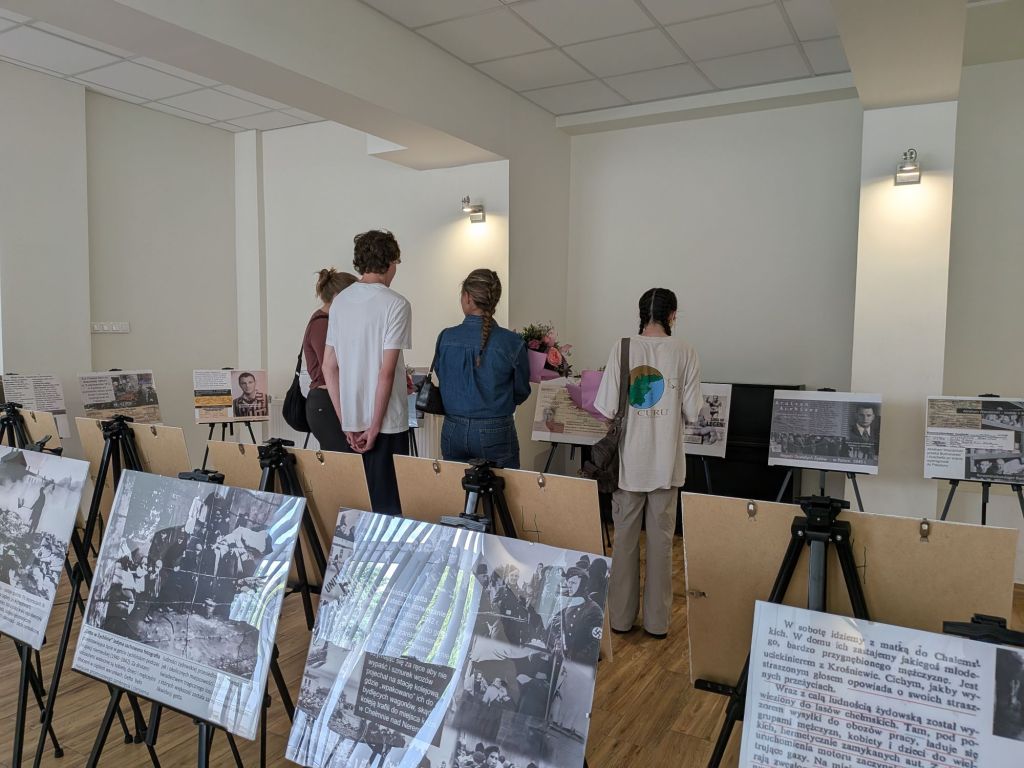
In the afternoon we visited the Community Center where Henry Olszewski had an exhibition about the Jewish history of Żychlin, with photographs of the synagogue and biographic details about Jewish inhabitants including Raphael Zlatkin.
Exhibit by Henryk Olszewski
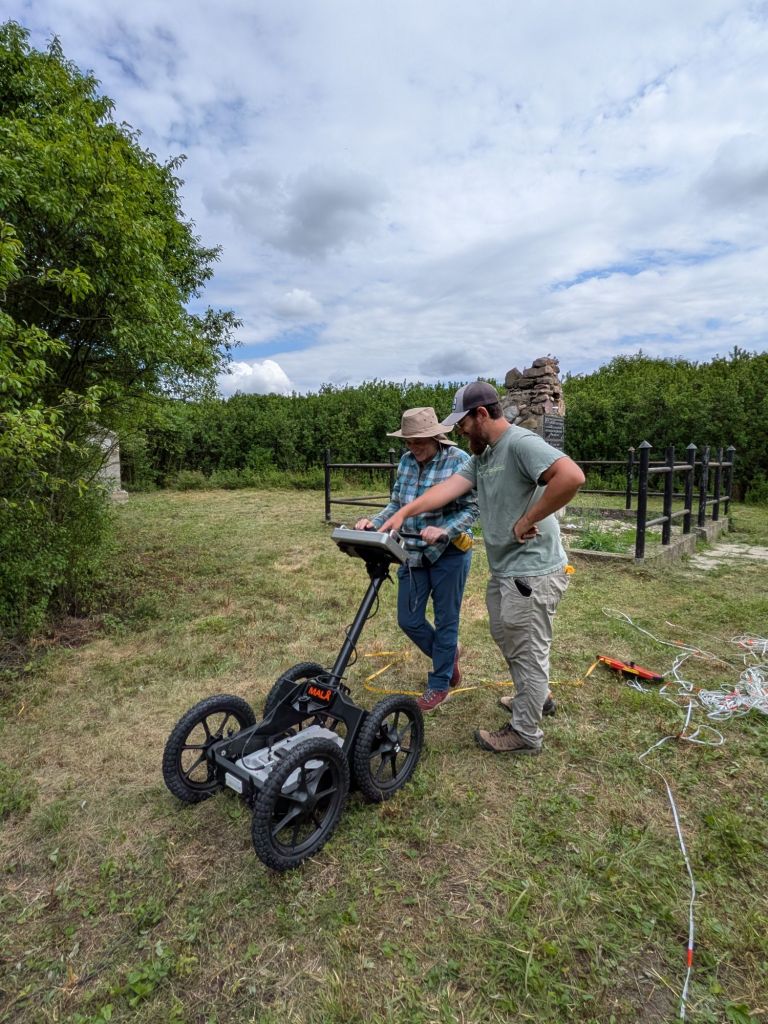
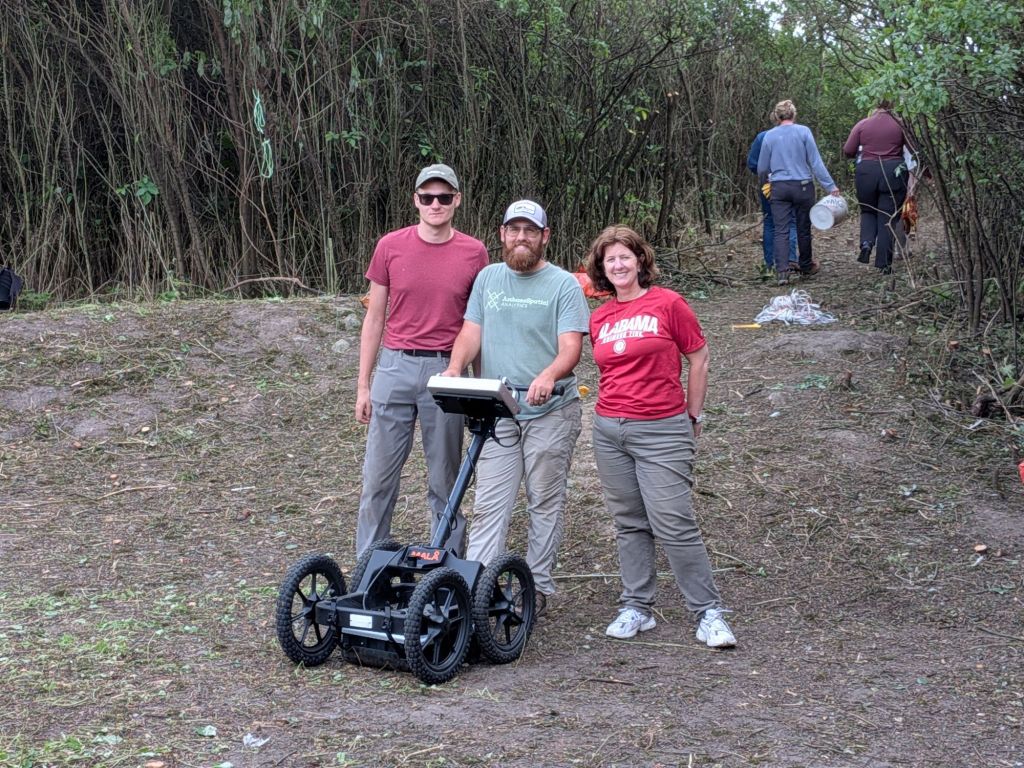
Not everyone could attend because they were hard at work helping UA Archaeology graduate student Claiborne Sea run the GPR (ground-penetrating radar) across the sites we had cleared. He showed the other students how the machine operates and gave them opportunities to operate the device. Claiborne’s work has only begun. It will take weeks to process the data and analyze the results.
More from UA archaeology graduate student Michele Hoferitza:
I figured I would post about our Europe trip a week at a time, but this week in Poland is going to need some extra explanation, and there are too many photos to dump. We are here as volunteers for the Matzevah Foundation, a US-based organization that works to preserve Jewish cemeteries in Poland. Many were simply obliterated by Nazis, and others were sites of mass execution before gas chambers were systematically used. Both are the case for our site in Zychlin, where LiDAR data has shown two depressed areas under dense growth of blackthorn. We have cleared a significant area in order to do a GPR survey to verify a mass burial site. It has been a lot of physical work, but it feels amazing to be part of this project. We are not just uncovering history, but living it. As we have worked, a few local people have brought old Jewish headstones they have found on farm property, recognizing that these monuments were taken to desecrate the memory of those who died. Restoring these is a sacred work of healing and remembrance.
Students do a surface survey led by Michele
From Steven Reece of the Matzevah Foundation:
While some volunteers continued to clear the overgrowth, the main activity was an introduction to the Ground Penetrating Radar (GPR) that was used to evaluate the mass grave within the cemetery. Students from the University of Alabama learned how to use the equipment and take some initial findings. The GPR investigators will need time to analyze the results so those will come at a later date.
We also held a commemorative ceremony where Lawrence Zlatkin said Kaddish. About 25 people joined us today including Grzegorz Ambroziak, the major of Żychlin.
Thank you to the many local volunteers who joined us again today…your efforts made a big difference in what we were able to accomplish!
From volunteer Michael Mooney:
On the final day in Żychlin, our team completed an incredibly meaningful day of volunteer work at the Jewish cemetery. While some of us cleared overgrowth, the main focus was introducing Ground Penetrating Radar (GPR) technology to evaluate a suspected mass grave on site. Students from the University of Alabama learned to use the equipment and began initial surveys; the results will take time to analyze, but we hope they’ll shed more light on the tragic history of Żychlin’s Jewish community.
Throughout the day, we made several poignant discoveries—including human bones exposed above ground, among them the leg bones of a toddler—painful reminders of the atrocities endured here during the Holocaust. In a remarkable moment, a neighbor living four houses away approached and revealed he had a Jewish headstone in his garden, likely displaced when Nazis destroyed the cemetery. The stone, belonging to a 96-year-old woman named Beila, will now be returned to its rightful place, helping to reclaim her memory and dignity.
We also held a moving commemorative ceremony at the cemetery, with Lawrence Zlatkin reciting Kaddish in memory of those lost. Roughly 25 people attended, including Mayor Grzegorz Ambroziak and many local residents, whose dedication made all the difference.
At the end of the day, before leaving the cemetery, we gathered to respectfully bury the bones we found—ensuring those whose remains were uncovered received the dignity and rest they so deserve.
Our project is part of ongoing research led by Professor Marysia Galbraith of the University of Alabama—a descendant of Żychlin Jews—who documents these histories, stories, and testimonies of survivors and witnesses to ensure that the past is not forgotten.
How do we learn difficult history? What is the most effective way of gaining factual and emotional understanding of what happened?
Memorial wall in the forest
One thing participants are learning is how important it is to consider multiple factors and viewpoints, to resist the urge to tell a simple moralistic story that avoids ambiguity and nuance.
Another is the importance of learning through individuals’ personal stories. These are what make the events of the Holocaust real to the students. By learning the stories of those who survived and those who died, they come to understand the human cost of the dehumanization at the core of the Shoah, and the suffering and resilience of the victims.
A third lesson comes from simply being in the spaces where history happened. The Żychlin Cemetery is one such place. The Chełmno Death Camp is another.
For our tour of Chełmno, we had no guide, each of us instead weaving our own path through the museum exhibit and the remains of the camp buildings. Though less known than Auschwitz, what happened at Chełmno needs to be remembered. There, techniques for mass murder were tested to tragic effect. More than 200,000 Jews, 4000 Roma, and many Poles were gassed in makeshift gas chambers, and then their ashes were buried in the forest five kilometers away.
Most prisoners came via train from towns like Żychlin and Kutno, as well as the city of Łódż, bypassing the tiny town of Chełmno and disembarking at a mansion next to the church. Arrivals were reassured by the fancy façade, the invitation to write postcards to their loved ones describing how nice the place was, and the promise they could relax after cleaning up after their long journey. They were instructed to list their valuables on a form so that they could be returned to them after they washed. They were led into rooms to remove their clothes, then led down a corridor to the back of a waiting truck they were told was a shower. But instead of water, the truck’s exhaust filled the space. With the door locked behind them, they had nowhere to go and no way of saving themselves.
Initially, workers were instructed to bury the dead, but quickly the leadership realized they needed to cremate the bodies, so crematoria were added in the forest and human ashes were spread over clearings.
After viewing the museum exhibitions, we drove on to the ash fields in the forest. Everyone moved through the space in the way that felt most appropriate for themselves–some solo, most in pairs.
Our group got to the memorial wall, solemn as they contemplated this killing space, only to be met by a glimpse of home–a couple from Mobile, Alabama on their own historical tour of Poland. Meeting them helped lighten the mood, a reminder about the living and our own familiar places.
Back in the Żychlin Cemetery, the graduate students and other volunteers were busy. Half of the back depression is cleared.
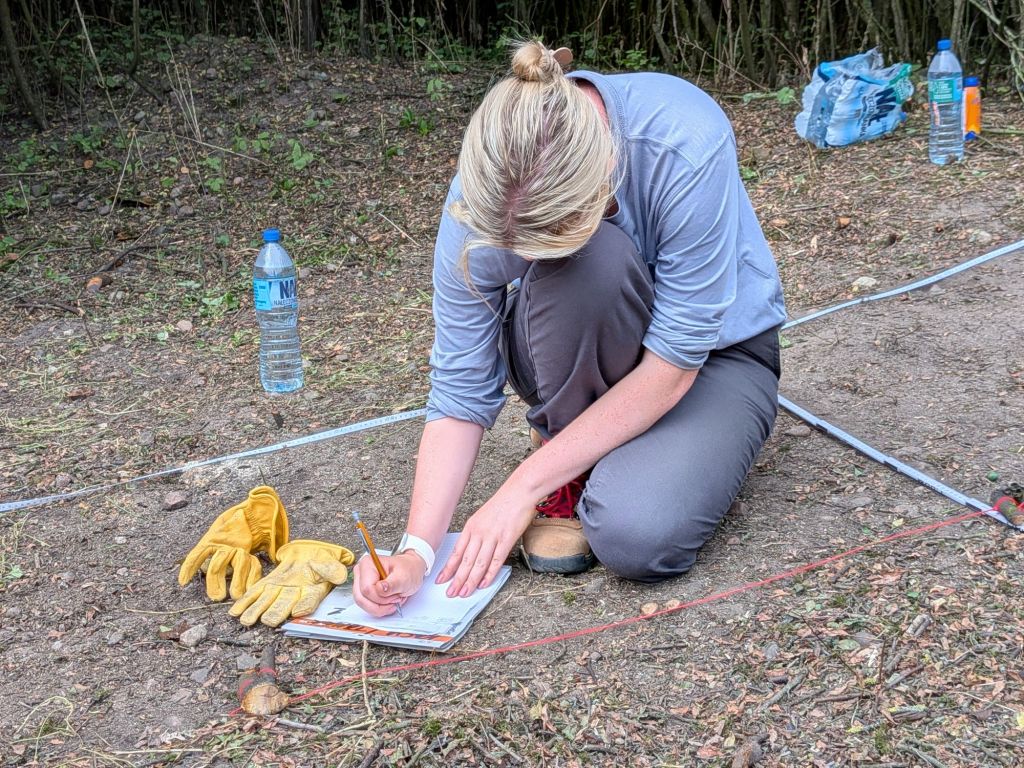
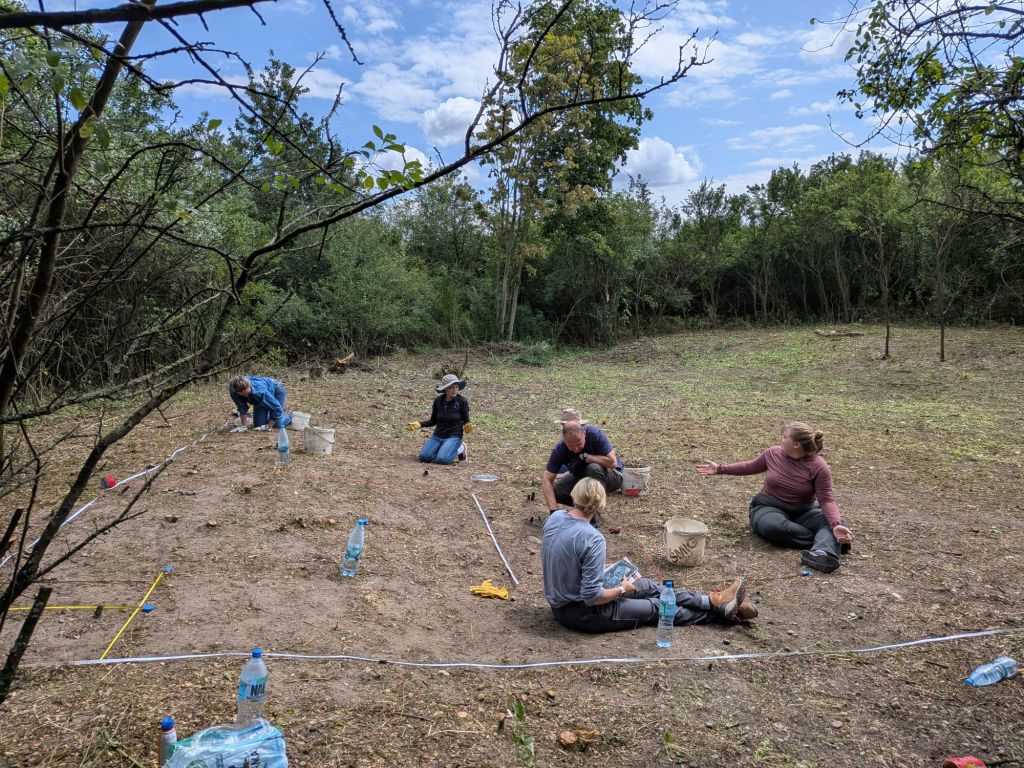
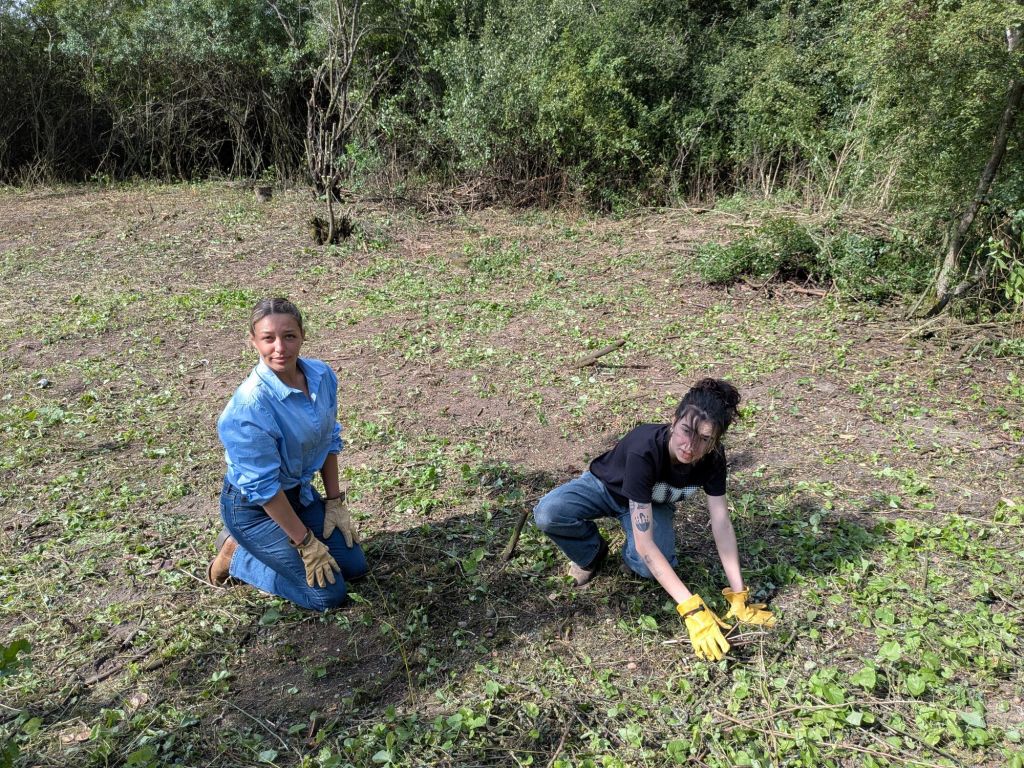
When we joined them, archaeology graduate student Michele Hoferitza helped us think about artifacts and making sense of their significance. She set up a task for us to remove all the small sticks still covering the surface of the ground so that the rocks and other objects on top of the ground would be more visible. Tomorrow, we’ll map what we see in 1 meter square grids. Maybe it will provide some indication of what happened at this site–how the space was used, what caused the depression, and whether we have located the mass grave.
A Guest Post by Michael Mooney of the Matzevah Foundation
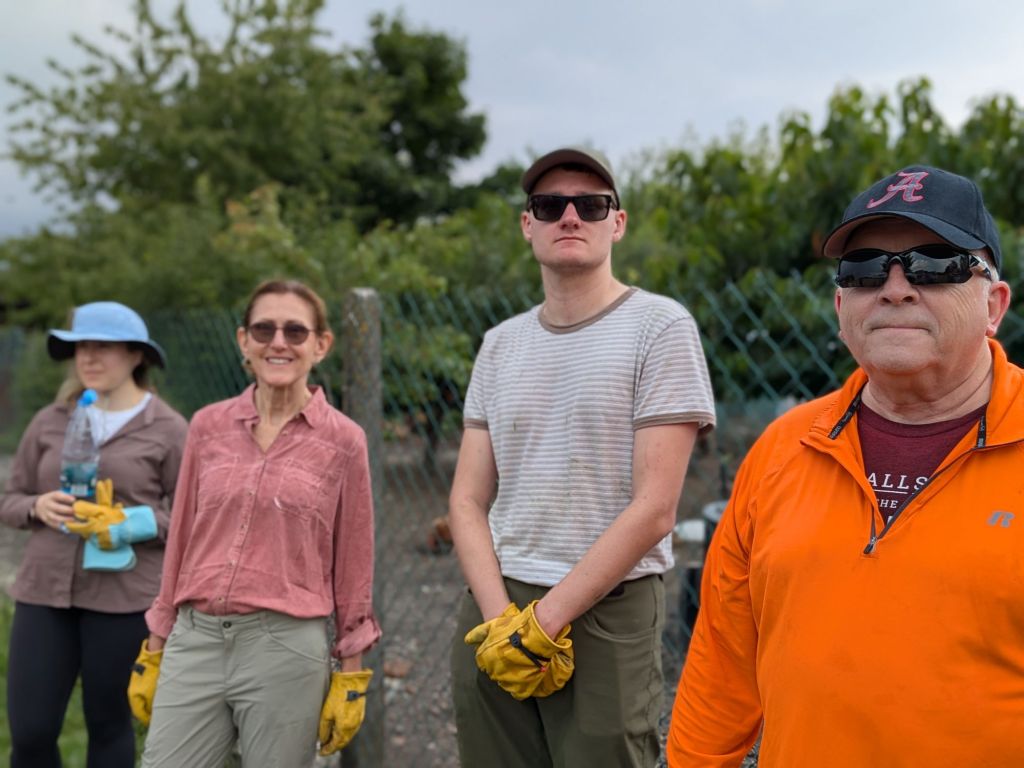
Day two has wrapped up for the Matzevah Foundation, our core team of volunteers, three individuals from a local reintegration program, and several local residents who stepped forward to lend their hands. These community members have their own reasons for joining us—personal, deeply-felt convictions about the importance of this work. They rarely say much about it, but their quiet presence speaks volumes. Their support adds a layer of silent solidarity that is deeply moving.
Our main task today focused on continuing the physically intensive work of clearing the brush and thick overgrowth from the depressed area believed to mark the site of a mass grave—just outside Żychlin. The sunken terrain could be the final resting place of hundreds of Jews—families and children—who were massacred during the German occupation of Poland. Step by step, we’re reclaiming this space from years of neglect, trying to bring dignity to a site long obscured both by vegetation and silence. Evidence and testimonies collected over the years suggest this area may be one of many unmarked mass graves, now hidden within the landscape yet never truly forgotten.
Before the war, Żychlin was home to a thriving Jewish community, with Jews making up over 40% of the town’s population. They had their own schools, synagogues, businesses, and institutions woven into the daily life of the town. The Nazi invasion brought devastation—ghettoization, mass deportations, executions, and widespread destruction. Few Jews from Żychlin survived the war.
Later in the day, our group visited what remains of the town’s historic Jewish quarter. Only the gutted walls of a 19th-century synagogue still stand—silent and broken. The cheder (Jewish school) and mikveh (ritual bath) that once operated nearby were destroyed long ago. The courtyard is cracked pavement, overrun with weeds and scattered debris. There is no plaque. No sign. Just the vacant presence of what was once central to community life.
Żychlin synagogue
As we surveyed the site, a few residents peered from behind curtains or doorways, then disappeared back inside. One person reportedly remarked to a member of our team that the synagogue “should just be torn down.” Is this concern about safety and dereliction? Or is it also a quiet wish to erase uncomfortable history—to bury the memory of a tragically obliterated community? Is forgetting easier than remembering?
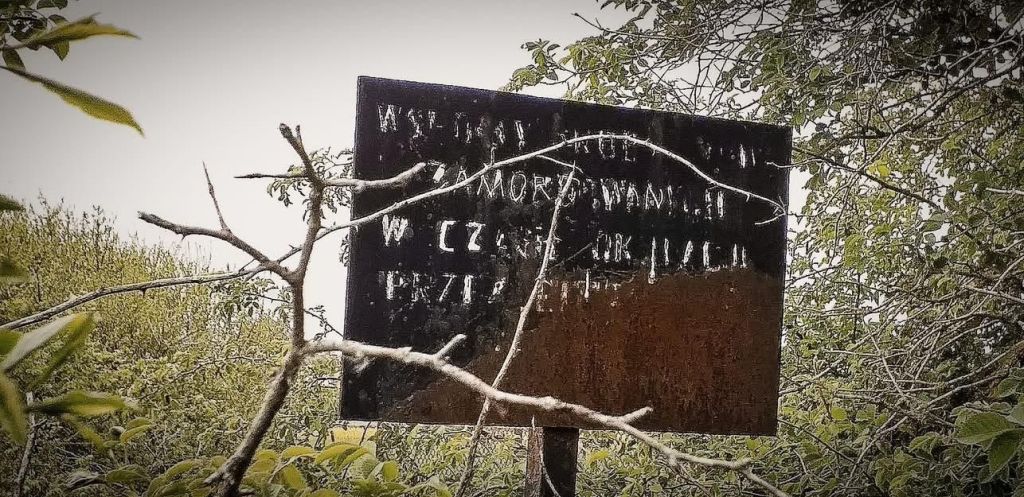
Near the clearing at the suspected grave site, we stumbled upon a weathered old sign—almost completely obscured by plants and exposure to the elements. The sign matches a photograph taken about eight years ago at (or near) this same location that once surfaced online. Most of the paint has worn away, but a few phrases remain legible:
– **”WSPÓLNY GRÓB”** – “In this place rest”
– **”ZAMORDOWANYCH”** – “Murdered people”
– **”W CZASIE OKUPACJI PRZEZ”** – “During the occupation by”
– One barely visible word at the bottom: **”HITLEROWCÓW,”** meaning “Nazis”
Metal sign indicating a collective grave is nearby
This style of memorial wording is common on World War II-era markers around Poland. It typically refers to civilians—often Jews or resistance members—murdered by the Nazis and buried in unmarked sites like this one.
Even in its deteriorated state, that plaque whispers a truth: this place is hallowed ground. And while some might look away, we cannot. Our work is about remembrance, dignity, and bearing witness to what many would rather forget.
When I return home, I plan to read *Neighbors: The Destruction of the Jewish Community in Jedwabne, Poland* by Jan T. Gross. The book tells the horrifying account of how, in 1941, the Jews of Jedwabne were not killed by distant Nazis, but by their own non-Jewish neighbors in an act of unspeakable violence. The story Gross tells echoes here in Żychlin and many other towns across Poland—places once filled with Jewish life, now emptied of memory, unless someone comes to uncover it. https://amzn.to/3Ixc0rK
Tomorrow, on Day Three, we’ll begin with a sobering visit to Chełmno—the extermination camp where most of Żychlin’s Jews were murdered and incinerated for the simple “crime” of being Jewish.
Our day started with a quick trip to the grocery store to pick up food for lunch. How fitting that we found matzo!
Annice and Matzo at Kaufland
Our next surprise was the large matzevah fragment left in front of the cemetery gate by an anonymous donor who found it buried under grass in a private garden. It memorialized a 60-year-old man, though his name is not on this fragment.
Lawrence reading the Hebrew inscription on the tombstone fragment. Look how big it is, even without it’s top
Bożena Gajewska was there to greet us with all of the saws and other equipment I had arranged to be delivered to her for our project. She also brought Pringles from the local factory.
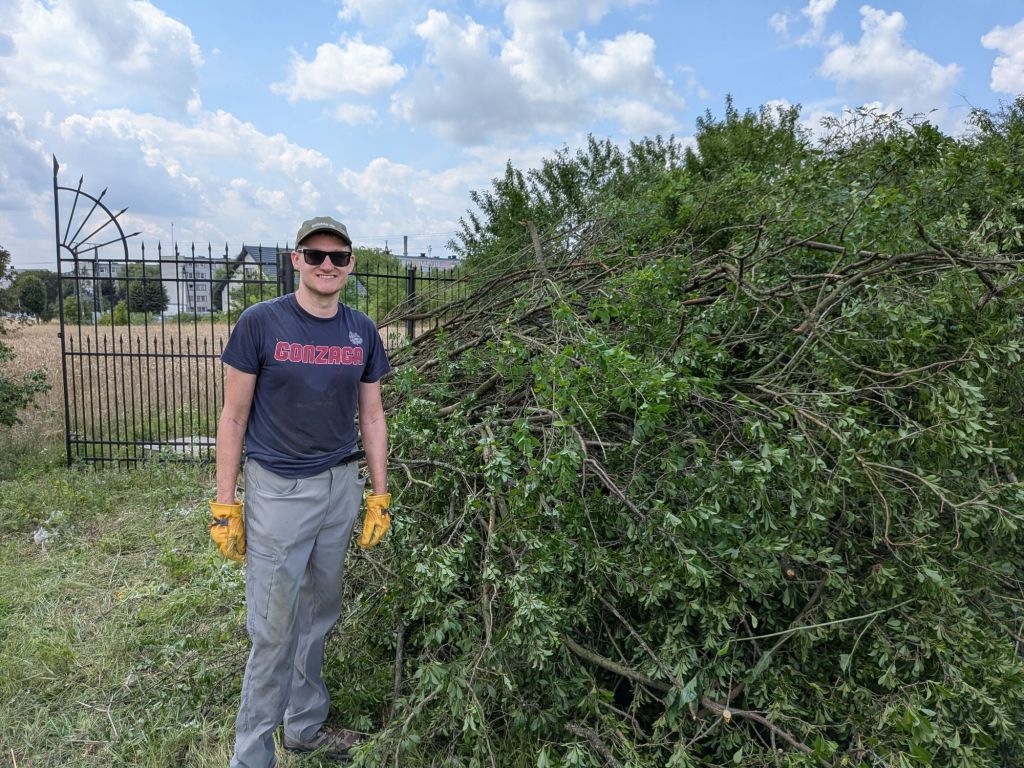
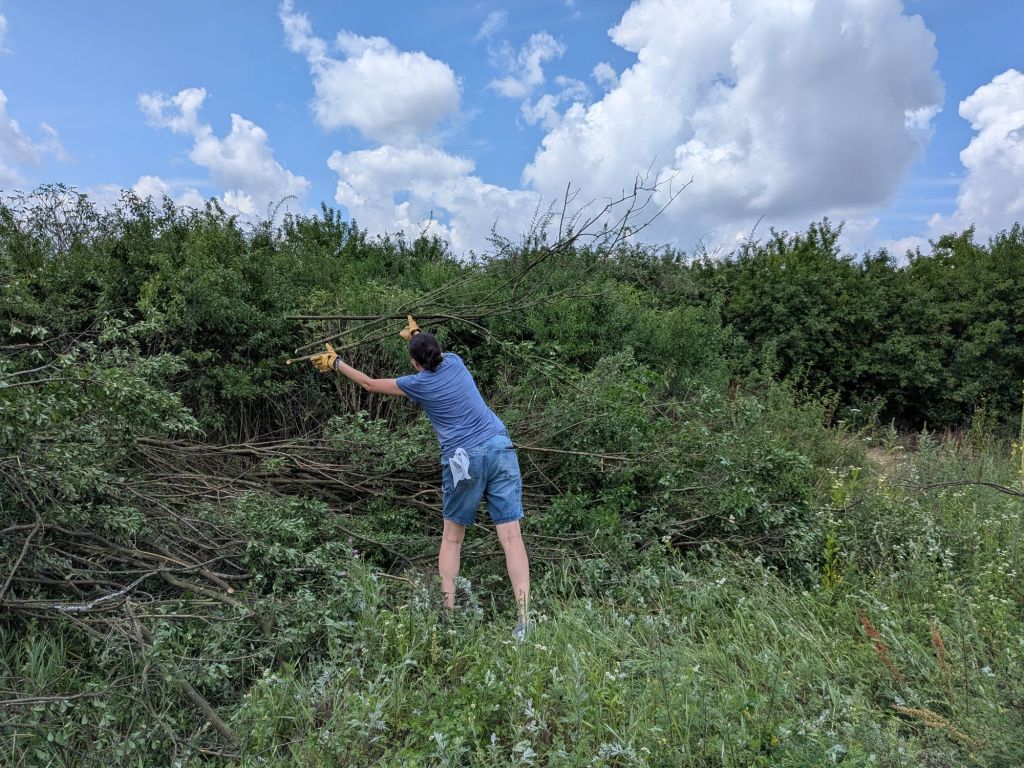
We got right to work clearing a path to the depression we plan to inspect with non-invasive ground penetrating radar. Some got hold of the loppers and others grabbed the branches as they were cut and hauled them out of the cemetery, where archaeology graduate student Caleb took charge of stacking them. In fact, he did this task systematically and neatly all day.
Working
Claibourne, who is heading up the GPR research, crawled and bushwhacked through the dense blackthorn to lay a measuring tape that would keep the cutters working in the right direction. Steven gave Claibourne the nickname “Magnum” when he saw that he is listed as the PI (principal investigator) of the project.
Filip instructing us on proper behavior in the cemetery
We took a break when Filip Szczepański of the Rabbinical Commission arrived. The most important thing, he told us, is not to disturb those who are buried–we are not to dig in the ground or do anything that might expose human remains. If we find any human bones, they are to be left at rest and carefully covered in the location where we find them. Steven suggested we get a bag of topsoil for this purpose.
We had other visitors and helpers, including Ola Głuszcz, who is a high school history teacher, and her daughter, as well as Henryk and Agnieszka Olszewski, and Żychlin mayor Grzegorz Ambroziak.
Some guests
We got as much as or more done than we expected, with a path cleared across the middle of the depression. Tomorrow, we’ll continue our work, making sure all the stumps are flush with the ground so the GPR can run over the ground smoothly.
New alleyway to the research site
I refuse to get my hopes up. Even if we find no evidence of a mass grave, that is important information. We will know this disturbance had other causes and we should look elsewhere. But maybe? Filip, whose first impression was that we are looking at a hole made by people digging out sand, said there must be a reason the metal sign nearby refers to a mass grave. There must have been something there that made them put it there.
Day two began with beautiful sunshine. The first for days, we were told.
We met our guide Tomasz where we left off yesterday, outside the POLIN Museum.
The Heroes
The Monument to the Ghetto Heroes was dedicated in 1948, 5 years after the ghetto uprising. The relief sculpture features a heroic central figure that Szymon compared to a socialist realist superhero. Most of the figures around him are young, as were most of the ghetto uprising fighters. Behind the central hero floats a woman with her breast exposed holding a baby, perhaps symbolic of Matka Polka–the idealized Polish mother, though perhaps also reminiscent of Madonna and the Christ child. The image emphasizes the heroism of the ghetto fighters. This is the best known side of the monument.
The relief on the back paints a different portrait of suffering and oppression. A line of robed figures tread heavily with down-turned faces. On this side, the central figure looks like a rabbi; he’s older with a flowing beard, holding a Torah scroll in his hand. The helmets and bayonets of Nazi soldiers hover above the line of hunched figures. Szymon pointed out the glittering black stone along the front of the platform, intended for a Nazi monument that never was built, and repurposed by survivors as a symbolic act of defiance.
The oppressed
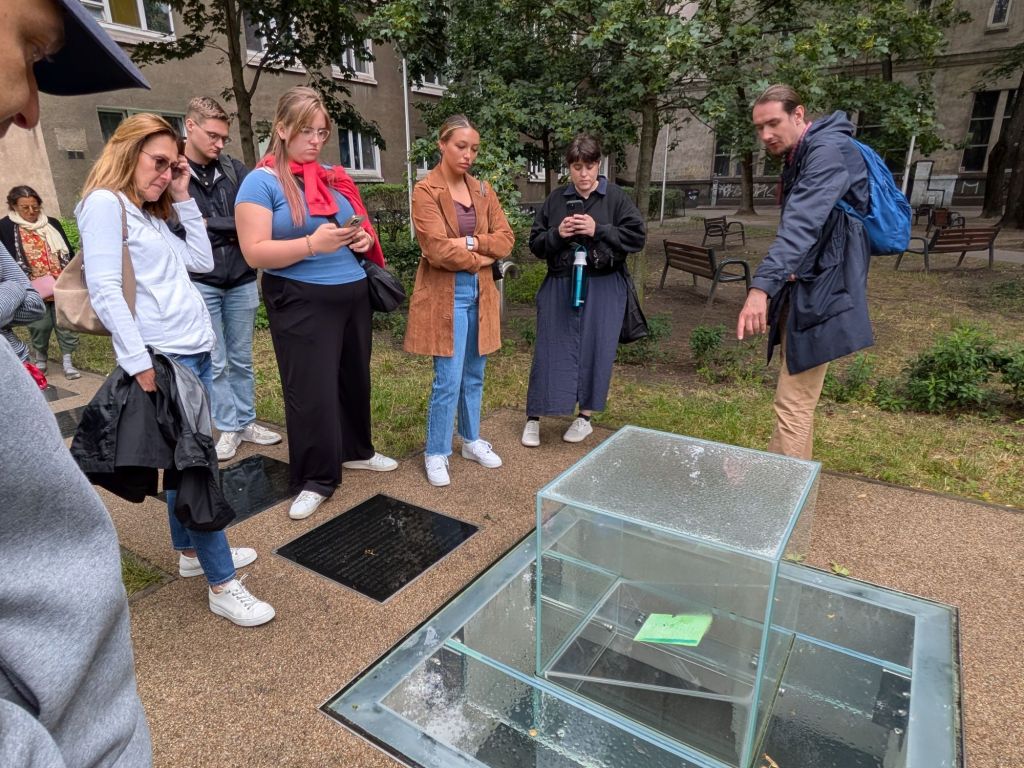
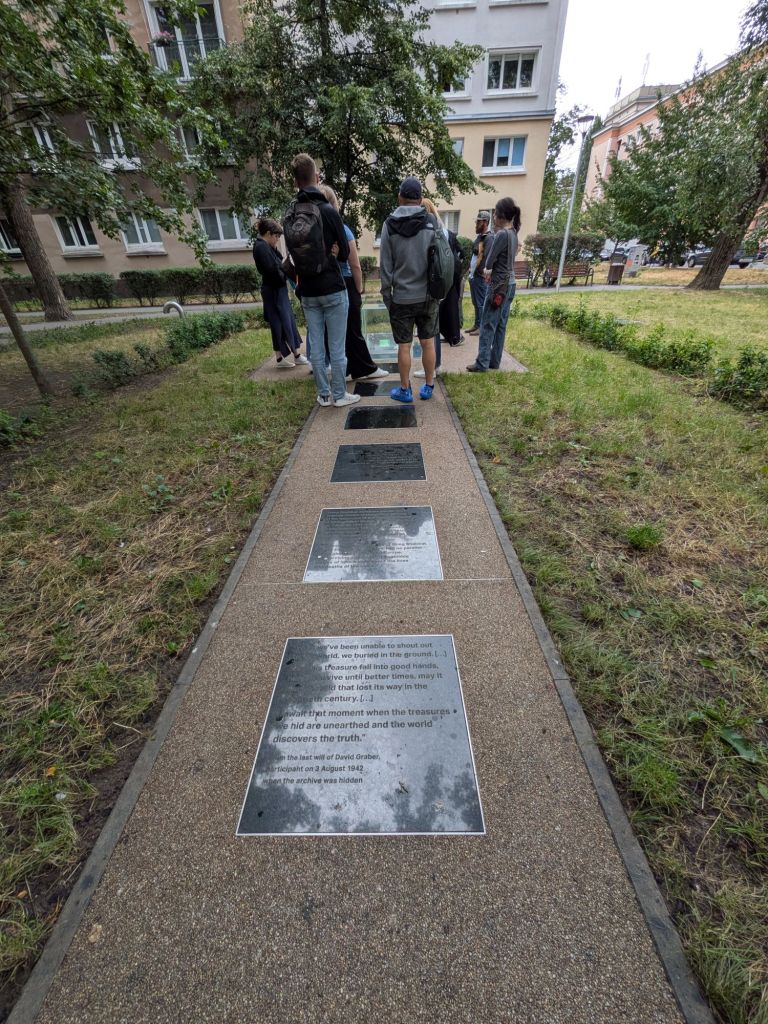
We continued along the trail of the ghetto heroes, recognized on a series of metal cubes, then stopped at 18 Miła Street, where a dirt mound and monument mark the location of a bunker where ghetto heroes and civilians chose suicide rather than death at the hands of the occupiers.
These weren’t the only Jewish leaders who committed suicide. Judenrat leader Adam Czerniaków took his own life when he realized he couldn’t stop the final removals of ghetto residents to the death camps. Szmul Zygielbojm, a Jewish representative in the Polish government in exile, died by suicide after he learned the details of the murder of the Jewish people back in Poland. I wonder what my students think of this. It seems that for many Americans, suicide is an individual choice, not one motivated by a sense of collective grief or defiance. We aren’t facing down genocide, either…
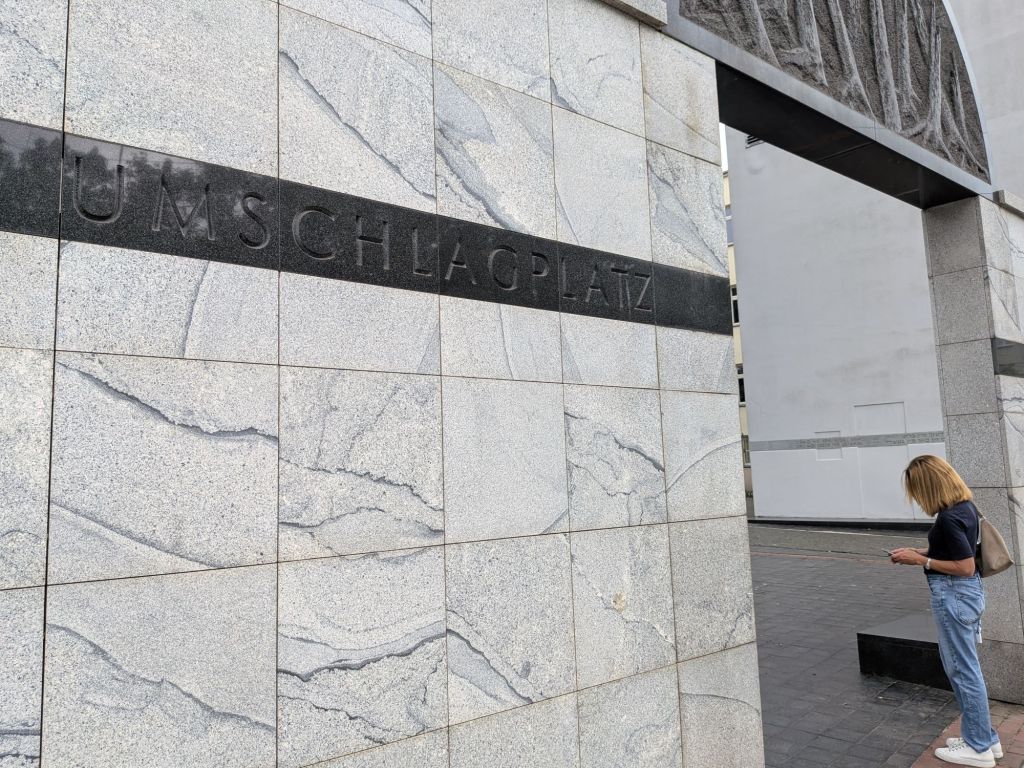
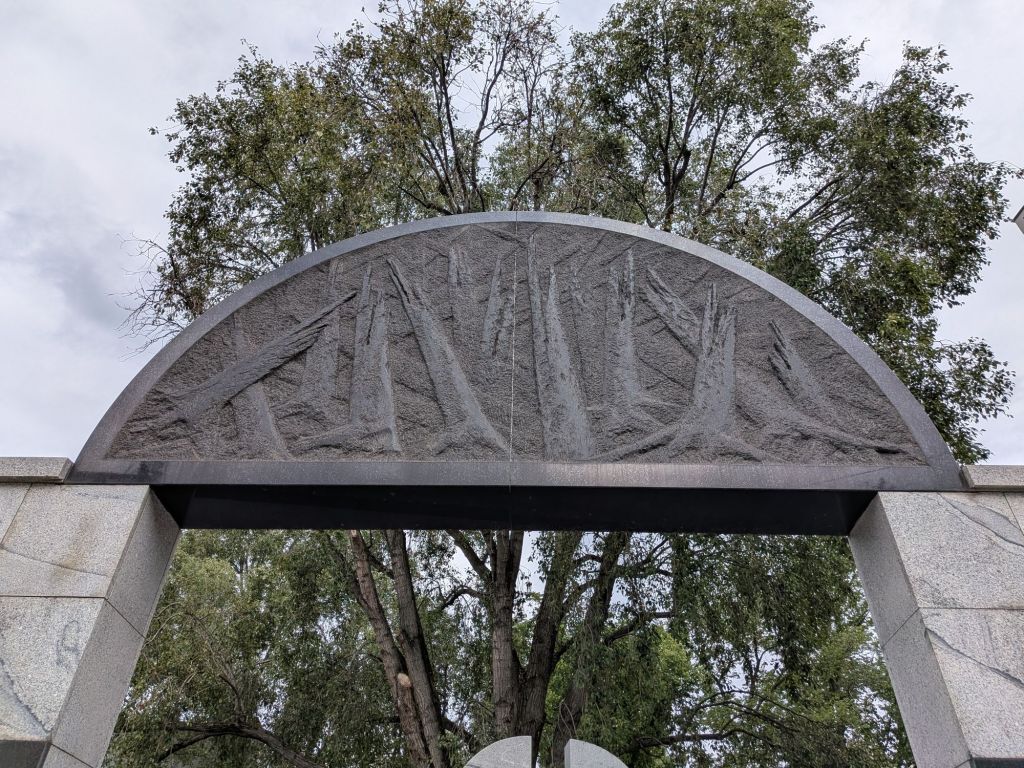
We continued on to Umschlagplatz, where captives were gathered for transport to the camps.
The broken trees on a tombstone-like feature symbolizes untimely deathThe tree behind the break in the wall symbolizes life
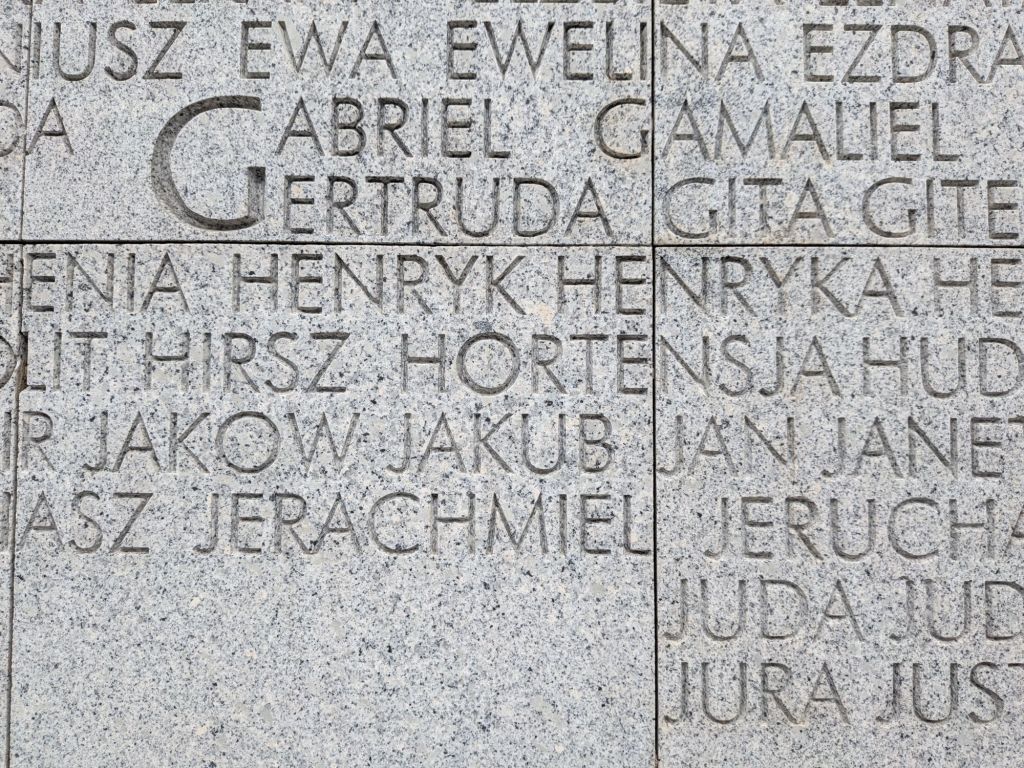
The walls inside are inscribed with the first names of victims. I took a photo of Jakub in memory of my grandfather Jakub Rotblit and my grandmother’s brother Jakub Piwko, both of whom died in 1942, likely victims of the Holocaust
Jakub among the names of victims
We finished our tour at the Jewish Historical Institute, where many of the victims’ personal words are displayed along with one of the milk cans where Ringelblum hid the archive documenting life in the ghetto. Some of the saved documents are on display, including poetry, personal accounts, and official reports. One listing the number of victims in different towns says there were 3500 in Żychlin and 6500 in Kutno.
As we departed, thunder rumbled, the sky opened up and rain turned to hail.
Some of the students with our guide right before the hail came down.
“Is the weather always like this here?” a student asked. “No,” I replied. “That was really unusual.”
Nothing like spending the whole day on your feet the day after an overnight plane trip. But our group is intrepid.
Dinner on Friday night
The day began with a walking tour “The Unremovable Traces of the Warsaw Ghetto” led by Dr. Szymon Pietrzykowski of the Jewish Historical Institute. We started in the JHI in the lobby where the stone floor retains the burn stains caused by the fire bombs that destroyed the Great Synagogue in 1943 after the Warsaw Ghetto Uprising
Great Synagogue in Warsaw. Photo source: WikipediaBurn marks dating from the destruction of the neighboring Great Synagogue in 1943.
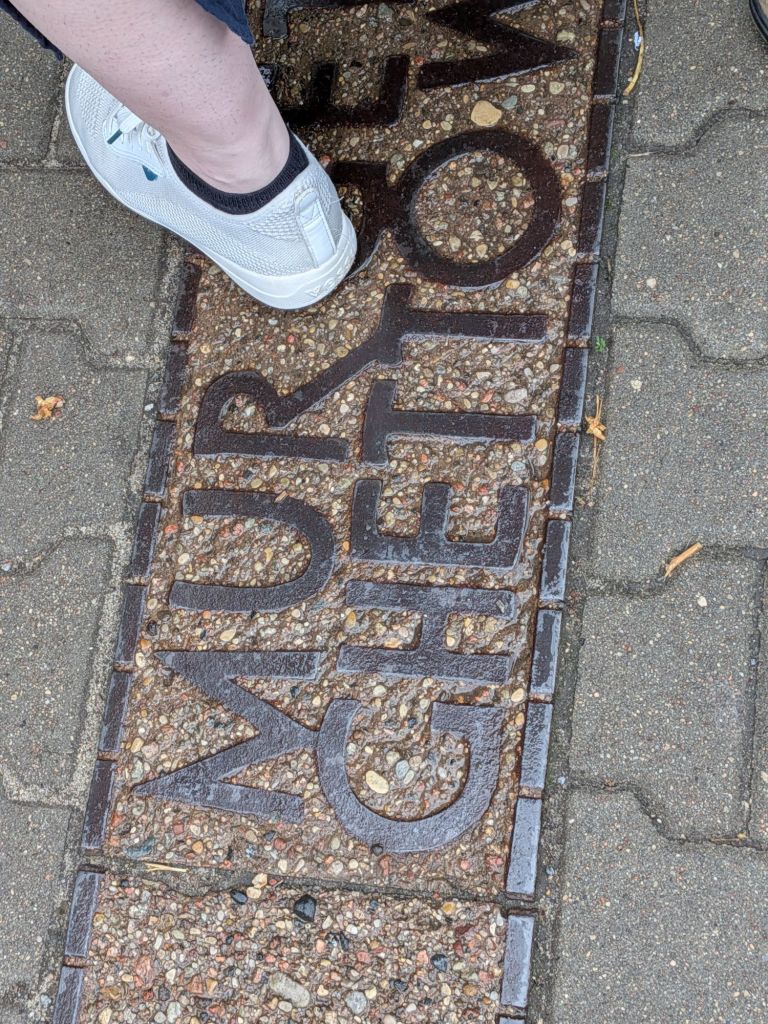
We visited places where the former location of the ghetto walls are marked by metal plaques in the sidewalk, buildings reconstructed after the war, sites where important Jewish institutions were destroyed and never rebuilt, and places significant to the Jewish Ghetto Uprising and the archive of Jewish life in the ghetto collected by historian Emanuel Ringelblum.
Jewish Historical Institute on Tłomacka StreetThe building that replaced the Great Synagogue. Note the arched feature evocative of synagogue windows.Location of the ghetto wallTraditional courtyard, one of the few showing what prewar Warsaw was likeMonument where part of the Ringelblum archive was found in milk cans under the rubble on Nowolipie Street
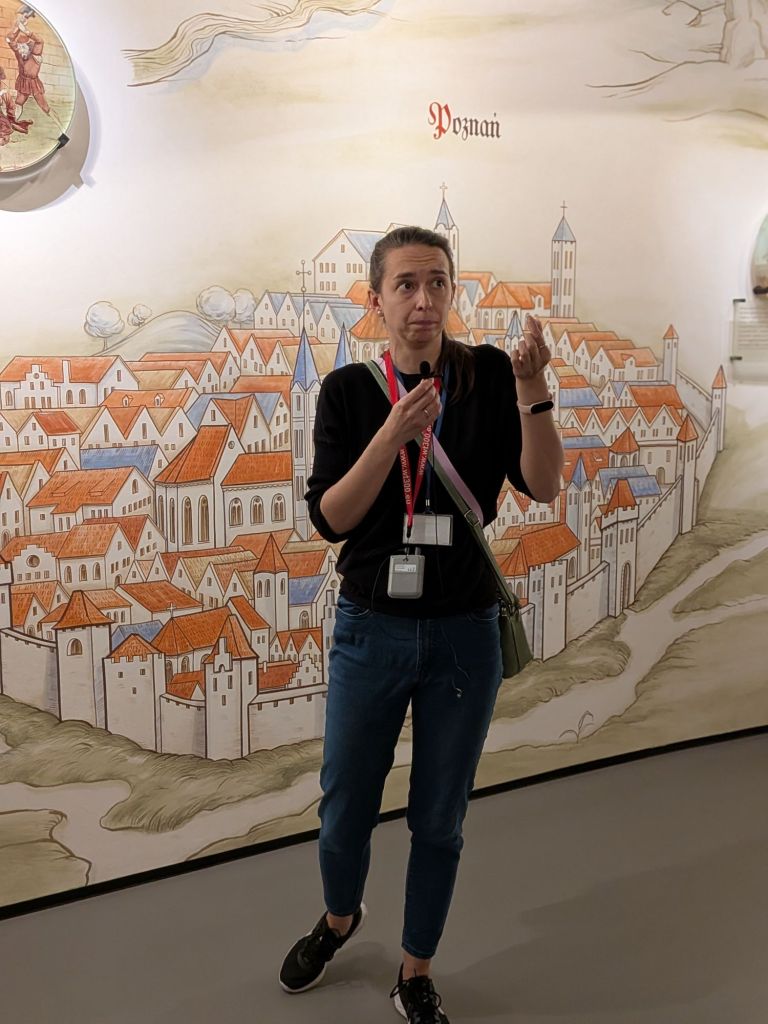
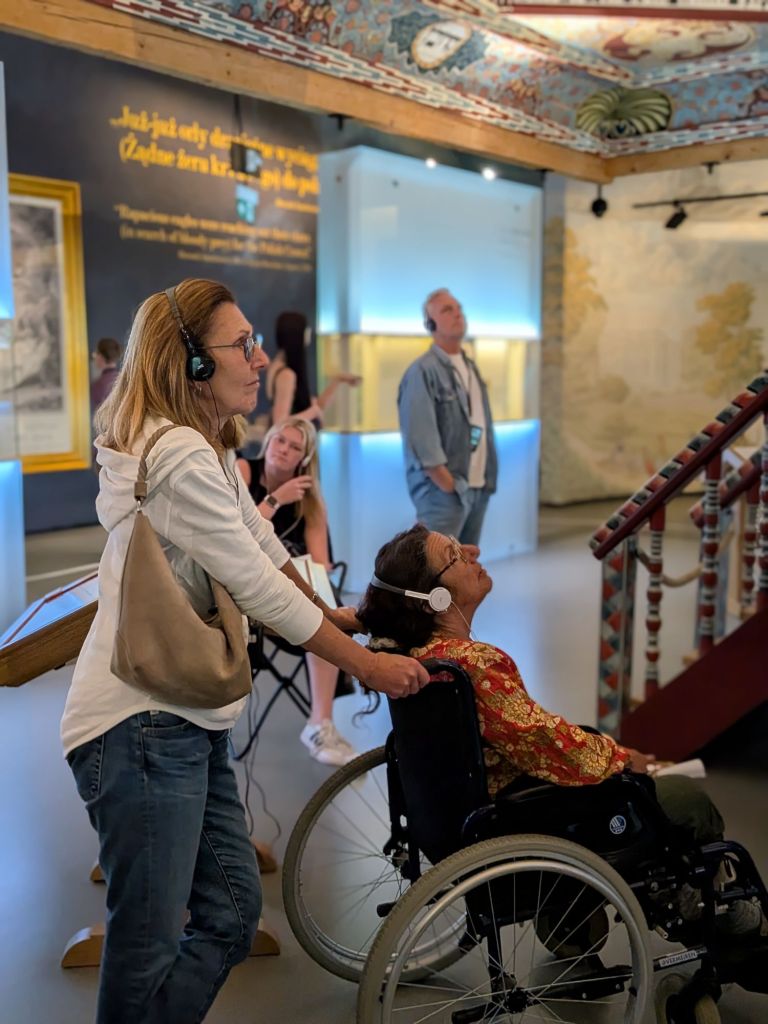
Our tour continued at the POLIN Museum of the History of Polish Jews, led by our guide Martina.
Our group at POLIN in the reproduction of a wooden painted synagogue Model of the Great Synagogue
After six hours of walking, we were ready to sit down. Paula, whose ancestor Tema Walfisz Jakubowicz grew up in Żychlin, treated us to a well-deserved meal. Many in our group got to try pierogi for the first time!
LiDAR image of the Żychlin Jewish Cemetery reveals two trenches that are likely mass graves. We’ll focus on the one outlined in green this July. Image details added by Claiborne Sea, a doctoral student in archaeology at The University of Alabama who will lead the ground penetrating radar (GPR) research.
































 Uncovering Jewish Heritage